The Lake County Plan Commission met on October 23, 2026, at 5:30 p.m. local time (8:30 p.m. UTC) to address agenda adjustments, approve routine items, deliberate on land-use applications, and discuss enforcement and regulatory updates. Key actions included approvals for two subdivisions, a special exception recommendation for a battery energy storage facility, and tabling a data center ordinance amendment for further review. Consent Calendar - The minutes from the special meeting on August 27, 2026, were approved by voice vote. Commissioner Coates and Commissioner Miller abstained due to absence. Communications - Agenda adjustments: Items 3 through 8 under New Business (Clark Street Ridge waivers and primary approval) were deferred due to improper advertising; they will reappear on the November 18, 2026 (or 19th) agenda. - Two agenda order changes were approved: moving Item 9 (Plank Estates) before Old Business, and moving Item 1 (Trkulja Subdivision) before Old Business. - Commissioner Tippy announced the hiring of Butler, Fairman & Seafort as an engineering firm to enforce ordinance items, special exceptions, and zoning conditions beyond normal operations. The firm has begun contract negotiations and intends to review historical issues such as the quarry. Discussion Items - Trkulja Subdivision (26-FS-08): Final approval for a two-lot commercial subdivision. No changes from preliminary design. Approved unanimously. - Plank Estates (26-PS-10): Primary plat approval for a two-lot residential subdivision. Commissioners required a shared-driveway agreement acceptable to the county attorney as a condition of approval. Approved unanimously. - Martinez Subdivision (26-PS-09): Primary plat approval for a two-lot commercial subdivision. Also conditioned on a county attorney-approved shared-driveway agreement. Approved unanimously. - Foundry Works Energy Storage (26-SE-06): Special exception for a Battery Energy Storage System (BESS) in Eagle Creek Township. The petitioner presented solutions to address stormwater runoff and contamination containment, including lining detention basins with impermeable clay, installing shut-off valves, and committing to soil/water testing. After discussion, the commission voted to send a favorable recommendation to the BZA with conditions: (1) installation of a liner in the basin serving the battery area, (2) re-notification of adjacent property owners and a public comment period during future site plan review. Motion passed unanimously. - Data Center Ordinance Amendment (Item 11): Proposed amendment to replace Chapter 90 regarding data centers. Commissioners expressed concerns about enforceability and requested review by the newly hired engineering firm and a future zoning consultant. To comply with statutory 60-day hearing requirements while allowing time for review, the commission voted to table the ordinance. If not brought off the table at the next meeting, it will die and require re-advertisement. Motion passed unanimously. Key Outcomes - Trkulja Subdivision final approval granted. - Plank Estates primary approval granted with shared-driveway condition. - Martinez Subdivision primary approval granted with shared-driveway condition. - Foundry Works BESS special exception forwarded to BZA with conditions (unanimous). - Data center ordinance amendment tabled for further review. - Commissioners requested an end-of-year consultant review summary from staff. Public Comments - The meeting transcript concluded before the public comment period began; no public comments were recorded.
The Public Meeting Index
The Public Meeting IndexThe Lake County Board of Zoning Appeals met with four of five voting members present. Although the agenda and transcript identify the meeting as Wednesday, October 21, 2026, at 6:30 p.m., the supplied meeting timestamp is 2026-10-23 20:15:00+00:00; this summary uses that supplied date. The board reordered the agenda, approved a residential side-yard accessory building variance, and then approved a battery energy storage system (BESS) special exception subject to Plan Commission conditions. The agenda lists the residential petitioners as Kenneth J. and Beth D. Puent; the transcript occasionally transcribes the surname as "Pruant" or "Pruent." The BESS owner is identified as Van Kalker Family Limited Partnership, which the transcript also renders as "Van Calker." Communications and Agenda Reordering - Staff noted that only four of the usual five BZA members were present to decide cases, and applicants were offered the option to defer if they preferred a full board. - The board voted unanimously (all aye) to flip the agenda, hearing petition 26-V-23 (Puent) before 26-SE-06 (Van Kalker/Foundry Works). Public Comments & Testimony - No public testimony was offered for or against the Puent variance. - Kristen Woodward (Eagle Creek Township resident, 4941 East 165th Ave, Hebron) opposed further approval pending review. She argued the Foundry Works rezoning failed mandatory notice and application requirements: Lake County UDO section 154-8-080B11 requires mailing notices to county officials, township trustee, soil and water conservation, 911, sheriff, fire departments, and municipalities within 1.5 miles; she said records showed only neighboring property owners were notified at rezoning. She also said section 154-8-080B9 required a preliminary emergency response plan at rezoning, not only at the special exception stage. She said Eagle Creek Township has executed firefighting service agreements with Hebron, Lowell, Shelby, and Lakedale, while the applicant's emergency documents named only Hebron and Lowell; she noted Shelby's contract expressly requires responses to all alarms. She cited the October 15, 2026 White County Circuit Court decision in Snyder v. White County Commissioners and the Indiana Supreme Court's Town of Beverly Shores Planning Commission v. NRIT decision, and formally requested no further approval until county council reviews the deficiencies and determines corrective action. She asked that her submitted documents be made part of the record. - AJ Martin (1615 Colorado Street, Eden) raised safety and community concerns. He questioned how remote monitoring would function during power, storm, or Wi-Fi outages; what future fire department equipment needs might be; and why soil testing would occur only after an event rather than periodically. He stated that families in the Tri-Creek school area do not want the project this close to their homes until it is fully engineered. - Dr. Andy Anderson, superintendent of Tri-Creek School Corporation, expressed support: the district would welcome Foundry Works into the community if Lake County officials determine all expectations and the approval process have been met, noting the company offered financial support responsive to district concerns. - Chris Law, president/CEO of the Lake County Economic Alliance and Lowell resident, expressed support, citing union labor, work with the county planning commission, inclusion in the county's TIF district at that intersection, and economic development benefits for South Lake County. Discussion Items - Puent variance (26-V-23): Kenneth Puent, owner/petitioner of 525 S. Lakeview Drive in Cedar Creek Township, testified he sought a variance to demolish a current structure in the side yard that is in violation of the setback and to rebuild essentially on the same space, correcting the setback by moving or angling it into compliance. The board had no questions, and the public had none. - Foundry Works BESS (26-SE-06): Applicant representatives Ryerson Burkritz, Lance, and Jim Griffin presented. Key project facts included a proposed $300 million investment; union construction jobs through a letter of intent with the Northwestern Indiana Building and Construction Trades Council; a community benefit agreement; local grid capacity benefits at no cost to Lake County; lithium iron phosphate (LFP) battery chemistry with no nickel, manganese, or cobalt; NFPA 855 compliance; an Indiana Department of Homeland Security permit in process; two-phase first responder training with continuous refreshers; segmented, externally accessible, non-walk-in enclosures; remote monitoring; landscape screening with tree spacing cut in half beyond ordinance requirements; stormwater basin redirection above the topographic contour to reduce off-site flooding; lined basins with shutoff valves; and third-party testing and removal of potentially contaminated water. The applicant also said the project would be deconstructed if the neighboring NIPSCO substation is decommissioned. - Board discussion: One board member noted the high cost of firefighter gear and decontamination, encouraged the applicant to support the fire department as well as schools, and asked about first responder preparedness. The applicant responded that the local fire department had not identified specific unmet equipment needs, that the project would have two to three on-site personnel at the operations and maintenance building, and that 24/7 monitoring would continue remotely. - Procedural response: Jim Griffin responded to Woodward's objections by stating the applicant noticed a discrepancy between the County Council-passed BESS ordinance and its UDO codification. After discussions with county officials identified as Ned and Christian Bartholomew, the applicant says they confirmed the County Council version controlled, and that the mailings and documents Woodward cited were required only at the special exception stage, not the rezoning. He stated certificates of mailing for the special exception were shared with the county. Key Outcomes - Approved 26-V-23, the Puent variance, to allow an accessory building in the side yard for personal use, including findings of fact; the motion passed by voice vote with all ayes. - Approved 26-SE-06, the Foundry Works Energy Storage special exception for a Battery Energy Storage System in a CD district, including findings of fact and the conditions adopted in the Plan Commission recommendation; the motion passed by voice vote with all ayes. The applicant was instructed that the next step is site development plan approval as required by the conditions. - The meeting adjourned after the agenda was completed.
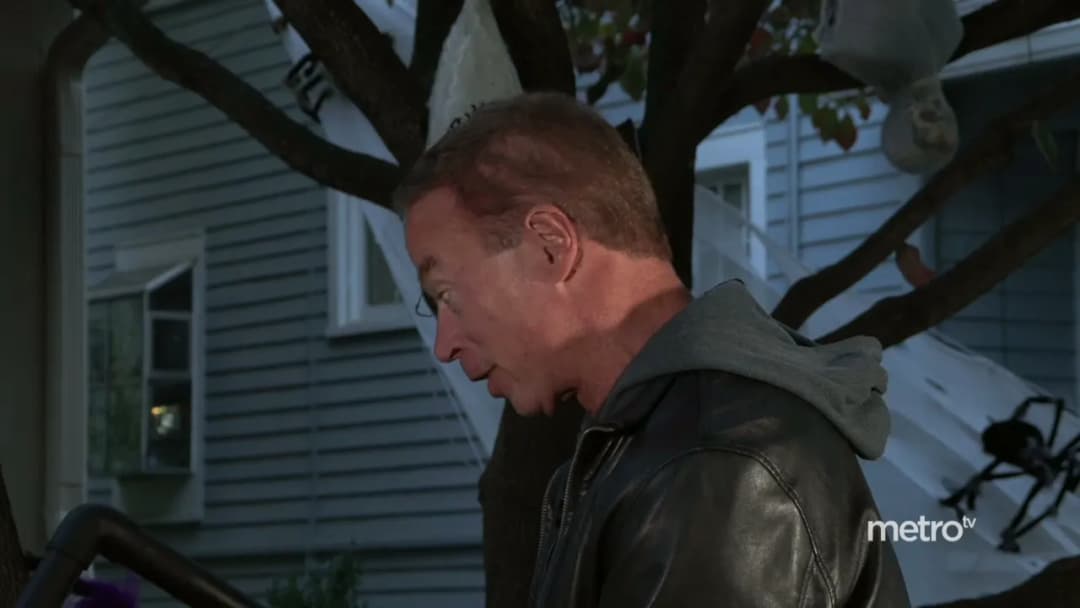
The program, recorded on October 23, 2026, featured interviews with residents of Hillcrest Avenue, the owner of Caulfield's novelty store, and a Louisville Metro Police officer, discussing Halloween decorations, candy distribution, community traditions, and safety tips. Hillcrest Avenue Decorations - Host interviewed Brian Adams, resident of 113 Hillcrest Avenue. Adams described building a giant spider decoration in his garage, adding to it each year, and estimated that on Halloween night they give away about 3,000 pieces of candy to approximately 3,000 children, with total attendance of 4,000–5,000 people. He emphasized the joy of seeing families and noted that they collect non-perishable food for Crescent Hill Ministries and gently used costumes for Hook & Bus. He reported hearing the number 20,000 visitors over an unspecified period. - Host interviewed Aiden Schmidt, resident of 209 Hillcrest Avenue, who built his own decorations (guillotine, PVC figures) using reclaimed materials and received help from a neighbor. Schmidt stated he "100%" recommends families visit Hillcrest Avenue for Halloween and said he sees only happy faces. Caulfield's Novelty Store - Host interviewed Tracy Caulfield Johnson, third-generation owner of Caulfield's. She recounted the store's history: founded in 1915 as a photography studio, transitioned to novelty items in 1920 after insurance money from her father's accident was used to buy tricks and jokes. She displayed popular costumes for 2026, including Descendants, Fortnite, Beetlejuice, Scream, and Terrifier. She noted the store has a makeup artist and longtime staff who help customers create outfits. She expressed that the store is a destination for families and that she loves helping customers. Halloween Safety Tips - Officer John Keeling, resource officer for the 5th Division, provided safety advice: do not send children out alone, have parents stay a half block behind; wear bright costumes that allow peripheral vision; use crosswalks; carry flashlights or glow sticks; avoid unwrapped candy; and do not accept invitations into homes or garages of strangers. Key Outcomes - No formal votes or decisions were made. The program promoted community participation in Halloween activities and encouraged safe practices. The broadcast concluded with a reminder of the hours (5:00 p.m. to 9:00 p.m.) for visiting Hillcrest Avenue and the charitable collections taking place.
On October 23, 2026, a brief public session featured students sharing one-word descriptions and hopes for their senior year. Participants expressed wishes for a busy, joyful, unforgettable, and creative year, using words such as "transcending," "exciting," "fun," "amazing," "awesome," and "whimsical." No formal agenda, minutes, or decisions were available. Student Comments - A student hoped their senior year would be busy and described it as "unforgettable." - Another described the year as "joyful." - One student wished for a year filled with sunshine, creativity, memories, and happiness. - Additional descriptors included "memorable," "transcending," "exciting," "fun," "cool," "smiles," "amazing," "awesome," and "whimsical."
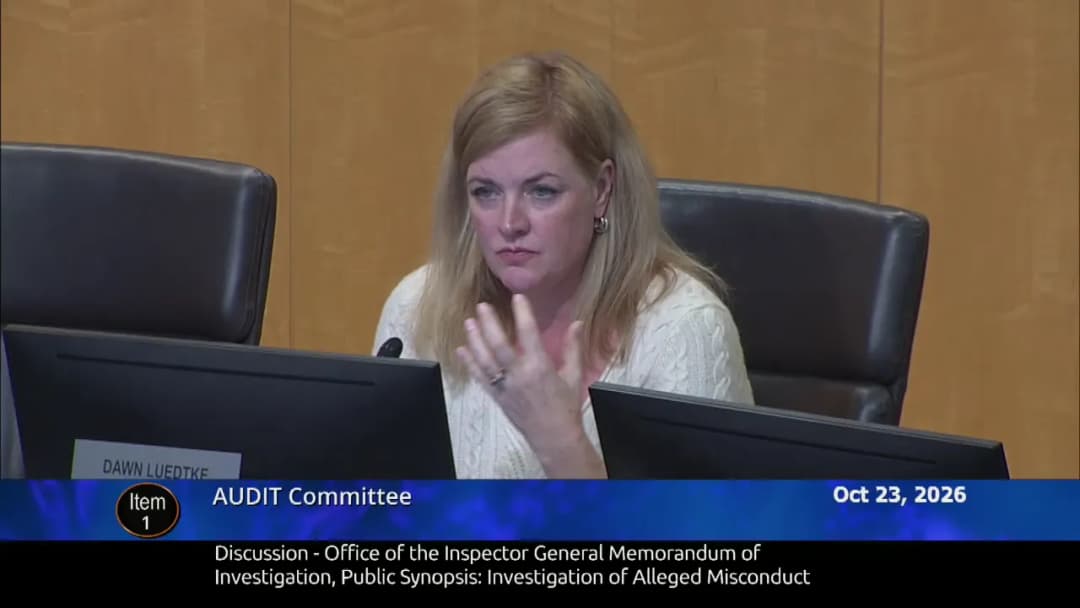
The Montgomery County Council Audit Committee met on October 23, 2026, from 2:30 p.m. to 4:30 p.m. to review two reports from the Office of the Inspector General (OIG) regarding alleged misconduct by a Montgomery County Police Department (MCPD) executive and an employee of the Office of the County Attorney. The committee heard presentations from OIG Inspector General Megan Lamarzy, Deputy Chief Administrative Officer Faribaksiri, Acting Police Chief Darren Frank, and County Attorney Marcos, followed by discussion and questions from councilmembers. Office of the Inspector General Report on MCPD Executive - Inspector General Lamarzy presented findings on a high-level MCPD executive. The investigation substantiated that the executive failed to record leave for at least 40 hours of absences (including attending a golf tournament while on duty and consuming alcohol), falsely told investigators that they were not involved in selecting a family member for an out-of-state conference assignment (violating county code), and directed a county vehicle be provided to the County Attorney employee without proper authorization. - The report also noted that many high-level appointees are exempt from HR regulations, creating confusion about time and attendance requirements, and that MCPD policy on timesheet approval does not align with county policy. Office of the Inspector General Report on County Attorney Employee - Inspector General Lamarzy reported on allegations against an Office of the County Attorney employee, including improper travel, use of a secure messaging app to avoid public information requests, and involvement in a motor vehicle accident while potentially under the influence. The investigation did not substantiate the MPIA or impairment allegations, but found that the employee used a county vehicle without required director approval, had not been approved for a take-home vehicle, and failed to report an accident. The employee resigned during the investigation. Discussion Items - Council President Natali Fani-González praised the OIG hotline and Inspector General for effective oversight, emphasized that the misconduct does not reflect on the majority of MCPD staff, and stressed the need for clarifying time and attendance expectations for exempt employees. - Councilmember Katz noted the importance of respecting the Inspector General's role and urged that the focus remain on correction rather than dwelling on negative aspects of long-serving employees' careers. - Councilmember Balcombe expressed concern about complacency at the highest levels and asked how to ensure ongoing compliance. - Councilmember Evans highlighted the need for oversight and accountability for all employees regardless of exempt status, and supported cross-departmental checks. - Councilmember Luedtke questioned how problems could be identified and resolved earlier before escalating to the OIG, and stressed the importance of internal mechanisms for compliance and corrective action. - Acting Chief Frank described actions taken: an audit of admin vehicles, direct orders to fleet manager, issuance of a headquarters memorandum on leave recording, a new policy for attending social events during work hours, and mandatory ethics training for executives. The County Attorney stated the former employee is no longer with the office and clarified that he was unaware of the vehicle assignment. - Deputy CAO Faribaksiri reported that a policy reminder on time and attendance was issued to all managers, and that the CAO's office is updating administrative procedures on vehicle assignments and developing improved tracking. Key Outcomes - The committee acknowledged the OIG findings and the corrective actions already initiated by the county executive's office, MCPD, and the County Attorney's office. - Recommendations from the OIG include: recovering compensation for at least 40 hours of unrecorded leave, clarifying expectations for exempt employees, updating MCPD timesheet policy, implementing a policy on attendance at social events during work hours, and reviewing civilian vehicle assignments. - All recommendations were accepted by the Chief Administrative Officer, with responses included in the public report. - Councilmembers emphasized the need for ongoing vigilance, cross-departmental learning, and additional resources for the OIG to conduct proactive audits. - Meeting adjourned at approximately 4:30 p.m.
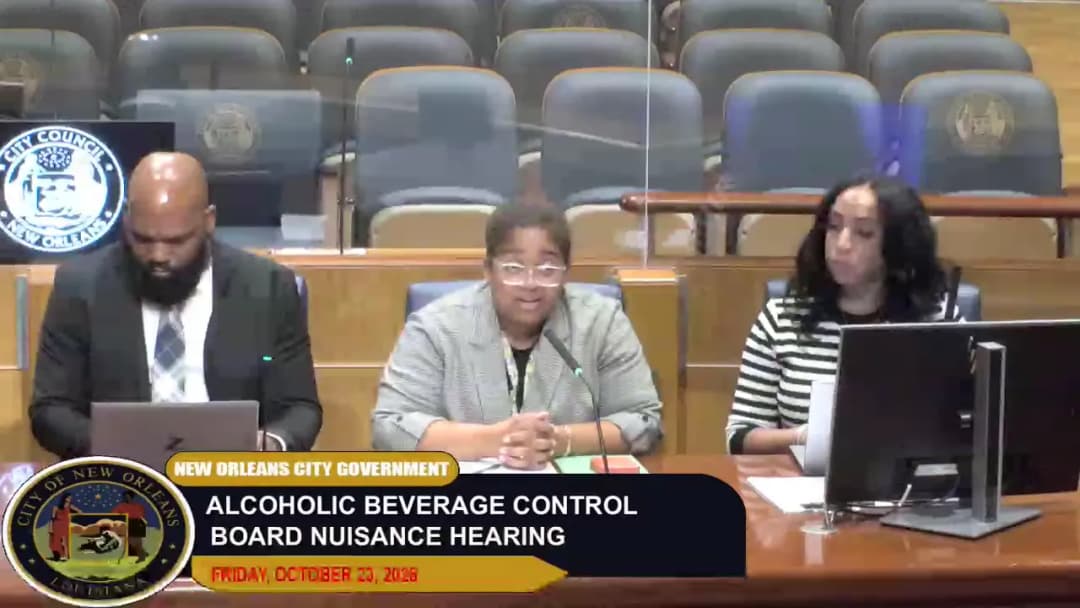
Date: October 23, 2026 Time: 1:00 PM - 1:22 PM Location: City Council Chamber, New Orleans This meeting of the Alcoholic Beverage Control Board (ABCB) addressed a single nuisance hearing concerning Stuph'd Beignets and Burgers. The board heard testimony from the city attorney regarding a 30-month delinquency in alcoholic beverage licensing and a failure to pay a prior judgment. The board voted to grant a 30-day continuance for the permittee to resolve the outstanding debt. Discussion Items - Stuph'd Beignets and Burgers (Hearing 001-26(A)) The city attorney summarized the allegations: The permittee had operated for 30 months without an Alcoholic Beverage Outlet (ABO) license, covering 12 months (2022–2023), 12 months (2024–2025), and 6 months (2025–2026). A prior judgment of $4,500 was issued on March 31, 2026, during a hearing before hearing officer Molly Ponds, with 180 days to pay. The permittee had not paid the judgment, leading to the nuisance hearing. The city attorney noted that since the nuisance notice was issued, the permittee explained they attempted to pay the judgment but mistakenly paid the Treasury Department, which applied the payment to business personal property taxes instead. The Treasury was unable to refund the payment. The city attorney stated the city would be amenable to granting an additional 30 days for the permittee to pay the $4,500 judgment to Safety and Permits. Key Outcomes - Motion and Vote: A motion was made and seconded to adjourn. The board voted unanimously (5–0) to approve the motion. - Continuance Granted: The board effectively granted a 30-day continuance for Hearing 001-26(A), moving the next hearing to December 4, 2026, at 1:00 PM, to allow the permittee additional time to pay the $4,500 judgment. - No Other Business: No sales tax hearing or other agenda items were addressed. Public Comments & Testimony - No public comments were received during the meeting.
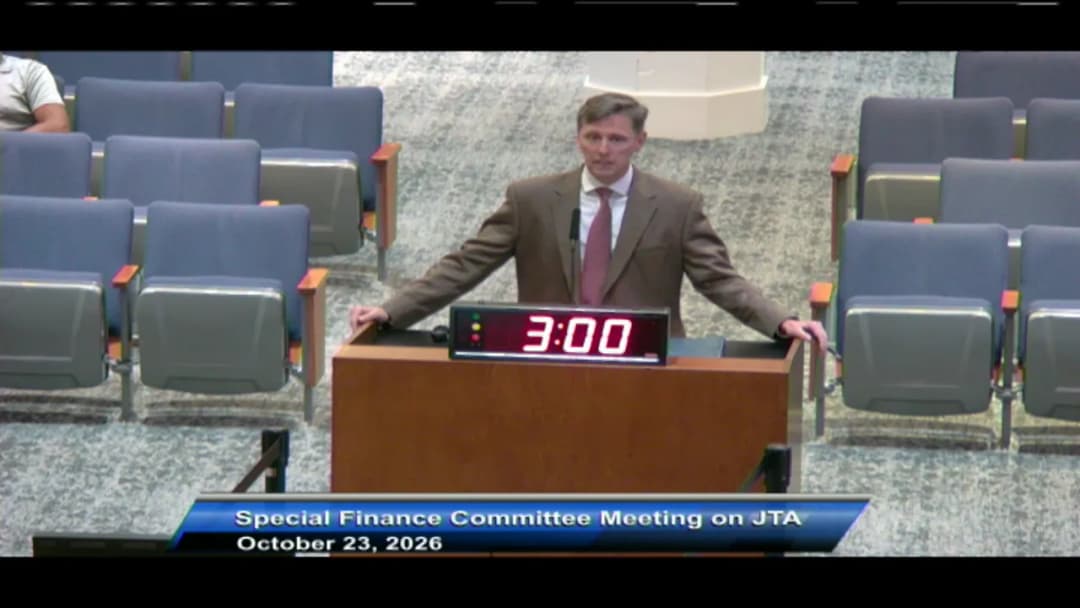
The Jacksonville City Council Finance Committee convened a special meeting on October 23, 2026, to discuss testimony from former Jacksonville Transportation Authority (JTA) CEO Nat Ford and the status of the subpoena issued to him. Chair Will Lahnen presided; Vice Chair Chris Miller and several councilmembers attended. The only substantive agenda item was testimony from Mr. Ford or discussion to otherwise address his testimony before the committee; no public testimony was heard. Call to Order and Introductions - Chair Will Lahnen called the meeting to order and introduced committee staff and members, including Vice Chair Chris Miller and Councilmembers Rockman Johnson, Rory Diamond, Randy White, Nick Howland, Gay, Salem, and others. - Councilmember Diamond, the JTA liaison, summarized how the committee reached this point: the Finance Committee voted to subpoena Mr. Ford at its Tuesday meeting; Mr. Ford was not served that day, but was served at his home on Thursday morning. Mr. Diamond said Mr. Ford was not expected to appear at this special meeting and described the subpoena as still active. Discussion Items - Councilmember Diamond stated that Mr. Ford has historically cooperated with the committee and said his office would work with Mr. Ford's team to schedule a mutually agreeable date. General Counsel Fackler advised that no formal reissuance was needed because Mr. Ford remains under the validly served subpoena. - Councilmember Johnson questioned the necessity of the subpoena, calling the situation disingenuous and arguing for equal treatment of independent authority CEOs. He asked about enforcement if the subpoena were ignored. General Counsel Fackler and Ms. Stepopoulos outlined potential penalties, including a Class D code violation, contempt of council, and charter misdemeanor penalties of up to a $1,000 fine and/or 60 or 90 days' imprisonment under certain charter provisions. - Councilmember Johnson also referenced a Deloitte report requested from JTA. Council Auditor's Office staff member Mr. Peterson said the report had been requested but not yet received. - Councilmember Johnson moved to remove the subpoena and work voluntarily with Mr. Ford's team; the motion was seconded. - The Council President opposed removal, saying Mr. Ford served 14 years as JTA CEO and that Jacksonville citizens deserve his testimony after the near-complete financial collapse of JTA at the end of his tenure. The Council President referred to the subpoena as a "friendly subpoena" and preferred keeping it while arranging testimony collaboratively. - Councilmember White proposed a compromise to hold the subpoena for 14 days and rescind it if Mr. Ford voluntarily scheduled testimony. Councilmember Diamond said he would try to arrange a date with Mr. Ford, but keeping the subpoena in place could also protect the witness. - Councilmember Gay supported keeping the subpoena as an "insurance policy" to ensure the committee obtains information. - Councilmember Salem asked about the duration of the subpoena and whether testimony should come after hearing from JTA CFOs from the relevant period. General Counsel confirmed the subpoena has no automatic expiration, and testimony would occur before the Finance Committee, with FAO select committee members potentially invited. Key Outcomes - The motion to remove or release the subpoena failed; one member voted in favor and all others opposed. - Mr. Ford remains under subpoena. Councilmember Diamond will coordinate with Mr. Ford's team to find a mutually convenient date for testimony before the Finance Committee. - No further action was taken, and the special meeting was adjourned.
The Anchorage Assembly held its second work session on the proposed FY27 budget on Friday, October 23, 2026, from 11:00 AM to approximately 4:00 PM. The session focused on the general government operating budget, capital projects previously deferred, and detailed departmental presentations. Mayor LaFrance and OMB Director Brouse provided an overview of the fiscal challenges, including a projected $15 million budget gap and the use of one-time funds to close it. The administration presented potential 5% reduction scenarios across departments, emphasizing that deeper cuts would likely require personnel reductions. Departments discussed included Health, Fire, Police, Public Works, Maintenance & Operations, Traffic, Parks & Recreation, Library, Transit, Housing & Development, and the ACE Fund. No public testimony was taken. Consent Calendar - No items were identified as consent calendar items. Discussion Items - Budget Overview & Fiscal Cliff: OMB Director Brouse presented the 2027 proposed budget ($692.5 million total, $383 million tax cap), noting the use of one-time ML&P sale funds to close the gap. A discussion ensued on trade-offs between using one-time funds versus making structural reductions. - Potential 5% Cut Scenarios: The administration detailed hypothetical cuts across departments, including elimination of 21 CSO positions and CAP team at APD ($4.7M), reduction of Anchorage Safety Patrol and fire battalion chiefs ($6M), elimination of snow removal heavy equipment operators ($1.6M), reduced janitorial and security at public facilities ($1.4M), discontinuing bus Route 51 and reducing Route 65 frequency ($1.8M), closing Bartlett and Diamond pools ($1.1M), closing the Moulding library and reducing Sunday hours ($700K), and cutting senior center and Brother Francis shelter funding ($300K). Assembly members noted these cuts disproportionately impact specific neighborhoods and vulnerable populations. - Safe Anchorage & Alcohol Tax: The administration presented the consolidated Safe Anchorage budget ($31 million from all sources). The alcohol tax revenue is slightly down. The budget includes $1.4 million increase for shelter surge to maintain 450 beds seasonally. Discussion on the appropriate use of these funds and the distinction between homelessness services and broader safety initiatives. - Fire Department: Chief Shrogi reported near full staffing with 416 positions, but noted an expected large wave of retirements in FY27 (approximately 50 eligible). The cost to run an academy is about $2 million. Discussion on the challenges of retention without a defined benefit program and the possibility of a third academy. - Police Department: Chief Wilson reported 416 sworn officers with 42 vacancies; 21 CSO positions are budgeted. The capital request includes $3.75 million for vehicles and $500,000 for the Elmore station parking lot repair (a drainage issue). Members expressed concern about past bond failures and the need for alternative strategies. - Maintenance & Operations: The budget permanently includes seven heavy equipment operator positions for snow removal (net zero due to reduced contractual costs). Discussion on the cost of snow operations (specific figures to be provided later) and the challenges of absorbing utility cost increases. - Transportation: Transit Director Rudolph noted 7 driver vacancies and an in-house CDL training program is in development. The AnchorRides contract is expected to increase by $1.5–$1.6 million in FY27, not yet accommodated in the budget. A feasibility study found it is currently cheaper to contract out than bring service in-house. - Parks & Recreation: Director Gamble presented a net-zero reorganization converting seasonal positions to full-time, funded by the Healthy Spaces surcharge. Discussion on the high cost of utilities and the challenge of contractual services. - Public Works & Project Management: Director Colhays and team discussed the capital road projects list ($64 million total, including $43.5 million in bond requests). Assembly members questioned the prioritization of projects and capacity of PME to deliver given staffing constraints. - ACE Fund / Marijuana Tax: The FY27 proposal includes $2 million for ASD pre-K programs, continued from prior years. Assembly members debated whether this aligns with voter intent and noted the tax cap limitation prevents local tax increases until 2028. Key Outcomes - No formal votes were taken; the session was informational. Assembly members directed staff to follow up on specific data requests (e.g., snow removal costs, IGC breakdowns, detailed staffing numbers). - The next work session on assembly amendments is scheduled for Friday, November 6, 2026. The legislative branch budget will also be discussed. - Deadline for draft budget amendments is Wednesday, November 4, 2026; final amendments are due by November 11, 2026. A public hearing is set for November 4, 2026, with potential continuation to November 17, 2026, when the budget is scheduled for a vote. - Members were encouraged to submit amendments early to allow time for technical analysis.
The Compensation Plan Board of Leesburg, Virginia met on October 23, 2026 to approve previous meeting minutes, receive fiduciary training, review plan performance, and approve several fund changes and a new retirement income option. Consent Calendar - Approval of Minutes: The board unanimously approved the minutes of the May 19, 2026 Compensation Plan Board meeting. Discussion Items - Fiduciary Training: Andy Larson and Mike Sullivan from the Retirement Learning Center presented on fiduciary responsibilities, including the four core rules (best interest, expert rule, plan document rule, diversification rule). They emphasized the importance of documenting decisions (what and why), reviewing plan documents every 2-3 years, cybersecurity and vendor contract reviews, data privacy (including data sales by vendors), evaluating managed accounts (fees, data points, algorithms, investments), monitoring target-date funds (indirect fees, participant misconceptions), and fiduciary liability insurance. The presenters noted that participant complaints are a common trigger for lawsuits and that good documentation is the best defense. - Plan Performance Report: Total plan assets as of June 2026 were $40.2 million, up from $37.2 million at the end of March 2026, the highest since moving to Nationwide in 2024. Target-date funds comprise 40% of plan assets ($16.1 million), domestic equity 33.3% ($13.4 million), and stable value 13% ($5.2 million). The top four funds account for over 40% of assets. - Fund Change - BlackRock Equity Dividend Fund: The board discussed replacing the BlackRock Equity Dividend Fund (large-cap value) with the Columbia Dividend Income Fund due to the departure of the entire investment team and analyst support. The Columbia fund has a lower expense ratio (0.40% vs. current 0.54%) and similar performance. The change affects 95 participants (page 95 of the report). The motion passed unanimously. - Fund Change - EuroPacific Growth Fund: The board discussed replacing the EuroPacific Growth Fund (international) with the Victory Pioneer International Equity Fund after the fund had been on the watch list for over a year due to poor risk-return profile (bottom-right quadrant: higher volatility, lower returns). The Victory fund has lower expenses (0.39% after rebate vs. 0.74%), better long-term performance, and a more concentrated portfolio (64 vs. 372 holdings). The motion passed unanimously. - CIT Conversion: The board approved converting mutual fund versions of American Century and Wasatch funds to collective investment trusts (CITs) to lower participant costs. The Allspring CIT was removed from consideration as its mutual fund class was already cheaper. - Retirement Income Builder (RIB) Option: The board discussed adding a guaranteed lifetime income option from State Street, designed specifically for governmental entities. Key features: income begins building at age 47, payouts start at age 65, with a high-water mark mechanism locking in gains quarterly. Fees are 9 basis points during accumulation and 20 basis points during income building/withdrawal. Loans are not permitted within the RIB, but participants can keep other assets for loans. Spousal survivor options are available (irrevocable election). The option is portable to other plans offering the same product. The board approved adding the RIB option, with the launch to align with the fund changes (targeting December 2026). Key Outcomes - Approved Minutes of the May 19, 2026 meeting. - Approved Fund Change: BlackRock Equity Dividend Fund to Columbia Dividend Income Fund (effective November/December 2026). - Approved Fund Change: EuroPacific Growth Fund to Victory Pioneer International Equity Fund. - Approved CIT Conversions: American Century and Wasatch mutual funds to CIT versions. - Approved New Option: Retirement Income Builder (RIB) added to the plan as a target-date-like investment option. - Next Steps: Participant communications will be sent at least 30 days prior to changes (targeting November 2026 letters for December changes). Education workshops will be scheduled to inform employees about changes and the new RIB option. The next meeting will include a one-year participant engagement report.