1111
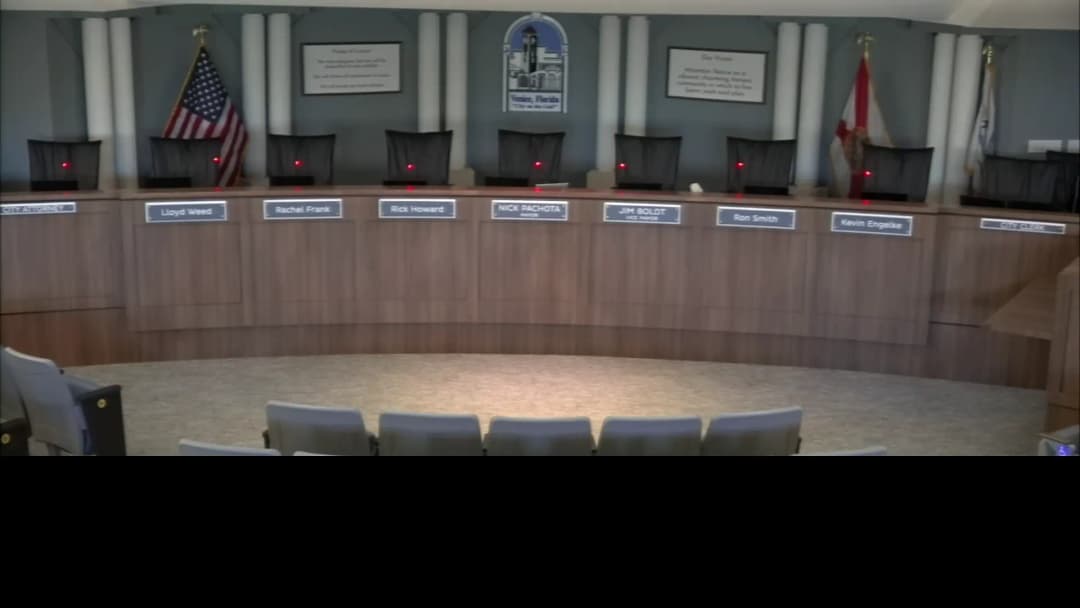
OCT 23, 2026 · VENICE, FLORIDA · CITY COUNCIL & BOARDS
City Meeting Live Stream and Captioning Test – October 23, 2026
TECHNOLOGY AND INNOVATION 100%
On October 23, 2026, at 18:00 UTC, city staff conducted a technical test of the live stream and closed captioning system prior to the official city meeting. No agenda or minutes were available, and the transcript contains only the testing dialogue. No official business, public comment, or decisions occurred. Technical Testing Details - Staff tested the live stream on the city website and in the AV room, with participants including Tony and D (remote/AV support). - Captioning initially did not appear on the website stream or on the AV room screen, and no captions button was visible. - After further checks, a captioning button became available and captions began displaying correctly on both the website stream and the AV room screens. - Staff confirmed "everything appears to be displaying properly" and concluded the test.
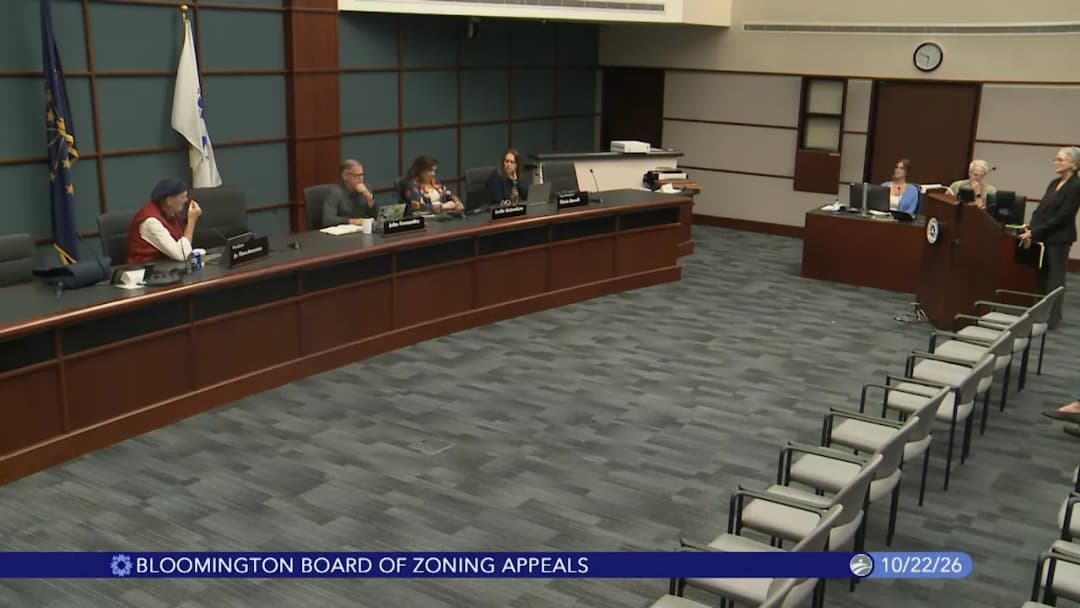
The Board of Zoning Appeals (BZA) met on October 23, 2026, to consider a phasing plan request for a conditional use approved in 2023 for a supportive housing project at 1201 West Third Street. The applicant, Beacon Inc., sought approval to construct the project in two phases due to funding challenges, with phase one covering approximately half of the originally planned building. The board unanimously approved the request with a condition requiring initiation of phase two by January 1, 2029, or a new conditional use approval would be needed. Discussion Items - The project was originally approved in 2023 for a 45,000-square-foot building containing supportive housing (50-bed overnight shelter, 20 dwelling units, five work-to-live units), community services, and parking, with variances for work in the floodplain and riparian buffer. - Staff reported that the applicant encountered funding challenges, leading to a request for a phasing plan: phase one (approximately 20,000 square feet, two stories) would include the west side of the building, half the parking, all stormwater improvements, and the entrance from Third Street. Phase two (remainder of building and parking) would be built when funding becomes available. - Staff recommended approval with a condition that if phase two is not initiated by January 1, 2029, a new conditional use approval would be required. - Don Gray (Spring Point Architects, for petitioner) stated phase one construction drawings are underway and construction is expected to begin early 2027, weather dependent. He expressed gratitude for the board's consideration. - Board members discussed the history of the original case, noting that the prior approvals (conditional use and variance) were unanimous. They questioned the appropriateness of the 2029 deadline and the risk that phase two might never be built, leaving the project without full services (emergency shelter, day center) that were part of the original concept. - Forrest Gilmore (Executive Director, Beacon Inc.) testified that phase one is funded by a $7 million grant requiring lease-up by March 31, 2028. He stated that phase one is self-contained with permanent supportive housing, case management offices, and community space, and would function independently even if phase two is not completed. He noted a $4 million funding gap for phase two, but said Beacon is committed to completing the full project. He confirmed that the 2029 deadline is reasonable but could not guarantee due to unpredictable funding. - A board member raised a concern from the original public comment about distance to services and bus lines, and another noted that the project originally received letters of support, including one expressing concern about services proximity. - Staff clarified that the city cannot compel construction of phase two even if approved; it can only approve what is brought forward. Public Comments & Testimony - No members of the public spoke in person or online during the public comment period. Key Outcomes - The board approved the phasing plan (ZR 2026-09-0043) for 1201 West Third Street by a vote of 4-0 (Roch Morton: yes, Burrell: yes, Fernandez: yes, Casinka: yes). - Condition of approval: If phase two has not been initiated by January 1, 2029, a new conditional use approval is required for phase two. - No other new business was discussed; the meeting adjourned.
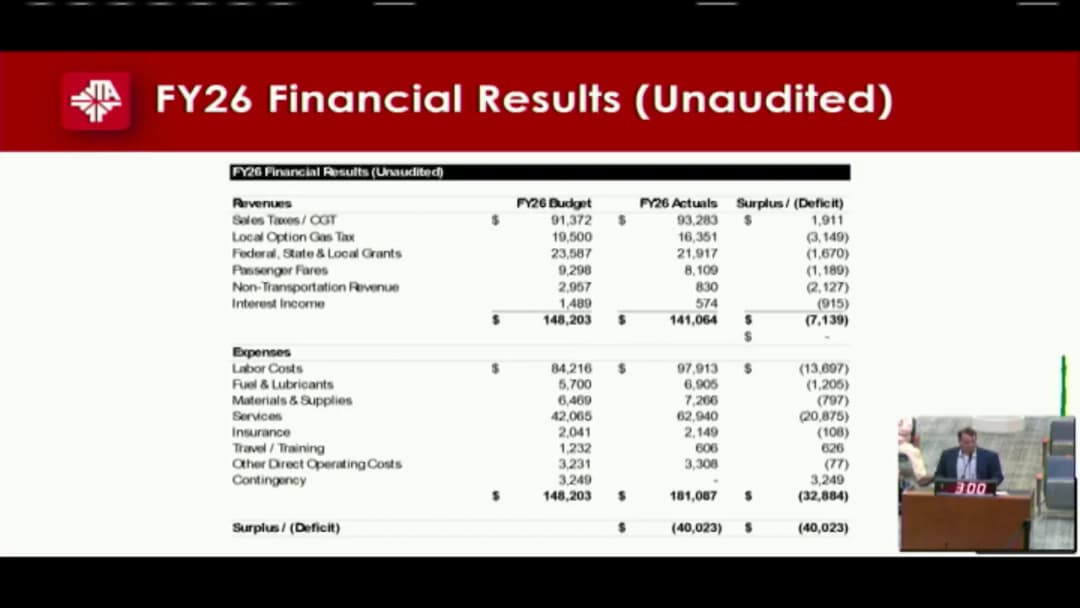
The Financial Audit and Oversight (FAO) Select Committee of the Jacksonville City Council convened on October 23, 2026, to continue its in-depth review of the Jacksonville Transportation Authority's (JTA) financial management. The meeting covered follow-up items from previous sessions, a presentation from JTA CFO Randall Barnes on the FY27 budget, the Local Option Gas Tax (LOGT) loan, JTA's current financial condition, and the causes of its fiscal distress. The committee also discussed the recent Fitch Ratings downgrade of JTA's issuer default rating. Consent Calendar - None. Public Comments & Testimony - No public comments were heard; due to time constraints, the Chair deferred all public comment to the next meeting scheduled for November 2, 2026, where no time limit will be imposed. Follow-Up Items from Prior Meetings - Council Auditor Philip Peterson reported that JTA received approximately $135 million in COVID-19 relief funds over five years, used for operations and capital projects. He noted no audit findings of misuse, but could not confirm whether the funds masked underlying operational shortfalls without deeper transaction-level review. Council Member Ron Salem expressed concern that the end of COVID dollars may have coincided with the emergence of JTA's deficits. - Chair Chris Miller requested documentation on fiduciary responsibilities for JTA executives and board members, including oaths, board policy manuals, and ethics training records. He asked JTA to provide current versions without specific names. - Council Member Salem requested analysis of cost savings from proposed paratransit cuts and furloughs that JTA had considered earlier in the year, as well as a timeline of CFOs over the past two years. - Chair Miller announced he is reaching out to former CFOs (Greg Hayes, Raj Surinath, Heather Abora) and former board chairs (Debbie Buckland, Andre Wallace) to appear before the committee. Former CEO Nat Ford was served a subpoena on October 22 and has agreed to testify; a date is being coordinated. Discussion Items - JTA FY27 Budget and Actions: CFO Randall Barnes outlined the approved $139.2 million operating budget for FY27, which had been passed by the JTA board and city council. He contrasted it with FY26 unaudited actuals, revealing a $42 million shortfall. JTA responded by reducing its workforce by approximately 200 employees, suspending Skyway and Navi services, and moving to a modified Saturday bus schedule. A new “working budget” is being implemented to replace what Barnes characterized as a “fictional” approved budget that had been constructed by making indiscriminate, across-the-board cuts without proper cost analysis. The working budget includes tighter controls and will be used for accurate variance reporting starting in November. - LOGT Loan: JTA was authorized to borrow $30 million from its Local Option Gas Tax (LOGT2) funds. The primary use will be to pay down a $25 million line of credit, saving an estimated $1.5 million per year in interest. Barnes confirmed that the loan will comply with all reporting requirements. - Financial Condition and Fitch Downgrade: Barnes presented FY26 results showing a $40 million deficit, with expenses $32.9 million over budget due largely to labor and services (especially paratransit and NABI). Cash reserves had fallen to about $8 million, well below the board’s target of $41.6 million. Fitch Ratings downgraded JTA’s issuer default rating from AA+ to AA- with a negative outlook, citing diminished financial resilience and weak budgeting controls. Barnes noted that the downgrade affects overall reputation but not existing debt ratings, which are tied to specific revenue streams. He outlined credit-positive steps: the LOGT loan, the FAO committee’s oversight, a planned external audit, and stricter governance. - Budget Process Failures: In response to questions from Council President Nick Howland and Council Member Roy Diamond, Barnes confirmed that the budget team (reporting to the CFO) had unilaterally cut line items to match revenue constraints without collaboration with operating departments. This practice, he stated, is not standard and left the budget unrealistic. Council Member Diamond stressed the need for accurate financial reporting to provide early warning of problems. - Paratransit and NABI Costs: The committee agreed to schedule future deep dives into paratransit cost drivers and the NABI (autonomous vehicle) project, including the associated maintenance facility cost overruns that consumed significant cash reserves. JTA’s General Counsel Cleveland Ferguson indicated that paratransit costs are rising and that the broader policy question of how to fund such services requires council input. Key Outcomes - Subpoena for former CEO Nat Ford was served; he has agreed to testify. The committee will coordinate a date for in-person or virtual testimony. - Former CFOs and board chairs will be invited to future meetings to provide perspective on JTA’s financial decline. - No formal votes were taken by the committee, but consensus was reached to hold longer sessions (no time limit) starting November 2 to allow for public comment and extended discussion. - JTA committed to present detailed reports on paratransit operations and NABI project finances at upcoming meetings.

This is a summary of the Planning Director Hearing held on October 23, 2026, conducted via Zoom by Hearing Officer Ruth Gueto on behalf of the Director of Planning, Building and Code Enforcement. The sole agenda item was a proposed wireless facility at 8790 Village View Drive, including an 80-foot monopine tower, antennas, generator, and equipment. The hearing officer approved the project after considering public testimony and staff recommendations. Public Comments & Testimony - Bob Dando (Villages homeowner, representing homeowners committee): Expressed support for the ATT tower project but opposed the proposed location. Requested alternative sites such as Corporation Yard, upper gardens, or behind the water tank. Cited concerns about direct sight lines from 15 Valvista residents, a narrow one-lane road, traffic mitigation issues, and a high-fire-risk area. Stated a gap exists between trees, giving residents a full view of the tower. - Robert Costa (directly affected homeowner): Opposed the chosen site, arguing the city's fact sheet misleadingly claimed views were considered. Noted 15 homes face the tower and urged relocation 80 feet west. Highlighted that the site is in a Cal Fire high-fire-hazard zone (fire insurance doubled) and near a seasonal creek bed with a riparian zone, for which exemptions should not apply. Stated residents are not against the tower but want a more appropriate location. Discussion Items - Staff (Jacqueline Guerrero) presented the project: the 80-foot monopine tower, antennas, generator, and cabinets on a 90-acre site. The project is in the R1PD zone; a planned development permit is required. Setbacks comply with R1 standards (nearest residence 230 feet). Height is allowed under Section 20.8530 due to the monopine design. A NEPA report found no direct effects on a nearby riverine wetland (within 70 feet) given existing development. The project is CEQA-exempt under Section 15303. Staff recommended approval. - Applicant representative (Mike McLaughlin, Western Fire Chiefs Association, for Public Safety Tower Company): Emphasized the critical need for FirstNet public safety broadband coverage, noting over 80% of 911 calls come from wireless devices and 80.2% of homes are wireless-only. The monopine design minimizes visual impact. Alternative sites (water tower, parks, etc.) were evaluated but did not meet coverage objectives. Addressed fire safety by stating wireless infrastructure is essential for first responders and cell tower fires are extremely rare (one reported worldwide in 2025). - Hearing Officer Ruth Gueto acknowledged community impacts but found that staff and applicant had worked on the project for over a year, examined alternative locations, and designed the tower to blend in. The 230-foot setback was deemed sufficient to limit visual impact. Regarding the riparian corridor, policy allows exceptions, which staff cited. Key Outcomes - Decision: The hearing officer considered the CEQA exemption (Section 15303) and approved the planned development permit (PD-25-004 and ER25-042) for the wireless facility. - The action is final upon signing and mailing the permit, subject to appeal under Title 20 (zoning) and Title 21 (CEQA) of the San Jose Municipal Code. - Conditions include obtaining required grading permits from Public Works and complying with NEPA report recommendations (e.g., protection for salamanders).
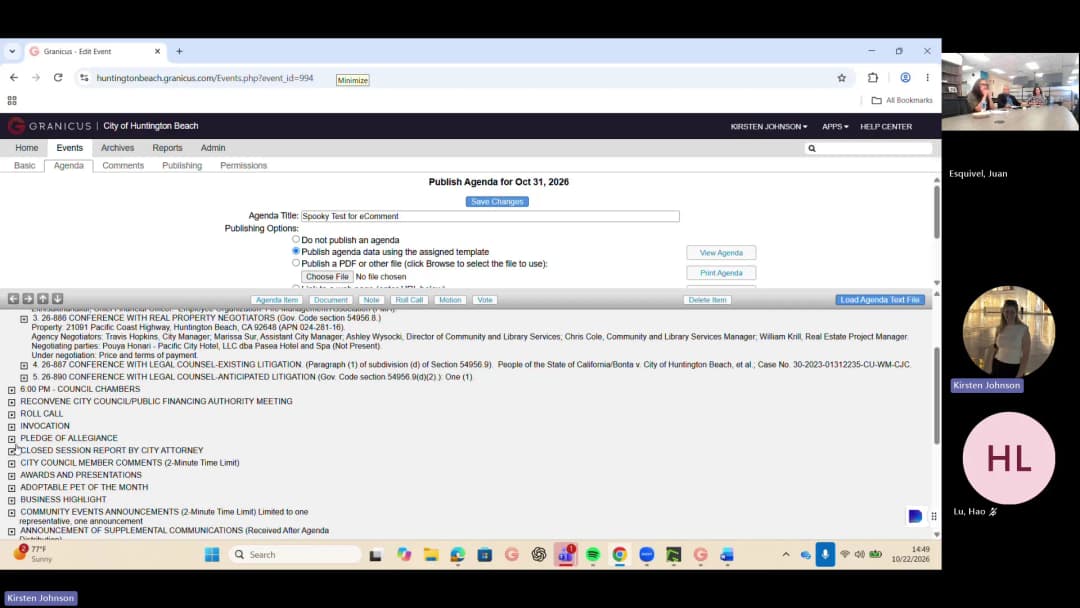
This internal training session, held on October 23, 2026, provided a detailed walkthrough of the Granicus e-comment and speak-up modules. Led by Granicus representative Kristen, the session covered system configuration, public access settings, and administrative controls. City staff (including attendees named Donna and Juan) discussed and decided on key implementation choices for e-comments. Discussion Items - Enabling E-Comment per Meeting: E-comment must be enabled on a meeting-by-meeting basis via the Media Manager (huntingtonbeach.granicus.com). The system allows cherry-picking which agenda items accept comments. - Speak Up Feature Not Needed: The city confirmed they will not use the speaker registration (speak up) module, and it will remain disabled. - Comment Deadline Calculation: The comment cutoff time is set as minutes before the meeting start time (pulled from Legistar). For a 6 p.m. meeting with a 25‑hour advance cutoff, 1,500 minutes must be entered. Staff expressed confusion about closed session start times varying, but clarified the calculation is based on the stated meeting time. - Anonymous Comments: The city requires anonymous comment submission (no mandatory account or email). Kristen will coordinate with Brianna to disable email validation requirements. - Attachments: Attachments will be disallowed due to security risks and ADA compliance concerns. - Comment Visibility and Replies: After debate, the city decided: - Allow users to view comments: Enabled – all public comments will be visible to other users. - Allow users to comment (on others’ comments): Disabled – users may only submit one independent comment per agenda item; they cannot reply to or discuss others’ comments. - Profanity Filter: The city explicitly stated they want to permit offensive language and profanity to avoid First Amendment violations. The default filter must be turned off. Kristen will confirm this with Brianna. - Support/Oppose/Neutral Toggle: The system can display a sentiment indicator for each comment. This will be enabled. The percentage breakdown (e.g., 60% support) is only visible to council via the Legislate application, not to the public. - Public Access: Once enabled, the public accesses comments via the Legistar Insight page. Comments display as a list under each agenda item. - Council Access: Council can view comments through the web-based Legislate application (no longer a native iPad app). Instructions will be provided. - User Guides: The city requested printable instructions for citizens on how to use e-comments. Brianna will follow up. Key Outcomes - E-comment will be adopted with the following specific settings: - Speak up (speaker registration) disabled. - Attachments not allowed. - Anonymous comments permitted (email validation to be turned off). - Users may view all comments but may not reply to or comment on others’ comments. - Profanity filter disabled to allow all speech. - Comment deadline set at 1,500 minutes (25 hours) before the meeting. - Sentiment toggle (support/neutral/oppose) enabled. - Next steps: Brianna will provide user-facing instructions, confirm anonymous comment settings, and verify the ability to disable the profanity filter. - The test meeting created during the session was deleted to avoid confusion with the live system.
The Beckley City Council and Parking Commission met on October 23, 2026. The meeting included approval of prior meeting minutes, public comments, a public hearing and second reading for a real estate purchase, adoption of formal rules of decorum, discussion on a new litter control officer and e-bikes, and a parking commission session detailing the management of new Neville Street parking lots. Consent Calendar - Minutes: The council unanimously approved the minutes from the October 6, 2026 regular council meeting and the October 13, 2026 workshop. Public Comments & Testimony - Mary West expressed concerns about trash accumulation on Metal Street, overgrown grass on Lincoln Street and at a former car wash on LaRue Avenue, and what she described as unequal code enforcement. She also urged the city to install street cameras to catch speeders. - Tom Mosley thanked council and suggested implementing a safe streets program with police department signage to draw attention to road safety. - Andrew Penny (Athletic Director, Woodrow Wilson High School): Invited the council to the West Virginia SSAC State Soccer Tournament (November 4-7), which has been hosted in Beckley for over 25 years. He noted the tournament brings approximately 7,000 attendees, requires 25 hotel rooms per team, and provides significant economic benefit to Beckley hotels and restaurants. He also thanked Chief Bailey and the police for their support and stated the city and school are working together on financial and security arrangements for the event. Discussion Items - Council & City Manager Comments: - Councilwoman noted a Trunk-or-Treat event (Oct 31, 5:30-7:30 PM) and funding from Delegate Eric Brooks for smoke alarms for senior and disabled residents. - Councilman raised concerns about e-bike safety on trails and streets, noting they can reach speeds up to 30 mph and pose fire risks. Chief Bailey agreed to investigate existing regulations. - Councilman expressed support for the soccer tournament and praised a recent joint town hall meeting with the county on vagrancy, panhandling, and safety. - Councilwoman thanked city employees and clarified that Crescent Road is a state-maintained street, not a city maintenance responsibility. - City Manager Gerald thanked his staff and noted the soccer tournament is one of only four state tournaments not held in Charleston, making it a valuable asset. - Ordinance – Real Estate Purchase: A public hearing was held on the second reading of an ordinance authorizing the city to purchase two tracts of real estate on Neville Street for parking. No public comments were made, and the council unanimously approved the ordinance. - Rules of Decorum: City Attorney Fowle presented proposed rules of decorum and public participation policy. The rules formalize existing practices regarding respectful behavior, public comment procedures, prohibited interruptions, signage, and weapons. A change was announced: doors will now open 15 minutes before the meeting instead of 30. The council unanimously approved the rules. - October 13 Workshop Follow-Up: - City Manager Gerald confirmed he and Mike Hennings are working on the job description for a new Litter Control Officer, modeled on the county's position. This officer will have police credentials, including the ability to carry a firearm and badge, and will work in tandem with the Litter Rehabilitation Act. - A discussion on Code Enforcement staffing revealed that a previous lieutenant position was never filled following a retirement, as the department is currently short-staffed in operations. - Executive Session: The council voted to enter executive session for approximately 10-15 minutes to discuss personnel matters. Key Outcomes - Minutes Approved: Minutes from October 6 and October 13, 2026 were approved as presented. - Real Estate Purchase Approved: The council approved the purchase of two tracts of land on Neville Street for downtown parking. - Rules of Decorum Adopted: The formal rules of decorum and public participation policy were adopted. Doors will now open 15 minutes prior to meetings. - Litter Control Officer: The city is actively moving forward with posting the position for a dedicated Litter Control Officer to address blight and enforcement. - Parking Commission Decision: The commission authorized temporary development of the newly acquired Neville Street lots. The lot will provide approximately 25 spaces using crushed asphalt and bumper guards. Parking will be set to two-hour free parking for customers, with no overnight parking. Violators will be subject to towing. The City Manager was authorized to procure signs with appropriate language. (Motion carried unanimously). - November Schedule: The November 3 meeting was canceled due to Election Day. The next council meeting will be later in November. - Community Events: Halloween trick-or-treat is scheduled for October 31, 6-8 PM. The state soccer tournament runs November 4-7.
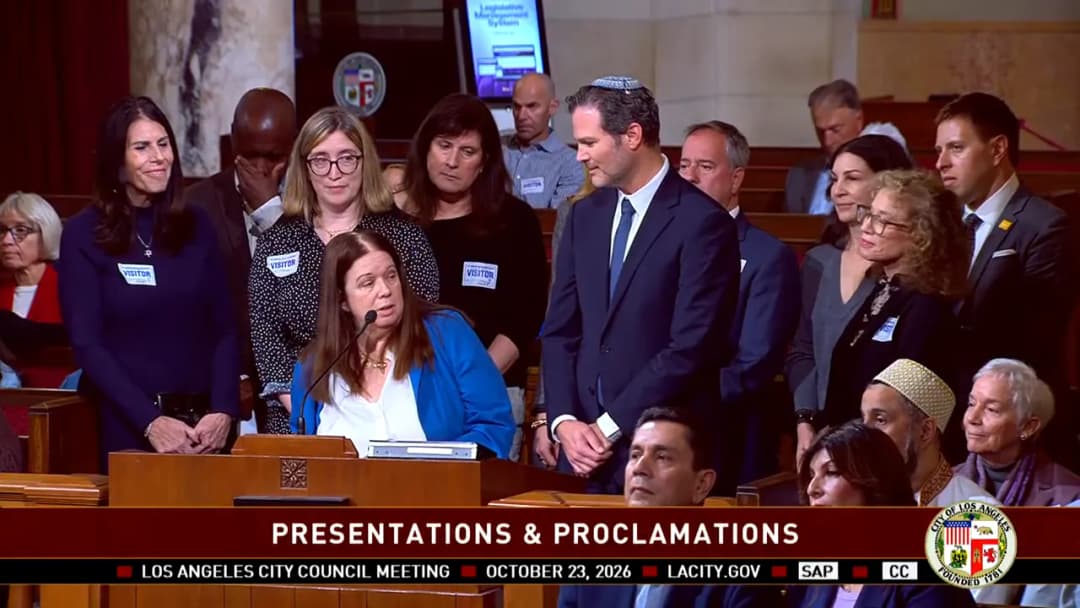
The Los Angeles City Council held its regularly scheduled meeting on October 23, 2026, with 12 members present and a quorum. The meeting covered the consent calendar, multiple presentations and recognitions, public comment on Measure FD and other topics, and two major discussion items: a presentation on the Los Angeles Fire Department's implementation plan for Measure FD (a half-cent sales tax measure on the November ballot) and approval of a term sheet for data sharing and coordinated entry system management with Los Angeles County regarding homelessness services. Consent Calendar - Items 2 through 8 were approved unanimously (12-0) after public hearings had been held. These included routine approvals and reports. Public Comments & Testimony - Support for Measure FD: Multiple firefighters and union representatives (including Rich Ramirez, Chung Ho, Dave Riles, Gary Esquerdo, Tony J, Dennis Garrison, and Riley Quigley) spoke in support of Measure FD, emphasizing the department's staffing shortages (same number of firefighters as the 1960s but five times the call volume), aging infrastructure (53 of 106 stations past 50-year life expectancy), delayed response times (average 7 minutes 53 seconds vs. national standard of 4 minutes), and the critical need for additional resources. They argued the measure is not about pensions or benefits but about core firefighting and emergency services. - General Public Comment: Multiple callers addressed a variety of topics, including concerns about LA Animal Services, homelessness governance, opposition to certain city policies, allegations of misconduct in city departments, and criticisms regarding the city's relationship with the Church of Scientology. One speaker, Jason Spindler, was warned and eventually removed for disruptive behavior. Discussion Items - Item 9 – Measure FD Implementation Plan (Fire Department Presentation): Fire Chief Moore presented a detailed plan for how the LAFD would prioritize and manage resources if Measure FD passes on November 3, 2026. Key investments include strengthening the workforce (recruitment, academy capacity), improving apparatus maintenance (repairing broken hoists, addressing maintenance yard infrastructure), upgrading or replacing aging fire stations (56 stations past service life), enhancing technology (drone program, tablet command, geotabbing), and expanding EMS dispatch capacity (parallel dispatch center). The chief emphasized transparency, promising a citizens oversight committee, quarterly reports to council, and public dashboards to track expenditures and performance. Councilmembers asked about recruitment from local communities, including formally incarcerated firefighters, women, and youth programs; prioritization of restoring previously closed fire companies; the relationship between Measure FD and overtime/pension costs; and the impact on underserved neighborhoods. The presentation concluded with a unanimous vote to note and file the report. - Item 10 & Amendment 10A – Homelessness Data Sharing Agreement with Los Angeles County: The City Administrative Officer (Matt Zabo) and Bureau of Homelessness Oversight staff presented a term sheet negotiated with the county for the Homeless Management Information System (HMIS) and Coordinated Entry System (CES) lead roles, which the county is expected to assume. Key terms include: the city will have access to all HMIS data for persons experiencing homelessness within city boundaries; the county will contract with the city to manage CES matching for city-funded permanent supportive housing units; the city will have proportional representation on relevant policy bodies; and within 60 days, the city and county will jointly develop local preference for city homeless residents in city-funded housing. Councilmembers debated the definition of “proportional representation,” enforceability of commitments, the role of the COC (Continuum of Care) board, and the scope of data access. Some expressed skepticism about the county's track record. After discussion, the council voted (10 ayes) to adopt item 10 as amended, advancing the agreement. Key Outcomes - Items 2-8 approved unanimously (12-0). - Measure FD Presentation (Item 9) was noted and filed after discussion. - Item 10 with Amendment 10A (data and matching agreement with the county) was approved (10-0, with two members not voting). The special meeting originally scheduled for later that day was cancelled. - Recognitions: The council adopted commendatory resolutions recognizing World Polio Day (October 24), National Clergy Appreciation Month (recognizing 15 faith leaders from various districts), Patty Giggins Day (founder of Peace Over Violence, for her 45 years of advocacy and creation of Denim Day), and the 100th anniversary of the Sisters of Social Service in Los Angeles.
This special meeting of the Colorado Springs City Council, chaired by President Crow Iverson, was convened solely to consider a resolution authorizing a long-term lease of Colorado Springs Utilities’ fiber optic communications network assets. Chief Planning and Finance Officer Tristan Gearhart presented the proposal, which would extend the current lease beyond 25 years and is allowed under City Charter Section 10-16 only upon a finding of public benefit. Discussion Items - Lease Term Extension: The current lease, originally signed in 2021, expires in 2046 (25-year term). The resolution seeks authority to approve a new lease running through 2057 (30 years) with the option for the counterparty to extend for two additional five-year periods (to 2062 and 2067, a total of 40 years). - Financial Benefits (per Gearhart): - Over the current term (through 2046): $440 million in cash flow. - Over extended term to 2057: $670 million, an increase of $230 million. - Over potential 40-year term (to 2067): $890 million. - Net present value increase: $55 million (to 2057) and $85 million (to 2067). - Public Interest Rationale: Gearhart stated that the extension provides longer revenue certainty, greater cumulative cash flow, higher net present value, and generates additional revenue that offsets the cost of the fiber optic system and benefits utilities customers. - Councilman Donaldson expressed strong support, citing the economic benefits and noting he is a current customer of the Ting service provided through the network. He moved to approve the resolution; Councilman Gold seconded. Key Outcomes - Vote: The resolution passed unanimously by voice vote, 8–0, with Councilmember Risley absent and excused. Voting aye: Casey, Crow Iverson, Donaldson, Gold, Hendram (Henry), Linewever (Lineweber), Rainey (Raining), and Williams. - Next Steps: The approved resolution authorizes Colorado Springs Utilities to execute the lease extension running through 2057 with additional extension options, contingent upon final contract details.
The Development Planning Sustainability Committee continued part two of day two of the Community Development Block Grant (CDBG) hearings on October 23, 2026. No agenda or minutes were included in the available record; this summary is drawn from the raw transcript. The committee reviewed home repair programs, Community Development Corporation (CDC) funding, public services and community engagement, the proposed CDBG/general fund swap, and HUD compliance issues. Home Repair Programs - The department presented home repair programs including Model Block exterior repair along commercial corridors, the Senior Home Assistance Program (SHAP), Repair-A-Home (RAW) loans, and furnace/hot water tank repair and replacement. In 2025, 375 homes received one of these services. - Model Block currently has 24 projects in production and is funded through decertified CDBG dollars. SHAP serves seniors and disabled owner-occupants below 35% AMI with one critical health/safety repair every 10 years. RAW provides loans at 0-3% interest to owner-occupants who usually cannot access traditional financing. - Councilman Bishop asked for the 375 repaired homes broken down by ward, repair category, and dollar amount; the department agreed to provide that data. - Councilman Slay asked for AMI figures and raised concerns that home repair programs reach a limited audience in a majority-renter city. He requested analysis of the qualifying population and its distribution across the city. The director said the department is working on a home repair gap analysis and is coordinating with the Mayor's innovation team and CDCs. - The department confirmed AMI thresholds: 50% AMI is $52,500 for a family of four and $36,750 for an individual; 80% AMI is $84,000 for a family of four and $58,800 for an individual. - Councilman Slay asked whether rental properties could be served. The department stated lead grants already serve rental properties based on renter income, and furnace/hot water tank repair also serves renters. SHAP and RAW are currently limited to homeowners, but department leadership indicated changes are planned. - Councilman Jones raised concerns about long waiting lists, contractor shortages, and seniors waiting so long that they pass away before receiving service. The department reported that an implementation vendor completed 71 units in the last year across four programs, including lead grants, Healthy Homes Production, and SHAP. That was an improvement over past production of roughly 20 units, but it came with challenges from relying on a single contractor. - Councilwoman Gray said SHAP has become backlogged beyond nine months to a year, that applications have been stopped, and that seniors are not always told about alternatives like Cleveland Housing Solutions. The director acknowledged communication failures and said the department is rebuilding the programs. - Councilman Jones proposed allocating $10 million to community development to expand these programs and argued for setting AMI eligibility at the highest level permitted. The director said CDBG dollars are capped at 80% AMI; general fund dollars could be used to serve higher-income households. The chair explained that AMI is set by HUD for the Cleveland-Lorain metropolitan statistical area. CDC Administration and Funding - The department said it plans to fund 15 CDCs in 2026 with about $7.35 million. In 2025, CDCs completed 58 substantial rehabilitations, provided technical assistance to 342 small businesses, and completed 581 public services. - Six CDCs were close to $100,000 short after ward redistricting; the department supplemented those funds to help preserve CDC staff. - The department proposed a more proactive funding model: CDCs would submit proposals, and the city and council would develop a collective CDC funding plan. The long-discussed 'swap' would move CDC and council neighborhood development support to general fund dollars while using CDBG for eligible projects, reducing HUD compliance burdens. - The chair provided historical context: Cleveland has funded hyperlocal CDCs since 1975, but HUD has long questioned the arrangement. The swap concept grew out of Councilman McCormick's framework. - Councilman Jones criticized slow contracts and reimbursements, saying CDCs are being starved out. The department said average payment time is about 45-60 days and that slower payment alone is not the full problem. The director said no specific timeline is set, but more political will exists, and the department has a meeting scheduled with CDCs on October 29 to introduce new processes. - Councilwoman Hudson asked how council NDA allocations would work under the new process. The department said council members would still choose how to use their allocated funds, subject to procurement and eligibility requirements, depending on whether the money comes from CDBG or general funds. - The chair used a hypothetical $20 million CDBG illustration: roughly 20% for administration, 40% for council/NDA redistribution, and 40% for department-run programs, while noting actual allocations are set through the budget process. - Councilwoman Gray and Councilman Davis expressed concerns about CDC capacity, particularly in Black communities and less-resourced neighborhoods. Gray said one of her CDCs is in trouble and cannot be allowed to shut down. Davis said his wards' six CDCs faced arbitrary six-figure cuts because of redistricting, threatening four jobs, and he asked how CDC goals are established. - Staff explained that consolidated plan goals are tied to HUD's five-year planning categories. For small-business technical assistance, the 2025 CDC goal was 335 and actual reported performance was 377; the 2026 forecast is 350, while the 2027 goal of 100 is a HUD planning artifact rather than a realistic annual target. - Councilman Fisher noted that the presentation showed $19 million in total CDBG funds, with $3.9 million, about 21%, for planning and administration. He asked about acceptable CDC administrative costs and was told the CDC indirect cost rate is less than 20%. Public Services and Community Engagement - The department outlined 19 public services contracts for 2026 plus 10 anticipated citywide contracts focused on home repair, housing counseling, housing-related financial education, and senior transportation. In 2025, public services grants provided emergency food to more than 15,000 people, and citywide grants provided housing counseling and support to about 2,300 homeowners and renters. - For 2027, the department plans competitive procurement and closer alignment with the consolidated plan, including attention to social determinants of work such as transportation and potentially child care. - New work from the Bureau of Community Programming includes a middle neighborhoods specialist, housing innovation district work, a financial empowerment blueprint and resource directory, neighborhood financial needs assessments, youth financial empowerment programming, and 10 community and institutional partnerships with Cleveland Neighborhood Progress, Cleveland Housing Solutions, the County Land Bank, and CDCs. - The community engagement team has five staff members. In 2025, the team attended about 103 events and engaged about 606 residents, connecting them with home repair, utility assistance, rental assistance, and land bank application information. The team also supports Southeast Side work and consolidated plan workshops. NDA, HUD Compliance, and Administrative Follow-ups - The department said NDA is not a project and cannot be submitted to HUD as a lump-sum dollar amount in the CDBG plan. A HUD representative has called the NDA line item a slush fund. Council members pushed back, saying council has budget authority and will continue deciding NDA allocations. The director said the department is not trying to take council funds but needs projects listed individually to satisfy HUD; the proposed swap is intended to resolve that problem. - The department said previous HUD findings about exceeding the administrative cap have been resolved, and no funds are currently at risk of being clawed back. - Outstanding follow-up items include RAW and SHAP carryover balances, fair housing outreach broken down by ward, a report on CRA depository banks expected in roughly two months, and a list of CDCs reporting home repair accomplishments. Environmental Review - The department said every federal dollar requires an environmental review; even exempt projects require documentation. CD has two environmental review technicians and one compliance manager, and CD also performs environmental reviews for CMHA under a memorandum of understanding. - Councilman Davis requested a citywide count of people trained to perform environmental reviews. Councilwoman Gray said CDCs previously blamed environmental review delays for unmet deliverables; the department said that backlog has passed. Key Outcomes - No formal votes were taken; the hearing was adjourned until the call of the chair. - The committee requested home repair data by ward, category, and dollar amount. - The committee requested analysis of the eligible home repair population, including owner-occupancy, renter eligibility, and AMI distribution. - Councilman Jones proposed a $10 million investment in community development and discussion of raising AMI eligibility caps; CDBG is capped at 80% AMI, while general fund dollars could reach higher-income households. - The department committed to providing RAW/SHAP carryover data, fair housing outreach by ward, the CRA depository bank report, and CDC home repair accomplishment data. - The department scheduled a meeting with CDCs on October 29 to discuss new processes. - Further negotiations on NDA funding and the CDBG/general-fund swap remain open ahead of spring budget decisions.
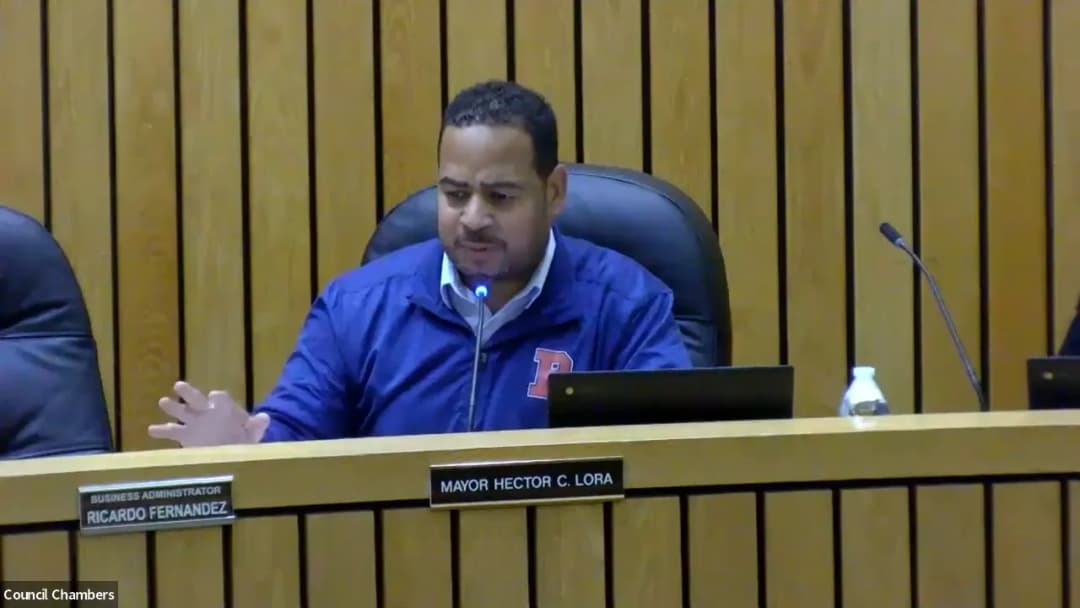
The Passaic City Council held a regular meeting on October 23, 2026, beginning at approximately 4:00 PM. The meeting included public comments, ordinances for second reading, consent agenda items, resolutions, introduction of a new ordinance, a rent leveling appeal, bill approvals, and a detailed mayor's report covering transportation, infrastructure, and community initiatives. All votes were unanimous unless noted otherwise. Public Comments & Testimony - No members of the public addressed the council during the public comment period. A motion to close public comments was approved unanimously. Consent Calendar - Items 3–7 and 8–12 (routine communications and consent items) were approved without discussion by unanimous roll-call votes. - Resolutions 15–37 (excluding Resolution 31) were approved as a block. Key resolutions discussed individually included: - Resolution 25: Awarding a contract for the 2025 Safe Streets to Transit program for improvements at the Saik and Brook Avenue intersection (new traffic signal, full-depth roadway repair, ADA ramps, striping) and at Monroe and Hoover intersection (rectangular rapid flashing beacons, bus stop surfacing, restriping, signs). Discussion addressed county versus city jurisdiction; the city funds all work and informs the county as needed. - Resolution 36: Awarding a contract to On-Site Inspection Agency for elevator inspections (90% fee to vendor, 10% to city). The city's construction code official explained this is a new arrangement due to a reduced number of state-authorized inspectors; the 90/10 split is higher than past contracts but necessary because of limited competition. No additional fees are charged for emergencies. - Resolution 15: Authorizing the purchase of a shuttle bus using UEZ funds to own rather than rent the vehicle. The mayor stated the city intends to purchase two more shuttles, enabling expansion of the free city shuttle service to weekends and early/late hours. The current rented service runs entirely within Passaic and carries an average of 700 to 1,400 riders weekly (including about 110 students from Wall Street). Councilman Monk requested a cost-effectiveness analysis; the mayor agreed to provide data at the next meeting. - Resolution 31: Voted separately due to a question. Approved 6-0 with Councilman Mayer abstaining. Ordinance for Final Reading - Ordinance 2539-26 (Vehicle Parking Schedules): Amending Chapter 295, Article 12, Section 20.2 regarding parking. Opened for public hearing; no public comment. Adopted unanimously. - Ordinance 2540-26 (Prescriptive Parking for Disabled Persons): Opened for public hearing; no public comment. Adopted unanimously. Ordinance for Introduction & First Reading - Ordinance 38 (Fire Hydrant Obstruction): Amends city code to prohibit obstruction of fire hydrants and authorize uniformed firefighters to act as parking enforcement officers. Set down for second reading and final adoption at the November 5, 2026 meeting. Unanimous approval. Discussion Items: Rent Leveling Appeal - Item 9 (Golia Property Management LLC): Landlord of 949 Main Avenue, Apartment 6, appealed a rent leveling board decision. The city clerk noted the appeal was filed 22 days after the decision, exceeding the 20-day calendar-day deadline set by ordinance. The council rejected the appeal by motion and vote (unanimous). No alternative was considered. Mayor's Report & Other Items - Shuttle Service Expansion: The mayor reported that the free shuttle service has been extremely well-received, especially by seniors and students after the closure of the high school. The city aims to own shuttles to reduce reliance on UEZ funding and allow flexible operation. - Other Transportation Options: The city offers a low-cost ride-share program (under $2 per trip), paratransit for seniors, recreation vans for special-needs children, and free UEZ bicycles (about 10 rentals daily across six stations). The mayor highlighted safety benefits for individuals with autism. - Fire Hydrant Enforcement: Firefighters will soon be empowered to write fines for vehicles blocking fire hydrants. - Health Planning Grant: A $20,000 grant was received to create a planning health committee, with community input to be incorporated into the city's master plan. - Community Events: Fall festival drew over 1,000 attendees; first roller-skating movie night at Third Ward Park was successful; vendors pay the city for mechanical rides, funding free food and activities. - Infrastructure: Two new speed feedback signs ordered for Parker Avenue; ADA curb cuts being installed on Monroe and Madison Streets; ground-breaking for Dundee Island Pedestrian Bridge on October 27; temporary speed humps considered for safe routes to school. - Elections: Early voting begins October 24 at City Hall. - Police & Safety: Recent hit-and-run incidents; police worked with residents and cameras. Increased crossing guards now empowered to write tickets for obstruction violations. - Councilman Love: Requested crosswalk repainting at Broadway and Mount Prospect; mayor responded that curb cuts are needed first and will investigate. - Resolution 37: Approved a $20,000 grant for a planning health committee. Key Outcomes - Ordinances 2539-26 and 2540-26 adopted unanimously. - Ordinance 38 set for final adoption on November 5, 2026. - Resolution 36 (Elevator Inspections) approved; city will receive 10% of inspection fees. - Resolution 15 (Shuttle Purchase) approved; city will purchase its own shuttle with UEZ funds. - Rent leveling appeal rejected due to late filing (unanimous). - Consent resolutions (items 15–37, except 31) approved unanimously. - Mayor committed to providing cost-per-ride data for the shuttle by the next meeting.