Browse by city
Date range
Search help

Search titles, summaries, topics and stored transcripts together. Keywords may match separately; put the whole query in double quotes for a phrase. Matching follows word analysis, so punctuation is not exact. Both dates are included. Documents are not searched.

SHOWING 1131–1140 ENTRIES
1131
OCT 23, 2026 · BLOOMINGTON, INDIANA · CITY COUNCIL
Bloomington City Council Public Safety Deliberation Session Two - October 23, 2026

This was the second community deliberation session on public safety hosted by the Bloomington City Council. Approximately half of attendees had also participated in the first session in September. The meeting began with an overview of four focus areas derived from prior feedback: safe and welcoming public spaces, community care and crisis response, public safety response and accountability, and communication and trust. After establishing community agreements, participants divided into small groups for 75 minutes of facilitated discussion. Each group was led by a council member and supported by facilitators from CGM. Following the discussions, each group reported key themes to the full assembly. The meeting concluded with an exit survey and a preview of next steps. Discussion Items - Group A – Safe, Accessible, and Welcoming Public Spaces: Participants discussed how information flows (e.g., about downtown businesses, homelessness) affect perceived safety. They highlighted the need for user-centered design (e.g., fenced playgrounds), consistent lighting, and prioritization of sidewalk investments. Solutions revolved around increased spending, but trade-offs in prioritizing among competing needs were noted. - Group B – Community Care, Crisis Response, and Supportive Services: The group quickly identified shelter as the top public safety need, especially for underserved groups (people with pets, couples, women, sex offenders, those with behavioral issues). Discussion included better coordination among service providers (e.g., a universal release-of-information form), hiring Spanish-speaking staff, coupling housing with wraparound services, and increased visibility of existing services. Specific recommendations for the council included holding grant recipients accountable, reviewing outcome data, following up on the mayor's homeless coordinator position, and avoiding stigmatizing language. - Group C – Public Safety Response, Prevention, and Accountability: Key themes were the need for careful crisis communication on social media, balancing enforcement with compassion, and addressing the trauma inherent in public-safety encounters for all involved. Participants emphasized asset mapping of existing resources, expanding public education (e.g., a residents academy model), and marketing alternative numbers like 211 and 988. They called for integrated services involving IU, Monroe County, and the city. - Group D – Communication, Transparency, and Community Trust: Two separate reports were given - one from the in-person group and one from a virtual group. The in-person group focused on improving information access for both council members and the public. Suggestions included better council awareness of community organizations and public-safety resources, expanding partnerships, and council members meeting regularly with district leaders. Gun safety education was also raised. The virtual group discussed budgetary concerns (PSAP funds commingled, tax increases for dispatch), cybersecurity vulnerabilities, inadequate public comment time (proposal for an ombudsman), and the need for comprehensive collaboration on substance-use treatment, including jail programs and peer support. Key Outcomes - No formal votes or decisions were taken; the session was designed for idea generation and community input. - The council plans to consider legislative proposals related to public safety within the next six months, informed by the discussions and exit survey results. - Participants completed an exit survey to provide additional feedback on both the topics and the process. - CGM will compile a report of the evening's findings for the city council.

PUBLIC SAFETY 56% · PUBLIC ENGAGEMENT 21% · COMMUNITY ENGAGEMENT 13% · HOMELESSNESS 6%
1132
OCT 23, 2026 · GOLDEN, COLORADO · CITY COUNCIL & BOARDS
Golden Downtown Development Authority Business Meeting - October 23, 2026

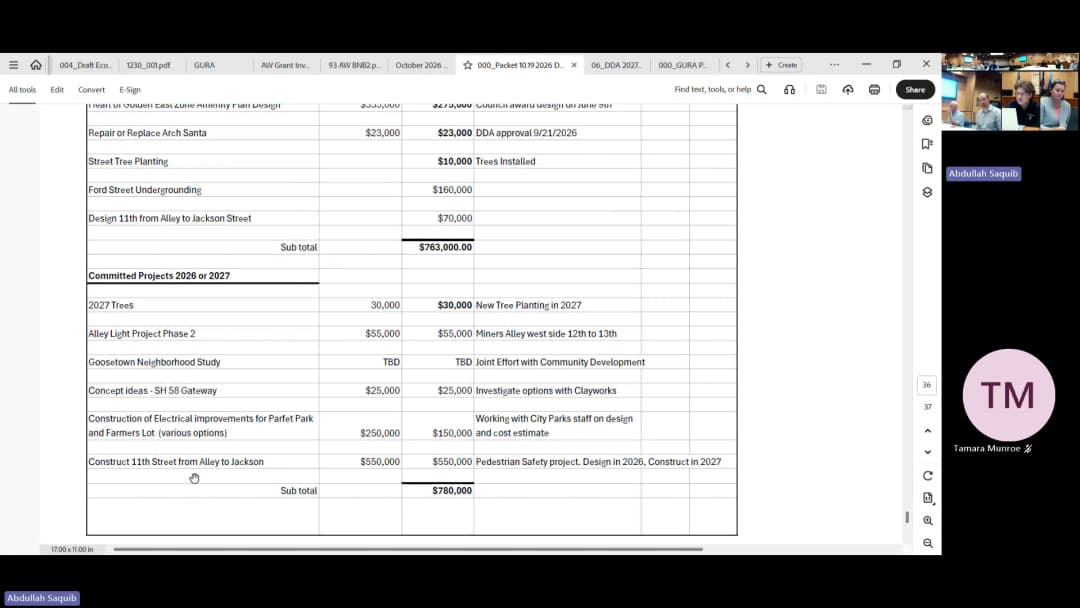
Note: The meeting was originally scheduled for October 19, 2026, per the agenda, but the provided information indicates it took place on October 23, 2026. All board members were present except Tim Gerhold. The DDA board discussed community marketing, an emergency grant, a block party recap, Ford Street undergrounding, and the 2027–2028 budget. Consent Calendar - Approved the minutes from the September 21, 2026, business meeting by unanimous vote. Public Comments & Testimony - No public comments were received via email or in-person. Discussion Items 1. Community Marketing (Visit Golden) Update — Derek Schimmel (Community Marketing Field Manager) and Meredith DePrich (Director of Communications and Community Engagement) presented. They outlined the shift from destination marketing to destination management, the new strategic plan (published in October 2026), and a winter campaign to boost holiday visitation. The program is funded by a 2.5% vendor fee (about $750 per $1,000,000 in retail sales) rather than a lodging tax. Board members asked about wayfinding, a digital downtown map, and A-frame signs for small businesses. The wayfinding project is moving forward: six vendors were interviewed, proposals due by October 21, with a vendor selection expected by late October and concept designs by February 2027. 2. 807 13th Street Grant for Emergency Repairs — The board approved a $15,884 grant (50% of the $31,768 total) for emergency sewer mainline replacement at the historic 807–809 13th Street building. The work was completed on September 21, 2026, to address a total blockage. Board member Terry Weber (a tenant in the building) recused himself. Richard Gardner (site manager and historic preservation specialist) confirmed the repairs were minimally invasive and did not affect the building's historic integrity. The Grants Subcommittee recommended approval. 3. DDA Block Party Community Engagement Event Recap — The October 10 block party on 12th Street had modest attendance but generated over 120 survey responses (later reported as 150). Respondents were split on a potential public plaza: the top response was "Yes, install on 12th Street," with "I do not support a public plaza" as the second most common. Board members discussed improvements for future events, including switching to a Friday evening, integrating nonprofits, and better physical layout to draw attendees. A second block party is tentatively planned for spring 2027. 4. Ford Street Undergrounding Update — Staff received a verbal estimate on October 19: the DDA share for undergrounding utilities south of 10th Street is approximately $142,000 for Xcel Energy and $25,000 for Comcast, totaling about $167,000. No formal vote was taken because written documentation was not yet available. Board members expressed support, noting benefits for aesthetics and wildfire resiliency. A formal proposal and vote are expected in November or later. 5. DDA 2027/2028 Budget Continued Review — Staff presented an updated draft budget. Key changes include lower property tax increment revenue due to state legislation, a reduction in projected 2026 legal fees, and adjustments to outreach and communications and holiday lights line items. The budget includes $200,000 annually for grants, $2,250,000 over two years for joint city projects, and $200,000 annual contingency. Board discussed reserve targets (currently $1.09 million by end of 2028) and power washing frequency (currently twice a year plus spot cleaning). No final action taken; public hearing and adoption scheduled for the November meeting. Key Outcomes - Approved the $15,884 emergency grant for 807 13th Street (unanimous, with Weber recused). - No formal action on Ford Street undergrounding; board indicated support for moving forward. - Budget discussion ongoing; final adoption set for November 2026. - Block party survey analysis to continue; staff to present full results at next meeting. - Wayfinding process underway; vendor selection imminent. - Commissioner comments included interest in improving tree lawn (hell strip) aesthetics and increasing power washing frequency. Subcommittee and Liaison Updates - Development Subcommittee: Plans to meet with key developers by year-end. - Grants Subcommittee: No new proposals beyond the approved grant. - Special Events Review Committee Liaison: Trick-or-Treat Street is scheduled for October 30, 2026, 3–5 p.m. - 12th Street Plaza Ad Hoc Committee: Covered under the block party recap; next meeting will delve into survey results. Staff Report - 2026 Budget Tracker: Not attached; projected 2026 expenditures are reflected in the draft budget. - Project Updates: - Replica Santa and reindeer arch display nearly complete (original to be offered to the Golden History Museum). - Street trees planted on Arapahoe Street between 12th and 13th streets (October 13–14). - Design work beginning for 11th Street improvements (from alley to Jackson Street). - Ford Street undergrounding cost estimate received. - Staff planning to re-engage with RTD regarding Gold Line future plans. - Capital, Redevelopment, and City Updates: Foundation construction underway for the Prosper affordable housing project (817 14th Street), and the Clayworks retail tenant Sweet Bloom is opening. Items that May Affect Another Board or Commission - Strong partnership with the Community Marketing Board (Visit Golden) was highlighted. Board discussed potential future coordination on parking studies with the Golden Downtown General Improvement District and city council.

TOURISM MANAGEMENT 20% · PUBLIC ENGAGEMENT 12% · WAYFINDING 9% · FISCAL SUSTAINABILITY 8%
1133
OCT 23, 2026 · NEW BEDFORD, MASSACHUSETTS · DEFAULT VIEW
New Bedford Audit Committee Meeting – October 23, 2026

The New Bedford City Council Audit Committee met in Council Chambers, Room 214, City Hall, 133 William Street, at 7:01 p.m. Chair Sean Oliver (Ward 3) presided with Councilors Joseph Lopes (Ward 5) and Ryan Pereira (Ward 6). Councillors-at-Large James Roy and Shane Burgo were also present as non-voting participants. City Auditor Quillan Lowney, Chief of Staff Neil Mello, and Director of Personnel Jose Gouveia addressed the committee. The meeting covered three written motions: monthly departmental expenditure reports, the mayor’s new staff hire, and health insurance broker/consultant fees and commissions. Note: the agenda and transcript open with the date October 21, 2026, while the date provided for this summary is October 23, 2026. Discussion Items - Monthly expenditure reports (Matter 1155): The committee removed from the table a motion by Councilors Pereira, Oliver, and Morad requesting monthly reports for expenditures from every department and account. Auditor Lowney said his office is facing challenges from the decentralization of accounts payable, a reduced team, and the retirement of assistant auditors, which delayed the reports. He offered to provide the committee with raw Munis printouts and to publish a cleaner, simplified version without narrative write-ups on the city website. Councilor Pereira asked for an accurate five- or six-month financial lookback by mid-December or early January. Lowney cautioned that figures can change because invoices are now recorded at the effective service date, so prior-period numbers may be revised. Councilor Lopes asked Lowney to highlight any line item exceeding the expected percentage of the year, for example anything over 75 percent in the fourth quarter. The committee then tabled the item. - Review of the mayor’s new staff hire (Matter 1460): Councilor Burgo’s motion asked the committee to review the position, compensation, funding source, and hiring process for the mayor’s newest employee. Chief of Staff Neil Mello explained that the mayor’s office hired a special assistant to the mayor, classified as an administrative manager in the city’s Unit C table at an M9 grade, with a salary of about $66,000. The position replaced Melissa Sears and provides scheduling, logistics, and direct support to the mayor. Mello said the mayor’s office has six staff; the mayor’s proposed budget already reduced personnel costs by about $67,000, and the council cut the mayor’s personnel budget by roughly $245,000, which he called a 35 percent reduction. He said the personnel budget was left at $582,000, with about $356,000 remaining after roughly $225,000 in first-quarter spending, and that the office was not currently projecting a deficit. He argued that council budget reductions limit appropriation authority but do not directly order the elimination of specific positions, citing Department of Revenue guidance, and that the mayor viewed the cut as unfair and targeted because following the council’s stated intent would require laying off an existing employee rather than eliminating a vacant position. Councilor Burgo responded that the council made its cut after Mello presented the administrative manager position as one that would not continue into the new fiscal year, so the council’s intent was to avoid filling a vacancy, not to fire a new hire. He also rejected the claim that the mayor’s office was singled out, citing a similar council cut involving a police department chief-of-staff title. Mello disputed that the position was vacant on July 1, saying Melissa Sears’ departure date was undetermined and that she transitioned out on a part-time basis before the new hire was recruited. Councilor Pereira said he had watched the budget presentation and believed Mello had indicated the position would not be filled on July 1; he expressed disappointment that the explanation had changed. Mello acknowledged possible miscommunication but denied an intent to mislead. Councilor Lopes asked for an actual first-quarter spending breakdown for the mayor’s office, and Mello and Lowney agreed to provide it. Pereira also questioned the informal role of Chief Operating Officer Christina Conley and asked whether the mayor would consider formalizing the COO position through an ordinance with council confirmation. Mello said the mayor would be open to considering it. Pereira said he could not support funding an informal COO or chief-of-staff title without a formal position and council oversight, but would have a different conversation if a formal ordinance were proposed. - Health insurance broker and consultant fees (Matter 1462): Councilor Pereira’s motion requested a review of the city’s health insurance broker fees, consultant fees, and all commissions paid over the last three fiscal years. Personnel Director Jose Gouveia provided an overview of Lockton’s role. He said Lockton has a flat contract fee of $40,000 per year, frozen for three years, with about two more years remaining under the contract. He described additional commissions Lockton receives through other positions, including 1.17 percent on MedEx, a percentage on Boston Mutual based on participants, and 5 percent on stop-loss coverage above the threshold. Gouveia estimated Lockton’s total compensation at roughly $300,000 annually, equal to about 0.5 percent of the overall plan value, and said that is low compared with roughly $300,000 to $400,000 for similar work at comparably sized municipalities. He described Lockton’s services as including market analysis, regulatory compliance, annual RFPs, contract renewals, plan design proposals, and support for Public Employee Committee meetings. Gouveia also outlined cost-saving options that had been discussed with the PEC and administration: raising the family deductible from $875 to $1,000 and the individual deductible from $375 to $500, moving new employees to a 70/30 or 65/35 contribution split rather than the current 75/25 split, and adding an employee-plus-one coverage tier. He said an opt-out program was considered but not recommended because of the age mix of covered employees. He also noted that Fall River offers a dental plan and New Bedford does not, and that implementing a dental/vision benefit would require council follow-through. Councilor Pereira asked for an executive summary explaining how Lockton works on the city’s behalf, all relevant contracts including Trustmark and Boston Mutual, a breakdown of all commissions for the last three years, and information on the Blue Cross Blue Shield relationship. Gouveia said the city has been with Blue Cross Blue Shield since 2015 and that the next RFP process for carriers should begin around mid-year. He agreed to compile the requested information within three weeks, citing open enrollment as the reason for the timeline. Committee members discussed whether a bundled fixed-fee arrangement could be cheaper or more expensive and agreed to review the information at a future meeting. Key Outcomes - Item 1 was tabled; Auditor Lowney agreed to provide raw Munis reports to the committee and simplified public reports, with a target lookback in December or January. - Item 2 was referred to the full City Council for no further action by a voice vote, after a motion by Councilor Pereira seconded by Councilor Lopes. The auditor and chief of staff were asked to provide a detailed first-quarter spending breakdown for the mayor’s office. - Item 3 was tabled; Director Gouveia agreed to provide a comprehensive package on Lockton, carrier contracts, and commission data within three weeks, with further committee discussion planned for the next month. - The committee adjourned at 8:41 p.m.

PERSONNEL MATTERS 28% · BUDGET EQUITY ANALYSIS 26% · HEALTH AND HUMAN SERVICES 19% · FISCAL SUSTAINABILITY 7%
1134
OCT 23, 2026 · PLEASANTVILLE, NEW YORK · VILLAGE BOARD OF TRUSTEES & BOARDS
Pleasantville Village Board of Trustees Work Session – October 23, 2026

The Village Board of Trustees held a work session on October 23, 2026, to discuss the Pleasantville Music Festival, a proposed traffic signal analysis and peer review study, and procedures for the upcoming Lenar public hearing. The meeting included public comment from one resident. Public Comments & Testimony - Ralph Fabrioli, owner of La Babia and a longtime resident, shared his experience organizing a successful "battle of the bands" event in Yonkers in the 1980s, which raised funds through low admission and local band participation. He suggested the Village could apply a similar model—using local musicians and a single stage—to continue the music festival at a lower cost. He expressed support for maintaining the festival but rethinking the approach. Discussion Items - Pleasantville Music Festival: The board reviewed the festival's financial performance, noting a net loss of $157,000 in the most recent year (including all costs such as overtime) and five consecutive years of losses. The executive director, Bruce Figler, has indicated this was his final year, and a key volunteer is also stepping back. The Mayor and board members discussed whether to continue the festival in its current form. Several trustees felt it had "run its course" financially and operationally, suggesting the board focus on smaller monthly civic space concerts and other community events. Others expressed interest in a revamped version featuring local bands and lower expenses. The public commenter proposed a local band showcase model. No consensus on a specific replacement was reached, but the board agreed the current festival format is not sustainable. - Traffic Signal Analysis and Peer Review: The board discussed a proposal from engineering firm NV5 to conduct a traffic signal analysis at the Manville Road intersections with Washington Avenue, Wheeler Avenue, and Grant Street. These signals are state-owned, requiring coordination with the NYS DOT. The analysis would update traffic counts (last done in 2017) and optimize signal timing to address resident complaints about delays. The proposal also includes a peer review of speed data collected by DTS on Nannahagan Road near the school zone. Village staff praised NV5's work on the Safe Streets for All project and recommended approval. The board appeared supportive, and staff noted that additional intersections raised by trustees could be added to the scope. - Lenar Public Hearing Logistics: The board finalized parameters for the upcoming public hearing on the Lenar proposal. Key decisions included: hearing from 7:00 PM to approximately 9:30 PM with a three-minute speaking limit per person, a sign-in sheet, and no back-and-forth dialogue between the public and the applicant. Lenar would be allowed to present a brief overview but not respond to comments during the hearing. The board also discussed the timeline for a vote, noting that a decision is unlikely on the hearing date and may extend into December or January 2027. Key Outcomes - Music Festival: No formal vote took place; the board agreed that the current festival model is unsustainable. Staff will explore alternative community event concepts, potentially incorporating elements of local band showcases and lower-cost productions. - Traffic Study: The board broadly supported moving forward with the NV5 proposal. Formal authorization and funding approval are expected at a future meeting. - Lenar Hearing: Procedures established as described. The public hearing will proceed, with the board expected to keep the record open for additional written comments. A timeline for a final decision was not set but is likely in late 2026 or early 2027.

COMMUNITY EVENTS 36% · TRANSPORTATION SAFETY 15% · PROCEDURAL 11% · PUBLIC ENGAGEMENT 10%
1136
OCT 23, 2026 · MIAMI, FLORIDA · MEETING PORTAL
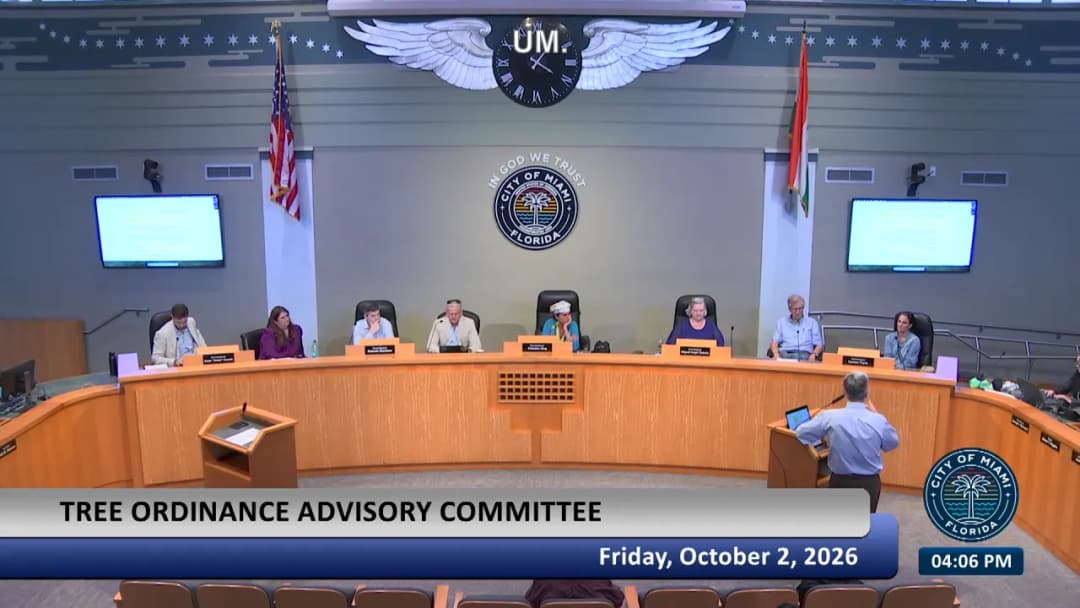
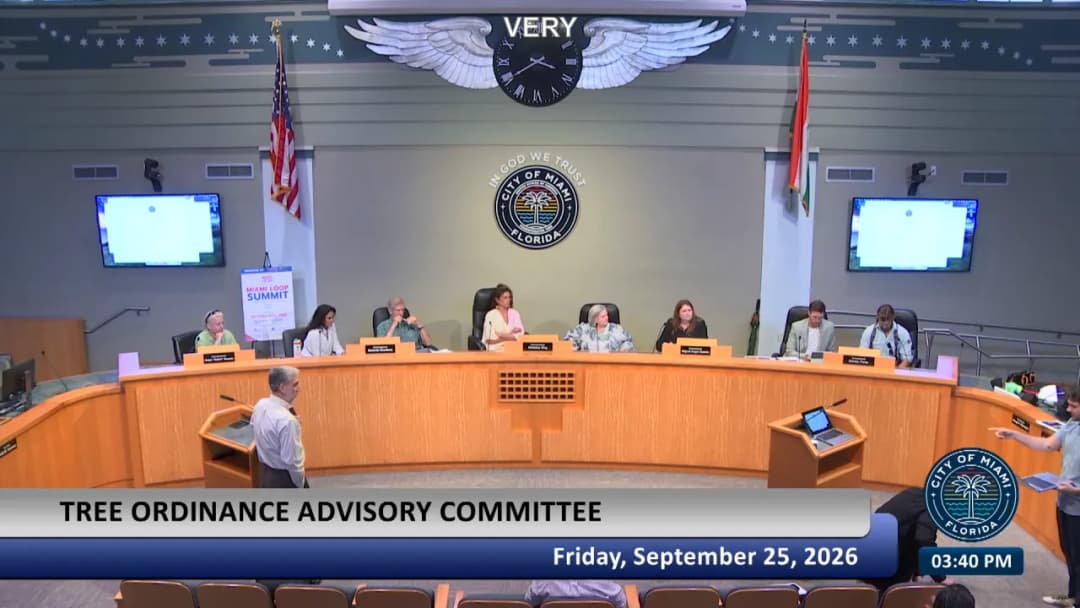
Miami Tree Ordinance Advisory Committee First Working Meeting - October 23, 2026

The Tree Ordinance Advisory Committee (TOAC) held its first working meeting. The session focused on outlining the committee's iterative process, discussing takeaways from initial public outreach and a prior staff question-and-answer session, and putting a first set of ideas on the table regarding regulatory changes. The committee did not take any formal votes but laid substantial groundwork for future meetings. Consent Calendar - No consent calendar items were presented. Public Comments & Testimony - No members of the public were present to provide oral comment during this meeting. Discussion Items Committee Process Overview - Facilitator Raphael described the four-part structure for the committee's work: 1) Regulations (Code, Plans), 2) Process (Permit Review, Enforcement), 3) City Actions (Planting, Pruning, Parks), and 4) Overarching Issues (Trust, Transparency). The group will generate ideas, receive information from staff, rate concepts, and ultimately present recommendations to the City Commission. A second round of public comment on the committee's draft ideas is planned for early 2027. Takeaways from Staff Q&A and Community Input - Legal Pathways (Abra): Abra asked for a formal explanation of the city's ability to make changes that impact county or state regulations, specifically questioning whether county rules are an absolute floor that prevents any changes at that level. - Data Needs (Dina): Dina requested specific data on the number of plan reviewers in Environmental Resources, their current workload volume, and the status of a comprehensive tree survey of the public right-of-way. - District Disparities (Dina, Andy, Lindsay): Members noted that public feedback varied significantly by district. Dina suggested grouping overlapping ideas versus outliers. Andy emphasized that a single standard cannot fit all transect zones (T3 vs. T6). Lindsay observed that many public concerns are already addressed in the existing code, indicating a potential implementation gap rather than a policy gap. - Thomas's Four Themes: Thomas Lawrence distilled public feedback into four primary concerns: inadequate replacement trees, low removal fees, a lack of preservation incentives relative to mitigation, and insufficient city inspection and enforcement of Chapter 17. Proposed Regulatory Changes - Revised Tree Valuation and Mitigation (Chris, Thomas): Chris Barolado proposed overhauling the mitigation table to be based on a composite measure of a tree's ecological value (diameter, height, canopy volume) rather than a simple linear trunk diameter, ensuring replacement fees reflect true value. Thomas noted public interest in using canopy area as the primary metric. - Tiered Fee and Fine System (Lindsay, Mariela, Andy): Members proposed a tiered fee schedule distinguishing residents (homesteaded properties) from commercial developments. Lindsay suggested raising the minimum replacement tree size from a 2-inch caliper to a 4-inch caliper. Andy called for significantly increased punitive fines for intentional, after-hours removal of protected trees, arguing the current fine is merely a cost of doing business. - Preservation of High-Canopy Non-Native Trees (Dina): Dina proposed allowing exemptions for valuable non-native trees (such as the historic Ficus trees on Coral Way) from blanket prohibitions on exotic species, provided they offer significant canopy and community value. Proposed Process and Implementation Changes - Self-Certification (Abra, Dina): Abra proposed allowing residents to use licensed landscape architects for self-certification of routine tree pruning or dead tree removal to reduce city staff burden. Dina clarified that certified arborists, unlike landscape architects, are not state-regulated licensed professionals. - Appeals Process (Abra): Abra suggested requiring appellants in tree hearings to demonstrate they have reviewed and are citing specific code violations, increasing transparency and reducing appeals based on general dissatisfaction. - Trust Fund Transparency (Abra, Lindsay): A call for codified transparency regarding how payments into the city's tree trust fund are spent. Zoning and Incentive Proposals - Zoning Flexibility for Preservation (Aaron): Aaron DeMaio presented a detailed proposal previously developed for the Climate Resilience Committee and indefinitely deferred by the City Commission. It suggests amending Miami 21 to allow floor area transfers (e.g., moving unbuilt ground floor square footage to a second or third story) within T3 single-family lots in exchange for preserving existing specimen trees and their critical root zones. - Developer Incentives (Andy, Mariela): Andy urged the committee to understand what specific incentives work for developers, such as expedited permitting or height and setback relief. He requested a future session with local for-profit developers to discuss the economics of tree preservation. - Tree Banking (Chris, Abra): The committee discussed creating a city-supported tree bank to temporarily hold and allow for the relocation of displaced trees off-site, with mitigation credits granted for successful relocation. Technology and Education Needs - Technology Seminar (Andy, Dina): Andy requested a dedicated presentation on modern tree preservation technologies, including air-spading, bridging over root zones, and canopy projection modeling. Dina noted that the City of Coral Gables recently completed a full LiDAR canopy analysis and digital twin that could serve as a useful model. Legal Constraints and Staff Responses - Members discussed the impact of state statute HB 1555/SB 180, which allows single-family homeowners to remove hazardous trees with a certified arborist report without a city permit. Staff agreed to provide a comprehensive overview of all state and county statutory constraints in the next meeting to clarify the committee's true scope of authority. Key Outcomes - No Formal Votes: As this was a working session, no formal votes were taken on any of the discussed ideas. - Information Requests Granted: Staff committed to providing a legal overview of jurisdictional pathways and constraints, specific data on city staffing levels and tree inventories, and answers to operational questions at the next meeting. - Member Presentations Scheduled: Chris Barolado will distribute his research on a volumetric tree valuation methodology to the full committee. Aaron DeMaio will share the link to his full zoning flexibility proposal for committee review. - Scheduling: The committee aims for three to four more meetings. Staff will circulate a scheduling poll for available dates on Monday, Wednesday, or Friday afternoons, with a goal of having a set of conceptual recommendations ready by early 2027. - Public Engagement Roadmap: The initial public input portal will close shortly to formalize the first round of idea collection. A second round of public comment on the committee's drafted recommendations is scheduled for January or February 2027.

URBAN FORESTRY MANAGEMENT 55% · PROCEDURAL 18% · PLANNING AND ZONING 9% · PUBLIC ENGAGEMENT 7%
1137
OCT 23, 2026 · ROCHESTER, MINNESOTA · BOARDS AND COMMISSIONS
Joint Airport Zoning Board Meeting - October 23, 2026

The Joint Airport Zoning Board (JAZB) held its fourth and final meeting to adopt the updated State Model Zoning Ordinance for Rochester International Airport. The board addressed minor text and map revisions requested by the Minnesota Department of Transportation (MnDOT) following a 90-day review of the ordinance submitted in April 2026. After a public hearing and discussion, the board unanimously approved the ordinance as amended. Consent Calendar - Minutes of April 1, 2026: Approved unanimously (7-0) as the official record of the JAZB. Public Comments & Testimony - Duane Schumann (self-identified as a representative of Highport Township) spoke during the public hearing. He described a scenario where a tower application sent to multiple agencies received no response within the required 30 days, leading to delays and a second hearing. He urged the board to improve the response process for such inquiries. Discussion Items - Presentation of MnDOT-Required Revisions: - Text Update: Clarified that the inner width of the non-precision instrument approach zone for Runway 21 is 1,000 feet, correcting ambiguous language that could be read as 200 feet. - Map Update: Adjusted the outer width of Zone A from 1,842 to 2,000 feet and Zone B from 2,300 to 2,500 feet to extend zones to the edge of the approach surface. The expansion does not affect any new parcels or structures—only previously affected property owners see slightly larger portions of their land included. - Evan Barrett (airport planner, Mead & Hunt) presented the changes and noted that MnDOT has pre-approved these adjustments; resubmission is expected to be a formality, likely taking less than the full 90-day review period. - Readability and Public Understanding: - Commissioner David Senjem raised concerns that lay readers may struggle to determine building height limitations from the ordinance text alone. He suggested adding clarifying language or references to the heat maps (which show maximum construction heights) in the preamble. - Deputy City Attorney Brent Carlson expressed caution about altering language already cleared by MnDOT, as that could trigger a new review. Senjem withdrew his request for a formal amendment, leaving it as a “strong suggestion” for staff to consider adding informational references without substantive change. - Implementation and Enforcement: - Discussion confirmed that once adopted, the underlying jurisdictions (counties, townships, and the City of Rochester) are responsible for integrating the ordinance into their codes and reviewing building permits within the affected zones. Staff noted that existing airport zoning has been in place for years, so processes remain familiar. - Commissioner Ruchi Gupta asked about potential land uses that could interfere with aviation safety (e.g., a limestone quarry). Evan Barrett responded that the ordinance prohibits uses that pose safety risks, but variance and conditional use procedures exist; a quarry could potentially fall under those provisions. - Commissioner Polly Glynn raised the need for training or outreach to townships to ensure they understand the new ordinance. The board agreed that each jurisdiction’s representatives could assist their local planning offices. Key Outcomes - Motion to Adopt the State Model Zoning Ordinance: Moved by Ruchi Gupta, seconded by David Kenworthy. Passed unanimously (7-0) with three members absent. The motion includes authorization for staff to resubmit the updated ordinance text and maps to MnDOT for final approval. - Adjournment: Moved by Brian Mueller, seconded by Polly Glynn. The meeting adjourned at approximately 5:35 p.m. - Next Steps: Staff will incorporate the minor text and map corrections, then submit the final ordinance to MnDOT. The board expects approval within 90 days, with the understanding that the ordinance is substantively complete.

AIRPORT OPERATIONS 44% · PROCEDURAL 19% · PUBLIC COMMENT 19% · LEGAL AND CONTRACTUAL MATTERS 13%
1138
OCT 23, 2026 · NEW ORLEANS, LOUISIANA · CITY COUNCIL
New Orleans City Council Meeting: October 23, 2026

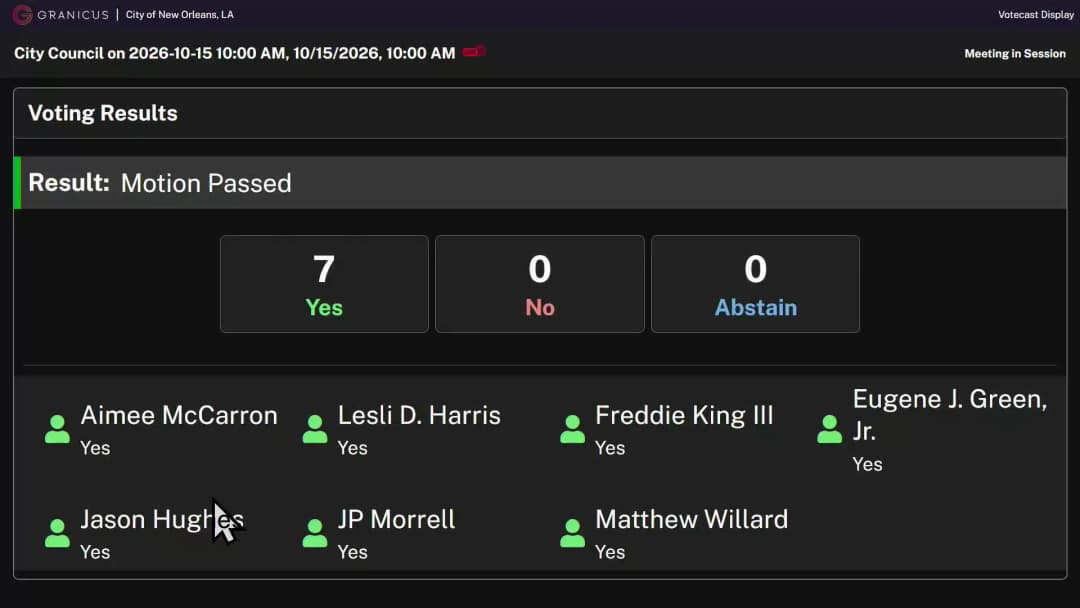
The New Orleans City Council met on Thursday, October 23, 2026, at 10:45 AM (transcript indicates meeting began at approximately 4:37 AM, likely a transcription error). Five members were present, establishing a quorum. The meeting included a consent agenda, multiple zoning dockets, short-term rental regulations, and recognition of community organizations and an individual. Key actions included reversal of an HDLC decision, several conditional use approvals and denials, an increase in the short-term rental nightly fee, and deferrals of several items to future meetings. Consent Calendar - Received multiple communications and referred some to committees (e.g., community development, governmental affairs, climate and sustainability, economic development). - Approved ordinances 35,587 and 35,588 (by Councilmember Harris) for properties at 727 and 750 Coronda Ledge Street (unanimous 5-0). Public Comments & Testimony - Pirates Alley Artist (speaker 1): Expressed concern that removal of a fence behind St. Louis Cathedral would eliminate the artists' exhibition space. Preferred relocation to the 400 block of the courthouse fence; noted that Jackson Square is too crowded. Councilmember Willard acknowledged ongoing work with the Supreme Court, FQMD, and French Market Commission to find a solution. Discussion Items - HDLC Appeal – 3636 St. Charles Avenue (Nicole Weber/Webb Consultants): Applicant appealed the Historic District Landmarks Commission's (HDLC) decision to require option four for facade improvements (four-foot balcony depth) instead of the requested option three and four-foot-seven-inch depth. HDLC staff explained that option four maintains cohesive building appearance; increased balcony depth would be out of scale. Councilmember Harris moved to reverse the HDLC decision and approve option three with the increased depth. The motion passed 6-0. (Notable: Councilmember Harris stated she rarely overturns HDLC.) - Zoning Docket 7526 (withdrawn): Request withdrawn by applicant. - Zoning Docket 8126 (5433 Laurel Street / 509-515 Octavia Street): Request to rezone from HUB-1A to HURD-2 to revert Cafe Maloo's zoning after conditional alcohol use approval. City Planning Commission (CPC) recommended approval. Councilmember McCarron moved to approve. Passed 6-0. - Zoning Docket 8326 (Mississippi River Heritage Park, 350 John Churchill Chase Street): Request to correct maximum building height to 35 feet for an OSN district park. CPC recommended approval. Councilmember Harris moved to approve. Passed 5-0. - Zoning Docket 8426 (deferred): Deferred to November 5, 2026. - Zoning Docket 8526 (901-909 Julia Street / 751 Baron Street): Conditional use for commercial short-term rental (CSTR) at Moto Julia motorcycle dealership. CPC recommended denial, citing general concern about permanent entitlements amid pending STR regulations. Councilmember Harris moved to deny. Passed 7-0. - Zoning Docket 8726 (3157 Chapatula Street): Conditional use for a live performance venue (comedy club) in an MU-1 district. CPC recommended approval subject to one waiver and three provisos. Councilmember Harris moved to approve as recommended. Passed 7-0 (with second by Councilmember McCarron). - Zoning Docket 8826 (814 Poland Avenue): Conditional use for a coffee shop in an HMR-3 district. CPC recommended approval subject to two provisos. Councilmember King moved to approve. Public speakers (Reese Walker, Ali Duffy, Jane Stenjum, Arnold Rivera) all supported the project. Passed (vote not specified in transcript, but approved). - Zoning Docket 8926 (1515 Calarek Street): Conditional use for a third dwelling unit in an HMR-3 district. CPC recommended approval subject to two provisos. Councilmember King moved to approve. Passed. - Zoning Docket 9026 (2404-6 St. Claude Avenue): Conditional use for commercial short-term rental in an HMC-2 district. CPC recommended denial. Councilmember King moved to approve, stating the application had CPC staff support (despite the commission's denial). The motion passed (vote tally unclear; transcript shows "Six years, five years, six years one day." Noted discrepancy: CPC recommended denial but council approved.) - Zoning Docket 9426 (24855 Chef Menteur Highway): Conditional use for commercial short-term rental in an MU district. CPC recommended approval subject to four provisos. Councilmember Hughes moved to approve. Passed 5-1. - Zoning Docket 9626 (25894 Chef Menteur Highway): Similar CSTR in Lake Catherine area. CPC recommended approval subject to two provisos. Councilmember Hughes moved to approve. Passed 6-1. - Ordinance 35,572 (1137 Esplanade Avenue servitude): Granted servitude for minor encroachments at affordable housing development, with annual payment of $937 to the city. Councilmember King moved to adopt. Passed 7-0. - Ordinance 35,573 (1822 Joseph Gilliam Place CSTR): Implementing conditional use approved September 3, 2026. Councilmember King moved to adopt. Passed 6-1 (Morrell voted nay). - Ordinance 35,574 (Short-term rental nightly fee increase): Increased fee from $12 to $20 per night for both commercial and non-commercial rentals, expected to generate $3–4 million additional revenue. Councilmember McCarron moved to adopt. Passed 7-0. - Ordinance 35,589 (Repeal of erroneous salary ordinance for Sheriff's Office): Corrected calculation error. Councilmember Morrell moved to adopt. Passed 7-0. - Ordinance 35,597 (STR regulation amendments per Fifth Circuit ruling): Amended short-term rental regulations to comply with court decision on corporate ownership. Councilmember Morrell moved to adopt. Passed (vote not specified). - Motion M26438 (Land Use Barrier Study hearing): Directed CPC to hold a public hearing on technical zoning amendments. Councilmember Harris moved to adopt. Passed 7-0. - Motion M26441 (Canal Street Renaissance initiative): Directed CPC to consider zoning amendments based on 2025 Canal Street Progress Report. Councilmember Morrell moved to adopt. Passed 7-0. - Resolution R26446 (Real Timbrous crime prevention district election): Called for an election on April 17, 2027, for voters to approve an annual parcel fee for crime prevention and quality of life. Councilmember King moved to adopt. Seconded by Councilmember Harris. Passed. - Motion M26451 (Emergency temporary polling location): Relocated Ward 7, Precincts 25 and 25A from Beacon Light Baptist Church to Bastion Center (1825 Mirabu) for November and December elections. Councilmember Green moved to adopt. Passed 7-0. - Motion M26453 (SP+ LLC contract amendment): Added Council President as signatory to contract extension through June 2, 2027 (net revenue $2.3 million per year). Councilmember Morrell moved to adopt. Passed 7-0. - Motion M26454 (Professional Account Management LLC contract amendment): Similar extension for parking/photo ticket system through January 31, 2027 (net revenue $5.8 million per year). Councilmember Morrell moved to adopt. Passed 7-0. - Special Order – Studs Club Recognition: Honored the organization for 80 years of civic commitment, including scholarships to Louisiana HBCUs (over $250,000 in contributions since 2015). - Special Order – Retirement of WGNO Chief Photographer Patrick Thomas: Recognized his 30-year career at WGNO, being the first African American chief photographer, and his military service. Key Outcomes - HDLC decision reversed on appeal for 3636 St. Charles Avenue (option three and 4-foot-7-inch balcony depth approved). - Café Maloo zoning reverted to residential (HURD-2) as part of prior compromise. - Mississippi River Heritage Park height limit corrected to 35 feet. - Commercial short-term rental denied for Moto Julia (Julia Street) and for St. Claude Avenue property (though latter was approved despite CPC denial). - Commercial short-term rentals approved in Lake Catherine area (two properties) and for the St. Claude property (controversial vote). - Live performance venue approved on Chapatula Street; coffee shop approved on Poland Avenue; third unit approved on Calarek Street. - Short-term rental nightly fee raised from $12 to $20; expected additional $3–4 million annually. - Several items deferred to November 5, 2026 meeting. - Resolutions passed to initiate Canal Street revitalization and land use barrier study hearings. - Multiple contract extensions approved for parking and ticket collection systems. - Resolution calling for April 2027 special election in Real Timbrous crime prevention district passed.

ZONING AND LAND USE 32% · PROCEDURAL 14% · COMMUNITY ENGAGEMENT 14% · SHORT TERM RENTALS 13%
1139
OCT 23, 2026 · GOLDEN, COLORADO · CITY COUNCIL & BOARDS
Golden Urban Renewal Authority Business Meeting – October 23, 2026

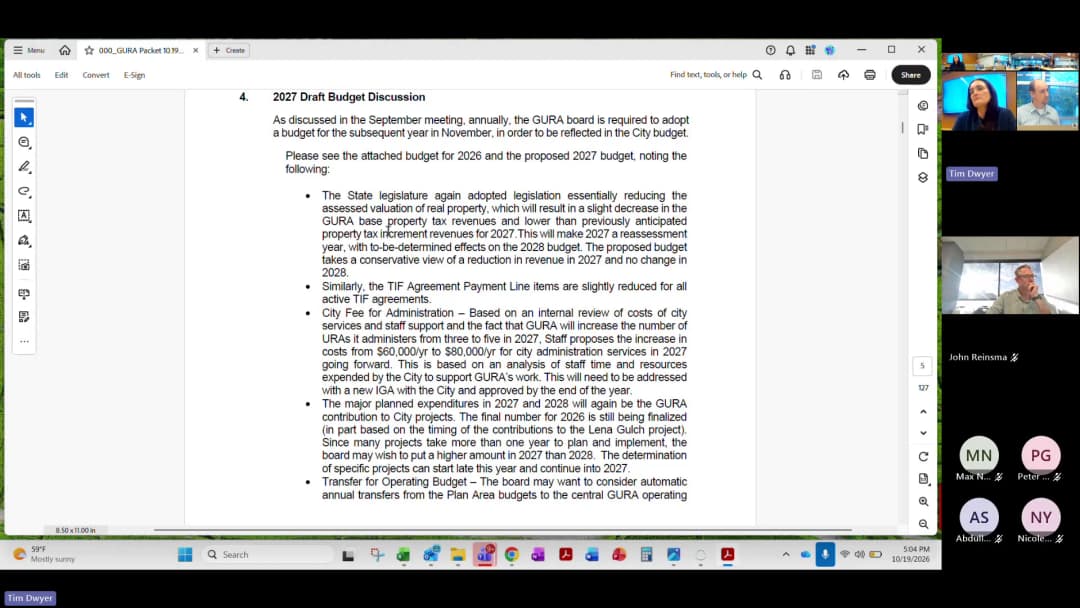
This meeting of the Golden Urban Renewal Authority (GURA) covered key updates on the Junction development, a draft Tax Increment Financing (TIF) agreement for the Nazarene affordable housing project, status of taxing entity agreements for the Junction URA formation, and the 2027–2028 budget. The board discussed financial feasibility, infrastructure costs, and developer commitments before referring major items to subcommittees for further refinement. Consent Calendar - Approved the October 19, 2026 meeting agenda without a formal vote (per new rules). - Approved the minutes of the September 14, 2026 regular business meeting. Public Comments & Testimony - Written comment from Kathy Egert (Table Rock resident): Expressed concerns that adding more development along Highway 93 will worsen traffic, and objected to the proposed roundabout. - One in-person speaker (referenced in minutes from September meeting): Questioned the need for large-scale commercial development and raised concerns about traffic and water resources. No additional oral comments were offered at this meeting. Discussion Items 1. Junction Plan Area – Evergreen Development Team Presentation - Tyler from Evergreen presented the 52-acre Junction project, highlighting its goals of creating primary jobs (targeting advanced manufacturing, aerospace, bioscience, etc.), expanding trail connectivity, and improving Highway 93 access. - The project requires an estimated $59 million in public improvements, including a roundabout on Highway 93, a grade-separated pedestrian bridge, wetlands mitigation, a sanitary sewer lift station, and Xcel Energy power constraints (5 MW limitation until 2032). - The Junction Metropolitan District has a standalone bonding capacity of $14.2 million. With GURA TIF support (81% of total mills, 73.318 mills), bonding capacity would increase to $35.1 million, leaving a $23.9 million private funding gap that Evergreen has committed to cover. - The developer presented a pro forma showing a 7.22% yield on cost post-URA, below the 8% target, but argued the project is financially unachievable without TIF due to the extraordinary infrastructure burden. - Board discussion: - Board Member Don Cameron expressed concerns about the Fire Mill levy and the city's cost to service the development, urging the subcommittee to consider not granting 100% TIF from the city. - Board Member Max Neumeyer and others questioned the impact of market conditions (rising interest rates) on project feasibility. - Board Member Alison Loftsgordon asked about the economic modeling and the employment projection of 690–700 permanent jobs. - Board Member Andy Kerr noted the need for amenities on the west side of Highway 93. - Discussion included data centers (allowed under M1 zoning north of Highway 58) and the possibility of restricting them through the URA plan document. - The board agreed to refer the matter to the Development & Operations Subcommittee for further sensitivity analysis and negotiation parameters. 2. 17455 West 16th Avenue Plan Area – Draft TIF Agreement Review - Staff presented a draft TIF agreement with Shanahan Development for the 100% affordable housing project (Nazarene). The agreement outlines a 100% commitment of projected TIF revenues to close the funding gap, with affordability covenants recorded in perpetuity. - The agreement was developed with input from the city’s affordable housing team and was sent to the developer for review. - Board comments: - Board members emphasized the need to ensure permanent affordability and proper coordination with the county assessor. - Chair Trout noted the importance of clear language on long-term affordability and oversight. - The board directed the Development Subcommittee to conduct a detailed review and bring a final agreement for approval at the November meeting. 3. The Junction URA Formation Update - Staff reported ongoing negotiations with taxing entities: - Jefferson County: Draft agreement sent; study session scheduled for late October/early November; target adoption November 17. - Jefferson County School District (JCSD): Draft 100% revenue sharing agreement sent; final approval expected December. - Jefferson County Public Library (JCPL): Draft sent; study session November 12, regular meeting November 19; adoption expected December 10. - Mile High Flood District (MHFD): Verbally agreed to 100% TIF; formal letter expected. - City of Golden: Staff engaged with Golden Fire to assess service costs; estimates will be presented at the next meeting. - The statutory 120-day limit expires December 23, 2026. The board will need to adopt final agreements at its December 14 meeting, with City Council approval on December 15. 4. 2027 Budget Discussion - Staff presented the 2027–2028 budget, noting a slight decrease in property tax revenues due to state legislation reducing assessed valuations. - Proposed changes: - Increase in City Fee for Administration from $60,000 to $80,000 annually, justified by the addition of two new URAs. - Introduction of a 2% transfer from plan area revenues to the GURA operating fund (beginning 2027) to offset administrative costs and fund blight-mitigating projects. - The Nazarene Plan Area will likely be exempt due to its 100% TIF commitment. - Standard 20% contingency applied to all plan area budgets. - The board approved a motion directing staff to draft a revised Intergovernmental Agreement (IGA) for the increased administrative fee, to be presented for approval at the November meeting. - Staff will also prepare a cash flow analysis for the West Colfax Plan Area to help the board plan future infrastructure investments. Key Outcomes - Junction Plan Area: Referred to the Development & Operations Subcommittee for detailed sensitivity analysis, including the TIF percentage (targeting up to 100% from taxing entities except where fire services require retention), yield-on-cost parameters, and potential restrictions on data center uses. The subcommittee will report back to the full board. - Nazarene TIF Agreement: Referred to the Development Subcommittee for review and final edits; expected to return for board approval in November. - URA Formation: Staff continues negotiations with taxing entities; board will need to adopt revenue sharing agreements by December 14, 2026. - Budget: Motion approved to draft a revised IGA for city administrative services (increase to $80,000/year) and to present the final 2027 budget for adoption at the November meeting. - Strategic Planning: The board agreed to hold a strategic planning session in early 2027 to set priorities for capital projects and URA fund deployment. Note: The agenda and minutes list the meeting date as October 19, 2026, but the meeting actually convened on October 23, 2026, per official record.

ECONOMIC DEVELOPMENT 30% · TAX INCREMENT FINANCING 15% · PROCEDURAL 13% · FISCAL SUSTAINABILITY 9%
1140
OCT 23, 2026 · MIAMI, FLORIDA · MEETING PORTAL
Tree Ordinance Advisory Committee Workshop on Preservation: Q&A with City Administration, October 23, 2026

The Tree Ordinance Advisory Committee met on October 23, 2026, for a question-and-answer workshop with City administration about the existing regulatory framework for tree preservation, protection, and canopy. Facilitators from the FSU Consensus Center, Rafael Montalvo and Hal Birdal, led the session. No agenda or minutes were provided in the source materials; this summary is based on the raw transcript. No public attendees were present, and the transcript indicates the meeting was approaching 4 p.m. near its close. Discussion Items - Quorum and attendance: Seven members were present at roll call, meeting the six-member quorum. Chris Baralotto was initially absent but joined later; Thomas Lawrence was absent. Committee member Andy Parrish urged that vacancies be filled so future meetings are not canceled for lack of a quorum. - Workshop purpose and future meeting format: The session was deliberately unstructured to let members ask detailed questions. Facilitators announced that an interim compilation of public input from the August/September workshops would be distributed after the meeting. It contains more than 100 pages of input plus more than 1,100 online comments from about 400 respondents. The comments are grouped into four categories: regulations; process; direct city actions; and overarching issues such as trust, transparency, strategy, and public education. One category will be introduced at each of the next four working meetings; the next meeting will focus on regulations. - Permitting process overview: At the start, a show of hands indicated five of the seven members had direct experience with city permitting or development review. Eureka Kulangis, Building Services Manager, described the five-step permitting process: application in the iBuild portal, plan review, permit payment, construction inspections, and final certificate. Review is concurrent across disciplines; zoning is always required, and environmental review is flagged when tree impacts are identified. A standalone tree permit can be submitted separately from a master permit. Applicants may seek same-day permitting help, walk-in assistance, and the city offers a homeowners assistance clinic. - Tree plan submittal requirements: Sean Smith, Acting Chief of Environmental Resources, said projects with tree activity require a tree disposition plan, tree protection plan, superimposed site plan, and tree replacement plan when removal is proposed. Boundary surveys must depict trees when required. Arborist reports are requested on nearly every project although not explicitly required by code. For commercial projects, submittals must be prepared by a Florida licensed landscape architect; for residential projects, a homeowner or representative may prepare them. Sean Smith also noted that demolition permits generally do not allow tree removals unless trees block access or become unsafe due to structure removal, and new-construction tree activity is reviewed as a subpermit so conflicts can be assessed. - Environmental review staffing and workload: Asked about capacity, Sean Smith said his division has seven reviewers plus himself. Tree plan reviews number in the thousands each year. Committee members raised concerns about whether site visits can keep pace with that volume. - Site verification: Environmental Resources does not visit every site. Staff use aerial imagery, Google Street View, historical imagery, and tools such as Zillow to check conditions, and conduct site visits for many canopy and specimen trees. Drones are not currently used. Lindsay Corrales questioned relying on possibly outdated imagery; staff said they use whatever tools are available. - Tree relocation and mitigation decisions: Sean Smith explained that the first question is whether a conflict exists. Preservation in place is the first priority for specimen trees; redesign may be required. Relocation is considered based on size, species, age, condition, the availability of a feasible landing spot, and the tree's likely long-term viability. Supplemental arborist reports and tree-mover vetting may be required. - Review time and transparency concerns: Ian Wogan said the tree review is often the longest part of the permitting process and that back-and-forth is not visible to the public. He suggested separating or duplicating the tree submittal process to improve transparency. Staff explained current public access options: iBuild accounts, public records requests, on-screen review at the building department, and the environmental resources page on the city website. The committee indicated that increased transparency should be considered in future recommendations. Eureka Kulangis said she did not have an exact count of applications that should have been flagged for environmental review but were not, and that it was minimal; committee members asked that the number be tracked and made public. - Interdepartmental coordination: Plan review is concurrent, and a joint plan review process exists when needed. Departments also consult directly because many review staff are on the same floor. Asked how much authority Environmental Resources has to force plan changes, Sean Smith said he does not personally have power, but Chapter 17 governs the process and departments generally work together to preserve trees, including on specimen-tree and right-of-way conflicts. - Pre-application and planning-stage review: Dina Bellown described Coral Gables' practice of requiring tree surveys, tree disposition plans, tree protection plans, and parking plans before a project can move to preliminary design. She asked why the city does not require equivalent information at the pre-application stage. Planning and zoning staff responded that pre-applications are optional except for rezones and variances, so landscape plans cannot be demanded in an optional meeting; landscape and environmental review occur by cycles once plans are submitted. Committee members suggested evaluating whether earlier tree review should be required. - Legal, state, and county constraints: Senior Assistant City Attorney Patricia Aria discussed legal limits on a stricter tree ordinance. Florida Statutes Chapter 163 and 163.045 were cited as state preemption provisions, and the city cannot go below Miami-Dade County requirements. She also discussed Senate Bill 180, tied to hurricanes Debbie, Helene, and Milton, which may limit certain stricter regulations, potentially through October 1, 2027, depending on hurricane tracking details. She did not give a definitive answer, noting it depends on what the committee recommends. Private providers may perform plan review only for Florida Building Code disciplines; environmental resources review is not among those disciplines. - Urban canopy data and right-of-way planting: Thomas Lawrence could not attend; his emailed questions were read and answered. The city quantifies urban tree canopy using GIS-based UTC assessments derived from aerial and satellite imagery, tracking progress toward the 30 percent canopy goal. The city will ground its tree keeper inventory software within the next 60 days to supplement countywide assessments. Right-of-way tree plantings are requested through multiple avenues, including 311, commission district offices, the Department of Resiliency and Public Works web page, phone, and email, not only by residents. - Potential future agenda topics: Andy Parrish asked for specific code sections to be printed and discussed, requested legal analysis of the court decision Cube 3585 v. City of Miami, and proposed exploring incentives such as additional height or expedited permitting for developers who preserve trees. Chris Baralotto requested relevant code citations be attached to each regulatory category and asked for access to canopy data and metadata to verify city statements. Marieta Lopez de Alviar cited an illegal weekend tree removal with what she described as a minimal fine and urged stronger enforcement and higher fines. Key Outcomes - No formal motions, votes, or recommendations were adopted; the meeting was framed as a question-and-answer workshop. - The interim compilation of workshop and online input will be sent to committee members after the meeting; the next working meeting will focus on the regulations category. - The audio recording of the workshop will be available so member comments can be carried into future discussions. - Staff committed to providing some written information, including an explanation of planning and zoning application types and environmental review triggers. - The committee's next meeting will require members to bring calendars; a focus on the first category of public input was set, and follow-up topics including transparency, earlier tree review, incentives, code citations, and Cube 3585 were placed on the table for future sessions.

URBAN FORESTRY MANAGEMENT 42% · PERMITTING PROCESS IMPROVEMENT 20% · PROCEDURAL 11% · PUBLIC ENGAGEMENT 10%
OPENPUBLICA · PUBLIC MEETING INDEXUPDATED DAILY · openpublica.com