Browse by city
Date range
Search help

Search titles, summaries, topics and stored transcripts together. Keywords may match separately; put the whole query in double quotes for a phrase. Matching follows word analysis, so punctuation is not exact. Both dates are included. Documents are not searched.

SHOWING 1121–1130 ENTRIES
1121
OCT 23, 2026 · BOZEMAN, MONTANA · CITY COMMISSION
Bozeman Board of Ethics Reviews Annual Training Curriculum and Code Update - October 23, 2026

The Board of Ethics of Bozeman, Montana, met on Friday, October 23, 2026, to review the City's annual staff ethics training curriculum, discuss the pending code of ethics review, and receive updates on financial disclosures and the new Civic Academy. The board unanimously approved a revamped training curriculum that focuses on the charter's prohibition of using public office for private gain and introduces a single interactive scenario, facilitated discussion, and a quiz. No public comments were offered. Discussion Items Review of the City's Annual Staff Ethics Training Curriculum (2026) Assistant City Attorney Jen Giuttari and City Attorney Greg Sullivan presented a revamped curriculum for the mandatory annual ethics training, now in its 18th year. The training will be delivered in 30–40 small-group sessions starting the week of November 9. Key changes include: - A concentrated focus on the charter's prohibition of using public office for private gain. - A single "choose your own adventure" scenario, replacing multiple separate scenarios used in previous years. - Two discussion questions asking employees to reflect on their roles as both employees and community members, with responses later compiled into a word cloud. - A short, fun quiz with candy as an incentive to promote engagement. - Random seat assignments to mix employees from different departments, breaking up silos. - Trainers recruited from nearly every department (17 volunteers) who facilitate discussion rather than lecture; a train-the-trainer session with the city attorney will prepare them. Board members expressed strong support for the deliberate redesign. Chair Rushing noted the value of shifting from technical scenarios to broader ethical conversations and encouraged ongoing departmental follow-ups. Mark Bond emphasized the importance of helping new public servants understand the difference from the private sector. The city attorney highlighted that the training is intended to move beyond a single annual session to become part of ongoing team discussions led by directors. Code of Ethics Review The board revisited its long-standing assignment to review the City's Code of Ethics. Members reported that after comparing the code with other policies (e.g., Montana State University) and considering technological changes, the current policy is sound and requires only minor updates. The main question was whether to add provisions related to artificial intelligence (AI). The board agreed to await recommendations from a staff committee led by Assistant City Manager John Henderson that is developing updated AI policies. Board members will submit their individual findings to Chair Rushing by October 30, after which the board will produce a formal response to the city attorney. Other FYI Items - City Clerk Mike reported that financial disclosure forms will move from DocuSign to a web form, making submission and tracking easier, and that the forms are now on a state retention schedule. - City Attorney Sullivan announced the launch of the Civic Academy, a seven-week program for community members to learn about city operations. The first session (public safety) was oversubscribed, and future sessions will cover other departments. The city hopes to run it twice a year. - The board discussed the potential impact of the proposed new city charter. Sullivan clarified that the board's scope and purview would not change, but the new charter suggests that neighborhood councils receive ethics training, which will now be offered. Key Outcomes - Approval of Staff Ethics Training Curriculum: The board voted unanimously to approve the proposed 2026 staff ethics training plan. - Code Review Next Steps: Board members will provide individual feedback by October 30, and the board will await staff AI policy recommendations before finalizing any code amendments. - Financial Disclosure Process: The board noted the transition to a web-based form and improved retention schedules. - Civic Academy: The board acknowledged the successful launch of the new Civic Academy and the expanded training for neighborhood councils under the new charter.

ETHICS TRAINING 32% · PUBLIC ENGAGEMENT 23% · COMMUNITY ENGAGEMENT 15% · PROCEDURAL 12%
1122
OCT 23, 2026 · EVANSVILLE, INDIANA · CITY COUNCIL
Evansville Loan Administration Board Meeting - October 23, 2026

The City of Evansville Loan Administration Board met on October 23, 2026, at 9:30 a.m. in Room 301 of the Civic Center. The board unanimously approved prior meeting minutes and a revised revolving loan fund plan, received an update on loan portfolio performance, and discussed upcoming meeting schedules and a borrower's status. Consent Calendar - Approved the meeting minutes from May 22, 2026. - Approved the executive session memo from May 22, 2026. - Approved the revised Revolving Loan Fund Plan. Discussion Items - Loan and Fund Updates: The board received an update on loan fund activity. Most borrowers are performing well, but two borrowers have become less consistent in payments, making larger payments after missing a month. Two additional borrowers—Artisan Pizza Revolution and Main Street Wedding—are behind on payments; they have received two notices, and a third will be sent soon. If no response, the loans will be sent to collections. Also, Emerald Design paid off a $1,000 loan balance, and those funds are now available for lending but require appropriation before being spent. - Helponics Loan Status: The board discussed Helponics, which has three loans with the city. The first two remain deferred, and the third is interest-only with a reduced interest rate. Helponics had previously applied for an SBA loan that was denied due to changing federal guidelines. They are pursuing new SBA loan opportunities. The board decided to invite Helponics to the January 2027 meeting to provide an update, either in person or via video call. - Future Meeting Schedule and Board Terms: The board noted that there will be no meetings in November or December 2026 due to holidays (the fourth Friday of each month falls on holidays). Board member terms expire December 31, 2026, and members will receive email notifications about reapplying for mayor-appointed positions. The January 2027 meeting will include swearing-in of members and moving forward with the new loan plan. Key Outcomes - Approved all consent items unanimously (voice votes with no opposition). - Directed staff to continue monitoring delinquent borrowers and proceed to collections if necessary. - Agreed to invite Helponics to the January 2027 meeting for a loan status update. - Confirmed that the December 31, 2026, term expirations will trigger a new application process for board membership.

FINANCIAL MANAGEMENT 61% · PROCEDURAL 39%
1123
OCT 23, 2026 · WASHINGTON, DISTRICT OF COLUMBIA · COUNCIL OF THE DISTRICT OF COLUMBIA
DC Council Committee of the Whole Hearing on Audi Field Redevelopment - October 23, 2026

The Committee of the Whole, chaired by Councilmember Phil Mendelssohn, held a public hearing on Bill 26-769 on October 23, 2026. The bill authorizes a public-private financing agreement with DC United to redevelop Audi Field with a climate-controlling roof and at least 8,000 additional seats (expanding from 19,200 to up to 28,000 capacity). It also establishes a preservation fund and provides tax exemptions. The record will close on November 6, 2026. Public Comments & Testimony - Shira Markov (DC Fiscal Policy Institute) opposed the bill, arguing the $300 million subsidy is a poor fiscal priority. She stated the annual debt service could fund nearly 250 child care subsidies, and economic studies show stadiums do not generate net new local spending. - Frederica Kramer (ANC 6D) testified the ANC does not support the expansion as presented, citing severe traffic congestion on the Buzzard Point peninsula, the lack of a cap on district spending, and insufficient planning for more events. - Kim Stone (CEO, Washington Spirit) took a neutral position, stating the bill lacks key protections. She requested meaningful tenant consultation, guaranteed access to preferred dates, operational continuity during construction, and fairness for Spirit fans regarding a new sales tax, confirming negotiations with DC United were stalled. - Anna Forge (Resident) opposed the bill, describing the traffic situation as a nightmare and noting the bill lacks alternative transportation incentives. - Joey Davis (AFGE Local 1975) opposed the bill, arguing it is impossible to justify $300 million for a stadium while the city cannot fund cost-of-living adjustments for its employees. - Supporting witnesses included labor representatives (Greg Ackerman, Teddy Keith) who praised the Project Labor Agreement (PLA) and commitment to union jobs. Monty Hoffman and Mike King testified in support of the adjacent Parcel B development, which includes 122 deeply affordable senior housing units and the relocation of Volunteers of America HQ. - Jan Adams (Owner, DC Power FC) and Jamie Weston (Commissioner, Major League Volleyball) voiced strong support, emphasizing the bill's potential to establish DC as a national leader in women's sports. - Several residents and business owners expressed mixed views. The Navy Yard BID and restaurateurs supported the year-round economic boost, while the Safe Streets Task Force and many residents emphasized the urgent need for a revised transportation plan. Discussion Items - District's Financial Exposure: Councilmember Allen strongly criticized the bill's language committing the district to "not less than $300 million," calling it an open-ended liability and demanding a hard cap. Deputy Mayor Nina Albert (DMPED) stated the executive branch could not support the bill without a thorough economic analysis and raised concerns about cannibalizing events from Capital One Arena. - Transportation and Neighborhood Impact: Councilmember Allen and multiple witnesses from ANC 6D and Southwest residents testified that the current traffic and safety configuration for Audi Field events is untenable for the peninsula, with emergency vehicles struggling to reach homes and residents unable to leave during events. A comprehensive update to the Transportation Operations and Parking Plan (TOPP) was widely requested. - Washington Spirit Partnership: Several Councilmembers made their support contingent on a secure and fair long-term deal between DC United and the Washington Spirit. Kim Stone's neutral testimony and description of stalled negotiations highlighted this as a critical unresolved issue. DC United CEO Jason Levian stated negotiations were constructive but not yet complete. - Affordable Housing and Community Benefits: The bill is linked to the Parcel B development (467 units, 148 affordable, 122 for seniors). Councilmember Allen noted changes in the Parcel B plan and asked for strong clawback provisions if housing commitments are not delivered, to which developer Monty Hoffman agreed. - Need for a Roof and Expanded Seating: DC United President Janita Johnson and MLS executive Charles Alchek explained that the MLS move to a global calendar makes the roof a necessity for winter operations. They argued expanded seats are required to meet surging demand post-World Cup and to host new tenants like the DC Flight volleyball team. Key Outcomes - Executive Branch Opposition: Deputy Mayor Nina Albert stated the Bowser Administration cannot support Bill 26-769 in its current form and requested more time to evaluate its economic impact and potential market cannibalization, recommending the process follow the normal budget cycle. - Councilmember Conditions: Councilmember Allen, the Ward representative, laid out specific conditions for support: a firm cap on the $300 million contribution, a drastically improved transportation plan for Southwest, a finalized fair deal for the Washington Spirit, and strict accountability provisions for housing commitments. - Next Steps: Chairman Mendelssohn directed the Deputy Mayor and DC United CEO Jason Levian to schedule a follow-up meeting to work through outstanding issues. The official record for the hearing will remain open until 5:00 PM on November 6, 2026, for additional written testimony. The legislation is considered a first step, requiring a subsequent budget approval.

ECONOMIC DEVELOPMENT 29% · TRANSPORTATION SAFETY 16% · PUBLIC ENGAGEMENT 10% · SPORTS FACILITIES 10%
1124
OCT 23, 2026 · MINNEAPOLIS, MINNESOTA · CITY COUNCIL
Minneapolis Budget Committee Meeting: Parks and Convention Center Budgets - October 23, 2026

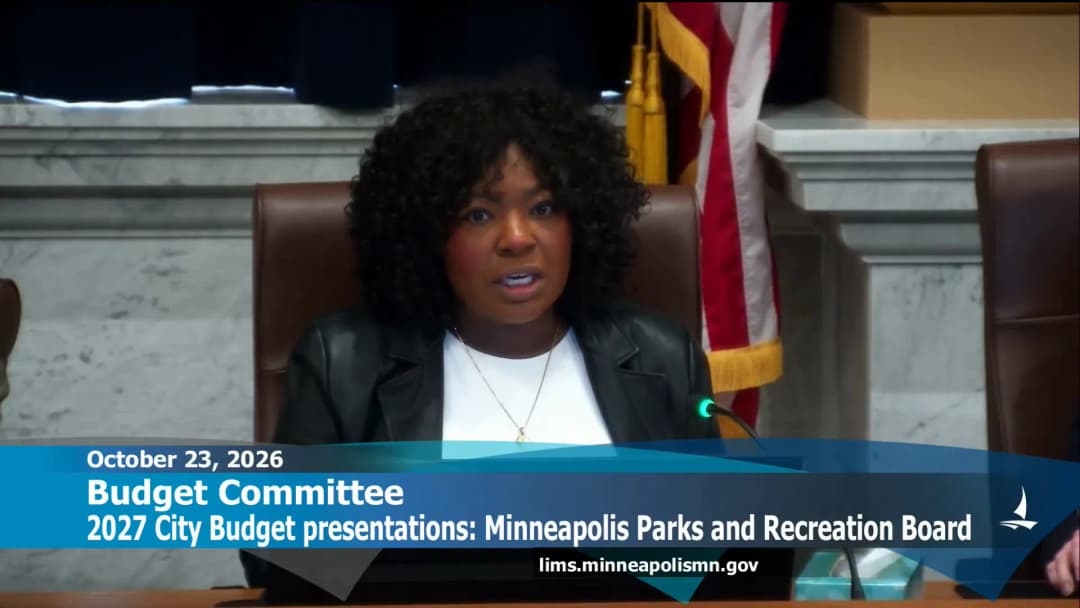
Chair Aisha Chugtai called the meeting to order, establishing a quorum of seven members. The scheduled Youth Coordinating Board presentation was postponed, and materials were filed for review. The committee heard two presentations on the Mayor's recommended 2027 budgets: the Minneapolis Parks and Recreation Board and the Convention Center and Downtown Assets Fund. Discussion: Minneapolis Parks and Recreation Board (2027-2028) Budget Deputy Superintendent Jennifer Ringold and Finance Director Julie Weisman presented the Park Board's budget. The initial request for a 12% increase was scaled back to 5.6% for the 2027 General Fund, with a projected 4.8% increase for 2028. The General Fund relies 81.5% on property taxes. Councilmembers discussed the Board's four strategic priorities—revenue generation, youth, natural areas, and climate—with a strong focus on non-property tax revenue ideas including corporate sponsorships, food trucks, beer gardens, and concessions. Vice Chair Schaefer noted a new sliding-scale youth programming model has eliminated a structural deficit and is being expanded to senior programming. Councilmember Vita offered suggestions for activating North Commons and Upper Harbor Terminal. Councilmember Palmasano expressed frustration that the Park Board has not taken responsibility for maintaining Grass Lake, urging a resolution. Councilmember Stevenson inquired about equity metrics in capital planning and coordination with Minneapolis Public Schools. Councilmember Chavez questioned a prior decision regarding Met Council funding for the Mall parkway project. President Olsen of the Park Board noted that state legislation changes are needed for expanded alcohol sales in parks and that ideas for activation are being actively pursued. Discussion: Convention Center and Downtown Assets Budget (2027) General Manager Jeff Johnson presented the Downtown Assets Fund budget, noting a 4% expense increase driven by $1.1 million in union contracts and a $400,000 street assessment, partially offset by a $75,000 reduction in property insurance. Revenues from sales, lodging, and restaurant taxes are stagnating as hotel occupancy lags 10% below historical averages. The budget for Peavey (PV) Plaza maintenance increased significantly from $50,000 to $400,000 to address aging infrastructure. The Convention Center is bidding for the Big Ten Women's Volleyball tournament. Councilmember Stevenson criticized the area around the Convention Center as an unwelcoming 'island' and urged greater connectivity to downtown. Councilmember Rainville praised the presentation's analysis of tax trends. Councilmember Schaefer questioned the long-term sustainability of the Downtown Assets Fund given revenue stagnation. Councilmember Vita proposed pop-up concepts featuring local award-winning chefs to attract convention business. Councilmember Palmasano asked about the PV Plaza maintenance increase and the upcoming food vendor RFP. Key Outcomes Both presentations were filed without formal votes, serving as informational sessions for the budget process. The Youth Coordinating Board presentation materials were filed for review. The committee will reconvene on Monday, October 26, 2026 at 10:00 AM to receive presentations from Performance Management and Innovation and Public Works.

PARKS AND RECREATION 33% · PUBLIC WORKS 14% · PUBLIC ENGAGEMENT 11% · BUDGET MANAGEMENT 10%
1125
OCT 23, 2026 · JOPLIN, MISSOURI · BOARDS & COMMISSIONS
Joplin Building Board of Appeals Meeting – October 23, 2026

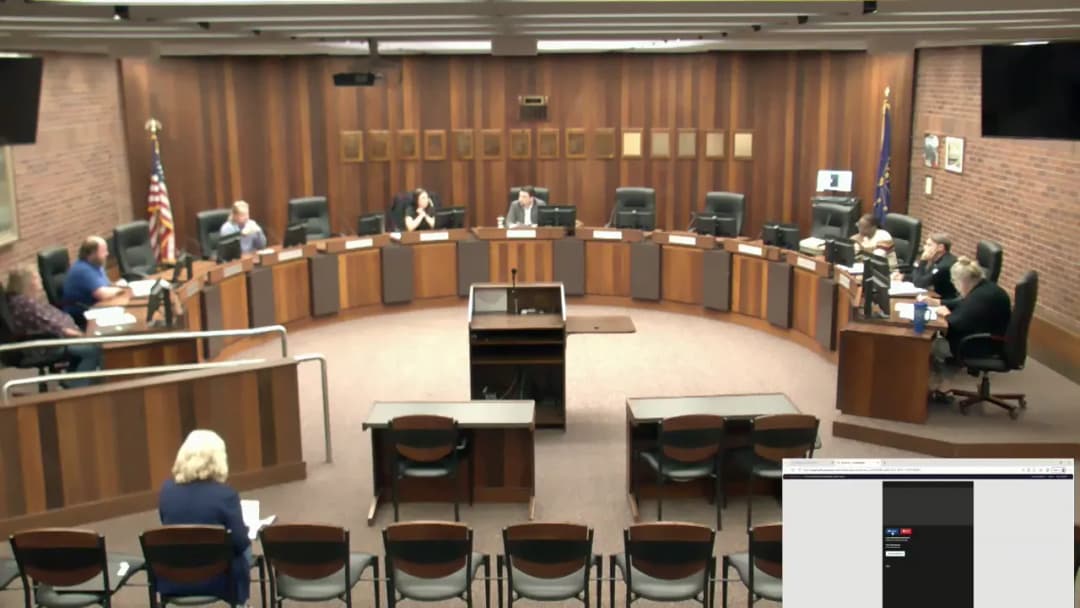
The Joplin, Missouri, Building Board of Appeals met on October 23, 2026, to review a lengthy docket of residential and commercial properties. The board approved the September minutes, excused one absent member, and acted on more than a dozen continued and new cases. Most properties were continued to the next meeting on December 11, 2026, several with warnings that demolition hearings would follow if required progress was not made. The board also held two formal dangerous-building hearings, ordering the building at 320 South Wall to be vacated and ordering demolition at 723 South Roosevelt. Consent Calendar - Board member Mr. Brown was excused due to a business obligation; Mr. Wickland arrived later in the meeting. - The September board meeting minutes were approved by voice vote. Public Comments & Testimony - There was no separate public comment period; property owners, contractors, and an interpreter spoke during individual agenda items. No members of the public spoke at the two formal dangerous-building hearings. Continued Business & New Property Reviews - Item 3121 – 714 East Hill: Staff reported electrical and plumbing inspections are moving forward, but the property is not ready to release. Continued to December 11 for a progress report/demolition hearing. - Item 3141 – 2402 South Alabama: Staff said the project is close to completion but failed final electrical because two additional breakers and lines are needed; temporary power is in place. Continued to December 11. - Item 3142 – 723 South Roosevelt: No response from the owner and no visible progress; the item was tabled to the end of the meeting, when the board held a dangerous-building hearing (see below). - Item 3149 – 929 South Roosevelt: Spire utility approval for the demolition permit was obtained, but water sign-off is still pending; a contractor is ready to pull the permit. Continued to December 11. - Item 3152 – 614 South Moffat: Owner Sammy Abdallah said he finally lined up a plumber and would submit that information immediately. He said he has about $105,000 invested, plans to sell to a buyer, and estimated $15,000–$20,000 for interior work. Board members cautioned that the real cost could be far higher and stressed that a permit and visible work were required. Continued to December 11 on a 5–1 vote. - Item 3154 – 1620 South Iowa: The property owner has hired demolition contractor Vortex/Jeff Anderson; one utility sign-off remains before demolition. Continued to December 11. - Item 3158 – 210 North Oak: Owner David Williams said he decided to demolish rather than remodel, but had not yet hired a demolition contractor. Continued to December 11. - Item 3162 – 12 South Patterson: The owner said he wanted to rehabilitate the property rather than demolish it, had received bids from eight contractors, and planned to make it a three-bedroom rental, with a full-rehab bid of $85,000. Board members expressed skepticism because he brought no written bids, the roof had not been tarped, and the proposed contractor had not appeared. The board voted to allow the existing demolition stay to expire, allowing demolition to proceed. The owner was told there is a 30-day appeal window and that he could still demolish it himself before the city’s process moves forward. Later in the meeting, the owner showed two written bids—$85,000 for the full scope of work and just over $16,000 for structural floor/foundation work—but the board did not revisit its decision. - Item 3163 – 906 East Furnace: Staff said an inspection did not pass; footings and floor joists still need work, with a reinspection scheduled for November 9. The owner is living in the house, utilities are on, and a permit is active. Continued to December 11. - Item 3164 – 915 East Second: Staff said the owner qualified for a vacant dangerous-building permit and secured the house, but had not yet paid for the permit. Board members expressed concern about the front porch and required it to be removed. Note: the transcript lists the address as 915 East Second, while motions refer to 915 West 2nd/916 East 2nd. Continued to December 11 with the porch-removal stipulation. - Item 3165 – 3022 East Ninth: Owner Christian Cornelio explained that his father, who planned the renovation, was deported, and his brother’s DACA status is expired; they are waiting for DACA renewal to fund the work. No permit had been pulled and no contractor hired. The board continued the case to December 11 and warned that demolition could be ordered if there is no permit and measurable progress. - Item 3166 – 222 South Jackson: The Spanish-speaking owner, through an interpreter, said he cleaned out fire debris, received a bid of roughly $45,000–$50,000, and was denied a bank loan due to credit. Staff noted a stop-work order and a pending permit review. Continued to December 11 and expected to be ready for a demolition hearing at that time. - Item 3167 – 805 South Connor: Patrick Stone of Stone Company said he purchased the property nine days earlier and plans to gut-rehab the two-unit building, act as his own contractor, obtain insurance, secure the property, and then apply for the permit. Continued to December 11. - Item 3168 – 2627 Grand: The owner, who said she has lived there 27 years and is on disability, described serious health problems and said insurance lapsed before a fire damaged the back addition and roof. Her pastor is trying to help, but she has no funding yet and faces long waits for assistance programs. The board continued the case to December 11 and asked for a clear plan or bids. - Item 3169 – 320 South Wall: Staff reported that the owner’s representative had hired a Springfield company and was seeking an engineer to address the badly deteriorated fire escape. Board members discussed the condition, the risk to tenants and firefighters, and the possibility of a fire watch. The building was about 30% occupied, with roughly five to seven tenants. The board later held a formal hearing and ordered the building vacated. - Item 3170 – 610 East Pool: Staff said the owners are incarcerated in Jasper County and the property, a former Habitat for Humanity house, burned in the back portion. Continued to December 11 and expected to be ready for a hearing. - Item 3171 – 605 East Pool: Cable Gunlock, owner of GRC Construction, purchased the property seven days earlier and plans to demolish the existing house and build a new structure. He said he did not know it was on the board’s list. Continued to December 11. - Item 3172 – 925 South Pitcher: Staff said the owner died in early August, the family does not want the property, and it is a demolition candidate; publication notice is needed. Continued to December 11. Dangerous Building Hearings - 320 South Wall – Order to Vacate: In a formal hearing, Assistant City Attorney Andrew Knobloch presented evidence from Chief Building Official Brian Wickland. Photos showed a deteriorated steel-and-concrete fire escape with collapsed steps and heavy rust. Title work identified Zon Joplin LLC as owner, and certified mail notices had been delivered to the registered agent. The board found the property dangerous under Joplin Code section 26-612(7) and (11) and ordered the building vacated. - 723 South Roosevelt – Order of Demolition: Earlier in the meeting, the board set this property for a hearing and revoked the current building permit. Inspector Jeff Hadley testified about the posted structure, partial interior demolition, title work showing Christopher D. Finkley as owner, certified mail notices, and required newspaper publications in the Joplin Globe on April 4, 9, 16, and 23, 2026. The board found the property dangerous under section 26-612(3), (4), (13), (14), (16), and (18) and ordered demolition, including outbuildings. Key Outcomes - September minutes approved; Mr. Brown excused. - Most continued items were placed on the December 11, 2026 agenda for progress reports and possible demolition hearings. - 614 South Moffat was continued on a 5–1 vote. - 12 South Patterson’s demolition stay was allowed to expire; the owner has 30 days to appeal and may still demolish it himself. - 915 East Second was continued with a requirement that the front porch be removed. - 320 South Wall was declared dangerous and ordered vacated. - 723 South Roosevelt had its permit revoked and was ordered demolished. Meeting adjourned.

1126
OCT 23, 2026 · BOSTON, MASSACHUSETTS · CITY COUNCIL
City Services Committee Hearing on Boston Rodent Action Plan Status, October 23, 2026

The Boston City Council Committee on City Services, chaired by Councilor Ed Flynn, convened at 10:02 a.m. on October 23, 2026, for Docket 1804, an order for a hearing to discuss the status of the Boston Rodent Action Plan (BRAP). Council President Liz Braden, the co-sponsor, gave opening remarks. Administration officials from Inspectional Services, the Mayor's Office, the analytics team, and the Boston Housing Authority presented an update. Public testimony was taken from residents and neighborhood representatives in person and on Zoom. No minutes were available for this hearing. Public Comments & Testimony - Bonnie Weiss, a property owner on Commonwealth Avenue, said that rats will persist as long as trash collection relies on plastic bags set out overnight; bags are ripped, spill onto the street, and create a chronic food source. - A resident identified in the transcript as D testified that city-owned property in the Bayswater area across from a senior center was left with a trash pile for weeks, 311 cases were closed or marked duplicate, and city departments shifted responsibility. - Lydia Lowe of the Chinatown Community Land Trust said rodent problems in Chinatown are tied to aging infrastructure, private ways, and lack of trash storage; she called for city-provided containerization and action against abandoned buildings and absentee landlords. - Harry, a neighborhood advocate, supported moving trash put-out to the morning of pickup instead of the night before. - Susan Buda, Bay Village Neighborhood Association, said Bay Village has no alleys or outdoor storage and that trash sits out overnight; she also expressed concern that every-other-week compost pickup could increase rodent pressure and said compost expansion needs to be strategic. - A South End resident named David said the same issues were raised at a December 8, 2022 hearing in the same chamber and recommended a rat czar plus enforcement of existing code, including minimum trash-bag thickness. - Allie, a Back Bay resident and block-captain leader, reported increased rat damage to car wiring, urged same-day trash put-out, proposed a pilot using thicker black contractor bags, and called for containerization enforcement. - Kevin Conroy, a lifelong South Boston resident, said his neighborhood has become overrun with rats, called for a central authority and higher fines, and cited absentee landlords and improper trash disposal. - Bob Lathrop of the St. Botolph Neighborhood Association described a successful grassroots effort with the Colonnade Hotel to contain food sources and supported a rat czar for accountability. - John Machikowski, a South Boston resident on Acadia Street, said he has killed 40-50 rats this year, including 8 in the past 10 days, and that his son was hospitalized for two weeks with leptospirosis after exposure to rat-related bacteria; he said the city's response has not been adequate and called for more aggressive enforcement and a rat czar. - Heather O'Brien, from Dorchester and East Boston, said she has filed 247 311 reports over three years about a neighboring developer's unmaintained property, criticized low fines and lack of landlord accountability, and framed rat activity as a public health and environmental justice issue. - Alicia Manning, a Beacon Hill resident for over 30 years, said conditions have worsened, supported a rat czar, and said the city must address the root cause by keeping food waste from being put out overnight. - Lexi Gross, an Allston resident, praised Boston's rat-mitigation work and the recent summit, but called for multilingual public communication, a regional approach, and landlord accountability. - Kelly McGrath, executive director of Brighton Main Streets, said Allston-Brighton commercial corridors have high 311 rat complaints and need the same enforcement and follow-through as residential blocks. Discussion Items - John Elric of Inspectional Services (ISD) said BRAP is a cross-departmental citywide effort launched under Mayor Wu and involving more than 18 departments. - Since January 1, ISD reported responding to 6,018 rodent complaints, conducting 750 rodent treatments, issuing 785 violations, performing 3,000 dumpster inspections, and completing 25 community walkthroughs. ISD has 14 licensed rodent inspectors and almost 60 inspectors who can handle rat-related complaints. - Jeff Kaplan of the city's analytics team described baseline-and-control evaluation of interventions, ground sensors, camera sensors, a hotspot model for proactive mitigation, and a partnership with Basis AI using ultrasonic audio detection at six sites. - The city has deployed rodent-resistant Victor Stanley barrels in Boston Common, the North End, Chinatown, and Mattapan Square, and is incorporating rodent-resistant design standards into new parks and public facilities. - Boston Water and Sewer deployed more than 25 sewer traps in the North End and Back Bay and plans to deploy audio sensors in the North End and South Boston to study subsurface and seasonal rat populations. - The Boston Housing Authority dedicated a four-person rodent reduction team, offers enhanced pay for staff who obtain pesticide licenses, and is piloting containerization, commercial hauling, and composting at its Commonwealth site. - Boston hosted the National Urban Rat Summit on September 23-24 with more than 100 academics, city officials, and pest professionals; administration officials said key takeaways included focusing on old infrastructure, food sources, hiding places, and sewer populations. - Councilor Liz Braden said Allston Village is still waiting for promised rodent-proof trash cans and asked when Allston would be reassessed as a priority; administration officials said they are working with New York on factors that drive rat populations and are measuring tools such as gas-based treatment machines at Ringer Park. - Councilor Murphy asked about bag-thickness rules; John Elric said the code requires thicker two-ply bags, not regular kitchen bags, and that education is used to reduce time trash sits out. - Councilor Julia Mejia asked about fines, enforcement, and public data; administration officials said most fines are issued by code enforcement, not ISD, that no public report has been released yet, and that a public report is planned after more pilot data are collected. - Councilor Flynn said there is a disconnect between resident experiences and the administration's update, called the problem a public health and public safety crisis, and renewed his call for a rat czar and a standalone city department. Key Outcomes - No formal votes or orders were taken; the hearing was informational. - Chair Flynn kept Docket 1804 in committee and said he may schedule another update hearing in the near future. - Councilor Flynn said he will fight during the budget process for a rat czar and a dedicated city department for pest control. - Administration officials said they will continue data collection and pilot programs and plan to publish a public report on intervention results by summer 2027. - Councilor Braden said her office filed a bad-landlords ordinance and noted that a home-rule petition raising the maximum fine to $2,000 was passed; she asked for enforcement follow-up.

PUBLIC HEALTH 37% · ENVIRONMENTAL PROTECTION 23% · PUBLIC SAFETY 13% · WASTE MANAGEMENT 11%
1127
OCT 23, 2026 · INDIANAPOLIS, INDIANA · OTHER MEETINGS (J-Z)
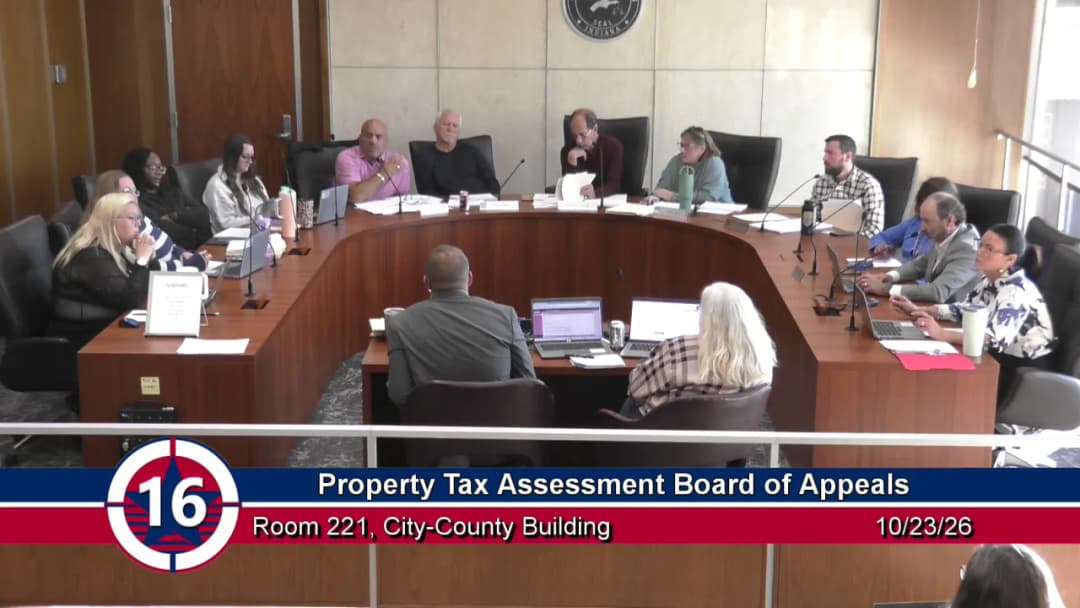
Marion County Property Tax Board of Appeals Meeting - October 23, 2026

The Marion County Property Tax Board of Appeals (PWO) convened on October 23, 2026, to hear several property tax assessment appeals and other routine matters. The board considered both residential and commercial appeals, including requests for adjustments based on property condition, income data, and administrative errors. Key decisions included votes on individual assessments, tabling of certain appeals, and approval of exemptions and meeting dates. Consent Calendar - Minutes from the previous meeting were unanimously approved. - Bulk approvals for pages 26-106 (with exceptions), pages 107-197 (with exceptions), pages 198-289 (withdrawals), and pages 290-300 (exemptions) were passed via consent motions. Discussion Items - John Sturm Appeal (Parcel 1034364): The petitioner argued his property assessment was too high, presenting evidence of a gutted, unfinished interior. He requested deductions for unfinished interior, removal of air conditioning charges, adjustment of completion percentage to 32%, and a condition rating of "very poor" (95% depreciation). Staff analyst Bradley Powers offered a final value based on 35% completion and fair condition, with values of $80,200 for 2023 and 2024, $92,800 for 2025, and $96,500 for 2026. The board voted to accept the staff's recommendation. (Note: The board voted on multiple years including 2023, 2024, and 2025, and also addressed 2026.) - Allison Transmission Personal Property Appeals (Two parcels): Matt Angler (Ice Miller) requested a one-month postponement to allow a meeting between Allison, the county assessor's office, and DMD regarding an abatement issue. Emily Stump (DMD) agreed. The board voted to table the appeals until the next meeting. - Crystal House Name Change Appeal: Terry Chase (via staff) requested correction of a name change issue that led to an incorrect tax bill. The board approved the name change and restored exemptions for 2024 and 2025. - David King Appeal (4742 East 17th Street): The petitioner contested a 44% assessment increase to $114,800, citing extensive needed repairs (roof, electrical, HVAC, etc.) and arguing the property should be valued as a cash sale. Staff had offered $100,000 based on poor condition. After hearing testimony, the board voted to accept staff's proposed value of $100,800 (noting the discrepancy between staff's $100,000 offer and the chairman's stated $100,800). The motion passed. - Crickside Square Apartments Appeal (Parcels 6022125, 6022128, and others): Staff indicated they could not meet the 5% burden of proof because the property owner refused to provide income information. They proposed lowering the assessment to the prior year's value. The board discussed the lack of cooperation and voted to reject the lower values and sustain the original assessed values for all years. The motion passed. - Other Bulk Actions: The board approved multiple sets of appeals via consent: pages 1-25 (with minor items), pages 26-106 (with exceptions for the already-heard cases), pages 107-197 (objective appeals, with exceptions), pages 198-289 (withdrawals), and pages 290-300 (exemptions, including a CIB building). Key Outcomes - John Sturm's property was assessed at $80,200 (2023, 2024), $92,800 (2025), and $96,500 (2026). - David King's property was assessed at $100,800 for 2025 (the appeal year). - Allison Transmission appeals were tabled to the next meeting. - Crystal House exemption was restored for 2024 and 2025. - Crickside Square appeals were denied, with original assessments sustained for all years. - Meeting dates for the next year were approved.

PROPERTY TAX ASSESSMENT 80% · PROCEDURAL 11% · DATA ANALYSIS 8% · PUBLIC ENGAGEMENT 1%
1128
OCT 23, 2026 · KIRKLAND, WASHINGTON · CITY COUNCIL
Kirkland City Council Study Session and Regular Meeting – October 23, 2026

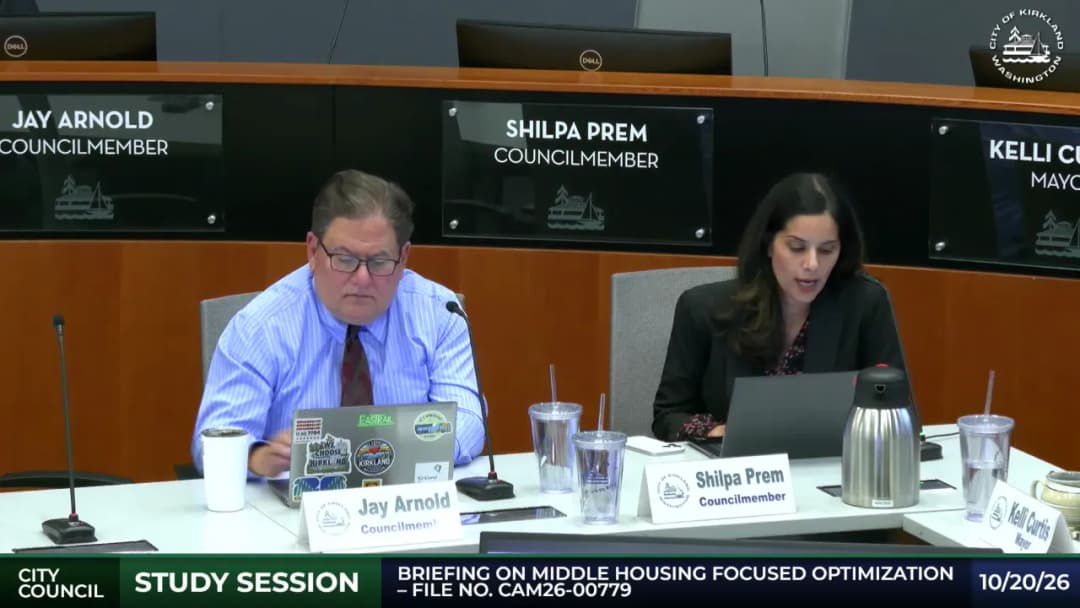
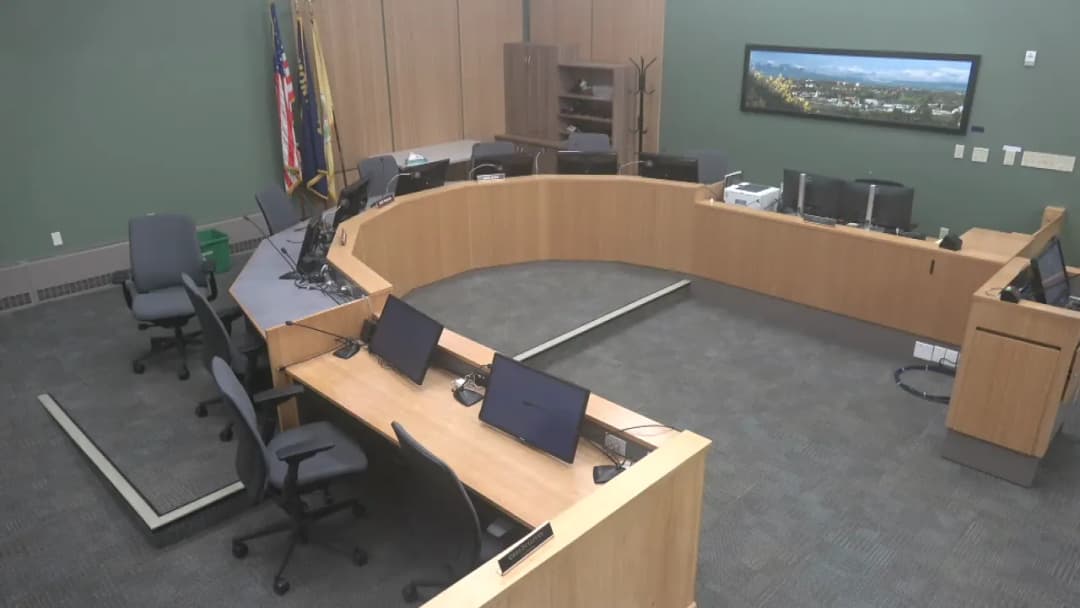
Note: The transcript of the meeting states the meeting was called to order as “October 20th, 2026,” but the session metadata specifies the meeting took place on 2026-10-23. This summary uses the date provided in the metadata per the summarization instructions. The Kirkland City Council convened on October 23, 2026, for three study sessions followed by a regular meeting. Study sessions covered intelligent transportation systems (ITS) and artificial intelligence, the Green Loop implementation plan, and middle housing focused optimization. The regular meeting included public comment, adoption of utility rates for 2027–2028, review of the draft 2027 state legislative agenda, and action on four legislative request memos (LRMs) concerning micromobility, bicycle helmets, and two Homes Point Overlay (HPO) items. Consent Calendar - Motion and second: Deputy Mayor Black moved approval of the consent calendar; seconded by Councilmember Prem. - Vote: Unanimously approved (7–0), including payroll of $8,270,916.57 and bills of $14,526,619.15. - Councilmember Tim Chisholm indicated support before logging off due to a work commitment. Public Comments & Testimony Seven members of the public addressed the council: - Karen Story (wearing a green bandana, representing a group of residents) urged the council to accelerate the phase-out of gas-powered leaf blowers, proposing an ordinance by early 2027. She suggested initially exempting properties larger than one acre, allowing gas blower use during emergencies, enforcement by code enforcement (not police), and holding property owners (not landscapers) responsible. She noted that over 200 U.S. cities have adopted restrictions. - Valentine Kaspar expressed frustration with the Homes Point Overlay (HPO) impervious surface limits, stating his 58,000-square-foot lot was restricted to roughly 14% coverage, preventing remodeling or additions. He argued the progressive sliding scale makes redevelopment infeasible and added that it cost him $50,000 to convince the city of an error in his case. - Scott Morris (Finn Hill Neighborhood Alliance) submitted a letter on two legislative request memos on the agenda and reinforced that any HPO amendments should follow a robust public process with Planning Commission review and public comment. - Steve Yoder (Kenmore resident) thanked the council and police chief for investing in noise enforcement training (Pipe Down training) for officers, stating that citations will be the true measure of success. He expressed broad support for actions against noise pollution. - Susan Carlson (Finn Hill Neighborhood Alliance, Mountains to Sound Greenway Trust) urged the council to adopt a robust ordinance phasing out gas-powered leaf blowers in 2027, citing examples from Washington, D.C., Montgomery County, and Portland. - Ken McKinsey proposed a tool‑lending library partnership with King County Library System (KCLS), modeled on Issaquah’s Curiosity Collection, which was launched in October 2026 with city-donated items and KCLS Foundation funding. - Mark Vossler (retired cardiologist) spoke about air pollution from small engines (particulate matter, oxides of nitrogen) and associated health risks (cardiovascular disease, stroke, asthma). He urged rapid phase-out of gas leaf blowers, noting electric alternatives are cost-effective and emit no pollutants. Discussion Items 1. Intelligent Transportation Systems (ITS), Traffic Signals, and AI (Study Session) - Presentation by Jennifer Palmer (Transportation Engineering Supervisor) and Stephen Padua (Transportation Manager): Palmer outlined Kirkland’s ITS (68 signals, 59 connected to the Transportation Management Center). AI tools include multimodal intersection detection (29 intersections) and a near‑miss analysis pilot (vendor Dirx). Two potential pilots were presented: 1. Adaptive Signal Control Technology: MyOVision ($74,000 for six intersections on NE 85th Street) or Scoot ($140,000 plus unknown infrastructure costs). Vendor-published studies suggested travel‑time reductions of 8–41%. 2. Near‑Miss Analysis: $16,000 per intersection per year (1–5 intersections), requiring staff resources to analyze data and implement countermeasures. - Council Feedback: - Councilmember Prem supported both pilots and asked how near‑miss intersections would be prioritized (Palmer: compatible cameras, higher volume/crash rates, proximity to schools/parks). - Councilmember Pascal supported the adaptive pilot but stressed that staffing resources must be available to operate new systems (citing Issaquah’s experience). He asked for a full view of transportation program priorities. - Councilmember Arnold expressed support but noted budget concerns, requesting that unfunded future‑upgrade items be tracked in the CIP. He asked about MyOVision equipment compatibility (Palmer: MyOVision already deployed on 85th; further expansion would need $25–30K per intersection). - Deputy Mayor Black supported the adaptive pilot and suggested a smaller near‑miss deployment. He asked about connecting the five unconnected signals (Palmer: high cost due to fiber trenching; one will be connected by 2027 via ITS Phase 3, leaving four orphaned signals with no relay options). - Outcome: Council gave general support to both pilot concepts; staff will incorporate budget discussions into next steps. 2. Green Loop Implementation Plan Update (Study Session) - Presentation by Mariah Gill (Planning and Development Manager) and Jody Galvin (Parks Maintenance/Green Loop Partnership Manager): The Green Loop (13.73 miles) connects parks in Finn Hill and Juanita. Of that, 6.28 miles already exist; 7.45 miles of new natural-surface trail need development. The plan would require adding over 10 acres of open space, largely through acquisition from willing sellers. Three logo concepts (tree ring, banana slug, fern) were presented; community feedback favored the fern. $14 million has been dedicated (four Conservation Futures grants, a Department of Commerce grant, and parks levy funds). Near‑term priorities were highlighted. - Council Feedback: - Deputy Mayor Black viewed it as a long‑term project, recommending opportunism and prioritizing North Juanita park needs. - Councilmember Pascal asked for specific timeline expectations for near‑term priorities (staff: will vary by segment—some trails can be built in a few years, others need acquisition). He supported the concept but sought clearer five‑year actions. He deferred on the logo and asked whether connections proposed by the Finn Hill Neighborhood Alliance had been vetted (staff: open to opportunities but want genuine connections). - Councilmember Arnold was more optimistic, asked why certain segments (e.g., near elementary school, Finn Hill Middle School) were mid‑ or long‑term, and whether acquiring all land now might be a priority (staff: focus on acquisition with levy funds, but some grants require construction). He favored the tree ring logo. - Councilmember Prem considered the plan a living document open to opportunism; she disfavored the banana slug and liked the fern or tree ring. - Councilmember Tim Chisholm (remote) echoed Deputy Mayor Black’s comments. - Mayor Curtis noted grant timelines (Conservation Futures may time out soon) and commended the $14 million raised. - Outcome: Staff received feedback to refine priorities and will return in January 2027 with a draft implementation plan. 3. Middle Housing Focused Optimization (Study Session) - Presentation by Adam Weinstein (Planning Director) and Martha Rhubar (Senior Planner): Middle housing (cottages, ADUs, townhomes, multiplexes, stacked flats) was first allowed in 2007; updates in 2020 and 2025 (state law) have increased production (peak of 140‑160 units per year, mostly ADUs and cottages). The 2026–2028 planning work program explicitly allows updates to lot coverage and floor‑area ratio (FAR) but not height, setbacks, or tree retention (to be addressed in 2028). Four options were presented: 1. Targeted adjustments to streamline permits. 2. General optimization (adjust FAR, lot coverage). 3. Incentivize retention of existing homes and age‑friendly housing (e.g., stacked flats). 4. No action until 2028. The Master Builders Association supported options 1, 2, and voluntary incentives from option 3, emphasizing simplicity and flexibility. - Council Feedback: - Councilmember Arnold supported options 1 and 2, advocating for streamlined FAR (e.g., fixed allowances per unit instead of calculations) and tiered FAR bonuses for preserving existing houses. - Deputy Mayor Black offered four guiding principles: Simple, Smaller, Streamlined, Stability. He emphasized FAR as a key lever and urged quick, stable implementation. - Councilmember Prem supported option 2 with a tiered FAR approach that incentivizes more units rather than larger units. - Councilmember Pascal supported options 2 and 3, stressing market demand and the need to make ADU/cottage projects feasible for small property owners (e.g., retired residents who want to downsize). - Councilmember Tim Chisholm supported option 2 with elements of option 3. - Councilmember Falcone supported options 1, 2, and 3, especially age‑friendly housing types like stacked flats. - Mayor Curtis called herself a “strong option 2,” wanting to pull in option 1 for short‑term gains, and expressed interest in option 3 pending time constraints. - Outcome: Council provided direction to pursue options 1 and 2, with some interest in option 3; the matter goes to the Planning Commission next. 4. Adoption of 2027–2028 Utility Rates (Regular Business) - Presentation by Jenny Gauss (Surface Water Strategic Advisor) and Tracy Dunlap (Deputy City Manager of Operations): Rates were presented following earlier preliminary discussions (August and September 2026). The approved increases are: - Water: 6.75% each year (2027, 2028) - Sewer: Local 8.85% each year; King County pass‑through 6.29% (2027), 12.75% (2028) - Surface Water: 5.9% each year - Solid Waste: 5.3% each year Rate smoothing over six years helps stabilize revenue; regional partner increases remain a key driver. - Motion and vote: Councilmember Pascal moved, Deputy Mayor Black seconded, to adopt ordinances O4951, O4952, O4953, and O4954. Councilmember Prem expressed strong concern about the burden on residents and businesses and urged cost reduction efforts. The motion carried 7–0. 5. Draft 2027 State Legislative Agenda (Regular Business) - Presentation by Andriana Campbell (Government Affairs Manager): Eight legislative priorities grouped under three headings. Highlights include preserving local planning authority, counting ARCH contributions toward GMA housing targets, utility rate regional affordability, balanced approach to electric motorcycles, transportation funding (including road‑usage charge revenue sharing and heavier‑vehicle weight limits for TBD fees), noise camera authority, municipal jail liability, public defense funding, ballot‑box buffer zones (expanding from 25 ft to 100 ft), and stable behavioral health funding. - Council Feedback: Councilmember Arnold asked that the Agenda explicitly include counting Affordable Housing contributions (e.g., ARCH) toward GMA obligations; City Manager suggested extending the language to sub‑regional entities. The draft will be refined by the legislative work group and brought back for adoption on November 17, 2026. 6. Legislative Request Memo – Micromobility (Regular Business) - Presentation by Stephen Padua (Transportation Manager): Four options were presented: (1) pilot a shared mobility program, (2) contract with a private company for a longer‑term program, (3) procure and operate a city‑owned fleet, or (4) a hybrid. - Motion by Deputy Mayor Black (seconded by Councilmember Arnold): Commence a due diligence process, including conversations with the Transportation Commission, with a goal of reporting back in or around the end of 2027, taking into account the opening of high‑frequency transit (Stride BRT, RapidRide), and subject to budget discussions and available resources. An amendment adding budget considerations (moved by Deputy Mayor Black, seconded by Councilmember Pascal) was adopted. - Vote: Motion carried 7–0. 7. Legislative Request Memo – Bicycle Helmets (Regular Business) - Options: (1) adopt a local ordinance requiring helmets for all bicyclists/e‑bike/e‑scooter users, (2) further research and engagement, (3) incentive‑based approach, (4) pursue statewide legislation. - Council Discussion: Councilmember Prem (option 1) stressed urgency. Councilmember Falcone supported options 2 and 3 (equity concerns). Councilmember Arnold supported option 3 (incentive‑based). Deputy Mayor Black supported option 1 plus option 3 (helmets for all, with a distribution program). Councilmember Pascal favored option 3. Mayor Curtis leaned toward options 2 and 3, wanting more community engagement and free‑helmet distribution (e.g., via Evergreen Health). - Motion by Councilmember Arnold (seconded by Councilmember Falcone): Pursue options 2 (further engagement before considering an ordinance) and 3 (incentive‑based approach). - Vote: Carried 5–1 (Councilmember Prem opposed). 8. Legislative Request Memo – Homes Point Overlay: Middle Housing Development Standards (Regular Business) - Presentation by Adam Weinstein (Planning Director): The HPO has unique environmental constraints (landslide hazards, streams, wetlands). Options Menu A: (1) leave code, (2) bring lot coverage up to 50% citywide standard, (3) special carve‑out for middle housing with looser standards. Menu B: standard or more public engagement. - Council Feedback: Councilmember Pascal sought a “surgical” change (option 2). Councilmember Arnold suggested exploring values below 50% (40% as a max). Councilmember Falcone agreed but wanted to see impacts of 50% vs. lower numbers. Deputy Mayor Black supported standard public engagement. Councilmember Prem asked for clarity on determining thresholds and proposed returning with a staff report analyzing three options (40%, 50%, hybrid). - Motion by Councilmember Pascal (seconded by Councilmember Falcone): Proceed with option 2 (lot coverage modifications from 40% to 50% or other options) with a standard public engagement process. - Vote: Carried 6–0. 9. Legislative Request Memo – Homes Point Overlay: Tree Removal Allowances (Regular Business) - Presentation by Adam Weinstein: Current HPO tree removal only for hazard/nuisance. Options: (1) leave code, (2) focus code amendments (citywide allowance of 2–4 trees per year depending on lot size, or something less such as two trees every 5 years as proposed by the Finn Hill Neighborhood Alliance), (3) same plus more public engagement. - Council Feedback: Councilmember Falcone wanted options ranging from matching the rest of Kirkland to a compromise (e.g., one tree per year). Deputy Mayor Black preferred uniform citywide allowance (two per year) or one per year, but not the five‑year variant due to administrative burden. Councilmember Pascal supported exploring one per year or similar. Councilmember Prem wanted consistency unless strong environmental reasons justify otherwise. Deputy Mayor Black noted that critical‑area constraints naturally limit removals. - Motion by Councilmember Falcone (seconded by Deputy Mayor Black): Proceed with option 2 with standard public engagement, with two variants: (a) match the rest of Kirkland (two trees per year), (b) half of the rest of Kirkland (one tree per year). - Vote: Carried 6–0. Key Outcomes - ITS/AI Pilots: Council expressed general support for adaptive signal control and near‑miss analysis pilots; staff will incorporate budget considerations. - Green Loop Implementation Plan: Staff to refine priorities and return with a draft plan in January 2027; logo direction favors fern or tree ring, with final designs to be presented for community vote in November 2026. - Middle Housing Focused Optimization: Council directed staff to pursue options 1 and 2 (streamlined adjustments and general FAR/lot coverage optimization); matter proceeds to Planning Commission. - 2027–2028 Utility Rates: Four ordinances adopted 7–0 (water +6.75%/yr, sewer local +8.85%/yr + King County pass‑through, surface water +5.9%/yr, solid waste +5.3%/yr). - 2027 State Legislative Agenda: Draft agenda reviewed; staff directed to include explicit reference to counting sub‑regional affordable housing contributions toward GMA obligations; final adoption scheduled for November 17, 2026. - Micromobility: Motion approved 7–0 to commence due diligence (Transportation Commission input, considering high‑frequency transit openings, reporting by end of 2027, subject to budget). - Bicycle Helmets: Motion approved 5–1 to pursue further engagement (option 2) and an incentive‑based approach (option 3); no ordinance adopted at this time. - HPO – Middle Housing Standards: Motion approved 6–0 to explore lot‑coverage modifications (40–50% range) with standard public engagement. - HPO – Tree Removal: Motion approved 6–0 to pursue a focus code amendment with standard public engagement, considering two options: (a) citywide allowance (two trees per year) or (b) half that (one tree per year). - Executive Session: Council adjourned to executive session to discuss sale/lease of real property and potential litigation; reconvened at 11:10 PM solely for adjournment.

INTELLIGENT TRANSPORTATION SYSTEMS 14% · PARKS AND RECREATION 12% · PLANNING AND ZONING 10% · ZONING REGULATIONS 9%
1129
OCT 23, 2026 · CLEVELAND, OHIO · CITY COUNCIL MEETINGS
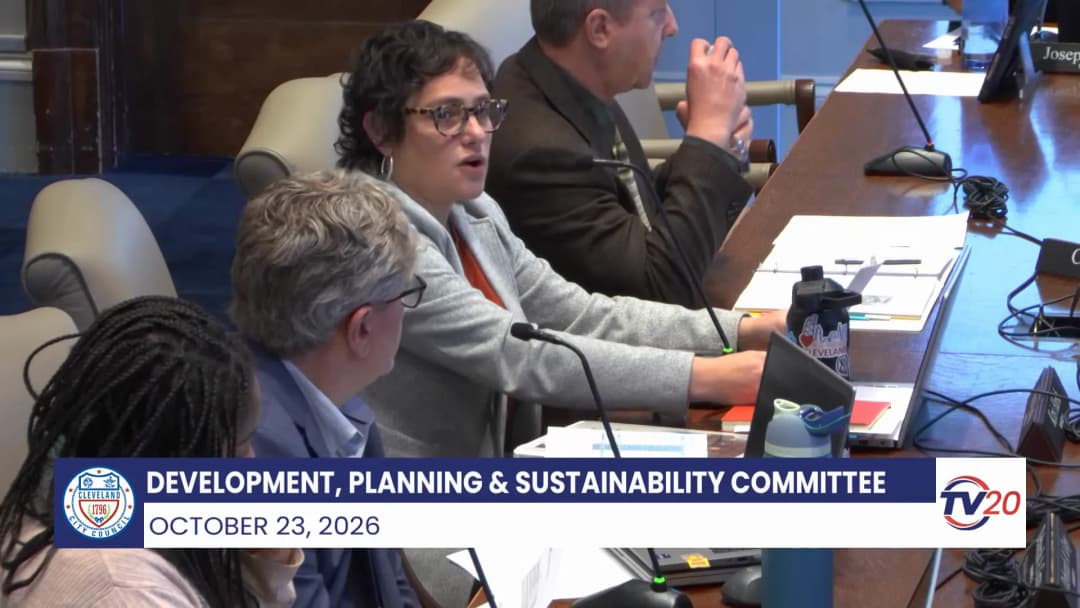
Cleveland City Council CDBG Budget Hearing (Day 2) – October 23, 2026

This was the second day of the annual Community Development Block Grant (CDBG) budget hearing, convened by the city council committee responsible for CDBG oversight. The meeting focused on detailed presentations and discussion of programs funded through CDBG and related HUD grants, including HOPWA, Emergency Solutions Grant (ESG), the Department of Aging Chore Program, and the HOME program. Council members and administration staff addressed program performance, data challenges, federal funding cuts, homelessness, housing equity, and the need for improved metrics. Procedural Matters - The chair noted Councilwoman Santiana’s excused absence. - A procedural question was raised about upcoming legislation to expend a grant; it was determined that a separate DPS committee meeting would likely be needed after the legislation’s introduction. Data and Process Challenges - An assistant director explained that data collection for CDBG-funded activities is “noisy and fragmented,” with challenges aligning goals, programs, projects, and activities. - National objectives for CDBG were outlined: benefit low-/moderate-income persons, eliminate slum/blight, or meet urgent needs. - Internal caps: administrative costs cannot exceed 20% of total grant; public services cannot exceed 15%; 70% of dollars must benefit low/moderate-income persons. - Emphasis on proper setup of activities in HUD’s data tracking system to avoid compliance issues. HOPWA (Housing Opportunities for Persons With AIDS) Presentation - Lita Wills (Department of Public Health) presented HIV/AIDS housing and prevention programs funded by HOPWA and CDBG. - Services include rent/mortgage assistance, utilities, food, transportation, case management, and wraparound supports. - Partner agencies: NEAC, Joseph’s and Mary’s Home, AIDS Task Force of Greater Cleveland, Nueva Luz, Eden, and CDPH. - Administrative cap for HOPWA is 10% (CDPH uses approximately $70,000 admin, well under cap). - Funding distribution (ballpark): Eden and AIDS Task Force $900,000 each, NEAC $350,000, Nueva Luz $270,000, St. Joseph’s $38,000. - CDBG provides about $275,000 (10% match) to HOPWA. - Fast Track Cities initiative: Cleveland and Cuyahoga County joined to reduce HIV infections 95% by 2030; group meets biweekly to coordinate and advocate. - Concern about Medicaid cuts affecting HIV treatment access; task force formed to mitigate impact. - Council members questioned whether administrative burden of block grants could be reduced; Wills noted client-level data stays with provider agencies. Emergency Solutions Grant (ESG) Presentation - David Steinmüller (Manager, Emerging Programs) presented ESG and related CDBG-funded homeless services. - Annual ESG allocation: $1.76 million (expected to be $1.72 million in coming year due to federal cuts). - 2025 point-in-time count: 1,655 homeless individuals in Cuyahoga County; 18.8% under 18, 8.2% over 64, 68% Black, 21.5% white. - ESG funded emergency shelter (4,056 individuals) and rapid rehousing (278 people/91 households). - CDBG supplements: shelter (150 individuals/night), street outreach (150 individuals), food distribution (208,371 meals to 7,723 individuals). - Programs operate in coordination with the county as Continuum of Care lead. - 20 applications received for next grant cycle; determinations pending. - Council members raised concerns about shelter capacity (full shelters, no beds), the end of emergency housing vouchers (approximately 475 units at risk), and lack of a coordinated plan to address the gap. - Director noted that city council controls 40% of CDBG, limiting strategic flexibility. Department of Aging Chore Program - Director Mary McNamara presented the chore program (grass cutting, leaf raking, snow path shoveling) funded in part by CDBG ($280,000) plus general fund (total over $400,000). - 1,259 unduplicated clients received 11,056 services in the past year. - The program uses staff and contractors (including court community services) and has a volunteer component (Snow Heroes). - Council members praised the program and discussed expansion, including a hybrid model with CDCs (Community Development Corporations) funded by ward council members. - CDBG public services cap (15%) limits further expansion. HOME Program Presentation - Ben Trimble (Housing Development Manager) and Joe Rose Bordeaux Small (Director of Development) presented the HOME Investment Partnerships Program. - HOME annual allotment $4–6 million; program income varies. - 2025 accomplishments: 511 total affordable units produced; city investment $9.6 million; leveraged private investment $176.9 million. - 59 units directly funded by HOME; others leveraged. - Admin cap for HOME is 10%; positions moving to general fund next budget. - Most funds used as gap financing for Low-Income Housing Tax Credit (LIHTC) projects (multifamily rental). - Councilman Jones expressed frustration about lack of homeownership opportunities in his ward (Ward 1), arguing that HOME investments predominantly go to rental housing, not owner-occupied. He advocated for lease-to-own requirements and more equity in distribution. - Councilman Shaw raised the Cleveland Housing Plan 2030 and its “Housing Report Card” metrics, requesting annual progress reports. Director acknowledged the plan’s goals but said the current framework is insufficient for measurement and would require a year of development to produce meaningful data. Shaw pushed for a better system and offered to collaborate. - Councilman Davis asked about the location of HOME units and future funding outlook; Trimble reported a 15% decline in HOME funding this fiscal year. Key Outcomes - A DPS committee meeting will be scheduled to consider legislation for grant expenditure (likely the upcoming week). - No formal votes were taken during this hearing; discussion was informational. - Director committed to providing council with information on the housing report card metrics and exploring a better accountability framework. - The hearing was recessed for lunch at 11:50 AM and was scheduled to resume at 12:20 PM with continued discussion of community development programs.

HOMELESSNESS 24% · HOUSING 17% · PUBLIC HEALTH AWARENESS 16% · AFFORDABLE HOUSING 14%
1130
OCT 23, 2026 · PLEASANTVILLE, NEW YORK · VILLAGE BOARD OF TRUSTEES & BOARDS
Pleasantville Village Board of Trustees Regular Meeting – October 23, 2026

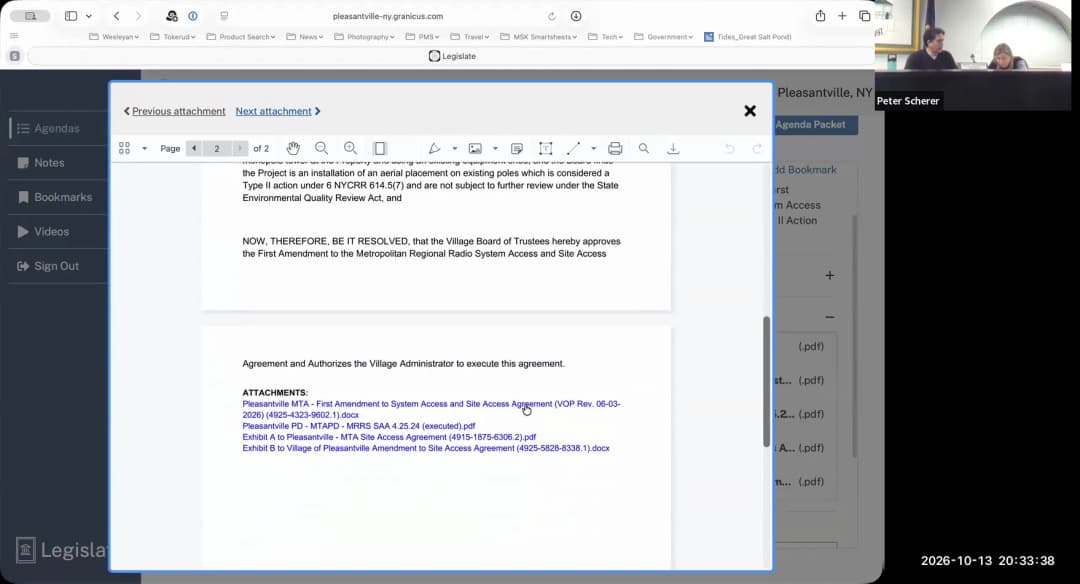
Public Comments & Testimony - Two public comment periods were held. No members of the public offered comments from the audience or via Zoom. Public Hearing: Local Law No. 6 of 2026 - The board opened a continued public hearing on Introductory Local Law No. 6, which would amend Chapter 21 of the Village Code to establish the Village’s official year as starting at 12:00 noon on January 1 and to move the commencement of terms for elected officials to the same time, following the November election. No public comments were received, and the hearing was closed. The board later adopted the law via Resolution 2026-338. Announcements and Reports - The Mayor provided updates on several village matters: - Nighttime hybrid flushing was concluding (last session 12:00 a.m.–7:00 a.m. on Friday). - The Safe Streets for All project workshop results would be presented with priorities at the end of November. - The red light camera on the Saw Mill River Parkway at Grant Street remained pending; the county had taken legislative action and selected a vendor, but no installation date was available. - E-bike and electric scooter enforcement was a growing concern; riders must be 16 and wear helmets. - The Halloween costume swap was ongoing through October 18; the Ragamuffin Parade and Fall Festival would take place October 25; the Live Well Pleasantville health fair and a free movie night were scheduled for October 17; window painting was also occurring. - The dog park was closed for approximately two to three weeks due to cell tower work. - Anthony, Superintendent of Public Works, reported on annual paving: - Milling was completed on Congress, Cornell, Crawford, Temple, and Tompkins streets; paving was expected to finish by Friday, weather and equipment permitting, within the $360,000 budget. - Additional funds might be used for sidewalk repairs on Sunnyside Avenue near the crest of the hill, pending final accounting. - A trustee announced the Live Well Pleasantville community health event and evening movie (free, showing Hocus Pocus) on October 17, and the Halloween costume swap schedule. - The Mayor recognized the DPW and 929 Construction Services for their work on the paving project. Resolutions and Discussion - Resolution 2026-338 (Local Law No. 6): Adopted as described above. - Resolution 2026-339 (Close Police Capital Account): The board authorized closing the Police Department Capital Account due to project completion and transferring the remaining $9,115.63 to fund a contract with Urban SDK for police software ($9,100). - Resolution 2026-340 (Budget Amendments FYE 2027): Approved multiple fund transfers and revenue/expense adjustments totaling $151,215.22 in capital fund increases and corresponding decreases. - Resolution 2026-341 (Minutes of Sept. 28, 2026): Approved. - Resolution 2026-342 (PCTV Dissolution Expenses): Authorized up to $10,000 for dissolution expenses; it was noted that PCTV had about $9,500 remaining. - Resolution 2026-343 (Abstract of Claims): Approved payments totaling $513,034.06 across funds. - Resolution 2026-344 (MTA Radio Access Agreement): Approved a First Amendment to the Metropolitan Regional Radio System Access and Site Access Agreement to install radio equipment for the DPW’s SCADA system failover. The project was determined to be a Type II action under SEQRA. - Resolution 2026-345 (SS4A Grant): Accepted a $160,000 grant from the U.S. DOT for the Pleasantville Vision Zero Action Plan. - Resolution 2026-346 (Hire Recreation Assistant): Elizabeth McDonough was hired at $22.00/hour for the Panther Club, effective October 13, 2026. - Resolution 2026-347 (Holiday Lighting Contract): Awarded a three-year contract to Neave Decor at $61,750 per year for downtown holiday lighting installation and removal. - Resolution 2026-348 (Bulletproof Vest Grant): Authorized the Police Department to apply for a $10,255 federal grant to replace six vests. - Resolution 2026-349 (Resignation): Accepted the resignation of Laborer Anthony J. Tufo, III, effective October 22, 2026. - Resolution 2026-350 (Motorcycle Replacement Grant): Authorized application to the NYS Municipal Facilities Capital Program for replacing the 19-year-old police motorcycle. - Resolution 2026-351 (Block Party): Approved a block party and road closure on Sarles Lane (Congress to Crawford Streets) for October 17, with a rain date of October 24, from 12:00 p.m. to 10:00 p.m. - Resolution 2026-352 (ZBA Appointment): Approved the Mayor’s appointment of Alex Shukhman to the Zoning Board of Appeals for a five-year term ending April 1, 2031. - Resolution 2026-353 (Memorial Plaza Closure): Authorized the closure of Memorial Plaza on October 25 from 7:00 a.m. to 3:00 p.m. for the Ragamuffin Parade and Fall Festival. Key Outcomes - Local Law 6 of 2026 was adopted, shifting the start of elected officials’ terms to January 1 at noon. - All 16 resolutions were approved unanimously by voice vote. - Two new grants were authorized (SS4A for Vision Zero and Bulletproof Vest Partnership), and the Police Department was authorized to apply for a third grant (motorcycle replacement). - Personnel actions included one hire, one resignation acceptance, and one board appointment. - Financial actions included closing a capital account, approving budget amendments, and paying claims. - The next meeting is scheduled for Monday, October 26, 2026, at 7:00 p.m. at Pleasantville High School, featuring a public hearing on the Lenar proposal for 102 townhouses.

PROCEDURAL 55% · TECHNOLOGY AND INNOVATION 14% · PUBLIC WORKS 13% · PUBLIC ENGAGEMENT 4%
OPENPUBLICA · PUBLIC MEETING INDEXUPDATED DAILY · openpublica.com