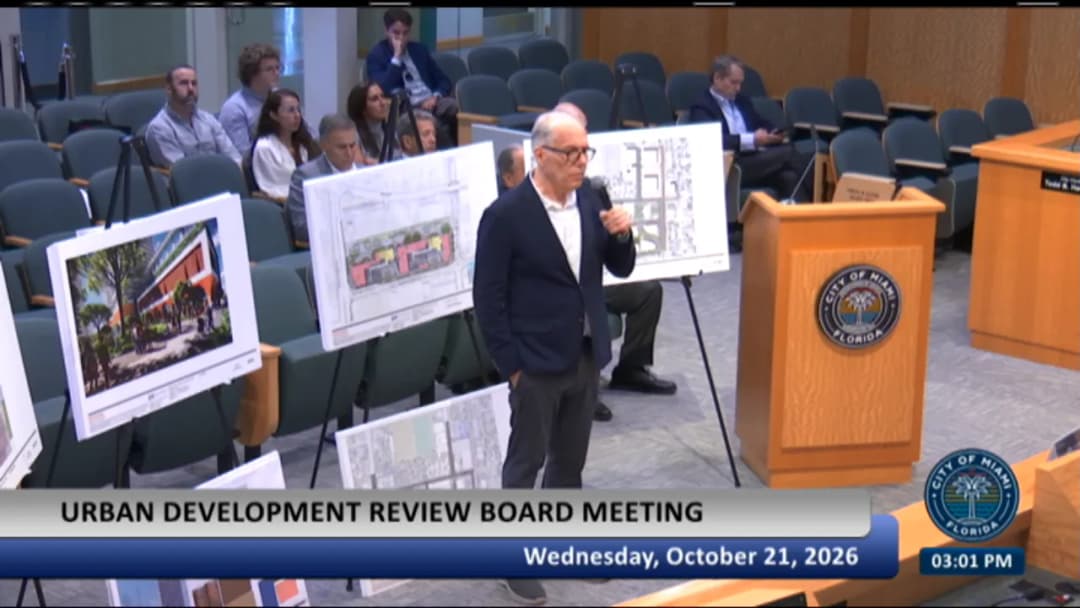
The Miami Urban Development Review Board (UDRB) convened on October 21, 2026. The board considered two major development applications, reviewed the city's waterfront connectivity report, and received an update on the Live Local Act. Consent Calendar & Routine Approvals - A quorum was established. Absence waivers for Chair Labrata and Member Barrera were approved (4-0). - No online public comments were received. - The minutes from the September 16, 2026 meeting were approved (4-0). Agenda Item: 1836 Biscayne Boulevard (1836 Residences) Project Description: A Special Certificate of Appropriateness request for a 42-story, 406-unit residential tower incorporating the restoration of the historic church on site. The applicant (represented by Carlos Diaz, Bernardo For Brescia, and Richard Heisenbottle) reduced the required code waivers from 16 to 9 and increased open space from 13% to 26%. Discussion: Board members praised the preservation of the church facade. Member Garlardo criticized the "vertical blocks" on the podium as harsh and out of proportion with the historic structure. Member Behar regretted the loss of the church's interior dome, questioned the "cool gray" color palette, and requested warm tones and shade trees. Outcome: Approved (3-1). The motion included a condition to review the podium's color palette and a recommendation to add shade trees. Member Garlardo voted against, preferring the podium redesign be mandatory. Agenda Item: 6001 NE 2nd Avenue (Magic City Residences) Project Description: Approval for two towers (parcels 13 and 15, 553 total units) within the Magic City / Little Haiti Innovation District Special Area Plan (SAP). The project emphasizes ground-floor retail along a grand promenade and steps down in height towards NE 2nd Avenue. Discussion: Members discussed the delivery of the promenade, a long interior corridor, and the use of artificial green screening. Member Pramui requested subtle breaks in the corridor. Member Perez Azua requested removing the artificial facade planting, noting it is against city code. The developer confirmed the adjacent section of the promenade will be built concurrently. Outcome: Approved (4-0) with conditions: 1) Break up the long corridor on level A110, 2) Remove artificial green facade screening, and 3) Build the adjacent promenade to full width. Discussion Item: Waterfront Connectivity Report Presentation: Principal Planner Andrea Sandoval presented the report, a benchmark study since Miami 21 (2009). Key Statistics: 2.75 miles completed following Miami 21 standards. 1 mile in the pipeline. 12% of disconnected gaps are on city-owned land, creating grant opportunities. Board Action: The board unanimously supported the study and recommended it proceed to the City Commission. Discussion Item: Live Local Act Update Presentation: Staff provided an update on the state law and its local impact. Key Statistics: 93 projects submitted, proposing over 20,000 dwelling units (11,000 income-restricted). Board Feedback: The board requested quarterly updates on the act's impact, specifically regarding traffic and congestion near transit corridors where parking reductions are permitted. Key Outcomes - 1836 Residences: Approved (3-1) with 1 condition and 1 recommendation. - Magic City Residences: Approved (4-0) with 3 conditions. - Waterfront Connectivity Report: Recommended to the City Commission with full board support. - Live Local Act: Quarterly updates to be provided to the board.
The Public Meeting Index
The Public Meeting IndexThe Public Health, Safety, and Equity Committee of the Minneapolis City Council met on October 21, 2026, at the recorded start time of 2026-10-21 18:32:56+00:00. Chair Jason Chavez presided; members present were Councilmember Payne, Councilmember Wandsley, Councilmember Vita, Vice Chair Stevenson, and Chair Chavez. Councilmembers Greenville and Whiting were absent, and the committee confirmed a quorum. The committee recognized Health Literacy Awareness Month, approved an ethics education alignment ordinance, heard public testimony demanding accountability in the killing of Mariah Samuels, approved several contracts and grants, and received reports on public safety organizational structure and police chief hiring recommendations. Health Literacy Awareness Month Resolution Health department staff presented a resolution declaring October 2026 as Health Literacy Awareness Month in Minneapolis, emphasizing plain-language health information, accessibility for non-English speakers, and science-based information. Chair Chavez shared that his wife is a 10-year breast cancer survivor and spoke about the difficulty of navigating complex medical terminology as a caregiver. Health department staff said health literacy is tied to a resident's right to understand and make informed health decisions. The resolution was approved by voice vote with no announced opposition. Public Hearing: CCPO Ethics Education Ordinance The public hearing concerned a proposed ordinance amending Title 9, Chapter 172 of the Minneapolis Code of Ordinances to align ethics education training requirements for Community Commission on Police Oversight (CCPO) members with the citywide ethics ordinance adopted in May 2026 for non-employee local officials. No members of the public signed up to testify. Councilmember Payne said police reform is a continuous journey. The ordinance was approved by voice vote with no announced opposition; Councilmember Wandsley later asked to be recorded as an aye, and the request was accepted without objection. Public Comments & Testimony: Domestic Violence Response and Mariah Samuels During the public comment period on the city's response to domestic violence-related calls for service, community members and family members described the Sept. 14, 2025 killing of Mariah Samuels and called for an independent after-action review, discipline for responding MPD Officer Ryan Weber, accountability from Mayor Jacob Frey and then-Chief Brian O'Hara, and community control of public safety. Jay Yates of the Twin Cities Coalition for Justice said Samuels had obtained an order of protection, called 911 at 5:14 a.m., and was fatally shot at 7:50 a.m.; he said body-worn camera footage contradicted Officer Weber's report that Samuels said she felt safe. Loretta cited Violence-Free Minnesota statistics of 31 domestic-violence homicide victims in Minnesota in 2025, 24 in 2024, and a historic high of 40 in 2023, and said Black women are murdered at 2.7 times the rate of white women and Native American women at 7 times the rate. Umberto cited a Global Rights for Women study finding that only 20% of more than 43,000 domestic violence calls to MPD resulted in an official police report or arrest. Melissa Washington, also with the Twin Cities Coalition for Justice, criticized unaccountable policing and a $23 million MPD overtime request. Simone Ray, Mariah's sister, said Mayor Frey did not meet with her family and that officers should be reprimanded. Jana Williams, aunt of Allison Lucer and Ariana Buchanaga, demanded justice and said two murderers had been charged in Ariana's case only after community pressure, while a county attorney deal and destroyed evidence threatened the case. Anusha Ramaswamy, a Ward 4 resident, supported the after-action review and opposed a $13 million MPD overtime increase. Another commenter, Phil, cited an audit finding that only three to five investigators handled felony domestic violence investigations at that time. Momo Rose, a domestic violence survivor, said victims must be believed by government when they report. Committee members thanked the speakers; Councilmember Wandsley shared that her aunt was also murdered by a partner and had never received justice; Chair Chavez acknowledged Mariah Samuels was failed and committed to pursuing an after-action review through another route if the independent audit department did not act. Public Hearings Set for Health Commissioner and Police Chief Nominations The committee set a public hearing for Nov. 4, 2026, to consider Mayor Frey's nomination of Heidi Ritchie as health commissioner for a term ending January 30, and a Nov. 4, 2026 hearing to consider his nomination of Bill Peterson as police chief for a term ending January 2030. Chair Chavez clarified these actions set hearings and were not confirmation votes. The motion carried. Contract and Grant Approvals The following items were approved by voice vote with no announced opposition: - Fire and emergency response contract with the Minnesota DNR for Fort Snelling Upper Post Housing Development: $15,000 annual retainer plus per-response fees. Fire Finance Director Luke Scardili said incidents have been rare but included a fire a few years ago. - Three-year contract with Keepers Wellness for firefighter mental health services, approximately $440,000, providing 24/7 first-responder trauma response and critical-incident debriefing. - Contract with Roche Diagnostics for point-of-care testing equipment for chlamydia and gonorrhea on the mobile medical unit, adding to existing syphilis, HIV, and hepatitis C testing. The health department representative said high rates exist among 15-to-24-year-olds, the opioid settlement would cover capital costs, and maternal/child health funding could support supplies. - Acceptance of the Title V Maternal and Child Health Block Grant passed through the Minnesota Department of Health, funding maternal-child health and school-based clinics under a 2024-2029 contract; funding is received year to year and not guaranteed. - Acceptance of $250,000 from the Minneapolis Foundation EPA Environmental Justice Thriving Communities Grant Making Program for the community air monitoring project, including a full-time temporary staff position, community stipends, air monitoring training, and analysis of data collected since 2022. - Joint powers agreement with Hennepin County for $704,000 for Community Trauma Response Services. Neighborhood Safety Director Amanda Harrington said COPE would provide a response team for shootings in the Third Precinct, funded to add two county staff to a current countywide team of two, while remaining available citywide. - Gift acceptance from the National Association for Civilian Oversight of Law Enforcement (NACOLE) to cover costs for one civilian police department implementation-unit member to attend the annual conference in November, supporting oversight and body-worn camera review work. Legislative Directives and Referrals - Automated license plate reader (ALPR) legislative directive, introduced by Councilmember Wandsley, asks for a citywide overview of ALPRs, their functions, data management practices, permitting and regulation, and implementation status of recommendations from an independent MPD ALPR audit. Councilmember Payne noted an officer in Savannah, Georgia was fired for giving an ICE agent husband access to Flock data. Approved. - Behavioral Crisis Response (BCR) transition legislative directive, also introduced by Councilmember Wandsley, requests an overview of steps to bring BCR in-house, including staffing, one-time and ongoing costs, a timeline, a plan to avoid service disruption, and recommended legislative changes. Approved. - The committee set a Nov. 4, 2026, public hearing on an ordinance related to the commercial hood and exhaust cleaning program. Councilmember Payne said restaurant fires involving solid-fuel cooking equipment led him to propose aligning Minneapolis fire code with updated international code inspection standards. - The committee referred to staff a smokeless tobacco use ordinance update related to stadiums, after Councilmember Vita said she and Councilmember Rainville had been working with advocates. Receive and File: Public Safety Organizational Structure Nick Barkley, managing advisor in Legislative Research and Oversight, presented a comparative brief based on publicly available data as of Oct. 19, 2026. It profiled Minneapolis, St. Paul, Oakland, Baltimore, Seattle, and New Orleans. Key findings: form of government shapes command chains; deputy/assistant mayor roles are operationally similar and usually do not require council confirmation, while Minneapolis and Oakland require council confirmation for public safety oversight appointments; consent-decree cities have had higher police chief turnover, with 5 in New Orleans to 11 in Oakland over 15 years, compared with 3-4 in non-consent-decree cities; and structure is not clearly linked to outcomes, with an Oakland study suggesting funding and leadership continuity matter more than organizational design. The report was received and filed. Councilmember Wandsley asked for follow-up materials on Baltimore's codification language. Receive and File: Police Chief Hiring Recommendations The committee received and filed recommendations from the CCPO, adopted in August, on community involvement in the next police chief hiring process, and a letter from the Minneapolis Commission on Civil Rights. The Civil Rights Commission requested meeting the finalists or, if that was not possible, building civil-rights qualifications into candidate evaluation, including experience with MDHR settlement reforms, reducing use of force, working with civilian oversight, building trust with immigrant communities, and stating a clear position on MPD's relationship with federal immigration enforcement. Chair Chavez asked the administration to report which CCPO recommendations were used, and the committee directed that both documents be added to the Nov. 4 public hearing file for the police chief nomination. Key Outcomes - Declared October 2026 as Health Literacy Awareness Month in Minneapolis. - Approved the CCPO ethics education alignment ordinance. - Set Nov. 4, 2026, public hearings for the health commissioner and police chief nominations and for the commercial hood and exhaust cleaning ordinance. - Approved the DNR fire services revenue contract, Keepers Wellness mental health contract, Roche point-of-care testing contract, maternal and child health block grant, EPA air-monitoring grant, Hennepin County community trauma response joint powers agreement, and NACOLE conference gift acceptance. - Approved legislative directives on automated license plate readers and the behavioral crisis response transition plan. - Referred the smokeless tobacco ordinance update to staff. - Received and filed the public safety organizational structure report and the CCPO and Civil Rights Commission police chief hiring recommendations, and directed that the hiring recommendations be included in the Nov. 4 public hearing file. - All approvals in this meeting were by voice vote with no announced opposition.
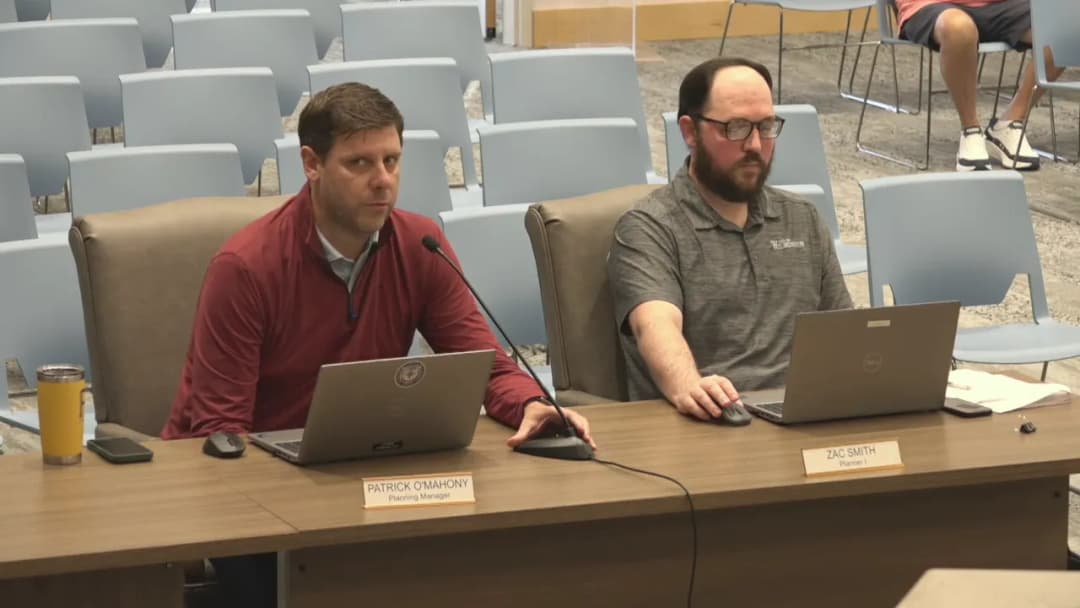
The City of Wilmington Design Adjustment Committee met on Wednesday, October 21, 2026, at 1:30 p.m. per the agenda, in City Council Chambers, Skyline Center, 929 North Front Street, Wilmington, NC, to hold quasi-judicial evidentiary hearings on requested deviations from the city's Technical Standards and Specifications Manual. The committee heard one application, 5710 Market Street, and noted that a second application, 1205 Airlie Road, had been withdrawn by the applicant. After staff and applicant testimony, the committee approved most requested waivers, placed conditions on a sidewalk waiver, and approved the preliminary plan. Consent Calendar - Approval of June 18, 2026 minutes: the agenda indicates a motion to approve passed 0-0, but the transcript does not capture this action and no minutes document was available. Public Comments & Testimony - The committee opened and closed a public hearing for 5710 Market Street; no members of the public came forward to speak. Discussion Items - 5710 Market Street (DAC-2026-0002) — Planner Zac Smith presented the request by Cindee Wolf with Design Solutions on behalf of property owner Eston Brinkley. The RB-zoned site is served by a proposed private right-of-way from Market Street. Staff listed ten requested adjustments from the Technical Standards and Specifications Manual: a 50-foot right-of-way instead of 60 feet; 21 feet of pavement instead of 34 feet; a 5-foot plaza instead of 6 feet; sidewalk on one side only; a 615-foot cul-de-sac instead of a 500-foot maximum; elimination or reduction of the non-municipal easement; street trees on one side only; retention of three existing driveways from 32 to 36 feet wide instead of a 30-foot maximum; and a 1,490-linear-foot driveway instead of the 500-foot/800-foot limits. - Applicant's position — Eston Brinkley said the existing road has long served a mobile home park that is being eliminated; about nine or ten mobile homes remain, two-thirds of the park has already been removed over five years, and 180-day notices were given. Cindee Wolf argued the waivers are justified by the site's long, narrow shape (roughly 200 feet of Market Street frontage and more than 1,100 feet of depth), a large public drainage easement, existing significant and specimen trees, and the existing roadway. She noted the project would preserve existing trees, keep sidewalk/plaza/trees along the northeastern side, include a new cul-de-sac, connect to the adjacent Toyota dealership for emergency access, and would be a private right-of-way, so maintenance would not fall on the city. - Committee discussion — Members questioned whether a future subdivided rear lot in the RB district might need the wider street standards, whether the existing sidewalk could be an ADA-accessible route to Market Street, and whether fire access would be adequate. Fire-access concerns were addressed by noting the reduced width was acceptable for the proposed vehicle-sales use because of the hydrant extension and two additional connections to the Toyota property, but a narrower road could limit future development on the rear parcel. The applicant's engineer said a collapsed sidewalk over a storm drain at the T-head turnaround would be repaired as part of the work. A discrepancy between the 615-foot and 630-foot cul-de-sac figures was explained as different measurement points (centerline versus the transition to the private driveway). Key Outcomes - Waivers 1-3 and 5-10: Approved unanimously (agenda records the overall approval as 5-0), based on the non-through street condition, environmental/topographic constraints, lot depth, tree preservation, and emergency connectivity. - Waiver 4 (sidewalk on one side): Conditionally approved unanimously. Conditions required the existing sidewalk/accessible route to Market Street to be evaluated for accessibility and the western sidewalk to be extended from the sales office to the first driveway/property line to the north. - Preliminary plan: Approved unanimously, subject to the recommended conditions in the agenda packet and the conditions attached to the waiver approvals. - 1205 Airlie Road (DAC-2026-0003): Withdrawn by the applicant; no hearing was held.
The Louisville Metro Council's Equity, Community Affairs, Housing, Health, and Education Committee, chaired by Councilwoman Barbara Shanklin (D-2), convened on Wednesday, October 21, 2026, at 1:30 PM. The committee unanimously recommended approval for three honorary street naming resolutions. A resolution endorsing the Plant Based Treaty was held in committee without discussion. Consent Calendar - The committee voted to send the following items to the full Metro Council's Consent Calendar for final approval at the October 29, 2026 meeting. All motions were made by Committee Member Dan Seum (R-13) and seconded by Vice Chair Stuart Benson (R-20), and carried via voice votes with no opposition. Public Comments & Testimony - Jackie Floyd (Community Liaison, District 4) spoke in support of R-146-26, detailing the legacy of Harry Johnson Jr. as a pioneering beauty supply store owner and community benefactor in West Louisville. - Ashkan Rezai (Legislative Aide, District 21) spoke in support of R-147-26, recalling the lives of Kimberly Asa and Louisnes "Lou" Fedon, who were among 15 individuals who lost their lives in the UPS crash the previous year. He noted that their family founded the Asa Lou Foundation in their memory. - Councilwoman Tammy Hawkins (D-1) spoke in support of R-150-26, honoring Rose Smith and Walter Smith. She characterized Rose Smith as a pioneering child care owner and pillar of the community who turned personal tragedy into passionate advocacy. - Councilman JP Lyninger (D-6) spoke in support of R-150-26, praising Rose Smith as a fantastic woman and invaluable community organizer whose leadership has positively impacted his district. Discussion Items - R-142-26: The resolution endorsing the Plant Based Treaty was held in committee at the request of its sponsor, Councilwoman Paula McCraney (I-7), who was out of town. No discussion or vote occurred. - R-146-26: Chair Shanklin briefly inquired about clarifying details regarding the honoree, which Ms. Floyd addressed. - R-150-26: Chair Shanklin asked about a community program the honoree opened following a family tragedy, which Councilwoman Hawkins confirmed. Key Outcomes - R-146-26 (Harry Johnson Jr.): Approved by voice vote and sent to the Consent Calendar. - R-147-26 (Kimberly Asa and Lou Fedon): Approved by voice vote and sent to the Consent Calendar. - R-150-26 (Rose Smith, Walter Smith / Trinity Way): Approved by voice vote and sent to the Consent Calendar. - R-142-26 (Plant Based Treaty): Remained held in committee. - The meeting was adjourned by Chair Shanklin without objection at 1:44 PM.
The Clark County Redevelopment Agency met on October 21, 2026, to consider adoption of a new Relocation Assistance Policy and receive a feasibility study on the potential rehabilitation or demolition of properties at 900 Liberace Avenue. The board extensively debated the relocation policy and ultimately voted to hold the item to a future meeting, while directing staff to begin work on a specific relocation plan for New Orleans Square in the interim. No action was taken on the feasibility study. Public Comments & Testimony - During the second public comment period, Monica Gresser, owner and architect at Brazen Architecture located at 900 Liberace Avenue, spoke in favor of renovating the building rather than demolishing it, noting its character and history. She acknowledged the increased budget estimate but urged the board to continue considering renovation. Discussion Items - Relocation Assistance Policy (Item 3): The board reviewed a proposed 69-page policy restating federal and state relocation laws. Commissioners raised concerns about not having enough time to review the document, questions about definitions of displacement, and what portions of the policy go beyond existing legal requirements. Commissioner Kirkpatrick expressed frustration with the pace and requested that the policy be held to the November 3rd Board of County Commissioners meeting to allow for proper review. Several commissioners also urged simultaneous development of a specific relocation grant program for New Orleans Square, which had been under discussion since July. Staff noted that while the policy largely mirrors existing law, some details—such as the need for a dedicated relocation coordinator—may require additional staffing or contracts. - Feasibility Study – 900 Liberace Avenue (Item 4): Shauna Bradley, Director of Rural Property Management, presented updated cost estimates: full demolition at $3.8 million, a tier‑one code-required renovation at $21.4 million (to bring the buildings to code‑compliant status), and a tier‑two leasable‑space renovation at $25.3 million. The presentation noted additional deficiencies discovered, including path of travel, building envelope, and electrical system issues. Commissioner asked for a future list of all consultant spending by the redevelopment agency. Key Outcomes - Item 3 (Relocation Policy): The board voted to hold the item until the November 3, 2026 BCC meeting, giving commissioners time to review the 69‑page document. Simultaneously, the board directed staff to begin developing a specific relocation grant program for the New Orleans Square commercial center, with the expectation that a program should be ready for adoption by the end of the year. Chair Knap noted the importance of moving forward after months of discussion. - Item 4 (Feasibility Study): The board received and noted the report; no further action was taken. Discussions indicated that additional pro forma and leasing feasibility analysis would be presented at a future meeting.
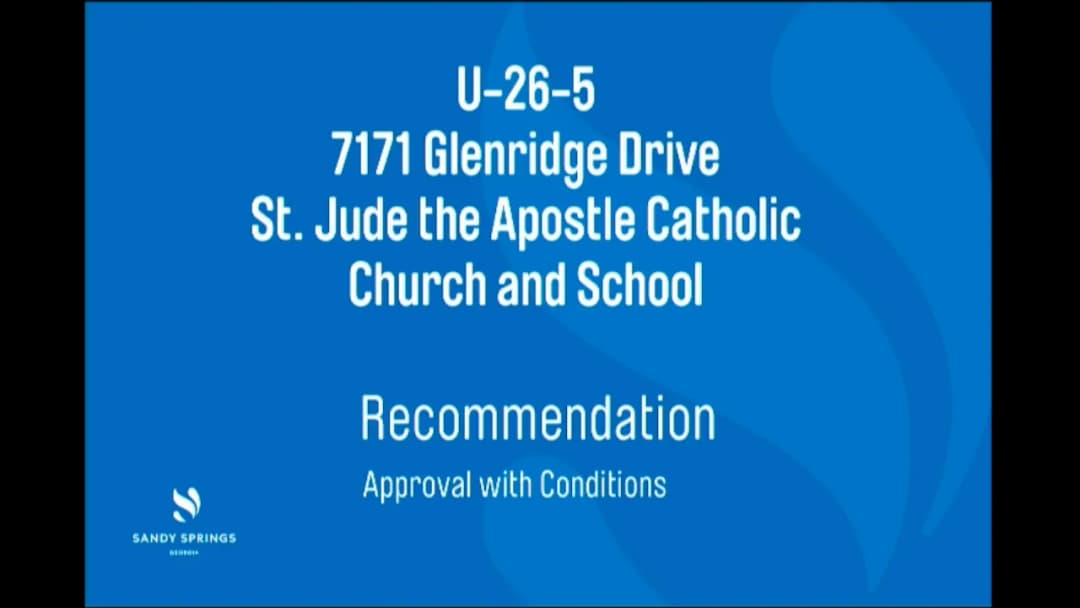
The Sandy Springs Planning Commission met on Wednesday, October 21, 2026, at 6:00 p.m. in the Studio Theatre at Sandy Springs City Hall. Chair Reed Haggard presided; Commissioners Robin Conklin, Karen Trylovich, Sherwin Clemons, and Jay O'Meara were present, and Steve Leeds was absent. The commission honored outgoing Commissioner Andy Porter, approved the agenda and September 16, 2026 minutes, and considered three agenda items: the Sandy Springs Design Guidelines, Development Code text amendment TA-26-3, and a conditional use permit for St. Jude the Apostle Catholic Church and School. Call to Order, Agenda, and Minutes - Chair Haggard offered a tribute to Andy Porter, whose seat was empty, noting more than a decade on the Planning Commission and over 23 years of volunteer service to Sandy Springs. - The October 21, 2026 agenda was approved unanimously. - The September 16, 2026 meeting minutes were approved unanimously. Public Comments & Testimony - No public comment was delivered during the meeting. For the St. Jude case, one comment card was submitted by George Jones, but the speaker was not present when called. Design Guidelines Resolution - Sukirti Ghosh, Principal and Urban Designer with RHI, presented the resolution to create the Sandy Springs Design Guidelines, developed over roughly two years with multiple rounds of public meetings, online surveys, stakeholder meetings, and input from city leadership and staff. - The guidelines are intended to create a visual identity for Sandy Springs across six commercial districts: North End, City Springs, Central Perimeter, Powers Ferry, Crossroads, and Neighborhood Village. They are organized by building, private realm, and public realm elements and are described as advisory, with flexibility, incentives, and implementation through the development review process. - Topics covered included streetscapes, street furniture, trees and planting, public art, connections and gathering spaces, building materials, massing, articulation, transparency, facade improvements, low walls, and district-specific guidance. - A commissioner moved to approve the resolution; the motion was seconded by Commissioner Conklin and passed unanimously, recommending adoption to the Mayor and City Council. Development Code Edits – TA-26-3 - Matthew Anspach, Senior Planner, AICP, presented text amendment 2026-0003 TA-26-3, comprising two significant edits: Section 7.5.13B for massage establishments and Section 7.5.15G for smoke shops. - Staff stated the massage establishment edit would create a distinct use category under personal services, requiring a half-mile separation from other massage establishments and a 1,000-foot separation from schools, daycares, places of worship, and residential zoning or attached/detached housing, with hours consistent with the city code of ordinances and exemptions for certain accessory uses. Staff stated the purpose was to distinguish licensed therapeutic services from businesses that may operate without proper credentials or as fronts for unlawful activity. - Staff stated the smoke shop edit would create specific regulations under retail, including a half-mile separation from existing smoke shops and a 1,000-foot separation from sensitive uses such as schools, daycares, public parks, places of worship, and residential districts and uses. Existing smoke shops would be legally non-conforming, and the new rules would apply to future businesses. - The commission initially passed a single motion approving both amendments, but then voted to reconsider that approval and bifurcated the item into separate motions. - The massage establishment amendment was approved with staff recommendations and an added request for further clarity on closing times and definitions before it goes to the Mayor and City Council. - The smoke shop amendment was approved with the proposed language, with clarification requested on how cigar lounges will be classified and on the definition of a lounge. Commissioner Trylovich said cigar lounges are higher-end establishments that generally do not sell the products targeted by the regulations; Commissioner Clemons requested a clear definition of lounge; Commissioner O'Meara noted a possible 2% revenue or 200-square-foot accessory threshold and asked whether convenience stores could be captured. - Staff agreed to review exemptions and definitions and provide additional options before the item proceeds to the Mayor and City Council. St. Jude Conditional Use Permit – U-26-5 - LaQuita Williams, Planner II, presented the request for 7171 Glenridge Drive to amend conditions of U02-0010 to allow site improvements at St. Jude the Apostle Catholic Church and School. Staff recommended approval with conditions. - The site is approximately 17 acres, zoned RE2 in a protected neighborhood character area, and currently houses a place of worship and a private pre-K through eighth-grade school. The applicant proposed a six-phase campus master plan, with phase one involving the already-relocated rectory and phase two including a new parish life center, church renovation, parking improvements, a columbarium garden, and stormwater work. Later phases include a preschool relocation, school administrative expansion, a two-story gymnatorium, and a new middle school after demolition of the former gymnasium. Phases one and two are planned for 2027 or 2028. - Recommended conditions included limits of 347,684 square feet of church, school, and related uses; 700 fixed seats in the largest church assembly area; 525 students; 50 daycare children; 49% maximum lot coverage; two driveway accesses on Glenridge Drive; city engineer approval for curb cuts and turn-lane needs; a 100-foot playground setback from protected neighborhood property lines; buffering along the southern property line; and allowing certain existing nonconforming buildings to remain as permitted in the original use permit. - Applicant Michael Boland, architect and agent representing the Archdiocese of Atlanta, answered Commissioner Conklin's questions about capacity. He said the project is not intended to increase capacity: the church has about 690 fixed seats and weekend attendance ranges from roughly 250-300 to 525; the school currently has about 460 students against a 525 cap. He described the improvements as addressing aging 1960s-era facilities and providing needed amenities such as a parish life center and a gymnatorium. - A motion to approve the conditional use permit with staff recommendations was seconded and passed unanimously. Key Outcomes - Recommended the Sandy Springs Design Guidelines resolution to the Mayor and City Council by unanimous vote. - Approved the agenda and September 16, 2026 minutes unanimously. - Reconsidered and bifurcated TA-26-3; approved the massage establishment and smoke shop amendments with requests for additional clarity on definitions, closing times, and cigar lounge treatment before the item goes to the Mayor and City Council. - Approved conditional use permit U-26-5 for St. Jude the Apostle Catholic Church and School with staff conditions, allowing phased site improvements. - Announced a Next Chapter public meeting on October 29, 2026 at City Hall; noted that the July 2027 Planning Commission meeting will be canceled under the adopted 2027 calendar; and noted that Andy Porter's seat and a vice chair nomination will be addressed at a future meeting.
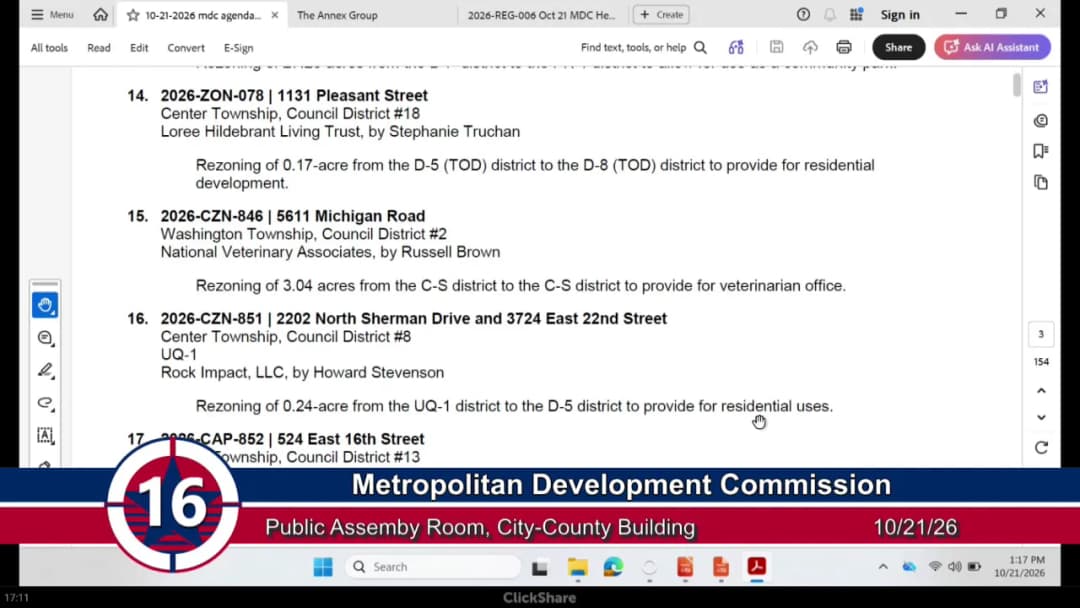
The Metropolitan Development Commission of Indianapolis-Marion County met on 2026-10-21 (October 21, 2026); the agenda noticed the meeting for 1:00 PM in the Public Assembly Room, City-County Building, 200 E. Washington Street. The Commission adopted prior meeting minutes, approved routine administrative items, granted multiple continuances, and held a contested public hearing on a Regional Center design approval for the 'Union at Astor' multifamily project. All recorded votes were 6-0. Consent Calendar - Adopted the October 7, 2026 meeting minutes by a 6-0 vote. - Approved six policy resolutions en bloc by a 6-0 vote: - 2026-R-033: as-needed outside legal services contract with Ricks Legal Services LLC, not to exceed $30,000. - 2026-R-036: amendment with Raven Commercial Group LLC for Union Station Grand Hall repairs; the agenda lists an increased not-to-exceed amount of $585,000, while the clerk's reading in the transcript appears to say $185,000. - 2026-R-037: amendment with Allied Logistical Services Inc. for property preservation, adding $40,000 for a total not to exceed $1,615,000. - 2026-R-038: demolition contract with Ray's Demolition LLC, not to exceed $127,200. - 2026-R-039: Vacant to Vibrant property conveyance authorization. - 2026-A-048: preliminary Economic Revitalization Area for M22 Housing, LP at 2204 North Meridian Street; the agenda states ten-year real property tax abatement, while the clerk's reading in the transcript states personal property tax abatement. - Approved all 11 petitions of no appeal recommended for approval en bloc by a 6-0 vote: 2026-APP-017, 2026-APP-018, 2026-ZON-072, 2026-ZON-078, 2026-CZN-846, 2026-CZN-851, 2026-CAP-852, 2026-ZON-056, 2026-ZON-082, 2026-ZON-089, and 2026-REG-044. Public Comments & Testimony - Jesse Baum, representing the registered neighborhood organization Stringtown Now, opposed 2026-REG-006. She testified that the Annex Group has been named among the top 40 evictors of Central Indiana for two years, that Indianapolis has 14 evictions for every 100 units, and that the developer's eviction record undermines its affordable housing mission. She stated the project would remove five heritage trees and roughly 90 percent of the block's green space, and she cited data she said showed Stringtown has a 40 percent lung cancer rate, 28 percent higher COPD rate, and 9 percent higher lung cancer death rate than anywhere else in Marion County. She also asserted the existing homes had been deliberately blighted and some destroyed by arson, that no promised traffic study had been done, and that the building's scale, window patterns, and materials were out of keeping with the 150-year-old neighborhood. She asked that feral cats be captured before demolition. During questioning, she acknowledged her testimony extended beyond design issues. - In rebuttal, Ms. Baum raised additional concerns about spillover parking and traffic, said many Stringtown residents at 30 percent AMI own cars, argued the affordable rents would still be higher than many current Stringtown rents, and described the proposal as a wall of apartment buildings separating the neighborhood from downtown. Discussion Items - Continuances granted: - 2026-P-008 (Marion County Land Use Plan amendment) continued to December 16, 2026, at staff request for more review time; vote 6-0. - 2026-HP-002 (Former St. Francis de Sales Catholic Church Preservation Plan) continued to November 18, 2026, at the request of the Indianapolis Historic Preservation Commission and with both parties' agreement; vote 6-0. - 2026-A-016 and 2026-A-017 (Metrobloks, LLC final ERA resolutions) each continued to November 18, 2026, because IEDI reported development terms were still being finalized; each vote 6-0. - 2026-ZON-060 (1305 Broad Ripple Avenue mixed-use rezoning) continued to December 16, 2026, after staff sought more time to review amended documents and the petitioner agreed; vote 6-0. - 2026-CZN-841 / 2026-CVR-841 (5935 West 56th Street companion petitions) continued to November 18, 2026, because staff discovered a legal notice mailing deficiency that prevented the petition from being heard under state statute; the petitioner agreed; vote 6-0. - 2026-REG-006 regional center hearing: Petitioner Misha Rabinowitch, representing Brougher Developments LLC / the Annex Group, requested Regional Center approval for demolition and construction of approximately 241 multifamily units, an integrated 258-space parking garage, and resident amenities at 219 Koehne Street and nearby parcels in Stringtown. He emphasized that the property was already zoned D-8 and that height, building type, and open space variances had been approved in May 2026, so the hearing concerned only design guideline compliance. He described design revisions made after the Regional Center Hearing Examiner's concerns, including gabled roofs on the three-story western portion, lighter colors, balconies, and more brick, and he offered a commitment to submit final site plan, elevations, landscape plan, and lighting plan for staff approval before permits. - Staff and commissioner discussion: Planning staff's Jeff York recommended approval, noting the site's history, the withdrawal of an earlier demolition-only request, the design improvements after meetings with remonstrators, and the fully wrapped parking garage. He said not every urban structure guideline had to be satisfied and that the project would add needed density. Commissioner Hergett said the proposal should be viewed in the context of Indiana's push for more housing and the demonstrated need for units affordable at lower AMI levels. President Dillon clarified that this was solely a design approval, not a zoning or variance matter. Commissioner Murphy explained that low-income housing tax credits are sold to reduce borrowing costs and enable lower rents, not to generate direct developer profit. Key Outcomes - Approved 2026-REG-006 by a 6-0 vote, subject to staff approval of final site plan, building elevations, landscape plan, and lighting plan before issuance of permits. - Approved all policy resolutions and all 11 no-appeal petitions en bloc by 6-0 votes. - Granted multiple continuances: 2026-P-008 and 2026-ZON-060 to December 16, 2026; 2026-HP-002, 2026-A-016, 2026-A-017, and 2026-CZN-841 / 2026-CVR-841 to November 18, 2026.
The Grand Junction City Council held its regular meeting at 5:30 p.m. on Wednesday, October 21, 2026, in the City Hall Auditorium at 250 North 5th Street. The mayor presided; Councilmember Stout attended virtually and Councilmember Ballard was absent. The six voting members present approved each item requiring a vote by 6-0, including a supplemental budget appropriation, a data center moratorium, a property rezone, and a wastewater treatment plant engineering contract amendment. City Manager Report - City Manager Mike Bennett, moved ahead of proclamations and public comment, announced that his recommended budget for the November council hearings will continue to provide the current facility rent-free to the nonprofit that operates the Senior Recreation Center. He said the earlier proposal was too abrupt, apologized for the communication, and credited civil, constructive feedback rather than personal attacks for changing the decision. - Bennett described a structural deficit that began in 2021 and required hundreds of decisions across a budget of more than $300 million. He added that Community Recreation Center programs, while adding services and more than 2,300 senior sign-ups, do not replicate what the senior center offers. Proclamation - Councilmember Kennedy read a proclamation recognizing October 10, 2026, as the 100th anniversary of Lincoln Park Golf Course. The course opened October 10, 1926, is the oldest golf course in Grand Junction and one of the oldest on Colorado's Western Slope, and has hosted the Rocky Mountain Open since 1939. A course representative accepted the proclamation and invited the community to a Saturday centennial celebration. Boards and Commission Liaison Reports - Council liaisons reported on the Business Incubator's 40th anniversary and the fact that more than 30% of local businesses have worked with it; the Grand Junction Economic Partnership's unanimous endorsement of D51 ballot measure A; the airport authority's 28,000-plus air show attendees, $30 million in runway improvement approvals, 44 consecutive months of passenger growth, and roughly $50 million terminal expansion planning; and a Colorado water roundtable discussion about conservation and $20 million in statewide water project grants. - Other reports covered the homeless coalition's REACH program, which has already registered more than 500 students this year versus roughly 300 at this time in past years; urban trails walk audit results; Colorado Municipal League priority topics including ALPR technology and data centers; and Downtown Development Authority work on phase zero of the Terminal project, which includes 112 units of affordable housing. Consent Calendar - The council adopted the consent agenda, items 1-5, by a single 6-0 motion: approval of the October 5 workshop summary and October 7 regular meeting minutes; setting a November 4 public hearing for a Terminal Project bank loan ordinance; setting a December 2 public hearing for Redlands 360 Annexations No. 2, 3, 4, and 5; a North Avenue Enhanced Transportation Corridor MOU with Mesa County; the Ridges Irrigation Pump Motor Control Center Replacement procurement; a resolution authorizing a DOLA HB-1152 ADU grant application; and a resolution transferring a 0.14-acre city parcel to Mesa County for a Grand Valley Transit transportation hub. Public Comments & Testimony - The majority of public comment concerned the Senior Recreation Center. Speakers expressed relief and gratitude for reversing the closure recommendation, but several asked for a permanent commitment rather than a one-year reprieve. Speakers said the center is a social and psychosocial lifeline, especially for isolated seniors, and described the Community Recreation Center as not a substitute; some noted many seniors cannot afford the $30 per month rec center fee, and one speaker said Silver Sneakers was not free because his Medicare plan cost $100 more per month. - Carol Rathbun questioned the decision's durability and listed prior city spending she said helped create the budget problem, including $1.03 million in riverfront debt service next year, an $866,000 general fund subsidy, $1.7 million in zip line/Bonsai building incentives, and $1.2 million in city funds for a child care center. - Donald Hunger blamed the former city manager and previous council for the structural deficit, naming Greg Keaton and council members Anna Stout, Abe Herman, Randall Rice, and Rick Taggart. He cited failed incentives, closed businesses, and spending on homeless programs and road pilots that were later reversed, and said the current council and city manager did not create the mess. - Other senior center commenters offered help raising $100,000 through a 501(c)(3), called for repairs to the center after bingo had been halted and the kitchen shut down, and compared Grand Junction unfavorably to Las Cruces, New Mexico, which funds six senior centers with no membership fees. One board member said she felt threatened with criminal charges over bingo and described the emotional toll on seniors. - On surveillance, Carl Doji asked the council to schedule an open agenda discussion of Flock cameras and related systems, citing over 250 cameras, roughly $140,000 paid in 2025 to Flock, Motorola, and Project NOLA, more than $100,000 in recurring subscriptions, and over 300,000 Flock searches per month in early 2026, about 90 percent from agencies outside Colorado. Additional speakers opposed the camera network, cited security vulnerabilities and facial recognition capture of children, and asked for public forums and data-sharing and retention rules. - Kristen Hartman requested changes to the VRBO/Airbnb approval process to treat neighbors as impacted stakeholders and consider neighborhood appropriateness, saying more than 500,000 square feet of housing had been converted to short-term rentals during a housing crisis. - Other comments addressed Orchard Mesa pool fees for county residents, including a retired nurse who said a recreation center membership would cost $492 a year, $276 more than she pays for the pool; street-sweeping boundaries; and requests to place the surveillance issue on a future council agenda. Discussion Items Supplemental Appropriation (Ordinance 5344) - Chief Financial Officer Jay Valentine requested $3.5 million in additional spending authority for the self-funded health insurance fund because 2026 claims were trending 20-25 percent above budget, offset by a $4 million reinvestment from participating funds; the General Fund share is about $2.9 million. Brown and Brown analysis showed about $5.8 million in savings since the city moved to self-insurance. The supplemental also covered grant-funded programs, police and fire equipment, water debt service, and a $1 million no-net-impact Visit Grand Junction reclassification. - Council discussion covered stop-loss coverage of $175,000 per claim in 2026, increasing to $225,000 in 2027; the fund being restored to only 50-75 percent of recommended reserves; and an average citywide employee premium increase of 34 percent. No public hearing comments were offered. The ordinance passed 6-0. Data Center Moratorium (Ordinance 5345) - Interim Community Development Director Thomas Lloyd presented the ordinance. The city code does not currently define data centers, so the moratorium would pause acceptance, processing, and approval of data center applications for up to 365 days or until Title 21 amendments are adopted. It applies to facilities with a projected, designed, or requested electrical load of 1 megawatt or more, excluding accessory server rooms, specified telecommunications facilities, and minor utility facilities. - Staff will study zoning, development standards, and impacts and coordinate with Mesa County and Fruita, which are taking related actions. Council discussion addressed model codes, changing technology, and whether off-grid power could circumvent the threshold; the definition applies regardless of power source. Public hearing speakers urged water-use caps, grid cost offsets, performance bonds, and bans on non-disclosure agreements; some opposed AI data centers entirely. A few asked for an indefinite extension. The ordinance passed 6-0. Rezone (Ordinance 5346) - Senior Planner Lily Sutton presented a request to rezone 2.88 acres at 2324 Highway 6 and 50 from I-1 (Industrial Light) to CG (Commercial General). The property has an existing auto sales use; the owner wants future redevelopment flexibility. The site is within the 24 Road corridor overlay and complies with the Comprehensive Plan's commercial designation and infill principles. No public testimony was given. The ordinance passed 6-0. Persigo Wastewater Treatment Plant Phase 2 Contract Amendment - Interim Utilities Director Ashley Frell requested authorization for a $950,000 contract amendment with AE2S to accelerate design and permitting of a new secondary clarifier, clarifier 3, and evaluate the long-term viability of clarifier 4 after recent failures. Clarifiers 1 and 2 date to 1984, clarifier 4 was added in 2000, and clarifier 3 has never been built. The plant normally operates two clarifiers with a third standby as a permit requirement. - Clarifier 4 is out of service due to mechanical and structural concerns; clarifier 1 suffered an influent pipe obstruction, a tire, that caused a reportable overflow and was repaired. The plant currently has no standby clarifier and has notified the Colorado Department of Public Health and Environment. Design completion is targeted as early as December and construction is estimated at about nine months. - Council discussion covered accelerated construction at risk, the procurement basis of itemized task hours and rates under a not-to-exceed amount, and capacity: the plant is currently permitted at 12.5 million gallons per day, averages about 8 million gallons per day, and the incoming 15-million-gallon-per-day permit will still require three clarifiers. The motion passed 6-0. Non-Scheduled Comments and Other Business - No non-scheduled public comments were made. - Under Other Business, Councilmember Kennedy praised the city manager's handling of the senior center decision, noted the city charter limits council involvement in operational matters, and credited city staff. The mayor raised a concern about a council member's communications regarding staff and said a further discussion is needed; other council members agreed. Key Outcomes - The city manager will include continued senior center space in the recommended November budget. - The consent agenda was adopted 6-0, including approved minutes, public hearing dates, an intergovernmental MOU, a procurement, a grant application resolution, and a property transfer resolution. - Ordinance 5344, supplemental appropriations to the 2026 budget, passed 6-0. - Ordinance 5345, the data center moratorium, passed 6-0; staff will study code amendments and return with proposed Title 21 changes. - Ordinance 5346, rezoning 2.88 acres at 2324 Highway 6 and 50, passed 6-0. - The $950,000 AE2S contract amendment for Persigo clarifier work was authorized 6-0. - Staff will coordinate with Mesa County and Fruita on regional data center regulations.
The Denver City Council Health and Safety Committee met on Wednesday, October 21, 2026, at 10:30 AM. Chair Darrell Watson presided. Present were Councilmembers Diana Romero Campbell, Paul Kashmann, Serena Gonzales-Gutierrez, Jamie Torres, and Vice Chair Amanda Sandoval; Kevin Flynn was absent. The committee heard the annual Denver Preschool Program (DPP) update (Council Presentation 26-1538) and approved three consent resolutions. Briefing: Denver Preschool Program Annual Update - DPP's President and CEO and Vice President of Communications presented the annual update. DPP was created by a 2006 ballot initiative, originally for four-year-olds, later expanded to three-year-olds, and was permanently reauthorized in 2023 with 78% voter approval. The program celebrated its 20th anniversary on November 6, 2026. - Reported outcomes include: $272 million in tuition support, $41 million for child-care quality improvements, $20 million for the three-year-old expansion, and 83,150 students funded. The provider network grew from 41 to 267 high-quality providers; about 60% of students attend Denver Public Schools and the rest attend community-based, nonprofit, for-profit, religiously affiliated, or home-based providers. - On quality, 70% of DPP providers are rated Level 4 and 10% Level 5 under Colorado Shines, compared with 25% Level 4 and 5% Level 5 statewide. DPP has spent $3.5 million on quality improvements and $1.4 million in direct grants to providers. The current provider mix is 85 DPS providers, 175 child-care centers, and 7 family child-care homes. - DPP reported a net return on investment as high as $14 per dollar invested, 95% parent satisfaction, $42.3 million in citywide savings over four years, and one of the largest early-childhood longitudinal data systems in the country, behind only Head Start. - On affordability, DPP cited an estimated average monthly Denver tuition cost of $1,640 for a four-year-old, an average DPP tuition credit of $518, and an average UPK contribution of $627, leaving an unmet need for many families. DPP also brought about $45 million in state universal preschool funding to Denver last year as a local coordinating organization. - DPP's board has decided to expand from a preschool program to a zero-to-five organization over the next three to five years. An infant-toddler pilot at Blossom House, operated by Mahai Early Learning, has a waitlist of nearly 70 families. DPP also added a family navigation service called 'My Friend Ben.' - The CEO described demographic changes in Denver, including 1,000 fewer four-year-olds than before the pandemic, families leaving due to housing costs, and some families returning to Denver to apply for DPP because the state child-care assistance program is frozen. She said DPP is working to support family, friend, and neighbor caregivers without requiring them to become licensed small businesses. - Councilmembers asked about changing demographics, universal child care, and support for families experiencing homelessness. The CEO said DPP's three-year-old program is free up to 270% of the federal poverty level and that DPP follows families even if they move near or beyond Denver's borders. Councilmembers praised the program's 20-year record and expressed support for a more holistic, coordinated early-childhood system. - Jess Ridgway, Executive Director of the Office of Children's Affairs, described the office's close administrative relationship with DPP and said the city will retain 1% of special revenue funds to support oversight, including new program and fiscal administrator positions shared with the Prosperity Denver Fund. Consent Calendar - Council Resolution 26-1510 was approved by consent: a contract with Metro Caring for $747,718.98, ending July 31, 2029, for food and food-based education funding for youth through the Healthy Food for Denver's Kid Initiative, citywide. - Council Resolution 26-1512 was approved by consent: a $675,000 contract with Denver Health & Hospital Authority, ending May 15, 2028, to renovate and expand the Denver CARES facility into a coordinated recovery and stabilization hub meeting future Level 3.5 Residential Treatment standards, citywide. - Council Resolution 26-1513 was approved by consent: an amendment with the Mental Health Center of Denver adding $3,670,867 for a new total of $27,079,152, extending the contract 11.5 months to August 15, 2027, to operate the Behavioral Health Solutions Center, citywide. Key Outcomes - The committee heard and discussed Council Presentation 26-1538; no vote was required for the briefing. - All three consent resolutions were approved by consent. - DPP will continue planning its zero-to-five expansion and an upcoming 20th anniversary celebration; follow-up contract changes are expected later in the year.