The Green Bay Common Council convened on October 21, 2026. The meeting included a report from the mayor on early voting, recognition of a comprehensive plan award, and extensive public testimony and council debate regarding a proposed Vacant Property Ordinance. After a series of votes, the ordinance was referred back to the Protection and Policy Committee. Consent Calendar - Minutes and Agenda were approved. - Reports were approved from the Redevelopment Authority, Improvement and Services Committee, Protection and Policy Committee (with item 2 handled separately), Police Department licensing, Finance Committee, Parks Committee, and Personnel Committee. - A Plan Commission rezoning item was approved after a public hearing. - Resolutions regarding tax increment districts were adopted. Public Comments & Testimony - Steve Schneider (Property owner, 22 parcels): Opposed the Vacant Property Ordinance. He argued the escalating fee acts as a disincentive for redevelopment of historic properties. He presented research suggesting higher vacancy rates in Wisconsin cities with similar ordinances (e.g., Bayside, Delavan) compared to those without (e.g., Green Bay, Appleton). He raised concerns about how the ordinance defines a parcel versus a building and its impact on long-term property assembly projects like the Vic Theatre redevelopment. - Dane Lisecki (Grow Green Bay): Opposed the ordinance as drafted but supported a mandatory free registry. He argued the fee structure punishes vacancy rather than neglect, disproportionately impacts small property owners, and raises legal questions under Wisconsin Statute 66.0628 regarding fees needing a reasonable relationship to the service provided. He proposed amendments to charge escalating fees only for uncorrected code or safety violations. - Jared Fink (Goldfinch Management): Opposed. He stated the ordinance would turn away investors and harm small businesses, citing the prolonged development timeline of the Shipyard neighborhood as an example of why long-term property holding is sometimes necessary for community growth. - John Vanderleas (Business owner, former Alder): Opposed. He argued Green Bay is not a blighted city and already possesses adequate property maintenance and nuisance enforcement tools to address specific problem properties without a new citywide registry. - Rick Vanderleas (Apartment Association of NE Wisconsin & Fox Valley): Opposed. He emphasized legal concerns under Wisconsin Statute 66.0628, citing the Buchanan case. He highlighted the lack of clarity for mixed-use properties and argued the city already has legal authority to handle 'demolition by neglect'. He contended that charging for vacancy penalizes legitimate economic delays. - Jennifer Sundstrom (Realtors Association of NE Wisconsin): Strongly opposed. She argued commercial vacancies are a natural market reality, not misconduct. She asserted the ordinance creates an intrusion on private property rights, discourages investment, and does not solve the underlying nuisance issue, which existing codes already address. Discussion Items - Vacant Commercial Building Ordinance: The core debate centered on whether vacancy itself or the physical neglect of properties should be the target of fees. - Supporting View (Alders Presley, Shelton): Argued vacant properties inherently impose higher costs for city services. They framed the fee as cost recovery for a class of property generating disproportionate calls for service. They stated the adopted amendments significantly narrowed the ordinance's impact to address habitual problems while protecting owners actively marketing their properties. - Opposing View (Alders Morgan, Grant, Hinkfus, Hutchison, Eck, Delee, Debaker, Ritterbush): A broad majority expressed concern that the ordinance conflates vacancy with neglect. Many argued it sends an anti-business message and adds regulatory burdens without effectively targeting specific nuisance properties. Alders Grant and Morgan advocated for amending existing nuisance ordinances instead. Alder Hutchison stated he could not support a system that punishes good actors who maintain their properties while vacant. - Amendments: Alder Presley successfully moved two amendments: 1) removing the 12-month limit on the exemption for properties actively and in good faith listed for sale or lease, and 2) protecting new owners in arm's-length transactions from inheriting the previous owner's unpaid registration fees. - Plan Commission Item (Rezoning): A hearing was held on a request to rezone a property at 434 Mission Road to allow for a car lot business. Anne Lays spoke in support. Key Outcomes - Vacant Property Ordinance (Item 2 of Protection & Policy): The motion to approve the item as amended failed (5-7). A subsequent motion to deny the item also failed (5-7). The item was then referred back to the Protection and Policy Committee by a majority vote. - Rezoning: The Plan Commission item to rezone a property on Mission Road was approved. - Ordinances First Reading: Several ordinances were advanced to a second and final reading. One item was held over to the next council meeting.
The Public Meeting Index
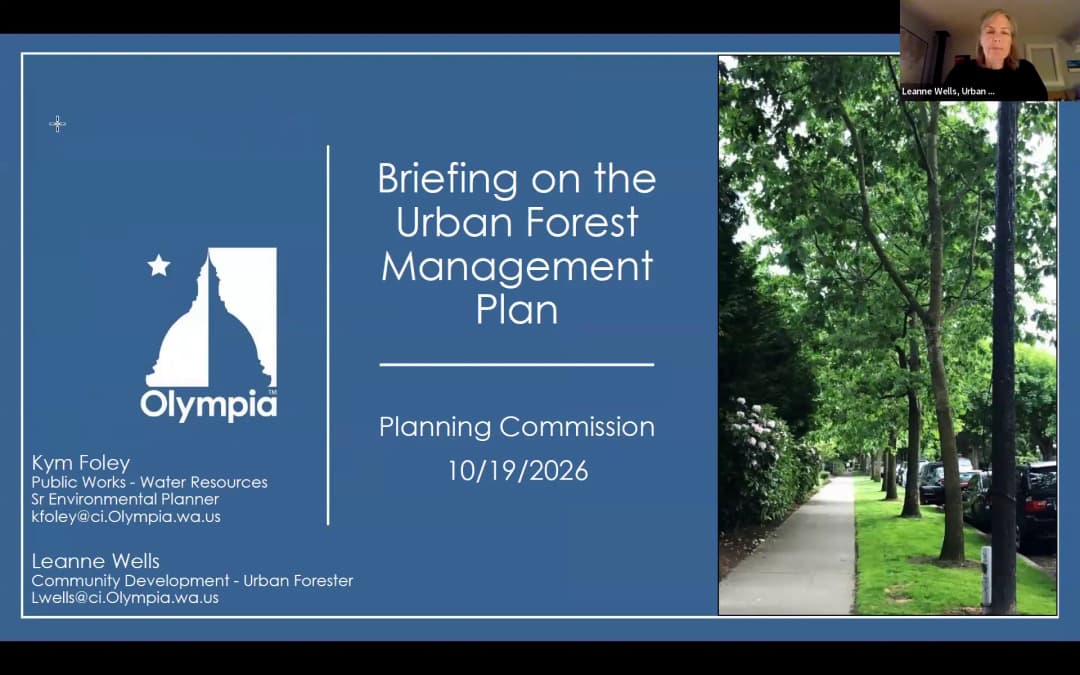
The Public Meeting IndexThe Olympia Planning Commission met on October 21, 2026, for a business meeting that included a public hearing and recommendation on parking-code amendments and a briefing on the Urban Forest Management Plan. The transcript labels the meeting date as October 19, 2026; this summary uses the supplied meeting date of October 21, 2026. Unless otherwise noted, votes were voice votes. Call to Order and Procedural Approvals - Chair Queen called the meeting to order and roll call was completed. - The commission approved the meeting agenda as submitted. - The commission approved the October 5, 2026 meeting minutes, with one commissioner abstaining. Public Comments & Testimony - Judy Bardin spoke during general public comment about the upcoming neighborhood-scale commercial amendments. She asked the commission and staff to consider expanded definitions and clarifications for operating hours, how the city would evaluate public nuisance and minimized detrimental activity, and outdoor alcohol consumption. She cited personal experience living next to an Airbnb with loud hot-tub noise at night. - No members of the public testified during the parking-code public hearing. Staff Announcements - Casey Shoffler announced that the Community Livability and Public Safety Council Subcommittee would ask City Council the next evening to sunset three advisory committees, including the Bicycle and Pedestrian Advisory Committee. He noted the Planning Commission could inherit some related work items. Public Hearing: Proposed Parking Minimum Amendments - Casey Shoffler presented proposed amendments to Olympia Municipal Code Chapter 18.38 to implement the state Parking Reform and Modernization Act (PRMA) and to update parking standards. - Staff described the PRMA as capping minimum parking requirements, including a one-half space per multifamily unit limit for developments of four or more units, one space per single-family home, and two spaces per 1,000 square feet of commercial space. - The proposal would eliminate all citywide vehicle parking minimums, remove the existing parking-use table, consolidate parking types into residential, commercial, industrial, and institutional/public facilities, and revise bicycle parking standards. - The proposal would establish parking-lot maximums: residential uses would be limited to three spaces per 1,000 square feet of lot area or 50 spaces, whichever is less; commercial uses would be limited to four spaces per 1,000 square feet or 100 spaces, whichever is less. - Staff recommended revisions after the briefing: clarifying the bicycle-parking cap as up to a total of 12 required spaces; exempting bicycle-parking requirements for changes of use in existing commercial spaces under 3,000 square feet in the downtown exempt parking area; and limiting the parking-maximum exemption to multi-story parking structures. - During discussion, Vice Chair Daniel Garcia proposed removing the 12-space maximum for commercial bicycle parking, calling it arbitrary. Commissioners also discussed parking-structure loopholes, shared parking agreements, ADA accessible parking, cargo and adaptive bicycles, and potential future bicycle-parking work. Key Outcomes: Parking Amendments - The commission voted to recommend that City Council approve the proposed amendments to Olympia Municipal Code Chapter 18.38, Parking and Loading, with revisions as discussed. - The approved revisions included: - Removing the maximum of 12 required bicycle-parking spaces under the commercial and related categories covered by the revision. - Exempting bicycle-parking requirements for change of use in existing commercial spaces under 3,000 square feet in the downtown exempt parking area. - Applying the parking-maximum exemption only to multi-story parking structures. - Staff will draft a recommendation letter for commission review before the November 2, 2026 meeting. The item is scheduled for the Land Use and Environment Committee on November 19 and a first City Council briefing on December 8. The PRMA requires local adoption by January 27, 2027. Briefing: Urban Forest Management Plan - Kim Foley (Environmental Planner, Public Works Water Resources) and Leanne Wells (City Urban Forester, Community Development) briefed the commission on the upcoming Urban Forest Management Plan. - The plan will treat the urban forest as all trees in Olympia, including street trees, yard trees, parking-lot trees, shoreline trees, and park trees. - The 2023 tree canopy assessment found Olympia had about 42% tree canopy cover, which the presenters said is relatively high; the plan will focus on strategically protecting and managing existing canopy rather than simply planting more trees everywhere. - Drivers include growth pressures, overdue tree-protection code updates, stormwater permit requirements, and a Washington State urban and community forestry grant that was delayed about one year due to federal funding pauses. - The plan will emphasize equitable distribution of tree benefits and burdens, addressing infrastructure conflicts, sustainable funding and staffing, and potential tree-code amendments. - Consultants Cascadia Consulting and Facet will support community engagement and urban-forestry technical work. Engagement will include an Engage Olympia story map, paid focus groups with underrepresented and overburdened communities, open houses, and tabling events. - In response to commissioner questions, presenters said staff can overlay tree-canopy GIS data with utility and transportation layers and are working to make those layers more publicly accessible. They also explained that tree planting is not currently an accepted stormwater BMP for development requirements, but the City uses tree-canopy data to prioritize street sweeping and planting near salmon-bearing streams. - No formal action was taken on the Urban Forest Management Plan. Reports and Adjournment - No commissioner reports were offered. - The meeting was adjourned after the regular business; the next regular meeting is scheduled for November 2, 2026.
The Pittsburgh City Council Standing Committees convened on Wednesday, October 21, 2026, at 9:30 AM in Council Chambers. The meeting covered a wide range of legislative items including zoning reform, cooperative purchasing oversight, membership dues, and various administrative resolutions. Key debates centered on a $50,000 membership for Vibrant Pittsburgh and a major zoning package addressing accessory dwelling units, parking minimums, and affordable housing bonuses. A controversial proposal to require City Council approval for cooperative purchasing contracts over $30,000 was ultimately amended to require approval only for contracts of $1 million or more, with reporting requirements for smaller purchases. Consent Calendar - Appointments: Jennifer Cash Wade was appointed to the Housing Opportunity Fund Advisory Board after an interview. - Claim Settlements: Warrants approved for Patrick Goodfellow ($3,615.93) and Tomer Elbaz ($3,600.00) for damage from City vehicles. - Budget Transfer: Resolution 2026-0984 transferring $4,768.87 within the 2026 Operating Budget was approved. - Ordinances on Fiscal Transparency: Budget Training (2026-0985), P-Card Policy (2026-0986), and Quarterly Financial Reporting (2026-0987) were all affirmatively recommended. - Organizational Chart Ordinance: Council Bill 2026-0991 was held for one week to refine details. - Public Safety Contracts: Increased funding for Humane Animal Rescue of Pittsburgh ($151,295) was approved. - Easement and Bridge: Easement for Columbia Gas (2026-0979) and Swindell Bridge condemnation amendment (2026-0981) were approved. - Meals Program: Agreement with Pittsburgh Board of Public Education for 2026-2027 Food Service Program ($750,000) approved. - Technology Purchases: Warrants for OPEX Corporation ($11,470), Open Innovation Plans ($75,237.50 amendment), and eDocs Technologies ($8,845) were approved. - Sewage Facilities Plans: Plan revisions for 7119 Hamilton Avenue and 1 21st Street were adopted. - Invoices, Intradepartmental Transfers, and P-Card Approvals: All approved without objection. Public Comments & Testimony - David Fisher (Wilkinsburg): Proposed creating solar energy garden parks in East Liberty and pollinator-friendly agrivoltaics along I-79. - Genevieve Jerome (Mount Washington): Urged strong short-term rental regulations, describing negative impacts from Airbnbs on her street (at least seven on Ulysses Street) including noise, garbage, and safety issues. Asked not to grandfather existing short-term rentals. - Chris Basile (Mount Washington): Supported Executive Order Phase One zoning bill (2026-0834) but requested deferring residential compatibility setback changes to later phases and preserving the Grandview Public Realm District. - Bill Schlachter (Mount Washington): Echoed concerns about short-term rentals and criticized the proposed zoning changes for potentially weakening protections for the Grandview Public Realm. - Yvonne F. Brown (Bedford): Complained about lack of bus service for seniors and a dismissive response from a county council member. - Unique Brown: Spoke about human nature, accountability of elected officials, and need for direct resources for housing and violence prevention. - Special Agent Sunshine: Provided announcements for homeless services and urged compassion. - Ava Meadows (address not stated): Criticized no-bid contracts under the previous administration and called for greater accountability in funding cuts, noting that a food pantry ran out of food in one hour. Discussion Items - Vibrant Pittsburgh Membership (2026-0847): Council debated a $50,000 warrant for membership dues. Opponents (Councilmembers Warwick, Coghill, Charland, Salinetro) cited tight finances and unclear benefits; supporters (Council President Lavelle, Councilmember Mosley, Gross, Wilson, Strassburger) argued it is vital for attracting diverse talent and growing the city’s tax base. The motion passed 5–4. - Zoning Reform Package (2025-1545): This omnibus bill includes inclusionary zoning additions, accessory dwelling units (ADUs), removal of minimum off-street parking, and an affordable housing bonus program. Council first amended by substitution with the Planning Commission’s June 2026 recommendations. Three additional amendments were offered: (1) extending the affordability period from 20 to 35 years (approved); (2) removing the option for four bonus points in NDO/LNC zoning districts to prevent overdevelopment (approved); (3) correcting multi-suite residential use criteria (approved). Councilmembers Gross, Mosley, Warwick, and Strassburger spoke in support of the compromise. The bill was affirmatively recommended. - Short-Term Rental Ordinance (2026-0008): Held for six weeks pending receipt of the Planning Commission’s report on a companion zoning bill. - Executive Order Phase One Zoning (2026-0834): Amended by staff to fix a compatibility standard error, and further amended verbally to strike “or meals or both” from a definition. Approved as amended. - Cooperative Purchasing Oversight (2026-0994): Councilmember Warwick introduced a bill requiring City Council approval for cooperative (piggyback) contracts over $30,000 annually. After debate, a substitute amendment by Councilmember Wilson raised the threshold to $1 million for council approval and required OMB to send weekly notices for purchases between $30,000 and $1 million. The amendment passed 7–1–1 (Councilmember Gross opposed, Warwick abstained). The bill as amended was affirmatively recommended. - Petition for Historical Marker (2026-0993): Held for a cablecast public hearing regarding the return of the “Workplace Accidents and the Law” marker to Market Square. Key Outcomes - Vibrant Pittsburgh Membership: Approved 5–4 (Ayes: Wilson, Lavelle, Gross, Strassburger, Mosley; Noes: Salinetro, Charland, Coghill, Warwick). - Zoning Reform (2025-1545): Affirmatively recommended as amended. Key amendments: increase affordability period to 35 years, restrict height bonuses in NDO/LNC districts, and correct text. - Cooperative Purchasing (2026-0994): Amended to require council approval for contracts ≥$1 million and weekly written notice for purchases ≥$30,000. Affirmatively recommended. - Organizational Chart Ordinance (2026-0991): Held one week for revisions. - Short-Term Rental Ordinance (2026-0008): Held six weeks. - Rezoning of 1070 Banksville Ave (2026-1011): Held for public hearing. - Public Hearing on Historical Marker (2026-0993): Scheduled for cablecast. - All other items on the consent calendar and committees were approved as recommended.
On October 21, 2026, the Health and Human Services (HHS) Committee, chaired by Councilmember Laurie-Anne Sayles, held a virtual annual meeting with the Department of Health and Human Services' advisory boards, committees, and commissions (BCCs). The committee heard from 17 BCCs and three health initiatives over two days. Presenters outlined priorities for FY28, highlighting gaps in workforce, housing, behavioral health, and safety net services amid federal policy changes and fiscal constraints. The meeting focused on four questions: what is working, greatest gaps, what residents are saying, whether investments reach intended people, and specific actions needed. Panel 1: Victim Services, Montgomery Cares, Mental Health Advisory, Latino Health Initiative - Victim Services Advisory Board: Co-chairs Celeste Roja and Sean Quineta Anderson advocated for fully staffing HHS trauma services and expanding access to bridge housing. They noted that the Betty and Cranking shelter remains over capacity and that temporary housing often leads survivors back into dangerous situations due to lack of long-term options. They also highlighted the need for transportation and resources for male victims. - Mental Health Advisory Committee (MHAC): Elizabeth Neil presented four structural themes: workforce shortages in mental health/substance use, Medicaid sustainability, housing instability linked to behavioral health, and insufficient treatment for youth. She urged the committee to stabilize Medicaid safety net, confront workforce crisis (especially bilingual clinicians), mitigate school-based mental health staffing reductions, and stabilize housing crisis response. She noted chronic absenteeism at a five-year high and support for the crisis stabilization room. - Latino Health Initiative: Chair Diego Yerburo reported that federal ICE actions and policies are causing widespread fear, limiting access to medical services, and increasing chronic absenteeism in schools. He urged the county to increase safety net services for immigrant communities and to develop a coordinated strategy for mental health services. Committee Questions: Councilmembers asked about specific staffing needs for victim services (two additional advocates), bridge housing formula knowledge, and coordination with bills/legislation. Councilmember Ludke discussed need for warm handoffs between bridge housing and ongoing housing. Councilmember Friedson asked about regional best practices; Yerburo stated Montgomery County leads in culturally competent services. Councilmember Ludke also raised the need for better communication about student telehealth policies. Panel 2: Interagency Commission on Homelessness, Intellectual & Developmental Disabilities Commission, Community Reinvestment and Repair Fund - Interagency Commission on Homelessness (ICH): Chair Dr. Ebony Gray reported on 2026 Point-in-Time count (26% reduction, 390 fewer individuals) but noted a 12% increase in total people experiencing homelessness in CY2025 (3,613 individuals). Statewide trends show 30% increase in non-disabled individuals experiencing homelessness in Montgomery County. Priorities: establish a homelessness preference for public housing authority resources (HOC vouchers) and expand permanent housing/rental assistance for single adults. - Intellectual & Developmental Disabilities Commission (IDDC): Chair Susan Harton identified three priorities: employment (85% unemployment among people with IDD, citing the previous MCPIP program), restructuring the commission (26% vacancy rate), and proactive IEP progress communication (mid-year outreach when students are not on track). Also proposed using IDDC website as a resource hub. - Community Reinvestment and Repair Fund: Chair Colin Frazier explained that funds from cannabis sales will be used for re-entry, housing, mental health, and youth programs. They are developing an RFP and will track KPIs. The fund aims to offset cuts from federal reductions. Committee Questions: Councilmember Sayles asked about measurable improvements (KPI tracking, pre/post surveys). Dr. Gray discussed the cost per shelter bed ($28,923) and per overflow bed ($40,150). Councilmember Friedson asked about permanent supportive housing underfunding; Dr. Gray noted federal priority shifts to workforce development. Councilmember Friedson asked IDDC about employment feasibility study; Harton mentioned collaboration with other counties and the 2018 work group report. Councilmember Ludke discussed re-entry and youth justice, and the need for non-congregate shelter alternatives. Panel 3: Community Action Board, Commission on Veterans Affairs, Commission on People with Disabilities, Commission on Aging - Community Action Board (CAB): Chair David Rowley outlined two priorities: stronger protections for immigrants (concern about TPS ending, reduced Medicaid/SNAP, proposed citizenship question on tax forms) and protecting federally funded programs (Head Start, SNAP, Medicaid). He asked council to expand local tax credits (WFIS) and support outreach. CAB's VITA program generated $8.9 million in tax refunds last year. - Commission on Veterans Affairs: Chair Michael Wilson focused on communication/outreach to veterans (Operation Greenlight, speakers bureau) and supporting establishment of a veterans treatment court in Montgomery County. He noted need for permanent supportive housing vouchers for homeless veterans. - Commission on People with Disabilities (COPD): Chair Tony Gilchrist prioritized employment (request written employment outcomes plan from OHR), affordable and accessible housing (improve Design for Life and HARP), transportation safety (floating bus stops and bike lanes), and respite services (waiting lists for Social Services to Adults and SOR). Also called for education/enforcement of ADA and Fair Housing Act. - Commission on Aging (COA): Co-chair Lydia Bragowski presented two priorities: strengthening home accessibility programs (Design for Life and HARP) and a 12-month housing navigation pilot for older adults. She requested $1 million annually for HARP and regular reporting. Also supported HHS priorities including mitigating loss of Medicare/Medicaid coverage, rate increases for respite, and additional FTEs. Committee Questions: Councilmember Sayles asked CAB about preserving Head Start standards and immigrant outreach. CAB staff noted proactive outreach and collaboration with food hubs. Councilmember Sayles asked Veterans Commission about Operation Greenlight; Chair Wilson noted website and collaboration. Councilmember Sayles asked COPD about employment outcomes; Gilchrist cited AI/gig economy impacts and federal job losses, discussed floating bus stop inconsistency. Councilmember Friedson commented on Design for Life and HARP underutilization and need for legislative changes. CAB reported a dip in VITA use due to fear. Councilmember Ludke suggested using food distribution hubs for service outreach. COPD and COA discussed accessible parking shortages and elevator inspection issues. Key Outcomes - The committee received detailed recommendations from each BCC and will use them to guide oversight and budget decisions for FY28. - Councilmember Sayles committed to following up with the executive branch on delays in filling BCC vacancies and on coordinating advocacy efforts. - Councilmember Ludke committed to connecting the truancy prevention program (State’s Attorney’s Office) with the Mental Health Advisory Committee and to addressing student telehealth policy communication. - Councilmember Friedson noted ongoing work on Design for Life and HARP in the PHP committee and encouraged continued collaboration. - The committee will continue hearings on October 22 with remaining advisory boards on health care access, children and families, juvenile justice, behavioral health, and health equity.
The Citizens Budget Advisory Committee (CBAC) met Wednesday, October 21, 2026, at 7:30 a.m. local time (14:30 UTC) in City Council Chambers at 911 10th Street, Golden, CO. The committee reviewed the proposed 2027-28 operating and capital improvement budget, heard updates from the Police Department and the City Manager's office, and acted on bylaws and scheduling. Consent Calendar - Agenda approved unanimously after discussion of a September minutes correction. - Minutes of the September 16, 2026 meeting approved unanimously; corrections included adding an omitted member to attendance and removing a duplicate name. CBAC Bylaws Discussion - Chair Loretta Huff withdrew a proposal to amend the bylaws to allow remote participation, citing unresolved impacts such as monitoring live feeds. The committee voted unanimously to keep the bylaws as written, last updated in 2023. 2027-2028 Proposed Operating/CIP Budget - Director of Finance Joe Allaire presented the same draft budget presentation given to City Council, emphasizing it is a working document subject to change before adoption on December 8, 2026. - General fund revenue (excluding transfers) is projected at approximately $46.1 million in 2027 and $43.3 million in 2028; expenditures are approximately $42.2 million in 2027 and $42.7 million in 2028. Transfers out, driven heavily by the fire fund, are $3.7 million in 2027 and $4.9 million in 2028. - Property tax revenue is projected to decline in 2027 due to State of Colorado assessment-rate changes, then remain flat in 2028, affecting both the General Fund and the Fire Fund. The budget assumes 1% sales tax growth in each budget year. - The General Fund meets its 20% reserve target, ending 2027 at about 35% and 2028 at about 25% (before typical turnover/vacancy savings). - The proposed General Fund transfer to the Fire Fund is $3.4 million in 2027 and $4.5 million in 2028, bringing the Fire Fund balance down to $50,000. Members discussed the 6-mill fire levy and the need for a longer-term funding discussion before the 2028 budget review. - Staffing proposals include two additional firefighter positions offset by reduced overtime, one grant-funded community energy coordinator for two years, conversion of an unfilled community service officer position to a sworn patrol officer for the creek/downtown, and additional part-time support. The open graphic designer position will be contracted instead of filled. - Capital investments highlighted include water and wastewater system improvements, the Lena Gulch drainage project (largely grant-funded), Colfax Complete Street, Heart of Golden remaining work, Highway 93 design, ADA improvements, and park playground replacements. - Unfunded requests include full-time physicians, Taser 10 upgrades, Axon Draft One software, a paramedic program, Fire Station 22 design/construction, and energy program rebate increases. - Committee questions addressed property tax drivers, water and wastewater fund balances (cash vs. asset value), the community center transfer increase from $200,000 to $900,000, and the city's sales tax report, which is flat to budget; the lodging tax has rebounded. Joe Allaire will distribute the presentation slides. - An update was provided on the prior marijuana-fund recommendation: the city is moving forward with a $50,000 budget amendment ($25,000 for housing insecurity and $25,000 for food insecurity). First reading is scheduled for October 27, 2026, and second reading for November 10, 2026. Police Department Update - Police Chief Michelle Wagner reviewed budget-related items before the committee. - Funded items include: conversion of an unfilled CSO position to a sworn officer (sworn count from 53 to 54 of 71 employees), a second photo radar van (near revenue-neutral), a repurposed patrol vehicle for CSOs ($20,000 downfit, saving roughly $70,000), and Blue Voice software (about $9,000 in year one and $17,000 in year two). - Deferred or unfunded items include a civilian training/recruitment coordinator, Taser 10 upgrades, and Axon Draft One AI-assisted report-writing licenses. - On e-bikes/e-motos, the Chief said the city can regulate through ordinances, a regional approach is being pursued, and a Council study session is planned for December 8, 2026. - The Chief reported about 15 bears tracked in the city, likely entering hibernation; Colorado Parks and Wildlife is involved due to habituation concerns. - Wagner also discussed the department's compressed work week as a recruitment/retention tool that reduces overtime, while noting challenges with shift overlap and information sharing. City Manager Update - Steve Glick, attending in place of Interim City Manager Carly Lorentz, reported that the City Manager position was posted October 16, 2026, and Council hopes to review applications and make a decision by early December. - The fire chief selection is expected to be made by the incoming City Manager. Sarah Ott has been assisting Interim City Manager Carly Lorentz. - The Annex property is expected to be listed for sale early 2027, with proceeds exceeding the $2.5 million budgeted and acquisition targeted by end of June. - Municipal building tours remain unavailable until after February 2027; substantial completion is scheduled for the end of May, with move-in by the end of June. Key Outcomes - Agenda and corrected September minutes approved unanimously. - Motion passed unanimously to keep CBAC bylaws unchanged. - CBAC will continue budget discussion on November 4, 2026, at the Golden Community Center, and scheduled a potential follow-up meeting for November 18, 2026, if needed after the November 10 Council study session. - Loretta Huff and Sandy Curran, joined by Jim Dale and Bill Litz, will draft the CBAC budget recommendation letter for review. - Chair/vice-chair elections will be held at a November meeting. - Community Conversations was shortened to accommodate the Police and City Manager updates.
The Queen Creek Town Council held a regular meeting on October 21, 2026, beginning with a closed executive session. The primary focus of the public session was a detailed discussion on proposed changes to water delivery and wastewater utility rates, accompanied by extensive public comment regarding the financial impact on residents, particularly those on septic systems. The council also received updates from the Parks and Recreation Advisory Committee and the Mayor's Teen Advisory Committee and unanimously approved the consent agenda. Consent Calendar - Approved the minutes from the September 29 and October 7, 2026 meetings. - Approved expenditures and purchases, including $151,876 for Kimley-Horn ITS fiber network design services and $97,726 for Carahsoft software subscriptions. - Accepted a $60,000 grant from the Arizona Governor's Office of Highway Safety for DUI/Impaired Driving Enforcement. - Accepted a $111,660 grant for Selective Traffic Enforcement (STEP). - Approved a renewed Data Access/Exchange Agreement with ADOT for the Police Department's access to crash records. - Approved Amendment No. 1 to the IGA with Maricopa County for the Sheriff's Office Basic Training Academy, increasing the registration fee from $750 to $1,500 per recruit. - Approved an IGA with the City of Chandler for Back Up Ambulance Services. - Approved an IGA with participating cities and towns for Transportation Mutual Aid. - Approved the creation of CIP project WW106 for MSB sewer line replacement and a change order of $220,046. Public Comments & Testimony - David Waddell and Christine Williams expressed strong opposition to the proposed water resource fee, stating it would be highly punitive for residents with large lots and septic systems. They urged the council to consider requiring HOAs to allow water-wise landscaping, citing Scottsdale's ordinance prohibiting mandatory turf requirements. They calculated the fee could exceed their entire property tax bill by year five. - Jessica Keester, a 30-year Queen Creek resident and teacher, expressed concern that the rate increases would be detrimental to neighbors on fixed incomes and felt the proposed fee structure for septic users was punitive, as sewer connection was never an option for her neighborhood. - Doreen Connor, a retired nurse on a fixed income from Rancho Hardines, demanded a clear breakdown of the proposed $40 monthly fee for septic tank users. She argued residents with septic are charged a significantly higher per-gallon rate ($3.007) compared to those connected to the sewer system ($1.85), representing a 66% higher rate, and feels retroactively punished for having a septic system when no sewer connection is available. - Heather Fernandz criticized the confusing communication from the town regarding the $40 fee, having received conflicting information from different town representatives. She stated her strong opposition to the fee. Discussion Items - Water Utility Outreach Update: Communications Director Constance Wilson provided an update on public outreach regarding the proposed water rates. She clarified that the controversial $40 fee is not a new town-wide assessment for septic customers, but an existing charge affecting approximately 64 accounts in the Queen Creek Ranchettes and Terra Ranch subdivisions tied to older sewer infrastructure agreements. Staff is reviewing potential updates to the online rate calculator, which has only been used by 145 out of 40,000 accounts. - Water Delivery and Wastewater Rate Presentation: A consultant presented a comprehensive analysis. Key proposals included: - Water Delivery: No major increases were needed; slight reductions for some residential customers (e.g., a bill dropping from $39.44 to $36.08 for 10,000 gallons) were proposed to partially offset the new Water Resource Fee. The tiered rate structure would be maintained with modest adjustments. - Wastewater: No changes were recommended to single-family residential wastewater rates. Adjustments were proposed for commercial and multifamily accounts to align rates with the cost of service. - The combined impact of the Water Resource Fee and proposed delivery adjustments for an average single-family home using 10,000 gallons was estimated at a net increase of approximately $15 per month. - Council Discussion: Councilmembers emphasized the rate structure aims to ensure growth pays for growth and fairly distributes costs. Councilmember Brown highlighted the legal constraints imposed by the Arizona Department of Water Resources (ADWR), stating the town cannot receive credits for water used by septic systems, which drives a portion of the need for new water supplies. The agenda item regarding the CAGRD reimbursement program was postponed to the November 4th meeting. Key Outcomes - Consent Agenda: Unanimously approved by the Town Council. - Water/Wastewater Rates: No formal votes were taken. The discussion was intended for council direction and public education ahead of a potential vote on the Water Resource Fee at the November 18th meeting, and on other rate adjustments at the November 4th meeting. - Staff Direction: Council directed staff to improve communication regarding the specific legal and financial constraints (ADWR regulations) that necessitate the fee structure, and to continue refining the online calculator and public outreach efforts. - Next Steps: The discussion on the CAGRD reimbursement program was deferred to the next meeting. The council is scheduled to discuss water rate adjustments further on November 4th.
The Castro Valley Municipal Advisory Council (CVMAC) held a general purpose meeting on October 21, 2026, beginning at 6:00 p.m. at the Castro Valley Library. The meeting included presentations on a proposed Unincorporated Housing Trust Fund, the county's Pedestrian, Bicycle, and Trails Master Plan update, and the Sheriff's Office Axon contract renewal. Public comments were heard on non-agenda items and during each agenda item. All agenda items were informational, with no formal votes taken except for approval of prior meeting minutes. Consent Calendar - Approval of September 21, 2026 Minutes: The council approved the minutes of the September 21, 2026 meeting with a vote of 5-0-2 (two abstentions). Public Comments & Testimony - Aaron Penfilio (Alameda County Fire): Provided follow-up on fire hazard severity zone questions from the previous meeting. Key points: new construction rules apply only to new builds; the hillside behind Fire Station 6 is owned by Castro Valley School District; the period to challenge FHSZ classifications has expired. - Jen Pabst (CHP): Reported September statistics for unincorporated Castro Valley: 252 traffic citations, 12 DUI arrests, 16 injury crashes, 41 non-injury crashes; highlighted a pedestrian safety operation where 71 citations were issued for failing to yield to a pedestrian decoy. - Luis Soto: Asked about relocating a speed control sign on Kral Canyon Road. - Matt Turner: Raised concerns about a fire-damaged house on Queen Street, citing risk of toxic runoff into creeks and slow code enforcement response. - Rolando Gonzalez (East Bay MUD): Announced a public meeting on October 27 for the Stanton Avenue pipeline replacement project. - Pamela Glassoff (211 Alame da County): Supported the Housing Trust Fund, citing over 400 calls from Castro Valley zip codes for housing assistance in FY 2526. - Dave Thompson (My Eden Voice): Supported the fund, noting that local cities have similar funds and unincorporated areas need dedicated resources. - Kimberly Victorio (Eden United Church): Reported increasing food distribution numbers and urged support for the Housing Trust Fund. Discussion Items I. Findings and Recommendations for Establishing an Unincorporated Housing Trust Fund - Presenter: Natalie Kim (Partnership for the Bay's Future) presented research on the need for a dedicated housing fund in unincorporated Alameda County. Key data: 51.5% of renters are cost-burdened; 1 in 3 expensive units fail habitability standards; median income ($63,400) far below home purchase threshold ($150,700). Proposed a $3 million initial fund ($2 million annually from Measure W, $1 million from local housing trust fund pending Prop 1) to preserve existing affordable housing. Four recommendations: create fund, manage through HCD, allocate Measure W seed funding, identify permanent revenue sources (bond, parcel tax, inclusionary fees, sales tax). - Council Discussion: Members questioned data accuracy (especially the 1-in-3 habitability claim), geographic focus on Eden area vs. Castro Valley, and equity of new taxes when Measure W distributions to unincorporated areas are minimal. Vice Chair Moore expressed confusion about relevance to Castro Valley. Chair noted need for community vetting and involvement of all unincorporated areas. - Public Comment: 211 Alameda County, My Eden Voice, and Eden United Church spokespersons urged support. I. Alameda County Pedestrian, Bicycle, and Trails Master Plan Update - Presenters: M arit oni Marav ill a (Pub lic Works) and Lauren Pepe (Tool Design Group) presented existing conditions analysis for Castro Valley: current bike network gaps (primarily class 2 and class 3), sidewal k gaps at community edges, crash clusters on Redwood Road and Castro Valley Boulevard (4 fatal, 12 severe injuries from 2021-2026). Goals include context-approp riate solutions, improved access to destinations, and connectivity. - Council Discussion: Members raised concerns about coordination with downtown specific plan (not yet completed), e-bike regulation and enforcement, accuracy of existing infrastructure map, need for more detailed community involvement before implementation. Vice Chair Moore emphasized need for downtown plan first. - Public Comment: Community members highlighted need for context-approp riate design (e.g., Grove Way corridor), better data on crash types, and stronger public process. I. Axon Contract Renewal and Expansion - Presenter: Captain Dan Brody (Alameda County Sheriff's Office) presented proposed renewal of the Axon Officer Safety Program (OSP 10) including: Taser 10 (range 45 feet, 10 probes), VR training, dash cameras (Axon Fleet), real-time translation (Axon Assistant), AI report writing (Draft One), policy chat, and enhanced 911 dispatch. Current contract ends August 2027; early renewal by January 2026 saves 21.5% on pricing. No accelerated payment required. - Council Discussion: Members expressed strong support for the technology, praising benefits for accountability, training, and community engagement. Questions included impact on deputy time (reporting time reduced), licensing plate reader off feature, and deployment timeline. Vice Chair Moore noted value of technology in reducing lawsuits. - No public comment. Key Outcomes - Minutes Approved: September 21, 2026 minutes approved (5-0-2). - All agenda items are informational; no formal council action was taken on the Housing Trust Fund, Master Plan, or Axon contract. Presentations are expected to return to the Unincorporated Services Committee (Housing Trust Fund – December 2, 2026) and Board of Supervisors (Axon – December 2026). The Pedestrian/Bike plan will return to CVMAC in March/April 2027. - Chair's Report: Councilmember announced a community meeting on incorporation of Castro Valley on October 22 at 6 p.m. in the same library room. - Meeting adjourned at 9:13 p.m.
On October 21, 2026, the Lake County Drainage Board Advisory Committee met at 8:00 AM in the Commissioners Courtroom. The committee reviewed a full agenda including emergency obstruction removal contracts, routine maintenance approvals, several applications for work within regulated drains, and updates on current projects. All actions taken were recommendations to the Lake County Drainage Board for final approval. Township Reports & Correspondence - Eagle Creek Township representative John Jores reported a drainage issue at 165th Avenue and Clay Street: a tile cut during road raising has caused water to stand on about two acres of farmland, leading to mosquito complaints. The matter was referred to Dwayne for follow-up. - Kathy LaRue of Hanover Township thanked the Surveyor’s Office for addressing an issue in unincorporated Lake County south of Dyer. - Schererville representatives noted plans to clean brush on the Shilling Ditch from its confluence with Dyer Ditch to Route 30, to be done with the next Dyer Ditch phase. Also, Hartsdale Ponds are low enough to investigate remaining pump work, and the SCADA system project is progressing quickly. - Jim, representing St. John Township, reported reaching out to a landowner regarding an unresolved issue; phone tag delayed follow-up. - Under the Little Calumet River Watershed, the committee noted the Little Calumet River Basin Development Commission’s meeting that evening and a DNR Certificate of Approval for the Indiana Harbor Canal. - Under the Kankakee River Watershed, a State Line Bridge Removal Ceremony was announced for October 28, 2026, with the Governor expected. The actual bridge removal was delayed to early November. The committee also noted the passing of Bill Price, a long-time member of the Kankakee River Basin Commission. - On Bull Run Ditch, a tree cut by a property owner fell into the ditch and became an obstruction; the owner was notified by certified mail and must remove it. Discussion Items - The committee discussed the Hanover Ditch Reconstruction Report and responses from property owners (agenda item 3C). No votes were taken; the item remains pending. - Extensive discussion occurred on emergency obstruction removal contracts (8A1). The committee debated whether amounts exceeded bidding thresholds, with clarification that emergencies were properly declared. A new state program was introduced: a company called BreeTech will conduct drone evaluations of storm debris at no cost, and a state contractor will remove debris with only 6% local reimbursement. The committee expressed concerns about timing, bidding fairness, and potential delays. The emergency contractor agreement, drafted with FEMA reimbursement language and not to exceed $750,000, was approved. - An update was provided on the Little Calumet River-funded Kaiser Ditch structure removal project in Merrillville, which is ongoing and not part of the emergency work. - For the 2026 Turkey Creek Maintenance Phase 1, funding from the Little Calumet Commission is pending, but the committee approved plans and advertising for bids. Key Outcomes (Recommendations to Drainage Board) - Approved a two-year extension for St. John Ditch application 445-04-24-I-III. - Approved change order for Spring Street Ditch culvert replacement (Ellis Construction), estimated between $15,000 and $17,500. - Approved payment to Ellis Construction of $221,524.02. - Approved final payment to Gariup of $67,187.90 for Schoon Ditch Maintenance. - Approved final payment to Dyer Construction of $19,292.70 for Dyer Ditch Stabilization Phase 1. - Approved application 524 (Family Express Corporation, Turkey Creek) for storm sewer discharge and parking lot construction. - Approved application 525 (NIPSCO, Ernie Niemeyer Creek & Levee) for tree trimming and animal guard installation. - Approved application 526 (NIPSCO, Kaiser Ditch) for utility pole replacement. - Approved application 527 (Project Purple, Beaver Dam Ditch) for boring sanitary and water mains. - Approved application 528 (Surf Internet, Schoon Ditch) for directional bore fiber optics. - Approved the 2027 MS4 agreement with Lake County Soil & Water Conservation District for the Cover Crop Program ($20,000). - Approved invoices from KDM Services for emergency obstruction removal: Schoon Ditch ($263,815) and Turkey Creek Lats 6 & 7 ($36,645). - Approved the Emergency Contractor Agreement (not to exceed $750,000) incorporating FEMA reimbursement requirements. - Approved payments to Tom Larson for beaver relocation and dam removal: Dyer Ditch ($400), Cady Marsh Ditch ($400), and Turkey Creek Lat 6 ($200). - Approved Blood Hound invoice of $2,421 for investigative work at 8724 Marquette St, Schererville. - Approved plans and advertising for bids for 2026 Turkey Creek Maintenance Phase 1 (Liverpool to Broadway), subject to pending funding from the Little Calumet Commission. The meeting adjourned at approximately 9:00 AM. The next meeting is scheduled for November 18, 2026.
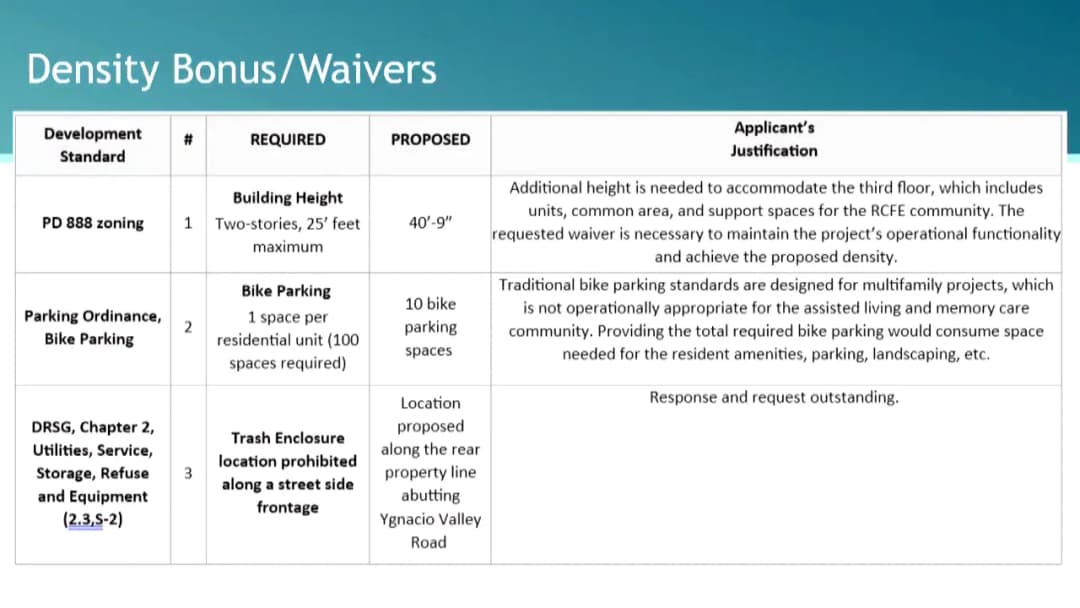
DISCREPANCY NOTICE: The provided agenda for this date indicates the meeting was cancelled. The provided raw transcript contains proceedings from the Design Review Commission. The summary below synthesizes these materials, using the specified meeting date. The meeting was a study session for two proposed 100-unit Residential Care Facilities for the Elderly (RCFEs) seeking approvals under the state Density Bonus Law. Study Session: 1350 Montego Way (O&I Development / Oakmont Management Group) - Application: Demolition of an existing two-story office building and construction of a three-story, 100-unit RCFE (70 assisted living, 30 memory care). The applicant requested density bonus waivers for building height, bike parking requirements, and a standard restricting trash enclosure locations. - Project Details: The site is 3.10 acres. 82 parking spaces are proposed (54 required). The building height is 40 feet 9 inches. The plan removes 44 trees and plants 217 trees. The applicant stated they would work with the city arborist to update the tree report and explore preserving more mature trees. - Commission Feedback: Commissioner Prose requested heightened modulation and color contrast to break up the building mass. Commissioner Newsom asked for more attention to the east elevation along Ignacio Valley Road and suggested exploring relocation of the trash enclosure. Vice Chair Riley and Chair Basting emphasized aggressive screening requirements for the trash enclosure and all utility equipment, strongly recommending the preservation of existing mature trees for screening. - Public Comment: Joe Perez (resident of 1362 Montego Way) expressed concern about the removal of mature Diodor cedar trees that screen his backyard and potential light trespass. He stated, \"the third floor kills my backyard.\" The applicant responded by committing to review tree preservation near his property and stated the project will use downlit fixtures to avoid light trespass, pending traffic department feedback on required lighting. Study Session: 1220 Rossmoor Parkway (Harvard South Bay Partners) - Application: Demolition of an existing single-story building and construction of a two-story, 100-unit RCFE (76 assisted living, 24 memory care). The applicant requested density bonus waivers for building height, required public outdoor access, parking maximums, and window recess standards. - Project Details: The site is 4.4 acres zoned PD 930. The building exceeds the 30-foot height limit by a maximum of 3.5 feet due to the 17-foot grade change across the site. The plan removes 65 trees (including one highly protected tree) and plants 73 trees. The architect stated the design was inspired by the existing 1960s mid-century modern office building to give the facility a \"residential feel.\" - Commission Feedback: The provided transcript concludes during the applicant presentation; commission discussion for this item is not fully captured in the source material. Key Outcomes - Both items were conducted as study sessions. No formal votes or final decisions were made by the Design Review Commission. - Both projects will proceed to the Planning Commission for final hearings at future dates, incorporating the design feedback and recommendations from the Design Review Commission.
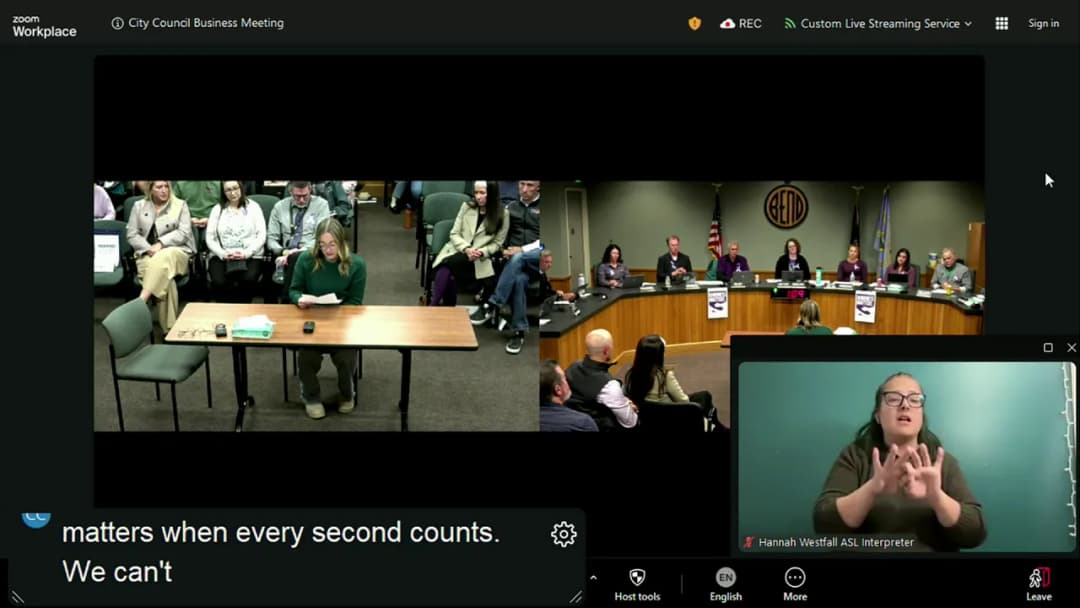
The Bend City Council convened on October 21, 2026, for a business meeting that was largely devoted to the mass shooting at Silver Rail Elementary School on October 15, 2026. The council issued a joint statement, received detailed briefings from emergency management and school officials, and heard extensive public testimony. The meeting concluded by approving consent agenda items and a resolution regarding a shared framework with Bend Park & Recreation District. A notable discrepancy in the source material involves the consent agenda: the agenda listed minutes for approval, but the minutes document provided stated "[No minutes available]". Discussion Items - Supporting Silver Rail Elementary: The council dedicated the first hour of the meeting to the tragedy. Mayor Pro Tem Perkins read a joint council statement expressing grief for the four victims, honoring first responders, and pledging action on gun violence and mental health. Individual councilors echoed the commitment to preventing future tragedies, with one stating, "we cannot let this happen again." - Police Chief Update: Chief Krance reported that the investigation remains active, involving 180 calls to 911 in the first 60 minutes, ongoing search warrants, and witness interviews. He confirmed the firearm was legally purchased. Regarding school safety, he stated that placing a School Resource Officer at every campus was "not something we can accomplish" and emphasized the SRO role is mentoring rather than dedicated armed security. - School District Update: Superintendent Cook reported that 32 of 33 district schools reopened with attendance near normal levels. The Family Assistance Center served roughly 870 people. Cook stated that all options for the future of Silver Rail Elementary, from demolition to rebuilding, are under consideration and will heavily involve community input. - Community & Emergency Response: Sarah O'Neill from the Bend Chamber detailed the outpouring of business support, including free meals, activities, and fundraising. Emergency Manager Carl reported that the Family Assistance Center involved over 240 volunteers supporting nearly 900 individuals and outlined continuing mental health resources and donation options. - Shared Framework Resolution: Councilor Franzosa requested the resolution be pulled from the consent agenda for discussion. The council unanimously adopted the resolution establishing a Shared Framework with the Bend Park & Recreation District for collaboration on affordable housing, recreation, and community vitality. Consent Calendar - The council voted unanimously to approve the consent agenda. This included the August 2026 Monthly Financial Report, authorization of a construction contract for the Pressure Reducing Valve and Galveston Corridor Projects, and an approval of the City of Bend Census Comment Letter. Public Comments & Testimony - During the Visitors Section, speakers focused on school safety and accountability regarding the Silver Rail shooting. - Catherine Cartwright and Tracy Martin called for Mayor Kebler's resignation, alleging that prior council decisions and a staffing study identifying SRO deficits were ignored, directly contributing to the lack of protection at the school. - Todd Pryor defended the council and Superintendent Cook, arguing that criticizing leadership during the tragedy was counterproductive and urging the community to build roots and listen rather than demand removals. - Benjamin Roberts advocated for allowing trained teachers and administrators to carry concealed weapons on campus to provide an immediate defense for students. - Michelle Hill, a survivor of a previous school shooting, shared her experience and urged the city to fund dedicated, full-time SROs at every school, emphasizing the need for proper training in de-escalation and adolescent development. - Trey Heiss, a parent of a student at Silver Rail, called for immediate physical security upgrades, independent third-party safety assessments of schools, and a dedicated private meeting for affected families with the council and district. - Amanda Romandia and Marissa Adams asked the council to prioritize statewide funding for school safety and to work with the school district to create a concrete action plan. - Bernadette Strome and Jenny Lingard questioned the council's budget priorities, stating that millions in federal funding for school safety were not pursued and that local dollars were spent on projects other than the recommended four additional SROs and patrol officers. - Ben Lysoid proposed the city implement gun buyback programs and subsidize gun safes to reduce youth access to firearms. - Kyle Lindquist and Brittney Lindquist demanded accountability, with Brittney asking who was specifically responsible for school security and why no leadership changes had occurred in the wake of the tragedy. Key Outcomes - Consent Agenda Approved: The council unanimously approved the consent agenda. - Shared Framework Resolution Adopted: The council unanimously adopted the resolution formalizing a collaborative framework with Bend Park & Recreation District. - Fee Waivers Authorized: The council granted the City Manager authority to waive fees, fines, and other charges for families and students directly impacted by the Silver Rail tragedy. - Public Input Received: The council received a significant volume of public testimony demanding immediate action on school security, accountability for past decisions, and a clear timeline for implementing safety measures.