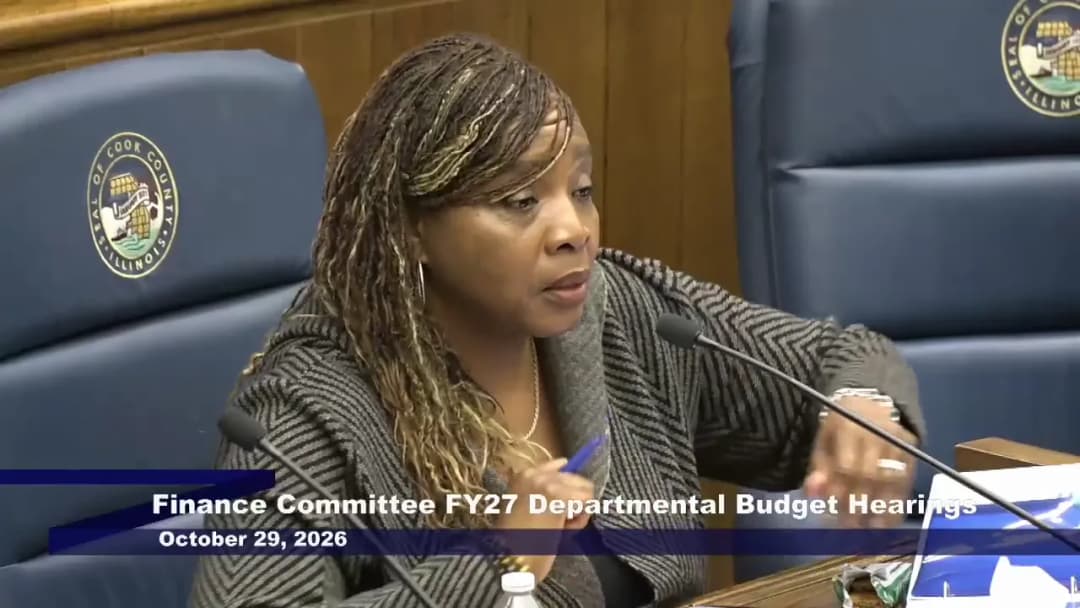
The Cook County State's Attorney, Eileen Burke, presented a revised budget request for fiscal year 2027 to the Cook County Board of Commissioners. The hearing focused on a request for 70 new positions, which the State's Attorney argued would be largely budget-neutral through savings from reduced outside counsel, overtime restructuring, and turnover adjustments. Commissioners questioned the request's sustainability, funding sources, and impact on the county's budget, as well as the office's policies on prosecuting retail theft, ICE-related referrals, and restorative justice programs. Presentation of Budget Request - State's Attorney Burke introduced her leadership team, including First Assistant Craig Engebretson, Chief of Staff Don Black, Chief Assistant for Policy and External Affairs Loisen, and Chief Financial Officer John Horahan. - She emphasized that the budget request is part of a strategic multi-year plan to strengthen the workforce, professionalize operations, and improve services to victims and witnesses. - The original request for 154 new positions was narrowed to 70 mission-critical positions after identifying funding mechanisms. Discussion Items - Budget Neutrality and Funding Sources: The State's Attorney argued that 50 of the 70 positions are permanently budget-neutral, funded by expanding in-house civil legal capacity (saving an estimated $5 million annually in outside counsel expenses) and eliminating overtime for weekend first appearance court (saving an estimated $750,000 to $1 million annually). The remaining 20 positions are budget-neutral this year through adjustments to turnover rates. - Outside Counsel Savings: The office previously collected $173 million from class-action settlements. By adding 10 experienced civil attorneys, the office projects annual savings of approximately $5 million, based on the reduction in outside counsel spending which averaged $359,000 per month over the past two years (over $8 million total). The workers' compensation unit was cited as a proof of concept, where adding three attorneys nearly eliminated outside counsel, saving $2.2 million in 2024 and 2025. - Digital Forensics Lab: The office is opening its first digital forensics lab at 525 West Van Buren, approved by the board last month, planned to open in January. It will be staffed by seven certified digital forensic examiners and four digital forensic analysts. The volume of digital evidence has surged: 308 requests for cell phone data analysis in the prior full year, now at 1,483 requests (an average of five per day), projected to grow 382%. The State's Attorney argued this investment helps prevent wrongful convictions. - Workforce and Recruitment: The office is swearing in its largest-ever class of bar takers (80 recently graduated law students), almost double the size of the previous class. This follows a period of critical understaffing that led to attorney burnout and low morale. - Mental Health and Victim Services: The request includes mental health specialists and additional victim specialists to reduce caseloads (which peaked at over 400 cases per specialist in 2025, down to mid-300s in 2026, with a goal of returning to 270-280 as in 2023). - Paralegals: Additional paralegal positions are requested to support attorneys with research, discovery review, and case preparation, improving workflow efficiency. - Retail Theft Prosecution: In response to Commissioner Broad's question, First Assistant Craig Engebretson stated that felony retail theft cases increased from 594 under the previous administration to 701 this year (a difference of about 100), and that this change does not impact staffing needs. Commissioner Broad noted that the public defender's office expressed concerns about increased resources needed due to more retail theft prosecutions. - ICE Referrals: State's Attorney Burke confirmed that no referrals have been received from any law enforcement agency requesting charges related to ICE. She also stated that two secret requests for federal agents were received, but she could not divulge further details. A protocol for federal immigration enforcement actions was created in February and adopted by all prosecutors in the state, with no updates. - Restorative Justice Programs: The office is using restorative justice community courts for the Gun Accountability Program (GAP), which allows people charged with a Class 4 felony for lacking a FOID card to have charges dismissed upon completing gun education and obtaining a FOID card. Over 90 people are in the program. The Misdemeanor Deferral Program (MDAP) offers treatment for mentally ill, drug-addicted, and veteran defendants. - Community Justice Centers: The 13 FTEs from the Community Justice Center unit have been redeployed to other vacancies. - Sexual Assault and Domestic Violence Division: The division has been moved from Special Prosecutions to a new Special Victims Bureau, consolidating sexual assault, domestic violence, and crimes against children. - Vacancies: The office has filled all allotted positions for the first time in 10 years, but operationally there are 32 positions posted or being interviewed for. The office can fill vacancies within 8-10 weeks. - Vine Contract: The contract for victim notification services has not yet been executed; the last issue was a background check in the procurement workflow. Key Outcomes - No votes were taken during the hearing. The State's Attorney concluded her presentation and answered Commissioner questions. - Commissioner Broad requested that the office provide documentation showing how the $7 million in new positions would be offset by savings from outside counsel, overtime reductions, and turnover adjustments. He specifically asked for a justification to reallocate funds from the current balanced budget. - Commissioner Vasquez requested a formal opinion from Risk Management on the estimated $5 million in savings from bringing civil cases in-house. Risk Management head Deana Zellas agreed to work with the budget office to produce a written review by the amendment deadline (the following Thursday). - Commissioner Nye stressed the importance of finalizing the Vine contract, noting an ordinance amendment passed at the last board meeting. - Commissioner Trebor expressed concern that adding 70 FTEs would lock the county into higher expenditures in future budget years, despite the structural savings identified. - Commissioner Grieg asked about revenue generation from civil settlements; State's Attorney Burke confirmed the office frequently brings civil actions against corporations for violations. - The hearing recessed for 10 minutes for the Board of Review to present.
The Public Meeting Index
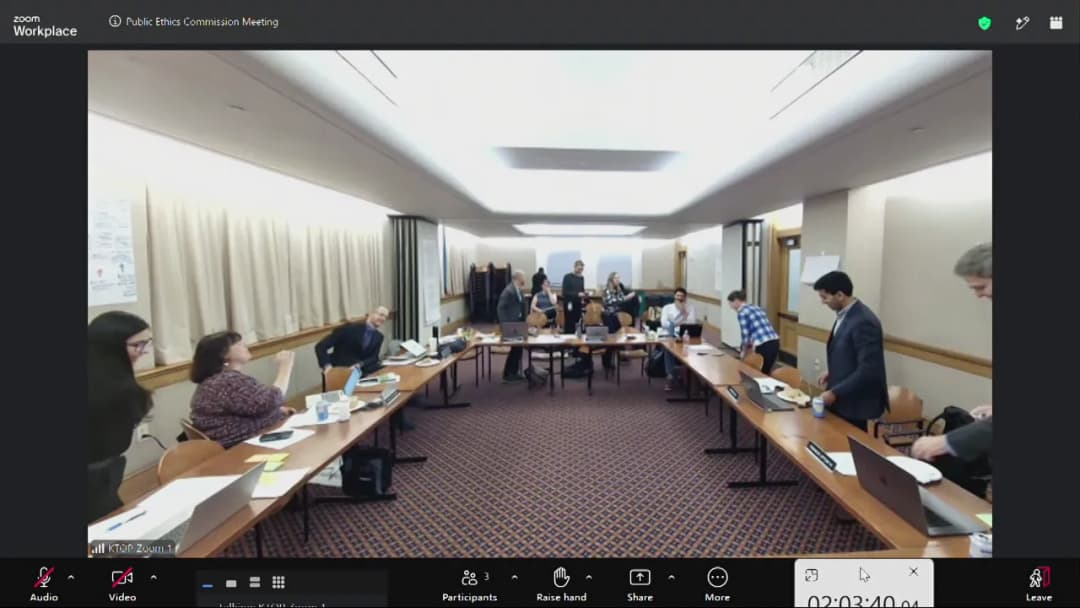
The Public Meeting IndexThe Oakland Public Ethics Commission (PEC) held a special retreat meeting on October 29, 2026, chaired by Francis Humpton. The retreat was designed to reflect on the commission's work over the past three years, review the current state of its programs, and establish strategic priorities for 2027. The meeting included an icebreaker activity, presentations on accomplishments and challenges in enforcement, disclosure, education, and communications, followed by a hypothetical case prioritization exercise and a vote on policy priorities for the coming year. Icebreaker Activity and Core Values - Senior Ethics Analyst Jelani Killings led an icebreaker exercise where staff and commissioners mapped their motivations and skills onto a "PEC Tree," identifying reasons for joining or staying with the commission, strongest attributes, and untapped talents. Themes included public service, government accountability, transparency, and creativity. - Staff and commissioners were reminded of the commission's core values: collaborative community, joint accountability, open mindset, inclusive design, and proactive transparency. Discussion Items and Staff Reports Strategic Overview of PEC Accomplishments (2022–2025) - Staff highlighted significant organizational growth: the budget expanded from $1.5 million to $2.7 million, and the team grew from 6 to 11 full-time positions, achieving full staffing for the first time in years. - Voter approval of Measure 00 with 73% support made the PEC an autonomous agency, significantly updating its authority for the first time in a decade and guaranteeing funding for additional investigative staff. - Enforcement activity reached a historic milestone in 2024 with seven settlements, including over $4,400 in campaign finance penalties. In 2025, 20 complaints were evaluated, four proactive investigations were initiated, and 65 cases were resolved. A backlog case closure program and a Form 700 enforcement pilot project were also launched. - The Democracy Dollars public financing program was delayed, but the commission successfully advocated for maintaining existing public financing and secured a $21,000 grant for outreach planning, the first grant the commission has ever won. - Outreach efforts reached a decade high, with participation in 15 community events. Communications Update - Staff reported strengths in a new brand identity, a design guide, and an expanded social media presence (Instagram @openethics, LinkedIn). - Key challenges included inaccessible technical language, outdated document templates, and a reliance on an outdated version of SharePoint. - Upcoming WCAG accessibility requirements and the commission's 30th anniversary in November 2026 were identified as key opportunities for storytelling and improving public access to information. Education and Disclosure Update - The education program is fully staffed for the first time in years, handling an average of 153 advice calls and 983 training completions annually on city ethics rules. - Education: Training materials are outdated (circa 2015). A partnership with department heads is being developed to improve compliance training for the city's 30+ boards and commissions. - Disclosure: Staff review over 750 disclosure reports annually. On-time filing rates reached 90% for campaigns and 93% for lobbyists. - Challenges: Fragmented technology systems require significant manual data entry. The lack of a central contractor database hinders enforcement of campaign contribution bans. There is no electronic payment system for fines. - Mediation Program: The backlog of 2019-era mediation cases was fully cleared. Staff are developing a training program for public records liaisons across city departments to reduce mediation requests caused by poor department responsiveness. The goal is 75% liaison participation in training by Q1 2027. Enforcement Update - The enforcement chief reported inheriting 152 open complaints in May 2025, a case ratio of 1:76 (peer agencies average approximately 1:9 to 1:14). - A seven-point rubric was used to analyze the legacy backlog; 101 of the 123 legacy cases were analyzed, and 82% of those were closed. - The current caseload ratio has been improved to 1:25, but a new intermediary backlog of 35–50 cases from 2024–2026 has developed due to the time spent on the original backlog. - Hypothetical Prioritization Exercise: Commissioners, staff, and a consultant ranked four hypothetical enforcement cases using the severity rubric. Results demonstrated strong consensus across groups, with higher scores aligning for cases with higher severity, clearer evidence, and stronger deterrence value. - Priorities discussed for 2027 included: achieving full staffing; using discretion to dismiss low-priority complaints; developing a proactive Form 700 plan; creating an enforcement subcommittee to revise penalty guidelines; exploring a diversion program using educational videos for lower-tier violations; and considering opening proactive investigations for high-profile matters. Key Outcomes and 2027 Priority Setting - Policy Focus: Commissioners ranked potential major policy review areas. Sunshine Ordinance reform and overall transparency received the highest number of first-choice votes, establishing it as the top policy priority for 2027. This work will include making system-wide recommendations to the City Administrator, potentially holding a public hearing, and creating a subcommittee to draft specific statutory revisions. - Disclosure Focus: Improving disclosure technology and efficiency was strongly linked to the transparency priority and was chosen as the top focus within the disclosure program area. - Enforcement Focus: The enforcement chief will explore establishing an enforcement subcommittee, updating penalty guidelines, and creating streamlined diversion options for low-level cases. Commissioners supported increasing the use of discretion to focus resources on high-impact cases. Public Comment - No members of the public provided comment during the retreat's open forum periods. The meeting was adjourned after the priority-setting session. Staff indicated they would synthesize the retreat discussion into a formal roadmap for future commission meetings.
The Health and Human Services (HHS) and Public Safety (PS) Committees met jointly on Thursday, October 29, 2026, to discuss Bill 34-26, which amends regulations for bodywork establishments to close loopholes that allow individuals affiliated with problematic establishments to open new ones. The meeting included a staff presentation, discussion of amendments, and a final vote. Discussion Items - Bill Overview: Mr. Ogorzalek presented Bill 34-26, which defines corporate officer and business manager roles, prohibits issuance of a license to establishments where such individuals have pending adjudication or prior violations, and requires reporting to cross-check applicants. The bill aims to prevent individuals who have faced enforcement at one bodywork establishment from opening another in the county. - Amendment 1 (Probation Before Judgment): Offered by Councilmember Luedtke, this amendment adds probation before judgment (PBJ) as an adjudicatory posture that would disqualify an individual. The committee approved this amendment by acclamation after a technical correction to reference the Criminal Procedure Article. - Discussion on Prostitution-Related Offenses: The committee debated three options to modify the list of disqualifying crimes: - Option A: Remove the STET docket from disqualifying adjudicatory postures. - Option B: Remove the specific crime of prostitution/assignation (Md. Crim. Law §11-303) from the disqualifying crimes. - Option C: Remove all prostitution and related crimes from the disqualifying list. - Option D: Leave the bill as currently drafted (including prostitution-related crimes). Councilmember Mink argued that sex workers are often victims and should not be further penalized, especially since many would be on the STET docket and could face barriers to economic advancement. Councilmember Luedtke and Councilmember Sayles countered that the bill targets ownership/management, not employment, and that the nexus between prostitution offenses and bodywork establishments justifies inclusion. Detective Dizinkowski from the Vice and Intelligence Unit provided an example of a manager charged with prostitution-related offenses in a trafficking case. Councilmember Luedtke also noted that once a STET docket expires, the charge no longer applies, so the prohibition is temporary. - Amendment to Clarify STET Docket Language: Councilmember Luedtke moved to amend the bill to clarify that the prohibition applies only while a charge is currently under disposition on the STET docket, not after it expires. The committee approved this amendment unanimously. - Vote on Option B: A motion to adopt Option B (remove prostitution from disqualifying crimes) failed 2-3. - Final Vote on Bill 34-26 as Amended: The committee voted 3-2 to approve the bill with the amendments (including the STET clarification). Key Outcomes - Amendment 1 (Adding PBJ): Approved by acclamation. - Amendment on STET Docket: Approved unanimously (5-0) to change language to apply only during the pendency of the STET. - Motion to Remove Prostitution (Option B): Defeated (2-3). - Final Bill Vote: Bill 34-26 as amended passed 3-2. The bill will now move to the full County Council for consideration. - Next Steps: Councilmember Sayles noted that the Department of Permitting Services has raised related issues for future consideration. Staff will provide data on the 46 currently licensed establishments and communication plans for affected businesses.
The Oakland City Council Rules and Legislation Committee convened at 10:31 AM on Thursday, October 29, 2026, in the City Council Chamber. Chairperson Kevin Jenkins presided with members Rowena Brown and Carroll Fife present; Janani Ramachandran was excused. The meeting adjourned at 11:07 AM after approving several scheduling items, forwarding recommendations from other committees, and confirming a mayoral appointment. Consent Calendar - Approval of Minutes (Item 1): The draft minutes from the October 15, 2026 committee meeting were approved unanimously (3-0). - Determination of Schedule of Outstanding Committee Items (Item 2): The pending list was accepted as is (3-0). - Draft 2027 Legislative Calendar (Item 5): Taken out of order; the committee approved forwarding the calendar to the November 10, 2026 Special City Council meeting on consent (3-0). - New Scheduling Items (Item 3): The committee approved the scheduling of many items to various future committee and council meetings, including appointments to commissions, grant acceptances, contract amendments, and reports. A dais request to add a resolution celebrating the 30th anniversary of the Oakland Public Ethics Commission was also approved for the November 10 consent agenda. (Approved as amended, 3-0) - Review of Draft Agendas and Pending Lists (Item 4): Approved as amended, with two additional items scheduled from the Public Safety pending list: an OPD Staffing Report to November 17, 2026 Public Safety Committee, and a Bi-Annual Negotiated Settlement Agreement Report to December 8, 2026 Public Safety Committee (3-0). - Appointment to Rent Board (Item 6): Resolution confirming the mayor's appointment of Lauren Hansen Wright as an undesignated representative to the Housing, Residential Rent and Relocation Board was forwarded to the November 10 City Council consent agenda (3-0). Public Comments & Testimony - Rajni Mandal (District 4): Speaking on Item 2, requested that the Rules Committee schedule amendments to Oakland's militarized equipment ordinance (Chapter 9.65). Mandal argued that the current process creates a chronic problem where the Police Commission effectively exercises veto power over equipment expansions before requests reach Council, leading to excessive administrative burden and preventing Council from considering the department's full operational needs. Mandal urged prioritizing amendments to restore accountability, reduce administrative burden, and preserve transparency. - Blair Beekman: Spoke on Item 3, praising efforts on procurement enhancement (Item 3.16) and emphasizing the importance of equity in contracts. On Item 4, Beekman commented on crime data reports and questioned the status of the Flock contract, calling for public transparency and consideration of alternative ALPR vendors. During Open Forum, Beekman reiterated concerns about Flock and suggested Oakland may need a Chief Operations Officer role. - One speaker during Open Forum (Rajni Mandal waived) – no additional details. Key Outcomes - All items on the agenda were approved by unanimous votes of 3-0 (with one member excused). - Item 3 (New Scheduling Items) was approved as amended to add a rule-24 resolution celebrating the Oakland Public Ethics Commission's 30th anniversary, with Council President Jenkins and Councilmember Brown added as co-sponsors. - Item 4 (Review of Draft Agendas) was amended to schedule OPD's Staffing Report to November 17, 2026 Public Safety Committee and the Negotiated Settlement Agreement biannual report to December 8, 2026 Public Safety Committee. - The committee forwarded all items from other standing committees (Finance & Management, Public Works & Transportation, Community & Economic Development, Life Enrichment, Public Safety) to the November 10 or December 1 City Council agendas as recommended.
The Alameda County Board of Supervisors Health Committee, chaired by Supervisor Miley (participating remotely) and joined by Supervisor Tam, convened on October 29, 2026, at 21:30 boulevard. The meeting focused on three information items: the annual update from the Health Care for the Homeless Commission, the proposed second Measure W Home Together Fund capital RFP, and the new Aligned grant management platform. Public comment was received on each agenda item. Health Care for the Homeless Commission Annual Update - Commissioners Lara Uzman (Chair), Gloria Crowell, and Sabrina Puentes presented an overview of the commission's work. The commission oversees a $5 million federal grant (HRSA funding) for the Health Care for the Homeless (HCH) program, which has been part of Alameda County Health for over 30 years. - The HCH program serves people experiencing homelessness countywide (unsheltered, sheltered, doubled up), with a network of direct county teams and contracted providers including Alameda Health System, Lifelong Medical Care, and others. Services include primary care, street medicine, shelter health, a mobile pharmacy (one of the first three in the U.S.), substance use disorder treatment, and overdose prevention. - Commissioners reported that 5,200 people in Alameda County are street- or vehicle-homeless, and street health teams cover 14 zones. Shelter health teams visit 16–18 sites monthly. Between 2023 and 2025, more than 1,000 homeless individuals died prematurely. - Key concerns raised by commissioners: The need for much closer collaboration between the HCH program, the Behavioral Health Department, and Public Health to achieve a "no wrong door" approach. Commissioners stressed that many homeless individuals have co-occurring medical, behavioral health, and substance use issues, and that current referral-based systems are insufficient. - Supervisor Miley asked about operational impediments to collaboration. Director of Alameda County Health, Anika Chowdhury, acknowledged the need and committed to providing a future report to the committee on how to make service delivery more seamless. Supervisor Miley directed that the report include ideas such as integrated work teams. - The commission discussed termination of the contract with Roots Community Health Clinic for street medicine in East Oakland (Zone 6). Luella Penserga, HCH Program Director, stated the decision was mutual due to Roots requesting flexibilities incompatible with the broader county model. The zone was transitioned to Alameda Health System as of July 2026. - Regarding the mobile pharmacy, commissioners noted it is a new, promising model but is still in a soft launch phase. Efforts are ongoing to bring medications directly into the field via street medicine teams. - Supervisor Miley asked about targeted strategies for older adults and African American men experiencing homelessness. Jonathan Russell, Director of H Housing and Homelessness Services, noted that over 50% of those housed in supportive housing are age 50 or older, and the county is expanding medically frail permanent supportive housing and homelessness prevention using shallow subsidies with a racial equity lens. - Funding details: The HCH program receives about $5.1 million annually in federal 330(h) grant funding. This designation also allows Alameda Health System to draw higher FQHC Medi-Cal rates. - Public comment: Joe Rose (NAMI Alameda County South) asked whether Newark is covered by street medicine. Staff confirmed it is covered by Tiburcio Vasquez Health Center. Measure W Home Together Fund and Proposed Second RFP - Jeanette Rodriguez (Deputy Director, Housing) and Michelle Stirrett (Housing Director, HCD) presented plans for a second capital RFP using Measure W funds. The first RFP of $56 million funded 10 new construction projects (300 units), most in Oakland. The second RFP will be approximately $119 million, targeting about 700 units. - The RFP has two pots: (1) Acquisition/Rehabilitation: estimated $180,000 per unit (plus operating funding) for converting existing buildings (hotels, motels, etc.) into homeless housing. (2) Preservation: about $40,000 per unit for rehabilitating existing supportive housing units that are 20+ years old and in need of capital improvements. Both pots include operating subsidies for a 10-year term to cover the gap between tenant rents and operating costs. - Staff highlighted a partnership with the City of Oakland: approximately $6 million in operating subsidies freed up from two Oakland projects (one secured project-based vouchers, another may not proceed) will be kept in Oakland for the city to identify additional units in its Measure U round, potentially adding 50–60 units. - The RFP will be released in January 2027, with proposals due by March 2027 and board commitments expected in late spring 2027. - Discussion: Supervisor Miley asked whether the RFP includes tax-defaulted properties, faith-based properties, or school district properties. Staff clarified it excludes vacant land (new construction was covered in the first RFP) but includes existing buildings acquired for conversion. Supervisor Miley urged coordination with Oakland Unified School District on underutilized properties. He also asked about junk fees; Michelle Stirrett confirmed that county regulatory agreements do not allow junk fees and that monitoring is done by an asset management team. - Supervisor Tam emphasized that acquisition/rehab likely yields more units per dollar than new construction, and asked about leveraging Prop 1 state bonds if passed. Staff stated they are aligning the RFP to position projects for state funding applications in spring 2027. - Public comment: Caleb Smith (City of Oakland Housing Community Development) expressed gratitude for the county investment and stressed the need for geographic balance within the RFP. Liz Varela (Building Futures) supported the preservation funding, noting her 52-unit PSH project for domestic violence survivors needs rehab. Chris Van Giesen (Boss Homes) asked about flexibility to produce more housing for less cost, to which staff responded this RFP is not for modular new construction. Berkeley Mayor Adina Ishi criticized the county for poor communication with cities regarding Measure W fund release dates and the Home Together plan, and urged closer city-county collaboration. Staff acknowledged and committed to improving communication. Aligned Shared Platform for Grant Management - Michelle Stirrett and Dylan Sweeney presented a new Salesforce-based data management platform called "Aligned" (also referred to as "a line"). The platform replaces the legacy City Data Services system (built in 2012) which became unresponsive after being sold. Aligned was built in-house with consultant support and has been operational for three months. - The system handles contract management, asset management, performance management, and public reporting for HCD’s portfolio of over 156 affordable housing projects (8,000 units) and 200+ service contracts. Partners (CBOs) can submit applications, invoices, and reports online via a self-service portal. Staff can track funding sources, expenditures, and performance metrics in real time. - Aligned enables tracing of funds from source through procurement, award, and expenditure, and can produce live dashboards (e.g., Measure A1 reporting at measure-a1.acgov.org). It also tracks project occupancy, inspections, and financial records. Future phases aim to integrate federal reporting and support interdepartmental/interjurisdictional collaboration. - Staff reported that other County departments (Healthy Homes, Economic Development) are interested, and cities (Oakland, San Mateo County) have expressed interest in potentially using the platform for a fee to cover costs. - A contract amendment for the next phase (increasing features) will come to the Board in January 2027. - Discussion: Supervisor Miley asked about data accuracy and auditing. Staff explained that program managers review all reports before payments, and the system does not automate human oversight. He urged expansion to other county agencies to create a unified data system. Supervisor Tam asked about tenant protection monitoring; staff noted that while not currently included, it could be built in the future. He also confirmed the platform will track Measure W capital funds and essential county services funds. Staff affirmed that performance dashboards will show progress toward the 10X goals and that expenditure data from all cities is being collected for the first time. - No public comments on this item. Key Outcomes - The committee directed Anika Chowdhury to return at a future meeting with a report on how to make service delivery across health, behavioral health, and homelessness systems more seamless ("no wrong door"). - Staff will proceed with drafting the second Measure W capital RFP ($119 million) for release in January 2027, with board commitments in late spring. The partnership with the City of Oakland for $6 million in operating subsidies was endorsed. - The committee expressed strong support for the Aligned platform and encouraged its expansion to other county departments and potential external partners (on a fee basis). The next contract amendment will be presented in January 2027. - The committee acknowledged public comments and committed to improving communication with cities on Measure W implementation.
The newly established Gap Analysis Committee, convened by the City of Nashville Division of Public Health and Community Services, held its first meeting on October 29, 2026, at 1:01 PM in the Aldermanic Chamber. Bobby Bagley served as interim chair to guide the committee through organization and officer elections. The committee is tasked with a comprehensive 90-day gap analysis of the city's homeless services system, covering emergency shelter, mental health, substance use, housing pathways, and street outreach. Public Comments & Testimony - No formal public comment period was held during this organizational meeting. Chair Jane Goodman acknowledged observers in the chamber and invited them to return to share their perspectives at future meetings. Discussion Items - Election of Officers: Alderman Greg nominated Jane Goodman for Chair, praising her public health background and role as a community partner. The nomination was seconded by Alderman Lopez and approved unanimously. After a discussion about the committee hierarchy, Tonya Nisley was elected Vice Chair and Alicia Gregg was elected Clerk to handle procedural logistics and minute-keeping. All elections were concluded via unanimous voice vote. - Meeting Protocol & Rules: The committee decided to operate under Mason's Rules of Order rather than Robert's Rules. A procedural cheat sheet and script were requested from the administrative office to ensure consistency, with Donna Graham identified as the resource for the script. - Meeting Logistics: - Location: The Aldermanic Chamber was selected as the primary venue for its recording capabilities, public access, and microphone setup, despite some members expressing a preference for a more intimate or flexible space. - Cadence: The committee will meet weekly on Thursdays at 1:00 PM. Holidays (Thanksgiving, Christmas, New Year's) will necessitate schedule flexibility; alternative dates (e.g., Tuesdays) will be explored. - Scope and Vision: Members extensively discussed the definition of "city" in the resolution. Latonya Mussioli clarified that the formal recommendations target the municipal entity (Board of Aldermen) rather than the community at large, though the group acknowledged overlap. Key themes included identifying uncomfortable gaps (e.g., individuals banned from all shelters), balancing hard data with qualitative human stories and context, and mapping all city spending (proactive and reactive costs across departments such as Police, Library, and Public Works). - Data Collection Strategy: Multiple members emphasized the importance of both quantitative data (PIT counts, HMIS data, budget figures) and qualitative data (lived experience, provider capacity). Latonya Mussioli offered to submit existing compiled data. A glossary of terms (HIC, HMIS, PIT) was requested to aid public understanding. Key Outcomes - Officers Elected: Jane Goodman (Chair), Tonya Nisley (Vice Chair), and Alicia Gregg (Clerk) were elected by unanimous voice votes. - Administrative Support: Jessica Connors (Public Health) was designated to manage minutes, meeting notices, and document distribution. - Data Submission: Committee members were directed to submit any relevant data, reports, budget overviews, and terminology glossaries to Jessica Connors before the next meeting to establish a baseline for the gap analysis. - Next Steps: The committee will meet at 1:00 PM on the following Thursday to review compiled data and formally structure its work plan. The formal 90-day completion deadline for the report runs from this meeting date.
The San Francisco Board of Supervisors Public Safety and Neighborhood Services Committee held a special meeting on October 29, 2026, chaired by Supervisor Danny Sauter, with Members Alan Wong, Supervisor Cheryl (replacing Vice Chair Bilal Mahmood), and the hearing organizer Supervisor Matt Dorsey. The meeting focused on a comprehensive El Niño storm preparedness hearing and two legislative ordinances. Public Comments & Testimony - An unnamed speaker who previously worked with the federal government criticized the city for lacking operable warning sirens and noted the Department of Emergency Management's watch center has been disbanded, stating "the poorest jurisdictions in this land have operable warning sirens." The speaker also pointed to the exclusion of San Francisco International Airport's workforce from the city's emergency management planning. - Anna Savage, an oceanographer at the San Francisco-based company SoFar Ocean, spoke about the value of collecting and maintaining real-time ocean observations locally and across the Pacific. She stated that "we're not able to prepare for conditions we're not measuring" and highlighted the company's partnership with the Port of San Francisco to deploy monitoring instrumentation in the Bay. Discussion Items - El Niño Storm Preparedness Hearing: Supervisor Dorsey opened the hearing by describing the unprecedented strength of the current El Niño. He stated the highest October tide ever measured had occurred earlier that week and cited UC climate scientist Daniel Swain's findings that the Oceanic Niño Index is running at 3.3 degrees Celsius above normal (previous record 2.1), with a greater than 90 percent chance of a wetter than average winter, a 5 times normal chance of an extremely wet winter, and a roughly 20 times normal chance of a record wet season. He warned that King Tides on Thanksgiving (Nov 24-26), Christmas (Dec 22-25), and in January (20-23) coinciding with storms could cause historic coastal flooding, calling his District 6 "ground zero." Department of Emergency Management Director Mary Ellen Carroll noted the ocean is already running 1 to 2 feet above normal tide predictions due to Kelvin waves, and stated the city has 76,000 Alert SF subscribers and a 55,000-member WhatsApp emergency alert channel. PUC's Joel Prather reported that 4,700 catch basins have been cleaned and the combined sewer system can treat up to 565 million gallons per day, activating "Stormwatch" when more than one inch of rain is forecast in a 24-hour period. The Port's Michael Martin detailed the construction of seasonal flood walls at Pier 45, Pier 14/Rincon Park, and Piers 80 and 96 using HESCO barriers and industrial sandbags. BCDC Executive Director Larry Goldspend noted that the flooding witnessed at Pier 14 this week is double the level projected for 2050, calling the current situation a "lesson for the future" and emphasizing that "the future is now." HSH's Emily Cohen described a three-phase inclement weather protocol for scaling shelter and outreach. SFFD Assistant Deputy Chief Erica Brown reported that the department analyzed tide predictions and identified 12 days this winter where water could reach flood levels, peaking on Christmas Eve morning. Public Works Nick Holzappel reported 27,000 sandbags on hand with a goal of 50,000. - Fire Code – Banning Lockable Butane Lighters: Sophie Marie from Supervisor Mandelman's office presented an ordinance prohibiting the sale of lockable butane lighters with plastic components. Fire Chief Dean Crispin reported 31 butane-related fire incidents from 2020 to 2025 causing an estimated 3.2 million dollars in property damage, representing a seven-fold increase since 2020. He stated that in 2026, the department has already recorded 3 documented lockable butane lighter fires and 1 death. The ordinance is deliberately narrow to avoid unintended consequences for commercial kitchens, and it does not ban unlocked lighters, metal lighters, or online sales. - Police Code – Cannabis Business Equity Applicant Status: Sophie Marie and Jeremy Schwartz from the Office of Cannabis presented an ordinance allowing the posthumous transfer of verified equity applicant status to up to four designated beneficiaries. Since 2020, the city has issued 71 social equity permits and distributed over 15 million dollars in grants. The ordinance establishes a one-year redemption period and requires beneficiaries to register and verify their familial relationship to the decedent. Key Outcomes - Item 1 (El Niño Preparedness): The committee voted unanimously to hear and file the report. - Item 2 (Butane Lighters): The committee voted unanimously to forward the ordinance to the full Board of Supervisors with a positive recommendation. - Item 3 (Cannabis Equity): The committee voted unanimously to forward the ordinance to the full Board of Supervisors with a positive recommendation.
The Des Moines City Council held its regular meeting on October 29, 2026. The agenda included routine consent approvals; three public hearings on the 2027 property tax levy, 2026 budget amendments, and the 2027–2028 biennial budget; first readings on tax and budget ordinances; an update to the square-footage B&O tax; a holiday tree purchase; and adoption of the Comprehensive Safety Action Plan. Councilmember Simons arrived late, so the consent agenda passed 6-0 before he joined. The meeting ended with a 40-minute executive session on property acquisition and potential litigation; no action was taken. Consent Calendar - Approved vouchers through Oct. 14, 2026 and payroll transfers through Oct. 20, 2026 totaling $4,835,359.38: EFT payments $2,294,335.84; wires $1,201,865.65; checks $287,939.73; payroll checks $871.16; payroll advice $526,946.62 and $523,400.38. Passed 6-0. - Approved minutes from the Sept. 24 and Oct. 1, 2026 regular meetings. - Approved the Service Electric agreement for $157,550.00, including a 15% contingency, for power cabling and charging equipment for future electric vessels at Marina guest moorage. - Approved the Green Earthworks Construction NW contract for $97,659.84 plus a $15,000 project contingency for demolition, utility improvements, and site preparation at the Marina tenant restrooms; increased the ROMTEC contract total to $1,063,107.84 for restroom installation, sales tax, and bonding. - Accepted the King County Youth and Amateur Sports Grant for the Midway Park Open Space Design Project. - Approved Parametrix 2026-2027 On-Call General Civil Engineering Task Assignment 2026-06 for the 6th and 287th Stormwater Project, $126,100.00. Public Comments & Testimony - Barbara McMichael, Des Moines resident, thanked Mayor Grace Matsui for joining other area mayors in a Seattle Times letter raising concerns about Port Commission attention to SeaTac Airport expansion. She invited port commissioners to experience aircraft noise from her terrace under the second runway; one commissioner accepted. She urged native tree replacement at 216th and consultation with Defenders of Highline Forest, and promoted the group's Nov. 4 speaker-series event at the Des Moines Library on birds. - Judy Grandy, Des Moines resident, opposed Flock safety cameras, arguing they do more harm than good and threaten Fourth Amendment privacy. She said Des Moines Police conducted only about 2% of searches while 98% came from outside entities, cited UW reporting on Border Patrol access, and asked the council to turn off, cover, or remove the cameras and end the Flock contract. She also raised concern that a warehouse could proceed through zoning without a known end use, referencing ICE detention-center concerns and a recently disclosed lease. - Bill Linscott, Des Moines resident, asked during the biennial budget hearing whether marina leasehold tax revenue is allocated back to the marina and other collection areas. Staff later answered that the marina pays leasehold tax to the state, a portion returns to the city's general fund, and it stays in the general fund rather than being reallocated back. - No public speakers signed up for the 2027 property tax levy or 2026 budget amendment hearings. Public Hearings: 2027 Property Tax Levy, 2026 Budget Amendments, and 2027–2028 Biennial Budget - 2027 Property Tax Levy (Ordinances 26-106 and 26-107): Finance Director Jeff Friend said the recommended levy is a little over $6.1 million; the city receives 6.89% of a property tax bill and ranks sixth among taxing authorities, with the top five taking just under 75%. Assessed valuation decreased 2.1%; the proposed 2027 rate was estimated at a little over 90 cents per $1,000 of assessed valuation, matching the 2024 rate of 90.8 cents. The 1% cap component was $58,364. Friend noted the city's rate was $1.30 in 2018 and bottomed at 86.5 cents in 2023. A Wesley nonprofit property-tax dispute remained unresolved; about $133,000 was cited for last year, unpaid, and any ruling in the city's favor would accrue to past and current budgets. Both ordinances advanced to second reading 7-0. - 2026 Budget Amendments (Ordinance 26-108): Friend reported proposed general-fund revenue amendments of almost $900,000 and expenditure amendments of $1.05 million, netting about a $163,000 cash decrease while ending cash remained above beginning cash. Public defender costs rose from $55,000 budgeted to about $280,000; an additional grant-funded patrol officer cost $140,000; red-light camera revenue fell $400,000; sales and B&O taxes were up; and indirect-cost allocations were corrected. Outside the general fund, the marina faced an $885,000 mortgage-revenue decrease from the dock replacement, a $400,000 equipment-fund transfer for travel-lift maintenance, and $38,444 less owed to the general fund; surface water removed $733,000 in state grants from the budget, saved $11,269 in indirect costs, and increased a capital transfer to $192,000. Advanced to second reading 7-0. - 2027–2028 Biennial Budget (Ordinance 26-105): Friend said council priorities set Aug. 6 were public safety staffing, making Des Moines easier to develop, long-term marina direction, and stronger fund-balance reserves, with honorable mentions for communications staffing and technology. Health-care costs were budgeted around 11.4% after a 10-16% range. Public safety was about 60% of expenditures, and salaries/benefits about 68%. The budget adds two police officers (July 2027 and July 2028), drone replacement, canine patrol, a police staffing study, a permit services manager, a communications manager, a parks/recreation director, a parks maintenance employee, a 2027 parks master plan, a Tyler Munis cloud migration in 2027, and streetlight/tree-canopy work. It raises contingency from $50,000 in 2026 to $100,000 in each of 2027 and 2028 and aims to add $125,000 to reserves each year. Revenue assumptions included 1% property tax growth, 2% sales-tax growth, stable B&O tax, $300,000 gambling tax, declining red-light revenue, and falling one-time taxes. General-fund revenue was projected to increase about $169,000; fines/penalties were down $589,000, or 40%, due to red-light cameras. Property tax was budgeted at $5.65 million for 2027 and $5.75 million for 2028, below the $6.1 million levy request because of county reductions, Wesley uncertainty, and conservatism. Sales tax was projected at about $4.8 million this year, with lower amounts budgeted for 2027-2028; utility taxes were $5.1 million this year and about $5.4 million in each budget year. General-fund cash was projected to begin at almost $3.1 million and end the biennium at $3.45 million. Marina ending cash was projected at $9.9 million in 2027 and $7.4 million in 2028, reflecting the $3 million South Seawall design/project management and marina master-plan investments; surface water was projected to end near $7.92 million while using about $2 million over the biennium for capital. Advanced to second reading on Nov. 12, 2026, 7-0. New Business - Square Footage Tax Update (Ordinance 26-109): Assistant City Attorney Matt Hutchins explained the 2024-enacted square-footage tax, effective Jan. 1, 2025, as an alternative to the gross-receipts B&O tax for warehouse/storage space; the rate began at 13.5 cents per square foot per quarter, about 4.5 cents per month, with 3% annual adjustments and a 4,000-square-foot threshold. Revenue lagged due to compliance issues, the Bartels/Right Aid vacancy, businesses paying higher gross-receipts tax, and non-warehouse businesses generating little gross receipts. The proposal expands the tax to non-warehouse business space inside buildings, keeps the threshold and calculation rules, and exempts landlords, with the tenant paying instead, and hotels. Staff estimated $100,000-$150,000 in additional annual revenue. The main motion advanced 7-0 to the next regular meeting. Councilmember Harris's motion to cap increases at CPI with annual review failed for lack of a second; Councilmember Bloss's CPI-indexing amendment also failed for lack of a second. Staff said it could return with a comparison of 3% versus CPI over recent years. - Holiday Tree Purchase: Assistant City Manager AJ Johnson-Newton described the Dec. 4 Winter Wonderland event at the marina, 5-8 p.m., following last year's tree lighting that drew about 1,000 people. Staff described a 40-foot tree with a 5-foot topper, just under 50 feet, with lights and ornaments, a five-year warranty, and an expected 10-year useful life; the agenda and adopted motion specified a 44-foot Majestic Mountain Pine package. Alternatives were reusing the prior mushroom tree at about $25,000 in labor and materials, renting for about $32,000 per year, or purchasing with an annualized cost around $25,000 over five years. The revised quote was $126,503.37. Staff proposed funding from the marina fund, waterfront zone fund, and lodging tax, with at least $40,000 in lodging tax described as pending or advanced through LTAC. The purchase was authorized not to exceed $135,000, including sales tax and shipping, on a 4-3 vote. Deputy Mayor Oxiger's amendment to instead use the marina steps contingency fund failed 2-5; several members argued that using bond-backed contingency funds would mean paying interest for 30 years on a 10-year asset. - Comprehensive Safety Action Plan (Resolution 26-041): City Engineer Tommy Owen and Chris Como of Transpo presented the 76-page final plan. The city adopted Vision Zero in May and had completed a Local Road Safety Plan; a recent $1.5 million HSIP grant will fund a Sixth Avenue South streetscape project. Crash analysis covered 2022-2025; high-injury networks concentrated in north-central Des Moines. The plan uses the Safe System Approach and Washington's added safer-land-use focus. Priority locations included South 16th Street, Des Moines Memorial Drive, Marine View Drive, 16th Avenue South, and downtown active transportation improvements. The policy audit found the city generally in good shape, but the 2012 Complete Streets policy needs refreshing and safety data must be updated every two years to remain HSIP-eligible. Future grants included SS4A, uncertain pending federal reauthorization, TIB, HSIP, Safe Routes to School, and PSRC-administered federal funds. Adopted 7-0. Regional & Council Reports - Councilmember Harris reported on the West Emergency Management Advisory Committee, where FEMA funding uncertainty was discussed, and the Regional Transit Committee at Starfire Sports in Tukwila, which reviewed FIFA World Cup transit performance; the area had the third-highest ridership across platforms, and agencies discussed making big-event service routine. - Councilmember Bloss, on the King County Board of Health, urged flu vaccination, noting an early and potentially severe season, earlier than in the past 30 years, with the current vaccine well matched. - Councilmember Nutting reminded residents of the downtown trick-or-treat path and Halloween safety. - Councilmember Bloss described a tour of Cedar Grove Compost and Cedar Hills landfill in Maple Valley; the landfill has roughly 10 years or less of capacity, and King County is seeking input on future trash options, including rail to Oregon or waste-to-energy. He also thanked staff for landscaping and the Des Moines Theater for events, including a 21+ Halloween party Saturday, doors at 7 p.m. and live music at 8 p.m. - Councilmember Harris discussed the airport Part 150 process, saying the first half was complete and engagement now matters for sound insulation, air quality, and water quality funding; he said a $1.4 million annual community fund would cost the average King County taxpayer about 75 cents. - Deputy Mayor Oxiger promoted the Legacy Foundation's Back to the Brunch on Sunday at Anthony's Homeport, 9:30 a.m.-12:30 p.m., $75 tickets, benefiting kids, seniors, and the arts. - Mayor Matsui thanked staff for budget preparation, noted the new ballot drop box outside City Hall, and announced the Veterans Day program at the park near the marina plaza starting at 11:11 a.m., with refreshments around 10:30 a.m.; daylight saving time ends that weekend. Key Outcomes - Consent agenda approved 6-0 while Councilmember Simons was still arriving. - 2027 property tax levy ordinances 26-106 and 26-107 advanced to second reading 7-0. - 2026 budget amendments Ordinance 26-108 advanced to second reading 7-0. - 2027–2028 biennial budget Ordinance 26-105 advanced to second reading on Nov. 12, 2026, 7-0. - Square footage tax Ordinance 26-109 advanced to the next regular meeting 7-0; CPI-related amendments failed for lack of a second; staff is to return with a rate comparison. - Holiday tree purchase authorized up to $135,000 on a 4-3 vote; the amendment to use marina steps contingency funds failed 2-5. - Comprehensive Safety Action Plan Resolution 26-041 adopted 7-0. - Executive session held on property acquisition and potential litigation; no action taken. Next meeting: Nov. 5, 2026 Committee of the Whole and joint study session with the Planning Commission.
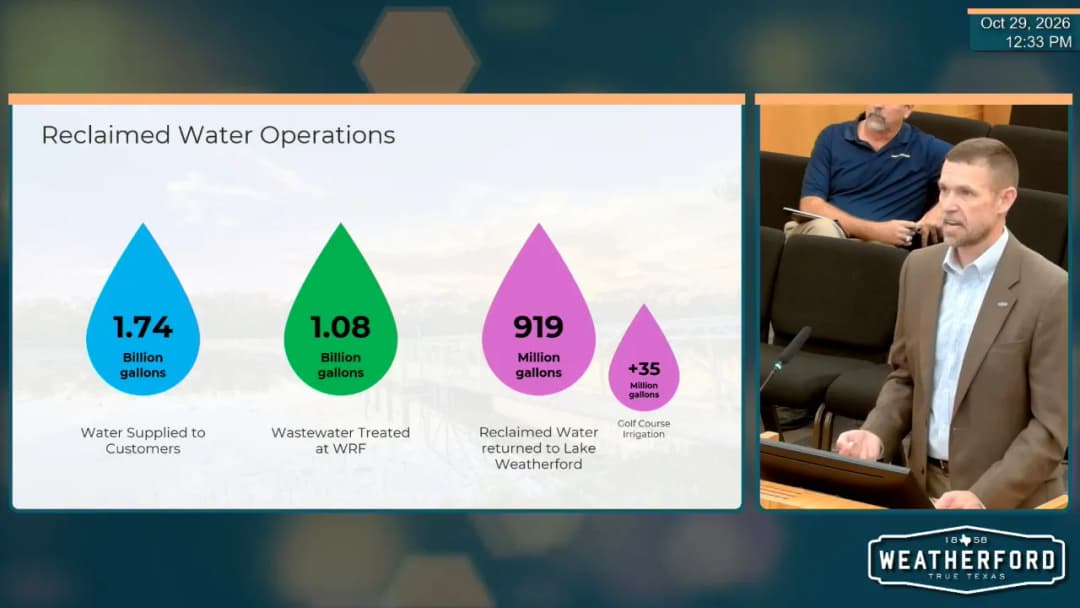
The Weatherford Municipal Utility Board held a regular and executive session meeting on October 29, 2026, at Weatherford City Hall. Mayor Paul Paschall was absent. The meeting was called to order at approximately 12:03 PM and adjourned at 1:15 PM. Presentations & Proclamations - Service Awards: The board recognized four employees: Josh Clements (Electric Warehouse, 10 years), Nick Benson (Public Works Engineering, 10 years), Valerie Escobelle (Utility Billing Manager, 10 years), and Rosa Palacios (Service Center, 30 years). - Take Back Meds Update: The 24th semiannual event collected 378 pounds of medication and 183 pounds of sharps. The city has collected over 10,000 pounds of medication since the program's creation. Consent Calendar The board approved the following items (6A-6G) with a single motion as routine business: - Authorized laboratory equipment and maintenance services from Hach Company and HD Supply (up to $200,000). - Awarded Bid No. 2026-020 to Evoqua Water Technologies, LLC. - Authorized professional services from Schneider Engineering for energy management consulting (up to $274,000). - Authorized expenditures with Anixter, Inc., Texas Electric Cooperatives, Inc., Techline, Inc., and Wesco Distribution, Inc. (up to $4 million). - Authorized pole attachment engineering services from TechServ Consulting (up to $200,000). - Authorized expenditure with Thirkettle Corporation (up to $1 million) through a cooperative agreement. - Renewed a utility forestry services contract with Northeast Service (dba Horton Tree Services) (up to $500,000). Discussion Items - Electric Line Construction Labor (Item 6H): The board approved the award of RFP 2026-017 for annual electric line construction labor to B&L Pole Line Construction Company as the primary vendor, with Last Call Line Services, Source Power, and Revolution Power as alternates (up to $1.5 million). Board Member Rod White asked about the purpose of the multiple alternates. Staff explained the alternates are a critical contingency for disaster response, and the bid tabulation process ensures the lowest available qualified vendor is used. - Water Purification Plant Expansion (Item 7A): The board approved Guaranteed Maximum Price (GMP) 4 for the Dr. Paul Phillips Water Purification Plant expansion to 18 MGD, increasing the total contract value to $96,856,978.55. GMP 4, valued at $43.88 million, includes a new raw water pump station and 36-inch raw water pipeline. Director Rick Shaffer reported that the price reflects a $3.2 million reduction from original bids due to negotiated fee reductions and the carryover of contingency funds from Phase 2, which is trending $2 million under budget. Construction on Phase 3 is scheduled to begin November 3, 2026, with completion expected in June 2029. - Annual Performance Dashboard (Item 8A): Directors Joe Farley (Electric) and Rick Shaffer (Water) presented the annual utility report. Electric rates have remained at 13 cents per kWh for 48 months, averaging 39% below the national average. System reliability numbers (CAID and SAID) were slightly above target due to major substation outages in February. Water rates remain 21% below the local average. The water loss rolling average is 11% (target 10%). An aerial leak detection program identified 50 leaks, saving an estimated 121 million gallons of water. The reclaimed water program returned 919 million gallons of treated water to Lake Weatherford, roughly a 50% return rate of water drawn from the lake. - Executive Session (Item 11A): The board recessed into executive session to discuss a Qualified Scheduling Service (QSE) agreement under the competitive matters exemption. Upon reconvening, the board approved a motion to authorize the City Manager to execute the QSE agreement and a credit agreement with Guidepost Energy LLC. Key Outcomes - The consent agenda (Items 6A-6G) was approved unanimously. - Electric line construction labor services were awarded to B&L Pole Line and three alternates (Item 6H). - GMP 4 for the water plant expansion was approved, setting the total project contract at $96.86 million (Item 7A). - The City Manager was authorized to execute agreements with Guidepost Energy LLC for qualified scheduling services (Item 11A). - Future performance dashboard updates will be provided to the board as written memos.
The Mesa City Council held a study session on October 29, 2026, to discuss proposed changes to the Large Water User Ordinance and an updated Water Shortage Management Plan. The meeting also included review of the upcoming November 2 council meeting agenda, brief remarks on historic preservation guidelines, and acknowledgment of board minutes. Consent Calendar - Council unanimously approved receipt of board minutes (item 3). Discussion Items Agenda Review for November 2 Council Meeting - City Manager Butler noted that item 4C (McFlood) currently displayed placeholder language that would be updated later in the day with corrected numbers from Maricopa County. Council also corrected a district designation error on item 4A. The council agreed to postpone the historic preservation guidelines and text amendments presentation to the Monday study session to allow for better public viewing, with Councilmember Taylor expressing support for the simplified new handbook and noting it clarifies that the overlay can be declined by property owners. Large Water User Ordinance Enhancements - Water Resources Director Joe Judice, Kathy McDonald, Lauren Whitaker, and Nicole Petker presented recommended enhancements to the Large Water User Ordinance (adopted 2019, updated 2024). Proposed changes include lowering the demand ceiling from 330 acre-feet to 224 acre-feet, aligning with Phoenix and Tucson. Mayor and staff emphasized that Mesa has had no new water-cooled data centers since 2021; only two exist in Mesa. The ordinance has driven innovation among large users, including advanced cooling treatment and air-cooling technologies. - The proposal expands allowable water resources customers can bring to meet allowance requirements (currently only long-term storage credits) to include groundwater rights and other acceptable supplies. A conservation plan would be required with permit applications. Permit terms could be adapted (3, 5, or 10 years), with longer terms requiring the user to provide water for the demand ceiling as well. Schools and hospitals remain excluded; landscape irrigation meters for excluded uses are still subject to the ceiling. - Councilmembers discussed flexibility options: Councilmember Duff inquired about smart meters and rebates for schools (staff noted non-residential irrigation equipment rebates exist); Councilmember Adams asked about groundwater rights mechanics; Councilmember Taylor questioned how business expansions are handled (demand ceiling not increased; allowance adjusted). Mayor proposed that council should have voting oversight when large users seek to increase their allowance beyond the ceiling. City Attorney Smith confirmed staff is developing details and will return for ordinance adoption later in fall 2026. - Vice Mayor raised concerns about externalities of air-cooling (noise, heat island effects) and chemical discharges into wastewater. Councilmember Duff emphasized the need for innovation funding and federal/state help for expensive water infrastructure. Councilmember Heredia suggested exploring whether customers could pay for infrastructure instead of providing credits, but staff noted capacity fee legislation now falls under impact fee statute. Water Shortage Management Plan Update - Nicole Petker presented an updated framework for Mesa's Water Shortage Management Plan, moving from single-source shortage planning to a portfolio-based evaluation. The framework uses four stages (currently Stage 1: awareness and voluntary efficiencies). Key principles: protect essential services first, act proportionately, communicate clearly, and adapt based on performance. The plan does not automatically trigger mandatory responses; it allows voluntary, phased, or mandatory measures depending on severity. - Examples of potential savings measures (from independent consultant) include AMI leak alerts, landscape optimization, watering schedules, and winter overseeding limits. Staff emphasized they would not impose all measures at once; they would start with communication and voluntary actions. - Council discussed HOA and community engagement. Councilmember Duff asked about adding a water rate surcharge for HOAs while considering differentiating useful vs. ornamental turf. Joe Judice confirmed they are working on rate proposals and will discuss with council in a few weeks. Councilmember Taylor raised the citrus sub-area plan requiring high-water-use orange trees; City Manager agreed to work with planning on options to allow replacement with lower-water-use plants. Councilmember Duff requested a community survey to gauge preferences on conservation measures, which staff supported. Councilmember Heredia noted the need for community input on potential restrictions like winter overseeding. Key Outcomes - Staff will return later in fall 2026 for ordinance adoption on both the Large Water User Ordinance updates and the Water Shortage Management Plan. - Council asked that future proposals include details on council oversight for large allowances and on community input (e.g., survey) regarding conservation measures. - The City Manager indicated the team will review landscape requirements for citrus grove areas to allow HOA flexibility for water conservation. - The next study session is scheduled for Monday, November 2, 2026, with a council meeting at 5:45 PM; the November 5 study session is canceled. Current Events & Future Meetings - Councilmembers reported on attended events: Youth Climate Action Fund ($50,000 from Bloomberg Philanthropies), One Community spotlight on success, Virgin Galactic's first Delta rocket departure from Mesa Gateway Airport, Halloween event at Red Mountain Library, ASU flight simulator tour, and semiconductor industry roundtable. City Manager noted six strong candidates for fire chief are being interviewed. - No further business; meeting adjourned.