Browse by city
Date range
Search help

Search titles, summaries, topics and stored transcripts together. Keywords may match separately; put the whole query in double quotes for a phrase. Matching follows word analysis, so punctuation is not exact. Both dates are included. Documents are not searched.

SHOWING 121–130 ENTRIES
121
NEWOCT 29, 2026 · ROCHESTER, MINNESOTA · BOARDS AND COMMISSIONS
Rochester Planning Commission Meeting Summary - October 29, 2026

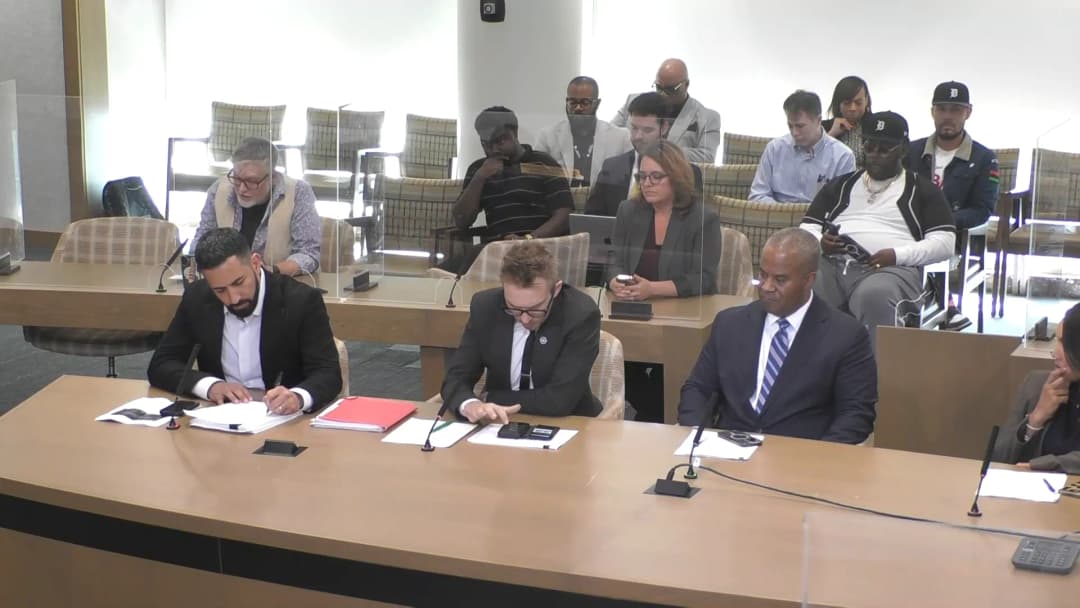
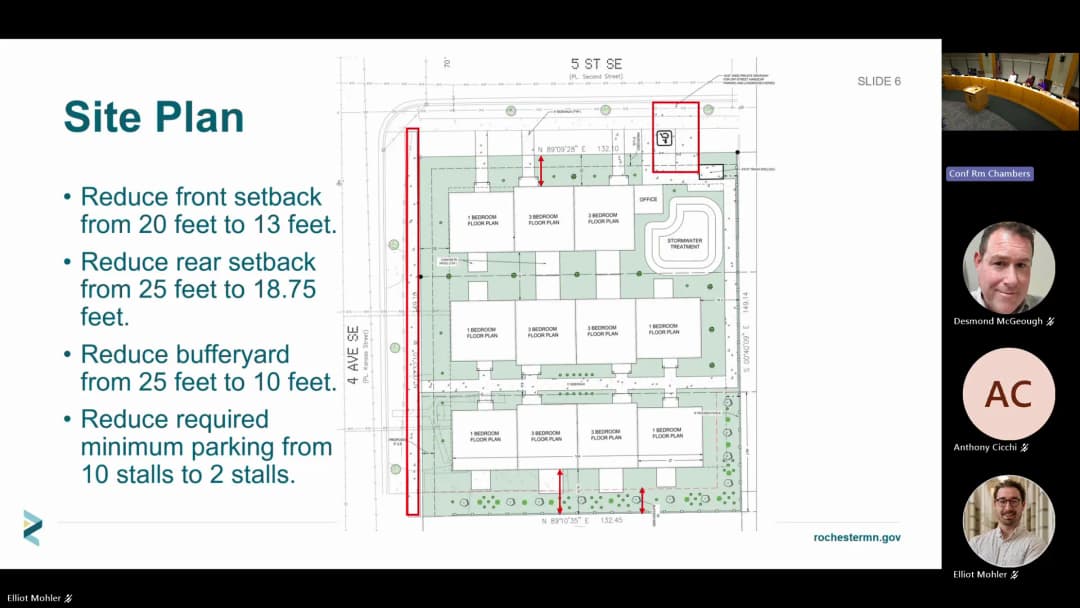
The Planning Commission met on October 29, 2026, to consider two major land use items: a preliminary plat for the Shannon Oaks 8th subdivision and a consolidated public hearing for a travel demand management plan and major modification to support a veteran housing project. The meeting included public comments, staff reports, and commission deliberation. Key votes included approval of the Shannon Oaks plat with conditions (3-2) and approval of the veteran housing parking reduction (4-1) and modification (5-0). Consent Calendar - Approved the September 16, 2026, meeting minutes unanimously. - Approved the order of agenda, combining items 6A and 6B into one public hearing, unanimously. Public Comments & Testimony - Kelly Raykirkpatrick (1107 East Center Street) urged the commission to table the Shannon Oaks 8th plat pending a complete environmental record, including a wetland delineation and verification that grading would not require engineered mitigation. She emphasized the need for adequate technical evidence before approval. - Andrew Inford (resident seven blocks from the veteran housing site) expressed support for the project's mission and infill density goals but raised concerns about parking adequacy given existing traffic and the nearby school. - John Lovald (COO, Minnesota Assistance Council for Veterans) stated the project provides permanent supportive housing for veterans, with 90% of residents at or below 50% AMI and 15% vehicle ownership based on their statewide experience. He emphasized the nonprofit's commitment to maintaining the property and addressing issues. - Ryan Schoenfeller (WSC, consultant) addressed parking concerns, noting availability of on-street parking, future multimodal investments (Link BRT), and a process for permit parking if needed. He explained that reducing parking further would cost housing units. Discussion Items Shannon Oaks 8th Preliminary Plat (Item 5A) - Staff report (Desmond McGill, Community Development) : The 10.73-acre site (zoned R1) would be divided into 25 single-family lots. The wetland delineation from 2015 has expired; a new one is pending with the Soil and Water Conservation District. Staff recommended approval with five conditions, including wetland sequencing approval before final plat. - Applicant (Mark Wells, GCUBE Engineering) : Presented a revised grading plan to reduce infrastructure costs and environmental impact. The wetland delineation was resubmitted; the incidental pond is not a permanent wetland. He confirmed no Decorah Edge features are present. The applicant agreed to the five conditions. - Commission discussion : Concerns were raised about missing wetland documentation, tree removal, and community opposition. Commissioner Ross moved to table for more information, but legal counsel noted the 60-day statutory deadline and availability of an extension. After debate, the commission approved forwarding the plat to city council with the five conditions (vote 3-2: Ayes: Commissioner Ross (recused?), Commissioner Ixon, Commissioner Kroll; Nays: Commissioner Klein, Commissioner Boyham; Commissioner Ahmed abstained/arrived late). Veteran Housing TDM & Major Modification (Items 6A & 6B) - Staff report (Elliott Miller, Community Development) : The project by Lenar/MACV at 5th St SE & 4th Ave SE seeks a travel demand management plan (reducing parking from 10 to 2 stalls) and a major modification (reducing front/rear setbacks and buffer yard). Staff recommended approval for both, citing transit access (frequent bus routes, future Link BRT), limited vehicle ownership among residents, and alignment with comprehensive plan goals. - First vote on parking reduction : Motion to approve 2 stalls failed (2-3). - Amended motion : After discussion of emergency access and precedent, the commission amended the parking reduction from 10 to 4 stalls. The new motion passed 4-1 (Ayes: Commissioners Ixon, Kroll, Boyham, Ahmed; Nay: Commissioner Klein; Commissioner Ross recused). - Major modification vote : Motion to approve with the one condition (buffer yard plantings) passed unanimously (5-0). Key Outcomes - Shannon Oaks 8th Preliminary Plat (CD 2026-026) : Forwarded a recommendation of approval to the City Council with five conditions (wetland sequencing, grading/civil plans, parkland fees, boulevard trees) by a vote of 3-2. - Travel Demand Management Plan (CD 2026-015 CUP) : Approved with a reduction from 10 to 4 parking stalls, tied to the MACV project, by a vote of 4-1. - Major Modification (CD 2026-014 MOD) : Approved with one condition (full buffer yard plantings despite reduced width) by a vote of 5-0. - Next Meeting : November 18, 2026. Adjourned.
PARKING 20% · ZONING REGULATIONS 18% · ENVIRONMENTAL PROTECTION 14% · URBAN DESIGN 9%
122
NEWOCT 29, 2026 · FRESNO, CALIFORNIA · CITY COUNCIL & COMMISSIONS
Fresno City Council Regular and Special Meeting - October 29, 2026

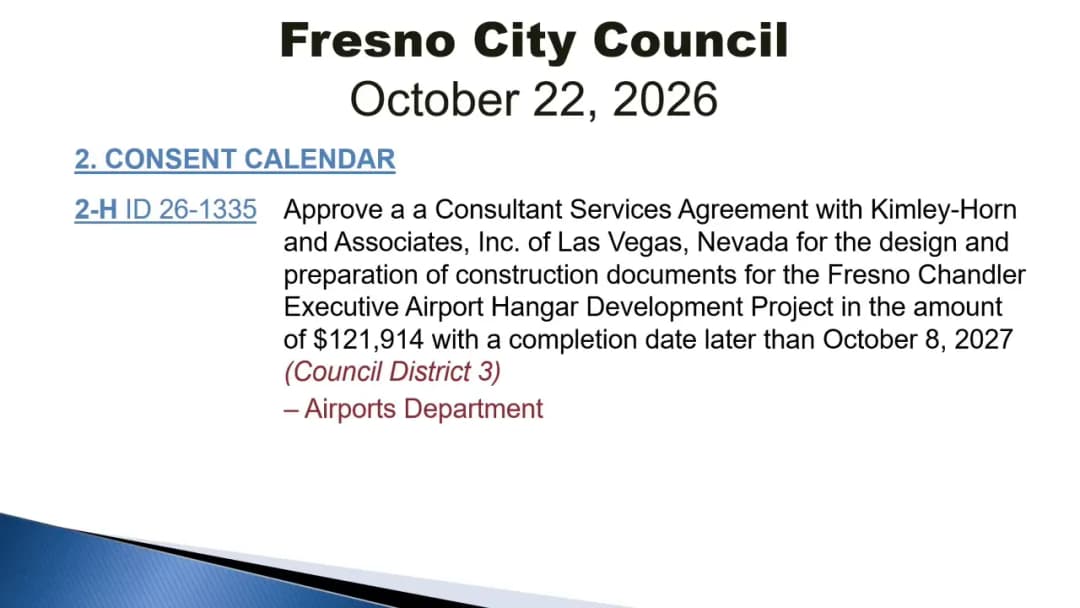
The Fresno City Council convened on October 29, 2026, for a regular meeting and a special meeting. Note: The official published agenda listed the meeting date as October 22, 2026, creating a discrepancy with the transcript metadata. The summary below uses the date provided with the transcript. The session included several ceremonial proclamations, a lengthy consent agenda, a robust debate on the SHIELD Act, and a special meeting to approve a 90-day public safety pilot program for the Tower District. The meeting concluded at 3:32 PM. Ceremonial Presentations Scott Mosier Day: The council honored retiring Public Works Director Scott Mosier for 24 years of service. He was recognized for his role in the $140 million Veterans Boulevard project and his responsiveness to community needs. Mayor Dyer and several council members praised his leadership. Domestic Violence Awareness Month: The council proclaimed October 2026 as Domestic Violence Awareness Month. The Fresno Police Department filed over 7,200 domestic violence reports in the previous year, and the Marjorie Mason Center served over 7,656 adults and children. The proclamation noted over 25 domestic violence-related homicides in the city over the last five years. Other Proclamations: The council proclaimed October 22, 2026 as Fresno Idea Works Day (honoring the downtown makerspace), Mobile Food Vendors Association Day, and Greg and Dre Day (celebrating 25 years of the local radio show). The council also proclaimed the week of October 18–24 as United Against Hate Week. Consent Calendar The consent calendar included a resolution re-establishing the Immigration Legal Defense Fund (Item 2BB), which was amended to limit eligibility to Fresno residents without a criminal conviction. Councilmember Richardson initially pulled it to contested consent, but a motion by Councilmember Arias to place it back on consent was approved 5-1, with Richardson dissenting. Other pulled items included a consultant agreement for Chandler hangars (Item 2H), which was discussed and approved. The consent calendar as a whole was approved 5-1. Public Comments & Testimony Immigration Legal Defense Fund (Item 2BB): Several residents spoke in support, citing a surge in ICE enforcement and the need for legal representation. Jesus Martinez (Central Valley Immigrant Integration Collaborative) and speakers from Power California and other groups urged approval. Neil O'Brien opposed the fund, arguing it creates preferential treatment. SHIELD Act (Item 4A): This item drew significant public comment. Janice Bellucci, an attorney with the Alliance for Constitutional Sex Offense Laws, stated the organization would file a lawsuit against the city, arguing the policy violates state law and could make registrants homeless and harder to monitor. She cited a less than 1% recidivism rate for paroled registrants. Multiple other speakers, including survivors of sexual violence like Dez Martinez, strongly supported the measure, arguing that some offenders cannot be rehabilitated and that protecting children is worth the legal risk. Tower District Pilot Program: A speaker questioned the root cause of the violence, suggesting the high concentration of liquor licenses is a primary factor requiring deeper scrutiny. Discussion Items SHIELD Act (Item 4A): Councilmember Karbassi, the sponsor, argued the city must act against a state system he described as protecting sexual predators and allowing them to be imported into Fresno. He cited the case of David Alan Funston, a convicted child molester with no ties to the city, as a primary example. Councilmember Richardson supported the intent but detailed significant legal barriers in state health and safety codes. Councilmember Perea strongly supported the measure, emphasizing the need to prioritize victims. The resolution passed 6-0. Tower District Public Safety Pilot Program: Councilmembers Perea, Arias, and Esparza, along with Mayor Dyer, presented a 90-day pilot program. The plan consolidates sidewalk vendors into a market zone on Olive and Van Ness to address overcrowding and public safety hazards. It was developed following a 4.5-hour community meeting with over 800 attendees. The pilot includes upgraded street lighting (from 38W to 75W), dedicated police foot patrols, and adjusted enforcement times for parking and street cleaning based on public feedback (loading zone enforcement moved from 6 PM to 10 PM, power washing moved from 2 AM to 3 AM). Key Outcomes Consent Calendar: Approved 5-1. Councilmember Richardson cast the dissenting vote. SHIELD Act Resolution (4A): Approved 6-0. The City Attorney is directed to return with a draft ordinance by the end of 2026. Tower District Pilot Program (Special Meeting): Approved 6-0. A 90-day pilot program establishing a vendor market zone and enhanced safety protocols. Chandler Hangars (Item 2H): Approved without opposition. Hangars will be replaced without increasing space or rates to allow for a future Fresno Unified project. Community Facilities Districts (CFD 9): Two separate items to annex territory and levy special taxes were approved unanimously (6-0). Closed Session: The council met in closed session for legal consultations. No reportable actions were taken.

PROCEDURAL 43% · PUBLIC SAFETY 15% · COMMUNITY ENGAGEMENT 8% · IMMIGRATION POLICY 8%
123
NEWOCT 29, 2026 · ALLEGHENY COUNTY, PENNSYLVANIA · COUNTY COUNCIL
Allegheny County Public Hearing on 2027 Proposed Budget – October 29, 2026

The Allegheny County Council held a public hearing on the 2027 proposed budget, hearing presentations from the Sheriff's Office, Treasurer's Office, the Court of Common Pleas, and Pittsburgh Regional Transit (PRT). The meeting began with public comment from three registered speakers, followed by departmental presentations and council questions. Public Comments & Testimony - John Stonecypher (resident of Manchester): Questioned budget assumptions, asking if spending and collection numbers hold up. Noted sheriff's net increase of 2% and expenditure recoveries rising over 8%, wondering what supports collecting the additional $2.1 million from reimbursement. For the treasurer, he said the $422,000 reduction comes from increased turnover savings, questioning whether less staff is wise given future pension work. Pointed out criminal court stationary and office supplies budget is negative $22,000, asking what credit or accounting adjustment justifies that. Noted court software licenses fall by $708,000, questioning if costs are shifted to the capital plan. Stated election operating expenses moved into grants budget, asking about a fiscal cliff when funding ends. For PRT, noted a $6.3 million draw from reserves and $9.5 million transfer out, while June fund balance was negative, calling for understanding year-end reconciliation. - John Kensowitz: Advocated for training five correctional officers in the "Healing the Hero" PTSD treatment at a cost under $10,000. Cited studies showing correctional officers have higher PTSD rates than military and police. Noted the treatment focuses on dissociative and reframing techniques, does not require clinical background, and peer relationships help reduce stigma. Presented survey results: officers reported less anger, triggers removed, feeling soul and life vitality back, and improved responses. Called it a game changer for morale, retention, and job performance. - Benjamin Chizzar (spelling unclear): Rose in opposition to the budget. Criticized lack of transparency, saying budgets reflect priorities and must not be an exercise in maintenance of status quo. Argued council is siloed from county government (Allegheny County Airport Authority, RAD, PRT, bonding authorities). Stated he could not account for even $30 million of the $135 million RAD budget. Suggested taxing all sales activity (approximately $71 billion) at 2% to bring in $1.4 billion, with $280 million for RAD. Asked why the county could not find $100 million for pensions. Called for current accurate property evaluations and lower millage rates. Discussion Items - Sheriff's Office (Sheriff Krause and Chief Deputy Manning): Presented a 2027 budget of $25.5 million, a 2% increase, manageable with cost recovery. Noted 16 additional positions contingent on agreement with county administration. Overtime rose 35% to $3.5 million, driven by extended hospital watches (80% straight overtime, non-reimbursed) and juvenile transports across the state. Highlighted efficiencies: reduced CISP program detail from 5 deputies to 3, saving $150,000 annually. Cited challenges with lack of juvenile detention beds (Schumann Center) increasing mileage and travel costs. Also mentioned canine unit (5 teams, self-funded), community outreach programs, and satellite license-to-carry events. Council members asked for specific measurable goals and breakdown of overtime costs. Sheriff assured he would not hold the county hostage over budget negotiations. - Treasurer's Office (Treasurer Eric Brussels): Proposed 2027 budget of $8.58 million, a reduction of $422,000 (4.7%). Net cost to county decreases 6.7% to $5.59 million. Savings came from strategic staffing (not filling vacancies automatically). Investment return through September 2026 was 3.83%, beating the federal funds rate benchmark of 3.65%. Outlined modernization: new real estate tax mailing solution reduced postage, streamlined volunteer service tax credit (firefighter) got payments out months earlier, and new website launching November 10, 2026. Expanded satellite offices to all council districts. Connected nearly 300 residents with $250,000 in unclaimed property. In 2027, plans to increase online special tax payments from 50% to 70%, introduce taxpayer bill of rights, and continue cybersecurity improvements. Responded to questions about pension funding: said statutory contributions are made, and additional funding requires state law changes and broad-based revenue solutions. - Court of Common Pleas (President Judge Susan Avachevich and District Court Administrator Joe Story): Reported criminal division disposed of 10,048 cases in last reporting period. Case time to disposition increased from 289 to 291 days, attributed to discovery delays (body cam, dash cam, cell phone data) that require redaction. Noted public defender's budget increased 40% since 2004, but the office conflicts out on many cases (1,095 at magisterial level year to date), shifting costs to court budget for conflict counsel. Family division collected over $103 million in child support, ranked 1 urban jurisdiction nationally. Highlighted alternative sentencing: electronic monitoring saved 282,783 adult jail days; DUI alternative to jail saved 1,256 days. However, juvenile electronic monitoring had high abscond rates: 181 of 683 juveniles absconded, 27 went AWOL multiple times, 11 were connected and reconnected over 3 times. Gave examples: a juvenile released due to lack of beds was later shot and killed; a juvenile released after assaulting an officer later stabbed someone at the NFL draft. Currently, 12 individuals under 18 are in Allegheny County Jail, charged with violent felonies. Criticized delays in opening Schumann Center detention facility: original contract promised 12 beds by February 2024 and full 60 beds within 18 months, but redesign (skylights, gardens, hot plates, no control center) has stalled progress. Only 12 beds are available; 24 more expected by end of 2027, full opening not until 2029. Also noted DHS pretrial diversion program fails because less than 1% of treatment plans are provided to judges due to public defender objections. - Pittsburgh Regional Transit (PRT): Presented budget overview, noting use of $106 million one-time capital waiver in 2025 to fill budget gap, leading to lean project years ahead. Human capital costs dominate (85% union workforce). Discussed Bus Line Refresh project (rebranded from Bus Line Redesign) which will maintain service within quarter mile for 99.4% of current riders, expand access to jobs by over 20%, and restore some direct routes (e.g., North Hills to Oakland). Acknowledged service discontinuation areas have per-passenger costs over $70 (seven times higher than standard). Updated on Wabash Tunnel: estimated $30 million needed for exhaust fan and lighting upgrades, but no partner agency has stepped up. Silver Line rail is the worst route by cost per rider; bringing it to modern standards would cost $500 million. Council members noted transit-oriented development and zoning issues in municipalities like Bethel Park and South Park. Key Outcomes - No votes were taken during this public hearing; it was solely for discussion and testimony. - Council members indicated they would set up follow-up meetings with the court and PRT to address specific issues. - The meeting adjourned after the PRT presentation.

PUBLIC SAFETY 28% · CRIMINAL JUSTICE REFORM 18% · BUDGET 17% · PUBLIC TRANSIT 9%
124
NEWOCT 29, 2026 · EVANSVILLE, INDIANA · CITY COUNCIL
Evansville Licensing Board Approves Construction, HVAC, and Electrical Applicants – October 29, 2026

On October 29, 2026, at approximately 09:45 UTC, the Evansville licensing board convened with no minutes from the previous meeting. The board approved a large slate of construction, roofing, HVAC, and electrical license applicants based on exam scores, voted unanimously to impose a three-year license suspension, and discussed updates to the residential contract exam. Consent Calendar The following applicants were approved by voice vote after motions and seconds: Construction and Roofing: - Andre Diaz – drywall partition, 84% - Jacob Williams – commercial construction parts 1 and 2, 74% and 74% - Leo Post – commercial construction parts 1 and 2, 78% and 78% - Richard Riggs – commercial construction parts 1 and 2, 74% and 74% - Richard Williams – commercial construction parts 1 and 2, 72% and 84% - Stephen White Jr. – brick and masonry, 72% - Aaron Waddell – residential construction parts 1 and 2, 80% and 72% - Chad Alstock – commercial construction parts 1 and 2, 70% and 74% - Christina Gray – unlimited concrete, 70% - Charles Reeves – fire sprinkler, 72% - Cody Sunderhouse – commercial construction parts 1 and 2, 74% and 70% - Deborah Bieber – excavating, 76% - Deborah Bieber – underground utilities, 72% - Daniel Wagner – underground utilities, 80% - Joshua Colbert – unlimited roofing (transcript initially said 'underground roofing'), no exam score stated - Jordan Funk – residential contractor parts 1 and 2, 76% and 80% - Jason Gaddis – building installation, 72% - John Gibson – commercial construction parts 1 and 2, 76% and 76% - Peyton O'Brien – residential contractor parts 1 and 2, 72% and 76% - Tyson Martin – residential contractor parts 1 and 2, 80% and 76% HVAC: - Sean Bean – HVAC, 72% - Austin Oglesby – HVAC journeyman, 70% - Braden Whitfield – HVAC journeyman (transcript shows 'HBAC'), 72% - Kelly Copeland – HVAC journeyman, 80% Electrical: - Jacob Elleman – journeyman electrician, 71% - Luke Castle – journeyman electrician, 75% - Cameron Bland – journeyman electrician, 80% - Rory Bain – journeyman electrician, 84% - Jose Chavez Carlos – journeyman electrician, 84% Discussion Items - Old business: The board took up a single item of old news, a proposed three-year suspension of Jacob Key's license. - New business: The SIBA residential contract exam has experienced glitches and is not currently available to applicants. A member reported that Bill Petby took the test and it appeared to be working, so the board should begin using it. - Exam cycle update: The board currently uses the 2023 exam. The first meeting with the exam body (transcribed as 'NASCAR') is scheduled for the following day, and they are targeting implementation of the 2026 exam by May 2027, following a three-year cycle. This timeline is not yet official. Key Outcomes - All listed applicants were approved unanimously by voice vote. - The board voted unanimously to suspend Jacob Key's license for three years. - The board intends to start using the SIBA residential contract exam after a satisfactory test by Bill Petby. - The exam update to the 2026 version is targeted for May 2027, pending official confirmation. - The meeting adjourned by voice vote.

LICENSING 87% · DATA CENTER INFRASTRUCTURE 13%
125
NEWOCT 29, 2026 · MONTGOMERY COUNTY, MARYLAND · COUNTY COUNCIL & COMMITTEES
Montgomery County HHS Committee Reviews Uninsured Care and H.R.1 Impacts on Oct 29, 2026

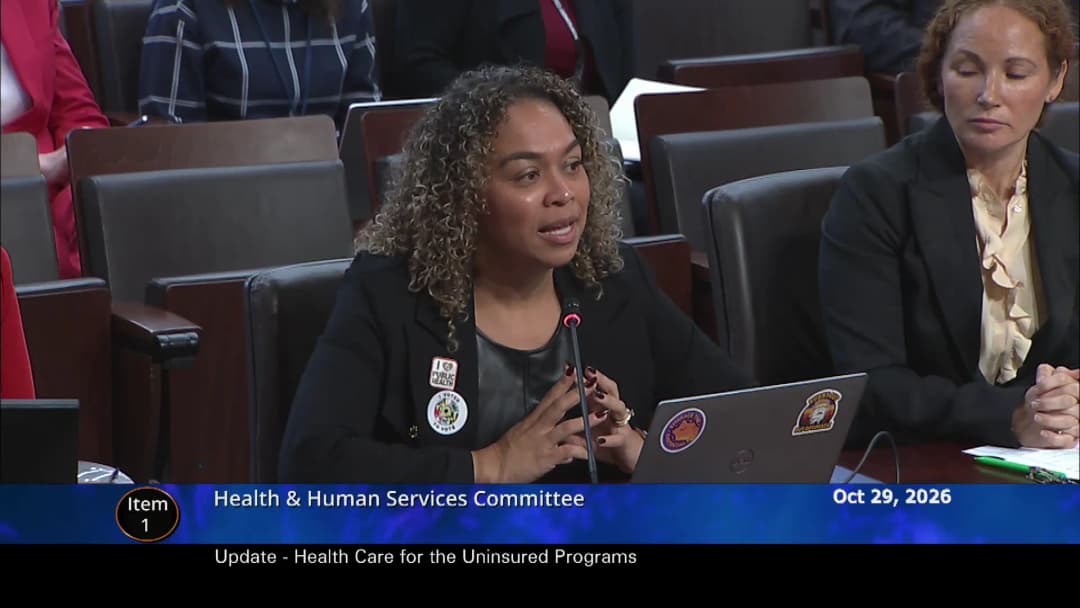
The Health and Human Services (HHS) Committee of the Montgomery County Council met on October 29, 2026, from 2:00 p.m. to 4:30 p.m. to review updates on health care programs for the uninsured and the implementation of H.R.1, focusing on October Medicaid eligibility changes. Chair Laurie-Anne Sayles led the session, with Councilmembers Andrew Friedson and Dawn Luedtke participating. Staff from the Department of Health and Human Services (DHHS) and the Primary Care Coalition (PCC) presented data and fielded questions. No formal votes were taken; the committee instead identified follow-up actions and priorities. Health Care for the Uninsured Programs - Dr. Nina Ashford, Chief of Public Health Services, presented an overview of three programs: Montgomery Cares (adults), Care for Kids (children), and the Montgomery Perinatal Program (formerly Maternity Partnership). The programs are funded by Montgomery County and administered by PCC, except the perinatal program, which is county-run. - Dr. Veronica Vella, Senior Director of Healthcare Access at PCC, provided utilization data: - Montgomery Cares encounters increased from 61,000 in FY23 to 82,000 in FY26. The county pays a rate of $130.82 per encounter in FY27. - Care for Kids enrollment declined from 3,928 to approximately 3,000 between 2025 and 2026. Dr. Vella attributed this to parents' fear of visiting government offices due to the political climate and the loss of a community health worker program (Point of Entry) that helped enroll children during school registration. - Average appointment wait time across the network is 10.5 days, ranging from 1 to 21 days; the longest waits are at Federally Qualified Health Centers (FQHCs). Wait times have been consistent over the past few years. - Quality metrics show high performance in hypertension control (99.7%) and diabetes A1C testing (90.4%), but lower rates for breast cancer screening (only women 45+ are covered) and diabetic retinal exams. PCC recently added retinopathy screening at two practices. - Behavioral health services, funded by a supplemental appropriation, served over 2,000 patients, including case consultations for 475 and social needs support for over 400. - The Montgomery Perinatal Program served 1,870 clients in FY26, a 20% increase from 1,500 in FY25. The first quarter of FY27 was strong with 480 clients. The program is transitioning to an integrated “One MCH” model to align with the 2025 OLO report on racial disparities. - Councilmembers raised concerns about declining enrollment in Care for Kids and the impact of clinic access barriers. Dr. Vella noted clinics have adapted by rearranging wait areas and increasing telehealth use. Councilmember Friedson requested comparison data on FQHC wait times versus national standards, and asked whether wait times are business or calendar days. - Councilmember Sayles asked about outreach and coordination with community partners such as VITA and libraries. Staff committed to sharing the new client guide and to reach out to VITA. H.R.1 Implementation - Tara Clemons Johnson, Council staff, reviewed the policy changes. State data indicates 1,082 Montgomery County residents have lost Medicaid eligibility due to H.R.1 changes, down from earlier estimates of 4,000. The county estimates 700–1,200 may be affected. County-wide, an estimated 33,000 Temporary Protected Status (TPS) holders will lose ACA subsidy eligibility beginning January 2027, with most residing in Montgomery and Prince George's counties. - Sean Gibson, Health Insurance Manager at OESS, described mitigation efforts: referral to Montgomery Cares, Care for Kids, and Qualified Health Plans (QHP) during open enrollment (November 1 through January 15). He highlighted the new rule eliminating the cap on advanced premium tax credit repayments, which could cause large tax bills. Refugee medical assistance will expand from 8 to 12 months in January. SSI recipients will face new immigration-related eligibility requirements starting January. - Dr. Patrice McGee, Chief of Aging and Disability Services, reported nine county residents lost Medicaid waiver services (emergency Medicaid waivers) as of October 1, affecting their home-based care and residential support. She noted DDA has not provided continuity plans or funding; county providers are trying to fill gaps, but a supplemental appropriation is being requested. - Yvonne Iskandry of OESS discussed SNAP changes: work requirement age range expanded from 18–54 to 18–64, and veterans and foster youth under 24 are no longer automatically exempt. The county is helping recipients comply, and so far few have lost benefits in October. - Councilmember Luedtke expressed concern about the lack of proactive planning by DDA, and questioned the adequacy of work requirement exemptions for people with disabilities. Staff affirmed that individuals with disabilities may be exempt if they provide medical documentation. Key Outcomes - Staff agreed to provide follow-up data comparing the county's 10.5-day average appointment wait time with state and national benchmarks for FQHCs and other systems, and to clarify whether the wait time is in business or calendar days. - The committee will receive updates on the supplemental appropriation requests, including those for the Montgomery Perinatal Program (nurse and health educator positions) and support for individuals who lost waiver services. These supplementals are scheduled for committee consideration on November 18. - Councilmembers requested continued coordination with community partners, including VITA and libraries, to disseminate information about coverage options and safety net programs. - Future reports will include outcomes of the new reproductive health services program and further analysis of Care for Kids enrollment trends.

HEALTHCARE ACCESS 52% · PUBLIC HEALTH 35% · FOOD SECURITY 11% · YOUTH PROGRAMS 1%
126
NEWOCT 29, 2026 · WASHINGTON, DISTRICT OF COLUMBIA · COUNCIL OF THE DISTRICT OF COLUMBIA
Committee on Human Services Hearing on Library Trustees Amendment Act (October 29, 2026)

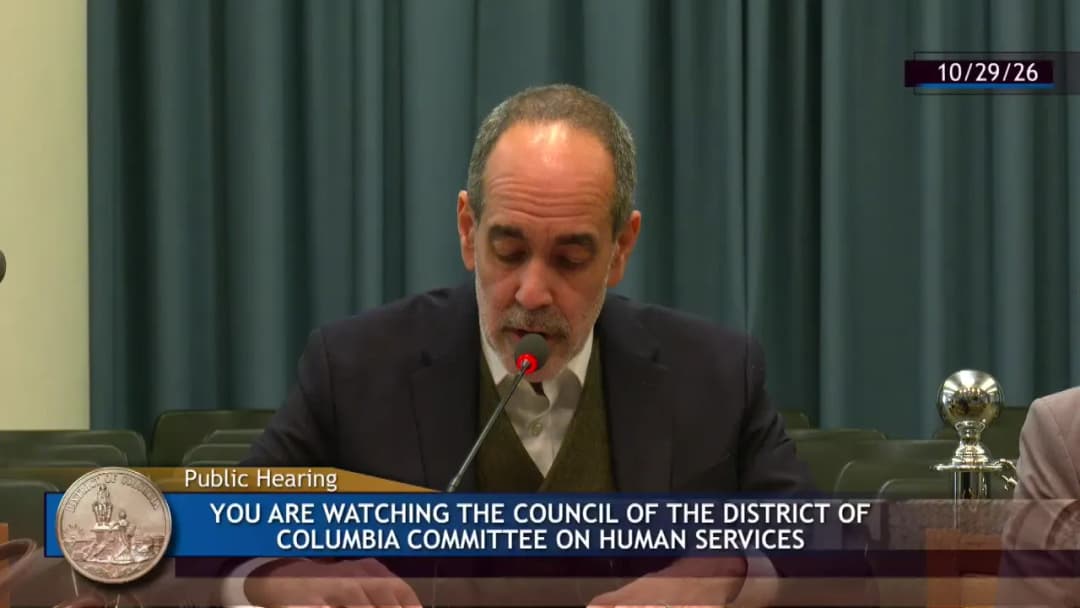
The Committee on Human Services, chaired by Ward Three Council Member Matt Freuman, held a public hearing on Thursday, October 29, 2026, to consider B26-0816, the Board of Library Trustees Technical Amendment Act of 2026. The hearing began at 12:00 PM and concluded at 4:25 PM. No public witnesses testified. Director of the District of Columbia Public Library, Richard Rez Gavilon, provided testimony on the bill alongside Chief of Staff Joy Mex. Public Comments & Testimony - No public witnesses appeared to testify before the committee. Discussion Items - Director Gavilon presented the four key components of the technical amendments: - Officer Election Cycle: Amends the statutory requirement for an annual election of the Board president to allow for greater leadership continuity, a practice the board has followed since January 2021. - Senior Leadership Title: Updates the statutory title from "librarian" to "chief librarian" or "executive director" to align with DCPL's modern organizational structure. - Annual Reporting: Replaces the statutory February 1 annual report requirement with alignment to the Council's already-established annual performance oversight process, eliminating duplicative reporting. Director Gavilon confirmed this process has been in place for at least 18 years. - Third-Party Revenue Activities: Clarifies code governing revenue-generating activities on library property by replacing the term "permit" with "fee-based use permit," authorizing the board to issue them, allowing fees to be set by a board-approved schedule, and permitting fee waivers for public interest or undue hardship. - Chairperson Freuman inquired about the impetus for the changes. Director Gavilon stated the amendments were a matter of good governance, intended to align the board's bylaws and the D.C. Code with practices that have been standard for years. - Regarding the fee schedule, Director Gavilon stated it is posted on the library's website. The fee-based permit has been exercised once. Fees range from $30 for nonprofits to $500 for for-profit entities. The revenue generated is deposited into a special purpose fund for library cultural programs. - Director Gavilon provided an example of a fee waiver: a partnership with a small independent bookstore for an author event, where the fee is waived to avoid an undue hardship on the partner. Key Outcomes - No vote was taken during the public hearing. - The public record for the hearing will remain open until the close of business on Thursday, November 5, 2026, for submission of written testimony.

LIBRARIES 91% · PROCEDURAL 9%
128
NEWOCT 29, 2026 · LAKE COUNTY, ILLINOIS · COMMITTEE MEETINGS
Lake County Board Legislative Committee Special Meeting on Census Proposal - October 29, 2026

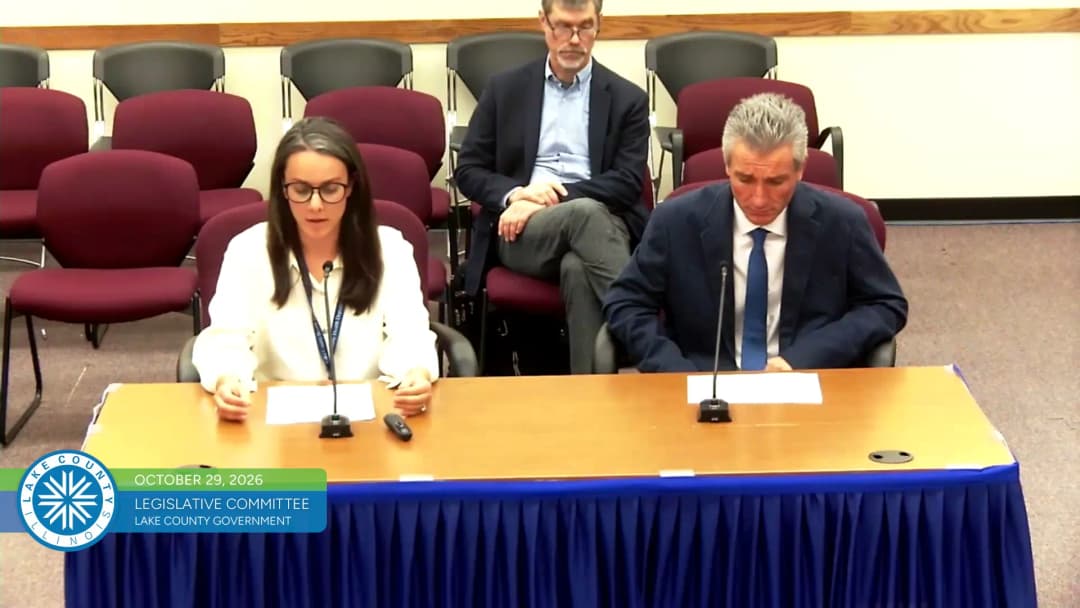
The Legislative Committee of the Lake County Board convened a special meeting at 10:45 AM on October 29, 2026, to address an urgent matter requiring action before a November 2, 2026 deadline—a proposed rule change for the 2030 Decennial Census by the U.S. Census Bureau. The meeting included a federal legislative update, a detailed overview of the proposed changes, analysis of local impacts by county staff, and committee deliberation on an official county response. Discussion Items - Federal Update: Clayton Cox of McGuire Woods provided a brief update on the upcoming elections, the potential for a change in House leadership, the retirements of Senator Durbin and Representative Schakowsky, and the importance of the county preparing for the FY28 earmarks and congressionally directed spending process. - Census Proposal Overview: Clayton Cox presented the key changes proposed by the Census Bureau. He stated the proposed rule would change the fundamental count from "every soul" to only U.S. citizens and certain lawful permanent residents. This would exclude individuals on H-1B visas, international students, DACA recipients, TPS holders, and undocumented residents. The proposal would also prohibit the collection of data on race, ethnicity, and sexual orientation, and would determine residency based on where a person lived from January to April. Cox noted that NLC and NACO were encouraging individual county comments to highlight specific local impacts. - Committee Debate on County Response: - Member Paul Frank initially expressed a preference for the county to work through state and national associations rather than submit an individual comment, but later clarified his full support for a robust individual county response given the severity and risk of the proposal. - Vice Chair Campos presented draft language for a comment letter, asserting the proposal was "fundamentally un-American" and calling for strong opposition from the county. - Member Hunter cautioned against partisan critiques ("administration bias") and expressed procedural concern over the committee taking action on behalf of the full 19-member board without a full vote, given the tight timeline. - Member Roberts supported the comment letter, arguing the proposal was an intentional method to "undercut funding to Illinois." - Local Impact Analysis: - Emily Gelber (Health Department): Stated the changes would "fundamentally pretend that people aren't there." She testified that removing demographic questions and excluding non-citizens would hinder the department's ability to track health disparities, understand community needs, and compete for federal grants. She noted that almost all health department grants rely on this data. - Dominic Strezo (Community Development): Stated that the changes could directly impact approximately $4.5 to $5 million in annual HUD entitlement funds. He emphasized that the county relies heavily on census data for planning affordable housing and allocating community development resources. Key Outcomes - The committee reached a consensus to submit a formal comment letter opposing the Census Bureau's proposed rule changes for the 2030 Census. - Content of the Letter: Staff was directed to finalize the letter using Vice Chair Campos' draft as a template. The letter will include context about Lake County's demographics, formal opposition to excluding non-citizen residents from the apportionment count, opposition to removing race, ethnicity, gender, and sexual orientation questions, and concerns about the proposed residency timeframe. - Submission and Distribution: The letter will be filed with the Census Bureau before the November 2nd deadline at 11:59 PM ET (10:59 PM CT). Copies will be sent to the county's full congressional and state delegations. - Outreach to Associations: Staff was directed to contact NACO and ISECO to encourage them to issue their own formal comments on the proposed rule. - Follow-up: Staff and McGuire Woods will monitor the proposal's progress and provide updates to the committee. - The committee voted to enter executive session to discuss personnel matters.

FEDERAL LEGISLATIVE UPDATE 55% · LEGISLATIVE PROCESS 19% · PROCEDURAL 10% · PUBLIC HEALTH 4%
129
NEWOCT 29, 2026 · FITCHBURG, WISCONSIN · COMMON COUNCIL & CITY BOARDS
Fitchburg Municipal Court Arraignment Session – October 29, 2026

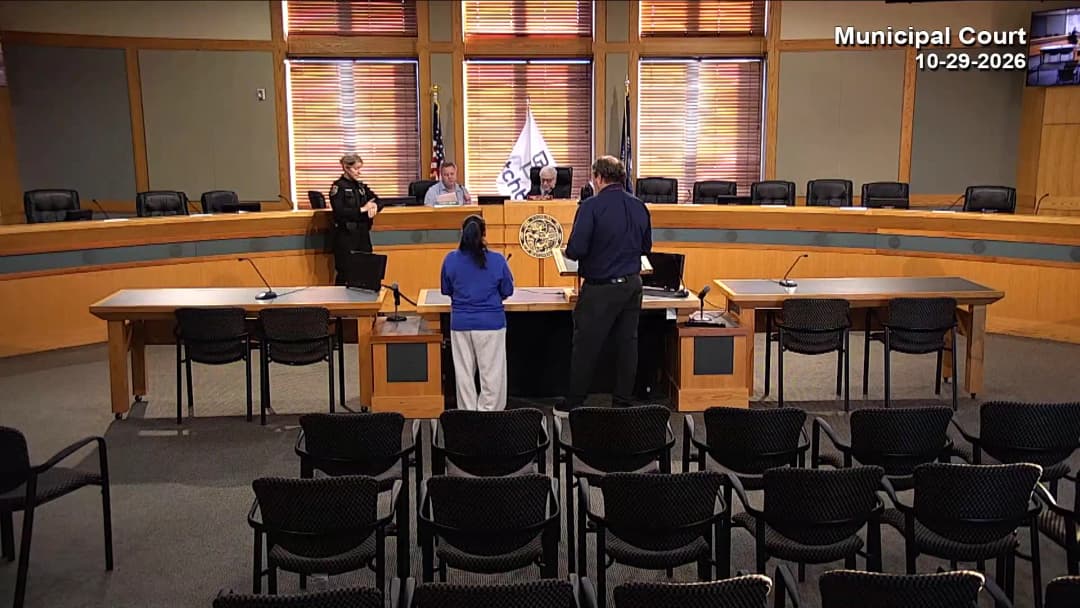
On October 29, 2026, the Fitchburg Municipal Court held an evening arraignment session. The presiding judge explained the plea process, the city’s individualized justice philosophy, possible penalties, and the consequences of conviction. Several traffic, ordinance, and OWI citations were resolved through guilty or no-contest pleas. No agenda or minutes were available for this session. Court Procedures & Advisements - The judge explained three plea options: not guilty, guilty, and no contest. The city has the burden of proving guilt beyond a reasonable doubt in a trial. - For Wisconsin traffic convictions, demerit points may be assessed; accumulating 12 points can result in revocation of driving privileges. - OWI defendants were advised that they have the right to request a jury trial in Dane County Circuit Court rather than Fitchburg. - The judge stated that municipal court cannot enter a criminal conviction for city ordinances that parallel criminal offenses, but fines for those ordinances will not be reduced. - Unpaid fines may lead to an arrest warrant and jail time of up to 60 days, with a daily credit against the fine. The transcript is inconsistent about whether the credit is $50 or $100 per day. - The judge said each case would be considered individually, based on mitigating circumstances and the defendant’s prior record, except for alcohol- or drug-related offenses and parallel criminal-code ordinances. Cases Heard - Andrew Adenopoe entered a no-contest plea to failure to yield the right of way while making a left turn. The court reduced the fine from $108 to $78 and the points from 4 to 3. - Mustafa Chatter entered a no-contest plea to violating a yellow traffic control signal. The court imposed a $78 fine and 2 demerit points, noting the points could be removed if he had no further convictions. - Christopher Brozek pleaded guilty to violating a red traffic control signal. He said he already had 10 points and risked losing his license. The court convicted him, ordered a driver improvement class, and gave him two months to complete it. The fine was stated as $108, though the transcript also includes a reference to $98. - Faith Waffler entered a no-contest plea to failure to yield the right of way. The court reduced the fine to $78 and gave her a choice of 3 points or 40 hours of community service; she chose 3 points. - One defendant entered a no-contest plea to disorderly conduct and said the incident involved self-defense. The court imposed the fine of $323 without reduction, but invited the defendant to return if the conviction affected employment or education. - Alexis Roll entered a no-contest plea to disorderly conduct and was fined $323. - Tori Dockery entered a no-contest plea to disorderly conduct and was fined $323. - Felicia Chrisco entered a no-contest plea to shoplifting and was fined $449. The court arranged a payment plan of $40 per month with extensions every two months. - Daniel Palayo entered a no-contest plea to failure to keep a vehicle under control. The court imposed a $146 fine and convicted him. Palayo said his job as an automotive technician was at risk because he might not remain insurable; the judge said he would speak with him after sentencing. - Sebastian Taylor appeared under a special appearance related to a motion to reopen, but said he was not trying to reopen anything. The judge reviewed the record and concluded there was no pending reason for him to be in court, allowing him to leave. - Maria Zampolteca pleaded guilty to deviation from a designated lane and to operating a motor vehicle while under the influence of an intoxicant with a prohibited blood alcohol concentration. Her test result was 0.19. The judge noted there were no minors in the vehicle and no accident. The OWI penalties included a $1,046 fine, 8-month license revocation, mandatory assessment, 6 demerit points, and installation of an ignition interlock device for at least one year. The lane deviation citation was reduced to a $78 fine and 3 points. An interpreter was used for the proceedings. Key Outcomes - The court accepted multiple guilty and no-contest pleas, imposing fines, points, classes, and payment plans as described above. - No juvenile cases were called, and the court took a break after the adult calendar.

TRANSPORTATION SAFETY 32% · PUBLIC SAFETY 30% · LEGAL AFFAIRS 22% · PROCEDURAL 16%
130
NEWOCT 29, 2026 · DETROIT, MICHIGAN · CITY COUNCIL
Detroit PED Committee Meeting Summary: Oct 29, 2026

Consent Calendar - Meeting minutes approved. - Multiple property sales (1003 Lowdale, 12160 Gloverdale, and others) were approved and sent to the formal council session. - Contract 600797 with Detroit Revival Engaging American Muslims for community land trust planning ($298,400) approved. - Various reports were received and filed. Public Comments & Testimony General Public Comment - Eden Bloom (Detroit People's Platform) and Theo Pride (Detroit People's Platform) questioned the process, specifically an NDA blocking the Neighborhood Advisory Council (NAC) from financial details and the shift to a non-profit (C4) ownership model. - Strong support for the East Riverfront project was voiced by numerous speakers including Emil Boyer (resident), Ronald Smith (District 7 resident), Chip Roadie (Rivertown Detroit Association), Pat McCloskey (Motor City Electric), Johnny Cannon (Joe Lewis Southern Kitchen), Joe Lewis Barrow II (son of Joe Lewis), Claude Molinari (Visit Detroit), Clifford A. Brown, Gina Cavalier (Downtown Detroit Partnership), Charity Dean (Michigan Black Business Alliance), Evans Janice (Real Estate Association of Developers), and Daryl Woods. - Kelly Tyrrell (Black Women Boaters Club) expressed conditional support, urging the preservation of Riverside Marina. - Nicole Small and Taron Haynes (who identified himself as a NAC member) strongly criticized the process. Haynes stated the NAC was denied access to financial documents and meeting recordings, alleging violations of the NAC's charter. - Concerns about scope, equity, and process were raised by Sahira Amai, Chedante Smith, William M. Davis (Detroit Active Retired Employee Association), Luella Pizzuti, and Tyson Gersh. Public Hearing 1020: Obsolete Property Rehab (New Center 2nd Ave) - Darren Kilgore and Miata Richardson (SCL Supportive Services) presented their $1.9 million project at 7601 2nd Avenue. The project seeks a 12-year PA146 tax abatement for a commercial rehab creating 20-25 permanent jobs and an estimated $333,865 in net fiscal benefit. Public comment was overwhelmingly supportive of the Black husband-and-wife team. Public Hearing 1040: RenCen Transformational Brownfield Plan (TBP) - Supporters included the Mayor's Office (Brittany Hoskew), developers (Ken Allen), labor (Adam Majestic), clergy (Pastor Mo), and residents (Seth, Rod Hardeman, David Lilly). They argued it is a generational opportunity to create a world-class riverfront, providing massive job creation and a significant increase in city tax revenue (from $700K/year to $10M/year). - Opponents and Skeptics included residents, transparency advocates, and NAC members. Kelly Tyrrell and Tracy opposed demolishing the iconic RenCen towers. Clarice Cochran and Allie Chemistry criticized the corporate tax incentive model. Cindy Dara and Luella Pizzuti demanded stronger accountability for developer commitments. Clara DeCastro raised detailed technical questions about the TBP structure. Discussion Items New Center 2nd Avenue - Approved with minimal discussion; Chair Johnson noted her desire for similar projects on the east side. Renaissance Center / East Riverfront - Presentations: - Brian Vosberg (DEGC/DBRA) explained the $300M TBP (state tax capture only, 20-year term) meets the state cap with Phases 1 and 2. - David Howell (DEGC) detailed the "But For" analysis. The project is un-financeable (DSCR of 0.77) without the full incentive stack ($548M), which brings the DSCR to 1.2. The city is projected to receive $301.9M in net fiscal benefit over 30 years, including a $95M PILOT payment. - Justin Barry (Bedrock) confirmed Bedrock and GM are donating $1.25B to a new non-profit (C4) that will own the project. No development fees or tax deductions are being taken. A $43.5M CBA package was negotiated with the NAC. - Council Deliberation & Questions: - Councilmember Santiago Romero asked about the loss of Utility Users Tax (UUT) and clarified the $95M pilot includes $5M going to an affordable housing trust fund. - Pro Tem Young requested granularity on the economic impact (GDP, indirect jobs, revenue sharing). - Chair Johnson pressed the Law Department and PDD on NAC transparency. Brian Coe (Law) defended the NDA and stated the CBO process was fully compliant. Edwina King (PDD) defended the NAC's internal negotiations. Johnson stated her intention to have council earmark all pilot funds. - Councilmember McCampbell confirmed Bedrock will receive no management or development fees from the non-profit. - Councilmember Benson calculated the Net Present Value (NPV) of the incentives ($150M) vs. the benefits ($100M), requesting a full NPV analysis for the next meeting. Key Outcomes - Line Item 5 (New Center 2nd Ave PA146): Approved and sent to formal council session. - Line Item 7 (RenCen TBP & incentives): The public hearing concluded. The item was ordered brought back on November 12, 2026 for further deliberation alongside the formal CBA presentation. A full NPV analysis of the deal for the city was requested. - Unfinished/New Business: Several property sales approved, various reports and contract awards adopted.

PUBLIC COMMENT 31% · ECONOMIC DEVELOPMENT 18% · BROWNFIELD REDEVELOPMENT 15% · PUBLIC ENGAGEMENT 13%
OPENPUBLICA · PUBLIC MEETING INDEXUPDATED DAILY · openpublica.com