The meeting was called to order on October 20, 2026, with Commissioners Bowling, Coates, Stewart, and Collins present; Commissioner Patterson was absent. The meeting began with the Pledge of Allegiance and roll call. Commissioner Collins recognized the county's 10th consecutive year of AAA bond ratings from all three major credit agencies. Commissioner Bowling acknowledged the passing of community leader Bernard Winkler. A motion to declare the day a legislative day failed on a 2-2 vote, preventing introduction of certain bills. The meeting covered administrative approvals, policy discussions, and briefings from multiple departments. Consent Calendar - The minutes of the October 6, 2026 meeting were approved unanimously. - Budget amendment 120 ($66,500 for tree maintenance under Chesapeake Bay Trust cooperative agreement) was approved. - Budget amendment 170 ($180,000 for strategic advisory services for the Western Charles County Tech Corridor) was approved. - Budget transfer 805 ($1.8 million from land/right-of-way to construction for Western Parkway Phase 3B) was approved. Discussion noted that Phase 3A bids came in 20% higher than estimates, leading to a $6.1 million construction estimate for Phase 3B. - A request to light the courthouse teal on November 2, 2026 for Alzheimer's awareness was approved. - Funding of $118.06 for a Diwali celebration and $854.53 for a clergy dinner, from the Interfaith Commission's community support funds, were approved. - A new Water and Sewer Assistance Program was established with $300,000 in general fund support, offering a $400 one-time annual benefit to eligible households. The program will launch January 1, 2027. Discussion Items Legislative Day Motion: Commissioner Collins moved to make October 20, 2026 a legislative day; the motion was seconded but failed on a roll call vote (Commissioners Coates and Collins in favor; Bowling and Stewart opposed; Patterson absent). This prevented introduction of the Heritage Commission code update and collective bargaining items. Letter of Support for Neighborhood Creative Arts Center (NCAC): Dr. Georgia Itma Bonnie, founder and executive director, requested a letter of support for a $585,650 state legislative bond initiative to create a permanent arts campus at 11680 Doolittle Drive in Waldorf. Some commissioners initially questioned the location and whether it conflicted with county plans. After clarification that NCAC is a separate nonprofit and no county funding is required, the board unanimously approved the letter of support. Orphan's Court Proposal: Commissioners considered a proposal to require Orphan's Court judges to hold law degrees. Acting Deputy County Administrator Danielle Mitchell reported that of roughly 200 cases heard annually, only 4-6 are appealed to circuit court (filing fee $165). Commissioners discussed the cost-effectiveness of the current system and noted that a state task force studied the issue in 2025-2026, recommending further work, and that the Maryland Supreme Court mandated continuing education for Orphan's Court judges by January 2027. The consensus was not to include the proposal in the county's legislative package at this time, citing ongoing state-level efforts and the need for local judiciary input. Sheriff's Office Retirement Plan (SORP) Annual Briefing: Alton Fryer (Bolton) reported the plan had $523.6 million in assets as of June 30, 2026, with a one-year return of 11.92% (net of fees), exceeding the 7.25% assumption. The 10-year annualized return was 8.79%. Michelle Boyle presented the actuarial update: funded ratio at 80.9% (actuarial value) and 82.9% (market value) as of July 1, 2025. The county contribution for FY2027 was $21.6 million (38.8% of payroll). An experience study will be conducted in the coming year. Charles County Pension Plan Annual Briefing: Lazaro Guzman (M Power) reported assets of $406 million as of mid-October. The one-year return was 13.5% (net of fees); the 10-year return was 8.5%, surpassing the 7.05% assumption. David Papalardo presented the actuarial update: the actuarially determined contribution for FY2027 was $10.3 million (11.5% of payroll), up from the prior year due to average salary increases of 7% and COLA of 3%. The funded ratio was 94% (actuarial value) and 111% (market value), placing the plan in the top quartile of public plans nationally. Economic Development Department Highlights: Director Jim Chandler reported a return on investment of $11.67 per dollar invested, based on MEDA data. Michelle Fry highlighted the redesigned website (meetcharlescounty.com). Anthony Adesina discussed the success of the Business Growth Advantage Program (BGAP) and the new Launch Pad pilot program, which graduated 52 businesses from 64 applicants with a waiting list of 52. Commissioners expressed strong support for institutionalizing Launch Pad and requested a cost estimate for sustainable funding, exploring mentorship from established businesses and potential tax credits. Mark Thompson reported that the Western Charles County Technology Corridor is seeing significant hiring; 200+ positions are expected to be filled in the next six months, and a second job fair is scheduled for October 21, 2026 at the Velocity Center. Public Works Department Update: - Western Parkway: Phase 3A3 is under construction (completion January 2027); an $80,000 savings was achieved via soil cementing. Phase 3B construction procurement begins October 2026, with construction start in February 2027 and completion in 2028. Traffic signal improvements at MD 301 will be bid in spring 2027. - Animal Care Center: MEP work in progress; estimated completion February 2027. - Pinefield EMS: 90% dry-in complete; estimated completion May 2027. - La Plata Library: Grading and demolition permits have been issued by the Town of La Plata, but the building permit is pending due to a water allocation issue. Commissioners expressed frustration over years of delays, with Commissioner Bowling suggesting the town may be using the permit as leverage for water allocation for new housing. Acting County Administrator Deb Hall assured that the town manager stated water would not be an impediment. Staff recommended a groundbreaking in March 2027 after construction costs are known and the building permit is issued. Commissioner Bowling advocated for immediate demolition to demonstrate progress. Following discussion, the board directed staff to proceed with demolition using the existing permits, install a sign after the building permit is obtained, and hold a formal groundbreaking in spring 2027 to recognize the outgoing board. - Sidewalk Program: Elisha O'Froil reported 46 requested projects, with 7 active totaling about 4 miles. The program uses a prioritization matrix considering connectivity, equity, and complexity. Challenges include right-of-way constraints, utilities, and environmental factors. Board of Fire and Rescue Annual Update: Richard Gilroy presented the annual report. The board reviewed capital expenditures, fund distributions, and company financial stability. Highlights included the operational status of Westlake Volunteer Fire and EMS (separated from Waldorf), solar energy project at Ryansville funded by a $300,000 grant, and replacement of all mobile data terminals in apparatus. He noted ongoing challenges with apparatus delivery delays (3-4 years for pumpers, 4-5 for ladder trucks). Gilroy announced he will step down as chair in December 2026. Key Outcomes - All budget amendments and transfers were approved. - Courthouse teal lighting, Interfaith Commission funding, and the letter of support for NCAC were approved. - The Water and Sewer Assistance Program was established for January 2027 launch. - The Orphan's Court judge eligibility proposal was not included in the state legislative package. - The motion to declare a legislative day failed, preventing introduction of Heritage Commission and collective bargaining items. - The board directed staff to begin demolition of the La Plata library site and schedule a groundbreaking for spring 2027. - Staff will explore sustainable funding options for Launch Pad and other economic development programs. - The board will review pension plan experience studies in the next year. - Closed session was held to discuss potential litigation and agreement negotiations.
The Public Meeting Index
The Public Meeting IndexThis meeting took place on 2026-10-20 (UTC; 01:48:03+00:00). The transcript identifies the local meeting as Monday, October 19, 2026, starting at 7:30 p.m. and adjourning at 8:49 p.m.; Councilmember Jim Posh was excused. No agenda or minutes were provided, and council noted there were no amendments to the agenda and no minutes to approve. Presentation and Honors - Mayor Petras announced that the city hired an owner's representative and design/engineering team for the Cumberland Pool Rebuild and selected Welty Construction as construction manager at risk after an RFQ and interviews with four firms; Welty will later transition to general contractor. - Paul Bex, Welty president, said the firm was founded in Northeast Ohio in 1945 (81 years of construction experience) and highlighted pool facilities, historic preservation, and high-stakes public projects. Work on the Cumberland Pool is planned for late 2027 into 2028, using the months after Labor Day to install the pool structure and winter months for the bathhouse and new building interior. - In response to council questions, Welty stated the current pool will be demolished to meet competition length; lead and asbestos may be encountered but will be handled through abatement without compromising historic fabric; utility lines are being tested now during pre-construction; and work will not interfere with public swim season. - Welty committed to local business outreach and to including Cleveland Heights companies, subcontractors, and suppliers in the project. Mayor's Report - Leaf collection began the day of the meeting; Public Works scheduled three crews instead of the usual two, with 35 team members and three passes through the city. - A tenant town hall was scheduled for October 20 at 5 p.m. at Noble Library. - The final Cumberland Pool open house will be October 28, 5–7 p.m., at the community center. - Early voting shuttles: every Wednesday in October at 10:30 a.m. from the community center, and every Friday in October from noon to 2 p.m. from Forest Hill Presbyterian Church. - The city joined the blue envelope program for residents with communication challenges, working with the police department and Board of Developmental Disabilities; University Heights and East Cleveland also expressed interest. Public Comments & Testimony - Herschel Weiser expressed concern about the Taylor Road Synagogue property, including an eviction the day before Rosh Hashanah and a $600 land bank sale, and asked whether the buyer received favorable treatment. Mayor Petras responded that the city never owned the property, declined the opportunity before his tenure, and was not involved in synagogue events. - James Williams shared a personal testimony of gratitude and recited lyrics from Karen Clark Sheard's song 'Sunday Morning.' - Joel Forker (3161 Essex Road) advocated for Essex Road to receive traffic-calming improvements from about $1 million in recently received funding. He cited the city's 2021 Vision Zero commitment and the comprehensive and equitable safety action plan pages 96, 169, and 99, and asked for speed tables, curb extensions, paint, and signage to reduce speeding and improve safety as a gateway to Cedar-Lee. - Patricia Fox Brooks (Bainbridge Road) asked whether the Blanche Road extension was 'a done deal,' noting it would come through backyards and that residents had heard a 2028-2029 timeline. She requested neighborhood meetings and timely communication. Mayor Petras said nothing had been presented to council, it was not a done deal, and no significant public announcement was available yet; fire access and possible access to South Euclid park are among issues being studied. - Susanna Aframson (Seven Road) asked the city to address tree-obscured stop signs on Maple, Crest and Wood, and Shannon and Maple. She also urged restoring weekly bulk pickup or creating an on-demand request system with about 25 allowances per year, saying the refuse and recycling task force did not recommend the current change. Mayor Petras said bulk pickup has been difficult, no near-term noticeable improvement is promised, and a drop-off site was abused by outside contractors. - Elizabeth Amberg (Scarborough Road) spoke in favor of accessory dwelling units, describing her desire to add living space over her garage for her son and future family; she also supported neighborhood traffic safety. Discussion Items - Planning and development staff gave a development-heavy update. Noble Court held its ribbon cutting on October 14, with the entire building leased and a waiting list. The Marquee project will hold its ribbon cutting on October 21 at 2 p.m., just over a year after the fire. The Taylor Tudor project is on track for first/second quarter 2027 completion, with strong commercial tenant leads. Colverse will break ground November 16 at the former Center Mayfield property. Park Synagogue received planning approval for initial phases, with construction expected late this year/spring. - Infill housing: five vacant lots were introduced at first reading for owner-occupants, with two to four more lots possible; an RFP is open for five city-owned houses for owner-occupant rehabilitation. Future Heights is drawing down its first four of 46 lots and has design approvals for two houses; StarWright CDC will receive three lots for its Welcome Home Ohio award; a future one-lot transfer to Forest City Community Land Trust was announced for its $100,000 award. - The zoning code rewrite is moving into codification, with extensive community engagement continuing through the rest of 2026 and early 2027; a story map and materials are on the city website. - Other planning efforts include the housing needs assessment final report due by the end of the month, a Parks Recreation Open Space Master Plan presentation next week, gateway and wayfinding signage design, Noble and Taylor Public Arts Plan kickoff, and a November 9 Committee of the Whole discussion of housing and building initiatives. - Council also received updates that the North Coventry neighborhood plan and Noble/Taylor streetscape plans are being finalized in-house; Taylor Road streetscaping will be incorporated into the TLCI project as a background document. Legislation and Resolutions - First readings approved as emergency measures: Resolution 198-2026 (A&J Cement Contractors contract for exterior repair and concrete work using ARPA funds); Resolution 199-2026 (accepting Ohio Traffic Safety Office grants for high-visibility, impaired driving, and selective traffic enforcement); Ordinance 200-2026 (FY2026 appropriation amendment). - First readings introduced only: Resolution 201-2026 (purchase of a 2027 Ford Super Duty F600 through Sourcewell/National Auto Fleet Group); Resolution 202-2026 (adopting a council code of conduct); Ordinance 203-2026 (sale agreements for five vacant residential lots). - Second readings approved: Ordinance 142-2026 as amended permits accessory dwelling units; councilmembers praised it as a milestone shaped by two years of community engagement. Resolution 173-2026 reappointed Peter DeGolia and Ira Edda Black to the Commission on Aging. Ordinance 194-2026 established a city Tree Commission. Resolution 195-2026 amended the GPD Group agreement for transfer station renovation services. Resolution 197-2026 authorized the Welty Construction construction manager at risk agreement for the Cumberland Pool project. - Proclamations approved: Resolution 204-2026 declared November 28, 2026 as Small Business Saturday; Resolution 205-2026 recognized November 2026 as Alzheimer's Disease Awareness Month. Key Outcomes - Council approved the ADU ordinance and the Cumberland Pool Welty agreement without dissent. - The new Tree Commission will have five community members; applications open on the city website with a November 2 deadline. The city is also reopening applications for the Planning Commission, a Board of Zoning Appeals alternate, and the Climate, Environmental and Sustainability Committee. - Upcoming dates announced: tenant town hall October 20 at 5 p.m.; Marquee ribbon cutting October 21 at 2 p.m.; Cumberland Pool open house October 28, 5–7 p.m.; budget hearings November 4–6; next regular council meeting November 2; Colverse groundbreaking November 16; and housing/building discussion November 9 at Committee of the Whole.
The Topeka Planning Commission met on October 20, 2026, with a recorded start time of 00:33 UTC, and seven members present: Brooks, Bowling, Hannon, Heron, Lawley, Nelson, and Pearson. The commission held public hearings and action items on a PUD rezoning, a zoning code text amendment, and a comprehensive plan amendment. It approved the first two items, continued the third to a later meeting, and received general public comments about data center impacts. No agenda or minutes were included in the source materials. Opening Business - Roll call established a quorum with seven commissioners present. - The commission approved the minutes from the September 21 meeting with 3 votes in favor, 0 opposed, and 4 abstentions. - No conflicts of interest or ex parte communications were declared. Action Item: PUD 2607 - AMICO Station, 5977 SW 29th Street - Staff presented a request to rezone a 0.915-acre property at the southwest corner of Wanamaker and 29th Street from C2 commercial to PUD for C2 commercial uses. The site is a gas station with a 1,000-square-foot convenience store. - The PUD would reduce the required rear yard setback from 25 feet to 10 feet for a proposed new convenience store. Staff noted that PUDs are traditionally at least one acre, but staff allowed this slightly smaller site to proceed. - The applicant, represented by Travis Hazlip of Cook Flat and Struble Engineers, said the project would replace the store with a more modern, larger building and needs the reduced setback to improve site circulation and traffic flow and avoid reconstructing the canopy. - Staff recommended approval subject to 11 conditions, including landscaping or fencing along the rear property line. Staff said the shared private access driveway to the south would not be affected. - A neighborhood meeting on September 30 drew one attendee, legal counsel for neighboring property owners to the south and east, who submitted a letter objecting that the variance was unfair to similarly zoned properties and did not arise from a condition unique to the site. - No public comment was offered during the hearing. - The commission voted 7-0 to approve PUD 2607 with the staff conditions. Action Item: Zoning Text Amendment CZR2604 - Staff said this broad text amendment had been discussed at three prior meetings and does not include data centers or energy storage systems. It changes land use tables, definitions, and special use standards in multiple zoning code chapters. - Drinking establishments: The amendment would allow a drinking establishment in the C2 district without a conditional use permit if it is accessory to a permitted primary use, is a principal use no larger than 2,000 square feet as calculated by the Shawnee County appraiser, or occupies no more than 40 percent of an existing multi-tenant commercial building. Live music or entertainment outside the enclosed building would not be permitted; larger or other establishments could still apply for a conditional use permit. Staff cited the former Dutch Goose at about 1,200 square feet and Abigail's at more than 6,000 square feet as examples of the range of establishments. - Large truck services: A convenience store with fuel pumps that also offers large truck services would be treated like a truck stop and require a conditional use permit, reflecting the larger traffic and street impacts. - Modular homes and multiple units: The amendment would add a definition for modular homes built to the International Residential Code and clarify that multiple single-family detached dwellings may be placed on one lot. New special use standards would require site and landscape plans, minimum building separations of 15 feet, or 8 feet rear-to-rear, and off-street parking based on dwelling size. - Short-term rentals: During discussion, a commissioner asked that the owner-manager requirement clearly allow owners to manage their own rental properties. Staff agreed to add owner to the language. - Secondhand shops and pawn shops: Staff said they had not been able to fully separate pawn shops from secondhand shops. Keeping them together and allowing secondhand shops in X1 districts was important to the NOTO area. The chair said she would prefer more restrictions on pawn shops but was willing to move forward. - No public comment was offered. - The commission voted 7-0 to approve the text amendment. Action Item: CPA 2602 - Land Use and Growth Management Plan 2040 Update - Staff said the plan update had been discussed at prior meetings and is intended to reflect how policies have been interpreted and applied since the plan was adopted in 2015, update density references, encourage adaptive reuse of vacant or underutilized commercial properties for multifamily residential use, and incorporate the downtown master plan. Future land use map examples at 6th and Fairlawn and near Lake Shawnee would change to mixed use. - Commissioner Brooks asked about annexation exceptions for city water and sewer service; staff explained that utility regulations allow specific exemptions, often involving one-lot residential plats. Commissioner Brooks also suggested adding a mechanism to require a future comprehensive review of the plan, and staff said they could consider adding such a review date. - Commissioner Pearson said she was not comfortable voting on the item without more time to review the material and would have abstained if forced to vote. The commission instead moved to continue the item for one month. - The public hearing was opened and closed with no public testimony. - The commission voted 7-0 to delay the vote and continue CPA 2602 to the next meeting. Staff said the continued item would not require a new public hearing advertisement. Public Comments & Testimony - Megan Ryan, with Protect Kansas, spoke against proposed data center siting near residential areas. She cited health concerns from lead exposure at the former firing range near the Compass proposal, potential contamination at MTAA Forbes Field, EPA deregulation, and diesel exhaust from a facility she described as 840 megawatts. She said low-income communities such as Monterra were being treated as sacrifice zones and asked whether an elementary school would be built next to a 600-megawatt facility. - Mike Bradley, a Monterra resident and former private pilot, spoke against locating hyperscale data centers near Topeka Regional Airport. He said thermal plumes from cooling towers, condenser arrays, and exhaust stacks, often 14 to 25 degrees above ambient temperature, could pose hazards to aircraft during takeoff, landing, and traffic patterns. He cited FAA Advisory Circular 150/5190-4B and airport grant assurance requirements and asked the commission to consult the FAA. - Staff responded that the city's three-mile extraterritorial authority applies only to subdivision plating, not zoning, so the data centers discussed outside the city limits would fall under county jurisdiction. Commissioner Brooks said the airport concern made sense, but staff said the county would be the relevant authority. The city's data center text amendments will first be presented to the governing body before returning to the commission. Discussion Items - Special Committee on Housing: A commissioner reported that the committee had not met and was considering whether to move to a quarterly schedule or re-evaluate its planning-related work; an email about the committee's future would be sent. - Communications and next steps: Staff noted the February agenda would include an action item and a parking discussion. A vacant commission seat was being processed for appointment. The duplex text amendment is scheduled for the governing body on November 10. Key Outcomes - PUD 2607 approved 7-0 with conditions. - Zoning text amendment CZR2604 approved 7-0. - CPA 2602 continued to the next meeting by a 7-0 vote. - No formal action was taken on the data center public comments. - The housing committee will communicate its future schedule by email.
The Rapid City Council met for a regular meeting on Monday, October 19, 2026 (transcript timestamp: October 20, 2026, 00:26 UTC). The meeting opened with an invocation by Dale Barcher, the Pledge of Allegiance, and adoption of the agenda. No agenda or minutes were available; this summary is based solely on the transcript. Recognition - The council recognized the Rapid City Stevens girls tennis team for winning the 2026 Class AA Girls Tennis State Championship. It was the team's third consecutive state title, fifth in six years, and ninth overall. Stevens finished first, second, or third in all nine flights (six singles and three doubles). Ella (surname not stated) won singles flight one and teamed with Bella Nelson to win doubles flight one. Coach Jason Olson coached Ella's mother to the same doubles title 20 years earlier; Olson's many coaching honors were noted, along with his role in supporting the Sioux Park tennis complex, which the United States Tennis Association recognized as one of the top new facilities in America. The team has won the state tournament every year since the facility was completed. Public Comments & Testimony - Isabel Schmidt, chair of the Rapid City Youth City Council, thanked the council for approving an expenditure request to attend a Washington, D.C. conference and encouraged council connection meetings; she recognized Councilmember Lehman. - Renee McFarland Hagelin (listed as Renee Hagland), a Rapid City resident and voter, requested a pause of active construction at the West Park apartments on 11th and South Street during polling hours (7 a.m.–7 p.m.) on Election Day, November 3. She argued that written permit conditions do not guarantee accessible routes and that construction barriers can suppress voting; she asked council members to walk the ADA-compliant route after dark if a pause is not possible. - Tom Cadus, former state senator for District 32, Ward 5, urged the council to make the polling site as open as possible on Election Day, describing blocked streets and danger to elderly and disabled voters. He also raised a streets complaint about 821 Upper Pines and asked the city to address it. - William Wagner challenged the perimeter fence at Memorial Park and the locked public restrooms, citing more than 800 logged health and safety incidents. He argued the city has documented that most unhoused park users have dual diagnoses (severe mental illness and chemical dependency), that the fence constitutes disability-based exclusion under the ADA and South Dakota law, and that locking the restrooms violates SDCL 9-32-5. He demanded the fence be dismantled. - Xander Hunter opposed the data center project, saying the public never voted on it, that water-use comparisons are misleading, and that opposition is bipartisan and overwhelming; he asked the council to put the matter to a vote. - James Bayalata (also rendered Bailato), a media owner, alleged corruption by councilmembers and city entities, including false testimony about free drinking wristbands at the Beerboards Festival, police perjury, and retaliation against the press; he called for action against those involved. - Lexi Meyer, a Rapid City native now living in Box Elder, opposed the data centers, describing the prior proposal meeting as a PR move and criticizing water use during drought, noise concerns, and what she called disrespectful double talk; she urged council members to listen to citizens. - There were no speaker request forms for items 2–20 or items 21–30, so public comment closed without testimony on those items. Consent Calendar - Items 2 through 20 were approved in one motion, with Item 13 pulled for separate consideration. Motion by Bieberdorf, second by Tamang. - Item 13, Resolution 2026-068 (nuisance abatement assessments), was approved after Finance Director Daniel Ainsley noted that payment had been received for one property (830 Wilsie, tax ID 26851), which was removed from the council's action. Motion by Bieberdorf, second by Strowman. Discussion Items - Item 21: First reading of Ordinance 6754 (supplemental appropriation 5, $6,131,686.58) was approved. - Item 22: Second reading of Ordinance 6750 (supplemental appropriation, $7,202,497.23) was approved. - Item 23: First reading of Ordinance 6735 (rezoning from Flood Hazard District to Light Industrial District, Boom Shakalaka/Indigo Design property near Campbell Street) was approved. - Item 24: First reading of Ordinance 6751 (rezoning from Low Density Residential District 1 to Mobile Home Residential District, 859 Valley Drive, Logan and Megan Beckett) was approved. - Item 25: First reading of Ordinance 6752 (rezoning from Flood Hazard District to General Commercial District, same Boom Shakalaka/Indigo Design area) was approved. - Item 26: The council considered the contested tree-trimming abatement at 220 East Watertown Street. Finance Director Ainsley noted a $100 late fee made the total balance $990, not $890. Community Development Director Vicky Fisher said staff reduced the bill by $290 to $600 based on the work performed and to avoid setting a precedent, though the city would absorb the difference. Councilmember Roberts said the reduction set a bad precedent and voted no; Councilmember Secrets also questioned the precedent and voted no; Councilmember Strowman supported the committee's decision. The motion to uphold the abatement at $600 passed with Roberts and Secrets voting no. - Item 27: Preliminary subdivision plan for Pioneer No. 3 Subdivision (3035 Pioneer Drive) was approved with stipulations. - Item 28: The petition of annexation for the same property was approved to waive the annexation requirement and deny the petition. - Item 29: The attached 2027 alcohol beverage licenses were approved without recommendation. - Item 30: The council approved an appropriation from City Council contingency funds to match community chili cook-off fundraiser proceeds. The agenda item text referenced up to $5,000, while the recommendation stated up to $10,000; the motion approved the recommendation. - Public hearing Item 31 was continued to the next council meeting for further data collection by city staff. Motion by Tamang, second by Roberts. - Item 32: A special event on-sale malt beverage license for Elevate Rapid City (18 East Main Street, event October 28, 2026) was approved. - Item 33: Second reading of Ordinance 6749 (rezoning from Medium Density Residential District to Public District for parks property at the eastern terminus of Nollwood Drive) was approved. Executive Session - The council moved into executive session under SDCL 1-25-2.3 (consultation with legal counsel about proposed or pending litigation/contractual matters) and SDCL 1-25-2.4 (preparation for contract negotiations with employees or their representatives). Motion by Roberts, second by Meyer. The council later voted to come out of executive session via motion by Armstrong, second by Tomang; no report was provided in the transcript. Key Outcomes - The agenda was adopted. - The consent calendar (items 2–20) was approved, with Item 13 amended to remove a paid property. - All non-consent items 21–30 were approved; Item 26 (tree-trimming abatement) passed with two no votes (Roberts, Secrets). - Public hearing items: Item 31 was continued; Items 32 and 33 were approved. - The bill list was approved; Finance Director Ainsley reported a remaining total of $12,431,966.42, and Councilmember Meyer abstained on an initial motion. The meeting then adjourned.
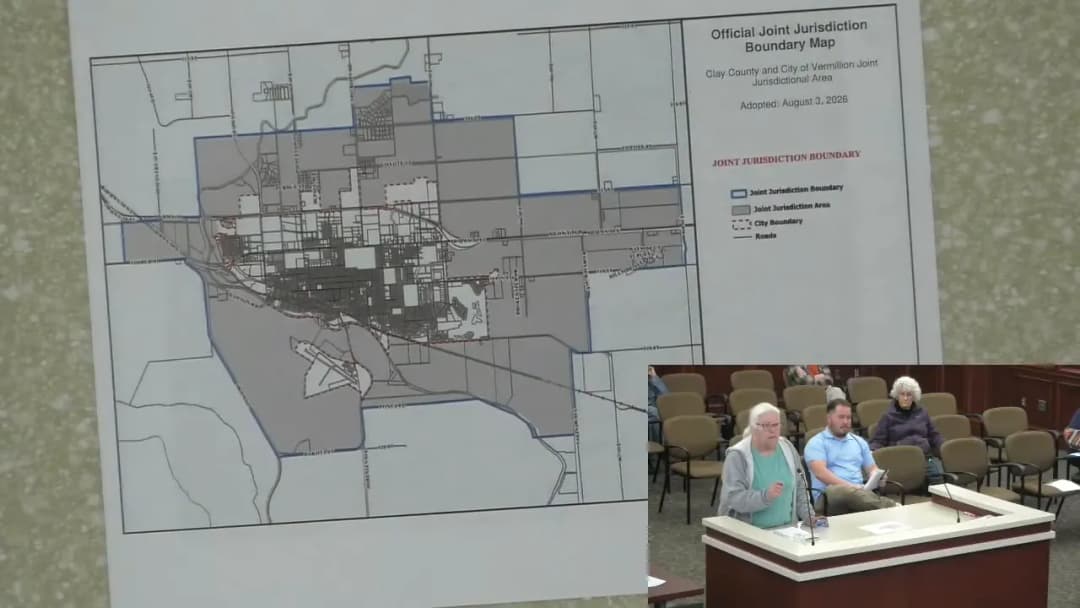
The Vermillion City Council and Clay County Commission convened in a joint session on October 20, 2026, to advance updates to the Joint Jurisdictional Zoning Area (JJZA) ordinances. Following the joint session, the City Council held its regular meeting, approving a water rate surcharge, revenue bonds, and receiving the annual Blue Peak Cable report. Public Comments & Testimony - Robin Shirell (former Clay County Commissioner, Elk Point resident): Alleged a series of crimes and injustices involving IRS impersonators, identity theft, and city hiring discrimination. She claimed the previous council and county administration failed to act on her complaints and urged the new council to investigate. - Dan Nuttleton (17 South Yale Street, Vermillion): Stated the property at 321 East Main Street has been in continuous violation of city nuisance codes (Chapters 90 and 94) since 2024, creating a public health hazard. He reported filing formal complaints with code enforcement in June 2025 and May 2026 with no successful resolution, and requested the council direct administration to expedite enforcement and abate the nuisance. Joint Meeting: JJZA Ordinance Discussion - Ordinance 2026-07 / 1571 (Boundary Map): Replaces the legal metes and bounds description of the JJZA with a map (Map 1 from the Comprehensive Plan). Amended during the meeting to clarify it only applies to Section 2.01A. Advanced to second reading. - Ordinance 2026-08 / 1572 (Annexation Boundary): Addresses how the JJZA boundary shifts after city annexation. Amended to specify the boundary must shift in the "general geographic direction" of annexation (adding "geographic" for clarity and changing "which" to "that"). Advanced to second reading. - Next Steps: Second reading for both ordinances set for November 2, 2026. Discussion Items - Termination of Street Utility Easement: Approved the petition by William Wood to vacate a 60-foot easement on Adam Street for future apartment development. Residents on the property are on month-to-month leases, and a private utility is working with the owner. - Blue Peak Cable Annual Report: Regional Managing Director Mike Carn presented the annual report, highlighting 99.99% network uptime and a 97% customer approval rate. He noted over $100,000 in community investments over four years. The council thanked Blue Peak for their community engagement. - Water Surcharge Rate Resolution: Finance Director Wendy presented the revised rate structure to support SRF loan repayments for the water facility plan. The base charge changes from $0.45 to $18.10, and the per-unit charge from $2.49 to $2.74. A typical 700 cu ft bill increases from $33.63 to $37.28. Effective for billing after December 1, 2026. - Revenue Bonds for Water Facility Project: The council approved a bond resolution for the $8.06 million water facility project (main replacement, SCADA, treatment plant upgrades), funded by SRF loans ($7M from 2023, $1.15M from 2026 at 4% for 30 years). - Proclamation: The council recognized the Vermillion High School Boys Golf Team for winning the 2026 South Dakota Class A State Championship by a 19-stroke margin, including individual champion Ryland Moran. - City Manager's Report: John Prescott noted the recent resolution of the French investment assessment issue. He reported the Bluffy Cemetery mausoleums have a continued comment period for National Register listing. Water hydrant flushing begins the next day. Key Outcomes - JJZA Ordinances Advanced: Both Ordinance 2026-07 and 2026-08 passed first reading (joint vote) and advanced to a second reading on November 2, 2026. - Street Easement Vacated: Unanimously approved by the City Council. - Water Rate Increase Approved: The City Council approved the water surcharge rate resolution, effective December 1, 2026. - Water Revenue Bonds Approved: The City Council approved the bond resolution for the water facility project. - Broadcaster Press Payment Approved: A $1,200 payment to Broadcaster Press was approved; Council member Dave Lias abstained. - City Manager Recognized: The council and mayor congratulated John Prescott on receiving the South Dakota Municipal League Employee of the Year award.
The San Antonio Zoning Commission met on October 20, 2026, at 1:00 PM, chaired by John Bustamante. The meeting covered multiple zoning cases and a major discussion on proposed Unified Development Code (UDC) amendments for data centers. Votes and decisions are summarized below. Consent Calendar - Items 7 through 12 were combined and approved unanimously (9-0). - Item 7: Rezone at 538 & 524 W. Woodlawn Ave. (C2/C1 to IDZ1HL). 33 notices mailed, 0 favor, 0 opposed. Alta Vista NA in favor. - Item 8: Rezone at 2401 W. Woodlawn Ave. (C3 to RM6). 33 notices, 0/0. Cable Westwood NA no response. - Item 9: Rezone at 7800 Callaghan Rd. (C3 to RM6). 33 notices, 0/0. - Item 10: Rezone at 525 W. Magnolia Ave. (R6 to RM6). 34 notices, 0/0. Alta Vista NA no response. - Item 11: Rezone at 1719 Goliad Rd. (I1 to C2, amended to C2NA). 17 notices, 0/0. Highland Hills NA no response. Applicant's amendment accepted. - Item 12: Rezone at 436 W. Craig Pl. (R6 to R6HL). 28 notices, 1 favor, 0 opposed. Alta Vista NA no response. - Items 5 and 6 were continued to the November 17, 2026 meeting. Public Comments & Testimony - Item 3 (15838 N US Hwy 281): Robin Thompson, a neighbor, expressed support after the applicant agreed to fix longstanding water drainage issues. Rachel Haynes (Policy Director, Greater Edwards Aquifer Alliance) opposed, stating C3 is incompatible with the North Sector Plan and the Edwards Aquifer recharge zone. - Item 1 (4400 block Nyato Dr.): Amelia Peacock (Paloma resident, veteran) opposed, citing lack of specific development proposal, concerns about traffic, and infrastructure adequacy. Joe Most (Paloma resident) opposed, noting proximity to existing homes and property value impact. - Item 4 (3460 Martin Luther King Dr.): Joe A. Rogers Howard (neighbor) opposed the car lot but was open to C2 commercial, citing school expansion and safety. Applicant Samonita Johnson expressed willingness to drop the car lot request for straight C2. - Item 13 (Data Center UDC): Multiple speakers: - Caroline McDonald (property owner) supported Option 1 (by-right with conditions), arguing Option 2 treats data centers more restrictively than heavy industrial uses like rock crushers. - Stephanie Reyes (RECA President/CEO) urged support for Option 1 to maintain consistency and attract investment. - Rob Killen (attorney) requested robust nonconforming use protections for existing data centers. - Rachel Haynes (GEAA) supported Option 2 (specific use authorization) for flexibility and public input. - Dee Dee Belmas (Public Citizen) supported Option 2, citing community concerns about noise, light, and lack of notification. - Evan Gray (Bear Data Center owner) asked for a small-scale exception to avoid regulating micro data centers. - Bill Kaufman (industry representative) argued 500-foot setback is excessive compared to other uses (e.g., 30 feet for outdoor amusement parks, gun ranges). - Dale Hanson (IBEW Local 60) and Mike West (Local 142) supported Option 1 for job creation. Discussion Items - Item 3 (15838 N US Hwy 281): Applicant Octavio Montes proposed C3 on the front 1.247 acres and C2CD (construction trade contractors) on the rear 2.61 acres. Staff recommended denial due to incompatibility with adjacent single-family homes. SAWS condition required 65% pervious cover and a 60-foot buffer around a solution cavity. After public comment, Commissioner Duval moved to approve as amended with conditions: hours M–F 8–5, Sat 8–1, height limit 20 ft, downward lighting. Motion passed 9-0. - Item 1 (4400 block Nyato Dr.): Applicant Bruce Cash (developer of Paloma subdivision) sought C2 (later amended to C2NA) to unify zoning on a parcel split between C2, NP10, and MXD. Staff recommended approval. After two motions (denial failed 5-4, reconsideration passed, then approval failed 3-6), no recommendation was sent to City Council; the applicant may choose to proceed or withdraw. - Item 2 (142 Gembler Rd.): Applicant (Vanessa Wertzer) request from C2 to IDZ3 for uses including parking, animal services, entertainment, and farm equipment storage. Amended site plan included a 25-foot buffer. Staff recommended denial due to industrial encroachment, but Planning Commission recommended approval. No public comment. Motion to approve with amended site plan passed unanimously. - Item 4 (3460 Martin Luther King Dr.): Applicant Samonita Johnson sought C2CD for a motor vehicle sales lot. Staff recommended denial but supported straight C2. Neighbors opposed car lot but open to C2. After discussion, Commissioner Losef moved to continue to November 17 to allow further community engagement. Motion carried 6-3. - Item 13 – Data Center UDC Amendments (Major Agenda Item): - Staff (Logan Sparrow) presented three options for regulating data centers: Option 1 (by-right in C3/industrial with conditions), Option 2 (specific use authorization required for all), and Option 3 (Mayor's proposal with additional requirements). - Discussion covered definitions, setbacks, nonconforming uses, environmental concerns, and water/energy impacts (deferred to SAWS and CPS). - After extensive debate and multiple motions, a final motion by Commissioner Pana (amended by consensus) was approved 8-1 (Witsett opposed). The recommendation to City Council includes: - Data centers allowed in C3, L (Light Industrial), and BP (Business Park) only with a Specific Use Authorization. - By-right permission in I1 and I2 districts if all conditions are met. - Minimum 350-foot separation from residential uses, schools, hospitals, etc. - 100-foot setback from property lines. - Downward lighting and screening of on-site chillers/generators from public view. - Use of Councilman White's definition for data centers, excluding small server rooms ancillary to a principal use. - Nonconforming use protections modeled after metal recycling facilities. Key Outcomes - Items 7–12: Approved unanimously (9-0). - Item 3: Approved as amended with conditions (9-0). - Item 5 & 6: Continued to November 17, 2026 (unanimous). - Item 1: No recommendation; applicant may choose path forward. - Item 2: Approved with amended site plan (unanimous). - Item 4: Continued to November 17, 2026 (6-3). - Item 13: Recommendation approved (8-1) for a hybrid regulation: by-right in I1/I2 with conditions; specific use authorization required in C3, L, and BP; 350-foot setback; 100-foot property setback; downward lighting; screening of chillers/generators; nonconforming protections. Staff will draft formal language for City Council consideration on October 29, 2026. - Minutes: Approved from October 4, 2026 meeting. - Meeting adjourned at 7:04 PM.
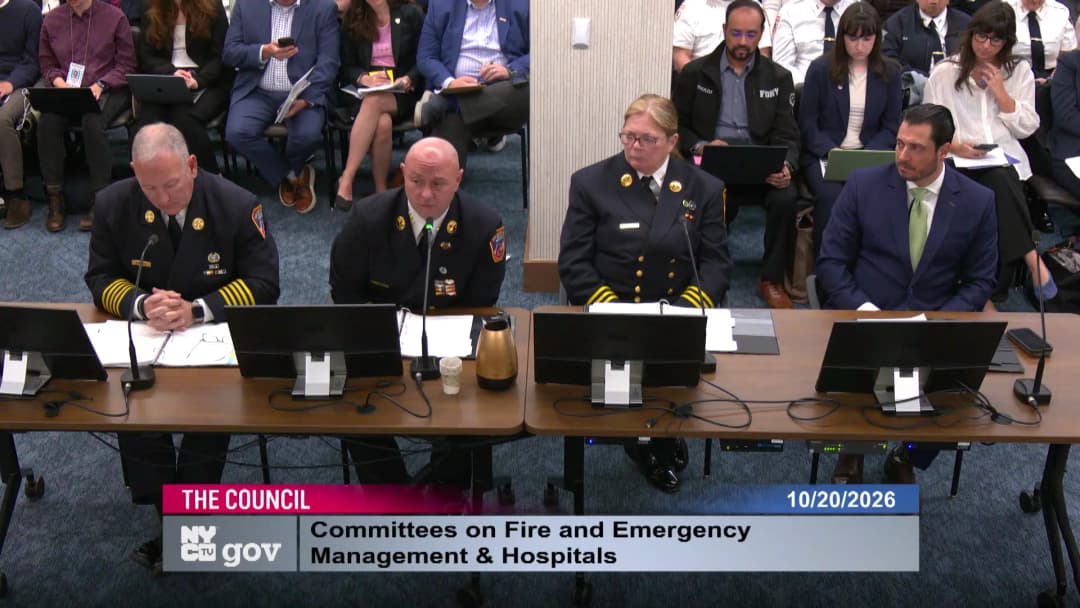
On Tuesday, October 20, 2026, at 10:00 AM in Hearing Room 2 at 250 Broadway, the NYC Council Committees on Hospitals and Fire & Emergency Management held a joint oversight hearing on ambulance response times and considered Introduction 990, which would require emergency notifications through Notify NYC when FDNY EMS has more than 25 pending ambulance dispatches. Chair Mercedes Narcisse (Hospitals) and Chair Joanne Ariola (Fire & Emergency Management) co-chaired. Committee members present were Narcisse, Aldebol, Brooks-Powers, Epstein, Farías, Gutiérrez, and Sanchez; other council members attending included Ariola, Won, Schulman, Paladino, Maloney, Restler, De La Rosa, Brewer, Dinowitz, and Speaker Julie Menin. The oversight item was filed and Intro 990 was laid over. Public Comments & Testimony - Jennifer Daly, mother of 14-year-old Kevin Daly, testified by Zoom that on September 28 her son suffered a stroke at St. Francis Preparatory School; the school nurse called 911 three times, no ambulance arrived, and the family drove him to New York Presbyterian Queens before transfer to Morgan Stanley Children's Hospital. She described the ordeal as unacceptable and urged action. - Michael Greco, president of Local 2507, said EMS is running out of time. He cited the controller's report showing life-threatening ambulance response times increased more than 41% since fiscal 2015 and that more than 500 EMTs left in fiscal 2026 alone. He argued the core problem is retention, not training, noting an EMT with five years' experience earns about $60,000 compared with about $109,000 for a firefighter. - Vincent Barrialli, president of Local 3621, said low wages and inferior benefits are confirmed by the mayor's management report and controller's report. He stated cardiac arrest survival rates have fallen from 35% to 16%, that EMS has about 25% of FDNY staffing while handling about 1.6 million calls annually compared with fire's 500,000, and that fire receives roughly 84% of FDNY's budget while EMS receives about 16%. He called for treating EMS as a co-equal branch and for pay and benefit parity. - Anthony Lamarena, vice president of Local 3621, provided ambulance off-service counts at 2 p.m. for the prior week: 138, 89, 92, 68, 94, 101, and 122. During his testimony, he said 112 ambulances were off service and 51 calls were holding, most for over three hours. He described multiple fatal delays, said EMS has failed because the government failed EMS, and cited 14 member suicides since 2020. - Logan Clark and Valerie Goudino of the Independent Budget Office testified that MMR data show end-to-end ambulance response times increased by nearly three minutes since FY22 to more than 13 minutes; daily ambulance hours fell nearly 10% from 8,900 to 8,100; hospital-run ambulances made up about one-third of tours; and 11 hospital systems removed ambulances from the 911 system in FY26. They noted EMT share of the EMS workforce fell from 69% to 63% and that promotional firefighter exam cycles contribute to attrition. - Joseph Raineri of the Regional EMS Council of New York City opposed single-paramedic staffing, saying dual medics are clinically necessary for complex patients. He supported pay parity, better work-life balance, clear career paths, and said efficiency measures alone will not fix the system. - Several current and former EMS workers testified about long waits, low pay, staffing shortages, hospital ambulance withdrawals, and 911 misuse. Christian Bear Lopez, a paramedic, cited the death of Lieutenant Nelson Cito and asked why the council is not holding a hearing on Intro 0521. Gerardney Williams described 25-minute travel times across Manhattan, said the city receives about 6,000 calls a day, and called mutual aid shameful. Andrew Freena said paramedics arrived within 10 minutes in only 26% of calls in the last month. Jack Chapman cited a 40-minute response to a life-threatening seizure at a hotel and said ALS call volume has increased 22.9% since 2015. Stephen Northmore gave multiple examples of patients waiting 30 minutes to three hours, including a patient who died from a manageable bleed. Christopher King said the government has failed EMS and that about 20 members he knows are considering retirement. - James Kerr, former executive director of NYC EMS from 1980 to 1988, said response time is a symptom, not an isolated issue. He recommended a mayor-directed EMS improvement task force that would submit an implementation plan within 90 days, including clinically appropriate response targets such as ALS units reaching patients 95% of the time within six minutes. - Tyler Weaver, whose son Nicholas Costello died in 2023 after a 20-minute ambulance wait, said cardiac arrest revival rates have fallen to 16% and that average response times have returned to 13 minutes for the first time in 40 years, with monthly averages reaching 15 minutes and the Bronx 18 minutes. He urged contract resolution and pay increases. - Cheryl Bernard, a retired NYPD communications supervisor, supported EMS pay raises but argued DOT bike lanes, bus lanes, and street closures are major causes of delayed ambulance travel. She opposed giving 911 callers ETAs because traffic conditions can change and create legal risk. - Chowdhury Mahmood, an FDNY technology staff member, testified about repeated CAD system crashes and an approximately $20.66 million no-bid sole-source contract with Accenture for the EMS CAD system, alleged retaliation against him, and asked the committees to require independent technical certification and milestone-by-milestone accounting before the EMS CAD system goes live. Discussion Items - Chair Ariola opened by noting that over the summer, 700 calls were held by the EMS system because of staffing shortages and that Intro 990 would tell New Yorkers when help is not moments away. She said EMS workers are underpaid and that the city has struggled to provide timely emergency care. - Chair Narcisse, a registered nurse, described emergency department overcrowding and said reports indicate H+H patients waited an average of 12.8 hours to be transferred from the ED to an inpatient bed between 2022 and 2025. She noted New York City has 49 hospital emergency departments, including 11 H+H hospitals serving more than 8.5 million New Yorkers, and called health care a human right. - FDNY Chief of Department John Esposito acknowledged rising response times and said addressing them is a top priority. He testified that average ambulance in-service hours fell from 8,891 in FY22 to 8,109 in FY26 while life-threatening calls rose from 564,412 to 610,771. He said 358 EMTs and 63 paramedics left EMS to become firefighters in 2026, 19 hospitals have closed since 2003, and the 911 system is about two-thirds municipal and one-third hospital-run. He described mitigation efforts including 14 paramedic response units, a centralized resource coordination center, borough-based command, mutual aid, redeploying offline members, and exploring AI and a new EMS CAD system. On Intro 990, he said FDNY does not believe the likely volume of notifications would provide useful information and is concerned about confusing or frightening the public, but is open to further discussion. - FDNY Chief Paul Miano and Chief Denise Werner answered detailed questions. For the St. Francis Prep case, they said the call came during a period with more than 100 extra calls, no EMS call taker was available, the call went through the overflow position, and it was classified as an unknown condition rather than a stroke call; an ambulance was dispatched but arrived after the family left. They acknowledged the response was unacceptable and said they are improving NYPD-EMS communications. For Speaker Menin's district incident, the call was triaged as a segment 5 injury, ambulances were redirected to life-threatening calls, and fire engines are not dispatched to segment 4 or 5 injuries and cannot transport patients. They said an average of more than 90 ambulances are off service per day, overwhelmingly due to staffing; EMS budgeted headcount is 4,500 but actual staffing is below 4,100; and 163 EMT trainees are currently in the academy, down from 200, with graduation expected in mid-December. They also said the hospital liaison unit pilot ended in late May because it did not produce a large enough systemwide impact, though citywide ambulance turnaround time increased by about two minutes after it ended. - Dr. Josh Motzquist of NYC Health + Hospitals testified that the current average time from ED arrival to first provider is 29 minutes, improved from 33 minutes; the average ED-to-inpatient-bed transfer time after admission is about 270 minutes. He said Lincoln Hospital sees about 37 patients per hour at peak, H+H recorded about 1.1 million ED visits in 2025, and patient acuity has increased. He reported that the ED Leads program had 30,400 encounters in 2025, over 6,500 referrals to outpatient clinics, and over 3,600 naloxone kits distributed. He said H+H does not yet have data on New York City Care's effect on ED utilization and would follow up on several programs. - Speaker Julie Menin said EMS workers are understaffed and underpaid, with EMT pay of about $18 an hour and average service under three years. She cited a 16-year-old in her district injured during a basketball game who waited 30 minutes before a parent called a private ambulance, with FDNY calling back nearly three hours later, and called the current average response time of about 13 minutes wholly unconscionable. - Council Members Paladino, Shulman, Brooks-Powers, Epstein, Brewer, Sanchez, Restler, and Aldebol raised pay parity, recruitment and retention, transparency of response data, NYPD responding before EMS, hospital handoffs, street closures, siren noise, and public education. Council Member Sanchez noted that a 90-year-old constituent waited 25 minutes for an ambulance and that NYPD officers often arrive first and sometimes transport patients; FDNY said it does not systematically track NYPD arrivals or transports and would follow up. Key Outcomes - Oversight item T2026-2406 on ambulance response times was heard and filed by the committee. - Introduction 0990-2026 was heard and laid over by the committee; no vote to advance was taken. - FDNY stated it is open to further discussion on Intro 990 but does not support the bill as written, citing potential public confusion and the likelihood of high notification volume. - Council members and union leaders repeatedly called for EMS pay parity, uniform status, civil service recognition, improved recruitment and retention, and stronger public education about when to call 911. - Written testimony was accepted for 72 hours after the hearing by email to testimony@council.nyc.gov.
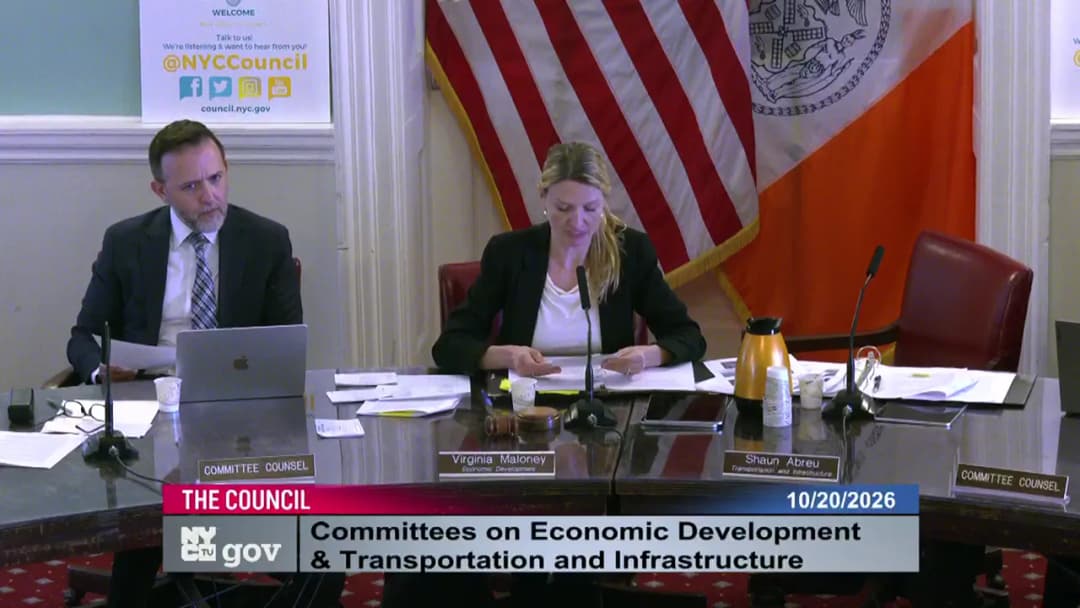
The New York City Council’s Committees on Economic Development and Transportation and Infrastructure held a joint oversight hearing on October 20, 2026, at 10:00 AM in City Hall. Chaired by Councilmember Virginia Maloney (Economic Development) and Majority Leader Shaun Abreu (Transportation and Infrastructure), the hearing examined transit on NYC’s waterways, including the New York City Ferry system, seaplane operations at East 23rd Street, party boat safety, and four proposed bills to expand ferry service to Canarsie Pier, Willets Point, West 125th Street, and City Island. No votes were taken; all four bills were laid over, and the oversight was filed. Public Comments & Testimony - Waterside Plaza Residents (Janet Handel, Miriam Applebaum, Diane Park) and Community Board 6 (Jesus Perez): Expressed strong opposition to continued seaplane operations on the East River, citing safety risks, noise violations (recorded up to 97 decibels), and lack of enforcement of the 1,000-foot shoreline rule. They argued that the area has become a dense residential corridor and called for stricter regulation or cessation of flights. - Mateo Lawman (High School Student): Described building a noise-tracking system (Helly Tracker) to document helicopter and seaplane disturbances, and is adapting it for seaplanes. Advocated for data-driven enforcement. - Disabled in Action Members (Jean Ryan, Kathleen Collins, Monica Bartley, Michael Ring): Urged the city to require four-point wheelchair securement on all ferries, improve accessible signage and bus connections, and involve the disability community in planning. Highlighted that current two-point securement is unsafe and violates Local Law 68 of 2005. - City Island Residents and Business Owners (Michael Shanley, Kim Woodruff, Lauren Nye, Dan Treiber, Henry Smith, Stephen Di Fiore): Largely supported Intro 1032 to study ferry service to City Island, citing over 2,500 petition signatures, 350 emails of support, and potential economic benefits. Noted that 43% of residents spend over an hour commuting and that over 20 storefronts are vacant. - City Island Opposition (Roxanne Delgado, Kathy Sebek, Ricardo Garcia): Raised concerns about low projected ridership (only 225 daily commuters per a prior EDC study), high per-rider subsidies ($8.79), traffic congestion, and environmental impacts. Suggested Orchard Beach as a more suitable location for a ferry landing. - New York City FC (Neve Wallace): Supported Intro 846 for ferry service to Willets Point, citing the upcoming Etihad Park stadium (25,000 seats) and the need for diverse transit options. - Katie McCormick (City Island Resident): Addressed party boat noise issues, reporting repeated late-night disturbances with little enforcement. - Kiana Diaz (Inwood Resident): Called for ferry service to Inwood/Dyckman Marina, noting the area’s rezoning and limited subway access. Discussion Items - Oversight of NYC Ferry Operations: EDC Executive Vice President James Wong testified that NYC Ferry carried 56 million passengers since 2017, with 7.4 million trips in the last fiscal year. The per-rider subsidy is $8.79 (down from $13 peak), and fares recently increased: base fare to $5, discount fare to $1.50. The current operating contract with Hornblower expires in 2028 with two three-year extension options. EDC plans a system-wide vision study to evaluate over 40 waterfront sites, expected by summer 2027, and opposes the four legislative bills as premature. - Seaplane and Party Boat Oversight: EDC’s Anton Frederickson stated that seaplane operations average 1,620 flights annually, with revenue of $300,000. Enforcement of safety rules (e.g., 1,000-foot shoreline rule) is delegated to Doc NYC, but residents and council members questioned accountability, citing incidents such as a July 2025 hard landing. Councilmember Maloney pressed for contract transparency and penalty data. - Ferry Expansion Bills (Int 0704, 0846, 1022, 1032): Each bill sponsor presented arguments for their district: - Councilmember Narcisse (Int 0704): Canarsie Pier is a transit desert; ferry would relieve overcrowded L train and buses, and support economic development. - Councilmember Thomas Henry (Int 0846): Willets Point is undergoing major redevelopment (2,500 affordable housing units, new stadium); a ferry would reduce congestion on the 7 train. - Majority Leader Abreu (Int 1022): West 125th Street has existing pier infrastructure; a ferry would connect Harlem and reduce travel times. - Councilmember Farias (Int 1032): City Island has one road, limited transit, and 20+ vacant storefronts; a feasibility study is needed to evaluate economic and transportation benefits. - EDC Concerns: EDC estimated that all four bills would require eight additional vessels and $25–30 million in annual operating costs, plus hundreds of millions in capital costs. Specific challenges were cited: Canarsie Pier needs $30 million in rehabilitation and federal coordination; Willets Point has shallow water and mudflats; West 125th Street is 4 miles outside NYC Ferry’s service area; City Island has low density and environmental constraints. - Accessibility and Equity: Councilmembers raised concerns about wheelchair securement (two-point vs. four-point), language access, and the need to include underserved communities. EDC noted ongoing improvements, including new signage and future four-point securement studies. Key Outcomes - All Four Introductions (Int 0704, Int 0846, Int 1022, Int 1032): Hearing held and laid over by committee; no further action taken. - Oversight (T2026-2572): Hearing held and filed by committee. - Next Steps: EDC’s citywide ferry vision study is expected to be completed by summer 2027. The council plans to continue dialogue with EDC and community stakeholders. Councilmember Maloney requested copies of EDC contracts and enforcement data. The committee will consider advancing legislation after the study's release.
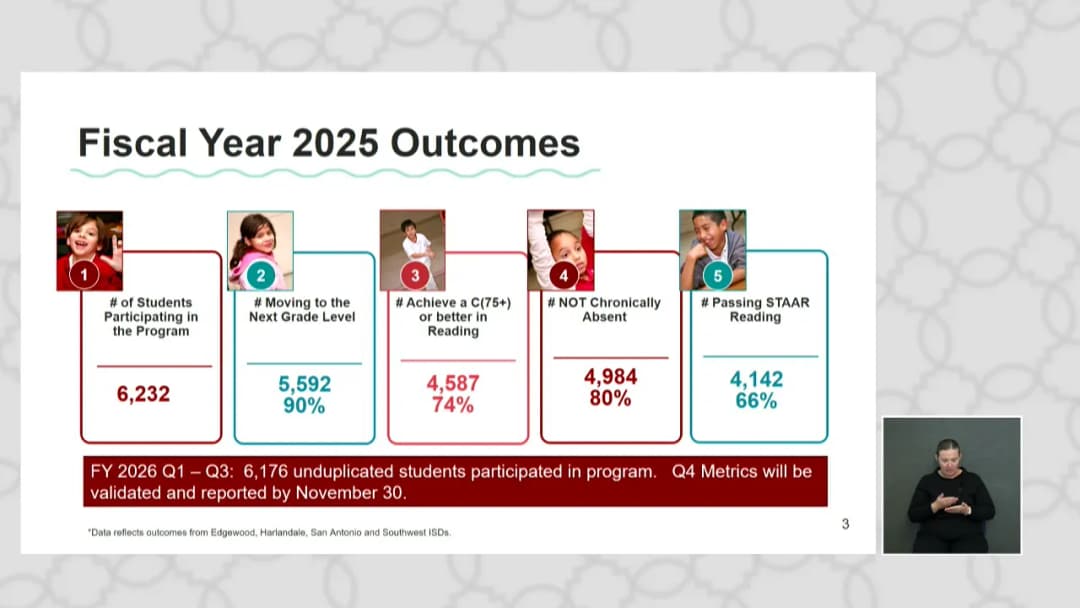
The Education Opportunities Committee met on October 20, 2026, to discuss three major agenda items: a proposed Ambassador Internship Pilot for opportunity youth, a presentation on student chronic absenteeism, and an overview of the After School Challenge Program. Chair Galvan presided, and discussions included presentations from city staff and community partners, followed by committee direction on data collection, program metrics, and interdepartmental coordination. Consent Calendar - The committee voted unanimously to approve the minutes from the previous meeting. - No public comment was offered. Ambassador Internship Pilot for Opportunity and Justice-Involved Youth Rebecca Flores, Education Programs Administrator for the Department of Human Services, presented an 8-week paid internship pilot for 25 disconnected youth (ages 16-24). The pilot prioritizes foster youth, those experiencing housing instability, LGBTQ+ youth, and youth with court involvement. It would be funded by reallocating $200,000 from the Ambassador Summer Internship Program, reducing its university cohort from 200 to 150 interns. - Councilmember Castillo expressed strong support, citing the need to address youth justice involvement at its root. She requested data tracking on participants with incarcerated parents and a post-program follow-up system. - Councilmember Coor supported the proposal but requested a formal control group for the pilot evaluation and targeted outreach in areas with the highest concentrations of opportunity youth. - Councilmember Mungia supported the fund reallocation, noting that the existing Ambassador program's college enrollment requirement excludes many disconnected youth. - Chair Galvan asked about staffing (temporary full-time positions) and employer interest (some employers are already engaged). - Outcome: Staff will return to committee in December or January with a refined data collection plan (including a control group) and a targeted outreach strategy before seeking full City Council approval. Student Attendance and Chronic Absenteeism Julia, from the Barricade Education Coalition, presented on the distinction between chronic absenteeism and truancy, the negative impact of attendance-based school funding in Texas, and tiered strategies from the Attendance Playbook. She highlighted the influence of after-school programs, transportation (VIA pilot), safe school routes, health services, and home visits. - Councilmember Mungia discussed holistic approaches, including incentives, laundry services at schools, and improved safe walking routes. - Councilmember Coor advocated for linking city investments in housing, sidewalks, and delegate agencies to attendance data. She requested a future presentation from Public Works on prioritizing sidewalk funding specifically around schools. - Councilmember Castillo raised infrastructure barriers (potholes, railroad crossings) and the impact of police presence, asking about the effectiveness of incentive programs and career technical education. - Chair Galvan called for better interdepartmental and ISD communication modeled on a children's cabinet and for disaggregated data on the root causes of absenteeism (health vs. disengagement). - Outcome: The committee discussed broad strategies to connect city investments to attendance outcomes and requested improved interagency coordination and data sharing. After School Challenge Program Melody Weasley, Human Services Director, provided an overview of the 30-year-old program. In FY26, it served 6,176 students across four ISDs (SAISD, Harlandale, Edgewood, Southwest) with a $2.1 million general fund budget. FY25 metrics showed 90% grade promotion, 74% achieving a C or better in reading, and 80% not chronically absent. Parent fees generate roughly $336,000. - Councilmember Mungia suggested reinvesting fee revenue into the program and making increased funding for Southwest ISD permanent. - Councilmember Castillo requested a breakdown of programming types and average attendance per school district. - Councilmember Coor expressed strong concern about the metrics (10% not promoted, 20% chronically absent), stating they appeared low without a comparison group. She demanded year-over-year data and demographic breakdowns. - Councilmember McKee Rodriguez requested comparative data for challenge vs. non-challenge students to properly evaluate the program's impact. - Chair Galvan recommended standardizing program names across campuses for public clarity and linking program outcomes to specific academic gaps. - Outcome: DHS will provide a detailed follow-up memo with improved metrics, comparative data, demographic details, and fee structure analysis. Key Outcomes - Ambassador Pilot: The committee supports the pilot and fund reallocation concept. Staff is directed to return in December or January with a refined data and outreach plan before a full Council vote. - Attendance: Staff will explore how existing city investments (transportation, housing, public works, delegate agencies) can be better linked to school attendance, and how to improve interagency communication between the city, ISDs, and partners. - After-School Challenge: Staff will produce a follow-up memo with year-over-year metrics, comparative data against non-participants, demographic details, and an assessment of the parent fee structure.
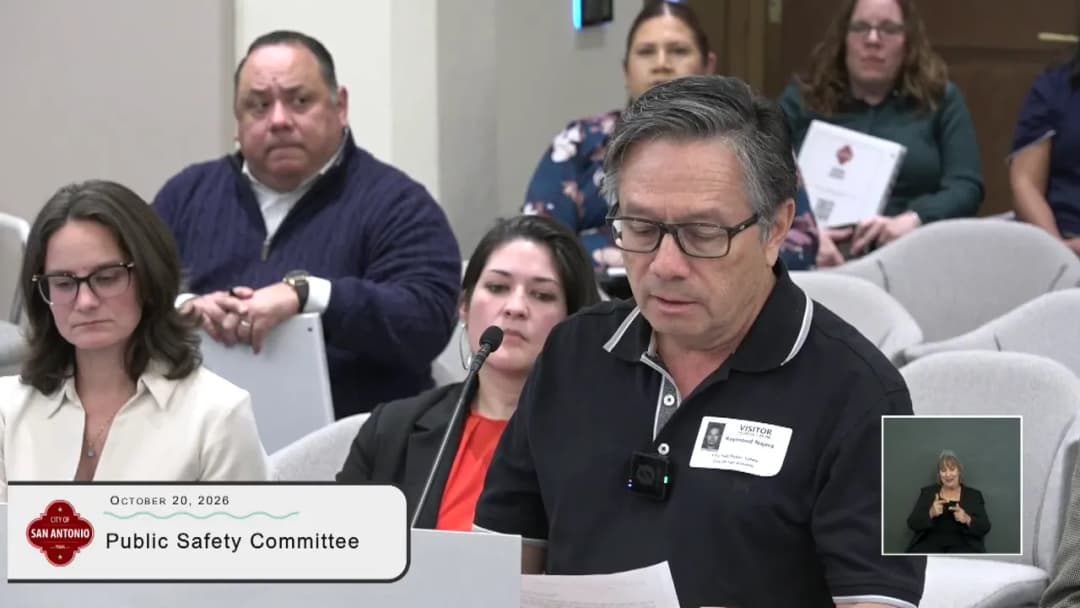
The Public Safety Committee met on October 20, 2026, at 2:38 PM with quorum present (Councilmembers Maki Rodríguez, José Castillo, Spears, White, and Chief Core). The committee reviewed multiple agenda items including Animal Care Services (ACS) performance, domestic violence data, the Good Neighbor Program, crime statistics, and the Dart property abatement program. No agenda or minutes were available beyond the transcript. Consent Calendar - Minutes Approval: The committee unanimously approved the minutes from the September 23 meeting without opposition. Motion by Councilmember Castillo. Public Comments & Testimony - Paul: Addressed spay/neuter data. Emphasized the need for better reporting by species and gender, noted that contracts often miss goals, and advocated for mobile clinics citing experience in Houston (23 surgeries per day). - Vicky Sturman: Expressed frustration with stray dogs and criticized ACS for partnering with Best Friends, which she claimed promotes leaving dogs on streets. Urged implementation of a strategic plan focused on dangerous dogs. - Jennifer Mate: Represented a dog rescue organization. Described a critical problem of stray dogs creating dangerous conditions. Criticized ACS for lack of enforcement and specifically condemned the arrest of 71-year-old Olga García, who was trying to help dogs. Asked for policies that prioritize real animal cruelty cases and support for rescuers. - Tina Castro: Given six minutes; echoed concerns about stray dogs and the criminalization of those who help animals. Called for justice and better collaboration. Discussion Items Animal Care Services (ACS) FY2026 Report - Presentation by Deputy City Manager John Gary and ACS Director. Key data: 5.6% fewer animals in shelter vs. FY2025; 18,932 stray dogs (lowest in 10 years); 26% increase in adoptions; live release rate declined due to a distemper outbreak that forced euthanasia of 7 dogs and testing of 200+ dogs (16 positive, 2 new cases). Spay/neuter surgeries increased by 7,000 with two new clinics, but cancellations and no-shows (42.5% average) remain a challenge. Comparative analysis with Austin, Dallas, Houston showed San Antonio has the most incoming animals and highest enforcement actions. - Council Questions: - Councilmember White probed policies on picking up stray dogs – ACS admitted they lack personnel and prioritize aggressive/injured animals; cannot respond to every report. Requested cost recovery data. - Councilmember Maki Rodríguez asked about spay/neuter costs per species, contracts vs. in-house, and requested a budget follow-up memo. - Councilmember Castillo inquired about outcomes of ambassador program, no-show costs (none currently), and urged better coordination with county. - Councilmember Spears emphasized need for a concrete plan to reduce stray dogs, not just incremental steps. Called for aggressive metrics, free adoptions, and better recruitment of veterinarians. Domestic Violence Update - Presentation by María (CCBD) and Judge Díaz. Data: 42% of children and 29% of adults reported witnessing domestic violence (up from 2023). 1,907 connections to services via United Way (5/day), 13,500 visits to assistance centers (27/day). 58,000+ emergency calls (7/hour). 28 family violence homicides (down from 2020 peak); 13 intimate partner homicides (low compared to Travis and Harris counties). 1,579 protective orders issued. 900 people received shelter, 20,000 received advocacy services. A 5-year prevention plan is mid-implementation focusing on communication, evaluation, and youth education. - Council Discussion: Councilmember White asked about measuring long-term stability of survivors – services include residential and crisis management for up to two years. Councilmember Castillo requested breakdown of shelters by agency and noted difficulty for some victims to access shelters (e.g., missing birth certificates). Councilmember Maki Rodríguez asked about the 800 cases received vs. 1,000 served – many do not need extra support; requested more granular data. Good Neighbor Program - Presentation by María Vargas Yates (Office of Integrated Community Safety). Program addresses chronic nuisance properties. Since 2023, 56 cases identified (37 active). Proposed ordinance: properties with 16+ calls in 365 days become eligible; owners/tenants must register and complete a reduction plan; failure to comply results in a $500 fine. Implementation 90 days after council approval. - Public Comment: Raymond Nájera shared personal story of a fatal dog attack after repeated unheeded calls. Urged better coordination and accountability. - Council Discussion: Councilmember White asked about criteria (16 calls) and fine collection rates – staff admitted no historical data but promised follow-up. Councilmember Castillo noted concern about repeat offenders and wanted support for the lone program manager (Megan). Councilmember Maki Rodríguez questioned about linking to other city services. A motion to advance the ordinance to full council was made and approved without opposition. Crime Statistics Update - Presentation by Chief Core or staff. Highlights: Homicides down 40% (national trend); property crimes down; increases in kidnapping/human trafficking due to proactive operations with US Marshals (45 exploited individuals identified); robberies and vehicle thefts slightly up. Response time at lowest ever. Staffing: 360 officers deployed but ideal is 383; more detectives needed for special victims unit. - Council Questions: Councilmember White asked about proactive patrols in hot spots – confirmed 85-90% coverage. Councilmember Maki Rodríguez requested context for increased kidnappings (linked to trafficking operations and revenge porn cases). Follow-up requested on ideal staffing by substation. Dart Program (Dwelling Abatement Review Team) - Presentation by staff. FY26: 40 inspections (down from 57 in FY25) due to voluntary resolutions and staffing constraints. 27 cases rejected for incomplete documentation. 9 properties in compliance, 17 pending hearings, 1 in litigation, 13 under special circumstances (elderly, disabled, family disputes). Successful case: removal of microplastics illegally stored near aquifer. Councilmember Castillo asked about recidivism (estimated 25-30%) and cost recovery opportunities. Councilmember Maki Rodríguez thanked the team and expressed interest in participating in inspections. Key Outcomes - Motion Approved: The Good Neighbor Program ordinance will be forwarded to the full City Council for consideration, including a parallel ordinance for administrative hearings and appeals. The motion passed unanimously. - Directives: - ACS to provide a follow-up memo on spay/neuter costs, cost recovery per service, and a plan to increase veterinarians and surgeries. - Staff to prepare a presentation on ideal police staffing levels by substation and unit. - Domestic violence presenters to provide more detailed data on case management and outcomes. - Referrals: Councilmember White requested cost recovery data from all departments given fiscal constraints. Councilmember Maki Rodríguez asked for a strategic plan update for ACS with aggressive targets. - Next Steps: The committee will reconvene in November for further discussions on crime trends and police staffing.