Browse by city
Date range
Search help

Search titles, summaries, topics and stored transcripts together. Keywords may match separately; put the whole query in double quotes for a phrase. Matching follows word analysis, so punctuation is not exact. Both dates are included. Documents are not searched.

SHOWING 1771–1780 ENTRIES
1771
OCT 20, 2026 · SAN ANTONIO, TEXAS · COUNCIL COMMITTEES
San Antonio Public Safety Committee Meeting Summary: October 20, 2026

The San Antonio City Council's Public Safety Committee, chaired by Councilmember Corps, convened on October 20, 2026, at 2:38 PM. The agenda included updates from Animal Care Services (ACS) on FY26 metrics and a distemper outbreak, the Bexar County Collaborative Commission on Domestic Violence (CCDV) 2025 report, a proposal for a Chronic Nuisance Property Ordinance, SAPD crime statistics, and the DART program. The meeting was adjourned at 5:01 PM. Consent Calendar - The committee unanimously approved the minutes from the September 23rd public safety committee meeting. Public Comments & Testimony - John Bachman advocated for more granular spay and neuter data (by species and sex) and suggested mobile clinics could efficiently increase daily surgery capacity. - Vicky Stierman expressed strong opposition to the city's partnership with Best Friends Animal Society, arguing the approach allows strays to remain on the streets. She urged full implementation of the ACS Strategic Plan. - Jennifer Mata (Nolan Friends Dog Rescue) criticized ACS enforcement priorities, specifically the arrest of a 71-year-old woman for hoarding, contrasting it with a lack of action against backyard breeders and true cruelty cases. She questioned ACS policies on owner surrenders and requested an independent review of enforcement practices. - Raymond Najera spoke powerfully about the death of his father, Ramon Najera, from a dog attack, urging the committee to ensure the Good Neighbor Program is effectively resourced and enforced to prevent such tragedies. Discussion Items Animal Care Services (ACS) Update Director John Gary presented FY26 metrics. Shelter intake decreased by 5.6% (1,663 fewer animals) after removing "diversions" from the count. The live release rate increased 1% to a target of 90%, alongside a 25% increase in adoptions and a 10% decrease in euthanasia. Critical call response rates reached a historic high of 94.2%. The department performed nearly 41,000 spay/neuter surgeries, slightly below a 41,000+ goal due to veterinarian staffing challenges, particularly in contract roles. A significant distemper outbreak required the temporary clearing of the shelter with partner Dogtopia; seven dogs were euthanized, and new isolation protocols were implemented. Council discussion focused on the capacity to respond to stray calls (policy of not responding to non-threatening strays due to staffing), the need for a comprehensive strategic plan to address the stray population, and the high cost of spay/neuter operations relative to the numbers achieved. Councilmember Core questioned why a request for more veterinarians was not made in the budget. Councilmember White requested cost-recovery data. Councilmember Castillo asked for breakdowns of spay/neuter referral sources and adoption fee comparisons with Dallas. Bexar County Domestic Violence Statistics Maria Vargas Yates and Judge Diaz presented the 2025 report from the CCDV. The report indicated 42% of assessed children witnessed family violence. There were over 58,000 combined SAPD/BCSO domestic violence calls for service and roughly 22,000 offense reports. Family violence homicides declined to 28, with 13 intimate partner fatalities. Support services connected with 1,900 individuals via 211. The DA's office received nearly 14,000 family violence cases. Councilmembers White and Castillo requested more detailed data on the specific delegate agencies providing services, survivor outcomes, and how the city connects with victims who do not enter the criminal justice system. The CCDV outlined its five-year plan focusing on a communications campaign, data utilization, and lifespan prevention. Good Neighbor Program & Chronic Nuisance Property Ordinance Maria Vargas Yates presented the Good Neighbor program, which currently manages 55 cases (37 active). A proposed chronic nuisance property ordinance is intended to address challenges of cyclical compliance, unresponsiveness (35% of cases), and chronic callers. The ordinance would require property owners to register and create an abatement plan, with violations carrying a fine of up to $500. Councilmember Castillo asked about overlapping cases with the DART program and a sliding scale for repeat violators; staff clarified that escalating enforcement can be managed through the Standard Operating Procedure rather than the ordinance text. SAPD Crime Statistics Chief presented crime data for January to September 2025/2026. Overall offenses decreased by 6.1%. Crimes against persons were up 1.5% (attributed to a slight rise in assaults and proactive human trafficking operations). Property crimes were down 10%. Homicides were down nearly 40% compared to the previous year, consistent with national trends. Hotspot policing initiatives are sustaining high fidelity and crime reductions. Councilmember White reiterated his disappointment that the budget did not fund additional patrol officers. Councilmember Core requested a holistic staffing model overview (substations, patrol units, detective divisions) for the next meeting. DART Program Update Joe Nina reported that the DART task force inspected 40 properties in FY26 (down from 57 due to partner availability). The Building Standards Board (BSB) remains the most common enforcement tool for uncooperative or deceased owners. A success story involving the cleanup of illegally stored microplastics on Creek View was highlighted. Recidivism was estimated at 25-30%. Staff agreed to provide an individual memo to councilmembers listing properties on the potential DART list that have not yet been formally reviewed. Key Outcomes - ACS Strategic Plan/Future Briefings: Staff were directed to prepare a comprehensive follow-up memo for the next goal-setting session, including a detailed plan to increase spay/neuter surgeries (costs, veterinarian recruitment strategies), cost recovery analysis, and metrics on referral sources for services. - Chronic Nuisance Property Ordinance: The committee voted unanimously to advance the proposed ordinance to the full City Council. Staff will retain flexibility in the SOP to address repeat violators more aggressively. - Domestic Violence Tracking: The committee requested future reports include specific breakdowns of delegate agency providers and better integrated data tracking systems to measure service outcomes and gaps. - SAPD Staffing: A comprehensive overview of the SAPD staffing model (patrol, substations, detectives, Safe Officers) is scheduled for the November committee meeting.

ANIMAL WELFARE 43% · CODE ENFORCEMENT 23% · DOMESTIC VIOLENCE PREVENTION 13% · PUBLIC SAFETY 11%
1772
OCT 20, 2026 · NEW YORK CITY, NEW YORK · CITY COUNCIL
NYC Council Subcommittee on Zoning and Franchises Meeting - October 20, 2026

The New York City Council Subcommittee on Zoning and Franchises, chaired by Council Member Farah N. Louis, met on Tuesday, October 20, 2026, at 11:00 AM. The subcommittee voted to approve two rezoning proposals in Brooklyn and Queens, and held a public hearing on the rehabilitation of Studio 54 in Manhattan. Discussion Items - 1455 Coney Island Avenue Rezoning (LU 0142-2026 and LU 0143-2026): Chair Louis reported that the applicant, Prospect Park Land LLC, seeks to develop a nursing home with 300 beds in Midwood, Brooklyn. The proposal includes a zoning map amendment from an R5 residential district to a C4-5D commercial district and a text amendment to map a Mandatory Inclusionary Housing (MIH) area. - 135-27 Sapphire Street Rezoning (LU 0144-2026 and LU 0145-2026): Chair Louis reported that the applicant, 135 Sapphire LLC, proposes a residential project with 268 apartments, of which 67 would be permanently affordable. The proposal includes a zoning map amendment from an R4 to an R6A residential district and a text amendment to map an MIH area. Council Member Ariola expressed support for this application. Public Comments and Testimony - Studio 54 Public Hearing (LU 0153-2026 and LU 0154-2026): - Council Member Wilson expressed strong support for Roundabout Theatre Company's application, stating that preserving iconic cultural spaces like Studio 54 is essential for New York City's arts and entertainment industry, which supports jobs and strengthens the local economy. - Applicant Panel (Roundabout Theatre Company): Chris Knave (Chief Advancement Officer), Carol Rosenthal (Freed Frank), and Francil Lim (Eniad Architects) presented the proposal. Knave highlighted Roundabout's mission, its production of six to eight shows annually reaching 500,000 people, and its Theatrical Workforce Development Program which has trained 150 young New Yorkers (86% employed in performing arts). He noted a $26.6 million city commitment to the workforce program, one-third from City Council. The panel detailed the comprehensive rehabilitation needed for the century-old theater, including restoring the orchestra pit, re-raking the orchestra seating, rebuilding the balcony, improving ADA accessibility, and upgrading building systems. The text amendment would allow the transfer of development rights (TDR) generated by the rehabilitation bonus to other sites within the Theater Subdistrict, as the current zoning limits bonus use to the original lot. Carol Rosenthal noted the existing provision has only been used three times in 44 years. - Public Testimony: Mitch Mattson read a statement on behalf of Megan Frazier, an alumna of Roundabout's Theatrical Workforce Development Program (TWDP) and a member of IATSE Local One. Frazier expressed full support for the application, stating that her training at Studio 54 set her on a career path that led her to become a highly licensed pyrotechnician working on Broadway shows. She argued the renovations will improve the skill-based curriculum for future technicians. Key Outcomes - Approved (LU 0142-2026 through LU 0145-2026): The subcommittee approved the 1455 Coney Island Avenue rezoning and the 135-27 Sapphire Street rezoning. The vote was 9 in the affirmative, 0 opposing, 0 abstentions (Council Members Louis, Carr, Encarnación, Farías, Felder, Salaam, Sanchez, Schulman, and Thomas-Henry voting in favor). The items were referred to the full Land Use Committee. - Laid Over (LU 0153-2026 and LU 0154-2026): The subcommittee held a hearing on the Studio 54 rehabilitation and text amendment but laid the items over without a vote.

ARTS AND CULTURE 67% · ZONING AND LAND USE 18% · PROCEDURAL 7% · AFFORDABLE HOUSING 4%
1773
OCT 20, 2026 · NEW YORK CITY, NEW YORK · CITY COUNCIL
Joint City Council Oversight Hearing on Seal of Civic Readiness - October 20, 2026

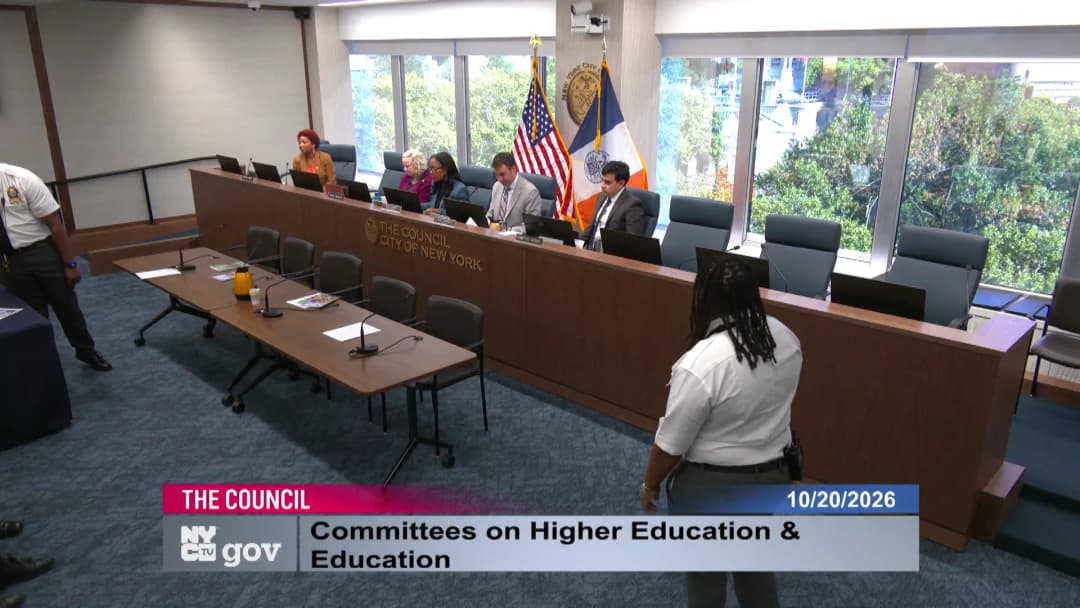
Joint Committees on Education and Higher Education, New York City Council On Tuesday, October 20, 2026, at 1:00 PM, the New York City Council Committees on Education (Chair Eric Dinowitz) and Higher Education (Chair Rita Joseph) held a joint oversight hearing at 250 Broadway to examine the implementation and expansion of the New York State Seal of Civic Readiness. The committees also discussed granting college credits for the Seal at CUNY and heard testimony on four related pieces of legislation: Intro 259 (dental care information), Res 418 (CUNY credits for the Seal), Res 451 (Next-Gen Civics Act), and Proposed Res 620-A (universal Seal access in DOE high schools). All introduced legislation was heard by the committees and laid over without a final vote. Discussion Items - Opening Remarks and Background: Chair Joseph provided an overview of the Seal of Civic Readiness, which requires students to earn points through civic knowledge benchmarks, participation, and a capstone project. Chair Dinowitz highlighted the rapid expansion of the program, noting that 8,000 students from 166 DOE high schools earned the Seal in the 2024-2025 school year, a 72% increase from the prior year. He strongly advocated for CUNY to award college credits for the Seal, comparing it to the successful expansion of credits for the Seal of Biliteracy. He framed the initiative as having no downside, calling it a "win-win-win-win-win" for students, families, schools, CUNY, and New York City. - CUNY Testimony: Alyssa Vine, University Director of Credit for Prior Learning (CPL) at CUNY, testified that CUNY has established CPL pathways for credentials like the Seal of Biliteracy but has not yet evaluated the Civic Readiness Seal for credit. She stated that the breadth of the Civic Readiness Seal requires careful faculty review to identify routes that demonstrate college-level learning, with the high school Capstone Project being a promising candidate. She committed to convening faculty to begin this evaluation process. - DOE Testimony: Cordelia Veve, Chief of Curriculum and Instruction for New York City Public Schools, presented on the "Civics for All" initiative and the scale of the Seal program. The number of schools offering the Seal has grown from 31 in the pilot year to a projected 271. In the 2025-2026 school year, 12,019 students earned the Seal, a 1,600% increase from the first year. The DOE detailed its project accreditation process to ensure rigor and its plan to offer the Seal in all high schools, as 56.2% of diploma-granting schools currently participate. The total civic education budget was reported as $3,001,659, with $1.6 million going directly to schools for participatory budgeting. - Interagency Collaboration and Data: Councilmember Joseph pressed for formal data sharing on Seal recipients between DOE and CUNY, which both agencies committed to establishing. Chair Dinowitz requested a meeting between CUNY and DOE to audit student Seal projects for college-level equivalency and urged both agencies to collaborate closely. CUNY agreed to form a faculty working group to evaluate the Seal. - Equity, Access, and Outreach: Councilmembers Wilson, Farías, Narcisse, and Gutiérrez raised concerns about equitable access for students of color, multilingual learners, and students with disabilities. The DOE testified that its curriculum focuses on multiple perspectives and that projects can be completed in a student's home language. Chair Dinowitz and Councilmember Brewer strongly emphasized the need for better public outreach to families, as many are unaware of the civic education programs in schools. The DOE committed to working with the "MySchools" website division to make Seal participation a searchable filter for families and to identify Seal-offering schools at high school fairs. - Data, Budget, and Transcripts: Chair Dinowitz requested data on Seal earners broken down by race, ethnicity, income, disability, borough, and school type, which the DOE agreed to provide. He also raised a technical concern that the legacy ATS system only allows listing one distinction on a transcript, potentially undercounting Seal earners. The DOE acknowledged the issue and noted the transition to the OASIS system. Chair Dinowitz urged the DOE to keep professional learning in-house to ensure teachers are compensated, rather than outsourcing to private contractors. Public Comments & Testimony - Panel 1: Hanata Caldera expressed support for civic education but criticized the lack of guardrails in a specific school voting project involving a fundraiser, requesting parental notification requirements. Elizabeth Shaddock (New Visions for Public Schools) supported the resolutions and offered to partner with the DOE on instructional materials and professional learning. Victor Medina (Futures Ignite) and Jeffrey Reim (Runway Green) supported expanding the Seal and college credit, providing examples of student-led environmental and civic action projects. Susie Gomes (League of Women Voters of NYC) advocated for empirical data on the program's impact on long-term voter participation. - Panel 2: CUNY Student Senate leaders Davia Willis, Hazel Prez Aqua, and Jared Fajardo strongly supported Res 418, 451, and 620-A, arguing that civic readiness is college readiness and that recognition through credit is critical for access and equity. Alan Sherman advocated for curricula that teach independent thinking, the mechanics of government, and how to respectfully disagree with political opponents, warning against indoctrination. Key Outcomes - All Proposed Legislation Laid Over: Intro 259 (dental care), Res 418 (CUNY credits for Seal), Res 451 (Next-Gen Civics Act), and Proposed Res 620-A (universal Seal access) were heard by the committees and laid over without a vote to advance them to the full Council. - Mandated DOE and CUNY Collaboration: The committees directed the DOE and CUNY to formalize data sharing on Seal of Civic Readiness recipients and to schedule a joint meeting to evaluate Seal projects for college credit equivalency. - Commitment to Website Transparency: The DOE committed to updating the "MySchools" portal so families can search for high schools specifically offering the Seal of Civic Readiness. - Data Release: The DOE agreed to provide the committees with a detailed demographic and geographic breakdown of Seal earners for further analysis. - Continued Expansion: The DOE confirmed its goal of offering the Seal in 100% of New York City public high schools, expanding from the current 56.2% of diploma-granting schools.

EDUCATION 53% · CIVIC EDUCATION 22% · PUBLIC ENGAGEMENT 11% · PROCEDURAL 5%
1774
OCT 20, 2026 · SEATTLE, WASHINGTON · CITY COUNCIL
Seattle City Council Meeting October 20, 2026: VRAP Vehicle Residency Package, Appointments, and Proclamations

The Seattle City Council convened on Tuesday, October 20, 2026, at 2:03 PM in the Council Chamber at City Hall (600 4th Avenue); the agenda had scheduled the meeting for 2:00 PM. The meeting featured two proclamations, public comment from 63 registered speakers (40 in person, 23 remote), and votes on a six-bill Vehicle Resident Assistance Program (VRAP) legislative package addressing vehicle residency, RV parking regulations, and related appropriations. The Council also confirmed a new Chief Technology Officer and approved a consent calendar with routine claims, property acquisitions, employment actions, and 12 commission appointments. The meeting adjourned at 6:06 PM. (No minutes were available for this meeting; the summary relies on the agenda and transcript.) Proclamations - Councilmember Rinck proclaimed October 2026 as Domestic Violence Awareness Month and October 15 as Purple Thursday. All nine Councilmembers signed. Speakers included Amory Theodoris (Co-Executive Director, Coalition Ending Gender-Based Violence), Natasha Wilson (Director, Project Ivora at Jewish Family Service), and a representative of the Seattle Women's Commission. Wilson cited CDC statistics that more than one in three women and more than one in six men experience gender-based violence during their lifetime, and Johns Hopkins research that in 68% of mass shootings the perpetrator killed a family member or intimate partner or had a history of domestic violence. - Councilmember Rivera proclaimed 2026 as the Skinner Building/Fifth Avenue Theater Centennial Year. All nine Councilmembers signed. Consent Calendar - Councilmember Lynn moved to remove item 12 (CB 121276, amending development standards for institutions in multifamily zones) because state notice was sent by mail rather than electronically, requiring more review time; the item will return on a future calendar. The motion carried 8-0. - The remaining consent calendar was adopted 9-0, including: minutes (Min 583, September 22, 2026); four claims ordinances (CB 121302-121305, covering claims for weeks September 14 through October 9, 2026); Seattle Public Utilities property acquisition by negotiation or eminent domain in Aurora Avenue North (CB 121292) and acceptance of a drainage facility easement at 13709 41st Ave NE (CB 121293); pay compression correction for non-represented classifications (CB 121219); civil service exemption/return of positions (CB 121284); retitling Automotive Sheet Metal Worker to Automotive Sheet Metal Worker - Painter (CB 121285); retitling Plant Ecologist to Restoration Ecologist and creating a Restoration Ecologist, Senior title (CB 121286); and 12 appointments to the Seattle LGBTQ Commission, Disability Commission, Housing Levy Oversight Committee, Women's Commission, and Human Rights Commission. Public Comments & Testimony Speakers received one minute each under council rules for 30-60 registered speakers. The public comment period was dominated by the VRAP legislative package, with additional testimony on transgender refugee concerns, budget cuts, and public safety. Support for VRAP or elements of it: - Mike Stewart (Executive Director, Ballard Alliance): urged support for the complete VRAP package, praising its pathway to housing. - Eugene Wasserman (North Seattle Industrial Association): called it a comprehensive, creative approach; said RVs do not belong parked in a city, but supported phasing people into shelter. - Lars (Seattle Metropolitan Chamber of Commerce, representing more than 2,600 employers): supported the package, citing outreach expansion and accountability. - Rubai (Woodland Park Zoo): supported the package, citing RVs stored near the zoo's west entrance creating disability, safety, and conflict concerns. - Low Income Housing Institute staff (Beatrix Kelly, Marta Kidana, Alexis Diltz): requested funding for a second RV safe lot; noted Glass Yard Commons in District One will open soon and cost $3.36 million. - Cassandra (We RV Outreach), Jennifer Adams: supported safe lots and outreach; Adams said her organization helps people with licensing and tabs. - Laura Mullen: described being the first resident of Seattle's first RV safe lot in December 2023 after a family crisis; said the lot provided stability and led to long-term housing. - Kevin Laurenson (West Seattle): supported better control of RV encampments but urged an amendment exempting RVs parked within the 72-hour limit at the address where the vehicle is legally registered. - Blakely Benson (Trade and Seafoods, Ballard): described vandalism, burglaries, and employee safety concerns near the company's Ballard facilities. - Christine Moreland (More We Love): supported the legislation as a diversion tool to reach vulnerable people and hold criminal activity accountable. - Mike Dunn (North Lake neighborhood): supported the legislation after three years of RV-related crime and victimization in his neighborhood. - Yvette: spoke in favor of CB 121283 as "a start," and requested funding for those who cannot afford permits. Opposition to VRAP or parts of it: - Dee Powers: opposed the RV proposal, describing being priced out of her Pioneer Square apartment in 2015 and waiting seven years for a suitable shelter offer; said services should come first. - Shauna (Trinity shelter): said people lack money to register vehicles or move them, and there are not enough shelters. - Hannah Jones (District 5): strongly opposed new parking restrictions and the one-time permit system; supported safe parking expansion and "suitable" shelter offers that accommodate partners, pets, and possessions. - Brandon and George (Nickelsville): urged a no vote, calling the legislation a ban on RVs and a vote to criminalize homelessness; cited unanswered questions about census misses, repair assistance, safe lot availability, and vehicle storage. - Todd Haas and Jazz (Share Wheel, Tent City 3/10): called the permitting system immoral; noted the eight FTEs to staff the permitting program conflict with mayor's proposed safe parking lot funding; said funds should go to shelters and safe lots instead. - Tara Miller and Rachel Catola (Church Council of Greater Seattle): urged legislating from abundance, not scarcity; described cost-prohibitive permitting, one-time census, and forced removal concerns. - Allison Eisinger (Seattle King County Coalition on Homelessness): supported vehicle storage and outreach investments but opposed the package as a whole, calling it a draconian ban on RVs and noting there still would not be enough designated places even with the proposed budget's 92 safe parking program. - Alison Bilo (Columbia Legal Services): strongly urged a no vote on the permitting, enforcement, and junk vehicle provisions, calling them legally and constitutionally problematic; she was co-counsel in City of Seattle v. Stephen Long. - Dr. Graham Pruss (National Vehicle Residency Coalition): urged no votes on CB 121280, 121281, and 121283; supported funding for outreach, legal parking, sanitation, and infrastructure through CB 121282. - Kate Rubin (B Seattle): supported safe lots and pathways but opposed the one-time permitting system, expressing concern about impoundment risks. - Mira (District 4): noted about 57% of RV residents live with a disability and a third own pets; rejected the permit program as an expensive paperwork program that confiscates property. - Reed Meyer: said vehicle residents are constituents too, pay taxes, and deserve representation, not dehumanization. - Chanel: said the permit is a one-time offer with consequences (towing after three refused shelter offers), and called it "a deadline with consequences." - Alice Lockhart (350 Seattle/Seattle Solidarity Budget): said she would be forced to leave the city or lose her only property if the RV ban passed. - Ashley Derby and Sam Wolf (PDA): opposed Amendment C's criminal-conviction permit revocation, arguing convictions should not carry additional collateral consequences; supported the pre-implementation work group. - Sarah (mutual aid volunteer): said the current process "of stealing people's homes ruins lives" and urged funding for safe lots and outreach instead of towing. - Margaret Shields (Lake City homelessness task force): said the timeline is too short for census outreach and safe lot creation; asked how the $5 million appropriation would be spent. Transgender community speakers (including Mia, Indigo Green, Evie, Lucas, Nina, M, Lydia, Mantai, Evan Sanders, Kira, and others): testified about violence, housing instability, and the need for resources; several called for restoring the $68 million in housing funds, putting JumpStart funding exclusively to housing, increasing tenant legal services, and holding police accountable. One speaker, M, noted the city passed $300,000 for housing and services for transgender people fleeing to Seattle, while 30% of trans people have experienced homelessness at some point in their lives. Other comments: Emma described a long-standing encampment at 25th Avenue South and Rainier Avenue and called for protecting public safety. Crystal alleged an SPD incident at Swedish Hospital Ballard; Council President Hollingsworth said she would address the commenter outside the meeting. Hannah Ziff (Pioneer Square) encouraged selling bonds to meet demand for over 100,000 more multifamily housing units and partnering with Renton Technical College and Bellevue Community College for construction workers. Justin (outreach worker) said the legislation provides working tools to speed services. Paul supported starting a dialogue and building community networks. Bennett reported on an October 7th rally at Cal Anderson Park, saying he stood with a sign urging against cheering for October 7th. Ann (North Seattle homeowner) urged approval, citing violent and property crimes committed by individuals living in RVs, including a September 9, 2023 Seattle Times-reported shooting. Joe Cunzler condemned violence against trans neighbors and supported Strauss's plan coupled with a second RV safe lot. Committee Reports and Discussion Items CB 121299 - SDOT bicycle/pedestrian safety education interlocal agreement (sponsored by Councilmember Saka): Authorizes the Director of Transportation to execute an interlocal agreement with Seattle Public Schools for bicycle and pedestrian safety education and training services for students in grades three through eight (Let's Go and Let's Go Further programs), supporting Vision Zero and Safe Routes to School goals. Passed 9-0. Appt 03594 - Shannon Smith, Chief Technology Officer: Confirmed 9-0. Council President Hollingsworth praised Smith's community engagement at the AI Equity Summit and her commitment to closing the digital equity gap. VRAP Legislative Package (six bills) Councilmember Strauss presented the package as centering humans caught in the middle of updating regulations about city streets. Key elements: $8.5 million in one-time costs (which Strauss said had ballooned from earlier estimates), $3.5 million annually beginning in 2027; a new RV safe lot; shelter storage; expanded contracted outreach (mechanics, caseworkers); a vehicle resident assistance permit; and updated junk vehicle standards. The permit regulations have an effective date of April 30, 2027, a 90-day warning period, and enforcement no earlier than essentially August 1, 2027. Strauss said the permit program acts as a release valve if safe lots are not open, and that he submitted a budget proposal earlier that day to fund an additional safe lot in 2027. He also stated there would be no prohibitions on vehicle residency in the package, only support and pathways inside. - CB 121279 (FAS director lease authority for transitional encampments, outdoor storage for any vehicle, and overnight respite areas for drivers): Passed 9-0. Strauss said it cuts red tape to bring safe lots and shelter storage online faster, similar to earlier tiny home village legislation. - CB 121280 (revising the definition of "junk motor vehicle" in the Traffic Code): Passed 8-1, with Councilmember Rinck opposed. Strauss said the bill targets hoarded, abandoned, non-livable vehicles (e.g., vehicles packed so full you cannot get inside), not lived-in vehicles; vehicles in the permit program are exempt from the junk vehicle standard. Councilmember Foster supported it because the bill requires meeting three of the listed conditions. - CB 121281 (adjusting definitions of recreational vehicle, outdoor storage, and flexible-use parking in the land use code): Passed 9-0. Strauss said this enables non-contiguous parcels to be used for "shelter storage" so people can store their vehicles while entering shelter or housing, making the entire shelter and housing portfolio accessible to vehicle residents. - CB 121282 (vehicle residency permitting and outreach appropriations, amending the 2026 budget; creating positions; modifying a proviso): Passed 6-3, with Councilmembers Rivera, Foster, and Rinck opposed. Strauss said the bill changes a proviso to allow the Human Services Department to expand contracted outreach and support one-time services like gas, minor repairs, and title assistance. Foster noted the bill creates eight new positions (seven outreach staff in HSD, one permit tech in SDOT) plus IT systems funding, and opposed because the Council was on the eve of finalizing the 2027 budget and she wanted to see the full picture, including the proposed safe lot investment. Rivera said she needed more information on why eight outreach staff and the costs, during the budget process. Rinck opposed, citing concerns about funding the permit program. - CB 121283 (creating a new permitting program for owners of motor homes and travel trailers): Passed 6-3 as amended, with Councilmembers Lynn, Foster, and Rinck opposed. - Amendment A (Lynn): Adds service providers to the work group and clarifies services; adopted 9-0. - Amendment B (Lynn): Directs the work group to identify key metrics and program effectiveness for inclusion in the annual report; adopted 9-0. - Amendment C (Rivera): Would revoke a permit upon the holder's conviction for sale or distribution of drugs, sex trafficking, sexual exploitation of children, or promoting loitering for the purpose of prostitution. Rivera verbally revised the amendment to strike "deferred sentence or deferred prosecution or statutory or non-statutory diversion agreement," limiting it to convictions. The revised amendment failed 3-6 (Rivera, Saka, and Kettle in favor; Strauss, Foster, Juarez, Lynn, Rinck, and Hollingsworth opposed). Juarez argued it could impose additional punishment without notice and raise constitutional concerns; Strauss said the conduct is already covered by the bill's violation structure (one major infraction leads to loss of eligibility with a 15-day appeal period) and offered to work with Rivera through the check-and-adjust work group. - During debate, Lynn explained his no vote: the one-time census would exclude people who become homeless or move into RVs later. Foster said the census/permit structure left out future RV residents and she could not support it. Strauss noted the permit allows parking in industrial areas between midnight and 6 a.m., requires moving every 72 hours, and requires engagement with a case manager. - Res 32216 (establishing the Vehicle Resident Assistance Program; accompanying legislation): Adopted 8-1, with Councilmember Rinck opposed. Rinck said she could not support the package in its entirety due to concerns about junk vehicle definitions (citing Columbia Legal Services), the one-time census, legal issues raised by the ACLU and Columbia Legal Services, and the appropriations funding eight positions for the permit program. She said she remains engaged on the policy and will follow implementation closely as Human Services chair. Hollingsworth supported the resolution, noting the Council's shelter legislation, the mayor's goals of 500 shelter units before the World Cup and 1,000 by the end of the next year, and the shift of contracts from the King County Regional Homeless Authority to the Human Services Department for better oversight. Key Outcomes - Consent calendar adopted 9-0, excluding CB 121276 (removed 8-0 for additional state review). - CB 121299 passed 9-0 (SDOT/Seattle Public Schools bike-ped education). - Shannon Smith confirmed as Chief Technology Officer 9-0. - CB 121279 passed 9-0 (FAS lease authority). - CB 121280 passed 8-1 (junk motor vehicle definition; Rinck opposed). - CB 121281 passed 9-0 (land use definitions for RV storage and shelter storage). - CB 121282 passed 6-3 (VRAP appropriations; Rivera, Foster, Rinck opposed). - CB 121283 passed 6-3 as amended (RV permitting program; Lynn, Foster, Rinck opposed); Amendment A and B adopted 9-0; revised Amendment C failed 3-6. - Res 32216 adopted 8-1 (VRAP resolution; Rinck opposed). - Both proclamations signed by all nine Councilmembers. - CB 121276 (institutions zoning) will return on a future meeting calendar. Closing Remarks Council President Hollingsworth condemned a sign referring to Councilmember Kettle as "KK Kettle," calling the Ku Klux Klan a terrorist organization founded in 1865 and describing her grandmother's experience of a cross burning on her family's lawn in South Carolina. She said political disagreement is not an excuse to weaponize the history of white supremacy, and that she would address the person individually. Councilmembers Foster and Juarez also spoke; Juarez said using the generational trauma of enslaved, genocided, and incarcerated ancestors as a political prop is "the most offensive form of insidious racism."

HOMELESSNESS 43% · PUBLIC SAFETY 12% · PROCEDURAL 9% · HUMAN TRAFFICKING 6%
1775
OCT 20, 2026 · BELGRADE, MONTANA · CITY COUNCIL & BOARDS
Belgrade City Council Meeting - October 20, 2026

The Belgrade City Council met on October 20, 2026, to consider a fee schedule amendment, adopt the 2026 Transportation Master Plan, and authorize a joint resolution on behavioral health. All items were approved unanimously. Mayoral Proclamation - Mayor proclaimed November 1, 2026 as "Extra Mile Day" in Belgrade. Public Hearing: Resolution 2026-24 - Amending FY27 Master Fee Schedule - City staff (Ms. Finn Kirk) presented amendments including: adding a fee for utility modeling (vendor fee plus 10% admin fee or $250/hour in-house), minor adjustments to library fees, changing sidewalk right-of-way fees from square feet to linear feet (cost unchanged), consolidating engineering subdivision plat review categories, and moving a backflow protection line. Councilmember Simon noted a possible inconsistency in fire detection/alarm system fees where cost dropped for larger square footages; staff will verify before next amendment. - No public comment. The resolution was adopted unanimously. Discussion Items 2026 Transportation Master Plan Adoption - City engineer presented the plan, developed with Cushing Terrell and Fair & Pears. Updated after September council feedback to include references to rail crossing quiet zones, snow storage in street design, and traffic calming options mindful of snow removal. - Council members praised the document as thorough and well-put-together, noting it provides a framework for project allocation. - A comment from Featherstone Mill Center was received and added to the record. - The plan was adopted unanimously. Joint Resolution Declaring Behavioral Health a Shared Regional Priority - Mayor reported collaboration with Bozeman Mayor Morrison and Gallatin County Commissioner Zach Brown to address behavioral health gaps. The resolution recognizes the issue affects all jurisdictions and often falls to first responders. It does not commit to specific projects but signals regional cooperation. - Council members expressed support, noting high suicide rates in Montana, especially among youth, and the impact on first responders themselves. - No public comment. Council authorized the mayor to sign the resolution on behalf of Belgrade at a future date with Bozeman and Gallatin County. Passed unanimously. Reports - Mayor reported attending the Montana League of Cities and Towns conference. - Assistant city manager noted Burlington Northern work at Jackrabbit crossing, ICMA conference attendance, cancellation of October 26 Planning Commission meeting, and encouraged voting on November 3. - Council members gave updates, including appreciation for public works leaf pickup and a tour of water facilities. Key Outcomes - Adopted Resolution 2026-24 amending the FY27 Master Fee Schedule (unanimous). - Adopted the 2026 Transportation Master Plan (unanimous). - Authorized the mayor to sign the joint resolution on behavioral health (unanimous). - Meeting adjourned.

PROCEDURAL 33% · TRANSPORTATION SAFETY 28% · PUBLIC ENGAGEMENT 18% · FISCAL SUSTAINABILITY 9%
1776
OCT 20, 2026 · NEW YORK CITY, NEW YORK · CITY COUNCIL
NYC Council Joint Higher Education & Education Committee Hearing on Seal of Civic Readiness — October 20, 2026

The New York City Council's Committees on Higher Education (Chair Rita C. Joseph) and Education (Chair Eric Dinowitz) held a joint hearing on Tuesday, October 20, 2026, at 1:00 PM at 250 Broadway, Hearing Room 2, to review the New York State Seal of Civic Readiness in DOE high schools and at CUNY, and to hear five legislative items: oversight T2026-2538, Intro 0259-2026 (dental care information), Res 0418-2026 (CUNY credit for the Seal), Res 0451-2026 (Next-Gen Civics Act), and Proposed Res 0620-A (universal Seal availability). In attendance were committee members Joseph, Ariola, Dinowitz, Epstein, Maloney, Restler, and Wilson, with other Council members Brewer, De La Rosa, Farías, Gutiérrez, Krishnan, Lee, Narcisse, Schulman, Zhuang, and Wong. All items were heard; the oversight item was filed, and the four legislative items were laid over. Discussion Items Oversight T2026-2538: Seal of Civic Readiness in DOE High Schools and at CUNY - Chair Joseph explained that the Seal, implemented statewide in 2022, requires students to earn six points from a menu of civic knowledge and participation benchmarks, including advanced social studies coursework, passing the social studies Regents exam, a research project, at least 25 hours of service learning, at least 40 hours of extracurricular or work-based learning, and a middle school or high school civic capstone project addressing a real-world issue. - Chair Dinowitz reported that 8,000 students from 166 DOE high schools earned the Seal in the 2024-2025 school year, a 72% increase from the prior year, and that 643 graduating seniors from 31 high schools earned it in the June 2022 pilot year. He noted that the State Board of Regents last month authorized ending the Regents exam graduation requirement beginning with the class of 2028, meaning the Seal would no longer count toward a diploma. He also noted that more than 60% of DOE graduates who go on to college enroll at CUNY, and that 10 CUNY colleges currently award between three and eight credits for the Seal of Biliteracy. - Alyssa Vine, CUNY University Director of Credit for Prior Learning, testified that CUNY does not currently track students entering with the Seal of Civic Readiness, that no CUNY college has yet evaluated the Seal for credit, and that the Seal's intentionally varied pathways make credit evaluation different from the Seal of Biliteracy. She identified the high school capstone project as a promising starting point for faculty review and expressed CUNY's interest in continuing exploration with NYC Public Schools. - Cordelia Vive, NYCPS Chief of Curriculum and Instruction, described the Civics for All initiative launched in 2018 and reported Seal growth from 31 schools in the pilot year to 60 (2022-23), 118 (2023-24), 166 (2024-25), 230 (2025-26), and 271 (2026-27). She reported that 12,019 students graduated with the Seal at the end of the 2025-26 school year, a 1,600% increase in five years from 682 in the 2021-22 pilot year. (Note: Chair Dinowitz cited 643 graduates in the June 2022 pilot year, while the DOE witness cited 682 in the 2021-22 pilot year; the source materials do not reconcile this difference.) She said 35 of 45 districts participate in the Civics for All Partner District program. - Superintendent Marcel Deans (Bronx Districts 8, 10, 11) reported growth from 9 students earning the Seal in 2022 to 780 in June 2026 in his districts, which are over 78% Title I. Superintendent Anthony Enzarello (District 26) said 96% of the district's high schools now offer the Seal and described middle school capstone and soapbox speech work. - Councilmember Dinowitz raised concerns about potential undercounting because ATS allows only one Seal to be listed per student transcript; DOE said schools report all Seal earners and are building a Seal tracker in STARS ahead of the OASIS transition. - Councilmember Wilson asked how the curriculum addresses the harder parts of history, including racism, homophobia, sexism, and violence; DOE cited its multi-perspective curriculum and hard history professional learning series, and described drawing on immigrant students' lived experiences as assets. - Councilmember Brewer pressed for stronger public messaging about civics education, saying constituents repeatedly tell her schools do not teach civics; DOE acknowledged the need and described external partner accreditation, newsletters, and school-based outreach. - Councilmember Dinowitz requested data on Seal earners by race, ethnicity, income, multilingual-learner status, disability, borough, school type, District 75, and transfer schools; DOE agreed to provide it. - DOE reported a total civics budget of $3,001,659, including $1.6 million for participatory budgeting and $861,770 for professional learning. Dinowitz urged DOE to keep professional learning and curriculum development in-house rather than hiring outside contractors. - Dinowitz asked why families cannot search for Seal-offering schools on the MySchools website; DOE committed to working with the relevant division to add the Seal of Civic Readiness and the Seal of Biliteracy to the school-search portal. - Dinowitz and Vine agreed to schedule a joint CUNY-DOE meeting for CUNY faculty to review student capstone projects and work products toward establishing a credit pathway. Intro 0259-2026: Dental care information - Sponsor Councilmember Krishnan said the bill would require DOE to inform parents about the importance of fluoride and dental health, in response to misinformation at the federal level about vaccines and fluoride. NYCPS witness Cordelia Vive expressed support for the collaboration with the Department of Health and Mental Hygiene to develop and distribute materials on the importance of dental care and fluoride. Res 0418-2026: CUNY college credit for the Seal of Civic Readiness - Sponsor Dinowitz called on CUNY to ensure all campuses award an appropriate number of college credits to students who earn the Seal. CUNY testified that no college has yet evaluated the Seal, but expressed openness to faculty review and noted that any credit would likely align with general education rather than a specific course. The CUNY University Student Senate supported the resolution and asked that any credit award be one clear standard across all campuses, published where students can find it before they apply. Res 0451-2026: Next-Gen Civics Act - Sponsor Councilmember Zhuang said young New Yorkers remain among the least civically engaged voters in the city and urged passage of A.9298 and its Senate companion, which would enact the Next-Gen Civics Act, providing hands-on, project-based civic education in grades 9 through 12, including mock elections, community projects, and policy simulations. Proposed Res 0620-A: Universal Seal availability - Sponsor Dinowitz called on DOE to ensure the Seal is awarded in all NYC public high schools to eligible students. DOE said it is actively pursuing 100% participation and is currently in 56.2% of diploma-granting schools, accepts all schools that apply, and works with schools to meet accreditation requirements. Public Comments & Testimony - Hanata Caldera, a parent from Forest Hills and constituent of Councilmember Schulman, expressed concern about hands-on civics without guardrails, describing an elementary school vote on a fundraiser that occurred while a complaint was under investigation by the DOE Office of Special Investigations. She asked the committees to require DOE guidance that student civic votes and projects never involve fundraisers or matters under investigation, that parents be notified before votes, and that DOE release the OSI findings. - Elizabeth Shattock, New Visions for Public Schools, expressed strong support for expanding Seal access and the Next-Gen Civics Act, and called for more pre-approved project structures and rubrics and high-quality professional learning grounded in specific instructional materials. - Victor Medina, Futures Ignite, expressed support for including the Seal in all NYC public schools and for college credit, citing a student-led permanent open street campaign on 182nd Street in Washington Heights as an example of student civic impact. - Jeffrey Reim, Runway Green, expressed strong support for the resolutions and described plans for an education campus at Floyd Bennett Field that could serve up to 50,000 students per year. - Susie Gomes, League of Women Voters of NYC, expressed support for civics for all in every grade K-12 and for the Seal, and suggested an empirical study of whether Seal participants become more civically knowledgeable and more likely to vote than their peers. - Davia Willis (Chairperson-elect), Hazel Prez Aqua (Lehman College graduate), and Jared Fajardo (Lehman College undergraduate), representing the CUNY University Student Senate, expressed support for Res 418, Res 451, and Res 620, citing the Senate's $700,000 OmniCard campaign win as evidence of student power, and asked for one clear credit standard across all CUNY campuses and public reporting of participating schools and campuses. - Alan Sherman, an NYC resident since 1961, urged civic education that teaches independent thinking, respectful debate, and compromise rather than indoctrination, and encouraged students to evaluate candidates across party lines. - Dr. Andrew Wilkes, Generation Citizen (remote), strongly endorsed Proposed Res 620-A and Res 418 and 451, urging universal implementation to combat systemic youth disconnection and civic education inequities, and cited Generation Citizen's advocacy with state legislators on the Next-Gen Civics Act. Key Outcomes - Oversight T2026-2538 was heard and filed by the committee. - Intro 0259-2026, Res 0418-2026, Res 0451-2026, and Proposed Res 0620-A were all heard and laid over by the committee. - CUNY and NYCPS agreed to schedule a follow-up meeting on faculty review of Seal capstone projects and work products toward a possible credit-for-prior-learning pathway. - DOE agreed to provide the committees with demographic data on Seal earners and participating schools, and to work with CUNY on data sharing so CUNY can track Seal earners. - DOE committed to adding the Seal of Civic Readiness and the Seal of Biliteracy to the MySchools school-search portal so families can identify participating schools. - DOE said it is building a Seal of Civic Readiness tracker in STARS to improve data accuracy ahead of the OASIS transition.

EDUCATION 59% · CIVIC EDUCATION 10% · HIGHER EDUCATION 9% · PROCEDURAL 7%
1777
OCT 20, 2026 · CEDAR RAPIDS, IOWA · CITY COUNCIL
Cedar Rapids City Council Meeting - October 20, 2026

The Cedar Rapids City Council held its regular meeting on Tuesday, October 20, 2026, with Mayor Tiffany O'Donnell presiding. Councilmember Tyler Olson and City Attorney Benessa Chavez were absent; Assistant City Attorney Trish Krop substituted. The meeting opened with an invocation and Pledge of Allegiance, followed by a proclamation recognizing Community Planning Month and honoring city planners. The council held six public hearings, approved ordinances and resolutions, and heard public comment concerning the police chief search and other community issues. Proclamation - Councilmember Ann Poe proclaimed Community Planning Month in Cedar Rapids, thanking planners in the planning division and other city departments for their public service. Procedural Notes - Councilmember Poe recused herself from agenda item 16(C), line items 28, 48, 398, and 399. - The clerk reported no written comments or objections filed in connection with the day's public hearings. Consent Calendar - The council approved the meeting agenda and the consent agenda on unanimous voice votes; no consent items were pulled. Public Hearings & Actions - Street renaming: Approved first reading of an ordinance renaming G Avenue Northwest between First Street and Second Street, and Second Street Northwest between G Avenue and F Avenue, to F Avenue Northwest, to create a continuous street name tied to the Cedar Rapids Casino roadway realignment. City Traffic Engineer Carrie Poly said the former F Avenue segment between Second and First streets will become a pedestrian walkway. The vote was unanimous. - Electric easement address correction: Approved a resolution correcting and restating the address in Resolution 0258-03-25 for an underground electric line easement granted to Interstate Power and Light Company. Public Works staff member Dustin Kern said the easement is at the northeast corner of City Hall; the original publication had inadvertently referred to First Avenue East Southeast instead of First Street Southeast. - Fruitland CDBG-DR project update: Laura Shaw provided a HUD-required mid-project update for the Roots single-family new construction project at 2677 Fruitland Boulevard, developed by Westwaters. The state received $57.5 million in CDBG-DR funding after the 2020 derecho; Cedar Rapids received $15 million for the Roots program, $9 million for multifamily new construction, $3.5 million for tree replacement, and $400,000 for generators. This project's total budget is $289,000, including $125,000 in DR funds and roughly $80,000 in reimbursed expenditures to date. Construction is complete, and final permit sign-offs, grading, and landscaping remain. Councilmember Ann Meyer asked about the first sale; Shaw said the home is already under contract at an expected purchase price of about $175,000 once permits and occupancy are finalized. No vote was taken. - NewBo townhome rezoning: Held a public hearing and approved first reading of a rezoning for roughly one-third of an acre at 475 10th Avenue Southeast and 1015 Fifth Street Southeast, requested by Tyler Oswood. Zoning Administrator Seth Gunnerson said the seven-unit townhome development is already permitted and under construction; the Traditional Residential Flex District with a Planned Unit Development overlay allows each unit to be platted on its own parcel, including two lots without public street frontage. The Planning Commission unanimously recommended approval on October 1. Councilmembers Poe and Meyer expressed support, calling it creative market-rate infill that meets demand for family housing. - FY27 large-diameter sanitary sewer inspections: Approved the plan, specifications, contract form, and estimated cost of $900,000. Ben Warrell of Public Works said the project will inspect more than 82,000 feet of large-diameter sanitary sewer and 277 manholes with specialty equipment to identify condition issues and infiltration/inflow. Bid letting is scheduled for October 28, with inspections from December through January 2028. Councilmember Poe asked about the New Bohemia/Czech Village area after recent groundwater infiltration and voiced support for the inspection work. - FY27 tree and vegetation removal: Approved the plan, specifications, contract form, and estimated cost of $270,000. Ben Warrell said trees must be removed before March 31 to comply with U.S. Fish and Wildlife protections for the northern long-eared bat, and disturbed areas will be reseeded. Bid letting is scheduled for October 21, with clearing from December through March. Councilmember Todd confirmed that additional locations can be added to the contract if needs are identified during the work window. Ordinances - Adopted on third/final reading the new Chapter 23 ordinance on animal control, repealing and replacing the previous Chapter 23 on cats, dogs, and other animals. - Adopted on third reading an ordinance vacating a 0.06-acre alley parcel north and west of 1018 Sixth Street Northwest, requested by Park Line, LLC; a related resolution for the item was also approved. - Approved on second reading, then suspended the three-reading rule and adopted on third/final reading, a change of zone for 3750 16th Avenue Southwest from Light Industrial District to Suburban Mixed-Use Community Center District, requested by the Housing Fund for Lynn County. Public Comments & Testimony - The first public input period had no signed-up speakers. - Rachel Suter criticized the city's landscaping and development choices, saying the grass sod around the Five Seasons Tree does nothing for soil health, increases nitrates, and fails to support endangered pollinators. She also criticized data centers and surveillance cameras, argued that the city prioritizes tax revenue over the environment, and cited the 2008 flood, 2016 flood, and 2020 derecho as warnings. - Christina Akers read a notice of constitutional violation of sworn oaths, asserting Fifth, Eighth, and Ninth Amendment violations and citing Marbury v. Madison, Corner Post, SEC v. Jarkesy, and Loper Bright. She argued that unalienable rights nullify municipal laws, ordinances, and administrative codes. Her three-minute speaking time expired before she completed her remarks. - Anthony Arrington, representing Advocates for Social Justice (ASJ), raised concerns about the police chief selection process. He said ASJ sent written requests on September 25 and September 30 but received no official response until 3:36 p.m. on the meeting day. He also said the RFP lacked detail and was difficult for the average citizen to find online. ASJ asked for a clear public explanation of the search process and ongoing proactive communication. - Circe Stumbo, also representing ASJ, said the new police chief should have a demonstrated record of protecting civil rights, advancing racial equity, investing in de-escalation and mental-health training, supporting data and transparency, confronting misconduct, building trust with diverse communities, and maintaining clear boundaries between local policing and federal civil immigration enforcement, including declining voluntary collaboration with ICE when not legally required. She requested community representation on the search committee, a community panel for finalists, and a public event where residents can meet the finalists. Key Outcomes - All items that came to a vote passed unanimously by voice vote; no roll-call tallies were reported. - The street renaming and NewBo townhome rezoning ordinances were approved on first reading. According to staff, the rezoning's second and possible third readings could occur on November 3. - The Fruitland CDBG-DR project update was informational; no vote was taken. - The city manager reported that WalletHub ranked Cedar Rapids the 7th safest city out of 182 U.S. cities, based on 168 factors covering police and fire safety. Mayor Tiffany O'Donnell and council members thanked police and fire personnel, including Interim Chief Yonker. The meeting adjourned after the second public input period.

PROCEDURAL 31% · AFFORDABLE HOUSING 12% · PUBLIC SAFETY 12% · URBAN PLANNING 10%
1778
OCT 20, 2026 · NEW YORK CITY, NEW YORK · CITY COUNCIL
New York City Council Joint Hearing on Ambulance Response Times and Intro 990 – October 20, 2026

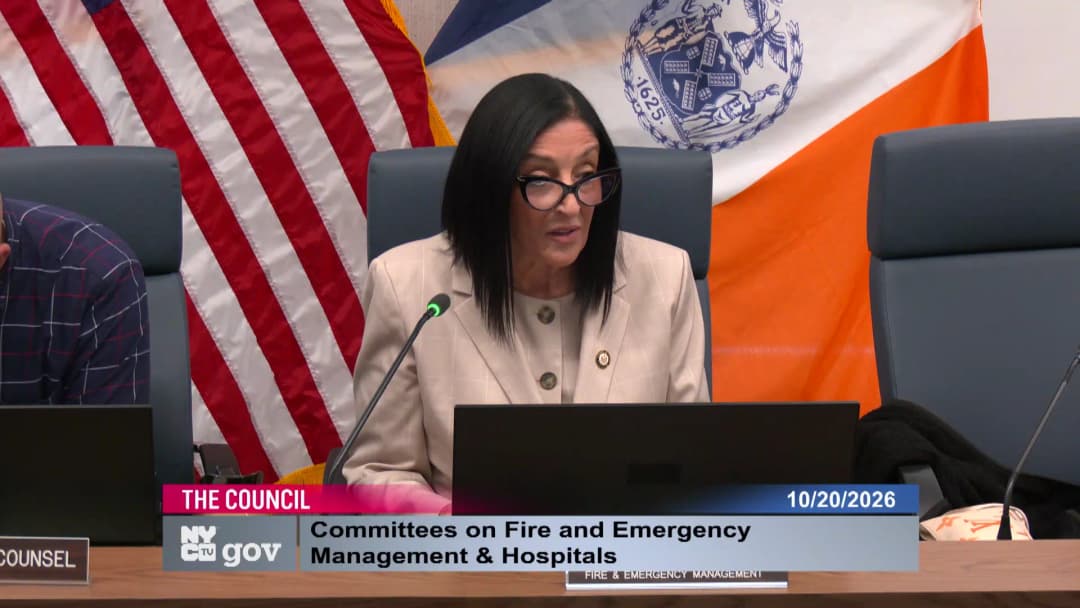
On Tuesday, October 20, 2026, at 10:00 AM, the New York City Council Committee on Fire and Emergency Management, chaired by Joann Ariola, held a joint oversight hearing with the Committee on Hospitals, chaired by Mercedes Narcisse, in Hearing Room 2 at 250 Broadway. The hearing covered oversight item T2026-2405 (Ambulance Response Times) and Int 0990-2026, a bill that would require Notify NYC alerts when FDNY EMS has more than 25 pending ambulance dispatches. Roll call was present for Ariola, De La Rosa, Maloney, Paladino, Sanchez, Schulman, and Wong. Other members attending included Speaker Julie Menin and Council Members Narcisse, Brooks Powers, Epstein, Restler, Brewer, Farías, Aldebol, Gutiérrez, and Dinowitz. The minutes record the oversight as filed by committee and Int 0990-2026 as laid over by committee. Public Comments & Testimony - Jennifer Daly, mother of 14-year-old Kevin, testified that on September 28, 2026, her son had a stroke at St. Francis Preparatory High School. The school nurse called 911 three times, but no ambulance arrived. The family drove Kevin to NewYork-Presbyterian Queens, where he was diagnosed with a stroke and later transferred to Morgan Stanley Children's Hospital. She expressed gratitude for the hearing and stressed that families need to know when help is not coming. - Michael Greco, President of Local 2507, said the EMS system is in crisis and that life-threatening ambulance response times have increased more than 41% since fiscal year 2015. He said more than 500 EMTs left in fiscal year 2026 alone, cited the pay disparity between EMTs and firefighters, and demanded pay equity, a fair contract, and recognition of EMS as an essential public safety service. - Vincent Barrialli, President of the Uniformed EMS Officers Union Local 3621, said cardiac arrest survival rates have fallen from roughly 35% to 16%, and that EMS is underpaid relative to firefighters despite handling the majority of FDNY's emergency calls. He called for EMS to be treated as a co-equal branch of FDNY and for pay and benefits comparable to firefighters. - Anthony Lamarena, Vice President of Local 3621, provided daily counts of ambulances off service, ranging from 68 to 138 at 2:00 PM during the week before the hearing. He said 112 ambulances were off service and 51 calls were holding during his testimony, with most holding over three hours. He described multiple cases of patients dying or waiting hours for ambulances and said the system has already failed. - Logan Clark and Valerie Gaudino of the Independent Budget Office testified that MMR data show end-to-end ambulance response times have increased by nearly three minutes since FY22 and now average more than 13 minutes. Daily ambulance operating hours in the 911 system fell from about 8,900 in FY22 to 8,100 in FY26. They noted that 11 hospital systems removed ambulances from the 911 system in FY26 and that EMT attrition is closely tied to the firefighter promotional exam cycle. - Joseph Raineri, Executive Director of the Regional EMS Council of New York City, opposed moving to single-paramedic ambulances, saying dual paramedics are needed for complex clinical care. He called for better pay, work-life balance, clear career paths, and a focus on retaining experienced providers. - Other public witnesses included Christian Bear Lopez, a paramedic who called for an independent EMS department and asked why the council had not held a hearing on Intro 0521; Gerardney Williams, a paramedic and Army veteran who described ambulances being sent 25 minutes across Manhattan and criticized hospitals for pulling ambulances out of the 911 system; Andrew Freena, a former EMT who said only 26% of paramedic responses arrived within 10 minutes; Walter Adler, a hospital-based paramedic and 1199 delegate who called for reducing 911 call volume, ending the promotional pipeline from EMS to fire, and creating an independent EMS department; Jack Chapman of 1199, who said ALS call volume increased 22.9% since 2015 versus 2.5% for non-life-threatening calls and that about 4,300 EMTs and paramedics left between FY2019 and FY2026; Stephen Northmore, a 14-year FDNY EMS member, who described multiple delayed-response cases and said pay is the wound that must be stopped first; James Kerr, former executive director of NYC EMS from 1980 to 1988, who proposed a mayor-directed EMS improvement task force with a 90-day implementation plan and response-time targets; Tyler Weaver, whose son Nicholas Costello died after a 20-minute ambulance wait in 2023, who said cardiac arrest revival rates fell from 20% to 16% and that response times are back to levels from the early 1980s; Cheryl Bernard, a retired NYPD communications supervisor, who argued that DOT bike lanes, bus lanes, and street narrowing are slowing emergency response; Christopher King, a 27-year FDNY EMT, who said the government has failed EMS, not the reverse, and that pay must be fixed immediately; and Chowdhury Mahmood, who alleged FireCAD system crashes, vendor accountability failures, and a no-bid EMS CAD contract, and requested independent technical certification. Discussion Items - Chair Ariola opened by noting that over the summer, 700 calls were being held by the EMS system due to staffing shortages. She said EMS responds to more than 1.6 million medical calls each year and that response times to life-threatening emergencies have increased over the past decade. She described Int 0990-2026 as a "minutes matter" bill to alert New Yorkers through Notify NYC when ambulance dispatch is delayed. - Chair Narcisse, a registered nurse, said delayed ambulance response and prolonged ED wait times are urgent challenges. She cited reports that H+H patients waited an average of 12.8 hours to be transferred from the emergency department to an inpatient bed between 2022 and 2025. She also cited hospital closures, staffing shortages, and federal Medicaid cuts as contributing factors. - Speaker Julie Menin said EMS is understaffed and underpaid, noting EMS responds to 1.6 million calls annually with about 4,500 members while fire operations respond to about 500,000 calls with about 13,000 members. She cited EMT pay of about $18 per hour, an average EMT tenure of under three years, and an average response time around 13 minutes. She said the city must pay EMS workers a living wage. - FDNY Chief of Department John Esposito testified that average ambulance in-service hours fell from 8,891 in FY22 to 8,109 in FY26, while life-threatening calls rose from 564,412 in FY22 to 610,771 in FY26. He said 358 EMTs and 63 paramedics left EMS to become firefighters in 2026, following 288 EMTs and 48 paramedics in 2025. He also cited 19 hospital closures since 2003, hospitals reducing ambulance contributions to the 911 system, and recruitment challenges. FDNY said it has deployed 14 Paramedic Response Units, created centralized resource coordination centers, moved to borough-based command, invoked mutual aid, and is reviewing offline EMS members for redeployment. - On the Kevin Daly incident, Chief Paul Miano said the 911 system was experiencing more than 100 calls above normal volume at the time. The call was processed through the overflow position and classified as an unknown condition because no EMS call taker was available to triage it. An ambulance was dispatched, but arrived after the patient had already left. Chief Denise Werner said the department is working to improve communications between NYPD and EMS dispatch. - On the incident in Speaker Menin's district involving a 16-year-old injured at a basketball game, FDNY said the call was triaged as a segment-five injury, not life-threatening. Ambulances were dispatched but were preempted and redirected to life-threatening emergencies. FDNY explained that CFR fire engines are only dispatched to segment one, two, and three calls and cannot transport patients. - FDNY said it does not support Int 0990-2026 as written because the likely volume of notifications may not provide useful information, but it is open to further discussion on providing real-time information to the public. - Chief Miano said the department averages more than 90 ambulances off service per day, overwhelmingly due to staffing shortages. He said high-acuity segment one through three calls are immediately dispatched and do not hold, while lower-acuity calls may be held or preempted. He also said response time is measured from the 911 call to arrival on scene, not to reaching the patient's side. - Council members pressed FDNY on pay parity, retention, recruitment, ambulance off-service numbers, NYPD transport of patients, public access to ambulance location data, street closures and Local Law 6, siren noise, and the promotion of EMTs to firefighter roles. FDNY said it cannot currently provide response-time-to-hospital data by council district or NYPD transport data, but committed to follow up. - NYC Health + Hospitals physician Dr. Josh Motzquist testified that current H+H average time from ED arrival to seeing a first provider is 29 minutes, an improvement from 33 minutes. He said the average time from an admission decision to transfer from the ED to an inpatient bed is about 270 minutes. This differs from Chair Narcisse's cited 12.8-hour average; the testimony did not reconcile the two figures, which may reflect different metrics or time periods. - Dr. Motzquist said H+H saw about 1.1 million ED patients in 2025, that higher-acuity cases have increased, and that about 2% of patients leave without being seen. He said H+H has used virtual express care with FDNY to treat some 911 calls without ambulance transport. He did not have data on NYC Care enrollment, hospital-specific wait times, AMA rates, Bridge to Home, SHOW, or B-HEARD expansion, and committed to provide follow-up information. - On psychiatric services, H+H reported 33,400 unique patients and 56,600 visits in 2025 across its psychiatric emergency services and comprehensive psychiatric emergency programs, up from about 33,000 patients and 55,000 visits. The ED Leads program reported 30,400 encounters in 2025, over 6,500 referrals to outpatient clinics, and over 3,600 naloxone kits distributed. Key Outcomes - The committee filed oversight item T2026-2405 and laid over Int 0990-2026 without a final vote. - FDNY opposed the current version of Int 0990-2026, citing notification volume concerns, but agreed to continue discussions about real-time public notification. - FDNY committed to follow up on requests for data, including full 911-to-hospital-arrival times by council district, NYPD transport data, the transcript of Kevin Daly's 911 calls, and information on recruitment, veteran staffing, and an NSF grant. - H+H committed to provide additional data on hospital-specific ED wait times, AMA rates, NYC Care enrollment, and program expansion details. - Council members, including Speaker Menin and Chair Ariola, pledged to prioritize EMS pay parity, contract resolution, uniformed first responder status for EMS, and retention efforts. Chair Narcisse and other members committed to supporting EMS holiday meals and continued oversight. - Written testimony was accepted for 72 hours after the hearing by email to testimony@council.nyc.gov.

PUBLIC SAFETY 43% · PUBLIC HEALTH 28% · EMERGENCY SERVICES 14% · WORKFORCE DEVELOPMENT 8%
1779
OCT 20, 2026 · HOUSTON, TEXAS · COMMITTEES AND COMMISSIONS
Housing and Affordability Committee Meeting - October 20, 2026

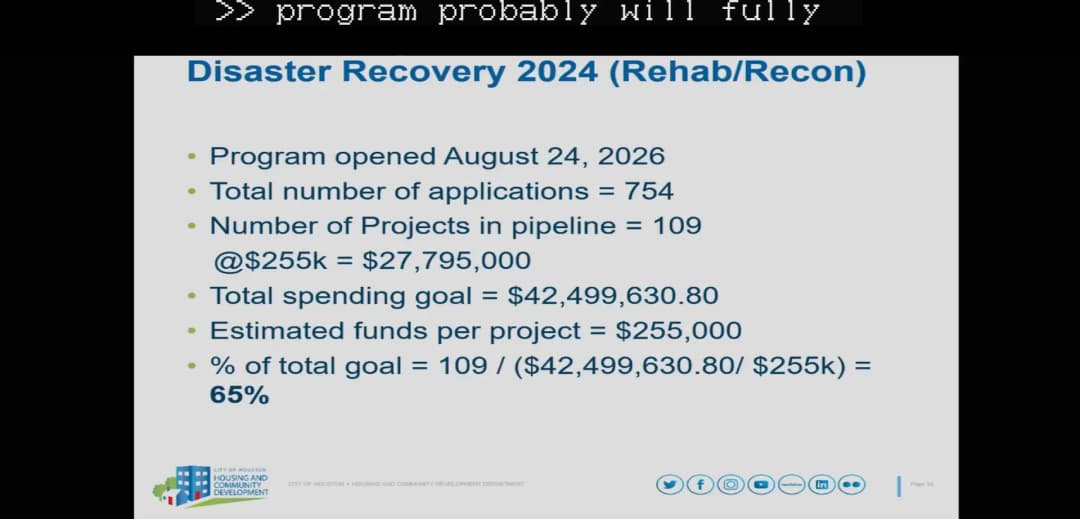
The Houston Housing and Affordability Committee, chaired by Councilmember Thomas, met on October 20, 2026, to discuss administrative amendments, funding reallocations, program updates, and a resolution of support. Presenters from the Housing and Community Development Department (HCD) and partner agencies provided updates on compliance, single-family programs, multifamily projects, power generation (generators), and public services. The committee received one public comment and recommended several items for full City Council approval. Compliance - Presentation by Kinesha London (HCD) on an ordinance to substantially amend the community development block grant disaster recovery (CDBG-DR) action plan for 2024 disasters (Hurricane Barrel). The amendment adds the "urgent need" national objective to four programs (emergency response, debris repository, vegetation management, power generation resilience) and revises the eligible activity for vegetation management from interroom assistance to public services to allow equipment purchases. No funding allocations changed. The change allows up to 30% of funds to serve areas not classified as low-to-moderate-income (LMI) or primarily residential, while maintaining the 70% LMI commitment. Councilmember Alcorn clarified it is an administrative change, not new money. Committee members expressed support. Single Family Programs - Presentation by Cedric Lussain (HCD) on four items (3A-3D): - Item 3A: Ordinance to reallocate $4,093,911.49 in HOME funds from closed single-family programs to existing programs: $3,093,911.49 to down payment assistance and $1,000,000 to the New Home Development Program (NHDP). NHDP builds affordable for-sale homes with funds returning in perpetuity. Councilmember Alcorn queried average assistance ($55,000-$60,000, max $75,000) and affordability period (5 years). Staff from Councilmember Ramirez's office discussed the difference between closed program residual funds and the need for down payment assistance, and noted the land trust model as a tool. - Item 3B: Revisions to the Single Family Home Repair Program Guidelines, version 2.0, increasing the reconstruction cap from $250,000 to $300,000, increasing delinquent tax payment plan cap from $1,000 to $5,000, incorporating prior assistance restrictions, and updating compliance provisions. A 10-year affordability period applies to reconstruction. The increase addresses historic preservation, HOA requirements, and elevation costs. - Item 3C: Ordinance to amend master contracts for home repair to align with the new guidelines; no new funding. - Item 3D: Ordinance to allocate an additional $2,792,023.26 in CDBG funds (PY2025 and PY2026) to home repair master contracts, increasing the aggregate max contract amount from $3,000,000 to $5,792,000. This is the annual allocation, not tied to the cap increase. - Committee members discussed high demand for down payment assistance and the importance of maximizing HOME funds. Multifamily - Presentation by Ryan Bibbs (HCD) on Item 4A: Resolution of support for Andover Village, a 105-unit family new construction at 6901 Belfort (District I), reducing from 120 units. The organizational structure adds Harris County Housing Finance Corporation to fill a funding gap. The project previously received city support; the new resolution confirms continued backing for a 9% housing tax credit application. Units range 30%-60% AMI. The developer (Donna Rickenbacher) was present. No questions. Committee noted prior unanimous support. - Item 4B: Resolution authorizing Houston Housing Finance Corporation (HHFC) to transfer its volume cap to the Texas Department of Housing and Community Affairs (TDHCA) to enable low-interest mortgage loans for first-time homebuyers and veterans in Houston. Richard Mudd (HHFC President) reported results as of September 30, 2026: 337 loans totaling $80 million, average home price $243,100, average down payment assistance $8,870, with 75% of borrowers at or below 80% AMI. The program partners with TDHCA and 50-60 lenders. Councilmember Alcorn asked about direct lending (answer: no, lenders in TDHCA pipeline). Councilmember Thomas praised the partnership. Committee requested zip code data and public-facing information for newsletters. Power Generation Program Update - Presentation by Ryan Bibbs, Chase Cronzer (Mayor's Office), and James Reddington (GSD): Update on DR24 power generation program. 18 sites selected from 12 city departments after prioritization, all eligible under LMI guidelines. The first 18 sites include multi-service centers, police/fire stations, wastewater sites, and distribution sites. The housing department funds design, equipment, and installation. Maintenance costs require separate funding (e.g., Prop A). Timeline: fire stations 8 months, community centers 10 months from design start; for earlier CIP-funded neighborhood center, April 2027. Site visits began last week. Gas lines exist at all sites, may need upsizing. Councilmember Alcorn requested a comprehensive timeline of all generator projects. Councilmember Davis asked about gas lines and timelines; committee emphasized need to communicate with constituents. Staff from Mayor Pro Tem Castic Statum asked that public be informed about generator locations (e.g., Fort Ben Houston, Stim Lee Blue Ridge Library). Financial and Disaster Recovery Updates - Presentation by Derek Sellers (HCD): - DR17 programs nearly closed; two active: HBAP 2.0 (194 homes closed, seeking additional funds for homebuyers) and buyout program (final amendments on November 4th agenda). Grant closes February 2027. - DR21 single family home repair: 125 homeowners qualified; only 9 reimbursement applications received. Chairwoman Thomas and Vice Chair noted the intrusive documentation (bank statements, deed) deterred seniors and others, citing personal family experiences. HCD acknowledged the barrier and working with HUD on improvement. - DR24 single family home repair: 754 applications, 109 likely eligible ($28 million committed, 65% of funding). Two-stage process: homeowner eligibility and home damage assessment. - DR24 multifamily NOFA: 9 deals selected ($48.6 million); first two (acquisition/rehabs) on November 4th council agenda; new construction in Q1 2027. - HOPWA program: Six amendments for Catholic Charities, Search Homeless Services, Houston Help, Houston SRO, Brentwood Community Foundation, and A Caring Safe Place. Total additional $4,056,472 extending agreements to late 2027. Jared (HCD) presented details; committee had no questions. Director's Comments - HCD announced a new application status dashboard for DR24 single family repair, addressing community frustration. 600 applications received, 125 in process; 7 community events with 1,200+ attendees. - Upcoming ribbon cuttings: Boulevard 61 (90 lower-income units, District J) and Rushmore (101 units, 85 at 30%-60% AMI, District G). - Fall community meeting held with 100+ attendees; virtual meeting scheduled for tomorrow at 3 p.m. Public Comments & Testimony - Kimberly Lanier spoke about her two fourplexes intended for reentry housing (young men under 32). She sought clarity on an exception in the housing ordinance (Section 10171) that exempts certain room-rent facilities for state/federal programs. She expressed concern that other facilities are substandard and harm residents' mental health. Councilmember Alcorn offered to connect her with the Administration and Regulatory Affairs department for guidance. Key Outcomes - Committee recommended approval of the CDBG-DR action plan amendment (compliance) for full council. - Committee recommended approval of all single-family items (3A-3D) for full council. - Committee recommended approval of the resolution of support for Andover Village (Item 4A). - Committee recommended approval of the volume cap transfer resolution (Item 4B). - Accepted the power generation program update and directed HCD and GSD to share generator timelines and location information with council offices. - Noted the need to improve communication and documentation accessibility for disaster recovery programs, especially for elderly residents. - Next Housing and Affordability Committee meeting scheduled for November 17, 2026, at 10 a.m.

HOUSING AND COMMUNITY DEVELOPMENT 32% · DISASTER RECOVERY 29% · PUBLIC ENGAGEMENT 27% · AFFORDABLE HOUSING 10%
1780
OCT 20, 2026 · NEW YORK CITY, NEW YORK · CITY COUNCIL
NYC Council Committee on Environmental Protection and Waterfronts Hearing on Citizen Enforcement Programs – October 20, 2026

The Committee on Environmental Protection and Waterfronts met on Tuesday, October 20, 2026, at 12:00 PM in Hearing Room 1 at 250 Broadway for an oversight hearing on the Department of Environmental Protection's citizen enforcement programs and six related bills. Chair James F. Gennaro presided; Committee members Harvey D. Epstein, Kamillah Hanks, Lincoln Restler, and Justin E. Sanchez were present, and Councilmember Alexa Avilés attended for her bill. DEP did not send a witness to testify, although an administration representative was in the audience; DEP submitted written testimony, which Chair Gennaro read into the record. OATH and DOF did not provide testimony. Public Comments & Testimony - Government watchdog Reinvent Albany said it supports the citizen air complaint program but opposes Intro 561-A and Intro 11-A, arguing 561-A creates loopholes that would increase idling and that higher fines would worsen delinquency, noting delinquency rates above 60% for fines over $1,000. - Environmental and public health advocates, including 350 NYC, NYLPI, NRDC, NYLCV, the New York Clean Air Collective, and medical professionals, largely opposed Intro 561-A as drafted, called it unsalvageable in current form, and supported language access. NRDC supported Intros 11-A, 48, 562, and 869-A while saying 561-A needs additional work; NYLCV supported Intros 48 and 11-A but not 561-A; NYLPI urged passage of Intros 11 and 48 and rejection of 561-A. - Citizen complainants testified that the program has reduced idling by fleets such as Con Edison, Amazon, and Verizon, and asked the council to preserve it. Many opposed the 60-day dismissal provision, the diesel particulate filter regeneration exemption, reduced citizen awards, and self-prosecution burdens. Several supported Intro 48 to expand access to non-English speakers. - Industry and business representatives, including the Building Trades Employers Association, Subcontractors Trade Association, Mechanical Contractors Association, New York State Energy Coalition, Trucking Association of New York, RDS Delivery, Edge Auto Rental, bus and motorcoach associations, Teamsters Local 817, and the National Waste and Recycling Association, generally supported Intros 561-A, 562, and/or 869-A with amendments, and asked the council to hold Intro 11-A until due process, timely notice, and fair hearings are fixed. They cited delayed notices arriving six to eighteen months later, hearings more than a year later, legitimate operational idling (pumps, liftgates, compaction, HVAC, DPF regeneration), and liability problems for leased vehicles. - Some participants disputed industry claims, arguing fuel pumps and liftgates are already exempt, regeneration can be done while driving, and the program is effective and should be expanded rather than weakened. Discussion Items - Chair Gennaro noted the city's air quality improvements and said motor vehicles contribute approximately 11% of local fine particulate matter (PM2.5) and 28% of local nitrogen oxide emissions. He reported citizen idling complaints rose from 9,070 in 2019 to 163,090 in 2025. - DEP's written testimony stated that in 2025 DEP reviewed more than 163,000 public submissions and issued about 102,000 idling summonses, currently receives about 700 idling reports per day, and has a backlog of about 230,000 videos. DEP received 21 new personnel lines in the FY27 November plan, including seven air pollution inspectors who recently started. - DEP declined to comment on provisions related to pending litigation, expressed concerns about Intro 562's liability transfer, supported the intent of Intro 869-A, and said Intro 48's portal instructions and translations already exist in designated citywide languages, though Councilmember Avilés responded that the translations are not integrated into the portal. - The bills heard were: Intro 11-A (increasing civil penalties for idling infractions, sponsored by Speaker Julie Menon); Intro 48 (translating the citizen air complaint portal into designated citywide languages, sponsored by Councilmember Avilés); Intro 561-A (regulating engine idling and citizen complaint enforcement, sponsored by Chair Gennaro); Intro 562 (transferring liability for certain idling violations to lessees); Intro 869-A (establishing a code of conduct for citizen noise complaints); and preconsidered T2026-2662 (including idling violations in the Department of Finance fleet program). - Chair Gennaro stated that the 60-day deadline in Intro 561-A was not intended to automatically discard pending complaints or the backlog, and that the language would be clarified. Key Outcomes - Oversight T2026-2107 was heard and filed by the committee. - Hearing was held on all six legislative items. The committee proposed and adopted amendments to Intros 11-A, 561-A, and 869-A. - All introductions, including Intros 11-A, 48, 561-A, 562, 869-A, and T2026-2662, were laid over by the committee; no final votes were taken. - The committee accepted written testimony for 72 hours after the hearing and committed to further stakeholder engagement before finalizing amendments.

ENVIRONMENTAL PROTECTION 40% · PUBLIC HEALTH 19% · PROCEDURAL 12% · TRANSPORTATION SAFETY 10%
OPENPUBLICA · PUBLIC MEETING INDEXUPDATED DAILY · openpublica.com