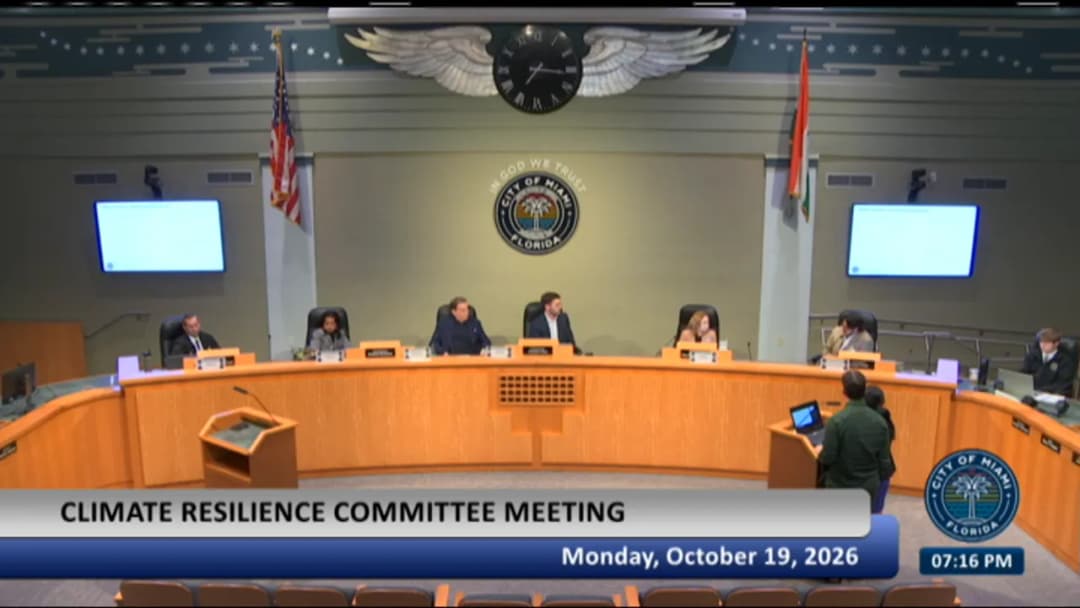
The Climate Resilience Committee (CRC) held its regular meeting on October 19, 2026, starting at 10:15 AM. The agenda included a presentation on the Legion Park living shoreline design, a report on waterfront connectivity, discussion of a resolution to request a city appointment to the Biscayne Bay Watershed Management Advisory Board, and updates from the Office of Resilience and Sustainability. The committee voted unanimously to approve the September 21 regular minutes and October 6 agenda planning workshop minutes, and also unanimously approved three absence waivers for members who were ill (Avra, Alison, and Jenny Lee). Public comments addressed waterfront walkway protection and tree canopy resilience. The committee supported the waterfront connectivity report with emphasis on interim connectivity and FDOT partnerships, and passed a resolution requesting city commission action on a watershed board seat. Consent Calendar - Approval of Minutes: Motion to approve the regular September 21, 2026 minutes and the October 6, 2026 agenda planning workshop minutes passed unanimously. (Motion: Grant Muster; Second: Wayne Pathman) - Absence Waivers: Motion to hear and then approve late waiver requests for Avra, Alison, and Jenny Lee (all illness-related) required a supermajority and passed unanimously. Public Comments & Testimony - Abbey Ape (online comment): Expressed support for protecting the full 25-foot public waterfront walkway in Brickell, urging that access remain continuous, clearly marked, and welcoming. Asked that landscaping, seating, or private uses not reduce the public space, and that approvals include requirements for public access, maintenance, and enforcement. - Gabrielle Pekena (online comment): Urged the CRC to consider tree canopy and resilience, stating that trees and shade are being reduced by interest groups and municipal actions, which violates the city's codified commitment to resiliency. Asked that the CRC redirect Miami's future toward stronger ecological systems. Discussion Items - Legion Park Living Shoreline Design (Presentation by Sahida Curtis and Olivia of Curtis Rogers Design Studio/EXP): The design update showed a 12-foot wide baywalk (reduced from standard 15-foot via variance), preservation of all existing canopy, removal of two invasive species only, and creation of tidal pools, oyster reefs, and marsh grasses per the National Coastal Resilience Grant requirements. Elevated decks are placed in existing mangrove gaps; inland retention swales will capture and infiltrate stormwater to improve water quality. No trees are being removed; only a few palms will be relocated. The committee discussed the need for interim connectivity and noted that the project was previously reviewed under CRC waterfront guidelines. No formal vote was taken; the committee recommended that the design team review the CRC’s waterfront checklist and suggested that the project return for a later update after public outreach (which begins October 22, 2026). - Waterfront Connectivity Report (Presentation by Andrea Sandoval and Richard Brown, Planning Department): This benchmark study categorises all waterfront frontage (Baywalk and Riverwalk) into connected/Miami 21 compliant, connected/pre-Miami 21, disconnected, forthcoming, proposed greenway, or not applicable. Key findings: 48% of overall waterfront is connected, but only 15% of that meets current Miami 21 standards; 30% of the pre-Miami 21 connections are considered “satisfied.” The report identifies opportunities for interim connections, coordination with FDOT at bridge underpasses, expansion of the waterfront materials index, and a potential on-road greenway along South Brickell Avenue. The committee discussed incentives, living shorelines, best practices, and dimensional constraints. A motion was made to support the report’s 12 preliminary recommendations, with emphasis on items 3 (partnering with FDOT) and 4 (providing interim connectivity), and to include suggestions for implementing green infrastructure/living shorelines wherever possible, reviewing best practices, and evaluating dimensional waiver options. The motion passed unanimously. - Biscayne Bay Watershed Management Advisory Board Resolution: The committee discussed and then voted on a draft resolution requesting the Miami City Commission to appoint a city representative to the county’s Biscayne Bay Watershed Management Advisory Board. Committee member Urella Baget reported that there is currently one vacancy and likely another, and that the city’s seat would come through the League of Cities. The resolution cites the city’s extensive waterfront, its role as the largest municipality in the county, and the need for a seat at the table as the county develops nutrient reduction targets. The motion to approve the resolution (as amended per legal review) passed unanimously. The item will be placed on the December 10, 2026 city commission agenda. Key Outcomes - Votes: - Approval of September 21 and October 6 minutes: unanimous. - Approval of three absence waivers: unanimous. - Support for Waterfront Connectivity Report and its 12 recommendations with added emphasis on interim connectivity and FDOT partnerships: unanimous. - Approval of resolution for city appointment to Biscayne Bay Watershed Management Advisory Board: unanimous. - Directives & Next Steps: - Legion Park design team will receive the CRC’s waterfront checklist and is expected to return for a future update after public outreach. - The Planning Department will incorporate the committee’s suggestions (green infrastructure, living shorelines, best practices, dimensional review) into the waterfront report and proceed toward a city commission briefing by year’s end. - The approved resolution will be submitted to the city commission by October 23 to appear on the December 10 agenda; committee member Urella Baget will serve as point of contact. - Responses to staff questions (on Back Bay study, Dream projects, etc.) are anticipated by the next meeting. - Other Updates: The Office of Resilience and Sustainability reported giving away 600 trees on October 2-4 (1,100 total for the year), receiving 24 applications for the Bloomberg Youth Climate Action Fund microgrants, and collecting 12,515 pounds of trash from 25 coastal cleanups with 1,359 volunteers during International Coastal Cleanup Day.
The Public Meeting Index
The Public Meeting IndexThe Alameda Commission on Access for People with Disabilities met on October 19, 2026, at 6:31 PM. The meeting featured a staff presentation on the Mastic Senior Center ADA upgrade project, a detailed discussion and public hearing on the Gibbons Drive Sidewalks and Tree Plan, and the postponement of a pesticide use informational item. Public participation was heavily weighted toward the Gibbons Drive item, with numerous residents urging the commission not to endorse the current draft plan. Consent Calendar - The commission unanimously approved the minutes from the May 13, 2026, meeting via a roll call vote (5-0). Public Comments & Testimony - Non-Agenda Comment: Jinky Barreto asked about enforcement and reporting mechanisms for disabled parking violations. - Mastic Senior Center: Carol Gottstein, a Mastic Advisory Board member who uses a walker, strongly criticized the ADA upgrade plan. She argued it ignored the most critical accessibility barriers, specifically the lack of automatic door openers (push pads) on the main lobby restrooms, which are used by the general senior population. - Gibbons Drive Sidewalks and Tree Plan (Multiple Speakers): - Most speakers urged the commission to reject the plan as written. Specific concerns included: - The 20% tree removal cap was too high (many advocated for a 10% cap). - The plan lacked objective, measurable criteria for tree removal decisions. - There was insufficient community engagement and a lack of a formal community advisory committee. - The plan prioritized tree removal over creative, preservation-focused sidewalk repair solutions (e.g., meandering sidewalks, steel root plates). - Representatives from the community collected over 1,200 petition signatures opposing the plan. - Several speakers referenced the planning board's recent meeting, noting that it unanimously found the plan required significant revisions. - One speaker highlighted the extreme heat danger for disabled individuals on unshaded pavement, urging preservation of the canopy for safety. Discussion Items - Item 6379: Mastic Senior Center ADA Upgrade Project - Staff (Chandani Patel) presented the 95% construction drawings. The project addresses 239 observations. 83% will be fully compliant. The project is phased over a two-year construction period, but funding for construction has not been fully appropriated. - Commissioners questioned the reliance on a single accessible path and distant restrooms. They expressed overwhelming consensus that automatic door openers should be a priority. - Staff agreed to explore adding push pads to the scope and developing temporary access plans. They noted the current temporary solution is propping restroom doors open. - Item 6385: Gibbons Drive Sidewalks and Tree Plan - Staff (Aaron Smith) and arborist Ryan Suttle presented the draft plan to balance the legal obligation for accessible sidewalks with tree preservation. The plan recommends a preservation-first, location-by-location approach with a 20% maximum tree removal cap per five-year period. - Commissioners were swayed by the volume and passion of public testimony. Commissioner Canadler noted the troubling disparity in turnout between the disability-focused Mastic item and the Gibbons item. - Commissioner Lyons, speaking from personal mobility experience, stated that the current Gibbons sidewalks are completely impassable for mobility scooters, making accessibility a non-negotiable priority. - Commissioner Bieler acknowledged that the Planning Board had submitted substantial revision recommendations that had not yet been incorporated into the draft before the commission. - The commission formed a consensus not to endorse the plan and to work on formal recommendations. - Item 6380: Pesticide Use - Commissioner Schmitz requested the item be continued to allow time for review. The commission voted unanimously (5-0) to continue the item to the December meeting. Key Outcomes - Mastic Senior Center: Staff was directed to report back on incorporating automatic door openers (push pads) into the project scope and temporary access solutions. - Gibbons Drive Plan: The commission declined to endorse the plan. The commission will schedule a special meeting to draft formal feedback for the City Council, emphasizing the urgency of accessibility and incorporating public and Planning Board feedback before the December 1 Council hearing. - Pesticide Use Item: Continued to the next regular commission meeting in December. - Community Engagement Disparity: Commissioner Canadler highlighted the high public engagement on trees vs. senior access barriers. The commission committed to improving outreach to ensure Mastic Senior Center members and other disability communities have accessible avenues to provide input.
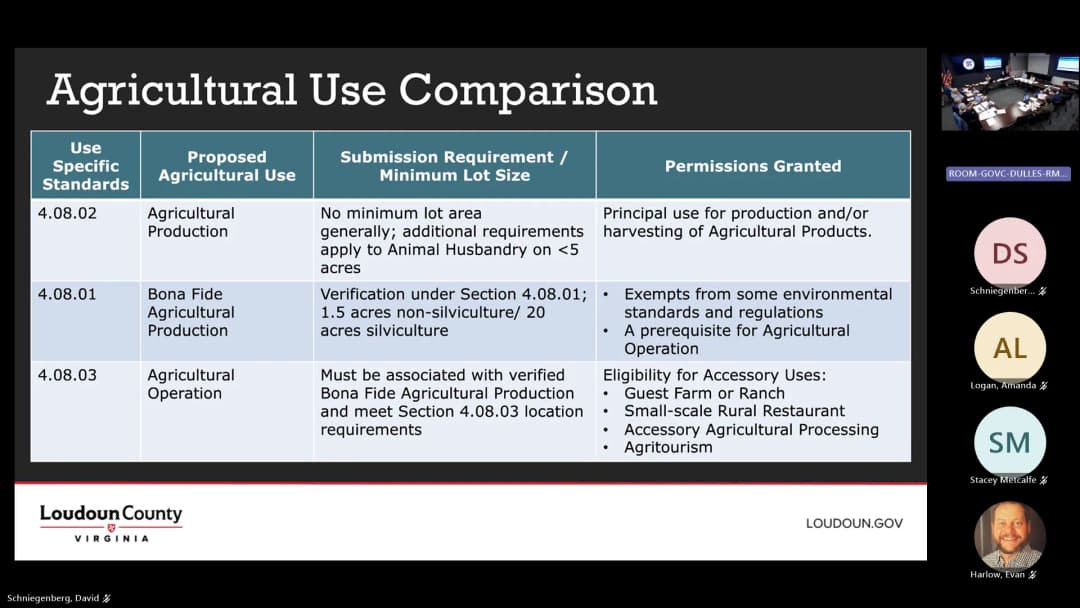
The Western Loudoun Rural Uses and Standards Ad Hoc Committee met on October 19, 2026, to continue its detailed review of proposed Zoning Ordinance amendments. The meeting focused on defining agricultural terms, creating a tiered system for agricultural uses, establishing verification processes for bona fide agricultural production, and setting standards for agricultural processing. The committee made significant progress, voting on a series of motions to refine staff draft language, often deviating from initial proposals to better support local farming operations. Consent Calendar - The committee approved the meeting minutes from September 29, 2026, with amendments addressing errors in attribution, word choice corrections ("received" vs. "questioned"), and inconsistencies in how voice votes were recorded across the document. Disclosures - Bill Hatch disclosed that his family owns and operates a farm in Western Loudoun that would be affected by the provisions under discussion. - Mark Miller disclosed that on October 1, 2026, he had met with staff and stakeholders to discuss the draft language before the committee. Discussion: Agricultural Definitions (Motions 27 & 30) - Staff presented revisions to replace the existing "agriculture" use with "agricultural production" and add a definition for "agricultural products." - Committee members Eric Combs and Beth Erickson found the draft definitions of "agricultural production" and "agricultural products" to be circular, where each term simply referred to the other. Eric Combs advocated for rooting the "agricultural products" definition in the state's Right to Farm Act (Va. Code § 3.2-300) rather than the agritourism liability code to eliminate this circularity. Staff had combined language from multiple code sections. - A significant debate centered on the exclusion of "direct market retail or wholesale" of agricultural products from the "agricultural production" definition. Beth Erickson, Bill Hatch, and Dale Myers argued that on-farm sales to clients (e.g., purchasing meat from a freezer, CSA pickups) is a standard and essential practice for working farms in Loudoun County. The committee stressed that this activity should remain clearly permitted, where the staff draft had struck it out with the intent to move it to "agritourism." - Dale Myers criticized the "30-day" requirement for active agricultural activity and specific material exclusions, calling them unrealistic for standard agricultural practices like preparing fallow fields. - The committee found that the staff's draft was not consistent with the board's direction in Motions 27 and 30. Discussion: Bona Fide Agricultural Production (Motions 18 & 28) - Staff outlined a shift in the verification process, removing the Loudoun Soil and Water Conservation District from a "de facto zoning approval" role and placing it with the Zoning Administrator in consultation with Virginia Cooperative Extension. - Staff announced they were removing proposed minimum acreage limitations (1.5 acres for silviculture, 20 acres for others) due to complications with state requirements and the potential for creating expensive hurdles for small-lot farmers. - The verification timeline was a major point of contention. A motion by Dale Myers to align the re-verification of bona fide agricultural production with the Land Use Assessment Program's cycle (every 6 years) passed (5-3). Robin-Eve Jasper led the opposition, arguing that a 6-year cycle was too long to effectively prevent abuse of exemptions, particularly in environmentally sensitive areas like the Mountainside Overlay District. She expressed concern that the Land Use program's initial certification does not guarantee active inspection. - Robin-Eve Jasper successfully passed a subsequent motion requesting staff to provide the committee with a detailed breakdown of the practical verification procedures used by the Commissioner of Revenue's office. - The committee supported the distinction between general agricultural production and "bona fide agricultural production," which acts as a gateway for exemptions and higher-tier agricultural uses. Discussion: Agricultural Operation (Motion 29) - Staff presented the new "Agricultural Operation" tier, defined consistently with state code (Va. Code § 3.2-300). To qualify for this use, a farm must first be verified as "bona fide agricultural production." - Staff introduced a "tier chart" showing the hierarchy: Agricultural Production - Bona Fide Ag Production - Agricultural Operation. This chart clarifies the building blocks and was praised by the committee. - The committee unanimously found the definition of "agricultural operation" consistent with board direction, with the understanding that the list of accessory uses (such as guest ranches and small-scale restaurants) in Section 4.0803(D) was incomplete and would be finalized for the next meeting. Discussion: Agricultural Processing (Motions 42, 43, 44) - Staff presented a framework distinguishing between processing as part of agricultural production, accessory agricultural processing, and principal agricultural processing. - The sourcing requirement for accessory processing was extended to a 50-mile radius, following a motion to match the principal processing standard. - The committee revised the building size allowances to decouple cold storage from the main processing area. Cold storage was capped at a maximum of 5,000 square feet and is not counted towards the overall structure size limit. - The committee moved to add explicit language that Section 4.08.12 (Agricultural Processing) does not apply to ABC-regulated uses such as farm wineries, limited breweries, and distilleries, to avoid conflicting regulations. - Dale Myers requested documentation on how the specific square footage limits (2,500, 10,000, 15,000) and cold storage caps were derived, indicating the numbers seemed arbitrary. Key Outcomes - Motion 1 (Unanimous): Found staff's draft for Motions 27 & 30 inconsistent with board direction regarding definitions and sales permissions. - Motion 2 (Unanimous): Directed staff to add explanatory text to agricultural use categories to help lay readers distinguish between them. - Motion 3 (Unanimous): Directed staff to develop language for a new section or standards clarifying permissible sale and distribution activities (direct sales, wholesale, third-party sales) for agricultural products. - Motion 4 (Unanimous): Directed staff to root the definition of agricultural products within the "agricultural production" definition, referencing the state's Right to Farm Act. - Motion 5 (Unanimous): Directed that all defined terms in the draft text be capitalized for clarity. - Motion 6 (Passed): Recommended the Planning Commission review the prohibition on animal husbandry on cluster subdivision lots (Dale Myers opposed, citing scope). - Motion 7 (Unanimous): Found staff's draft for Motion 18 consistent (moving verification from Soil & Water to Zoning/VCE). - Motion 8 (Passed 5-3): Aligned the re-verification timeline for Bona Fide Agricultural Production with the county's Land Use Assessment Program cycle. - Motion 9 (Unanimous): Directed staff to add an explanatory clause to the "bona fide agricultural production" section explaining its distinction from general agricultural production. - Motion 10 (Passed): Information request for staff to report back on the Commissioner of Revenue's specific verification procedures for the Land Use Assessment Program. - Motion 11 (Unanimous): Found the definition of "Agricultural Operation" (Motion 29) consistent with board direction. - Motion 12 (Unanimous): Found the agricultural processing framework (Motions 42, 43, 44) consistent with board direction, with specific revisions: (a) Cold storage capped at 5,000 sq. ft. and excluded from main floor area limits; (b) Exclusion of ABC-regulated uses from the section; (c) Extension of the 50-mile sourcing radius to accessory agricultural processing. - The committee requested staff create master comparison charts of all proposed agricultural uses and tiers for the next meeting.
The City of Deltona Special City Commission Meeting was called to order on October 19, 2026, at 5:00 PM. The single action item on the agenda was the approval of Resolution No. 2026-95, awarding a contract for the Lake Windsor Stormwater Force Main Relocation. Commissioner Heriot was absent. No public testimony was offered, and the meeting concluded shortly after the vote. Discussion Items - Lake Windsor Force Main Relocation: Deputy Public Works Director Phyllis Wallace explained that the project involves an aging, 25-year-old 8-inch force main inherited from Volusia County. Located in easements behind homes, it has become difficult to access for repairs during storms. Staff expedited the design and permitting in about 90 days. - Funding and Bid Process: The project relies on Stormwater funds and American Rescue Plan Act (ARPA) funds, which must be spent by December 31, 2026. Staff reported a competitive bidding process. A discrepancy between the agenda and the meeting transcript exists regarding the exact number of bidders: the agenda notes ten qualified bids were received, while Ms. Wallace stated during the meeting that there were nine bidders. All bids came in under the engineer's estimate of roughly $2.2 million. - Motion: Commissioner Nabicht made a motion to approve Resolution No. 2026-95, which was seconded by Commissioner Santiago. Key Outcomes - Unanimous Approval: The commission voted 6-0 to approve Resolution No. 2026-95. Voting in favor were Mayor Avila, Vice Mayor Avila-Vazquez, Commissioners Colwell, Howington, Nabicht, and Santiago. - Contract Award: The resolution authorizes the City Manager to execute an agreement with the qualified low bidder, GPS Civil Construction, Inc. of Ormond Beach, Florida. A notable discrepancy exists regarding the exact bid amount: the official agenda lists the low bid as $1,059,391.00, whereas the meeting transcript records the city attorney reciting a figure of $1,309,391 ("one million three hundred and nine thousand three hundred and ninety-one dollars"). The total project budget, including contingencies, is not to exceed $1,618,770. - Next Steps: The City Manager is directed to proceed with the contract. Staff indicated that failure to execute the agreement with GPS would have resulted in moving to the second-lowest bidder, Carr & Collier, Inc., to meet the ARPA spending deadline. - Adjournment: The meeting was adjourned. The official minutes state the meeting concluded at 5:04 PM. The raw transcript of the meeting records the Mayor saying, "Meetings adjourned till 5:30," a discrepancy in the recorded conclusion time.
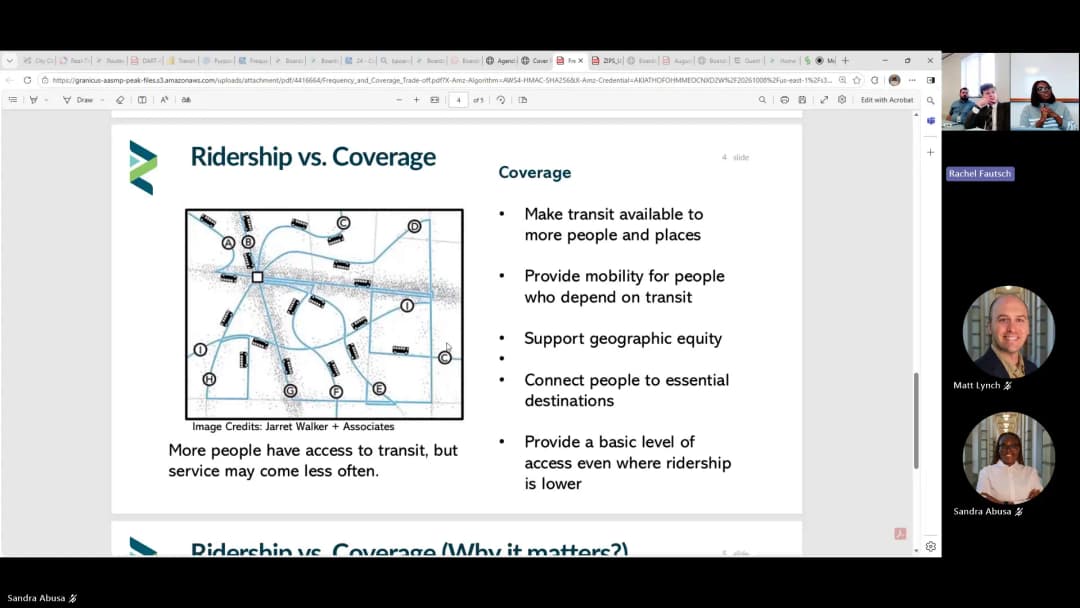
The Citizens Advisory on Transit (CAT) of Rochester, Minnesota, met to receive the August 2026 Transit Report, hear an update on the ZIPS paratransit service, and discuss the trade-off between frequency and coverage in transit service design. The committee approved the prior meeting minutes and agenda, accepted a member resignation, and was notified of a temporary park-and-ride relocation. No public comments were offered. Note: The agenda and minutes are dated October 8, 2026, while the metadata provided for this summary specifies 2026-10-19; this summary uses the specified metadata date. Consent Calendar & Routine Approvals - Minutes of the September 11, 2026 meeting were approved unanimously (moved by Kenneth D. Baerg, seconded by Derek S. Aiono). - The order of the agenda was approved unanimously (moved by Derek S. Aiono, seconded by Kristin E. Buchholz). Public Comments & Testimony - No members of the public offered comments during the open comment period. Transit August 2026 Report - Transit staff presented the August 2026 Transit Report as an information item. They explained that the transit reserve estimate has dropped by about three-quarters of a year because MnDOT's 15% local-share allowance for grant funding will now end in 2028 instead of 2029. - The report excludes BRT figures because Mayo Clinic operating-agreement dollars need to be split among capital, replacement, and operating accounts. Projected budget dips in 2027 and 2028 reflect large bus purchases, with no vehicle procurements outlined after 2028. - Bus purchase estimates are based on MnDOT's diesel replacement amount, which does not include electric bus costs; the agency applied for a Low-No grant for hybrid paratransit vehicles with a 15% local match. - Ridership is below the level needed for solvency; the target presented was 1.3 ridership units. Revenue per ride is $1.75 against expenses per ride of $2.91. Mayo Clinic riders make up about 49% of fixed-route riders, compared with 48% last year and 23% in 2024. ZIPS Update - Devin Lihall, Mobility Coordinator, reported that Via became the ZIPS paratransit operator on September 1, 2026, following a competitive procurement. The previous operator contract ran for 10 years. - ZIPS serves people unable to use fixed-route transit, typically due to disability or mobility needs. Applications require a care provider's sign-off; staff have 21 days to make a determination, and reviews typically take 3 to 4 business days. - The fleet has 13 vehicles, including accessible minivans, small buses with wheelchair ramps, and electric vehicles, with a required 20% spare ratio. - September performance: the on-time goal is 90% for both pickup and drop-off; the first week of October improved to 93% pickup on-time and 92% drop-off on-time. The service averages about 4,000 rides per month and averaged 192.5 riders per day in September. - Rides per vehicle revenue hour reached 2.0 and are trending toward the contract target of 2.4. Overflow services (Handy Van/Med City Taxi) carried 13% of August rides and 0% in September. - A new rider app provides vehicle tracking and arrival notifications. Staff stated that every paratransit rider was individually notified about the change. One member suggested a press release about the improvements; staff responded that they want to see consistent improvement before publicizing, to avoid advertising a temporary gain. - The fare is $3 per trip, while the federal maximum allowed is $4. The program is near break-even but is expected to run a deficit of about $50,000. Operations are currently 85% grant-funded through MnDOT/FTA, shifting to 80% in 2028. - Microtransit is included in the Via contract but has not yet been activated; it could be used later as a mixed service with fixed routes. Transit Priorities: Frequency vs. Coverage Trade-off - Staff presented an informational briefing on two service-design approaches: a ridership/frequency model concentrating buses on high-demand corridors such as Second Street SW and Broadway, and a coverage model spreading service across the city at lower frequencies, such as every 60 minutes. - Staff emphasized that no decision was requested today; Rochester-specific options will be presented next year to the committee, city council, and public. Most cities use a blend, such as 70/30 or 80/20 ridership/coverage. - The current system has 22 routes, and about 98% of the city is within half a mile of a transit stop. Low-frequency coverage routes can make trips impractical; one member noted that a bus trip could take up to two hours for a trip that would be a 15-minute drive. - Microtransit was discussed as a potential hybrid tool: fixed routes on high-demand corridors plus on-demand zones for broader coverage, with paratransit riders prioritized and microtransit riders paying a premium. - Staff compared Duluth, which runs 13 routes and has nearly 3 million annual riders; Duluth's ridership increased after reducing coverage and increasing frequency. Other Business - The committee was notified that Parker Acree resigned because his schedule no longer allowed him to serve. A motion to accept the resignation was made, seconded, and passed unanimously. Staff will contact the mayor's office about a new appointment. - Staff announced that the North Broadway Park and Ride is temporarily relocating to the Transportation Center (RPT office) parking lot, about half a mile from the current site, while a new park-and-ride facility is built. The new facility is expected to be ready around March. Key Outcomes - Minutes and agenda order approved unanimously. - Parker Acree's resignation accepted unanimously. - The meeting adjourned unanimously (moved by Kenneth D. Baerg, seconded by Kristin E. Buchholz). - No formal votes were taken on the transit report, ZIPS update, or frequency/coverage discussion; all three were informational items that will inform future decisions.
Chair Drew France called the October 19, 2026 regular meeting of the Human Rights Commission to order. A quorum was not immediately present, preventing formal action, but the meeting proceeded with discussions and a presentation from a guest speaker. Guest Speaker & Discussion - Brentum Todd, Deputy Chief of Staff to Mayor Nichols, addressed the commission. He expressed the mayor's office appreciation for the commission's role in representing diverse voices and acting as a recommending body, emphasizing the importance of aligning 2027 recommendations with the mayor's six core priorities to leverage existing momentum. - Todd highlighted the significant challenge of recruiting qualified Tulsans to serve on the city's Authorities, Boards, and Commissions (ABCs), describing it as a constant struggle to maintain a strong pipeline of candidates. He encouraged commissioners to actively help build this pipeline. Public Comments & Testimony - A member of the public raised a concern about the difficulty of getting a city code violation regarding a sidewalk addressed, expressing frustration with being directed back and forth between the police department and the 311 system. Chair France acknowledged the difficulty and offered to assist in routing the complaint to the appropriate department after the meeting. Discussion Items - 2027 Goals & Learning Agenda: Chair France presented a summary of a survey completed by 10 commissioners. Proposed topics for the 2027 calendar included learning from peer cities about human rights complaint processes, improving language access and 311 referral systems, disability rights, fair housing, immigrant and 2SLGBTQIA+ rights, mental health access, veteran issues, and facilitating constructive dialogue. A commissioner strongly advocated for directly including community residents as speakers to ensure initiatives are done 'for them', not 'to them'. The commission agreed to form a working group to develop a structured 2027 learning calendar. - Improving Human Rights Complaint Process: LaKendra reported ongoing progress on digitizing the complaint process, including work on automated email response templates, a reference number structure, and a dedicated email address. Commissioners expressed interest in publicly publishing aggregated complaint data to increase transparency and measure progress. - Authorities, Boards, and Commissions (ABCs) Representation: The commission discussed methods to improve outreach in underrepresented districts. Suggestions included adding demographic questions to the application form (pending legal review) and creating better promotional materials. The discussion connected directly to Todd's earlier comments on the need for a stronger applicant pipeline. Key Outcomes - No official votes were taken due to the lack of a quorum. - The commission will finalize its 2027 goals and learning agenda at the next meeting on November 16, 2026 at 3:30 PM. - Ideas regarding the complaint process and ABC representation will be forwarded to city staff for feedback. - A working group will be established to schedule guest speakers and plan the 2027 calendar. Committee Reports - Fair Housing Committee: Shifted its senior services fair housing summit to Spring 2027 to better coordinate with partners during Fair Housing Month. - 2SLGBTQIA+ Committee: Distributed information on the human rights complaint process at the October 17th Pride Parade. The committee is also exploring a partnership with OSU for a community survey. - Veterans Affairs: Commissioner Starks announced the November 11th Veterans Day Parade, projected to be the largest in Tulsa history with over 140 floats, 5,000 marchers, a live performance of the 1812 Overture by the Tulsa Symphony Orchestra with four howitzers, and a military flyover. - Native American Affairs: The Dreamkeepers Award Ceremony honoring 12 individuals is scheduled for November 17th. - Asian Affairs: Commissioner B highlighted effective bilingual outreach flyers used by other commissions as a model for the HRC. Announcements - Mayor Nichols' community conversations on public safety: October 26th - November 5th. - Black Educator Excellence Award Ceremony: October 27th. - Tulsa Equality Indicator Summit: November 4th. - Asian Affairs Luminary Award Ceremony: November 9th. - Humanitarian of the Year Award Ceremony: December 10th.
The Charlotte City Council held a zoning meeting on October 19, 2026, at the Charlotte-Mecklenburg Government Center. The meeting covered consent agenda items, public hearings on several rezoning petitions, and discussions on stormwater management, street lighting, billboard impacts, and tree canopy preservation. Key outcomes included approval of consent items, deferrals and withdrawals of several petitions, and closure of public hearings with further review pending. Consent Calendar - Items 3, 4, 5, 6, and 8 were approved unanimously via a single motion. These petitions had no public opposition, staff and Zoning Committee recommendations for approval, and no changes after committee review. - Item 7 (Rezoning Petition 2026-041 by Owl Services) was pulled by Councilmember Mayo for separate discussion and later approved unanimously after CDOT clarified a street lighting project. Public Comments & Testimony - Item 13 (2026-030, Olympia & Wright LLC): Petitioner David Murray requested rezoning from CG to N1-E for a single-family home on a 0.15-acre lot. Resident Ricky Hall (Reed Park neighborhood) opposed unless a longstanding stormwater issue affecting eight properties is resolved. Councilmembers debated the city's stormwater responsibilities; the public hearing was closed without a vote. - Item 14 (2026-034, Sam’s Mart LLC): Petitioner Bridget Grant proposed a billboard on 7.6 acres with 86% tree preserve under ML-1(CD) zoning. Residents Sean Thomas (Far East Neighborhoods Coalition) and Joseph Cassio opposed, citing potential property value loss, light pollution, and precedent for industrial zoning. Staff recommended denial due to policy misalignment. The hearing closed without a vote. - Item 15 (2026-050, Mid-America Apartments L.P.): No opposition speakers. The petitioner John Carmichael presented plans for up to 275 multifamily units and ground-floor commercial on a former cinema site. Staff recommended approval upon resolution of minor issues. The hearing closed. Discussion Items - Item 7 Street Lighting: Councilmember Mayo raised concerns about non-working streetlights at Forest Pine Drive. CDOT confirmed removal of existing non-working infrastructure and installation of solar lighting by early January 2027, before construction. Councilmember Ajmera noted the rezoning conditions do not limit use to EV charging and suggested a referral to separate EV charging regulations from gas station standards. - Item 13 Stormwater: Councilmembers discussed stormwater challenges affecting eight properties near the site. Stormwater staff stated a permanent easement from all owners is needed; one owner is unwilling. The small lot size (0.15 acres) would not trigger stormwater rules. Councilmember Mayfield and Owens expressed concern about adding a home to an area with existing flooding problems. - Item 14 Billboard vs. Tree Canopy: Extensive debate on whether 86% tree preserve offsets a billboard on ML zoning. Petitioner highlighted $4.6 million value of preserved trees. Councilmember Anderson noted the tree preserve is unusually large. Councilmember Ashmira raised concerns about light pollution and requested potential hour restrictions. Councilmember Mayfield questioned seasonal visibility and impact on sleep. Staff reiterated policy mismatch but acknowledged the conditions are favorable. - Item 15 Phillips Place Redevelopment: Discussion focused on traffic reduction (proposed 2,000 trips vs. 4,593 under existing zoning), building height reduction to 120 feet, and pedestrian connectivity. Councilmember Owens confirmed neighborhood engagement via SPAN group emphasized walkability. An easement for a future greenway will be provided. Key Outcomes - Approvals: Consent items 3, 4, 5, 6, and 8 passed unanimously. Item 7 passed unanimously after discussion. - Deferrals/Withdrawals: Item 9 was withdrawn; Items 10, 11, and 12 were deferred to future dates (December 21, 2026; November 16, 2026; and November 16, 2026, respectively). - Public Hearings Closed: Items 13, 14, and 15 had their public hearings closed and will proceed to the Zoning Committee for further review and recommendation. - Referral: Councilmember Ajmera requested a referral to consider separating EV charging station regulations from gas station standards in city ordinances, to be discussed further with the Mayor. - Recusal: Mayor Harrington recused himself from item 15 due to his law partner's representation of the petitioner; Councilmember Driggs presided temporarily.
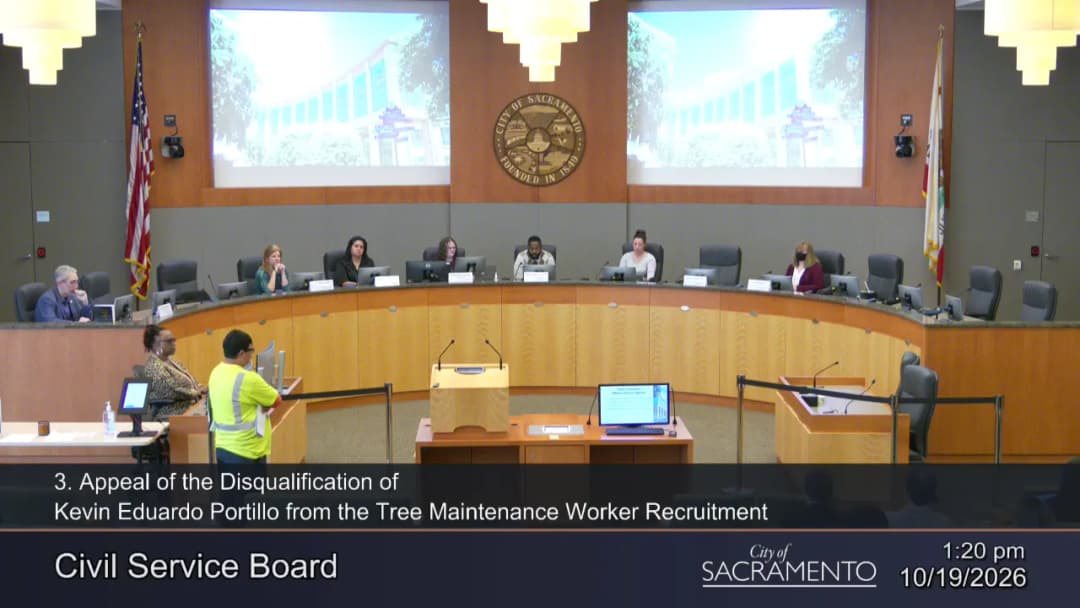
The Sacramento Civil Service Board met on Monday, October 19, 2026, at 1:00 PM at City Hall Complex, 915 I Street, Sacramento, CA. Present were Chair Emmanuel Amanfor and Board Members Gwynnae L. Byrd, Julie 'Jules' Stein, and Elena Gonzalez-Soto; Member Kathryn Elizabeth Meola was absent. The board conducted a hearing on an employment disqualification appeal, discussed application-process improvements, and took a divided vote. Consent Calendar - Revision of Program Developer and Program Coordinator Classification Specifications (File ID 2026-01851) to modify the minimum qualification experience requirement. - Revision of Western Council of Engineers Classification Specifications (File ID 2026-01852) as part of the Citywide Classification and Compensation Study. - No separate vote or discussion on the consent calendar appears in the transcript; the board moved to the discussion item. Public Comments & Testimony - There were no public speakers on the appeal item or for matters not on the agenda. Discussion Items - Kevin Eduardo Portillo Majia, a City of Sacramento employee working as a Tree Pruner Level 2, appealed his disqualification from the Tree Maintenance Worker recruitment. He stated that he used nearly the same application as for his current higher-level position, wrote NA in the duty sections, was unaware that translation or language assistance services were available, and believed his application was a misunderstanding. - Ebony Heaven, Human Resources Manager, explained that Portillo passed the examination but was disqualified because he did not complete the experience/education portion in a way that allowed staff to verify minimum qualifications. She noted that the city manually processes approximately 55,000 applications annually and that a prior screening decision does not set a precedent for later applications. She also confirmed that a job offer had already been extended for the position. - Staff confirmed that Portillo's prior application for another classification also contained NA and should not have advanced, which board members cited as evidence of inconsistent treatment. - Board members expressed concern about language barriers, fairness, and administrative errors. Some questioned whether applicants can reasonably be expected to seek outside translation resources when the application itself is in English. - Board counsel explained that under Civil Service Board Rule 4.10, if the board grants an appeal it may order remedial relief but cannot rescind or order appointments made before or during the appeal process. Member Comments-Ideas and Questions - Board Member Stein recommended adding a notice at the beginning of the application, in the city's most commonly used languages, directing applicants to language assistance. Staff responded that the NEOGOV applicant tracking system cannot translate application templates, but a link to translation resources could be added, and staff agreed to research which languages should be included and report back. Key Outcomes - The board passed the motion to waive formal hearing rules and adopt the Director's findings, determinations, and decision disqualifying Kevin Eduardo Portillo from the Tree Maintenance Worker recruitment. The roll-call vote was: Member Byrd - Aye; Member Gonzalez-Soto - Aye; Member Stein - Abstain; Chair Amanfor - No; Member Meola - Absent. The motion carried 2-1 with one abstention. - The board directed staff to research and return with options for making language assistance information more visible and accessible to applicants. Meeting adjourned after completing the agenda.
The Appointments Committee of the Westchester County Board of Legislators met on Monday, October 19, 2026, at 4:02 PM to consider a single agenda item: the appointment of Thomas McGrath to the Housing Opportunity Commission. Chair Anant Nambiar presided, with Legislators Clements, Puja, Ulaj, and Cunzio (remote) present. Discussion: Appointment of Thomas McGrath - Thomas McGrath introduced himself, describing 48 years in real estate, including 32 years with the nonprofit Community Preservation Corporation (an affordable housing lender) and a former chairman of Blue Mountain Housing. He recently moved to North Salem but remains active in affordable housing projects in Bedford and elsewhere. - Legislator Nambiar asked about building opportunities on limited land (e.g., second floors, town‑owned properties). McGrath noted that lack of sewers in northern areas is a barrier, but underutilized commercial buildings can support additional units. He cited a new policy in Bedford requiring 20% affordability in new housing (double the previous 10%), and a project in Katonah where 3 of 13 units are affordable. - Legislator Clements (via remote) asked for suggestions to reduce NIMBY resistance. McGrath emphasized education, noting that many people mistakenly associate affordable housing with very low‑income tenants and crime. He pointed to the Westchester housing settlement and examples of well‑integrated affordable units that go unnoticed. Legislator Clements also noted declining school enrollment (10% drop in 10 years, with a further 5% projected) and argued that multifamily housing does not significantly increase school populations. - Legislator Puja inquired about the “emotional resistance” to housing (traffic, flooding, character). McGrath agreed and stressed the importance of explaining that affordable units are often indistinguishable from market‑rate housing, and that mixed‑income buildings avoid stigmatization. Key Outcomes - Motion and Vote: Legislator Clements moved, and Legislator Puja seconded, the resolution (2026‑482) appointing Thomas McGrath as an at‑large member of the Westchester County Housing Opportunity Commission for a term from May 11, 2026 to December 31, 2028. The motion carried unanimously (5‑0). - Action: The resolution was signed by the committee and referred to the full Board of Legislators for final approval. - Adjournment: The meeting was adjourned at 4:14 PM.
The committee, chaired by Chris Miller, convened at 1:00 PM and adjourned at 1:43 PM. All seven members were present. The committee acted on a consent agenda and several substantive items, including approvals for the Jacksonville Zoo, affordable housing loans, EMS equipment grants, and bond issuances. Consent Calendar - 2024-0966 (Settlement of fines with Live Oak Ancient City Living) – Deferred at request of CM Carrico. - 2025-0361 (Retiree adjustment payments) – Deferred at request of CM White. - 2026-0227 (Prohibition on city funds for abortions) – Deferred at request of CM Diamond. - 2026-0320 (Police & Fire pension board governance) – Deferred at request of CM White. - 2026-0377 (Downtown Entertainment District report) – Deferred at request of CM Johnson. - 2026-0672 (Surplus property donation for affordable housing) – Withdrawn by a 7‑0 vote. - 2026-0677 (Springfield Lofts redevelopment) – Deferred at request of CM M. Carlucci. - 2026-0756 (Prohibiting grant funds for motor vehicles) – Read second time and rereferred. - 2026-0779 (Industrial parking requirements) – Deferred due to Planning Commission. - 2026-0800 (Inmate Welfare Trust Fund budget) – Read second time and rereferred. - 2026-0802 (Post-election voting audit system grant) – Read second time and rereferred. - 2026-0805 (Murray Hill Preservation Association grant) – Read second time and rereferred. - 2026-0806 (Preservation of historic structures) – Read second time and rereferred. - 2026-0807 (Urban agriculture zoning amendments) – Read second time and rereferred. - 2026-0808 (Affordable housing initiative on Sibbald Road) – Read second time and rereferred. - 2026-0809 (Wareworks electrical apprenticeship training) – Read second time and rereferred. - 2026-0810 (Junior Achievement experiential learning center) – Read second time and rereferred. - 2026-0811 (Stadium use agreement for Gator Bowl) – Read second time and rereferred. - 2026-0813 (Youth Crisis Center House of Hope funding) – Read second time and rereferred. - 2026-0814 (Downtown special assessment) – Read second time and rereferred. - 2026-0816 (Resolution supporting JAA/JAXPORT meeting transparency) – Read second time and rereferred. - 2026-0817 (Resolution supporting Pearl Square Open Container District) – Read second time and rereferred. - 2026-0832 (Eastside Community Grants Program composition) – Read second time and rereferred. Public Comments & Testimony - Carnell Oliver (citizen) spoke in opposition to 2026-0765 (JHFA homeowner mortgage revenue bonds), arguing the $100 million bond issuance was excessive and would be used to “buy votes.” He suggested a lower threshold of $25 million tied to the Civil Rights Act of 1866. Discussion Items - Item 8 – 2026-0749 (Jacksonville Zoo capital agreement) The committee considered an amendment to allow the Jacksonville Zoological Society to receive the final $4 million from the City before fully documenting $12 million in matching funds. Council Auditor Heather Reber explained the Auditor’s concern that if the Zoo failed to provide adequate evidence of matching expenditures, the City’s only recourse would be to sue for specific performance. Jeff Ettling, President/CEO of the Zoo, and Nina Sickler from Public Works detailed that the Zoo had spent the advanced $12 million on earlier project phases, but the matching dollars documented did not align with the scope defined in the current amendment. Vice Chair Clark-Murray moved an additional amendment to expand the definition of the $12 million match to “any phase as approved in the Seventh Amendment,” which passed unanimously. The bill as amended was then approved 7‑0. - Item 10 – 2026-0752 (Tori Meadows affordable housing loan) The committee adopted a Rules Amendment correcting extension language, lowering the General Partner annual distribution limit from $500,000 to $280,000, and correcting scrivener’s errors. Council Auditor Reber noted that all 180 units would be restricted to those at or below 60% AMI. Vice Chair Clark-Murray, who had voted against the bill in the Rules Committee due to concerns about Amendment 3, explained she changed her vote after researching the funding source and timeline. Chair Miller questioned whether the Administration intended to include the $2.8 million loan in the budget; Bill Delaney confirmed that the goal was to incorporate it in FY2028‑29. The bill as amended passed 7‑0. - Item 11 – 2026-0753 (SHIP grant additional appropriation) An amendment corrected the fiscal year, attached a corrected exhibit, and added a SHIP disbursement schedule for Municipal Code compliance. Vice Chair Clark-Murray requested to be added as a co‑sponsor. The bill passed 7‑0. - Item 12 – 2026-0755 (Traffic calming funds for electric bicycle signage) An amendment added reference to Ordinance 2025‑186 to clarify the authorization covers those funds as well. Chair Miller supported the bill, noting it empowers district council members. Vice Chair Clark-Murray asked to be added as a co‑sponsor. The bill passed 7‑0. - Item 15 – 2026-0778 (Homelessness Initiatives Commission deadline extension) The committee approved extending the deadline for the Commission to deliver its five‑year strategic plan from October 31, 2026 to February 1, 2027. Chair Miller noted this was the fourth extension and expressed desire to see a draft plan. The bill passed 7‑0. - Item 14 – 2026-0765 (JHFA homeowner mortgage revenue bonds) The committee approved a resolution supporting the issuance of up to $100 million in bonds for mortgage loans and securities in Duval County. No opposition was expressed by committee members. The resolution passed 7‑0. Key Outcomes - Approved (7‑0): Items 8 (as amended), 9, 10 (as amended), 11 (as amended), 12 (as amended), 14, and 15. - Withdrawn (7‑0): Item 6. - Deferred: Items 1–5, 7, and 16. - Read 2nd & Rereferred: Items 13, 17, 18, 19, 20, 21, 22, 23, 24, 25, 26, 27, 28, 29, and 30 (awaiting further committee or full council action). - Amendments: The item 8 amendment (covering the $12 million match across all phases) and item 12 amendment (adding Ordinance 2025‑186 reference) were both approved unanimously.