Browse by city
Date range
Search help

Search titles, summaries, topics and stored transcripts together. Keywords may match separately; put the whole query in double quotes for a phrase. Matching follows word analysis, so punctuation is not exact. Both dates are included. Documents are not searched.

SHOWING 1941–1950 ENTRIES
1941
OCT 19, 2026 · CHARLES COUNTY, MARYLAND · COUNTY COMMISSIONERS & BOARDS
Charles County Planning Commission Meeting - October 19, 2026

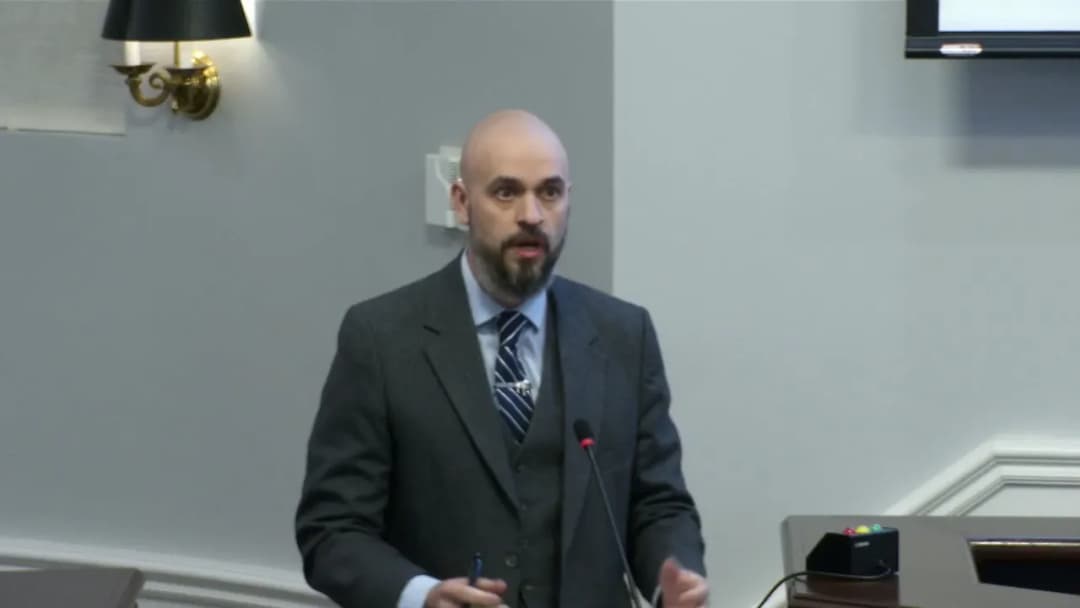
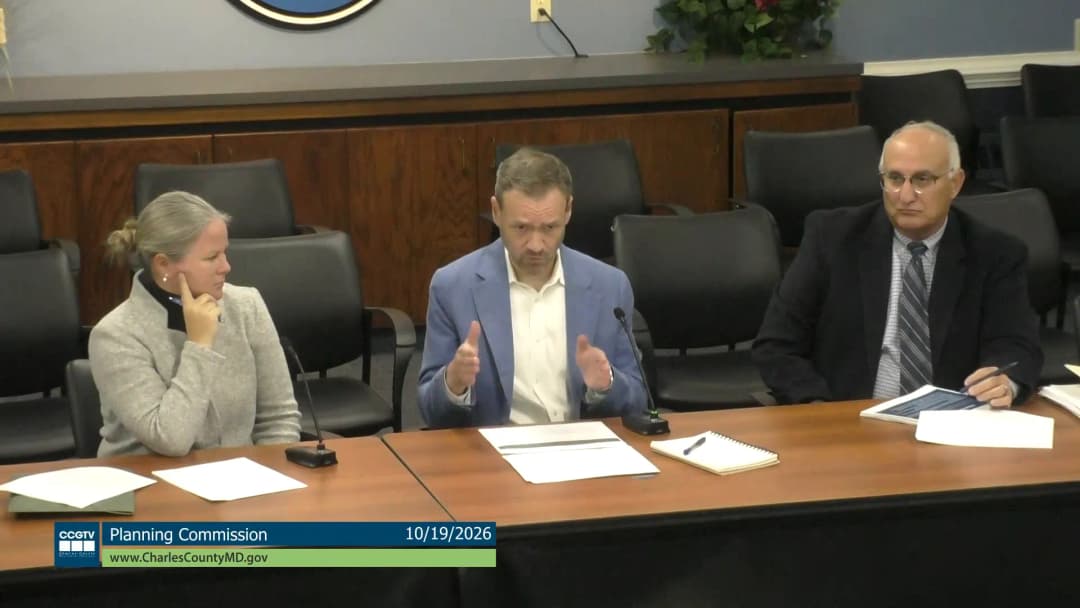
The Charles County Planning Commission convened on October 19, 2026, with all members present. The central agenda item was a work session and vote on Docket 8A, a proposal to delegate certain minor architectural and use approvals from the St. Charles Plan Design Review Board (PDRB) to county planning staff, aimed at reducing delays for homeowners and small businesses. Consent Calendar - Roll call was taken. Present: Kevin Wettding, Denard Earl, Jeffrey Bossert, Samaya Hackett, Ryan Sekretarsky, Britt Toku. - The agenda was approved. - Minutes of September 21, 2026, were approved (Commissioner Earl recused). - Minutes of October 5, 2026, were approved (Commissioner Chow recused due to absence). Public Comments & Testimony - Staff recounted public testimony from the prior hearing on this item. They reported that opposition was primarily based on a conflation of the proposal with data center development. Staff explicitly and repeatedly stated that this delegation has no bearing on data center approvals. - Staff noted that supporters of the request acknowledged it would streamline an inefficient process for basic homeowner items (fences, decks, sheds) and small business openings, who currently face lengthy PDRB delays. Discussion Items - Docket 90 Designation Delegation: Jason Groth (Planning Director), Kathy Reisinger (Deputy Director), and Steve Scott (Attorney for St. Charles) presented the narrowly-scoped request. The delegation applies only to: residential projects after initial certificate of occupancy; commercial changes in ownership or tenant without a change in use; and temporary commercial sign permits. It does not affect new construction, exterior renovations, use changes, or growth rates. A final draft Memorandum of Understanding (MOU) detailing roles and responsibilities was included in the meeting materials. - Planning Commission Role and Transparency: Commissioner Jeffrey Bossert raised concerns that the Planning Commission could be placed in a difficult position if it only sees major projects at the site development plan stage. He advocated for earlier notification and more frequent reviews of St. Charles master plans. Staff responded that the standard process for all zones is to review site plans, and the significant pre-development costs (e.g., $100,000 to $500,000 for utility studies for a data center) typically ensure developers conduct thorough due diligence and community outreach before reaching that stage. - Staff Capacity: Commissioner Samaya Hackett questioned whether county staff had sufficient resources to handle the new approvals without creating new delays. Staff confirmed the workload would not increase—the same applications would simply bypass the PDRB step, potentially reducing current wait times of up to four months for simple permits like decks and sheds. - Stakeholder Engagement: The Chairperson recommended that St. Charles representatives schedule a formal update briefing for the Planning Commission, a practice that has not occurred recently. Key Outcomes - Motion Approved: The Planning Commission voted unanimously to approve the delegation of authority for the defined minor items to the county. - Memorandum of Understanding: The approval is contingent on the execution of a formal MOU, with an indefinite term and termination provisions, to be signed by the President of the County Commissioners and St. Charles Community LLC. - Action Items: Staff committed to exploring ways to provide the Planning Commission with earlier notice of significant commercial or industrial development in the PUD. The St. Charles team agreed to present a community status update to the Commission. The meeting adjourned at 7:00 PM.

PLANNING COMMISSION ANNUAL REPORT 41% · ZONING 33% · DATA CENTER REGULATION 18% · PROCEDURAL 8%
1942
OCT 19, 2026 · SOUTHFIELD, MICHIGAN · CITY COUNCIL
Southfield City Council Regular Meeting - October 19, 2026

The City of Southfield, Michigan City Council held its regular meeting at 6 p.m. on October 19, 2026. Roll call confirmed a quorum, and Council President Hicks presided. The meeting included a youth baseball championship recognition, a public comment period, consent agenda approvals, public hearings on two tax-incentive requests, ordinance actions, and departmental reports. The meeting adjourned at 8:52 p.m. No separate agenda or minutes were included with the supplied transcript. Presentation: Southfield A's 12U Championship - Council and the mayor jointly congratulated the Southfield A's 12U travel baseball team on winning the 2026 Detroit PAL Championship. The organization was noted as serving Southfield youth since 2004. - Coaches and parents spoke, thanking the council for field improvements that helped the team practice; organization leader Coach Gill was honored in absentia because he was attending his father's viewing. Consent Calendar - Approved all items on the consent calendar in one motion with all ayes and no opposition. Items included: (A) police department investigation division/patrol administration renovation; (B) police department National Transportation Safety Organizational grant; (C) application for a 2027 Michigan Arts and Culture Council grant; (D) Nine Mile Road pathway agreement, Northwestern Highway to Greenfield Road; (E) DTE billing agreement for equipment removal/relocation for the Nine Mile pathway; (F) Road Commission for Oakland County winter maintenance agreement for 2026-27; (G) amendment of Resolution 2025-366, pump station renovation program, to include a change order; (H) audio and lighting services contract for concerts/events; (I) SMART municipal community credit service agreement for July 1, 2026-June 30, 2027; (J) Southfield Public Library construction manager contract for phase one of the library improvement project; and (K) receipt of bids for printing the 26th annual report and 2027 calendar. - During discussion of item E, council questioned the 'unforeseen conditions' cost language. Staff replied that DTE has not previously sought extra funds, contingency is typically about 10%, city administration can authorize up to 20% above council authorization, and larger changes would return to council. Public Comments & Testimony - Robin Boyer (Mount Vernon subdivision) asked what 'multi-generational community hubs' means in the Leonard Elementary redevelopment, whether plans had been submitted, and why nearby subdivisions were not notified. Council President responded by referring to a redevelopment website. - Sydney Thompson, Cameron Fink, Laura Fink, and Mary spoke about ICE. They demanded release of unredacted bodycam footage from the June 29, 2026 high-speed ICE chase at Tel-12, said a FOIA appeal had passed its deadline, and called for charges against ICE agents and a ban on ICE chases in Southfield. Laura Fink, citing ICE data compiled by the Deportation Data Project, said 78 Southfield neighbors were taken between January 2025 and July 2026, none had been convicted of a violent crime, and 90% had not been charged with a crime. Laura Fink also said more than 50 people have died in ICE custody since President Trump took office. The city attorney said FOIA appeals are reviewed by her office, an appeal was sent September 14, and Michigan FOIA exemptions apply. - Jill Spadora said the council had shown disrespect to residents, citing an earlier instance when a teenage speaker was escorted out, and urged council to model respect. - Cheryl Oliverio, Sean McDonnell, and another speaker objected to the data center approved near Inkster/I-696/Eleven Mile. They cited electricity demand of about 100 megawatts, only about 35 jobs, noise, water use, diesel generators, property values, and lack of public input; they asked for a moratorium or reconsideration and stronger oversight. Council President responded that the project has multiple uncompleted phases before groundbreaking, and environmental/health questions remain to be determined. - Garland McWilliams said Kroger has not delivered promised upgrades at the Southfield store while spending $70 million on projects in Dearborn and Commerce Township; he called for accountability. Council President said he had weekly contact with Kroger and had pressed for cleanliness, food options, amenities, and a remodel. - Fred Pinkston opposed an ordinance he said would require a city inspection and fees before a homeowner could transfer property to children, and he opposed Flock cameras. He said residents had not voted on these measures and needed respect from council. - Vince Gallant said public information about the aquatic center and data center had been insufficient. Councilmembers responded that the aquatic center had been studied for several years with council committees, visits to six communities, an RFP, and community input. - Pam Gerald criticized the Southfield Chamber of Commerce for missing ribbon cuttings and pushing city staff out of photos, and asked council to address the city's chamber membership. Public Hearing: DDK Acquisition Tax Abatement Extension - The city held a public hearing on a request by DDK Acquisitions for an extension of Commercial Rehabilitation Exemption Certificate C2021-001 for 23800 Northwestern Highway, originally approved January 21, 2021. - The petitioner said he had exceeded the original $2 million improvement commitment, has over 20 businesses in the building, 14 new to Southfield, about 200 employees, and pays over $65,000 in property taxes; the building is about 65% occupied. He requested the full additional period available under PA 210, while staff recommended five years. - Public comment included praise for the investment and questions about the tax freeze length, milestones, and accessibility of application materials. City staff said an additional $500,000 investment is planned and the building would be reassessed/uncapped after the exemption. - Council approved a five-year extension and added language permitting the owner to return after five years for the remaining two-year extension. Motion carried. Public Hearing: Specs Howard/Condo Detroit LLC OpRA and Exemption Certificate - The council held public hearings on establishing an Obsolete Property Rehabilitation Act (PA 146) district and approving an exemption certificate for 1990 West Nine Mile, the former Specs Howard building. - Brian Giles of Condo Detroit LLC said the 60,000-square-foot building, built in 1971 and vacant since about 2020-21, would be converted into 56 rental apartments (28 per floor) on 3.3 acres with two parking spaces per unit, gated parking, and a possible retail corner. He cited a current assessed value of $800,000, a $15 million post-renovation investment, $30,000 annual taxes if unabated, an estimated $54,000 annual incremental tax gain, at least 35 construction jobs, and 2 property management jobs. - Public comment included concerns about density, unit sizes, HOA disclosures, the number of apartments already in Southfield, tax abatement burden, and uncertainty about design; one resident supported the redevelopment. Council questions covered short-term rentals, parking gates, retail parking, and neighborhood contacts; the developer said he had talked to the neighborhood association president and would address details in upcoming site plan review. - The council approved both the establishment of the OpRA district and the exemption certificate for Condo Detroit LLC. Motions carried. Ordinances, Resolutions, and Reports - Ordinance 1846 was enacted. The transcript did not specify its subject. - Travel expense reports related to the MML convention in Traverse City were approved. - Council approved an amendment to Chapter 17 (Garbage and Rubbish), allowing containers from 10 to 96 gallons and requiring them to be kept out of the front yard; Ordinance 1847 was then introduced. - Council approved an ordinance prohibiting the sale of Kratom to persons under 21 and introduced it as Ordinance 1848. A coalition representative said the DEA had recently proposed temporary scheduling of enhanced Kratom and noted about 304 Kratom products contain opiates. - Treasurer's report: the council approved the annual depository resolution update, adding Dort Financial Credit Union, Financial Plus Credit Union, First State Bank, and Oxford Bank, and approved the annual investment policy update with no changes. Key Outcomes - Recognized the Southfield A's 12U baseball team. - Approved the entire consent calendar. - Approved the five-year DDK Acquisitions commercial rehabilitation exemption extension, with a future two-year option. - Established an Obsolete Property Rehabilitation District and approved an exemption certificate for Condo Detroit LLC's Specs Howard redevelopment. - Enacted Ordinance 1846; approved and introduced Ordinance 1847 (garbage/rubbish) and Ordinance 1848 (Kratom age restriction). - Approved travel expense reports, the depository resolution update, and the investment policy update. - Announced upcoming events: aquatic center groundbreaking on Thursday at 4 p.m., library jazz event on Wednesday, Catalpa Park soft launch, VA community-based outpatient center opening, and an active election season with official ballot drop boxes.

ECONOMIC DEVELOPMENT 21% · PROCEDURAL 12% · PUBLIC ENGAGEMENT 11% · COMMUNITY ENGAGEMENT 8%
1943
OCT 19, 2026 · HOUSTON, TEXAS · COMMITTEES AND COMMISSIONS
Houston Historic Preservation Appeals Board Meeting – October 19, 2026

The Houston Archaeological and Historical Commission Appeals Board (HPAB) met on October 19, 2026, to consider an appeal of the HAHC's decision regarding a certificate of appropriateness for a protected landmark at 3023 Delmonte Avenue. The board also approved the prior meeting minutes and the 2027 meeting schedule. After extensive discussion of life-safety and preservation code conflicts, the board voted to affirm the HAHC's decision with a direction for the applicant to provide additional technical information for reconsideration by the HAHC at its November 5, 2026, meeting. Consent Calendar - The board unanimously approved the minutes of the prior meeting (motion by Edminster, second by Kelman). - The board unanimously approved the proposed 2027 HPAB meeting schedule (motion by Kelman, second by Edminster). Discussion Items - Appeal of HAHC Decision for 3023 Delmonte Avenue (Mr. and Mrs. John P. Bullington House): - Staff (Samantha DeLeon) summarized the HAHC's September 10, 2026, decision: approval with conditions that only rear windows may be replaced; all original windows visible from the public right-of-way on front and side elevations must be retained. The applicant sought to replace all windows with custom, double-hung, insulated, tempered-glass replicas, citing safety (floor-to-ceiling windows in children's bedrooms violating residential code for tempered glass and egress) and moisture problems. - Appellant representative Nadia Palacios Lauterbach argued that the unique floor-to-ceiling windows designed by architect Birdsall Briscoe create a life-safety hazard, and that an interior storm window solution (suggested by staff) would violate egress and trap moisture. She emphasized that the proposed custom windows would be exact replicas and that salvaging the originals was offered. - Board members questioned the feasibility of retrofitting the existing sashes with tempered glass alone (without full replacement), the weight implications, and the need for detailed drawings of the proposed replacement windows. The board also noted a conflict between the historic preservation ordinance and the residential building code. - Legal counsel clarified that the HPAB must either affirm or reverse the HAHC decision within 45 days; a

HISTORIC PRESERVATION 69% · PUBLIC SAFETY 15% · LEGAL CONSIDERATIONS 10% · PROCEDURAL 6%
1944
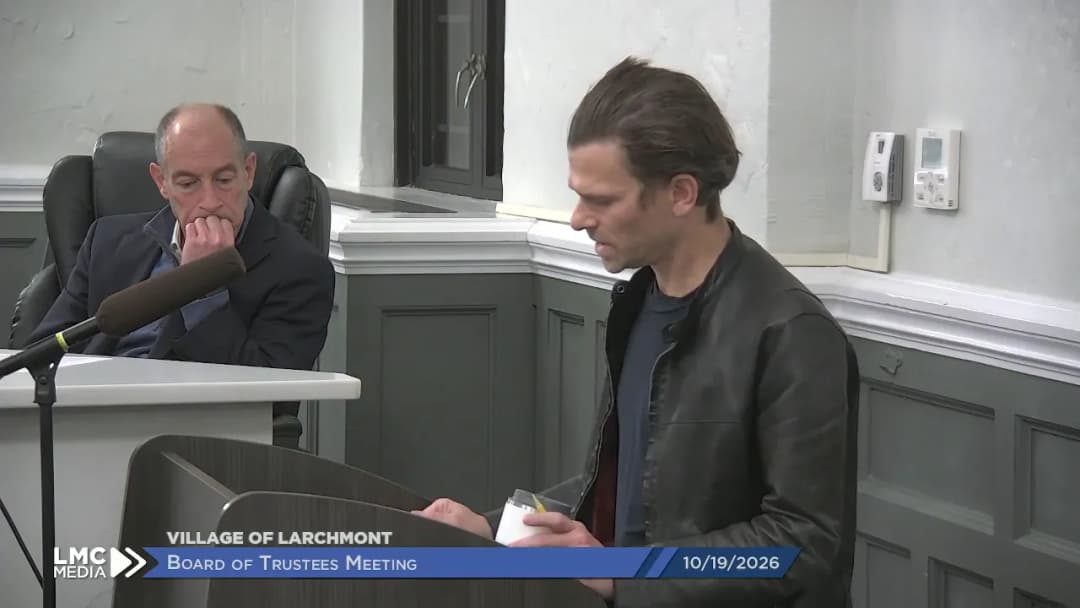
OCT 19, 2026 · LARCHMONT, NEW YORK · VILLAGE BOARD OF TRUSTEES
Larchmont Village Board Meeting: Grants, Appointments, and Public Comment, October 19, 2026

The Larchmont Village Board met in the evening on October 19, 2026. Trustee Fennelli was absent; the village attorney and village administrator attended. The board heard department reports, approved a series of special agenda items and bill lists, and received public comment on two major local issues: the New York State DOT road diet proposal for Boston Post Road and environmental contamination at Flint Park. Consent Calendar - Approved the special meeting minutes of September 18, 2025. - Approved the bill list from July 24, 2026 through October 1, 2026 totaling $1,599,597.46, and a second bill list identified as job ID 444 totaling $251,001.33. The board highlighted that a new police vehicle on the bill list was a hybrid, consistent with the village's green fleet goals. - Noted prior work-session actions from September 28, 2026: amendment to the fringe benefit policy for non-union employees and elected officials, promotion of Sergeant Michael Dusset to police lieutenant, and an exception to the bench donation policy. A separate bill list approval was also noted as from October 5, 2023, as stated in the transcription. Public Comments & Testimony - Julie Hecker, co-owner of Sherwood's Restaurant, read a letter into the record formally opposing the NYS DOT road diet/complete streets plan for Boston Post Road. She cited concerns about concrete medians, loss of curbside parking, delivery trucks blocking single-lane traffic, and bike lanes on a busy commercial corridor. She said the plan could force Sherwood's to move to a more business-friendly town, noted about a dozen empty storefronts already in the area, and urged the board to advocate on behalf of local businesses to the NYS DOT. - Kristen Anderson, a concerned resident, said the village ignored applicable environmental laws during construction at Flint Park, which sits on a documented incinerator-ash landfill. She described public health risks, likely project cost overruns, and asked the village to conduct park-wide soil testing, inform residents, especially parents, about potential exposure, and take a more open approach. - John, a community member, asked the board for transparency. He cited site history, shallow soil testing showing elevated lead, carcinogenic PAHs, chromium, mercury, semi-volatile organic compounds, and all 18 samples with toxicity. He said the project should have triggered additional permitting and a Type I environmental review, and he referenced an August DEC Notice of Violation. He requested work-session minutes, FOIL compliance, community workshops, and involvement of the environmental committee and coastal zone commission. - Michael, a community member, thanked village staff for responding to hazardous leaf piles after a complaint the prior year. He discussed leaf collection procedures, mentioned that nearby Mamaroneck moved its leaf window to November 2, and urged the board to harmonize leaf collection rules for safety. Discussion Items - Mayor's report: announced a $4.8 million Transportation Alternatives Program grant from Governor Hochul's office, with a $1.2 million village match, totaling $6 million for safety infrastructure improvements on Chatsworth Avenue, Larchmont Avenue, and Vanderberg Avenue. She credited the prior board, AKRF, the Safe Routes to School Committee, and village staff. She also reminded residents about the November 3 general election, early voting starting October 24, the 23rd annual Arts Festival with over 60 artists, the October 24 Ragamuffin Parade, and the November 15 emergency preparedness webinar with free emergency go bags for registered attendees. - Village administrator report: said the affected Flint Park area has been secured and posted with signage, and the village is working with New York State DEC on mitigation, remediation, and monitoring. Police Chief Paprota retired effective October 16, 2026; Lieutenant Dan Callipai is overseeing the department while the village conducts a search for a new chief. - Police chief report: oversaw the swearing-in of Lieutenant Michael Dusset, a 21-year Larchmont PD veteran with 27 years of total police service. He reported assisting MTA PD on October 16 with an arrest of a suspect who allegedly set a small fire at the Larchmont train platform. He also discussed seasonal property crime prevention, the dark-house property check program, the 50th anniversary memorial for Patrolman Arthur DeMati, who was killed on October 12, 1976, Coffee with a Cop, and library storytime. - Fire chief report: described an October 9 response to an electrical fire in a bathroom, fire prevention week education focused on safe charging of lithium-ion batteries, and a FEMA Assistance to Firefighters Grant covering 95% of the cost, just over $60,000, to replace the fire department's vehicle exhaust system. He urged residents to check smoke and carbon monoxide detectors and congratulated Lieutenant John Adams and Firefighter Jordan Bogart on completing marathons. - Trustee reports: no items were reported. Key Outcomes - Unanimously scheduled a public hearing on a proposed local law to amend Chapter 245 of the Village Code relating to streets and sidewalks; the hearing date was not stated. - Unanimously approved the SCADA application upgrade for the water department, covering both hardware and software. - Unanimously authorized the purchase and installation of a new vehicle exhaust system for the fire department. - Unanimously appointed Julia Davis as deputy village clerk. - Unanimously amended the paddle tennis permit and league fees schedule. - Unanimously authorized the village administrator to extend the Westchester Joint Waterworks water purchase contract for one year on a form acceptable to the village attorney. - Noted that a rescheduled special work session on capital planning will be publicly noticed, with the Flint Park Conservancy invited. - Adjourned the meeting after the above actions.

PROCEDURAL 33% · PUBLIC SAFETY 14% · ENVIRONMENTAL PROTECTION 13% · TRANSPORTATION SAFETY 12%
1945
OCT 19, 2026 · CARMEL, INDIANA · CITY COUNCIL
Carmel Finance Utilities and Rules Committee Meeting Summary - October 19, 2026

The Carmel Finance Utilities and Rules Committee met on Monday, October 19, 2026, at 3:31 PM. The committee considered two items: an ordinance regarding nonprofit organizations receiving city support (Ordinance D-2772-25) and a resolution to maintain the current property tax rate for 2027 (Resolution CC 10-05-26-02). The committee voted unanimously on both items. Ordinance D-2772-25: Non-Profit Oversight - Corporation Counsel Benjamin Legg presented analysis of the originally proposed ordinance. He noted that the definition of "affiliated entity" was overly broad, potentially encompassing many nonprofits that receive indirect city support (e.g., Rotary Club for CarmelFest). The ordinance would require nonprofits to amend their articles of incorporation to include a council appointee and have all other board members approved by the city council, which Legg argued may exceed the council's legal authority under Indiana Code and could deter nonprofits from partnering with the city. - Legg proposed an alternative: narrow the definition to organizations that are supporting organizations under IRC 509(a)(3) or community development corporations, and require only annual financial reporting. - Councillors Minor, Green, Rowell, and Ward all expressed agreement with Legg's concerns. Minor stated she researched Indiana Code 23-17 and consulted a nonprofit attorney, concluding the requirement to amend articles of incorporation would be an undue hardship. Green noted the ordinance was introduced hastily as a reaction to a past event and called it "bad government." Rowell said forcing nonprofits to change bylaws to partner with the city is difficult. - A motion was made by Councilor Royal to send the original ordinance back to the full council with a negative recommendation, seconded by Councilor Green. The motion passed unanimously. Resolution CC 10-05-26-02: Property Tax Rate for 2027 - CFO Zach presented the resolution to keep the 2027 property tax rate at 0.7783, the same as 2026. This is due to a 1.6% decline in net assessed value (down $199 million) resulting from changes in SEA 1. Holding the rate flat means the city will collect less property tax revenue (from approximately $92 million to approximately $90 million). - To compensate, the administration prioritized the operating levy to maximize local income tax (LIT) receipts, capturing an additional $3 million that would otherwise have gone to other communities. The debt levy will be supplemented with general fund dollars. The budget fully funds operations without increasing taxes. - Councillor Ward asked about the impact; Zach confirmed the budget is balanced. Councillor Minor praised the strategy of maximizing the max levy quotient. - A motion to send the resolution to full council with a positive recommendation was made by Councilor Minor, seconded by Councilor Ward, and passed unanimously. Adjournment The meeting adjourned at 3:31 PM.

NONPROFIT OVERSIGHT 51% · BUDGET EQUITY ANALYSIS 30% · LEGAL DEPARTMENT BUDGET 10% · DEBT MANAGEMENT 6%
1946
OCT 19, 2026 · NEW YORK CITY, NEW YORK · CITY COUNCIL
NYC Council Committee on Health: Food Service Inspection Oversight and Legislation – October 19, 2026

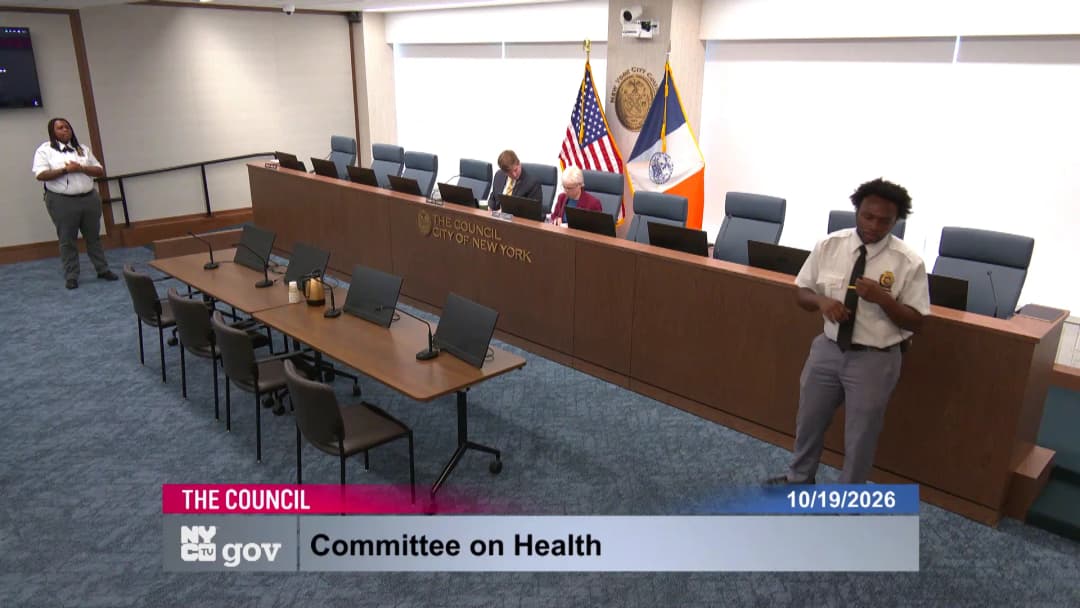
The New York City Council Committee on Health, chaired by Councilmember Lynn C. Schulman, convened at 10:00 AM in Hearing Room 2 at 250 Broadway on Monday, October 19, 2026, for an oversight hearing on food service establishment inspections in New York City and to consider six introductions and one resolution. Members present: Schulman, Ariola, De La Rosa, Epstein, Marte, Narcisse, and Wilson; Councilmember Gennaro was absent and Councilmember Felder was excused for medical reasons. Deputy Commissioner Corinne Schiff testified for the Department of Health and Mental Hygiene (DOHMH), joined by Assistant Commissioner Kim Kessler, Dr. Achala Talati (Director of Tobacco Policy and Programs), and Vasuda Reddy (Deputy Director, Bureau of Communicable Diseases). All legislation considered was laid over by the committee without final action. Oversight: Food Service Establishment Inspections Chair Schulman reported that council analysis of DOHMH data showed average monthly inspections rose from approximately 1,400 in the final quarter of 2023 to nearly 2,200 by June 2024, reaching just under 2,700 by August 2026. She noted the entry-level public health sanitarian workforce has not returned to pre-COVID levels, and that facility/equipment maintenance and pest presence/prevention account for nearly half of all violations. DOHMH testimony and Q&A highlights: - About 90% of restaurants post an A grade, up from 85% in FY12; the program celebrated its 15th anniversary in July 2025. - DOHMH regulates about 40,000 food service establishments, roughly 30,000 of which are restaurants; inspections are unannounced and randomized. - Inspections totaled just over 20,000 in FY24, almost 21,000 in FY25, and nearly 21,400 in FY26 (just over 16,000 initial inspections, almost 6,000 re-inspections, and just over 250 compliance inspections). - Per the Fiscal 2026 Mayor's Management Report, DOHMH inspected 71% of restaurants, below the 100% target; about 8,800 restaurants were not inspected in FY26, and just under 500 had gone two or more years without an inspection. - The food safety bureau budget is about $25 million, about $20 million for personnel; DOHMH stated hiring, not funding, is the main barrier to full staffing. - DOHMH trains about 35,000 food protection certificate (FPC) holders per year; the in-person course costs $114, the online course is free, and the review course and exam cost $24. In FY26 it issued about 2,800 violations for no FPC holder on site and just over 870 grade-posting violations. - DOHMH maintains an ombudsperson and customer service office for restaurant owners and agreed to share outreach materials with council members. Legislation Considered - Int. 0189-2026-A (photo/video documentation of violations): Would require notices of violation issued during food service inspections to include photographs or video recordings of each cited violation when an inspection results in 14 or more points (the cutoff for an A grade). DOHMH expressed concern that photographing and video-recording violations would lengthen inspections and require significant data storage and record retention resources. Local 768 called the mandate impractical, redundant, and a risk to inspector safety. The committee amended the bill and laid it over. - Int. 0405-2026-A (children's meal nutrition standards): Would set nutrition standards and beverage options for children's meals served in chain restaurants, including at least one non-juice fruit serving, one serving of non-deep-fried vegetables, reduced juice serving sizes, and limits on calories, sodium, and saturated fat. DOHMH expressed support, noting whole milk is appropriate for children ages 1–2 and flagging concerns about added sugars in flavored milk. The American Heart Association supported the bill but objected to whole milk and flavored milk being included as options, arguing this would weaken the existing default beverage standard. The committee amended the bill and laid it over. (Note: the transcript once refers to this bill as "504A"; the agenda and minutes identify it as Int. 0405-2026.) - Int. 0908-2026 (digital FPC verification): Would require DOHMH to create and maintain a digital database of food protection certificate holders and consult it during inspections before penalizing a restaurant for lacking a physical certificate. Sponsor Councilmember Santuso said the bill closes a bureaucratic loophole hurting restaurants. DOHMH supports the intent but cited operational hurdles, including records currently deleted after 10 years and the scale of maintaining decades of records for about 35,000 new certificate holders per year. Laid over. - Int. 0947-2026 (tobacco bar transfers): Would allow a qualifying tobacco bar experiencing financial hardship to seek a one-time transfer of its registration and tobacco retail dealer license to a new location. DOHMH opposed the bill, stating it would undermine the attrition purpose of the Smoke Free Air Act; it testified that five tobacco bars currently operate in the city, down from eight when the law was enacted. The American Cancer Society Cancer Action Network also opposed it. Christina Danson testified in support, arguing the government should regulate rather than ban lawful businesses. Laid over. - Int. 1094-2026 (Legionella reporting): Would require building owners to report Legionella test results of at least 10 colony forming units per milliliter (CFU/mL) to DOHMH. Chair Schulman noted the 10 CFU/mL metric has been used successfully in Canadian jurisdictions. DOHMH said its corrective-action requirements already begin at the same low level and looked forward to discussing the reporting requirement. Laid over. - Int. 1124-2026 (FPC recertification): Would require individuals managing or supervising food service establishments to renew their food protection course certification every five years. DOHMH said it supports the intent and would work with the council on implementation. Laid over. - Res. 0152-2026 (state food additives legislation): Would call on the New York State Legislature to pass, and the Governor to sign, S.1239A/A.1556A, prohibiting certain food additives, prohibiting the sale of food containing certain color additives at schools, and restricting substances "Generally Recognized as Safe" unless reporting requirements are met. Laid over. Public Comments & Testimony - Carmen Deleon, President, Local 768: Representing public health sanitarians, cited a shortage of sanitarians and salary concerns and said Intro 189 is impractical and redundant with existing processes. - Charlton Smith, Executive Vice President, Local 768: With 24 years of DOHMH service, raised serious concerns about Intro 189, including administrative burden, privacy risks, inspector safety, and data storage demands, and urged the council to reconsider the mandate. - Michael Divoli, American Cancer Society Cancer Action Network: Opposed Int. 947 as undermining the Smoke Free Air Act, noting more than 12,000 New Yorkers die annually from tobacco-related illness and that the city has more than 6,000 licensed tobacco retailers; he said the market now has six tobacco bars (a figure that differs from DOHMH's count of five). He also expressed support for the school food additives resolution. - American Heart Association representative: Supported Int. 405-A, citing that nearly 40% of New York City public school children in grades K–8 are overweight or obese and fewer than one in five children ages 5–13 consume recommended fruit and vegetable servings per day; raised concerns about whole milk and flavored milk in the bill and opposed Int. 947. - Christina Danson: Testified in favor of Int. 947, citing the 1942 New York State Supreme Court decision Good Humor v. City of New York holding that the city cannot ban a lawful licensed business where regulation would suffice. - Virginia Villa, Deputy Research Director, Hotel and Gaming Trades Council: Supported Int. 1094, describing a hotel where Legionella levels below the 1,000 CFU/mL reporting threshold went unreported; a later test showed density increased fourfold to over 700 CFU/mL, and workers and guests learned of the risk only after the union became involved and arbitration secured remediation. - Philip Stewart White, independent consultant and former co-designer of Vancouver's cooling tower registry: Supported Int. 1094 and suggested requiring every monthly test result to be reported, not only those at or above 10 CFU; he reported that Vancouver reduced elevated results from repeat systems by 86% in four years through targeted follow-up. - Ian Horn, President, Cooling Technology Institute: Opposed lowering the reporting threshold to 10 CFU/mL, stating that no single Legionella concentration has been demonstrated to reliably predict human illness and that the focus should remain on comprehensive water management programs; he offered CTI as a technical resource. Key Outcomes - The oversight item (T2026-2545) was filed by the committee. - All six introductions and the one resolution had hearings held and were laid over; Int. 0189-2026-A and Int. 0405-2026-A were amended by the committee before being laid over. - DOHMH committed to provide follow-up data, including a list of regulated establishment types, inspector job descriptions, data on takeout vs. sit-down restaurant inspections, salary comparisons with other jurisdictions, FPC fee revenue, and record retention periods. - Written testimony may be submitted to testimony@council.nyc.gov within 72 hours of adjournment.

PUBLIC HEALTH 60% · FOOD SAFETY 13% · PROCEDURAL 10% · PUBLIC ENGAGEMENT 7%
1947
OCT 19, 2026 · PLANO, TEXAS · PLANNING AND ZONING
Plano Planning and Zoning Commission Meeting – October 19, 2026

The Plano Planning and Zoning Commission met at 6:00 p.m. on October 19, 2026, and adjourned at 8:06 p.m. Seven commissioners were present; Commissioner Lingfelter was absent due to illness. The commission unanimously approved the consent agenda and two public hearing items, including a sign ordinance overhaul and a PD 184 amendment. Consent Calendar - The consent agenda was approved 7-0 as recommended by staff, with no items removed. Public Comments & Testimony - No speakers registered on the park easement item or the sign ordinance item. - On the PD 184 item, applicant Alan Hinckley, a long-term owner of the Preston and Parker center, supported the request, describing it as cleaning up a definitional "scrivener's error" and providing flexibility to lease a vacant 3,500-square-foot former title company space without new construction. - Michelle Giles, a neighboring resident directly behind the property, opposed the 3,500-square-foot retail increase. She said service tenants had been quiet but retail would increase trash, light pollution, and neighborhood disruption; she also cited landscaping and buffering concerns and asked that the property owners be better neighbors. Discussion Items Agenda Item 1 – Park Easement Modification - Staff presented an administrative request from the City of Plano to modify an easement necessary for park improvements on four lots totaling 70.8 acres at the southeast corner of Independence Parkway and Mao Mule Drive (as transcribed), within Single Family Residence 9 with Specific Use Permit 66 for a governmental service yard. - Staff recommended approval as submitted. The public hearing was closed with no speakers, and the commission approved the item 7-0. Agenda Item 2 – PD 184 Amendment at Preston Road and Parker Road - The petitioner, 3516 Preston LP, requested two amendments to Planned Development 184 on 31.3 acres at the northeast corner of Preston Road and Parker Road. Request A would allow retail and service uses permitted in the retail zoning district, excluding uses subject to residential adjacency standards. Request B would increase the allowed retail and service square footage in Tract 2 from 10,000 to 13,500 square feet. - Staff explained that Request A was consistent with the comprehensive plan and supported. Request B did not meet the community corners designation's priority to reduce excess retail zoning and would increase the retail share of the Preston/Parker measurement area above the recommended range; approval would require findings that the request is consistent with the comprehensive plan and beneficial to the community. - Staff received 10 signed letters of support within the subject property, four letters in opposition within 200 feet, and 17 total letters and online responses. - During discussion, commissioners noted the existing center was a well-occupied mixed-use retail center, that the change would not add buildings, and that the request resolved confusion about past certificates of occupancy. Some commissioners expressed concern about Plano's oversupply of retail but ultimately viewed the request as consistent with the center's actual use. - The commission approved both Request A and Request B 7-0, with findings required for the nonconforming square footage increase. Due to the electronic system being down, findings forms were to be completed on paper during a break. Agenda Item 3 – Sign Ordinance Update (Article 22) - Staff presented a legislative ordinance update requested by the City of Plano to revise sign regulations, following federal court decisions restricting content-based sign rules and changes in state law, including Chapter 216. - The update consolidates sign regulations into Article 22, reorganizes rules by time, place, and manner, removes content-based categories, and adds definitions. - Proposed changes include prohibiting new pole signs citywide, making existing pole signs non-conforming; allowing temporary signs to remain pole signs only if the commission adopted an amendment under paragraph Q; changing sign area measurement to an eight-line enclosure without a size penalty; excluding monument sign bases from sign area while including them in height; and adding a 300-foot residential adjacency restriction for illuminated signs unless fully screened or at a primary business entrance. - Staff also noted that gas station canopies may have sign copy on any side visible from the street and that price signs on poles would be considered non-conforming pole signs. - No public speakers registered. The commission approved the ordinance update 7-0, including the amended paragraph Q language exempting temporary signs from the pole sign prohibition. Key Outcomes - Consent agenda approved 7-0. - Agenda Item 1 approved 7-0. - Agenda Item 2 approved 7-0, including both requested amendments and required findings. - Agenda Item 3 approved 7-0, with the temporary-sign amendment. - Commissioner Michael Brunoff received a token of appreciation for four years of service on the commission. - Deputy City Attorney Michelle D'Andrea received a certificate of appreciation for 10 years of service to the commission.

PLANNING AND ZONING 68% · ZONING 19% · PROCEDURAL 8% · COMMUNITY ENGAGEMENT 4%
1948
OCT 19, 2026 · OVERLAND PARK, KANSAS · CITY COUNCIL
Overland Park City Council Meeting Summary – October 19, 2026

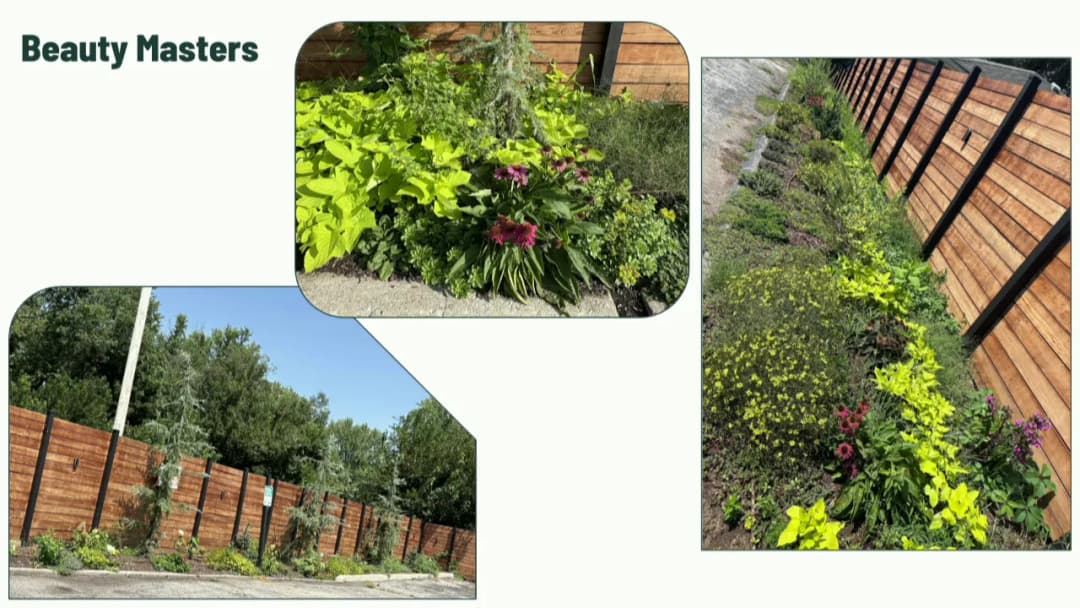
The Overland Park City Council met on Monday, October 19, 2026. No members of the public signed up for open public comment and no public hearings were held. The council approved routine consent items, a bond resolution, and scheduling of a budget amendment public hearing, then moved into a lengthy work session on the Unified Development Ordinance (UDO) update in Conference Room One. Consent Calendar - Council approved the consent agenda by roll call, with all members voting yes. The item was initially stepped through before a motion was made; council returned to it and formally approved it after acting on Resolution 5169. - Council also approved the proposed reappointment to the Planning Commission by voice vote. Public Comments & Testimony - None. The mayor stated that no one signed up for open public comment and there were no public hearings on the agenda. Mayor's Report and Presentations - The mayor read a proclamation designating October 2026 as Arts and Humanities Month in Overland Park. Sonia McClellan, Executive Director of the Arts and Recreation Foundation of Overland Park, thanked the council and highlighted that arts and culture generate $38.5 million in total economic activity in Johnson County and welcome over 652,000 audience members annually. - Councilmember Scribner read a proclamation designating October 2026 as Green Commute Challenge Month. Sustainability Programs Coordinator Gail Bergman said Overland Park has won an award every year since she took over the city's Mid-America Regional Council Green Commute Challenge effort and is currently in the top five; she invited council employees to join the city team. - The Legacy of Greenery Committee presented the 38th annual Landscape Excellence Awards. Winners were Element 25 Apartments, Overland Park Community Church, Overland Park Exchange, and Ranch Mart. Beautymasters Spa and Salon received the Continued Landscape Excellence Award for maintaining and enhancing landscaping since a previous 2012 award. City Foresters Bailey Patterson and Laura Peterson presented the awards. - The mayor announced that Overland Park was named the third safest city in America by WalletHub. - Council President Cheatham reported that approximately 1,000 residents attended Saturday's Recycling Extravaganza, resulting in more than three full box trucks of electronics and more than 550 pounds of fabric collected, with more than 200 volunteers, staff, vendors, and Shamrock Trading Corporation hosting the event. Discussion Items Unified Development Ordinance – Open Space and Amenities - Staff reviewed existing open space, landscaping, tree preservation, and amenity rules, noting that requirements are scattered across the code and that tree preservation currently applies to commercial and multifamily development but generally not single-family development. - Staff proposed six high-level amenity categories: natural areas, natural features, civic spaces, urban amenities, private community amenities, and housing/retail incentives. - Staff proposed requiring a minimum open-space set-aside across all zoning districts based on development size. Council feedback was mostly green with some yellow; concerns included impacts on housing cost, especially entry-level housing, and the need to calibrate requirements. Staff said the system would be cost-sensitive and flexible. - Staff proposed a flexible amenity system using major and minor amenity categories rather than a strict numeric point system. Council generally supported the direction with one yellow, but some councilmembers said the approach still felt complicated and warned against over-regulating in ways that deter development. - Council unanimously agreed that amenity types should vary by zoning district to account for infill, redevelopment, and greenfield conditions. - On the neighborhood district table, council members had questions about using both acreage and number of units but did not object; several yellow cards were shown. - For centers, corridors, and business districts, feedback was mixed: two green and the rest yellow on basing requirements on development square footage. Councilmembers discussed using acreage or trip-generation style metrics instead and called for more site-specific flexibility, possibly through planning director discretion. - Council generally supported establishing some base amenity requirements in business and industrial parks, with one yellow and discussion favoring open space, sidewalks, and landscaping improvements. - Council did not reach consensus on whether rural districts should require amenity points; most members showed red or yellow. Discussion raised off-site preservation, purchase/transfer of development rights, and the possibility of requiring plating in rural areas to preserve stream corridors and floodplain. Common Deviations and Alternative Compliance - Staff reviewed common deviations, including the 10 deviations associated with the 8036 Metcalf project, drive-through standards, trash/loading screening, and rooftop unit screening. - Council generally endorsed alternative compliance options instead of formal deviations, with a request for periodic reporting to the council on their use. - Council generally supported making architectural and building design standards less restrictive than current standards, with two yellows; staff said they would provide a detailed crosswalk of changes. - Council unanimously supported keeping the drive-through order box separation standard from residential uses, referencing the current minimum of 200 feet. - Council consensus was to maintain fully screened trash and truck loading area standards, with two yellows. Councilmembers discussed alternate compliance options, costs for churches, and one councilmember questioned whether trash screening should be an enforcement priority. - On rooftop requirements, there was no clear consensus: five yellow cards and the rest green on a proposal to be less restrictive about fully screening rooftop units. Council asked staff to define visibility standards more clearly and consider retrofits differently from new construction. UDO Alignment with Framework OP - Staff presented the Framework OP policy action ALU1 and a matrix of items A through J that the UDO update must address, including new zoning districts, sustainable development incentives, housing diversity, open space and greenway integration, tree canopy, drive-throughs, design standards, pedestrian and bicycle facilities, hybrid businesses, and missing middle/infill housing. - Staff said the next UDO meeting would focus on a timeline and process for releasing and reviewing a complete discussion draft. - Councilmembers raised questions about whether the amenity proposal fully addresses sustainable development infrastructure such as rain gardens and stormwater systems, and whether the UDO will help housing affordability. Staff responded that zoning can enable more housing production and that affordability would be addressed through broader production and incentives rather than direct affordability requirements. Key Outcomes - Resolution 5169 was adopted by roll call, all in favor. It authorizes the sale of $29.2 million in general obligation bonds with a sale date of November 16, 2026; net proceeds are anticipated to be approximately $31.6 million due to expected premium, funding projects in the city's adopted five-year capital improvements program. - The council voted to schedule a public hearing on a 2026 budget amendment for the Transient Guest Tax Capital Fund and the Transient Guest Tax Tourism Promotion Fund for November 16, 2026 at 7:30 p.m. in the City Council Chamber, with adoption to follow the hearing. The amendments would increase those two funds by $14.4 million as part of restructuring the transient guest tax funds. - The consent agenda was approved by unanimous roll call after the earlier procedural omission was corrected. - The Planning Commission reappointment was approved. - Council provided informal consensus and direction on UDO open space, amenity, and deviation topics; staff will incorporate feedback into the draft UDO and bring a timeline and draft-release plan to the next UDO discussion.

ZONING AND DEVELOPMENT 63% · ENVIRONMENTAL PROTECTION 11% · PARKS AND RECREATION 6% · PROCEDURAL 5%
1949
OCT 19, 2026 · NEW YORK CITY, NEW YORK · CITY COUNCIL
NYC Council Cultural Affairs Committee CreateNYC Oversight Hearing and Cultural Resolutions, October 19, 2026

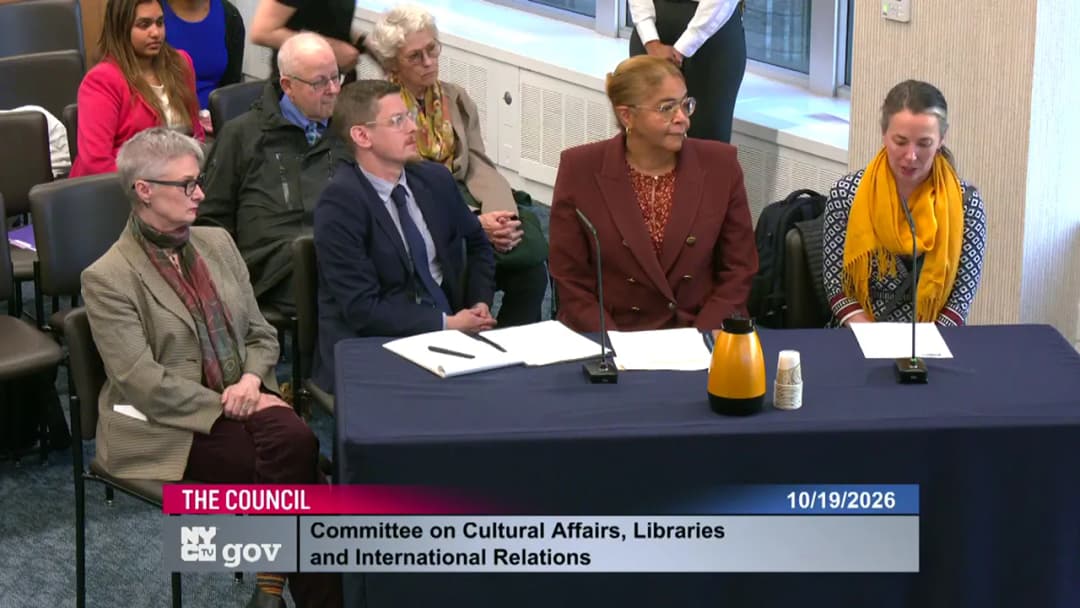
The New York City Council Committee on Cultural Affairs, Libraries and International Relations, chaired by Deputy Speaker Nantasha M. Williams, convened a hearing on October 19, 2026, at 1:00 PM. The primary focus was an oversight review of the 2017 CreateNYC cultural plan, evaluating its accomplishments and shortcomings. The committee also heard testimony on four resolutions designating cultural observances. Committee members present included Councilmembers Louis, Maloney, Ossé, Stevens, and Ung. Councilmember Hudson was absent. Public Comments & Testimony - Expert Witness (Penn SIAP): Mark Stern and Susan Seaford testified that cultural equity in New York has not meaningfully improved as economic inequality has deepened the "new geography of exclusion." They identified "civic clusters" in low-income neighborhoods as models for building community well-being from strength, recommending DCLA adopt a neighborhood lens and cultivate horizontal networks alongside vertical ones. - Expert Witness (IBO): Arden Armbrewster reported that CDF funding remains heavily concentrated in Manhattan, with 60% of grantees based there receiving 63% of funds. He noted small grantees (budgets under $500,000) are highly dependent on city funding and that organizations serving underserved communities were often the most financially vulnerable. - Public Testimony (Resolutions): Gregorio Mayers (Panama 507 Round Table) strongly urged passage of Res 0625-A (Reggaeton Heritage Month), detailing the genre's origins in Afro-Caribbean Panama and its evolution in New York. - Public Testimony (CreateNYC): Mauricio Delfin and Gonzalo Casals (CAP Institute) proposed separating CreateNYC into a DCLA capacity-building plan and a citywide shared cultural agenda. Lucy Sexton (NY4CA) called for legislation to make a cultural advisory group permanent, portable health benefits for teaching artists, and passage of artist preference housing legislation. - Public Testimony (Equity): Lisa Gold (A4) noted only 5% of CDF funding reaches AAPI-led organizations despite the population being 18%. Adam Odsess Rubin (National Queer Theater) requested $5 million baseline funding for queer arts. Chivelle Dixon (Pan African Solutions) urged extending CDF eligibility to mission-driven for-profit MWBEs. - Public Testimony (Space & Workforce): Randy Berry (Indie Space) urged land trusts, acquisition funds, and 20+ year leases. Esther Robinson (Art Built) called for a cultural production infrastructure fund. Kimberly Olson (NYC Arts in Ed Roundtable) highlighted the lack of certified arts teachers (69% of 8th graders not meeting state requirements) and the need to update CASA grant administration. - Public Testimony (Disability Access): Beth Prevor and Cindy Vandenbosch criticized the lack of transparency and accountability of the Disability Forward Fund, calling for disabled artists to be included in decision-making and for cultural organizations to be required to report on access data. Discussion Items - Oversight Hearing – What's Next for CreateNYC: Chair Williams opened by questioning whether the 2017 plan's promise of cultural equity had been kept. Commissioner Dea Vidge (DCLA) provided a comprehensive report, highlighting successes (CDF expansion by over $30M, DEI plans for all 39 CIGs, the Create in Place program, 568,000 Culture Pass reservations) and failures (lack of progress on living wages, weak support for individual artists, incomplete data tracking). Councilmember Stevens pressed on the lack of outcome data for the CUNY Cultural Corps (1,100 interns tracked anecdotally, not systematically) and the absence of measurable goals for CIG DEI plans besides their self-assessments. Chair Williams criticized the delays in submitting mandated reports to the Mayor and Speaker and the incomplete online data dashboards (stopping at FY22, updated just before the hearing). Councilmember Maloney, via written question from Councilmember Marte, challenged DCLA on the location of the Elizabeth Jennings Graham monument by Grand Central, geographically removed from the historic site of her protest. Key Outcomes - All four resolutions (Res 0163-A, 0164, 0186, 0625-A) were laid over by the committee without a final vote. - DCLA committed to submitting overdue progress reports to the Mayor and Speaker and to completing the appointment of the Cultural Affairs Advisory Commission within one month. - The committee broadly signaled a need for the next iteration of the city's cultural plan to include enforceable metrics, dedicated funding, and a broader "shared agenda" framework with cross-agency accountability, moving beyond DCLA alone. - No legislation was advanced to a full council vote from the hearing.

ARTS AND CULTURE 61% · PUBLIC ENGAGEMENT 7% · DISABILITY RIGHTS 4% · PROCEDURAL 3%
1950
OCT 19, 2026 · CARMEL, INDIANA · CITY COUNCIL
Carmel City Council Regular Meeting - October 19, 2026

The Carmel City Council met on Monday, October 19, 2026, at 6:00 p.m. in City Council Chambers. The meeting included approval of the amended agenda, invocation, Pledge of Allegiance, public comments, committee reports, adoption of the 2027 budget, discussion of a micromobility ordinance, and defeat of a nonprofit oversight ordinance. A report from the Center for the Performing Arts highlighted economic impact and parking challenges. Consent Calendar - Approval of Minutes from October 5, 2026 – Approved. - Claims, Payroll & General Claims – Approved: payroll $4,475,255.83, general claims $2,764.43, retirement $137,832.00. Public Comments & Testimony - William Lloyd (Carmel resident) – Opposed power-based restrictions in the micromobility ordinance, arguing the focus should be on behavior rather than vehicle specifications. Cited his experience with electric unicycles requiring higher power for stability. - Jack Feltman (Carmel resident) – Urged council to postpone the micromobility vote, citing that the public had insufficient time to review updated ordinance documents and that the land use committee meeting was held during fall break. Suggested enforcement alternatives using Indiana BMV penalties. - Karen Peyton (Small Business Administration) – Outlined SBA disaster assistance programs for individuals and businesses affected by the August storms, including physical damage loans and economic injury loans. Discussion Items Flood Recovery Update (Mayor) - Mayor reported on recovery from the August flood: damage assessments of structures in flood-impacted areas (Northwood Hills, Hazeldale Bridge area) were completed by Tetra Tech under Indiana Department of Homeland Security partnership. Under floodplain regulations, buildings with damage equal to or exceeding 50% of market value must be brought into compliance. Property owners will receive individualized letters with results and appeal information. Partnerships with Hamilton County Community Foundation and Clay Township Trustee office were highlighted; additional community support from Surve Village noted. 2027 Budget Adoption - Mayor's presentation: Held the city property tax rate steady at 77.83 cents per $100 of assessed value for the third year. Emphasized zero-based budgeting, increased road funding by nearly 100% since 2023, additional sworn police and fire positions, and continued investment in infrastructure and quality-of-life programs (arts, grants). Noted that state-mandated deductions will reduce city revenue despite flat rate. - Council comments: Several members praised the budget for maintaining services and a flat tax rate despite a challenging fiscal environment (declining assessed value growth). Councillor Locke voiced reservations about some items but acknowledged the necessity. - Key votes: - Ordinance D2848-26 (2027 budget) – Approved. - Resolution CC-10-05-26-02 (tax rate limit) – Approved. - Salary ordinances for city court, clerk, city employees, elected officials (D2849-26, D2850-26, D2851-26 as amended, D2852-26) – Approved. Center for the Performing Arts Report - Jeff McDermott (President/CEO) presented the economic impact ($23 million for Carmel; $27.4 million for Hamilton County), operational efficiency (cited Hyden report showing $581 per seat below peer average), and educational reach (over 25,000 participants in free/subsidized programs). Raised concerns about traffic and parking congestion during the Christkindlmarkt: holiday show attendance down 20% since 2023, revenue loss of $66,000, and increased attrition. Task force recommendations included a professional traffic/parking study, dedicated rideshare zone, and additional shuttle funding. Councillors expressed support and noted the need for long-term solutions. Micromobility Ordinance (D2843-26) - Councillor Joshi (Land Use Committee) summarized changes: added device examples, clarified that e-motos do not include e-bikes, revised dismount zone language to encourage caution, removed strict 3-foot passing requirement, and specified helmet standards. Public concern about document availability led to holding the item for further review. - Councillor Osin proposed an amendment setting a minimum age of 12 for Class 1/2 e-bikes. - Councillor Locke noted ongoing work to accommodate electric unicycles under appropriate subcategory. - The ordinance was held at the dais for additional public input and discussion. Nonprofit Support Ordinance (D2772-25) - Finance committee reported a unanimous negative recommendation. Corporation counsel Benjamin Legg outlined legal risks: the ordinance would require nonprofits receiving city funds to change their bylaws to include council representation and require council approval of board members, potentially conflicting with Indiana Nonprofit Corporation law. Councillors expressed concerns about overreach and disrespect to partners. A motion to adopt the ordinance failed unanimously. Key Outcomes - Approved 2027 budget and tax rate resolution (flat rate of 0.7783 per $100 AV). - Approved salary ordinances for court, clerk, employees, and elected officials, including an amendment to add a facility manager and a storm maintenance technician. - Held micromobility ordinance for further deliberation. - Defeated nonprofit oversight ordinance (motion failed). - Received reports from the Environmental Stewardship Committee (zero-waste subcommittee, sustainability fair) and the Center for the Performing Arts. - Announcements: Mayor’s Advisory Commission on Housing meets October 29; Back the Blue Bingo event on Friday (date unspecified) supports police food baskets.

COMMUNITY ENGAGEMENT 14% · PARKING MANAGEMENT 14% · PROCEDURAL 12% · ARTS AND CULTURE 11%
OPENPUBLICA · PUBLIC MEETING INDEXUPDATED DAILY · openpublica.com