The Commission on Family Affordability and Child Care Access met on November 4, 2026, at 6:00 PM. Commissioners approved the agenda and minutes from the last meeting, received member reports and updates from three ad hoc subcommittees, and appointed an alternate commissioner and filled vacant subcommittee seats. All votes were 9-0 in favor. Consent Calendar - Approved the agenda (9-0). - Approved the minutes from the last meeting (9-0). Public Comments & Testimony - No members of the public spoke during the unscheduled and scheduled communication portion, nor on the items regarding alternate commissioner appointments or subcommittee vacancies. Member Reports & Comments - Commissioner Rabiotto reported that his CWPC (Child Welfare and Parent Committee) meeting secured funding and grants for developing new child care centers at Fresno Pacific University. - Commissioner Cindy Hernandez had no comments. - Commissioner Young had no comments. - Commissioner Fabiola Gonzalez reported that First 5 is continuing to develop a scope of work for a child care pilot effort approved in the city's budget earlier this year. - Commissioner LeVra Smith congratulated Commissioners Nelson, Espranza, and Anna Lisa Perea, and announced that Supportive Services will celebrate its 50th anniversary with over 200 families registered. - Commissioner Ophelia Gonzalez expressed hope to bring the commission's affordable child care access plan to the city of Fresno and align efforts. - Commissioner Cervantes Woods shared that the Child Care and Development Local Planning Council continues work on a countywide child care strategic plan. - Chair Maxwell thanked commissioners for their dedication and noted that subcommittees have a one-year timeline with a six-month progress report. He requested that future subcommittee reports be submitted as written attachments to the agenda to allow discussion. The city clerk and city attorney confirmed this is permissible. Subcommittee Reports & Comments - Child Care Policy, Land Use, Funding, and Regulatory Solutions Ad Hoc Subcommittee (Chair: Fabiola Gonzalez): The subcommittee met twice since the last meeting and created a scope of work with deliverables and a timeline. Two major work areas: (1) review zoning and permitting standards for child care facilities to identify best practices and opportunities for change, and (2) examine potential funding resources (government, philanthropy, employers) to identify the best revenue model for the city. Members have research assignments and aim to present a report at the December meeting. - Child Care Workforce Development and Sustainability Ad Hoc Subcommittee (Chair: Commissioner Cervantes Woods): The subcommittee met once and will meet monthly (second Thursday). Priorities include gathering data from the city on current child care providers and gaps, leveraging partnerships (e.g., Local Planning Council), hearing directly from families, and gathering input from employers and providers. A report is expected in December. - Child Care Supply Capacity and Affordability Ad Hoc Subcommittee (Chair: LeVra Smith): The subcommittee will meet monthly (first Monday). Focus on maximizing existing resources, leveraging available data (including from the Local Planning Council's needs assessment), reviewing additional data (e.g., families awaiting child care assistance), and exploring the centralized eligibility list. The goal is to prepare a report in December and outline milestones to the six-month progress report. Key Outcomes - Appointment of Alternate Commissioner: Commissioner Rabiotto appointed Michael Balderas (EOC Head Start Director) as his alternate. The motion passed 9-0. - Filling Subcommittee Vacancies: - Item 8C: Commissioner Rabiotto was appointed to the Child Care Workforce Development and Sustainability Ad Hoc Subcommittee, bringing it to five members. Motion passed 9-0. - Item 8B: Commissioner Cervantes Woods was appointed to the Child Care Policy, Land Use, Funding, and Regulatory Solutions Ad Hoc Subcommittee, bringing it to five members. Motion passed 9-0. - Procedural Direction: Chair Maxwell will send a standardized template for written subcommittee reports to be included in future meeting packets. Future subcommittee updates will be agendized as discussion items to allow deliberation. - Next Meeting: No specific date was set, but the next regular meeting is expected in December with a target of six-month progress reports.
The Public Meeting Index
The Public Meeting IndexThe Board of Park Commissioners held its regular meeting on Wednesday, November 4, 2026, at 12:00 PM. The meeting was called to order, and the minutes from the October 21, 2026 meeting were approved unanimously. Consent Calendar - Approved surplus of two large mirrors from C.K. Newsome Center to the Children's Center for Dance Education. - Approved and executed agreement with Everything Exterior for Amazonia flat roof replacement at Mesker Park Zoo & Botanic Garden. - Approved and executed CenterPoint interconnection agreement for parking lot solar array at Mesker Park Zoo & Botanic Garden. Discussion Items - Igleheart Splashpad Fence Encroachment Amendment: Superintendent Scott Fankhouser requested approval of an amendment to the CenterPoint encroachment agreement to extend the fence into the parking lot for safety. Approved unanimously. - Igleheart Splashpad Change Order 3 ($27,029.49): Fankhouser detailed itemized costs including fleck flooring for bathrooms ($7,580), additional striping ($525), ADA sidewalk repair ($9,975), removal of concrete ribbon under fence, repainting exterior doors ($2,346) due to heat absorption, French drains ($5,008.49) for water issues, and a buck booster for pump ($1,595) to prevent power dropout. Approved unanimously. - Informational Signage at Howell Wetlands: Mariah Bradley (co-Executive Director of Wesselman Woods) presented a proposal to install two signs funded by Altrusa International Group ($2,000) featuring migrating birds and beavers as a keystone species. Also, a beaver baffle to mitigate flooding, funded by West Side and Dutch Club (up to $5,000). Approved unanimously. - Golfmoor Park Tennis Court Resurfacing Bids: Two bids were opened: Tennis Technology Inc. base bid $113,793 with an alternate fence item at $35,003; Superior Asphalt Maintenance base bid $110,050. Taken under advisement. - Wesselman Park Main Restroom Project Bids: Five bids were opened: ARC Construction $745,000; Midwest Contracting & Maintenance $798,000; Sellers Masonry $792,000; Dyke Brothers Lumber & Construction $853,600; Danco Construction $962,000. Taken under advisement. - Amazonia Boardwalk Change Orders 3 and 4 ($12,979): For Custom Mechanical to address unforeseen footing issues during bridge disassembly at Mesker Park Zoo. Approved unanimously. Key Outcomes - Approved minutes of October 21, 2026. - Approved consent calendar items (3 items). - Approved Igleheart Splashpad fence encroachment amendment. - Approved Igleheart Splashpad Change Order 3 ($27,029.49). - Approved informational signage at Howell Wetlands. - Opened and took under advisement bids for Golfmoor Park tennis court resurfacing and Wesselman Park main restroom. - Approved Amazonia boardwalk Change Orders 3 and 4 ($12,979). - Approved payroll and vendor claims. - Meeting adjourned.
This public hearing, held on Wednesday, November 4, 2026 at 12:00 PM in the Broken Arrow Council Chambers, addressed two nuisance abatement cases involving dilapidated structures. The council reviewed reports from code enforcement, heard testimony from a property owner's attorney, and made decisions on demolition orders for each property. Approval of Previous Minutes - The council approved the minutes of the March 4, 2026 Nuisance Abatement Public Hearing as submitted. Discussion Items - 113 North 9th Street: Code enforcement officer Ron presented the case, describing the property as having a house and garage with wood rot, cracked foundations, dilapidated siding, exposed electrical wiring, broken windows, missing doors, and other safety hazards. A courtesy notice was mailed on March 11, 2026; an order to correct was posted and mailed certified on May 28, 2026; a public hearing notice was posted and mailed certified on July 10, 2026; and a revised notice was posted and mailed certified on September 2, 2026. The property owner applied for a remodel permit but never followed through, and communication ceased. No owner or representative was present. The officer recommended declaring the structures dilapidated and authorizing demolition. - 8420 South Lynn Lane Road: Code enforcement officer Calvin presented the case, citing foundation issues, wood rot, holes in soffit and fascia, a severely dilapidated roof, and no active water account since October 19, 2022. Attorney Joe McCormick appeared on behalf of the property owners, Mr. and Mrs. Jan. He acknowledged the problem and explained that a contractor was paid but left, and a potential sale fell through when the buyer's loan failed. He requested 90 days to either finalize a sale or have the owner demolish the property himself. The council chair agreed to the 90-day extension, stating that if the property is not sold within that time, the matter will return to the body for further action, including possible demolition. Key Outcomes - 113 North 9th Street: The council declared the structures a dilapidated public nuisance and authorized demolition. No opposition was presented. - 8420 South Lynn Lane Road: The council granted a 90-day extension for the property owner to sell the property or demolish it voluntarily. If not resolved within 90 days, the matter will be brought back to the council for a demolition order.
The Sand City Council convened on November 4, 2026, at 5:30 PM to discuss several key initiatives. The meeting began with the Mayor honoring former Vice Mayor Jerry Blackwelder. City Manager Vivek reported that the California Transportation Commission staff had recommended a grant application fully funding the city's bike trail construction (the Gateway for Monterey Bay project), and that the city had advanced to the federal list for Opportunity Zone 2.0 designation. The agenda also included approvals for a trail use agreement, a stormwater maintenance contract, a city council code of conduct, and a proactive local emergency declaration for the anticipated El Niño season. Consent Calendar The Council unanimously approved the consent calendar, which included: - A resolution recognizing November 15–21, 2026, as Restorative Justice Week. - Approval of the 2027 City Council meeting and event calendar. - A second amendment to the professional services agreement with Woodson Engineers for the Sand City Coastal Trail 30% schematic design. During public comment, a resident expressed support for the Coastal Trail item after clarifying its scope. Public Comments & Testimony - Pete (Sand City Resident): Defended city staff from prior criticism regarding low survey response rates for the General Plan, arguing the community bore responsibility for participation. He also voiced urgent concerns about the severity of the upcoming El Niño season, citing high winds, a 10-degree ocean temperature anomaly, and the risk of compounding king tides and earthquakes. He requested the city expand its emergency preparedness planning. - Luke Kilpatrick (Sand City Resident): Expressed general support for the proposed Code of Conduct but suggested an amendment allowing any two council members to jointly place an item on the agenda. He also highlighted the immediate dangers of the El Niño (king tides, storms) and urged the city to improve public communication of its emergency plans. - Justin Rums (Sand City Resident): Echoed El Niño concerns and specifically requested the city clearly communicate its Emergency Operations Plan, including evacuation routes and shelter locations, to the public. Discussion Items - 9A: TAMC Multi-Use Trail Use Agreement: City Manager Vivek presented a landmark agreement with the Transportation Agency for Monterey County (TAMC) providing the city 30 years of site control for the missing link in the Monterey Bay Coastal Recreation Trail. The agreement requires the city to pay $10,186 per month in rent for 101 parking spaces built on TAMC right-of-way. The city retains the right to terminate with 60 days' notice prior to issuing a construction notice. Councilmembers expressed strong enthusiasm, noting the project had been a lengthy priority. The agreement was approved unanimously. - 9B: Stormwater Control Maintenance Agreement (Green Line): City Engineer Leon Gomez presented a three-year contract (with two one-year options) with Don Chapman Company (DBA Green Line) for the biannual inspection and maintenance of the city's stormwater control measures. The contract value was amended down from $492,500 to $447,500. Fortuna will reimburse the city $180,153 for systems serving the Sand Dollar Center, resulting in a net city expenditure of approximately $267,346. The item was approved unanimously. - 9C: Code of Conduct for City Council and City Committees: The City Manager and City Attorney presented a new Code of Conduct, requested by the Mayor, establishing norms for interactions among council members, staff, the public, and other agencies. The Council unanimously adopted the resolution. - 9D: Proclamation of Local Emergency due to El Niño: City Manager Vivek presented a resolution to proactively declare a threatened local emergency due to the developing 2026–2027 El Niño event. The declaration allows the city to coordinate resources, request mutual aid, and pursue funding. It will be reviewed every 60 days for continuance. Following public input urging enhanced communication of emergency resources, the resolution was adopted unanimously. Councilmember Reports - Councilmember Studder: Announced that four new residents had completed CERT training, bringing the city's total trained capacity to seven or eight. The next CERT training session is scheduled for May 2027. He also emphasized the dangers of downed power lines in standing water and urged caution during storm events. - Councilmember Adams: Reported attending an educational think tank meeting co-sponsored by the NAACP, the Monterey County Office of Education, and the Monterey Peninsula Unified School District. The next meeting is scheduled for December 17. Key Outcomes - Votes: All action items (Consent Calendar, 9A, 9B, 9C, 9D) were approved unanimously. Specific motions noted for 9A (Motion by Vice Mayor Diaz, Second by Councilmember Studder), 9B (Motion by Councilmember Adams, Second by Vice Mayor Diaz), and 9D (Motion by Vice Mayor Diaz, Second by Councilmember Adams). - Directives & Next Steps: - The City Manager will finalize a sister-agreement with the City of Seaside for the trail and pursue the California Transportation Commission’s ATP construction grant. - The City Manager and Police Chief will intensify public outreach for Alert Monterey County and the city’s Emergency Operations Plan. The El Niño local emergency proclamation will return for council review within 60 days. - The Mayor announced the holiday tree lighting will be held on December 4, 2026, and will coordinate the annual toy drive for local families.
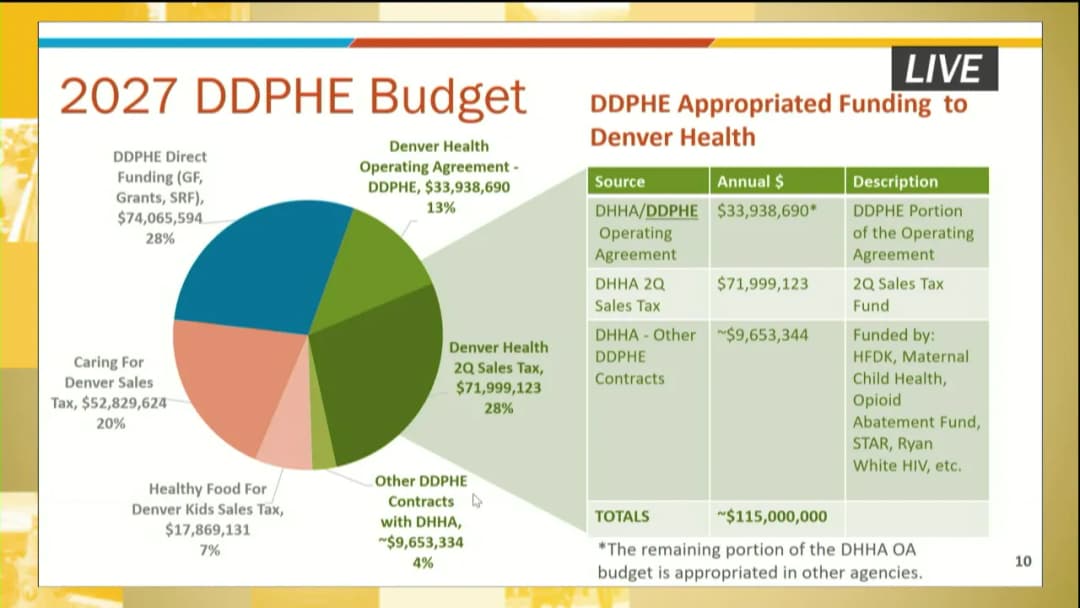
The Health and Safety Committee of the Denver City Council met on November 4, 2026, at 10:30 AM (Mountain Time) in Room 391 of the City & County Building. Chair Darrell Watson presided with six members present (Flynn, Gonzales-Gutierrez, Torres, Watson, Romero Campbell, Kashmann) and Vice Chair Amanda Sandoval absent. The primary action item was the approval of the annual Denver Health and Hospital Authority operating agreement (Bill 26-1622) for $48,796,698. The meeting included a detailed presentation, extensive discussion of budgetary challenges, and a consent calendar item. Consent Calendar - 26-1653: Amends a contract with Boys & Girls Clubs of Metro Denver, Inc., adding $60,000 for a new total of $985,500 and extending the end date to December 31, 2026, for out-of-school time programs citywide. Approved by consent (no roll call). Discussion Items - Denver Health Operating Agreement (26-1622): Meggan Parezo (DDPHE) and Donna Lynne (CEO, Denver Health) presented the 2027 agreement. Key points: - Total proposed budget: $48,796,698 for 12 months, ending December 31, 2027. This is down from $70 million in prior years because the jail medical services contract ($25-26 million) was removed as a separate contract. - The agreement includes 33 service sections (7 core, 13 non-core, 12 city-provided services). Three sections were removed: Rocky Mountain Poison Drug Center and Treatment on Demand (funding eliminated due to city budget cuts; services continue via state/grant funding) and jail medical (separated). - Language changes in three sections: MI payment/patient care (metric updates), EMS (Denver Dynamic Response Model pilot), and airport EMS (additional coverage). Minor changes to Public Health Clinical Services. - Denver CARES is funded at $1 for 2027, maintaining a position but effectively unfunded. The city and Denver Health agreed to a $2+ million package including $1.2 million in operating agreement expansions and $1.4 million from CASER (capital funds) for energy system modifications, intended to offset Denver Health's internal costs. Ongoing data analysis will inform 2028 decisions. - Budget expansions: $336,000 restoration for EMS service patrol (to 78% of full funding), full restoration for Southwest Clinic, $35,000 for sexual assault nurse examiners, 2% merit increase, and expansions for DEN paramedics and Inglewood EMS. - HR1 (federal Medicaid cuts): Denver Health estimated loss of up to 20,000 Medicaid patients and $65 million in impact over time. Already, 3,200 legal immigrants lost coverage on October 1, 2026. Work requirements (80 hours/month) and twice-yearly recertification begin January 1, 2027. - DERP (Denver Employee Retirement Plan) lawsuit: Denver Health has an unfunded liability; DERP filed suit over interpretation of payment agreement. Denver Health offered mediation; DERP declined. Councilmember Flynn expressed concern about cross-subsidization, but Lynne clarified liabilities are separate and noted 1,000+ Denver Health employees earn minimum wage. - Councilmember Positions: - Councilmember Flynn: Expressed appreciation for Denver Health services and leadership, but acknowledged budget constraints. Inquired about DERP lawsuit. - Councilmember Torres: Asked about data reporting frequency and possibility of a multi-year operating agreement. Noted need for better understanding of Denver CARES value. - Councilmember Kashmann: Strongly advocated for fully funding Denver CARES and STAR program, arguing underfunding leads to higher costs elsewhere (police handling eligible calls). Called the current approach "insane." - Council President Romero Campbell: Stressed the human and financial costs of not funding Denver CARES, asked for a timeline for resolving Denver CARES funding. Lynne set a goal of 5 months (by April 2027) to have a plan ready for 2028 negotiations. - Councilmember Gonzales-Gutierrez: Emphasized need for data on Denver CARES usage and alignment with community health assessment. Also raised concerns about Denver Health staff working conditions and dignity. - Pro Tem Torres: Thanked staff for data improvements, noted Community Health Improvement Plan (CHIP) celebration on Friday, and asked about Denver Health's involvement—confirmed two representatives on steering committee. Key Outcomes - Bill 26-1622 (Denver Health Operating Agreement) was approved for filing by a vote of 6-0 (Aye: Flynn, Gonzales-Gutierrez, Torres, Watson, Romero Campbell, Kashmann; Nay: 0; Absent: Sandoval). The motion was made by Councilmember Flynn and seconded by Council President Romero Campbell. - Consent item 26-1653 (Boys & Girls Clubs contract) was approved by consent. - Next steps: The operating agreement will proceed to full City Council. Denver Health and DDPHE will continue working on Denver CARES data analysis and funding strategy for 2028, with a target to finalize a plan within five months.
On Wednesday, November 4, 2026, at 12:00 PM, Pittsburgh City Council held a public hearing in Council Chambers regarding Bill 2026-0714, which proposes to amend the UC-E (Urban Center Employment) District zoning to allow increased residential development on parcels within 100 feet of an EMI (Educational Medical Institutional) district. The hearing included a presentation from the Department of City Planning and opposition from one speaker. Presentation by Department of City Planning - Kate Ruckus presented the timeline: the bill was introduced by Council Member Lavelle on July 7, 2026; amended by substitute and sent to the Planning Commission on July 22; the Planning Commission held a public hearing on September 22 and made a positive recommendation to Council. - The current UC-E district (only located in Oakland) permits residential development only if it is 100% affordable or if the residential portion is less than 50% of gross floor area. - The proposed amendment would allow 50–100% of gross floor area to be multi-suite residential on parcels wholly or partially within 100 feet of an EMI district, provided the rooms are rented monthly or longer. - Ruckus stated the amendment complies with the Oakland Neighborhood Plan, citing vision, land use, goals (D1B, D4A, D4C), and policies supporting housing diversity and transit-oriented/student housing. Opposition from a Speaker - One speaker (likely a council member or stakeholder) expressed strong opposition, arguing that the amendment contradicts the Oakland Plan's intent to preserve the Forbes-Fifth Corridor for commercial and employment uses. - The speaker noted that the exclusion of housing was deliberate to prevent commercial displacement; market forces (e.g., post-COVID) have stalled commercial projects like the Wexford Technology Center, but the speaker argued amending the base zone is the wrong approach—comparing it to using a screwdriver as a hammer, rendering it unusable for its original purpose elsewhere. - The speaker asserted that the amendment would remove a tool from city planning for other future needs. Key Outcomes - No public comments were made from chambers attendees after the opposition speaker. - No further discussion or vote was held by Council members. - The public hearing was closed, and the bill was referred to the Committee on Land Use and Economic Development for further consideration (as noted in the meeting minutes).
The Clark County Board of County Commissioners held a zoning and subdivision meeting on November 4, 2026, at 9:00 AM in the Commission Chambers. The meeting covered routine consent items, public hearings on non-routine items, and introductions of ordinances for future hearings. Key actions included approvals of extensions, use permits, zone changes, and plan amendments, with several modifications made during the discussions. Consent Calendar - Items 4 through 16 were approved collectively as routine action items, incorporating amendments for Items 5, 6, and 9. No public objections were raised for these items. Public Comments & Testimony - Early in the meeting, Mr. King spoke on Items 19 and 20, expressing concern about waivers eliminating street landscaping. He advocated for preserving trees to mitigate the urban heat island effect, particularly for vulnerable populations. The Chair noted that Item 19 would be heard separately once the public hearing began. - Cole Delani requested that Item 18 be held (postponed) to a later meeting, which the Board accommodated. - During the final public comment period, Al Rojas, a Sunrise Manor resident, thanked law enforcement for election security, reported community efforts to remove homeless encampments, and raised concerns about homeless populations congregating at parks and communication issues with Clark County Public Safety. Discussion Items - Item 17 (Venetian/Palazzo Condominium Tower): The applicant requested a seventh extension of time to complete 280 resort condominiums in an existing building under construction. Commissioner Sagerblum moved to amend the extension to five years, noting the building's progress. The motion passed. - Item 19 (Perez/Gonzalez Outdoor Storage): The applicant presented modifications including alternative street landscaping (not a waiver), withdrawal of the drainage study waiver, and agreement to build a wall between properties. Commissioner Kirkpatrick moved approval with conditions: eliminate Waiver 4 (drainage study), clarify Waiver 2 (defer landscaping until SID), require security cameras per Metro standards, and add emergency contact signage on street frontages. The motion passed. - Item 20 (Sterling Outdoor Storage): The applicant proposed landscaping and an 8-foot decorative block wall, withdrawing Waiver 1A. Commissioner Segerblom moved approval. The motion passed. - Item 21 (Communication Tower): The applicant proposed an 87-foot faux monopalm tower on a gravel pit site to improve cell coverage. Commissioner Kirkpatrick expressed concern about visual impact, noting a second nearby tower. She moved for approval with modifications: change the design to a standard monopole painted desert tan, require direct contact information on the gate, and support the waiver of off-site improvements. The motion passed. - Items 22–23 (Horito Vacations and Waivers): The applicant sought to combine parcels and build a garage before the house, with waivers for off-site improvements and a drainage study. Approved as recommended. - Items 30–33 (Toranji Senior Housing): The applicant proposed a 160-unit senior/assisted living facility. Public works confirmed Waiver 3B was no longer needed. Approved with the modification. - Items 34–38 (USA Wigwam Subdivision): The applicant proposed a 10-lot cul-de-sac subdivision with waivers for off-site improvements on one frontage and increased retaining wall height. Approved. - Items 39–43 (Ordinance Introductions): Five development agreements were introduced and set for public hearings on November 18, 2026. Approved. Key Outcomes - Item 17: Approved with an amendment to a 5-year extension (instead of the requested 7th extension). Vote: passed. - Item 19: Approved with conditions as moved by Commissioner Kirkpatrick. Vote: passed. - Item 20: Approved. Vote: passed. - Item 21: Approved with design change to a plain monopole, direct contact signage, and waiver of off-site improvements. Vote: passed. - Items 22–23: Approved. Vote: passed. - Items 30–33: Approved with withdrawal of Waiver 3B. Vote: passed. - Items 34–38: Approved. Vote: passed. - Items 39–43: Introduced; public hearings set for November 18, 2026. Vote: passed.
The Urban & Economic Development Committee met on November 4, 2026, at 10:30 AM (16:30 UTC) in Room 411 of One Technology Center. The committee, chaired by Councilor Lakin (who recused himself from items 8–10, with Co-Chair Bellis presiding over those items), considered a wide range of economic development and budgetary matters, including a major TIF project in North Tulsa, several supplemental budget appropriations, and allocations from Vision 2017 surplus funds. Reappointment to Library Commission - Cindy McGhee, a CPA and entrepreneur, was presented for reappointment to the Tulsa City/County Library Commission (term through July 31, 2029). She serves on the finance and oversight committees for library capital projects and has attended 5 of 9 meetings. The committee will take the appointment to the full council on November 18. Peak on the Parkway Economic Development Project - Aaron Pursley (Chief Economic Development Officer) and William Tisdale (developer, 2020 Management) presented the $200 million project on 40 undeveloped acres in North Tulsa. The plan creates four Tax Increment Finance (TIF) districts and includes medical offices, a Country Mart grocery, two new-to-market restaurants, mixed-use multifamily housing, and senior downsizing units. Councilors expressed strong support, noting the project’s transformation of vacant land and its health-care, retail, and housing components. Budget Amendments (Items 4–7) - No questions or debate were taken on the following supplemental appropriations: - $49,000 for Forensic Nurse Services (District Attorney’s Council grant). - $72,000 for Grand Lake Mobile Integrated Health (Grand Lake Mental Health grant). - $31,575 for Animal Shelter Phase II (Tulsa Community Foundation pledge). - $913,316.05 for Tulsa Performing Arts Center renovation design services. Budget Amendment for Economic and Neighborhood Initiatives (Item 8) - Chair Lakin recused; Co-Chair Bellis led the discussion. A $6,594,000 supplemental appropriation was presented to fund several time‑sensitive projects from the unappropriated balance of the 2016 Vision Economic Development Capital Projects Sub‑Fund. The projects included: - Golf Floodgate – $750,000 to install a floodgate at Mohawk course to reduce flood closures. Presenter Randy Heckenkamper (Tulsa Golf) stated the gate would cut evacuation time ten‑fold and help the course become financially sustainable. Council supportive. - Airport Child Care Facility – $1.5 million (lowered from an earlier estimate) to construct a child‑care center on airport property, addressing workforce shortages. Airport CEO Alexis Higgins presented. Discussions touched on liability, DHS subsidies, and tribal partnerships. - Plaza Santa Cecilia / East Side Center for Entrepreneurship – $1.5 million to complete phase 2 of the incubator in east Tulsa. The city’s deputy mayor presented; councilors highlighted inclusive entrepreneurship and the need to connect multiple incubators city‑wide. - After‑School Expanded Learning Pilot – $1 million proposed to pilot after‑school programming in high‑absenteeism TPS and Union schools, plus an elementary sports pilot with Tulsa Parks. Laura Latta (Mayor’s Office of Children, Youth and Families) and Stacey (Parks) presented. Council raised questions about sole‑sourcing, requested a presentation from the “Yes for Tulsa Kids” coalition, and emphasized transparent contracting. - The Irving on Brookside (Public Parking Component) – $450,000 in District 9 Community Development Priority Project funds to build public parking as part of a $59 million mixed‑use development. Aaron Pursley explained the project’s financing is already secured and tenants are pre‑leased; councilors praised the project’s alignment with the Peoria BRT corridor and its expected economic ripple effects. The budget amendment was on first reading November 4; final council votes are scheduled for November 18 and December 2. Vision for the Arts Program (Item 11) - Arts Commission representatives presented the FY 2026‑2027 grant cycle. Councilors gave substantive feedback that the application process is too burdensome and suggested simplifying narratives, standardizing budgets, and making the technology easier to use. The Commission vice chair agreed to bring proposed restructuring to the committee for approval. Remaining Vision Surplus & Future Allocations (Item 10) - The committee discussed how to allocate the remainder of the 2017 Vision Economic Development surplus (beyond the projects on the current budget amendment). Potential categories included: main street program investment, commercial revitalization (potentially through permanent revolving loan funds), community center reactivation (especially using closed school buildings), and utility assistance. Councilors stressed sustainability and avoiding new facility ownership. No formal action was taken; the committee will continue refining a project plan. Key Outcomes - Reappointment of Cindy McGhee will proceed to full council November 18. - TIF ordinance and most budget amendments (Items 3–8) are on first reading November 18 and public hearing December 2. - The after‑school pilot funds will not be appropriated until a competitive procurement process is clarified; staff will invite the Opportunity Project and coalition for a committee presentation. - The Arts Commission will return with a streamlined application process for future cycles. - The committee will adopt a formal project plan for the remaining Vision surplus at a later meeting.
The Hart Board of Directors convened on November 4, 2026, at the Hart Administrative Offices. The meeting included public comment, recognition of outgoing and new board members, approval of consent agenda items, and discussion of two major action items: a CNG/RNG contract award and an increase to the paratransit customer choice contract. Key outcomes included approval of the contract with Kinder Morgan for RFP 55218 and approval of the first option year for West Coast Transportation. Public Comments & Testimony - David Elpers (representing UF Energy) asked the board to defer action on Resolution R 2026-11-42 (RFP 55218), citing a $6.5 million difference between UF Energy's net cost estimate ($2.3 million over five years) and Hart's analysis of Kinder Morgan's proposal ($4.2 million revenue). He requested the matter be sent back for further review rather than awarding the contract. He stated that if the board authorized the award without review, UF Energy would preserve its rights under protest procedures. Consent Calendar - Approved minutes of the September 8, 2026 regular meeting and September 21, 2026 public hearing on FY2027 millage rate and budget. - Approved consent agenda items 6A and 6B as recommended by the Joint Finance, Audit, and Operations and Safety Committee. Item 6C was removed for separate discussion. Discussion Items - Removal of Item 6C from Consent Agenda: Director Nieberg requested removal of Resolution R 2026-11-42 from the consent agenda to allow discussion of concerns raised in public comment. Director Williams opposed, stating that UF Energy had an opportunity to protest earlier but did not. After discussion and legal guidance, the board voted to remove the item and consider it under the regular agenda. - Resolution R 2026-11-42 – CNG/RNG Contract Award: Procurement Director Marty provided an overview of the RFP process, noting that nine respondents were evaluated and Kinder Morgan scored highest, including the best net revenue to Hart. Marty explained that UF Energy's proposal would have resulted in a net cost to Hart of approximately $2.3 million over five years, while Kinder Morgan's would generate about $4.2 million in revenue, creating a $6.5 million swing. Director Nieberg sought clarification on the pricing and revenue structure. Commissioner Wassel requested safeguards and noted that Hart can terminate for convenience but the contract lacks a minimum annual guarantee. Director Hobbes confirmed that the protest window had expired with no protests. The board subsequently approved the resolution. - Resolution R 2026-11-43 – West Coast Transportation (Yellow Cab) Contract Option Year: Sean McCarthy presented a request to increase the contract not-to-exceed amount by $1,955,149 to $11,663,785 for the first option year of the customer choice paratransit service. He reviewed utilization growth, cost per trip comparisons (customer choice: $24; Hart Plus: $66), and service hour changes made in 2025 to control costs. The program is partially funded by a Section 5310 grant (anticipated $3.5 million) and Hart's FY27 operating budget. Board members discussed efficiency concerns and the need to evaluate program sustainability. The item was approved with the condition that staff return to the January 2027 committee meeting with options for program changes (fare increases, trip limits, etc.). Key Outcomes - Approved the removal of Item 6C from the consent agenda (vote). - Approved Resolution R 2026-11-42, authorizing the contract award to Kinder Morgan for RFP 55218 (vote). - Approved Resolution R 2026-11-43, authorizing the CEO to execute the first option year with West Coast Transportation and increase the contract ceiling (vote). - Established a CEO performance evaluation ad hoc committee composed of Directors Nieberg, Smith, Hobbes, Myers, and Williams to review evaluations and recommend a merit increase by January 2027.
The Westchester County Board of Legislators Committee on Health, chaired by Legislator Jewel Williams Johnson, held a meeting on Wednesday, November 4, 2026, from 11:15 AM to 12:21 PM to examine the Campaign for New York Health and the New York Health Act. Presenters Steven Rabinowitz, Convener of the Westchester Hub of the Campaign, and Melanie D'Arrigo, Executive Director of the Campaign, provided an overview of the proposed single-payer healthcare system and fielded questions from legislators. Vice Chair Legislator Barr also participated in the discussion. Discussion Items - Critique of Current System: Steven Rabinowitz argued the current healthcare system prioritizes profits over health, citing that the United States spends more per capita on healthcare than any other advanced economy yet achieves poorer outcomes. He noted that 740,000 New Yorkers carry medical debt and that medical debt is the single largest cause of personal bankruptcy in the U.S. - Overview of the New York Health Act: The presenters described the Act as a universal single-payer system that would replace private health insurance. It would cover all medically necessary care including primary, specialty, hospital, dental, vision, hearing, long-term care, and mental health services with no premiums, deductibles, or copays. - Funding Mechanism: Melanie D'Arrigo explained the system would be funded through a gradually progressive payroll tax. She stated the first $25,000 of income would be exempt, and illustrative models suggest most individuals earning under $350,000 would pay less than their current combined premiums and out-of-pocket costs. - Impact on Westchester County: The presenters highlighted a study by Dr. Judy Sherquist of the League of Women Voters projecting net annual savings of approximately $500 million for Westchester County, $11 million for the Village of Scarsdale, and up to $20 million for the Scarsdale School District. Rabinowitz added that roughly 10.5% of property taxes at the municipal level currently go towards funding public employee health insurance costs. - Job and Transition Concerns: Rabinowitz addressed concerns about job losses in the health insurance industry, arguing that AI and automation would eliminate many of those jobs regardless, and that the Act includes funding for extended unemployment benefits and job retraining. D'Arrigo added that a study projects the Act would create 8,000 to 12,000 net new jobs. - Union and Hospital Perspectives: D'Arrigo noted that many unions support the Act, while some like CSEA remain opposed, often due to misinformation. She stated that public hospitals like NYC Health + Hospitals are publicly supportive, while some hospital executives privately support the bill but are unable to do so publicly due to pressure from insurers. - Political Path and Implementation: The bill, reintroduced in 2025 by Senator Gustavo Rivera and Assemblymember Dick Gottfried, is expected to be a priority for the 2027 legislative session. Implementation is estimated to take 1 to 3 years, depending on federal waivers for Medicare and Medicaid and the degree of pre-implementation work funded. Assemblymember Dana Levinberg is scheduled to hold a roundtable on the issue in early December 2026. Key Outcomes - No formal votes or resolutions were passed during this informational hearing. - The presenters formally requested that the Westchester County Legislature consider passing a resolution in support of the New York Health Act. - Chair Jewel Williams Johnson expressed strong support for the Act, stating she would "lend whatever I can to get it across the line." - Guests committed to providing the committee with the white paper on municipal savings, illustrative tax structures, and a template for a resolution of support. - The meeting adjourned at 12:21 PM.