Browse by city
Date range
Search help

Search titles, summaries, topics and stored transcripts together. Keywords may match separately; put the whole query in double quotes for a phrase. Matching follows word analysis, so punctuation is not exact. Both dates are included. Documents are not searched.

SHOWING 2311–2320 ENTRIES
2311
OCT 13, 2026 · RICHMOND, KENTUCKY · CITY COMMISSION MEETINGS
Richmond, Kentucky Community Announcement: Mills Exhibit at Irvington House Museum – October 13, 2026

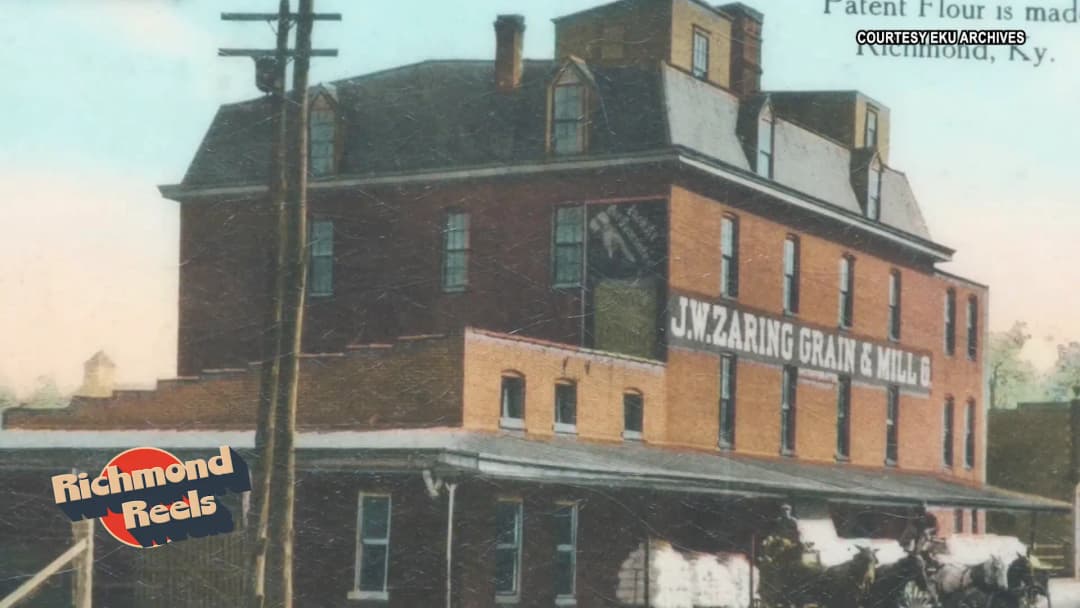
This recording is a community announcement rather than a formal city council or board meeting. No agenda or minutes were provided. The speaker promoted the Irvington House Museum’s October exhibit on the history of mills in Madison County and invited residents to visit the museum at 345 Lancaster Avenue in Richmond, Kentucky, Monday through Friday from 8 a.m. to 4 p.m.; the recording opened with questions about Millstone Park, the Millstone Festival, and mill-named roads. Presentation Content - The museum exhibit features artifacts and written documentation from the era when dozens of grist mills dotted the Madison County landscape. - The narrator stated that a great number of grist mills sprang up around central Kentucky in the 1780s, soon after pioneer settlement, and that Kentuckians built them along waterways to grind corn, wheat, and other grains for flour, cornmeal, and whiskey. - Central Kentucky counties each had dozens of grist mills in the 1800s, and Madison County was no exception; road names such as Bogeys Mill, Hagan's Mill, Morin Mill, and Potts Mill in Paint Lick recall that era. - The grist mills were not only manufacturing locations but also sources of community activity, where people learned news, met friends, and transacted business; mills were located within a day's wagon ride, about five to ten miles, from farmers and settlements. - Early mills were custom mills powered by water or animals; later, as technology developed, merchant mills like the Zaring Mill in downtown Richmond were additionally powered by steam. The Zaring Mill was especially popular in its time and engaged in active marketing. - The announcer cited Dr. Fred Allen Ingall Jr., an EKU professor and local historian, who wrote articles documenting Richmond's history for decades; in a January 1981 Richmond Register article, he recalled the acronym UZPF, which stood for “Use Zaring's Patent Flower” and was a quick code for the famous downtown Richmond product. Key Outcomes - No formal actions, votes, or decisions were made during the recording. - The announced next step is for residents to visit the Irvington House Museum throughout October to see the exhibit and learn more about the history of mills in Madison County.

HISTORIC PRESERVATION 100%
2312
OCT 13, 2026 · CHARLESTON, SOUTH CAROLINA · CITY COUNCIL
Charleston City Council Meeting – October 13, 2026

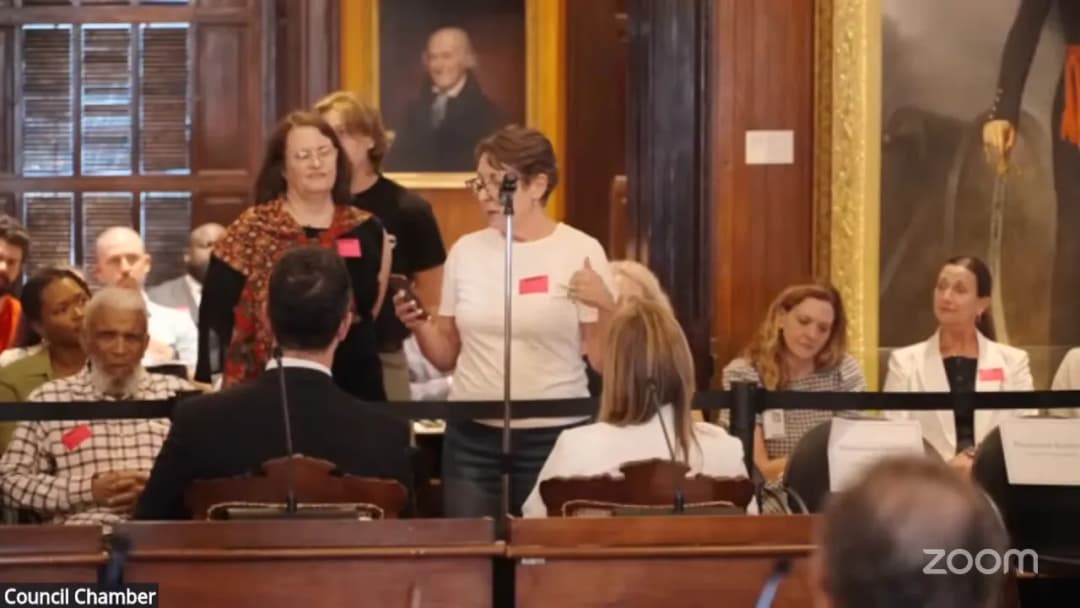
The Charleston City Council convened on October 13, 2026, for a regular meeting that included proclamations, public comments, appointments, a presentation on the Gilyard Center, and approval of several consent and committee items. The meeting began with roll call and an invocation, followed by two proclamations. The majority of public comments centered on opposition to the city's First Amendment demonstration ordinance, while other topics included budget requests, the Dominion Energy franchise agreement, and park planning. Council approved appointments, police agreements, and multiple bills without dissent. Consent Calendar - Approval of September 22, 2026 council minutes (approved by voice vote, all ayes). - Appointments to the ATAX Committee, Resiliency and Sustainability Advisory Committee (Maya Hargrove and Jacqueline Wills Winston), and code enforcement officers (motion made, seconded, approved unanimously). - Fast-tracked police agreements: School Resource Officer agreement with Berkeley County School District (2026–2029) and Law Enforcement Assistance and Support Agreement with SC State University (taken together, approved unanimously). - Committee reports from Public Safety, Public Works, and Ways and Means were adopted without objection. - Bills for second reading (7 bills) and third reading (7 bills) were approved by voice vote, all ayes. - A motion to adopt the terms proposed to Charleston County (P2/P1) was approved as a belt-and-suspenders measure, unanimously. Public Comments & Testimony - Buff Ross (Executive Director, Redux Contemporary Arts Center) advocated for Redux’s inclusion in the city’s 2027 budget, noting its 24-year history, free core programs, subsidized studio space for 42 artists, and arts education. - Tracy Tapp (volunteer, 50501) criticized the First Amendment protest ordinance, requesting deeper community engagement and stating that public comment periods are insufficient to address concerns. - Sam Carroll referred to recent constituent emails and urged council to consider recommendations from the public safety committee review. - Robin Condon (founder, Charleston Visibility Brigade) described an incident where police threatened citations for a sign reading “register to vote,” calling it voter suppression and an illegal breach of the U.S. Constitution. - Griffin Specker (concerned citizen) characterized the demonstration ordinance as an overreach and urged council to heed public recommendations at the upcoming public safety committee meeting. - Mallory Balling argued the ordinance is unconstitutional, citing dropped charges and intimidation of dissenting voices. - Colin Holloway called for a full repeal, stating that requiring permission to protest is not free speech. - Ben Frazelle (District 8 resident) spoke against the ordinance, emphasizing that Marion Square should be a public forum and that police should not have final authority over protests. - Anthony G. Bryant criticized the Dominion Energy franchise agreement (20-year term, $15 million) and alleged a conflict of interest regarding city speech. - Bonnie Cleveland submitted a FOIA request and reported preliminary data: only 1 of 15 Marion Square permits approved as submitted in 2025–2026, and only about 25% of all permits approved as submitted, with the city changing time and place for most approvals. - Leanne Owens discussed her medical condition and neurosurgeon care, not directly related to a specific agenda item. - Online comments (summarized by the clerk): Seven comments requested repeal of the First Amendment demonstration ordinance; one requested review of police protest strategies; one supported an opinion piece calling for repeal; nine requested council end its contract with Flock Safety; two requested restart of Parkshore Park pickleball planning with community input; one requested site-specific wildlife/acoustic assessments of Parkshore Park; one asked council to reconsider the Parkshore Park plan; five requested revisiting zoning plans for the Cainhoy Peninsula and Point Hope; and one comment from Anthony G. Bryant was distributed to council. Discussion Items - Proclamations: (1) October 2026 proclaimed “Father 365 Pledge Month” in recognition of the Father 360 program (South Carolina Center for Fathers and Families), which has served over 35,000 fathers since 2002. (2) October 2026 proclaimed “Community Planning Month,” honoring the city’s planning and preservation department and commission. - Gilyard Center Presentation: Lisa Frankel (CEO) delivered the state of the center, highlighting its role as a cultural and civic gathering space over the past decade. Key statistics: annual economic impact of $76.5 million, 500 jobs generated, $9 million in total taxes ($2.1 million local), 225,000 students served through its education program, and an $850,000 annual investment in education. The center partners with the Charleston Symphony and Spoleto Festival (45 prime performance days annually). A 2028 national tour of a play about Robert Smalls is planned. The board and staff were recognized. - Committee Reports: Public Safety Committee (Councilmember Shealy) reported approval of SRO agreements. Public Works and Utilities Committee (Councilmember Waring) reported unanimous passage of its agenda. Ways and Means Committee (Councilmember Waring, substituting) reported approval of all items with amendments, including a recusal for Councilmember Scardon. All committee reports were adopted by council. Key Outcomes - All appointments and consent items approved unanimously by voice vote. - Police agreements and school resource officer MOUs approved without opposition. - Seven bills passed second reading and seven passed third reading, all by voice vote with no dissent. - The motion to adopt terms for Charleston County (P2/P1) passed as a precautionary measure. - No executive session was held. The meeting adjourned without further business.

ARTS AND CULTURE 32% · PROCEDURAL 31% · PUBLIC ENGAGEMENT 14% · PUBLIC SAFETY 12%
2313
OCT 13, 2026 · PORTSMOUTH, VIRGINIA · CITY COUNCIL
Portsmouth City Council Work Session and Regular Meeting - October 13, 2026

The meeting consisted of a work session featuring updates on the city's broadband expansion, capital improvement program (CIP), and drought management plan, followed by the regular city council meeting which included three public hearing items (all deferred), a consent agenda, board appointments, council reports, and public comments. Consent Calendar - The Broadband Authority accepted meeting minutes via a roll call vote (7-0). - The City Council approved the consent agenda (items A-L) by a 7-0 vote, including acceptance of grant funds, certifications for revitalization grants, and adoption of the city's revised drought management plan. Specific grants included: $447,817.99 from USDA for summer food service; $591,226 from Virginia Department of Fire Programs; $2,937,775 from Virginia Department of Criminal Justice Services for safer communities; $3,030 from Office of Local Defense Community Cooperation for Glasgow Street pump station; $17,029 and $9,900 from NHTSA for traffic safety and DUI deterrence; $250,000 Port Host Community Revitalization Fund grant for 817-825 High Street; and $128,000 from the Virginia Outdoors Foundation for an open space lands preservation trust fund grant. Public Comments & Testimony - Tony Goodwin (Park View neighborhood) expressed support for the open space lands preservation trust fund grant (Consent Agenda Item K), noting that two previously non-conforming apartment properties in Park View are underwater and cause flooding issues for neighbors. He advocated using Virginia Outdoors Grant to acquire the land for open space and stormwater management, and suggested similar approaches for Cedar Grove cemetery flooding and Wall Street alleyway ownership issues. - Tania Garcia Cartagena (Portsmouth resident) proposed a Boricua Cultural Center in the Craddock/Old Town area, featuring a gym, a mother's oasis with café and library, a screen-free teen area, and a "my first job" program for youth ages 14-18. She requested the council review the plan with the Department of Economic Development. - David House (Simonsdale district) criticized the rollout of the new bulk trash pickup process, stating that the new process was not properly communicated and led to items being left on streets for weeks. He noted discrepancies between the waste management submission page and city code regarding limb diameter (6 inches vs. 18 inches) and pile size (reduced to 6x6x6). He asked for clarity on the hold status and future rollout. - Mark Badal de Gutrowski (Portsmouth resident) spoke against the proposed 1% sales tax referendum for school construction, suggesting instead that casino revenue and future hotel occupancy tax be dedicated to school construction and maintenance, arguing residents are already heavily taxed. - David Loving Good (owner of property at 749 Broad Street) complained that the city has allowed a neighboring property to become a junkyard within six feet of his home, attracting pests. He stated he received violation letters for his own property after complaining. He presented documentation showing a zoning violation notice from June 1st had not been enforced. - Sherman Tyler (Portsmouth resident) addressed the city's sign policy at City Hall. He stated that candidates were only notified of the sign ban on September 18th (the day of early voting), contradicting a council member's claim that the change was voted on in May. He demanded to know why notification was delayed and called the process suspicious. Discussion Items - Broadband Expansion Update: The CIO reported on three critical projects: - GNW Railroad Agreement: Application approved. A flagger is needed; Danella coordinated with VDOT and GNW Railroad for an October 19th date. Splicing and testing begin then, with completion targeted for October 30th. - Tri-Cities/ODU Area: Survey completed and provided to ODU on October 5th. ODU acknowledged receipt of survey and draft deed of easement; their design and engineering team is reviewing the proposed route and easement language. Once technical review is complete, the package moves through ODU's real estate and legal teams (may take weeks). Fiber splicing will proceed quickly after execution. - Churchland Bridge: Danella found that a directional bore is required because the bridge contractor did not complete the tie-in. Boring began October 10th but was delayed by weather on the 11th. Work resumed this week to set the handhold and replace fiber; splicing and testing targeted for October 30th. - Fiber Ring Update: Seven initial city sites (City Hall, Police Department Headquarters, Police Administration, Welcome Center, Detective Bureau, Fire Administration, Sheriff Training Building) will be connected to the fiber ring next week. All sites have been notified via change control forms. Each site may experience up to three hours of downtime during testing. Once these connections are complete, the remaining city sites will be migrated. - Capital Improvement Program (CIP) Update: - Seven projects completed; ten active construction projects totaling over $90 million. - Several large projects (e.g., City Hall relocation, public safety complex, K-8 school, sportsplex enhancements, Craddock Fire Station) are at risk due to cost, scope, or funding exposure. - ARPA: $31 million spending requirement; expenditures to date just under $19 million. Anticipate meeting the December deadline with $35.5 million spent. - A project prioritization tool (modeled after HRPDC's spreadsheet) is being developed to score projects based on council priorities; will be refined at the council retreat. - A project dashboard with 90+ projects (title, description, milestones, costs) is expected by early 2027. - Council members requested details on specific projects (e.g., Twin Pines Road widening, pump stations, Charles Peak Park, jail modifications), asked for a full project list including non-city projects (like VDOT or HRSD), and emphasized the need for clear communication with the public and civic leagues. - Drought Management Plan: Informational presentation by Public Utilities Director Michael Johnson and Ben Wright of Hazen & Sawyer. - The plan has three stages: Watch (voluntary conservation), Warning (mandatory restrictions on outdoor watering), and Emergency (further restrictions targeting 10% water use reduction). - Current conditions: rainfall surplus of 2.89 inches; reservoir storage at 87% (263 days of storage, trigger at 120 days); groundwater level at 11.19 feet (near trigger). Overall, conditions are normal but drier than typical. No drought stage is currently activated. - Residents on private wells are not subject to mandatory restrictions; they will be informed but not cited. - Crawford Bay Development: The selection process involves a committee of two council members, the EDA, and economic development. A recommendation will be brought to the EDA and council for a vote. Council members expressed a desire for full transparency to review all submissions before the final selection. - School MOU: City Manager Carter reported that there is a misunderstanding about the scope of the MOU between the city and school division. He stated his intent was to cover all projects, but the schools now do not want every project included. The K-8 school design is expected to start in January, take 16 months, with construction beginning about 4 years from now. Key Outcomes - Deferrals: All three public hearing items were deferred to the November 10, 2026 meeting: Item A (drug and alcohol treatment facility at 3736 Turnpike Road, deferred 6-1), Item B (multifamily complex at 2000 High Street, deferred 7-0), and Item C (short-term rental zoning amendment, deferred 7-0). - Consent Agenda: Adopted 7-0. - Boards and Commissions Appointments: Ollie Ray Farkin Dakish (Tilling Advisory Board) and Lavonda Graham Williams (Law Library Board) were appointed 7-0. - Closed Session: Council voted 7-0 to enter closed session for legal consultation regarding a specific lawsuit, shootings in the city, and appointments to boards and commissions. - Bulk Trash Policy: The policy remains on hold until January 1, 2027, per a previous council motion. The city manager affirmed that direction. - Property Enforcement: Councilwoman Thomas requested a report on properties with multiple zoning violations over 60-90 days; the city manager agreed to provide that.

PROCEDURAL 21% · TECHNOLOGY AND INNOVATION 20% · WATER AND WASTEWATER MANAGEMENT 10% · DATA AND METRICS 8%
2314
OCT 13, 2026 · FORT WORTH, TEXAS · CITY COUNCIL
Fort Worth Community Development Committee Meeting – October 13, 2026

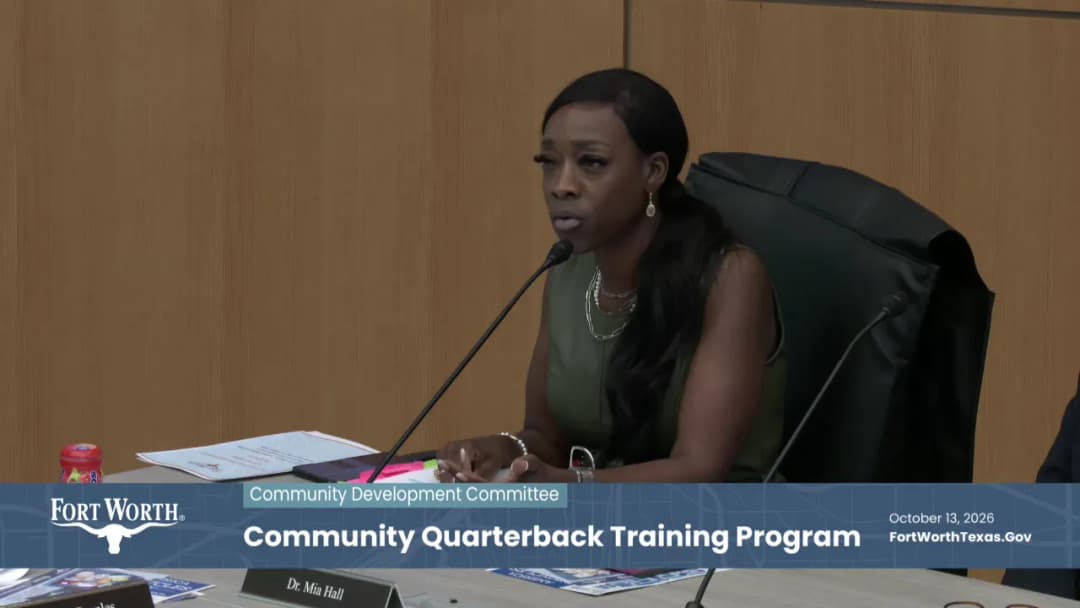
The Fort Worth Community Development Committee met on Tuesday, October 13, 2026, at approximately 4:06 p.m. in the City Council Work Session Room, adjourning at 4:34 p.m. Mayor Pro Tem Carlos Flores chaired the meeting. The committee received briefings on the Community Center Facility Master Plan and proposed Woodhaven Community Center, the Community Quarterback Training Program, and the NET Force update. No public comments were made, and no executive session was held. Consent Calendar - The committee unanimously approved the meeting minutes. Note: the agenda listed the August 11, 2026 minutes, but the chair referred to the September 15th meeting minutes. Discussion Items Community Center Facility Master Plan and Proposed Woodhaven Community Center - Joel McElhaney, Park and Recreation Assistant Director, presented the master plan. The agenda listed Teresa Thomason as presenting, but McElhaney delivered the briefing. The plan assessed all 25 facilities, including 24 community centers (with LAT Rise and North Park YMCA) and the Hawes Athletic Center, evaluating building condition, layout, mechanical/electrical/plumbing systems, capacity, and usage, plus benchmarking against other cities and national standards. - The assessment identified five service gaps, shown in different colors, in north, west, southwest, and east Fort Worth. The proposed Woodhaven Community Center, at the old Woodhaven Clubhouse, sits within the Hanley Meadowbrook Community Center capture radius and is intended to address an East Fort Worth service gap. - Phillip Michael Smart (Economic Development) reviewed TIF 13 funding: TIF 13 terminates at the end of 2028, with all remaining funds needing to be allocated. The fund balance is about $27.3 million, with a projected total of about $33 million. Neighborhood feedback emphasized economic development, connectivity, and gathering places, leading staff to prioritize the Woodhaven Business Park, Woodhaven Trail Connection, and Woodhaven Community Center. - The TIF request for the Woodhaven Community Center is $28 million; the November TIF board request is about $2.5 million for land acquisition and demolition. The center is planned at about 25,000 square feet. - Council members asked how the Woodhaven site was chosen. McElhaney cited the available roughly 5-acre site, existing parking and utilities, and the Woodhaven Conservation Plan listing a community center as its top priority. Smart and staff noted the property is owned by the developer who bought the former Woodhaven golf course. Council member Lauersdorf asked about the service gap methodology and advocated for other areas, including north and south Fort Worth; McElhaney explained the capture-radius mapping and said future bond programs would be the usual funding source for other centers. Community Quarterback Training Program - Smart presented a seven-month leadership program developed from the Main Street program, using the National Main Street four-point approach. In June 2025, the Fort Worth Local Development Corporation approved a two-year extension, and Main Street America (MSA) was engaged to lead training, working with city staff and the North Texas Community Foundation. - The program combines virtual and in-person workshops covering Main Street principles, market analysis, small business support, partnership building, fundraising campaigns, and work plans. Recruitment is expected to begin around the end of October. It is open to representatives from the 12 revitalization target areas, with citywide applications also considered. The target number of participants is 35, and participants should represent a broad cross-section of community members and commit to most workshops. - Council member Lauersdorf asked how the 12 target areas were identified and raised concerns about keeping the training community-centric rather than political. Smart said the target areas were originally identified by the city's economic development department using demographics and census data, with reassessment planned as part of the economic development strategic plan; the application process and a grading rubric would help applicants understand whether the workshops fit their work. Update on NET Force - Brian Daugherty, Code Compliance Director, updated the committee on the Nuisance Enforcement Task Force (NET Force). After a six-month pilot, the program was adopted in the current budget with additional staffing: one nuisance abatement officer, one supervisor, and two inspectors. - Pilot outcomes included: at ECO, six buildings declared hazardous by the Building Standards Commission and the owner obtaining permits and nearing full compliance; South Side Food Mart closing under Chapter 125; and Rockies 2 experiencing a significant reduction in criminal offenses and being listed for sale. The city also worked with TCEQ and ACT (Action for Community Transformation) on enforcement and litigation. - The program now uses three tiers: active list, monitoring, and properties of interest. The active list includes Cowboy Inn (District 2), Ranch Motel (District 2), Central Motel (District 11, with a pending demolition permit), Maribo Apartments, residential properties, and a shopping center. The first inspection at Ranch Motel that morning yielded code violations and three arrests. Monitoring includes the three pilot properties. Properties of interest include residential properties, lounges, and nightclubs. - A new public dashboard will be live when Daugherty presents to the City Council on the 20th (October 20, 2026). Staff will reassess capacity after six months and may expand to 10 active properties; the department is also seeking funding sources for demolition. Key Outcomes - The committee unanimously approved the meeting minutes, noting the agenda/transcript date discrepancy. - No formal votes were taken on the briefing items. Next steps include: TIF 13 board consideration of Woodhaven Community Center funding on November 4; a work session on the community center master plan on October 27; Park Board consideration on November 18; and City Council consideration on December 8. - The meeting adjourned at 4:34 p.m. without an executive session.

ECONOMIC DEVELOPMENT 29% · PARKS AND RECREATION 22% · COMMUNITY ENGAGEMENT 21% · CODE ENFORCEMENT 12%
2315
OCT 13, 2026 · NEW ROCHELLE, NEW YORK · MEETING PORTAL
New Rochelle Committee of the Whole Meeting – October 13, 2026

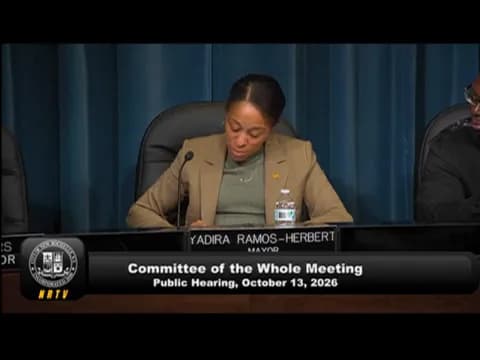
The New Rochelle City Council met as a Committee of the Whole on October 13, 2026, to discuss proposed ordinances, budget amendments, grant acceptances, and other items. The meeting included four public hearings on garbage, speed cameras, rodents/pet waste, and site plan fees, followed by community comments. All remaining action items were moved to the consent agenda for later approval. Consent Calendar - Item 5: Advanced payment acceptance for EDPL legal proceedings regarding Hudson Park and Beach. - Item 6: Amendment to the property tax exemption for permanently and totally disabled veterans (to align with state law). - Item 7: Tax abatement for rent-controlled properties occupied by senior citizens and disabled citizens (state threshold increased from $50,000 to $75,000). - Item 8: Third-quarter budget adjustments for fiscal year 2026 (revenues and expenses balanced). - Item 9: Acceptance of a $376,892 state grant for playground improvements at Five Islands Park. - Item 10: Acceptance of a $283,705 grant from the Westchester Putnam Workforce Development Board for the 2026 youth employment program (fall, winter, spring). - Item 11: Amendment to the 2026 budget to fund a gun buyback program from forfeiture funds. - Item 12: Acceptance of an $855,502.24 FEMA Assistance to Firefighters grant for new self-contained breathing apparatus (SCBA) equipment. - Item 13: Acceptance of a NYS DEC grant for electric vehicle (EV) charger upgrades at Hamilton (two Level 2 chargers with four ports). - Item 14: Application for a $1.2 million NYSERDA grant (80% state, 20% local match) to add 60 public EV charging ports in downtown parking facilities. Public Comments & Testimony Public Hearings (four topics): - Garbage, rubbish, and refuse: Vince Malfitano expressed concern over fines for improper containers and requested a grace period. No other speakers. - School speed zone cameras: Vince Malfitano opposed, calling it a revenue generator and predicting expansion citywide. Jesse Laufer (29 Glenmore Dr.) strongly supported, citing improved safety in NYC and dangerous conditions at Webster Avenue. Alicia Jones (26 Glenwood Ave.) urged placement at Daniel Webster School after a student was struck in June. Miriam DeSane (Mount Joy) opposed, arguing that speed bumps and four-way stops would be more effective and that the program focuses on revenue rather than safety. - Rodents, pet waste, and waste storage: No speakers. - Site plan administration fees: No speakers. Community to Be Heard: - Three groups of Iona University social work students presented: 1. Housing insecurity: Antasia Smith, Vanessa Rivera, Vita Debona highlighted high rents ($1,917 median) and called for rent control and rehabilitation of affordable properties. 2. Transportation accessibility: Ali Felix, Braden Crispino, Grace Poluani noted cracked sidewalks, limited pedestrian signals, and barriers for people with disabilities. 3. Physical accessibility: Victoria Polidoro, Diana Bernard, Matthew Gugliemo cited a 2025 state audit finding 19% of sampled city facilities needed accessibility improvements. - Minister Noel Arroyo (Atelier Tenant Association, 40 Westchester Pl.) requested a city investigation into 12% rent increases, rodent issues, and management failures, citing possible Good Cause Eviction Law violations. - Stephanie Lopez (40 Westchester Pl.) echoed concerns about rent calculations, fees, and lack of transparency on affordability requirements. - Miriam DeSane criticized the rodent ordinance as placing burden on residents while ignoring construction-caused rodent problems. - Vince Malfitano spoke against new state traffic laws, including a one-point violation for broken brake lights. Discussion Items - Item 1 (Garbage ordinance): Councilmember noted a misalignment in sections about paper recycling; a non-material edit was acknowledged. - Item 6 (Veterans tax exemption): Commissioner explained the need to align with revised state law changing eligibility from 100% service-connected disability to permanent and total disability. Councilmembers requested cost analysis and data on average household impact; city manager agreed to recirculate figures. The exemption was described as neutral for equalization rates. - Item 7 (Senior/disabled tax abatement): Commissioner estimated current cost at $50,000, which could rise to $90,000 with expanded income threshold. Councilmember requested periodic updates. - Item 9 (Five Islands grant): Commissioner said the grant funds an aging playground. Discussion expanded to park bathroom needs: plans for Five Islands, Dinofrio, Davenport, Ward Acres, and Hudson Park band shell restrooms. Councilmember asked about Neptune Park; flood zone challenges noted. - Item 10 (Youth employment grant): Executive Director Johnson described the program: matching youth with employers, site visits, and support. Councilmembers praised the work and emphasized the program's role in connecting youth and local businesses. Grant covers fall, winter, spring; summer program remains separate. - Item 14 (EV charger grant): Commissioner noted the grant builds on the EV master plan, targeting downtown city-owned parking. Councilmember raised equity concerns about the north end's lack of chargers; commissioner agreed to explore other locations and mentioned separately working with houses of worship and shopping centers. Discussion included power sourcing (solar at ITC, grid for others) and revenue neutrality. Key Outcomes - All consent agenda items (5–14) were moved to the consent agenda by voice votes with no opposition. - The four public hearings were closed after hearing from registered speakers. - The meeting adjourned to executive session for pending litigation and performance evaluation. - Council directed staff to provide cost analyses for items 6 and 7 and to explore north-end EV charging options.

PUBLIC SAFETY 20% · AFFORDABLE HOUSING 10% · PROCEDURAL 9% · VETERANS AFFAIRS 9%
2316
OCT 13, 2026 · TUSCALOOSA, ALABAMA · CITY COUNCIL MEETINGS
Tuscaloosa City Council Meeting Summary: October 13, 2026

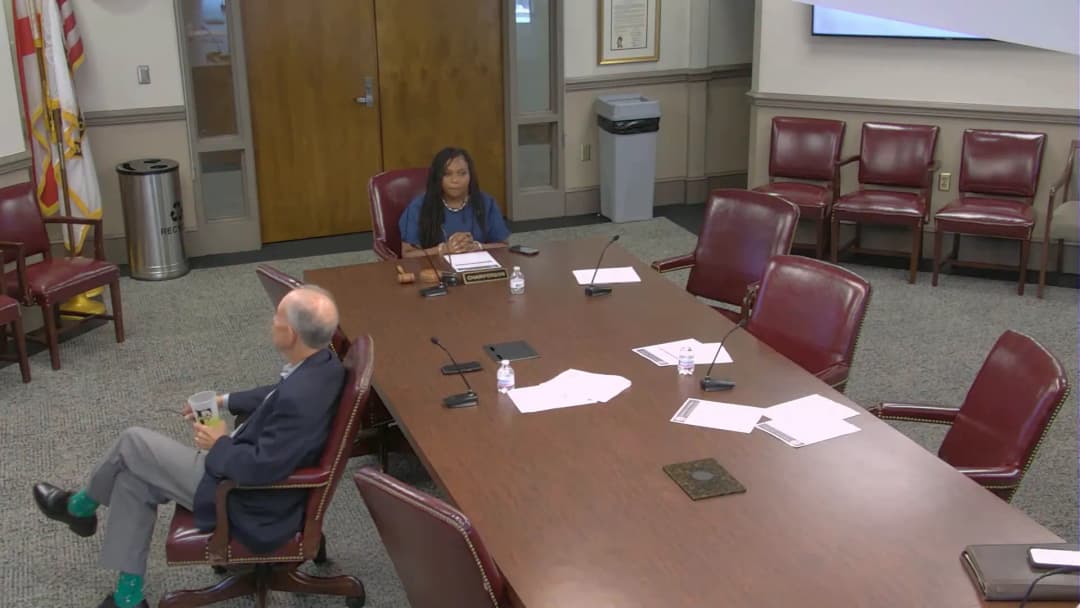
The City Council convened to approve the minutes from the previous meeting and to discuss and vote on a professional services contract with Target Solutions. Consent Calendar - The minutes from the previous meeting were approved by unanimous voice vote. Discussion Items - Professional Services Contract with Target Solutions: The Chief of Police presented a contract to consolidate public safety software systems. The proposal involved reducing the number of software vendors from three to one, which the Chief described as a cheaper option that will simplify operations for officers. The Council expressed strong support for the cost savings and operational improvements. Key Outcomes - Unanimous Approval: The motion to approve the professional services contract with Target Solutions passed by unanimous voice vote. The meeting then continued to address other public safety matters.

PROCEDURAL 50% · TECHNOLOGY AND INNOVATION 50%
2317
OCT 13, 2026 · DENVER, COLORADO · COUNCIL COMMITTEES
Community Planning and Housing Committee Meeting - October 13, 2026

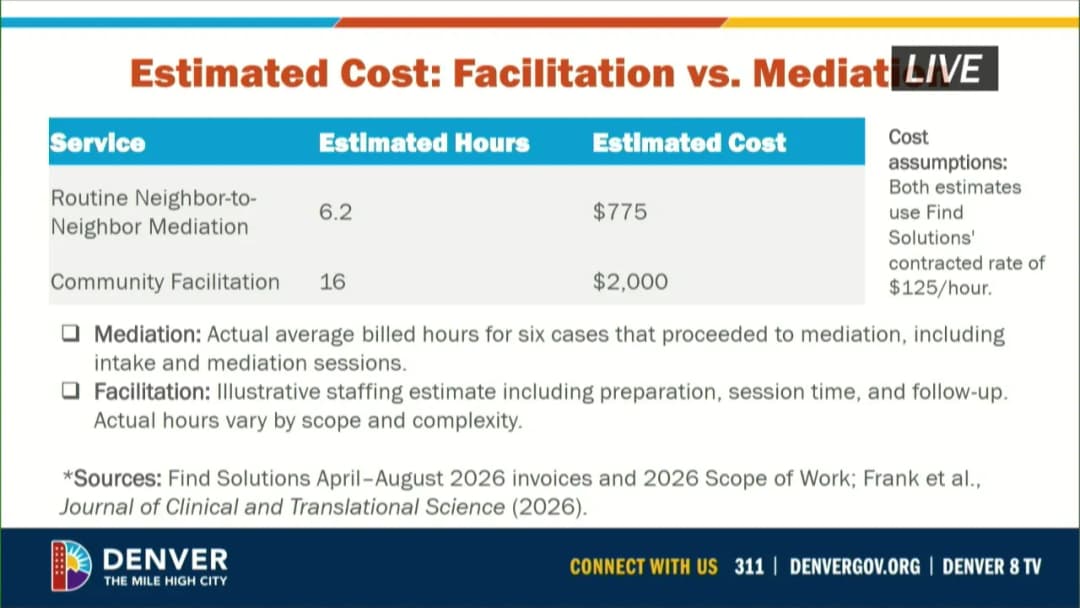
The Community Planning and Housing Committee met on October 13, 2026, to receive a briefing from Human Rights and Community Partnerships (HRCP) on the overhaul of the citywide mediation service model and to approve two consent contracts for homeless services. The discussion heavily focused on the operational and administrative challenges stemming from the transition from a single vendor to a three-vendor system. Consent Calendar - 26-1492: Amended a contract with Volunteers of America Colorado Branch to add $852,000 (new total $3,413,433) and extend the end date to 12-31-2028 for rapid rehousing. Approved by consent. - 26-1493: Amended a contract with The Salvation Army to add $40,000 (new total $1,157,803) and extend the end date to 12-31-2027 for rapid resolution services. Approved by consent. Briefing & Discussion: Citywide Mediation Services (Council Presentation 26-1499) Heidi Rodriguez and Perla Gaylor from HRCP presented the new three-vendor model for mediation services, replacing the long-standing sole provider, Find Solutions. The annual program funding of $177,000 is now split evenly at $59,000 between three vendors: Find Solutions, Paradigm Public Affairs, and Project Mediation Pros. HRCP stated the change was driven by the need for better data on outcomes, utilization, and mediator diversity. Key Council Concerns and Positions: - Contract Placement: Councilmember Amanda Sawyer strongly criticized the administration for placing the management of this contract with HRCP, arguing it should be managed by General Services. She called it "a terrible management decision" and stated the current process was "not fair" to HRCP staff, who should not have to manage a general services function. - Institutional Knowledge: Councilmembers Sandoval, Kashmann, and Romero Campbell expressed concern about the loss of institutional knowledge and effective service continuity, particularly with Find Solutions, which has deep relationships with city council offices and complex community cases (e.g., the DPS coordinating committee and Good Neighbor Agreements). HRCP clarified that HOST maintains a separate contract with Find Solutions for Good Neighbor Agreements. - Funding Gaps: HRCP reported that Find Solutions was already 80% spent on its $59,000 allocation for 2026, leaving roughly $8,000 for the remainder of the year and raising concerns about service capacity. Councilmember Sandoval proposed collecting discretionary funds from council offices to supplement the Find Solutions contract. Councilmember Watson questioned whether the base funding of $59,000 per vendor was sufficient to meet City Council's ongoing mediation needs. - Service Definitions & Costs: HRCP distinguished mediation from facilitation, noting that facilitation is more expensive and is not currently scoped into the vendor contracts. A single facilitation session was estimated at $2,000, while six mediation cases averaged $775 total. HRCP noted that facilitation requests are putting avoidable pressure on the limited program funding. - Liaison & Communication: HRCP requested a designated point of contact from City Council for better communication on referrals and utilization. Chair Sandoval suggested each council office delegate a council aide as their primary point of contact. Key Outcomes - Consent Items Approved: Resolutions 26-1492 and 26-1493 were approved unanimously. - No Formal Vote on Model: The briefing was informational; no formal action was taken on the mediation contract model itself. - Future Budget Actions: Councilmember Sandoval committed to leading an effort to gather remaining discretionary funds from council offices to support the Find Solutions contract in the current budget year. - Data & Reporting: HRCP committed to surveying mediation requesters and user agencies to establish performance benchmarks and improve data transparency for the 2027 contract year.

CONTRACTS AND PROCUREMENT 36% · COMMUNITY ENGAGEMENT 26% · DATA MANAGEMENT 17% · BUDGET EQUITY ANALYSIS 9%
2318
OCT 13, 2026 · RAMSEY COUNTY, MINNESOTA · BOARD OF COMMISSIONERS & AUTHORITIES
Ramsey County Board Workshop: Building Stronger Together Dynamic Downtown Update - October 13, 2026

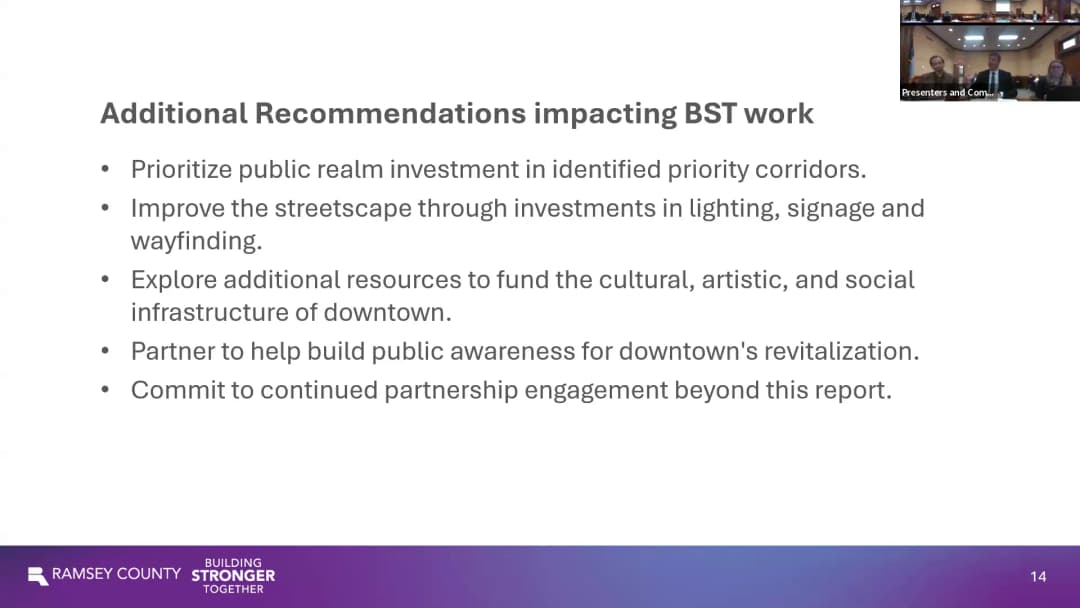
On October 13, 2026, the Ramsey County Board held a workshop to receive an update on the "Building Stronger Together" (BST) initiative, a $320 million economic development plan aimed at broadening the tax base and reducing property tax burdens. Commissioner Mike Tonjon chaired the session, filling in for Commissioner Moran. The session focused specifically on the "Dynamic Downtown Strategy" component. No votes were taken during this informational session, which was led by Community & Economic Development (CED) staff. Project Overview and Scope - The BST initiative consists of two main strategies: 1) Dynamic Downtown (targeted investments), and 2) Sale of county-owned lands for redevelopment. - A previous fiscal health analysis by Urban Three, mentioned in the workshop, found that only 28% of land in downtown St. Paul is taxable, underscoring the need for strategic investment in taxable parcels. Planning and Community Engagement - Staff (Brad Moore, Max Holdeson) conducted a planning and engagement phase over the summer of 2026, interviewing a broad list of downtown partners (e.g., City of St. Paul PED, Port Authority, Downtown Alliance) and reviewing plans dating back to 1997. - Key findings from this phase included an acknowledgement of strong downtown assets (parks, riverfront, Fortune 500 companies), persistent commercial vacancies, and a limited current pipeline for office-to-housing conversions. The City of St. Paul's Downtown Vitality Fund did not fund any housing applications due to project readiness issues. Recommendations: Establishing a Dynamic Downtown Fund - Staff recommended expanding the originally proposed $50 million office-to-housing conversion bond into a broader "Dynamic Downtown Fund" utilizing the HRA and potentially the new EDA authority. - Eligible uses would be expanded to include commercial, retail, hospitality, and housing redevelopment, as well as privately-owned public spaces. - The fund would be deployed through competitive solicitations. The first solicitation is planned for January 2027, with project selections in Spring 2027 and bond sale proceeds arriving around June 2027. Projects would have 180 days to close on loans. - Additional recommendations included investing in public infrastructure along priority corridors (5th, 6th, Kellogg), streetscaping, lighting, and wayfinding, though this sparked debate about the county's role in city streets. Commissioner Discussion and Feedback - Commissioner Ortega strongly advocated for the county to "step on the gas" and move from planning to implementation, expressing concern that "all these plans are still on the shelf." - Commissioner Miller raised concerns about resource equity, questioning whether using HRA levy dollars for downtown projects could exclude other parts of St. Paul or suburban communities. She also questioned the county's role in funding streetscaping on city streets and requested clear, measurable goals tied to a five-year plan, including intergenerational wealth building. - Commissioner McGuire expressed significant frustration with the City of St. Paul's perceived lack of leadership and partnership, stating, "really city of St. Paul should be coming to the table a lot more." - Commissioner Zhang emphasized the need for clear metrics for success and measurable outcomes, expressing concern about expanding bond uses without a clear guiding plan. He requested a detailed primer on the bond mechanics and its impact on suburban versus downtown investments. - Commissioner McMurtry questioned the level of engagement with Met Transit and highlighted the underutilization of existing assets like the riverfront. Staff Responses and Next Steps - Staff responded that the eligibility area for the fund is intentionally the downtown core to maximize impact on the tax base, noting that suburban Ramsey County's HRA allocation is not impacted by this shift in the St. Paul levy. - Staff committed to developing a policy presentation on eligible uses, scoring criteria, and measurable goals to address board feedback. - Staff noted that the county's AAA bond rating allows for below-market rate loans for developers, creating a strong incentive for private investment. - Other BST projects are advancing: River's Edge (evaluating accelerated delivery methods and phasing), Rice Creek Commons (construction starting late 2026), and county-owned lands (Payne & Maryland, Frost & English), with a full update on land sales expected in December 2026. - A BST newsletter and one-pagers are being finalized for public engagement. Key Outcomes - No formal votes or decisions were made; the workshop was held for board discussion and direction. - Board members requested follow-up information, including a clear educational primer on the bond financing mechanics, a framework for coordination with the City of St. Paul, and a detailed breakdown of eligible uses and scoring criteria for the Dynamic Downtown Fund solicitation. - The next BST-related board update is scheduled for a workshop in December 2026, focusing on the sale of county-owned lands and broader strategy metrics.

ECONOMIC DEVELOPMENT 69% · AFFORDABLE HOUSING 11% · COMMUNITY ENGAGEMENT 9% · PUBLIC ENGAGEMENT 3%
2319
OCT 13, 2026 · FORT WORTH, TEXAS · CITY COUNCIL
Infrastructure and Growth Committee Meeting - October 13, 2026: Texas Compassionate Use Program Zoning Regulations

Date: October 13, 2026 Time: 3:00 PM (convened) Location: City Council Work Session Room, 100 Fort Worth Trail, Fort Worth, Texas This meeting of the Infrastructure and Growth Committee focused primarily on a briefing regarding updates to zoning regulations for the Texas Compassionate Use Program (TCUP). The committee discussed proposed amendments to treat satellite dispensing locations as pharmacies and to create a separate land use for cultivation and processing facilities. Members expressed concerns about allowing such facilities in light industrial (I) districts adjacent to residential areas and reached informal consensus to remove that zoning designation from the staff recommendation. Consent Calendar - Approval of May 12, 2026 Meeting Minutes: Approved unanimously. Briefings - Texas Compassionate Use Program and Zoning Regulations – Dave McCorquodale, Planning Manager, Development Services, briefed the committee. The presentation reviewed the TCUP framework, existing state regulations, and staff's proposal to: - Amend the definition of "pharmacy" to include TCUP satellite locations, allowing them by right in all commercial and industrial zoning districts and certain form-based districts. - Create a new land use category for compassionate use cultivation, extraction, testing, packaging, processing, and distribution, limited to industrial districts IJ and K. - Staff reported that two of the three licensed dispensing organizations in Texas have pickup locations in Fort Worth, and two conditionally approved licenses exist in Public Health Region 3 (which includes Fort Worth, though specific locations are unknown). Discussion Items - Council Member Michael D. Crain asked clarifying questions about the program's scope, noting it is medicinal only and requires a prescription. He confirmed that satellite locations do not involve on-site manufacturing or packaging, and that the definition as a pharmacy allows for future expansion once a licensee has a satellite in all 11 public health regions. - Council Member Jeanette Martinez expressed concern about allowing cultivation and processing facilities in light industrial (I) districts that are often adjacent to single-family residential areas, potentially burdening economically disenfranchised communities. - Council Member Chris Nettles echoed these concerns, stating he is not in favor of any industrial uses (IJ or K) next to single-family housing. - Staff clarified that under current state law, each licensee can have only one cultivation site per public health region, limiting the potential number of such facilities. The two conditionally approved licenses for Region 3 may not yet be located in Fort Worth. - The committee discussed whether to remove light industrial (I) districts from the permitted zones for cultivation/processing facilities. Council member Martinez and another member (words attributed to Council Member Nettles or Crain) expressed agreement that light industrial should be excluded to prevent stigmatizing communities and avoid proximity to residential areas. Key Outcomes - No formal vote was taken, but the committee reached informal consensus to remove light industrial (I) zoning districts from the allowed locations for compassionate use cultivation and processing facilities. Staff will revise the recommendation accordingly. - The committee upheld the proposal to treat satellite dispensing locations as pharmacies, allowing them in all zones where pharmacies are permitted. - The next steps will involve further legal review regarding preemption and potential adoption of the revised zoning amendments at a future City Council meeting.

CANNABIS REGULATION 62% · ZONING 38%
2320
OCT 13, 2026 · TACOMA, WASHINGTON · CITY COUNCIL STUDY SESSION
Tacoma City Council Study Session: 2027-28 Budgets, Rates, and Trick or Streets - October 13, 2026

The Tacoma City Council met in study session on October 13, 2026, to review the proposed 2027-2028 budgets and rates for Tacoma Public Utilities (TPU) and the Environment and Public Works Department (EPW), and to consider a $5,000 Council Consideration Request for Trick or Streets. The presentations were informational; no formal votes were taken. The City Manager reported no recommended modifications to the evening agenda and noted two public comment opportunities later in the day. No meeting minutes were available in the record. Public Comments & Testimony - No public testimony was taken during the study session. City Manager Hyun Kim noted that the evening council meeting would include two public comment opportunities: public comment and community forum. Discussion Items Tacoma Public Utilities Budget and Rates Presentation - TPU Director Jackie Flowers presented the proposed 2027-2028 budget and rates for Tacoma Power, Tacoma Water, and Tacoma Rail, emphasizing alignment with the Tacoma 2035 goals. - Accomplishments highlighted included the 20-year Bonneville Power Administration contract renewal, joining the day-ahead energy market, Howard Hanson Dam additional water storage, Cascade Water Alliance wholesale agreement, and Tacoma Rail locomotive modernization: eight locomotives, a historic $31 million investment, and more than a 90% emissions reduction in the Tide Flats. - Flowers cited major cost pressures: transformer costs increased 228% between 2019 and 2026, plus labor, health care, regulatory mandates, aging infrastructure, and hydropower modernization. - The budget uses a net-zero FTE approach, resulting in a net reduction of 7.5 FTE at TPU; the 'stop, start, continue' initiative produced more than 70 employee submittals and $23 million per year in reductions in the proposed biennial budget. - Proposed residential rate impacts for an average combined electric and water customer are $10.75 per month in 2027 and $11.52 per month in 2028. - The Bill Credit Assistance Program would expand eligibility from 60% to 80% of area median income, increasing potentially eligible power customers from 43,000 to 63,000 and water customers from 25,000 to 37,000, with 25% participation assumed. - Hydro relicensing planning will address three of TPU's four FERC-licensed hydropower projects with licenses expiring in 2037; TPU targets submitting its application by 2032 and estimates about $100 million for this round of relicensing. - Councilmembers asked about PFAS regulation and water supply planning, cumulative bill affordability, the rate stabilization account, FERC relicensing, Joint Base Lewis-McChord energy resilience, and stranded assets. Director Flowers responded that PFAS compliance is an unfunded federal mandate and that Tacoma's water system remains robust despite regional drought, but fixed infrastructure costs continue regardless of usage. Environment and Public Works Budget and Rates Presentation - EPW Director Ramiro Chavez presented the consolidated 2027-2028 budgets for environmental services and public works, covering climate/environment and transportation/mobility investments. - Proposed residential rate increases: solid waste 5% ($3.24 in 2027, $3.42 in 2028); wastewater 6.5% ($4.25 and $4.75); stormwater 7.5% ($2.90 and $3.42). The combined residential monthly increase for the three EPW utilities is $10.43 in 2027 and $11.59 in 2028. - Fee proposals include increasing the transfer station commercial county disposal rate from $8.50 to $9.50 per 100 pounds; a new residential self-haul yard waste fee of $10 for the first 400 pounds and $2.50 per additional 100 pounds; a 10% commercial parking tax; raising the commercial right-of-way occupancy application fee from $641 to $1,280 with an annual 2% increase; on-street parking citation tiers of $30, $40, and $50; and increasing street vacation application fees from $500 to $5,000. - Environmental programs described included pollution response, wastewater and stormwater maintenance, urban tree canopy growth, alternative-fuel fleet transitions, solid waste diversion, and community education and cleanup programs. - Transportation investments centered on Connect Tacoma, approved by voters in August 2026, and the existing streets initiative, which has repaired more than 5,600 residential blocks and leveraged $144 million in state and federal grants. EPW is developing a Connect Tacoma implementation framework, with a study session anticipated in early December and project list updates in 2027. - Chavez also noted Vision Zero efforts and automated enforcement on selected corridors, with citations beginning October 14, 2026. - Councilmembers asked about street sweeping, the yard waste fee, parking enforcement, street vacations, bridge maintenance, and use of utility revenues. Staff clarified that utility funds are restricted to their specific utility purposes and that the new yard waste fee would be accompanied by a public awareness campaign if adopted. Trick or Streets Funding Request - Councilmember Hines requested $5,000 in council consideration funds for Trick or Streets, hosted by Safe Streets, to cover street-closure permitting costs for community Halloween and Dia de los Muertos gatherings during the weekend of October 31 through November 2. Last year's inaugural program received $7,500; this year's request is gap funding while Safe Streets pursues Tacoma Venues and Events community funding. Councilmembers Diaz, Walker, and Rumbaugh were listed as co-sponsors. Mayor Ibsen expressed support for the community-building program. City Manager's Weekly Report - City Manager Hyun Kim presented four proclamations for the evening agenda: Community Conflict Resolution Day (October 15), Day of Democracy (October 17), Walk and Roll to School Month (October 2026), and Domestic Violence Awareness Month (October 2026). He stated there were no recommended modifications to the evening agenda. Key Outcomes - No formal council votes were taken during the study session. - TPU will take its budget and rates to first reading on October 14, 2026, with a Public Utility Board second reading tentatively planned for October 28, 2026; the budget packet will be included in citywide budget consideration on November 10 and November 17, 2026. - EPW will present the Connect Tacoma implementation framework to the IPS committee on October 14, 2026, and to the full council in a study session in early December. - The City Manager provided the weekly report with four proclamations and no recommended agenda modifications. - An executive session for pending/potential litigation was listed on the agenda but was not reflected in the available transcript.

PUBLIC WORKS 17% · PUBLIC UTILITIES 13% · PUBLIC FINANCE 13% · WATER AND WASTEWATER MANAGEMENT 12%
OPENPUBLICA · PUBLIC MEETING INDEXUPDATED DAILY · openpublica.com