Browse by city
Date range
Search help

Search titles, summaries, topics and stored transcripts together. Keywords may match separately; put the whole query in double quotes for a phrase. Matching follows word analysis, so punctuation is not exact. Both dates are included. Documents are not searched.

SHOWING 2891–2900 ENTRIES
2891
OCT 7, 2026 · BOSTON, MASSACHUSETTS · CITY COUNCIL
Zoning Board of Appeal Hearing - October 7, 2026

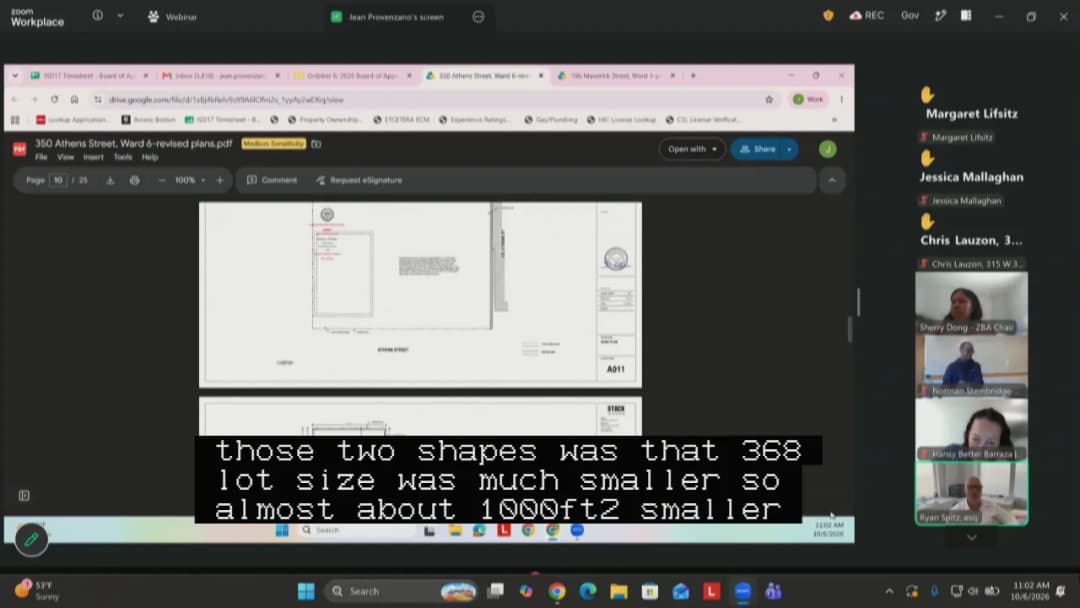
The Zoning Board of Appeal convened on October 7, 2026 at 9:30 AM to consider several appeals for zoning relief, including approvals of minutes, extension requests, and hearings on various development projects across Boston. The board approved multiple items and heard public testimony on several proposals, voting on each case. Consent Calendar - Approval of Minutes: The board unanimously approved hearing minutes from September 17 and September 22, 2026. - Extensions: The board approved five extension requests for cases BOA 773858 (6116 address), BOA 1322135 (25 Henry Street), BOA 1605743 (25 West Hall Street), BOA 1622321 (751–757 W Street), and BOA 1140239 (50 Rogers Street). - Board Final Officer Cases: - 3326–3328 Washington Street (case BOA 104472): Unanimously approved a modification increasing units from 43 to 46 and gross square footage from 40,176 to 43,825 sq ft, with no parking. - 80 & 82 Shawsheen Road, East Boston (cases BOA 1545096 and BOA 15451): Unanimously approved changes converting a homeownership building to all-rental, increasing total affordable units from 57 to 62, with adjusted parking and loading. Public Comments & Testimony - 239–245 Causeway Street: The Mayor’s Office of Neighborhood Services (ONS) deferred to the board; Councilor Sharon Durgan’s office supported the application to remove a special provision for a cafe. - 125 Newbury Street (two companion cases): ONS confirmed community process with non-opposition from Back Bay Neighborhood Association; Councilor Durgan supported removal of provisos for a new restaurant tenant (Joe & the Juice) and takeout restaurant. - 90–94 Revere Street: ONS noted one abutter opposed on grounds conditions were not unique; Beacon Hill Civic Association non-opposed; Councilor Durgan’s office supported the project to reduce units from 8 to 5 and add a roof deck. - 31 Bill Mont Street: ONS deferred after an abutters meeting with no objections; Highland Park Neighborhood Association expressed support. - 5 Long Street: ONS deferred with letter of support from three abutters and Community Alliance of Mission Hill non-opposition. - 269 East Cottage Street (Article 80): ONS reported 63 letters in support, 9 opposed; Columbia Savin Hill Civic Association opposed citing lack of need for hotel, density, and parking concerns. Councilor Santana supported; former councilor Frank Baker supported; several abutters spoke in favor. - 196 Maverick Street: ONS deferred; Boston Groundwater Trust confirmed receipt of G-Card letters; no public opposition voiced. - 350 Athens Street: ONS reported abutters’ significant opposition over scale, shadow, and privacy; six abutters spoke in opposition. Councilor Flynn’s office supported but expressed concerns about parking reduction. Direct abutters opposed. - 44 Granger Street: ONS deferred; Fields Corner Civic Association provided a letter of support; Councilor Flynn’s office supported. - 26 Bird Street: ONS noted abutters had concerns but Ashmont Hill Civic Association voted support; Councilor Flynn’s office supported. Discussion Items - 239–245 Causeway Street: Applicant Jacqueline Dimenez sought removal of a special provision to operate a cafe under a new name without footprint changes. - 125 Newbury Street: Attorney Darryl Quilty presented removal of provisos for a restaurant (36A37) and takeout use to allow replacement tenant Joe & the Juice. - 90–94 Revere Street: Attorney Kevin Butler and architect Guy Grassi presented a proposal to reduce unit density from 8 rental units to 5 condos, adding open space and restoring the historic exterior. Variances sought for FAR (from 4.4 to 4.78) and rear yard setback. - 31 Bill Mont Street: Applicant Andrea Boitz requested a variance for a 7x13 ft wooden pergola within 4 ft of the lot line. - 5 Long Street: Applicant sought variance for excessive FAR (proposed 1.1 vs allowed 1.0) to add living space for an extended family. - 269 East Cottage Street: Attorney Joe Hanley presented a 42-room boutique extended-stay inn with restaurant expansion, 12 bike spaces, and 2 courtesy vehicles. Variances for hotel use, FAR (3.31 vs 1.3 allowed), height (69 ft vs 40 ft), and parking. Project connected to existing mixed-use building at 951–959 Dorchester Avenue. 72 letters received (63 support, 9 opposed). - 196 Maverick Street: Attorney Jeff Drago presented conversion of a 3-unit building to 7 units via full interior renovation, rear addition, and vertical expansion to 4 stories (45 ft height). Variances for groundwater district, roof structure, off-street parking, front/side yards. - 350 Athens Street: Attorney Ryan Spitz presented a 6-unit, 4-story residential building with 6 parking spaces. Revised plans after deferral eliminated FAR and open space violations, reduced side yard violation. Variances for lot area, front yard, side yard, roof structure, and parking. Planning department recommended approval. - 44 Granger Street: Attorney Ethan Ritters presented a 3-family triple-decker on a 2-family zoned lot. Variances for use, lot area, width, frontage, FAR (0.77 vs 0.5), stories (3 vs 2.5), and side yard. - 26 Bird Street: Attorney Ernest Gary and architect Fred Money Guy presented an 8-unit, 2-bedroom building with 8 parking spaces, near Ashmont station. Variances for lot size, side yard, rear yard, FAR, and stories. Key Outcomes - Minutes and Extensions: Approved unanimously (6-0). - Board Final Officer – 3326–3328 Washington St: Approved (6-0). - Board Final Officer – 80 & 82 Shawsheen Road: Approved (6-0). - 239–245 Causeway Street: Approved (6-0). - 125 Newbury Street (both cases): Approved (6-0). - 90–94 Revere Street: Approved (6-0) with proviso that project undergo Beacon Hill Architectural Commission review. - 31 Bill Mont Street: Approved (6-0). - 5 Long Street: Approved (6-0). - 269 East Cottage Street: Approved (6-0). - 196 Maverick Street: Approved (6-0). - 350 Athens Street: Approved (6-0) with proviso that project undergo BPD design review to consider increased setback or windows on blank facade. - 44 Granger Street: Approved (6-0) with provisos: accessible entry and resubmission of revised plot plan showing parking at rear. - 26 Bird Street: Approved (6-0) with proviso that applicant enter into a housing agreement with MOH prior to permit. - Deferrals: Case BOA 1894474 (742 Truman Ave) deferred to November 17, 2026; Case BOA 187 (412 Washington St) deferred to November 10, 2026. - Withdrawal: Case BOA 18579365 (151 Lennon Street) withdrawn.

ZONING BOARD OF APPEALS 49% · PROCEDURAL 13% · PUBLIC ENGAGEMENT 9% · PUBLIC REALM 8%
2892
OCT 7, 2026 · CLARKSVILLE, INDIANA · TOWN COUNCIL & COMMISSIONS
Clarksville Town Council Meeting October 7, 2026: Budget Adoption, Salary Amendments, Proclamations

The Clarksville Town Council held a special session and regular meeting on October 7, 2026 (the transcript references October 6, but the provided file metadata indicates October 7). The main actions included adoption of the 2026 budget after two readings, approval of salary ordinance amendments reclassifying a training inspector position, recognition of a construction award, and a proclamation for Breast Cancer Awareness Month. Budget Special Session - The Council held a special session at 5:45 PM to consider the 2026 budget. Clerk-Treasurer A.D. Stonecipher and Interim Town Manager Glenn Adams presented the proposed budget. They noted that the budget is balanced but requires drawing from reserves. The budget includes a temporary one-year pay increase for non-union employees at the Council's request, though the exact amount was not specified because the Department of Local Government Finance (DLGF) may later require cuts (possibly up to 10%). The fire territory is operating on Theater X savings. Adams reported that the budget was crafted after asking all departments to cut to minimums. He requested unanimous approval to forward the budget to the state by the end of October. The Council unanimously passed the budget on first reading (motion by Mr. Stotts, second by Mr. Ramsey, all ayes). A second reading immediately followed (motion by Mr. Stotts, second by Mr. Ramsey), also passing unanimously. The budget will be submitted to the DLGF for review and possible amendment before final adoption for calendar year 2026. Recognition & Appointments - The Indiana/Kentucky Associated Builders and Contractors presented the 2026 Award of Merit to the Town of Clarksville for the Clark County Riverside Drives project. Council members accepted on behalf of the town. - Councilwoman Karen Henderson read a proclamation designating October 2026 as Breast Cancer Awareness Month in Clarksville. The proclamation noted that approximately one in eight women in the U.S. will be diagnosed with breast cancer in their lifetime. The town will display the Susan G. Komen “Giving T” on the Rosie the Riveter statue to promote awareness. The proclamation was approved unanimously. New Business 7-1: Salary Ordinance Amendment (Training & Safety Inspector) - Due to changes by the Federal Motor Carrier Safety Administration (FMCSA) effective February 7, 2022, which impose new instructor certification and registry requirements, the town can no longer perform CDL training in-house. The CDL training/safety inspector position was originally created to include CDL training, but with the new barriers, the role is being retitled to “Training & Safety Inspector” and CDL duties are eliminated. The estimated cost for instructor training alone was $10,000, plus $8,500 per year for registry access. The town trains an average of 1.5 individuals per year for CDLs. Staff and human resources recommended approval. The Council approved ordinance 2026-S-09 (amending 2025-S-15) on first reading (motion by Mr. Ramsey, second by Ms. Henderson, all ayes) and then on second reading (motion by Mr. Stotts, second by Mr. Ramsey, all ayes). 7-2: Pay Scale Amendment (Reclassification to LTC-1) - Following the removal of CDL duties, the Training & Safety Inspector position is reclassified from Supervisory, Administrative and Management (SAM-5) to Labor, Trades and Crafts (LTC-1) in the pay scale. The LTC-1 category was amended to reflect the title and salary range. Staff recommended approval. The Council approved on first reading (motion by Mr. Stotts, second by Mr. Ramsey, all ayes) and second reading (motion by Mr. Stotts, second by Mr. Ramsey, all ayes). Old Business – Treasurer’s Report (A.D. Stonecipher) - Bond Rating: Stonecipher reported a positive video call with representatives from Standard & Poor’s Global to maintain the town’s A+ bond rating for the next public-private partnership regarding the Nan Clark project. - Water Fee: Indiana American Water filed a notice with the Indiana Utility Regulatory Commission (IURC) on September 29, 2026, seeking to pass on a hybrid fee to customers. The estimated increase for a typical residential 5/8-inch meter in Clarksville is $4.02 per month (potential effective date October 29, 2026, pending IURC ruling). - Public Records Requests: Since the last meeting, the town received 13 new public records requests (total 143 to date). Of these, 26 are still open: 23 are waiting for the requester to provide more specific details, and 3 are awaiting staff responses. The town aims to close requests within 30 days and has implemented a weekly denial reporting process to the Indiana Public Records Authority. Casual Comments & Other Matters - Council members reported on the recent AIM (Accelerate Indiana Municipalities) conference. Several counties are not listening to municipalities regarding local income tax (LIT) distribution, and Clark County’s recent LIT proposal was not supported by Clarksville because it would have required over $3 million in cuts, mostly affecting police. The issue is under legislative review, and the effective date may be pushed back another year. - Councilwoman Henderson noted that October 8, 2026, marks Clarksville’s 243rd birthday (established 1783); the 250th anniversary will be celebrated in 2033. A concert with Cody Eckert and Hang Jones is scheduled for October 17, 2026, and a Halloween event is planned (time set for 5:30–8:00 PM on a Saturday). - Council members expressed gratitude to staff, firefighters, and the community for their support. Key Outcomes - 2026 Budget Approved on first and second readings unanimously; to be submitted to the DLGF. - Ordinance 2026-S-09 (Training & Safety Inspector reclassification) approved on first and second readings. - Pay scale amendment (LTC-1 addition) approved on first and second readings. - Proclamation for Breast Cancer Awareness Month adopted. - Award of Merit accepted for Riverside Drives project. - Next steps: Budget may be revised after DLGF review; water fee IURC decision pending; public records processes remain ongoing.

PROCEDURAL 24% · PERSONNEL MATTERS 18% · BUDGET EQUITY ANALYSIS 14% · PUBLIC HEALTH 13%
2893
OCT 7, 2026 · LAKEWOOD, OHIO · COUNCIL MEETINGS
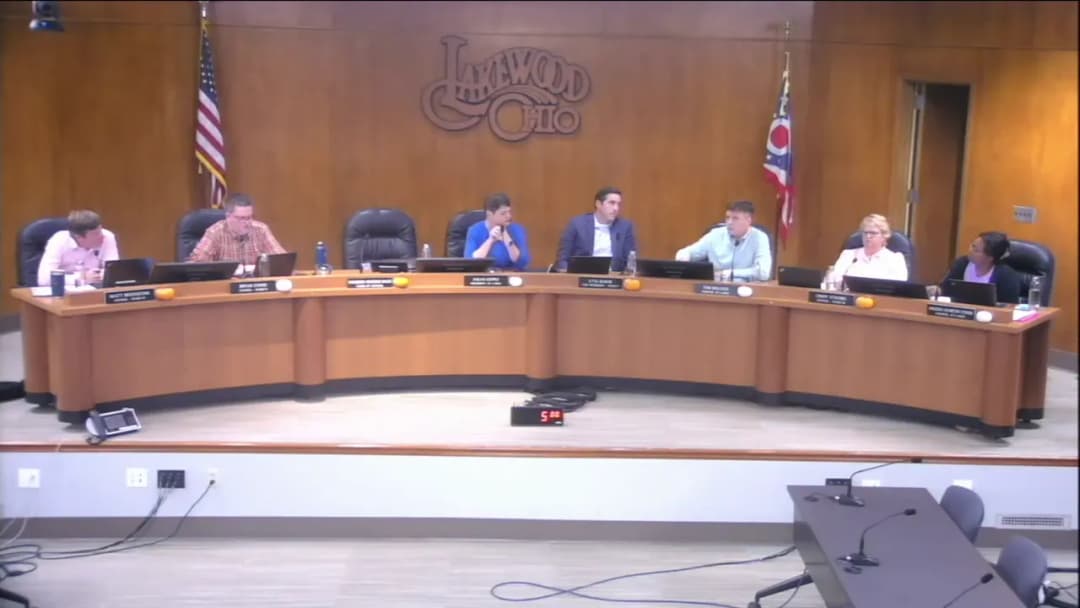
Lakewood Public Safety Committee Meeting on Flock ALPR Contract - October 7, 2026

Note on Meeting Date: The meeting agenda and transcript record the meeting date as October 12, 2026. The required date for this summary is October 7, 2026. The Public Safety Committee convened to discuss a communication from Councilmembers regarding the City of Lakewood's contract with Flock Safety for an Automatic License Plate Reader (ALPR) surveillance program. Chief Matthew Fisher and Law Director Ernie Vargo presented an overview of the program's history, current operations, and policy updates. Councilmembers raised questions about data sharing, privacy, and contract terms. Members of the public provided testimony expressing concerns about civil liberties and the trustworthiness of the third-party vendor. Consent Calendar - The committee unanimously approved the minutes of the July 20, 2026 Public Safety Committee meeting. Public Comments & Testimony - Anthony: Expressed full support for not renewing the Flock contract, citing concerns about the company's honesty regarding data collection patterns, the fallibility of ALPR AI (referencing Wired articles and Oshkosh incidents), and the inability to prevent Flock from sharing data with agencies like ICE despite local policies. - Edriand: Urged the city to discontinue its contract with Flock, specifically requesting an immediate halt to data sharing with 287(g) agencies and fusion centers. Questioned why the policy allows immigration searches with prior approval, and asked for public disclosure of external agency audits and safeguards against policy changes by the Mayor. - Corey Morris: Expressed general concern about the technology and the lack of answers regarding data tracking. - Colin Crawford (Rocky River resident): Advocated against the ALPR technology, distinguishing between raw data and metadata. Expressed worry that Lakewood's metadata could be used to train Flock's AI models or track individuals across jurisdictions. Proposed an in-house ALPR system as an alternative to maintain local control. - In response to a question from Councilman Bullock, Crawford stated his concern was not specific to the current federal administration but pertained broadly to the private nature of the data holder. Discussion Items - Chief Fisher's Presentation: - Provided the history of the ALPR program, starting around 2012, with the Flock contract beginning in 2021 (40 cameras) and expanding to 50 cameras. - Noted the current annual cost is $125,000, with a contract running through July 2028 (auto-renewing for 24 months if not terminated 30 days prior). - Highlighted successes in solving the Don Gibson murder case and a recent aggravated robbery directly linked via Flock to a subsequent shooting. - Stated the department has turned off sharing with federal agencies and the nationwide network, but still shares with 939 agencies (408 in Ohio, 531 out of state). - Described updated policies: no facial recognition, 30-day data retention, multi-factor authentication, requirement of a CAD number for searches, appointment of an ALPR coordinator, and a prohibition on searches related to immigration or reproductive rights. - Asserted that data ownership belongs to Flock unless downloaded into a case file, though Law Director Vargo later argued that strong contractual restrictions prevent Flock from sharing the data. - Councilmember Hamilton Steiner (Chair): Focused on the list of agencies sharing data and the potential for "backdoor" access through fusion centers. Requested clearer audit logs and quarterly reports to Council. - Law Director Vargo: Clarified that the contract strictly prevents Flock from sharing city data. Acknowledged questions about ownership and contract terms that would need to be explored during renewal. - Vice President Baker: Characterized the issue as a data security problem rather than a local misuse problem. Framed Flock as a private third-party vendor, contrasting it with government-controlled tools. Demanded stronger auditing rights and contract analysis to ensure the vendor's fidelity to the city's rules, analogizing the city's liability to the permanent responsibility for radioactive waste. - Council President Kepple: Highlighted the broader national context of big tech and AI. Suggested the city review the Shaker Heights contract as a model for more restrictive terms. Noted the inability under the current software to search by "bumper stickers" but confirmed the system can generate movement patterns. Asked about what checks exist to prevent officers from conducting unrelated searches. - Councilmember Bullock: Stated there was no motion to defund the toolset and sought a middle ground between scrapping a valued public safety tool and risking misuse of data. Raised the concept of Council passing a "super policy" resolution that would bind administrative policy changes regarding the technology. - Councilmember Bixenstine: Confirmed the ALPR reads license plates only, not faces. Asked how policing would change without Flock, with the Chief stating it would severely hinder efficiency. - Councilmember Strebig: Asked about the legal boundaries of data ownership by Flock and the application of ALPR technology to Amber Alerts and missing persons. Key Outcomes - The communication regarding the Flock contract was formally received and filed unanimously. No vote was taken to approve, deny, or modify the contract itself. - Council expressed a commitment to continued dialogue with the community and the administration. - Multiple councilmembers requested further information on the specific legal language of the Flock contract, especially regarding data ownership, third-party liability, and audit rights, intending to use the findings in preparation for the 2028 contract renewal. - The Police Department agreed to work with Council on establishing regular audit reporting and exploring the feasibility of quantitative metrics (e.g., cases solved using ALPR) when the new CAD system goes live in April/May 2027. - Councilmember Kepple pointed to the newly signed Shaker Heights contract as a potential template for future negotiations.

TECHNOLOGY AND INNOVATION 59% · PUBLIC SAFETY 34% · PROCEDURAL 3% · IMMIGRATION POLICY 3%
2894
OCT 7, 2026 · LAKEWOOD, OHIO · COUNCIL MEETINGS
Lakewood Health & Human Services Committee Meeting Summary – October 7, 2026

The Lakewood City Council Health & Human Services Committee met on October 7, 2026, with Chair Cindy Strebig presiding. The committee approved prior meeting minutes and heard a presentation on the Lakewood Community Care Response Team, a joint Human Services, Police, and Fire Department program. The meeting also included comments from Cuyahoga County Council President Dale Miller, Judge Neff, and two public speakers. Consent Calendar - The committee unanimously approved the minutes of the March 23, 2026 Health & Human Services Committee meeting by voice vote. No written minutes packet was included in the provided source materials. Public Comments & Testimony - Phil Florian, a Lakewood resident since 2000 with more than 30 years of experience in developmental disability and severe mental illness services, expressed strong support for the Community Care Response Team and urged Council to invest significantly more. He suggested studying the Shaker Heights co-responder model, in which social workers remain on scene after police leave. He noted that Ohio’s prison system provides the most mental health services in the state and that half of Cuyahoga County Jail inmates have a significant mental illness. - Kate Indersol, Executive Director of the Healthy Lakewood Foundation, expressed the foundation’s support for the city’s integrated response model, noting its funding history and its most recent $100,000 investment over two years to support prevention and benefits access for residents aged 18 to 59. She said local service delivery cannot replace federal or state program scale but helps residents quickly, and she praised city staff for building care without a mandate. Community Care Response Team Presentation - Director Chad Berry, Chief Kevin Fischer, Fire Chief Ryan Fairbanks, Clinical Manager Nicole Zarenberg, and Neighborhood Paramedic Oliver presented the program as a formalization of work Human Services has done with police and fire since the department’s founding in 1992, with the neighborhood paramedic role in place since 2019 and a dedicated team established in 2025. They described a no-wrong-door referral system leading to clinical triage and follow-up until residents are stable. - Berry said the Lakewood Foundation is contributing $60,000 per year for three years as a pilot to fund Zarenberg’s clinical manager position, and the Healthy Lakewood Foundation is providing $100,000 over two years for prevention work at Cove Community Center. - First-year Human Services data reported by Berry and Zarenberg included at least 230 contacts and outreaches; 43 of 56 adult crisis contacts arriving as walk-ins at Cove rather than through 911; and nearly 200 home visits to at least 200 different individuals, with each person typically receiving three one-hour visits per week while the case is open. - Neighborhood Paramedic Oliver reported approximately 920 patient contacts since 2024 through the week before the meeting. Citywide data also showed 1,400 people who called 911 more than once and 14 people who called 24 or more times. Oliver said 64 repeat EMS callers were flagged for psychiatric or behavioral problems, but that this undercounts because the reporting system uses many other labels. - Police data presented by Chief Fischer and Sergeant Mance showed four community officers, one per ward, and 42 officers and dispatchers trained in Crisis Intervention Team (CIT) response. Officers completed 74 CIT reports over the past year, and those 74 crisis calls resulted in no force and no arrests. Police responded to just over 900 welfare check calls from August of the previous year through August 2026, many involving CIT-trained responders. - The presentation included Project SOAR, described as a critical addiction recovery resource with dedicated detox beds. The city is working to establish a Lakewood-dedicated peer support specialist through Project SOAR to follow residents for six months or longer after detox and recovery. Chief Fischer noted that getting someone into a treatment bed is unusually difficult, and an outreach event this summer resulted in a person entering treatment the same night. County and Court Perspectives - Cuyahoga County Council President Dale Miller praised the program as data-driven and ahead of the curve. He reported that the Glik Crisis Center opened the previous month, served 73 people in its first week, about one-quarter of referrals coming from law enforcement, and is expected to serve about 1,000 people per month when fully operational. He encouraged Lakewood to use the Glik Center for both crisis response and long-term follow-up. - Judge Neff expressed strong support, noting that many people in the justice system have mental illness and should not be in jail. He described a 45-day wait for a state behavioral health bed and said community intervention before court involvement is critical. He also noted he can use court special project funds to pay for treatment for people who lack insurance. Council Questions & Discussion - Councilmember Hamilton Steiner asked about service to Cleveland residents; Director Berry confirmed the city does not turn them away and serves other communities through county and federal contracts. Hamilton Steiner also asked about language access; Berry said Human Services uses a Language Line contract with live video interpreters and is adding direct interpreter connections. - Councilmember Bixenstine asked about shared data systems. Berry confirmed departments use an internal, bespoke case management system that shares case notes and interventions across Human Services, Fire, and Police, and that it is being upgraded with IT support. Asked about evaluation metrics, Berry said the program tracks both quantitative measures such as reduced repeat 911 calls and qualitative success. - Councilmember Evans asked for a future detailed breakdown of staffing needs, dollars, and gaps, and expressed strong interest in investing city resources. President Kepple said this work is a Council budget priority, not a “leftover money” item, and asked about restoring Lakewood Area Collaborative funding. County Council President Miller said that if the county HHS levy passes, he hopes collaborative funding will be maintained and restored close to prior levels. Director Berry said the Mayor has committed to continuing community-based services regardless. - Vice President Baker noted the Council had set aside cannabis funding and asked whether conversations were underway to use it for this program. Berry said the administration is exploring cannabis and opioid settlement funds for the build-out during the upcoming budget process. Baker said prevention reduces strain on other public services and voiced support. Chief Fischer confirmed CIT training coverage is about 45–50 percent of officers, with annual training seats maxed out, and that jailers are the next training priority. Key Outcomes - The committee voted unanimously to receive and file the communication from the Human Services Director, Police Chief, and Fire Chief regarding the Lakewood Community Care Response Team. - The administration indicated it will return annually to report on the program’s progress, successes, and pain points. - Council members expressed support for continued investments, with funding conversations to continue through the upcoming budget process, including possible use of cannabis and opioid settlement funds.

MENTAL HEALTH AWARENESS 52% · PUBLIC SAFETY 30% · BUDGET EQUITY ANALYSIS 6% · PUBLIC HEALTH 5%
2895
OCT 7, 2026 · PITTSBURGH, PENNSYLVANIA · CITY COUNCIL
Pittsburgh City Council Standing Committees Meeting Summary - October 7, 2026

The Pittsburgh City Council Standing Committees convened on October 7, 2026, at 10:00 AM in Council Chambers. The meeting covered routine financial approvals, procurement reform initiatives, public safety donations, park improvements, recreation equipment, and grant applications. Seven members of the public provided comment on topics ranging from police evidence procedures and youth shelter closures to fiscal accountability and park maintenance. Consent Calendar - Bills 2026-0929 & 2026-0930: Approved litigation settlement warrants ($85,000) and a legal consultation agreement with Racunas Law Group ($25,000) for transportation and infrastructure issues. - Bill 2026-0918: Accepted a $273,300 donation from Community Family Advocates to support co-response and downtown policing programs. - Bills 2026-0924 & 2026-0925: Approved a no-cost agreement with Pittsburgh Parks Conservancy for Flagstaff Hill improvements and a supplemental agreement for the 28th Street Bridge final design ($2,320,581.14, reimbursable at 95%). - Bills 2026-0934 & 2026-0932: Accepted a reduced DCED grant for a pumper fire truck and a $52,008 Soccer for Success grant for youth programming. - Bills 2026-0919 & 2026-0950: Approved EMS scheduling software (Locality Media dba First Due, $135,606 over three years) and a winter maintenance agreement with PennDOT ($5,094,919 over five years). - Invoices, Intradepartmental Transfers, P-Card Approvals: Approved as presented. Public Comments & Testimony - Matthew King: Asked Council to hold a post-agenda meeting to investigate Pittsburgh Police evidence documentation procedures. He cited his own criminal case (where charges were dismissed or not prosecuted) and stated he never received body-worn camera footage from police, despite requests through his attorneys. He questioned whether the city's evidence process can adequately account for evidence from creation through production. - Dr. Ronald Lynn Miller: Criticized a Council proclamation for using the term "our community" as exclusionary and advocated for a "library of liberation" emphasizing science and math curricula (Gauss, Euler, Godel) to be established in Homewood. - Ava Meadows: Spoke against the city shutting down "Roots," an independent homeless trans youth shelter in the North Side, calling the decision "morally corrupt" and harmful to vulnerable community members. - Carleno Giampolo: Publicly criticized Councilmembers Warwick and Charland for using cell phones and holding conversations during public comments, stating they disrespect the dignity of speakers. Also raised concerns about the illegal Oakland skate park and pervasive graffiti. - Unique Brown: Questioned the necessity of large open-end professional service agreements totaling millions (Bills 2026-0927 and 2026-0928), criticized small-dollar reimbursements listed in invoices as wasteful, and strongly opposed the $273,300 police donation, arguing it funds police violence against youth. - Yvonne F. Brown: Represented a business owner on Fifth Avenue who lost significant revenue during street closures for city events, requesting a system of passes so employees can access their jobs. Also reported that her building manager removed all recycling bins, forcing all waste to landfill. - Special Agent Sunshine: Delivered an inspirational speech urging Council to "be a blessing to others" but also heavily criticized city leadership, stating the city has "gone straight to hell" due to corruption and stolen funds. Discussion Items - Procurement Optimization (Bill 2026-0926): Deputy COO Claire Strang and Sourcing Specialist Jacob Goldman explained an expanded partnership with Partners for Public Good (at no cost to the city) to build a standardized vendor performance review system. Councilmember Warwick highlighted cases where contractors (e.g., cleaning services) fail to perform but still get paid due to lack of reporting and follow-up. The system aims to create transparency, track poor performance, and potentially inform the "responsible bidder" determination. Councilmember Wilson noted this could open doors for smaller, diverse vendors who perform well despite higher costs. - Open-End Professional Services Agreements (Bills 2026-0927 & 2026-0928): These resolutions amended existing contracts to expand the number of on-call vendors from 131 to 179, with agreement terms up to $1.5 million or $750,000 annually. Councilmember Warwick requested that a full list of awarded vendors and service categories be attached to future legislation for public transparency. Administration agreed to provide this information by the end of the day. - Tree Inventories (Bills 2026-0922 & 2026-0923): City Forester Lisa Chalk and Utility Arborist Michael Kelly explained the Ohio Riverfront Trail inventory ($4,290) is required for a legal case regarding an adjoining property owner who illegally cleared half a mile of trees and dumped material into the river. The Arsenal Park inventory ($7,620) is to assess older trees for preservation, supported by Lawrenceville Together. Councilmembers Mosley and Gross commended the work. - CDBG Amendments (Bills 2026-0768 & 2026-0769): Councilmember Gross moved to amend Bill 2026-0768 to move expired funds. Bill 2026-0769 was held for four weeks to finalize details on public service grant projects in District 7. - Zoning Code Overhaul Grant (Bill 2026-0933): Councilperson Wilson requested additional written information from City Planning before full council vote. The $150,000 MAP grant from DCED requires a matching $150,000 from the city for a total project cost of $300,000. - Lifeguard Chair Warrant (Bill 2026-0964): Director Chris Hornstein (Public Works) explained the $5,849.31 warrant for two lifeguard chairs at Homewood Park Pool was necessary due to an oversight in the large construction project requisition and the inability of existing contract vendors to supply them. Councilmembers Mosley and Hornstein discussed the need for a streamlined process to handle small, urgent off-contract expenses without resorting to warrants or blanket waiver requests. - Creative Communities Grant (Bill 2026-0931): Deputy Director Mary McKinney Flaherty confirmed the $100,000 state grant requires a $100,000 match, which will be provided entirely through in-kind support (staff time and previous investments), resulting in zero budget impact. Councilmember Warwick requested an amendment to the bill and title to clearly state "at no cost to the city" to avoid public misunderstanding. The funds will support a creative strategist consultant focused on downtown arts-based revitalization (public art, storefront activation). Key Outcomes - Affirmatively Recommended (advanced to full Council): Bills 2026-0926, 0927, 0928, 0929, 0930, 0918, 0922, 0923, 0924, 0925, 0914, 0933, 0934, 0964, 0931, 0932, 0919, 0950. - Amended & Recommended: Bill 2026-0768 was amended and recommended. Bill 2026-0931 was committed to be amended for clarity on zero city cost. - Held: Bill 2026-0769 (held for 4 weeks in Land Use Committee), Bill 2026-0917 (Liquor License for Adda Gelato, held for Cablecast Public Hearing). - Invoices, Transfers, P-Cards: Approved without objection. - Administrative Action: Office of Management and Budget to provide vendor lists for Bills 2026-0927 and 2026-0928 to be attached to the legislative record. - Upcoming Schedule: Briefings on the 2026 NFL Draft (Oct 8), Vibrant Pittsburgh (Oct 13), and a Cablecast Public Hearing on Bill 834 (Zoning Code update) on Oct 13.

PUBLIC ENGAGEMENT 18% · PROCUREMENT 16% · PUBLIC WORKS 15% · BUDGET 10%
2896
OCT 7, 2026 · MILWAUKEE, WISCONSIN · COMMON COUNCIL
Finance & Personnel Committee Meeting - October 7, 2026

The Finance & Personnel Committee, chaired by Ald. Marina Dimitrijevic, met on Wednesday, October 7, 2026, to consider eight agenda items, including settlement funding, fund transfers, expenditure authority, vacancy requests, and administrative ordinances. All items were approved or held unanimously (5-0). Item 1: Settlement Claims Funding (File 260812) - Action: Resolution reserving and appropriating up to $500,000 from the 2026 Common Council Contingent Fund to the Damages and Claims Fund Special Purpose Account for settling claims. - Discussion: City Attorney Evan Goyke reported that $5.7 million had been paid in claims and litigation in 2026, including the Keyshawn Thomas case ($2.5 million settlement, with $1.5 million paid in 2026), and that the request was needed to continue resolving claims through year-end. Ald. Coggs and Ald. Moore pressed for improved risk management and communication with police, noting large police-related settlements and a desire for actionable guidance to prevent future claims. Ald. Spiker asked about the Contingent Fund balance (currently $1.65 million before this transfer). City Attorney committed to providing department-level data and exploring insurance options. - Outcome: Recommended for adoption (5-0). Item 2: CLTF Special Fund Transfer (File 260751) - Action: Resolution authorizing creation of a CLTF special fund, transfer of up to $796,125.90 from the Common Council-City Clerk operating account, and carryover into 2027. - Discussion: Deputy City Clerk Dana Zelazny described the transfer as a bookkeeping measure to segregate unencumbered CLTF funds. Ald. Burgelis noted that $600,000 of the unencumbered amount is for the Community Impact Fund, with contracts not yet expired. - Outcome: Recommended for adoption (5-0). Item 3: Reimbursable Expenditure Authority (File 260776) - Action: Substitute resolution increasing reimbursable expenditure authority for various city departments. - Discussion: A substitute (Proposed Substitute A) was adopted 5-0. Budget Office Mason Lavey explained that the resolution would allow the Department of Community Wellness and Safety to charge up to $200,000 to the reimbursable fund to access opioid settlement funds for a credible clinician program. Ald. Spiker questioned timing but was satisfied it was for the current 2026 year. - Outcome: Recommended for adoption (5-0). Item 4: Vacancy Requests, Fund Transfers, and Equipment Requests (File 260786) - Action: Communication from DOA Budget and Management Analysis Division approving various vacancy requests, fund transfers, and equipment requests. - Discussion: The vacancy agenda included positions across multiple departments. Particular attention was given to Police Department Community Service Officer positions, where 26 vacancies exist (90% vacancy). MPD HR Manager April Nwandu stated the department planned to recruit but had been waiting for budget results. Ald. Burgelis and Ald. Coggs expressed frustration over prolonged unfilled positions. Other positions read without objection. - Outcome: Approved (5-0). Items 5-7: Salary and Position Ordinances (Files 260788, 260790, 260791) - Action: Communications and ordinances amending salary and position ordinances; all held to call of the chair due to no pending changes. - Outcome: Held to call of the chair (5-0 each). Item 8: Travel Resolution (File 260789) - Action: Substitute resolution authorizing attendance at conventions, seminars, and other travel. - Discussion: No questions. - Outcome: Recommended for adoption (5-0). Key Outcomes - All eight agenda items were approved or held with unanimous 5-0 votes. The committee recessed and will reconvene at 1:00 PM for budget hearings on Election Commission, Neighborhood Services, and BOSA.

PENDING LITIGATION 29% · BUDGET EQUITY ANALYSIS 28% · RISK MANAGEMENT 10% · PERSONNEL MATTERS 10%
2897
OCT 7, 2026 · RICHMOND, VIRGINIA · CITY COUNCIL
Richmond Planning Commission Meeting - October 7, 2026: Grove Ave Townhomes and Office Use SUP

The Richmond Planning Commission met in person and virtually on October 7, 2026, at 3:15 PM UTC (evening local time) to consider a consent agenda of 26 items, two regular agenda items, and a council action update. The meeting featured extensive discussion on a proposed 33-unit townhome development at 4101 Grove Avenue, where the commission ultimately approved the project with an amended site plan overruling the Department of Public Works’ objection to a mid-block curb cut. A separate special use permit for interior design and tutoring offices at 5900/5902 Grove Avenue was also approved. Consent Calendar - The consent agenda (items 2 through 26) was approved unanimously with one recusal (Commissioner White recused himself on item 19, 5908 Three Chopt Road). Items included acquisitions for drainage improvements, green space preservation, multimodal transportation easements, a $1 million Safe Streets and Roads for All grant, and numerous special use permits for residential infill, mixed-use buildings, accessory dwelling units, and amendments to existing permits. Also included was a final location and character extent review for a future RACC adoption facility at 2310 West Cary Street. Public Comments & Testimony Item 27 – 4101 Grove Avenue (33 townhomes): - Bo Farland (King Crest neighborhood) spoke in favor, thanking the developer for extensive community engagement and noting the need for two access points due to density. He expressed sadness over the loss of the historic 7th Street Christian Church but supported the project with the Grove Avenue entrance. - Bill Atkinson (King Crest resident) supported the project, stating the Grove entrance was safer than a Malvern entrance, which would introduce conflicts with bike lanes and pedestrians. - Scott Oostdyk (adjacent resident) spoke in favor, praising the developer’s responsiveness and the reduction from 35 to 33 units. - Zachary Taylor (resident) expressed concern about potential U-turns at the Grove Avenue entrance but acknowledged DPW could address safety. - No speakers opposed the project. Item 28 – 5900/5902 Grove Avenue (office for interior design and education): - Meg Coogan (4302 Grove Avenue) spoke in favor, noting similar uses already exist on the block and that low-impact uses fit the neighborhood. - Susie Keller (616 Maple Avenue) supported, stating traffic impact would be minimal and the educational services benefit local families. - Jane Gill (Willway Avenue) spoke in favor, emphasizing the applicants’ local ties and stewardship of the open space. - Ray Paul (5805 Grove Avenue) supported, saying traffic from the proposal would be insignificant compared to existing school carpool peaks. - Eugenie Calderon (5905 York Avenue) opposed, presenting a petition from 30 households. She argued that approving commercial use on R2-zoned property would blur the boundary between the commercial node and residential neighborhood, setting a harmful precedent. - Zachary Taylor (York Road) opposed, citing the same precedent concern and noting Maple Avenue as a clear demarcation line. - John Mancini (unclear address) opposed, also citing the line of demarcation and urging preservation of the single-family character. Discussion Items Item 27 – 4101 Grove Avenue SUP for 33 townhomes: - Staff presented the proposal for a special use permit to allow up to 35 single-family attached dwellings (later amended to 33) on a 1.8-acre site currently occupied by a church and parking lot at Grove Avenue between Malvern and Antrim. The property is zoned R5; attached dwellings are not permitted without a SUP. - The applicant’s revised site plan introduced a mid-block curb cut on Grove Avenue for a second access point. The Department of Public Works (DPW) objected, citing safety concerns: increased conflict points, potential for rear-end collisions, and higher traffic volumes compared to the former church use. DPW recommended an entrance on Malvern Avenue instead, but the applicant and neighborhood favored the Grove entrance. - Commissioners debated safety tradeoffs. Several commissioners (White, Rowe, Greenfield) questioned DPW’s position, noting that the existing curb cut had been used for decades, that right-in/right-out on Grove (with a median) might be safer than a full-access entrance on Malvern (which has bike lanes and higher perceived speeds). Commissioner White noted that DPW’s standard approach may not apply to this specific location. - The applicant argued that the Grove entrance was safer than Malvern, which would require grading, tree removal, and create conflicts with queuing from a signalized intersection. - The neighborhood representatives (Farland, Atkinson) supported the Grove entrance, stating it was critical for their support and that Malvern would create more hazards. - The commission voted to recommend approval with an amendment reducing units to 33 and adopting the applicant’s updated site plan showing the Grove Avenue entrance (6-1, with Commissioner Rowe dissenting). Item 28 – 5900/5902 Grove Avenue SUP for interior design and education: - Staff presented the request to convert an existing single-family house and adjacent lot (currently a learning garden) into an office for interior design and Montessori-style tutoring (pre-K to grade 5), with nine off-street parking spaces. No new construction; only interior renovations and parking lot improvements. - The property is zoned R2; the uses are not permitted by right. The site is on the corner of Grove and Maple, within the West Hampton neighborhood node designated for mixed-use services. Staff found the uses compatible with the node and consistent with the master plan. - The applicant noted that traffic generation would be less than 1% of current intersection volume, based on a traffic study. - Opponents argued that approving commercial use on a residential lot would set a precedent for creeping commercial activity across Maple Avenue, which they consider a clear boundary. Supporters countered that the SUP is specific to these two parcels and does not rezone the area; the underlying R2 zoning remains. - The commission voted unanimously to recommend approval, with several members noting the corner location, limited nature of the uses, and the fact that special use permits are evaluated case-by-case (7-0). Key Outcomes - Item 27 – 4101 Grove Avenue: Recommended approval (6-1) of the special use permit for 33 townhomes, with an amended site plan reducing units from 35 and retaining the mid-block entrance on Grove Avenue. The matter will be forwarded to City Council. - Item 28 – 5900/5902 Grove Avenue: Recommended approval (7-0) of the special use permit for interior design and educational services, with conditions on hours, parking, and student capacity. - Consent Agenda: Approved unanimously with Commissioner White recused on item 19. - Council Action Update: The September 28 City Council meeting was adjourned early; a special meeting on October 5 introduced three new SUPs referred to the October 20 Planning Commission meeting. Five SUPs were adopted on September 28. The next Planning Commission agenda (October 20) will include three new SUPs, three returning SUPs, and a final resolution on the Jackson Ward community plan.

LAND USE AND ZONING 75% · TRANSPORTATION SAFETY 9% · PROCEDURAL 8% · COMMUNITY ENGAGEMENT 4%
2898
OCT 7, 2026 · BELMONT, CALIFORNIA · CITY COUNCIL
Belmont Parks and Recreation Commission Meeting – October 7, 2026

The Belmont Parks and Recreation Commission met on Wednesday, October 7, 2026, at 7:00 PM in the City Council Chambers at City Hall, One Twin Pines Lane. The meeting was broadcast on Comcast Channel 27, streamed on the city website and Zoom, and open to in-person attendance. The Commission approved the consent calendar, approved centennial hydrant and utility box designs, discussed the Barrett Community Center off-leash dog program, and received department updates. Consent Calendar - The Commission approved the minutes of the September 2, 2026 meeting by a 6-0 vote, with one commissioner absent. The agenda referenced the minutes as an attachment, but no separate minutes text was included in the source packet. Public Comments & Testimony - There were no public comments during the community forum or on the hydrant/utility box item. - Five residents spoke in strong support of the Barrett off-leash dog program: Valerie Newhouse, Maggie Diab, Rachel Isola, Mark Narr, and Catherine Burns. Speakers described Barrett Field as a valuable, scarce grass space for dogs, a community-building third space, and a place that creates well-socialized, quieter dogs. Several asked the Commission to keep existing hours or extend them; one speaker also raised a concern about possible chemical use and safety at Cipriani Dog Park. Discussion Items Centennial Hydrant and Utility Box Designs - Staff presented a new Happy Hydrant design by artist Jennifer titled You Are Not Alone, featuring colorful stripes, white hearts, and uplifting messages, along with alternative versions with less or no lettering. The Commission supported keeping the inspirational wording if feasible, suggested using stencils or practice painting, and offered design feedback on letter placement. - Staff presented a utility box design by Veronica, a Carlmont High School graduate and art teacher, depicting local California birds: chestnut-backed chickadee, great horned owl, and lesser goldfinch. Commissioner Cunha, absent, had submitted support for both designs. - The Commission approved the Selection Committee's recommendations as presented by a 6-0 vote, with one absent. Barrett Community Center Off-Leash Dog Program - Staff reviewed the program history: an off-leash pilot at Barrett multi-use field began in 2018; weekday morning hours are 7-8 a.m. from March 1 through November 30, with summer evening hours from 7-8 p.m. from June 15 through August 7. Cipriani Dog Park, built in the mid-1990s, is Belmont's only dedicated dog park, with fenced small and large dog areas on decomposed granite and open sunrise to sunset. Staff also noted that Cipriani was temporarily closed for storm drain cleaning and expected to reopen Friday. - Challenges discussed included barking and noise near adjacent homes, owners staying past hours, enforcement difficulties because park staff are not always present, signage that is wordy or confusing, maintenance of the grass field, and the absence of a formal definition of excessive barking. Staff noted police response data had declined, with roughly four calls responded to over a recent six-month period, compared with earlier figures cited by a commissioner from 2023 of 48 police checks and one citation. - Staff reported that usage numbers are not currently tracked, and field conditions are generally good, but digging and uncollected dog waste are recurring maintenance concerns. In response to a public comment about chemicals at Cipriani, staff stated all products have safety data sheets and can be provided on request, but are not currently on a public-facing website. - Commissioners voiced broad support for maintaining the off-leash hours and described the program as a valuable community space. They discussed a potential dog-owner ambassador program focused on education rather than enforcement, possible hour extensions, and the need for better data before changing hours. For future Barrett community center planning, staff and commissioners discussed designing the planned dog run so it serves larger dogs; one commissioner noted placement near businesses could reduce noise impacts. - The Commission moved to recommend that staff form a committee to gather use and neighborhood-impact data, including information on hours, enforcement, noise, and a possible ambassador program pilot. The motion passed 6-0, with one commissioner absent. Department Updates - Senior Community Center: remediation work is complete, including removal of flood-damaged flooring, drywall, and bathroom fixtures; the tile floor was tested and found to have normal bacteria levels. The City Council is scheduled to consider appropriating reconstruction funding on the following Tuesday. - Water Dog Run: the event set a record with 1,087 registered participants for the third consecutive year; roughly $407 in centennial merchandise was sold. - Movies in the Park concluded with Zootopia 2, The Incredibles, and School of Rock. - The chatty bench and time capsule plaza area is nearing completion; a centennial ceremony is planned for October 24, with time capsules to be buried later beneath commemorative rocks and plaques. - Upcoming events: high school/college fair on October 15, preschool fall festival on October 16, centennial celebration at Twin Pines Park on October 24 from 2-7 p.m. following a 1 p.m. parade, and Boo Bash/Trunk or Treat on October 28 from 5-7 p.m. Volunteers can sign up through Belmont.gov/hundredyears. Key Outcomes - Consent calendar minutes approved 6-0, one absent. - Centennial Happy Hydrant and utility box designs approved 6-0, one absent, with hydrant feedback to the artist. - Commission recommended formation of a committee to study the off-leash dog program and an ambassador pilot; motion passed 6-0, one absent. - Staff will return with dog program data and update the Commission as the senior center reconstruction and centennial events proceed. - The meeting adjourned after department updates and commissioner comments.

PARKS AND RECREATION 61% · COMMUNITY ENGAGEMENT 18% · ANIMAL WELFARE 7% · ARTS AND CULTURE 6%
2899
OCT 7, 2026 · MOUNTAIN VIEW, CALIFORNIA · CITY COUNCIL
Environmental Planning Commission Meeting – October 7, 2026

The Mountain View Environmental Planning Commission (EPC) met on October 7, 2026, to consider two major land use items. The Commission unanimously recommended approval of a new ordinance creating zoning incentives for voluntary all-electric construction in single-family and duplex zones. Following a lengthy public hearing and deliberation, the Commission voted 6-1 to recommend the comprehensive R3 Zoning District Update to the City Council, capping a seven-year process covering updates to zoning maps, precise plans, development standards, and a certified Environmental Impact Report (EIR). Consent Calendar - The EPC unanimously approved the meeting minutes from June 17, 2026, and August 19, 2026. Public Comments & Testimony Item 5.1 – All-Electric Zoning Program: - Alex Brown expressed support for electrification but noted mobile home parks remain underserved by such programs. - John Scarborough voiced strong support for the program as a step forward for city sustainability goals. - Alex Omonoro thanked the commission and urged future planning for electric vehicle charging infrastructure in all housing types. Item 5.2 – R3 Zoning District Update: - Manuel Salazar (Silicon Valley at Home) expressed strong support, stating the proposal balances housing needs with preservation and displacement protection. - Katya Kamangar (representing Del Medio Investors) requested the property at 2747 Del Medio Court be zoned R4 or R3C instead of the proposed R3B, arguing the R3B yield of 78 units would be fewer than the existing 85 units, conflicting with “no-net-loss” policies. - Amy Shelton expressed concern that high-density R4 upzoning is disproportionately concentrated in her Escuela Avenue neighborhood, overburdening infrastructure. - Daniel Hulse and Ilya Gurren (Mountain View YIMBY) supported the update but questioned mandatory massing breaks, which they argued can lead to poor design outcomes. - Ken Van B and Richard Wynne (Star Way residents) opposed the proposed upzoning of their street from R2 to R3A, citing potential harm to neighborhood character and low development feasibility. - Kevin Ma (League of Women Voters and as an individual) supported the general update but urged careful review of objective design standards and emphasized preventing unit loss. - Christina Pereira supported pedestrian cut-throughs and ADU restrictions but raised concerns about the concentration of upzoning and impacts of short-term rentals. - David Watson (Mountain View YIMBY) supported the update and suggested allowing uniform decorative styles as an alternative to massing breaks. Discussion Items Item 5.1 – All Electric Construction Zoning Program Amendments Staff presented a voluntary zoning incentive program allowing exceptions to development standards (e.g., 5% FAR bonus, rear/front yard encroachments) for single-family and duplex properties that voluntarily pursue all-electric construction. The program is modeled on a successful Sunnyvale initiative and is designed to comply with state constraints (AB 130) by operating as a zoning incentive rather than a building code mandate. Commissioners praised the “carrot over stick” approach, discussed gas meter removal requirements, and supported tracking the program for future expansion. Item 5.2 – R3 Zoning District Update Staff presented the final recommendations for the multi-year R3 update. Key components included updated development standards for small lots and transition areas, compliance with new state laws (SB 9, Starter Home Revitalization Act), rezoning 14 “change areas” to R4, and amending or repealing several precise plans. The Final EIR identified significant unavoidable cumulative impacts to air quality, greenhouse gas emissions, and transportation, necessitating a Statement of Overriding Considerations. Commissioners engaged in detailed technical discussion on massing transitions, parking minimums, the definition of bay boundaries, and the need for project drop-off zones. Commissioner Subramanian proposed several technical amendments, including reducing parking minimums on small lots, removing green wall requirements in transition zones, and allowing delivery drop-off areas. A straw poll indicated support for the parking and drop-off concepts. Commissioner Cranston voiced general support but raised specific questions about zoning orphans on individual parcels. Commissioner Dempsey requested a transparent rubric for merit-based zoning decisions in the staff report to Council. Key Outcomes - All-Electric Zoning Program (Item 5.1): The Commission voted 7-0 to recommend the ordinance to the City Council. - San Antonio Precise Plan (P40) Amendment: The Commission voted 5-1-1 to recommend the amendment. Commissioner Pham recused herself from this item due to a conflict of interest. - Full R3 Zoning District Update (Item 5.2): The Commission voted 6-1 to recommend the comprehensive package to the City Council (certify EIR, adopt General Plan and Zoning Code amendments, amend the Zoning Map, update seven Precise Plans, and repeal four outdated plans). - Advisory Direction: The Commission directed staff to include an advisory recommendation in the Council staff report regarding the importance of drop-off/pick-up zones and reducing parking minimums on small lots to improve development feasibility.

ZONING CODE 53% · SUSTAINABILITY AND RESILIENCE 10% · PUBLIC ENGAGEMENT 8% · PROCEDURAL 7%
2900
OCT 7, 2026 · GREENVILLE, NORTH CAROLINA · CITY COUNCIL
Greenville City Council Workshop - October 7, 2026

On October 7, 2026, the Greenville City Council held a workshop meeting at City Hall. Council approved the agenda with the addition of a closed session item. Presentations and discussions focused on the Pitt County Community Development Department’s tourism update, a new small business participation policy, and downtown safety concerns following a recent shooting. Presentation: Pitt County CDD Update - Rachel Whitman, President of the Pitt County Community Development Department, presented a tourism economic impact update. She reported $332 million in visitor spending for calendar year 2025, supporting 2,100+ jobs with $75 million in payroll, $10 million in local tax revenue, and saving each Pitt County resident $122 in taxes annually. - Whitman outlined five organizational pillars: internal stakeholders, partnerships, destination marketing, sports tourism, and conventions. She highlighted the African American Cultural Trail’s fifth anniversary, a new coffee trail, a partnership with ECU to reimagine the visitor center, and the Little League tournament marketing campaign that generated 3.8 million impressions. - Councilmember Robinson, the council’s liaison to the CDD board, praised Whitman’s leadership and announced proposed bylaw amendments to add representatives from East Carolina University and Pitt Community College to the board. Council expressed support for the expanded collaboration. Small Business Participation Policy - City staff presented a proposed small business participation policy to replace the former MWBE program, which was repealed by recent state law (Session Law 2026-41). The new policy is race- and gender-neutral and focuses on awareness, access, education, and engagement. - Council members expressed disappointment at the loss of the MWBE program but committed to ensuring equitable opportunities through intentional outreach and communication. Discussion included using qualified census tracts to target assistance, maintaining the small business technical assistance program, and coordinating with Greenville Utilities Commission (GUC) on any joint changes. - Next steps: incorporate council feedback, finalize the policy, meet with GUC, develop an implementation plan, and create updated branding. Downtown Safety Discussion - Police Chief K Z Thomas reviewed a September 27 shooting incident downtown (three non-life-threatening injuries; arrests made quickly). He attributed the incident to large crowds blocking sidewalks, which hindered police response. He presented photos showing crowded sidewalks with officers present. - Immediate police response: increased officer presence, light towers for visibility, message boards, use of utility vehicles for patrol, real-time crime center monitoring on Saturday nights, proactive enforcement of sidewalk code violations. - Council discussed underlying factors: the city’s 500-foot rule concentrating nightlife activity in a small area, alcohol consumption, underage drinking, and lack of alternative venues. Councilmember Michael suggested a need to reconsider the 500-foot rule. Others called for consistent enforcement, parental accountability for juveniles, and coordination with ECU on student discipline. - Ideas included livestreaming public cameras to increase transparency and accountability (Chief Thomas had contacted a webcam service), and a "mama bear" approach to parent accountability. - Chief Thomas noted that officers recovered five guns downtown even during a relatively quiet fall-break weekend. He emphasized that the increased downtown presence is supplemented by overtime and does not reduce policing elsewhere. - Council acknowledged that downtown has long had a persistent culture of disorderly behavior, not just isolated incidents, and stressed the need for honest public communication while also promoting downtown as generally safe. Councilmember Stone recounted a positive experience downtown recently. - Upcoming concerns: Halloween weekend with a football game potentially exacerbating crowds. Key Outcomes - Agenda approved with the addition of a closed session item (to discuss private business). - Council directed staff to finalize the small business participation policy and return for formal consideration. - Council will continue discussions on downtown safety, including possible amendments to the 500-foot rule and sidewalk enforcement ordinances. - Chief Thomas will continue enhanced downtown patrols and evaluate effectiveness. - No formal votes were taken on the presentations; discussions were for feedback and future action.

PUBLIC SAFETY 45% · TOURISM 19% · SMALL BUSINESS PARTICIPATION 11% · PUBLIC COMMENT 10%
OPENPUBLICA · PUBLIC MEETING INDEXUPDATED DAILY · openpublica.com