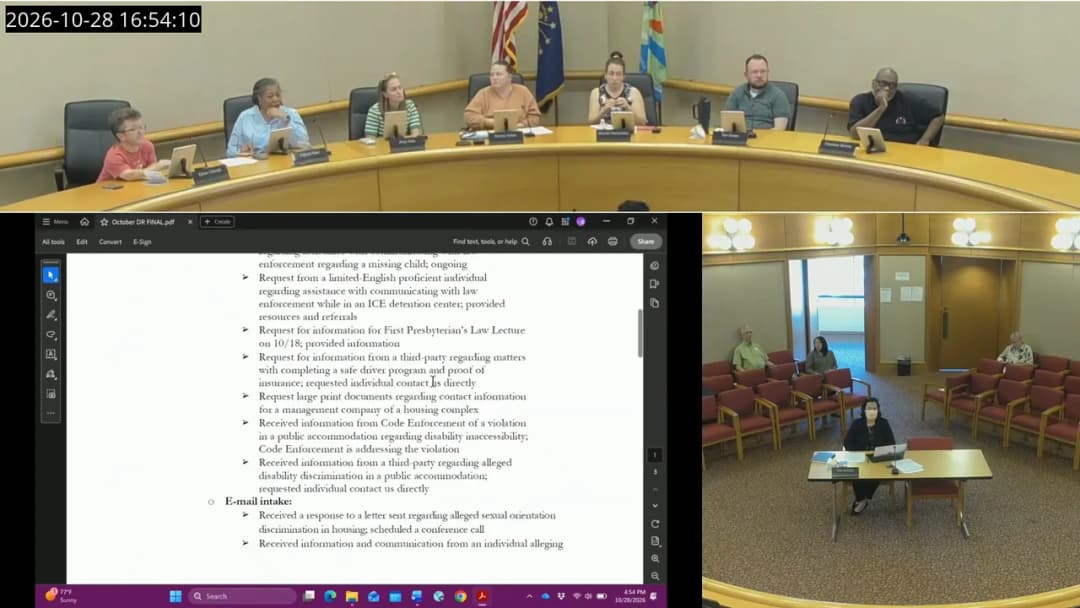
The Columbus Human Rights Commission convened on October 30, 2026, at 4:30 PM. The meeting included approval of previous minutes and the treasurer's report, a director's report covering a missing child case and language access cards, a lengthy discussion regarding proposed amendments to the commission's ordinance, and a special election for the chairperson position. Consent Calendar - The September meeting minutes were approved unanimously as distributed. - The October Treasurer's Report was accepted, showing a beginning balance of $28,540.58, a sympathy gift of $123.04 to Commissioner Garr, and an ending balance of $28,417.54. Public Comments & Testimony - Paul Hoffman, a candidate for Columbus Township Trustee, introduced himself to the commission. Director's Report - Missing Child Case: Director Ida reported on a case involving the abduction and potential trafficking of a minor child of Spanish-speaking parents. The father was arrested on an active warrant after reporting his son missing. The Director highlighted a compliance issue regarding the family's difficulty communicating with law enforcement over six weeks due to a lack of language interpretation services. She noted a gap between federal and state law regarding the creation of a missing child poster and stated the commission is working to bridge communication gaps rather than conduct a criminal investigation. Commissioner Crow questioned whose responsibility it was to post a missing child alert, to which the Director replied that it is a complex issue involving federal regulations and state law gaps. - Know Your Rights / I Speak Cards: The Director reported the distribution of over 1,000 cards at community events like Ethnic Expo and Fiesta Latina. Commissioner Felicia Garr raised a concern about distributing the cards to minors without parental consent. Staff advised commissioners to follow their employer's protocols regarding distribution. The Director cautioned against profiling individuals based on appearance when offering the cards. - Office Closures: The commission was reminded of upcoming city closures for Election Day, Veterans Day, and the Thanksgiving holiday. Proposed Ordinance Amendments - Director Ida initiated a major discussion regarding proposed amendments to the city ordinance that governs the Human Rights Commission. She expressed deep concern that amendments were drafted and circulated without prior consultation with the commission's staff or executive committee, despite requests to be involved following an October 6th department head meeting. - Director's Position: Ida firmly rejected the back-channel process, stating the commission relies on impartiality and statutory independence. She cited potential conflicts of interest and separation of powers concerns. - Council Liaison Frank's Position: Frank acknowledged a "total mistake" was made in putting an active draft on the city council agenda. He stated his intent was to "instigate change" but admitted the process failed and offered an apology. - Council Liaison Elaine Hilbert's Position: Newly appointed as the council liaison, Elaine stated she was out of the country. She believed the ordinance was a collaborative effort and committed to working transparently with the full commission moving forward. - Commissioner Felicia Garr's Position: Commissioner Garr stated she felt uninformed and did not appreciate being included in statements of "unified" opposition without being consulted. She requested pre-reads and red-line changes. - Commissioner Cheryl's Position: Commissioner Cheryl stated that back-channel communications had caused significant division. She urged that all future communications go through the full executive committee. - Outcome: The proposed amendments were removed from the city council agenda. Council liaison Hilbert committed to a new, open process moving forward. The Director confirmed all related communications are public record. Special Election for Chairperson - Ballots for the chairperson position were distributed. No candidates had declared before the stated deadline. Commissioner Tim self-nominated at the meeting, expressing that a "new fire has been lit" to help guide the commission. The ballot includes his name and a blank line for write-in candidates. The term runs until March 31st, 2027. Key Outcomes - Ordinance Amendments: The proposed changes to the city ordinance were withdrawn from the city council agenda. The new council liaison committed to a transparent, collaborative process with the full commission for any future changes. - Election: A special election for chairperson is underway via paper ballot distributed at the meeting. - Directive on Language Access Cards: Commissioners were advised to follow their employer's protocols when distributing cards to minors and to avoid racial profiling. - Youth Engagement: Commissioner Garner Kelly announced the "Yumoja's Small Footprints" youth booklet initiative, which encourages student engagement in the community and includes attendance at a Human Rights Commission meeting.
The Public Meeting Index
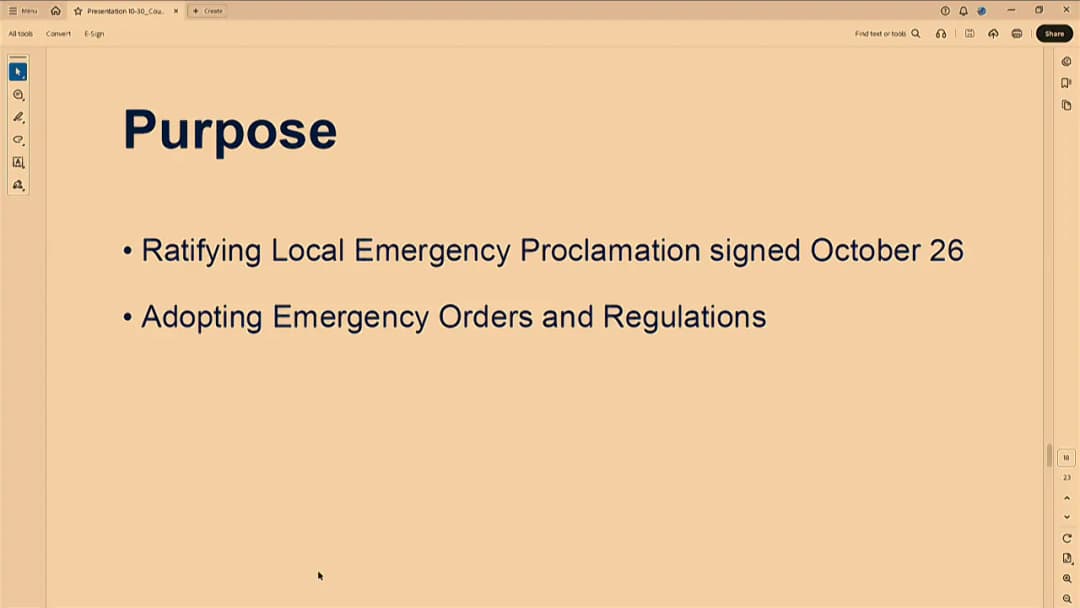
The Public Meeting IndexThe Huntington Beach City Council/Public Financing Authority held a special meeting on Friday, October 30, 2026, to ratify a local emergency proclamation following historic high tides that caused significant flooding in Sunset Beach and Huntington Harbor. The meeting covered a closed session legal report, public testimony, a detailed staff briefing on the response, and a council vote on emergency measures. Closed Session Report - The City Attorney reported a 7-0 vote to seek a petition for review in the case Grant Parks (California State Auditor) v. City of Huntington Beach (OCSC Case No. 30-2024-01435113). The report emphasized the city’s commitment to transparency but noted that the state’s audit requests were unreasonable and lacked guardrails, making a settlement unattainable. Public Comments & Testimony - Kristen Altbom, a Bayview Drive resident, thanked first responders for their presence during the flooding. She requested a public-private partnership to repair and raise seawalls on the island, offering to reimburse the city. She reported that her family built a 125-foot wall that saved their home and requested assistance with a malfunctioning drain valve at 16860 Bayview. Mayor McKeon acknowledged her request and announced a town hall meeting on Thursday, November 5. - Councilwoman Van Der Mark shared observations from the field, noting that speeding cars and boat wakes were pushing water into damaged homes and urged residents to be mindful of this. She also thanked first responders for helping an elderly couple sandbag their home. Discussion Items - Adoption of Resolution No. 2026-41: The Council considered ratifying the local emergency proclamation and adopting emergency orders and regulations. - Staff Report: City Manager Travis Hopkins and Division Chief Kyle Kramer presented the city’s response. The Emergency Operations Center (EOC) activated on October 9. The incident ran on 12-hour operational periods from October 25-29. Statistics: 75 personnel assigned daily, 10 fire calls (including one working fire), 32 police calls, 114 homes reported damaged, 18 structures yellow-tagged. The highest tide reached 8.2 feet on October 27. Projections for November 24-25 are 8.5-8.9 feet, with similar or higher levels in December. - Proposed Emergency Orders: The resolution provides authority for street closures, evacuations, emergency purchases (up to $500,000 without council sign-off), mutual aid requests, and enforcement of protective measures. - Council Deliberation and Amendments: - Enforcement (Section 4K): A debate arose over making violations of emergency orders a misdemeanor. Councilmember Williams suggested removing fines for those who cannot act, instead having the city install protective measures. Mayor McKeon and Councilmember Kennedy insisted on keeping enforcement teeth for property owners who refuse to act, while seeking a hardship exception and city assistance for seniors and disabled residents. The final consensus maintained enforcement with a focus on outreach and assistance. - Flood Help Desk & Fee Waivers: Councilmember Williams presented his HELP framework (Hold fees, Emergency funds, Lend a hand, Pre-cleared permits). The Council directed the city manager to immediately establish a flood protection help desk, waive city permit fees for flood repairs and protection, and coordinate sandbag assistance for vulnerable residents. - Drone Program: The Council directed the fire department to establish a drone program funded by the new emergency fund for real-time flood monitoring, as proposed by Councilmember Gruel. A citizen had already offered to donate funds for the drone. - Coastal Commission: The Council directed the city manager to request the California Coastal Commission to pre-approve a menu of flood protection measures (e.g., raising seawalls and dock pilings) and to waive or reduce fees. - Funding: The Council approved a $1,000,000 appropriation from the city’s reserves (rainy day fund) into a dedicated flood help desk supply fund to cover emergency costs and improve tracking for state/federal reimbursement. Councilmember Burns stressed the importance of meticulous record-keeping for reimbursement. Key Outcomes - Resolutions Adopted: Resolution No. 2026-41 ratifying the local emergency was adopted as amended, with a unanimous 7-0 vote. - Funding Secured: $1,000,000 appropriated from city reserves for flood response. - Fee Waiver: City permit fees for flood protection and repair were waived. - New Programs: A flood protection help desk and a fire department drone program were established. - Coastal Commission: Direction given to seek pre-approved measures and fee waivers from the Coastal Commission. - Litigation: A 7-0 vote to seek further review in the Grant Parks v. City of Huntington Beach audit case. - Next Steps: A community town hall is scheduled for November 5. The next regular City Council meeting is November 3, 2026. Votes: All substantive motions (ratification, appropriations, directives) passed 7-0.
The Joint Planning Committee (JPC) met on October 30, 2026, to receive Duval County Public Schools (DCPS) follow-up information on the proposed Venetia Elementary replacement and Ortega consolidation, hear public testimony, and make an advisory recommendation on the DCPS master facilities plan. The committee approved the plan as presented with an accompanying memo addressing three review concerns. Consent Calendar - The minutes from the prior meeting were approved by voice vote after a motion and second; no opposition was noted. Public Comments & Testimony - The committee adopted a three-minute limit for public comment by voice vote after a motion and second; no counted tally was recorded. - Laura Garcia, of Ortega, raised concerns about traffic and the Chaffee Trail experience, saying a prior traffic process did not prevent later problems; she urged review of boundary lines and school capacity before deciding and said she was not against Venetia staff. - Caitlin Armstrong said she grew up in Venetia and has children at Stockton; she argued west-side growth requires updated zones and that forcing larger enrollments into existing areas does not fit; she opposed treating school capacity numbers as one-size-fits-all. - An unnamed speaker urged that any recommendation be made subject to comprehensive-plan compliance and traffic-study approval; he argued distances should be measured from students' homes and that sites near Collins Road and Sadie Tillis deserved more consideration. - Cassie Bergstrom, 4660 Yacht Club Road, supported reworking queuing and access but warned that the Winn-Dixie/Roosevelt exit without a signal could cause accidents and likely require costly signalization. - Jason Burdy, 4376 Longgo, asked whether the school is fixed at 840 students or remains expandable to 1,200. - A public-school advocate whose name was not clear criticized the order of events and said students were moved prematurely; he called the counsel memo an opinion, raised a conflict-of-interest concern about shared counsel, and said the alternatives presented were not the community's proposals. - A Venetia teacher at 2280 Tyson Lake Drive supported the new build and said the master facilities plan has been underway for years; she said state FTE funding makes schools below roughly 750-800 students difficult to sustain. - A speaker identified as Yasina said the 2019 plan always included Venetia and Ortega consolidation; she alleged racism and microaggressions in the process, noted about 35% military families at Venetia, and asked the Stockton community to support Venetia families. - Tiffany Clark urged more knowledge of the consolidation history and defended the school board's responsiveness; she said bias concerns had influenced the process and that some opponents prefer the students stay elsewhere, while challenging characterizations of students as bad, saying they are brilliant and determined. - A later speaker opposed the scale and cost and possible later expansion to 1,200; he said the 94,000-square-foot building is well over the 40,000-square-foot zoning-exception threshold and would heavily affect the historic neighborhood; he suggested renovating existing schools and reconsidering alternative sites. Discussion Items - School Board staff presented four requested bringbacks on Venetia: a legal memorandum from school district counsel concluding DCPS followed the collaborative process under Florida statutes, the amended interlocal agreement, and School Board policy, while expressing no opinion on whether technical or operational aspects fit the city comprehensive plan; three traffic-study components, including a September limited study, the city traffic engineer's October 15 comments, and the school board traffic engineer's October 16 redline response; a conceptual site plan showing possible access on Timuquana and behind Winn-Dixie/Roosevelt; and an alternative-site analysis. Staff said a Roosevelt Boulevard study is underway and that FDOT coordination through Jim Knight includes a supplemental agreement for the US 17 and Timuquana signalized intersection, with 20-year background traffic projections to follow approval. A broker is negotiating possible additional access or an easement with the private owner of the Winn-Dixie property, but staff said that outcome is not certain. - The alternative-site analysis said the combined Ortega/Venetia boundary had 809 students in 2025-26 and 761 projected for 2026-27; 244 boundary students choose other schools, 116 attend charter schools, and private-school counts were unavailable. The proposed capacity is 840 versus 814 existing combined stations, a 3.19% change, below the 5% review threshold. Sites reviewed included John Stockton (11.656 acres, floodplain, rebuild to 1,250, 53% in boundary), Timuquana (10.214 acres, about 1,150, 71% in boundary), Ortega (3.247 acres, impractical), Bayview (30.76 acres, about 1,000, 56% in boundary), Fishweir (3.756 acres, too small, 44% in boundary), and Sadie Tillis (12.17 acres, about 1,150, 79% in boundary). Distances from Venetia ranged from 1.3 miles for Stockton to 4.7 miles for Sadie Tillis. Several sites had city MOUs or parks; Stockton had floodplain and a city park, and Bayview had a city emergency telecommunications tower. - The Venetia principal said she has been principal for 10 years and at the school for 13 years; she supported the new build and said students do not walk on Roosevelt or Timuquana, no car-loop accidents had occurred in 10 years, the new queuing system could hold almost 200 cars versus about 15 now, buses could line up on campus, and about 35% of students are military-connected. She said the school has been in the community since 1942 and is ready to move back home. - Planning staff explained that a public building over 40,000 square feet requires a zoning exception, with a public hearing before the nine-member Planning Commission appointed by the mayor; notice goes to neighbors within 350 feet and signs are posted; staff evaluates exception criteria, including comprehensive-plan consistency. The Office of General Counsel said the JPC does not make the final comprehensive-plan consistency determination; that rests with the local government, and the JPC's role is to make an advisory recommendation. Planning staff preliminarily found the proposal consistent but would do a formal review with actual plans. The chair noted comprehensive-plan policy 2.1.6 on direct access to collector or arterial roads; planning staff said that policy is aimed more at new sites and Venetia is an existing school. - Committee members raised concerns about the unfinished final traffic study, the Roosevelt and Timuquana intersection, queuing, and possible off-site improvement costs. City and school board staff said traffic and queuing would be reviewed through the zoning-exception and civil-plan processes, and that permit or stop-work mechanisms apply if required improvements are not completed. The chair proposed three conditions for the recommendation: a city comprehensive-plan consistency determination, final traffic study review and approval by the city traffic engineer, and final queuing plan review and approval by the city traffic engineer, all before construction-plan approval. Legal staff advised that such conditions would be advisory and largely redundant, and recommended conveying the concerns in a memo instead. - At the outset, Councilman Johnson asked that JPC meetings be streamed, recorded, and archived on Jackson Plus and asked the general counsel's office to ensure transparency and accessibility. Key Outcomes - The committee approved the minutes from the prior meeting by voice vote. - The committee adopted a three-minute public-comment limit and later closed public comment by voice vote after motion and second; no counted tally was recorded. - By voice vote, with all in favor and none opposed, the committee approved a motion to recommend the DCPS master facilities plan as presented, including Venetia, with an accompanying memo addressing three concerns: a city comprehensive-plan consistency determination; final traffic study review and approval by the city traffic engineer; and final queuing plan review and approval by the city traffic engineer. The recommendation is advisory and does not bind the Duval County School Board. - Staff announced that an ILA working group meeting should be scheduled in early 2027 and that the JPC should receive future plans around April 2027 before School Board votes; a February meeting is already scheduled. Attendees were encouraged to sign in for notices, and the meeting was adjourned.
The St. Louis Board of Aldermen convened on October 30, 2026, with President Green presiding. The meeting featured an opening reflection from Stray Rescue for Adopt a Shelter Dog Month, the adoption of resolutions honoring community leaders, and extensive debate on the future of the North-South transit tax. Consent Calendar - Minutes from October 23, 2026 were approved. - Resolution 165 was adopted honoring Judge Newton J. McCoy for his decades of service to the municipal courts. - Resolution 168 was adopted honoring Harris-Stowe State University, Sandra K. Kelly, Three Daughters and a Thousand Sons, and the Clean Slate Initiative for their expungement clinic. - Board Bills 3, 4, 5, 6, 7 directing speed humps in the 13th Ward were adopted. - Board Bill 79 directing speed humps in the 9th Ward was adopted. - Board Bill 91 establishing the Cold Weather Emergency Response Program (Code Blue Fund), funded by the city's 3% sales tax on adult-use marijuana, was adopted. - Board Bill 94 appropriating funds from national opiate settlement agreements was adopted. - Board Bills 47, 57, and 82 received final passage on the consent calendar. Public Comments & Testimony - Sandra K. Kelly, Founder of Three Daughters and a Thousand Sons, testified with community partners. She spoke about the importance of record expungement for returning citizens, framing it as a community effort to restore opportunity. Alderwomen celebrating the work noted over 1,000 records have been cleared. - Judge Newton J. McCoy gave retiring remarks, thanking staff and emphasizing the need to treat everyone with respect. - Honored Guests included Major Brittany Wells (U.S. Army), SLU policy pod students, and Sterling Samuel Miller. Discussion Items - Board Bill 59 Committee Substitute (Transit Tax Restructuring): The central debate was over a bill to let voters decide whether to redirect a half-cent sales tax (collected since 2017 for a North-South light rail line) to also allow Bus Rapid Transit (BRT). - Supporters (Aldermen from the 14th, 5th, 1st, 7th, and 13th Wards) argued the $1.1 billion light rail project is not feasible, while the 11.5-mile BRT line ($360-$590 million) connects more neighborhoods and puts the decision in voters' hands. - Opponents (Alderwoman from the 12th Ward) delivered a detailed history of broken promises to North St. Louis for rail transit, calling the current proposal a "cheat" and "fraud." She requested a roll call to vote no. - Outcome and Discrepancy: The bill was perfected. The clerk's tally recorded the vote as 13 in favor, 1 opposed (Alderwoman Keys). A discrepancy exists as Alderwoman Marlin (12th Ward) explicitly requested the roll call to register her dissenting vote, which was not reflected in the final count. - Introduction of Board Bills: BB 106 (Housing Act), BB 107 (ARPA funds), and BB 108 (Dickman Park) were introduced and referred to the HUDS Committee. Key Outcomes - BB 59 was perfected and heads to third reading and the April 2027 ballot. - Resolutions 165 and 168 were officially adopted. - Next Meeting: The board adjourned until Friday, November 6, 2026, at 10:00 AM.
The Health and Human Development Committee of the St. Louis Board of Aldermen convened on October 30, 2026, primarily to discuss and take public testimony on Board Bill 91 (Committee Substitute). The bill, sponsored by Alderwoman Sonier (Ward 7), seeks to codify the city's Code Blue emergency cold weather protocol into law and establish a dedicated funding source through the existing 3% marijuana sales tax. After hearing from over 20 members of the public, nearly all in support, the committee voted to advance the bill to the full Board of Aldermen. Consent Calendar - The committee unanimously approved the minutes from the October 22, 2026, committee hearing. Discussion Items Alderwoman Sonier presented the committee substitute for Board Bill 91, highlighting several key changes and features: - Timeframe: The mandatory activation period is December 1 to March 1, with an optional period from November 1 to March 31 to provide flexibility for inconsistent climate conditions. - Temperature Threshold: Activation is triggered when temperatures fall to 32 degrees Fahrenheit or below for two consecutive hours overnight. - Operational Flexibility: The activation window was changed from a fixed 9 a.m. to 3 p.m. timeframe to a flexible "six hours" to allow operations to begin early in the morning if needed. - Funding: The bill creates a non-lapsing Code Blue fund financed by the existing voter-approved 3% marijuana sales tax, capped at $5 million annually. Any surplus tax revenue beyond $5 million would revert to the city's general revenue. Administrative costs for the fund are capped at 7.5%. - Shelter Requirements: At least one trained staff person must be on site. Shelters receiving funding must be low-barrier. At least one overnight shelter must be pet-friendly. Specialized shelters (serving only women, families, or domestic violence survivors) may set their own low-barrier protocols. - Scope: The fund can also be activated for extreme heat events and natural disasters (e.g., the 2025 tornado). - Context: Alderwoman Sonier noted that the unhoused population had more than tripled following the May 2025 tornado. She referenced 129 cold-related deaths over the past four years, which were reduced to four last winter under the temporary executive order. Public Comments & Testimony The committee heard extensive public testimony, almost entirely in strong support of the bill. Speakers included state representatives, service providers, outreach volunteers, legal advocates, disaster case managers, social work and medical students, and community advocates. Key themes and positions included: - Life-Saving Impact: Multiple speakers stressed the bill is a matter of life and death. State Representative Kimberly Ann Collins (12th Ward) cited frostbite amputations and voiced strong support. Outreach volunteer KB Dillman (7th Ward, Tent Mission) noted last winter was the first in nine years she did not have to tell someone no bed was available. - Operational and Funding Stability: Several speakers, including Annie Rice (ArchCity Defenders) and Meredith Schatz (WashU), emphasized the need for a permanent funding source (the marijuana tax) over temporary solutions like RAM settlement funds to allow providers to plan ahead by issuing RFPs earlier. - Post-Tornado Vulnerability: Dallas Adams (3rd Ward) and Jacqueline Friedham (10th Ward) highlighted the acute housing crisis. Adams noted 391 people in the RAM-funded rental assistance program face homelessness when their aid ends between December and April, representing a potential 18% increase in the unhoused population. Friedham stated only about 40 of over 2,000 tornado repair applications had been completed. - Data and Statistics: Margot Chelser cited 129 recorded deaths from cold exposure in St. Louis over the last four years. Emily Fan (WashU) noted ER visits for unhoused individuals cost the city $1,500 to $3,700 per visit. Elise Schaeffer (MCE) noted St. Louis City represents over a third of heat deaths in Missouri despite being only 5% of the state's population. - Call for Broader Action: While strongly supporting the bill as a crucial first step, speakers like Mitchell Geg (4th Ward), Karen Yang (7th Ward), and Lauren Phila (Maplewood) called for future expansions such as a formal "Code Orange" extreme heat protocol, 24/7 walk-up shelters, Housing First policies, shelter in every neighborhood, and activation at higher temperatures (e.g., 40°F). - Concerns: Chris Wilcox (14th Ward) expressed that police should have no involvement in the program due to recent camp sweeps. Judith Alvey (9th Ward) questioned whether funds would be used wisely, and Kim Jane criticized slow city reimbursement policies for small organizations. Key Outcomes - The committee voted unanimously to adopt the committee substitute for Board Bill 91. - The committee voted to pass Board Bill 91 out of committee with a 'do pass' recommendation. (The roll call for the final advancement motion reflects a tally of four 'aye' votes, though the transcript notes five members being called and responding 'aye'). - Absent committee members were excused. The meeting was adjourned.
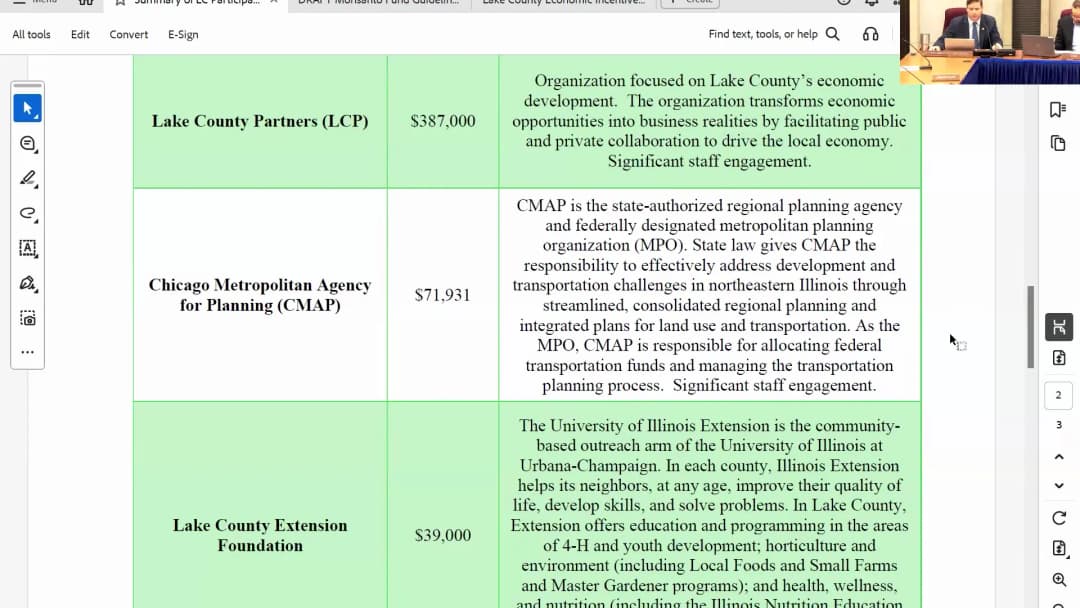
Chair Frank called the meeting to order at 8:33 a.m. The transcript gives the date as Thursday, October 29, but the supplied meeting-date metadata is 2026-10-30; this summary uses the supplied date. Member Clark was absent with prior notice; a quorum was present. The committee approved consent items and capital contracts, discussed FY 2027 budget amendments and Monsanto settlement fund guidelines, and made ethics commission appointments. Public Comments & Testimony - None were offered. Consent Calendar - Consent agenda items 8.1 through 8.18, except 8.3, were approved by voice vote (motion by Vice Chair Park, second by Member Bolitzik). Item 8.3 was not acted on because the L&J Committee postponed the West Publishing Corporation contract resolution; no action was taken. - Carryover budget items 7.1, 7.2, and 7.3 were moved to the end of the agenda and acted on with the FY 2027 budget discussion. Capital Project and Contract Approvals - 8.19 – Approved a job order contract project exceeding $350,000 for HVAC replacement and server room improvements at the Lake County Central Permit Facility, not to exceed $825,000. Facilities Manager Jeremiah Barco said the server room air conditioning and UPS were beyond useful life and critical; the county worked with IT on the project. - 8.20 – Approved a similar job order contract project at the LCDOT Administrative Building for HVAC replacement and server room improvements, not to exceed $600,000. Barco said the traffic management center server room had outdated equipment and was right-sized after moving most applications to the cloud. The two projects were bid together through the job order contractor so work could be coordinated. Used equipment would be recycled, with refrigerants recovered. - 8.21 – Approved a resolution authorizing a contract with Amber Mechanical Contractors (identified in the transcript as "of LSIP") for $3,491,000 for the Babcox Medical Bay Air Handler Unit Replacement. The two air handlers, original to the 1985 jail, serve the entire second floor medical area, jail administration, and library; the project will modernize HVAC controls and connect to life safety systems. FY 2027 Budget Discussion and Carryover Actions County Administrator Patrice Sutton walked through amendments discussed at prior budget meetings. The committee gave consensus to bring the formal amendment back for final action at the next meeting. Key elements included: - Public Works: an emergency vehicle was added from the capital fund using fund balance, after being missed on the asset listing. - Public Defender staffing: the staffing NPR was revised from one principal attorney for 10/12 of the year to staggered funding for principal attorneys, one assistant attorney funded from the start of the year, and a senior investigator. A proposed $350,000 federal funding contingency was removed because it was not the right funding mechanism; a different solution is planned. - Sheriff's staffing NPR: Sutton said the original recommendation had been two of the four requested administrative clerks handling orders of protection, failures to appear, and warrants, and that the data supports the need. - SSA 18: an amendment added $60,000 for property tax and $60,000 in capital expenditures for public works sanitary system upkeep; the property tax applies only to SSA 18 residents in Delmar Woods subdivision. - Sheriff's Office vacancy savings: a $2.5 million correction was funded by reducing the operating contingency by about $2 million, still within the 0.2% to 1% policy range, and by reducing the settlements expense line in the risk fund by $807,000, leaving $400,000 available for settlements. - Risk and liability fund: projected FY26 revenues were about $13 million and expenses about $10 million, adding an estimated $3 million surplus; the FY27 reserve requirement was estimated at about $14 million against an approximately $24 million fund balance. Property tax allocations were reallocated among funds while keeping the total tax amount the same. - Health department and TB clinic levies were increased after a $2 million FY25 fund balance decrease and a projected FY26 deficit. Stormwater funding was also increased because of a deficit. - VAC: the $3.5 million building set-aside was removed from the property tax request and will instead be covered by a transfer from the general fund, consistent with capital budgeting practice. This increases displayed totals by $3.5 million but does not increase total taxes. - Sutton noted alternatives, including revisiting the bridge and matching tax ordinance from 2012/2008 or reducing recommended new program requests. - Deputy Administrator Matt Myers presented the required annual summary of county organizational memberships, including the Illinois Association of County Board Members, NACO, ISECO, Lake County Municipal League, Lake County Partners, CMAP, Lake County Extension Foundation, Visit Lake County, environmental organizations, Waste Agency of Lake County, and GSEP. GSEP's $39,000 contribution is new to the list but has been in the budget since FY24. - Member Maine asked about the Lake County Extension Foundation and suggested having it present; Chair Frank pushed back, saying prior debate had settled on a compromise and he did not want to reopen it. Member Maine said she would visit the foundation directly. - Member Maine also questioned why the Des Plaines River Watershed Working Group was listed separately, saying it should be in the public works budget. Staff explained it appears because it is paid from GOE or county board funds. - Member Maine raised a broader concern about accumulating property taxes in capital funds and urged the board to consider using bonding capacity instead; she noted all bonds are alternative revenue bonds and the county has unused capacity. Chair Frank agreed the issue should be discussed next year and noted the unfunded capital project list is almost $1 billion. Sutton said the county now uses an operating transfer for capital rather than a general surplus sweep. - The committee agreed with the recommended amendments. A motion to amend items 7.1, 7.2, and 7.3 as recommended was approved, and the items were then approved as amended (motions by Member Hewitt/Vice Chair Park, with seconds by Member Bolitzik/Member Hewitt). Monsanto Settlement Fund Guidelines - Staff proposed guidelines for use of the $7.5 million Monsanto settlement funds, to be incorporated into Lake County's 2015 economic incentive policy. The funds would be available through a rubric-based process, not a competitive NOFO. - Proposed guiding principles include environmental benefit and water quality, equity and environmental justice, Lake Michigan watershed focus, positive health outcomes, partnerships and matching, restoration and remediation, economic development benefit, and projects that can be completed relatively quickly. - Initially, staff proposed that no less than 50% of funds go to projects in Waukegan, North Chicago, or Zion. Members debated 50%, 75%, 80%, and 100%. Member Roberts supported 100% investment in underserved communities; Member Hunter supported about 75% to avoid locking out Beach Park and Winthrop Harbor; Member Maine preferred no hard 100% and emphasized the Lake Michigan watershed. Final direction was to add Beach Park and Winthrop Harbor to the community list and set the floor at no less than 75%. - Members also asked for the F&A Committee to review the guidelines annually. - Members discussed whether projects must demonstrate a net positive impact on air or water quality; some supported a 50% requirement, while others preferred relying on the rubric. Staff noted the rubric already contains a minimum score of 60 for projects to be presented to the committee. - Eligible uses include green space and park creation or restoration that improves environmental health and quality of life. Funding requests may not exceed $2 million per request, and projects are generally expected to be completed within two years, with extensions available. - Staff said the Monsanto funding would be added as a new incentive type in the economic incentive policy, with Lake County Partners as point of contact for economic-development uses and county review for quality-of-life projects. - Chair Frank suggested naming the funds the "Monsanto Environmental Contamination Settlement Funds" to clarify their source; members agreed. - Staff also floated creating a separate economic development incentive fund as a fourth incentive type. Member Bolitzik expressed concern that this needed more discussion and a clearer process before creating a fund; staff said it would return as a separate discussion. Appointments - 8.24 and 8.25 were approved jointly: reappointment of Andrea Hess to the Lake County Ethics Commission and appointments of Daniel Kuznitsky and Lindsay Nemchek to the Ethics Commission. Members thanked all candidates; the motion was by Member Bolitzik, second by Member Hewitt, and passed by voice vote. Key Outcomes - Approved consent agenda 8.1–8.18, with no action on 8.3. - Approved 8.19, 8.20, and 8.21 capital/HVAC contracts with no opposing votes. - Approved amended carryover items 7.1, 7.2, and 7.3 after adopting Sutton's recommended budget amendments; final FY2027 budget action is scheduled for the next meeting (the transcript says Thursday, November 5). - Directed staff to revise the Monsanto fund guidelines to add Beach Park and Winthrop Harbor, set no less than 75% for the listed communities, add annual F&A review, and return next week for action. - Approved the Ethics Commission appointment resolutions. - Went into executive session on a personnel matter and returned to regular session; no additional member remarks were made and the meeting was adjourned.
On October 30, 2026, the Detroit City Council Committee of the Whole met in the morning to receive an update on unapproved fill used in the city's demolition program. The meeting began without a quorum, then proceeded after enough members arrived. Council President James Tate presided. Corporation Counsel Conrad Mallett, Construction and Demolition Director Tim Palazzolo, and Chief Public Health Officer Dr. Ali Abazi presented and answered questions from council members. Public comment was taken before the presentation. Public Comments & Testimony - Eight callers joined online; no in-person public comment was recorded before public comment closed. - Betty A. Varner, identified as president of the Soda Elsword Black Association as transcribed, advocated for corridor redevelopment, funding for a $1,500 land-use hearing fee, and playground equipment; she also asked about a Halloween costume event. - Cindy Darrell alleged the city violated the charter by using M1 domain for solar fields and tearing down houses; she called for fencing and public disclosure of dirty dirt locations and criticized tax breaks and nonprofits. - A caller identified as owner Papa/owner Popper criticized the one-minute public-comment limit and called the process corrupt; the caller urged voters to reject millages supported by the committee and made personal attacks against Councilmember Scott Benson. - Tyson Gersh said the city messed this up and argued protocols were overridden by executive order under the Duggan administration; he hoped council would address the issue sincerely and raised concerns about unlawfully issued permits. - William M. Davis encouraged voting, said he was voting straight Democratic and for museums, and called for more investigation into dirty dirt and for polluters, not the city, to pay. - Darren McCliskey focused on cleanup logistics, suggested notices or plaques on affected parcels, fencing for elevated results, and a ground-penetrating-radar and free-testing program for vacant lots. - Another caller made personal attacks and allegations against council members and officials, demanded proper mitigation of contaminated dirt, and threatened to publicize alleged wrongdoing. - Brother Connor/Cunningham offered free rides to and from early voting and described being approached by police while doing voting outreach. Discussion Items - Presentation: In early June 2025, the Office of the Inspector General notified Construction and Demolition that a contractor, Gianga Co. spelled variously in the transcript, may have used unapproved fill. The Law Department assisted; the Detroit Police Department opened an investigation in September 2025 and executed search warrants; OIG and DPD provided more addresses. A second source, Ironhorse in Milford, also allegedly supplied unapproved fill. Total sites in question: 655; 535 were owned by the Detroit Land Bank Authority. - Funding and costs: A $15 million dedicated fund was set aside around December 2025; $8.4 million remained. Staff estimated $11.65 million in remaining work. Expected $3.5 million from the Denman settlement would leave about $290,000 surplus. Staff said the dedicated fund is not used for other demolition functions and other funds remain available. Separate accounts included $8.44 million for the unapproved-fill fund, $8.62 million for abatement and clear-board supplies, and $11.48 million in remaining Prop N funds supporting residential demolition. - Testing and remediation: 587 sites were sampled; about $3.3 million was spent on testing; initial sampling averaged about $5,700 per site. Waste-characterization testing was run on 179 properties. Removal and replacement was completed at 121 sites, 120 public and 1 private, averaging about $26,000 each for about $3 million; additional excavation at 67 sites averaged about $12,000, totaling about $830,000. Total costs incurred to date were about $7.8 million. Staff estimated an average per-property cost of about $34,000; the transcript cites both $34,005 and $34,554. - Tiering: 195 publicly owned tier-one properties were described as presenting elevated risk due to contaminant concentrations and potential vapor migration; estimated remediation cost was $6.7 million. Another 87 tier-two properties had exceedances but lower direct-contact risk; estimated cost was $3.01 million. Eighty tier-one properties were packaged into four groups of 20 for bidding; each group was estimated at $690,000, but bids were not yet locked in. - Private properties: Of 120 private properties, 50 owners approved access, 7 denied, and 63 did not respond. Forty-two had confirmed exceedances with estimated remediation cost of $1.45 million; eight results were pending, with estimated cost of $280,000 if all exceeded. - Process changes: Palazzolo said the city reduced approved native sand and gravel fill sources from 14 to 7, increased inspections from annual to monthly, added city staff to inspections, tests material regularly, and plans to publish results online. Mallett said the Law Department and Office of Contracting and Procurement had corrected surety and document processes and that the city is exploring buying its own dirt and requiring stronger surety or environmental insurance. - Recovery and accountability: Mallett said recovery from Gianga may be difficult because bankruptcy is likely, the environmental insurer is resisting coverage, and the city had no direct contract with Ironhorse. He said the city is pursuing personal and corporate liability against Gianga principals and has referred Ironhorse to the state environmental agency, EGLE, referred to in the transcript as Eagle. He said no evidence so far showed fraud beyond Gianga among demolition contractors. - Public health: Dr. Abazi said the Detroit Health Department's preliminary review broadly supports the city's approach from a public-health perspective, focusing on potential exposure and nearby sensitive populations such as daycares and schools. The department reviewed over four million analytical records; the full report was expected in about 10 days. He stressed that contamination does not equal exposure and that the analysis was preliminary. He said health department experts could later address specific contaminants and potential health harms. - Fencing and access: Most tier-one sites were fenced with orange or soft fencing; staff said only about a dozen remained and should be done by October 30 or the following Monday. Councilmembers McCampbell and Callaway criticized the orange fencing as insufficient and easy for children or pets to enter. Callaway formally requested do-not-enter and no-trespassing signs on all affected properties and said she would put the request in writing. Staff said tarps were limited because they can cause runoff onto neighboring properties. For private properties with no response, staff said administrative warrants, described by Mallett as court orders, would likely be sought by spring if access is not resolved. - Grants and Land Bank: Staff said federal EPA grants are unlikely because the city was the contracting agent; state grant opportunities would continue to be explored but were not guaranteed. Mallett said cost-sharing discussions with the Detroit Land Bank Authority were preliminary. - Council concerns: McCampbell warned that the roughly $290,000 cushion is thin given change-order risk; staff said tier-one remediation costs have ranged from the low tens of thousands of dollars to over $100,000 for one site. Pro Tem Young objected that no Department of Innovation and Technology representative was present and requested one at future meetings; Tate said members should make specific department requests. Key Outcomes - No substantive votes were taken on the contaminated-fill program; the committee received the presentation and staff answered questions. - Staff committed to continue remediation, bidding, outreach, and coordination with the Health Department; a fuller health report was expected in about 10 days. - Councilmember Callaway requested in writing that do-not-enter and no-trespassing signs be posted at all affected properties; staff said they would consider the request. - Staff said remaining tier-one fencing should be completed by October 30 or the following Monday, and administrative warrants would be pursued for unresponsive private properties by spring if needed. - The meeting adjourned by motion without objection.
The New York City Council Committees on Public Safety and Governmental Operations held a joint oversight hearing on October 30, 2026, to examine the newly established Office of Community Safety (OCS) and non-police violence reduction strategies. The hearing, chaired by Councilmember Oswald J. Feliz (Public Safety) and Councilmember Gale A. Brewer (Government Operations), included testimony on three proposed local laws: Int. 0403 to create a Department of Community Safety, Int. 0414 to establish a gun violence intervention hotline, and Int. 0667 regarding community service for littering violations. The meeting featured opening statements from Speaker Julie Menon, Public Advocate Jumani Williams, and bill sponsors, followed by a detailed panel with OCS Commissioner Dr. Aisha Delaney Brumsey and her team, and concluded with extensive public testimony. Consent Calendar - No items were approved under a consent calendar. The oversight item (T2026-2701) was "Filed" by the committee, and all three introduced bills were "Laid Over," meaning no vote was taken and they remain under consideration for future action. Public Comments & Testimony Approximately 60 individuals registered to testify in person and via Zoom. The overwhelming majority expressed support for the creation of a permanent Department of Community Safety while offering significant input on its structure. - Community-Based Organizations (Support with Conditions): Groups like the Center for Anti-Violence Education, the People's Plan, the Muslim Community Network, the Rise Project, the Legal Aid Society, the NYCLU, and the NAACP Legal Defense Fund urged the council to ensure legislation (Int. 0403) focused on establishing the department in law rather than prescribing specific operational details like safety patrols or borough offices. They argued for a community-driven planning process. - School and Youth Safety Advocates: Organizations such as the Dignity in Schools Campaign, Girls for Gender Equity, and the YAYA Network called for OCS's mission to explicitly include school safety, youth mental health, restorative justice, and a transition away from school-based policing and surveillance. - Hate Violence Prevention Testimony: The Jewish Community Relations Council (JCRC), the Arab American Association of New York, the Anti-Violence Project, and the Wagner College Holocaust Center detailed the success of community-based hate crime prevention (PATH initiative) and requested sustained investment. - Personal and Constituent Testimony: Speakers including Conrad Blackburn (Bronx Defenders), Christina Sparrich, and Ruth Lohencron shared personal stories of police escalation during mental health crises, emphasizing the need for civilian-led, peer-based crisis response and the passage of Daniel's Law to remove police from crisis response. - Opposition: One speaker, Christopher Leon Johnson, opposed the bills, arguing for increased police presence and questioning the effectiveness of Cure Violence programs. Discussion Items - Oversight of the Office of Community Safety (OCS): Commissioner Brumsey testified that OCS operates on a $271 million budget, with $67 million in new resources, and oversees five offices with about 100 staff. Council members scrutinized the high vacancy rate (25.3%) in the Office to End Domestic and Gender-Based Violence (NGBV) and the initial staffing (3 employees) of the Office for the Prevention of Hate Crimes (OPHC). - Mental Health Crisis Response (BHERD Program): Major focus was placed on BHERD. OCS reported responding to 8,524 out of 10,945 eligible calls in FY26, a fraction of the 150,000 total mental health 911 calls. Council members raised concerns about the lack of 24/7 service, the reliance on EMS, and the absence of comprehensive data tracking repeat calls or long-term outcomes for individuals served. Chair Brewer highlighted the lack of appropriate facilities ("somewhere to go") for patients after crisis stabilization. - Violence Prevention and CMS: OCS reported a 16% decline in shooting incidents year-over-year and that the Crisis Management System (CMS) conducted 14,232 mediations. Councilmember Morano challenged OCS to identify specific public safety improvements directly attributable to the creation of OCS rather than pre-existing programs. Discussion also covered the transfer of CMS contracts from DYCD to OCS and ensuring timely payments to community providers. - Coordination with NYPD: Public Advocate Williams questioned the depth of OCS's integration, noting the lack of regular high-level meetings with the Police Commissioner and non-attendance at CompStat meetings. OCS stated that operational coordination happens daily but acknowledged a need for stronger strategic partnership. - Legislation: - Int 0403 (Department of Community Safety): Councilmember Resler stated the bill has 34 co-sponsors. OCS expressed support for its goal and committed to working with the council on amendments. Public testimony was largely supportive but requested the bill avoid prescriptive details. - Int 0414 (Gun Violence Intervention Hotline): Councilmember Riley provided emotional testimony about a recent youth shooting (15-year-old Javis Frimpong) to urge action. OCS supported the intent but noted federal authorization is required for a new three-digit number and suggested leveraging existing resources like 988 and the Hope Hotline. - Int 0667 (Community Service for Littering): Mentioned in Chair Feliz's opening, this bill received minimal substantive discussion during the hearing. Key Outcomes - Hearing Held: The committees successfully held the hearing and received testimony on the oversight and all three bills. - Bills Laid Over: Int. 0403, Int. 0414, and Int. 0667 were all laid over by the committees, indicating further negotiation and revision before a potential vote. - Continued Oversight and Directives: Council members expressed a strong intent to continue scrutinizing OCS, particularly regarding operational metrics, BHERD expansion, and coordination with NYPD. OCS committed to providing the council with a breakdown of its personnel vs. programmatic budget. Chair Feliz formally requested that OCS consider establishing a field headquarters in a community highly impacted by violence, such as the Bronx.
The New York City Council Committees on Public Safety (Chair Oswald J. Feliz) and Governmental Operations, State & Federal Legislation (Chair Gail Brewer) held a joint oversight hearing on Friday, October 30, 2026, beginning at 1:00 PM in City Hall. The hearing examined the newly established Office of Community Safety (OCS), non-police violence reduction strategies, and three related bills. Speaker Julie Menin, Public Advocate Jumaane Williams, and multiple councilmembers participated. Following a lengthy panel of administration officials led by OCS Commissioner Dr. Aisha Delaney Brumsey, the committees heard over two hours of public testimony from more than 60 registered speakers. Public Comments & Testimony - School Safety and Youth Justice Coalition: Organizations including YAYA Network, Dignity in Schools, Girls for Gender Equity, and the UFT urged the council to expand OCS's scope to include schools. They argued the current $400 million school policing model disproportionately criminalizes Black and Brown students (52% of police interventions) and advocated for divesting from school police, investing in restorative justice, hiring school climate coordinators, and passing the Curb Act and Intro 460 (abolish gang database). - Hate and Violence Prevention Coalition: Groups such as JFREJ, CAE, JCRC, Asian American Federation, and Arab American Association of NY praised the OPHC budget increase and PATH initiative. They stressed the importance of community-based, culturally competent prevention work over policing, requesting continued funding and meaningful stakeholder engagement in designing the future Department of Community Safety. - Mental Health Crisis Response Advocates: NYLPI's Disability Justice Program, the Legal Aid Society, and individuals like Christina Spark and Nicholas Pearson delivered powerful testimony demanding police removal from mental health crisis response. They pointed to the near-fatal police shooting of Jabez Chockboardy and 24 police-involved deaths since 2015, calling for the full implementation of Daniel's Law. They urged that new legislation specifically bar police from being the primary responders. - Community Members and Opposing View: A resident (Crystal Glover) expressed feeling disconnected from the city's process, advocating for respect and resources for low-income Black communities. Christopher Leon Johnson testified virtually in opposition, arguing the city needs more police, not violence interrupters. - Direct Service Providers: Organizations including the Korean American Family Service Center and Muslim Community Network testified to the effectiveness of community-based safety nets, particularly for immigrant survivors of domestic violence, asking for continued sustainable funding. Discussion Items Office of Community Safety (OCS) Structure and Oversight - Commissioner Brumsey testified that OCS was created by Executive Order in March 2026 to coordinate five existing mayoral offices: Neighborhood Safety, Community Mental Health, End Domestic & Gender-Based Violence (NGBV), Prevention of Hate Crimes (OPHC), and Crime Victim Services. Its stated goal is a "whole of government" public health approach to safety. - The OCS budget is approximately $271 million, including $67 million in new investments. Staffing is around 100 people. Councilmembers expressed concern about a new layer of bureaucracy, with Councilmember Wong comparing it to the troubled Thrive NYC program. Commissioner Brumsey argued the consolidation enables a comprehensive strategy and better coordination. - A 25.3% vacancy rate in NGBV was flagged. The administration attributed this to prior hiring freezes, while councilmembers noted reported rapes are up nearly 4% year-to-date. BHERD (Behavioral Health Emergency Response) Program - BHERD pairs 2 EMS workers with 1 social worker to respond to low-acuity 911 mental health calls. - In FY 2026, BHERD responded to 8,524 of 10,945 eligible calls (77.8%). Of those served, 42% received care in the community rather than an ER. The program runs 9 AM to 1 AM in 31 precincts with a $35.3 million budget. - Councilmembers Morano and Feliz pressed for data on long-term outcomes and repeat calls. Commissioner Brumsey acknowledged gaps in tracking what happens after an initial contact but cited an interagency working group and ongoing expansion plans. - Councilmember Brewer noted the critical lack of step-down facilities (e.g., 24-hour observation) for individuals who don't need an ER but cannot be left in crisis. Violence Prevention and Crisis Management System (CMS) - CMS providers conducted 14,232 mediations and de-escalations in FY 26. Commissioner Brumsey cited evidence supporting the model, including a 34% reduction in low-level offenses related to Denver's STAR program. - Councilmember Morano questioned the independent verification of CMS metrics beyond contractor self-reports. OCS cited regular site visits and plans for third-party evaluations. - Councilmember Banks asked about the transfer of CMS contracts from DYCD to OCS and ensuring stable, on-time funding for providers. OCS committed to a new RFP and improved contracting processes. Hate Crimes and Domestic Violence - Hate crimes are up 13% in 2026. Speaker Menin noted OPHC had only 3 employees in June. OCS stated a $26 million budget increase is enabling significant hiring and program expansion (e.g., the PATH program was doubled). - Councilmembers expressed concern over the removal of the NGBV Commissioner's standalone authority. OCS argued the restructuring allows better integration, noting a $15.7 million investment in NGBV programs. Legislation - Int 0403-2026 (Councilmember Restler): Would create a permanent Department of Community Safety. Supported by a supermajority of 34 co-sponsors and the Public Advocate. OCS supports the goal. Public testimony was largely supportive but urged specific amendments, including removing prescriptive language about patrols and NYPD coordination, and ensuring the department is designed collaboratively with community. Councilmember Morano pointed out a discrepancy where the Fiscal Impact Statement claims zero cost, contradicting the significant new resources discussed by OCS. The administration committed to working on amendments. - Int 0414-2026 (Councilmember Riley): Would create a 3-digit gun violence intervention hotline. OCS supports the intent but suggested leveraging existing 988 and Hope Hotline infrastructure. Councilmember Stevens raised questions about data privacy from NYPD. - Int 0667-2026 (Councilmember Williams): Would allow community service in lieu of fines for certain littering violations. Received less public discussion but was laid over. Key Outcomes - The oversight hearing (T2026-2551) on the Office of Community Safety was held and filed by the committee. - Int 0403-2026 (Department of Community Safety), Int 0414-2026 (Gun Violence Hotline), and Int 0667-2026 (Community Service for Littering) were all heard and laid over by the committees, meaning no votes were taken. - Councilmembers clearly signaled several expectations for OCS: develop a concrete BHERD expansion plan and 24/7 feasibility study, improve public reporting on long-term outcomes (e.g., repeat crisis calls), and enhance its physical and strategic presence in high-need communities like the Bronx. - Commissioner Brumsey committed to collaboratively amending Intro 0403 with Councilmember Restler and incorporating peer workers into the BHERD program.
The Butte-Silver Bow Planning Board met on October 29, 2026 (2026-10-29) with a quorum of all nine members present. The board approved previous meeting minutes and the Liebengooth minor subdivision preliminary plat, then held a public hearing on the proposed replacement of Title 17, the county zoning ordinance, and voted not to refer the draft to the Council of Commissioners until further revisions are made. Call to Order and Minutes Approval - Chair Matt Steitzer called the meeting to order and confirmed a quorum: Stephen Coe, Margot Enns, Mark Garf, Julie Jackshaw, Josh O'Neill, Mike McLeod, Bart Riley, Matt Steitzer, and Macy Sulser. - The board approved the minutes of the August 27 and September 24 meetings without corrections. Motion by Mark Garf, seconded by Stephen Coe; voice vote carried unanimously. Minor Subdivision: Liebengooth Preliminary Plat - Staff presented the application by Scott and Susan Liebengooth, with Everly and Associates as representative, for a two-lot minor subdivision. The proposed plat would create a 44.65-acre tract (B1) and a 9.97-acre tract (B2) containing the existing home and sanitation facility. The parcel is currently unzoned and is near Ramsey, I-90, low-density residential areas, and grazing land. - The property includes a natural spring, weir, irrigation channel, and lateral ditches; the water rights are co-owned with an adjacent property owner. A court-ordered easement from District Court cause DV 2320 would preserve access for maintenance of the water system. - The lots would be served by individual well and septic systems, outside the 300-foot connection requirement to public infrastructure. Tract B1 would have a sanitary exclusion until development; Tract B2 has an existing permitted well and septic system. Access would be via North Ramsey Road, and the driveway would be named Bar 01 Road under the county addressing ordinance. - Fish, Wildlife and Parks indicated no likely impact to pronghorn or elk migration. Staff recommended conditions including wildlife-friendly fencing per FWP's 2012 best practices, an approved weed control plan with a bond, and required fire sprinklers for any new construction. - Staff recommended approval subject to eight conditions. Bart Riley moved approval, Josh O'Neill seconded, and the motion carried on a unanimous voice vote. Public Hearing: GEN AMD 25-1 Zoning Ordinance Update - Director Julia Crane presented the application by the Butte-Silver Bow Planning Department to repeal and replace Title 17, the zoning ordinance, for the first major update since 1978. She described the process as including 107 individual participants, more than 400 written comments, 30 one-on-one meetings, six open houses, five planning board meetings without a public hearing and four with public hearings, four code revisions, and a resulting 354-page, 15-chapter document. - Crane summarized the draft code's chapters: new zoning districts aligned with the comprehensive plan; building and development-type standards; use-specific conditions; general measurement and lot standards; parking maximums rather than minimums; landscaping, buffers, and open space; rewritten sign standards; environmental and brownfields/superfund provisions; administrative procedures; nonconformity rules; enforcement; and updated definitions. - Recent map changes included extending the historic overlay boundary along Mercury Street and Broadway Street from Montana Street west to Excelsior Street, incorporating updated Bert Mooney Airport shapefiles into the airport overlay, and expanding the heavy industrial gateway boundary southerly in response to an October 23, 2026 comment from the Hanson family. - Data center provisions and definitions were redlined out of the draft because the Council of Commissioners is considering an interim zoning ordinance for data centers. The billboard amortization schedule was removed, but the draft retains a prohibition on off-premise signs in Silver Bow County. - Crane presented additional proposed shipping container regulations: containers could not be used as occupiable space; they could not display shipping markings except one tracking series; existing containers would be grandfathered if they met accessory structure standards; residential zones would require a minimum 10,000-square-foot lot and screening when adjacent to a public right-of-way; commercial zones would require a commercial building permit and screening; and the earlier requirements for engineered foundations, paint color, and siting were removed. Crane confirmed these specific changes were not yet in the published draft. - Other recent changes discussed included extending historic review approval periods from 18 months to 24 months with a possible 12-month extension and requiring photographic documentation when historic resources are demolished or removed. Public Comments and Testimony - Cassie Wick (820 West Mercury Street; owner of 5518 Designs and property at 27 North Main Street) supported the zoning modernization, saying updated codes would create predictable processes, encourage investment, and preserve Butte's character. - Jim Ayers (13 Laird in Ramsey) said he previously opposed the zoning map but now supported the plan after the planning director addressed Ramsey residents' concerns; the revised map allows local commercial use. - Holly Hansen, part owner of the Silver Bow Drive-In, appreciated the county's responsiveness, preferred that the drive-in be expressly allowed in the zone, and supported the boundary adjustment and April 1 light-dimming change. - A speaker from CLR Services thanked staff for the shipping container revisions. - Chris Harris (823 North Excelsior) raised concerns about historic preservation and ghost signs, arguing the county does not own those signs, access could be denied, and the provisions could create takings issues. He recommended review by a land use attorney before approval. - Jennifer Plut, owner of Elk Meadows Realty, said the proposed 10,000-square-foot minimum for shipping containers would be problematic in Butte because lots vary in size and a 3,000-square-foot lot would require four lots to meet the threshold. - Logan Warner (5100 South Warren Trailer 25) raised consistency concerns about manufactured and mobile home definitions, opposed the 10,000-square-foot shipping container minimum, and said the draft's 8,000-square-foot lot requirement for small-scale ground-mounted solar systems was too restrictive for smaller Butte lots and could discourage modern solar installations. - Another speaker, addressed as Mr. Moore, said a recent state law prohibits treating manufactured homes differently from regular homes and urged the board to correct the definitions before approval. - Eric Sweet and Allie Carly, representatives of Lamar Advertising, asked the board to remove the signage chapter from the ordinance for further discussion. They opposed uncompensated removal of billboards, appreciated the removal of the amortization schedule, and proposed a cap-and-replace program and public-private partnerships instead of a complete off-premise sign ban. - The chair also noted written public comments from Mike Flannick, Bert Mooney Airport, Shanna Adams, and several shipping-container commenters. Board Discussion and Direction - Planning board members praised Director Crane and staff for the size and quality of the zoning update. - During questions, Director Crane said residential lot coverage rules would generally limit the number of shipping containers on a property, but commercial zones have no lot coverage limits, so the board could consider container maximums for commercial and mixed-use zones. - Crane said existing uses would be grandfathered in; property owners would need to follow the new rules when making future changes. She noted the draft reduces some minimum lot sizes, including removing minimum lot sizes in areas such as Centerville and Walkerville. - Regarding data centers, Crane explained that the Council of Commissioners has authority over an interim zoning ordinance, and any resulting permanent regulations would later come back to the planning board for public hearing and recommendation. - After the public hearing, the board discussed whether to approve the draft conditionally. Director Crane recommended allowing time to republish the revised draft, particularly for shipping container rules, the Bert Mooney Airport/FAA technical requirements, and manufactured/mobile home definitions. - Mark Garf suggested having an outside land use attorney review the historic preservation and ghost sign provisions. Crane said she would confer with the county attorney about internal capacity or the need to seek outside counsel. - Mark Garf also asked about solar regulations; Crane explained the intent was to preserve yard vegetation and encourage rooftop solar, while Garf said he did not want to discourage renewable energy installations. Key Outcomes - The board approved the August 27 and September 24 meeting minutes. - The board approved the Liebengooth Minor Subdivision preliminary plat, subject to the eight staff conditions. - The board voted not to recommend the draft GEN AMD 25-1 zoning ordinance to the Council of Commissioners. - The board directed planning staff to return on November 19, 2026, with a revised draft incorporating public comment and staff's proposed changes, including shipping container regulations, the Bert Mooney Airport/FAA overlay updates, manufactured and mobile home definition verification, and any needed historic preservation and ghost sign legal review. - The vote to postpone referral and schedule the November 19 hearing carried on a voice vote with no opposition heard.