This meeting was convened by Councilmember Carlucci (chair) to discuss proposed legislation to allocate $204,000 from debt service savings to the Exchange Club Family Center for its parent aid program. The funding would not affect the current budget. Councilmembers Ken Amar (District One) and Monet Holder were present, along with representatives from the Mayor's office, the Exchange Club, and Journey Forward. Presentation and Discussion - Sue Watson, Executive Director of the Exchange Club Family Center, described the organization's 30-plus years of service in Duval County. The Center operates an evidence-based home visiting program for parents and caregivers, focusing on prevention of child abuse and neglect. Key statistics: since 2023, 90 referrals from the State Attorney's diversion program, 75 completions, and 100% of completers had no DCF involvement after one year. The program costs approximately $1,800 per child per year, compared to foster care costs of $40,000–$105,000. Last year, the Center served 231 children (150 families) on a budget just over $1 million; this year, with additional state funding, they expect to serve 500+ children (251 families). The requested $204,000 would fund two additional parent aides for Duval County, serving a minimum of 50 families. - Councilmember Amar asked clarifying questions about the per-child cost methodology and the geographic focus. Watson confirmed that Duval County provides 53% of referrals, and the requested funds would be used exclusively for Duval families, allowing other funding to support adjacent counties. - Dr. Tracy Paulson, a clinical social worker, spoke in support of the program's approach, emphasizing the importance of working with caregivers to break cycles of abuse. - Charles Griggs from the Mayor's office confirmed that the program aligns with the city's Journey Forward initiatives and that the Mayor supports the appropriation. He noted that the Journey Forward board has committed to monitoring metrics. - Councilmember Holder asked about staffing; Watson explained that the Center has 10 parent aides who conduct the in-home visits. - Councilmember Carlucci expressed strong support, citing low recidivism rates and the program's alignment with juvenile justice prevention. Key Outcomes - No formal vote was taken during this meeting. Councilmember Carlucci will be out of town when the legislation goes to committee the following week, and he urged the Exchange Club representatives to attend that committee meeting. - The council members present expressed general support, and the Mayor's office indicated backing. The legislation is expected to be considered further next week.
The Public Meeting Index
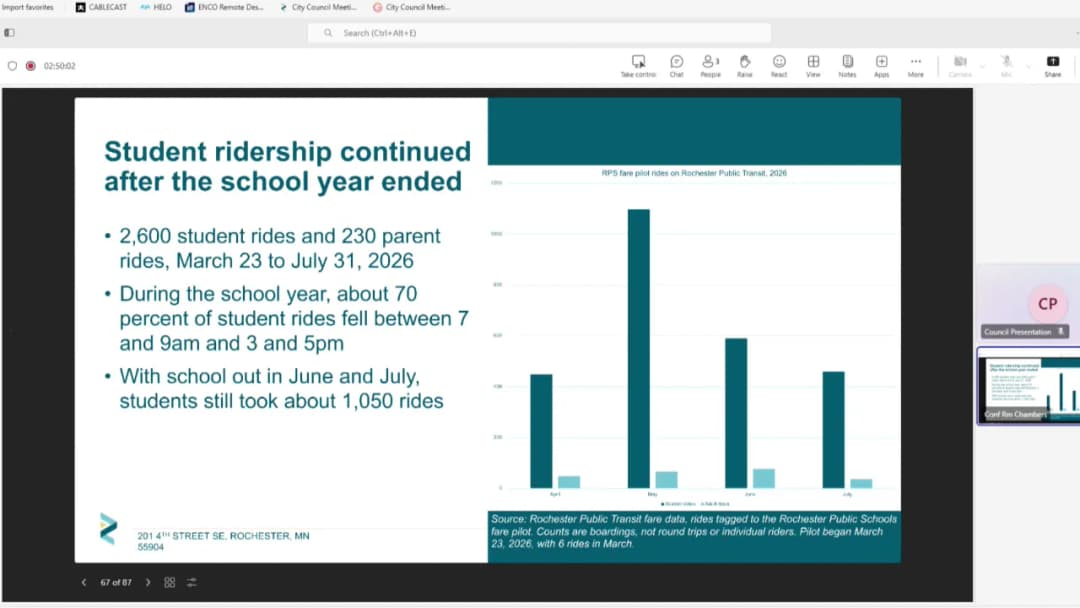
The Public Meeting IndexThe Rochester City Council held a study session on September 28, 2026, from 3:30 p.m. to approximately 6:30 p.m. at the Government Center Council Chamber. The session covered three main topics: an update on housing access, a mode shift and transportation demand management overview, and a stormwater water quality treatment credit transfer policy update. No formal votes were taken; the council provided feedback and direction to staff for future action. Housing Access Update Staff from Community Development (Taryn Eadens and Irene Woodward) presented a comprehensive overview of housing context, needs, and policy options. Key data included: - Over 12,000 housing units built in the last 20 years; 2,600 for-sale lots platted and 3,400 rental units approved in the pipeline. - 4,700 single-family rentals (13% of single-family dwellings), with 6% corporately owned and 15% by non-local corporations. - 502 short-term rental units, half in single-family homes; majority are in lower-cost housing (affordable to 30-80% AMI). - Homeownership gap: 50 percentage point disparity between white households and households of color. Council members discussed three policy options for single-family rentals (no change, density caps, per-owner limits) and short-term rentals (no change, geographic limits, platform licensing requirements). Mayor Norton expressed concern about short-term rentals degrading neighborhood integrity. Councilmember Miller proposed escalating license fees for large rental portfolios to reinvest in neighborhoods. Councilmember Fredericks favored no changes, emphasizing the need for diverse housing options. The council leaned toward further exploring fee-based and administrative tools rather than outright prohibitions. For ADUs, staff noted only 10 permitted units and a $20,000 pilot program with low uptake; council members were split on removing the owner-occupancy requirement for R1 districts. From Plans to Practical Choice: Mode Shift and Transportation Demand Management Overview Matt Lynch, Mode Shift Coordinator, presented on implementing adopted plans to reduce single-occupancy vehicle trips. The problem statement, co-developed with partners (including DMC, Mayo Clinic, Rochester Public Schools, and others), highlighted that current travel patterns do not scale with growth and that options are fragmented. Data showed: - Drive-alone commuting down 10 points since 2013, but total drivers unchanged due to more people working from home. - A student fare pilot recorded 2,600 rides (70% during school peak hours) plus 1,050 rides in summer. - 13 modal count sites: 85% walking, 12% cycling, 2% scooting; one downtown location accounts for nearly half of all counts. - Bike to Work Day (June 23, 2026) saw 1,736 counts, 16% above June daily average. Council feedback included: Councilmember Keene emphasized planning ahead of gridlock; Councilmember Fredericks questioned cost-effectiveness of bike lanes; Councilmember Doring stressed connections for other destinations beyond downtown; Councilmember Miller asked for time-of-day and event parking coordination. The council supported continuing the data collection and bringing back an action plan in early 2027. A separate discussion on the Lime scooter contract was requested. Stormwater Water Quality Treatment Credit Transfer Policy Update Aaron Luxteen (Public Works) provided a brief update on the draft policy, which allows developers to purchase off-site stormwater treatment credits when on-site treatment is infeasible. Key features: voluntary participation, transfer ratios increasing with geographic distance, 0.1 of each transfer set aside for environmental benefits, and city-generated credits require council approval. The policy aims to support infill development and improve water quality. Staff will bring the policy and ordinance for approval at the October 19, 2026 council meeting. Council members expressed support, with Councilmember Keene noting the need to ensure localized impacts are considered. Study Session Schedule Staff announced the next study session on October 5, 2026, will include updates on the Red Owl and Time Theater history, youth council visit to Germany, parks and recreation marketing, and council rules. A closed session is planned for October 26, 2026. Key Outcomes - No formal votes were taken. - Council provided direction to staff to refine housing policy options (single-family rentals, short-term rentals, ADUs) based on discussion, with emphasis on fee structures and administrative tools. - For mode shift, council affirmed the problem statement and directed staff to continue data collection and return with an action plan and recommendations in early 2027. A separate Lime scooter discussion will be scheduled. - The stormwater credit transfer policy will be brought forward for approval at the October 19 council meeting. - Next study session scheduled for October 5, 2026.
The Criminal Justice Planning Council met on September 28, 2026, at 4:00 PM in the City-County Building (T-260) in Indianapolis, chaired by Ryan Mears. The meeting, rescheduled from the prior week due to Yom Kippur, covered the Marion County Sheriff's Office (MCSO) inmate count and a presentation on juvenile waiver statutes from the Marion County Prosecutor's Office. Board members present as introduced included Leroy Robinson, Abby Hanson, Sheriff Kerry Forestal, Andrew Merkley, and Scott Hall. The agenda header prints the date as September 28, 2025, but the confirmed meeting date is September 28, 2026. Discussion Items MCSO Inmate Count – Major Shanklin Woods, Marion County Sheriff's Office - As of September 28, 2026, the Adult Detention Center (ADC) held 2,286 males, 325 females, and 24 juvenile males. Crisis mode is set at 80% of capacity; exceeding that rate is flagged in red. - The HEA 1006 inmate count was 2; the Sheriff's Office said the Department of Correction (DOC) has not improved pickup, so the two individuals remain held. - A total of 221 inmates were awaiting DOC placement (186 housed in the ADC plus 35 held off-site), with 19 additional parole detainees. - The Sheriff's Office has moved inmates to Carroll County (25 on one trip, 15 on another) as a "pass-through" to free space for new arrests, beginning about two weeks before the meeting. Those inmates are not included in the 186 housed DOC-hold count, making the true total higher. - The board discussed that the most common detained charges include level 5 offenses such as battery by deadly weapon and burglary, while many level 6 detainees face domestic-related charges. Bond amounts—driven by factors such as use of a deadly weapon or multiple victims—affect how long level 5 defendants remain in custody; level 6 defendants generally do not stay as long. - OPHS Director Andrew Merkley asked whether more could be done to engage level 5/6 detainees on recidivism as release-lobby operations change next year; the Prosecutor's Office responded that bonds are judge-determined and it is willing to keep working with OPHS. - A board member requested a pretrial versus post-conviction breakdown in future reports, noting that a significant number of inmates are pretrial. Juvenile Waivers – Celita Scott, Marion County Prosecutor's Office - As of the meeting, three juvenile waiver cases were pending (juveniles ages 14, 15, and 15), and four cases had been direct-filed into adult court in 2026. - A total of 39 cases had been filed into adult court this year; 28 were dangerous possession cases, with the remainder ranging from armed robbery to burglary to aggravated battery. - A July 2026 statutory change made it harder to direct-file dangerous possession cases: a prior misdemeanor dangerous possession adjudication alone no longer permits direct filing; another linked felony charge and more than one prior dangerous possession adjudication are now required. - Direct filing remains available at age 16 and older for level 5 dangerous possession committed on school property or within 500 feet of school grounds or a school bus, when a child gives a gun to another child, or when a child intends to use a gun in a crime. - Juveniles under 16 must begin in juvenile court, including for murder, and can reach adult court only through the waiver process; direct filing at 16 and older is available for murder, robbery, and certain sex crimes. - Scott Hall, Executive Director of Marion County Community Corrections, said his agency serves juveniles only after waiver to adult court; only one individual under 18 is currently on the caseload, so no juvenile-specific programming exists. The agency is exploring an "emerging adult" (18–24) specialty caseload and is partnering with an organization referred to as "recycle force" for that population. - Scott said the curfew statute is a status offense: a child cannot be committed to the Department of Correction for a curfew violation; law enforcement must make reasonable efforts to contact a parent or guardian, and the court can provide resources to address home issues. Next Steps - The next Criminal Justice Planning Council meeting is scheduled for November 16, 2026. - Andrew Merkley offered an OPHS update on reporting, including AIC data, CLCR, and the release lobby; board members expressed particular interest in the release lobby and AIC information. Key Outcomes - No substantive motions or roll-call votes were taken; a motion to adjourn was made and seconded, and the meeting ended. - The Sheriff's Office was asked to provide a pretrial/post-conviction breakdown in future inmate-count reports. - The Prosecutor's Office will continue monitoring juvenile waiver trends under the revised statute. - The November 16 meeting will include an OPHS presentation on crime statistics and release-lobby operations.
The Richmond City Council held its informal meeting on Monday, September 28, 2026; the agenda listed a 4:00 PM start in the Council Chamber, City Hall. After the emergency evacuation announcement and roll call, the clerk reviewed the consent and regular dockets, and members received presentations on the draft 2027 General Assembly legislative package and a proposed municipal solar power purchase agreement (PPA). The published agenda included a closed session under Va. Code § 2.2-3711(A)(7) for pending litigation, but the raw transcript ends with adjournment and does not record Council entering closed session; no minutes are available to resolve that discrepancy. Consent Calendar / Docket Review - The clerk reviewed consent items, including ordinances 2026-155, 2026-175, 2026-180, 2026-192 through 195, 2026-197, 2026-202 through 206, 2026-208 through 214, 2027-276/277, 2026-278/279, and 2026-280, plus resolutions R031, R032/R033, R035/R036, R037, and R038. - Ordinance 2026-180 was continued to the November 9, 2026 council meeting; Ordinance 2026-197 and Resolution R038 were continued to the October 13, 2026 council meeting. - Councilwoman McGibson asked to move Ordinance 2026-195, which she described as relating to the sale of data, to the regular agenda for more discussion. No motion or second was made, so the item remained as docketed. - Councillor Robertson asked to be added as co-patron on Resolutions R032 and R033, and the clerk noted that request. - On the regular agenda, Ordinance 2026-081 was retained; Ordinance 2026-109 was continued to November 9, 2026; Ordinance 2026-120 was retained; Ordinance 2026-196 was continued to October 13, 2026; Ordinances 2026-215 through 253 were retained without committee recommendation; and Resolution R019 was retained. Discussion: Draft 2027 General Assembly Legislative Package - Devin Cabot of Two Caps Consulting presented the eight-page draft legislative agenda. She identified the Long-Term Owner Occupancy Program (LOOP) as the council's top priority. Because LOOP requires a constitutional amendment, the package seeks a first reference during the 2027 session, with a second reference in 2028 and a potential referendum later. - Cabot said the package combines tenant protections and housing justice into an omnibus request, including items before the Housing Commission. It also asks for expanded local authority over vacant and blighted property and for short-term rental compliance measures, including information sharing between city agencies and parameters for platforms serving noncompliant properties. - Policy positions in the draft cover housing supply and eviction prevention, health and behavioral health care, utility cost burdens, DSS technology, traffic calming and pedestrian/bicycle safety, transit and street maintenance funding, violence prevention, support for dispatchers, firefighters, public defenders, and domestic violence survivors, K-12 funding modernization and school construction, early childhood and after-school programs, commercial redevelopment, lead service line replacement, workforce development, local authority protections, drinking water infrastructure, and state partnership on combined sewer outflow funding to meet the Commonwealth's 2035 deadline. - Cabot gave a timeline: a legislative summit with the state delegation on October 19, 2026; the governor's budget amendment on December 17, 2026; the 2027 General Assembly session beginning January 13, 2027, at 10:00 a.m.; and a 45-day short session. - Council President praised the package as a true representation of the body's interests and the mayor's initiatives, especially on anti-displacement and tenant protections. A council member identified in the transcript as RJ said the package would be continued to the October 13, 2026 meeting for amendments and adoption as a resolution before the delegation meeting. Amendments under discussion included tree canopy funding from Member Abu Bacher and good cause eviction language from Councilwoman McGibson; Councilmember Jordan raised a possible post-adoption action. - Council President raised a future effort to revisit charter changes, including updating public meeting notice requirements. Councilmember Lynch urged building on the previous work group's recommendations rather than starting over. Cabot said state legislators prefer one cohesive consensus document and offered to work on it in the interim. Discussion: Municipal Solar Power Purchase Agreement - Laura Thomas, Director of Sustainability, introduced the municipal solar PPA. She called it potentially the most impactful project in the city's history for climate goals and said PPAs are a proven approach used by many public bodies, including Richmond Public Schools. - Don Alexi, Energy Program Manager, said the project had been explored since 2019 and was time-constrained by expiring federal tax credits and federal administration deadlines. The contract was competitively sourced through Prince William County Public Schools, approved and signed by city administration in August, and also used by the City of Roanoke. - The proposal would place solar on 39 public properties, generate five megawatts across all nine council districts, and produce an estimated $20 million in avoided electric costs over 25 years with zero upfront city capital investment. PPA rates are fixed with no escalators, while the city's electricity budget was described as rising from $18 million to $22 million and then $26 million; Dominion rates were cited as increasing 23.5% on July 1 and another 20% on July 1, 2027. - The seven LLCs in the ordinances are grouped by department for financing and billing purposes only and are owned entirely by Secure Solar Futures, the project partner. Additional structural engineering and permitting would be required before installation, and leases could be canceled at no cost to the city if buildings are not viable. - The presentation highlighted workforce training, apprenticeships, and job opportunities tied to the project. Richmond Public Schools, using the same agreement since 2019, was cited as having saved over $1 million on ten schools. Key Outcomes - No roll-call votes appear in the transcript; the informal meeting was used for docket review and presentations. - Continuances announced: Ordinance 2026-180 and Ordinance 2026-109 to November 9, 2026; Ordinance 2026-197, Ordinance 2026-196, and Resolution R038 to October 13, 2026. - Councillor Robertson was added as co-patron on Resolutions R032 and R033. - The legislative package was continued to the October 13, 2026 council meeting, where councilmembers planned to consider amendments and adopt the resolution before the October 19, 2026 delegation meeting. - The municipal solar PPA presentation did not produce a formal action in the informal meeting; the related site-lease ordinances were before council for consideration that evening according to the presentation. Note on Record - The agenda also listed a referral of service delivery issues to city administration; no discussion on that item appears in the transcript. The closed session item and the absence of minutes mean the summary cannot confirm what occurred.
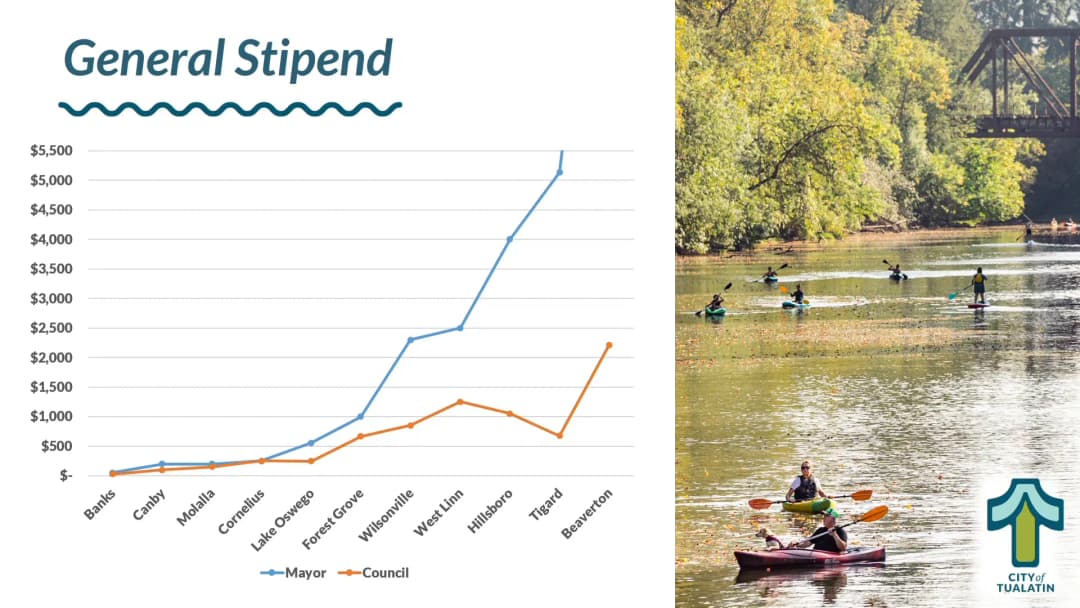
The Tualatin City Council held a work session on the evening of September 28, 2026, before the regular council meeting. Staff and consultants presented a transportation project prioritization framework, an update on the Washington County Cooperative Library System (WCCLS) memorandum of understanding, and a review of council compensation. No formal ordinances were adopted during the work session, but council gave informal direction on compensation items for staff to bring back later. Discussion Items Transportation Project Prioritization Overview - City Engineer Mike McCarthy, joined by consultants Ashavila and Brianna Calhoun from Fair and Pears, presented a technical evaluation process to prioritize transportation projects from the Transportation System Plan (TSP) for the city's five-year Capital Improvement Program (CIP). - The process is designed to be objective and repeatable. About 100 projects were divided into three roughly equal tiers rather than a strict ranked list, allowing projects to be matched to available funding opportunities without implying a fixed order of construction. - Evaluation categories included: - Network completion: active transportation and non-auto connections, sidewalk gaps, bike lane enhancements, ADA ramp retrofits, connections to schools and key destinations such as affordable housing, parks, the library, and grocery stores, new street connections, and reducing pedestrian barriers such as the Tualatin River, Tualatin-Sherwood Road, and I-5. - Congestion and emissions reductions: vehicle bottleneck relief, efficiency measures such as adaptive signal systems, and alignment with the city's Climate Action Plan. - Safety: five-year ODOT crash data, crash modification factors, speeding history, pedestrian and bicycle level of traffic stress, and crossing improvements. - Critical infrastructure: new or enhanced transportation infrastructure serving developing areas, primarily Basalt Creek and Cora. - Councilor Brooks asked whether building materials and shade structures were factored into environmental impacts; staff said they were not currently factored. She also asked about the lack of measured speed data; staff explained citywide speed data is not available, but speed measurements are collected after resident complaints, and projects typically need observed speeds more than five miles per hour over the limit for a significant share of traffic to earn points. - Staff discussed ODOT funding opportunities, including the ARTS (All Roads Transportation Safety) program and technical assistance grants. When asked how staff would choose among similarly funded Tier One projects, staff said they would consider readiness, project scores, and council input through the CIP process. - Next steps: finalize the prioritization work product and use named projects in the CIP development around December or January. WCCLS Memorandum of Understanding Update - The library director, Sarah, presented the MOU between the city and the Washington County Cooperative Library System for a centralized collection project. The MOU is a working agreement rather than the formal, enforceable IGA, and it describes how WCCLS and partner libraries will collaborate. - The initial MOU draft went to the executive board in May, the library leadership group in June, with two additional meetings in July, and the current draft went to the executive board earlier this month. - The MOU language emphasizes preserving each library's community identity, including local purchasing supplements, staff expertise, and qualitative measures of success in addition to quantitative metrics such as hold times. - WCCLS has issued an RFP for materials vendors; nine vendors applied, and a scoring panel will meet next month. Tualatin's Ingram discount, about 40%, was highlighted as an important local interest. Centralized purchasing is expected to begin with English and Spanish materials, with Chinese added later. - Tualatin is grouped with Sherwood, Forest Grove, and Cornelius for project steering committee representation; Tualatin's representative is Adrian Domain Calkins from Sherwood. - Council members asked about hold metrics, vendor selection, local collection supplements, collection profiles, foot traffic versus online use, and community advocacy. Sarah noted foot traffic is nearing pre-pandemic levels, while programming and social connection remain central to the library's role. - Several council members raised concerns about MOU language, including the use of 'will' versus 'must' or 'shall,' WCCLS's final decision authority over local collections, the unmet August deadline for scope and format definitions, and the one-sided nature of good-faith communication language. It was noted that the IGA remains the enforceable agreement and provides a process for enforcing county obligations. - No formal council action was taken on the MOU; the working agreement process continues. Council Compensation Discussion - Assistant City Manager and Finance Director Don Hudson presented current council compensation: - $750 technology stipend at the start of a term, grossed up for taxes, adopted in 2013. - Health and dental insurance with a 90/10 cost share: the mayor is eligible for coverage up to family, currently about $2,800 per month, and council members are eligible for single coverage, just under $1,000 per month. Council members who opt out receive a $100 per month stipend. - $20 monthly utility bill credit that was in place before 1986; a 1996 resolution designated it as per diem and stated council positions are non-lucrative. - The FY 2026-27 council compensation budget is about $67,000, with potential exposure of about $114,000 if all council members took insurance. - A survey of 18 neighboring cities in Washington and Clackamas Counties found that eight offer technology-related benefits, only three offer health benefits, and eleven offer monetary stipends. Beaverton's mayor is full-time and receives about $11,000 per month; most surveyed cities pay $500 or less per month to mayors and $250 or less to council members. - Council discussion included: - Councilor Brooks: preferred cost-of-living and inflation adjustments over renegotiating individual benefits, and cautioned against mixing compensation with a broader equity study. - Councilor Sacco: expressed concern that modest compensation increases would not meaningfully expand who can afford to serve and could simply pay people who would already run. - Councilor Reyes: described council service as a sacrifice and supported updating the technology stipend and utility bill credit, noting the $750 technology stipend is outdated. - Councilor Gonzalez: emphasized equity and barriers such as child care and work flexibility, and urged an honest look at what would help more diverse candidates serve. - Council President Pratt: suggested the IDEA advisory committee study barriers to running for office; Councilor Reyes preferred the budget committee or staff with HR/budget expertise for compensation questions. - By informal show of hands, council directed staff to bring back options to adjust the technology stipend and the $20 utility bill stipend for inflation. Health insurance changes and broader compensation redesign were not advanced at this meeting. Key Outcomes - Transportation prioritization: no formal decisions; staff will finalize the scoring framework and use it in the upcoming CIP process. - WCCLS MOU: no formal action; council received the update and raised legal language and transparency concerns for continued work. - Council compensation: council gave informal direction to staff to return with inflation-adjusted options for the technology stipend and utility bill per diem; health insurance and any broader compensation changes were deferred.
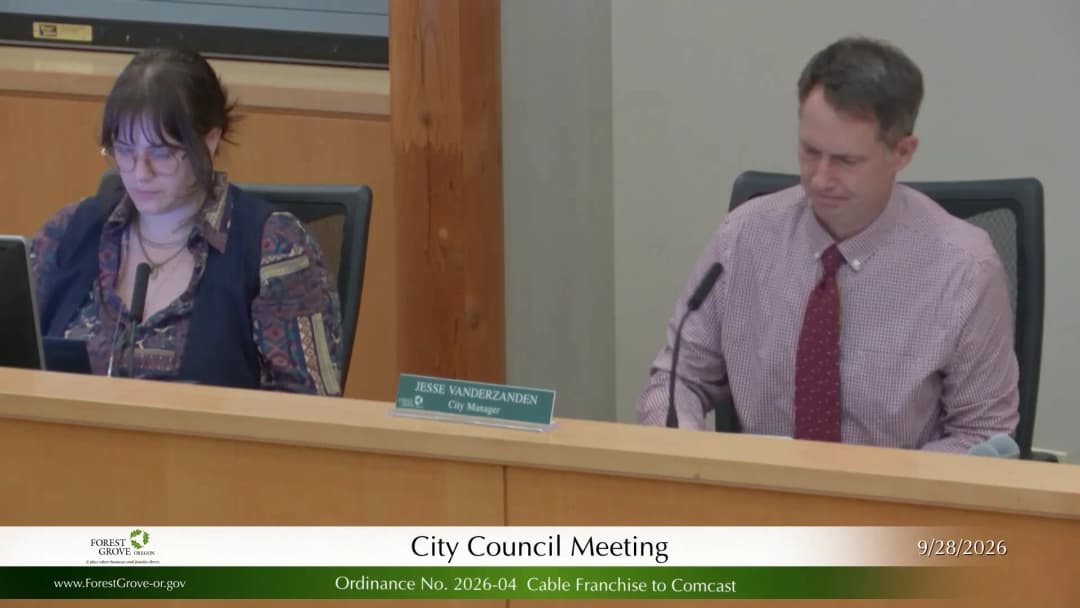
- Approved Ordinance 2026-04, a 10-year non-exclusive cable franchise with Comcast of Oregon II, by a 5-0 vote with the mayor abstaining due to a perceived conflict. - Approved Resolution 2026-46 by a 6-0 vote, updating the tourism event sponsorship program. Changes include shortening the application deadline to 30 days before an event (previously 90), allowing the Forest Grove School District to apply, and adding an event-series category. The related tourism capital grant program was sunset due to lack of interest. - Issued proclamations for Public Power Week (Oct. 4-10), Banned Books Week, and Arts & Humanities Month. - Heard public comments, including a request for code enforcement attention to a dumping/garbage issue on a pathway; comments about a property near the old gyms were clarified by staff to involve Washington County-owned property that will be supportive/transitional housing, not a homeless camp. A resident also announced the Tualatin Plains Outpost effort and a Forest Grove Indivisible meeting with Oregon Secretary of State Tobias Read. - Council President Valenzuela reported on the library commission, including the WCCLS book sale Oct. 22-24, and expressed concern about Washington County's centralized library material selection and multilingual collections. Councilor Schimmel reported on Coffee with Cops and youth advisory activities, including a transit access issue: a 90-minute TriMet ride from Forest Grove to PCC makes it hard for students to access mechatronics and community college programs. - The city manager reported that the economic development strategic plan narrowed to three firms, right-of-way applications will be submitted in October for the Mountain View/TV Highway Safe Routes to School project with construction possible in summer 2027, and a CEP committee meeting is set for Oct. 12. - Heard the annual electric rate study presentation. Staff recommended no rate increase this fall and a February work session after more is known about the new large load. Scenarios: if the load does not come online, residential rates would need to rise about 4.25% over several years; if it comes online in April, a 3.25% first-year increase with no increases in following years; if it comes online in July, a 3.7% first-year increase with no residential increases for several years. The study also referenced about $65.6 million in new debt obligations for two larger projects. - The council adjourned and went into an e-bikes work session.
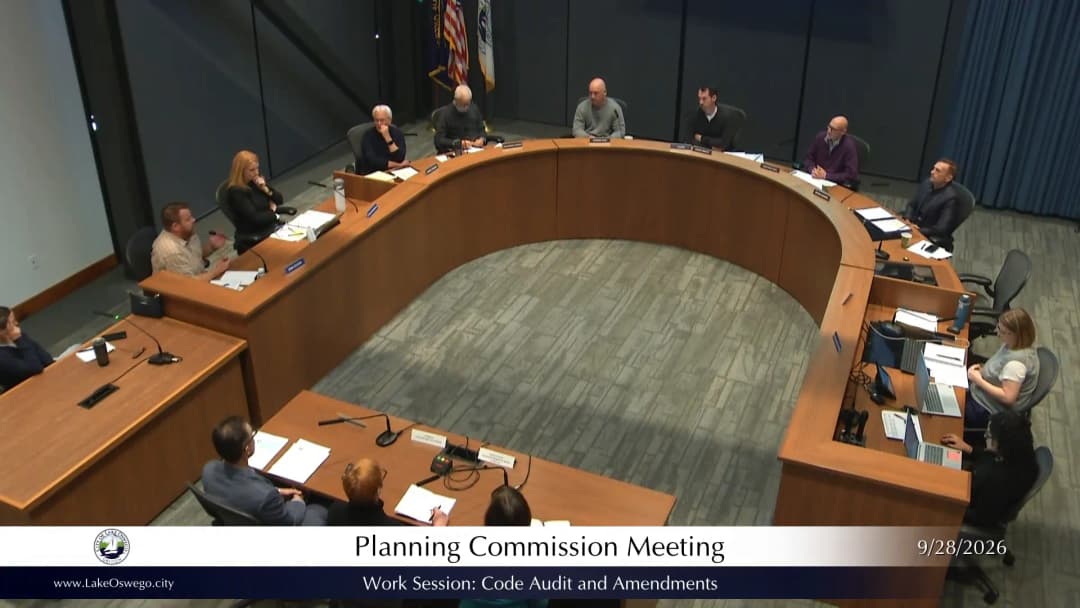
The Lake Oswego Planning Commission met on September 28, 2026, at 7:00 p.m. for a regular meeting that included a city council update, neighborhood association announcements, adoption of findings for a land use case, and a fourth work session on the code audit and amendments for housing and business (PP 25-0002). The meeting was chaired by Vice Chair James Bruce, with Commissioners Avishon, Guinea, Call, Sly, Twing, and Vice Chair Bruce present. Commissioner Avishon initially abstained from the findings vote due to not attending the original hearing, but the vote was retaken and approved. City Council Update - Councilor Verdick reported on several city matters: (1) A new city manager, Denzel Maxwell, will start on Monday, September 30. (2) An update on the wastewater treatment plant, with the council deliberating on a rate increase—either a one-time large increase or a gradual increase over ten years. No decision has been made. (3) Republic Services has increased staff and resolved garbage and recycling issues; apologies were issued for prior service problems. (4) The Arts Council is active: the August Trunk sculpture (the elephant on Boone's Ferry) requires maintenance; the Ferry Tree art piece at George Rogers Park is being decommissioned, with plans for 3D renderings to archive it; a new art piece was unveiled at the library. (5) Municipal grants will now be awarded once a year instead of twice. (6) Updates on e-bike and micro-mobility device regulations are underway to improve safety and control. Neighborhood Association Announcements - The Palisades Neighborhood Association, along with four other neighborhoods, will co-host a city council candidate forum on October 23, 2026, at 6:30 p.m. at Park Academy (1915 South Shore Boulevard). Questions will be submitted by neighborhood associations. Contact Chris Durke, Palisades Chair, for involvement. - The Old Town Neighborhood Association announced its new website: oldtownlakeoswego.org. The site will provide neighborhood news, blog updates, upcoming meetings, city council candidate forum information, and fun activities. Findings for LU 26-0019 - The draft findings for this land use case were distributed earlier. A motion to approve was made and seconded; a voice vote was taken with all ayes, and the findings were approved. Later, during Other Business, Commissioner Guinea raised a procedural question: Commissioner Avishon was not present at the original hearing and had not reviewed the record. To ensure proper procedure, the vote was retaken. Commissioner Call made a new motion, seconded by Commissioner Guinea. The findings were approved with Commissioner Avishon abstaining. Work Session on Code Audit and Amendments for Housing and Business (PP 25-0002) - Senior Planner Evan Franstead introduced the project team, including consultants Lee Oligode (3J Consulting) and Karen Tolstad (Veritas Collaborations). The code audit is part of the economic development strategy and housing production strategy, alongside a separate rezoning for housing project. The audit focuses on removing barriers to housing and economic development while retaining quality standards, streamlining the code, and ensuring compliance with state legislation. - Key findings from focus groups and interviews: The current code is difficult for applicants and staff due to complexity, numerous neighborhood overlays (at least 52 zone combinations), conflicting standards, and barriers to middle housing (e.g., commercial building code for triplexes/quadplexes). Initial recommendations include reorganizing the code, combining design standards, streamlining overlays, addressing housing development standards, and improving business use categories. - Legislative compliance updates: New state laws effective July 2026 and January 2027 require updates to procedures for housing applications, new housing types (including single room occupancies), and updated rules for cottage clusters and middle housing (e.g., floor area averaging, reduced minimum lot sizes). The team will distinguish mandatory state requirements from discretionary local choices. - Public involvement strategy: A draft plan emphasizes educational outreach, casual engagement (e.g., QR codes at parks, library events, bus stops) to reach busy residents and underrepresented groups. The goal is to gather input on key policy choices as the audit progresses. Commissioners stressed the importance of engaging the general public who may not attend formal meetings. - Discussion on housing need numbers: Staff noted the city's 2023 housing needs analysis projected 2,000 new units over 20 years, but the state's new Oregon Housing Needs Analysis (OHNA) methodology indicates a need of 4,850 units. The city aims to plan for the higher number to avoid underproducing. Commissioners questioned the discrepancy and requested clarity on mandatory vs. discretionary changes. Staff confirmed that the code audit will include a table labeling recommendations as legislative mandates, local policy, or best practices. - Additional topics: The audit will identify existing requirements that add cost or delay (e.g., material standards, dimensional rules). The commission discussed the evolution of neighborhood overlays and the need to prevent future complexity. Commissioner Guinea referenced a new state report (SB 1537) highlighting fragmentation in housing production policies. - Next steps: The first Technical Advisory Committee (TAC) meeting will occur at the end of October. The consultant team will work on the code audit and action plan through early 2026. The next commission work session on this topic is scheduled for November 23, 2026, with a city council briefing on November 3, 2026. Other Business - Commissioner Guinea raised a procedural point regarding the adoption of findings earlier in the meeting. Since Commissioner Avishon was absent for the original hearing, she abstained. The vote was retaken, and the findings were approved with one abstention. Schedule Update - October 12, 2026: Work session on the rezoning for housing project, led by Associate Planner Michael McNamee. - October 13, 2026: Citizens Advisory Committee (CAC) meeting. - October 20, 2026: City council study session on Foothills. - October 26, 2026: Work session on Foothills progress, including schematic plans, massing, 3D views, financial feasibility, and density analysis. - November 9, 2026: Remote meeting to begin planning the 2027 work plan. Key Outcomes - Findings for LU 26-0019 approved (motion by Commissioner Call, second by Commissioner Guinea; vote: 4 ayes, 0 nays, 1 abstention (Commissioner Avishon)). - Direction for code audit: Staff and consultants received feedback to include clear labeling of mandatory vs. discretionary changes, focus on cost-effective improvements, and implement a broad public engagement strategy targeting underrepresented groups. The commission emphasized the need to plan for the higher housing need projection (4,850 units) and to avoid future code complexity. - TAC formation: The Technical Advisory Committee will have its first meeting in late October 2026, with a representative from DLCD invited.
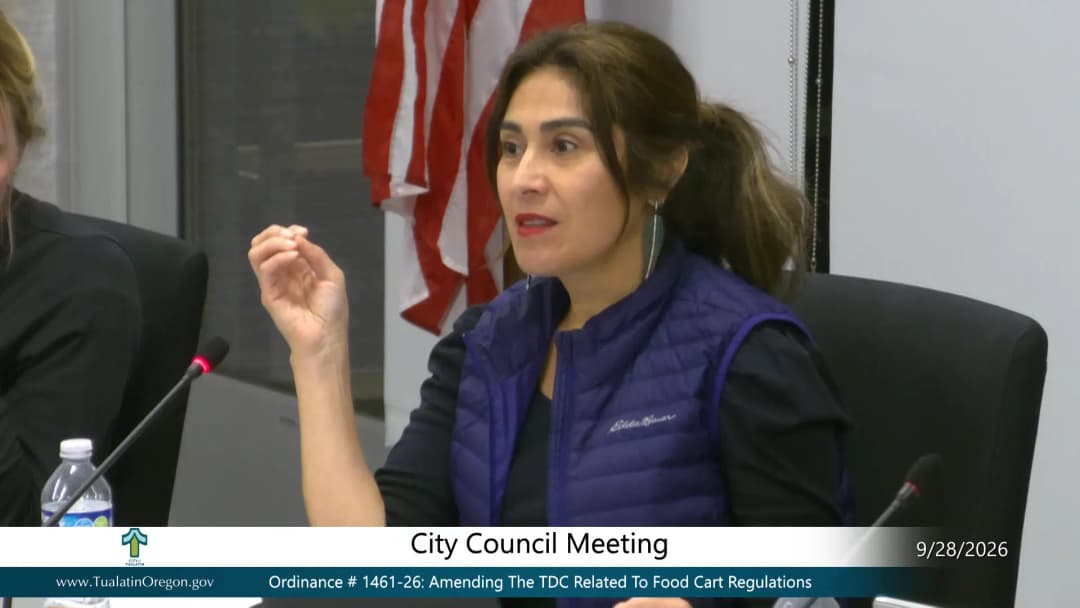
The Tualatin City Council met on September 28, 2026, for a regular meeting that included proclamations, public comment, special reports, and action on several ordinances and resolutions. Key topics included a water transmission line emergency debrief, adoption of food cart pod regulations, and adjustments to building fees. Consent Calendar - Approved minutes of the September 14, 2026 work session and regular meeting. - Approved a new liquor license application for Game Show Battle Rooms. - Adopted Resolution No. 5998‑26 authorizing a reinstatement agreement with the Oregon Department of Energy for grant funds to purchase electric vehicles. Public Comments & Testimony - Victoria (Tualatin Community Gather) expressed concern that city policies and complaint systems are being used to dismantle community efforts. She urged the council to ensure policies support residents and community connections, rather than allowing a complaints‑based system to disproportionately influence public spaces. Special Report: Water Transmission Line Leak Debrief - Rachel Sykes (Public Works Director) and Terrence Leahy (Water Division Manager) presented an after‑action report on a major leak discovered August 24, 2026, at 6:30 a.m. on 72nd Avenue. - The leak involved a 12‑inch transmission line at 150‑175 PSI; a manhole cover was blown off due to pressure. Repair took approximately 48 hours and required draining over 300,000 gallons of water. The leak occurred at 11 feet depth, complicating repairs. - Key takeaways: - Regional partnerships were critical; neighboring agencies (Tualatin Valley Water District, Sherwood, Tigard, Hillsboro, River Grove) provided equipment, expertise, and 3 million gallons of water via interties. - Communications need improvement; the city lacked a mass notification tool and could not email water customers. Staff will work on a better toolkit. - Backup water supply vulnerability: Tualatin relies on a single transmission line from Portland. The 2023 Water Master Plan identified the need for a seismically resilient backup supply. Council discussed the urgency of pursuing this project. - Councilors thanked staff for transparency and highlighted the importance of backup water supply, noting that the city was at risk of a severe water emergency. Discussion Items Building Division Fee Schedule (Ordinance 1459‑26) - Staff explained that the fee increase is needed to meet state and city reserve policy requirements; current fees are low compared to neighboring cities. - Councilor Gonzalez opposed, arguing the city should look inward to cut costs rather than increase fees during a tough economic time. Councilor Reyes also voted no. - Councilors Sacco, Brooks, and Pratt supported, noting the fees are necessary for fiscal responsibility and that the city has waited too long to adjust. - Vote: 3‑2 (Sacco, Brooks, Pratt aye; Gonzalez, Reyes no). Ordinance adopted. Cable Franchise Agreement (Ordinance 1460‑26) - Nick Westendorf (Deputy Public Works Director) presented a 10‑year non‑exclusive cable franchise renewal with Comcast. The agreement retains a 5% revenue fee, expands HD channels for public programming, and includes modest enforcement tools. - Approved unanimously (first, second readings and adoption). Sub‑Regional Transit Study (Resolution 5997‑26) - Mike McCarthy (City Engineer) presented an intergovernmental agreement with Lake Oswego, Sherwood, and West Linn to share costs ($160,000 total, $40,000 each) for a transit service study. Consultant Nelson Nygaard will conduct a nine‑month study exploring better transit options for these communities, with TriMet cooperation. - Councilor Brooks noted the importance of transit for the city’s job center. - Approved unanimously. Food Cart Pod Regulations (Ordinance 1461‑26) - Aaron Angman (Senior Planner) and Planning Commission Chair Thompson presented the proposed code amendments to allow food cart pods as eating/drinking establishments in commercial zones (downtown, Bridgeport, etc.). Requirements include plumbed restrooms, covered seating (permanent structure), connection to city utilities, and grease interceptors. Larger pods (20+ carts) require conditional use permit. - Public testimony: Robert Kellogg supported the ordinance but argued a “missing middle” tier (2‑4 carts with fewer amenities) is needed to make small pods feasible. He noted the high cost of permanent restrooms ($100k+) and covered structures ($750k) would likely stifle development; smaller pods could test demand. - Council deliberated: Councilor Gonzalez and Councilor Brooks favored the destination‑pod approach but wanted more study on smaller pods. Councilor Sacco raised concerns about sanitation and enforcement. Mayor Pratt noted that if a small pod fails, it proves market demand; the big pod may never happen without proof of concept. - Council voted unanimously to adopt the ordinance as presented (first, second readings and adoption). Additionally, they directed staff to bring back a work session to explore a smaller‑tier (“missing middle”) food cart pod option. Push Cart Regulations (Ordinance 1462‑26) - Code cleanup, moving individual food cart regulations from municipal code to development code. Unanimously approved. Key Outcomes - Ordinance 1459‑26 (Building Division Fee Schedule) adopted 3‑2. - Ordinance 1460‑26 (Cable Franchise) adopted unanimously. - Resolution 5997‑26 (Transit Study IGA) adopted unanimously. - Ordinance 1461‑26 (Food Cart Pod Regulations) adopted unanimously; council directed staff to return with a work session on a smaller‑tier pod option. - Ordinance 1462‑26 (Push Cart Regulations) adopted unanimously. - Future work sessions: smaller food cart pod tier to be discussed.
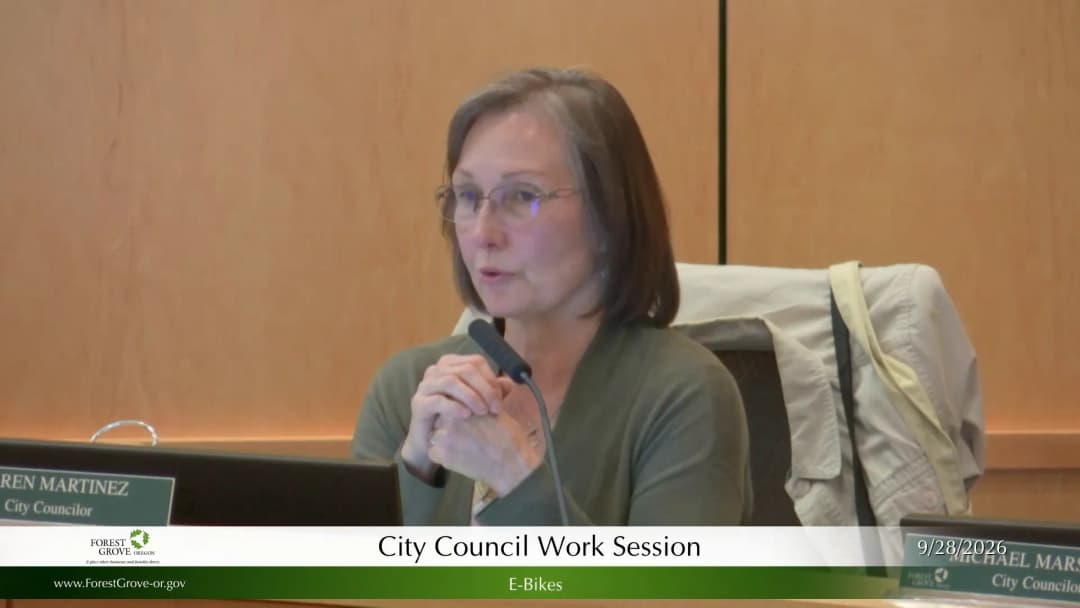
This work session was held to discuss e-bike and micromobility device regulations in Forest Grove. No public comment was taken, and no formal actions were voted on. The council reached consensus to move forward with updating city ordinances related to e-bikes, with an emphasis on gathering detailed data, improving infrastructure, and engaging schools and the community. Presentation and Discussion - City Manager Jesse Vanderzanden and Sergeant Troy Maslin presented on the growing use of e-bikes, scooters, and other micromobility devices, citing safety concerns and an increase in related incidents. A keyword search of dispatch records (Washington County area) from June 1 to September 28, 2026, returned 673 incidents involving e-bikes (including crashes, thefts, and complaints). - The presentation linked e-bike regulation to the Vision 2040 plan’s principal value of safety, and reviewed state law (ORS Chapter 814) and upcoming changes from House Bill 4007 (effective January 1, 2027), which redefines device classes, lowers age requirements, and clarifies helmet rules. - Council members raised concerns about the lack of granular data on crash types (e.g., e-bike vs. car vs. pedestrian), inadequate bicycle infrastructure (e.g., missing bike lanes, unsafe intersections), and the need to avoid regulating vulnerable road users. Several members shared personal experiences of unsafe conditions and crashes. - Council requested that future efforts include targeted data analysis, engagement with schools (individual schools, school district, and Pacific University), outreach to e-bike rebate recipients, and a broader examination of infrastructure and driver education. Key Outcomes - The council unanimously agreed to move forward with updating the city’s ordinances to address e-bikes and related devices, with a focus on safety and data-driven policy. - Staff was directed to gather more specific incident data (e.g., crashes involving pedestrians vs. vehicles, location details) and to incorporate infrastructure assessments into the process. - The timeline for ordinance development will align with neighboring jurisdictions (Cornelius, Hillsboro, Washington County) and the January 1, 2027 effective date of HB 4007. Public education and engagement will continue concurrently. - The work session adjourned at 8:40 PM.
The Aurora City Council met for a study session on Monday, September 28, 2026, at 6:00 PM. The meeting included roll call, consent calendar items, discussions on police grant applications, a proposed amendment to council rules regarding emergency agenda items, and planning and zoning commission vacancies. Several items were pulled for discussion, and audio issues affected participation. Consent Calendar - Items 2B through 2E were moved forward without objection. Item 2A (appointments to housing and community development) was initially pulled due to questions about additional members being added after interviews, but later it was not included in the consent calendar approval. Items 2F and 2G (police grant applications) were pulled for separate discussion. Discussion Items - 5A – Rules of Order and Procedure Amendment (Emergency Agendas): Councilmember Hancock, joined by Councilmember Andrews, presented a resolution to require emergency agenda items to go through policy committees and study session first, with exceptions for public safety emergencies, negative fiscal impact, or legislative deadlines. Mayor Pro Tem Coombs requested adding “public health” alongside “public safety” to cover situations like pandemics. Council debated the definition and voted to continue the item to the next study session for staff to provide a clear definition of “public health emergency.” - 2F – Police Department Grant Application (Peace Officers Behavioral Health): The Aurora Police Department requested council approval to apply for a $300,000 state grant from the Colorado Department of Local Affairs for a neural feedback program supporting officers and their families with stress and trauma. Council questioned the amount (the backup listed $1.6 million total available) and clarified the request is for $300,000 of that amount. The application was approved to move forward. - 2G – Police Department Grant Application (Cybercrime under Violence Against Women Act): APD requested approval to apply for a $750,000 federal grant for digital forensic and cybercrime investigation equipment and training, targeting technology-facilitated offenses against women (e.g., revenge porn, stalking). Council asked for a more detailed presentation at the public safety committee or on the floor; staff agreed to provide further specifics. The application was approved. - 7A – Planning and Zoning Commission Vacancies and Interview Schedule: Two vacancies will occur on December 31, 2026: Sunny Binka (seeking reappointment) and Gail Jetchik (term-limited). Council debated whether to reappoint Binka without an interview. Councilmember Hancock proposed reappointing Binka and interviewing for the other seat; this proposal failed on objections (Councilmembers Bergen, Lawson, Hancock, and Gardner). Mayor Pro Tem Coombs then proposed interviewing for both vacancies, which passed. The interview schedule was approved: application deadline October 23, council selects candidates November 9, interviews November 23, appointments December 7. Key Outcomes - Consent calendar items 2B, 2C, 2D, and 2E were approved. - Item 2F (APD behavioral health grant application) approved to move forward. - Item 2G (APD cybercrime grant application) approved to move forward with a promise of a detailed presentation. - Item 5A (rules amendment) continued to the next study session for a staff definition of “public health emergency.” - Item 7A: Council will conduct interviews for both Planning and Zoning Commission vacancies; the interview schedule was adopted. - No public comments were recorded. - The meeting was recessed for executive session regarding AURA.