Browse by city
Date range
Search help

Search titles, summaries, topics and stored transcripts together. Keywords may match separately; put the whole query in double quotes for a phrase. Matching follows word analysis, so punctuation is not exact. Both dates are included. Documents are not searched.

SHOWING 4811–4820 ENTRIES
4811
SEP 22, 2026 · NEW CASTLE COUNTY, DELAWARE · MEETING PORTAL
New Castle County Boards & Commission Subcommittee Meeting - September 22, 2026

The New Castle County Boards and Commission Subcommittee met on September 22, 2026, to consider nominations and reappointments to several county boards and commissions. Present in chambers were Councilman Smiley, Councilman Cartier, Councilwoman Kilpatrick, Councilman Toole, Councilman Carter, Councilman Hollins, and Councilwoman George; Councilman Street and Councilman Tackett participated online. Council President Monique Johns and Councilman Sheldon also joined during the meeting. The subcommittee approved the minutes of the July 21st meeting (the chair later referred to them as the July 22nd minutes, a minor discrepancy in the record), heard from several nominees, and forwarded appointments to the full council for formal votes. No public comment was offered. Consent Calendar - Minutes from the July 21st meeting were approved by unanimous voice vote; the chair subsequently described the approved minutes as being from July 22nd. - Councilman George moved, with unanimous approval, to move forward expeditiously with any appointees listed on both the boards and commissions agenda and the evening's consent agenda so they could be seated without delay. - The meeting adjourned by unanimous voice vote. Public Comments & Testimony - No public comment was received, either in chambers or online. Appointments & Reappointments - Howard Hayt — Board of Assessment Review (nomination). Hayt stated he has been a Delaware resident for 40 years, living in the Eden Ridge 3 community in North Wilmington and in his current property for 33 years. He expressed interest in serving and noted his knowledge of property taxation. His vote was scheduled for the following week, not the current consent agenda. - Brian Moore — Board of Assessment Review (nomination). Moore described himself as a 10-year Delaware resident and a retired corporate finance professional with 35+ years of experience, including 10 years in public transportation and 25 years in the energy sector, with skills in financial analysis, capital budgeting, forecasting, and risk management. He said he wanted to serve, contribute, and do good within the community. His appointment was placed on that evening's consent agenda. - Niels Fouager — Audit Committee (nomination). Councilman Toole introduced Dr. Fouager, an economist with a PhD who worked as an adjunct professor at Temple University and held positions at Sallie Mae Bank, JP Morgan Chase, and most recently as a senior vice president at Citibank, with expertise in enterprise risk management and corporate governance. Fouager said he would be honored to serve on the audit committee in the county where he has lived for 14 years with his wife and two children. His vote was scheduled for that evening. - Robert Ott — Board of Adjustment, Chair (nomination). Councilman Hollins explained that Ott, who has served on the Planning Board, was switching to the Board of Adjustment, while Herb Inden would switch from the Board of Adjustment to the Planning Board. Ott was not present; Councilman George noted that both could serve on either board and expressed support for them. The expedited consent motion covered Ott and other consent-listed appointees. - Herb Inden — Planning Board (nomination). Councilman Hollins described Inden as a former director of planning for the City of Wilmington beginning under Mayor Frawley, noting his involvement with Delaware's comprehensive plan requirement and the creation of the Riverfront Development Corporation. Inden briefly joined virtually. - Chris DeMarco — Board of Assessment Review, Chair (nomination). Councilman Cartier highlighted DeMarco's extensive experience in real estate management and stressed that it is critical to fully staff the board to address the backlog of assessment appeals and prepare for future reassessment. - Dennis Godak — Fire and Ambulance Advisory Board (reappointment). Presented as a routine reappointment with no additional discussion. - Charles Tolliver, Esq. — Ethics Commission (reappointment). Councilman Hollins voiced support for Tolliver, a local attorney and judge in New Castle County, and said he was pleased to have him continue in the role. Key Outcomes - The subcommittee forwarded all nominations and reappointments to the full council for final votes; several appointees (Moore, Fouager, and others on the consent list) were expected to be voted on that evening, while Hayt's vote was scheduled for the following week. - Approval of the July 21st meeting minutes passed unanimously. - The motion to expeditiously advance consent-listed appointees passed unanimously. - The motion to adjourn passed unanimously.

PROCEDURAL 62% · PERSONNEL MATTERS 38%
4812
SEP 22, 2026 · SAN ANTONIO, TEXAS · COUNCIL COMMITTEES
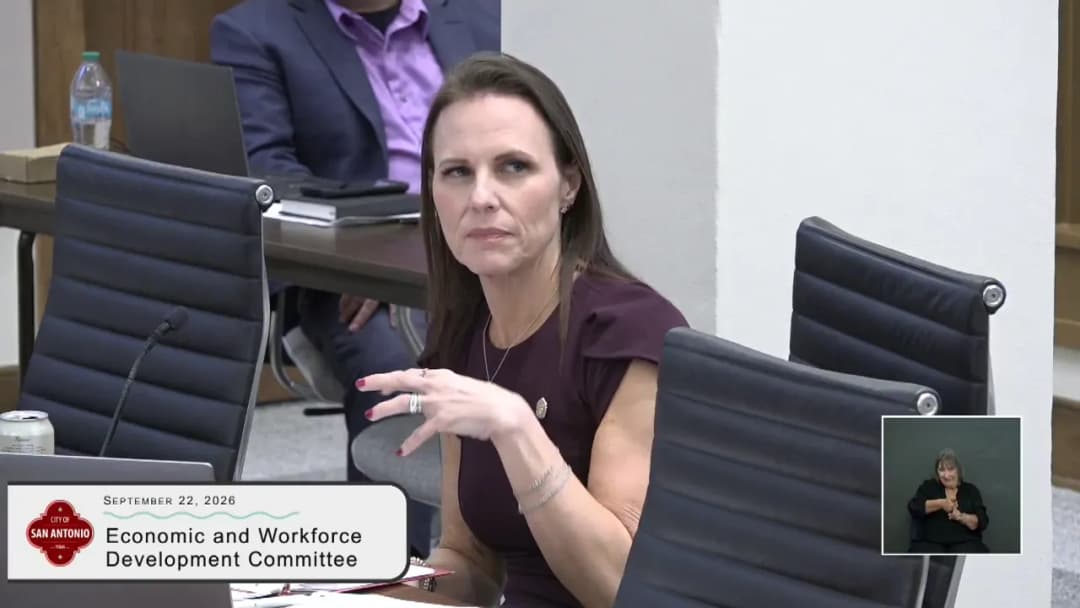
San Antonio Economic Development Committee Meeting - September 22, 2026

The Economic Development and Workforce Committee met on September 22, 2026 at 2:05 PM. The meeting included updates on the Strategic Economic Development Framework, the Nelson Wolff Municipal Stadium redevelopment, proposed incentive policy changes, and international economic participation plans for FY2027. Consent Calendar - Approved the minutes from the previous meeting by unanimous voice vote. Discussion Items - Strategic Economic Development Framework Update: Director Brenda Hicks Sorensen presented an expanded version of the framework, emphasizing innovation, workforce readiness, site preparation, and new target industries (military/defense, aerospace, AI). A new goal (1.3) specifically addresses military advancement and defense industry retention. Ten sites were identified for large-scale development. Implementation will be tracked with semiannual updates to council. The committee discussed the need to align the framework with budget realities, workforce programs like Ready to Work, and coordination with school districts and county entities. - Nelson Wolff Municipal Stadium Redevelopment: The site will become available in Spring 2029. Three public meetings were held, with 220 community responses. Top priorities included parks, affordable housing, and food truck opportunities. A draft concept plan was presented on September 12, dividing the area into five zones including commercial corridors, single-family housing, a community center, and a flex space for small-scale industrial/roastery use. The city will conduct Phase 1 environmental assessment, a mobility study, and financial modeling before seeking development partner interest in Spring 2029. - Proposed Incentive Policy Updates: Staff proposed switching wage benchmarks from ACS to QCEW (Quarterly Census of Employment and Wages) for greater stability and comparability. Wage indexation would remain at 3.5% annually. The minimum wage threshold would move from 60% to 80% of area median wage. A new R&D incentive would offer up to $5,000 per job (up to 50 jobs) for projects exceeding 200% of QCEW wages. An Economic Mobility Fund set-aside (5% of incentive value) would support workforce programs like childcare, transportation, and second-chance employment. Data centers would remain ineligible for incentives. The policy aims to simplify tiers and improve flexibility for small businesses. - International Economic Participation FY2027: Protocol Officer Sherry Delastri outlined expected delegations including a Japan national security forum (October 2), a business delegation from Monterrey, Mexico (late October), a delegation from Taiwan (late October), a cyber security business delegation from Israel (December), and a life sciences delegation from Belgium. The city also plans small trade missions to Costa Rica and Colombia, and prioritizes return visits to Canada (Quebec, Toronto, Montreal) and Japan (Kumamoto anniversary trip with potential Toyota visit). The 10th anniversary of the sister city relationship with Germany (Manacore) will be celebrated. Council members stressed the importance of in-person diplomacy and relationship-building. Key Outcomes - Motion to send the Strategic Economic Development Framework to the City Council B session on October 13, 2026 (unanimously approved). Staff will incorporate pending feedback on AI policy and naval base opportunities. - Motion to send the Nelson Wolff Stadium redevelopment update to the City Council B session on October 14, 2026 (unanimously approved). Further details on property valuation, zoning, and parking strategy were requested. - The proposed incentive policy changes and international participation report were informational; both will be discussed further at the October 14 City Council B session. - The economic mobility fund set-aside will require review to determine if it can be adopted by the Economic Development Department or requires voter approval. - Staff will prepare a consolidated list of programs and contacts regarding workforce, innovation, and industrial coordination for the October session.

ECONOMIC DEVELOPMENT 61% · INTERNATIONAL RELATIONS 10% · PARKS AND RECREATION 8% · PUBLIC ENGAGEMENT 5%
4813
SEP 22, 2026 · GRAND RAPIDS, MICHIGAN · MEETING PORTAL
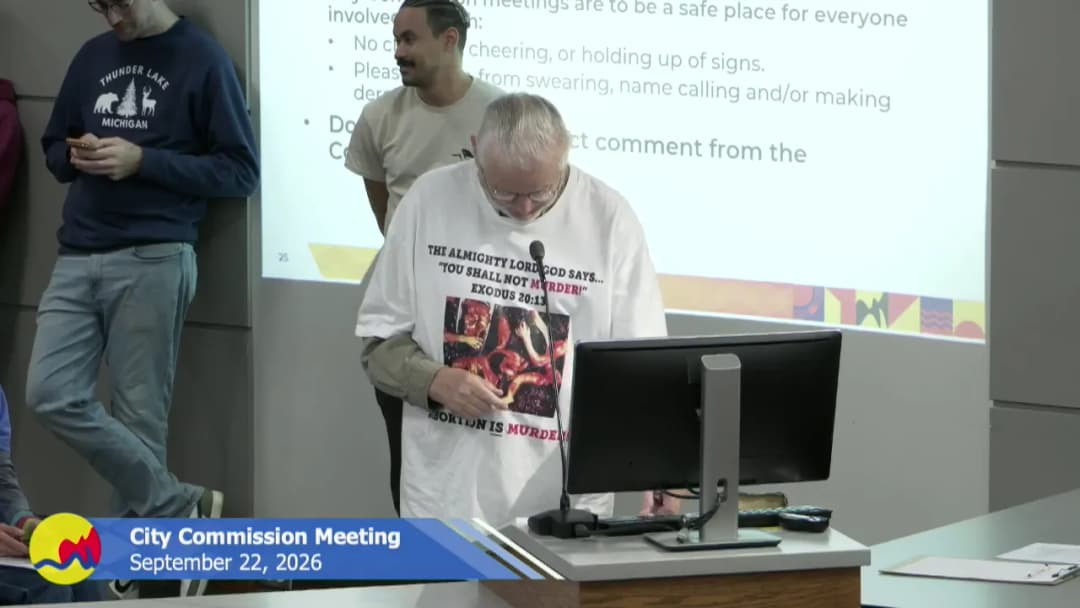
Grand Rapids City Commission Meeting: September 22, 2026

The Grand Rapids City Commission met on September 22, 2026, to consider a budget amendment, hear public testimony on housing and community development, approve three obsolete property rehabilitation projects, and receive extensive public comment on immigration enforcement, police surveillance, and other community concerns. The meeting began with a moment of silence and the Pledge of Allegiance. Consent Calendar - Unanimously approved the consent agenda, which included routine approvals and items that passed out of committee without objection. - The comptroller's warrant report for August 25 to September 7, 2026, in the amount of $23,778,750.89, and the treasurer's report for August 26 to September 8, 2026, were received and filed. Public Comments & Testimony - Education Grant Support: D. Jones expressed support for a $300,000 grant from the Community Foundation for the “to college” program, emphasizing the importance of higher education and continuous city investment in such initiatives. - Opposition to Substance Spending: A resident (Daniel) opposed the city’s budget allocation for a drug sobriety court grant, arguing that allowing marijuana stores and breweries while spending on sobriety programs is hypocritical; he urged prevention over remediation. - Housing & Community Development (CAPER): - D. Jones advocated for 3D-printed housing as a future affordable housing innovation. - Jim Davis (Family Promise of West Michigan) urged stronger explicit funding for family homelessness prevention, noting a 39% increase in family homelessness nationally and rising local calls. - Nancy Haynes (Fair Housing Center of West Michigan) thanked the city for increased support ($90,000) and detailed services: 188 hours of education, 52 discrimination tests, and opening 1,420 housing units. - Anna Diaz (Community Rebuilders) reported on the HOME TBRA program: $400,000 in city funding served 61 households, 99% exited to permanent housing. - Amphitheater Noise: Dan Hibma and Ted Roseboom (Plaza Towers residents) complained about excessive noise from the Acreshir Amphitheater, including low-frequency bass that carries for miles. Hibma presented a poll showing 74% support for a sound wall; both urged mitigation measures. The planning commission was criticized for relying on inaccurate noise studies. - Affordable Housing Crisis: Amy Brock and Julie Hauk (Grand Rapids for Affordable Housing) and Martha Cooper highlighted the severe shortage of affordable units—6,990 rental and 6,333 owner-occupied units needed by 2030—and criticized large public subsidies for luxury developments (e.g., $560 million for Three Towers) while affordable housing gets far less. They proposed tiny home villages, portable tenant applications, bans on algorithmic rent-setting, and a vacancy tax. - Bicycle & Pedestrian Infrastructure: Multiple speakers (Jacob Warner, Adam Williams, Laura Sessa, Andrew Carley, Anna Carly) called for better maintenance, connectivity, and investment in bike lanes and walkable infrastructure, emphasizing safety, economic benefits, and alignment with previous city plans. They requested interdepartmental coordination and funding for traffic calming. - Sanctuary City & ICE Collaboration: Numerous speakers (Matt, Tanner, Jacob Christophori, Chloe Mulder, Kyle, Alex, John Haynes, and others) demanded adoption of the six sanctuary policies proposed by Movimiento Cosecha, an end to GRPD cooperation with ICE, and cancellation of all ALPR (Flock) camera contracts. They cited the September 12 arrest of five peaceful protesters outside the ICE field office and the death of Mario David Coronado Juarez on September 20, who died in a crash allegedly during an ICE pursuit. Speakers claimed GRPD shares Flock data with 1,656 agencies, including at least 127 with ICE 287G agreements, and that GRPD actively assists ICE operations. - First Amendment & Hate Speech: A speaker (traveling advocate) educated the commission on First Amendment protections, arguing that hate speech is legal and that the city’s decorum rules may be unconstitutional. Another speaker (Michael Thompson) condemned the earlier anti-Islam remarks as hateful. - Police Conduct & Transparency: Lucas (former West Grand Neighborhood VP) criticized Chief Trigg’s social media post depicting violence and alleged city interference. Several speakers (Chloe Mulder, Teresa, Jasmine’s statement) described GRPD’s physical force during the September 12 protest. - Other: Matthew Scudigan and Daniel spoke on religious themes; Kim promoted a school board candidate forum. Discussion Items - Budget Amendment (Ordinance): Commissioner Sauci introduced a batch of budget adjustments, including grants for community development (CHIP lead hazard control), Michigan Indigent Defense Fund, 61st District Court drug and sobriety court grants, engineering items (Scribner capital bond, fire department training facilities), police auto theft prevention grant, parks and recreation (Michigan Natural Resources Trust Fund for river edges trail), and substance abuse/mental health services. The ordinance was adopted by unanimous roll call (all commissioners voting yes). Immediate effect also approved. - Consolidated Annual Performance and Evaluation Report (CAPER): Mr. Tucker presented the CAPER covering July 1, 2025 – June 30, 2026, required by HUD. Funding sources included CDBG, HOME, ESG, JAG, opioid settlement funds, and affordable housing fund. Key outcomes: 222 households prevented/resolved homelessness; 31,600 people received fair housing education; 135 affordable units completed; 3,400 code compliance cases; 531 housing units repaired. The public hearing was opened and closed; written comments accepted until September 23. - Obsolete Property Rehabilitation Districts: Three projects were presented and referred to the Committee of the Whole for further consideration: 1. 2130 Plinyfield: Rehabilitation of 3,000 sq ft building plus 1,600 sq ft commercial space, four one-bedroom units at 100% AMI, total cost $1.19 million. Includes 82% aspirational inclusion goals for micro/local/WMBE businesses. 2. 1024 MLK: Rehabilitation of 5,300 sq ft into child care and after-school programming, total cost $1 million. Applicant Latrice Hampton spoke of her passion for the community. 3. 1956 Eastern SE: Rehabilitation of 8,000 sq ft into eight one-bedroom units at 80% AMI, total cost $1.5 million. Term extended to 11 years due to affordability commitment. Key Outcomes - Consent Agenda approved unanimously. - Budget Amendment adopted by unanimous roll call (Commissioners Belchak, Kilgore, Asasi, Purdue, Knight, Mayor Legrand all yes). Immediate effect also carried. - CAPER Public Hearing closed; final written comments due September 23. - Board of Review (Special Assessment) hearing closed; two appeals received. - Three Obsolete Property Projects referred to Committee of the Whole for final action. - No votes taken on sanctuary city policies, ALPR contracts, amphitheater noise mitigation, or bike infrastructure proposals. These remain open topics. - Meeting recessed after a public commenter refused to yield time and the room became disorderly; no further business was conducted. Note: The death of Mario David Coronado Juarez (allegedly during an ICE pursuit on September 20) was repeatedly referenced by public commenters, who called for accountability and the adoption of sanctuary policies. The commission did not respond directly to these demands during the meeting.

AFFORDABLE HOUSING 16% · IMMIGRATION 16% · IMMIGRATION ENFORCEMENT 15% · PUBLIC SAFETY 9%
4814
SEP 22, 2026 · HOUSTON, TEXAS · CITY COUNCIL
Houston City Council Meeting – September 22, 2026: Proclamations, Grant Debate, and Public Comments

On September 22, 2026, the Houston City Council convened for a regular meeting that included multiple proclamations, a debate over a federal grant application (Item 26) that was pulled from the agenda, and public testimony on homelessness, immigration enforcement, and city services. The meeting opened with proclamations recognizing National ENS Sign Awareness Day (June 24, 2026), Prairie View A&M University's 150th anniversary (August 14, 2026), Joy Horak Brown's service (September 22, 2026), and Ovarian Cancer Awareness Month (Teal Talk Day, September 23, 2026). The council then adopted the minutes of September 15–16, 2026, and approved adding speakers to the non-agenda lists. Consent Calendar - Motion to adopt the minutes of September 15 and 16, 2026 passed unanimously. - Motion to add Ruthie Needle (one-minute) and Cessad Espinosa (two-minute) to the non-agenda list passed unanimously. - Motion to suspend rules to move Carla Perdu to the top of the three-minute non-agenda list passed unanimously. Public Comments & Testimony - Lisa Hunt (retired clergy, Migration with Dignity) expressed skepticism of the DOJ Model Cities grant, citing concerns about ICE cooperation and National Guard deployment. She urged the city not to seek the funds. - Mo Cortez (speaker not transcribed in detail) – appeared but no specific remarks captured. - Neil Aquino criticized the grant as requiring immigration enforcement, comparing Houston to Memphis and Washington with National Guard deployments. He opposed the application. - Alfredo Dominguez spoke about ICE victimization, referencing the shooting of a man delivering food in Austin and the killing of Lorenzo Selga. He demanded justice and transparency. - Amal Sharif – appeared but no specific remarks captured. - Cesar Espinosa criticized the mayor's response to Lorenzo Selga's murder, accusing the city of inaction and lying about the grant's requirements. He urged the council to protect immigrant communities. - Carla Perdu (Memorial Plaza neighborhood) described public safety concerns from homeless encampments near schools and businesses, requesting coordinated solutions and increased HPD presence on the West Side. - Janice Beckov (data analyst) presented findings from 46,000+ 311 solid waste complaints, noting that nearly half of garbage complaints are filed on the scheduled collection day. She requested a working session with Solid Waste, 311, and technology teams. - Earl Brownlow (Tara story) – spoke about family violence and unfair court proceedings, requesting protection and oversight. - Ray Field (Nicholas Taylor?) – Nicholas Taylor testified about construction on Houston Avenue that blocked his business entrance, alleging bait-and-switch by a city project manager and a public safety hazard noted by a fire chief. He requested an investigation. - David Falouks shared his personal experience of homelessness across multiple states, urging compassion and better housing, environmental safety, and transportation. - Charles Moore proposed a digital currency system to address homelessness and job pay. - Rodney Underwood (Uplift Development, Third Ward) requested assistance for property improvement and veteran employment, seeking partnerships with Coalition for the Homeless and Baker Ripley. - Diane Hobson (Pastor, National Coordinator for Seniors and Family) requested a proclamation for National Food Day (October 24) and a national organic food drive, citing rising childhood cancer and obesity. - Steve Showdry – spoke about morality and voting, referenced a meeting at 5601 Bridgewood. - Christine Voll (Anthony Hubbard?) – Anthony Hubbard noted 77 days since Lorenzo Selga's murder, criticized council for inaction, and demanded an end to HPD collaboration with ICE. - Cora Fortune – referenced the Austin shooting and called for ICE out of Houston. Discussion Items - Item 26 – Model Cities Grant Application (pulled from agenda): Mayor Whitmire stated the grant was pulled after misrepresentation by media; it was intended to demonstrate the city's commitment to seeking third-party funding for homeless initiatives, not immigration enforcement. He reaffirmed that Houston does not enforce immigration laws and that the city's ordinance guides policy. Councilmember Salinas thanked the administration for working on the issue but expressed concern that the grant's FAQs indicated potential ICE cooperation; she stated she would vote no if DOJ confirms that requirement. The mayor reiterated that no grant funds would be used for enforcement and that the city had made its position clear to stakeholders. Several councilmembers (e.g., Panzarella, Pollard) echoed support for the mayor's approach. Key Outcomes - Proclamations were declared for ENS Sign Awareness Day (June 24, 2026), Prairie View A&M University 150th Anniversary (August 14, 2026), Joy Horak Brown Day (September 22, 2026), and Ovarian Cancer Awareness Month/Teal Talk Day (September 23, 2026). - Minutes of September 15–16, 2026 were adopted. - Speakers were added to the non-agenda lists as moved. - Item 26 was pulled from the agenda; the mayor committed to not applying for the Model Cities grant if it requires immigration enforcement. Council will await DOJ clarification before any future action. - The council committed to following up on several public comments: construction oversight (Houston Avenue repavement), solid waste data analysis, family court concerns, and homeless encampment coordination.

IMMIGRATION 16% · PROCEDURAL 14% · HOMELESSNESS 14% · AFFORDABLE HOUSING 10%
4815
SEP 22, 2026 · NEW YORK CITY, NEW YORK · CITY COUNCIL
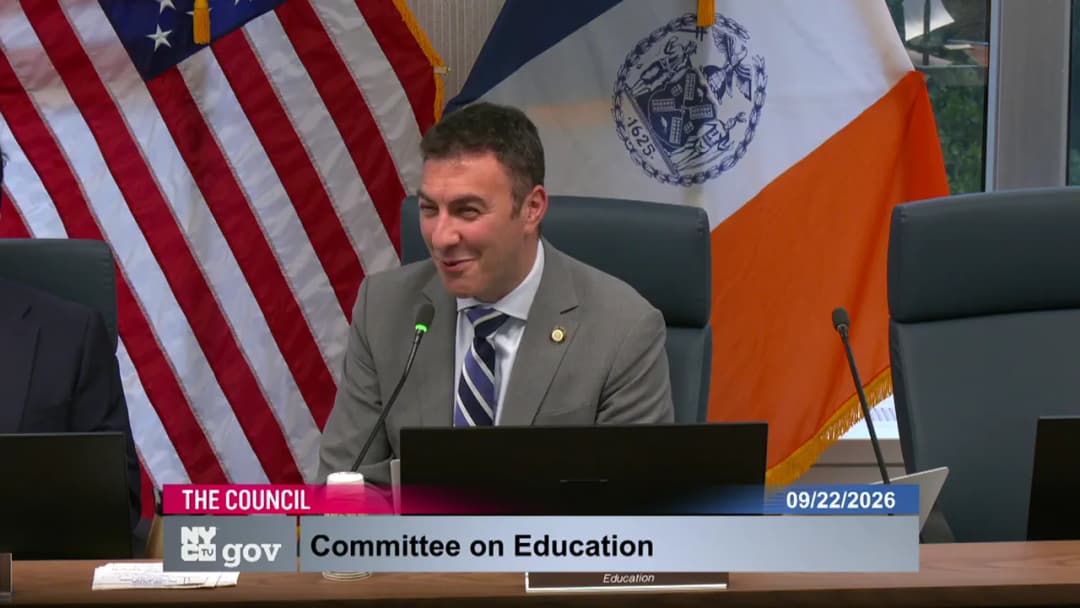
NYC Council Education Committee Oversight Hearing on Portrait of a Graduate – September 22, 2026

The New York City Council Committee on Education, chaired by Councilmember Eric Dinowitz, held an oversight hearing on the implementation of the New York State "Portrait of a Graduate" (POG) framework. The hearing examined the New York City Department of Education's (DOE) preparedness to shift from Regents exam graduation requirements to performance-based assessments, beginning with the 2027-28 school year. Chair Dinowitz emphasized concerns about maintaining rigor, the need for clear guidance to schools, and the importance of leveraging existing expertise within the city's school system. DOE officials, including First Deputy Chancellor Danielle Junta and Supervising Superintendent Dr. Alan Chang, presented the city's implementation plans and answered questions from council members. Public testimony featured over 30 speakers, including students, educators, advocates, and representatives from community organizations, many highlighting the value of journalism education, performance-based assessment models (e.g., consortium schools), and the need for equitable access to high-quality learning experiences. Public Comments & Testimony - Students from the Youth Journalism Coalition and other schools testified that journalism education inherently develops the POG attributes—critical thinking, effective communication, global citizenship, and academic preparedness. They cited data from Baruch College (2022) that 73% of NYC public high schools lack a journalism program and urged the DOE to integrate journalism into the POG framework. Several students shared personal stories of how reporting helped them find their voice, research complex issues, and engage civically. - Representatives from the New York Performance Standards Consortium, Internationals Network, Outward Bound, and other affinity networks argued that performance-based assessments (PBAs) already in place in their schools align closely with POG. They stressed that the DOE should build on these existing models rather than start from scratch, and called for sustained investment in teacher collaboration, norming sessions, and intervisitation structures. - Advocates from Children's Aid, Ed Trust New York, and Advocates for Children emphasized the need for extensive stakeholder engagement, clear communication to families, and safeguards for students with disabilities and multilingual learners. Ed Trust New York urged the state to delay implementation until districts receive comprehensive guidance, warning that hasty rollout could exacerbate inequities. - Parent and educator testimony highlighted the importance of arts education, trauma-informed support for students in foster care, and the dangers of over-reliance on standardized tests. A parent of consortium school graduates shared that her children thrived without Regents exams, while another educator argued that POG must include culturally responsive curriculum and warned against corporate curricular products like NYC Reads and NYC Solves. Discussion Items - DOE Implementation Plans and Timeline: First Deputy Chancellor Junta and Dr. Chang outlined steps taken so far, including training for all superintendents and principals (45 meetings), creation of a 20-person steering committee, and asset mapping of existing school practices. They acknowledged that the state's regulatory timeline is not fully defined but emphasized that the city is preparing to be ahead of the curve. Chair Dinowitz pressed for specifics on classroom-level changes, noting that many principals and teachers remain unclear about what POG will look like in practice. - Personal Finance Education Rollout: Jane Martinez Dowling, Chief of Student Pathways, reported that nearly 50% of middle and high school students have personal finance instruction scheduled for fall 2026 as part of POG’s phase two. Schools may choose from five vetted curricula, but council members questioned whether assessments and rubrics are standardized across schools. DOE officials stated that all curricula align to state standards and that teacher norming is being implemented to ensure consistency. - Rigor and Accountability: Councilmember Joseph and others asked how the DOE will ensure that performance-based assessments (e.g., capstones, portfolios) remain rigorous and comparable across schools. Dr. Chang cited the consortium schools’ 20-year track record of rubrics validated by CUNY/SUNY, and Superintendent Michael Prayer described the “HEAT” program (healthcare, energy, education, agriculture, technology) in Brooklyn South, where 400 11th graders engage in place-based projects with professional partners. However, scaling such programs to all 31,000 high school students in Brooklyn South alone remains a challenge. - Communication with Families and Schools: Councilmembers Narcisse and Wong noted that many parents and CEC members are unaware of the pending changes. DOE representatives stated that a broader communications plan is in development and that principals are expected to share information through school leadership teams and CEC meetings. The DOE also clarified that for the current school year (2026-27), graduation requirements remain unchanged; the decoupling of Regents exams begins for the class of 2028. Key Outcomes - No formal votes were taken; the oversight matter was filed by committee. - Chair Dinowitz committed to continued oversight and accountability, stressing the need for enhanced communication, robust professional development, and structural support—including funding—for schools to share best practices and implement POG effectively. - The DOE promised to refine its reporting on journalism access (per Local Law 27) and to accelerate community engagement, drawing on the expertise of affinity networks and consortium schools. - Councilmembers and testifiers called for the DOE to leverage internal expertise rather than rely on expensive external vendors, and to ensure that POG implementation does not diminish rigor or widen equity gaps.

EDUCATION 71% · HIGHER EDUCATION 7% · YOUTH PROGRAMS 5% · STUDENT SUPPORT SERVICES 4%
4816
SEP 22, 2026 · NEW YORK CITY, NEW YORK · CITY COUNCIL
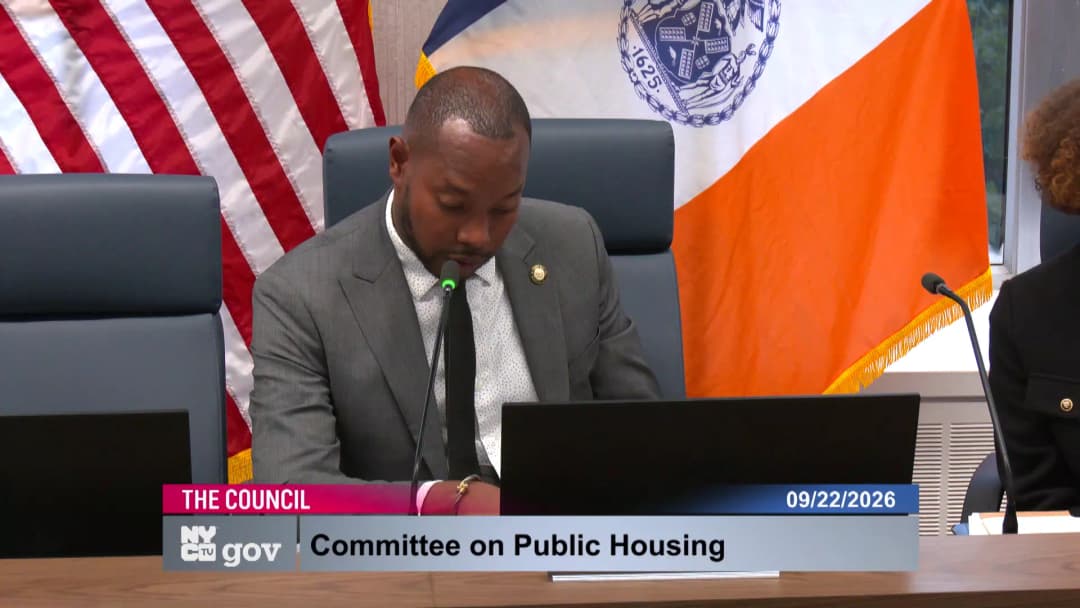
Oversight Hearing on Work Order Practices at NYCHA and PACT - September 22, 2026

The New York City Council Committee on Public Housing, chaired by Councilmember Chris Banks, held an oversight hearing on Tuesday, September 22, 2026, to examine work order systems used by the New York City Housing Authority (NYCHA) and its Permanent Affordability Commitment Together (PACT) program. The hearing focused on the backlog of open work orders, response times, transparency, and discrepancies between Section 9 (traditional NYCHA) and PACT developments. Councilmembers Banks, Encarnación, Marte, Ossé, and Won were present; Mealy and Restler were absent. Councilmember Nurse also attended. Public Comments & Testimony - Mateen Scarcy (Manhattan Community Board 9 co-chair, NYCHA employee, testifying personally): Described siloed operations at NYCHA, noting that the My NYCHA app does not connect to property management systems, forcing residents to navigate complex scheduling. Urged multi-trade teams and integrated software. - Carla Hollingsworth (Secretary, Stuyvesant Gardens One Tenants Association): Reported that PACT renovations at Stuyvesant Gardens One were failing—new windows fell inward, asbestos was encapsulated not removed, and apartments were altered without resident consent. Questioned contractor oversight and the $380,000 per unit cost. - Keith Ramsey (Eastchester Gardens resident): Highlighted success at his development using Property Mail software, achieving 98% completion of 3,280 work tickets, median 24-hour first response, and 3.3-day average turnaround. Residents rated service 4.1/5 stars. He described a joint bi-weekly tracking list with NYCHA, the first such data-sharing partnership. - Jeremy Estrada (Housing organizer): Shared his mother’s experience waiting two months for kitchen cabinets despite a broken sink and asthma-triggering dust. Noted similar delays in Queensbridge, Astoria, and Ravenswood for asbestos and other repairs. - Patricia Dickey (NYCHA resident, via Zoom): Described work orders being closed without repairs, difficulty reaching customer service, and constant resets. Her kitchen repairs were scheduled for six months out until intervention by Councilmember Banks’ office resolved them in three days. - Layla Glasgow (Democratic District Leader, Chelsea): Reported dangerous gaps at Fulton and Elliott-Chelsea houses slated for demolition: a tenant trapped in her apartment had to be freed by FDNY, and a building entrance door was broken for weeks. The “Meanwhile Plan” meant to prevent deterioration was not being implemented. - Denise Davis (Penn-Workman Houses, PACT resident): Reported persistent leaks, loss of subsidy without explanation, elevator breakdowns, and eviction threats related to non-payment tied to unresolved conditions. - Ms. Eves (PACT resident): Alleged that PACT is designed to remove tenants, citing retaliation for complaints, chronic eviction cases, and safety hazards like falling down stairs 15 times. - Sophia Finn (Legal fellow, New York Legal Assistance Group): Described systemic issues: work orders closed mysteriously, workers taking pictures without repairs, poor scheduling (painters before plaster), and multiple relocations for lead and asbestos that ruined tenants’ belongings. - Amelia Walden (Penn-Workman Houses, PACT): Reported mold removal that only wipes and paints, falsified HPD reports, new elevators constantly out of service, and loss of closet space during renovations. - Cynthia Tibbs (TA president, Wasser Brownstones, via Zoom): Alleged that NYCHA is now requiring non-disclosure agreements (NDAs) from tenant leaders during PACT pre-development, barring them from speaking to elected officials or residents, calling it undemocratic and unacceptable. - Ms. Hines (Elder, Brooklyn): Expressed frustration with systemic failures, mold, asbestos, lead, and paper-thin doors, stating NYCHA should be torn down. Discussion Items - Opening Statement by Chair Banks: Outlined the purpose: understanding two work order systems (SIBO/Maximo for NYCHA, varied systems for PACT), residents’ complaints about disappearing work orders during PACT transitions, and lack of transparency (only one year of public data). - NYCHA Testimony – Daniel Green (EVP Property Management) and Heather Beck (EVP & Chief Real Estate Officer): - Work order volume: NYCHA receives 98,000 new maintenance work orders per month; 2.5 million created in 2025, with 2.49 million closed. Open work orders as of Sept 21, 2026: 606,583 (Section 9 only), broken down into: 17,000 maintenance, 311,000 skilled trades, 58,000 other crafts, 221,371 vendor tickets. Skilled trades backlog reduced 14% since 2024 to 282,000. - Response times: Emergency work orders averaged 11.1 hours (target 24 hrs); non-emergency averaged 55.6 days. Maintenance basic repairs completed in under 4 days. Missed skilled trade appointments reduced from 10.9% (2024) to 2.7% (July 2026). - Aging work orders: 93,000 open for 6–12 months; 332,000 open for over one year (mostly paint). Mold/leak backlog: 63,972 total, 21,968 (34%) older than one year, 58,295 (91%) requiring skilled trades. - PACT work orders: NYCHA collects monthly data on five HUD pillar areas (elevators, heat, leaks, mold, pests). As of Aug 31, 2026, only 409 open work orders across 32,000 PACT units (one per 100 units). Typical resolution within one day. On-time resolution decreased: 90.75% (2023), 87.5% (2024), 74.5% (2025). Total 65 work orders open 100 days. - Inspections: NYCHA now inspects 100% of apartments annually (previously 50% every 4 years). HUD physical inspection (INSPIRE) scores improved from 32.5 (2022-23) to 79.5 (Sept 2026), with 89% passing. - Vacancies: Only 44 skilled trades vacancies out of 1,750; 30 maintenance vacancies out of 750. Plaster academy underway. - Initiatives: Maintenance Cares (1,164 high-need apartments resolved since Feb 2025); Critical Repairs Initiative (CRI) launching with $20M for overtime; Mold & Leaks Restore & Renew (4,000 work orders completed, goal 10,000 over 2 years); Elevator door parts funding ($2M over 3 years, zero repairs to date). - Council Q&A Highlights: - Chair Banks: Pressed on why total work orders aren’t dropping despite PACT conversions (Green cited increased inspections generating more work orders). Questioned seven-month average wait for skilled trades; Green acknowledged it’s unacceptable but cited resource constraints. - Councilmember Encarnación (District 8): Noted that constituent services are overwhelmed tracking work orders; called for proactive management instead of resident-driven follow-up. Questioned how apartment inspections can yield high pass rates when conditions remain poor. - Transparency: NYCHA does not publish work order closures without repair separately. Only one year of Section 9 data is public; 7.5 million work order transactions provided to Council oversight. PAC data published quarterly but less detailed because NYCHA is not the property manager. - Oversight: NYCHA’s quality assurance unit inspects 3,500 closed work orders per quarter; 3% found unsatisfactory. No specific data on disciplinary actions for falsification or referrals to DOI. Independent mold analyst inspects closed mold/leak work orders monthly. - Housing Court: In FY2025, 551 order-to-show-cause HP cases brought 5,312 violations; only 31% resolved as of September 2026. NYCHA now receives daily HPD violation data electronically. Key Outcomes - The Committee held the oversight hearing; the matter was filed without any immediate legislative action. - NYCHA committed to provide additional data requested by the Chair, including historical work order numbers, breakdown by age, and follow-up on disciplinary actions. - Chair Banks emphasized the need for NYCHA to accept independent inspections by HPD and greater transparency for PACT work order data. - Several public testifiers raised concerns about PACT evictions, non-disclosure agreements, and unsafe conditions; NYCHA stated it would take back questions on NDAs and the Meanwhile Plan for further review. - The hearing concluded with no formal votes or directives, but the record will remain open for written testimony submitted within 72 hours.

PUBLIC HOUSING 55% · MISCELLANEOUS 18% · HOUSING AND INFRASTRUCTURE 14% · ENGINEERING AND INFRASTRUCTURE 7%
4817
SEP 22, 2026 · NEW YORK CITY, NEW YORK · CITY COUNCIL
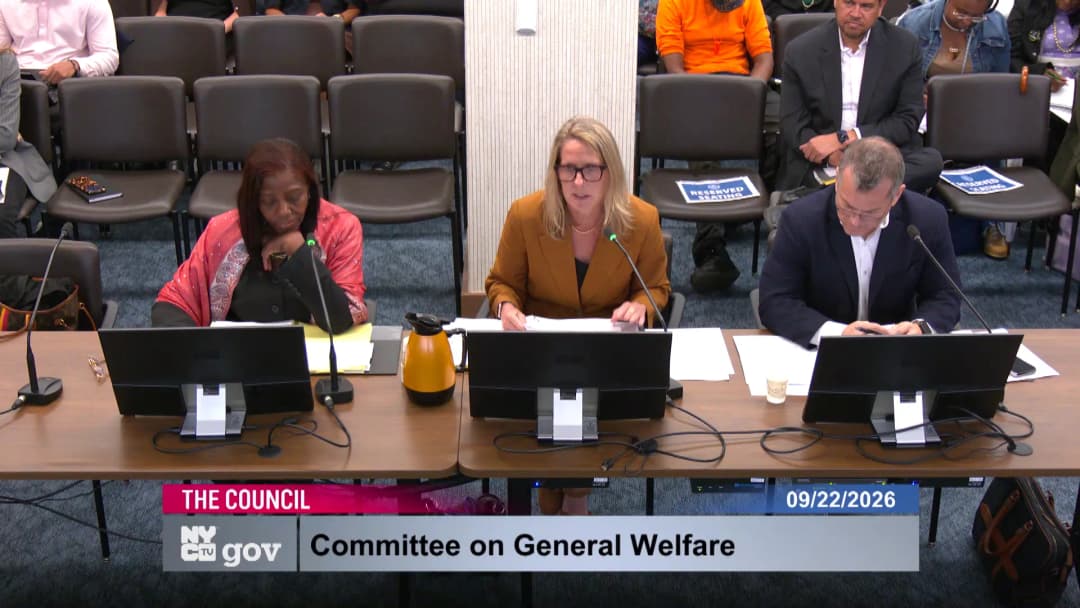
NYC Council General Welfare Committee Hearing on CityFEPS Reforms - September 22, 2026

On September 22, 2026, the New York City Council Committee on General Welfare, chaired by Crystal Hudson, held a hearing on five legislative proposals aimed at improving the City Family Homelessness and Eviction Prevention Supplement (CityFEPS) rental assistance program. The hearing began at 1:00 PM at 250 Broadway. Roll call showed members Hudson, Morano, Nurse, Ung, and Wilson present; Avilés and Mealy absent. Councilmember Brewer also attended. The committee heard testimony from Department of Social Services (DSS) Commissioner Aaron Dalton and his team, followed by over a dozen panels of public testimony from advocates, service providers, and individuals with lived experience. All five bills received hearings and were laid over without a vote. Opening Remarks Chair Hudson opened by stating that New York City faces intertwined crises of an acute affordable housing shortage and widespread homelessness. She cited data from the Coalition for the Homeless showing that 96,528 people slept in NYC shelters each night in July 2026, including 30,824 children, with the total unhoused population likely in the hundreds of thousands. She noted that CityFEPS, established in 2018, had helped 123,762 individuals secure permanent housing through March 2025, with the city budgeting $1.78 billion for FY2026 and $1.97 billion for FY2027. She described the five bills as attempts to remove roadblocks at key stages of the CityFEPS process. Discussion Items Intro 98-2026 (Sponsor: Councilmember Brewer) – Would require the Commissioner of Social Services to deem a dwelling unit habitable before approving CityFEPS assistance for that unit. DSS Commissioner Aaron Dalton testified that while the agency supports the goal, the bill as drafted would limit flexibility and increase processing time. He highlighted a nine-month pilot program that distinguishes between minor and major repairs and uses virtual reinspections for minor fixes. The pilot results are expected to roll out systemwide in early 2027. Committee members questioned the average wait time for inspections (2–3 weeks), failure rates (44% for HRA-conducted inspections on harder units), and specific failure reasons (e.g., water temperature failures 41%, electrical outlet deficiencies 33%). DSS noted they only conduct about a third of inspections; providers handle the rest. Intro 100-2026 (Sponsor: Councilmember Brewer) – Would require DSS to annually report the average time from shopping letter issuance to lease-up. Dalton stated the agency can report this metric but questioned whether it is the best measure, as many factors (low vacancy, geographic preferences) affect timelines. He provided average lease-up times: 244 days in 2024, 221 in 2025, and 236 year-to-date in 2026. The difference between community applicants (21 days from application to approval) and shelter applicants (31 days) was noted. Intro 101-2026 (Sponsor: Councilmember Brewer) – Would require DSS to respond to CityFEPS applications within 15 days (approved, denied, or needing correction). Dalton reported current average processing time of 28 days, improved to 24.8 days in recent months due to reorganization and streamlined review. DSS plans to launch a client-facing portal by end of October 2026 to show real-time status. Several testifiers urged that the 15-day limit should apply to the entire process, including pre-submission steps (e.g., through Home Base). Intro 641-2026 (Sponsor: Councilmember Wrestler) – Would require DSS to issue rental assistance payments no later than seven days before the first of the month. Dalton stated that DSS currently pays on the 26th of the prior month, with electronic transfers arriving within 24 hours and paper checks around the 1st. He noted that the state’s shelter allowance is paid in two installments (beginning and middle of month), which can result in partial payments. DSS provides landlords a payment breakdown but not a full calendar. Preconsidered Intro T2026-1424 (Sponsor: Councilmember Morano) – Would require DSS to create a landlord portal for rental subsidy programs. Dalton supported the goal but said the January 2027 deadline is not feasible given ongoing IT work; enhancements are expected to roll out in phases starting first quarter 2027. Councilmember Morano pressed for a specific commitment date, but Dalton could not provide one. Testifiers from Spony (small property owners) strongly supported the portal as a way to reduce administrative burdens. Public Comments & Testimony The committee heard from multiple panels, all expressing strong support for the five bills while often urging stronger timelines and broader scope. - First Panel (Lived Experience): Judita Francis, a shelter resident with a child, testified that she secured an apartment in April 2026 but still cannot move in due to inspection and approval delays. Akira Morris shared her experience of nearly losing her apartment due to communication breakdowns between Home Base and HRA. Elizabeth Mackey reported that her landlord has not been paid for five months, despite her voucher being active, putting her at risk of eviction. Diana Ramos described a unit with pests, non-working outlets, and plumbing issues; she also had to act as a middleman to ensure payments were correct. - Providers and Advocates: Kathy Batista (Anthos Home), Jade Vasquez (WIN), Maritza Rico (New Destiny Housing), Graham Horn (NYLAG), Helen Strom (Urban Justice Center), Jean Stevens (VOLS), Lauren Price (Brooklyn Defender Services), Yvonne Pena (CSS), Brandon Lloyd (URI), Jerry Hippolyte (HSNY), and Pepper (Homeless Services United) all testified in favor of the bills. Common themes included: the need for rapid response times (15 days should cover pre-application steps), transparency in reporting (including reasons for package rejections and data on lease-up times), and concerns about rent reasonableness reviews causing months-long delays. Testifiers also flagged discrimination by landlords and brokers against voucher holders and called for stronger enforcement of source-of-income laws. - Virtual Testimony: Ann Korchak (Spony) praised the landlord portal bill. Miranda Denovo and Calvin Michael shared personal experiences—Denovo described a friend waiting months for a shopping letter due to case manager turnover; Michael stated CityFEPS works but is underfunded and has payment discrepancies. Key Outcomes - All five bills (Int 98, 100, 101, 641, and T2026-1424) were Hearing Held and Laid Over by the committee (no vote taken). Written testimony may be submitted within 72 hours. - The committee did not take any final action. Councilmembers indicated intent to continue working with DSS and bill sponsors to refine the legislation. - DSS committed to providing additional data requested by committee members, including disaggregation of processing times, reasons for package returns, and estimated shelter cost savings from reduced delays. - DSS noted upcoming improvements: a client portal by end of October 2026, expansion of the inspection pilot systemwide in first quarter 2027, and ongoing enhancements to the landlord portal.

HOMELESSNESS 35% · HOUSING 22% · AFFORDABLE HOUSING 12% · TECHNOLOGY AND INNOVATION 10%
4818
SEP 22, 2026 · DALLAS, TEXAS · CITY COUNCIL
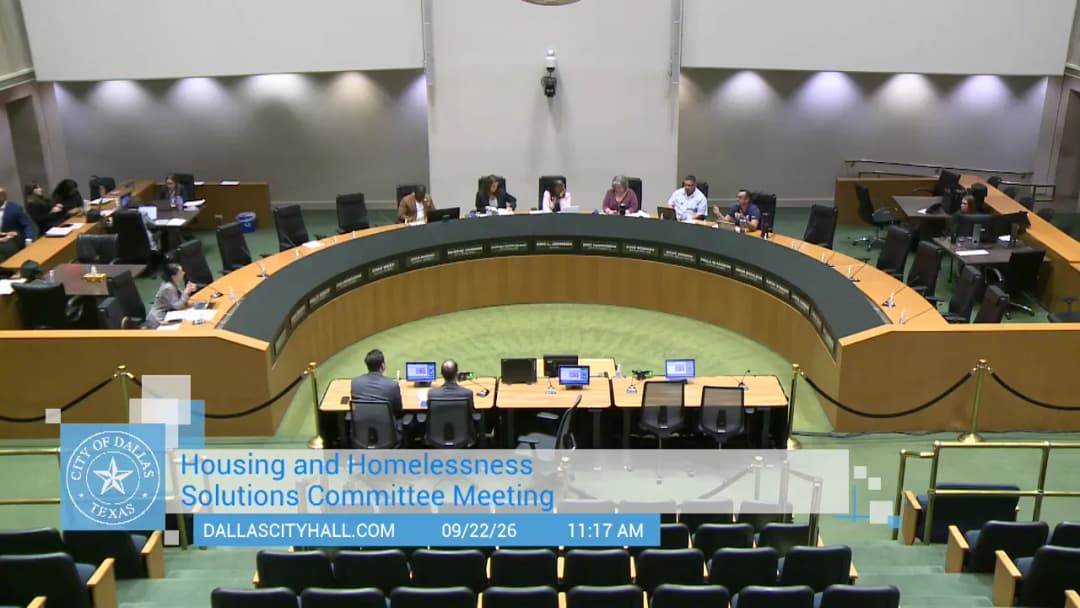
Dallas Housing and Homelessness Solutions Committee Meeting - September 22, 2026

On September 22, 2026, the Housing and Homelessness Solutions Committee met to receive two major briefings: an update on the Dallas is Home housing policy framework and an overview of the Dallas Street Response (DSR) and City Action Strike Team (CAST). Committee Chair Blair opened the meeting at 9:09 a.m. The minutes from August 24, 2026, were approved unanimously. Consent Calendar - Approval of the August 24, 2026, Housing and Homelessness Solutions Committee Meeting Minutes. Motion passed without objection. Discussion Items Update on Dallas is Home (Briefing Item A) Thor Erickson, Director of the Office of Housing and Community Empowerment, and Deputy Director James Armstrong presented the Dallas is Home framework. The proposed policy aims to positively impact 55,000 households over five years by addressing the full housing continuum—from homelessness response to homeownership. The approach is organized around seven pillars: expanding housing choice through production, citywide preservation, improving housing stability, expanding fair access, infrastructure alignment, and collaboration/community engagement. Staff emphasized using baseline data, common definitions, and separating city-supported results from broader market activity. Committee members raised several points: - Councilmember Bazett (District 7) questioned why his district was listed only as “supporting” for production despite vacancy and infill opportunities. He urged cross-referencing with city-owned lot data and requested a full cost estimate before adoption. He also stressed transparency in site selection for shelter beds and avoiding siloed decision-making. - The Vice Chair asked for a definition of “housing stability” and whether missing targets would trigger corrective actions. Staff defined it as households paying less than 30% of income on housing, with additional services for vulnerable populations. They described a red/yellow/green monitoring system for contracts. - Councilmember (Chair Blair) expressed concern about districts resisting services and noted the goal of one service per district has not been met. She also requested a fair housing dashboard and linking fair housing assessments in agenda items. - Councilmember Willis (District 13) praised the granular district breakdown but questioned the absence of District 13 in expiration reviews. She highlighted the Vickery Meadow area and supported the faith-based land initiative, asking for a comprehensive approach including Dallas College. - Councilmember Gracie (District 4) questioned how the housing policy translates into planning and zoning decisions, noting that preferences sometimes block housing. She also asked about preservation for poorly managed properties and noted District 4 was missing from the infrastructure alignment list. Staff committed to refining the data, providing a fair housing memo in October, and returning to committee in October, November, and December with deeper dives into pillars. The policy is expected to go to City Council in January 2027. Dallas Street Response and City Action Strike Team Overview (Briefing Item B) Kevin Oden, Director of Emergency Management and Crisis Response, and Program Administrator Andrew Rolo presented an overview of DSR and CAST. The model distinguishes between person-centered outcomes (housing, treatment) and place-based outcomes (site cleanup and closure). Key statistics: - DSR managed 8,500 service requests in the current period, a 28.6% reduction from the prior period (12,000). - 82% of encampment requests were addressed within five days. - In August 2026, 139 encampments were verified from 311 requests; 196 locations were unverified. - Outreach engagements totaled 1,833 in August, with a 25% resource referral acceptance rate. - 61% of cleared grids remained closed for 30 days. - In downtown, all identified encampments were permanently closed and street homelessness declined by more than 80%. - CAST intervened at more than 150 hotspots with 1,300 targeted interventions (June–September 2026). Crime incidents near CAST locations declined by 20.4%. Committee members raised significant concerns: - Councilmember Gracie noted a shift of encampments from public to private property and asked about the process for private land. - Councilmember Willis asked about firearm safety during cleanings and whether individual tracking (HMIS) is used. Staff said names are not collected in Salesforce due to PII concerns, but partners use HMIS when people are placed. - Councilmember Mendelson strongly criticized the data, stating it does not match on-the-ground realities. She cited long-standing encampments that remain unresolved and argued that camping on public land is illegal and inhumane to leave people outside. She asked for a memo on total outreach engagements in FY26. - Councilmember Bazett challenged the 61% closure rate, noting that 39% reopen within 30 days. He argued the model shows success by displacement, not solutions. He also questioned the 25% referral acceptance rate without knowing how many individuals were contacted repeatedly. He called for more granular, personalized data and urged the city to adopt best practices from other jurisdictions. - Chair Blair suggested using fictitious numbers or service request tracking if HMIS cannot be used for PII reasons. She requested a more comprehensive state of homelessness presentation that includes partners (code, DPD, community courts). Staff acknowledged the feedback and committed to presenting a more complete picture in the upcoming state of homelessness briefing. Upcoming Agenda Items (Items C–H) Brief discussion of several items on upcoming City Council agendas: - Item E: Contract renewal with Bridge (The Bridge) for facility management services. Staff noted a redline correction for funding amount ($5,147,500). - Item F: Rapid rehousing contract with the Bridge. Councilmember Mendelson asked for verification of how many clients remain housed. - Item D: Supportive services for seniors experiencing homelessness via Catholic Charities. Councilmember Mendelson questioned why general fund money is used instead of Housing Forward funds. - Item G: Development of University Hills (420 mixed-income units, only 2.8% three-bedroom). Councilmember Willis asked about the low number of family-sized units. Staff explained it is part of a larger master plan with additional three-bedroom units in a neighboring HFC project. - Staff promised to provide answers before the respective council dates. Key Outcomes - The committee accepted the briefings but expressed significant concerns about data completeness and the need for more personalized tracking of homeless individuals. - Staff will provide a more detailed state of homelessness presentation in October, including granular metrics and partner involvement. - The Dallas is Home policy will be further developed with monthly committee updates (pillars one and two in October) and a goal for council adoption in January 2027. - Upcoming agenda items were noted; no votes were taken during the committee meeting.

HOMELESSNESS 36% · AFFORDABLE HOUSING 35% · COMMUNITY ENGAGEMENT 9% · PUBLIC SAFETY 6%
4819
SEP 22, 2026 · SAN ANTONIO, TEXAS · COUNCIL COMMITTEES
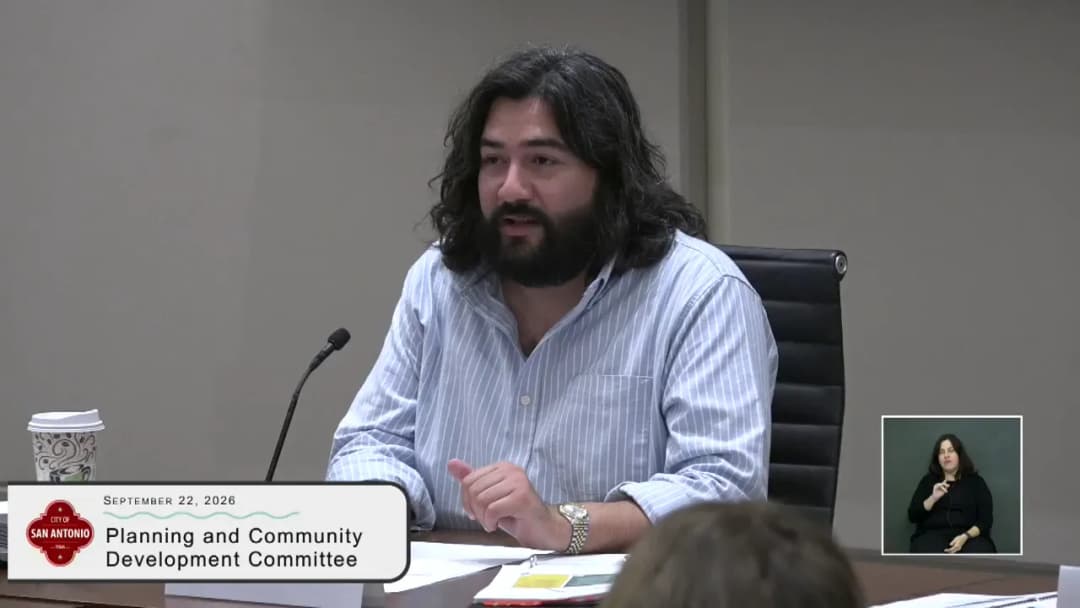
San Antonio Planning Community Development Committee Meeting - September 22, 2026

The Planning Community Development Committee (PCDC) met on September 22, 2026, from 10:00 a.m. to 12:15 p.m. The agenda included approval of minutes, interviews for the Zoning Board of Adjustments, a briefing on proposed revisions to the Strategic Housing Implementation Plan (SHIP), a briefing on the Tax Increment Financing (TIF) policy, and a briefing on the Jones Avenue Municipal Management District (MMD) within the Midtown TIF. Quorum was present. No public comments were made. Consent Calendar - Approval of Minutes: The minutes from the previous meeting were approved unanimously by voice vote. Discussion Items - Interviews for Zoning Board of Adjustments (ZBA): The committee interviewed 12 applicants (one applicant did not appear, one withdrew). Seven applicants were recommended for appointment as at-large alternates: John Bonias, Nelly de la Cruz, Uce Echiozo, Crystal Del Bosque, Haley Nichols, Sierra Trevino, and Jesse Vasquez. The recommendation will go to the full city council for a vote. - Proposed Revisions to Affordable Housing Goals (SHIP): Veronica Garcia, Director of Neighborhood and Housing Services, presented a briefing. The SHIP was created in 2021 with a goal of 28,028 homes. As of mid-2026, 29,207 homes have been created or preserved, surpassing that goal. Proposed revisions increase the overall goal by 46% to 41,050 homes, reflecting cost increases and current market conditions. Key changes include: rental preservation for 0-30% AMI increased by 1,800 units; rental production for 0-30% AMI decreased due to high development costs; homeownership production increased; home preservation goal reduced by 64% (from 11,000 to 4,000) due to capacity and cost constraints. Council members emphasized the need to maintain stretch goals, especially for home preservation and affordable rental production at the lowest income levels. No action was taken; the committee directed staff to present the revised goals at the September 30 full council B session. - Tax Increment Financing (TIF) Policy Briefing: Ian Benavides presented an overview of the TIF policy. Discussion focused on potential changes: removing city staff as voting members, restricting membership to those without financial conflicts, and broadening representation on TIF boards. Council members expressed interest in these changes and requested staff gather input from other council members. The committee agreed to revisit the topic after the new year. - Jones Avenue Municipal Management District (MMD) Briefing: A developer representative presented plans for a mixed-use development on a former CPS Energy site (6 acres at Camden and Jones). The MMD was created in 2023 and the project is within the Midtown TIF. The developer clarified they are not seeking to use existing TIF increment; instead, they would participate only in the increment generated by their project. The project is projected to generate over $160 million in property and sales tax revenue for the city. Council discussion included the possibility of early termination of the Midtown TIF and using uncommitted funds (estimated over $500 million by 2060) for other public purposes. Staff will provide further analysis next month. Key Outcomes - ZBA Appointments: The committee voted unanimously to recommend John Bonias, Nelly de la Cruz, Uce Echiozo, Crystal Del Bosque, Haley Nichols, Sierra Trevino, and Jesse Vasquez as at-large alternates to the full city council. - SHIP Refresh: The committee directed staff to present the proposed goal revisions at the September 30 B session. Further adjustments may be made based on council feedback. - TIF Policy Changes: Staff will gather input from council members and report back after the holidays. Potential changes include board composition and conflict-of-interest rules. - Jones Avenue MMD: Staff will continue reviewing the project proposal and provide a recommendation to PCDC next month, including analysis of early TIF termination.

AFFORDABLE HOUSING 33% · ZONING AND LAND USE 19% · PUBLIC ENGAGEMENT 15% · COMMUNITY ENGAGEMENT 8%
4820
SEP 22, 2026 · NEW YORK CITY, NEW YORK · CITY COUNCIL
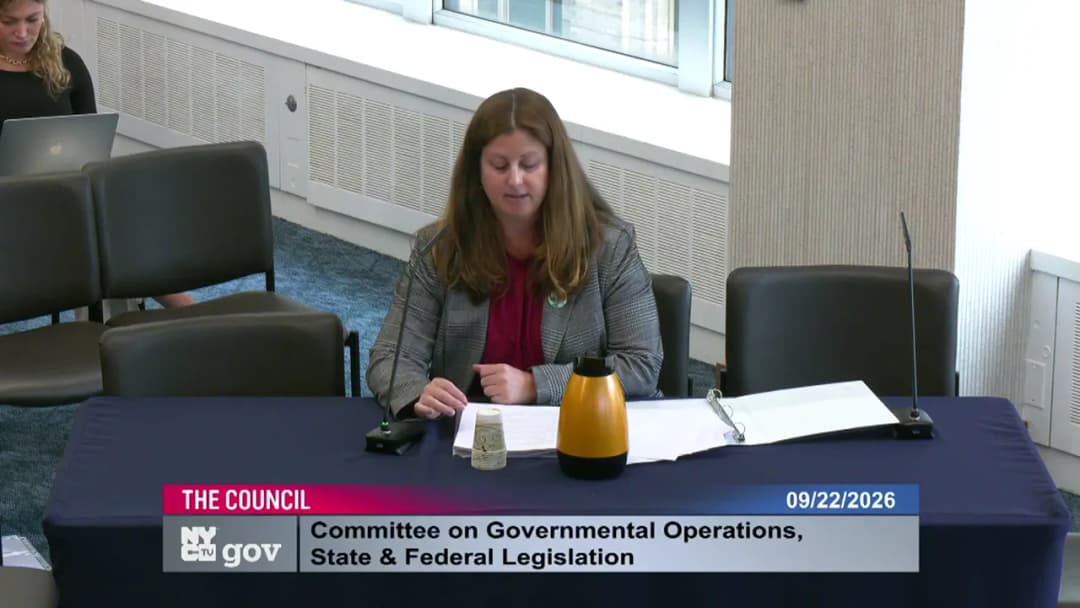
NYC Council Governmental Operations Committee Hearing on Civic Engagement and Influencer Disclosure - September 22, 2026

On Tuesday, September 22, 2026, at 10:00 AM, the New York City Council Committee on Governmental Operations, State & Federal Legislation met at 250 Broadway, 8th Floor, Hearing Room 1, chaired by Gale A. Brewer. Roll call showed Present: Brewer, Dinowitz, Feliz, Morano, Wilson, and Zhuang; Absent: Stevens. Councilmembers Carr, Ariola, and Wong, and Public Advocate Williams also attended. The committee held an oversight hearing on access to city government and the Mamdani administration's civic engagement efforts, then heard four preconsidered local laws on third-party public communications and campaign finance disclosures. Oversight Hearing: DORIS and the Mayor's Office of Mass Engagement Testimony - Department of Records and Information Services (DORIS) Commissioner Shonda Smith Cruz testified that DORIS provides access to more than 11.3 million digitized items, 10.5 million historical vital records, more than 74,000 government publications, and roughly 185,000 cubic feet and 400 terabytes of historical records. She said DORIS serves 65 government entities and that the city's Record Point electronic records system is used by 31 agencies, including the Mayor's Office, and manages more than 215 million records. - DORIS described its May 2025 instant-messaging policy: instant electronic messages are transitory by default, with no expectation of retention; if a user determines a message contains substantive content, the user must move it to a format suitable for preservation. DORIS said it strongly discourages city employees from creating substantive instant messages and does not monitor agencies' active communications. DORIS also said deletion of an instant message is not in itself a violation of the citywide policy. - DORIS explained that substantive messages are those that document or relate to the decisions, actions, or policies of a city office or agency. Councilmembers and Public Advocate Williams pressed for clearer definitions; several questioned whether the Signal group's daily talking points, updates, and clips would count as substantive. DORIS responded that communications about records are often transitory while the underlying record itself is what must be retained. - DORIS said Signal cannot currently be archived. Its civic-plus social media archiving tool covers Facebook, X, Instagram, LinkedIn, TikTok, YouTube, Vimeo, Nextdoor, Pinterest, and Flickr, but not BlueSky, Reddit, or WhatsApp. The 2021 social media policy treats social media posts as publications with permanent retention. - Commissioner Tasha Van Aken testified about the Mayor's Office of Mass Engagement (OME), created on the mayor's second day in office. OME consolidated offices including the public engagement unit, NYC Service, faith-based and community partnerships, and other civic engagement functions. She cited outreach statistics: over 240 community board meetings attended by borough organizers; more than 5,800 New Yorkers at 30 events in 30 weeks; over 900,000 people supported through NYC Service programs; and a SNAP outreach effort that knocked on more than 10,000 doors, made more than 40,000 phone calls, and reached about 11,000 New Yorkers. The 2026 People's Money participatory budgeting program drew more than 134,000 ballots, with more than 26,000 cast in a language other than English. - OME stated it does not use Signal and communicates through city email, city phones, and Teams. It said it does not maintain creator or influencer lists and referred detailed questions about influencer work to the Mayor's Office of Communications. OME said it has 20 new staff lines and a roughly $2.8 million budget, but the commissioner did not provide a filled/unfilled breakdown during the hearing. - Minority Leader Carr, Councilmembers Dinowitz, Morano, Wong, Wilson, Ariola, and Public Advocate Williams all expressed disappointment that Mayor's Office of Communications staff, including Amelia Rowland, the director of new media who runs the influencer and Signal operation, were not present. Councilmember Morano entered a memorandum from the mayor's office chief counsel that, according to him, was dated January 15, 2022 but had metadata suggesting January 2026, stating that employees should not use WhatsApp, Signal, or any other communications app or platform for work. Morano raised the possibility of using the council's subpoena power. Preconsidered Legislation and Campaign Finance Board Testimony - Four preconsidered bills were heard: T2026-2555, sponsored by Minority Leader Carr, prohibiting candidates from appearing in certain government-funded third-party communications during an election campaign; T2026-1440, sponsored by Carr, requiring reporting on third-party public communications; T2026-2554, sponsored by Councilmember Feliz, requiring disclosures on third-party public communications paid for with government resources; and T2026-2553, sponsored by Councilmember Wong, requiring campaign finance disclosures in online and digital content and directing the Campaign Finance Board to issue guidance. - First Deputy Executive Director Amanda Melillo of the New York City Campaign Finance Board (CFB) testified that the CFB began working with influencers through a vendor in 2021 and brought influencer selection in-house in 2023. In 2025, the CFB worked with 29 influencers, producing more than 70 posts on Instagram and TikTok at a total cost of $626,365, generating more than 6 million views and over 500,000 engagements, with an average engagement rate of about 5%, above the 1-3% industry average. Non-English content in Spanish, Mandarin, Korean, and Bengali generated more than 2.3 million views and more than 4,000 visits to the CFB's NYC Votes website. - The CFB said it had only one week to review the four bills and gave preliminary feedback. It described T2026-2553, Councilmember Wong's bill, as duplicating existing CFB Rules 6-06 and 14-04 on paid-for-by disclaimers and said the charter changes did not appear necessary. It took no formal position on T2026-2555, Carr's bill broadening the existing 90-day government mass-mailing prohibition. It opposed T2026-1440 as drafted, arguing that individual-level reporting would disperse responsibility and produce duplicative or missed reports, and recommended agency-level reporting through existing advertising spending reports. It opposed T2026-2554 as drafted, saying designating the CFB as an enforcing agency was misaligned with its charter role and that shared enforcement with the Conflicts of Interest Board would create complexity and inconsistent standards. Public Comments & Testimony - Dr. Anya Schiffrin, Senior Lecturer at Columbia University's School of International and Public Affairs, testified about her forthcoming working paper, "Mapping New York City Influencers and the Funding of Public Messaging." She said her research found no systemic record keeping on city agencies' influencer relationships, inconsistent labeling and disclosure, and secrecy around hiring and payment. She discussed the mayor's invite-only Signal group, "NYC Creators Announcements," saying it appeared unpaid but raised questions about its function, access, and relationship to the traditional press list. She recommended clear and standardized disclosures, publication of influencer lists, training for city employees and agencies, and possible use of an influencer hub or model disclosure rules. - Rachel Fowles of Reinvent Albany asked the council to pass legislation clarifying that all electronic communications creating public records, including instant messages, be archived and retrievable by FOIL officers. She said the city should define instant messages as substantive or non-substantive rather than treating them as transitory by default. Reinvent Albany also asked the council to revise T2026-2555 and T2026-1440 and not to move forward with T2026-2554 and T2026-2553 as drafted. - Grace Rao of Citizens Union said auto-delete functions should be explicitly prohibited for official city business and that city employees should not be permitted to use any function that automatically deletes or destroys government records. She called for a uniform citywide disclosure standard for paid government advertising and influencer contracts, and said unpaid influencer communication is not inherently wrong but must not come at the expense of reporter access or involve confidential information. - Susan Lerner of Common Cause New York questioned whether the Office of Mass Engagement was promoting a narrow model of civic engagement focused on tenant organizing rather than a broad invitation for New Yorkers to understand and affect government. She supported disclosure labels on city-initiated or city-partnered communications and generally supported the bills while recommending amendments. - Octavio Blanco, executive editor of Uptown Voices, a hyperlocal news outlet, testified that he was not paid to cover the administration, was not on the Signal chat, and communicates with the mayor's office through normal channels. He said Uptown Voices invited all three candidates in a congressional race to appear on its podcast, rejected a $500 payment offered by a campaign, and holds a press pass. He expressed strong concern that trust was his publication's most valuable asset. - A former city employee, Charles Diamond, testified on procurement, saying government media buys should go through procurement with selection, record keeping, and protections against political interference. He said zero-dollar contracts and unpaid work should make the city more suspicious, not less. He criticized the administration's testimony on transitory versus substantive messages as circular and said Signal was not an approved channel. - Content creators Norberto Briseño and Taiwan Green, also known as Mr. Fingers, testified that they had never been paid by the administration and were not directed on how to message their content. Taiwan Green said he lost money by taking time off work to cover events, retains the right to criticize the mayor, and uses access to ask questions relevant to Southeast Queens. Briseño said he made videos about the administration's bus work because his audience needs factual information about city government. - Christopher Leon Johnson, a media press credential holder, disputed those accounts, accusing Mr. Fingers and Uptown Voices of being paid through third-party agencies, saying the mayor's office controls narratives and deletes unfavorable videos, and criticizing the administration's reliance on influencers. Tim Fullerton, founder and CEO of Find Out Media and a former state and federal digital strategy official, defended the Signal group as a distribution list sharing the same information given to the press, said its members were not paid by the administration, and argued that government information is useless if it does not reach people on the platforms they use. Key Outcomes - The oversight item, T2026-2324, was held by the committee and filed. - All four preconsidered local laws, T2026-2555, T2026-1440, T2026-2554, and T2026-2553, were heard and laid over by the committee; no final votes were taken. - Several councilmembers said the Mayor's Office of Communications should appear at future hearings and suggested subpoena power if necessary to obtain testimony about the Signal influencer group and related spending. - OME committed to follow up with borough-by-borough outreach spending, staffing, and event data, and DORIS indicated openness to continued policy discussion with the council on instant-messaging retention. - The CFB said it would provide more detailed legislative comments after further analysis, and written testimony was accepted for 72 hours after the hearing.

PUBLIC ENGAGEMENT 45% · DATA PRIVACY AND SECURITY 22% · TECHNOLOGY AND INNOVATION 12% · PROCEDURAL 7%
OPENPUBLICA · PUBLIC MEETING INDEXUPDATED DAILY · openpublica.com