501
OCT 28, 2026 · SAN FRANCISCO, CALIFORNIA · BUDGET AND FINANCE COMMITTEE
Budget and Finance Committee Regular Meeting - October 28, 2026
AFFORDABLE HOUSING 16% · HOMELESSNESS 15% · PROCUREMENT 10% · ENGINEERING AND INFRASTRUCTURE 10%
Item 13: Grant OEWD for B. of The committee approved. Key Outcomes - The committee voted to forward all items to the full Board with recommendation. - For item 11 originally made error that passes, then two amendments were.
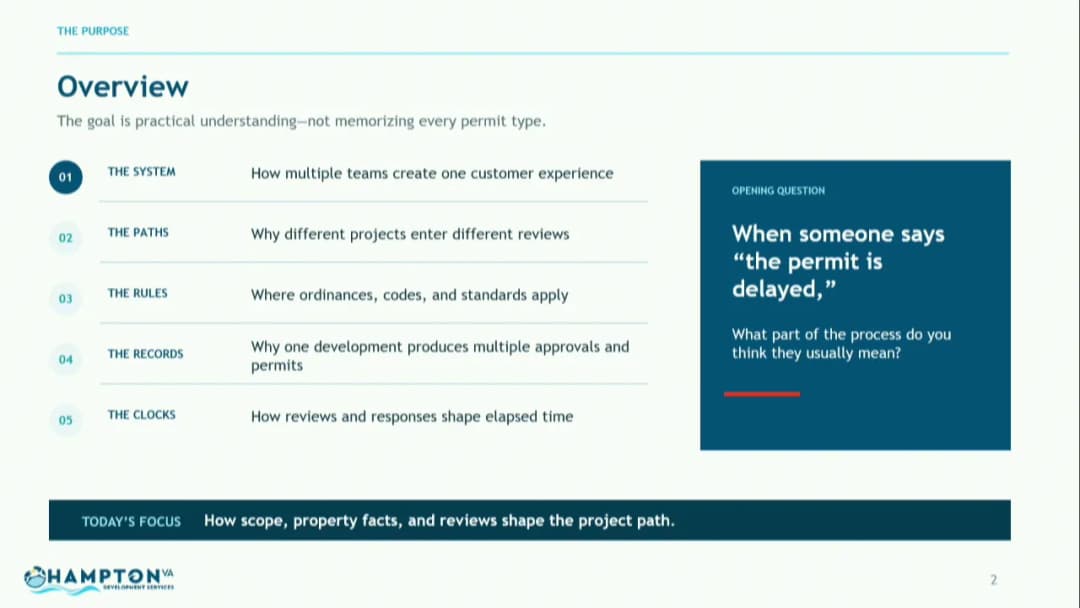
The Hampton City Council held a work session on Wednesday, October 28, 2026, from 1:00 PM to 4:10 PM in Council Chambers with all seven council members present. The agenda included an update on the 2027 Legislative Priorities, a deep dive on the Placemaking strategic priority, a briefing and tour of the Development Services Center (DSC), and a closed session to discuss potential land disposition and appointments. Discussion Items 2027 Legislative Priorities Update Ed Reed, Vice President of Two Capitols Consulting, presented the final tweaks to the 2027 legislative package. Adjustments included a request for expanded local authority to regulate retail tobacco establishments, added policy statements on menhaden conservation, flexibility for state license group homes, support for a 1% state tourism sales tax renewal, and an updated collective bargaining stance preserving local fiscal management authority. Council discussed sponsoring legislation for photo enforcement speed limits in neighborhoods identified by accident data and resident supermajority support. City Manager Mary Bunting noted the city was two weeks ahead of schedule in finalizing the agenda, which was placed on the consent calendar for adoption that evening. Strategic Priority Update: Placemaking Neva White, the Placemaking Strategic Priority Leader and Library Director, presented a broad overview of placemaking initiatives across departments. Key statistics reported included: - Neighborhood block party kits: 256 items checked out by registered associations, serving over 2,900 residents with a 5-out-of-5 satisfaction rate. - The Placemaking Lab pilot funded 5 projects in 5 neighborhoods, representing an estimated $336,000 in community investment. - Over 13,000 guests attended Hampton Arts events in the past year. - Libraries hosted over 1,400 programs with an attendance of over 45,000 people. - The city received a perfect score on the Municipal Quality Index. Ms. White also presented a set of proposed quick-win projects for potential year-end savings funding, including open space upgrades at Air Power Park, a nature music garden at Sandy Bottom, a nature trail at Gosnold's Hope Park, a calisthenics area at Buckrow Beach, and inclusive sensory rooms in community centers. - Councilmember Ferebee expressed a desire to see stronger integration with Hampton University, the Virginia School for the Deaf and Blind, and historic sites like St. John's Church and the Contraband churches. - Councilmember Harper praised the effort but urged improved storytelling of Hampton's history, including the 1619 legacy and Fort Monroe's role. - Vice Mayor Brown suggested the city adopt "Every place in Hampton is a place to make memories" as a guiding concept and recommended independent external contractors for customer surveys. - Councilmember Bowman commended the inclusive sensory rooms for individuals with autism and the pop-up recreation programs. Briefing on the Development Services Center Joshua George, Executive Project Manager, and Latoya Forbes, DSC Manager, explained the development review process using a relay race analogy. They distinguished between active city review time and total project elapsed time. Presenters highlighted that customer feedback from January to September 2026 (153 responses) rated staff service highly (4.91/5) but identified the online portal as the weakest area (4.36/5). City Manager Bunting confirmed that council-appropriated funds are being used to procure a new portal system and that staff are exploring AI tools to help applicants, especially small businesses, ensure complete submissions. Key Outcomes - Legislative Adoption: The 2027 Legislative Priorities package was finalized and scheduled for formal adoption on the consent agenda at the regular meeting. - Proposed Placemaking Projects: Council received the quick-win project proposals for consideration through the year-end savings appropriation process in December. - DSC Tour: The work session recessed at 2:19 PM for a tour of the Development Services Center, reconvening at 2:55 PM. - Closed Session Motions: - A motion to enter closed session to discuss the disposition of land on Kecoughtan Road and appointments to the Citizens Police Advisory Group and the Mayor's Committee for People with Disabilities passed unanimously (7-0). - A motion to certify the closed session passed unanimously (7-0). - Adjournment: The meeting adjourned at 4:10 PM.
The Board of Public Works met on October 28, 2026, at 1:00 PM in the Public Assembly Room of the City-County Building. Chair Todd Wilson presided. The board unanimously approved a series of routine items including bid awards, change orders, professional services agreements, and amendments. No public comments were made. All votes were unanimous. Consent Calendar - Agenda Adoption: The October 28, 2026, revised agenda was adopted with an amendment to remove item T from section 7 and to consider items A through F, O through R, and U and V together as zero dollar amendments. Motion by Susie Cordy, seconded by Adrieth Redman. - Minutes Approval: The October 14, 2026, meeting minutes were approved. Motion by Bob Perrin, seconded by Sebastian J. Wanza. Discussion Items - Bid Award – Wood Fiber Surfacing Material: Brian Cavanaugh presented a two-year agreement with Superior Groundcover, Inc. for $180,981.60 as the lowest responsive and responsible bidder. No questions. Motion to approve carried. - Bid Award – 2025 Traffic Signals: Jamie Cole presented project TR-25-008(A) for traffic signal replacements at three intersections on Allisonville Road (56th St, Kessler Blvd East Dr, and 62nd St) to James H. Drew Corporation for $596,565.70. The engineer's estimate was $625,908; the low bid was 4.31% lower. A board member asked about the completion date: substantial completion by July 17, 2027, final completion by August 31, 2027. Good faith effort on MWBE goals was noted. Motion to approve carried. - Bid Award – Crack Sealing: Jamie Cole presented a bid award for crack sealing (RS-26-001) to Howard Asphalt LLC for $1,837,250.00 with substantial completion by June 2027 and final by July 2027. No questions. Motion to approve carried. - Change Order No. 2 – Shelby Street over Pleasant Run: $25,806.46 increase to Pontem Contractors, Inc.; no days added. Approved. - Change Order No. 3 – Eagle Creek Greenway Phases 2B & 2C: $49,328.28 increase to Morphey Construction, Inc.; 4 days added to completion dates. Approved. - Final Change Order – Grassy Creek at Brookville Road Bank Stabilization: Decrease of $767.50 to Yarberry Companies, Inc.; no days added. Approved. - Professional Services Agreement – Emerson Way over Fall Creek: Mark St. John presented a new design agreement with Janssen & Spaans Engineering, Inc. for $993,424, expiring December 31, 2030. MWBE participation includes 11.66% to Metric Environmental, 4.33% to JQOL Inc., 2.53% to Value Plus Engineering, and 10.51% to DB Engineering. Approved. - Professional Services Amendments (A–F): Six zero-dollar amendments for rate and time extensions only (United Consulting Engineers, EMCS Inc., DLZ Indiana, Crawford Murphy & Tilly, HWC Engineering, Fleis & VandenBrink). Approved together. - Amendment No. 1 – 46th Street over Indian Creek (Item G): $84,600 increase to GAI Consultants for additional design work for a superstructure replacement instead of deck replacement and substructure rehabilitation. New total $451,408.80; expiration extended to December 31, 2028. Approved. - Amendment No. 7 – On-Call Transportation Design & Inspection (Item H): $140,000 increase to VS Engineering for concrete pavement rehabilitation area 2, including scope changes for Fortune Circle and Executive Drive. New total $1,110,350; expiration extended to December 31, 2028. Approved. - Professional Services Amendments (I–N): Various amendments with funding increases: (I) S&ME – $0 (rate/time only), (J) 7NT Engineering – $200,000, (K) First Group Engineering – $200,000, (L) HNTB Corporation – $250,000 for Ralston Campus Infrastructure Improvements, (M) Corradino Group – $330,000, (N) VS Engineering – $340,000. All approved with updated rates and expiration extended to December 31, 2028. - Professional Services Amendments (O–R): Four zero-dollar amendments for stormwater-related on-call contracts (Howland Ditch Greenway District, Commonwealth Engineers, V3 Companies, Kimley-Horn). A board member asked if zero dollar reflects remaining within original amount despite rate increases. Staff confirmed yes. Approved. - Amendment No. 2 – New Products Review (Item S): $7,000 increase to DLZ Indiana for additional review work; new total $39,000; expiration extended to December 31, 2027. Approved. - Amendment No. 1 – Police-Grade Car Tires (Items U & V): Two zero-dollar amendments with Pomp's Tire Service and Gem City Tires extending contracts to November 17, 2027, at same rates. Yearly expenditures estimated at $250,000. Approved. Key Outcomes - All votes were unanimous. Each motion passed with a voice vote, no dissents recorded. - Bid Awards: Three contracts awarded totaling $2,614,797.30. - Change Orders: Two increases ($75,134.74 total) and one credit ($767.50) approved. - Professional Services Agreement: One new design contract for $993,424. - Professional Services Amendments: 21 amendments approved: 12 with funding increases (aggregate $1,551,600), 9 with zero-dollar changes. - No other business was discussed, and the meeting adjourned.
On October 28, 2026, the Cook County Board of Commissioners held a budget hearing for the Cook County Health (CCH) proposed Fiscal Year 2027 budget. The CCH Board Chair, Raul Garza, CEO Dr. McKaitis, Interim CFO Scott Spencer, and other health system leaders presented a $4.7 billion budget facing severe financial pressure from federal Medicaid cuts and policy changes (HR 1), projected to leave 330,000 Illinois residents uninsured. The budget relies on an additional $40 million in county support to close the gap and preserve access to care. Discussion Items - Federal Policy Impact on CCH Budget: Chair Garza highlighted the impact of HR 1, which drastically reduces federal Medicaid funding. CCH projects a $138 million decline in patient care revenue and a $100 million increase in charity care, reaching a total of $485 million in charity care costs. Dr. McKaitis stated that over the past three years, CCH has eliminated approximately $315 million in expenses and reduced agency FTEs by 53% (from 1,366 to 637) to prepare for federal cuts. - County Support and Financial Sustainability: The proposed budget includes a $40 million increase in direct Cook County support, reflecting President Preckwinkle's commitment. Chair Garza noted that direct county funding has fallen from supporting one-quarter of the CCH budget in 2013 to less than 5% in the proposed FY2027 budget. Commissioners acknowledged the tight fiscal environment but praised CCH leadership for protecting services and workforce. - Uncompensated Care and Coverage Losses: Commissioner Trevor expressed concern that the $100 million charity care estimate might be too low given the scale of federal changes. Commissioner Lowry queried the rise of uninsured patients from area hospital closures (e.g., South Side, Roseland, Trinity). Dr. McKaitis reported the uninsured rate in CCH's patient mix rose from 20% to 25% in January 2026 following the end of the enhanced ACA tax subsidy. - CERMAC Health Services (Correctional Health): Commissioner Lowry raised concerns about a net decrease of 15 FTEs in CERMAC health services. Manny Estrada (COO) and Dr. Nutter clarified that while the budgeted FTE line decreased, actual staffing increased as the department filled 40+ vacancies and realigned positions, reducing vacancies to just six. The reduction was in mental health positions, offset by increased direct patient care staff. - Behavioral Health and ARPA Programs: Several ARPA-funded programs were sunset or reduced in the FY2027 budget. Commissioner Aguilar noted the Healthy Workers Initiative was cut from $3 million to $1.5 million. Commissioner Morrison commended CCH for retaining a net increase of 50 behavioral health positions post-ARPA. Dr. Nutter stated that the behavioral health program at the JTDC (Juvenile Detention Center) sees only 63% of patients receiving individualized counseling, which Commissioner Degnan criticized as insufficient, demanding 100% access for detained youth. - Health Plan Services (County Care): Aaron Galiner discussed investments in community outreach, text messaging, and data flows to prepare members for redetermination. Commissioner Aguilar inquired about the CareLink charity care program, confirming it is handled by the same financial counseling team. - Provident Hospital Services: Dr. McKaitis explained the temporary closure of the Medical ICU at Provident due to an average daily census of one patient, while the Emergency Room remains open. He highlighted a 15-16% improvement over budget in operating room performance and a plan to expand outpatient access by 40% through consolidation. - Workforce and Settlement (Guidehouse): Commissioner Degnan inquired about the Guidehouse labor settlement hiring. CCH reported that of the 135 new PIDs allocated in FY2026, 72 have been filled, with 106 offers made. An additional 25 positions will be added via a technical amendment in FY2027. - Maternal Health and OB/GYN: Commissioner Degnan raised concerns about cuts to OB/GYN FTEs on budget pages G106 and G112. Dr. McKaitis clarified the positions were repurposed for insourcing, but the overall OB/GYN coverage is expanding through a partnership with the University of Illinois, growing from 6 to 13 providers, supported by a $3 million increase in medical consultation funding. - Public Health and Operations: Dr. Joshi (CCDPH) noted the Department is essentially flat year-over-year in FTEs, with changes being reclassifications. Dr. McKaitis highlighted an increase in annual wellness visits to 41% (up from 4%) and a 50% year-over-year increase in quality outcomes under value-based care contracts. Key Outcomes - The FY2027 CCH budget is presented without cuts to patient care services, maintaining a flat FTE count and avoiding any layoffs or clinic closures. - The budget relies on $40 million in additional county support to help offset a projected $138 million decline in patient revenue and $100 million increase in charity care. - CCH will continue its multi-year cost reduction strategy, having achieved over $300 million in cumulative savings and reducing agency reliance by 53%. - A technical amendment is planned to add the final 25 positions related to the Guidehouse labor settlement, totaling 160 positions. - CCH leaders acknowledged that FY2027 is a temporary reprieve and that future fiscal years may require increasingly difficult measures including workforce reductions or health center closures if federal funding shortfalls persist. - Commissioners and CCH leaders agreed to strengthen state-level advocacy to protect programs like the Health Benefits for Immigrant Seniors (HBIS) and negotiate broader reforms for charity care distribution among private health systems.
On Wednesday, October 28, 2026, the Evansville Human Relations Commission (HRC) held its regular board meeting, scheduled for 11:30 a.m. in Civic Center Room 301 in Evansville, Indiana. The board approved minutes as corrected, debriefed the Annual Dinner & Mayor's Celebration of Human Rights Awards, discussed the upcoming 12:30 p.m. strategic planning session and broader community violence concerns, reviewed the Black History Month Banner Project, and received updates from the Director and legal counsel. A quorum was present. Note: the raw transcript refers to the chair as "Ruby McLean" at points; the official agenda lists Ruby McGlown. Consent Calendar - Agenda requests: none. - Minutes: Motion to approve the minutes as corrected, changing the referenced approval from September to August. The motion passed unanimously (all in favor, none opposed). Annual Dinner & Mayor's Celebration of Human Rights Awards (Debrief) - Director Diane Clements-Boyd opened a debrief of the annual dinner. Commissioners praised the event: the room was large and full, and the food service was excellent - one commissioner ranked the meal among the top three they've had at the venue and noted the food was served hot. - Ticket sales were approximately 300, similar to the prior year. Sponsorships were lower than in past years, which Director Boyd said the commission needs to explore and improve. - A recording of keynote speaker Reverend Barber exists with two cameras and good quality, but the viewing links were not working; staff are working with the AV technician to make it available to commissioners on a password-protected internal server for archival purposes. - Commissioner Samantha Buente recommended directly soliciting previous ad buyers. She said she sponsored an ad last year, was not asked again, and would have said yes - calling for better follow-up and record-keeping. Director Boyd agreed the commission could use more help and better delegation, and noted sponsors normally receive a thank-you card and a copy of the speaker's book. - The speaker's books did not arrive from the vendor this year; the speaker's tight schedule also prevented a formal book signing, though he signed books attendees brought. Staff are still trying to purchase the books, potentially from another vendor. - Commissioner Buente relayed community feedback that the last few featured speakers have been religious leaders and that some community members would prefer a non-religious leader. Director Boyd said the selections were based on civil rights and diversity/inclusion work, not religious affiliation, but agreed the commission should consider diverse perspectives in future planning. Buente said the feedback was worth keeping in mind for the next planning cycle. Strategic Plan Session and Community Violence Discussion - Director Boyd reminded the board that the strategic plan session would begin at 12:30 p.m. in Room 318, with staff present, and encouraged commissioners to voice concerns about drafts before finalization. - The board discussed the upcoming Evansville Town Hall Part 2 at Zion Church on October 29 from 5:30 to 7:00 p.m., following a first session at the Dream Center. Commissioners noted Chair McGlown attended the Dream Center session, and a commissioner was asked on short notice to moderate after the scheduled moderator could not attend; that moderator's opening remarks emphasized root-cause analysis of crime rather than a law-enforcement-only focus. - Commissioner McGlown said the forums were missing the actual young people most affected by violence; the youth who attended were "handpicked" and well-spoken. She called for "boots on the ground" outreach and meeting youth "at their point of need," citing a funeral for a recent murder victim attended by nearly 700 youth, and a young man on the news who said, "We don't have anything to do. We have nowhere to go." - A commissioner expressed broader community concerns: residents losing confidence in elected officials, questions about transparency and accountability, compromised trust between law enforcement and the community, reluctance to report crimes, and the need for mentorship, conflict resolution, mental health resources, family support, educational opportunities, and positive alternatives to violence. The commissioner also cited the school-to-prison pipeline and the absence of visible restorative justice, and referenced a recent death involving police where public video and a report appeared to conflict. - Commissioners discussed a Divine Nine candidate forum at the Boys & Girls Club where candidates gave no concrete answers on the school-to-prison pipeline; a 2016 study on the issue was noted as never acted on. Commissioner McGlown suggested commissioners gather informally to discuss issues and organize outreach, while following protocol. Director Boyd said meeting details would be shared with all commissioners. Old Business: Black History Month Banner Project - Director Boyd said she will meet with Adam Trinkle next week to plan the 2027 Black History Month Banner Project and hopes to avoid last year's issues. - Community suggestions include Haynie's Corner and the Lincoln Avenue Corridor. A commissioner who serves on the Haynie's Corner board said that board supports placing banners there. - The project will use a two-year cohort; committee members from last year will serve again this year. - The board also noted the commission's outreach person was missing from the staff listing in the minutes; Director Boyd said she did a good job reporting last month and will have an announcement next month. Counsel Report - Ted Ziemer IV was absent due to a doctor's appointment with his wife. - In the district court case, opposing counsel filed for an extension; HRC's attorney, Kyle Biesecker, did not object. The response to the complaint is due the first week of November. Director's Report - The Director reported 13 complaints filed in September, 3 transferred to the EEOC, and approximately 77 cases open at the end of August. The transcript also states "there were two 10 new cases added," which is unclear. - Few closures occurred in September because the end of the EEOC fiscal year and a federal funding glitch put cases in a holding pattern; the EEOC asked the commission not to close cases until resolved. Housing cases are still being closed. One settlement was negotiated. - The commission did not meet its contractual obligation with the EEOC for the fiscal year; the new EEOC fiscal year began October 1, 2026. - Outreach and education meetings were limited in September due to annual dinner planning; other staff maintained regular meeting cadences. Open Discussion & Commissioners' Remarks - Commissioners acknowledged the passing of Mistella Moss's brother, who died at age 100; his service is Saturday. - The Mayor's Gala is scheduled for Saturday, December 12, at City View. - The board discussed state rules for virtual participation: at least 50% of board members (six) must be physically present; otherwise the meeting must be canceled or postponed. Off-site members must be seen and heard to vote, and virtual attendance is limited to two consecutive meetings. One commissioner described the rule as "draconian" and said the board will proceed if six members are physically present, unless someone objects. - Meeting dates were changed: the November meeting will be November 18 because of Thanksgiving, and the December meeting is set for December 16 (per the invitation). One commissioner cannot attend the November meeting. - A motion to adjourn was made and seconded; the meeting adjourned, with commissioners planning to move directly to the strategic planning session. Key Outcomes - Minutes approved as corrected (all in favor, none opposed). - The board will work on improving sponsor and ad solicitation follow-up and record-keeping. - The strategic planning session will take place immediately after the regular meeting at 12:30 p.m. in Room 318. - The Black History Month Banner Project will continue with a two-year committee cohort; 2027 planning is ongoing, with a meeting with Adam Trinkle scheduled for next week. - November 18 and December 16 meeting dates were set. - No other formal votes were taken during the meeting.
This meeting of the Finance Committee focused on the Public Administrator's office budget and performance. The Public Administrator, Louie, presented an overview of office operations, finances, and achievements, followed by questions from committee members. Discussion Items - Public Administrator Presentation: Louie reported that the office has 15 full-time staff (a 20% reduction from 2016), has conducted 909 investigations year-to-date, and has generated $2.7 million in fees and court costs (140% of FY26 target). The office returned $28 million to heirs/beneficiaries and assisted in recovering $3.2 million from nursing home wrongful death actions. The FY27 budget is $2.1 million (increase of $171,000). The office closed 40 properties last year, generating $11.5 million in sales, and currently manages 39 properties. - Chair Lauer asked about the complaint process and requested an FAQ document; the Public Administrator agreed to provide it. - Commissioner Dick inquired about a shift of two FTEs from general administration to estate administration. General Counsel Leah Jacobowski explained it was a right-sizing of job classifications. Commissioner Dick suggested condensing the categories for FY28, and the Public Administrator agreed to discuss with the budget office. - Another commissioner asked about probate case targets (target 370; 396 reported in Q1/Q2) and average closure time. The Public Administrator noted that complexity and court approval cause delays and that they aim to close many by year-end. - Additional question: about investigator caseload—900 investigations per year across 4 FTEs. Key Outcomes - No formal votes or decisions were recorded. - The Public Administrator committed to providing an FAQ document to committee members. - A recommendation was made to condense general administration and estate administration employee categories for FY28.
This meeting convened on October 28, 2026, though the agenda and transcript refer to the meeting as taking place on October 27, 2026. The session began with closed session negotiations, resumed at 1:30 p.m., and featured a comprehensive HR1 update from the Social Services Agency. The Board unanimously approved a large consent calendar, passed salary and benefit ordinances, and took significant steps on reparations and homelessness. Consent Calendar - Approved Unanimously (Items 2–19, 21, 23–42, 44–62, 64–71): Items 20 and 43 were pulled from the agenda and not voted on. - Senior Services (Items 2, 4): Approved over $7.9 million in contracts for home-delivered and congregate meals, and senior center activities, with retroactive terms to July 1, 2026. - Social Services Contracts: Approved agreements for child abuse prevention, housing support, obesity prevention, and peer navigation services. - Affordable Housing (Items 33, 34): Approved $3.2 million for the 53-unit 500 Lake Park project and $4.375 million for the 73-unit 3135 San Pablo project in Oakland, utilizing Measure W funds. - Violence Prevention (Item 21): Approved $100,000 in Enhancing Vision 2036 funds from District 3 to five organizations. - Russell City Redress Fund (Item 22): Approved a total of $1.45 million in contributions from all five supervisorial districts to the Russell City Redress Fund, with payments up to $25,000 per eligible household. - Salary & Benefits (Items 41, 42): Adopted the 2026–2027 Salary Ordinance. Approved a $100 increase to the County Allowance (to $3,700) and a $100 increase to the dental maximum (to $2,000) for unrepresented M-designated classifications, along with Military Time Bank and Administrative Code amendments. - Other Actions: Approved contracts for the Sheriff’s Drone as First Responder Program, Fire Training Center budget increases, Probation grants, and Public Works resolutions. Public Comments & Testimony - On Investment Report (Item 67): - Tim Drew (Democratic Socialists of America, D5) urged the Board to cease the peer review process and directly implement the Ethical Investment Policy. - David Thorpe (D3) supported the policy, connecting divestment from surveillance and border technology companies to the safety of immigrant communities. - On Item 63 (HR1 Update): - Jane Cramer advocated for expanding community service and volunteer program pathways for meeting work requirements. - On Matters Not on the Agenda: - Depot Community Apartments resident criticized the John Stewart Company and ABODE programs for neglecting wraparound services at the Hayward supportive housing site. - Justine, Sarah Dorman and Maya (D5) demanded immediate implementation of the Ethical Investment Policy, calling the ongoing peer review a stall tactic on an urgent human rights issue. Departmental Discussion & Board Deliberation - Supervisor Remarks: - Supervisor Tam reported on ICE enforcement activity, highlighted the ACILEP hotline (510-241-4011, 6am–6pm daily), and discussed coordination with the Sheriff’s Office and Highland Hospital. - Supervisor Márquez confirmed ICE detentions in Hayward, promoted the SELUTE protocol for identifying law enforcement, and announced a forthcoming board letter on commuting death sentences. - Supervisor Fortunato-Bass announced community workshops on behavioral health, federal benefits changes (Medi-Cal, CalFresh), and the Port of Oakland Waterfront Resilience Plan. - HR1 Impacts Overview (Item 63): - CalFresh Work Requirements: Agency Director Andrea Ford and program specialists detailed changes for Able-Bodied Adults Without Dependents (ABAWD). The age limit expanded to 18–64, and the dependent age was lowered to under 14. Exemptions were eliminated for unhoused individuals and veterans. Of 167,000 county recipients, 12,000 are non-exempt ABAWD. Over 1,000 recipients were discontinued by October 2026, with 35% of those being unhoused and 6% aged 60–64. The state is phasing in implementation at annual renewals. - Medi-Cal Work Requirements: Starting January 1, 2027, adult expansion enrollees must meet 80 hours per month of work or community engagement. Alameda County estimates 13,500 individuals could be affected in the first year. Exemptions include medical frailty, caregiving, and high unemployment areas. Self-attestation is allowed for 2027. - Non-Citizen Eligibility: The redefinition of qualified non-citizen status resulted in 9,510 Alameda County residents losing federally funded full-scope Medi-Cal and being shifted to state funding. Short-term food assistance is available for impacted refugees. - Staffing and Outreach: The agency is collaborating with the Alameda County Food Sovereignty Roundtable, AC Health, and CBOs like Alameda County Community Food Bank. The Health Navigators Project and website HealthyAC.org are central to outreach. - Matrix Presentation: Staff presented a comparison of work requirements across CalWorks, CalFresh, and Medi-Cal, highlighting areas of alignment and conflict to streamline client experiences. Key Outcomes and Votes - Closed Session Settlement: Authorized a $75,000 settlement in Azimi v. Kurniawan (Case No. 25CV130981). - Reparations Committee (Items 68, 69): The Board established the Committee on Reparations as a standing policy committee. Supervisor Miley was appointed Chair, joining Supervisor Márquez. The first meeting is expected before the end of 2026. - HR1 Update (Item 63): Received and filed as an informational item. Direction was given for continued inter-agency coordination to mitigate benefit losses. - Items Pulled: Agenda Items 20 (Housing and Homelessness Services Vendor Pool) and 43 (Enhanced Infrastructure Financing District Policy) were pulled from the consent calendar and did not receive a vote.
The Denver City Council Health and Safety Committee met on Wednesday, October 28, 2026, at 10:30 AM in Room 391 of the City & County Building. According to the minutes, members present were Kevin Flynn, Serena Gonzales-Gutierrez, Jamie Torres, Darrell Watson, and Paul Kashmann; Vice Chair Amanda Sandoval and Diana Romero Campbell were listed as absent, though the transcript appears to include Romero Campbell in the discussion. The committee received an update on the Support Team Assisted Response (STAR) Program and approved two consent items. Briefing: STAR Program Update - Tandis Hashemi, operations and clinical crisis services manager, and Marion Rorke, access to care manager, Department of Public Health and Environment, presented the update. - STAR is a civilian crisis response team pairing a master's-level licensed behavioral health clinician with a paramedic or EMT. It operates citywide seven days a week from 6 a.m. to 10 p.m. and is dispatched by Denver 911. It provides person-centric, trauma-informed response for mental health crises, substance use concerns, homelessness-related needs, poverty-related crises, and other nonviolent situations that do not require police, fire, or EMS response. - Program goals include reducing unnecessary encounters with the criminal justice system and unnecessary emergency department visits, connecting people to appropriate resources, improving resource allocation, and reducing reliance on emergency services. STAR also provides case management and post-crisis follow-up through its Community Partner Network. - Timeline: launched in June 2020 with one unit in one police district operating Monday through Friday, 10 a.m. to 6 p.m.; expanded in 2022 to five units per day, 6 a.m. to 10 p.m., seven days a week, with the Community Partner Network added; expanded to eight units per day in 2023; added mobile data terminals in 2024; and in August 2026 brought clinical services internal to DDPHE. - The internal transition has maintained the same hours. The city hired 12 clinicians and 2 supervisors. About half of the clinicians previously worked on STAR, and the rest had other crisis-related experience. Training now runs about six to eight weeks, including classroom work, shadowing with 911 call takers and dispatchers, partner overviews, supervisor and peer shadowing, and supervised field work before sign-off. - Budget: the 2026 general fund was about $4.4 million, including one-time costs of $580,000, of which $80,000 came from City Council and another portion was supplemental; the 2027 general fund decreases because those one-time allocations are not repeated. Caring for Denver grants are $1.6 million in 2026 and $2.7 million in 2027, with some rollover from the 2026 grant because Denver Health was again awarded the RFP and the planned overlap of two providers did not occur. DDPHE personnel costs increase in 2027 because clinicians were hired partway through 2026. The wraparound network contract has a slight increase for cost-of-living adjustments. There is no clinician contract in 2027 because clinical staff are now city employees. - The program previously had eight vans and now has six, and was never fully staffed at 16 clinicians. Staff said the priority is meeting demand within current hours before expanding to 24/7; overnight call volume is lower, but some STAR-eligible calls are likely missed overnight. Staff also said most funding is lapsing, making hiring and sustainability difficult, and non-lapsing funds would help. Discussion Items - Councilmember Paul Kashmann asked whether vans are assigned by district. Staff said response is citywide, with District 6 and District 3 among the busiest. Kashmann asked for call percentages by district and later requested clinician salary and benefits information. He also asked about 24/7 expansion; staff said meeting current demand should come first. Kashmann compared STAR's budget, just under $4 million, with the Denver Police Department budget of over $300 million, expressed strong support for STAR, and called the current funding level 'paltry' and 'embarrassing.' He later said the city has made no substantial commitment to STAR, called that 'outrageous,' and suggested shifting money from DPD to STAR so eligible calls are not answered by uniformed officers. He said 'don't tell me your values, show me your budget.' - A councilmember identified in the transcript as Romero Campbell, despite the minutes listing her absent, asked whether the presentation was about budget or the internal transition, asked whether the 2024 evaluation finding that 94% of STAR-eligible calls fell within existing STAR hours remained true, and asked what happens to after-hours calls. Staff said the figure is likely similar but not certain, and would follow up. She asked about the January evaluation recommendations, including underrepresentation of the Latino community and data integration and service tracking infrastructure. Staff said bringing services internal creates more opportunities to link data, build dashboards, and report on outcomes, and they plan to return with recommendation follow-up. She also asked whether moving clinicians internal was for cost savings; staff said the goal was efficiency and program integrity, not cost savings, and that new job classifications pay more than WellPower did. Staff noted STAR currently does not receive Medicaid reimbursement, while WellPower did; the city is exploring Medicaid reimbursement, but it is a slow, complex process. - Councilmember Serena Gonzales-Gutierrez asked about connections with Colorado Access, the Behavioral Health Administration, and the state Department of Health Care Policy and Financing to pursue Medicaid reimbursement. Staff said other DDPHE staff are exploring this and would follow up. She asked about barriers to staffing additional vans; staff cited the need for clinicians with specific crisis experience, though the internal hiring process drew many qualified applicants. Gonzales-Gutierrez noted grant funding creates instability and said the city is 'cobbling together' a nationally recognized program with grants and small general fund pieces rather than making a real commitment. She said she would follow up with the mayor's office about sustained investment. - Chair Darrell Watson asked about coordination with Denver Health and Servicios. Staff described weekly meetings, shared supervision, joint training, and efforts to break down silos, and mentioned exploring a 'STAR Academy' for combined clinician and EMT and paramedic training. Watson asked what clinician staffing would be needed to serve a higher share of eligible calls; staff said they need post-transition data and that any clinician increase must be paired with more EMTs and paramedics and case management and wraparound capacity. Watson requested a first- or second-quarter follow-up with outcome data and projections, praised STAR, and noted survey satisfaction upwards of 90%. Consent Calendar - 26-1579: Approved by consent a $5,000,000 contract with Peak Environmental, Inc. for a term of five years to support asbestos removal and regulated building material abatement, indoor air quality and mold remediation, emergency response support, and environmental litigation support and expert technical analysis, citywide. - 26-1581: Approved by consent an amendment to a revenue intergovernmental agreement with the Colorado Department of Health Care Policy and Financing (HCPF) adding $1,370,255.08 for a new total of $2,665,043.48 and extending the end date one year to June 30, 2027, to continue receiving payments from HCPF as incentives for providing Medicaid eligibility-related work within the City and County of Denver, citywide. Key Outcomes - Both consent items were approved by consent. - No formal committee vote was taken on the STAR briefing; it was received as an informational update. - Staff committed to follow up on: call volume and district-level data; the share of STAR-eligible calls answered; after-hours call outcomes; clinician salary and benefits information; Medicaid reimbursement exploration; data dashboard development and evaluation recommendations; and a future Q1 or Q2 report with outcomes and workforce projections. - Councilmember Gonzales-Gutierrez indicated she would follow up with the mayor's office about sustained city investment in STAR.
The Boston City Council held a regular meeting beginning at 12:10 p.m. in the Christopher A. Iannella Chamber, City Hall, with President Breadon presiding. A quorum of 13 councilors was present; Councilor Pepén was absent for several early roll calls and joined later. Rev. Dr. Gregory G. Groover Sr. of Charles Street AME Church delivered the invocation. The council approved the October 21, 2026 minutes, acted on grant orders and appointments, referred multiple hearing orders to committees, and adopted a 27-item consent agenda before adjourning at 2:01 p.m. in memory of Eileen G. Rumble, Maria Fonseca, John Covert, Gretchen Crowley, Larry Culpepper, and Dolores Huerta. The next regular meeting was scheduled for November 4, 2026 at 12:00 p.m. Consent Calendar - Minutes of October 21, 2026 were approved by voice vote. - Docket 2041, constable bonds for Ron Cobb, Burton Malkofsky, Alexa McNeil, and Rouseline Torres, was approved under the usual terms and conditions. - The consent agenda (Dockets 2053-2079) was adopted without additions. It contained resolutions recognizing individual residents and honorees, including Alexa Gomberg, Jenny Marcelin, Pamela Carver, Honorable Neil A. Hourihan, Ryan Whitcomb, Ken Sazama, four community leaders honored at the 2026 Gala Solidaridad, four Codman Academy Charter Public School educators, Dale Elliott Jr., 12 EMPath Economic Mobility Program graduates, Lovante Dixon, Chant D'esperance Tour members, Andre Kearns, Sinaï Rimpel, Jean Daniel St. Marc, the Fifth Annual Night in the Stacks, Sarah Benat, Allen Knight, the Charles Yancey Book Fair, Roxbury Action Program, Tamika Turner, Amanda Turner, Sharmaine Jones, Barbara Ogarro, Kioumara Estrada, Yrmaris Matias, and Zabdieli Diaz-Rodriguez. Grants, Appointments, and Notices - Docket 2025 ($2,409,496.20 WIOA Youth Program Grant) and Docket 2026 ($1,822,840.20 WIOA Adult Activities) were referred to the Committee on Labor and Economic Development. - Docket 2027 ($760,000 FY27 Hazardous Materials Response Team Earmark Grant) was passed by voice vote after a rules suspension. Councilor Santana recommended passage, noting the grant supports the Boston Fire Department's Hazmat team. - Dockets 2028 ($300,000 Bloomberg Harvard City Leadership Fellow) and 2029 ($190,105.22 Apprenticeship Building America) were referred to the Committee on Labor and Economic Development. - Docket 2030 ($187,000 East Boston Foundation Fund II, administered by the Age Strong Commission) passed 12-0-1 after a rules suspension. Councilor Murphy sponsored and said the grant funds the East Boston Senior Center's director and assistant director salaries. - Docket 2031 confirmed Mercy Robinson as an Alternate Member of the Zoning Board of Appeal for a term expiring May 1, 2029, by a 12-0-1 vote. Councilors Durkan, Murphy, Flynn, Louijeune, Santana, and Mejia spoke in support. - Docket 2032 confirmed new constables authorized to serve civil process for May 1, 2026-April 30, 2029. The official minutes record 12 yeas and 1 not present; the live transcript announced the roll call as 11 affirmative votes. - Dockets 2033-2040 (mayoral appointments and communications) were placed on file. Committee Updates: Crime Lab and In-Custody Deaths - Docket 0180, an order for a hearing on resources for the Boston Police Crime Laboratory, remains in the Committee on Public Safety and Criminal Justice. Councilor Santana reported that no panelists appeared. Councilor Flynn said the lab was in violation of state law requiring sexual assault kits to be tested within 30 days, lacked stable leadership, and may not be using Y-screening; he requested an investigation by the Massachusetts Forensic Science Oversight Board and, if necessary, by the U.S. attorney. Councilor Murphy noted that the administration did not attend. - Docket 0870, an order for a hearing on in-custody deaths at the Suffolk County House of Correction, remains in the same committee. Santana reported testimony that more than 20 people have died at the facility in the last five years, with descriptions of illegal chokeholds, restraint techniques such as kneeling on the neck or back, and sexual assault. Councilor Culpepper thanked the advocates and a mother who testified and said he hopes future hearings can include testimony from individuals currently in custody. Motions, Orders, and Resolutions - Docket 2042, a home rule petition directing the Boston Police Department to waive the maximum age requirement for Marcus Alexis, was passed on suspension of the rules. Councilor Culpepper described Alexis's Roxbury roots, degrees in criminal justice and counseling, and work as a co-response clinician with Boston Police. The official minutes record 13 yeas; the transcript announced 12 affirmative votes. - Docket 2043, a hearing order on the opportunity gap for young women and women of color, was referred to the Committee on Labor and Economic Development. Councilors Coletta Zapata, Louijeune, and Mejia spoke about systemic barriers, DEI rollbacks, mentorship, and the need to institutionalize opportunities. - Docket 2044, a hearing order on implementing an elected Boston School Committee, was referred to the Committee on Education. Councilors Mejia, Worrell, and Santana supported the hearing; Santana noted Boston is the only district in Massachusetts with a non-elected school committee and has over 40,000 students. - Docket 2045, a hearing order to review Boston's updated 311 system, was referred to the Committee on City Services. Councilor Murphy said 311 is often residents' first contact with city government and raised concerns about accountability across departments. - Docket 2046, a hearing order on proposed 2030 Census changes under Code of Federal Regulations Part 60 and Part 70, was referred to the Committee on Census, Redistricting, and Elections. Councilors Breadon and Louijeune said the changes could exclude upwards of 80,000 Boston residents, compared with a 25,000 undercount in 2020, and threaten the distribution of over $2.8 trillion in federal assistance across more than 350 programs. The public comment period closes November 2, 2026. - Docket 2047, a hearing order on the City's decision-making and permitting process for a South Boston block party, was referred to the Committee on City Services. Councilor Flynn described a city-funded block party promoted on social media to more than 125,000 followers, with no 48-hour notice to neighbors and concerns about commercial use of public funds. - Docket 2048, a hearing order on the O'Connor Way bike lane in South Boston, was referred to the Committee on Planning, Development, and Transportation. Flynn said the bike lane served a 46-unit affordable senior housing development, was installed in August with no connection to a bike network, created ambulance and fire access problems, and was removed after residents and elected officials raised concerns. - Docket 2049, a hearing order on public safety and quality of life challenges in South Boston, was referred to the Committee on Public Safety and Criminal Justice. Flynn cited open-air drug dealing, encampments, discarded needles, and incidents including the armed robbery of a child's lemonade stand, a shooting, a stabbing, and property damage. - Docket 2050, a hearing order on public safety and storage of lithium-ion batteries in micromobility devices, was referred to the Committee on Public Safety and Criminal Justice. Flynn cited about a 300 percent increase in nationwide emergency department visits, nearly a dozen Massachusetts battery fires reported in July 2026, a two-alarm Roxbury fire that forced 40 residents to evacuate, and actions taken by New York City and San Francisco. - Docket 2051, a Section 17F order requesting information on youth jobs, was passed unanimously. Councilor Mejia cited FY27 budget cuts, outstanding questions about approximately 2,000 promised summer jobs, and the need for timely answers from the administration. - Docket 2052, a resolution in support of waiving the 10-year residency requirement for Boston Police civilian employees transferring to sworn officers, was not adopted on this date. Councilor Flynn argued for fairness and recruitment. Councilor Durkan objected to the vote, calling it an individual personnel matter. Councilors Worrell and Weber said they would vote no without a hearing; Councilor Pepén requested a hearing; Councilor Murphy warned that previous hearings lacked administration attendance. It was referred to the Committee on Public Safety and Criminal Justice. Late-Filed Matters - Two late-file matters were offered: an emergency hearing order to discuss the October 27, 2026 bomb threats at Boston Public Schools and multiple universities, colleges, and nonprofits, and a resolution in support of an emergency investigation. Objections were raised, so neither matter was considered. Key Outcomes - Dockets 2027, 2030, 2031, 2032, 2041, 2042, and 2051 were approved or confirmed. Dockets 2025, 2026, 2028, 2029, 2033-2040, and 2043-2050 were referred or placed on file as indicated above. - Docket 2052 was referred to committee after an objection, rather than being voted on. - The consent agenda was adopted. - The council adjourned at 2:01 p.m. and will meet again on November 4, 2026 at 12:00 p.m.
The Cleveland City Council Safety Committee met on Oct. 28, 2026 (timestamped 17:06:39 UTC) to review operations and 2027 budget plans for the Division of Animal Care and Control and the Department of Public Safety Administration. No agenda or minutes were available; all material in this summary comes from the meeting transcript. Animal Care and Control Operations - Public Safety Assistant Director Chris Weiland, appearing for Director Drummond, introduced Animal Care and Control Manager Bruce Campbell and Chief Animal Control Officer Rachel Bryant. Staff were credited with managing 140 to 150 dogs daily, about 40 dogs in foster care at any time, and 254 volunteers donating more than 12,000 hours so far in 2026. - Through the third quarter of 2026, the division reported an 80 percent live release rate, a 5 percent increase; 890 dogs reunited with owners; 677 dogs adopted; and 1,040 animals pulled by rescues, including farm animals. Adoptions rose 2.2 percent over the same period after a plateau. - The division reported 675 spay/neuter surgeries, 30 heartworm treatments funded by Friends of City Dogs, which spent over $10,000, and five microchip/vaccine clinics with the APL providing free microchips and initial vaccines to the first 100 residents at each clinic. - Enforcement statistics included 243 new cases, a 62 percent increase in violations cited and prosecuted, 569 citations, and seven felony animal neglect/abuse prosecutions. - Staffing was reported as 32 full-time and 3 part-time employees in one presentation segment, then as 33 full-time in a later exchange; the division is budgeted for 38 full-time and 4 part-time positions in 2027. Openings include one animal control officer, three animal care workers, one chief clerk, one registered vet tech, and one part-time volunteer adoption coordinator. A councilmember stressed that all critical positions must be filled before next year. - Workforce demographics were described as 68.5 percent female and 31 percent male, with racial demographics reported as 74.28 percent white, 17.14 percent Black, and 8.5 percent Hispanic; the Black share was said to have nearly doubled from 9 percent in 2025. - The kennel capacity is about 155 dogs and is at or near capacity. A councilmember estimated about 90 percent of the dogs were pit bulldogs and called for stronger action against backyard breeders. - A councilmember cited prior live release rates of about 90 percent pre-pandemic, 70 percent at the post-pandemic low, and 75 percent last year; staff said they could not confirm the pre-pandemic figure and argued open-intake urban shelters should not be judged on that metric because they cannot refuse animals. - The fleet consists of eight vehicles, with five on the road and three in repair; the city took delivery of a 2024 Ford Transit van and decommissioned a 2016 vehicle this year. - Staff said a package of animal legislation is being finalized with the Law Department and could come to council in January, covering dog limits, outdoor kenneling, breeding permits, some breed prohibitions, and neglect standards. Nuisance Wildlife Program - The city's previous in-house wildlife removal program was described as a misallocation of animal control officers, a legal liability for unmonitored traps, and scientifically counterproductive. Staff argued that removing healthy wildlife creates a vacuum effect, drawing in more animals, and that urban wildlife should be managed through education, deterrence, and cohabitation. - After an RFP process, Freeman was the only bidder and was awarded the pilot contract. Freeman had serviced nearly 700 properties in 2026, removed 1,566 animals, including 707 groundhogs, and completed single-point repairs at 142 homes through Oct. 16. The 2026 contract cost $212,000; the 2027 proposal was $384,000 without repairs or $418,000 with repairs at the same pace. - The $65 complaint was explained as Freeman's private-side charge for residents who did not qualify for the program or did not want to wait for a scheduled zone, roughly half the typical market rate; Freeman also provided one free removal to help residents transition. - Program eligibility rules excluding gardens, wildlife feeding, unsecured trash, and properties adjacent to wooded areas were longstanding; staff said garden critter-proofing could be added in 2027. - The chair described a constituent experience in which a resident with a garden and flowers was denied a trap, bought his own trap, and was told healthy wildlife would not be picked up. The chair said the program cannot simply be eliminated because councilmembers would face intense public pressure, but acknowledged staff's statement that the present approach is not working. - Councilmembers directed staff to develop a cohabitation and education campaign, with one councilmember offering $10,000 to $20,000 for materials, and another requesting quantified alternatives for the budget. Staff said the 2027 pilot funding request would move forward in parallel with such a campaign. - A councilmember noted that Cleveland Metro Parks wildlife ecologist John Seepek will be invited to present to council and the Urban Forestry Commission on urban wildlife, and that the Office of Sustainability is helping plan the presentation. - The current nuisance wildlife trapping season was scheduled to end 'this Saturday' relative to the Oct. 28 meeting date. Public Safety Administration and DOJ Budget - The Department of Public Safety Administration provides oversight, policy, fiscal, technology, emergency management, internal affairs, and legislative support for police, fire, EMS, animal control, and corrections. The DOJ budget lines were created in 2015 for federal consent decree monitoring and are police budget lines, not a separate staff unit. - Staffing in Public Safety Administration is 36 of 39 authorized positions; two offers were out and the third vacancy was expected to be filled by year-end. The 2027 budget will fund 39 positions. Staffing demographics were reported as 50/50 by gender and race. - The Drone First Responder pilot, operating with one drone hive, has flown more than 300 flights since June 2026 and assisted with locating an overturned kayaker, identifying multiple freeway crash sites, and finding a transformer fire using thermal imaging. - The city replaced the Code Red mass notification system, worked with Risk Management on attenuator and blocker trucks, and transitioned the ambassador program to a fire and EMS Explorers program with the Cleveland Metropolitan School District to create a hiring pipeline. - The monitoring team's disciplinary assessment found that police and public safety disciplinary processes are meeting compliance goals. - Under the nuisance abatement ordinance, the city reviews about 238 properties per month. Current data included 47 nuisance properties citywide, 175 violations, 32 abatement plans since May, 16 properties declared nuisances since May, 20 properties with more than three violations, 41 closed properties, 35 LLC-owned properties, and 12 properties with liquor licenses. Fines escalate from $500 to $750 to $1,000 and are attached to property tax bills; $100-per-day fines apply for failure to submit an abatement plan. Key Outcomes - No formal votes were recorded in the transcript; the committee adjourned after directing several follow-ups. - City staff will provide the committee with nuisance abatement data, promotional material for Friends of City Dogs, and information on filling animal control vacancies. - The chair said a wildlife proposal must be ready by Feb. 1, 2027, with council discussion between Feb. 1 and Apr. 1; one councilmember offered seed money for an education campaign. - The safety committee expects the animal control legislation package in January and asked for a drone demonstration plus tours of the five renovated police districts once the Leopardo refresh is complete. - Public Safety Administration will continue pursuing its three hires and will support the 2027 budget request for the wildlife pilot and a parallel education campaign.