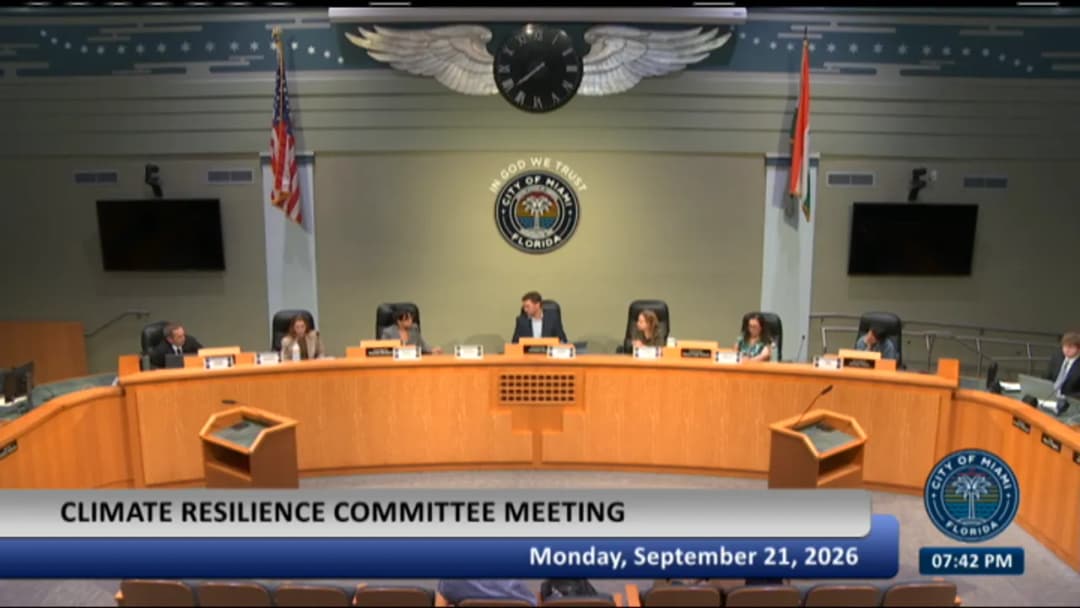
The City of Miami Climate Resilience Committee held a regular meeting on September 21, 2026, at 10:45 AM. The meeting covered updates on Biscayne Bay health, the Back Bay Coastal Storm Risk Management study, budget recommendations, and other resilience initiatives. The committee also addressed attendance requirements and set a future workshop. Consent Calendar - Unanimously approved the minutes of the June 1, 2026, regular meeting, the July 6, 2026, workshop (which had been treated as a workshop due to lack of quorum), and the June 18, 2026, budget workshop minutes. (Motion by Sarahi, seconded, unanimous) - Unanimously approved waiver requests for two absent members: one for a member who was absent that day (motion by Sarahi, seconded, unanimous) and one for Silvio, who was attending New York Climate Week (motion by Sarahi, seconded, unanimous). Public Comments & Testimony - No public comments were made, either in person or online. Discussion Items - Attendance Requirements and Quorum: Nick Atkinson from the City Attorney's Office reviewed bylaws: members are considered absent if not present for at least 75% of a meeting; automatic vacation occurs after three consecutive absences, four total absences in a calendar year, or attendance at fewer than 50% of meetings. Quorum requires six members (50%+1). Remote participation counts for attendance but not quorum. The prior meeting (July 6) had only five members present, rendering any official actions void, so items were re-voted. - Biscayne Bay Marine Health Summit Recap: Dave Dobler, co-chair of the Biscayne Bay Marine Health Coalition, presented highlights from the 2026 summit held in May. Key issues: persistent water quality challenges with 70% of bay segments impaired for nutrient pollution; 18 billion microplastic particles; 64 billion dollars in economic activity supported by the bay; 12,000 septic properties countywide. Dobler noted that street sweeping and stormwater cleaning are cost-effective interventions. He recommended: expanding street sweeping to secondary and tertiary streets, increasing stormwater cleaning to an annual cycle (currently every two years), growing neighborhood litter crews, checking progress on plastics policies (single-use reduction), closing the stormwater funding gap, requiring net benefit development for new coastal projects, and using the Biscayne Bay Task Force report as a roadmap. Committee members expressed strong support and discussed prioritizing septic-to-sewer conversions, integrating stormwater projects with water quality goals, and exploring a charter boat regulatory model similar to Miami Beach's Marine Waterfront Protection Authority. - Back Bay Coastal Storm Risk Management Feasibility Study: Aaron (Chair) noted that a presentation from the Army Corps and Miami-Dade County was not possible this meeting. Alyssa Parina summarized the tentatively selected plan: elevation of approximately 3,200 residential buildings, dry floodproofing of 175 non-residential buildings and 100 critical infrastructure facilities. The public comment period ended September 18. Committee members expressed concerns about costs, feasibility, and the need for structural measures like gates. They emphasized the importance of understanding the study to advocate for the city's interests. The committee agreed to invite these agencies for a future presentation. - Tree Ordinance Advisory Committee Update: Avra provided an update on the first meeting of the committee, which reviewed the regulatory framework (city, county, state rules). Public input meetings were held across five locations. The committee's focus includes improving transparency and process. The timeline aims to wrap up by end of year. The Flora initiative (related to tree canopy) was discussed at a recent City Commission meeting, with a recommendation that the tree ordinance committee consider it. - Office of Resilience and Sustainability Updates: - Heat Sensors in Homes Report: Final report to be published soon. Key findings: outdoor heat exposure varied across neighborhoods; humidity and moisture were more prevalent issues than high temperatures; recommendations include improving building envelopes and energy efficiency. Report includes neighborhood-specific data, 911 call demographics (people over 60 and those in their 30s were most likely to call), and a resource guide. - Tree Giveaways: Six events in early October offering fruit trees and flowering trees. - Youth Climate Action Fund: Microgrants ($1,000–$5,000) for youth-led projects (age 15–24) focused on flooding, heat, or waste reduction. Application deadline October 2. A unique idea from a diabetic pageant queen about medical waste. - Jose Marti Park Adaptive Redesign: Construction begins November 2026 with an estimated 24-month schedule. Features include improved riverwalk, subsurface cistern, raised seawall, and landscape improvements. Project aims for Envision certification (similar to LEED for waterfront projects). Key Outcomes - Approved FY 2026–2027 Budget Recommendations: The committee voted (6-0-1, with one abstention from a city employee) to approve the budget recommendations as presented. These had been previously discussed at the July 6 meeting but were voided due to lack of quorum. - Set Workshop for October 6, 2026: The committee voted to hold a workshop on October 6, 2026, from 12:00 PM to 2:00 PM at City Hall. The purpose is to set the committee's agenda for the next six months, including prioritization of topics like Biscayne Bay health and other resilience issues. Members are to submit agenda ideas in advance. - Referred action on Biscayne Bay recommendations: The committee expressed intent to develop recommendations to the City Commission based on Dave Dobler's presentation, including exploring expansion of street sweeping, annual stormwater cleaning, net benefit development policies, and addressing charter boat regulation. - Directed staff to invite Army Corps and Miami-Dade County for a future presentation on the Back Bay Coastal Storm Risk Management Feasibility Study.

The Public Meeting Index
The Public Meeting IndexThe Southwest Deltona Community Redevelopment Agency (CRA) Board met on Monday, September 21, 2026, at 5:30 PM in the Deltona Commission Chambers. The meeting lasted approximately two minutes, with all six present members voting unanimously to approve a budget amendment for Fiscal Year 2025-2026. One member, C. Nabicht, was absent. Public Comments & Testimony - No members of the public spoke during the public forum. Discussion Items - Budget Amendment (Resolution No. 2026-82): The Economic Development Director reported that the board had previously approved the fiscal year budget by a 6-0 vote. The proposed amendment increased the budget by approximately $245,000, reflecting higher-than-anticipated year-end revenues from the County and additional trust fund interest. Vice Mayor asked about grant applications; the Director replied that the next grant cycle will begin at the start of the next fiscal year. Key Outcomes - Approval of Resolution No. 2026-82: Member E. Santiago made a motion, seconded by M. Avila-Vazquez, to adopt the resolution. The motion passed unanimously with a 6-0 vote (Members Avila, Avila-Vazquez, Colwell, Heriot, Howington, and Santiago in favor; Member Nabicht absent). The resolution authorizes a budget amendment to allocate $245,475 in available funds for additional sidewalk repair and road resurfacing within the CRA district. Note: The agenda stated $245,475 as available funds; the minutes stated "approximately $245,000". This minor discrepancy is noted. The meeting adjourned at 5:32 PM.
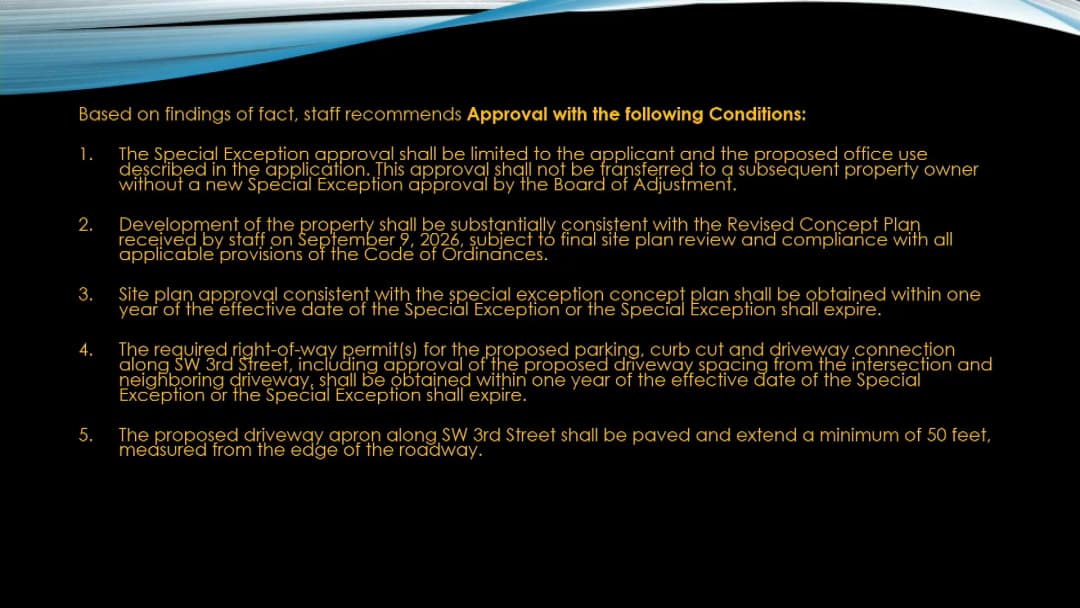
The City of Ocala Board of Adjustment held its first 2026 meeting on September 21, 2026, at 10:30 AM (as per the date provided). The primary agenda item was a special exception application for a professional office use at a historic 1938 residence located at 11 Northwest 56th Street. Staff presented a revised site plan with conditions, and after discussion, the board voted unanimously to approve the special exception with a key modification that the approval runs with the land for the same professional office use rather than being limited to the current applicant. Consent Calendar - The board approved the August 17, 2026 meeting minutes unanimously (motion by Mr. Jergins, seconded, roll call: all present voted yes). - Proof of publication was acknowledged: public notice posted at City Hall and published in the Ocala Gazette on July 3, 2026. Discussion Items - Special Exception Application (LLC) – 11 NW 56th Street - Staff Presentation: Indira Madravarin (Growth Management) summarized the revised concept plan. The 1938-built residence would be converted to a professional office. The revised plan relocates six parking spaces (including one ADA) to the southern portion, adds a driveway off Southeast Third Street, extends a pedestrian connection, relocates a sign, and expands landscaping. However, staff noted remaining concerns: the two existing driveways on Sanchez Avenue should be consolidated, and additional screening is needed on the southwestern corner. Staff recommended approval subject to eight conditions, including that the special exception is limited to the applicant and this specific use, that site plan approval be obtained within one year, and various construction and landscaping timelines. - Board Discussion: - Mr. Carrasco objected to condition 1 that restricts the special exception to the current applicant, arguing that if a subsequent owner uses the property for the same professional office use, they should not have to undergo a new special exception process. He noted that the city does not actively police such conditions. - Mr. Hartley and others debated enforcement mechanisms, with Mr. Hartley stating that a condition running with the land provides a tool for future compliance if problems arise. Ms. Gibb and Mr. White joined the discussion. - Board members also questioned why the revised plan did not address all staff concerns, and staff clarified that further details would be resolved during the site plan approval process. - Applicant Testimony: William Martyr, the property owner, expressed frustration with the lengthy five-month process and high costs (estimated $60,000-$100,000). He stated he owns the adjacent corner and plans a future $10-15 million development with 30 units and commercial space, contingent on form-based code approval. He argued that public street parking should suffice and that the city’s requirements were excessive for an interim use. He noted he would demolish the building for future development. - No public comments were offered. Key Outcomes - Vote on Special Exception: The board voted unanimously (5-0) to approve the special exception application with the following modifications: - Condition 1 was revised to read: “The special exception approval shall run with the land,” meaning it applies to subsequent property owners as long as the use remains a professional office substantially consistent with the concept plan. Staff clarified that future changes of ownership or occupancy would be reviewed for substantial deviations, and if none, a new special exception would not be required. - All other recommended conditions from staff were adopted as presented, including requirements for site plan approval within one year, driveway consolidation, landscaping, signage restrictions, and 18-month timelines for building and exterior permits. - Board Comments: Mr. Carrasco raised a general concern about the city’s lack of routine enforcement of landscaping conditions, citing an example at South State Bank where overgrown shrubs create safety issues. He urged code enforcement to address such problems. - No applications were scheduled for the October 19, 2026 meeting.
The Denver City Council held its regular session on Monday, September 21, 2026, at 3:30 PM. Eleven members were present, one absent. The meeting included two proclamations, several resolutions and bills passed en bloc, and individual votes on contested items. Key topics included the Civic Center Next 100 design contract, the Department of Housing Stability's continuation plan, employee classification changes, and an update to the Minority and Women Business Enterprise (MWBE) ordinance. Council Announcements - Councilmember Hinds announced a proclamation event for Dolly Parton on September 25 at Governor's Park. - Councilmember Sawyer reminded District 5 residents of the community cleanup day and annual survey. - Councilmember Alvidrez announced a panel for at-large B candidates and thanked the Athmar Park Neighborhood Association. - Councilmember Watson wished observers of Yom Kippur a meaningful holiday and advertised a Hoop for Safety event. - Councilmember Sandoval promoted a free yoga session and the Far Northwest Neighborhood Plan kickoff. - Councilmember Lewis announced the Budget Book Club, a domestic violence awareness conversation, a community safety meeting, and a screening by the Denver Basic Income Project. - Council President Romero Campbell announced the rescheduling of a canceled concert to a fall fest on October 24. Proclamations - 26-1389: Honoring retired Denver Police Detectives Abe and Amy Alonzo for Hispanic Heritage Month. Councilmember Alvidrez expressed gratitude for their service, highlighting the resolution of a missing and murdered indigenous women case. Chief Thomas and the Alonzos spoke. Adopted unanimously (11-0). - 26-1388: Recognizing September 2026 as Right to Food Action Month. Councilmember Torres noted the need for a coordinated food system. Several councilmembers spoke in support; Emily Sadolkowski of Metro Caring and Sydney Skilkin of the Southwest Food Coalition accepted, calling for sustained investment. Adopted unanimously (11-0). Consent Calendar (En Bloc Approvals) All items listed below were approved en bloc by an 11-0 vote, with no separate discussion except where noted. - Proclamation 26-1387: Celebrating the life and legacy of Dolly Parton. - Resolution 26-1283 (St. Francis Center, +$40,000 for rapid resolution services) - Resolution 26-1284 (Senior Support Services, +$40,000) - Resolution 26-1285 (Colorado Legal Services, +$100,000 for eviction legal services) - Resolution 26-1286 (Denver Rescue Mission, +$45,000) - Resolution 26-1287 (Brothers Redevelopment, +$400,000 for TRUA program) - Resolution 26-1288 (Housing Connector, +$1,773,600) - Resolution 26-1290 (5280 Waste Solutions, contract assignment) – Councilmember Sawyer provided comments noting the company was acquired by a venture capital firm, but did not call for a separate vote. - Resolution 26-1292 (Savio House, +$814 for Collaborative Management Program) - Resolution 26-1293 (Caring for Denver, $2,463,443 for Co-Responder Program) - Resolution 26-1294 (Bear Communications, +$923,000 for vehicle upfitting) - Resolution 26-1295 (Stride Sober Living, +$280,000) - Resolution 26-1274 (Dedicating public alley in District 9) - Resolution 26-1281 (HCL Engineering, $700,000 for DIA services) - Resolution 26-1282 (Staffbase Inc., $1,350,000 for employee communication app) - Bill 26-1253 (Allowing HOST one-year continuation plan) - Bill 26-1259 (Amending DMV lease at 4685 Peoria St., +$167,634) - Bill 26-1245 (UASI FY25 grant, $4,946,929) - Bill 26-1251 (Classification notice 1906) - Bill 26-1127 (Revising Mayor’s Youth Commission) – Councilmember Torres noted future name change to come in 2027. - Bill 26-1206 (Denver Health contract, $686,352) - Bill 26-1261 (Naming park at 47th & Telluride as Fox Run Park) - Bill 26-1210 (Globeville Levee Project, +$12,750,000) - Bill 26-1236 (Relinquishing access easement at 4991 N. Telluride) Discussion Items - Resolution 26-1280 (Studio Gang Architects, +$1,633,824 for Civic Center Next 100 design): Councilmember Flynn voted no, stating the project is an “abomination” and ruining Civic Center Park. Adopted 10-1 (Flynn nay). - Resolution 26-1254 (HOST one-year continuation of strategic plan): Councilmembers Alvidrez and Lewis voted no. Alvidrez argued the city is “failing” and should recommit to better goals; Lewis stated the strategy does not help people. Adopted 9-2. - Bill 26-1190 (Classification and pay plan change 1897): Councilmember Gonzales-Gutierrez expressed concerns about education requirements and urged agencies to support impacted workers. Alvidrez said the change makes city jobs harder for working-class people to obtain. Passed 9-2 (Alvidrez, Gonzales-Gutierrez nay). - Bill 26-1216 (MWBE contracting ordinance repeal/re-enactment): Councilmember Alvidrez voted no, citing declining goals and outstanding concerns. City staff (Aaron Croak) responded to questions. Passed 10-1 (Alvidrez nay). Key Outcomes - All proclamations, resolutions, and bills were adopted or passed. - The zoning change for 2246 North Federal Boulevard (Bill 26-1302) was ordered published; a required public hearing is set for October 19, 2026. Protests must be filed by noon on October 13, 2026. - The next regular meeting will occur on Monday, October 5, 2026. The meeting adjourned at 4:34 PM.
Date: September 21, 2026, 5:30 p.m. The Metropolitan and Economic Development Committee of the Indianapolis-Marion County City-County Council met to consider one appointment and hold budget hearings for the Marion County Recorder's Office and the Marion County Assessor's Office. All items were discussed with no public testimony. Discussion Items Proposal No. 278, 2026 – Appointment of Cindy Kirchhofer to the Metropolitan Development Commission Cindy Kirchhofer presented her background in public service, including service on the Beech Grove Redevelopment Commission, a road subcommittee, the police complaint board, and the Indiana House of Representatives. She expressed a desire to continue serving without campaigning. Multiple councilors (Mowrey, Hart, Brown, Evans) voiced support, citing her experience and willingness to serve. Councilor Brown asked about her stance on data centers and interactions with the council and public. Kirchhofer replied that the jury is still out on data centers, and she believes in weighing risks and benefits, adding that she is not afraid of difficult conversations, having faced them in the legislature. The committee voted unanimously to send the proposal to the full council with a do-pass recommendation. Marion County Recorder’s Office – Budget Hearing Faith Kimbrough, Marion County Recorder, and her chief deputy presented the office’s operations and budget. Key points included: - The office processes about 100,000 documents annually, 89% e-recorded, and maintains over 11 million records dating to 1821. - A new process (DNUF) allows customers to obtain recorded documents same-day, down from 24-48 hours. - The property fraud alert program saw a 56.35% increase in sign-ups year-to-date (from 5,958 to 9,338) and a 139.73% increase in the last three months (June–August) after bus ads and billboards. The 2027 goal is 12,000 sign-ups. - Advertising costs rose from $42,000 in 2026 to $45,000 in 2027, funded by interest from a cash perpetuation fund. Councilor Cahill criticized the ads, stating that the Recorder’s photo takes up one-third of the space, making them look like political advertisements. He noted the campaign photo is the same as her official campaign photo. Kimbrough defended the ads as effective and the photo as building trust. Councilor Lewis echoed concerns about the photo size. Councilor Brown asked about the fraud alert mechanism and requested data on notifications sent. He also questioned the return on investment of increased advertising spending and suggested staff salary improvements instead. Councilor Delaney confirmed the advertising funds came from interest earnings. Councilor Gibson asked how to sign up for fraud alerts. No public comment was offered. The hearing concluded without a vote. Marion County Assessor’s Office – Budget Hearing Joseph O’Connor, Marion County Assessor, presented the agency’s budget and operations. Highlights: - The office has 92 full-time positions (74 filled, 18 vacant), down from about 120 in 2011 due to technology. Employment is 61% minority female; management is 58% minority female. - Efforts to address gentrification include taking extra time in older neighborhoods (e.g., Fountain Square, Near Northside, Irvington) to ensure sales data accurately reflect property conditions, preventing unfair tax increases. The median assessed value rose 25% over four years but only 2% in the latest certification. - The office uses AI to analyze commercial appraisals and is consolidating GIS data with the city to eliminate duplication. - Budget increase is primarily due to COLA, step-and-grade adjustments, and chargebacks. Revenue from sales disclosure and endorsement fees fluctuates with transaction volume. Councilor Cahill asked about specific gentrification efforts. O’Connor explained that they don’t have a formal flag but carve out separate neighborhoods for review. Councilor Roberts noted 18 vacancies and asked about hiring difficulties; O’Connor said vacancies are mostly entry-level and that the city’s pay increases have helped retain staff. Councilor Brown praised the office for responsiveness and asked about revenue fluctuations (sales disclosure vs. endorsement fees), which O’Connor attributed to transaction volume. Councilor Gibson inquired about union membership; O’Connor stated that non-management staff are in the bargaining unit but exact membership numbers are unknown. No public comment was received. Key Outcomes - Proposal No. 278: Approved unanimously (voice vote) to be forwarded to the full council with a do-pass recommendation. - Recorder’s Office Budget: Heard and discussed; no formal vote taken. - Assessor’s Office Budget: Heard and discussed; no formal vote taken. - The meeting adjourned after the assessor’s hearing.
On September 21, 2026, the Portsmouth City Council and Planning Commission held a joint public work session at 5:30 p.m. to review the Planning Commission's 20-month body of work and upcoming land-use priorities. Planning Director Rhonda Russell presented on housing approvals, nonresidential uses, design review, stakeholder engagement, entertainment-use enforcement, and the commission's future work plan. No formal votes were taken; the council and commission reached consensus on follow-up items. Housing and Development Activity - Approximately 341 housing units were approved for development since January 2025. Of those, 299 are in Newport Phase 2, 39 multifamily units were approved in the West Croft/ANZO Gardens community, and three townhouse units each were approved as infill in Princess Place and Oakden. - Staff reported that nonresidential activity since August 2025 included entertainment-use cases, one on Hodges Ferry Road that was ultimately denied and two event centers that did not materialize, plus an outdoor kennel expansion on Towery Neck Road, a shipping container chassis storage use on Military Road, and a treatment facility in the Link District on Enterprise Parkway. - Staff observed that residential development has predominated over commercial permitting and that new housing is trending toward multifamily for-sale and rental units rather than detached single-family homes. Policy and Process Updates - Staff expects the short-term rental policy to come to a final City Council vote this fall, followed by development of the 2040 comprehensive plan and review of uses and design standards in the Link District. - Planned work includes a two-year 2040 comprehensive plan effort, Link District ordinance phase two design standards, and targeted zoning amendments for narrow lots and accessory dwelling units. - Staff will change the public notice sign process, modeled on Hampton and Newport News: the city will provide corrugated, weatherproof, UV-protected signs; applicants will post them and send photo verification. - For the Link District, staff is assembling a stakeholder task force of about 10 to 15 community members to help draft design standards by the end of the year. Design Quality and 'Character of the Neighborhood' - Dr. Russell said planning staff has responded to neighborhood complaints about narrow-lot infill by asking applicants to assess nearby single-family characteristics and incorporate design elements into their elevations. Staff described the required number of elements at times as up to three and later as three to five. - Councilman Hugo expressed concern that the 'character of the neighborhood' standard feels subjective; when a three-story house is proposed in a one-story neighborhood, he said he cannot explain to constituents how it was found compatible. He asked for a clearer rubric and staff report showing how staff's negotiations with the developer produced the final recommendation. - Vice Mayor Moody and others questioned whether the design-element approach will resolve resident opposition, and Commissioner Glover raised side-yard setback issues, including contractors working over neighbor property; City Attorney Derrick Challenger said trespass law already covers that issue and adding redundant language may not be advisable. - Council members and commissioners generally agreed that proactive, neighborhood-based design standards and going to residents rather than expecting them to come to city meetings improves engagement and reduces conflict later. Entertainment and Event Center Regulation - Staff reported that since the city adopted its entertainment/event space ordinance in August 2025, only one event center has been approved; a second application was considered at the prior council meeting and deferred. Staff identified five event space users and eight entertainment establishments, noting that many historically permitted venues are now non-operational. - Dr. Russell recognized confusion between entertainment uses and event center uses, including how DJs are treated, and noted problems with restaurant operators who serve alcohol with entertainment after midnight without obtaining the required use permit. She said the ordinance likely needs fine-tuning. - She also said planning staff's own provider outreach drew very low attendance, while a police chief's meeting with the same providers was fully attended, so staff intends to partner with the police department for education and enforcement outreach. Group Homes and Independent Living - Councilman Hugo raised constituent complaints about learning about group homes only when large vans arrive, with no advance notice. Zoning Administrator Mr. Boone confirmed that group homes must obtain a zoning clearance but that nothing in the current ordinance requires notification to neighboring property owners. - Councilman Hugo asked whether the ordinance could be amended to require notice during the zoning clearance process; City Attorney Challenger said that question needs research. Mayor Clever cautioned that informing neighbors that a group home is moving in could create legal challenges and that state code limits local authority. - Councilwoman Bryant urged the city not to target group homes because of Virginia Fair Housing Law concerns, saying enforcement should focus on property maintenance rather than the type of occupants. - Commissioner Curry suggested the recent influx may actually be independent living homes that are not licensed by DMAS or regulated like traditional group homes, driven by the regional housing crisis and the need to house people with disabilities or fixed incomes. Vice Mayor Moody called for more data on group homes' effects on property values. Board and Commission Training - Staff highlighted the VCU Planning Commissioners Institute, a hybrid certificate program; two commissioners have signed up, and the city covers tuition, commuting, and overnight costs. City Council consensus was to direct staff to return with cost and logistics information for making training mandatory for both the Planning Commission and the Board of Zoning Appeals. - Councilwoman Thomas asked that any required training be accessible to volunteers, including virtual options, so it does not create additional work or travel burdens. Key Outcomes - No formal motions or votes were taken during the joint work session. - Council consensus was reached to explore required training for Planning Commission and Board of Zoning Appeals members, with staff to bring back cost and access options. - Staff will research whether the zoning ordinance can be amended to provide public notice for group homes or independent living uses. - The narrow-lot ordinance effort will continue with stakeholder engagement and return to the Planning Commission in October. - Staff will develop fine-tuning amendments for the entertainment/event center ordinance and work with the police department on provider education. - Staff will proceed with the 2040 comprehensive plan, Link District design standards, public notice sign changes, and the fall short-term rental vote.
The Sarasota City Commission held a special meeting on September 21, 2026, at 5:30 PM to conduct second public hearings on six budget resolutions setting millage rates and approving budgets for the City of Sarasota, the Golden Gate Point Streetscape Special District, and the Downtown Improvement District for fiscal year 2026–2027. The meeting also included public comments on a proposed transportation chapter rewrite and capital improvement projects. Public Comments & Testimony - Non‑Budget Public Comment: Dan Lobeck, a resident, business owner, and citizen advocate, spoke during the non‑budget public comment period. He expressed strong opposition to the proposed rewrite of the transportation chapter, arguing that under Senate Bill 180, the city cannot impose new burdens on developers. He urged the commission to split the amendment, as done nine years ago, and to keep existing controls. He distributed a staff report from the Florida Department of Commerce and FDOT. - Budget Public Hearing: Three speakers addressed the budget: - John Harshman, a city resident, advocated for zero‑based budgeting, where each department starts from zero annually, and suggested performance incentives for staff. He encouraged forward‑looking efficiency. - Martin Hyde criticized the budget as profligate, noting that 49% of city residents are asset‑limited, income‑constrained, employed (ALICE) while the general fund expense increased 80% vs. 41.5% inflation. He proposed a three‑year hiring moratorium and prioritizing needs (e.g., homeless support, law enforcement) over wants (e.g., performing arts center design, golf course clubhouse). - Dan Lobeck (also spoke during budget item) urged the commission to direct staff to amend the Capital Improvement Program (CIP) by removing the two‑lane reduction on 10th Street (a “road diet” project), arguing that potential development at the eastern terminus (Sarasota Military Academy site) could create untenable traffic. He suggested shifting federal funds to Boulevard of the Arts improvements without lane reductions. Discussion Items - 10th Street / Boulevard of the Arts Complete Streets Project: Commissioners questioned Public Works Director Nick Patel about traffic impacts, safety, and multimodal benefits. Commissioner Alpert supported the project, citing success on Ringling Boulevard (roundabouts, pedestrian improvements). Commissioner Battie expressed skepticism about achieving a mode shift and noted congestion during peak times. Patel confirmed a traffic study is underway that will include future development (e.g., McCowan Towers, Bay Park garage) and will ensure compliance with Florida Green Book standards. If lane repurposing is not feasible, the project will be brought back for public input and commission decision. - Transportation Chapter Update Timeline: Commissioner Ahern‑Koch asked City Attorney Farling for the schedule. Farling replied that staff are incorporating feedback from state commerce officials and expect to provide a public update in early November 2026. Key Outcomes - The commission closed the public hearing and voted on each resolution separately. All six resolutions passed unanimously (roll‑call votes: all commissioners voted yes on each). - Resolution 26R‑3417 (City general fund operating millage at 3.2730, aggregate 3.3430) – adopted. - Resolution 26R‑3418 (City budget for fiscal year 2026–2027) – approved. - Resolution 26R‑3419 (Golden Gate Point Streetscape Special District millage: operating 0.6148, debt service 0.4977) – approved. - Resolution 26R‑3420 (Golden Gate Point Streetscape Special District budget) – approved. - Resolution 26R‑3421 (Downtown Improvement District operating millage at 2.0000) – adopted. - Resolution 26R‑3422 (Downtown Improvement District budget) – approved. - Commissioners expressed gratitude to Finance Director Kelly Strickland and staff for their work through a challenging budget cycle with multiple city manager transitions.
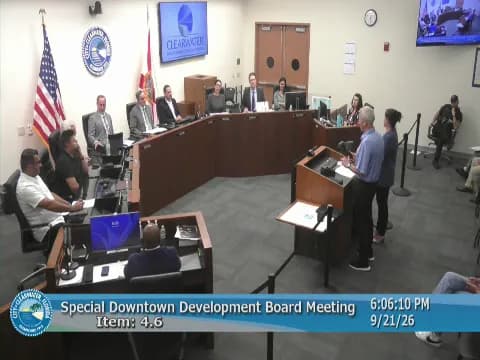
The Clearwater Downtown Development Board (DDB) held this Special Budget Hearing / Special Meeting on Monday, September 21, 2026, at 5:15 PM in the Main Library Council Chambers on Osceola Avenue, Clearwater, Florida. The board set the final fiscal year 2026-27 property tax millage rate, adopted the DDB annual operating budget, approved a High Impact Grant, two Community Event Funding requests, and a restated funding agreement, and discussed a possible one-time purchase of a portable stage. All required actions were taken on second and final reading where applicable. Call to Order and Approval of Minutes - The special meeting was called to order, and the board approved the previous meeting's minutes without recorded objection. Citizens to Be Heard (Items Not on the Agenda) - No members of the public came forward to speak on non-agenda items. - No public comments were offered on agenda items 4.1, 4.2, or 4.5. New Business Items 4.1 Final Millage Rate - Resolution 26-01 - Staff presented a final millage rate of 0.9700 mills for fiscal year 2026-27 within the Downtown Development Board boundaries. This rate is 0.65% above the rollback rate of 0.9637 mills. - The resolution, read in full as required for millage resolutions, declares that estimated ad valorem tax revenue of $523,809 will be received for the fiscal year beginning October 1, 2026, and the levy takes effect October 1, 2026. - The item was presented for first reading on September 15, 2026. The board adopted Resolution 26-01 on second and final reading. 4.2 Annual Operating Budget - Resolution 26-02 - Staff presented the DDB annual operating budget for fiscal year 2026-27, with Resolution 26-02 on second and final reading (first reading September 15, 2026). - No public comment was offered, and the board adopted the budget resolution. 4.3 High Impact Grant - Florida Best Promotions Inc. - Staff recommended a High Impact Grant in an amount not to exceed $20,000 for the Salsa and Bachata at the District - Halloween Costume Block Party on October 31, 2026. - The applicant asked for the full $30,000 requested in the application, noting the prior year's grant was $15,000. The applicant argued the additional $10,000 would fund marketing targeting areas more than 20 miles outside Clearwater (while spending that money outside the city), attract a more diverse audience, and help the event become self-sufficient so no further grant would be needed the following year. - Board member Alborn asked the applicant to justify the extra $10,000 and explain how it would improve attendance metrics, while noting the board is trying to taper funding and encourage self-sufficiency. - One board member noted that approving $20,000 would still be an increase from last year's $15,000, which runs counter to the goal of reducing funding, but supported the staff recommendation. - A motion to approve agenda item 4.3 at the staff-recommended $20,000 carried. 4.4 Community Event Funding - Clearwater Sister Cities Inc. - Staff recommended approval of $13,000 for Clearwater Illuminations Lantern Festival and International Night Market at Coachman Park on December 6, 2026. - The applicant stated the goal is for attendees to experience all of downtown, not just the park, and requested that $6,000 be provided up front (rather than through reimbursement) to pay required deposits in advance, including hotel partnerships to attract visitors. - A motion to approve agenda item 4.4 in the amount of $13,000, including $6,000 up front, carried. 4.5 Restated Coastal Route Funding Agreement - Staff recommended approval of the Restated Coastal Route Funding Agreement (with PSDA). The DDB's annual contribution is approximately $24,653, estimated at $26,231 for fiscal year 2026-27. - The coastal route's total annual operating budget is $1,591,540. Staff noted representatives were present to answer questions. - The board approved the agreement. 4.6 Community Event Funding - Downtown Pizza Sports Bar and Grill (Hello Cleveland Street Live Music Series) - Staff recommended approval of a community event funding request not to exceed $15,000 for the Hello Cleveland Street Live Music Series on the 400 block of Cleveland Street, October 2026 through May 2027, submitted on behalf of the Fourner Block Merchants. Events are free and open to the public, beginning at 5:00 PM. - The applicant said the series averages about $15,000 per month in expenses, described an eight-month schedule of on-stage concerts modeled on spring events in front of the Colony, and requested monthly advances (e.g., $15,000 on October 1 and again on November 1) with periodic accounting of expenses. The applicant noted that quality bands book more than four months in advance, making commitments difficult without funding in hand. - A board member who is a CPA proposed a controlled advance schedule: $15,000 up front in month one, with subsequent monthly installments released only after the prior month's funds have been fully accounted for, so funding never runs two months behind on expense documentation. The applicant agreed to this structure. - Note on discrepancy: The agenda lists the staff recommendation as 'not to exceed $15,000,' while the applicant stated the series averages about $15,000 per month and discussed receiving monthly advances of $15,000. The total approved amount is not fully clear from the transcript excerpt. - The board also discussed, as a long-term cost-saving alternative to repeated equipment rentals, purchasing a 12x20 portable stage with stairs and storage cart, priced between $15,000 and $20,000. Supporters noted it would be a one-time purchase usable year after year, with a possible order around February to April 2027. A board member raised concerns about storage, responsibility, and setup/breakdown logistics, and the board indicated the idea was worth exploring before the fiscal year closes in about two weeks. Board Members to Be Heard - No board members offered additional comments, and the meeting moved to adjournment. Key Outcomes - Adopted Resolution 26-01, setting the final DDB millage rate at 0.9700 mills for fiscal year 2026-27, a 0.65% increase above the rollback rate of 0.9637 mills, effective October 1, 2026. - Adopted Resolution 26-02, approving the DDB annual operating budget for fiscal year 2026-27. - Approved a $20,000 High Impact Grant to Florida Best Promotions Inc., less than the applicant's requested $30,000. - Approved $13,000 for Clearwater Sister Cities Inc., with $6,000 payable up front. - Approved the Restated Coastal Route Funding Agreement, with DDB contributions of approximately $24,653 (estimated at $26,231 for FY 2026-27). - Approved the Hello Cleveland Street Live Music Series funding (staff-recommended $15,000 per the agenda) with a monthly advance and reconciliation disbursement structure as discussed by the board. - Discussed exploring a one-time portable stage purchase ($15,000-$20,000) as a potential long-term asset in place of recurring rental costs.
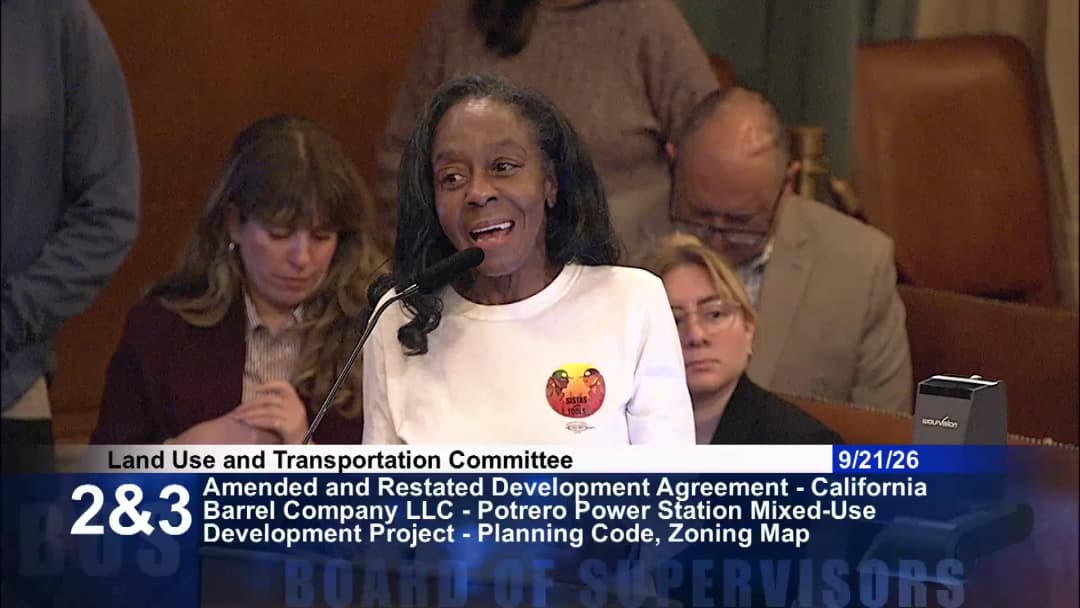
The Land Use and Transportation Committee of the San Francisco Board of Supervisors met on September 21, 2026, at 9:45 AM, chaired by Vice Chair Cheyenne Chan in the absence of Chair Malgus. Supervisors Matt Dorsey and Shaman Walton were present. The committee considered four agenda items: a landmark designation amendment, amendments to the Potrero Power Station development agreement and special use district, and a street vacation for the Transbay Under Ramp Park project. Public comment was heard on items two and three. Consent Calendar - Item 1: Planning Code – Landmark Designation Amendment – Sylvester House – The committee unanimously (3-0) voted to recommend approval to the full board. The amendment renames Landmark No. 61 (Sylvester House) to the Blacketeer-Sylvester House to honor Linda Blacketeer’s preservation work. Public Comments & Testimony - On Items 2 and 3 (Potrero Power Station amendments) – Multiple speakers addressed the committee. Zack Weisenberger (Young Community Developers) thanked Supervisor Walton for removing data center language but voiced concerns about proposed exemptions from Intermediate Length Occupancy (ILO) caps and reporting requirements, arguing no demonstrated need exists. Jean-Tal Laboranto (REP SF Coalition) opposed ILO exemptions, citing risks to the city’s ILO program integrity and geographic distribution limits. Bill Blackwell (Plumbers & Pipefitters Local 38) and Shalina Esgridge (Homeless Prenatal Program) supported the amendments, noting positive community and labor outcomes. Jamie Breen Miles (YMCA) supported flexibility for child care and community spaces. Rashida Nairobi (Sisters with Tools) and Bruce Huey (Dog Patch resident/business owner) also supported the project, emphasizing workforce opportunities and business growth. Elaine Sprague Stuby (Friends of Jackson Park) urged approval for park delivery flexibility. Discussion Items - Items 2 and 3: Potrero Power Station – Amended Development Agreement and Special Use District Amendments – Presenters John Lau (OEWD) and Monica Giacomucci (Planning) outlined targeted amendments to add flexibility and feasibility: removing data centers as a permitted use; increasing height limits (e.g., Block 15 from 160 to 190 feet); allowing rooftop bars site-wide; aligning open space rules with family zoning; and technical modifications from the Planning Commission (July 30, 2026) regarding above-grade parking structures, TDM plans, and Muni shelter plans. Supervisor Walton noted the removal of data center language and confirmed that jet ski water rescue provisions were unaffected. A substantive change required a one-week continuance. - Item 4: Transbay Under Ramp Park Project – Street Vacation and Related Actions – The item was continued from a previous meeting for minor technical amendments. No additional presentation was given. The committee voted to send it as a committee report to the full board. Key Outcomes - Item 1: Motion by Supervisor Walton to recommend approval to the full board passed 3-0 (Walton aye, Dorsey aye, Chan aye). - Items 2 and 3: Supervisor Walton moved to accept the amendments as presented by staff. The motion passed 3-0. Supervisor Walton then moved to continue both items to the committee meeting of September 28, 2026, due to a substantive change requiring a one-week hold. That motion passed 3-0. - Item 4: Motion by Supervisor Dorsey to send the ordinance as a committee report to the full board (for consideration on September 22, 2026) passed 3-0.
The Columbus Redevelopment Commission met on September 21, 2026, to consider a $3 million commitment to the Crump Center for the Performing Arts, approve meeting minutes and claims, and receive updates on major downtown infrastructure and development projects. Public Comments & Testimony - A community member expressed strong support for the Crump Center project, stating it is exactly what Columbus needs to compete for businesses, retain talent, and attract visitors. He thanked volunteers and donors, urged the commission to approve the $3 million, and noted he would support the project with his own resources. Discussion Items - Crump Center for the Performing Arts Request: Laura and Steve, project leaders, presented the timeline and funding needs. They noted: - Schematic design completed fall 2026; design development underway with historic reviews (SHIPO) and construction manager hiring. - Spring 2027 groundbreaking anticipated; 14–16 month construction; grand opening planned for fall 2028. - Funding from Ready requires all dollars spent by end of 2028, driving the timeline. - A $3 million community match from the Redevelopment Commission is needed to secure Ready funds. - Programming discussions with arts organizations are ongoing; modeling suggests 180 to 263 live events per year, mixing local, regional, and national touring acts, with accessibility for all. - Design charrettes with user groups (e.g., Mill Race Theater Company, high school theater) are assessing must-have versus nice-to-have features (e.g., full fly system). - The commission’s financial advisor (Andrew Lanham) and a historic theater consultant (Herb Straffer) are reviewing the pro forma and operational plan. Herb noted that historic theaters across the U.S. require municipal participation to succeed. - Staff Updates (Heather): - Second Street Thoroughfare Project: Unforeseen aging infrastructure has caused delays; substantial completion expected late October 2026, with landscaping to follow. - Riverfront Project: Dam removal began after federal funding was unfrozen; estimated 10 days to complete. Due to the wettest August on record, the October 23 ribbon cutting is postponed to Q2 2027 to allow full completion, including connection to the 1821 trail and landscaping. - Columbus Downtown 2030: Three teams responded to RFQ for lead development partner for Finish Fourth initiative; RFP is being developed. Hall Creek Meadows/Thrive Alliance project (64 affordable housing units and daycare) is on track for December 2026 completion. - Downtown 2030 Action Team Report (Commission Member): Irwin block RFI responses all from developers with Columbus connections; Alley 54 design finalizing; diversity of shops and eateries filling; downtown improvement grants exceeding funds; City Hall project completed; opportunity zone application pending September decision. Key Outcomes - Resolution 19-2026: A unanimous vote (all in favor) authorized $3 million from the central allocation area for the Crump Center for the Performing Arts (Crump Project Encore redevelopment initiative). The resolution is contingent on staff review of the pro forma and operational plan. The item will go to City Council on October 6, 2026, at 6:00 p.m., as the spending exceeds $50,000. - Approval of Minutes: - August 17, 2026 regular meeting minutes: Approved unanimously. - September 11, 2026 executive meeting minutes: Approved, with acknowledgment that the meeting’s posting did not technically qualify as a quorum, but legal counsel confirmed the approval could proceed. Two members present at that session (Jenna and another) voted; the motion passed. - Approval of Claims: Total claims for the month of $1,044,029.69 (including a $76.14 city department cell phone bill added after the claims table was distributed) were approved unanimously. - The meeting adjourned.