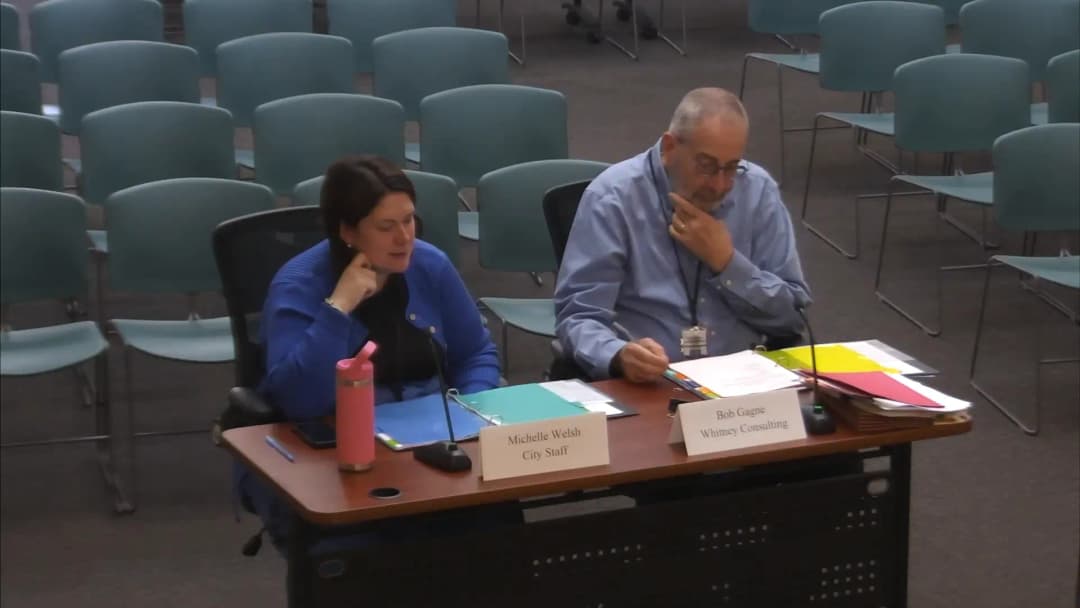
The Board of Zoning Appeals met on September 17, 2026, to consider two area variance applications. The first, for Helio Health at 344 North Salina Street, was approved after a public hearing and deliberation. The second, for the Spanish Action League at 316 Delaware Street, was continued to a future meeting because the applicant did not appear. Consent Calendar - The minutes from the July 16, 2026 meeting were approved unanimously. Public Comments & Testimony - V-2026-16 (344 North Salina Street): No members of the public spoke for or against the project. The applicant noted that they had contacted neighbors who previously expressed concerns about a treatment center, but after clarification that it is a training center, most neighbors considered the project an improvement. - V-2026-18 (316 Delaware Street): Michael Harris, owner of 321 Kellogg, the property adjacent to the proposed development, spoke in opposition. He expressed frustration that the Spanish Action League had not responded to his attempts to negotiate or discuss the project, which he said would be built within six feet of his home. He requested contact information and the board agreed to leave the public hearing open until the next meeting. Discussion Items - V-2026-16 – Area Variance for Helio Health Training Institute (344 North Salina Street): The applicant, Bob Seigert (architect) and Kathleen Gaffney Babb (CEO of Helio Health), presented plans for a two-story office building in the MX4 Zone District. The variance was needed because the district requires a minimum of three stories. The project had been approved by the Landmark Preservation Board in 2022. The applicant explained that the building would be a training center for behavioral health workforce development, not a treatment facility. The existing structure on the site is deteriorated and will be demolished. During board discussion, concerns were raised about whether a two-story building was appropriate at a prominent corner and whether it could accept a third story in the future. The applicant stated that a third story would create unused space and that the building could be structurally designed to accommodate an additional story later. Staff recommended three conditions for approval. After deliberation on the five criteria for an area variance, the board found that four of the five criteria were met (neighborhood character, feasibility of alternatives, substantiality, and adverse effects) and one (self-created difficulties) was not met. The motion to approve with conditions carried 2–1. - V-2026-18 – Area Variance for 30% Ground Floor Window Transparency (316 Delaware Street): The applicant (Spanish Action League of Onondaga County) was not present to present their case. The board opened the public hearing to hear from the neighbor, then left the hearing open for the next meeting. Board members discussed the need for understanding the intent of the transparency requirement, but deferred further consideration. Key Outcomes - Approved: V-2026-16 – Area variance to construct a two-story office building at 344 North Salina Street (relief from three-story minimum), subject to the following conditions: 1. Comply with general conditions for variance approval. 2. Comply with comments and recommendations of the Onondaga County Planning Board as incorporated into the companion major site plan. 3. Any further reduction in building stories requires a new variance application. (Vote: 2 in favor, 1 opposed). - Continued: V-2026-18 – Area variance for 30% ground floor window transparency at 316 Delaware Street was left open; rescheduled for a future meeting. The board directed staff to provide the applicant's contact information to the neighbor and to re-notice the hearing.
The Public Meeting Index
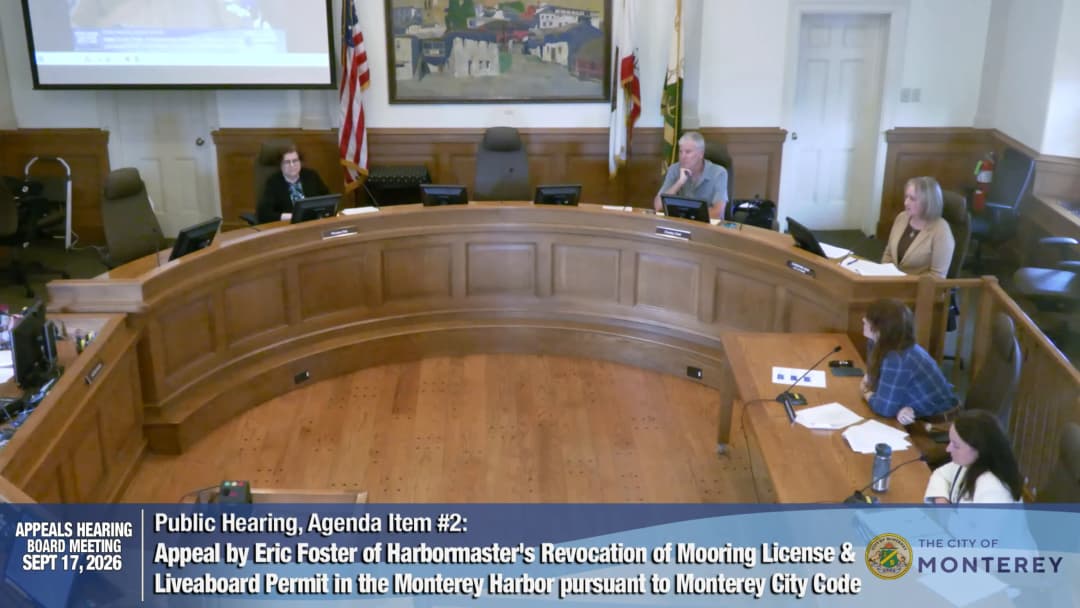
The Public Meeting IndexOn September 17, 2026, the City of Monterey Appeals Hearing Board convened at 10 a.m. to hear an appeal by Eric Foster regarding the Harbormaster's revocation of his mooring license and liveaboard permit. The board voted 2-0 to deny the appeal, upholding the revocation effective October 1, 2026, due to Foster's non-compliance with the city's vessel insurance requirements. Consent Calendar - Approval of Minutes (August 20, 2026): The board unanimously approved the minutes with a 2-0 vote. Public Comments & Testimony - No members of the public made comments either online or in the chambers. Discussion Items - Appeal by Eric Foster: The hearing centered on Foster's appeal of the Harbormaster's decision to revoke his mooring license (mooring 21) and liveaboard permit, effective September 24, 2026 (later amended to October 1). Staff presented evidence that Foster failed to provide proof of vessel liability insurance (minimum $300,000, with the city named as additional insured) as required by Monterey City Code Section 17-33M, adopted September 1, 2025, and enforced through multiple notices since December 2025. - City Staff Presentation: Harbormaster Nicole Rodriguez testified that Foster is the only recreational vessel owner in the harbor who has not complied with the insurance requirement. A small group of commercial fishermen (the "mosquito fleet") were granted a hold due to ongoing code amendments. Rodriguez stated that the city's revocation notice provided 30 days' notice as required by code and contract. - Appellant's Testimony: Foster acknowledged the timeline but argued that the city acted illegally by using its sovereign authority (police power) as a landlord to change contract terms midterm, citing contract law and California Civil Code protections against retaliatory eviction. He claimed that other tenants had not yet provided insurance without facing revocation, and that the revocation notice was issued just days after he raised legal objections. Foster stated he does not have insurance and has no intent to obtain it under the current framework, but requested a remedy through lease renegotiation rather than revocation. - Board Deliberation: Board members considered Foster's arguments but noted that the mooring license agreement (signed in 2015) allows either party to terminate with 30 days' notice. The board concluded that the revocation procedure was properly followed and that Foster's non-compliance was undisputed. Key Outcomes - Motion to Deny Appeal: Board member Shell moved to deny the appeal, with a second from board member Fritz. The motion passed 2-0. - Revocation Effective Date Amended: At the request of the board and with city staff's agreement, the revocation effective date was changed from September 24, 2026, to October 1, 2026. - Final Decision: The board adopted the proposed decision (attachment five) as modified, upholding the Harbormaster's revocation. The decision is a final administrative order subject to judicial review under Code of Civil Procedure Section 1094.6.
The Carson City Board of Supervisors met on Thursday, September 17, 2026, beginning at 8:30 a.m. in the Bob Crowell Board Room. The meeting included public comment, special presentations, approval of a consent agenda, appointments, grant applications, policy reports, and a memorandum of understanding for a bike park. The board took unanimous action on all items. Consent Calendar - 8a. Ratified approval of bills and payment requests for August 10 – September 4, 2026. - 9a. Approved closing North Curry Street from West Robinson to West Washington on October 23, 2026, 4–9 p.m. for the Nevada State Museum Trunk-or-Treat Block Party. - 10a. Accepted the treasury condition report and receipts/expenditures through September 4, 2026. - 11a. Approved deobligation of $315,650 in ARPA LRHA funds (new award not to exceed $3,159,284) and authorized the Mayor to sign documents. - 12a. Received the Fiscal Year 2026 Human Resources annual report (discussion only). - 13a. Approved purchase authority for a full-body security scanner for Juvenile Services (not to exceed $179,000 via joinder contract with Orange County, CA/TEK84 Inc.). - 14a. Accepted the Treasurer’s monthly statement for August 2026. Public Comments & Testimony - Jeannie Elder (resident) requested help with speeding on Parkland Avenue (25 mph limit routinely exceeded) and mentioned 15 feral cats in the neighborhood. - Denny French (resident) urged the board to reconsider the Flock camera contract, citing national scrutiny and lack of guardrails. He also called for better community wildfire prevention communication and highlighted links between sleep deprivation, nutrition, and homelessness. - Spike McGuire (Executive Director, Brewery Art Center) thanked the city for supporting the Levitt Summer Concert Series (highest attendance this year), promoted the Music and Murals Festival, and expressed strong support for the proposed Carson City Bike Park. - Eric Brooks (Arts and Culture Program Manager, Visit Carson City) highlighted the Music and Murals Festival featuring international artists from Spain, Australia, and Mexico, noting the international promotional value for Carson City. - During item 17a (MOST grant), Danny French voiced concerns about information privacy and the potential for data sharing similar to Flock. - On item 19a (CDBG CAPER), Danny French objected to voting before the public comment period closed, saying insufficient information was provided for informed comment. - On item 20a (Bike Park MOU), Christine Sylvester (resident, engineer, mother of three) spoke in favor. Juan Guzman (former open space manager) supported the MOU, recalling the land’s history. Denny French expressed concern for maintaining open-space character but supported the project. Stella Thornton (Carson High graduate) thanked citizens for sustained engagement and praised her father Dan Thornton’s dedication. Discussion Items - 16a. CTA Appointment: Two candidates were interviewed for the hotel/motel industry seat on the Carson City Culture and Tourism Authority: Sam Molzingo and Ben Baggett. The board asked about tourism challenges, the city’s identity, and how they would evaluate sponsorship requests. Both candidates emphasized attracting multi-day visitors. The board selected Sam Molzingo for a two-year term (unanimous). - 17a. MOST Grant Application: The Sheriff’s Office applied for the 2023 Byrne State Crisis Intervention Program Grant to support the Mobile Outreach Safety Team (MOST). Funds would purchase an electronic medical record system (Julata), a third unmarked vehicle, and an 18-month contract program manager to identify gaps in crisis response. Discussion focused on HIPAA compliance and data security. Supervisors Giomi and White raised concerns about privacy policies and long-term funding. The board unanimously authorized the Sheriff to submit the application and execute grant documents if awarded. - 18a. Drug Testing Trends Report: The Alternative Sentencing Department presented Q2 2026 data. In quarter two, 43,063 assays were run with 946 positives (2.2% overall). THC had 330 positives (7.4% positivity, declining 36% from April to June). Amphetamine had 159 positives (declining 41%). Buprenorphine had the highest positivity rate (8–10.9%) but was primarily from prescribed Suboxone. Alcohol (EtG) positivity peaked in May. A total of 4,521 specimens were collected from approximately 85–90 individuals per day. Staff agreed to add discrete individual counts in future reports. - 19a. CDBG CAPER: Staff presented the 2025-2026 Consolidated Annual Performance and Evaluation Report, summarizing accomplishments including the Carmine’s ADA improvement project. The report was available for public comment through September 24; the board approved it before the comment period ended due to federal delays, with the understanding that any comments would be appended. Unanimous approval. - 20a. Bike Park MOU: Muscle Powered proposed a Memorandum of Understanding to plan, fundraise, and design a bike park at Centennial Park at no cost to the city. The facility would be inclusive (adaptive riders, all ages) and built to IMBA guidelines. No city funding is committed; a maintenance reserve will be funded before any phase opens. The MOU was unanimously approved. Key Outcomes - Appointment: Sam Molzingo appointed to the CTA for a term ending September 16, 2028. - Grant Authorization: Sheriff authorized to apply for and accept the 2023 SCIP grant for MOST; staff to develop HIPAA policies with the DA’s office. - CDBG CAPER: Approved and authorized submission by September 28 deadline. - Bike Park MOU: Approved, allowing Muscle Powered to proceed with fundraising and design. - Public Comment Items: No formal action on speeding, feral cats, or Flock cameras; the board took written public comment under advisement.
(This meeting was originally scheduled for September 16, 2026 per the agenda and transcript, but the provided timestamp indicates September 17, 2026. The summary uses the given date.) The Sunol Citizens Advisory Council (SCAC) met on September 17, 2026, to receive law enforcement and fire reports, discuss progress on downtown revitalization and wayfinding signs, consider a funding request from the Sunol Business Guild, review Caltrans' response to community concerns, and honor Fenestra Winery's 50th anniversary. Public Comments & Testimony - Andrew Turnbull thanked the SCAC for standing up to Caltrans on the tree issue, praised the quick response from Mobile Citizen for a crosswalk repair, and also thanked Caltrans for freeway improvements. - Tom Pittman raised concerns about repeated phone service outages on Killcare Road, urging the council to pursue communication alternatives (e.g., radios or antennas). He also criticized traffic light timing on Main Street and requested recontacting Caltrans. - Kelly A. Bruce commented on traffic light programming issues observed elsewhere, urged the council to verify project outcomes via satellite imagery, and reminded attendees of the Hotlock picnic on Saturday. Discussion Items - Law Enforcement Report (Sgt. Franco, ACSO): Since July 15, 2026, deputies responded to 135 calls in Sunol, conducted 97 traffic stops, and handled a small fire and an incident on Niles Canyon (subject under influence in wheelchair). No major incidents. Franco noted a planned Caltrans closure on September 26-27 and coordinated notification. - CHP Report (Officer Landers): Low staffing levels and upcoming transfers will reduce presence; officer asked community to report issues and they will respond as able. Traffic light timing on Main Street was again flagged. - Fire Report (Chief Terra, ACFD): From July 1 to September 16, Station 14 handled 101 calls: 48% medical, 13% fires, 39% other. New federal reporting system (NERUS) delayed data. Defensible space rule changes pending. - Progress Reports: - Fire Safety Workgroup: No update. - Tree Advisory: Jim O’Laughlin unavailable; need volunteer. Planning department workshop on trees in unincorporated areas announced. - Downtown Revitalization Workgroup: Wayfinding signs in production; community voting on nameplates for two signs (at Foothill/Killcare and Main/Bond). Third sign at Main/84 delayed until construction finishes. Restrooms: Design made period-appropriate (1920s) using salvaged tiles from depot roof, coordinated with Niles Canyon Railway. - Proclamation: SCAC presented a proclamation to the Replogle family honoring Fenestra Winery’s 50 years of leadership in the Livermore Viticultural Area and Sunol. Family members spoke and thanked the council. - Funding Request ($1,000 from Community Improvement Fund for Sunol Business Guild’s Stroll in Sunol): Veena Rossler reported the event sold over 200 tickets, netting about $5,000. Several public comments opposed the request, arguing the fund was intended for physical infrastructure. Council debated semantics of “project” vs “physical improvements.” A motion to approve passed 4-1 (Councilmember Start opposed). The council noted approval with encouragement to contribute to park improvements. - Caltrans Response (Item 4C): Chair DeGrange summarized the 122-page response as dismissive—self-certifying “no effect” on cultural resources, ignoring concerns about traffic signal systems, heritage oak tree, and proposing a 42-inch concrete barrier at the Water Temple gate. Council members expressed frustration and recommended escalating to state legislators (Senator McDermott, Assemblymember Lee) and possibly involving Alameda Creek Alliance. No formal action taken, but next steps include contacting representatives. - Wayfinding Signs Location (Item 4D): Benjamin Harrison reported community voting results: top nameplates are Little Brown Church, Bosco statue, Elliston, and Sunol Train Depot. Signs will be placed at two locations; third location pending construction completion. Key Outcomes - Funding Approved: $1,000 from the SCAC Community Improvement Fund to the Sunol Business Guild for the Stroll in Sunol event (vote 4-1). - Wayfinding Signs: Top five nameplates selected; signs to be installed at Foothill/Killcare and Main/Bond. Third sign deferred. - Caltrans Escalation: Council will contact state representatives (Senator McDermott, Assemblymember Lee) and explore legal options regarding Caltrans’ treatment of historical resources. - Minutes Approved: The minutes of July 15, 2026, were approved unanimously. - Adjournment: Meeting adjourned in memory of Al Ducharm, a volunteer at Sunol Depot Gardens. Note: Date discrepancy – agenda and transcript state September 16, 2026; however, the provided timestamp indicates September 17, 2026. The summary uses the given date.
The Planning, Housing and Economic Development (PHED) Committee of the Prince George's County Council convened on Thursday, September 17, 2026, at 10:35 a.m., concluding at 12:20 p.m. The meeting, chaired by Council Member Wala Blegay, handled nine legislative bills with all final votes cast unanimously (5-0). Central themes included repealing the data center site plan exemption, streamlining development approvals for transit areas, and regulating tobacco sales. Public Comments & Testimony CB-019 | Data Centers: Several residents and advocates expressed strong support for repealing the site plan exemption. Beth Landry (CCAN Action Fund) asked for confirmation the bill would not undermine the existing two-year moratorium, which Chair Blegay and Vice Chair Oriadha affirmed. Nancy Feissner (District 4) reported a 100% rejection of data centers among sampled constituents. Taylor Frazier McCollum presented a petition with over 25,000 signatures against data centers. Speakers broadly urged stronger action, including a permanent ban. CB-076 | Commercial Reinvestment: John Robinson expressed concern that the bill accelerated developer-driven processes, advocating for community-led planning models instead. CB-083 | Tobacco & Convenience Stores: Industry representatives Mike O'Halloran (MAPDA) and Sarah Price (Maryland Retailers Alliance) asked the committee to distinguish legitimate convenience stores from illegal smoke shops, arguing the bill penalizes compliant businesses. CB-084 | Streamlining Site Plan: John Robinson and Kathy Bartolomeo opposed the bill, arguing it reduces transparency and risks environmental oversight given current departmental understaffing. CB-035 | Day Care Centers: Heather Dlhopolsky (Kingdom Fellowship AME Church) supported the bill. John Robinson cautioned against removing approval steps to maintain public safety. Discussion Items CB-019 | Data Centers (Favorably Recommended): Vice Chair Krystal Oriadha characterized the original 2021 exemption (CB-120-21) as a profound betrayal of public trust, labeling it a process done in the dark of night to circumvent community input. Proposed Draft 2A, explained by Legislative Attorney Josh Hamlin, closes the loophole by reaching back to projects with transitional provisions and requiring consistency with the General Plan. Chair Blegay emphasized transparency and apologized for not knowing about the loophole. CB-076 | Commercial Reinvestment (Held): This bill creates an alternate, streamlined review track for high-density mixed-use projects in transit districts. Discussion focused on the definition of qualifying areas. Chad Williams (M-NCPPC) corrected the record that as written the definition would not include Purple Line stations. The bill also removes the council's call-up power. Council members debated the scope, leading the committee to hold the bill for the sponsor to draft revisions. CB-077 | Community Service & Commercial Uses (Favorably Recommended): The bill permits commercial reuse of existing buildings in the RSF-A zone. David Warner (M-NCPPC) noted vague character standards are difficult for permit staff. Council Member Dernoga suggested applying commercial zone (CS) standards. Chair Oriadha committed to working on amendments. CB-083 | Tobacco in Convenience Stores (Favorably Recommended): Chair Oriadha described the bill as the culmination of a three-year battle against an epidemic of law-breaking shops. The bill prohibits tobacco sales in convenience stores without fuel pumps. CB-084 & CB-035 | Streamlining and Day Cares (Favorably Recommended): Both bills advanced with technical Draft 2 amendments. The childcare bill (CB-035) removes zoning hurdles such as special exceptions to increase capacity while preserving strict state safety licensing standards. Key Outcomes All motions carried 5-0. - Held Indefinitely: CB-089 (Tobacco Sales) - Held in Committee: CB-081 (Mixed-Use Community), CB-076 (Commercial Reinvestment) - Favorably Recommended with Amendments: CB-019 (Data Centers), CB-084 (Streamlining), CB-035 (Day Cares) - Favorably Recommended: CB-077 (Community Service RSF-A), CB-082 (Cannabis Dispensaries), CB-083 (Tobacco Convenience Stores)
On Thursday, September 17, 2026, the Colorado Springs City Council convened a special quasi-judicial hearing at the Pikes Peak Center for Performing Arts to consider two appeals of the City Planning Commission's decision regarding the Project Taurus data center. The project involves a Development Plan Major Modification for Corporate Ridge Filing No. 1 Lot 4 at 1565 High Tech Way, proposing conversion of a former Intel chip manufacturing facility into a data center in Council District 1. The meeting began at 9:00 AM and adjourned at 6:42 PM. All nine Councilmembers were present: Casey, Crow-Iverson, Donelson, Gold, Henjum, Leinweber, Rainey Jr., Risley, and Williams. Staff Presentation - Daniel Sexton, Planning Manager, presented the project overview: a just-under-22-acre site zoned Business Park (BP), with a 400,000+ square foot building proposed for data center use, considered a light industrial use under the Unified Development Code (UDC). - Staff described the review timeline: application taken in March 2026, four review cycles, administrative approval issued June 11, 2026, five appeals heard by the Planning Commission on July 23, 2026 (a 14-hour hearing), which denied the appeals but added conditions to the approval. - Sexton reported over 2,000 public comments received, 168 postcards distributed within 1,000 feet, neighborhood meetings on April 7 and May 14, and that the project received a Rapid Response Certificate designation (which prioritizes review but provides no financial incentives or regulatory changes). - Staff stated the applicant met the four review criteria, including compliance with the City's noise ordinance (55 dBA daytime / 50 dBA nighttime), and that a third-party consultant evaluated the applicant's noise study and found the project could comply. - A Development Agreement includes a 10-year Sound Monitoring Plan and a $1 million assurance bond. - Councilmember Donelson expressed concern that dBA measurements filter out low-frequency noise, and City Code regulates only dBA. He requested megawatt information for other data centers in the Garden of the Gods corridor. - Councilmember Henjum asked whether the hearing was de novo; City Attorney Stephanie Boster clarified that Council may hear the appeal de novo or limit it to matters raised on appeal, and that Council had not made that election. Appellant Presentation - Kate Kent, representing appellants (residents of Chelsea Glen and others), stated their legal counsel was unavailable despite repeated rescheduling requests. She argued the applicant bears the burden of proof, that Council cannot convert an appeal into the application that should have been filed, and that the remedy is remand for proper process. - Kent identified four City Code requirements she says were not met and seven claims of appeal. She argued the original approval was never identified: the City pointed to a file labeled "AR" (Administrative Review), but the file's own cover sheet says it is an amendment, and the 1995 City Council special permit cited by staff carries conditions the City said did not exist. - Kent alleged the approved plan's Sheet 13 (M201) originally listed 72 chillers, 60 generators, 30 double-stacked units, and two 50-megawatt data halls; the sheet was later replaced with an office-space plan carrying no Land Use review approval stamp. She argued changing those numbers constitutes a major modification requiring a new quasi-judicial process. - Deirdre Aden-Smith stated no one claims noise comes from inside the building; the issue is outdoor chillers and generators near Chelsea Glen homes, and noise referenced in public comment came from chiller equipment and low-frequency sound. - Dr. Jon Forshee, acoustician at UCCS, presented videos from Dr. Jamie Banks (Quiet Communities) and Peter Wilson (Industrial Noise Vibration Center). They described health impacts of low-frequency and tonal noise including cardiovascular, psychiatric, and neurological disorders, sleep disruption, and harm to vulnerable groups, pets, and wildlife. Wilson cited a $5 million wasted barrier at an Atlas Power data center in Williston, North Dakota, said the A-weighted decibel is "deaf" to low frequencies, and recommended a 6 dBA penalty unless narrowband frequency analysis proves absence of tones. - Kent summarized concerns from three acousticians who reviewed the applicant's sound study, including 17 comments from the City's independent acoustical consultant (dated May 14, 2026) that do not appear in the record before Council. Concerns included unverifiable modeling, unspecified power levels, and that nighttime 50 dBA should not be called "quiet" when existing nighttime levels are in the high 30s. - Kent stated the applicant claimed 41 dBA daytime and 34 dBA nighttime with an "equal" dBC component, but the study itself shows chillers at 41 dBA and 62 dBC (a 21-decibel gap), versus existing background of 38.8 dBA and 47.4 dBC (a gap under 9 decibels) — the increased gap being the source of the hum. - Kent noted the Sound Monitoring Plan sets no thresholds, allows 30 days to mitigate, requires no independent monitoring, and that Section 2 of the Development Agreement does not include noise among secured obligations. She stated the appellants proposed an enforceable dBC threshold costing the developer nothing if the facility performed as described, which the applicant refused. - Kent said the appellants made five formal Colorado Open Records Act (CORA) requests over 91 days seeking the original approval and received conflicting documents. She urged Council to "look behind the doors," identify the correct document, or reverse the decision. Applicant Presentation - Jason Green, Founder and Co-owner of Raeden, described the project as adaptive reuse of a building vacant since 2010, with existing power and fiber infrastructure. He stated data centers produce no noise from inside the building; noise sources are external chillers and generators. - Green stated the company moved generator yards to the north side (toward Garden of the Gods Road), added a 30-foot screen wall, uses fully enclosed 45-foot generator walls and 33-foot chiller walls, and that the approved Development Plan locks in the number and location of 30 generators and 36 chillers. - Green claimed the company has had zero noise complaints in 25 years of operating data centers, uses closed-loop cooling requiring a one-time 200,000-gallon water charge with no ongoing consumption, and signed a first-of-its-kind Development Agreement with a $1 million bond. - Caitlin Quander, land use counsel (Brownstein Hyatt Farber Schreck), argued the original Development Plan was approved administratively (stamped "AR") and imposed no conditions, so administrative approval of this major modification was proper. She cited PlanCOS (2019) naming data centers as desirable development on page 71 for the Garden of the Gods corridor, and noted the Planning Commission added conditions including dBA/dBC monitoring. - Quander asked Council not to impose the Planning Commission's power-usage condition, stating power regulation is within Colorado Springs Utilities' (CSU) purview, not land use authority. Public Comments & Testimony In support of the applicant (opposed to the appeals): - Johnna Reeder Kleymeyer, CEO of the Colorado Springs Chamber & EDC, expressed support, citing the applicant's commitments to relocate equipment, add a mural, donate the upper parking lot for a park, and build a playground and technology center for D-11. She asked Council to follow process and deny the appeal. - Tim Leigh, former City Councilmember and Utilities Board member, framed the decision as a budget vote: "Project Taurus generates new tax revenue equivalent to seven and a half new D11 teachers and 15 new patrol officers every year." - Bonnie Goff, VP of Economic Development, Chamber & EDC, argued the use is "by right," the site has been industrial for 50+ years, and that changing the answer at the finish line sends a damaging message to site selectors. - Steve Mulliken (Southern Colorado Rail Park), Lesley Thompson (IBEW), Betty Clark-Wine, Gabe Andrews, Jesse Kimber (retired naval intelligence officer), Bob Thompson, Bruce LePage (Market Director, Mortenson), Maxwell Rist (listing broker), Tom Ashley, Seth Harvey (Founder, Blue Stack), Bill Shaner, Tim Prime, Brandon Krame (Marcus & Millichap), Lamia Hovelsen, Sean Blumenheim, Sean Page, and Jen Furda (UCCS) spoke in support, citing jobs (700+ construction workers, over 1.5 million man-hours, $60+ million in wages), national security, property rights, and the site's appropriateness. - Bill Shaner cited El Paso County Assessor data: a $20 million facility generating $300,000/year in property tax, projected to rise to $1.2 million/year with $80 million in new infrastructure investment. In opposition to the applicant (supporting the appeals): - Approximately 100 speakers opposed the project, including Chelsea Glen residents, UCCS students, veterans, health professionals, and elected officials. - Matt Martin (Electrical Engineer, Keysight) said Raeden is "exploiting weaknesses in the current code," argued the $1 million bond is "a rounding error" compared to rack equipment valued at $12–16 million each, and called for stronger penalties. - Kyle McGuffey, a 14-year-old resident, cited documents showing phase one at 72 megawatts gross, later plans up to 300 megawatts computing power / 420 megawatts gross, and stated Jason Green emailed doubting his age and calling himself a "ready and rolling cat fishing target." - Multiple speakers cited health concerns: Carol Lucking (temporal lobe epilepsy triggered by low-pitched sounds), Sarah Debusek (son with heart condition and asthma), and Rachel Hallum-Montes (stroke survivor who said she would move her two businesses out of Colorado Springs if the project proceeds). - Christopher Bonham (CWA Local 777) said data centers cause union members to lose jobs. - State Representative Stephanie Vigil (HD 16) said constituents "overwhelmingly oppose" the project. State Representative Amy Paschal (HD 18) criticized the process, noting the paperwork showed 100 megawatts even though CSU said it could deliver less, and called dBA-only ordinances "wholly inadequate." - Speakers cited the Garden of the Gods proximity, bighorn sheep habitat, wildfire risk, drought, heat island effects, infrasound health risks, property value concerns, and Raeden's litigation against Gibraltar, Michigan over its moratorium. - Several speakers referenced a Magellan Strategies survey of 1,389 Coloradans finding 86% opposed a data center near their neighborhood and 82% opposed one in their town. - David Cronenwett cited a $45 average monthly rate increase from the NG Wise program (over $10 million per month burden on ratepayers). - Griffin Ash suggested an in-person ballot vote; Matt Grubesic cited the Ford Amphitheater precedent where "when the noise turned out to be worse than promised, the answer wasn't to fix the noise, it was to change the rule." - Anita Miller described four proposed initiated ordinances (prohibiting automated vehicle tracking, prohibiting noise detrimental to quiet enjoyment of residential property, prohibiting mayoral noise hardship permits, and requiring a public vote for facilities using more than 200,000 gallons/day). - Kathleen Stock noted the U.S. House passed a bipartisan Ratepayer Protection Act 417–3 the day before, aimed at protecting utility customers from absorbing data center infrastructure costs. - Two speakers were removed by police during the opposition comment period; Council President Crow-Iverson stated late speakers had bypassed 10–15 citizens who were called earlier but not present. Applicant Rebuttal - Quander clarified the item is a Development Plan modification, not a rezoning or a referendum on data centers; the site has been zoned to allow data centers for approximately 30 years. - She reaffirmed the approved plan shows 30 generators and 36 chillers, that generators run only during power outages and periodic testing, and that multiple sound study iterations incorporated community concerns including dBC. - Quander stated the project was reviewed through several revision rounds, community meetings, relocation of generators, addition of a sound wall, and that the Planning Commission added a monitoring/reporting condition the applicant accepted. - She asked Council to uphold the Planning Director's approval and not impose the Planning Commission's power condition. Appellant Rebuttal - Aden-Smith argued the applicant's counsel said appellants must prove error, while the City Attorney described a de novo hearing — "those cannot both be true." - She reiterated that the M201 sheet listed 72 chillers, 60 generators, and two 50-megawatt data halls at the time of the June 11, 2026 approval, and changing those numbers requires a new major modification review. She noted the Planning Manager said on July 1, 2026 that revising M201 would be treated as a subsequent plan modification, yet the sheet was revised 22 days later. - Kent repeated that three acousticians (including the City's own consultant) could not audit the study; that the approved configuration (72 chillers, 60 generators) was never modeled; and that mitigation walls reduce higher frequencies but are ineffective against low-frequency hum. - Kent stated the Development Agreement's Section 2 does not secure noise obligations, Section 6 gives enforcement solely to the City with no community recourse, and the Sound Monitoring Plan was finalized 35 days after approval. Council Deliberation and Votes - Councilmember Rainey moved to postpone the appeal hearing to Tuesday, April 13, 2027 (after the election), requiring: an independent land use compatibility analysis, an additional independent noise analysis focused on low-frequency noise, a military coordination analysis, a Large-Load Electricity Study/Agreement (CSU), and a framework for potential data center code requirements. President Pro Tem Risley seconded. - Councilmember Leinweber asked about noise complaint history; Planning Director Kevin Walker stated there have been three complaints in the area over the last 6–8 years (one related to the 2018/2019 Bitcoin operation; two in the last six months, both tested and found in compliance). - Walker confirmed the Garden of the Gods corridor has been industrial since the late 1960s, with residential development in the 1990s; the sound study was requested by the Planning Department though not required by Code. - CSU CEO Travas Deal stated the largest CSU customer is 30 megawatts (not a data center); the largest data center customer is about 6 megawatts. CSU is the first utility in the state to implement a Large Load Tariff protecting ratepayers; no power agreement with Raeden has been executed. Deal stated a March 2027 timeline for a purchase power agreement would be "difficult" due to Southwest Power Pool interconnection delays. - Councilmember Henjum stated the appeal standard (UDC 7.5.415.A(2)) allows reversal only if the decision was contrary to City Code, erroneous, or clearly contrary to law; the burden rests on appellants. She said the dispute over the original approval (2000 administrative approval vs. 1995 City Council special permit with conditions) made the required finding unclear. She noted the 1995 Special Permit is not in the record, that the administrative decision documents did not identify the original approval, deciding body, or procedure, and stated she would vote in favor of the appeal. - Henjum also questioned the enforceability of the Sound Monitoring Plan: no defined cure procedure, no third-party beneficiary rights for Chelsea Glen residents, no liquidated damages, and a $1 million bond she called insufficient. She stated the mitigation efforts "need more work" and proposed enforcement "is not strong enough." - Councilmember Donelson asked for withdrawal of the postponement motion to allow a motion to approve the appeal; Rainey declined. Donelson cited UDC Section 7.1.103 (promoting public health, safety, and welfare; protecting private property from adjacent nuisances and incompatible uses and noise), the 380-foot distance to homes versus an industry panel expert's preference for one mile, and expressed concern the Mayor could later issue a noise hardship permit. He stated data centers at this proximity conflict with the UDC's protections. - Councilmember Gold stated residents live with decisions "for decades and generations," expressed support for the appeal, and hoped Council would vote today. - Councilmember Donelson moved to amend the postponement to Friday, March 5, 2027 (before the election); Councilmember Gold seconded. The amendment failed 3–6 (Aye: Donelson, Gold, Henjum; No: Casey, Crow-Iverson, Leinweber, Rainey Jr., Risley, Williams). - Councilmember Rainey's original motion to postpone to April 13, 2027 passed 7–2 (Aye: Casey, Crow-Iverson, Donelson, Leinweber, Rainey Jr., Risley, Williams; No: Gold, Henjum). Key Outcomes - The City Council voted 7–2 to postpone the appeal hearing on the Project Taurus Development Plan modification to the regularly scheduled City Council meeting on Tuesday, April 13, 2027. - The postponement requires completion of: an independent land use compatibility analysis (City Planning), an additional independent noise analysis focused on low-frequency noise (City Planning), a military coordination analysis (City Planning), a Large-Load Electricity Study/Agreement (CSU), and a framework for potential code requirements for data center uses (City Planning). - A motion to move the postponement date earlier (March 5, 2027, before the election) failed 3–6. - Council took no final action on the merits of the appeal itself; the appellants' request to reverse the administrative approval remains pending until the postponed hearing.
The Central Business Improvement District (CBID) of Fort Smith, Arkansas, held a regular board meeting at The Blue Lion, chaired by Matthew Holland. The board approved routine items, received program updates from Main Street Fort Smith and city staff, discussed the Butterfield Trail Monument and Cisterna Park projects, reviewed a board vacancy, and set the next quarterly meeting. Note: the agenda, minutes, and transcript list the meeting date as September 15, 2026, while the provided timestamp indicates September 17, 2026; this summary uses September 17 per instructions. Consent Calendar - Motion to approve the minutes of the August 20, 2026 regular meeting; passed unanimously. - Treasurer's report through August 31, 2026, accepted. City Administrator Jeff Dingman noted general revenues typically arrive in October–November. Chair Holland clarified that CBID funding is not a city tax but an assessment on property owners within the district, responding to an inaccurate comment by a city director. - Prior meeting minutes recorded 2026 personnel expenses supporting the downtown Ambassador and Police Department Liaison of $71,881 through July 31, plus $73,641 in operating costs. Presentations & Reports - Main Street Fort Smith (Amanda Hager): Reported on the nonprofit's January–July impact numbers. The Downtown Mini grant program had $15,000 available (originally $16,000; one grantee withdrew and another significantly scaled back the scope of her project, but the organization still wanted to help). Upcoming events include the 11Ap Fort Smith Music Series, Peacemaker Festival (first weekend of October), Fall Festival (October 24), Ghouls on Garrison, the inaugural Garrison Arts Walk with Go Downtown, and the free Invest Fort Smith economic development summit. Hager noted an artist given a key to the city last year had not performed in Fort Smith in nearly a decade; only a pop-up show at Bakery District is scheduled for October 1. - Parks and Recreation Director Sara Deuster was not present, so that agenda item was skipped. Discussion Items - Butterfield Trail Monument Update (Commissioner Phil White): The monument is finished; photos showed it being loaded at Midwest Automation. Placement awaits foundation work, with a dedication expected within roughly two weeks after the foundation is completed. A group of citizens paid for the monument, and a plaque will be commissioned from the San Antonio company that produced the avenue monuments. White thanked Judge Spears for his role. - Cisterna Park Project Update (Commissioner Eric Hartness): A meeting was held at MAHQ three weeks earlier to develop an original concept; architects will provide new plans and concepts in early October. Ideas include incorporating Italian monuments into the park. Chair Holland advocated thinking big and potentially pursuing both the Cisterna Park renovation and the gateway-to-riverfront project simultaneously rather than choosing one; combining both versions was estimated at about $1.5 million. The board agreed to revisit once a formal written proposal and financing approach are presented. - CBID Commissioner Vacancy: State statute requires appointees to be property owners within the district or to serve on the board of a corporation that owns property in the district. Applications are available on the city website, and appointments are expected at the second regular meeting in October. No current applications were mentioned. New Business - Fort Reconstruction Proposal: A private citizen is proposing to rebuild the original Fort Smith fort (not the current fort site) and is not seeking public funds; the location may fall within the CBID. Commissioners Holland and Hartness agreed to meet with the citizen to discuss the project and consider a letter of support, while noting final decisions rest with other bodies. Key Outcomes - Approved the August 20, 2026 minutes and the treasurer's report. - Butterfield Trail Monument: proceed with foundation work, order the plaque, and schedule a dedication. - Cisterna Park: architects to present new concepts in early October; explore combining with the riverfront gateway project; revisit financing with a formal proposal. - Commissioner vacancy: applications accepted; appointments targeted for mid-October. - Meeting cadence changes to quarterly; the next regular meeting is December 15, 2026 (third Tuesday of December), with special meetings called by public notice as needed. - Motion to adjourn carried; the meeting was adjourned.
The Sparks Group Healthcare Committee met on September 17, 2026, at 8:30 AM. The meeting covered consent items (agenda and July 9, 2026 minutes), announcements from the chair regarding changes to the new healthcare plans, financial reports from the Finance Department and LP Insurance on claims and fund health, a performance report from UMR, and a request for future agenda items. All votes were unanimous. Consent Calendar - Approval of Agenda (Item 4.1): Motion by Chris Hartwig IFF, second by Chris Hardwig IFF; passed unanimously. - Approval of Minutes (Item 5.1, July 9, 2026): Motion by Chris Hartwig IFF, second by Rachel Rulin Anthem FTA; passed unanimously. Public Comments & Testimony - No public comments were made. Announcements from the Chair - The standard Vital One report was deferred to the next meeting. - A meeting with LP Insurance is scheduled for the following Tuesday to set up sessions (in-person, virtual, one-on-one) about new healthcare options, to be held in October and November, before and during open enrollment. Information will be sent to current employees, full-time employees, and retirees on the plan. - A health fair is scheduled for Wednesday, November 4, from 9:00 AM to noon at 98 Richards Way, including flu shots. - High deductible PPO (Option 1): The city’s savings from the plan will go into an HRA (not an FSA) due to federal restrictions on employer FSA contributions. The HRA and any personal FSA contributions will be on one card. Employees may contribute to a health FSA, dependent care FSA, or both. - Emergency Room Coverage: The current 100% coverage for ER visits within 48 hours of an incident cannot apply to the high deductible health plan (HDHP) due to federal regulations; deductibles must be met first except for preventive care. This applies to both the current plan and the new HDHP. - These details will be covered in the upcoming presentations. Financial Report – Group Health Fund (Fiscal Year 2026) Wayne Weber, Sparks Budget Manager, presented the unaudited financials for fiscal year 2026 and year-to-date for July and August 2026. - Total plan costs increased 21% over the prior year. - Expenditures in the last quarter were $1 million higher than previous quarters, partly due to a $249,000 IBNR liability adjustment (journal entry true-up). - The fund ended fiscal 2026 with $10.035 million in net assets, providing approximately 7 months of coverage. - A 15-year chart showed the fund’s net assets and months of coverage have remained healthy, compared to a period of serious trouble in 2015–2017. - The 15-year average annual rate increase for employees is 4.27%, below healthcare inflation. Report on Healthcare Cost Analysis (May 2026) Nate Kurt from LP Insurance presented the group health plan cost analysis through July 2026. - Active Employees: Enrollment down 3% (average 519/month); dependent units down 1% (348/month); total dependents flat (852/month). - Employee claims up 40% ($838.72/month); dependent claims up 34% ($1,786/month); combined active cost up 38% (over $2,000 per employee per month). - No single large claim caused the increase; it’s a combination of higher utilization, higher industry costs, and some large claims. - Retirees: Retiree-only enrollment flat (141/month); dependent units up 1.5% (70/month); total dependents up 4% (85/month). Retiree claims up 10%; dependent claims down 12%; combined up 3.5% (average $1,975/month). - Total Plan Cost: Fixed costs up 1.1%, claims plus fixed costs net of rebates and stop-loss reimbursements result in $2,132 per employee per month (up 27% over prior period). - IBNR: Through July, IBNR is $1.567 million, approximately 11% of total spend. - The chair noted that future reports may include visual charts, and feedback on desired data is welcome. UMR Performance Report Russ Garrett of UMR reported on claims processed through the end of July 2026. - Total claims processed: 29,785 (medical 17,000, pharmacy 11,000, dental 2,000). - Total paid: $9.3 million ($6.0 million medical, $544,000 dental, $2.7 million pharmacy). - Per member per month cost: medical $537.67 (book of business $465), pharmacy $247 (book $16? likely $160?), combined $784 (book $625). - Claims denied: 980 (mostly duplicates). Claims pending: 8 over 30 days, 51 between 10-29 days, 422 under 10 days. - Emergency room visits: 262 costing $971,000 ($3,700 per visit vs. book $2,400). Urgent care: 415 costing $47,000 ($113 per visit vs. book $115). - 99.5% of claims are in-network, with a 65.5% network savings. - All performance guarantees were met. Future Agenda Items - Rachel (Anthem) requested statistics on emergency room visits that are accidental within 48 hours and the processing time for those claims, as members have had issues with coverage. Also requested information on what members can say when visiting the ER to help ensure claims are covered at 100%. Key Outcomes - The agenda and minutes were approved unanimously. - The committee received detailed reports on fund finances, claims costs, and plan changes. - A future agenda item on ER visit statistics and processing was accepted for follow-up.
The Nashua Board of Assessors convened at 9:00 a.m. on Thursday, September 17, 2026, with members Robert Early, Jay McCara, and Charles Dobbins present. The board approved routine minutes, received a department update on a new hire, denied a solar energy exemption, reviewed a statutory land use change tax warrant tied to the Mohawk Tannery redevelopment, and entered non-public session by unanimous roll call. Consent Calendar - Public minutes from the August 6 meeting: motion to waive reading, accept, and place on file; passed unanimously. - Non-public minutes from the August 6 meeting: motion to waive reading, accept, and place on file; passed unanimously. Department Updates - The department announced the hiring of Lucy as the administrative CSR (customer service representative); she declined to offer remarks. Old Business - No old business was brought forward. New Business / Discussion Items - Solar exemption – 17 Roy Street (account 10414): The board denied the exemption because the applicant failed to provide a signed PA 33 form and the trust for review. Discussion clarified that, for a home owned in trust, the board must confirm the trust is revocable and amendable and that the owner maintains beneficial ownership to qualify for the exemption or credit. A certificate of trust may suffice, but only if it contains all required specific items; otherwise the full trust document must be reviewed. - Land use change tax – Mohawk Tannery parcel: A two-thirds acre parcel, subdivided from land enrolled in current use as part of a lot line adjustment for the Mohawk Tannery redevelopment, no longer qualifies because it is not contiguous with 10 acres in current use under common ownership. The original current use application dates to 1995. The board previously agreed the site would be assessed at $100,000 in aggregate until development occurred. The parcel sold for $110,500, an agreed-upon value between the parties. The 10% land use change tax equals $11,050. Because the tax is statutory, the board did not take a vote; the warrant will be signed and forwarded to the tax collector for billing. Public Comments & Testimony - No members of the public were present for comment. Key Outcomes - Solar exemption for account 10414 (17 Roy Street) denied by unanimous voice vote. - Land use change tax warrant in the amount of $11,050 for the Mohawk Tannery lot-line-adjustment parcel discussed; no vote required; warrant to be signed and forwarded to the tax collector. - Motion to enter non-public session at 9:08 a.m. approved by unanimous roll call (Early: yes; McCara: yes; Dobbins: yes) under RSA 91-A:2, II(c) (protection of reputation / tax abatement applications based on inability to pay) and RSA 91-A:2, II(l) (legal advice from counsel).
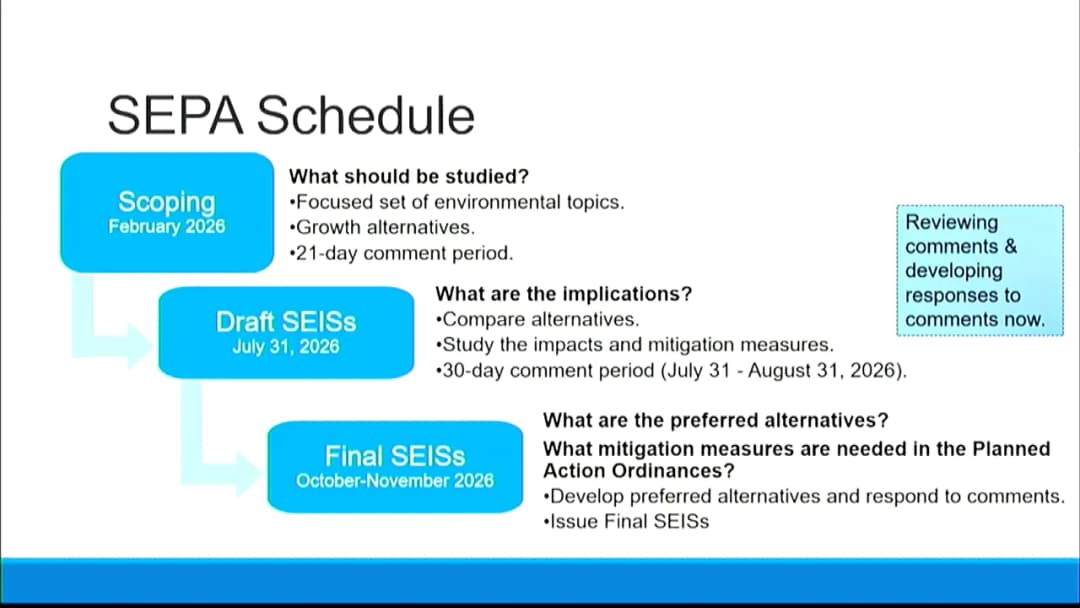
On September 17, 2026, the Shoreline Planning Commission held a regular meeting to discuss updates to the Light Rail Subarea Plans, including policy revisions, draft Planned Action Ordinances, the 185th Zoning Overlay boundary, and a Connectivity Framework. The meeting featured public comments and commissioner deliberations ahead of a scheduled public hearing on October 1, 2026. Consent Calendar - Approval of agenda and minutes from September 3, 2026, accepted as presented. Public Comments & Testimony - Dolapo Martins, a resident near 180th Street and 10th Avenue NE, expressed concern about proposed zoning near the 185th Street light rail station, citing an abrupt transition from seven-story mixed-use to MUR-35’ zoning, inadequate shadow impact consideration, and safety issues from two impaired-driving crashes that struck nearby homes within the past five years. - Dia Dreyer, Shoreline, asked the City to confirm that the Comprehensive Plan update will not supersede the station subarea plans and that Phase 2 zoning will not take effect before 2033, as promised during the 2015 planning process. She also raised concerns that expanding the Planned Action Ordinance boundary and updating the environmental impact statement could allow earlier Phase 2 zoning, and urged that property-maintenance enforcement focus on developer-owned properties rather than existing residents. Discussion Items - Policy Updates: Staff presented revised transportation, community design, parks, and natural environment policies based on feedback from the September 3 meeting. Key changes included adding connectivity through parks, updating references to the 185th Multimodal Corridor Strategy, and a new policy on sports field lighting to minimize light pollution and glare within the 185th station overlay. - Planned Action Ordinance: Staff reviewed the draft ordinance, which replaces existing ordinances and sets development thresholds for each station area. For Shoreline North (185th Station), the ordinance assumes 3,700 additional dwelling units and 2,736 net PM peak hour trips. Mitigation measures include cultural resource protections, multimodal connectivity policy compliance, and noise/light/glare conditions for the 185th overlay. Commissioners discussed parking needs and concurrency with the 185th Corridor project, which is not yet scheduled or funded. - 185th Zoning Overlay: Staff recommended Option 2, a smaller boundary extending north to approximately 192nd-193rd Street, to focus on properties zoned MUR-70’ and better accommodate transit-oriented housing development per HB 1491. Commissioners unanimously supported the smaller boundary, noting it concentrates sports/recreation uses and supports housing near transit. - Connectivity Framework: Staff presented updated maps using a hybrid methodology (buffer overlap and prioritized connections) and added community assets and informal trails. Commissioners requested removing several east-west connection areas: west of I-5 near 195th (where the 195th Street overpass already provides access), south of 148th Station (where a planned bridge may eliminate the need), and blocks adjacent to I-5 on 145th (due to existing large buildings unlikely to be redeveloped). Staff agreed to review and adjust the maps. - Connectivity Implementation: Staff showed illustrative cross-sections (mid-block pedestrian path, alleyway, community courtyard, pedestrian plaza) to be refined in Q1 2027 code amendments. Commissioners noted that the alleyway description should better balance pedestrian priority with operational functions, and that dumpster/operational obstructions should not block pedestrian and bicycle spaces. Developer interviews indicated larger multifamily projects generally did not find connection requirements infeasible, while smaller projects may require flexibility. Key Outcomes - Commissioners directed staff to include the smaller 185th Zoning Overlay boundary (Option 2) in the final draft subarea plan and Planned Action Ordinance. - Staff will remove or adjust specific connectivity priority areas identified by commissioners (west of I-5 near 195th, south of 148th Station, and blocks adjacent to I-5 on 145th) and incorporate flexibility language in the future development code. - The Commission will hold a public hearing on October 1, 2026, to consider the updated subarea plans, Planned Action Ordinances, and related policies. If no agreement is reached, existing Planned Action Ordinances remain in effect until growth thresholds are exceeded.