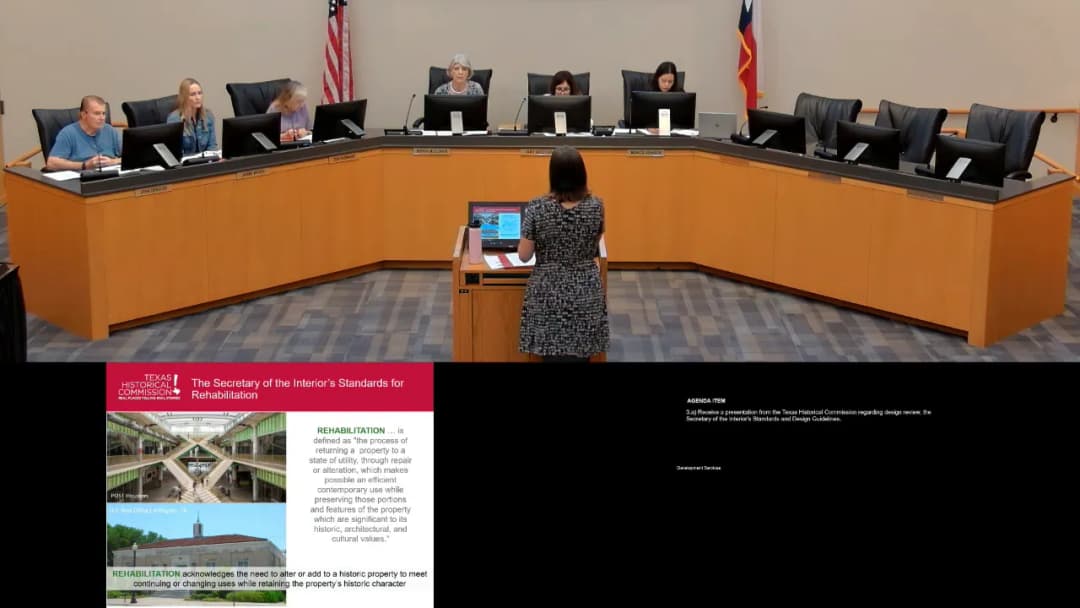
The Weatherford Historic Preservation Commission met on October 28, 2026, at 5:30 PM in City Hall. The commission approved the June 2026 minutes, received a training presentation from the Texas Historical Commission, and adjusted its meeting schedule for November and December 2026. Consent Calendar - Approval of Minutes: The commission unanimously approved the minutes from the June 24, 2026 meeting (4–0 vote). Presentation from Texas Historical Commission Kelly Little, a representative of the Texas Historical Commission, delivered a presentation on design review, the Secretary of the Interior’s Standards for Rehabilitation, and best practices for historic preservation commissions. Key points included: - The Certified Local Government (CLG) program; Texas has 83 CLGs. - Legal basis for local preservation (police power, Fifth and Fourteenth Amendments). - Overview of each of the ten Secretary of the Interior Standards for Rehabilitation. - Tips for commissioners: base decisions on adopted standards, avoid personal preferences, make clear and defensible motions, and avoid ex parte communications. - Resources available to CLGs: NAPC membership, preservation briefs, workshops, and grant funding. Commissioners asked about enforcement for non-designated historic buildings, the use of state and federal tax credits, and how to engage property owners. Ms. Little suggested conducting historic resource surveys, updating design guidelines, and holding informational sessions for property owners. Discussion Items - Meeting Schedule for November and December 2026: To accommodate holidays, the commission moved the November meeting to Wednesday, November 18, 2026, at 4:30 PM (voted, with all five members in favor). For December, the commission will use an email poll to select a date and time, with a possible work session as an alternative. - Future Agenda Items: Commissioner Teri Hubbard requested that the November agenda include discussion of alternatives for a replica historic marker, noting that the $1,600 cost may be high for property owners. Staff will put the item on the agenda. Announcements - Commissioner Hubbard announced the Parker County Historical Commission’s regional conference on Friday, October 29, 2026, from 9:30 AM to 3:00 PM at the Doss Heritage and Museum. The conference includes sessions on historic cemeteries and guided tours of historic cabins. - The Doss Heritage Museum is currently featuring an exhibit on the artwork and historical research of Homer Norris, available through the end of October. Adjournment The meeting adjourned at approximately 6:40 PM.
The Public Meeting Index
The Public Meeting IndexChapel Hill Town Council Work Session on Updated Land Use Management Ordinance - October 28, 2026\n\nThe Chapel Hill Town Council held a work session on October 28, 2026, beginning at 6:00 PM, to discuss the draft Land Use Management Ordinance (LUMO) and recommendations from the Planning Commission. Mayor Jessica Anderson presided. The primary goal was to signal direction to staff on whether to adopt Planning Commission recommendations, keep the draft language as is, or seek adjustments for the upcoming November 18th business meeting. Taz Lagoo, Long-Range Planning Manager, presented staff's assessment of the Planning Commission's recommendations.\n\n Announcements\n- Mayor Anderson expressed gratitude to the Chapel Hill Police Department for their work concluding a trial related to the Hedgepeth family.\n- Mayor Anderson reminded the public that early voting was underway through October 31st, with Election Day on November 3rd.\n\n Discussion Items\n- Location-Based Density Bonuses: Staff recommended keeping all proposed bonuses, including those for proximity to schools and greenways, while the Planning Commission recommended removing the school and greenway bonuses. Council debated whether the criteria were limiting or helpful signals for housing density.\n- Hundred-Year Storm Standard: The Planning Commission recommended applying the hundred-year storm standard to most projects. Staff recommended keeping the tiered system where the standard applies to projects over 40,000 square feet of land disturbance but expressed openness to dialing thresholds.\n- Downstream Impact Analysis: The Planning Commission recommended codifying specific criteria for discretionary downstream impact analyses. Staff recommended keeping the existing flexible language. Council favored the staff recommendation, citing the need for discretion on a case-by-case basis.\n- Tree Canopy Baseline & Minimum Canopy Floor: The Planning Commission recommended a three-year lookback for measuring existing tree canopy and a minimum canopy floor that incentives could not drop below. Staff recommended against both, favoring the existing incentive system and clarifying the state forestry exemption.\n- Cluster Development: Staff presented a revision providing a one-to-one credit for land protected by regulatory requirements and a two-to-one credit for voluntarily protected land. Council supported this revised staff recommendation.\n- Native Trees: The Planning Commission recommended requiring 100% native species immediately. Staff recommended a three-year phase-in period for the 100% native requirement. Council supported the staff recommendation and expressed interest in an ecologically productive species list.\n- Stormwater Management Triggers: Council extensively discussed the Planning Commission's recommendation to use net new impervious surface as the primary trigger, removing land use and number of homes. Council did not finalize a decision, directing staff to analyze this alternative for future consideration.\n\n Key Outcomes\n- Density Bonuses: Council directed staff to retain the draft language with all proposed location-based bonuses (staff recommendation) by a vote of 5 to 4.\n- Hundred-Year Storm Standard: Council adopted a modified staff recommendation, directing staff to lower the threshold for single-family homes from 40,000 to 20,000 square feet of land disturbance to require the hundred-year storm standard.\n- Downstream Impact Analysis, Tree Canopy Issues, Cluster Development, Native Trees: On these items, Council aligned with the staff recommendations over the Planning Commission's proposals.\n- Amendments Process: Council agreed to a formal process for council members to submit amendment interests for staff to draft ahead of the November 18th public hearing.\n- Future Work: Council directed staff to return with an analysis of alternative stormwater management triggers and a broader look at stormwater and tree canopy priorities for a future LUMO work resolution.
The Hampton City Council held a ceremonial session on Wednesday, October 28, 2026, beginning at 6:00 PM in Council Chambers. Mayor Jimmy Gray presided, and all seven council members were present. The meeting focused on recognizing volunteer boards and commissions under the theme Spotlight on Citizen Engagement. No formal legislative actions or votes were taken, and the meeting adjourned at 6:11 PM. Ceremonial Items: Spotlight on Citizen Engagement - Brian Marchese, Marketing and Outreach Coordinator, presented the recognitions. He described boards and commissions as a direct line from residents to city hall and tied the evening to the city's strategic plan priority of excellence in government through resident participation. - Youth Advisory Group: Recognized Gabriella Oliveras, Noah McMillan, and Evan Rone. Marchese noted the group includes young people ages 13 to 19 from across Hampton and creates spaces for honest conversations about diversity and inclusion, as well as planning and running their own events. - Citizens' Unity Commission: Recognized Chair Phylis Porter and Vice Chair Mei Stukes. Marchese said the commission began in 1995 after City Council asked residents to study diversity in Hampton, and that the commission marked its 30th anniversary the prior week. He highlighted its programs, including the Hampton Diversity College and the Unity Awards, which have honored people and organizations since 2000. He also noted that the commission's Diversity College was being held that evening, so some members could not attend. - Senior Citizens Advisory Committee: Recognized Chair Linda Kindred. Marchese said the committee's goal is to make Hampton the community of choice for seniors, guided by the motto SAVE seniors, meaning Support, Acknowledge, Value, Empower seniors. The committee meets on the first Monday of each month at the renovated Hampton Senior Center on Kikitan Road and works with partners including Human Services, the Peninsula Agency on Aging, the Peninsula Foster Grandparents Program, the Community Service Board, and the Hampton Health Department. - Marchese encouraged residents interested in serving on a board or commission to apply at Hampton.gov/boards. Key Outcomes - No formal council votes or decisions were made; the session was purely ceremonial. - Mayor Gray thanked all honorees and affirmed that Council continues to support their work. - Meeting adjourned at 6:11 PM. Note: The minutes spell the senior committee chair's name as Linda Kindred, while the transcript spells it Linda Kendridge. Similarly, the minutes spell the Unity Commission chair's name as Phylis Porter, while the transcript spells it Phyllis Porter.
The City of Deltona Special Magistrate for Code Enforcement convened on October 28, 2026, at 10:45 AM to hear 17 cases, including multiple compliance hearings and two lien reduction requests. The meeting began with roll call, the Pledge of Allegiance, and approval of the previous month's minutes. Several cases were withdrawn prior to hearings. Withdrawn Cases - Six cases were withdrawn: DEL 26081, DEL 26082, DEL 26086, DEL 26084 (with a correction from 86 to 83 for 3510 Patron Avenue), Fire 059 2026, and Fire 060 2026. Cases with Imposed Fines and Continuing Fines - DEL 26028 (927 Lauren Drive): Property came into compliance on September 8, 2026, after 17 days of noncompliance. A fine of $1,700 was imposed (17 days at $100/day). - DEL 26051 (8108-0101010 Avenue East): Fence installed without permit. Noncompliance for 33 days as of hearing date. Fine of $8,250 imposed, continuing at $250/day until compliance. - DEL 26053 ANB (820 Deltona Boulevard): Noncompliance on multiple violations. Fine of $6,600 imposed (33 days at $100/day per violation), continuing at $100/day per violation. - DEL 26056 (2265 Rabbington Road): Noncompliance for 33 days. Fine of $3,300 imposed, continuing at $100/day. - DEL 26057 (2985 Keysler Street): Noncompliance for 33 days. Fine of $3,300 imposed, continuing at $100/day. - DEL 26058 ANB (2289 Remington Road): Partial compliance achieved for Violation A (permit issued). Violation B (closed patio) remained noncompliant. Fine of $8,250 imposed (33 days at $250/day), continuing at $250/day. Property owner Antonio Salais Jr. testified he is a 100% disabled veteran who has spent nearly $10,000 on engineering and permit efforts but faced repeated setbacks. The magistrate acknowledged his efforts but ruled the violation continues. - Fire 044 2026 (1000 Integral Miss Way): Violation C complied; Violation B complied after 11 days (fine $2,200); Violation A remained noncompliant for 33 days (fine $6,600), continuing at $200/day. Representative Lauren Hendry stated that a tamper switch in Building 13 was repaired that day; the city required a report from a contractor to verify compliance. - Fire 061 2026 (2196 Howland Boulevard): Repeat violation for electrical work without permit. Property obtained permit on October 15, 2026, after 24 days of noncompliance. A one-time fine of $2,400 (24 days at $100/day) was imposed due to the repeat offense. New Cases with Compliance Deadlines and Fines - DEL 26071 (Anthony Barnes - fence disrepair): Compliance deadline set for November 27, 2026. Fine of $100/day will begin if not met. - DEL 26076 A&B (927 Lauren Drive - pool enclosure and fence): Two violations. Compliance deadline set for November 27, 2026. Fine of $100/day per violation ($200/day total) will begin if not met. - DEL 26078 (2033 El Campo Avenue - outdoor storage): Compliance deadline set for November 11, 2026. Fine of $100/day will begin if not met. - DEL 26079 (1400 Hayward Avenue - exterior wall disrepair): Compliance deadline set for November 27, 2026. Fine of $100/day will begin if not met. - DEL 26080 (1995 Montfort Lane - right-of-way obstruction): Compliance deadline set for November 4, 2026. Fine of $50/day will begin if not met. - Fire 055 2026 (3296 Graves Avenue - unpermitted break room): Compliance deadline set for November 27, 2026. Fine of $250/day will begin if not met. Lien Reduction Cases - DEL 2217/22178 (2123 Saxon Boulevard): The lien reduction request was continued to the next hearing because the property owner did not appear. - DEL 16245 (829 Westline Avenue - unsanitary pool, 2016 case): Attorney Patrice Scott represented the owner, requesting full abatement of the $10,000 capped fine. She argued the fine was disproportionate to a maintenance violation, the owner received inadequate notice, and the city took no action for nine years after the cap was reached. The city recommended full recovery. The magistrate took the matter under advisement. - Fire 0032 2024 (hair salon work without permit): Property manager Wayne Scott testified that a contractor abandoned the project and the owner was unaware of the outstanding violation until 2026. Compliance was achieved promptly upon discovery. The city acknowledged the owner's responsiveness. The magistrate took the matter under advisement. Key Outcomes - Fines and continuing fines were imposed in eight cases, totaling $41,850 in accrued fines (excluding continuing daily amounts). - Compliance deadlines and prospective fines were set in six new violation cases. - Two lien reduction cases were taken under advisement; written orders are expected within approximately one week. - One lien reduction case was continued due to nonappearance. - All decisions and recommendations are subject to the special magistrate's written orders and, in lien reduction cases, final action by the City Commission.
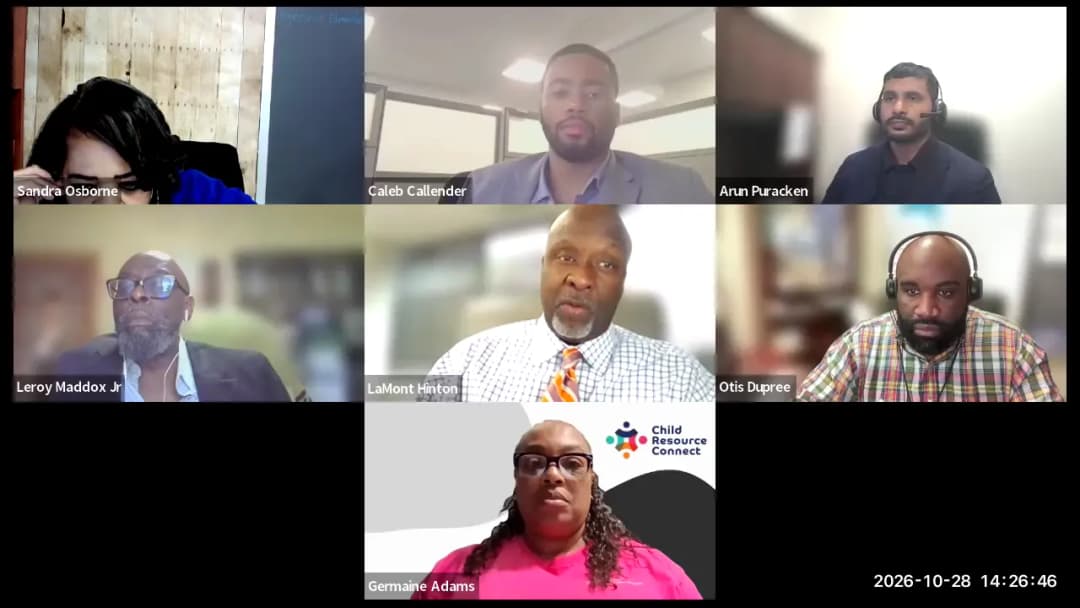
On Wednesday, October 28, 2026, at 2:03 p.m., the Prince George's County Child Care Improvement Work Group met virtually. Dr. Run Perakan, director of the education workforce development committee, convened the meeting; Chair Oriada was absent. The meeting began without a quorum as an informational session, so the agenda was shifted to allow discussion of recommendations and the DPIE presentation before formal action. Quorum was reached later in the meeting. Quorum and Agenda - Roll call was taken, with several members joining after the start. The agenda included consideration of the October 14, 2026 meeting minutes, a presentation from the Department of Permitting Inspection and Enforcement (DPIE), and prioritization of the work group's recommendations. - Because quorum was not initially present, the minutes vote was deferred until later. DPIE Presentation: Child Care Permitting and County Review - DPIE Deputy Director Henson and Chief of Staff Lori Paris presented the county and state permitting process for child care facilities. They described a dual-track process with state requirements and local review, and varying rules for family child care homes (8 and under), large family child care homes (9–12), and commercial child care centers (12 or more). - Presenters emphasized use-and-occupancy permits, licensed contractors, floor and site plans, sprinkler and fire-protection requirements, and early zoning due diligence before purchasing or leasing space. They said a zoning certification letter from the Maryland-National Capital Park and Planning Commission can be obtained for $50, $75, or $100 and typically returns within five business days. - DPIE noted customer-service improvements, a fast-track program for projects 5,000 square feet and below, and willingness to revisit a prior use-and-occupancy work group with Prince George's County Public Schools (PGCPS). - In response to a question about sprinkler-system costs quoted at $20,000–$30,000 for a family child care home, DPIE said costs depend on the building and referred providers to the Prince George's Economic Development Corporation and the Small Business Administration for possible grants or loans. PGCPS Before and After-School Care Recommendation - Dr. Searcy, joined by PGCPS staff Otis Dupree and Sandy Osborne, presented a new recommendation. PGCPS does not operate before- and after-care programs itself; it currently partners with four vendors serving 65 schools. A new RFP to expand vendor-managed child care is expected to be released in the first or second week of November. - The concern is that vendors must wait for PGCPS to receive documentation and approvals from DPIE and other agencies, sometimes as late as July, before starting a licensing process that can take up to 90 days. That delay can prevent programs from being ready for the first day of school. - Dr. Searcy recommended allowing vendors to pursue MSDE licensing concurrently, or allowing vendors to use PGCPS's use-and-occupancy and fire inspection certificates for the same buildings and children. The goal is for families to have before- and after-care available when school starts. - DPIE Chief of Staff Lori Paris said the suggestions could be reviewed for possible code amendments, and Henson noted that an earlier DPIE work group had examined use-and-occupancy issues with PGCPS. Work Group Discussion and Prioritization - Dr. Searcy urged prioritizing the PGCPS facility-approval recommendation, with a goal of being in place by April or May 2027 at the latest for the 2027–2028 school year. She also said PGCPS has grant-writing support for providers seeking to participate in mixed-delivery pre-K, so that may not need to be a work group recommendation. - Brianna Meadows, a new family child care provider, described difficulties finding buildings zoned for child care and expressed interest in expanding and in becoming a mixed-delivery pre-K provider. PGCPS said an MSDE grant is typically released in January or February and that support is available for eligible providers. - Alejandra urged the group to treat county-level initiatives, such as the child care facility grant and the scholarship for Prince George's County families passed earlier in the year, as priority work and to accelerate their rollout. - A participant with licensing experience advised school-based providers to notify regional offices early and begin MSDE applications in January rather than waiting until late summer, noting that licensing specialists face heavy caseloads and required inspections in August and September. - Caleb described CB 35 as legislation promoted by Chair Oriada that increases child care access by eliminating special-exception approval for day care centers in all zones, removing minimum parking requirements in transit-oriented zones, and allowing alternative parking compliance in other zones. Key Outcomes - The October 14, 2026 meeting minutes were approved by roll-call vote after quorum was reached; no nays were heard. - The work group agreed to continue refining and narrowing its recommendations, with attention to implementation steps, resources and costs, success measures, and county-level actions. Staff will reach out to individual members for input before the next group discussion. - The next Child Care Improvement Work Group meeting is scheduled for Thursday, November 12, 2026, at 2:00 p.m., instead of the usual Wednesday because of the November 11 holiday. - The meeting was adjourned by voice vote after a motion and second.
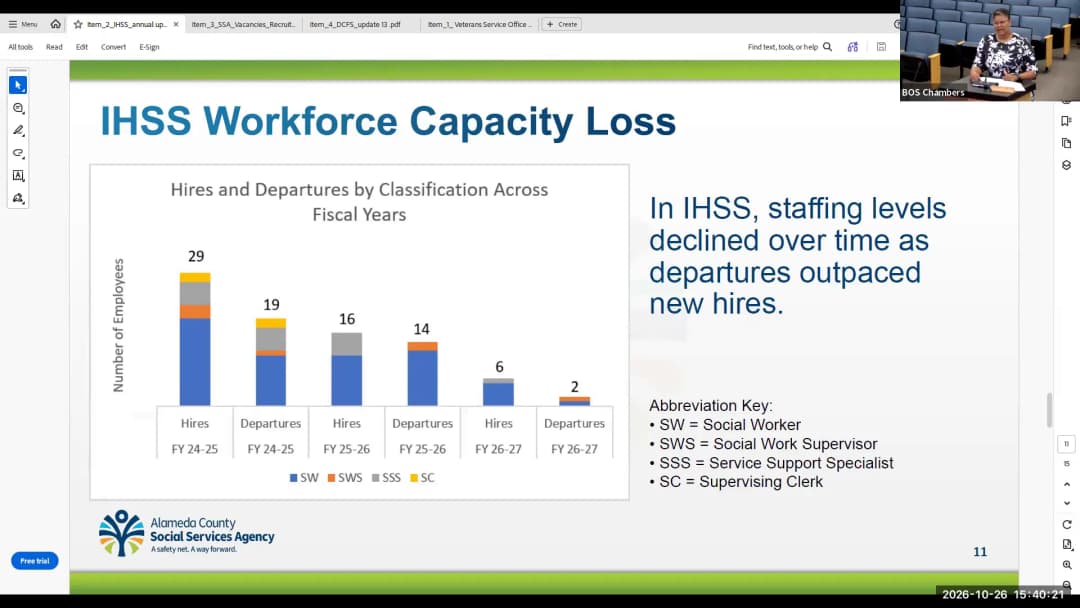
The Alameda County Board of Supervisors Social Services Committee convened with Chair Lena Tam and Supervisor Nikki Fortunato Bas present, constituting a quorum. The agenda and transcript list the meeting as Monday, October 26, 2026, at 2:30 p.m., while the supplied meeting timestamp is October 28, 2026, 10:30 UTC; this summary uses the required date of October 28, 2026. No minutes were available. All four agenda items were informational, and no formal votes were taken. Public Comments & Testimony - County Veterans Service Office update: no public speakers. - In-Home Supportive Services update: Velma Gaye, a 61-year-old permanently disabled tenant at Depot Community Apartments, expressed concern that people moving from street encampments, shelters, and transitional housing into new affordable housing are not connected with IHSS providers in advance. She said this operational gap has contributed to deaths, drug use, bed bug infestation, and habitability problems in her building, and she asked where IHSS workers are. Staff offered to connect her with Nicole Hayes for follow-up. - Social Services Agency vacancies update: no public speakers. - Department of Children and Family Services update: Melody Davis raised concerns about labor problems involving social workers and staff, referenced policy and procedure work with the sheriff’s department, and asked how many state audit recommendations have been completed and who oversees implementation. Michelle Love responded that the state’s assessment is still pending, the county believes audit items were completed, and items not fully completed or sustained are incorporated into the corrective action plan. Discussion Items County Veterans Service Office (CVSO) Annual Update - Anthony Simpson, County Veterans Service Officer, reported on the CVSO’s new main office in Hayward, relocated around February 17–19, 2026; Eastmont and Fremont remain appointment-based satellite locations on Thursdays and Tuesdays, respectively. He said clients and staff respond positively to the new location, and signage on Foothill Boulevard was installed about two months ago. - The office has focused on specialized benefits training, including total disability individual unemployability, special monthly compensation, discharge-related documents, debt management and waivers, dependency and indemnity compensation, survivor’s pension, and veterans’ readiness and employment. - Outcomes reported: more than 254 college fee waivers processed and more than 9,200 veterans served. Visitors grew from over 5,000 in FY 2021-22 to 9,200 in FY 2025-26. Simpson attributed the growth to outreach, increased public awareness, economic need, and the PACT Act of 2022. - He shared a case example of a Vietnam veteran whose monthly compensation rose from about $2,300 to more than $4,700 tax-free after moving from an 80% to a 100% permanent and total rating, including special monthly compensation and property tax exemption. - Future plans include a virtual office, a countywide newsletter, targeted outreach, continued use of the VA mobile team, stronger coordination with IHSS and workforce programs, CalVet legal brief assistance, and correction of clear and unmistakable errors. - In follow-up, speakers noted that the virtual office has been a significant tool in Contra Costa County and could increase claims once implemented in Alameda County. In-Home Supportive Services (IHSS) Annual Update - Nicole Hayes and Hue Giang presented the IHSS and Public Authority annual update. The Public Authority recruits and supports providers, administers provider-related programs, and is the employer of record for collective bargaining. - A client story was shared in which a social worker helped a double-amputee, wheelchair-bound client reactivate lapsed CalFresh benefits, connect to an IHSS provider through the Public Authority, complete a reassessment, and avoid institutionalization. - Demographics: 35,671 IHSS recipients, with 41% in Oakland, 12% in Hayward, and 10% in Fremont; 61% were seniors 65 and older, 31% adults 18–64, and 8% minors. Reported recipient demographics included 22% Chinese, 12% Hispanic, and 1% Cambodian; 55% spoke English, 16% Cantonese, and 8% Spanish. - IHSS providers totaled 35,495; 69% were female and 31% male; 64% spoke English and 10% Cantonese. More than half of providers were family members, 6% were parents of minor children, and 6% were friends. - The enacted FY 2026-27 state budget rejected major IHSS reductions, including elimination of the backup provider system, ending eligibility with Medicaid, and shifting IHSS growth costs to counties. The federal administration is withholding $1 billion from California, and 28 counties, including Alameda, are subject to CMS audits. - Telehealth reassessment was implemented early in July 2025, but adoption has remained low. Alameda County is ahead of state eForms deadlines: intercounty forms and quality assurance reviews are required by July 1, 2026, and recipient/provider case files by January 1, 2027. - Pending technology projects include a phone/voice response upgrade, self-service scheduling for about 3,000 monthly appointments, AI-assisted case narratives, and BOUNDS portal enhancements for provider enrollment. - Audit results included 90–100% in nine areas, but initial assessment timeliness was 75% and combined CFCO/non-CFCO reassessment compliance was 42.86%. The county was removed from the CFCO QIAP in August 2026 and is currently at 99% CFCO compliance, while non-CFCO reassessments are at 70.32% and timely applications at 69.696%, below the 80% minimum target. - Workload: IHSS applications have increased 19% over two fiscal years to nearly 800 per month. Social workers have carried caseloads in the 500–600 range, versus a realistic 300. Alameda County has 92 IHSS social workers (29 intake, 63 case-carrying) and, by comparison, has the highest overdue assessments and highest average caseloads statewide; Sacramento has 171 social workers and about 30% more recipients, and San Francisco has 18 more social workers while serving fewer recipients. - Alameda County paid more than $2.1 million in CFCO penalties last fiscal year, described as equivalent to 10 social worker positions; counties are now 100% responsible for penalties. First-quarter FY 2026-27 penalties were $48,200. Staffing has declined from 125 to 92 social workers and from 75 to 57 service support specialists, with departures outpacing hiring. - A phased staffing plan was presented: Phase 1 would restore 10 funded and 23 unfunded social worker positions and 3 funded and 15 unfunded service support specialists plus supervisors; Phase 2 would add about 25 more social workers and additional support staff to reach roughly 150 social workers. - In discussion, overdue assessments were defined as exceeding 12 months. Director Andrea Ford said the county administrator’s office has been engaged about funding additional IHSS social workers; a training joint-powers agreement with Los Angeles and Santa Clara counties has signed articles of incorporation, with a funding decision still pending. Social Services Agency Vacancies, Recruitment, and Retention - Sharon Moore, Chief Departmental Human Resources Administrator, reported that the agency has 109 classifications (59 unique to Social Services), 2,151 budgeted positions, 208 vacant full-time-equivalent positions, and a vacancy rate of 8.8%, excluding TAP employees. - Hiring totals: 346 employees hired in FY 2025-26 and 137 hired from July through October 2026. Child welfare worker vacancies were reduced to 4.4%. In October 2026, 196 eligibility service technician candidates were interviewed, producing an eligibility list of about 180 people, with about 80 expected to start in January. - Separations continued across FY 2025-26 and FY 2026-27. Workforce demographics for the largest classifications: 259 child welfare workers with attrition near 8%, and 92 social workers with attrition slightly above 8%. - Hard-to-fill classifications are identified by vacancy rates over 10%, lengthy recruitment, and limited eligibility lists. Child welfare workers and social workers are on the employee referral incentive program; eligibility service technicians and adult protective services workers also warrant focused recruitment, although eligibility technician recruitments draw many applicants. - Recruitment and retention challenges include applicant pool limitations, competition from neighboring counties and the private sector, Alameda County’s cost of living, and retention after training, with eligibility technician roles sometimes used as a stepping stone. - In discussion, Moore did not have a comparison of vacancy rates with peer counties and agreed to provide one. Ford noted recent SEIU negotiations included comparative salary work with counties such as Santa Clara and that some hard-to-recruit positions are now above the median. Department of Children and Family Services Status Update 13 - Michelle Love provided the 13th update on the department. The county submitted its Corrective Action Plan (CAP) to the California Department of Social Services on October 1, 2026; implementation is anticipated to begin January 7, 2027, with completion projected by December 31, 2028. A new statewide child welfare database begins December 7, 2026. - Love explained the CAP is a targeted, two-year plan addressing front-end referral investigation timeliness and documentation, while the System Improvement Plan (SIP) is a broader five-year process that is board-approved and rolled up into the state’s federal performance plan. The CAP includes 10 action steps and six longer-term steps to be folded into the next SIP. - Key CAP work includes front-end emergency response practices, structured decision-making reviews using case readings with Evident Change, relative engagement, and a communications plan to be developed over the next six weeks. A continuous quality improvement process is built into the CAP. - SIP accomplishments since 2024 include a permanency guide, permanency-related policies and referrals, an FFE provider, internal process mapping, increased staffing, and improved court report documentation, including for siblings placed apart. - Foster care data as of October 11, 2026: approximately 620 children ages 0–17 in care, with the majority placed with relatives; about 118 in foster family agencies, 113 in county resource family homes, 39 in short-term residential therapeutic programs, 24 in small family homes, and 15 in group homes. Non-minor dependents ages 18–21 average about 275–290. - Emergency placement capacity: the transitional shelter care facility can currently serve up to six children, with eventual capacity for 10. Emergency STRTP placements and RFA emergency beds are being used to maintain compliance, including the state’s 72-hour limit for transitional shelter care. - In discussion, Love said the dashboard’s roughly 24% increase in open referral investigations since January reflects pending closures, including about 600 cases affected by a recent union agreement; she expects the number to fall as new staff close cases. New child welfare workers complete the required 10-week state training plus an 8-week on-the-job training, and first immediate referrals are assigned after about 2.5 to 4 months, consistent with peer counties. - The board sought monthly CAP updates to monitor progress. Love said the CAP is still a working document and CDSS edits are expected before January. Baker Tilly’s root-cause analysis feedback is expected mid-January 2027. Key Outcomes - No formal motions or votes were taken; the committee received all four informational updates. - The committee requested that SSA provide a peer-county vacancy rate comparison and continue working with the county administrator’s office on funding for additional IHSS social workers; board involvement may be considered if funding is not otherwise secured. - DCFS will continue monthly/ongoing status updates during CAP implementation, with the next milestones including the new database on December 7, 2026, CAP implementation on January 7, 2027, and Baker Tilly feedback in mid-January 2027. - Staff will follow up with the IHSS public commenter, Velma Gaye, regarding conditions at Depot Community Apartments. - Informational milestones to track: IHSS eForms statewide deadlines (July 1, 2026 and January 1, 2027), the IHSS phased staffing request, and the CAP completion target of December 31, 2028.
The Code Enforcement Board of Miami, Florida, convened on October 28, 2026, at 10:15 AM to address administrative matters and hear cases related to code violations. The board approved the 2027 meeting calendar, excused an absent member, and heard 17 cases including extensions of time and requests for mitigation of fines. New board member Jason Manowitz was welcomed. Discussion Items Extensions of Time (EOT) - Seven cases were granted 120-day extensions to allow property owners to complete compliance work. Cases included 2631 NW 23rd Ct, 2628 NW 23rd Ct, 3031 NW 11th St, 4926 SW 7th St, 729 NW 55th Ter, 2479 NW 34th St (initially requested 60 days but board granted 120), and 761 NW 29th St. In each case, the city recommended 120 days, and the board voted unanimously to approve. Mitigations - 2320 NW 24th Ave (single-family, non-homestead): Lien of $309,750. After a failed motion to reduce to $5,000 (2-2 vote), the board reduced the fine to $3,000 on a second motion. - 80 NW 45th St (single-family, non-homestead, short-term rental): Lien of $791,000. The board reduced to $15,000, treating the violation as commercial due to rental activity. The owner's representative described the owner as having been misled by the prior seller and having stopped renting immediately upon discovering the violation. - 350 NW 45th St (single-family, non-homestead, now vacant lot): Lien of $725,100. The board reduced to $7,500, noting the owner had demolished the structure and obtained permits for new construction. - 30 NW 17th Ave (two cases, same property): Two liens totaling $591,500 and $638,500. Each reduced to $15,000. The property was vacant and undergoing 40-year recertification. - 1436 SW 5th St (commercial): Lien of $158,250. Reduced to $15,000. The owner's attorney explained a property manager mistakenly believed a certificate of use was not needed. - 45 SW 63rd Ave (homestead): Lien of $519,900. Reduced to $0 by unanimous vote. The owner bought the property with existing violations and took time to obtain financing; all violations were now corrected. - 7622 N Miami Ave (single-family, non-homestead, corporation): Lien of $1.7 million. Reduced to $10,000. The owner purchased in 2009 with violations and had difficulty due to inspector miscommunication. - 508 NE 67th St (vacant lot, originally single-family): Lien of $194,000. Reduced to $2,500 after a failed motion to reduce to $5,000. The property had a fire and was demolished; the owner was selling the lot. - 1642 SW 8th St (commercial): Lien of $515,000. Reduced to $15,000. Compliance was achieved after code changes and COVID delays. - 1700 NW 18th Ave (duplex, homestead): Lien not specified. Reduced to $0 by unanimous vote. Violations were for work without a permit and a tree permit issue. - 1222 NW 59th St (two cases, single-family, now vacant): Initially proposed $7,500 each, but upon discovery that the property had a structure at the time of violation, the board reversed the previous motion and reduced each to $1,000. The owner had paid other fines and liens. - 382 NW 24th St (commercial): Lien of $28,000. Reduced to $5,600 (20%), the statutory minimum for commercial. Compliance occurred during COVID. - 2337 NW 5th Ave (commercial): Lien of $514,500. Reduced to $15,000. The owner discovered the violation during a title search and immediately complied. - 420 NW 45th St (single-family, non-homestead): Lien of $43,750. Reduced to $0 because the city acknowledged a notice issue; the board concurred. - 3161 NW 2nd St (single-family, lost homestead exemption due to divorce): Lien of $116,500. Reduced to $0 by unanimous vote. The board advised the owner to reapply for homestead exemption. - 528 SW 6th St (commercial): Lien of $624,000. Reduced to $15,000. The owner discovered the lien during refinancing; the board noted cities had provided proper notice to the registered agent. - 154 NE 58th Ter (duplex, non-homestead, corporation): Lien of $528,000. Reduced to $2,500. The owner demolished the structure and was stuck with a mortgage; the board considered her financial hardship. Key Outcomes - The board approved the 2027 meeting calendar and excused board member Keon Williams. - All EOT requests were granted exactly as recommended by the city (120 days) unless the owner requested less. - Mitigation results ranged from full reduction to $0 (in three cases) to statutory minimums ($10,000 for non-homestead residential, $15,000 for commercial, $10,000 for single-family, etc.) with some cases going below minimum by unanimous vote. - The board demonstrated flexibility in cases involving notice errors, pandemic delays, and properties purchased with pre-existing violations.
The Office of the Chief Judge presented its fiscal year 2027 budget to the Cook County Board, outlining a $386.5 million general fund request (a $24.5 million increase from FY26) and highlighting progress in staffing, operations, and services across the circuit court. Chief Judge Beach emphasized efficiency, transparency, and fairness, and fielded questions from commissioners on domestic violence courthouse hours, interpreter services, electronic monitoring, juvenile detention, and other initiatives. Budget Overview - Total FY27 general fund: $386.5 million, a $24.5 million increase from FY26, largely in salaries, benefits, and additional FTEs. - Anticipated revenues: $2,450,000 from the Office of the Public Guardian (up $50,000), $80,680,967 in reimbursements from the AOIC and Office of Statewide Pretrial Services (up $4.5 million), and approximately $18 million in grants (down $1.7 million). Staffing and Personnel Improvements - Non-judicial staff vacancies reduced by over 57% across the circuit court. - New leadership positions created: Trial Court Administrator (Justice Leroy Martin) and Ombudsperson (Veronica Claudio). - Juvenile services leadership overhauled: Director Sarah Hemeter, JTDC Superintendent Mac McGee, Chief Juvenile Probation Officer Melissa Spooner. - Interpreter services: All full-time Spanish interpreter vacancies filled for the first time in years; budget includes new FTEs for two Russian and two Arabic interpreters. Certification requirement relaxed but must be obtained within 18 months of hire. - JTDC youth detention specialist vacancies reduced from 32 (June 2025) to 8 (October 2026), resulting in a 20% decrease in overtime spending. Juvenile Services and JTDC - The Chief Judge described changes at the Juvenile Temporary Detention Center (JTDC) including a new laundry process, progress toward PRIA safety standards, and a pre-evaluation by the John Howard Association (final report expected February 2027). - Programming funds were secured through overtime savings, shifting from reliance on external volunteers. - The SORA Center shelter care contract with Heartland ends November 30, 2026; the OCJ is in conversations with multiple alternative providers. - An independent assessment by the Annie Casey Foundation (Catalyze Justice) is underway, examining safety, security, programming, and youth and staff perspectives. An initial visit found no safety issues. Domestic Violence Courthouse - Commissioner Daly asked about recommendations from the domestic violence committee. Chief Judge Beach detailed new extended hours: in-person at the courthouse until 6 p.m. (currently 4:30), supplemented by fully remote hours until midnight, Monday through Friday, with existing remote hours on weekends. The change requires additional judges and court administrators, but the Chief Judge noted such resources are a zero-sum game across divisions. - An RFP for after-hours advocacy resulted in Family Rescue joining the existing network. - The shift to stalking no-contact orders from 555 West Harrison to the Daly Center was also noted. Electronic Monitoring and Probation - Commissioner Bridge asked about the transition of electronic monitoring (EM) from the Sheriff’s office. The Sheriff still handles about 100 cases; the transfer has begun and is expected to be mostly complete by the end of FY27. Chief Judge Beach expressed interest in eventually moving all EM to the state's Office of Statewide Pretrial Services (OSPS), as done in over 80 other counties. - OSPS funding increased by $4.5 million, offsetting a $3.7 million reduction in other grant resources. - Adult Probation initiatives: increased cognitive behavioral interventions (over 170 referrals in FY26), a partnership with Chestnut Health Systems for substance use treatment screening (200+ screened, 100+ eligible), distribution of over 2,000 Narcan kits and 8,600 one-day venture passes, and expanded partner intervention programs. - Commissioner Treter asked about a shift in FTEs under home confinement; Chief Probation Officer Megan Volker explained it reflects contractual titles due to new hires, not a reduction in positions. Other Initiatives - Jury utilization in the First Municipal District improved from 13% (January 2026) to 69% (mid-October 2026) while reducing the number of judges assigned, achieved through data analysis. - Pro se assistance desks expanded, particularly at the Markham Courthouse. - The OCJ is exploring digitization of court documents to expedite jail release times, but the Chief Judge noted that judges typically issue orders on the bench and that delays often stem from the clerk’s key-punching process. An EMIT pilot program is being developed to automate the order system. - The Empower app for domestic violence survivors saw a 197% increase in uptake since January, and the Chief Judge is working with advocates and the State’s Attorney’s office to further expand use. Commissioner Questions and Responses - Commissioner Day: Followed up on domestic violence courthouse hours and interpreter services. The Chief Judge noted the challenges of judge allocation but committed to using data to reallocate resources. On interpreters, he cited technology allowing remote interpretation to reduce burdens and mentioned a pipeline committee. - Commissioner Bridge: Asked about EM transition and caseload increases due to new charging decisions by the State’s Attorney. The Chief Judge confirmed an increase in detention hearings, which extend court hours. He also confirmed that the board has no authority over circuit court judges. - Commissioner Kevin Morrison: Expressed appreciation and had no questions. - Commissioner Hagler: Thanked the Chief Judge for addressing EM concerns. - Commissioner Morita: Praised language access improvements at the Skokie Courthouse and the first ADA courtroom, and noted the courthouse’s community role. - Commissioner Vasquez: Asked about the JTDC independent review (scope to be finalized in December, includes safety, staffing, programming, and external perspectives) and digitization of court documents to speed jail releases. The Chief Judge invited her to observe first appearance court and discussed the EMIT pilot. He also noted no data is currently collected on remote appearances, but tracking will begin. - Commissioner Nye (in closing): Noted previous discussions and asked about the Empower app. The Chief Judge reported the 197% uptake increase and upcoming collaboration with the State’s Attorney. Key Outcomes - No formal votes were taken during the hearing. - The Chief Judge committed to: - Further updates on domestic violence courthouse hours and implementation timeline. - Sharing final JTDC assessment reports from the John Howard Association and Annie Casey Foundation. - Continuing the EM transition from the Sheriff and exploring a shift to OSPS. - Working with commissioners on data-driven resource allocation. - Commissioners expressed support for the Chief Judge’s efforts and requested ongoing communication on these initiatives.
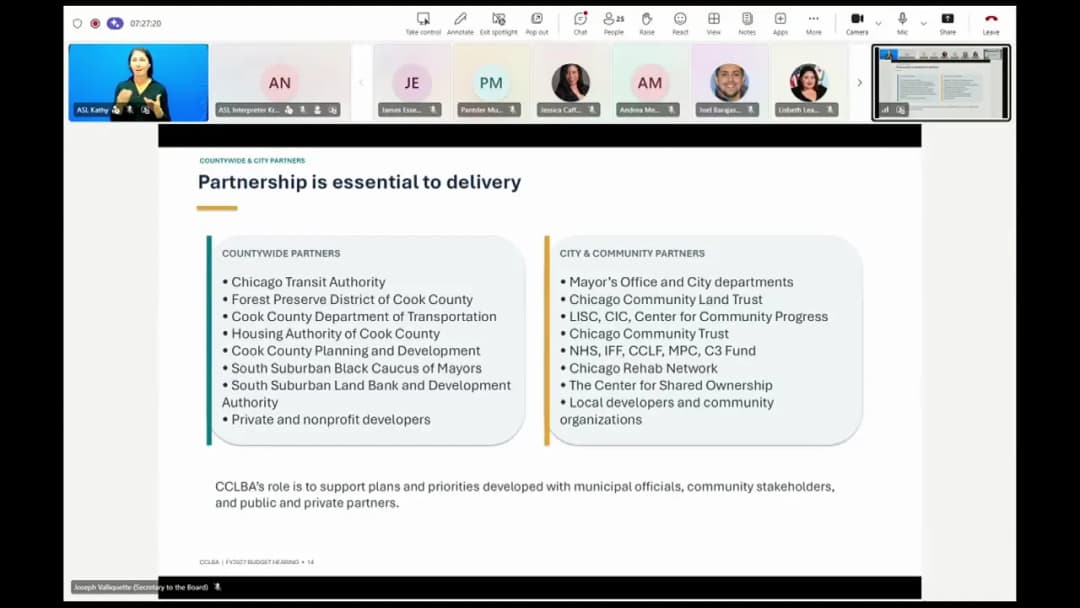
Executive Director Jessica Caffrey presented the Cook County Land Bank's proposed FY2027 budget of $14.5 million, a $652,000 reduction from the previous year. The hearing covered the land bank's achievements, revenue trends, and plans to address over 38,000 long-term tax-delinquent properties. Commissioners asked questions about inventory, partnerships, affordable housing, and new reactivation initiatives. Discussion Items - Budget Overview: The FY2027 total appropriation is $14.5 million (down from $15.2 million in FY2026). Cook County's appropriation adjustment decreased from $3.5 million to $2.6 million, based on a three-year rolling average of penalties and fines. Equity funds from FY2026 are carried over and will be spent down in FY2027. The IDA (Illinois Housing Development Authority) strong communities grant of $750,000 is pending, so it is budgeted at $0. The property maintenance line (landscaping, snow removal, board-ups) remains consistent year-over-year at about $6.5 million for 1,800+ properties. - Operational Impact (2013–present): Since 2013, the land bank has acquired over 5,000 parcels, sold over 3,500, and rehabbed over 2,600 across 76 municipalities and 61 Chicago neighborhoods. This generated $38.5 million in property tax revenue, $330 million in community wealth, and $38 million in delinquent taxes redeemed through notice actions. A 10-year economic impact report estimated $1.8 billion in total economic impact, with a 77-cent benefit per $1 of public-private spending. - Revenue & Sales: Primary revenue sources are traditional property sales, municipal sales, land banking agreements, and tax reimbursements. As of October 27, 2026, revenue stood at $7.32 million, in line with FY2024 ($7.29 million). FY2025 was the strongest year since 2018 at $9.64 million. FY2027 revenue is budgeted conservatively at $7 million, slightly below the three-year average of $8.08 million. Sales depend on market conditions and closing timings; inventory consists of very low-valued properties. - Developer Network & Vendors: The land bank works with over 1,400 unique developers (small, local contractors often working in their own neighborhoods) and 19 vendors for property preservation. Each sale includes a rehab requirement, deed restriction, and soft second mortgage. Annual developer recognition events cover the west side, south side, south suburbs, and west suburbs. - Inventory & Acquisition Strategy: Current active inventory is about 1,800 properties. The annual acquisition volume is constrained by budget (the largest expense is property preservation). The land bank acquires properties for market viability, community strategy, municipal requests, long-term tax delinquency, and to align with public investments (e.g., City of Chicago's Missing Middle program). The goal is to keep inventory stable around 2,000 properties. - FY2027 Commitments: Minimum targets: 300 acquisitions, 500 dispositions (which reduces inventory and holding costs), $30 million in community wealth, 80% of homes going to homeownership, 90% of acquisitions in priority/low-to-moderate-income areas, 30 purchase assistance grants, a 15% reduction in age inventory (properties held over two years), and four community outreach events. In FY2026, the land bank sold 302 age-inventory properties (18.82% of that category), exceeding the 15% goal. - Opportunity – Over 38,000 Long-Term Tax-Delinquent Properties: There are more than 38,000 properties left unsold from 2021/2022 tax sales. Recent state laws (2023 and 2026) ended mandatory scavenger sales and addressed the Tyler v. Hennepin Supreme Court decision. The county, under President Preckwinkle, is developing a new reactivation mechanism with the Civic Consulting Alliance (CCA). The land bank will not hold 38,000 properties; most will pass through an auction process. For FY2027, the implementation phase is within the budget request. Requirements: auction system with clear rules, technology to track tens of thousands of parcels, legal capacity for deeds, and agreements with municipalities, the city, the clerk, the treasurer, and the president's office. A pilot program is planned before full-scale operations. The added costs at full scale (auction, legal, technology, holding costs) will be brought back to the board later. - Partnership Examples: (1) Rebuild 2.0 with Chicago Department of Housing: transferred 33 vacant homes in Englewood and Roseland; community lenders (Chicago Community Loan Fund, Greenwood Archer Capital) financed local developers; homes sold to owner-occupants with a $20 million IDA grant. (2) Austin Hope Center: vacant lots became a 25,000 sq ft facility with pediatric care, mental health services, youth programs, and community space, developed by Stone Community Development Group and Chicago Neighborhood Initiatives. The land bank is also closing on homes in Roseland with the Hope Center Foundation. - Commissioner Questions: - Commissioner (unidentified): Asked about the ratio of land bank to city-owned lots and whether the land bank can get a share of the 38,000 properties. Caffrey explained that the land bank only takes inventory it can afford to maintain (around 2,000 active properties). The 38,000 are not yet in inventory; the new process will assemble them. Collaboration with the city through joint RFPs is being explored. - Commissioner Dagner: Praised the land bank's charrettes and asked about a $1.25 million reduction in professional services on page E6. Daniel Taylor clarified that the reduction includes carryover equity funds from FY2026; the professional services line actually decreased from $450,000 to $404,000. - Commissioner (another): Asked for clarification on the 38,765 properties – not all are vacant. Caffrey stated that 60% of the 38,000 are vacant land (no structures). The land bank does not take occupied residential properties; a separate pilot program (with Bureau of Economic Development) aims to keep 100 families in their homes. Discussed the new auction process: after the auction, if no bid meets the total taxes/debt, the property can go into land bank inventory and be sold without surplus equity concerns. Surplus equity would be returned to former owners when required. Legal details are still being worked out with judges and CCA. - Commissioner (same): Asked about FY2027 goals – they appear to be new goals. Caffrey confirmed they are new; previous goals were met except acquisition targets (due to a 75-step deed process). Also noted that the IDA grant of $562,000 (state) has been fully expended; the pending $750,000 for FY2027 is not yet announced. - Commissioner (8th District): Commented on the website's improved user-friendliness and asked for more suburban/south suburban community partners. Caffrey noted existing partnership with South Suburban Land Bank and willingness to do more. The commissioner also requested that the 8th district be considered for future acquisitions, especially in its lower-income south end. Caffrey agreed to meet and discuss tax-delinquent areas. - Other commissioners: Expressed appreciation for the land bank's work and staff responsiveness. Commissioner noted enforcement follow-through by land bank staff on developer maintenance. Key Outcomes - The board did not take a vote on the FY2027 budget request ($14.5 million) during the hearing. The meeting was recessed until 9:30 AM the following day (October 29, 2026) for a finance committee with the Cook County Sheriff and a board meeting at 9:30 AM. - Several commissioners requested follow-up meetings with the land bank to discuss district-specific properties, affordable housing strategies, and partnerships. - The land bank will continue working with CCA and judges to finalize the auction and reactivation program, with a pilot expected to inform full-scale operations.