Browse by city
Date range
Search help

Search titles, summaries, topics and stored transcripts together. Keywords may match separately; put the whole query in double quotes for a phrase. Matching follows word analysis, so punctuation is not exact. Both dates are included. Documents are not searched.

SHOWING 6071–6080 ENTRIES
6071
SEP 14, 2026 · SHERIDAN, WYOMING · CITY COUNCIL
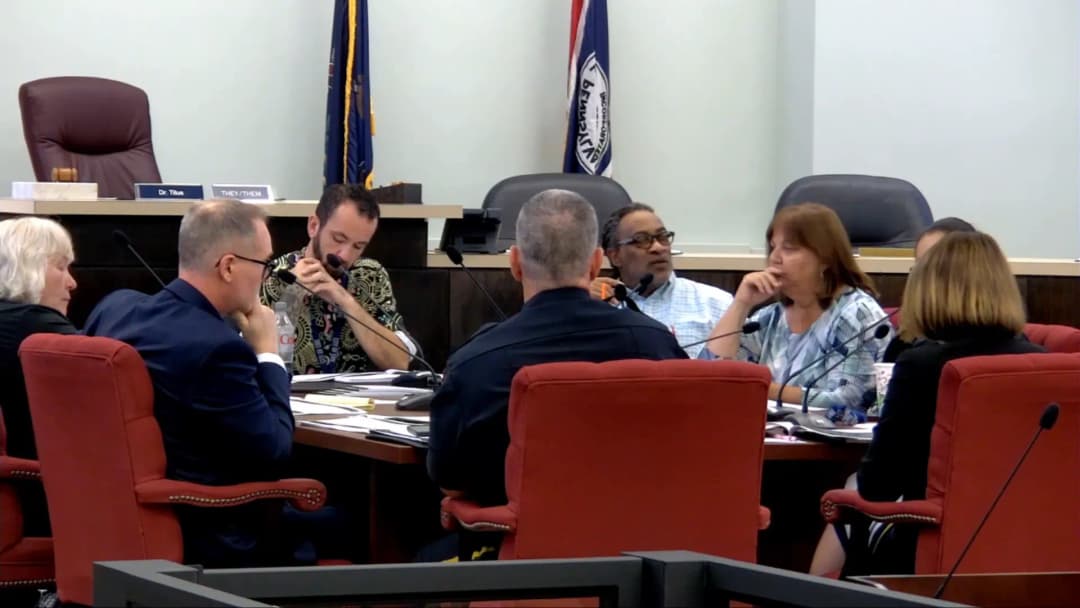
Sheridan City Council Study Session - September 14, 2026

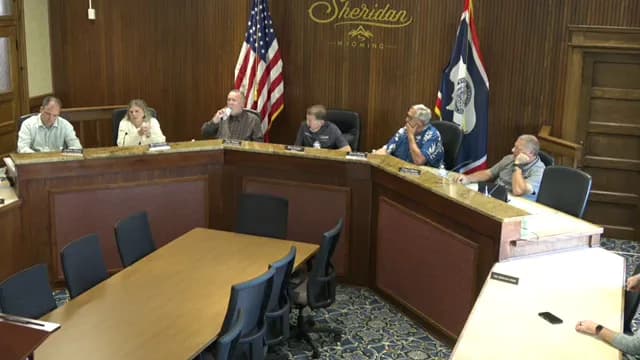
The Sheridan City Council held a study session on September 14, 2026, beginning at 5:30 PM and concluding at 6:13 PM. The meeting covered seven agenda items including vehicle purchases, a crushing project, a diagonal parking resolution, a subdivision, and a water/sewer capacity update. No formal votes were taken; recommendations will be considered at a subsequent regular meeting. Introduction of New Staff - Mayor Stu introduced Anna Lisa Johnson as the replacement for outgoing staff member Kaylin. Johnson expressed her honor and commitment to learning from the council. Discussion Items - Bid Award – Police Vehicles (Item 1): Fleet coordinator Heather Kaplinski presented a bid award to Fremont Motor Company (Lander) for three 2027 Dodge Durango Pursuit AWD vehicles at $125,544. Outfitting (camera, radio, radar) is estimated at approximately $28,000 per vehicle, funded by GPET from the PD fleet account. The vehicles will replace a 2015 Ford Taurus, a 2018 Dodge Charger, and a 2019 Dodge Charger. Staff recommends approval at the next meeting. - Bid Award – Trucks (Item 2): A bid award to Laramie Peak Motors (Wheatland) for three trucks: a half-ton for the fire department ($56,853), a three-quarter-ton for the landfill ($56,085), and a one-ton for the street department ($63,584), totaling $176,512. All were within budget and will replace vehicles from 2007, 2005, and 2008 respectively. Staff recommends approval. - Bid Award – Crushing Project (Item 3): City engineer Thomas Marneau presented a bid award to Wagner Ranch Services for the 2026 crushing project at the landfill for $64,125. The project will crush 5,500 cubic yards of concrete and asphalt (approximately 6,600 tons) into one-inch aggregate for city use, saving roughly $118,000 compared to purchasing equivalent material. Funded by GPET. Staff recommends approval. - Diagonal Parking Resolution (Item 4): A resolution to allow diagonal parking on the west side of North Connor Street, adjacent to a six-unit apartment development at 260 East Brundage Lane. The developer will fund five diagonal parking spaces and a sidewalk easement. Staff recommends approval of the resolution. - Allison Minor Subdivision (Item 5): Planner Kelly Schroeder presented a subdivision of Lot A into two lots (0.91 and 0.90 acres) zoned B1, intended for future multifamily development. No public comments were received; staff recommends planning commission approval and council approval next week. - Water and Sewer System Capacity Update (Item 6): Utilities Director Dan Roberts provided an update distinguishing system capacity from water availability. The water system has capacity for approximately 5,359 additional equivalent dwelling units (over 39 years), and the sewer system for 3,524 units (over 26 years). He explained that drought conditions affect availability but are managed through the drought response plan, last exercised in 2006. Councilmembers asked about drought resilience; Roberts noted that domestic supply is secure and that restrictions target non-essential irrigation. The city is exploring Lake Desmet as a secondary water source. Other Business and Reports - Councilmember Patzak reminded attendees of the September 19th Miss Indian America events (presentation at the museum, plaque dedication at the fairgrounds, and trail walk at the arboretum). - A councilmember reported that no e-bike rentals exist in town due to high liability insurance costs. - A councilmember requested the installation of dog waste bag holders downtown (currently only available on trails). - A councilmember requested a comprehensive fleet presentation from Heather Kaplinski to review fleet composition and replacement cycles. - A councilmember requested a recycling presentation to address public rumors that recyclables are being landfilled. Dan Roberts clarified that plastics 3-7 and glass currently lack markets but that a new Canadian broker will accept all plastics, improving recycling rates. A formal presentation will be scheduled. Key Outcomes - No formal votes were taken; all bid awards and the parking resolution are scheduled for approval at the next regular council meeting. - Staff was directed to prepare presentations on fleet management and recycling operations for a future meeting. - The council clarified that water system capacity remains sufficient for planned growth, with drought response measures focused on managing non-essential use.
WATER AND WASTEWATER MANAGEMENT 31% · ENGINEERING AND INFRASTRUCTURE 13% · WASTE MANAGEMENT 11% · ZONING REGULATION 10%
6072
SEP 14, 2026 · COUNCIL BLUFFS, IOWA · CITY COUNCIL
Council Bluffs City Council Study Session and Regular Meeting - September 14, 2026

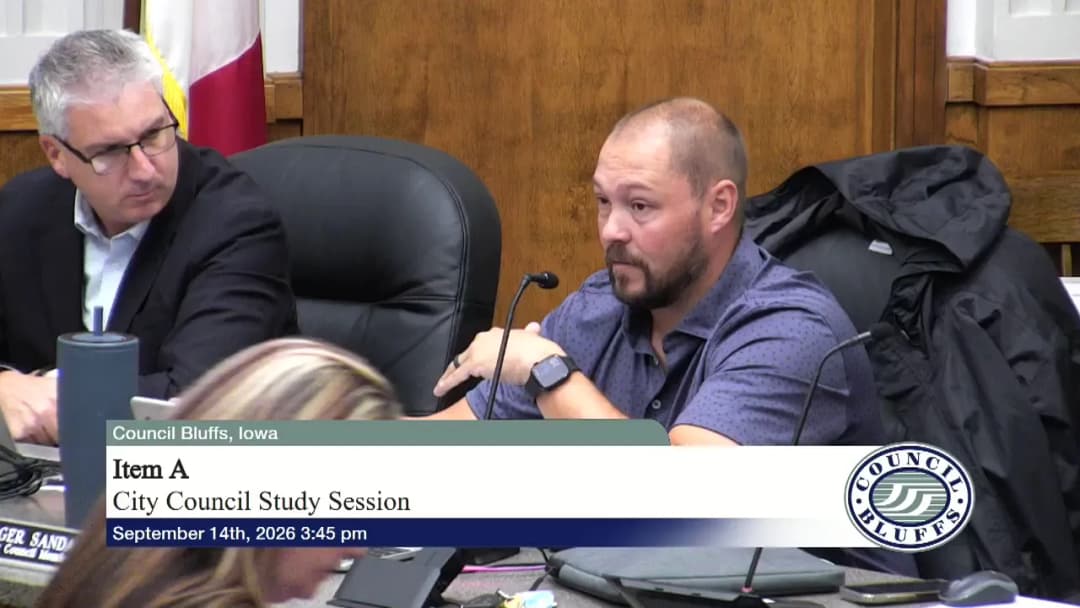
The City Council held a study session followed by a regular meeting on September 14, 2026. The main focus of the study session was a detailed presentation on data center regulations, including research on other communities and proposed zoning recommendations. The regular meeting included public hearings, consent agenda, and approval of numerous resolutions, including franchise agreements, subdivision plats, and policy adoptions. Consent Calendar - The consent agenda was approved unanimously without discussion. It included routine approvals and items deemed non-controversial. Public Comments & Testimony - Paul Cersei (20 South 41st Street, Apt. 129) spoke during citizens' request to be heard. He urged the council to prioritize environmental and community impacts when drafting data center regulations, rather than prioritizing existing business interests. He noted that the 20-year tax abatement for Google (2007–2027) cost the city approximately $33 million in lost revenue. He also called out a council member's online comment about potentially disclosing another person's address, characterizing it as off-putting. Discussion Items - Data Center Regulation Study (Presentation by Chris and Planning Team) - Staff presented results of a 60-day research project on data center regulations (originally requested with a 90-day timeline). They reviewed ordinances from Iowa, Nebraska, and national leaders like Loudoun County, Virginia. - Key findings: Most communities limit data centers to industrial districts; separation distances from sensitive uses range from 500 feet to half a mile; noise limits commonly set at 55 dB at the nearest residence; some require design standards, impact studies, and decommissioning plans. - Recommendations: Create small-scale (≤30 MW) and large-scale (30 MW) data center definitions based on aggregate power usage per site; allow small-scale in I-1 and I-2 districts with conditional use permits; allow large-scale only in PI district with council-approved development plans; require closed-loop liquid cooling, design standards, noise controls, building setbacks (100 ft for small, 200 ft for large), separation distances (500 ft for small, 1,000 ft for large from sensitive uses), environmental/community impact analysis, and decommissioning plans with escrow accounts. - Council members expressed support for the recommendations but raised concerns: existing data centers would become non-conforming under new rules; the separation distances might limit available sites; the economic impact and property tax revenue from existing centers must be considered; the need to talk with utilities (MidAmerican) and existing companies (Google, CIRUS 1) before drafting amendments. - Councilman DeSalba requested a site availability analysis for different separation distance scenarios (e.g., 350 ft, 500 ft, 1,000 ft). Councilman Gorman noted that any code change creates non-conforming uses and that legal remedies exist. The city attorney confirmed that prior councils cannot bind future councils and that regulating data centers is legally permissible. - Council directed staff to form an internal subcommittee (including legal, planning, and other departments) and to invite input from MidAmerican Energy, Google, and CIRUS 1. The subcommittee will develop draft text amendments for planning commission review and eventual council consideration. - Pro Fleet Parking Lot Final Plat (Item 5G/Resolution 26-302) - The plat consolidates three lots on South 11th Street for a semi-truck parking and staging facility. The use had already received a conditional use permit from the Zoning Board of Adjustment. - Council discussion focused on traffic impacts on narrow two-lane roads and potential obstruction of fire station access. Some members expressed concern about the lack of a traffic study, but staff noted the use was already approved and this plat only merges parcels. The motion to approve carried (no formal tally recorded in transcript, but it passed). - Social Media Policy for Elected Officials (Resolution 26-275) - The city attorney explained that the policy distinguishes between personal and official accounts/posts. Elected officials cannot be disciplined by the council, but the policy sets expectations to avoid liability. Council members expressed skepticism about enforceability but adopted it as a good-faith effort. Motion carried, with some members noting it seems unenforceable but is a step toward professionalism. - MidAmerican Electric Franchise Fee (Ordinance 6700) - The ordinance renews a non-exclusive franchise for 25 years with a franchise fee of 2.5% (increased from 2%). One council member voted against, stating the increase will be passed on to residents. The motion carried with one nay (voice vote indicated opposition). - Other Items - Black Hills Natural Gas franchise renewal at 2% fee (passed unanimously). - Prohibition of alley vacation at High Street due to inability to contact all property owners (motion to deny carried). - Several engineering agreements, grants, and administrative resolutions were approved without debate. Key Outcomes - Data Center Regulation: Council directed staff to form a subcommittee to draft zoning text amendments, incorporating input from existing data center operators and MidAmerican Energy. A site availability analysis for different separation distances was requested. All existing data centers will become non-conforming under any new rules; staff will propose mechanisms to mitigate impacts. - Pro Fleet Final Plat: Approved (Resolution 26-302). The plat consolidates lots for a truck parking facility; use already permitted by ZBA. - Social Media Policy: Adopted (Resolution 26-275) despite concerns about enforceability. - MidAmerican Franchise Fee: Ordinance 6700 passed with one dissenting vote (2.5% fee). Revenue purpose statement also adopted. - Black Hills Franchise: Adopted at 2% fee (Ordinance 6699 and Revenue Purpose Statement). - Alley Vacation: Denied due to lack of property owner response. - Other Approvals: All remaining resolutions and ordinances on the agenda were approved, including consent agenda, animal code amendments, TIF ordinance for East Manawa Drive housing, nuisance abatement liens, CDBG disaster recovery grant application, Tyler Technologies software agreement, and the River's Edge maintenance fund agreement with American National Bank.

ZONING REGULATIONS 30% · TECHNOLOGY AND INNOVATION 12% · PUBLIC SAFETY 12% · TRANSPORTATION SAFETY 9%
6073
SEP 12, 2026 · ERIE, PENNSYLVANIA · CITY COUNCIL
Erie Police Budget Study Session & Crime Stats Review - Sept 12, 2026

This study session focused on the Erie Police Department's mid-year crime statistics, overtime reduction efforts, grant-funded positions, and the proposed 2027 budget. Council members and command staff discussed data-driven policing, community initiatives, and long-term fiscal planning. Crime Statistics & Narcotics Unit - Homicides are trending down; 2022 had 145 people shot, declining to 29 in the first half of 2026 (with 3 homicides). - Shots fired and people shot both trending down. Aggravated assaults and robberies down since 2022. - Sex offenses rising (139 in 2026 vs 117 in 2025, 81 in 2024), but rapes trending down. Arson down; UIs (unidentified incidents) trending up. - Narcotics unit (STING) restarted in May 2026: seized 8.88 lbs methamphetamine (street value $63,000–$300,000), 5.136 lbs cocaine, 18.144 lbs fentanyl (potential 4.165 million overdoses per DEA), 19.29 lbs marijuana – total 51.45 lbs. Also seized $50,000 currency, 16 stolen firearms, made 23 felony and 4 misdemeanor arrests. - Seized money is evidence; eventual return to the department can take years. - Discussion of using opioid settlement funds for drug-related overtime: will explore with county DNA director. Overtime Reduction & Budget - Overtime for Celebrate Erie: 2023 – $104,000; 2024 – $96,000; 2025 – $88,000; 2026 – $43,978 (reduction achieved by cutting hours and using grant funding for community policing). - Overall overtime usage as of August 28, 2026: 45.82% of budget vs 64.46% same date in 2025. December is typically the highest overtime month (holiday season and vacation usage). - Reductions attributed to finding clerical errors in reimbursements, reducing wasteful hours, and renegotiating shift end times. - 2027 police budget primarily frozen at prior year levels except line 4059 (other service charges) increased by $310,000 as a placeholder for ShotSpotter, pending outside funding. If unfunded, it will revert to general fund. Line 4078 (machinery and equipment) dropped by $280,000 because ShotSpotter was moved to 4059. - City manager noted police department now represents 36% of city budget, down from 41% five years ago. Grant-Funded Positions - 25 officers funded by COPS hiring grant (ARP initially, then DOJ grant) – grant expires 2029; department must maintain 194-officer complement through grant term. Cutting complement could require repaying funds and jeopardize future DOJ grants. - Housing Authority provides 6 officers (Quebec unit) through auto-renewing contract. Current contract to 2028. Concern about federal housing cuts mentioned. - PAL program: 3 officers partially grant-funded; grant runs out next year. - Two auto theft detectives, two cold case detectives, one insurance fraud detective – all historically auto-renewing. - Total of 36 positions partially or fully grant-funded; all are existing positions, not new hires. - Discussion of attrition: 40 officers expected to retire around 2028-2029, which could absorb the 25 COPS grant officers if grant not renewed, avoiding layoffs. - Specific grants: SWAT training refunded, bomb squad fully refunded. Community Policing & Discussion - Current initiatives: PAL, COPS program, Mayor's Council on Community Safety and Trust, ride-alongs, internships, citizen police academy (relaunch this year), police explorer program (returned after 5-6 years), National Night Out, coffee with a cop, recruitment. - Council member Troop proposed a list of respected community adults (like "Mo") who could be called to intervene with juveniles before police escalation, similar to but distinct from Blue Coats. Chief open to meeting about legality and logistics. - Blue Coats praised for recent work in Perry Square; suggestion they receive Red Cross training to assist in emergencies (e.g., recent storm). - Discussion about recruiting city residents: potential for city residency points in civil service hiring (currently 15-mile radius contractually). Civil service board could approve. Budget & Other Details - Salaries: difference between police officer and Class A officer (Class A is highest patrol rank, achieved at 5 years; basis for pension). - Subscriptions: Axon contract (body cameras, fleet cameras, tasers, digital storage, de-escalation VR) – $1 million/year, 10-year contract until 2035. Other subscriptions like Cell Hawk (investigative tool). Council asked for a list with cost history. - PAL overtime is 100% reimbursed by county drug and alcohol funds (DNA); reimbursements sometimes arrive the following fiscal year. - No votes were taken; session concluded with thanks to finance department and plan to continue budget discussions next week.

PUBLIC SAFETY 64% · PUBLIC ENGAGEMENT 9% · FISCAL SUSTAINABILITY 6% · COMMUNITY ENGAGEMENT 6%
6074
SEP 11, 2026 · ANCHORAGE, ALASKA · ASSEMBLY & COMMITTEE MEETINGS
Anchorage Assembly Work Session on Missing Middle Housing Ordinance (AO 2026-85) - September 11, 2026

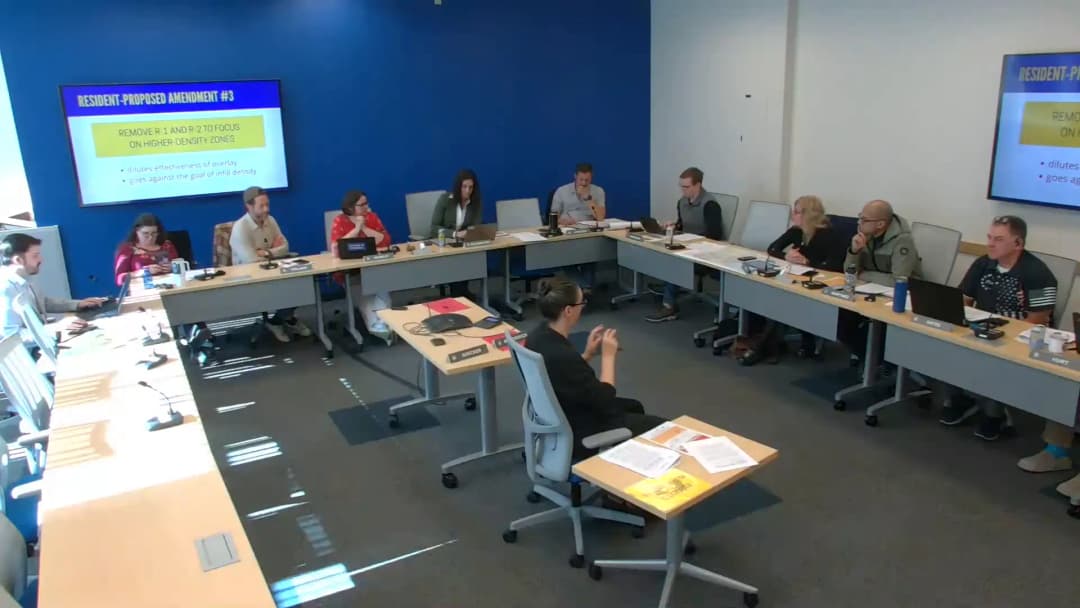
On Friday, September 11, 2026, from 1:00–2:00 PM, the Anchorage Assembly held a work session to discuss AO 2026‑85, the Missing Middle Housing Opportunities (MHOP) ordinance. Chair Anna Brawley called the meeting to order, noting that this was the second work session on the item, that the public hearing had not yet been opened, and that debate was not permitted during work sessions. The session focused on the overlay map and a suite of resident‑proposed amendments. Discussion Items Sponsor Presentation – Problem and Overlay Details Sponsor Assemblymember Baldwin‑Day presented the ordinance as a tool to increase housing supply, supporting both the Assembly’s housing work plan and the mayor’s “10,000 homes in 10 years” goal. The MHOP overlay would apply to parcels within a quarter‑mile of existing or near‑term transit corridors, within the multifamily property tax abatement area, in town centers, and in areas where the 2040 Comprehensive Plan suggests upzoning. Key dimensional changes include: flexible minimum lot size (governed by subdivision standards), 70% lot coverage, no specified front setback, flexible side/rear setbacks (zero if adjacent units), 40‑foot height (30 ft in R1 zones), and any number of structures per lot. Resident‑Proposed Amendment 1 – Exclude Seismic Hazard Zones 4 and 5 The sponsor noted that seismic safety is already managed through building code (Title 23), not zoning (Title 21), and that seismic maps are being updated (current data dates to the 1960s). Member Boland asked whether any analysis showed that taller or more dense buildings would be significantly more dangerous in those zones; none was known. Member Silvers observed that engineering standards are used to address seismic risk. The sponsor declined to support the amendment, stating that building in such zones is feasible (citing Inlet View Elementary built in zone 5). Resident‑Proposed Amendment 2 – Require Multi‑Unit Development with Expanded Dimensions The sponsor expressed strong support for this concept and stated he intends to bring an amendment that prevents “McMansions” (large single‑family homes on large lots from using the flexible standards) but still allows small single‑family homes on small lots. Member Park raised concerns about short‑term rentals taking advantage of the overlay; the sponsor confirmed that the multifamily tax abatement already excludes short‑term rentals. Member Park later indicated she would like to be a co‑sponsor of this amendment. Resident‑Proposed Amendment 3 – Remove R1 and R2 Zones from the Overlay The sponsor argued this would dilute the overlay’s effectiveness and noted that R3 and R4 zones have been underutilized (e.g., no building permits issued for R4A). Member Handlin asked about demand for missing‑middle housing; the sponsor cited 21 rezoning applications since May 2025, of which 29% would likely have been unnecessary if the overlay were in effect (based on analysis by S4 group). Member Johnson requested that planning produce a map showing which parcels are R1, R2, R3, and R4 within the overlay by the next meeting. Resident‑Proposed Amendment 4 – Maintain Height‑to‑Setback Proportions The sponsor considered this technically complex and counter to the goal of simplifying Title 21. Planning Manager Daniel McKenna‑Foster added that current height rules are outdated (e.g., assume 10–12 ft ceilings, but modern construction requires more space for HVAC and fire suppression). Resident‑Proposed Amendment 5 – Define Multiple Uses and Structures McKenna‑Foster explained that allowing multiple uses on a lot (e.g., a church and a house) and multiple primary structures (e.g., cottage clusters) is already permitted in many zones and that the ordinance mirrors existing code. He noted that the definition of “mixed use” is being clarified in a separate upcoming ordinance. Resident‑Proposed Amendment 6 – Remove Dwelling Mixed Use as a Permitted Use The sponsor noted this is a broader question being addressed separately and not specific to MHOP. Resident‑Proposed Amendment 7 – Require Conditional Use Permits for Multifamily in R1 and R2 Conditional use permits add uncertainty and discourage development, making the intended housing types less likely to be built. Member Boland pointed out that in R2 zones, duplexes are currently permitted outright; this amendment would make them conditional, which is more restrictive than existing law. Additional Discussion - Infrastructure costs: McKenna‑Foster stated that AWWU generally requires new development to pay for its own connection costs and that the system has capacity for additional growth. - Member Park asked about the origin of the proposed amendments; they came from the Housing Work Group and were presented to community councils. - Member Martinez argued that the MHOP ordinance is not the starting point for growth planning—the 2017 Transit Supportive Development Corridor map and the 2020 Comprehensive Plan already identified these areas for density. He framed the ordinance as “keeping promises” made in earlier planning processes. - Correction noted: the second regular assembly meeting for this item is October 6, not October 7. Key Outcomes - The public hearing on AO 2026‑85 is scheduled for Tuesday, September 15, 2026, and will be continued to a future meeting (no debate until the public hearing is closed). - Sponsor Baldwin‑Day committed to introduce an amendment requiring multi‑unit development (or small single‑family) under the expanded dimensional standards to prevent “McMansions”. Member Park expressed intent to co‑sponsor that amendment. - Planning department was asked to produce a map highlighting R1, R2, R3, and R4 zones within the overlay for the next meeting. - No votes were taken; the work session was informational only.

LAND USE PLANNING 45% · AFFORDABLE HOUSING 24% · ZONING 11% · SEISMIC SAFETY 5%
6075
SEP 11, 2026 · BLACKSBURG, VIRGINIA · TOWN COUNCIL WORK SESSIONS
Blacksburg Town Council Work Session Summary – September 11, 2026

This work session covered a countywide Fire/Emergency Medical Services (EMS) study, three ordinances scheduled for public hearing, a Capital Improvement Program (CIP)/budget preview, and required FOIA training. The agenda and minutes list the meeting date as September 15, 2026, while this summary uses the specified date of September 11, 2026; that discrepancy is noted. The supplied raw transcript contains only the fragment "And I've got more." and added no substantive detail. Present were Mayor Michael Sutphin, Vice Mayor Susan Anderson, Councilmembers Lauren Colliver, Jerry Ford Jr., and Joel Goodhart; Town Manager Marc Verniel; Town Attorney Lawrence S. Spencer (arrived late); and Town Clerk Lorraine S. Spaulding. Councilmember Darryl Campbell and Councilmember Andrew Kassoff were absent. Fire/Emergency Medical Services Study Presentation - Consultant Frank Edwards of Mission CIT presented the county's comprehensive Fire & EMS study, initiated about a year ago and described as the county's first countywide analysis treating all town and rural departments as a unified system. - The study addresses declining volunteerism, particularly in rural areas, and aims to develop a fair funding model that equitably distributes costs among the county and towns while addressing the growing reliance on paid Fire & EMS staff. Review of Public Hearings Scheduled for October 13, 2026 - Ordinance 2073 (Homestay): Town Attorney Lawrence Spencer summarized the ordinance, which updates the Town's Homestay regulations to align with state law changes and establishes civil, rather than criminal, penalties. He noted the revised Homestay penalties had been previously addressed by Council. - Ordinance 2117 (Meals Tax): Spencer explained the ordinance updates the meals tax code to clarify definitions and exemptions and adds a cumulative penalty of up to 25% for late payments. - Ordinance 2121 (Utility Easement): Spencer described the ordinance authorizing a utility easement over Town property near the Blacksburg Transit Building to Appalachian Power Company (AEP). Sustainability Manager Carol Davis added that the project will include installation of a new pole to support AEP equipment. Capital Improvement Program / Budget Preview - Town Manager Marc Verniel provided a preview of the FY 2027-2031 Capital Improvement Program, focusing on economic conditions, revenues, service costs, and long-term financial planning. - Staff noted that CIP priorities and assumptions will be refined before a recommended CIP is presented to Council. Freedom of Information Act (FOIA) Training - Town Attorney Lawrence Spencer provided the state-mandated FOIA training for Town Council members. Council/Staff Discussion and Key Outcomes - Mayor Sutphin reviewed the upcoming regular meeting scheduled for September 22 and noted there were no items on the agenda; Council agreed to cancel that meeting. - No formal votes were recorded; the work session adjourned at 1:03 p.m.

PROCEDURAL 100%
6076
SEP 11, 2026 · FAYETTEVILLE, NORTH CAROLINA · CITY COUNCIL
Legistar System Configuration Working Session - September 11, 2026

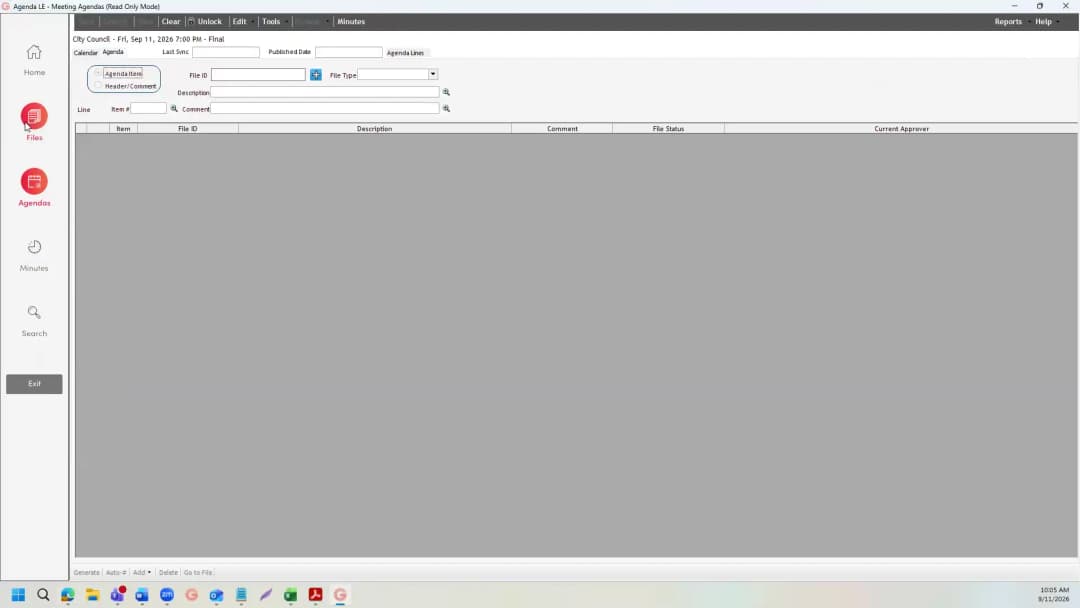
This was a technical working session between city staff (Jennifer and Sam) focused on optimizing the Legistar meeting management system. The session covered agenda and minutes formatting, audio/video publishing, historical archives, and meeting body setup. No public comments or formal votes occurred; the meeting was purely administrative. Discussion Items - Accessible Agenda & Minutes: Sam enabled accessible agenda, minutes, and audio columns. A design ticket was created to add the necessary template code for automatic publishing of accessible versions. - Audio Publishing: Sam enabled automatic MP3 transcoding in the media manager but noted existing meeting audio links were broken due to a non-retroactive setting. A new “Audio” column was created for manual audio uploads; testing will occur after the next video meeting. - Attendance & Name Formatting: Jennifer requested moving the district number after the council member’s name. Sam adjusted settings to display “Last Name, Office Title” and reordered the member list (Mayor, Mayor Pro Tem, then council members). Attendance now shows correct order. - DJ Hair Attendance Issue: A duplicate record for DJ Hair was causing his name not to appear. Sam removed the duplicate and activated the correct record, fixing the issue. - Historical Minutes Archives: Sam demonstrated how to create a dedicated view page in Media Manager for pre-2013 minutes, using a tabbed interface by year. Jennifer plans to upload historical PDFs. - Agenda Briefings: Jennifer wanted a way to display virtual agenda briefings (third Wednesdays) without a full agenda. Sam created a new meeting body called “City Council Agenda Briefing” and granted security access so staff can create events with location/notes fields containing the meeting link and reference to the related agenda packet. - Minutes Template Customization: Sam reviewed Jennifer’s markups and confirmed changes including removing the “District 1” language, adjusting header bolding, and hard-coding location information. A design ticket will be submitted to implement these changes. - Insight Portal Review: Sam showed examples of other cities’ Legistar Insight pages (e.g., Seattle, San Mateo, King County) for inspiration on splash pages, upcoming meetings separation, and embedded widgets (Google Translate, social media links). Jennifer will discuss options with senior leadership. Key Outcomes - Tickets Created: An engineering ticket to investigate DJ Hair attendance issue (now resolved); a design ticket for minutes template updates and enhanced ADA styling. - Meeting Body Created: “City Council Agenda Briefing” added to Legistar; security permissions granted to staff. - Historical Archives Setup: A pre-2013 archive view page and folder created in Media Manager; Jennifer will upload PDFs and Sam will add an iframe tab to Insight. - Next Steps: Sam will send Jennifer the iLegislate web link and documentation; will update names in the database (first/last name swapped); will submit design ticket with due date before next training session. Jennifer will test the new audio column after her next video meeting. - Follow-up: Sam will record the session and upload to media manager; training is scheduled to begin soon, with ongoing email support.

TECHNOLOGY AND INNOVATION 55% · PUBLIC ENGAGEMENT 14% · PROCEDURAL 13% · MEETING SCHEDULING 8%
6078
SEP 11, 2026 · LOS ANGELES, CALIFORNIA · CITY COUNCIL
Los Angeles City Council Special Meeting – September 11, 2026: 9/11 Commemoration & Agenda Votes

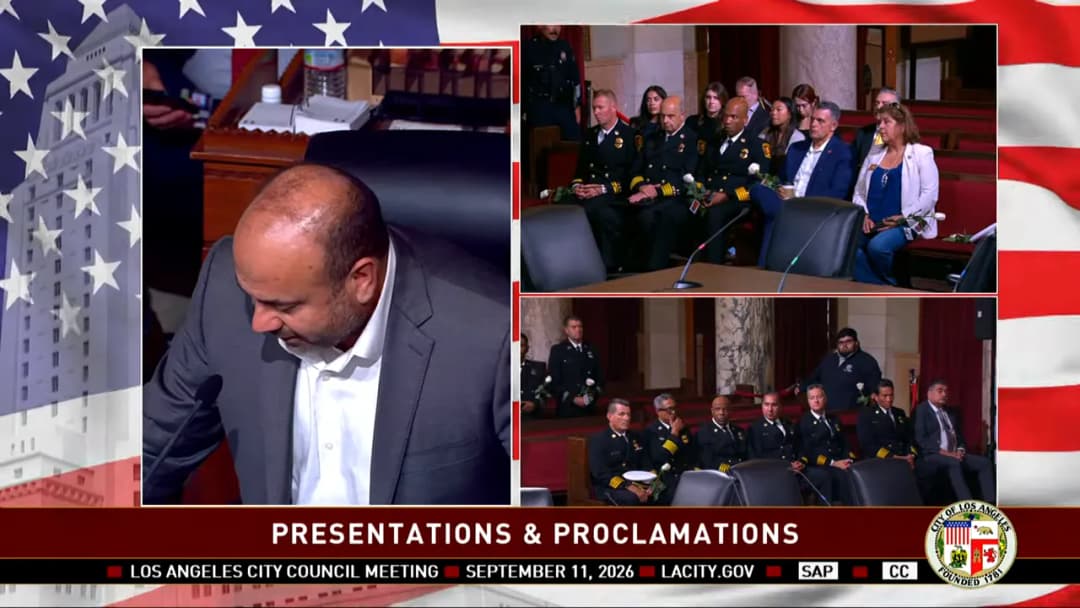
The Los Angeles City Council convened a special meeting on Friday, September 11, 2026, at approximately 10:21 AM local time (17:21 UTC) to commemorate the 25th anniversary of the September 11, 2001 attacks and to consider seven agenda items. The meeting opened with a moment of silence, followed by presentations from councilmembers, LAFD Chief Jamie Moore, retired FDNY firefighter Michael Barberino, and LAFD Captain Tom Kittihada, who was among the 70 members of California Task Force One deployed to Ground Zero. Multiple councilmembers shared personal reflections. After the commemoration, the council heard public testimony, primarily on Item 7 (homeless systems governance), and then voted on all items. Consent Calendar - Items 1 through 6 were considered as a consent calendar after public hearings had been held. The council approved all six items unanimously (11 ayes) without further discussion. Public Comments & Testimony - In-person speakers: Several members of the Domestic Violence and Homeless Services Coalition spoke on Item 7, urging the city to collaborate with Los Angeles County on any changes to homeless systems governance and Continuum of Care (COC) functions. They highlighted that the percentage of people experiencing homelessness due to domestic violence has doubled since 2018, and that separate city-only systems could create barriers for survivors who cross jurisdictional boundaries. - Virtual callers: Additional speakers reiterated calls for city-county partnership on Item 7, stressing the need to preserve specialized domestic violence systems under the Violence Against Women Act. One caller raised procedural objections (Brown Act violations) regarding revised agenda notices in English vs. Spanish; the clerk noted that the posted agenda was clearly marked as “Revised” in bold at the top of the online version. Other callers commented on Item 2 (sidewalk amenities) and Item 4 (street vacation), with some expressing dissatisfaction with city infrastructure maintenance. - Disruptive comments: A few in-person speakers used profanity and made unrelated statements; they were warned to stay on topic and eventually their time expired. Discussion Items - 9/11 Commemoration (Presentation): Councilmembers Eunisses Hernandez, Nithya Raman, and others gave remarks recalling the unity, heroism, and subsequent Islamophobia and division. Chief Moore noted that 343 FDNY firefighters died that day and that 453 have since succumbed to 9/11-related illnesses. Michael Barberino, a retired FDNY member who responded to both World Trade Center attacks, emphasized the ongoing sacrifice of first responders and families. Captain Kittihada described his role as a search specialist crawling through debris. Councilmembers also remembered the 70 LAFD Task Force One members who deployed to New York. - Item 7 – Homeless Systems Governance: The council considered a report and amendment (7A) on applying for COC administrative functions. No substantive debate occurred on the floor beyond the public testimony. Key Outcomes - Vote on Items 1-6: Approved 11–0. - Vote on Item 7 (as amended by Motion 7A): Approved 11–0. The item was ordered to go forth with the case. - Adjournment Motions: The council adjourned in memory of LAFD Captain Christopher “Yok” Yokoyama, who passed away on July 6, 2026 at age 46 after 25 years of service. Members also recognized the 245th birthday of Los Angeles (September 4) with a video tribute, but that segment was not part of the official meeting proceedings. - Next Steps: No specific referrals or follow-up actions were noted beyond the votes.

PUBLIC SAFETY 25% · PUBLIC COMMENT 16% · EMERGENCY MANAGEMENT 13% · PROCEDURAL 8%
6079
SEP 11, 2026 · ALEXANDRIA, VIRGINIA · PUBLIC MEETINGS
Community Meeting on Historic Preservation Zoning Text Amendments - September 11, 2026

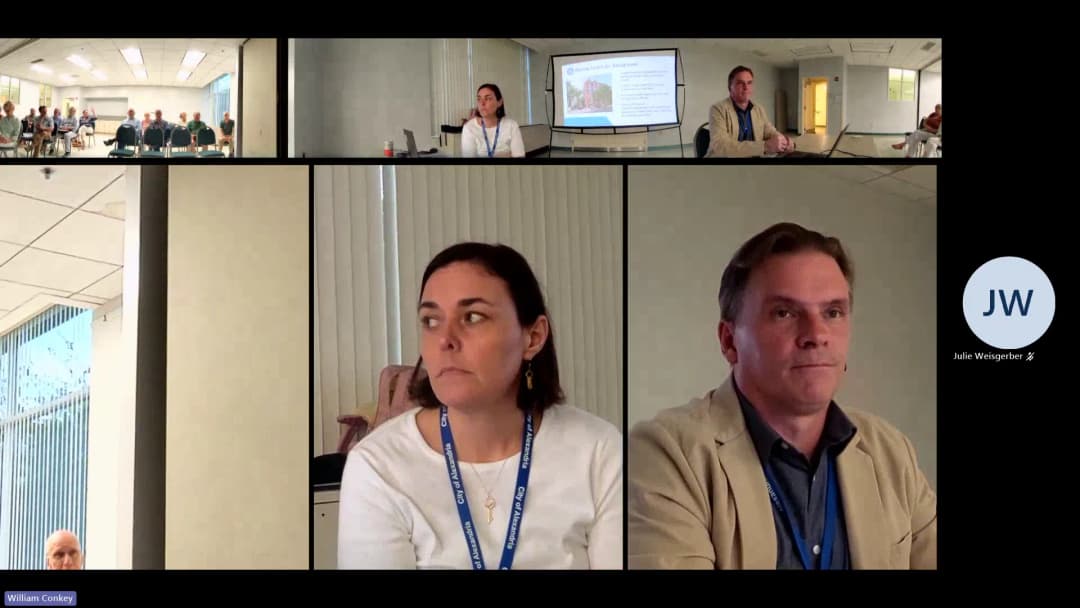
On September 11, 2026, the Alexandria Historic Preservation staff held a community meeting to introduce proposed zoning text amendments. The amendments address parking curb cuts in the Old and Historic District (OHAD) and Parker Gray, establish a formal development concept review process, and make several administrative clarifications. Staff emphasized that no formal votes were taken; the meeting was for gathering public input. Public Comments & Testimony - A speaker raised concerns about the fairness of fees for administrative reviews (currently $121) compared to the low cost of items like replacement lamps ($40), suggesting this discourages compliance. Staff noted that fees were recently adjusted citywide and are not part of this zoning amendment, but the comment was recorded. - Scott questioned the need for a curb cut process, noting that most OHAD properties have no space for a driveway and that existing curb cuts often harm streetscape character. Staff clarified they are not advocating for curb cuts but must establish a legal pathway after a court ruling eliminated the previous variance process. - Another speaker expressed opposition to any curb cuts in OHAD, arguing they damage the historic character. Staff responded that public comments advocating a blanket ban would be considered. - During the development concept review discussion, a participant urged that the process allow for up to three meetings instead of two, citing experiences with intransigent developers who did not meaningfully reduce mass and scale. Staff agreed to consider this feedback. - A speaker suggested that the first-stage review should require the applicant to show they have considered alternative site layouts, but staff explained that applicants are not required to present alternatives. Discussion Items Parking Curb Cuts - Julie Weiss Gerber, Principal Planner, explained that the current ordinance provides no process for applying for a curb cut after the Virginia Court of Appeals in 2025 ruled that variances from the Board of Zoning Appeals (BZA) were not an appropriate relief mechanism. Two pending cases are on hold. - Staff presented data: there are approximately 1,350 existing curb cuts in OHAD (887 are driveways to individual homes); about 1,480 properties lack alley access or interior courts and could potentially seek a curb cut. - The proposed process: an applicant must first prove no alley or interior court exists, then undergo a feasibility review by Transportation & Environmental Services (T&ES) for safety and code compliance. If feasible, Historic Preservation staff would review for appropriateness based on new design guidelines (still being drafted). If T&ES denies, the applicant or neighbor can appeal to the Traffic and Parking Board (no further appeal). If staff denies, appeal goes to the Board of Architectural Review (BAR) and then to City Council. - The process would also apply to Parker Gray, where currently curb cuts go directly to BAR; the change would place T&ES feasibility first. - Bill Conki, Preservation Architect, emphasized that design guidelines will be strict, likely prohibiting curb cuts on pre-1932 properties and those that block historic building views. He noted that the guidelines will be developed separately and reviewed by the Design Guidelines Committee on September 23. Development Concept Review - Bill Conki described the current informal, non-binding concept review that occurs before a project goes to Planning Commission and City Council for a Development Special Use Permit (DSUP). Under current rules, the BAR can only give feedback; applicants can attend once and proceed, often bypassing meaningful input on height, mass, and scale. - The proposed change splits the Certificate of Appropriateness (C of A) into two stages. Stage 1 (tentatively called "Concept Plan Approval" or "C of A Stage One") would be a formal vote on the building envelope: height, mass, scale, and location of buildings on the site. This would occur before the DSUP. Stage 2 would cover architectural details, materials, and other standards. - Applicants would be required to attend at least two concept review meetings (unless all parties agree earlier) before a vote is taken. The board would vote yes/no; if denied, the applicant can appeal to City Council. The number of meetings was debated; staff agreed to consider a maximum of three. - Staff noted that this change does not alter the list of standards; it merely moves the bulk characteristics review earlier in the process to provide certainty to developers and ensure BAR input is not an afterthought. - Public commenters supported the idea but raised concerns about land-use attorneys conflating envelope and architectural issues. Staff acknowledged the challenge and said they would work on clear language. Administrative Clean-Up Items - Staff proposed correcting outdated language, such as removing references to "urban renewal" as a reason for proceeding with projects and eliminating the $15 fee for mailing hearing calendars. - They seek to align rooftop mechanical screening waivers between OHAD and Parker Gray. - A major proposal extends the validity of a Certificate of Appropriateness from 12 months to 36 months, matching the DSUP approval period. This was requested by the BAR due to homeowner difficulties in securing contractors and materials. Some commenters suggested a fee waiver for renewal after 12 months instead, which staff said they would consider. - Enforcement of historic preservation violations was raised as an ongoing issue but not part of this amendment. Key Outcomes - No votes were taken; this was an informational and input-gathering meeting. - Public comments are accepted through Thursday, September 17, via email or phone to Julie Weiss Gerber. - The presentation and materials will be posted on the historic preservation website the following day. - The Planning Commission held a workshop on the amendments on September 1 and gave generally positive feedback. - Staff will compile public comments and continue refining the proposals, including design guidelines, before bringing them to the BAR and City Council for formal action.

PLANNING AND ZONING 42% · HISTORIC PRESERVATION 32% · ZONING 11% · PROCEDURAL 6%
6080
SEP 11, 2026 · SYRACUSE, NEW YORK · PUBLIC MEETINGS
City Council Meeting on Capital Plan Charter Changes - September 11, 2026

The Syracuse City Council met on September 11, 2026, to discuss proposed charter changes to the capital planning process, presented by Director of Budget Evan. The changes aim to improve transparency, clarity, and quality of the capital improvement plan (CIP). Councillors Patrona, Joan Srauser, Marty Nave, Corey Williams, and Hannah Erin Rick were present, along with Evan and the director of budget. Discussion Items - Evan proposed renaming the "capital program" to "capital improvement plan" (CIP) to better reflect its purpose as a planning document. - The current requirement for six-year projections would be changed to a minimum of two years and a maximum of six, to prioritize quality over quantity of data. - The plan would require two-year post-completion operating impact projections for each project (currently required three years but inconsistently applied). - Clarification that the CIP aligns with fiscal years (July 1–June 30) and that departments must seek council authorization for cash capital or bonding accordingly. - Evan outlined a broader vision: incorporating historical data, project timelines, procurement timelines, consistent naming conventions, and better alignment with the operating budget and grants management. - He noted that the current CIP includes too many projects (e.g., $90 million general fund) to be financially sustainable and plans to align the CIP with realistic spending capacity. - Implementation will be incremental: the first updated plan (due December 2026) will include a new introductory narrative and selected pilot projects with historical data and timelines, with full citywide rollout over two to three years. - A grant from Bloomberg will fund a consultant to build backend capacity, and a mid-year dashboard is being developed with API to track project status and spending. - Council members asked about how one-time grant-funded projects are reflected, the need for master plans to answer constituent questions about project schedules, and the importance of making the plan understandable to the public. - County Legislator Romeo commented, noting that the county's capital plan has a good template worth reviewing. - A councillor commended Evan for incorporating previous feedback and going above expectations, expressing strong support for the changes. - Evan acknowledged the iterative nature of the process and welcomed ongoing feedback. Key Outcomes - The council discussed and showed support for the proposed charter changes and the broader capital planning improvements. - No formal vote was taken; the changes are expected to be reflected in the upcoming capital plan release. - The first updated CIP under the new framework is targeted for December 2026, with incremental improvements each year. - The city will continue current capital operations while implementing changes, with a focus on transparency and constituent usability.

CAPITAL IMPROVEMENT PLAN 62% · PROCUREMENT 13% · PROCEDURAL 11% · DATA MANAGEMENT 8%
OPENPUBLICA · PUBLIC MEETING INDEXUPDATED DAILY · openpublica.com