Browse by city
Date range
Search help

Search titles, summaries, topics and stored transcripts together. Keywords may match separately; put the whole query in double quotes for a phrase. Matching follows word analysis, so punctuation is not exact. Both dates are included. Documents are not searched.

SHOWING 671–680 ENTRIES
671
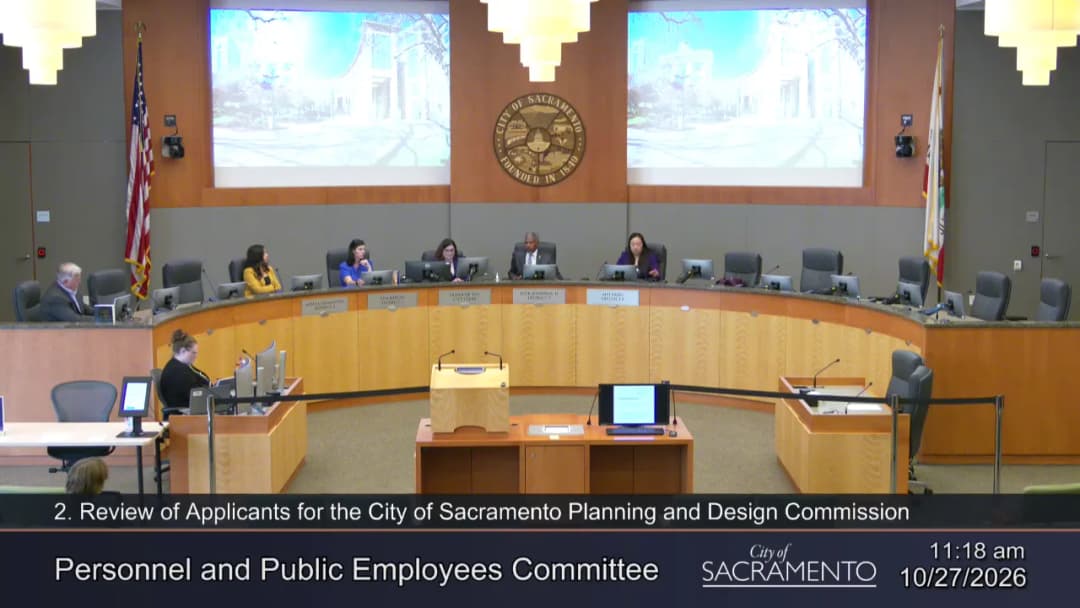
OCT 27, 2026 · SACRAMENTO, CALIFORNIA · PERSONNEL AND PUBLIC EMPLOYEES COMMITTEE
Sacramento Personnel and Public Employee Committee Meeting Summary – October 27, 2026

The Personnel and Public Employee Committee met on October 27, 2026. No agenda or minutes were provided; this summary is reconstructed from the raw transcript. A quorum was present. The committee approved its prior minutes, reviewed applicants for Planning and Design Commission seat J, and ended the item without advancing a nominee after split roll-call votes. Consent Calendar - Item 1: Approval of the Personnel and Public Employee Committee meeting minutes. There were no public speakers. A motion was made, seconded, and approved unanimously by voice vote. Public Comments & Testimony - No public speakers were recorded for the consent calendar or for matters not on the agenda. The only testimony during the meeting came from applicants speaking as part of the Planning and Design Commission seat J review item. Planning and Design Commission Seat J Applicants - Staff outlined seat J requirements: members must reside in Sacramento for the full term, must not be city employees, and must have expressed interest, training, or experience in areas such as master planning, land use or land use policy, housing policy, large-scale construction, urban planning, urban design, or mid- and high-rise urban, commercial, institutional, and mixed-use projects. - Each applicant was given two minutes to answer two questions: why they are interested in serving and what knowledge or experience qualifies them. - Varun Aurora (District 3): not present; submitted written comments given to committee members. - Emily Condon (District 4): not attending. - Nate Dobernick (District 7): present; described a land use degree from Cornell, a master's from UCLA with an architecture and urban design emphasis, planning experience at state, county, and city levels plus private consulting, and extensive community-meeting experience. - Benjamin Garcia (District 8): not present due to work obligations. - Scott C. Lau: present; Sacramento native; urban planning degree from Arizona State University, MBA from Texas A&M-Corpus Christi; nearly a decade at Caltrans, currently emergency planning branch chief; emphasized balance among housing, economic development, transportation access, infrastructure capacity, and neighborhood compatibility. - Ansel Lundberg (District 7): present; Sacramento resident for about 10 years; UC Santa Barbara geography/GIS degree and UC Davis MBA; member of House Sacramento; engaged with the city's 2040 general plan; nearly seven years at SMUD, including representing SMUD on the water forum. Committee Discussion and Votes - Vice Chair Kaplan moved to appoint Ansel Lundberg, citing his work on the general plan, missing-middle housing, affordability for younger families, and readiness to hit the ground running. - Vice Mayor Talamantes made a substitute motion to appoint Varun Aurora, arguing the personnel committee should be a starting point for applicants without existing Sacramento connections and that outside endorsements should not drive the process. - Councilmember Vang seconded the substitute motion and thanked all applicants. Chair Jennings seconded the original motion and praised Lundberg's work in the city. - Kaplan said there were no open Planning and Design Commission seats, only reappointments, and defended the use of references and support letters. Talamantes respectfully disagreed and said she supports the relevant organizations. - Vote on the substitute motion for Aurora: 2-2, failed (Talamantes yes, Kaplan no, Vang yes, Jennings no). - Vote on the original motion for Lundberg: recorded as Kaplan yes, Talamantes no, Vang no, Jennings yes, a 2-2 result. The transcript is internally ambiguous because the chair initially said the motion 'does pass,' but the committee then stated that a three-one majority was needed and no nominee was advanced. Member Comments & Reports - No council member comments, ideas, questions, or conference reports were offered. Key Outcomes - The consent calendar item was approved unanimously. - Neither seat J nominee received a majority, so no applicant was forwarded to the full council. - The chair announced that seat M had also opened, requiring a member with demonstrated interest in urban landscape or architectural design and, as stated, a licensed architect. The discussion noted a contractor or licensed engineer might meet the definition, and Varun Aurora's construction background was mentioned, but seat M had not been advertised. - The committee agreed to advertise both seat J and seat M for the next meeting and to allow current applications to roll over automatically, with applicants also considered for the other seat if they choose. - No public comments were made under matters not on the agenda, and no council member comments were offered. The meeting was then adjourned.

PLANNING AND DESIGN COMMISSION 62% · PROCEDURAL 17% · PERSONNEL MATTERS 14% · AFFORDABLE HOUSING 4%
672
OCT 27, 2026 · RAMSEY COUNTY, MINNESOTA · BOARD OF COMMISSIONERS & AUTHORITIES
Ramsey County 2027 Legislative Platform Workshop - October 27, 2026

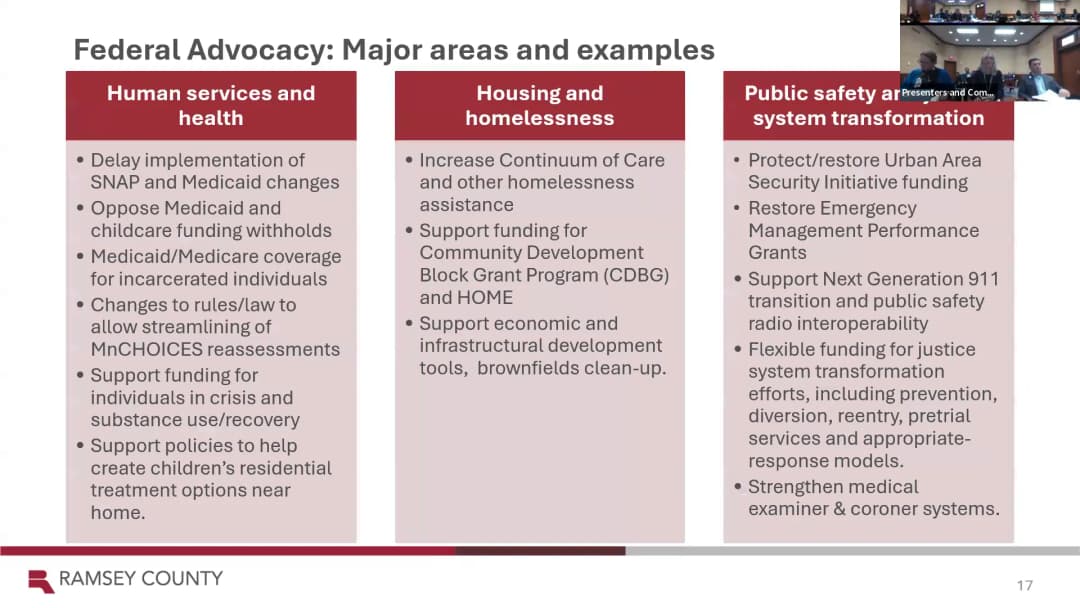
The Ramsey County Board held a workshop on October 27, 2026, to review the first draft of the 2027 State and Federal Legislative Platform. The platform focused on three main themes: reducing the property tax burden, improving county operations, and improving community wellness. No votes were taken during the workshop. Final recommendations are scheduled for the Legislative Committee of the Whole on November 17, 2026, with final board approval on November 24, 2026. State Legislative Lead Items - Capital Host Program: Proposes an annual state payment in lieu of taxes (PILT) of approximately $22 million for tax-exempt state property in Ramsey County. Commissioners discussed the need to coordinate with the City of Saint Paul and other jurisdictions. Commissioner McGuire expressed concern about aligning with AMC's broader property tax relief efforts and noted the importance of a unified approach. Commissioner Moran suggested leveraging community partners for storytelling. Commissioner Zhang highlighted how the program addresses Ramsey County's unique tax base constraints. - Lake Owasso Residence Rate Increase: Seeks a legislative remedy to achieve greater financial stability for the facility, recognizing a changing care and reimbursement environment. Commissioner Jibbenstein appreciated the proactive, forward-looking approach. - HR Statute Modernization: Updating outdated human resources language in Minnesota Statute 383A, which pertains specifically to the administration of Ramsey County. - Day Shelter and Wrap-around Services Appropriation: A state funding request for a family day shelter and wrap-around services. Commissioners discussed potential community partners such as Heading Home Ramsey. State Legislative Active Advocacy Items - SNAP Cost Share Protection: A top priority seeking state assistance in covering federal HR1-imposed SNAP benefit and administrative cost shares. Commissioners emphasized the need for clear prioritization when communicating with legislators. - Long-Term Services and Supports (LTSS) Cost Shift: Advocating for the application of identified savings to eliminate the proposed cost shifts. County Manager Becker noted the importance of flexibility, as LTSS funding could also help offset the county levy. - Minnesota African American Family Preservation Act: Support for moving case review to the state and obtaining additional funding for implementation. - ARMER Funding and Governance: Seeking state funding for public safety radio communications infrastructure; it was noted that if Ramsey County must fund its own system, it would cost over $13 million. - LALA Administrative Cost Allowance: Allowing administrative costs for Local Affordable Housing Aid and other state housing and homelessness funding sources. Commissioner Moran suggested leveraging letters of support from all 19 Ramsey County cities. - E-book License Restrictions: Opposing publisher-imposed restrictions that increase costs and delays for library users. Commissioner Kunish noted broad legislative support for removing these restrictions. - Homelessness Program Funding: Increasing funding for FHPAP, Emergency Solutions Grants, and Local Homelessness Prevention Aid, with greater flexibility in administration. - State Disaster Assistance: Ensuring a well-funded and predictable state disaster assistance resource to prevent local governments from absorbing significant unexpected costs. - Medical Examiner Death Certificate Cost Recovery: Allowing cost recovery when the medical examiner must complete a death certificate due to provider non-compliance. - Affordable Housing Property Tax Deduction Reform: Adjusting the current 75% property tax deduction for rental housing at 60% AMI to require a greater proportion of deeply affordable units. DCM Collins clarified the policy aims to target deeper affordability. Commissioners expressed interest in further analysis and considering an AMC platform amendment. - Firearm Bans in Public Facilities: Supporting the option for local governments to ban firearms in facilities such as libraries and park buildings. - Discriminatory Restrictive Covenant Removal: Simplifying the removal process by eliminating the notary requirement for discharge forms. Support Items - A list of additional items where Ramsey County will provide letters or testimony as needed, including restorative practices grant funding, auto theft fund expansion, child support good cause policy reform, medical examiner system strengthening, and others. County Manager Becker advised limiting the list to maintain focus and strategic clarity; the team will continue to refine the presentation of support items. Bonding Request - Aldrich Arena and Community Events Center Renovation: Requesting $6.5 million in state bonding for renovations to improve energy efficiency, accessibility, and user experience. County Manager Becker outlined a shift to a multi-year bonding strategy, preparing projects through phased homework and readiness. Commissioners supported the strategic approach and noted the importance of being prepared to answer legislators' questions about future priorities. Federal Priorities - Focus on SNAP and Medicaid changes, housing and homelessness funding (CDBG, HOME), public safety radio interoperability, and justice system transformation. Commissioner Moran advocated for broader positions such as supporting Medicaid for all and raising the federal minimum wage. The team is developing a federal advocacy strategy that includes outreach to potential new U.S. senators and their staff. Key Outcomes - The first draft of the 2027 legislative platform was reviewed; no votes were taken. - Final recommendations will be discussed at the Legislative Committee of the Whole on November 17, 2026, with final board approval on November 24, 2026. - Government Relations will refine the platform based on board feedback, including clarifying the classification of lead, active advocacy, and support items. - Commissioners will receive one-pagers and talking points to support engagement with legislators. - A legislative delegation meeting is scheduled for November 19, 2026, to discuss the platform with returning and new legislators.

PUBLIC ENGAGEMENT 39% · PUBLIC HEALTH 11% · COMMUNITY ENGAGEMENT 10% · AFFORDABLE HOUSING 10%
673
OCT 27, 2026 · NORTH BEND, WASHINGTON · CITY COUNCIL
North Bend City Council Workstudy: 2027-2028 Biennial Budget Discussion, October 27, 2026

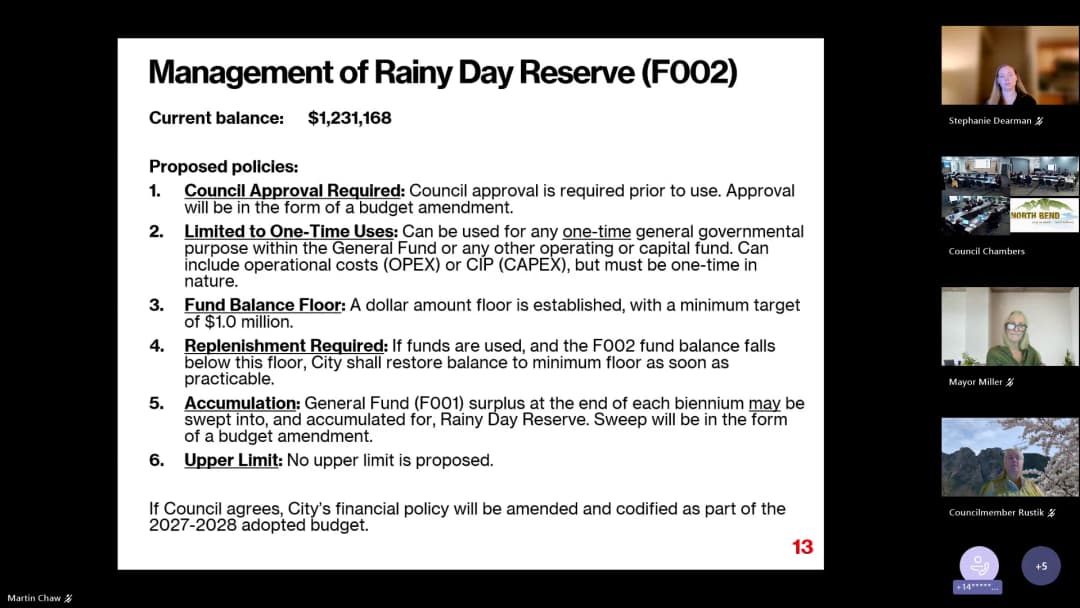
The North Bend City Council met in workstudy on October 27, 2026, at 7:00 p.m. at City Hall, 920 SE Cedar Falls Way, to continue the 2027-2028 biennial budget discussion. Mr. Chaw led the presentation, covering the General Fund, rainy day reserves, utility rates and debt, and the Capital Improvement Plan. No public comment was taken, consistent with the workstudy practice, and no formal votes were taken. Discussion Items General Fund: service levels and long-term context - Mr. Chaw recapped the first workstudy, including General Fund forecasts, Regional Fire Authority options, and levy options, before moving into a deeper review of service levels. - The city’s service area was described as about 8,700 residents inside North Bend plus about 8,400 residents in surrounding unincorporated areas, serving a total of about 17,000 people. Councilmembers noted that nonresidents use city roads, infrastructure, and emergency services without directly paying property taxes for them, and discussed the policy implications for annexation, use taxes, and levy decisions. - From 2017 to 2026, the city’s population grew by 32 percent while city FTE grew by 9 percent. Councilmembers said this illustrated doing more with less, with one councilmember describing the city’s “check engine light” being on. Council asked staff to explore additional department-level service metrics, but directed that deeper analysis be brought back next year rather than during the current budget cycle. - The General Fund budget is $33.5 million over the biennium, divided into six categories: mandatory/regulatory services 11 percent; life safety 50 percent; revenue-generating services 17 percent; community services 8 percent; internal policy support 6 percent; and remaining internal operations. Closing the projected gap with reductions only would require about $2.7 million per year, or $5.5 million over the biennium, and would fall first on community services and internal operations. - East Side Fire & Rescue Chief Aho told the city that the original budget request for a new aid/ALS unit at Station 87, including 12 FTEs and costing about $2 million per year, was cut by the fire district board. As a result, the station is cross-staffed and simultaneous major incidents would require mutual aid. - Police Chief Hall discussed pressures from I-90-related transient crime and from outlet mall corporate policies that delay calls to police. Councilmembers expressed interest in exploring a public safety sales tax and in holding large retailers more accountable for the public safety costs caused by delayed loss-prevention calls. - Councilmembers also discussed the proposed community/economic development position. One councilmember argued that eliminating the new position would effectively eliminate sponsored events unless the city contracted them separately; another councilmember noted the city could choose to fund events as it did in 2026. Rainy day reserves (Fund 002) - Mr. Chaw proposed six policies for the General Fund operating reserve, Fund 002, which has a balance of about $1.2 million and was described as roughly 10 percent of the General Fund. The proposed policies were: council approval required; use limited to one-time expenses; a minimum fund balance floor of $1 million; a replenishment plan if the fund drops below the floor; sweeping excess General Fund balance into the reserve; and no upper limit on the reserve. - Councilmembers supported council approval and one-time-use restrictions, but recommended that the floor be a percentage of the General Fund rather than a fixed $1 million amount. Several councilmembers opposed the no-upper-limit approach, saying every dollar should have a job and the reserve should not become a high-yield savings account. Staff planned to codify revised reserve policies as part of budget adoption. Utilities - Stormwater rates were adjusted through 2030 by Ordinance 1839, and water and sewer rates were adjusted through 2030 by Ordinances 1849 and 1850. All three utilities assume 2 to 2.5 percent annual growth. The rate studies include a new water field worker in 2027, a stormwater engineer in 2028, and two additional stormwater positions in 2029 and 2030. - Staff recommended removing the 2028 stormwater engineer position from the budget assumptions until the city is closer to the 10,000-population threshold for federal NPDES/MS4 requirements, saying staff will bring it back if the Department of Ecology requires it earlier. - The sewer utility carries revenue bonds for the treatment plant and CER improvements financed through a bond anticipation note; a refinancing ordinance will come to council on November 3. Mr. Chaw also gave a preview of ULID 7, involving about $9 million in revenue bonds for Mountain Park area sewer improvements, with assessments placed on improved properties after completion. - Councilmembers discussed ongoing sewer rate pressure, the high cost of King County sewer rates, and the need to monitor bond repayment through 2050. Capital Improvement Plan (CIP) dashboard - Stephanie, the city’s senior GIS analyst, demonstrated a new interactive CIP dashboard for the 2027-2032 proposed CIP. It maps projects, filters by project type and year, shows budget amounts, and includes charts and detail pop-ups. The example shown included the South Fork levy setback project with $10 million proposed in 2032; the 2029 project list was estimated at $36.6 million. - Councilmembers requested additions, including grant-funded amounts, a public-accessible version, project status/development timelines, and links to past council approvals. Staff said they would incorporate feedback and roll the tool out to council. Key Outcomes - No formal votes were taken; the workstudy provided direction for the budget adoption process. - Council generally affirmed the service levels and spending in the proposed 2027-2028 budget book, with no consensus to cut major programs. - Staff will refine the rainy day reserve policy using a percentage-based floor and an upper limit, with council approval and one-time-use restrictions. - Staff will delay the 2028 stormwater FTE unless federal/state requirements force earlier action. - The CIP dashboard will be updated with grant funding data and public access, and further layers will be explored. - Mayor acknowledged remote participation problems and said the city’s meeting technology would be fixed.

FISCAL SUSTAINABILITY 25% · PUBLIC SAFETY 13% · TECHNOLOGY AND INNOVATION 12% · ECONOMIC DEVELOPMENT 11%
674
OCT 27, 2026 · EVANSVILLE, INDIANA · CITY COUNCIL
Vanderburgh County Data Center Research Committee Meeting - October 27, 2026

The Vanderburgh County Data Center Research Committee met Tuesday, October 27, 2026, from 1:00 to 3:00 PM in Room 301 of the Civic Center Complex in Evansville, Indiana. Chair Lloyd Lamberton led the meeting. Committee members present included Jason Nabb, Scott Ambrose, Tom Settler, Jenna Richardt, Lauren Lynch, John Bates, John Dykoff, John Robertson, Richard Reed, Chai Mamadala, Susan Hardwick, and Mark Murray; County Commissioner Mike Gable also attended. The committee approved the prior minutes, reviewed fire/EMS/EMA/public safety recommendations, began planning an evening public comment session, heard community comments, and discussed research on health impacts of data centers. Consent Calendar - Roll call was completed. - The October 20, 2026 meeting minutes were approved by voice vote after a motion and second. The minutes text was not included in the source material provided. Public Comments & Testimony - Melanie McDowell thanked the committee for its due diligence, suggested using a cell phone recording on Facebook and the 4-H Center as a larger venue, and asked whether the ordinance would require millions of dollars in decommissioning and cleanup because the technology may be outdated in three to seven years. She said communities in Warrick and Posey counties do not want data centers, expressed concern about cancer rates and air quality in the Ohio River Valley, and predicted that most public comments will be opposition. - Mike Gable, Vanderburgh County Commissioner, thanked the volunteer committee and said the commission needs its support. He acknowledged the room is small, said recording at the library can be expensive, cited a recent $2,500 event-recording cost, and said the commission might revisit recording if the committee thinks it is important. - Margaret Connolly suggested contacting Vicky Small about the League of Women Voters recording arrangement shown on WNIN, and about possible library recording equipment. Discussion Items Data Center Tour and Amazon Outreach - Lloyd Lamberton reported that he had contacted Amazon representatives for the South Bend-area facility and South Bend officials, and was waiting to hear back about a possible committee tour. He had also spoken with Amazon staff at a public event and formally requested a tour. - Committee members who attended the Amazon open house reported a large Amazon team answered questions on many topics. Lloyd said he spoke with economic development and environmental staff, including about South Bend's pretreatment program and challenges. One member learned the South Bend facility's actual wastewater discharge was substantially less than its permitted amount, that water use is seasonal because air cooling is used in the winter, and that backup power comes from diesel generators with limited annual run hours. Members noted the words emergency and temporary may need to be defined, and questioned why natural gas was not used instead of diesel; infrastructure differences were cited as a likely reason. Section 16: Fire, EMS, EMA, and Public Safety - Richard Reed presented on fire, EMS, EMA, and public safety. He said the National Fire Protection Association (NFPA), building codes, OSHA, the Area Planning Commission, and county road use agreements/INDOT already govern construction, suppression, egress, and traffic. He said existing local employers such as Cook, Sterling, AstraZeneca, power plants, refineries, and Toyota have internal response teams, emergency action plans, and standard operating guidelines. - Reed identified the main gap as the absence of an ordinance requirement for live, hands-on training, site tours, and developed standard operating guidelines before a data center starts operating. He recommended requiring developer/operator-funded training and planning, including during construction before testing and power-up, and said this should include communication about specialty equipment needed by responding departments. He noted many nearby counties are still developing ordinances and that South Bend had not responded to his inquiries. - Committee discussion supported an all-of-the-above approach: existing regulations, ordinance language, and development contracts should all require adequate fire safety, planning, and training, especially because large data-center developers may not be local companies. Members broadly agreed that any additional fire resources, such as firefighters, trucks, or stations, should be funded by the developer rather than shifting costs to property taxpayers. - A member cited the Louisville Powerhouse campus, described as 157 acres and 400 to 402 megawatts, with $12.5 million provided to Pleasure Ridge Fire Department. Reed suggested comparing facilities on a per-megawatt basis and noted that county councils and economic development agreements handle many funding decisions. - Members discussed lithium-ion battery risks, including hydrogen fluoride and hydrofluoric acid, and the need for air quality sensors, fixed or third-party monitoring, and training for all local fire departments. Reed agreed and cited refinery boundary monitoring as a model. - Members discussed possible city/county mutual aid or contractual fire protection for facilities outside the city. Reed said he had general talks with Chief Knight, and mutual aid agreements are feasible. Lauren Lynch advised that formal arrangements with the city would be negotiation points for county commissioners, although the committee could include a recommendation in its document. - Reed and members acknowledged that an ordinance must be supported by legal authority. The committee agreed to list desired best practices holistically rather than write ordinance language, and Reed agreed to draft a living document on SharePoint for committee comment. - A member raised property setbacks, noting the Vanderburgh County draft had a 20-foot residential setback compared with Posey County's 1,000-foot setback. Property value impacts on nearby homeowners were also identified as a public concern to address. Community Comments and Correspondence - John Robertson was absent, so the committee deferred its response to emailed community comments. Members discussed the need to acknowledge comments and respond to them, and John was expected to collate and report comments at the next meeting. Lauren Lynch also said some public comments had gone to spam folders and planned to follow up with IT. Evening Public Comment Session Planning - Lauren Lynch said the committee identified two potential dates, November 10 or November 17, 2026, at 5:00 to 6:30 or 7:00 PM. Option 1 was Room 301 at the Civic Center, with the county's normal live streaming and recording, commissioner-funded security, and roughly 76-person capacity. Option 2 was the Evansville Public Library Browning Room A, with about 98-person capacity and commissioner-funded security, but no county recording or live streaming; she initially said the library was only available on November 17. - Lynch noted recording and streaming are not legally required because the committee has no decision-making or fiduciary authority, but she recommended recording so remote residents can participate. - Some members were unavailable on each date, so the committee agreed to poll the full committee and use majority preference. Members said they would look for another date or venue if fewer than 60 percent of members were available. They also considered the Old National Events Plaza and 4-H Center. - The committee planned two-minute speaker limits, first-come/first-served signup, and encouraged written copies of statements. They agreed to state at the outset that the committee is not deciding whether to site a data center or reviewing a proposal, but is seeking input related to its research and recommendations. - Discrepancy note: Later in the meeting, a statement was made that Browning Room A was already reserved for November 10 and that Lauren would check with Vicky Small about recording equipment. This conflicts with Lauren's earlier statement that the library was available only on November 17. The transcript does not resolve the conflict. Health Impacts Research - Mark Murray, speaking personally and not on behalf of his employer Ascension, summarized three research studies posted to SharePoint. - Washington State/Quincy study: modeled diesel exhaust from four data centers and estimated an additional lifetime cancer risk of 11 per million for 2016 operations, projected to rise to 19 per million in future operations. Murray said this is not statistically insignificant but not major, and he connected it to possible requirements for disclosure of generator count, fuel type, emissions, and allowable non-emergency testing hours. - Virginia study: residents near data centers reported disrupted sleep, migraines, and reduced outdoor enjoyment; complaint-related measurements were in the 40 to 59 decibel range including low-frequency background noise. Relevance included residential setbacks, nighttime testing restrictions, low-frequency noise monitoring, and pre-construction modeling with post-construction verification. - Arizona study by Pima County Health Department and Johns Hopkins researchers, dated August 2026, screened exposure pathways across construction, operation, and decommissioning, including diesel and upstream power emissions, water use, noise, waste heat, light pollution, and equipment disposal. Relevance included a life-cycle checklist, baseline measurements, and comparing facility disclosures to actual implementation. - Discussion included Amazon's New Carlisle facility, described as having 910 diesel generators, a large backup-power capacity, and six million gallons of stored fuel. Members discussed battery storage as cleaner and quieter but noted its footprint, cost, and difficult decommissioning. Several members favored setting strong standards and using contracts to encourage good-neighbor operators rather than directly banning specific technologies. Air emissions permitting and enforcement is handled by IDEM, not the city or county. Memphis was cited as having documented health impacts from diesel generation. Decommissioning was again identified as a critical future topic. Key Outcomes - The October 20, 2026 minutes were approved. - Richard Reed will draft Section 16 fire/public safety recommendations and best practices, post a living document to SharePoint within about seven days, and incorporate committee comments before the next meeting. - The committee will poll members to choose the evening public comment session: November 10 in Room 301 with streaming/recording, or November 17 at the Evansville Public Library Browning Room A without county streaming/recording, subject to the noted availability discrepancy. The selected date and venue will be publicly announced. - John Robertson will report on emailed community comments and responses at the next meeting. Lauren Lynch will follow up on spam-folder issues with IT. - Jenna Richardt will present on electric/energy at the November 10, 2026 meeting, and Mark Murray will also cover backup generation. - Upcoming dates: November 10, 2026; November 17, 2026; December 8, 2026, for a public comment meeting and committee discussion; and December 15, 2026, for the final meeting to vote on recommendations to the County Commissioners.

FIRE SAFETY 31% · DATA CENTER INFRASTRUCTURE 19% · PUBLIC ENGAGEMENT 15% · TECHNOLOGY AND INNOVATION 7%
676
OCT 27, 2026 · SOUTH FULTON, GEORGIA · CITY COUNCIL & PUBLIC FACILITIES AUTHORITY
South Fulton City Council Regular Meeting - October 27, 2026

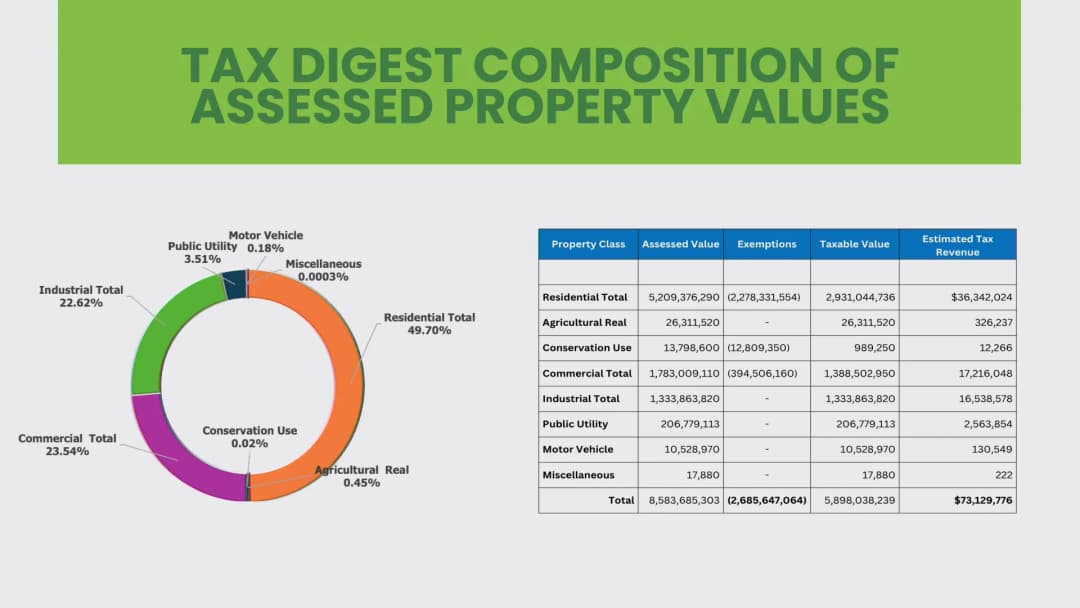
The South Fulton City Council met in regular session on Tuesday, October 27, 2026, at City Hall from 7:02 p.m. to 8:54 p.m. Mayor Carmalitha Gumbs presided. Six of seven council members were present; District 6 Councilmember Natasha Williams-Brown was absent. The council adopted the amended agenda and minutes, approved land-use decisions, set the 2026 millage rate at 12.399 mills, approved multiple contracts and intergovernmental agreements, and received extensive public comment, mostly against a proposed confidentiality ordinance that Councilmember Jaceey Sebastian pulled from the agenda for further public education. Consent Calendar - The agenda was adopted as amended: Councilmember Sebastian removed the Safeguarding Confidential Information ordinance (Item XII.A.1), and the city attorney added a settlement approval item. - Minutes of the October 13 regular meeting, work session, and alcohol/zoning public hearing were approved by unanimous consent. Councilmember Linda B. Pritchett objected, saying unanimous consent is not the same as a voice vote; the city attorney cited Charter Section 3.15 and case law to explain that the city's recorded votes are more transparent than a voice vote. - The consent agenda was approved by unanimous consent, including: proclamations for Dr. Mary A. Mudd, James Edward Betts, Kingdom of God International Ministry, Westlake High School Mighty Marching Lions, Nobie Wiggles Sears, and Commissioner Marvin S. Arrington; a $93,274.40 HEAT grant with a $23,318.60 match; a $405,000 COPS Technology and Equipment grant; an additional $1,500 from the National Recreation and Park Association (increasing the Leaders in Training grant to $11,500); an MOU with the NAACP ACT-SO Committee; the District 1 special events list; the appointment of Dr. Arnita Johnson to the Parks and Recreation Advisory Board; and a $500 donation from Elizabeth Baptist Church Cares. Public Comments & Testimony - Most speakers addressed the now-pulled Safeguarding Confidential Information ordinance. They broadly opposed it, saying it would criminalize the dissemination of confidential information, chill whistleblowers, violate First Amendment and open-records rights, and reduce government transparency. - Grace McKenna McLean, founder of Americans Against Judicial Corruption, said whistleblowers expose misconduct and that the council 'called yourselves out' by proposing the ordinance. - Mandel Robinson criticized the council's transparency and leadership, saying residents are watching and would vote officials out if changes are not made. - Brenda Aiken (District 3) said officials are 'hiding too much' and questioned unexplained cost escalation on the Old Fairburn Road roundabout, which she said grew from about $1 million or $1.4 million to $5 million under TSPLOST. - Mike Johnson (District 4) welcomed new Police Chief Chrissy Lattimore but criticized Mayor Gumbs and City Manager Sharon Subadan over past police department leadership and told Councilmember Sebastian that work-camp threats would not intimidate residents. - Demeter Chapman said the ordinance was disrespectful and resembled 'something we talk about Trump doing,' and said council members should get full-time jobs if they have time for such proposals. - Wanda Mosley (District 3) expressed serious concerns about data-center noise, saying the Union City Data Center on Stonewall Tell Road is deafening and that the current data-center ordinance does not protect residents. - Pamela Harris asked for a written legal assessment of the confidentiality ordinance and formally requested that her October 27, 2026 public comment letter be included in the minutes. - Richard Schnellings said the ordinance should be 'dead, not off the agenda,' and complained about three-month delays in open-records requests and the use of city resources for campaigns. - Another speaker, whose call was listed as Mel Keaton, accused council members of deferring a case for a friend, taking money from developers, and 'weaponizing' city council. - Lynn King (District 4) said she was not in favor of the ordinance, welcomed its removal, and urged the council to build trust and transparency. - Charles Rambo (District 2), a former national vice president of the International Brotherhood of Police Officers, argued the ordinance would violate constitutional protections, including Pickering rights, open records, and the 13th Amendment, and said 'stop sending folk to jail.' - Connie Robinson (District 2, via Zoom), speaking for HLA Collaboration and Community Advocacy, requested that the council revisit establishing a homeowners association advisory board. She cited roughly 2.3 million Georgians in 11,400 community associations and said South Fulton has about 63 community organizations representing more than 5,000 homeowners. Her time expired before she completed her remarks. Zoning and Land Use Decisions - Z26-024/CDP26-008 - TDS Capital Two, LLC: Request to rezone 59 acres at 4380 Old Fairburn Road from CUP (Community Unit Plan District) to TR (Townhouse Residential) and amend the Comprehensive Development Plan to build 52 attached dwellings. Staff and the Planning Commission both recommended denial. The council voted to deny; the transcript's tally is garbled, but it appears to be a 5-1 vote. - Z26-019/U26-009 - Alibhai Energy Holding LLC: Request to rezone 1.97 acres at 3985 Roosevelt Highway from C-1 to C-2 and obtain a use permit for a gas station with a quick-service restaurant. Staff recommended approval; the Planning Commission recommended denial. The council approved the request on staff recommendation by a 6-0 roll-call vote. Millage Rate Public Hearing and 2026 Millage Rate - City Manager Sharon D. Subadan and CFO Althea Philord-Bradley presented the 2026 millage rate, proposing no change for the fourth consecutive year. The proposed rate of 12.399 mills is below the 12.457 rollback rate, with the $342,000 difference covered by new properties added to the tax digest. - The city's assessed value is $8.5 billion; exemptions reduce the taxable digest to $5.8 billion. Residential property makes up about 49.7% of the taxable digest, commercial 23.5%, and industrial 22.6%. The city gives back $33.3 million in exemptions. New homestead exemptions for residents 65 and older and 70 and older require application by April 2027. - The public hearing was opened and closed with no speakers. The council then approved the ordinance setting the 2026 millage rate at 12.399 mills by a 6-0 roll-call vote. Council Comments and Reports - District 7: Halloween trunk-or-treat at Orchard Springs apartments; October 30 street dedication for fallen officer Captain Elio A. Garcia on Flat Shoals Road; welcomed new Police Chief Chrissy Lattimore. - District 4: promoted the November 7 veterans motorcade; defended the work-camp language removal; noted that the work-camp penalty language already exists in city code but is not used; city attorney confirmed the confidentiality ordinance would not affect open records, free speech, or whistleblower protections. - District 2: encouraged early voting through November 3, honored National First Responders Day on October 28, and asked for prayers for Westlake High School after the deaths of two teachers and one student in one month. - District 3: highlighted community cleanups, a street dedication for Pastor Emeritus Walter Kimbrough, a data-center listening session with Creekside residents, and fall events. - District 5: thanked the city manager for a TSPLOST presentation, announced the Urban Food Movement giveaway, the opening of Southside Touche Restaurant, the senior holiday luncheon, and Workforce Academy programs. - District 1: promoted arts programming at the Southwest Arts Center and thanked Councilmember Sebastian for listening to residents and pulling the ordinance. - Mayor Gumbs: touted a PNC bank ribbon-cutting on Old National Highway, defended the city's progress, urged residents to get facts from council members, and thanked Dr. Alexander for his service as interim police chief. Discussion Items and Votes - Confidentiality ordinance: Councilmember Sebastian removed Item XII.A.1 from the agenda at the start of the meeting, saying there was misunderstanding and misinformation and that he would provide more public education. Later, he read existing city code and charter provisions on confidential information, and the city attorney read language in the proposal preserving Open Records Act and Whistleblower Act protections. - Proclamation co-sponsorship policy: The council approved a resolution automatically designating the mayor and all councilmembers as co-sponsors for life-celebration and birthday proclamations, with amendments to include church anniversaries, sports championships, and department head recognitions, and to allow a councilmember to opt out and sponsor solo. Approved by unanimous consent. - Orkin, LLC pest control contract: Approved 6-0. The contract is through Sourcewell Cooperative Contract No. 012825-ORK, not to exceed $150,000 for 12 months, with a one-year renewal option. - Musco Sports Lighting piggyback contract: Approved by unanimous consent. The contract covers sports lighting solutions up to $1,000,000 through June 16, 2027, with up to three one-year extensions. - IGA with City of Atlanta Watershed Management: Approved 6-0. The IGA covers relocation of water facilities for the TSPLOST I, OSI 618 Welcome All Road at Scarbrough-Jailette Road intersection project; City of Atlanta will contribute up to $20,448. - IGA with MARTA (Safe Routes to Transit): Approved 6-0. MARTA will construct pedestrian improvements at 15 listed bus stop locations and bear all costs. Councilmembers raised concerns about unsafe stops at Jonesboro Road and Peters Road and along Highway 92/South Fulton Parkway. - First-read ordinances: Introduced but not voted on - an ordinance establishing a Cultural Affairs Advisory Board (sponsored by Councilmember Rowell), an ordinance amending voluntary inclusionary zoning (sponsored by Mayor Gumbs), and an ordinance removing references to work camps from the charter and code (sponsored by Councilmember Sebastian). - Walk-on settlement: The council approved a $10,000 settlement in Miller v. City of South Fulton, contingent on execution of a general release, with final terms delegated to the city manager and interim city attorney. Approved by unanimous consent. Key Outcomes - The proposed Safeguarding Confidential Information ordinance was pulled from the agenda; Councilmember Sebastian committed to additional public education and discussion. - The 2026 millage rate was set at 12.399 mills by a 6-0 vote, marking the fourth consecutive year without a rate increase. - Z26-024 was denied and Z26-019 was approved, both on roll-call votes. - The proclamation co-sponsorship policy was approved as amended. - The Orkin contract, Musco Sports Lighting contract, two public works IGAs, and the $10,000 settlement were approved. - Three first-read ordinances were introduced for future consideration. - The meeting adjourned at 8:54 p.m.

PUBLIC ENGAGEMENT 28% · PROCEDURAL 20% · PUBLIC SAFETY 11% · COMMUNITY ENGAGEMENT 10%
677
OCT 27, 2026 · DEKALB COUNTY, GEORGIA · BOARD OF COMMISSIONERS & COMMITTEES
DeKalb County Finance, Audit and Budget Committee Reviews FY2027 Requests on October 27, 2026

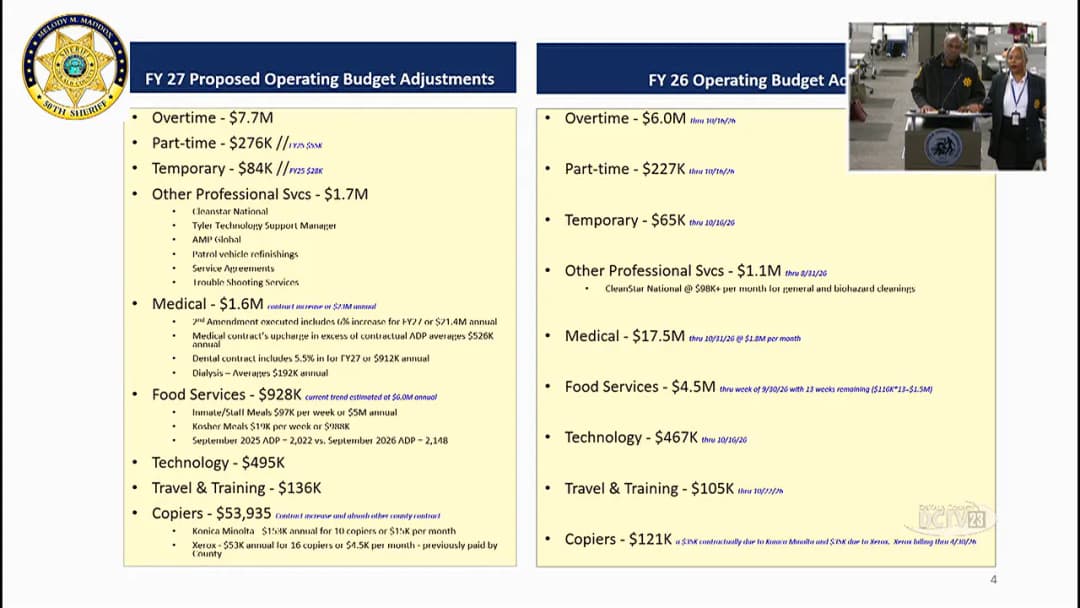
On October 27, 2026, the Finance, Audit and Budget Committee, chaired by Commissioner Ted Terry, met to approve routine items and hear FY2027 budget presentations from the Superior Court, State Court, Tax Commissioner, and Sheriff's Office. Commissioner Michelle Longspears stepped out briefly but returned; Commissioners Shakira Johnson, Patrick, and others participated. No public comment period appeared in the transcript. Consent Calendar - The committee approved the minutes of the October 12 special call meeting (item 1493) by voice vote with no changes. - No public comments were heard. Contracting Item - Change Order No. 5 to Contract No. 1136419, inventory of capital assets, was approved. The change order increases funds to a total not to exceed $500,000 and extends the term through December 31, 2029, with HCA Asset Management LLC. Finance Director McNabb said the county has roughly $2.8 billion in fixed assets and the vendor uses tag-reading technology to conduct inventories. Superior Court FY2027 Budget Presentation - Chief Judge Shondina Morris and Court Administrator Hawkins Ponzo presented Superior Court's priorities. - Superior Court reported 11,406 cases closed across all 10 divisions in 2025, a 112 percent cumulative clearance rate, a 195.7 percent murder clearance rate, more than 175,000 jury summons issued, and 75 completed jury trials. For 2026, the court reported 68 adoptions disposed (94 percent clearance), 456 serious violent felonies (128 percent clearance), and 1,663 divorces (105 percent clearance). - The court requested a total of $2,212,000, including $772,000 for personnel for an 11th judge, $185,000 for senior judge support, $100,000 for security at the off-site accountability court office, $250,000 for judicial security, $150,000 for computer equipment and software, $175,000 for court administration, $30,000 for digital court reporters, $175,000 for jury management and juror summons, and $10,000 for dispute resolution. - Judge Morris said DeKalb has 10 Superior Court judges 'doing the work of 12' and that the 11th judgeship has been authorized by the Council of Superior Courts and the Georgia Supreme Court Chief Justice. - The court administrator clarified that the $772,000 request is for personnel only; courtroom capital needs are part of a separate CIP request. COO Williams said roughly $3.4 million to $3.5 million is set aside in CIP for a courtroom build-out, but that figure may be outdated and needs an updated cost estimate. - Judge Morris said a larger courtroom is needed for multi-defendant gang and RICO murder cases and is a future request; the near-term ask is for an 11th judge's courtroom. - Commissioner Massey asked about pro se litigants; Judge Morris estimated a 40 to 45 percent increase in her division and said the family law information center currently receives $50,000 and relies on volunteer attorneys. The court agreed to add a request for a paid staff attorney for the law clinic after Commissioner Massey asked for one. - Commissioner Terry asked for a memo separating one-time and ongoing costs. State Court FY2027 Budget Presentation - Chief Judge Mike Jacobs, Judge Kimberly Anderson, and Court Administrator Edwin Bell presented. Judge Anderson becomes chief judge on January 1. - State Court and Magistrate Court jointly employ about 350 people, including judges' staffs, probation, marshal's office, and shared clerk's office. - Requests included sworn marshal benefits parity with police; vehicle replacements for the marshal's office and probation; judicial security positions and equipment after a serious threat to a judge; clerk's office training and staffing; and new clerk positions for new case loads. - Magistrate Court's civil jurisdictional limit rises from $15,000 to $25,000 on January 1, expected to increase small-claims filings. New school-bus-camera citations, with fines up to $1,000, will go to State Court Division B; Judge Jacobs said other jurisdictions are seeing an 'avalanche' of such cases. - Commissioner Longspears calculated the requested capital total as $2,560,000 and the operating total as $1,605,641. COO Williams said vehicle purchases are treated as an operating expense, not capital. - Commissioner Patrick asked that vehicle purchases follow the county's resolution encouraging electric vehicles. - Judge Jacobs said State Court plans a pilot in two divisions, led by himself and Judge Charlie Bailey, using judicially supervised mental-health treatment as a special bond condition. It is not in this year's request but is expected to be in next year's request. Tax Commissioner FY2027 Budget Presentation - Tax Commissioner Golden requested a salary line increase of about $356,000, later cited as $356,441, offset by $255,000 in reductions elsewhere, for a net increase of about $101,000 over the current budget. - He said the office collects nearly $2 billion per year in taxes, with about $670 million going to DeKalb County, and that attrition and retention are driven primarily by pay. He expects to return about $155,000 in salary savings this year and noted five new employees started that day. - Commissioners praised the office's community outreach and customer service and expressed support for the request. Sheriff's Office FY2027 Budget Presentation - Chief Atkins and Senior Fiscal Officer Carla Campbell presented the Sheriff's Office request. - The FY2027 request is $108.3 million, a 3.8 percent increase over the FY2026 adopted budget of $104.3 million. The roughly $4 million increase includes about $1.9 million for the full-year cost of a 5 percent salary adjustment, a 6 percent medical services contractual increase, a 5.5 percent dental services increase, and food service costs rising from about $5 million to about $6 million, including a 3.7 percent contractual increase. - The overtime request remains at $7.7 million; $6 million had already been spent through October 16, attributed to mandatory overtime and unfilled deputy positions. - Chief Atkins separately asked for deputy benefits parity with the police and fire departments, noting that the request is not included in the budget figures. - Chief Atkins also said the Sheriff's Office supported the court security response to the judge-related threat. Key Outcomes - The committee approved the October 12 meeting minutes and the HCA asset inventory change order unanimously. - The FY2027 budget presentations were received; no formal votes were taken on the budget requests themselves at this meeting. - Superior Court will provide a law-clinic staff attorney request and a one-time versus ongoing cost breakdown; COO Williams will bring back an updated courtroom build-out cost estimate. - The Sheriff's Office was asked to provide updated 2026 data on incarcerated criminal-trespass misdemeanants with mental health or substance abuse diagnoses and associated costs, with additional breakdowns by overall population growth, incident type, public or private origin, jurisdiction, and any additional charges. - The committee adjourned after the presentations and discussion.

PERSONNEL MATTERS 33% · FISCAL SUSTAINABILITY 28% · PUBLIC SAFETY 21% · HOMELESSNESS 10%
678
OCT 27, 2026 · TOLEDO, OHIO · CITY COUNCIL
Toledo City Council Agenda Review — October 27, 2026

The City of Toledo City Council held its agenda review meeting on Tuesday, October 27, 2026, at 2:00 PM in Council Chambers. The session prepared the agenda for the November 11, 2026, Council meeting. No formal votes were taken; items were advanced, referred, or scheduled for later action. Roll call showed a quorum. Consent Calendar / Routine Agenda Advancements - Advanced without questions from Council members: $300,000 reappropriation in the Municipal Garage Fund Fleet Operations budget for vehicle repair parts and materials, using salary savings from unfilled positions. - Advanced without questions from Council members: $633,213 agreement with the Arts Commission of Greater Toledo to implement the 2026 Municipal Art Plan under the 1% for the Arts allocation. - Advanced without questions from Council members: $375,500 reappropriation within the Solid Waste General Fund to pay forecasted regulatory disposal fees, funded by vacancy savings and other identified 2026 budget savings. - Agenda items 4 and 5, including the emergency spent-lime hauling and disposal contract with BCA Express Co. LTD and the CAAS Cyanobacteria Analyzer preventative maintenance contract, were moved to the next agenda because no administration representative was present to present them. Presentations and Advancements - TARTA Youth Blast Pass academic-year pilot: Chief Impact Officer Tiffany Whitman and TARTA staff presented a $40,000 General Fund agreement to pilot an expansion of the Youth Summer Blast Pass program from January through May 2027. The investment would support up to 3,576 youth transit passes for Toledo youth. TARTA reported that the summer 2026 program served 3,576 youth and provided 40,000 fixed-route youth rides; the top zip codes of riders have consistently been inside Toledo. Council members praised the program, asked about measuring economic impact, and asked what happens if funds are underspent. TARTA said it has covered overage costs in previous years and has never underspent. First reading was requested. - Toledo Public Schools youth and family success initiative: A $40,000 pilot would provide $10,000 to each of four schools in Neighborhood Revitalization Strategy Areas to address chronic absenteeism. TPS was not present but submitted a letter of support. The item was advanced without objection. - Toledo/Lucas County CareNet: A $10,100 agreement to support healthcare access, insurance navigation, and community health worker services for uninsured and underinsured residents was advanced without discussion. - Toledo Urban Volleyball Association: An additional $10,000 for 2026-2027 school-year programming was advanced. The administration stated the organization's original proposal was for $20,000, but the contract was mistakenly written for $10,000; sufficient funds remain. - Resolutions were announced recognizing James Hartung and the 70th anniversary of the Hungarian Revolution of 1956. - Mayor's appointments were presented: David Mann to TCIC for a three-year term expiring November 4, 2029; April Welch to the Troy Township JEDD, replacing Cody Brown, for a term to July 1, 2030; and Andy Schaefer to the Plumbing Board of Control for a three-year term expiring November 4, 2029. Discussion Items - 2027 Council calendar: Second reading list included O-413-26 (ARPA-SLFRF reallocation), O-425-26 ($355,297 Healthy Food Small Market Program agreement with the Toledo-Lucas County Board of Health), R-435-26 (Flock Group contract termination and equipment removal), and R-436-26 (2027 calendar). Council members suggested moving July meetings to August or late June. President Williams said the two July dates would be moved to August and directed the clerk to make the notation. - Electric police vehicles: A new item was announced authorizing $210,809 from the General Fund, transferred to the Capital Improvement Fund, for electric police vehicles and related charging infrastructure. Discussion clarified the vehicles would be community police/CSO vehicles, not general patrol units. Councilman Driscoll said CSOs have regular daytime schedules that fit EV use, and earlier this year the city piloted several electric police vehicles. - Flock and TPD technology: Councilman Martinez presented an ordinance codifying prohibited uses of Toledo Police Department technology. He said it codifies existing transparency commitments, reaffirms prior legislation, and creates officer accountability for misuse. Martinez cited prior hearing testimony that roughly 10.5-11% of shared Flock users had active 287(g) agreements and said the ordinance would require monthly review and removal of such users from camera-sharing access. He also said Flock has removed keyword search and now requires searches to be tied to FBI crime categories. He asked for co-sponsors and proposed a November 4 vote or committee referral. Councilman Driscoll called the ordinance a step in the right direction and suggested penalties for city-side misuse. Councilman Meldon said a broader data governance and data privacy policy is still in development. Councilwoman Kramer raised concerns about protecting civil liberties and protest activity and said the need to legislate around protests was alarming. President Williams asked whether the proposed pause covered cameras or only license plate readers, noting residents in her district have wanted cameras after shootings. Councilwoman Morris asked about contract-breach points, camera costs, and vandalism replacement liability and said she would submit referrals to legal and police. Martinez said the resolution would pause the Flock OS, including LPRs and cameras. Martinez also described a work-in-progress proposal to geofence sacred areas such as schools, houses of worship, libraries, hospitals, and community centers, keeping cameras off unless there is a 911 call for service. President Williams also said city auditor John Robowski has been compiling Flock data but has been delayed because access requires law-enforcement certification, and she noted the Ohio acting attorney general has proposed termination of any officer convicted of Flock misuse. Other Council Business - New items announced included $80,000 for the Code Blue Cold Weather Response Initiative, $67,000 for Connecting Kids to Meals, and $210,809 for electric police vehicles and charging infrastructure. - Councilman Martinez said he filed referrals regarding the Beverly subdivision school lot and its proposed use with Habitat for Humanity, arguing the property should have gone to market for market-rate, senior, or multigenerational housing; he also filed a referral to the school board. - President Williams said she would send a referral to the administration about scams in which constituents received emails claiming to represent the city's zoning department and were defrauded out of money; she urged residents to verify such emails. - President Williams announced a finance committee meeting for October 28, 2026, at 4:00 PM where the administration would present a blueprint for complying with budget restrictions if the police/fire safety levy fails. Key Outcomes - The two July 2027 City Council meeting dates will be moved to August. - The TARTA pilot and most new items advanced to the November 11, 2026, agenda; first reading was requested for the TARTA item. - Councilman Martinez's TPD technology ordinance will be open for co-sponsors and may be scheduled for a November 4 vote or referred to committee. - Council members announced referrals concerning Flock contract liability and camera costs, zoning application scams, and the Beverly subdivision property. - No formal Council votes were taken during this agenda review session.

PUBLIC SAFETY 26% · TECHNOLOGY AND INNOVATION 24% · PROCEDURAL 19% · YOUTH PROGRAMS 13%
679
OCT 27, 2026 · TULSA, OKLAHOMA · CITY COUNCIL
City of Tulsa Board of Adjustment Meeting No. 1393 (October 27, 2026): Zoning Variances and Special Exceptions

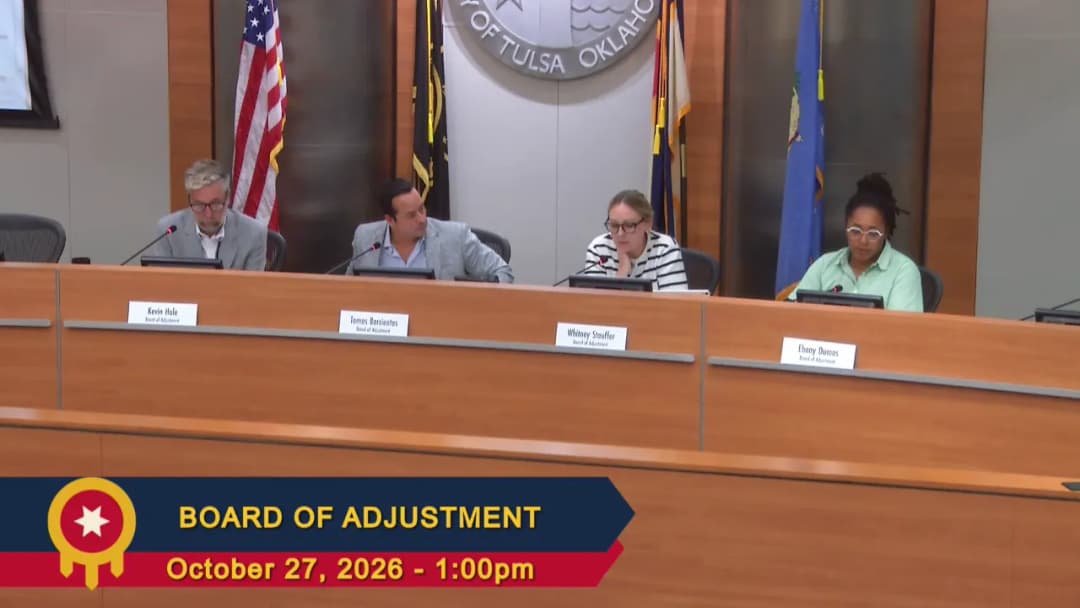
The City of Tulsa Board of Adjustment met at 1:00 p.m. on Tuesday, October 27, 2026, in the Tulsa City Council Chamber, 175 E. 2nd St., to consider eight zoning cases. Only four of the five board members were present, so three affirmative votes were required for approval. The chair noted that Ms. Dumas would leave at 2:30 p.m., reducing the board to three members. The board approved the corrected minutes of Meeting No. 1392, approved six applications, denied one application, and continued one case to November 17, 2026. The meeting adjourned at approximately 2:31 p.m. Consent Calendar - Approval of Minutes (Meeting No. 1392, October 13, 2026): The chair requested a correction to Case BOA-24105, changing his recorded vote from no to yes. The board unanimously approved the minutes as corrected. Public Comments & Testimony - No members of the public testified in opposition to any case. - BOA-24116 – Mike Vaughn (20 East Fifth Street, Suite 600) asked a clarifying question about which sides of the building would have signs; the applicant corrected an earlier misstatement about the building elevations. Discussion Items BOA-24108 – 3017 South 129th East Avenue (Variance for vehicle display) Applicant Domingo Maldonado, through counsel Anna Sanchez, requested a variance to display and store used vehicles for sale within 300 feet of an abutting residential district in the CS district. The property is a former Sonic drive-in on a 0.65-acre lot; the related special exception for personal vehicle sales had already been approved at the previous meeting. The applicant proposed a maximum of 25 vehicles, placed on the east and south sides farthest from the adjacent apartments, with existing screening fencing retained. The board discussed the narrow lot and minimal neighborhood impact. Vote: Approved 3-1, conditioned on no more than 25 vehicles on the south and east sides only; one board member, Mr. Hill, voted no, citing an insufficient hardship. BOA-24114 – 317 South Trenton Avenue (Special Exception for vinyl record press) Applicant Nathalie Cornett, Eller & Detrich, P.C., requested a special exception for low-impact manufacturing and industry in the CH district to operate a boutique vinyl record pressing studio, said to be the first in Oklahoma. The 2,500-square-foot space would employ four to six people during business hours (8 a.m.–5 p.m.) and involve one production line. The applicant said the process produces no odor, vibration, or off-site noise, and the surrounding Pearl District includes music-related uses. Board members discussed limiting the exception to the leased space. Vote: Approved unanimously. BOA-24116 – 15 East 5th Street South (Variance for wall sign area) Applicant Jesse Bucelluni requested a variance to increase the aggregate wall-sign area in the CBD from 426 square feet to approximately 479 square feet. The building is 41 stories; an existing tenant sign at the top uses 426 of the 427 square feet otherwise available, leaving 1 square foot, and the applicant wanted to replace an existing sign at the same size using existing mounting structure. The board identified the size and height of the building as the hardship and approved the variance. Vote: Approved unanimously. BOA-24117 – 6915 South Canton Avenue East (Special Exception for assisted living) Applicant Katherine Ormond requested a special exception for an assisted living facility in the OL district. The existing building is under contract for purchase, near St. Francis Medical Center, and surrounded by office, commercial, and hotel uses rather than residential. The facility would have 11 beds, 24/7 occupancy, four staff during the day and one at night; the 61-occupant figure in drawings was a code calculation, not the planned occupancy. Vote: Approved unanimously. BOA-24118 – Southwest of E. 27th Street and S. Peoria Avenue (Variance to reduce open space) Applicant W Design, represented by Roger McKee, requested a variance to reduce the minimum open space per unit in the RS-3 district from 4,000 to 3,480 square feet. The 7,000-square-foot lot is the smallest in the neighborhood; an asphalt-paved mutual access/emergency-access easement takes up approximately 736 square feet that would otherwise count as open space. The proposed house would be about 3,700 square feet. Board members divided, with some viewing the open-space requirement as important and others seeing the easement as a unique hardship; because a vote might split 2-2, the case was continued. Vote: Unanimously continued to November 17, 2026, so a fifth board member could be present. BOA-24119 – 13412 East Admiral Place (Special Exception for barbed/razor wire fencing) Applicant Mark Capron, Wallace Design Collective, on behalf of LDF, requested a special exception for barbed-wire or razor-wire fencing in the CG district around a warehouse distribution and vehicle storage area. No residential uses are within 850–1,000 feet; the property is buffered by wetlands/floodplain, and an older Albertson's distribution center in the area already uses barbed wire. Vote: Approved unanimously. BOA-24120 – North of W. 91st Street and S. Maybelle Avenue (Special Exception for fence height) Applicant Nathalie Cornett, Eller & Detrich, P.C., requested a special exception to allow entry gate features up to 12 feet tall in the street setback of the Estates at Tulsa Hills subdivision. The 8-foot masonry perimeter wall was already in place; the entry columns would range from 8 to 12 feet and be set back more than 70 feet from Maybelle. Board members found 12 feet excessive and without sufficient justification. Vote: Denied 3-1. BOA-24121 – 2425 East Pine Street (Special Exception for food truck court) Applicant Daniel Ruiz, with his daughter, requested a special exception for an outdoor assembly and entertainment use in the CS district to operate a food truck court on family-owned property. Two food trucks would operate—Mexican food and Mexican snacks/ice cream—with requested hours of 11 a.m.–6 p.m., a dumpster area, and no covered seating. A neighboring property owner expressed support before the meeting, and the applicant had consulted the Health Department. The board supported the use but added conditions because of its proximity to a residential neighborhood. Vote: Approved unanimously, subject to hours of 10 a.m.–8 p.m. and a maximum of three food trucks on site. Key Outcomes - Minutes of Meeting No. 1392 approved as corrected. - BOA-24108 (vehicle display variance) approved 3-1 with conditions. - BOA-24114 (vinyl record press) approved unanimously. - BOA-24116 (wall sign variance) approved unanimously. - BOA-24117 (assisted living facility) approved unanimously. - BOA-24118 (open space variance) continued to November 17, 2026. - BOA-24119 (barbed/razor wire fence) approved unanimously. - BOA-24120 (fence height special exception) denied 3-1. - BOA-24121 (food truck court) approved unanimously with conditions. - Meeting adjourned at approximately 2:31 p.m.

ZONING 50% · SIGNAGE 18% · FOOD INSECURITY 10% · PROCEDURAL 7%
680
OCT 27, 2026 · JACKSONVILLE, FLORIDA · CITY COUNCIL
Jacksonville Historic Preservation Bill Work Session – October 27, 2026

On October 27, 2026, Jacksonville City Council members, planning and code staff, and Historic Preservation Commission representatives met to review proposed historic preservation legislation and a friendly amendment. No agenda or minutes were available for this meeting; the transcript opens with “Time is 1110” and “Good afternoon,” while the provided timestamp is 19:00 UTC. Discussion Items - Councilmember Carlucci offered a friendly amendment adding an Exhibit A map to extend the bill’s benefits to areas in San Marco and St. Nicholas that are not currently locally designated. General Counsel staff and HPC participants confirmed that a non-designated property could be landmarked after the city acquires it, allowing the new disposition process to apply. - The group reviewed the process: Municipal Code Compliance would pull properties with liens and identify historic status, total fines, and accumulated liens. HPC would create an endangered historic homes list at least once each calendar year, and the administration/mayor’s office could further narrow the list. HPC’s role would be limited to identifying priorities, not conducting legal or enforcement review. - If the city forecloses on a qualifying property, it would be landmarked and offered first to qualified historic preservation nonprofits; if no nonprofit can take it, it would go to private bidders with a minimum bid of $10,000. Councilmember Carlucci estimated the program would likely involve only about seven or eight properties in three years, not 185. - Councilmember Palooza suggested adding Durkeeville to the map; the East Side (about 900 properties, on the National Register but with no current overlay) and Normandy Boulevard were also discussed for possible inclusion. Staff said planning could draw the map within about two weeks using the San Marco overlay and a simple outline for St. Nicholas. - Participants discussed changing the eligibility age threshold from 50 years to 70 years after public comment; Councilmember Carlucci and General Counsel staff agreed to 70. Public Comments & Testimony - Mr. Nuni, in a two-minute public comment, urged that the age threshold be applied citywide rather than only to mapped historic areas. He said he would also speak to the issue at that night’s council meeting. Key Outcomes - The group agreed to add a friendly amendment with an Exhibit A map including San Marco, St. Nicholas, and Durkeeville, with East Side and Normandy Boulevard still under consideration. - The age threshold for qualifying structures was revised to 70 years. - Planning staff will prepare the map; it is needed for the enrolled bill when it reaches full council. - The bill is expected to move through Rules, Neighborhoods, and Finance committees, with a committee meeting scheduled for the following Monday morning. - No formal vote was taken at the work session; HPC participants expressed strong support for the bill and its intent.

HISTORIC PRESERVATION 88% · PROCEDURAL 7% · PUBLIC COMMENT 5%
OPENPUBLICA · PUBLIC MEETING INDEXUPDATED DAILY · openpublica.com