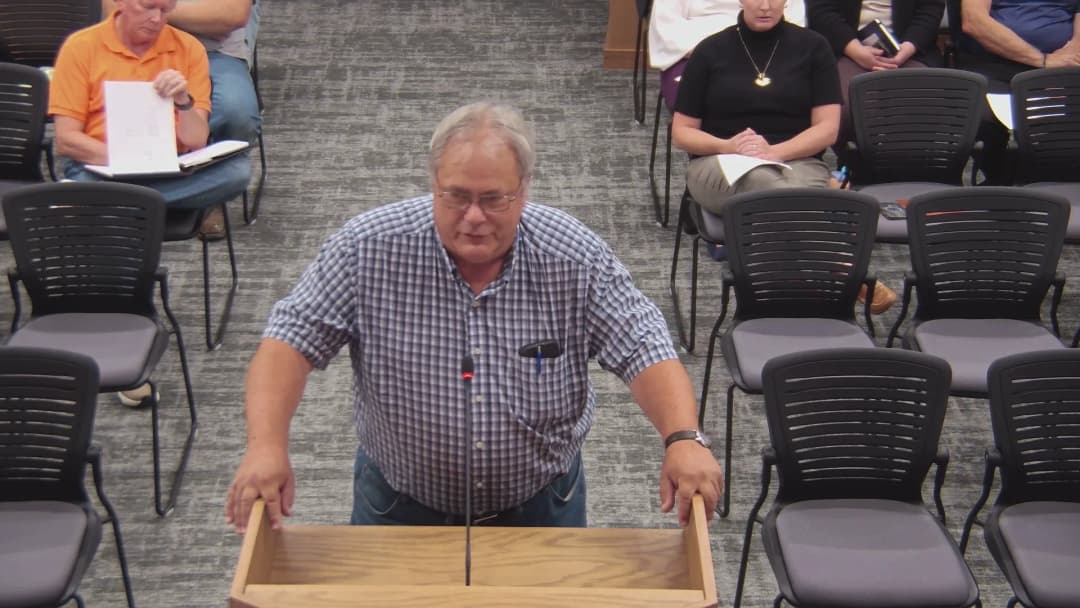
A special meeting of the Hastings City Council was held on September 14, 2026, at 6:00 PM to conduct two public hearings related to the proposed 2026-2027 annual budget and the property tax request for that fiscal year. The meeting lasted approximately seven minutes, with no council deliberation or votes taken on the agenda items. Two members of the public spoke, both opposing tax increases. Public Comments & Testimony - Edward Krontz (1203 East Night Street) spoke during the public hearing on the proposed 2026-2027 Annual Budget. He reported having spoken with over 100 residents: only two were okay with current taxes (one of whom did not pay taxes), and the rest were completely against any tax increase, including no middle levy increase, special sales tax, or restaurant tax. He highlighted that one resident who had lived in her home for over 50 years can no longer afford property taxes and must sell. He stated that Adams County has the highest property taxes in Nebraska, and Nebraska is the fourth highest in the nation. He urged the council to find alternatives to raising taxes. - Robert Lemke (1016 North Hewitt) spoke during the public hearing to set the property tax request for 2026-2027 at a different amount than the previous year. He opposed increasing taxes, warning against letting the tax rate rise too fast. He mentioned homelessness in the city and urged the council to control spending. He identified himself as a fellow citizen. Key Outcomes - The two public hearings were opened and closed without any further discussion or action by the council. No motion was made on the budget or tax request. The council adjourned at 6:07 PM, with plans to reconvene at 6:30 PM for the next meeting.
The Public Meeting Index
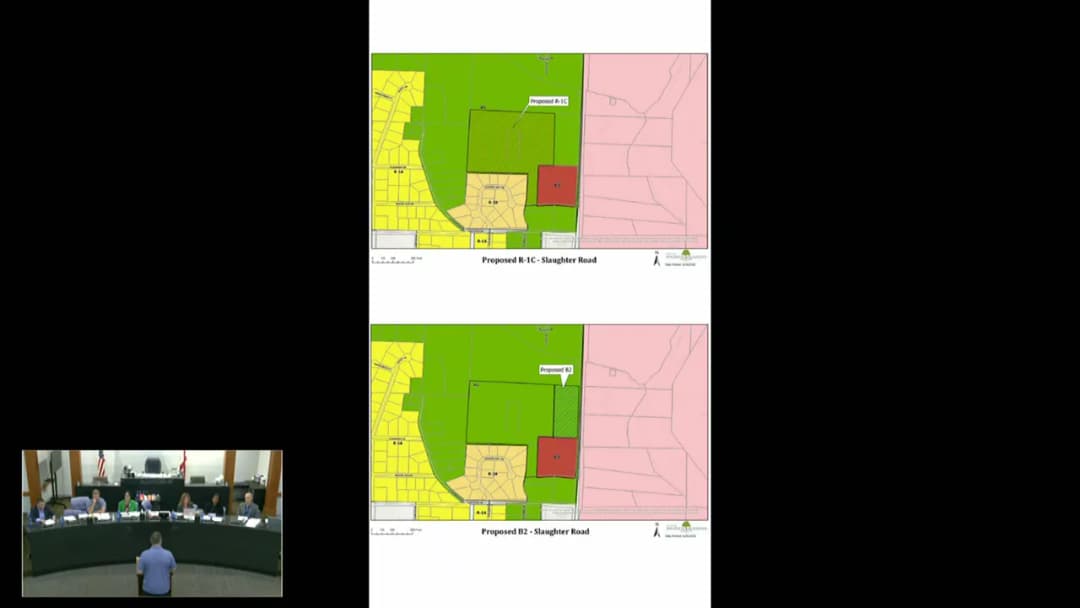
The Public Meeting IndexThe Madison City Council met on September 14, 2026, at 6:00 p.m. The meeting featured the unanimous adoption of the FY2027 budget, extensive public commentary on automated license plate readers (ALPRs) and the need for government transparency, the approval of a major rezoning on Slaughter Road, and the establishment of a new Public Park and Recreation Board to fund a future aquatic center. Consent Calendar - Fire department record destruction authorized. - One-year agreement with COSTAR for economic development approved. - Surplus fire safe house donated to Hazel Green Volunteer Fire Department. - Professional services agreement with River Tree Systems ($60,000) for sales tax auditing. - Disposal of surplus vehicles and fire equipment approved. - Land sale on Kaiser Boulevard to Taylor Properties authorized. - Transfer of $110,000 for Fire Station 2 repairs. - Donations of $9,760 (Police) and $22,000 (Fire) accepted. - $446,000 payment authorized for prior work on the I-565/Cline Interchange. - $435 claim for police vehicle graphics replacement approved. Public Comments & Testimony - Rhonda Fox (Senior Citizen, Madison Senior Center member): Formally requested the council establish a senior advisory committee to provide monthly feedback on programs and activities at the senior center. - Caroline Christian (District 3): Expressed strong opposition to the city's use of Flock cameras (ALPRs), calling it "mass surveillance." She cited a 32.3% false positive rate from an LAPD audit, raised concerns about ICE accessing data through backdoor queries, and argued the cameras are prone to errors and misuse. - Jamie Paulson (President, Ashbury HOA): Presented a utility billing dispute, stating Ashbury HOA was incorrectly billed $5,144 for water on commercial property owned by a third party. She requested the council direct Madison Utilities to immediately issue a refund. - Kim Delessandro: Raised ongoing concerns about communication, operational knowledge, and management at the Madison Senior Center. She noted unfulfilled promises of staff training and a lack of consultation with seniors on fee structures. - Maggie Minsk (Vice President, Ashbury HOA): Discussed the theme of government trust and transparency. She linked the HOA's unresolved water bill to a broader pattern of resistance and silence from city leadership and echoed concerns about transparency regarding surveillance data. - Amy Price (Non-resident/Community User): Argued against ALPR surveillance, characterizing it as pre-crime data collection without probable cause. She urged the council to consider not expanding the system and to implement strong data governance guardrails. Discussion Items - Aquatic Center & Parks Board: Mayor Bartlett announced a partnership with the school system to build an aquatic center at Dublin Park. She stated it will not require a tax increase. To help fund it, the council voted to incorporate the city's first Public Park and Recreation Board and appointed Scott Harbour, Dr. Steve Sullens, and Terran Thorpe as its initial directors. - FY 2027 Budget: Finance Director David Long presented the $108.6 million budget. Highlights included five new police officers (four for SROs), a 2% cost-of-living adjustment for employees, and 23 neighborhood street resurfacing projects. The budget reduces planned deficit spending from $20 million to $10.5 million. Councilmember White expressed disappointment that the full budget book was not made public before the vote, citing past practice. Councilmember Beer noted it was the first time council was asked to rank capital projects. The budget was approved unanimously. - Slaughter Road Rezoning: The council held a public hearing and approved rezoning 23.4 acres on Slaughter Road for 30 single-family homes and 4.4 acres of commercial development. Discussion focused on traffic impacts; Mayor Bartlett noted long-term plans to widen Slaughter Road. A 45-foot natural buffer was added to address tree canopy concerns. The planning commission recommended approval. The vote was 6-0-1 (Robleski abstaining on the related ordinance). - Board of Education Sidewalk Partnership: The council approved an agreement where the school board contributes $150,000 towards sidewalk construction at Discovery Middle, Liberty Middle, Bob Jones High, and James Clemens High Schools. - Fire Apparatus Antitrust Litigation: The city approved joining multi-district litigation against fire truck manufacturers to address rising costs and prolonged wait times for emergency vehicles. Key Outcomes - FY 2027 Budget Adopted: The budget was passed with unanimous support. - Public Park and Recreation Board Created: The board was formally established and its first members appointed to oversee funding for the aquatic center. - Slaughter Road Rezoning Approved: The 30-lot residential and 4.4-acre commercial rezoning was passed. - Litigation Joined: The city joined national multi-district litigation against fire apparatus manufacturers. - First Readings: First readings were held for updates to the Disability Advocacy Board code and Security Alarm Systems code, and for annexations on Forest Drive, Holiday Boulevard, and Ludar Drive. - Council Project Funded: $520 approved for mural paint supplies at the Animal Control building.
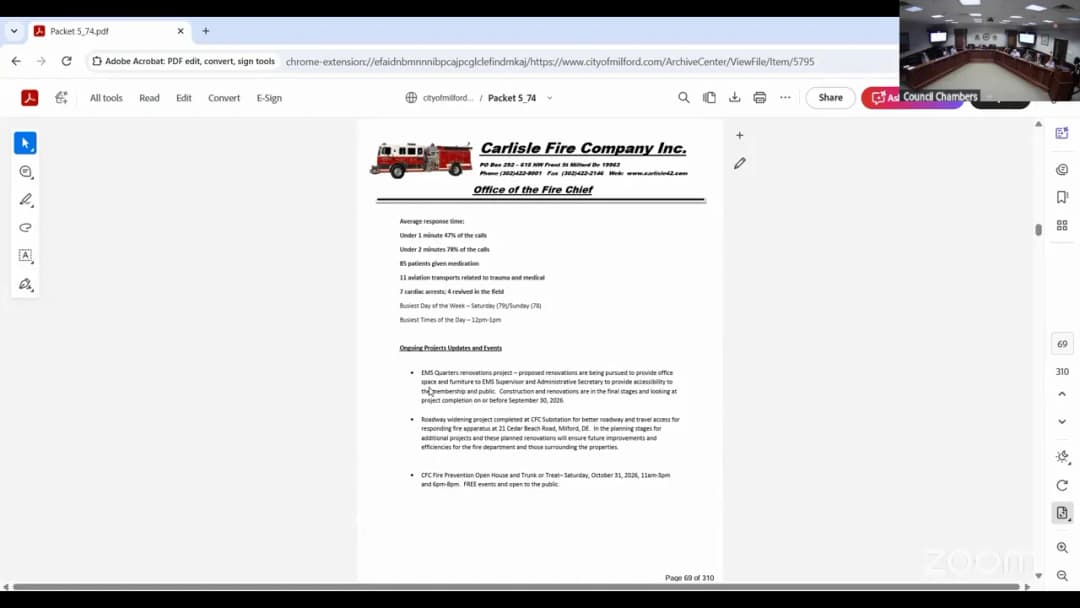
The Milford City Council held a regular meeting at 6:00 PM on September 14, 2026. The agenda included public comments on community support for Haitian families and state land-use policy, the reading of a FOIA settlement statement, a presentation on economic development, approval of several resolutions and easements, and departmental reports. Key actions included tabling a decision on the Kent County Economic Partnership, adopting a fund reserve policy, and approving appointments to the Planning Commission. Consent Calendar - Unanimously approved the monthly police report (1,362 calls for service in August). - Unanimously approved the city clerk's report, which noted the Ward 3 council member (Joan King) would be sworn in on October 12th, and listed upcoming community events. - Unanimously approved the city manager's and all indirect reports' reports. - Proclamation 2026-17 declared September as Suicide Prevention Awareness Month. The proclamation stated suicide is the 12th leading cause of death in the U.S., with 49,476 annual deaths, an estimated 1.6 million attempts, and the number one killer of police officers. Public Comments & Testimony - Dan Bond (105 North Street, Fourth Ward): Expressed strong support for an estimated 100 Haitian families in Milford facing difficulties due to the revocation of Temporary Protective Status (TPS). He noted that families have lost jobs and are in shock. He urged the city council to consider how it can formally and informally help mobilize churches and organizations to recognize the problem and provide assistance. - Jen Sidnella Miller (former DelDOT Transportation Planner for Sussex County): Expressed full support for Mr. Bond's comments. She then expressed opposition to Senate Bill 23, arguing that the state was forced to act because some local governments have been unaware of the infrastructure responsibilities that come with local control. She urged the city to make responsible decisions and work with the state, stating that all state taxpayers should not be paying for Milford's responsibilities. Discussion Items - FOIA Violation Acknowledgment: As part of a settlement with an individual, the city council read a statement acknowledging that the state Attorney General's office found the Delaware Freedom of Information Act was violated by denying Lance Tressler's rights to speak at the meeting on January 13, 2025. The city agreed to review its meeting and hearing procedures with legal counsel. - Kent County Economic Partnership (KEP) Presentation: Linda Parkowski, Executive Director of KEP, presented the benefits of rejoining the partnership, citing economic development successes in similar municipalities and requesting a $25,000 annual membership. Council discussed the history of Milford's withdrawal, which occurred when funds were redirected to hire an in-house Economic Development Director. Concerns were raised about existing contractual marketing obligations for the Milford Corporate Center (Emory Hill). A motion to table the decision until a future meeting when council has full information on existing obligations was approved. - Independence Commons Deed Restriction Amendment: A public hearing was held on the proposed amendment. The council voted to approve the amendment, which revises sign requirements in the deed restrictions to allow signs coordinated with architectural styles and provides an appeal process to the Planning Commission. - Milford Corporate Center Easements: Council approved two easement agreements. The first was with Blue Wired LLC for 406 square feet ($1,400) of land disturbance from roundabout construction. The second was with Delmarva Vitrio Retinal Building LLC for 46 square feet ($250). Both were funded by Realty Transfer Tax reserves. - DelDOT Agreement Amendment: Council authorized the mayor to sign an amended maintenance agreement with DelDOT for the Northeast Front Street/Rehoboth Boulevard project. - Fund Reserve Policy Update: Finance Director Lou Vitola presented an updated Fund Reserve Policy. The policy formalizes utility-to-general fund transfer limits (12.5% for electric, water, sewer) and updates the Realty Transfer Tax pledge formula. The updated policy was approved. - Carlisle Fire Company Residency Incentive: The fire chief requested a revision to the residency incentive for volunteer firefighters, proposing a reduction in the required annual call volume from 30% to 25%, citing additional community event requirements. The request was referred to the city manager and finance director for further review and a report to council. - Staff Reports and Deliberations: - Planning Director Rob Pierce reported 167 new residential dwelling permits were issued year-to-date (72 apartments, 24 condos, 6 townhouses, 65 single-family). Councilmember Wilson raised concerns about a perceived decline in proactive code enforcement regarding tall grass and overgrowth. - Public Works addressed a water leak on Northwest Front Street, confirming it is a city issue and a quote is being sought. Updates were given on cloudy water concerns and the EPA lead pipe inventory program. Council discussed the possibility of a public forum on the lead issue. - Councilman Marabella raised safety concerns regarding the North Rehoboth Boulevard and Route 14 intersection, requesting a traffic study. - Finance Director Vitola reported that $7.1 million in property taxes was billed for Fiscal Year 2027, $544,000 higher than the previous year. The monthly finance report was tabled to the next meeting. Key Outcomes - Tabled: Decision on rejoining the Kent County Economic Partnership. - Approved: Fund Reserve Policy, Independence Commons deed restriction amendment, DelDOT agreement amendment, MIFR Corporate Center easements (Blue Wired and Delmarva Vitrio). - Appointed: Shelby D'Costanzo (reappointed), Robert Longo, and Francis Reagan to the Planning Commission. - Referred: Carlisle Fire Company's residency incentive revision to the city manager and finance director for study. - Tabled: Monthly finance report to the next council meeting. - Acknowledged: Statement regarding the FOIA violation was read into the record.
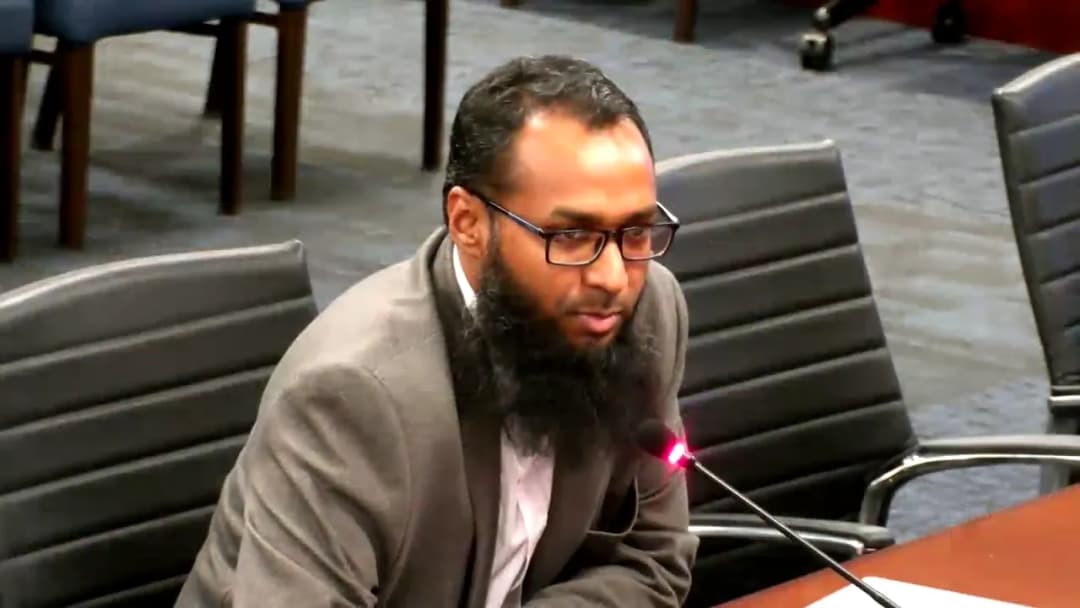
The Education and Workforce Development Committee of the Prince George's County Council met on Monday, September 14, 2026, at 1:30 PM in Committee Room 2027. Chair Shayla Adams-Stafford called the meeting to order with three members present; Council Member Dernoga arrived at 1:32 PM. The committee considered one piece of legislation, CB-105-2026, and received three briefings on apprenticeship best practices, artificial intelligence (AI) platforms in schools, and AI pathways at Bowie State University. The meeting adjourned at 3:02 PM. Legislation: CB-105-2026 High-Wage Employer Fast Track Program - Overview: Dr. Arun Puracken, Committee Director, introduced the bill, which aims to create an expedited development review pathway for employers meeting defined wage, investment, and job-quality standards. Fiscal analyst Caleb Callender reported that enactment would likely have an immediate, slightly adverse fiscal impact due to additional administrative costs at the Department of Permitting, Inspections and Environment (DPIE), but draft two amendments may mitigate costs by distributing responsibilities across agencies including the Economic Development Corporation (EDC). - Agency Comments: The County Executive's office expressed alignment with the bill's goals but noted current budget constraints and requested more information on costs. The Office of Law found the legislation legally sufficient. - Committee Discussion: Chair Adams-Stafford proposed draft two, which shifts program administration to the EDC in coordination with DPIE, Employ Prince George's, and the Office of Procurement. Council Member Dernoga asked for a definition of "high wage" and noted none was provided; staff indicated experts would develop criteria. Council Member Harrison requested a cost analysis from agencies within weeks. The committee clarified that the bill is enabling, not a mandate. - Votes: A motion to amend the bill (striking apprenticeship language to avoid duplication with CB-37-2026) passed 4-0. A motion to favorably recommend CB-105-2026 (draft two) with amendments passed 4-0. Vice Chair Burroughs was absent. Briefing: Best Practices in Apprenticeship Programs - CityWorks DC - Presenter: Lateefah Durant, Vice President of Innovation, CityWorks DC. She highlighted the county's existing assets (PGCPS, Employ Prince George's, community college) and urged a unified system. She emphasized that incentives under CB-37-2026 (effective September 13, 2026) should reward apprenticeship but meet employers where they are on a continuum of work-based learning. Durant shared lessons from DC's youth apprenticeship program, which served 90+ apprentices with 20+ business partners, and recommended barrier-based incentive design, wraparound supports, and measuring net new activity rather than just participation counts. - Discussion: Council Members asked about transportation and coaching supports; Durant noted one-on-one career coaching and community school infrastructure as key assets. Briefing: AI Platforms Available to Students, Families, and Educators - PGCPS - Presenters: Dr. Andrew Zuckerman, Chief Information Officer; Dr. Sandra Rose, Innovation Officer; Ms. Monica Jenkins, Assistant Director, Technology Integration & Support; Ms. Meghen Ehrich, Data Privacy Administrator. They outlined the district's AI literacy plan, noting that generative AI tools are not yet enabled for students, but Gemini will be enabled for high school students in 2027. Staff have access to Gemini, ChatGPT, Microsoft Copilot, and productivity tools like Brisk (for lesson design) and Canva. Student use is limited to teacher-directed activities. The district is aligning with MSDE guidance and has partnerships with AI EDU and a $1 million NSF grant (SCALES initiative) with Bowie State and George Mason. - Discussion: Council Members asked about student voice (Technology Advisory Committee includes students), pilot school selection (geographically and champion-based), data privacy protections (enterprise agreements, no PII allowed, vendor questionnaires), and ethical training (ethics embedded in foundational AI courses, librarian-led lessons at 9th grade). Chair Adams-Stafford emphasized the need for human-in-the-loop oversight, especially for automated feedback. Briefing: AI Pathways at Local Higher Education Institutions - Bowie State University - Presenter: Dr. Kamruzzaman Sarker, Assistant Professor, Department of Computer Science. He described Bowie State's AI and technology programs, including a new BS in AI starting spring 2027, and highlighted Bureau of Labor Statistics projections: 35% growth for data scientists, 21% for information security analysts, and 1.9 million healthcare openings annually. He noted a $1 million NSF grant that pays students for internships (nine students placed in Prince George's County IT Department). He proposed stronger pathways from K-12 to community college to university, and adult upskilling credentials. He also raised ethical concerns about AI misuse in health insurance pre-screening. - Discussion: Council Member Harrison noted the projected 130,000 healthcare worker shortage by 2030 and asked about AI's role in efficiency; Dr. Sarker agreed AI can assist but stressed trust issues. Council Member Olson asked about job displacement; Dr. Sarker predicted new jobs will emerge (e.g., robot maintenance) but emphasized the need for flexibility. Chair Adams-Stafford expressed interest in capstone projects at the council. Key Outcomes - CB-105-2026 was amended and favorably recommended (4-0) to the full County Council with draft two amendments shifting administration to the EDC. - The committee received three briefings with no formal votes required. - The committee requested a cost analysis from agencies on implementing the fast track program within the coming weeks. - The committee plans to hold a future roundtable on workforce development, with invitations extended to Ms. Durant and Dr. Sarker.
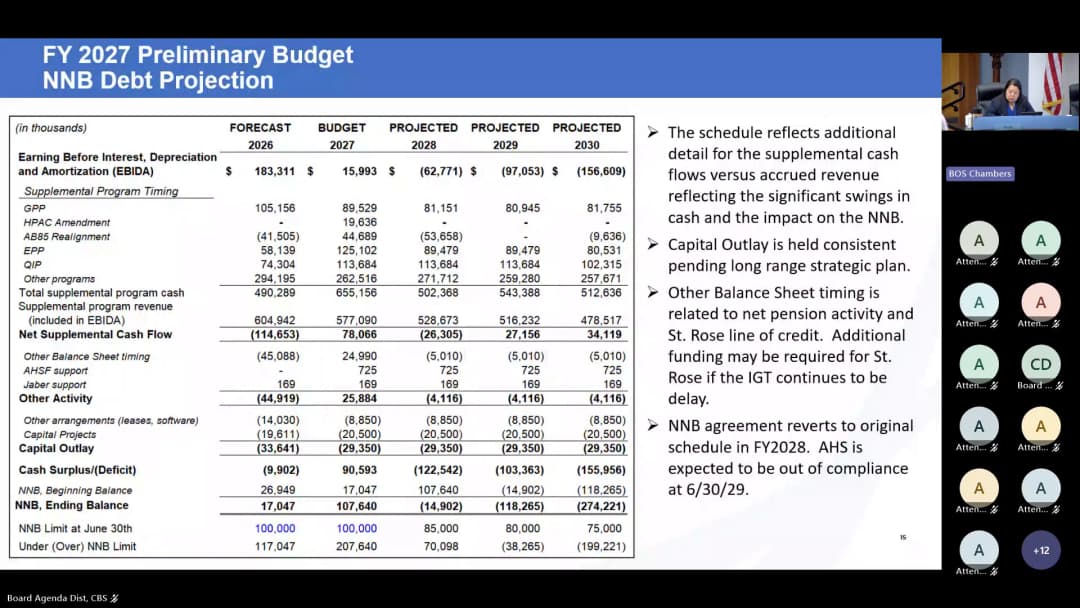
The Health Committee (Supervisor Miley, Chair, and Supervisor Tam) met at 9:30 a.m. to receive an informational presentation from Alameda Health System (AHS) on its Fiscal Year 2026-27 Operating Budget. The presentation reviewed the budget's financial position, supplemental revenue changes, FTE levels, and long-term projections. No public comments were made. Discussion Items - FY27 Budget Overview: Ann Metzger, Vice President of Finance for AHS, presented the budget. The June budget showed a $30.1 million loss; after additional work, the revised budget reduced the loss to $19.4 million, which the AHS Board of Trustees approved. The $10.7 million improvement came largely from supplemental revenue increases. Key changes included: increasing the EPP program by $9.6 million, adjusting the AB 85 redirection reserve by $10 million (based on repayment for FY26-27), new MCO tax benefit of $10 million, IFHCOF increase of $2.4 million, and a GME true-up of $0.8 million. Offsetting items included $9.3 million for a St. Rose IGT delay, contract cost increases, and software amortization true-ups. - FY26 Actuals: The original FY26 projection of a $10.2 million loss turned into a significant profit due to unanticipated revenues: a $40 million FQHC settlement covering fiscal years 2012 through 2021, $44.7 million from AB 85 realignment for FY24, and the $10 million MCO tax. The FY26 EBITDA is expected to be $183.3 million positive, compared to the projected $22.6 million positive. The additional cash will be received primarily in FY27. - FTEs and County Funding: AHS originally planned a reduction in force of 92 FTEs; the county provided $19.3 million in funding to maintain those positions. The budgeted FTEs are approximately 5,131, and AHS aims to hold paid FTEs flat. Performance initiatives are expected to generate $50 million in savings, offset by $78.2 million in increased labor costs. The largest expense improvement is $18.26 million from attrition (95 FTEs). - Long-Term Projections: The five-year forecast (FY27-30) shows a positive EBITDA of $16 million in FY27, but losses in subsequent years due to reduced supplemental funding and HR1 impacts. The NNB (net negative balance) line of credit was increased to $100 million for FY26-27; without extension, it would revert to $85 million. Projected NNB balances: positive $107.6 million in FY27, negative $14.9 million in FY28, negative $118.3 million in FY29, and negative $274.2 million in FY30. The FY29 and FY30 projections assume no major revenue increases and include HR1 impacts. - St. Rose Hospital: AHS has advanced $15 million (plus about $4 million in support) to St. Rose under a $25 million line of credit. St. Rose's financial performance is better than anticipated due to a Stanford relationship (20 beds in skilled nursing, and a planned hospital-within-a-hospital starting July 2027). The delay in the IGT supplemental program (approximately $30 million) threatens St. Rose's ability to repay the line of credit. County lobbyists are working with federal CMS to resolve the IGT delay. - Discussion on Revenues and Transparency: Supervisor Tam questioned why a large deficit was projected when FY26 actuals show a surplus. AHS explained that the unanticipated revenues (FQHC settlement, AB 85, MCO tax) were not known when deficit reduction efforts began. Supervisor Miley acknowledged the need for transparency and suggested the $19.3 million county funding could be held in reserve for future years rather than used immediately. He also expressed support for extending the NNB limit to $100 million to provide stability through 2030. - Out-Year Challenges: The committee focused on FY28-30 challenges driven by HR1 impacts. Measure W (a key funding source) sunsets in 2030. A joint meeting between the AHS Board of Trustees and the Board of Supervisors was anticipated for October or November to discuss long-term financial sustainability. Key Outcomes - The presentation was informational; no formal votes were taken. - Supervisor Miley indicated support for maintaining the NNB limit at $100 million. - A joint meeting between the AHS Board of Trustees and the Board of Supervisors will be scheduled for October or November. - The county and AHS will continue conversations regarding the use of the $19.3 million county funding (possible deferral or reserve) and the St. Rose IGT delay.
The Port Authority of Evansville held its regular meeting on Monday, September 14, 2026, beginning at approximately 12:00 p.m. and adjourning at 12:15 p.m. The board addressed approval of the prior meeting memorandum, an update on the LST mooring dock, the finance report, and acceptance of accounts payable vouchers. Discussion Items - Old Business – LST Mooring Dock Update: Board member Robert reported contacting a company to assess and potentially auction the dock. The company proposed a $5,000 fee for a site assessment (since original specifications were lost) and a 7–10% commission on the final sale price if auctioned. A prior assessment valued the dock at approximately $1 million, implying a potential commission of $70,000 to $100,000. The board discussed the costs and expressed interest in obtaining additional quotes from other vendors such as Current Miller and Southern. The board directed staff to contact at least two more companies for comparable assessment and auction fee proposals, given ongoing monthly carrying costs. - Finance Report – R. Gunter: As of August 31, 2026, revenues were up primarily due to a second transfer of $96,250 from the park and recreation fund. Expenses increased: electric services rose 26.6%, water services rose 18.3%, and a $44,805 rental payment was made to Marina Point. Total year-to-date expenditures were $180,274, resulting in a net income of $14,496. Cash on hand was $90,153, with $52,734 in investments, totaling $143,488; encumbrances stood at $39,892. Key Outcomes - Meeting Memorandum Approval: A motion was made and seconded to approve the meeting memorandum from August 10, 2026. The motion carried. - Finance Report Acceptance: The board voted unanimously to accept R. Gunter’s finance report. - Accounts Payable Voucher Approval: The board approved the accounts payable voucher registers for August 19, 2026, and September 10, 2026. Payments included utility bills for the LST site (SIGECO: $214.53 and $197.59), the building at 610 Northwest Riverside Drive (SIGECO: $4,396.03, $233.29, and $5,268.62), and rent payments to RDM Land LLC (the new owner of the inland marina) for July, August, and September 2026 at $4,978.33 each. - Direction on LST Mooring Dock: The board directed staff to obtain at least two additional assessment and auction fee proposals (e.g., from Current Miller and Southern) before deciding on the dock’s disposition.
The Casselberry City Commission met on Monday, September 14, 2026, at 5:30 PM in the City Commission Chambers. The meeting included presentations on employee wellness and a retiring deputy city clerk, an update on the Flock camera system, and public hearings to adopt the tentative millage rate and operating budget for Fiscal Year 2026/2027. The commission also approved a second reading of an ordinance increasing lien search fees and received numerous public comments in support of preserving the Brightwater historic home. Key decisions included setting a tentative millage rate 9.87% above the rollback rate and reducing the budget by $36,000 to reflect non-appropriation of Flock camera funds. Presentations & Commendations - American Heart Association Silver Level Award: Mayor Henson presented the award to Risk Officer Conan Bickford for the city’s recognition in the Well-being Works Better program. - Retirement of Deputy City Clerk Linda S. Sundvall: The mayor read a proclamation honoring her 14.5 years of service. Jessica Burnham, FACC Central East Director, presented a retirement resolution from the Florida Association of City Clerks. - Flock Camera System Update: Chief Krantz reported that the city suspended use of the Flock cameras on September 1, 2026, after FDOT revoked permits for cameras on state rights-of-way. Four cameras were affected. The city covered remaining cameras to demonstrate deactivation. The contract runs through February 2028 with a $36,000 payment due in February 2027. The chief noted that the Florida Police Chiefs Association is working with the legislature to establish statewide safeguards. Public Hearing: Tentative Millage Rate (Resolution 26-3590) - Staff Presentation: City Manager Randy Newland presented the proposed tentative millage rate of 4.2613 mills and voted debt millage rate of 0.5911 mills for FY 2027. The tentative operating millage is 9.87% above the rollback rate of 3.8784 mills. The rates would generate $11,705,072 in ad valorem revenue for the general fund and $1,623,652 for the debt service fund. - Public Comment: Lindsay Feist (516 Bridal Path) urged the commission to adopt the rollback rate instead, citing economic pressures on residents and the need to demonstrate fiscal responsibility. She noted that last year’s millage increase generated $3.5 million and asked if all efficiencies had been exhausted. - Commission Discussion: Commissioner Bush expressed discomfort with another increase, noting ad valorem revenue had more than doubled from $5.25 million in 2022 to $10.6 million in 2026. Mayor Henson and Commissioner DeVita argued that inflation, pension obligations, and needed police salary adjustments justified the increase. Commissioner Kirk suggested the city has held water rates and cut millage three times in prior years. - Vote: The resolution passed 4-1. Public Hearing: Tentative Operating Budget (Resolution 26-3591) - Staff Presentation: City Manager Newland presented a revised tentative budget totaling $101,847,992, reflecting a net reduction of $221,604 from the originally proposed amount due to health insurance rebates and other cuts. He noted reduced franchise fees and public service tax revenues, requiring increased reliance on fund balance. The budget includes $19.6 million for personal services and $31 million in capital projects. - Public Comment: Lindsay Feist again spoke, highlighting that additional savings of $36,000 were identified during the meeting (the Flock camera contract) and argued that the city should continue seeking efficiencies. She cautioned that continued spending increases could erode public trust and fuel support for Amendment 3. - Commission Discussion: Commissioner Kirk moved to amend the resolution to reduce the total expenditure by $36,000 (the Flock camera contract) and reduce the general fund accordingly, using the non-appropriation clause to terminate the contract. The amendment was seconded and passed. - Vote: The amended tentative budget (total $101,811,992) was adopted. The final public hearing is scheduled for September 28, 2026. Public Hearing: Lien Search Fee Ordinance (Second Reading, Ordinance 26-1637) - Staff Presentation: City Clerk Donna Gardner explained the need to increase the special service fee for outstanding lien searches from $25 to $75, reflecting increased staff time and volume (815 searches in the past year). The fee had not been increased since 2011. - No public comment. - Vote: The ordinance was approved unanimously on second and final reading, effective October 1, 2026. Consent Agenda - The consent agenda included approval of legal services invoices, budget amendments (Resolution 26-3592), an indemnity agreement with Florida Foundation for Responsible Angling (Resolution 26-3593), a utility easement agreement (Resolution 26-3594), a revised annexation agreement with Public Storage (Resolution 26-3595), termination of the Cheddars PUD agreement (Resolution 26-3596), an eighth amendment to the Casto acquisition agreement (Resolution 26-3597), software agreement amendments with Online Solutions and Sensus, and a sole source agreement with Carus LLC. The consent agenda was approved as presented. Other Items - Clarification on Continuance Date (Ordinance 26-1638): City Clerk Gardner noted that the continuance motion from August 24 had set a date of November 17, 2026, which is not a scheduled meeting date. Commissioner Kirk moved to change the date to November 16, 2026 (the next scheduled Monday). That motion passed. Commissioner Bush then moved to move the hearing to the next scheduled meeting (September 28, 2026), which passed 3-2. Citizens' Comments - Multiple residents spoke in support of preserving the Brightwater historic home (the former Casselberry family estate). Speakers included Colleen Huffer, Sandra Solomon, Frank Candy, Travis Kelly, Luis Brown, Lily Casselberry Carroll (descendant of the city’s founder), Chris Burke, Alison Burke, Lindsay Feist, and Ashley Woodard. They urged the commission to protect the property as a park, event venue, or cultural destination, citing historical significance, green space, and potential economic benefits. Several referenced the city’s successful public-private partnership model for the golf course. City Manager’s Report - City Manager Newland announced that the city had signed documents to close on the purchase of Casto-owned properties east of Lake Concord on September 16, reuniting the Lake Concord Park campus. He also thanked recreation and cultural arts staff for a successful weekend of events (Food Trucks, Latin Jazz Concert, Vintage Bazaar). City Commissioners’ Reports - Commissioner DeVita reported touring city parks and attending a presentation on Seminole County’s new sports complex. Commissioner Kirk thanked staff and reiterated philosophical differences on budget priorities. Vice Mayor Aramandia reported on Leadership Seminole Government Day, the ribbon cutting for the Bill Nigren buggy collection at the historic museum, and thanked Linda Sundvall for her service. Commissioner Bush and Mayor Henson provided additional comments on events and community issues. Key Outcomes - Tentative millage rate (4.2613 mills operating, 0.5911 mills voted debt) adopted for FY 2027, final hearing September 28. - Tentative budget amended to $101,811,992, including a $36,000 reduction for Flock camera non-appropriation. - Lien search fee ordinance approved (increase from $25 to $75). - Consent agenda approved. - Continuance date for ordinance 26-1638 moved to September 28, 2026 (3-2 vote). - Multiple residents advocated for preserving Brightwater; no immediate action taken.
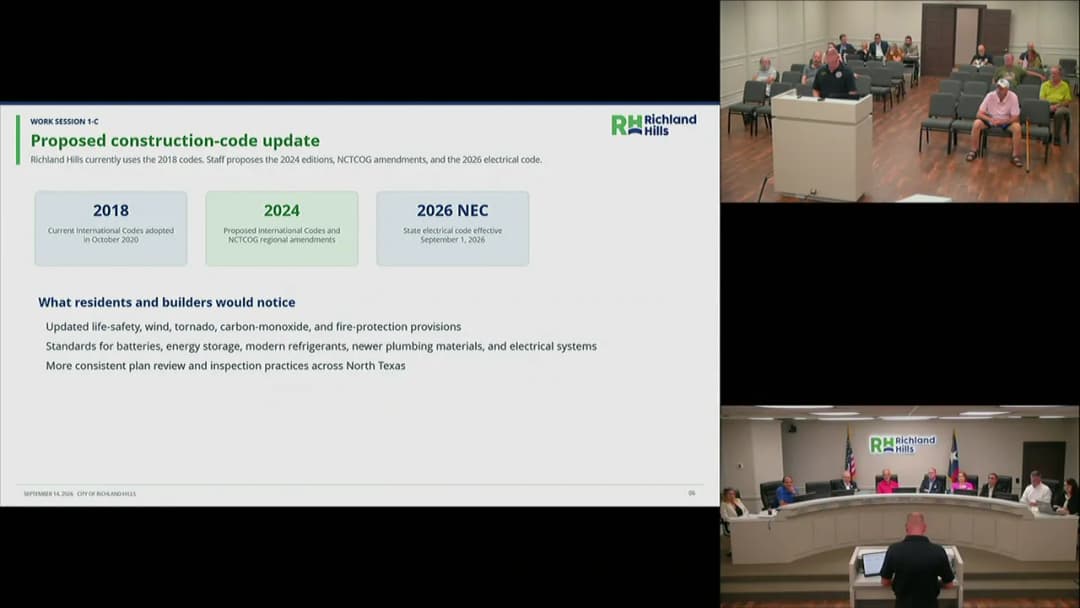
The Richland Hills City Council held a work session and regular meeting on September 14, 2026. The work session covered accessory structure amendments, international code updates, the municipal judge appointment process, utility rate and fee schedule amendments, and the fiscal year 2026 budget timeline. The regular session included citizen comments, an update on the Flash Vote survey, and the FY27 mill and overlay schedule. An executive session for economic development project 26-02 resulted in no action. Consent Calendar - Item 10A & 10B: Unanimously approved. These included the minutes from the August 24, 2026 city council meeting, and the appointment of Kelly Morris (voting) and Eric Valdez (alternate) to the Fort Worth Wholesale Water and Wastewater Customer Advisory Committee for FY2027. Public Comments & Testimony - Jenny Clark (6973 Hardesty Street): Questioned the validity of the FY2027 budget, arguing that if a council member's actions were ruled invalid under parliamentary procedure at a prior meeting, the subsequent vote on the budget could be voidable. She requested clarification from the council. - Jim Shabble: Recommended the city update its FEMA flood zone reports via representative Angela Davidson to address inaccurate flood insurance costs for residents. He advocated for improving drainage infrastructure by reclaiming land from a drainage trough. He also expressed support for amending city rules to allow shipping containers as accessory structures when placed behind fences. He announced his intention to run for city council. Discussion Items - Accessory Structure Amendments (Item 1B): Staff presented proposed revisions to accessory structure regulations, introducing a tiered system where taller structures require larger setbacks. The goal is to provide predictable height limitations tied to lot size and zoning, addressing issues raised by previous projects. Staff will return in October with a final draft ordinance for a joint work session with the Planning and Zoning Commission. - International Code Adoption (Item 1C): Staff recommended adopting the 2024 International Codes and the 2026 National Electrical Code. Chief Rhodes reported that failing to update could cost the city its elite ISO 2 fire rating, potentially increasing residential insurance premiums by approximately $75 annually and commercial premiums by hundreds to thousands of dollars. The new codes also provide critical standards for lithium-ion battery storage and mandatory carbon monoxide detection. Council was generally supportive. - Municipal Judge Appointment Process (Item 1D): Council favored a joint solicitation process with the cities of North Richland Hills and Watauga to appoint a new presiding municipal judge to replace Judge Bass. Staff will coordinate with the other cities over the next 60 days. - Utility & Court Fine Write-Offs (Item 1E): Staff presented aging reports showing over $4.6 million in outstanding court citations and $856,000 in old utility balances over three years. Council agreed that an initial significant write-off should come before the council as a body, with future annual write-offs delegated to staff as part of the audit process. - Proposed Citizen Civic Academy – RH 101 (Item 1F): A proposed pilot 8-session citizen academy was discussed, set to begin in October. The program aims to educate residents on city operations, budgeting, and public safety. Council supported the program, suggesting it target active residents and those with questions about city services. - Utility Rate Updates for FY27 (Item 1G): Staff proposed a water and sewer rate adjustment to address wholesale cost increases from Fort Worth (10.68% water, 18% sewer) and TRA (3.5% sewer). The proposed increase for a typical residential customer is approximately $6.95 per month (roughly 7%). Without any rate adjustments, the utility fund balance is projected to hit zero by 2031. A full presentation by the WaterWorth modeling tool was postponed to the October 12th meeting. - Draft Fee Schedule Amendments (Item 1H): Staff proposed updating various fees to cover actual costs, including increases to utility deposits, building permit fees, and code enforcement abatement fees. Council directed staff to research and prepare a credit card convenience fee across all city departments to offset processing costs. - FY27 Mill & Overlay Schedule (Item 9B): Kelly from Public Works reported that Tarrant County Precinct 3 recommends full-depth reclamation over standard mill and overlay for most of the 9 identified roadways, offering a 15-20 year lifespan. The county's cost estimate is $1.33 million. Staff will meet with the Infrastructure Committee to finalize road selections and develop interlocal agreements. Construction is anticipated for late spring or early summer 2027. - Flash Vote Update (Item 9A): Currently 160 residents are enrolled in the Flash Vote survey platform, short of the 200 needed for statistical significance. Staff will heavily promote sign-ups at the upcoming National Night Out event on October 6th. Key Outcomes - No Action Taken: Executive session for Economic Development Project 26-02 concluded with no action taken or requested. - Pending Actions: Staff will bring forward formal ordinances for the adoption of new international codes, utility rate adjustments, and fee schedule amendments for a vote in October. - Write-Off Approval: Staff will prepare a formal resolution for the initial write-off of uncollectible court and utility balances for council consideration. - Marketing Directed: Staff instructed to create promotional materials for the Flash Vote survey and the RH 101 Citizen Academy. - Credit Card Fees: Staff directed to develop a resolution implementing a credit card convenience fee.
The Watauga City Council held a workshop meeting on Monday, September 14, 2026, beginning at 5:30 PM in the City Hall Council Chamber at 7105 Whitley Road. All council members and the mayor were present. No members of the public spoke during the public comment period. The meeting was informational, with presentations on municipal court fines/fees and proposed personnel policy updates. The meeting adjourned at 6:33 PM, and the regular council meeting was scheduled to begin at 6:45 PM. Municipal Court Fines and Fees Presentation - Jennifer Dorsett presented an overview of Municipal Court revenue. She explained that defendants often assume the city keeps all fines, but the city remits a significant portion to the State of Texas each quarter. - For a sample speeding citation (41 mph in a 25 mph zone) paid at the window, the total payment is $214; the city retains $85 in unrestricted funds, and the state receives $112 (52%). In a defensive driving example, the defendant pays the city $144, with $115 (80%) going to the state, $15 to city unrestricted funds, and $14 to restricted funds. - Restricted funds include court security/technology, a local truancy prevention fund (used for juvenile case manager and teen court), and a municipal jury fund. Court security/technology and other restricted funds are audited by the state controller's office. - Councilman Mark Taylor asked about state remittances. The presenter estimated quarterly remittances of $50,000 to $60,000, on average. She said state-consolidated fees fund items such as police officer training and crime victims compensation, among 20-25 different funds. - Councilman Taylor and Councilman Dunn criticized state-imposed, unfunded mandates and argued that cities function as collection agencies for the state. The presenter noted that the Texas Municipal League revenue manual describes the city as a collection agency for the state. Dunn also mentioned a 2011 effort to require state reimbursement for unfunded mandates, which he said went nowhere. - Councilman Andrew Neal asked whether state fees set a floor for fines. The presenter responded that fines have statutory minimums and maximums set by the judge, but state court costs are set by the legislature and must be collected; judges can waive fines and costs for indigent defendants. - Councilman Can Hill asked whether court revenue covers court operations. The presenter said it is close, but if officer time writing citations is counted, the city is in the hole. - Police Chief Barkley addressed the idea that the recent speed limit reduction to 25 mph was for revenue. He reported that traffic stops were nearly identical in the four months before and after the change (3,304 before vs. 3,303 after). Citations dropped from 627 to 508, and warnings rose from 488 to 719. He noted that speeding is a factor in 29% of traffic fatalities and 8-18% of crashes, depending on data. Proposed Personnel Policy Updates - Juliet Rodriguez, Human Resources and Civil Service Director, presented proposed personnel policy revisions intended to take effect October 1, 2026. She said the changes respond to updated guidelines, employee retention needs, and requests made during meet-and-confer negotiations with the Watauga Police Officers Association. - ADA policy (2.02): Expand policy statement to cover Title I and Title II obligations; update definitions of disability and essential job function; expand procedures to include citizens and patrons; add employee ADA accommodation request steps, interactive process, verification of disability, and confidentiality/responsibility updates. - Performance evaluation policy: Encourage supervisors to meet with staff more than once a year, align the policy with evaluation form scoring, and clarify that appeals are placed in personnel files. - Classification and compensation policy (6.04): Allow cost-of-living adjustments at an alternate date rather than only at the beginning of the fiscal year; add monthly field training officer pay for police officers training new officers/cadets; create a one-time cost savings incentive of up to $1,500, subject to department head verification and city manager approval, split among teams if applicable. Rodriguez noted the slide incorrectly listed the policy number as 6.06. - Workers' compensation policy: Remove the five-day election window for salary continuation so injured employees are not blocked if the need for leave is discovered later. - Vacation leave policy: Allow employees at the maximum accrual (240 hours for 8/10-hour employees; 360 hours for 12/24-hour shift personnel) to accrue up to 60 or 80 additional hours until the last pay period in September, with balances then reduced back to the cap. This addresses staffing-related difficulty taking leave and does not increase year-end leave liability. The policy also adds pay period accrual amounts and allows the city manager to withhold vacation payout for employees appealing indefinite suspension until the appeal is resolved. - Sick leave policy: Clarify misuse of sick leave; update definitions of spouse, child, and parent; require employees to report absences before shift start, with family members allowed to report for them; add pay period accruals; allow withholding sick leave payout for appealing civil service employees; clarify that department heads must request sick leave donations; and update the well pay conversion form to include shift personnel. - Artificial intelligence policy (14.05): New policy covering city officials, employees, contractors, temporary staff, and volunteers; includes permitted/restricted uses, prior IT approval for new AI tools, data security, human verification of AI output, transparency/disclosure for public-facing AI-generated materials, ethical responsibility, mandatory compliance training, and retention under the Public Information Act. An approved-tools sample list from IT is included. - Employee safety policy (16.01): Update objectives and responsibilities, clarify immediate injury reporting, add hazard reporting, revise PPE language, and add a safety recognition section. - Inclement weather policy (18.01): Clarify guidelines; add an option for the city manager to grant special weather compensatory time for employees working on inclement weather days, with no payout at separation; add payroll reporting and accrual process language. - Rodriguez said the travel and reimbursement policy listed on the consent item was pulled and will come forward later after additional edits. Council Discussion on Personnel Policies - Councilman Taylor questioned why periodic performance discussions are only highly encouraged rather than required. Rodriguez cited time constraints, about 14 city vacancies, and recent supervisor training; Taylor maintained that periodic reviews should be required. - Taylor also questioned the cost savings incentive, asking whether a small saving would trigger a $1,500 award. Rodriguez clarified the policy allows up to $1,500 and requires department head and city manager approval. - Taylor raised concerns about vacation accrual, saying vacation is important for stress reduction and warning against allowing employees to bank leave when time off is available. He also asked if the city had considered a combined PTO system; Rodriguez said it had been researched previously and was not a fit, partly because Watauga is a civil service city. Mayor Artline noted that the prior leave liability was significant but not to the point of bankrupting the city. - Councilwoman Hale described a prior city's experience with sick leave donation abuse, where donations switched to vacation time and abuse declined. Rodriguez said Watauga sick leave donations are uncommon and unused donations are returned. - Councilman Neal supported keeping separate sick leave and vacation pools rather than combined PTO, noting that combined PTO can hurt employees who get sick. He asked about reporting mechanisms for questionable AI-generated output; Rodriguez and Chief Barkley said employees should escalate concerns through their chain of command and supervisors. - Councilman Welch suggested requiring employees to project their leave use so supervisors can manage balances and prevent employees from losing leave. Key Outcomes - No formal votes were taken during the workshop. - The Municipal Court presentation and traffic stop data were informational; no action was requested. - Personnel policy revisions were presented for council feedback; no formal adoption occurred, with proposed changes expected to be effective October 1, 2026, if approved later. - The travel and reimbursement policy was pulled from the consent item and will return at a later date. - The meeting adjourned at 6:33 PM; the regular council meeting was scheduled to start at 6:45 PM.
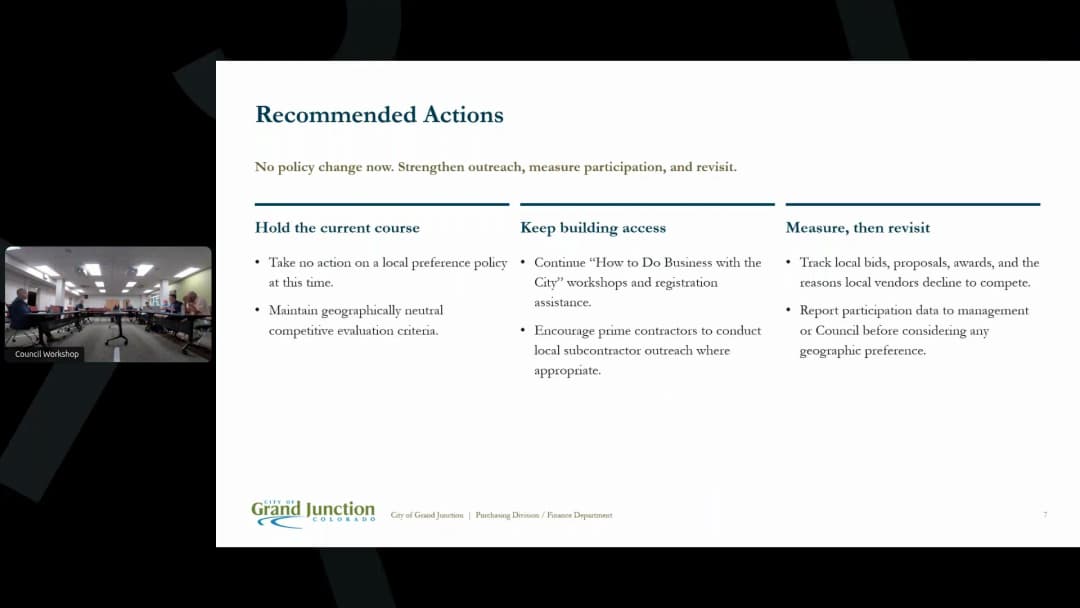
September 14, 2026 | 5:30 p.m. – 6:56 p.m. The Grand Junction City Council held a workshop on September 14, 2026, at the Fire Department Training Room. The meeting focused on three major discussion topics: a new Water Supply Element required by state law, a proposed temporary moratorium on data centers, and a potential local preference policy for city procurements. Council also discussed upcoming budget workshops, a resolution supporting Mountain Rail passenger service, and a request to join the Mayor's Alliance to End Childhood Hunger. No formal votes were taken; the workshop served as a forum for information and direction setting. Water Supply Element – Comprehensive Plan Amendment - Staff presented the Water Supply Element required by Colorado Senate Bill 24-174, which must be adopted by the Planning Commission by December 31, 2026. - The element draws from existing regional water-efficiency and drought-response plans and aligns with the Colorado Water Plan. - Staff reported that current water supplies meet current and projected future needs, and conservation efforts have extended the supply-demand nexus from 2039 to approximately 2049 without significant infrastructure investments. - Council discussed the effects of population growth, demographic shifts, and increasing aridity. Councilmember Scott Beilfuss noted that the outlook improvement is partly due to declining water use per tap and the trend toward an older population. - Staff will consult with local water providers and irrigation districts, incorporate feedback, and then forward the amendment to the Planning Commission. Temporary Moratorium on Data Centers - Staff proposed a temporary moratorium of up to 365 days on large data centers while the City develops appropriate land-use regulations. The current code does not specifically address data centers, creating uncertainty for evaluation. - No applications are pending, but the City has received inquiries. - Council emphasized the need to coordinate with Mesa County, neighboring jurisdictions, and water and energy providers, as a data center outside city limits could still have regional infrastructure impacts. - Council also suggested expanding the review to include other high-water or high-energy industrial uses, such as water bottling or chip manufacturing. - Staff will refine the draft moratorium ordinance and use the moratorium period to evaluate best practices and potential development standards. The moratorium would expire upon council adoption of code amendments or after 365 days, whichever comes first. Local Preference for Procurements - Staff reviewed options for giving local businesses an advantage in city procurement, citing examples from Longmont, Thornton, and Garfield County. Concerns raised included higher costs, reduced competition, administrative complexity, and conflicts with federal grant requirements. - Councilmembers expressed differing perspectives. Councilmember Cody Kennedy noted frustration with local firms losing contracts to out-of-state companies and cited examples of other Western Slope communities with local preference policies. Councilmembers Ben Van Dyke and Jason Nguyen expressed concerns about reduced competition and potential negative impacts on bid quality and taxpayer value. - Councilmember Nguyen suggested exploring a Colorado-based preference rather than strictly local, but the interim city attorney noted potential interstate commerce and constitutional issues. - Council agreed to begin tracking local versus non-local participation and contract awards, bid-price differences, and reasons local businesses may not bid. Staff will also continue outreach and education on how local businesses can compete for city contracts. Council Communication - Councilmember Scott Beilfuss shared information from the Colorado Basin Roundtable regarding statewide water conservation efforts. - Staff clarified that regular meetings among local domestic water-provider managers address operational issues, regulations, supply, and short-term planning. - Council revisited drought-related water rates; staff indicated proposed 2027 rates will address rate structure and potential drought-rate adjustments. - Council discussed supporting additional Mountain Rail passenger service to Grand Junction. A resolution demonstrating support, without committing funding, will be placed on the September 16, 2026, regular council agenda for consideration. Next Workshop Topics - City Manager Mike Bennett confirmed that the next three workshops will focus heavily on the city budget. October workshops will be held on October 5 and October 26 at 4:00 p.m. (instead of the usual first and third Monday). - Staff is preparing a comprehensive review of boards and commissions, including voting structures, bylaws, ordinances, charter provisions, and roles of council and staff liaisons. - Council's norms of conduct will return for discussion following the budget process. Other Business – Mayor's Alliance to End Childhood Hunger - Council reviewed an invitation for Mayor Laurel Lutz to join the Mayor's Alliance to End Childhood Hunger, which involves a pledge to work toward ending childhood hunger. Several councilmembers expressed caution about signing on without understanding specific commitments, noting that Mesa County and School District 51 already lead such efforts locally. - Mayor Lutz decided to hold off on signing and conduct further research before bringing the matter back to council. Key Outcomes - Water Supply Element: Staff will consult with water providers and then submit the amendment to the Planning Commission for adoption by December 31, 2026. - Data Center Moratorium: Staff will refine the draft moratorium ordinance and present it for first and second readings at a future council meeting. - Local Preference: Staff will begin quarterly tracking of local versus non-local procurement data and continue outreach. No policy change was adopted. - Mountain Rail: A resolution of support will be placed on the September 16, 2026, regular council agenda. - Budget Workshops: October 5 and 26 at 4:00 p.m. are confirmed. - Childhood Hunger Alliance: Mayor will research further before deciding to sign.