Browse by city
Date range
Search help

Search titles, summaries, topics and stored transcripts together. Keywords may match separately; put the whole query in double quotes for a phrase. Matching follows word analysis, so punctuation is not exact. Both dates are included. Documents are not searched.

SHOWING 6951–6960 ENTRIES
6951
SEP 14, 2026 · JOHNS CREEK, GEORGIA · CITY COUNCIL
Johns Creek City Council Work Session Summary - September 14, 2026

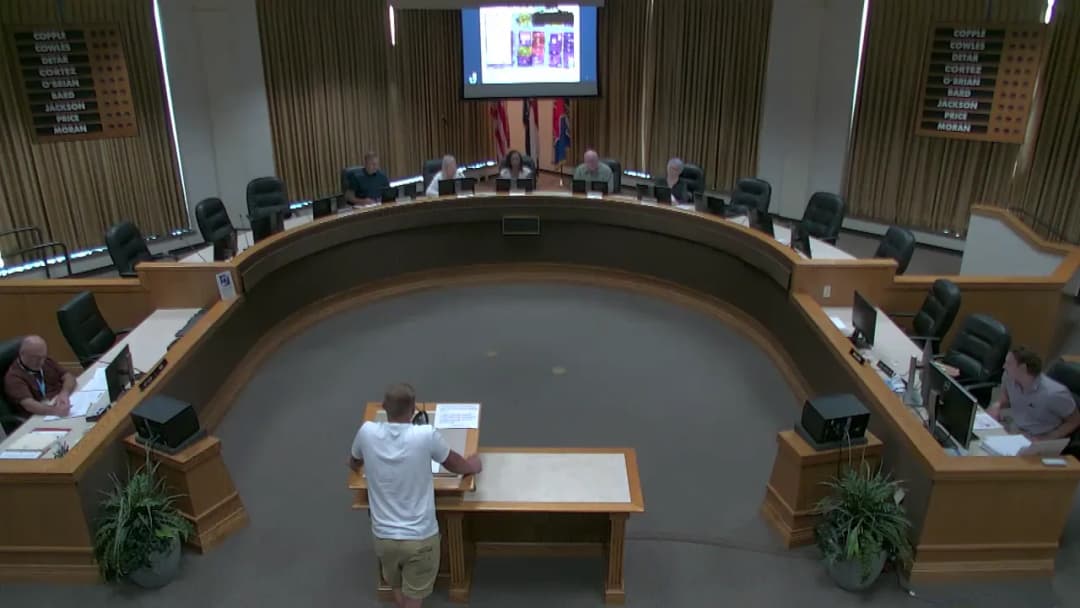
The Johns Creek City Council met for a work session at 5:01 p.m. on September 14, 2026, at 11360 Lakefield Drive. The mayor reported no remarks, and no strategic priorities were presented. The council discussed the 2027 meeting calendar, the 2027 renewal of employee health and other benefits, landscaping at the Medlock Bridge pedestrian tunnel, and Town Center monument signage. A routine non-discussion item, the Service Delivery Strategy Resolution with SDS Form 4 Certification, was listed but not discussed. The meeting concluded with an executive session for land, legal, and personnel matters. Consent Calendar - 2027 Meeting Calendar: Council reached consensus on date changes and asked staff to bring the calendar back on the consent calendar. - Annual Renewal of Employee Health and Other Benefits: Council agreed to advance staff's renewal recommendation, including a $6.6 million not-to-exceed authorization, to the consent agenda. - Service Delivery Strategy Resolution and SDS Form 4 Certification were listed as routine non-discussion business and were not discussed. Discussion Items 2027 Meeting Calendar - Staff presented a draft based on the 2026 calendar: meetings every three weeks, shifting to every two weeks during budget season, with accommodations for holidays and school breaks. The June meeting was left open as either a regular meeting or a possible mini-retreat. - Council moved the February 1 meeting to February 8, adjusted March dates to March 1 and March 22, and agreed to decide the June format at the January retreat. Council also planned to discuss retreat details in January. Annual Renewal of Employee Health and Other Benefits - Director Papu presented the 2027 renewal recommendation of approximately $6.6 million, compared with the $7.5 million anticipated in the proposed FY27 budget. - Medical: Cigna came in at a 4 percent increase, far below the assumed 16 percent. Staff attributed the lower rate to wellness investments and preventive care and negotiated a 100 percent surplus return for 2027, up from 50 percent in the current plan year. - Dental: Cigna's renewal was 31 percent; Guardian offered a self-funded plan at 24 percent. Staff recommended switching to the Guardian self-funded dental plan for lower cost, more plan control, and as a low-risk step toward possible future self-funded medical coverage. - Vision: no cost increase. Basic life came in at 17 percent, short-term disability at 9 percent, and long-term disability had no increase. - The HRA introduced in 2026 is being used by employees, and its 2 percent renewal increase was due mainly to headcount. - Councilmembers praised the result, asked about maintaining the roughly 80/20 cost share, and discussed using surplus funds and the 100 percent surplus return as seed money toward a future self-funded medical plan. GLP-1 drug coverage was confirmed as already included through the plan's formulary rider, with the HRA helping with out-of-pocket costs. - No formal vote was taken; the item was directed to the consent agenda as a $6.6 million not-to-exceed item. Landscaping and Tree Replanting Policy Implementation - Pedestrian Tunnel - Director O'Connor reported that the council approved the roadway landscaping and tree replanting policy on August 24, 2026, and asked for direction on three potential additional landscape areas on the west side of the Medlock Bridge pedestrian tunnel. - Funding options included the previously authorized tunnel contingency or TSPLOST II revenues assigned to the landscape/streetscape bucket. Rough staff estimates for the enhanced planting were about $65,000 to $75,000, and about $400,000 remained in the tunnel contingency, though invoices were not final. - Several council members expressed support for more shade trees, including full-sized oaks in areas one and two, and some suggested crepe myrtles, boxwoods, or ornamental plantings in area three. Others said the tunnel area already looks good and wanted to preserve TSPLOST funds for other priorities such as the boardwalk and other projects. - Staff said they would synthesize the council's direction and, after final consensus, develop a layout and send the plan out for installation bids to complete planting in the fall. Monument Signage - Town Center - City Manager Grear continued the previous work session discussion on the first Town Center monument sign. Staff reviewed the Medley sign design: painted neutral brick base, painted aluminum dark teal elements, and white channel letters. - Council discussed the gray option C color versus blue, and three locations along Medlock Bridge: north of Johns Creek Parkway, near the pedestrian tunnel, and at East Johns Crossing. - Council reached consensus on the gray/option C sign and on placing it on Medlock Bridge at Johns Creek Parkway, with design work allowing appropriate setback and scale so it would not be lost in the terrain and would preserve future right-of-way options. Some members preferred a more prominent or larger sign, and staff agreed to prepare additional renderings. - A council member said they did not want more than one sign and wanted the funding to come from tourism product development dollars. - Staff also recapped earlier archway marker concepts at the pedestrian tunnel; road-spanning arches were previously eliminated because of high cost, and side markers were estimated at $400,000 to $500,000 each, with the topic available for future discussion. Key Outcomes - The 2027 meeting calendar dates were revised to February 8, March 1, and March 22; the June format was deferred to the January retreat. - The employee benefits renewal was directed to the consent agenda with a $6.6 million not-to-exceed authorization and guidance to keep employee cost share near 80/20 while building reserves toward self-funded options. - For pedestrian tunnel landscaping, no formal vote was taken; staff were expected to incorporate council comments, refine costs, and return for fall installation, with funds kept within allowed TSPLOST/tunnel sources. - For Town Center monument signage, consensus was for a gray option C sign on Medlock Bridge at Johns Creek Parkway, with additional renderings and right-of-way/setback considerations to follow. - After the work session, the council moved into executive session for land, legal, and personnel matters. Upon returning, the council reported handling four real estate items, one personnel item, and one legal item, then adjourned.
PERSONNEL MATTERS 25% · PARKS AND RECREATION 25% · SIGNAGE 21% · PROCEDURAL 11%
6952
SEP 14, 2026 · FORT LAUDERDALE, FLORIDA · CITY COMMISSION
Fort Lauderdale City Commission Second Budget Hearing – September 14, 2026

The Fort Lauderdale City Commission held its second public hearing on the fiscal year 2027 budget on Monday, September 14, 2026, at 5:01 PM in the Fort Lauderdale Police Department Community Room. Mayor Dean J. Trantalis presided, with Commissioners John C. Herbst, Steven Glassman, Pam Beasley-Pittman, Vice Mayor Ben Sorensen, Acting City Manager Christopher Cooper, City Attorney Shari L. McCartney, City Auditor Patrick Reilly, and City Clerk Solomon present. The commission considered 10 budget items, including the final five-year capital improvement plan, special district assessments and millage rates, the city's final millage rate, the $1,283,327,106 all-funds budget, and the personnel complement for the fiscal year beginning October 1, 2026 and ending September 30, 2027. Public Comments & Testimony - Capital Improvement Plan: A resident said they supported fixing drainage and flooding problems but objected to a 20% increase applied in one single year. They questioned why the increase was not phased and noted that substantial wastewater items had already been discussed with a rate increase. - Beach Business Improvement Special District: A resident said residents do not experience government decisions in separate budget categories and asked whether the city looks at the total tax picture. - Final millage rate: A speaker said the millage rate had not changed in 20 years, questioned why the city needed to absorb all of that revenue and spend it, and asked the commission to adopt the 3.9408 rollback rate instead of the proposed 4.1193 rate. - Final budget: Four public speakers were listed. One said the city's budget and decision making were not correctly anticipating Fort Lauderdale's needs over the next five to ten years, criticized the lack of focus on attracting jobs, and urged the city to work with the private sector as a partner rather than a counterparty. Another thanked the commission for consistent support of programs helping children be ready for kindergarten and stay healthy and safe. Another urged the commission to distinguish needs from wants, phase immediate obligations, separate core services from discretionary spending, and stop spending money the city does not have. Discussion Items - The acting city manager presented the final five-year Capital Improvement Plan for October 1, 2026 through September 30, 2031. - The acting city manager presented the Lauderdale Isles Water Management District non-ad valorem assessment and budget. At the district's June 15, 2026 meeting, the board voted to continue levying an assessment of $15 per parcel for fiscal year 2027, generating $8,265. Vice Mayor Sorensen thanked district board members and noted improving waterways. - A public hearing was held on the Beach Business Improvement Special District; the resolution text was not included in the supplied agenda excerpt. - The Sunrise Key Neighborhood Improvement District held its second required public hearing. The district taxes residents to provide neighborhood security; the proposed final millage rate was 1.0000 mills and the proposed final budget was $230,007 for fiscal year 2027. The commission took two votes, one on the millage rate and one on the budget. - In response to questions about the total tax burden, city staff said the city looks at the overall picture with the Budget Advisory Board and described the breakdown in the Neighbor's Guide to the Budget: school board 35%, Broward County 31%, City of Fort Lauderdale 24%, public hospitals 7%, Children's Services Council 2%, and all other items 1%. Staff noted that the Budget Advisory Board's recommendation reflected a year of meetings with departments, and that one board member's approach was a minority position rather than consensus. - Discussion of fire and emergency medical services included the daytime population being larger than the city's resident population of about 200,000, different service demands and fees for commercial versus residential structures under Florida law, and the relationship between staffing levels and survivability. An official noted that equipment was purchased with a grant, blood was provided through an agreement with Broward Health, and the program had full cost recovery. A commissioner rejected the idea that supporting a fiscally prudent and responsible government means not supporting public safety personnel. - The final all-funds budget of $1,283,327,106 was presented, along with the final personnel complement for fiscal year 2027. The mayor encouraged adoption, saying the city must be maintained, the community protected, and the commission must provide for both. Key Outcomes - The commission adopted the final five-year Capital Improvement Plan for FY 2026-2031. - The commission approved the Lauderdale Isles Water Management District assessment and budget at $15 per parcel, with projected revenue of $8,265 for FY 2027. - The commission approved the Sunrise Key Neighborhood Improvement District final millage rate of 1.0000 mills and the final district budget of $230,007, in two separate votes. - The commission approved the city's FY 2027 final budget, including the $1,283,327,106 all-funds budget and the personnel complement, for the period beginning October 1, 2026 and ending September 30, 2027. - The supplied minutes record a 5-0 yea vote for one budget action and a four-member yea vote (Commissioners Glassman, Beasley-Pittman, Sorensen, and Mayor Trantalis) for another; Commissioner Herbst's vote is not shown in the provided minutes excerpt. The final budget item was declared approved, and no further business was brought before the commission.

BUDGET EQUITY ANALYSIS 32% · PUBLIC SAFETY 23% · PROCEDURAL 15% · WATER AND WASTEWATER MANAGEMENT 13%
6953
SEP 14, 2026 · JOPLIN, MISSOURI · BOARDS & COMMISSIONS
Joplin Planning & Zoning Commission Meeting Summary — September 14, 2026

The Joplin Planning and Zoning Commission met on September 14, 2026, at 10:00:00 UTC per the meeting record. The chair opened the public hearing by reading the hearing procedures, which included accepting into evidence the city's 2012 Comprehensive Plan, the Joplin Development Code (Appendix 29A of the Municipal Code), related design guides and regulations, staff recommendations, and all other written evidence. The commission voted unanimously to approve two rezoning requests for new single-family homes. Both approved cases are scheduled to be presented to the Joplin City Council on Monday, October 5, 2026. Consent Calendar - Motion to excuse Ms. Clue Michael (absent): made by Mr. Spruce, seconded by Mrs. Harrison. All in favor; motion carried. - Motion to approve the minutes from the previous meeting: made by Mrs. Harrison, seconded by Mr. Spruce. All in favor; motion carried. Public Comments & Testimony - Case 029-26: The applicant, identified as "Bow and Grinnegar" of 906 Grand Avenue, spoke in favor of the rezoning. They stated the rezoning application came after they had already applied to build a new single-family home without knowing the property's zoning district. - Case 030-26: Oscar Sarseno of Shuber Mitchell, 2030 Mia Faith Place, Joplin, spoke in favor of the application, describing the proposed 1,050-square-foot home as great for a first-time buyer or an empty nester. - No members of the audience testified in favor of or against either case. Discussion Items - Case 029-26: City staff presenter Tyler said the block has a mixed character, with single-family homes to the north and south and R3 zoning on the west half of the block. Staff recommended R3 because it is the infill zoning district for 50-foot lots, permits single-family use by right, and keeps the new home compatible with the neighborhood; the same use would also be allowed under R1. When a commissioner asked about the two neighboring C1 lots, staff explained the block had previously been rezoned for commercial development that never materialized; those existing homes are legally non-conforming and would need to be rezoned only if demolished and rebuilt. - Case 030-26: Staff explained the property is a 50-foot-wide corner lot on a block where all other lots are zoned R2. Although the future land use plan anticipated commercial uses along Broadway, that redevelopment never occurred on some blocks, and the small lot size severely limits commercial development. Staff therefore recommended R2 to be consistent with the rest of the block. Sarseno confirmed the applicant intends to build a single-family home on the lot. Key Outcomes - Case 029-26: Approved unanimously. Motion by Mr. Spruce, seconded by Mr. Skinsel (also recorded as "Skinzel" in the transcript). All in favor; motion carried. - Case 030-26: Approved unanimously. Motion by Ms. Harrison, seconded by Mr. Skinsel. All in favor; motion carried. - Adjournment: Motion made by Mr. Spruce, seconded by Mrs. Harrison. All in favor; motion carried. Note: No agenda or minutes were available in the source material, so this summary is based solely on the meeting transcript. The transcript includes minor audio-quality issues and inconsistent spellings of some commissioner names (e.g., Skinsel/Skinzel, Harrison/Harrington).

PLANNING AND ZONING 81% · PROCEDURAL 19%
6954
SEP 14, 2026 · MIRAMAR, FLORIDA · CITY COMMISSION
City of Miramar FY 2027 Millage and Budget First Public Hearing – September 14, 2026

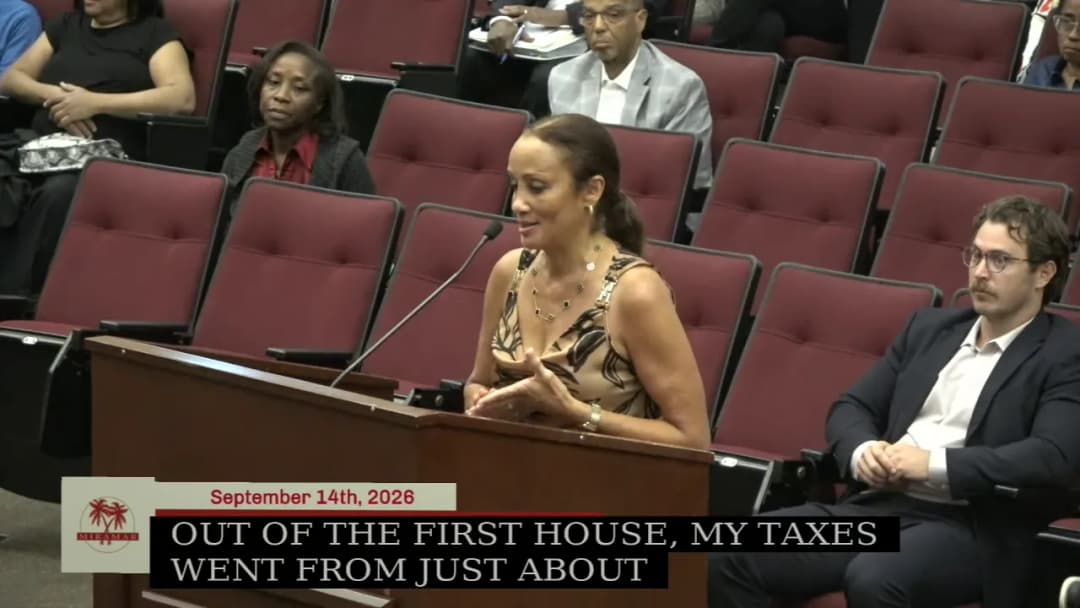
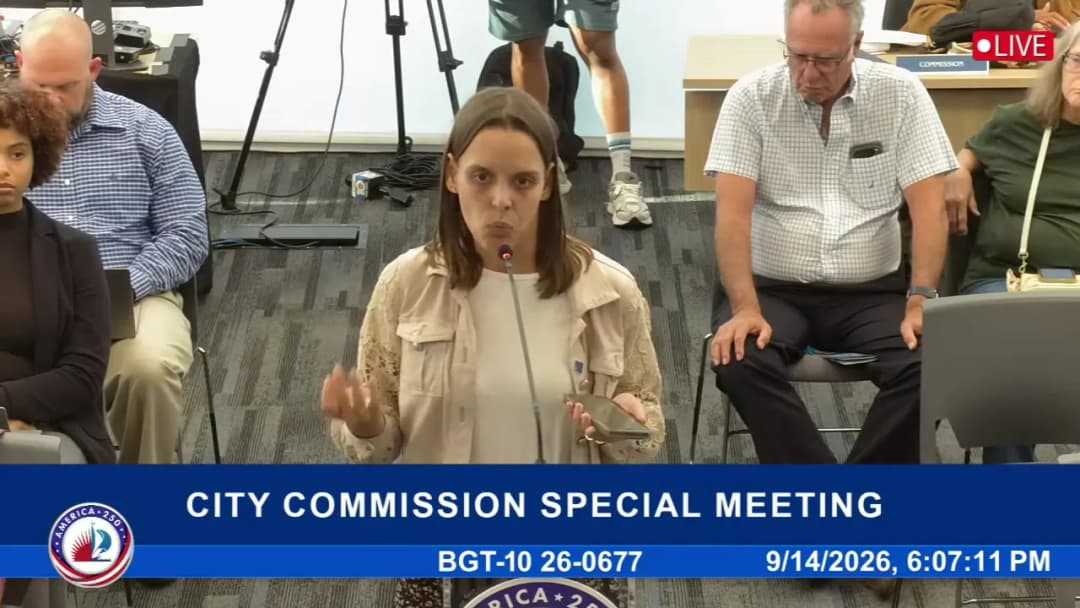
The City of Miramar City Commission held its first public hearing on September 14, 2026, to consider the proposed FY 2027 operating millage rate, the tentative FY 2027 operating and capital budget, the fire protection assessment update, and the stormwater management assessment. Staff presented the budget, a five-year financial forecast, and the impact of a proposed property tax amendment. The commission tentatively adopted the millage rate by a 4-1 vote and approved the budget, fire assessment, and stormwater assessment unanimously. A second and final public hearing is scheduled for Monday, September 28, 2026, at 5:01 p.m. Budget and Millage Presentation - The proposed operating millage rate is 7.1172 mills, or $7.11 per $1,000 of taxable assessed property value. The mayor read the required announcement stating that this rate is 5.18% above the rollback rate of 6.7664 mills. - City Manager Dr. Virgin stated there is no proposal to increase the millage rate from the current rate. - Budget staff member Rafael San Miguel presented the FY 2027 tentative budget. Total proposed spending for all funds is $442 million. The general fund accounts for 57% of the total, or $252.9 million; enterprise funds, including utilities and stormwater, account for 23%, or $101 million; internal service funds account for 13%, or $58.2 million; debt service funds account for 2%, or $11 million; capital projects and special revenue funds total $15.6 million, or 3% and 1% respectively; and subfunds total $3.4 million, or less than 1%. - Total proposed spending reflects a net decrease of $15.7 million compared to the FY 2026 adopted budget. Changes by fund type include a general fund increase of $11.2 million, an enterprise fund decrease of $26.2 million, an internal service fund increase of $4.6 million, a capital projects fund decrease of $5.4 million, a debt service fund decrease of $0.5 million, and an increase of just over $0.5 million in special revenue funds and subfunds. - General fund expenditures increase by 4.6%, or $11.2 million. Personal services increase by 5.7%, or $9 million, mainly due to collective bargaining increases, pensions, and the addition of 12 firefighters to fully staff the fourth firefighter shift under the IAFF contract. Operating expenses decrease by less than 1%, or $200,000. Capital outlay decreases by 51%, or $3.5 million, primarily due to reduced vehicle replacement funding. Transfers increase by 19%, or $2.4 million, and grants, debt, and other items, including OPEB and appropriated fund balance, increase by $3 million. - Salaries and benefits are just under 70% of general fund expenditures, or $174.9 million. Public safety is the largest general fund category at 50%, or $126.5 million. - General fund revenue sources include ad valorem taxes at 46%, or $117 million; permit fees and special assessments at 21%, or $53 million; charges for services at 11%, or $26.5 million; other taxes at 10%, or $26.4 million; intergovernmental revenues at 8%, or $19.9 million; and other revenues at 4%, or $10.3 million. - The average homesteaded single-family home taxable value increased from $272,000 to $280,000, an increase of just over $8,000, due to the 2.7% Save Our Homes cap. That home would see a city tax increase of $57.23 for the year. Combined with the fire assessment increase, the average homesteaded home would see an overall increase of $152.24 per year, or $12.69 per month. - A typical commercial space of just under 17,000 square feet would see its city tax increase by $326 for the year and its average fire fee increase by $4,200, for a total average increase of about $4,500 for the year. - The proposed fire protection assessment for residential properties is $574.22 per dwelling unit. This is an increase of about $95, or roughly 20%, and would generate about $32.4 million in revenue, an increase of $6.2 million. The current residential rate is $479 per dwelling unit, which represented about 80% of cost recovery. - Staff noted that Miramar is roughly 35% of the total ad valorem bill for the average homesteaded property. The remaining 65% consists of the Broward County School Board at 32%, Broward County at 28%, and other taxing authorities at 5%. - Staff highlighted exemptions available through the Broward County Property Appraiser, including low-income senior, long-term residency senior, widow/widower, disability/blindness, deployed military, veterans disability, first responder disability, and others. Residents with certain exemptions may be automatically exempt from the fire fee. The application deadline is September 18, 2026. - The city's hardship assistance program for fire assessments is available to properties with an assessed value of $300,000 or less, which was increased by $50,000 from the prior year. Applicants must meet income qualifications and the property must not be rented. Residents aged 65 or older who receive the Broward County senior exemption are automatically enrolled. - Peter Napoli of Stantec Consulting Services presented the five-year general fund sustainability analysis and fire assessment study. The analysis maintains the proposed millage rate of 7.1172 mills across all five projected years, includes no additional personnel beyond FY 2027 operating levels, and assumes the fire assessment increase is adopted. - Without the fire assessment increase, Stantec projected the city's general fund balance would fall below its minimum reserve policy by FY 2028. With the proposed property tax amendment impacts included, the fund balance is projected to be depleted by FY 2029. - Stantec presented illustrative scenarios to close the projected gap. Reducing personnel alone would require about 115 employees in FY 2028 and another 115 in FY 2029, a total reduction of about 230 employees, or 30% of the city's workforce. Increasing the millage alone would require about a 1.1 mill increase in 2028 and another 1.1 mill increase in 2029, bringing the total millage rate to about 9.3 mills, or 93% of the statutory maximum. A 50-50 approach would require a 0.5 mill increase in each year and reductions of about 60 employees in each year, or about 15% of the workforce. - Staff explained that if the proposed homestead exemption amendment is approved, the homestead exemption would increase from $50,000 to $150,000 on January 1, 2027, and the assessment growth cap would drop from 10% to 5%. This would have an estimated first-year impact of $19.1 million on the city's FY 2028 budget. The exemption would increase to $250,000 on January 1, 2028, with a total cumulative recurring impact of about $32.5 million by FY 2029. Over the first five years, the estimated loss to the city is approximately $150 million. - There are currently about 27,089 homesteaded residential units in the city. Of those, 299 currently pay no city ad valorem taxes. If the amendment passes, staff estimated 10,876 units, or 40% of all homestead properties, would pay no city ad valorem taxes. The median city taxable value would drop from $240,000 to $40,000, and the median homestead property bill would drop from $1,708 per year to $285 per year. Public Comments & Testimony - Celestine Fountain, 9750 Atlantic Drive, asked why her taxes are going up when her home value went down, and whether the additional fire personnel would improve response times. Staff explained that taxes are based on taxable value, not market value, that the assessed value is capped by Save Our Homes, and that the city is only one of multiple taxing authorities on the property bill. Fire Rescue Chief Jermaine McFarland said the SAFER grant provided 19 firefighters and expired in February, that average response time is about six minutes, and that the negotiated fourth shift supports improved service and recruitment. - Marie Joan Result, 6816 Southwest 37th Street, questioned why the fire assessment increase is so much larger than other increases and asked how the additional firefighter shift was justified. Stantec explained that the fire assessment had not been increased since 2023, that the current rate reflected 80% cost recovery, and that the fee is based on updated fire service costs. The fire chief said the fourth shift aligns with a statewide trend toward a 42-hour work week for firefighters. - Felix A. Pegueiro, 1402 Southwest 32nd Street in Catalina Bay, congratulated the city for its $40 million reserve but expressed concern that the city would be broke by 2029 if the proposed property tax amendment passes. He suggested the city may need to increase the millage rate toward the 10-mill cap or find other revenue tools. - Denise Mack and James Evans asked for a plain-language explanation, said their proposed bill appears to increase by roughly $1,000, and expressed fear of losing their home due to rising taxes, HOA fees, and possible special assessments. They asked when the final vote would occur and said they support public safety. - Felicia Gobaria asked why taxes are not going down despite development, why her second home tax bill rose from about $5,000 to $13,000, and whether budget cuts could give homeowners relief. Staff explained that portability, non-homestead status, and state statute determine assessed value, and that utility rate increases are separate from the property tax-funded general fund. - Sheena Flick asked for staff assistance in reviewing her comparison/sales grid to identify where she might get relief. Staff agreed to have a budget team member meet with her. - Several residents expressed appreciation for the city but said it is becoming unaffordable. The mayor encouraged residents to also attend Broward County and School Board budget hearings because Miramar controls only one of the 12 millage items on the property tax bill. Commission Discussion - Vice Mayor Edwards said Miramar receives only 35 cents of every property tax dollar paid by residents and that cutting the city's share alone would not produce major savings. He thanked residents for participating. - Commissioner Colburn asked for clarification of the 30% workforce reduction scenario. Staff confirmed that, in that illustrative scenario, reducing 30% of FTEs would likely reduce service levels across the city. - Commissioner Chambers said he was disappointed that he could not offer tax relief. He stated that the collective bargaining agreement and the fourth firefighter shift were missed opportunities to reduce costs, and he suggested earlier resident workshops in future budget cycles. - Commissioner Sherizard voted against the proposed millage rate and expressed strong concern that current residents are being asked to pay for the cost of growth. She said she wished the budget could roll back to the rollback rate or provide at least a symbolic decrease, and warned that failing to provide incremental relief can lead to drastic ballot measures. - The mayor said department heads had to defend their budgets and that the exercise produced about a 5% reduction across departments. He said the proposed 5.18% increase over the rollback rate partly reflects inflation and collective bargaining costs, and he emphasized the difficulty of balancing service levels, affordability, and the pending constitutional amendment. Key Outcomes - Item 1, Ordinance 1871, establishing the proposed FY 2027 operating millage rate at 7.1172 mills, was approved on first reading by a vote of 4-1. Commissioner Chambers voted yes, Commissioner Sherizard voted no, Commissioner Colburn voted yes, Vice Mayor Edwards voted yes, and Mayor Massum voted yes. - Item 2, Ordinance 1872, adopting the tentative FY 2027 operating and capital improvement budget, was approved unanimously. - Item 3, Resolution 8766, reimposing and updating the fire protection assessment, including the proposed residential rate of $574.22 per dwelling unit, was approved unanimously. - Item 4, the resolution reimposing the stormwater management service assessment at $135 per equivalent residential unit, or ERU, was approved unanimously. One ERU is equivalent to 3,619 square feet, each residential home is assessed one ERU, there are 60,795 ERUs citywide, and the projected revenue of approximately $7 million will fund stormwater operations, capital improvement projects, debt service, and equipment purchases. - The second and final public hearing to adopt the final millage rate and FY 2027 budget will be held Monday, September 28, 2026, at 5:01 p.m.

PROPERTY TAX 35% · BUDGET EQUITY ANALYSIS 19% · PUBLIC ENGAGEMENT 13% · FIRE PROTECTION 11%
6955
SEP 14, 2026 · SAN FRANCISCO, CALIFORNIA · LAND USE AND TRANSPORTATION COMMITTEE
San Francisco Board of Supervisors Land Use and Transportation Committee - September 14, 2026

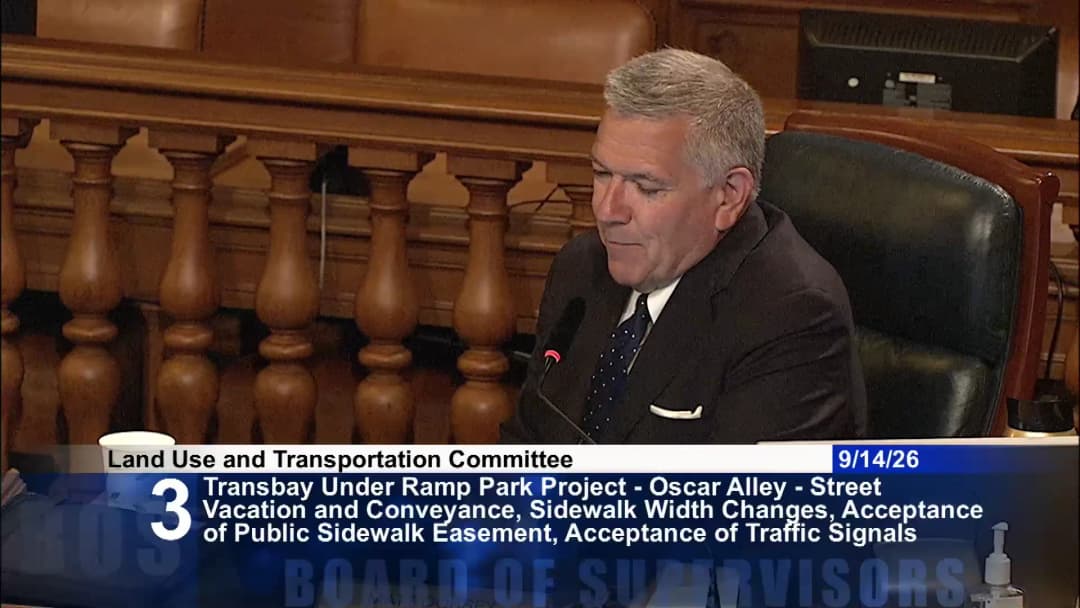
The Land Use and Transportation Committee of the San Francisco Board of Supervisors met on Monday, September 14, 2026, beginning at 9:45 AM, with Chair Melgar presiding. The clerk announced that public comment would be taken on each agenda item and that written comments could be submitted to the clerk's office. The committee considered three items: signage allowances in mixed-use districts, commercial-to-residential adaptive reuse code amendments, and the Transbay Under Ramp Park project involving the Oscar Alley street vacation and conveyance. Items acted upon during the meeting are expected to appear on the Board of Supervisors Agenda of September 22, 2026, unless otherwise stated. Public Comments & Testimony - No members of the public offered comment on Item 1 (Signs in Mixed Use Districts) or Item 3 (Transbay Under Ramp Park). - Mark Babson, representing Emerald Fund, San Francisco Housing Developers, expressed support for the adaptive reuse legislation (Item 2). He stated that Emerald Fund converted 100 Van Ness Avenue into 418 apartments in 2015 and has worked with the planning department and other city departments to create incentives to bring projects into financial feasibility. He noted the planning department had been forward-looking but additional adjustments were needed, and he supported the modifications to the legislation. Discussion Items Item 1 (File 260679): Planning Code - Signs in Mixed Use Districts Supervisor Dorsey (District 6) presented the ordinance amending the Planning Code to increase the allowable number and size of signs in mixed-use districts on lots over one half acre and in the mixed-use office district south of Townsend Street, affirming the Planning Department's CEQA determination and making required findings. Dorsey expressed support for the legislation, stating that Mission Bay is leading San Francisco's economic recovery and that good signage is part of what makes a commercial area work, particularly in mixed-use areas still working to attract tenants and visitors in the post-pandemic recovery. He acknowledged the committee was taking a narrow approach and noted the city will adapt the code's existing assumptions around signage as new residential districts are created. Planning staff presented the item. The Planning Commission heard the item on July 30, 2026 and unanimously adopted a recommendation of approval. The committee voted by roll call to send the item to the full Board of Supervisors with a positive recommendation. Item 2 (File 260771): Planning Code - Commercial to Residential Adaptive Reuse Supervisor Dorsey presented the ordinance, which builds on prior board actions to facilitate converting underutilized office and commercial space into housing. Dorsey stated that existing code obligations may be incompatible with the physical layout of buildings being converted, and satisfying them can be the difference between a project penciling out and a project never happening. He noted that several new adaptive reuse applications have been submitted and that his office supported the staff recommendations, which were incorporated into version two of the legislation before the committee. The recommended modifications included: waiving the bike parking requirement only where a project does not provide accessory off-street automobile parking; waiving the street frontage requirement for any project providing ground floor accessory off-street parking; and providing that off-street parking and loading requirements in Section 155S shall not apply to any existing off-street parking and loading retained to serve the new residential uses as long as the parking is located within or... (the remainder of the sentence and one additional modification were not captured in the transcript). Staff referenced included Jake Jacob Bentleff of the Office of Economic and Workforce Development and Lily Langwa of the Planning Department. The committee voted to send the item to the full Board of Supervisors with a positive recommendation. Item 3 (File 260873): Transbay Under Ramp Park Project - Oscar Alley Street Vacation and Conveyance Supervisor Dorsey presented the ordinance on behalf of Public Works, the Office of Community Investment and Infrastructure (OCII), and the Transbay Joint Powers Authority (TJPA) to facilitate construction of the Under Ramp Park (East Cut Sports and Dog Park), an approximately two-and-a-half-acre public open space planned beneath and around the elevated bus ramp connecting the Salesforce Transit Center to I-80, spanning the blocks between the Transit Center and Folsom Street. The park is a long-planned public amenity identified in multiple city-approved frameworks and essential to the neighborhood's open space network. Planned amenities include multi-sport courts for pickleball, basketball, and soccer; a roughly 20,000-square-foot dog park; a pavilion and amphitheater with retail space; a lawn; and an outdoor fitness area. The ordinance requests: vacation and conveyance of Oscar Alley, a small paper street above the Transbay bus off-ramp, to the TJPA for a nominal fee, with the area found not necessary for city use, containing no utilities, and exempt surplus property under the California Surplus Lands Act; waiver of the Administrative Code Chapter 23 appraisal requirement; sidewalk width changes on Folsom Street between Essex and Second Streets and on Clementina Street between First and Second Streets, including narrowing the sidewalk to create an ADA-accessible passenger loading zone with curb ramps and cutting back the Folsom Street sidewalk to create a 'jog handle' so eastbound bicyclists can turn north into the park when the traffic signal changes; acceptance of a public sidewalk easement from the TJPA; and acceptance of traffic signal infrastructure. Dorsey noted that the board previously vacated the airspace rights over Oscar Alley for the ramp's construction several years ago, and that continued discussions and negotiations with the TJPA since introduction prompted additional amendments circulated in revised legislation, but the overall concept remained unchanged. A motion was made to amend the legislation as described in the revised legislation and continue the item to the September 21, 2026 committee meeting. Key Outcomes - Item 1 (Signs in Mixed Use Districts): Forwarded to the full Board of Supervisors with a positive recommendation following a roll call vote. - Item 2 (Commercial to Residential Adaptive Reuse): Forwarded to the full Board of Supervisors with a positive recommendation. - Item 3 (Transbay Under Ramp Park): Amended as described in the revised legislation and continued to the September 21, 2026 Land Use and Transportation Committee meeting. - Items acted upon are expected to appear on the Board of Supervisors Agenda of September 22, 2026, unless otherwise stated. Note: The agenda also listed numerous items under 'Legislation Under the 30-Day Rule,' including landmark designation ordinances for properties such as the Transamerica Pyramid, Presidio Theatre, Vesuvio Cafe, Finocchio's, and the First AME Zion Church, as well as an item on noncomplying unpermitted residential yard structures. These items were not addressed in the portion of the meeting captured by the available transcript.

ADAPTIVE REUSE PROJECTS 39% · PARKS AND RECREATION 31% · PROCEDURAL 13% · SIGN ORDINANCE 12%
6956
SEP 14, 2026 · HOOKSETT, NEW HAMPSHIRE · TOWN COUNCIL & BOARDS
Conservation Commission Meeting – September 14, 2026: Bench Donation, Trail Safety, and Quimby Mountain Parking Lot Discussion

The Hooksett Conservation Commission met on September 14, 2026, to discuss a variety of topics including a memorial bench donation at Heads Pond, trail safety concerns on the Access for All trail, invasive species management, a stewardship plan for Clay Pond, beaver activity, deck repairs on the Riverwalk Trail, and the proposed Quimby Mountain parking lot. The meeting included public comments, votes on invoices, and motions for future actions. Consent Calendar - Minutes Approval: The minutes from the August 10, 2026 meeting were approved as amended (corrections to member designations and addition of a property identifier on line 70). - Sign Invoice: A $53.97 invoice for signs placed on the Heads Pond trail (to ask people to stay off new grass) was approved (one abstention). Public Comments & Testimony - Mark Gregoire (Manchester resident, teacher in Hooksett): Proposed a memorial bench at Heads Pond for his friend's 13-year-old son who passed away from cancer. The bench would be made of natural stone boulders (not finished granite), about 6–8 feet long, with a small brass plaque. Gregoire offered to provide labor and machinery. He stated the bench would be low-maintenance and blend with the environment. He requested approval to install it in a clearing about half a mile in, off the trail. Discussion Items - Memorial Bench at Heads Pond: Commissioners debated whether to standardize bench designs. Joe Carroll expressed concern about opening a "Pandora's box" of varied DIY benches. Others noted the stone bench would not rot and would simply look like a pile of rocks if it fell apart. A motion was made to approve the bench provided it is on town property and the plaque language is approved separately. An amendment was added that Alan (co-chair) would approve the ground materials (e.g., river rock) and the footprint area. The motion passed with one opposed. - Heads Pond Access for All Trail – Safety & Design: Several commissioners raised concerns about the trail's gate opening (narrow for wheelchairs), the actual trail width (8 feet vs. the promised 10 feet), and a steep drop-off near a culvert. John Peroni stated the trail was not welcoming to people with disabilities and called the drop-off a "lawsuit waiting to happen." He criticized Stantec's oversight, saying the engineer should have flagged the need for a fence earlier. Others noted the trail was designed to U.S. Forest Service accessible trail standards. A motion was made to obtain quotes for a safety fence or railing along the entry trail that meets the same standard to which the trail was built. The motion passed (votes not recorded, but no opposition noted). - Stantec Invoice: Discussion ensued about approving a $3,124 Stantec invoice (final for design work). Some commissioners wanted to table it until the trail issues were discussed. Ultimately, a motion to approve passed (one opposed, from a commissioner who had voted against the whole project). - Keep It Native Estimate: An estimate of $4,700 was presented for invasive species treatment on Field 3 and brush hogging/mowing on Field 1 at Riverwalk Trail. Commissioner Peroni expressed opposition to using glyphosate near the river. The motion to approve the work passed, with one opposed (Peroni). The funding source was designated as the Conservation Land Improvement Fund. - Clay Pond Stewardship Plan: A contract with Moosewood Ecological for $12,000 (plus $150 for additional insurance) was approved for a stewardship plan at Clay Pond. An invoice for $3,807.50 (first of at least two) was also approved. Both were to come from the Conservation Land Improvement Fund. - Hini Property (Map 26, Lot 4): A 27-acre landlocked parcel adjacent to the middle school was discussed. The owner had offered to sell to the town. The commission considered a motion to express interest in acquiring the property by donation or minimal cost. The motion failed in a 3–3 tie (Phil, Steve, John in favor; others opposed). - Beaver Activity on Riverwalk Trail: A landowner reported beaver activity blocking a brook. The commission voted to have a trapper handle the beaver on the trail as well. The motion passed unanimously. - Riverwalk Trail Deck Repairs: Several decking boards were reported as spongy and dangerous. Commissioners noted the wood (pressure-treated southern yellow pine) had deteriorated due to UV exposure, not moisture. Some felt the engineer (Stantec) should be responsible, but others noted the deck is 11 years old. An emergency motion to spend up to $500 to replace the worst boards passed unanimously. A longer-term discussion on full deck replacement was tabled. - Quimby Mountain Parking Lot: The commission reviewed a $36,000 Stantec estimate for design and permitting of a 10-car parking lot. Several commissioners wanted a total cost estimate for the entire project (design + construction) before approving the design work. A motion was made to request from Stantec a total estimated cost for designing and building a gravel parking lot for up to 10 cars (including fire department turnaround) on the Quimby Mountain property. The motion passed (one opposed). Public comment from Mark Lacas (34 Quimby Mountain Road) raised concerns about the parking lot location being too far from the road, potentially attracting illicit activity. He suggested a site closer to the road for better visibility. Key Outcomes - Memorial Bench: Approved with conditions (must be on town property; plaque language to be approved; materials and footprint approved by Alan). - Safety Fence/Railing: Motion passed to obtain quotes for a barrier along the Heads Pond Access for All trail entry. - Stantec Invoice: Approved ($3,124) from Conservation Land Improvement Fund. - Keep It Native Work: Approved ($4,700) from Conservation Land Improvement Fund; one opposed. - Clay Pond Stewardship Contract: Approved ($12,000) and first invoice ($3,807.50) from Conservation Land Improvement Fund. - Hini Property: Motion to express interest failed (3–3 tie). - Beaver Trapping: Approved. - Riverwalk Deck Emergency Repair: Approved up to $500 from current budget. - Quimby Mountain Parking Lot: Motion passed to request a total estimated cost from Stantec for design and construction of a 10-car gravel parking lot with fire truck turnaround. - Old Home Day: A volunteer (Steve) offered to staff the Riverwalk Trail booth for two hours on September 19, 2026, if the shuttle event occurs. - Farming Issue on Riverwalk Trail: A certified letter was sent to a farmer regarding improper practices and debris; no response yet (30-day response window).

PARKS AND RECREATION 32% · PROCEDURAL 14% · ENGINEERING AND INFRASTRUCTURE 11% · BUDGET EQUITY ANALYSIS 11%
6957
SEP 14, 2026 · ROCHESTER, MINNESOTA · CITY COUNCIL
Rochester City Council Study Session - September 14, 2026

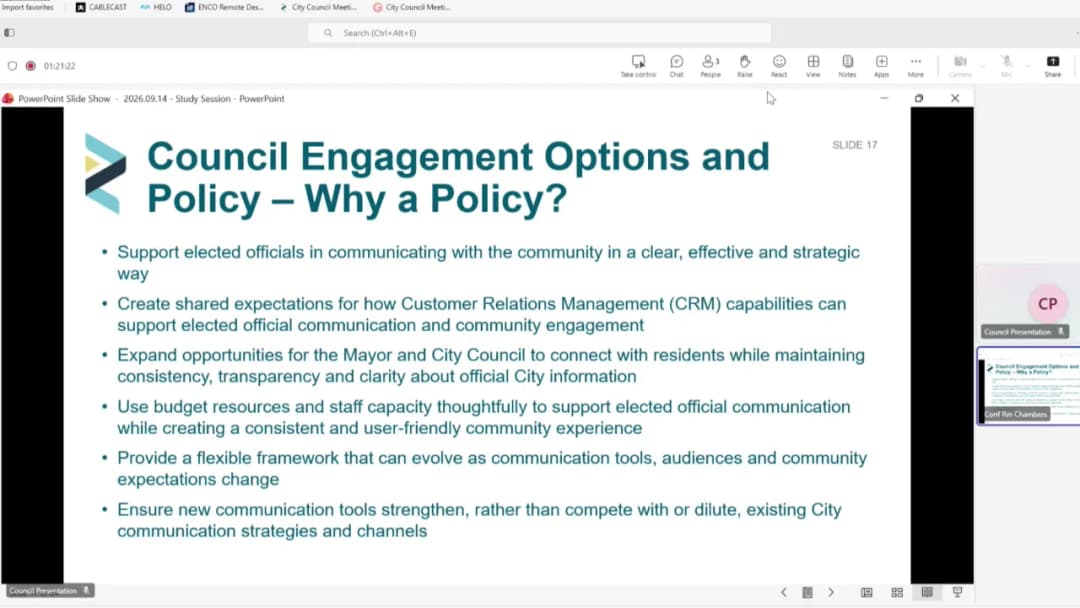
The Rochester City Council held a study session on September 14, 2026, to discuss the 2027 supplemental recommended operating budget, a payment card processing fee analysis, and the 2026 mid-year action plan. The session lasted from approximately 3:30 p.m. to after 6:30 p.m., with no formal votes taken; instead, staff received direction for preparing future resolutions and policies. 2027 Supplemental Recommended Operating Budget - Staff presented a recommended tax levy increase of 5.59% (to $124.9 million) and a total budget of $799.3 million (including Rochester Public Utilities). The increase is driven by capital improvements, equipment stabilization, and decision packages. - Councilmember Palmer proposed reducing the contingency fund from $1 million to $500,000 to lower the levy increase to 5.21%, matching the preliminary market value growth of 5.21%. Several council members (Keene, Wall, Miller) opposed, arguing the contingency provides necessary margin and that the reduction is a one-time budget trick that would not produce ongoing savings. No consensus was reached; staff will prepare the preliminary levy resolution reflecting the 5.59% increase but with the option for council to adjust at the September 21st action meeting. - A request for $100,000 in AnyPath Home funding was discussed. The council generally supported using one-time state affordable housing aid (projected $249,000 in 2027) rather than adding the amount to the property tax levy. Councilmember Doring preferred a levy-based approach, but the majority favored state aid. Staff will include a designation of $100,000 from that aid for AnyPath Home in the preliminary budget resolution. - Council Communications: Staff recommended MailChimp as an opt-in email tool ($9,300/year). Mayor Norton and several council members expressed disappointment, preferring a more robust platform like Indigov that allows geographic targeting and two-way communication. No direction was given; staff noted the current contract expires in November and a policy discussion will continue. - Shared Services: Deputy Administrator Parrish highlighted potential efficiencies in IT, fleet, GIS, and finance, but noted limited progress due to governance and cultural challenges. Council encouraged staff to sequence deeper dives into specific areas for future study sessions. - Mayor’s Initiatives & Council Travel Budget: Council President Schubring raised the possibility of combining council travel and training budgets into one pool, and of having council oversight over mayor’s initiative spending (currently $30,000). Mayor Norton defended the separate budget, noting her initiatives are funded by the council-approved budget and are reported monthly. Councilmember Palmer and Fredericks supported maintaining the mayor’s discretion. No changes were adopted; the topic may be revisited in a future study session on boards and commissions. Payment Card Processing Fee Analysis - Finance Manager Anderson presented a detailed analysis of the city’s 21 merchant IDs, six acquiring banks, and an average processing fee of 4.86% on credit card transactions, costing the city approximately $511,000 in 2025 (excluding pass-through fees). - The city could implement a surcharge or convenience fee (up to 5% per state statute) to recover most of the cost. Staff recommended a uniform 3% fee for most transactions, with some flat-fee options for small-ticket items (e.g., 25 cents for under-$3 purchases). The proposed policy would be broad, allowing the finance director to adjust fees by merchant as needed. - Council generally supported moving forward with a user-pay model, but raised concerns about alternatives for services where credit cards are the only payment method (e.g., parking ramps, bus fare via mobile app). Councilmember Keene cautioned against unintended customer frustration. Staff will bring a formal policy and implementation plan to a future meeting. 2026 Mid-Year Action Plan - Deputy Administrator Parrish reported that most action plan items are on track, with a few off-track items (e.g., some capital projects). The action plan links strategic priorities to departmental initiatives and is used to inform budget decisions. - Key updates included: 36 lead service lines replaced (RPU); 702 housing units supported through sales tax investment; 10% growth in transit ridership; progress on the ERP project (one go-live in fall 2027); and the $42.8 million Public Works/Parks Maintenance Center nearing completion. - Council asked about metrics for short-term rentals, lead service line funding, and air quality public communication. Staff will follow up on data trends and opportunities for more visible air quality information. - Councilmember Keene questioned whether the action plan is the best management tool; staff acknowledged continuous improvement and noted that a strategic priorities update will occur in early 2027, which may refine the action plan. Key Outcomes - Preliminary Levy Resolution: Staff will prepare the resolution with the 5.59% levy increase and $100,000 for AnyPath Home funded from state affordable housing aid. Council may adjust at the September 21 action meeting. - Contingency Reduction: No direction to reduce contingency; the 5.59% levy recommendation stands for now. - Payment Card Fee Policy: Staff will develop a policy to implement a surcharge/convenience fee, targeting cost recovery, and return to council for adoption. - Future Study Sessions: The next study session on September 28 will cover housing access, mode shift, and stormwater credit policy; October 12 will include the Red Owl/Time Theater history, youth council trip report, and parks and recreation marketing updates. - ERP Project: On track for a single go-live in fall 2027.

PUBLIC ENGAGEMENT 26% · CREDIT CARD FEES 17% · BUDGET EQUITY ANALYSIS 14% · SHARED SERVICES 9%
6958
SEP 14, 2026 · SACRAMENTO, CALIFORNIA · ARTS, CULTURE, AND CREATIVE ECONOMY COMMISSION
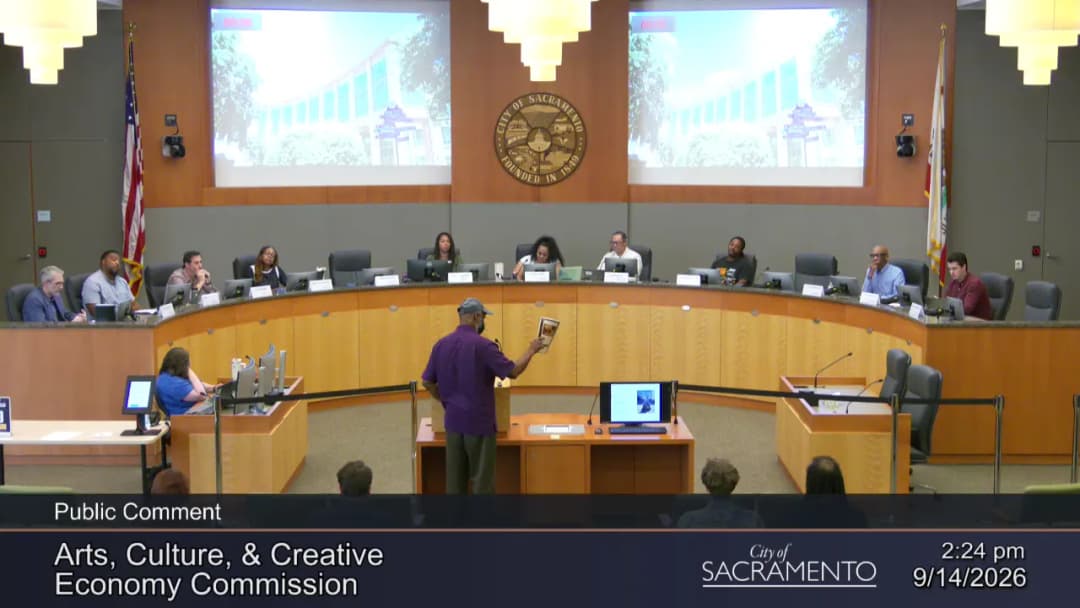
Sacramento Arts Commission Meeting - September 14, 2026: Education, Public Art, Equity

The meeting was called to order at 1:00 PM at City Hall with a quorum present. The commission discussed arts education and Proposition 28 funding, reviewed a temporary public art application for Winn Park, received a presentation on the Martin Luther King Jr. Library RFQ for public sculpture, and launched a new session of the Race Equity Ad Hoc Committee. Two consent calendar items were approved unanimously. Consent Calendar - The commission approved the minutes of the August 10, 2026 meeting and the Arts, Culture, and Creative Economy Commission Follow-Up Log. The motion passed with no opposition and no abstentions. Public Comments & Testimony - On Item 3 (Arts Education): Caleb Sanders, a professional musician and composer, stated he is a product of strong arts education and expressed full support for continued funding. Timothy Gay, a Sacramento resident and transplant from Detroit, also voiced strong support for arts education, citing its lifelong benefits. - On Item 4 (Temporary Public Art): Lambert Davis questioned why the artist Daniel Tran was not present to speak and contrasted this with a previous applicant who attended in person. He expressed general support for the project but noted the discrepancy. - On Item 6 (Race Equity Ad Hoc): Lambert Davis urged the commission to recognize the 80th anniversary of the Del Paso Heights community at City Council, emphasizing the importance of equity for long-standing residents. Timothy Gay advocated that the cultural equity statement should explicitly include storytelling as a core element. - On Matters Not on the Agenda: Lambert Davis repeated the call for Del Paso Heights recognition. Caleb Sanders highlighted that many live musicians are unaware of the commission and identified barriers such as paperwork, permitting, and parking fees. Timothy Gay criticized the city's entertainment permit fees, stating they harm small venues and musicians, and urged elimination of those barriers. Discussion Items - Item 3: Sacramento Arts Education Efforts and Proposition 28 Discussion Alison Tagley (Executive Director, Friends of Sacramento Arts) and CJ D'Angelis (Arts Integration Coordinator, Sacramento County Office of Education) presented. They noted that Prop 28 provides approximately $1 billion per year statewide for arts education, with an 80% requirement for certificated/classified staff and 20% for materials and community partnerships. Funding is permanent, per-pupil, with extra for Title I students. They encouraged parents to ask school principals how funds are used. Commissioner Dr. Winlock praised the collaborative efforts among the city, county, and advocacy groups. Chair Lavulo asked about a specific school (John Still) not appearing on the allocation list; CJ explained that schools have individual plans and that AB 2440 may require posting plans on school websites. Commissioner Smith inquired about expanded learning and after-school programming; CJ clarified that Prop 28 funds are intended for school-day use, though districts can waive the 80/20 split. - Item 4: Phase 1 Review - Temporary Public Art Application - Daniel Tran - Winn Park Donald Gensler presented the application for a sculpture with a pipevine planting at Winn Park. The artist, Daniel Tran, has already installed the sculpture as part of the Coordinates Dispatch exhibition and seeks a five-year temporary placement with a possible five-year extension. The project is self-funded. Commissioners discussed maintenance concerns based on a similar project at Southside Park, and staff noted that a maintenance plan would be required. The commission voted unanimously to allow the application to advance to Phase 2 review. - Item 5: Martin Luther King Jr. Library RFQ Presentation Donald Gensler presented the Request for Qualifications for a permanent public sculpture at the MLK Library entrance. The budget is $151,500 (including a $1,500 design fee). The artwork must be a relief panel or sculptural wall hanging with a civil rights theme. The RFQ is now open, with an information session on October 12, deadline October 26, panel review in December, artist selection by end of December, and installation targeted for December 2027. The rubric awards extra points for artists with a relationship to the area or subject matter. - Item 6: 2026 Race Equity Ad Hoc Committee - Session 2 of 6 Dr. Winlock outlined the ad hoc committee’s plan to revisit the commission’s cultural equity statement, originally developed about 15 years ago. The committee will meet in three Zoom sessions (Sept 24, Oct 8, Nov 19 from 3–5 PM) and will present recommendations at the January 2027 commission meeting. Discussion areas include how the cultural equity statement is guiding work, whether it needs updates, and examples of best practices. Commissioners suggested including elder communities and storytelling. Participating commissioners are Eisenberg, Hershey, Orozco, Smith, and Winlock. Key Outcomes - Consent Calendar approved unanimously. - Item 4 motion to advance Daniel Tran’s temporary public art to Phase 2 passed unanimously. - No other votes were taken; Items 3, 5, and 6 were for receive and comment/discuss. - Next meeting is Monday, October 5, 2026 at 1:00 PM (first Monday instead of second). No December meeting; next in January 2027. - The commission has two open seats (Districts 6 and 7). - Director’s Report highlighted upcoming events: Art in Public Places Birds & Benches workshop (Sept 26), MLK Library RFQ info session (Oct 12) and deadline (Oct 26), and professional development scholarships for individual artists (applications through Sept 21).

PUBLIC ART 29% · ARTS AND CULTURE 25% · EDUCATION POLICY 18% · RACIAL EQUITY COMMITTEE 12%
6959
SEP 14, 2026 · WESTCHESTER COUNTY, NEW YORK · BOARD OF LEGISLATORS & COMMITTEES
Westchester County Appointments Committee Meeting - September 14, 2026

The Appointments Committee of the Westchester County Board of Legislators met on Monday, September 14, 2026, at the Michaelian Office Building in White Plains, NY. Chair Anant Nambiar called the meeting to order at 4:06 PM; the committee adjourned at 4:47 PM. Legislators Margaret Cunzio and Jennifer Puja participated remotely. The committee unanimously approved four sets of prior meeting minutes and unanimously recommended the appointment of Kevin Winn to the Westchester County Storm Water Advisory Board, with the full Board vote expected at the evening session. Minutes Approval - The committee approved the May 18, 2026 minutes by a unanimous roll-call vote (5-0). - The committee approved the May 26, 2026, June 29, 2026, and August 31, 2026 minutes together in one unanimous motion (5-0). Discussion Items - Resolution 2026-376 — Appointment of Kevin Winn to the Storm Water Advisory Board: The resolution would appoint Winn for the term June 25, 2026 through December 31, 2027. (The agenda lists the appointee as 'Kevin Winn'; the transcript initially renders the name as 'Kevin Wynne.') - Winn described his roughly 35 years in public works and engineering, including 19 years as Commissioner of Public Works for the Town of Bedford, with significant experience in stormwater, sewage, and municipal infrastructure. He said the board advises the county on stormwater problems and on administering grant funds for municipal stormwater improvements. - On county-municipal coordination, Winn said drainage problems are often regional and tied to entire basins rather than single municipalities, that engineering models can identify bottlenecks and cost-effective solutions, and that rainfall intensity — not just total rainfall — may require updated storm models. - Chair Nambiar noted that flooding is one of the biggest challenges in his district, and the discussion highlighted that Rye received approximately seven inches of rain within a few hours during a recent storm, described as extreme intensity. - It was noted during the discussion that the county is taking on new watershed studies — including a refresh of a roughly 10-year-old Sound Shore watershed study — within the next six to twelve months, with assistance from third-party firms. - Legislator Erica Pierce expressed strong support for Winn, calling him a 'fantastic choice' and citing his work as Bedford's Public Works Commissioner. She emphasized that solving flooding in one place can push water and problems to another location, making a municipal voice at the county table valuable. - The committee voted unanimously (5-0) to approve the appointment. Chair Nambiar noted that he would cast his vote at the evening full Board of Legislators meeting. Key Outcomes - Approved minutes from the May 18, 2026 meeting (5-0). - Approved minutes from the May 26, 2026, June 29, 2026, and August 31, 2026 meetings (5-0). - Approved Resolution 2026-376 appointing Kevin Winn to the Westchester County Storm Water Advisory Board for the term June 25, 2026 to December 31, 2027 (5-0), with referral to the full Board for the evening session. - Meeting adjourned at 4:47 PM.

ENGINEERING AND INFRASTRUCTURE 45% · PROCEDURAL 40% · WATER AND WASTEWATER MANAGEMENT 15%
6960
SEP 14, 2026 · MILWAUKEE, WISCONSIN · COMMON COUNCIL
Milwaukee Historic Preservation Commission Meeting - September 14, 2026

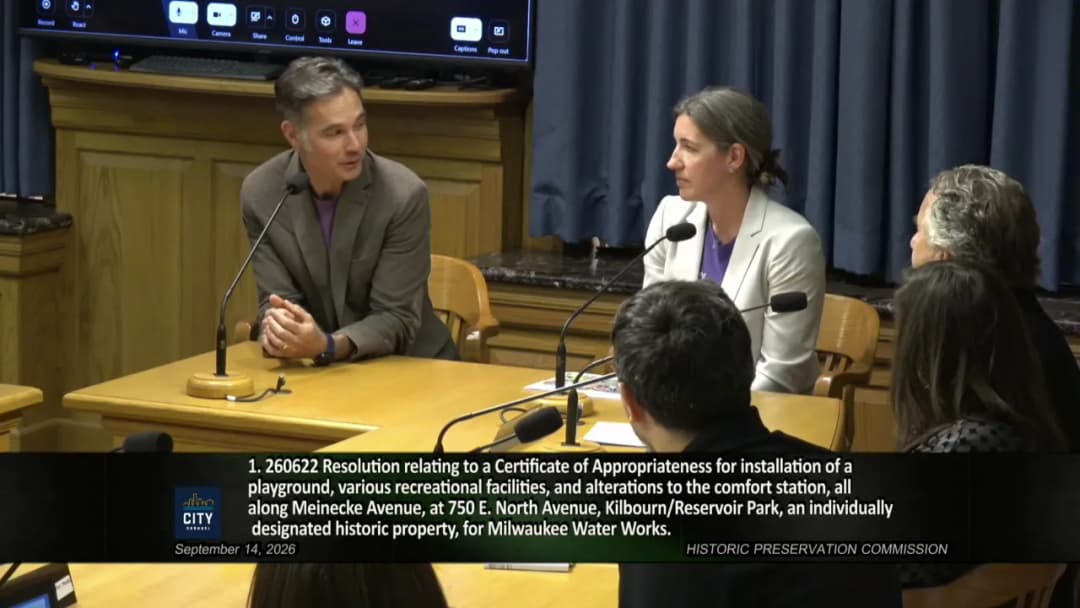
The Milwaukee Historic Preservation Commission met on Monday, September 14, 2026, at 3:00 PM in City Hall, Room 301-B, and adjourned at 4:57 PM. Chair Jordan Morales led the meeting. Present were Ann Pieper Eisenbrown, Matt Jarosz, Patricia Keating Kahn, Sally Peltz, Nicholas Hans Robinson, and Jordan Morales; Ald. Robert Bauman was excused. Commissioner Jarosz left at 4:50 PM, so votes on later agenda items were 5-0. Consent Calendar (Staff-Approved Certificates of Appropriateness, Items 7-22) - The commission approved all 16 staff-approved Certificates of Appropriateness in one motion (6-0, Bauman excused): - 260558: chimney flashing, tile roof repair, and tuck pointing at 2401 N. Grant Boulevard. - 260559: replacement of a damaged storefront at 1025-1027 W. Historic Mitchell Street. Note: this file number also appears as item 3, and the commission voted on it in both places. - 260560: stucco repair and in-kind cedar shingle replacement at 2421 N. Terrace Avenue. - 260561: re-facing an existing monument sign and installing a rear wall at 2133 W. Wisconsin Avenue (Grand Avenue Congregational Church). - 260580: masonry and gutter repair at 2857 N. Grant Boulevard. - 260581: HVAC installation at 2546 N. Summit Avenue. - 260585: wood replacement fences at 3022 W. State Street. - 260600: landscaping, roof repair, and temporary window removal at 2359 N. Wahl Avenue. - 260601: wood fence at 834 N. 26th Street. - 260602: roof shingle replacement at 2717 E. Bradford Avenue. - 260614: metal driveway gate at 2585 N. Summit Avenue. - 260624: spot siding repair and replacement at 1814 N. 1st Street. - 260669: roof repairs at 3107 W. Kilbourn Avenue. - 260685: landscaping modifications at the Milwaukee Auditorium (High Life Theater) and Milwaukee Arena (Panther Arena), 400-500 W. Kilbourn Avenue. - 260687: reconstruction of the tennis courts in Lake Park, 3233 E. Newberry Boulevard. - 260689: roof replacement for shed dormer and dormer repair at 2635 N. Terrace Avenue. Public Comments & Testimony - Rese Schneider and Bob Schneider, Stella's parents, testified in favor of the Kilbourn/Reservoir Park playground. They described their daughter's disability after brain tumor surgery and her statement that 'playgrounds aren't for me,' which inspired the project. They expressed strong support for creating an inclusive play space where all children feel they belong. - Katherine Hannah, owner of properties on North Bremen Street, said she supports accessible playgrounds and praised the investment, but said neighbors were taken aback by the scale of the development. She raised concerns about changes to the hill, tree preservation, swing sets, bathroom maintenance, concession viability, and parking congestion during concerts and events. - Christine Privetti, of North Booth Street, said she supports the park and donated to Stella's Playground, but raised long-range concerns about bathroom maintenance, past drug use and safety issues, picnic shelter reservations, night-time pressure, marketing the park as a national attraction, and increased trash. - Nicole Heinle, of North Bremen Street, supported the concept but worried about parking, noting that streets around the park currently have no restrictions and asking whether new restrictions or meters might follow. - Gerald Roesch, vice president of the congregation and a member since 1944, testified in favor of designating the English Evangelical Lutheran Church of the Incarnation. He said designation would help the church qualify for grants, including those for historically Black congregations, to fund an interior elevator and roof repairs. Discussion Items - Item 1 - Kilbourn/Reservoir Park Playground (260622): Staff planner Tim Askin presented a proposal by Milwaukee Water Works and MKE Parks. The plan would renovate the unused comfort station into accessible bathrooms with a potential concession stand, add picnic shelters set one foot from the building, and install a dragon-themed playground designed with KOMPAN and Kahler Slater. The playground would include about 25,000 square feet of playable surface, sensory areas, enlarged basketball courts, and a switchback trail up the hill. The City of Milwaukee contributed $200,000; approximately $1.5 million has been raised toward a $2 million goal through private fundraising and in-kind partners. The commission asked for a lower roof pitch on the shelters and directed that the proposed steel slab doors be replaced with a more historic design such as a five-panel door. Parks staff said there is no plan for off-street parking, but accessible on-street spaces are planned near Meinecke and Fratney, and that park topography would be preserved. The project was approved unanimously. - Item 2 - Mothball Status at 2544 N. Sherman Boulevard (251648): Jennifer Luckett requested a six-month extension of mothball status for a non-compliant chain link fence. She said a neighbor will not allow tree removal on the shared property line, has been uncooperative and threatening, and she has a municipal court date on October 15. The commission approved the extension and suggested she contact the City Attorney's office. - Item 3 - Storefront Replacement at 1025-1027 W. Historic Mitchell Street (260559): Staff described replacing a car-damaged storefront with dark anodized bronze aluminum, tile details, and spandrel glass in the transom. Staff recommended conditions requiring transom trim so only full squares of the spandrel glass pattern are visible, a different single-color tile instead of a gradient faux-stone tile, and replacement of all tile. There were no objections, and the commission approved with those conditions. - Item 4 - Historic Designation of the English Evangelical Lutheran Church of the Incarnation (260608): Staff planner Tim Askin presented the cultural and social history. The church was founded in 1917 as an English Lutheran tent mission, and the current Neo-Gothic Lannon stone building was designed by architect Hugo Haeuser in 1923. The designation excludes the parsonage at 1510 W. Keefe Avenue at the applicant's request; the parsonage currently serves as a food pantry. The property was found significant for its role in racial integration in the 1960s under Pastor Charles Loon, the music school boycotts, anti-busing protests, community organizing after the 1981 death of Ernest Lacy, and its association with Reverend Dennis Jacobson, co-founder of MICA (Milwaukee Inner City Churches Allied for Hope). Staff recommended approval under criteria F1, F3, F6, and F9. After a public hearing, the commission recommended adoption and assigned the resolution to the Zoning, Neighborhoods & Development Committee. - Item 5 - Rear Deck and Patio Doors at 2328 E. Back Bay Street (260613): Staff planner Andrew Stern presented a proposal for the Charles Sprague Forsythe House. The work would remove a non-historic bay window, add solid wood French doors, and build a cedar deck with turned balusters matching the house's existing design. Staff recommended approval with conditions to finalize door, baluster, and rail details. The commission approved unanimously. - Item 6 - Detached Garage at 1060 E. Juneau Avenue (260623): Staff planner Andrew Stern presented a proposal for the George P. Miller House. The detached garage would be set back, mostly out of street view, and built of cream brick with wood carriage-style doors. Lot lines and access easements are being adjusted. Staff recommended approval with conditions on materials, door and light details, and roofing, including that no termination bars be visible from ground level. The commission approved unanimously. - Item 24 - CLG Review of Greyhound Terminal and Office Building (260666): Staff planner Andrew Stern presented the National Register nomination for the Greyhound Terminal and Office Building at 633 W. Wisconsin Avenue. The nomination is based on mid-20th century transportation history, not architectural merit. The building, designed by Robert Lee Hall and Associates and developed by Bloomfield Building Industries, opened its bus terminal in February 1965 and served more than 200 buses per day. Greyhound operated there until 2017. Staff recommended supporting the nomination under Criterion A: Transportation History. The commission supported the nomination 5-0. - Item 25 - CLG Review of Milwaukee County Department of Welfare Building (260718): Staff planner Andrew Stern presented the National Register nomination for 1220 W. Vliet Street. The building was constructed for Schuster's department store in 1910, expanded in 1923, and became the Milwaukee County Department of Welfare in 1963. The nomination is under Criterion A for social history, politics, and government, with a period of significance from 1963 to 1986. The site is associated with welfare program growth, civil rights activism, protests, and sit-ins, as well as later welfare reform controversies. A $9.3 million federal funding cut in 1983 and major renovation in 1986 mark the end of the period. The building is now being renovated by Gorman and Company into workforce and affordable housing. The commission supported the nomination 5-0. Key Outcomes - Approved unanimously (6-0, Bauman excused): Item 1 (Kilbourn/Reservoir Park playground), Item 2 (mothball status), Item 3 (storefront replacement), Item 5 (rear deck), and Item 6 (detached garage). - Recommended for adoption and assigned to the Zoning, Neighborhoods & Development Committee (6-0, Bauman excused): Item 4 (permanent historic designation of the English Evangelical Lutheran Church of the Incarnation). - Approved the consent block of staff-approved Certificates of Appropriateness (6-0, Bauman excused): Items 7-22. - Approved the minutes from the August 3, 2026 meeting. - Supported National Register nominations for the Greyhound Terminal and the Milwaukee County Department of Welfare building (5-0, with Jarosz and Bauman excused). - Announcement: The Wisconsin Local History and Historic Preservation Conference is scheduled for October 14-16, 2026, in downtown Milwaukee. - Meeting adjourned at 4:57 PM.

HISTORIC PRESERVATION 41% · PARKS AND RECREATION 31% · DISABILITY RIGHTS 8% · PARKING ENFORCEMENT 5%
OPENPUBLICA · PUBLIC MEETING INDEXUPDATED DAILY · openpublica.com