The Police Policy Oversight Commission met on September 10, 2026, to discuss proposed changes to its rules and regulations, particularly the removal of the NAACP-designated seat and the incident review process. Three NAACP representatives spoke in opposition during public comment, emphasizing the organization's historical role in forming the commission and ongoing racial disparities. The commission held a lengthy discussion but took no final action, voting to continue the discussion to the next meeting in December. Public Comments & Testimony - Joe Phillips, former commissioner, expressed concern about a possible motion to remove the NAACP from the commission and requested an explanation. - Dr. Wale Elegbede, president of the Rochester branch of the NAACP, stated the NAACP was foundational in creating the commission over 18 months of advocacy and warned that proposed changes (removing the NAACP seat and complaint review process) would be a disservice. He urged no decisions until the commission receives additional background information. - Jill Leet-Otley, NAACP chair, argued against removing the designated NAACP seat, citing that other organizations could request their own seats rather than take the NAACP seat away. She also opposed removing language about appointing people based on social justice involvement and eliminating the incident review process, noting ongoing racial disparities in police use of force (e.g., firearms: 52% Black/African American vs 35% white; canine: 69.7% Black/African American vs 27% white). She requested the seat remain and the incident review process be preserved. Discussion Items - Rules and Regulations (Old Business): The commission reviewed several proposed changes to the ordinance, including: - Removing the designated NAACP seat (Section 213.1) and making all seven seats open. - Adding disqualifiers for felony convictions (debated with differing opinions on inclusion of all felonies vs. types). - Standardizing rulemaking language (Section 213.3) to align with other city commissions. - Eliminating the incident review process (Section 213.2a) due to conflict with state law. - Adding a requirement for an annual presentation from the Police Department's Professional Standards Manager. - Commissioners expressed varied opinions: Some supported opening seats to allow other marginalized groups; others argued the NAACP's seat was important and could be expanded. The felony disqualification proposal was contentious, with some arguing it should not be added or should distinguish types. The incident review change was seen as altering the commission's foundational purpose. Key Outcomes - Motion to Continue: Commissioner Phil Wheeler moved, seconded by Omar Nur, to continue the rules and regulations discussion to the next meeting. Approved unanimously (6-0, with Kauth-Fisher absent). The meeting scheduled for December will include further deliberation. - No formal votes were taken on any proposed changes, following Deputy City Attorney Grant Carlson's recommendation to not make decisions at this meeting and to publish the proposed changes for public input. - The commission approved the June 9, 2026 minutes and adopted the agenda (both unanimous with 5-0 votes, Parker and Kauth-Fisher absent for those items). Note: Linda Parker arrived later and participated in the motion to continue and adjournment. Note: Date discrepancy – Agenda lists September 8, 2026; transcript states October 8, 2026. The instruction directs to use September 10, 2026.
The Public Meeting Index
The Public Meeting IndexA special meeting of the Richmond City Council was held on September 10, 2026, to consider Resolution 2026-R034, authorizing the city's participation as a respondent in State Corporation Commission Case No. PUR-2026-0012, regarding the joint petition of Dominion Energy Incorporated and NextEra Energy Incorporated for approval of a disposition and acquisition of control of a public utility. The meeting was called to order with a quorum present (five members, with four absent: Robertson, Lynch, Trammell, and Abu Bakr). Discussion Items - Resolution 2026-R034: Council President Newbill introduced the resolution, emphasizing the city's direct interest in the outcome due to the potential creation of the world's largest regulated electric utility, with one of two headquarters located in Richmond. Concerns were raised about impacts on rates, service reliability, and the city as a ratepayer. - Councilwoman Gibson expressed support, noting the vote is about affordability for working families. She cited that NextEra's subsidiary Florida Power and Light is facing a $7 billion rate increase, and a report found NextEra profits accounted for 27.4% of the average bill in Florida. She also highlighted the burden of data center growth on utility bills and thanked resident groups in Henrico and Hanover for organizing against the merger. - Vice President Jordan supported the resolution, appreciating the quick turnaround and noting that public hearings are now occurring as a result of public pressure. He added that Dominion has over 5,000 employees in Richmond and relayed concerns from a Dominion employee at a listening session about future protections. - Public Hearing: No members of the public spoke in favor or opposition. Key Outcomes - Resolution 2026-R034 was adopted unanimously by a vote of 5-0 (Breton aye, Gibson yes, Jones aye, Jordan aye, Newbill aye). The resolution authorizes the city to participate as a respondent in the State Corporation Commission proceeding to monitor and advocate for ratepayers and employees.
The Hastings Utility Board held its regular meeting at 9:00 a.m. on September 10, 2026, in Council Chambers at Hastings City Hall, 615 West 3rd Street, Hastings, Nebraska. Official notice was published in the Hastings Tribune on September 8, 2026. Board members present were Scott Kvols, Jeanette Dewalt, Susan Meeske, Regg Rutt, and Pat Mertens; Larry Consbruck was absent. The meeting was called to order by Scott Kvols, who also led the Pledge of Allegiance. The board unanimously adopted the agenda, approved the prior meeting minutes, heard a public comment about a utility well, received a Q3 financial update and the FNIC insurance presentation, and entered closed session to discuss a potential real estate purchase. Manager Derek welcomed everyone to the new City Hall location, noted construction would continue because of deadlines, and said the utility is beginning to implement the recently passed rate ordinance. The meeting adjourned at 9:57 a.m. Consent Calendar - The board adopted the September 10, 2026 regular meeting agenda by a unanimous roll-call vote. - The minutes of the August 13, 2026 Hastings Utility Board meeting were approved unanimously on a motion by Susan Meeske, seconded by Regg Rutt. Public Comments & Testimony - Willis Hunt, a farmer from 616 Madden Road, Hastings, said he observed unit number four running, the ditch full, and water running to Lake Hastings. He asked whether a meter is installed on the well that supplies unit four. - Hunt expressed concern about water accounting in Nebraska, noting that farmers receive water allotments and face substantial fines with no appeal if they exceed them. He said water is critical for farmers and that he supports development in the Lake Hastings area. - Manager Derek responded that the question was not on the agenda and could be discussed at a later time. Discussion Items Q3 Financial Update Derek presented the Q3 financial update on behalf of JC, who was unavailable. Key points included: - Electric Department: The planned WEC1 six-week turbine overhaul uncovered discovery items that extended beyond the initial timeframe, and the unit remains de-rated until a fall outage. The improvement in net change in financial position compared with FY2025 was primarily due to receiving $4.266 million for Solar Farm II. - Gas Department: An extremely mild winter compared with FY2025 reduced gas revenue. The net change in financial position improved mainly because of monthly Transportation Credits of just over $1.9 million from October through June; these credits are market-driven, reported as Other Income, and represent an exceptionally unique year. - Water Department: Significant rainfall from April through June compared with FY2025 reduced yard watering and operating revenue. As of FY2026, water, electric, and gas operating expenses no longer include the Payment in Lieu of Tax expense. - Sewer Department: Operating revenue was lower than the prior year because of unbilled sewer usage; Derek stated that of the roughly $400,000 in unbilled usage, about $60,000 remained to be collected through agreed future payments. - Cash position: Cash is in a good position and trending in the right direction, supported in part by the Solar Farm II receipt. The Highway 6 project, 80 percent reimbursable, has pushed some capital projects back. FNIC Insurance Presentation Jeff and Mark from FNIC presented the Hastings Utilities insurance renewal remotely. Points included: - Property coverage remains with FM Global, which they described as the standard for power-generating facilities; FM Global insures roughly 20 percent of all power-generating facilities nationwide and, in FNIC's understanding, all of Hastings Utilities' Nebraska peer-group utilities. - FM Global provides a single $450 million per-event property limit, unchanged from the expiring term. Total insured values were increased from $561 million to just under $650 million for 2026 on a replacement-cost basis, reflecting sharply higher replacement costs for power-generation assets driven by data-center demand. In response to Jeanette DeWalt, FNIC confirmed this is replacement cost, not depreciated value. - The property renewal premium is effectively flat, with a total premium of $673,721 after TRIA (federal terrorism coverage) and credits. FNIC noted an FM membership credit of just under $169,000 and a resilience credit that increased from 5 percent to roughly 10 percent this year. - A separate equipment floater through Chubb renews with no meaningful premium change and a $5,000 deductible. - Excess liability is placed with Aegis, a utility-formed insurer, providing $35 million in limits above a $500,000 retention. FNIC said this policy includes specialized coverages such as pollution, failure to supply, and wildfire. The excess liability premium increased about 7 percent. - The overall year-over-year premium increase was about 3 percent, or $38,946, compared with roughly 2.5 percent for the city program as a whole. - Asked about cyber coverage, FNIC said Hastings Utilities' cyber liability is covered through the city of Hastings' separate cyber policy. IT staff noted they receive monthly vendor reports and scans and work with the vendor on vulnerabilities. - The presentation was informational; no formal board action was taken. Derek indicated he believed the insurance item may go to the city council at its Monday, September 14 meeting. Closed Session - The board unanimously approved a motion to enter closed session at 9:34 a.m. to discuss a potential real estate purchase, citing the protection of the public interest. The board returned to open session at 9:56 a.m. and took no further action on the matter. Key Outcomes - Agenda adopted unanimously: Ayes - Kvols, Dewalt, Meeske, Rutt, Mertens; Nays - none. - August 13, 2026 minutes approved unanimously: Ayes - Kvols, Dewalt, Meeske, Rutt, Mertens; Nays - none. - Q3 financial update received; no action taken. - FNIC insurance presentation received; no action taken. - Closed session authorized unanimously at 9:34 a.m.; board reconvened at 9:56 a.m. with no action. - Meeting adjourned at 9:57 a.m. by unanimous consent.
The Columbus Parks Board convened on September 10, 2026, at 4:00 PM to receive financial updates, approve budgets for the 2027 fiscal year, and discuss operational strategies. New staff members Veronica Fazio (Recreation Superintendent) and Amanda Waltz (Marketing Manager) were introduced. The meeting featured detailed presentations on the Commons, Field House, General Fund, and Capital budgets, alongside a master plan update. Key votes included approving the Commons, Field House, General Fund, and Capital budgets for submission to City Council. Discussion Items - Financial Update (August 2026): Don presented a one-page financial summary. The general fund showed revenues and expenses on track, with a cash balance of 66% against a council goal of 60%. Non-reverting funds performed well, with the field house fund generating increased own-source revenue and the commons fund receiving $300,000 of its $600,000 subsidy to date. Encumbrances brought forward totaled $3.665 million, with $1.65 million spent. - Commons Fund Budget (Fund 2535): The proposed 2027 budget totals $1,295,828, with revenues of just over $1 million and expenses including $830,000 in personal services. The fund is projected to run a deficit of approximately $270,000, depleting cash reserves to nearly zero (ending balance $1,669). Board members expressed concern about the subsidy remaining flat at $600,000 since 2019 despite rising costs. Staff noted a planned conversation with council about increasing the subsidy. - Field House Fund Budget (Fund 2537): Proposed 2027 budget of $1,108,737, a 9% increase driven by personal services. Revenue is projected at $1.1 million, with a 17% increase in earned revenue. Operating subsidy decreased to $200,000 (from $300,000 in 2026). The fund is expected to end the year with a 40% cash balance. - General Fund Budget (Fund 2204): Proposed 2027 budget of $8,615,843, a 7% increase. Property tax revenue estimated at $7.055 million (1.5% increase in parks-generated revenue, but overall a 2% decrease due to loss of supplemental taxes). Personal services increased by $915,000 due to COLA (3.5%), 27th pay period, and insurance costs (up $500,000). Supplies cut by 10%, services and charges by 15%. Projected cash balance of 36% if full budget expended. - Capital Budget (2027): Proposed $1,233,447 in capital funding from EDIT dollars, the largest allocation since before 2008 (except Freedom Field Playground). Original request was $4.871 million for 20 projects; after capital committee review, $542,772 in items were suggested for non-reverting funding (not guaranteed). Two large Nexus Park projects (roof and scoreboard) will be funded from a separate bond appropriation and removed from this list. Staff clarified that line-item flexibility exists within the total. - Master Plan Update: The "Imagine Your Columbus Parks" master plan process is underway, including a SWOT analysis, inclusion audit, vibe assessment, mystery shopping, and a cultural impact survey. Stakeholder meetings were held September 9-10, 2026. A salary compensation study kicked off, with results expected early 2027 and potential implementation in 2028. Key Outcomes - Commons Fund Budget (Fund 2535): Motion carried to approve and send favorable recommendation to City Council with revenues and expenses of $1,295,828, noting the projected deficit and need to discuss subsidy increase. (Vote: unanimous ayes) - Field House Fund Budget (Fund 2537): Motion carried to approve and send favorable recommendation to City Council with budget of $1,108,737. (Vote: unanimous ayes) - General Fund Budget (Fund 2204): Motion carried to approve and send favorable recommendation to City Council with budget of $8,615,843. (Vote: 3 in favor, none opposed) - Capital Budget (2027): Motion carried to approve and send favorable recommendation to City Council with EDIT dollar amount of $1,233,447 as presented. (Vote: 3 in favor, none opposed) - Minutes from August 13, 2026: Approved unanimously. - Claims and Payrolls: Motion carried to approve as reviewed.
The Prince George's County Council held its first fall listening tour on September 10, 2026, at Bowie, Maryland. Chair Crystal Orieta, Vice Chair Eric Olson, and councilmembers Danielle Hunter, Ingrid Watson, and others attended. The meeting featured opening remarks summarizing recent legislative packages (immigration, community beautification, child care, economic development, data center moratorium) and dedicated the majority of the evening to public comment. Twenty-eight speakers signed up; topics ranged from animal shelter conditions, land sale transparency, child care provider barriers, data centers and water security, library funding, senior services, traffic safety, and noise enforcement. Public Comments & Testimony - Leah Shuler (animal rescue advocate): Expressed concerns about poor communication, inadequate veterinary care, lack of spay/neuter enforcement at the county shelter, and the need for an active Animal Advisory Committee. Chair Orieta noted she had inquired about the committee and would follow up. - Tanya Stevens (Bowie resident, representing 450 homes along Duccatown Road): Criticized the lack of community engagement in the sale of a public asset for a winery/resort, which she said was sold at 57% below appraised value. She asked for a meeting and transparency. Councilmember Adams stated that the sale occurred before his term and that no development application had been filed. Chair Orieta acknowledged the need to re-evaluate the surplus property process. - Sharon McElvin: Called for reduced plastic use, more consumer choice in packaging (e.g., reusable mugs), and better recycling. - Alejandra Condono and Carolina Reyes (child care providers/parent advocates): Requested inclusion in the county's child care work group; raised concerns about high costs of sprinkler systems for expanding in-home daycares, lack of access to childcare scholarships, and the need for countywide coordination. Chair Orieta noted a new county childcare scholarship, $500,000 in EDI funds for provider renovations, and commitment to connect them with staff. - Angela Hyman (Bowie resident): Raised aging school buildings, bus driver shortages (attributed to background check delays by Councilmember Adams), overdevelopment without road improvements, and requested clarity on casino funds for education. - Sherman Hardy (Citizens for Accountability): Asked about progress on an Office of Inspector General (OIG). Chair Orieta and others stated no legislation had been formally introduced; the council member is free to propose it. - Terry Rogers (Greater Bowie Chamber of Commerce): Urged balanced regulation that respects zoning rights and avoids discouraging business investment. - John Robinson and Millie Hall (residents): Opposed data centers, citing environmental and property value impacts; questioned revenue claims. Millie Hall noted that a potential data center investor is tied to the Six Flags site. Councilmember Hunter clarified she had not been approached about data centers at Six Flags and opposes them. - Liz Anagnos (immigration advocate): Questioned the permit granted for ICE office expansion on Belcrest Road and sought recourse. Chair Orieta and others reaffirmed opposition to ICE actions and noted the county's legislation restricting immigration enforcement on county property. - Monica Roebuck (educator): Praised the new superintendent and rising MCAP scores, but raised concerns about ballot errors, rising taxes, trash, and the need for quality retail. - Paris Jackson and Brandon Adams (library employees): Described cuts to services, stagnant wages for two years, and asked for a supplemental funding package. Chair Orieta said they had advocated during budget negotiations and were assured financial issues would be resolved next fiscal year. - Anne Marie LePoor (senior): Criticized the Bowie senior center van policy (90-second pickup window) as insufficient for those with mobility issues. Councilmember Adams promised to look into it. - Denvia Johnson: Requested affordable housing for young adults and complained about lack of response from Councilmember Adams's office regarding a letter. - Florence Parker (senior): Asked about the reinstated senior property tax relief and high PEPCO bills. Councilmember Hunter outlined her plan to introduce three senior property tax options; Chair Orieta noted a $2 million senior utility relief program (starting in a few months). - Marjorie Jones (water security advocate): Supported the "Secure the Source" water study and asked for an emergency ordinance to pause all data center approvals until the study is completed. Councilmember Hunter and Chair Orieta clarified that the two-year moratorium is in place; the study and WSSC's plan will inform future decisions; Chair Orieta personally supports a full ban. - Yen Chin (Brandywine resident): Requested traffic safety measures (speed bumps, study) on Brandywine Heights Road; Chair Orieta said her office would follow up. - Linda Banks (District 6): Urged support for all residents (not just seniors) on utility costs, questioned casino funds for education, and asked Councilmember Hunter why she abstained from the data center moratorium vote. Councilmember Hunter explained she needed more information. - Demetria Whitley (HOA reform advocate): Criticized the slow implementation of CB31 (HOA commission) and requested a town hall. Chair Orieta committed to scheduling one and noted that the budget funded staffing for the commission. - Rich Knight (kidney transplant recipient): Raised awareness about kidney disease (APOL1) in African Americans and asked for education and more dialysis facilities. - Carlos Moreno Kingsfield (child care provider): Highlighted barriers for home-based providers expanding from 8 to 12 children (costly fire/structural requirements). Chair Orieta asked staff to follow up on state vs. county jurisdiction. - Sherry Cook (public safety committee member): Opposed data centers, concerned about fire/EMS capacity and recruitment. Vice Chair Olson noted the new fire chief's efforts to reduce overtime and increase recruitment; a new Beech Tree fire station is in the capital plan for FY29. - Malita Yearwood (resident): Called for widening of Route 193, broader senior property tax relief, and better responsiveness from council members regarding property tax bill errors. - Marilyn Padmore (District 3): Questioned the $39 million reallocation from the Maryland-National Capital Park and Planning Commission's (M-NCPPC) budget. Chair Orieta gave a detailed rebuttal, stating that the council took money from M-NCPPC's building fund (over $195M already spent) while increasing investments in senior services, special needs programs, free swim classes, and after-school buses. She provided figures and invited the speaker to review meeting clips. - Cheryl Ponds (Hyattsville arts district property owner): Stated property tax increases are outpacing rent increases, hurting small businesses and mom-and-pop landlords; asked for tax policy re-evaluation for storefront properties. - Eric Watson (small business owner, retired Marine): Expressed concern about a potential state living wage of $25/hour, arguing it would reduce entry-level jobs for youth. Council noted the county's minimum wage is tied to CPI. - Bethany Nishay (young entrepreneur, District 3): Called for more innovative recreation centers offering business, technology, and arts programs; noted that many youth spaces have disappeared. Councilmember Olson mentioned the Good Luck Community Center rebuild; Chair Orieta added that M-NCPPC had refused to implement a previously funded incubator and year-round jobs program, diverting funds to the building. - Kimberly Miles (Capitol Heights): Requested senior transportation options (like Bowie's shuttle) countywide, and raised noise enforcement issues. Councilmember Adams discussed a potential third-party noise enforcement model but cited cost and staffing challenges. - Don Dalton (final speaker, advocate for cannabis reinvestment): Praised the listening session for clarifications but urged council to support the Cannabis Restoration Board transparently; shared a negative experience with Social Services regarding a senior's utility assistance application, calling for accountability in agency management. Discussion Items - Legislative Updates (Chair Orieta): Summarized packages passed: immigration (ICE employment restrictions, Safe Spaces, Resident Kidnapping Protection), community beautification (clean corridors, transparency dashboard, vacant property tax, illegal signage enforcement, "See It, Snap It, Get Paid"), child care (universal work group, scholarship, quality of life fund), data center moratorium, economic development (sit-down restaurant incentives, streamlined permitting). Upcoming focus areas: affordable housing, workforce development, streamlined development process, access to government information. - Cannabis Restoration Board: Chair Orieta noted the board will submit recommendations for spending cannabis funds; first town hall on September 17, 2026. Funds rolled from FY26 to FY27, resulting in $4M available. - Budget and Park Planning (Chair Orieta): Defended the council's decision to redirect $39M from M-NCPPC's building fund to operational services, citing the agency's $195M+ building expenditure and refusal to implement prior council mandates (incubator, jobs program). She stated the council added $1M for special needs, $1M for seniors, free swim classes, after-school busing, and summer camp scholarships. Key Outcomes - Data Centers: Two-year moratorium remains in place; no data center will be approved during that period. Chair Orieta expressed personal support for a permanent ban. Councilmember Hunter stated she opposes data centers in all communities but wants to review all information. No vote was taken. - Child Care: Staff will follow up with Alejandra Condono and Carolina Reyes on work group participation and grant timelines; $2M scholarship program is being implemented; $500K provider grant program is being launched. Chair Orieta committed to sharing application dates. - HOA Commission: Chair Orieta confirmed that the FY27 budget includes funding to fully staff the commission; she will schedule a town hall and push for appointment of commissioners. - Senior Services: A $2M senior utility relief program will launch in coming months; Councilmember Hunter will introduce three options for senior property tax relief this session. - Animal Shelter: Chair Orieta will follow up on the Animal Advisory Committee status and policy compliance (spay/neuter). - Surplus Property Process: Chair Orieta suggested creating an additional checkpoint for surplus property sales to ensure community input before irrevocable decisions. - Noise Enforcement: Councilmember Adams indicated willingness to revisit a third-party noise enforcement model; the Nuisance Abatement Board remains an option for chronic violators. - Library Funding: Chair Orieta stated she received assurances that the library's financial discrepancies will be resolved for the next fiscal year. - Transportation and Traffic: Chair Orieta's office will follow up on Brandywine Heights Road traffic study; Vice Chair Olson will connect with resident about parking and speeding issues in District 3. - Social Services: Chair Orieta acknowledged the complaint about case backlog at Social Services and committed to raising the issue with the agency Director. Note: No formal votes were taken; the meeting was a listening session. Council members committed to follow-up actions and further engagement.
The Education and Human Services (EHS) Standing Committee met on September 10, 2026. The supplied timestamp indicates a 9:00 a.m. start, although several speakers in the transcript say "Good afternoon." Vice Chair/Acting Chair Jones presided, and Councilmember Breton was present. All committee members were present except Ms. Lynch, and the committee had a quorum. No agenda or minutes were available, so this summary is based on the raw transcript. The meeting included public comment, approval of the July 9, 2026 meeting minutes, a Richmond Thrives Grant Program presentation, a Richmond Public Schools facilities modernization update, an ordinance to accept juvenile detention center grant funds, and closing human services updates. Public Comments & Testimony - The public comment period for items not on the agenda was opened and closed with no speakers. - The public hearing for Ordinance 2026-191 was opened; no one spoke in opposition or in support. Discussion Items - Richmond Thrives Grant Program — Dominic Barrett, Senior Policy Advisor, Office of the DCO for Human Services. Barrett described the new competitive grant-making process replacing the former non-departmental grant process, with four priority areas (arts and culture; children and families; economic mobility; health) managed by three external grantmakers, including CultureWorks and United Way. He said the first two application windows close on September 11, 2026, and the new timeline from application closing to fund disbursement is about three to four months, compared with roughly 10 months under the previous model. Administrative costs were capped at 15% in the RFP process and are coming in closer to 10% across all four priority areas. The city will co-create guidelines, review applications for duplication, monitor grantmakers, report outcomes, and refine the process; grantmakers will provide equitable applications, community advisory input, and aggregate reporting. Grantees are expected to be announced in December, with an initial investment summary provided to council. A councilmember praised the program for increasing accountability and accessibility and suggested reviving a capacity-building training program for nonprofits; Barrett said the feedback was well received and that there remains a role for the city in supporting nonprofit training. - Richmond Public Schools Facilities Modernization — Patrick Harrell, Chief Operating Officer, with RPS Board Chair Fernandez. The superintendent sent apologies. RPS has held two community prioritization sessions and has seven remaining; the next is September 15 for District 9. Phase one is about prioritizing schools for modernization, not consolidation, rezoning, or specific capital projects; phase two would address implementation questions such as new construction versus renovation. Data cited by Harrell: enrollment is up about 1.8%; average building age is 62 years; over 20% of buildings are at least 100 years old. The transcript's sentence about buildings over 50 years old is garbled ("over 69% of our buildings, 36% of our buildings are over 50 years old"), so the exact percentage is unclear. An independent assessment identifies about $680 million in maintenance needs over 20 years, while projected annual funding is about $2.5 million; the nearly $10 million capital allocation from council averages out to about $2.5 million per year. Harrell credited meals tax funding for recent school construction and referenced the proposed 1% sales tax as a potential source. In the community activity, tables sort 26 school cards into high, medium, or low priority using building condition, enrollment trends, student need concentration, and historical context. Harrell and Fernandez said some parents and principals who arrived to advocate for their own schools instead recognized greater needs at other schools. Councilmember Breton, who attended a session, praised the activity and reported hearing an attendee say, "You convinced me, I'll vote yes." Acting Chair Jones said she planned to attend the District 9 session. - Ordinance 2026-191 — Juvenile Detention Center JAG Grant (Department of Justice Services Director Greg Hopkins). The ordinance authorizes the Chief Administrative Officer to accept $137,038 from the Virginia Department of Criminal Justice Services and to create and appropriate a new special fund for a juvenile detention center program. The transcript contains an amount discrepancy: it reads $137,038 for the accepted funds but $137,003 for the appropriation. Hopkins said the one-time grant would fund equipment, staff training, and facility upgrades to make the detention center more trauma-informed and youth-friendly, including replacing furniture that has not been upgraded since 2011 and improving intake and visitation areas. He noted that Richmond offers post-dispositional services, and youth can remain in custody for up to six months; he cited Cook County Juvenile Detention Center as a best-practice model. A councilmember asked whether the funding was for one-time activities; Hopkins confirmed it was. The public hearing had no speakers. - Human Services Office Updates — DCAO Ms. Popovich. Popovich introduced Lamont Barnes as the new Senior Policy Advisor in the Office of Gun Violence Prevention, described his previous work in violence prevention, juvenile behavioral health, and youth workforce development, and noted that the post-dispositional program recently visited the National Museum of African American History and Culture in Washington, D.C. She highlighted September as Library Card Month, a 35% increase in summer reading participation over four years with support from the Shea Berg Foundation, and the launch of the Central VA Resource Navigator website (centralvaresourcenavigator.org), a substance use and behavioral health resource hub developed with 1,500 hours of work by Monica Kelly and more than 130 organizations, in partnership with Henrico County and regional partners, during National Recovery Month. Acting Chair Jones praised the updates and introduced her liaison, Catherine Brown. Key Outcomes - The July 9, 2026 EHS meeting minutes, held at 2 p.m., were approved as presented. - The committee approved a motion to recommend approval of Ordinance 2026-191; no vote tally was recorded in the transcript. - No key action items or follow-up items were recorded in the staff report. - Next steps for Richmond Thrives: first application windows close September 11, 2026; grantees announced in December; an initial summary report to council; and the mayor's FY28 budget in March would propose allocations to the four priority areas. - The next EHS committee meeting is scheduled for October 8, 2026, with anticipated updates on early childhood enrollment from the Office of Children and Families and homeless services strategic planning.
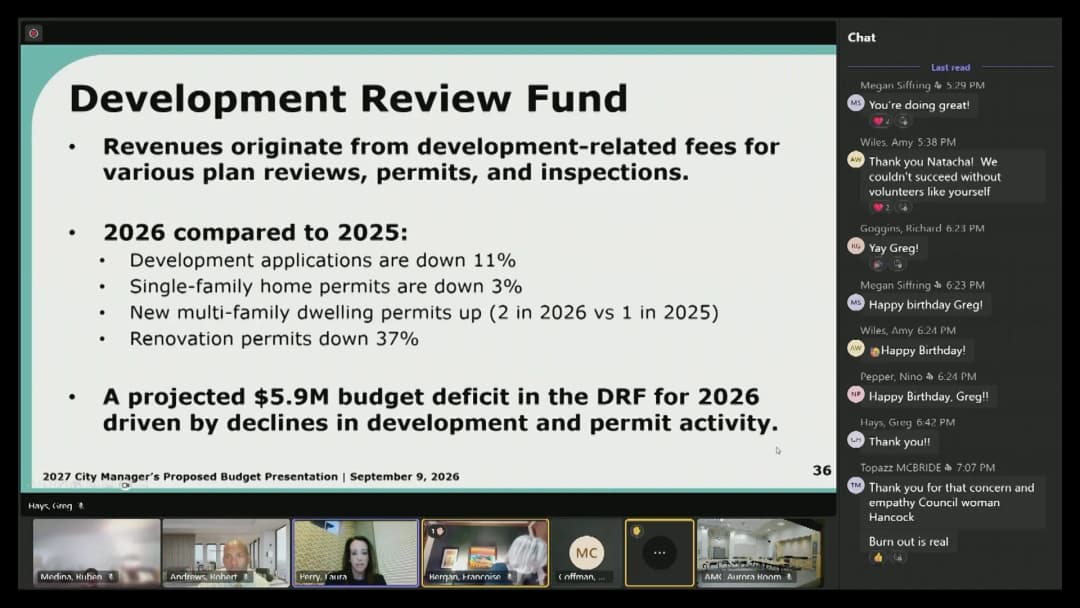
The Aurora City Council held a special study session on September 10, 2026, to receive presentations from three citizen advisory bodies and the city manager's proposed 2027 budget. The session was informational; no formal votes were taken. The raw transcript labels the meeting Wednesday, September 9, but the stated meeting date is September 10, 2026. Citizens Advisory Budget Committee (CABC) - Janet Marlowe, 2026 CABC chair, reported that the committee meets monthly, reviewed the proposed 2027 budget at a July 21-22 workshop, supports the proposed budget as presented, and previously provided a letter supporting Build Up Aurora. - Jim Mattson presented the PROS revenue-generation subcommittee report. It recommended continuing to outsource services, aligning fees with facility quality and inflation, using food trucks at city venues for vending, and pursuing naming rights and sponsorships through a contract with library and cultural services; PROS leadership expects naming-rights revenue to start in fiscal year 2028. - George Peck presented the library and arts subcommittee report, which reiterated the need for a multi-purpose arts and entertainment venue, recommended a dedicated arts/venues leadership position and a phased approach, and stated Aurora is an underserved market. The subcommittee expressed total support for Build Up Aurora. - Council discussion included support for outsourcing examples, a request for consistent food-truck fees across venues, interest in naming-rights partnerships, and a request for a big-picture look at PROS resource needs. City Manager Jason Bachelor said staff would provide food-truck arrangement details and respond to the requested analysis. Housing and Community Development (CHCD) HUD Budget - CHCD chair Natasha Dana and staff member Sarah Pulleum presented the proposed 2027 U.S. Department of Housing and Urban Development (HUD) budget totaling $5,010,955 across CDBG, HOME, and ESG funding. Proposed uses include affordable housing, home repair, public services, housing and financial counseling, homeownership, foreclosure prevention, homeless response and prevention, rapid rehousing, street outreach, emergency shelter, and supportive services. - Dana said residents closest to community challenges should help shape solutions and that CHCD is advisory, making funding recommendations rather than final decisions. - In response to Councilmember Hancock, staff said annual Consolidated Annual Performance Evaluation Report (CAPER) outcomes are filed with HUD, posted on the city website, and would be shared with council. Citizens Water Advisory Commission (CWAC) - Dick Easton, CWAC chair, said the commission unanimously supported the proposed 2027 water budget, rates, and fees after an August 5 presentation from Aurora Water staff. - The proposed increases include an overall water rate increase of 3.87%, varying from 0% for hydrant use to 14% for irrigation; residential rates up 3.5% in all four tiers; sewer and stormwater rates up 6.5%; fire protection rates unchanged. Water and stormwater development fees increase 5%; sewer connection fees do not increase. CWAC supports the growth-pays-for-growth principle, and about 80% of the water development fee supports future water resources. - The water fund summary included $276.8 million in planned revenues and $375.2 million in capital investment; the wastewater fund summary included $133.1 million in planned revenues and $163.1 million in planned expenditures. The five-year capital plan totals $2.37 billion for 2027-2031, with top priorities including Wild Horse Reservoir, Prairie Waters expansion, direct potable reuse, the Rampart delivery system, water rights/storage, treatment/transmission/distribution improvements, lead service line replacement, and SCADA/cybersecurity. - CWAC recommended maintaining Stage One drought restrictions until storage conditions improve, continuing investment in water reliability, removing barriers to drought-tolerant landscaping such as Tahoma 31, and finding sustainable funding for Aurora Water Cares. Marshall Brown said converting Kentucky bluegrass to Tahoma 31 uses 60-70% less water, and the city is working to simplify permits and rebates. City Manager's Proposed 2027 Budget - City Manager Jason Bachelor said the 2027 general fund faces about a $20 million shortfall, addressed through $10.2 million in expenditure cuts, $1.8 million in new revenue, and $7.3 million in available fund balances. The plan includes no layoffs, eliminates 9 vacant FTEs, freezes 8 additional FTEs, continues the 25% travel/training reduction, and uses five furlough days for non-24/7 employees, saving about $500,000 per day. - Budget Director Greg Hayes reported all-fund revenues of $1.8 billion, all-fund appropriations of $1.5 billion, and general fund revenues of $567.6 million. Sales taxes are 58% of general fund revenue; with use taxes, about two-thirds of general fund revenue comes from purchases. He said the recession forecast shifted from V-shaped to U-shaped, causing the 2027 shortfall, and projected a remaining 2028 shortfall of about $13.1 million. - Current reserves include $79.8 million in ending fund balance; the recession reserve is at about 54% after two years of use. July 2026 sales tax was up 2.6% compared with a 13.9% increase in July 2025, a better-than-budgeted month. - Citywide staffing is a net zero position add in the proposed budget; public safety remains over 50% of general fund appropriations. Public safety balancing includes moving some costs to the E911 fund, moving $1.7 million of police general fund costs to the designated revenue fund offset by photo radar, and transferring one FTE from police to Aurora Fire Rescue for a SWAT medic. - Municipal court, judicial, public defender, city attorney, civil service, and public safety accountability budgets were reviewed. Judge Day said the court is reducing from about $4.8 million to $4.2 million, roughly a 10% cut, by not filling three positions and closing a division while absorbing about 10,000 new vehicle-registration cases. Several council members, including Councilmember Hancock, objected or expressed concern that the cuts would harm court customer service and staff workload. - Laura Perry presented PROS, capital projects, and development review funds. Development applications are down 11%, single-family permits down 3%, renovation permits down 37%, and the development review fund projects a $5.9 million deficit. Balancing includes increasing the residential roof permit flat fee from $254 to $350, reducing contracted services, shifting $980,000 of staffing and drainage review costs to Aurora Water, and reallocating cross-trained staff. - Roberto Venegas reported the new animal shelter is under construction, on time and on budget, with opening expected in the first quarter of 2028. The Navigation Center serves 200-300 people nightly, with regional referral discussions underway. The marijuana tax revenue fund saw its first monthly increase in 58 months, but the 2027 budget assumes continued decline and absorbs the state share-back elimination. - Marshall Brown reported water enterprise capital spending is dominated by Wild Horse Reservoir, Prairie Waters/direct potable reuse, and treatment plant renewal. Water is proposing seven temporary-to-permanent FTE conversions at a net cost of $50,000, $22.5 million for SCADA/cybersecurity enhancements, and additional cybersecurity software funding. Key Outcomes - No formal council votes were taken during the study session. - CABC and CWAC expressed support for the proposed 2027 budgets; CHCD presented its HUD funding recommendations. - Staff committed to follow up on food-truck/vending arrangements, PROS resource needs, outside counsel spending, development review fee competitiveness, civil service cost breakdowns, CAPER reports, simplified Tahoma 31 and rebate processes, and a federal marijuana reclassification update. - Next steps: a public hearing on September 14, a Saturday budget workshop on October 3, written responses to council questions before the workshop, and budget adoption ordinances in late October or early November.
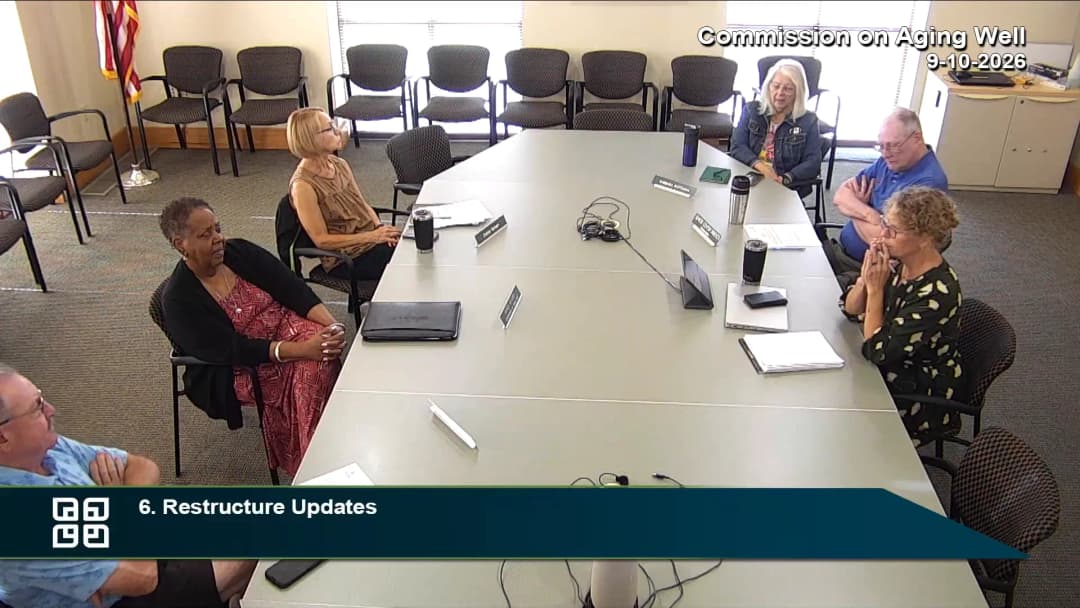
Members discussed the ongoing restructure of recreation roles and responsibilities, with Community Center and Recreation Coordinator Evelyn providing an overview of her duties and receiving questions from the Commission. Chad, the other recreation staff member, joined remotely on his vacation day. Consent Calendar - Minutes from the previous meeting were approved by general consent, with no deletions or additions proposed. Discussion Items - Role & Responsibilities Overview: Evelyn outlined her role as Community Center and Recreation Coordinator, explaining that she and Chad handle park shelter and community center room rentals, program coordination for youth sports and enrichment classes, and summer camp wrap-up. They also support outside organizations by providing space, administrative registration, and parent communication. - Marketing & Communications: Evelyn stated she handles marketing efforts including Facebook posts, email blasts, and infographics. - Ticket Sales: Chad added that the office sells Wisconsin Park and Rec discount tickets for attractions such as Mount Olympus, Noah's Ark, Milwaukee County Zoo, and Land of Natura, with roughly 800 tickets sold this past year. He noted that most customers buy two, four, or six tickets at a time. The office also sells Wisconsin State Trail Passes year-round. (Chairperson clarified this is a
The Fitchburg (Wisconsin) Tree Advisory Committee met on Thursday, September 10, 2026, from 4:06 p.m. to 4:50 p.m. Members approved the previous meeting minutes and the day's agenda, reviewed the public-facing memorial tree program materials, and heard a forestry department update covering fall planting projects, the city's 21% tree canopy report, a nearly completed woodlot management plan, and early tree care needs. Note: the transcript's spoken introduction repeatedly refers to the 'city of Pittsburgh,' while the program's promotional intro references Fitchburg and the discussion cites Wisconsin municipalities; this summary follows the supplied designation of Fitchburg, Wisconsin. Consent Calendar - Minutes from the previous meeting were approved by voice vote, all in favor, with no opposition. - The agenda for the September 10 meeting was approved unanimously. Public Comments & Testimony - No members of the public appeared for the non-agenda public comment period. Discussion Items: Memorial Tree Program - The committee reviewed the memorial tree program communication piece (graphic prepared by Miriam). Donors may choose the park but not the specific planting spot; city forestry staff select the location. Staff explained that park activities (concerts, festivals, athletics), underground stormwater and sanitary infrastructure, and wet spring conditions make staff selection necessary. Staff cited a current fall memorial tree in McKee Park where staff selected the location and sent a map to the donor. - Committee member Craig noted a typo in the second sentence of the 'How much does it cost' section (the transcript records 'this is the code'; the context indicates it should be 'this is the cost'). - Craig asked whether the document is backed by a formal policy. Staff responded that the document is the public communication piece and that a formal policy still needs to be drafted and moved through the city's policy framework with administration. - Craig also asked that the policy address early tree failure. Staff said memorial trees that die are typically replaced at no cost, and trees planted in spring/fall cycles are covered by nursery warranties. - The committee requested edits: change 'desired location' to 'selected location' (or 'preferred location') so donors understand staff make the final placement decision; remove the confusing phrase 'planted in your desired location' from the 'How does the program work' section; and state that after the donation is received, staff will plant the tree in the selected location. - The document is one of the action items from the city's urban forestry plan. The red lettering at the top was confirmed to be an internal OnBase packet annotation that will not appear in the public-facing version. Discussion Items: Forestry Department Report - Fall planting with Urban Tree Alliance will occur in the Belmar neighborhood using federal grant funding: approximately 60-something trees, including some in a park and many on terraces near multifamily housing. Staff described it as canopy renovation, though some locations may never have had trees before. - The city's other regular fall tree planting is scheduled for mid-October. - Staff participated in Youth Government Week, planting two trees on Research Park Drive. - Staff submitted a 'Million Trees' grant with a committee letter of support, for trees at Tigri Meadows, Terravesa, Softdale, and other parks. If awarded, as in past years, it would provide an extra $5,000 for volunteer tree planting. - The community canopy report from CarpC shows the city at 21% tree canopy for the entire city. Staff said Madison and Milton are also at 21% and other peer communities are lower (14-15%), adding that Fitchburg 'holds its own' despite limited forestry investment. The updated tree inventory is now visible in the report. - The city forestry budget is expected to be positive and will be released about a week after the meeting (around September 18, 2026). Staff offered to share the budget and the peer-community operations comparison at the next meeting. - Woodlot management plan: staff said it is nearly complete and should be on the October agenda. A proposed tour of the Holly Conservancy woodlot was discouraged because there are no maintained trails, heavy downed material (including black locust), and invasive species such as honeysuckle and buckthorn; no one has worked in that woodlot for about two years. A committee member suggested creating a trail; staff agreed a trail is needed but requires clearing and ideally the woodlot policy first. The plan references recreational opportunities but does not specifically call out a trail. - Budget proposal: staff confirmed they submitted a budget proposal to the mayor that includes an additional summer intern. The committee discussed extending the intern beyond 10 weeks or adding more hours; staff said there is year-round work (pruning, removals, and other tasks). - Tree protection ordinance: members asked about strengthening the recently approved ordinance. Staff said it is unclear what 'lever' could be used, noted that the Plan Commission (not DPW) approves development plans, and that tree surveys are already a required submittal. One member suggested creating non-binding guidelines to help developers and the Plan Commission use the tree survey data; another framed the goal as culture change so trees are treated as essential infrastructure. Staff said Fitchburg is a leader in tree preservation in Wisconsin, with only Madison doing better at protecting city trees, while acknowledging the city is still losing more trees than it preserves in some areas. Members agreed the committee needs a clear next goal; staff suggested an operations plan and mapped-out early tree care standards as the next frontier, possibly codified in policy. - Watering and early tree care: staff said they wish they could water more and have solutions planned for next year. The committee discussed news alerts, a pre-winter watering reminder, and flyers or door hangers for new trees. A member described a neighbor's recently planted terrace tree that died after looking dry; staff said it may be a replacement for an ash tree and likely under warranty. A member volunteered to research simple watering guidance, and staff noted an intern could draft materials. The committee also discussed sharing tree-protection-during-construction information through the architectural control committee. Key Outcomes - Approved the previous meeting minutes and the September 10, 2026 agenda by unanimous voice vote. - Directed staff to revise the memorial tree program communication piece (selected/preferred location wording, typo fix, removal of 'desired location' language) and to draft a formal memorial tree policy for the city's policy framework. - Forestry staff to present the nearly completed woodlot management plan at the October 8 meeting and to share the peer-community operations comparison and budget information. - The committee agreed to pursue early tree care outreach (watering guidance and a pre-winter reminder) and to consider non-binding guidelines on tree data use in development reviews as possible future work. - Next meeting: October 8, 2026, at 4:00 p.m., same location, with voting items expected. The meeting was adjourned at 4:50 p.m.
The Lee Planning Board held a meeting on September 10, 2026, to review and finalize a proposed Clean Energy Zoning Bylaw, required to comply with new state regulations taking effect October 1, 2026. The board discussed updates to solar, wind, and battery energy storage system regulations, and made numerous edits to the draft before moving it forward to the Select Board and Special Town Meeting. Consent Calendar - Approved the minutes of August 17, 2026, with no further discussion. - Correspondence regarding bylaw amendments from the town of Lenox was noted. Discussion Items - Clean Energy Bylaw Overview: Land Use staff (Brooke) explained that new state regulations (effective October 1, 2026) require all 351 municipalities to have a permitting process for clean energy systems: anaerobic digesters, wind turbines, solar energy systems, and battery energy storage systems (BESS). The state released model bylaws only two weeks prior, creating a tight timeline. The proposed bylaw combines existing solar and wind sections into a new Clean Energy Article, updates the use table to align with state capacity-based thresholds (megawatt-hours, not acreage), and adds a new BESS section based on the state model. - Solar Section Review: The board reviewed Peter's redlined version. They adjusted the use table to remove a defunct zoning district (BM) and added a column for projects over 25 MW that fall under state jurisdiction (Energy Facilities Siting Board, EFSB). The table uses "PRO" (prohibited) and "SP" (special permit) for different tiers and zones. The board also agreed to add language clarifying that the town may intervene as a party in EFSB proceedings. - Wind Section Review: Discussion focused on the definition of "fall zone." The board decided to keep the definition but link it to the additional setbacks in paragraph 9, rather than deleting it. They agreed to standardize the setback for multiple towers to 1.5 times tower height (instead of a quarter mile). Other minor wording changes were accepted, including corrections to typographical errors. - Battery Energy Storage Section Review: The board reviewed written comments from Tim. They agreed to many edits: clarifying that the consolidated permitting process does not exempt applicants from all requirements; retaining references to the Massachusetts Fire Code; adding language that fencing should, to the extent practicable, not interfere with wildlife movement (also to be added to the solar section); and striking some redundant text. The board also discussed the definition of aggregate energy capacity and decided to keep the state's definition. - Financial Surety: The board discussed requiring financial surety for decommissioning. They agreed to add language that failure to maintain a current surety constitutes a violation, and that the surety can be an insurance policy or performance bond. The Land Use Department (not office) will establish a tickler system to track expirations. - Procedural Changes: The board agreed to remove a requirement for a newspaper posting 14 days prior to a site visit, calling it unnecessary expense. They also reorganized sections to place application contents before special permit criteria for clarity. Key Outcomes - The board reached consensus on the draft with the discussed edits and directed staff to prepare a final version. - Staff (Brooke) and Peter will finalize the draft by Monday, September 14, for submission to the Select Board and inclusion in the Special Town Meeting warrant on October 1, 2026. - Specific changes: restore fall zone definition by reference; add wildlife-friendly fencing language to solar and BESS sections; remove duplicate newspaper posting requirement; add financial surety violation language; adjust use tables. - No formal vote was recorded on the bylaw itself; the board worked by consensus. - The meeting was adjourned by consensus.