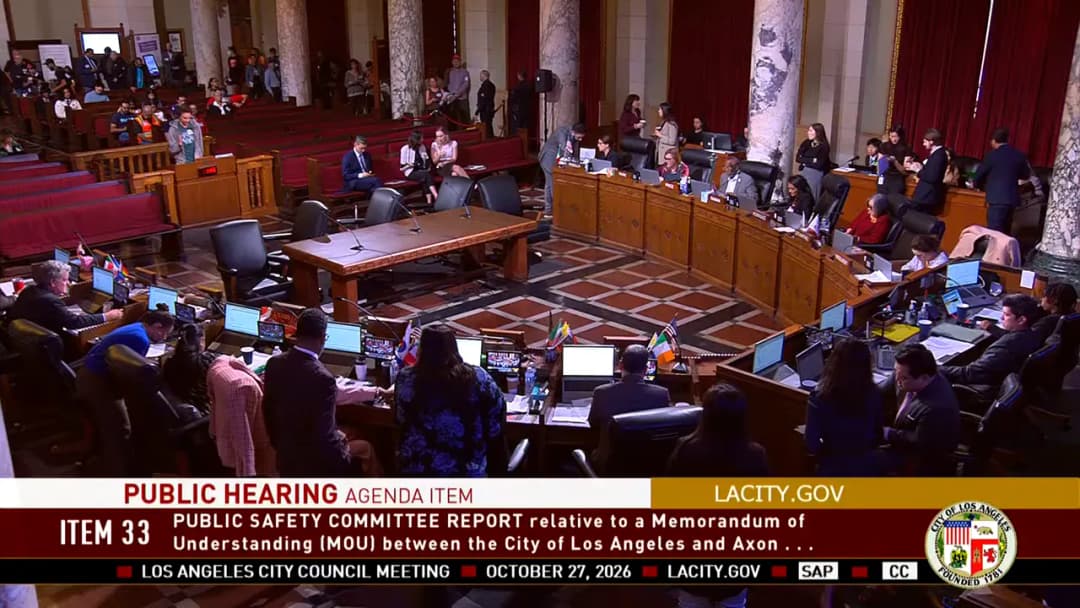
The Los Angeles City Council convened its regularly scheduled meeting on Tuesday, October 27, 2026. The meeting included routine approvals, a lengthy public comment period, and a high-profile vote on whether to veto the Police Commission's approval of an ALPR (automated license plate reader) contract with Axon Enterprise. After extensive debate, the veto failed, allowing the pilot program to proceed. Consent Calendar - Approved the minutes of the October 23, 2026 meeting (moved by Councilmember Hutt, seconded by Councilmember Hernandez). - Approved commendatory resolutions (moved by Councilmember Soto Martinez, seconded by Councilmember Nazarian). - Adopted items 1–4, 6–9, 13–14 by a 13–0 vote; items 16 and 19–32 by a 15–0 vote; and item 5 by a 15–0 vote. - Adopted items 11, 12, and 15 by a 12–3 vote; item 17 by an 11–4 vote; and item 18 as amended (18A) by a 15–0 vote. Public Comments & Testimony - A large majority of public speakers opposed item 33 (the Axon ALPR contract). Speakers represented organizations including the Clean Car Wash Workers Center, LA Sanctuary Coalition, Fair Games Coalition, California Immigrant Policy Center, Stop LAPD Spying Coalition, LA Forward, Black Lives Matter Grassroots LA, and the Harriet Tubman Center. They argued that Axon has ties to ICE (citing over $96 million in ICE contracts), that ALPRs enable mass surveillance, threaten privacy, and risk facilitating deportations. Many urged the Council to veto the contract and halt all ALPR programs. - Several speakers raised concerns about labor abuses on Executive Directive 1 (ED1) fast-tracked housing projects, including wage theft, unsafe conditions, and alleged child labor. Western States Regional Council of Carpenters representatives called for payroll audits, labor standards, and a freeze on permits for violators—specifically referencing item 22 (bond financing for The Flats on Sunset). - Other public comment topics included opposition to expanding 4118 zones (criminalizing homelessness), criticism of street banner funding, support for ending the U.S. blockade of Cuba, and demands for greater transparency in city spending. - Some speakers delivered personal testimonies about immigration enforcement fears, while others made disruptive remarks and were warned or removed from the chamber. Discussion Items - Item 10 (Councilmember Nazarian): Motion requesting LADOT to report on reconfiguring the Noho Dash shuttle to provide a direct, 7-day connection between North Hollywood Station and Hollywood Burbank Airport. Nazarian cited the airport's new $1.3 billion terminal, record 6.55 million passengers in 2024, and lack of direct transit. The motion passed 15–0. - Item 33 (Veto of Axon ALPR contract): Councilmember Soto Martinez moved to veto the Police Commission's approval of the Axon pilot program, arguing that independent audits, external data-sharing oversight, and stricter access limits must be in place before expansion. Councilmember Lee opposed the veto, proposing four safeguards (independent audit, access formula, documented searches, and commission review) while allowing the pilot to proceed. Councilmembers Hernandez, Price, Jurado, Padilla, Rodriguez, and Yaroslavsky supported the veto; Councilmembers Park, Blumenfield, Nazarian, and McOsker opposed it. Park cited public safety successes, while Blumenfield argued the pilot is a narrow test and not the right leverage point. Ultimately, the veto received 9 ayes—short of the 10 required—so it was disapproved, and the Axon pilot contract was allowed to move forward. Key Outcomes - Approved Nazarian's airport shuttle motion (15–0). - Approved items 11, 12, and 15 (12–3); item 17 (11–4); item 18 as amended (15–0). - Rejected the motion to veto the Axon ALPR contract: the first tally was 8 ayes / 7 noes, then a recount showed 9 ayes / 6 noes. A motion to reconsider passed 13–2, but on reconsideration the veto again failed 9–6. As a result, the contract was not vetoed and the pilot program will proceed, with the Council requesting additional guardrails from the Board of Police Commissioners.
The Public Meeting Index
The Public Meeting IndexThis summary covers the Board of Commissioners meeting highlighted by the Township Manager's draft preliminary 2027 operating and capital budget, several land-use approvals, adoption of a stormwater bond ordinance, introduction of data-center zoning regulations, and community grant awards. The agenda lists a 6:30 PM start and identifies the meeting date as Monday, October 26, 2026, while the transcript's call to order is at 7:00 PM and the supplied metadata states 2026-10-27; the summary uses the metadata date. Notice was also given of a prior executive session on legal and real estate issues. Consent Calendar - The board approved a motion to amend the consent agenda to add the Business Tax Settlement 2026-BPT-04, which was described as protected by the Taxpayer Bill of Rights and previously discussed in executive session. - The consent agenda was approved by voice vote, including: minutes from September 28, 2026 and October 12, 2026; the October 2026 Chief Monthly Report; September 16, 2026 Staff Traffic Committee minutes; HARB certificates of appropriateness 2026-26 through 2026-30 for properties at 421 St. Davids Road, 212 Poplar Avenue, 316 N. Wayne Avenue, 319 Louella Avenue, and 128 W. Wayne Avenue; Resolution 2026-125 authorizing a comprehensive separation agreement with Sergeant Anthony Radico; Resolution 2026-122 authorizing two 1.92TB SSD drives for $11,448.50; Resolution 2026-118 hiring Havertown Carpet Company for police department carpeting at $21,302 from the 2024 Facilities Bond; Resolution 2026-126 hiring Certa Pro Painters for $15,288.78 from the 2024 Facilities Bond; and the added Business Tax Settlement 2026-BPT-04. Budget Presentation: Draft Preliminary 2027 Operating and Capital Budget - Township Manager White presented the budget. He noted that Radnor Township receives about 12 cents of every real estate tax dollar, with the school district and county making up the rest, and that Act 511 taxes (realty transfer, mercantile, local services tax, and business privilege) are a major offset, roughly one-third of General Fund revenue. - 2026 trends: realty transfer tax was below expectations; mercantile tax surpassed $2 million for the first time in available records; business privilege tax spiked due to the recent settlement, but was about $9 million excluding that one-time transaction. Act 511 revenue has fluctuated by $3–4 million per year, creating budgeting volatility. - The General Fund is projected to end 2026 at roughly $863,000 net expense after expected November/December spending of about $3.8 million. - The 2027 draft includes no real estate tax increase; Act 511 tax rates are fixed/grandfathered and cannot be changed by the board. Wages include 3.5% collective bargaining increases at current headcount, with reduced overtime assumptions. Transfers are projected to grow from $4.8 million to $9.7 million, reflecting fire and rescue discussions, police and finance staffing requests, and work on a capital funding plan. - The township manager's recommended budget currently shows about $639 net expense. The sanitary sewer fund has no fee adjustment included, but a small increase from 13.46 to 14 was mentioned as a possible recommendation. The stormwater fee has not changed since 2014, but debt service is expected to rise beginning next year, likely requiring a fee adjustment. - Next budget dates: preliminary budget adoption planned for November 9; possible detailed work sessions in November; final adoption December 14. Staff may ask to move the November 23 meeting to November 30 because of Thanksgiving. - A commissioner praised the presentation and requested a line item showing returns from solar investments; the manager said the amounts would be small but tracked and reported. Board Liaison Reports - A commissioner reported attending the Radnor Fire Company annual banquet the previous weekend and thanked the firefighters for their service to the community. Public Comments & Testimony - During discussion of the data-center ordinance, Baron Gemmer of South Wayne Avenue questioned the proposed 200-foot setback from existing residential structures rather than lot lines, saying it could later limit construction on vacant neighboring lots. He also said data-center noise is a constant hum and that, based on hearing a party from more than 2,500 feet away, even 2,000 feet may not be enough. - Regarding community grants, Gemmer praised Commissioner Mulroney and the grant process, appreciated the diversity of recipients and causes, and asked whether future applications could be posted online for public comment. - At the end of the meeting, Gemmer urged residents to vote by November 3 and noted that the township has a secure drop box. Discussion Items - Connelly Center Preliminary Land Development Plan (Agenda Item 3.A): A representative of Villanova University/Connelly requested a continuance. The board granted an extension until November 30, 2026, for a decision. - Agnes Irwin School Waiver Request (Resolution 2026-121): The agenda identifies the property as 275 South Ithan Avenue, though the transcript at one point says South Eighth Avenue. Representatives for Agnes Irwin School requested and received approval of a waiver of land development for temporary modular classroom facilities associated with renovating the 1961 building. Two modular buildings will hold about 20–25 classrooms for one academic year: construction in June 2027, use from September through May, and removal in summer 2028. The buildings respect the 120-foot setback, impact about six parking spaces, and are located on an open field. The school stated that pickup/drop-off circulation would remain unchanged, and the waiver still requires grading and building permits. A commissioner cautioned the school to remove the modular buildings when finished. - Stormwater General Obligation Bond (Ordinance 2026-23): The board adopted the ordinance authorizing bank-qualified general obligation bonds not to exceed $10 million for stormwater capital improvements. Township staff reported the market was steady and calm, with a pre-pricing call held that day and another planned before the sale. - PAISBOA Lease (Ordinance 2026-22): The board adopted a three-year lease renewal for PAISBOA for approximately 1,500 square feet in the Radnor Township Municipal Building. Monthly rent is $4,059.17 in 2027 ($48,710 annually), $4,180.83 in 2028 ($50,170 annually), and $4,367 in 2029 ($51,680 annually), with the per-square-foot rate stated as $3,247 rising to $3,445 per foot. Staff called PAISBOA an excellent tenant and said the space is not currently needed by staff. - Data Center Zoning Amendment (Ordinance 2026-24 introduction): Staff presented a working draft to define data centers as a conditional use in the PLO (Planned Laboratory and Office) district, with a 38-foot height limit, setbacks, noise/vibration standards, post-construction testing, annual third-party compliance certifications, utility will-serve letters, emergency-response/cooling/environmental standards, and decommissioning plans with financial security. Staff clarified there are currently no pending data-center applications and the amendment is preemptive. The board voted to introduce the ordinance and move it forward; comments, including from the EAC and Board of Health, are to be sent to staff. A revised draft will go back to the Planning Commission. During discussion, one commissioner raised concerns about noise and setback distances, and another asked whether financial security would cover bankruptcy during construction or after the facility is built. - Stormwater Authority Appointments (Resolution 2026-120): The board appointed the first five Radnor Township Stormwater Authority members with one-, two-, three-, four-, and five-year terms as required by the Municipal Authorities Act; terms were assigned alphabetically. One commissioner restated opposition to the authority but voted for the qualified appointees. The solicitor will send explanatory information to appointees and file articles of incorporation. - Community Grant Awards (Resolution 2026-124): The board approved $100,000 in 2027 Radnor Township Community Grants. Eighteen applications requested just under $380,000. A grant subcommittee of Commissioners Mulroney, Myers, and Agnew, with staff, made the recommendations. Commissioner Mulroney thanked the committee and said she regretted not being able to fund all applicants; all 18 applicants will be notified of the outcome. Key Outcomes - Approved consent agenda, including the added Business Tax Settlement 2026-BPT-04. - Granted the Connelly Center continuance until November 30, 2026. - Approved the Agnes Irwin School land development waiver for temporary modular classrooms. - Adopted Ordinance 2026-23 authorizing up to $10 million in bank-qualified general obligation bonds for stormwater projects. - Adopted Ordinance 2026-22 approving the three-year PAISBOA lease renewal. - Introduced Ordinance 2026-24, the data-center zoning amendment, for further review and revision. - Appointed the first Radnor Township Stormwater Authority members. - Approved the $100,000 Community Grant awards. - Set budget next steps: preliminary budget adoption on November 9, detailed sessions, and final adoption on December 14. No further new or old business was discussed, and the meeting was adjourned by voice vote.
The Municipal Audit Committee convened on October 27, 2026 at 1:05 PM. The meeting focused on the presentation of an internal audit of the Community Development Block Grant (CDBG) program and a preliminary discussion on reforming the sunset review process for boards and commissions. One member of the public provided testimony regarding an advisory board experience. Public Comments & Testimony - A public commenter shared an experience with the Homelessness Lived Experience Advisory Board, which he said was abruptly disbanded after only a few months. He characterized it as a “political vehicle” and criticized the lack of shared power in advisory bodies. Discussion Items - CDBG Internal Audit Presentation: Dr. Kimberly Rash (Anchorage Health Department) presented a 27-slide review of the CDBG internal audit, which had not been performed in several years. The audit identified nine findings grouped into four themes: performance oversight, grant agreement/contract management, reporting and public participation, and documentation controls. Key issues included: lack of consistent tracking of goals and deliverables, expired agreements not amended in a timely manner, missing public hearing documentation for the 2024 annual action plan, and incomplete files for subrecipient agreements. Corrective actions already implemented include: use of Microsoft Planner for project tracking, standardized solicitation and agreement templates, pre-execution compliance checklists, and a formal monitoring escalation process (including notices to cure). Dr. Rash noted that 25 mobile home repairs had been completed against a goal of 40, and that 95 of 101 monthly subrecipient reports had non-compliance issues. Committee members asked detailed follow-up questions about enforcement actions, procurement compliance status (three or four grantees still out of compliance), and the status of individual corrective actions. - Pre-Sunset Reporting Requirements for Boards and Commissions (AL2026-132): Member Scout presented a proposal to change the approach to sunset audits, which currently require about 40–50 hours per audit from the internal audit team. Internal Auditor Alden Thurm expressed support, noting that annual self‑reports from commissions could provide more timely information than the current three-year retrospective audits. Suggestions were made to adjust language to reflect that most boards use meeting recordings rather than minutes, and to consider the role of the Mayor’s Office in managing boards. The item is scheduled for a future agenda with opportunity for co-sponsorship. Key Outcomes - The committee received and discussed the CDBG audit results. The Health Department confirmed that all corrective actions from the audit have been implemented, including new tracking tools, compliance checklists, and enforcement procedures. Follow-up on specific grantee compliance is ongoing, with a target of January 1, 2027 for full compliance. - The proposal to revise sunset reporting requirements was socialized; it will appear on a future agenda for formal consideration. Member Scout welcomed co-sponsors. - The meeting adjourned at 2:07 PM.
The meeting was called to order by the committee chair. Lynetta Haynes Turner, Chief of Staff to Cook County Board President Toni Preckwinkle, presented the fiscal year 2027 budget for offices under the president (OUP). The presentation highlighted the county's fiscal responsibility, equity investments, and the impact of programs supported by the OUP budget. Commissioners expressed appreciation for the administration's transparency and difficult decisions, and raised questions on specific programs and budget line items. Consent Calendar - No consent calendar items were noted in the transcript. Public Comments & Testimony - No public comments were made; only commissioners and county staff spoke. Discussion Items - Budget Overview: Lynetta Haynes Turner presented the FY2027 general fund budget for OUP as $338.8 million, an increase of $54.2 million driven by planned ARPA reserve allocations. Personnel services account for 65.5% of the budget. The budget supports 2,118 positions, a net decrease of 33 positions across all funds. - Community Safety: Gun homicides in Cook County have fallen by 50% since 2021. Through the Government Alliance for Safer Communities (GASC), over $350 million has been invested in community-based violence intervention, including $110 million from Cook County. An additional $20 million was committed for summer 2025 programming, and $5 million for domestic violence intervention via the Justice Advisory Council. - Housing & Homelessness: In FY2026, the Department of Planning and Development supported more than 350 units of affordable/supportive housing. A modular homes pilot is underway in Humboldt Park and Chicago Heights. The county provided over 400,000 nights of shelter and served 3,400 individuals. Cook County Legal Aid for Housing and Debt (CLAAD) has served 134,000 residents and provided 100,000 free legal consultations; evictions placed with the sheriff are down 10,000 (20%) compared to pre-pandemic levels. - Disaster Relief: The county passed a $15 million storm relief program providing up to $2,000 per household for residents affected by 2025 storms. Over $8 million was committed for debris removal; more than 450,000 cubic yards of debris were collected. Federal disaster assistance was denied despite surpassing FEMA thresholds; the county will appeal. - Build Up Cook: With $30.5 million in ARPA funding, dozens of infrastructure projects have been completed. A next phase in FY2027 will focus on capacity building and technical expertise for under-resourced communities. - Economic Development: The Access to Capital initiative awarded $2.4 million to five community financial institutions. The Small Business Source program continues with $6.5 million in FY2027, serving 106,000 small businesses (with 40-45% repeat clients). - Guaranteed Income Program: The $12.5 million allocation includes carryover. The next iteration will target specific constituencies, with a rollout scheduled for the first quarter of FY2027. Commissioner briefings will be held in the coming month. - Domestic Violence & CVI Grants: Commissioner Miller advocated for increased suburban funding. Avik Das, Director of Justice Advisory Council, stated that approximately 30% of post-ARPA grants will target suburban organizations, with specific tracks for domestic violence and community violence intervention. Commissioner Miller asked for a higher percentage, noting under-resourced south suburban courthouses. The $49.6 million CVI allocation includes $20 million in new funding for FY2027; existing grants are on two-year cycles. - Bureau of Asset Management (BAM): Commissioner Moore questioned reductions in facility maintenance from $6.4 million to $5.2 million (18% cut) and the creation of a new $450,000 emergency repair reserve. Jamie Myers explained that the cuts did not affect maintenance of good repair, and the reserve allows faster emergency response. Commissioner Moore also noted increased spending on engineering consultants (from $380,000 to $445,000) and overtime (from $2.1 million to $2.5 million, a 21.4% increase). He expressed concern about reliance on outside consultants (three firms: JLL, Ardmore Roderick, STV, with about 20-25 consultants each) versus hiring permanent trades staff. Chief of Staff Turner stated the administration stands behind BAM's budget decisions and will provide detailed follow-up. Key Outcomes - No formal votes were taken during the presentation; it was a budget hearing for discussion and Q&A. - Commissioners expected follow-up information on BAM line items, including specific cuts, consulting contracts, overtime causes, and project director caseloads. - The storm relief program will launch in December 2026; commissioner briefings will be held prior. - The guaranteed income program will begin in the first quarter of FY2027; commissioner briefings are scheduled. - The video presentation was unable to play; Chief of Staff noted it would be sent to commissioners later. - The meeting concluded with plans for subsequent hearings (Chief Judge and Assessor).
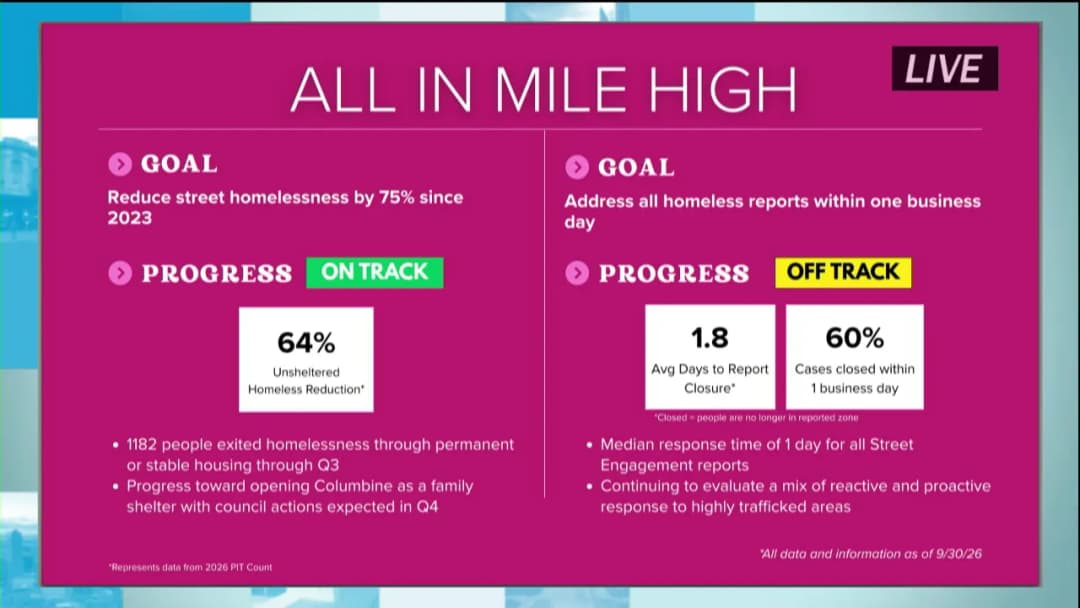
On 2026-10-27 at 16:30 UTC, the Denver mayor and City Council held their weekly joint meeting. The mayor's office presented the regular quarterly update on the six citywide goals, council members made community announcements, and the body moved into executive session to discuss pending litigation and legal advice. No agenda or minutes were available; this summary is based on the raw transcript. Announcements - A District 7 council member reminded viewers of the Constitution Buck Club on October 28 at 5 p.m. at Habitat for Humanity Headquarters in District 7, and constituent hours on Thursday, October 29, from 4 to 6 p.m. at Athmar Park Branch Library. - The City Council president announced, on behalf of Councilwoman Lewis in District 8, the 43rd annual Hiawatha Davis Jr. Senior Luncheon on Saturday, December 19, from 11 a.m. to 1 p.m. at the DoubleTree Hotel on Quebec. Seniors were asked to RSVP to the District 8 office at 720-337-8888 or by emailing District 8 at DenverGov.org. Discussion Items - Quarterly Citywide Goals Update: The mayor's office reviewed progress on six goals, noting that details are available on the public dashboard. - Vibrant: Goal to fill 3 million square feet of downtown office space; about 2.2 million square feet had been filled so far, with 877,000 square feet of leases renewed. The presenter described this as about 2 million square feet newly filled and about 1 million square feet retained. Catalytic projects include bond work, Denver Summit Stadium (groundbreaking October 1), Burnham Yard small-area planning, Ball Arena signage changes, and a $50 million Sloane's Lake preservation effort. - Affordable: Goals were to deliver 2,500 new affordable units and permit 5,000 more units. The city is behind on the 2,500-unit goal after losing about 400 units through federal and state voucher cuts, but has already exceeded the 5,000-unit permitting goal by more than 300 units, with a strong pipeline of deed-restricted affordable units. Rents are stabilizing or dropping by 10 to 24 percent depending on the part of the city and income level. - Safe: After a historically low crime year, high-risk-area shooting totals increased 75% because shootings went from four to seven across the sites (three additional shootings). The administration highlighted longer-term declines: homicide down more than 30%, firearm homicide down almost 42%, and non-fatal shootings down 50% over three years, with most cities seeing larger rebounds. - All In My Mile High: The goal is to reduce street homelessness by 75%; the mid-year point-in-time count showed a 64% reduction, with the next point-in-time count measuring year-end progress. The goal of responding within one day is off track at 1.8 days, driven mainly by people living in vehicles; the administration does not want to rush decisions to push someone out of a vehicle. - Climate Resilient: On track for 5,000 clean energy systems and 50 acres of green infrastructure. Projects include Carpio Sangrinetti Park, Lowell and Evans, 51st and Steel, Montbello, Harvard Gulch, and Rosedale, with Q4 completions. - Child Friendly: Both goals are on track. The Haynes Gary Task Force has held six listening events and collected almost 1,000 responses for the child care for all plan; a spring proposal will outline an ideal 0-to-5 program. The city is past 62,000 of the 70,000 goal for young people in out-of-school time and summer programming. - Executive Session Motion: After an initial procedural misstep, a motion was made and seconded to enter executive session pursuant to DRMC 234A, sections 3, 6, and 7, for discussion of settlement of pending litigation and related legal advice. The voice vote was all in favor with no opposition. Key Outcomes - Quarterly citywide goals update was presented; no formal action was taken. - Council approved moving into executive session for pending litigation and legal advice. - Upcoming community events were announced, including District 7 events and the District 8 senior luncheon.
The Mobile City Council held its regular meeting on Tuesday, October 27, 2026, at 10:00 a.m. (delayed due to an extended pre-council session). The meeting was dominated by discussion of a $14.7 million fraudulent wire transfer discovered in mid-October, with the mayor and finance director providing a detailed timeline and the council fielding public questions and criticism. Several routine items and public hearings were also handled. Proclamation - Councilwoman Ingram presented a proclamation declaring October 25–31, 2026, as National Lead Poisoning Prevention Week. Anthony Whitner, lead poisoning prevention outreach educator for Mobile County, accepted and noted that the RSA building would be lit purple in observance. Mayor's Report & Discussion of Fraudulent Transaction - Mayor Chiracotis reported on the Citizens Academy cohort 10 graduation, the Carnival cruise season restart, and the "Gateway from Graffiti to Gallery" exhibit at the Mobile Museum of Art. - The mayor then addressed the $14.7 million fraudulent wire transfer sent on October 2, 2026, intended for arena contractor B.L. Herbert. He stated the city is cooperating with the FBI, Secret Service, and a forensic team. Finance Director Logan Gwen provided a timeline: the fraud began in May with a fake vendor inquiry, included forged documents and invoices, and the transaction was processed on October 2. The first internal questions arose on October 7, but Hurricane Helene and a bank holiday delayed discovery until October 16. Gwen noted that the city had terminated one employee and that safeguards were being strengthened. - Council President Small announced a resolution (03-1170) to create an ad hoc advisory committee of financial experts to review city finance policies. The resolution is expected to be voted on next week. - Councilman Woods stated the finance committee will hold public meetings on November 3 and November 17 (12:30–1:00 p.m.) to gather additional information. - Council members Small, Penn, Gregory, and others expressed support for transparency and pledged to submit questions to the administration. Councilwoman Gregory clarified that the $15 million arena owner's contingency is being used to cover the loss, but the 2027 budget remains intact. - The council attorney explained that routine billing invoices, including the fraudulent one, do not require council approval; only contracts and budget amendments come before the council. Public Comments & Testimony - Matthew Miller (District 6): Called the loss a "catastrophic breakdown" and urged the council to use its independent investigatory powers under the Zogby Act (Code of Alabama §11-44C-87). He noted $14.7 million could have bought 230 new Chevy Tahoes. He asked for public hearings, not closed-door meetings. - Nina Darch: Questioned why no special emergency meeting was called, asked for a public release of the invoice, and asked whether similar fraud had occurred before. She requested an independent investigation by the council, noting that acknowledging the problem is not the same as accountability. - Estella Trotter: Asserted that the city had ignored earlier reports of fraud (e.g., public housing wire fraud, $70,000 theft), and that many officials should resign. She claimed some council members benefit from gentrification. - Reggie Hill: Referenced his 2024 lawsuit over the Mobile Civic Center demolition, alleging corruption and urging FBI Special Agent Flowers to investigate that case. He criticized the use of executive sessions. - Sabrina Mass: Expressed frustration with the council for not listening to citizens in the past (e.g., the Chief Barber contract). She apologized to Finance Director Gwen for earlier social media comments, but blamed previous councils for failing to implement safeguards. Consent Calendar - Approved minutes from previous meeting. - Approved waivers of noise ordinance for four events (October 31 at Elmyra St., April 3 at Mardi Gras Park, November 14 at Venesia Rd., December 5 at Dauphin Island Pkwy.). - Approved purchase orders and contracts: ID software for cruise terminal biometric readers (08-1154), ESRI software renewal (08-1156), Trillion Holdings employee training subscription (08-1160), and Osprey Initiative litter-free education programming (21-1162). - Approved resolutions honoring Mrs. Leon Foster Street, weed removal assessments, and determinations that several organizations serve a public purpose. - Laid over: Resolution 21-1141 (professional services contract with Bloom Group) for one week. - Laid over: Several resolutions calling for public hearings on Tax Increment Financing (TIF) districts for District 3, 5, and 7, scheduled for November 17, 2026. - Laid over: Ordinance 64-038 (rezoning 255 Church Street to T6) until December 8, 2026, with Councilman Penn indicating he will propose a map amendment to T6 with a 15-story height restriction. - Held public hearings for sedan service certificate and vacation of a public alleyway (no speakers, hearings closed). - Referred application of St. Ignatius Parish for cemetery creation to Mobile County Board of Health. Key Outcomes - Fraud response: The administration continues cooperating with FBI, Secret Service, and forensic auditors. The council will hold public finance committee meetings on November 3 and 17, 2026, to gather further information. An ad hoc advisory committee resolution will be voted on next week (November 3). - Budget impact: The 2027 budget is unaffected; the $15 million arena owner's contingency is being used to cover the loss, potentially reducing future project funds. - Transparency: Council members pledged to share answers with the public via newsletters and public meetings. The pre-council meeting (9:00 a.m. Tuesdays) is open to all. - Routine approvals: Multiple purchase orders, contracts, and resolutions passed. Rezoning and TIF matters held over for further study. - Community announcements: Council members highlighted Safe Passage program, C251 Citizens Academy, and upcoming events including a senior center fall market and road closures on McGregor Avenue (Oct 28 – Nov 11).
The Fort Worth City Council held a work session on October 27, 2026, to receive briefings and discuss a wide range of topics, including organizational updates, public safety initiatives, infrastructure coordination, and economic development proposals. Organizational Updates & Recognitions - United Way Campaign: Assistant City Manager Diana Giordano announced the annual Spectacular fundraising event on October 29th at City Hall for United Way of Tarrant County. - Area Arena: Jay Choppa announced the renaming of Dickie's Arena to Area Arena, highlighting the city's partnership with Area. - Neighbor of the Year: Julie Orbah introduced AJ Jackson as the Neighbor of the Year. A video documented his work forming the Riverwalk Residences Neighborhood Association. Councilman Martinez praised his efforts. - Floodplain Administrator of the Year: Jessica McGagrin recognized Lisa Biggs for being named the 2026 Texas Floodplain Administrator of the Year by the Texas Flood Plain Association. Biggs was praised for leading initiatives that improved the city's Community Rating System score from Class 8 to Class 7. - America Recycles Day Proclamation: The Mayor proclaimed November 15th as America Recycles Day, marking the 29th anniversary. The city celebrated the first anniversary of the Waste Management Recovery Facility on October 28th. - Parks & Rec Six-Pack Challenge: Teresa Thomason announced the Parks and Recreation Department won the DFW Directors Association Six-Pack Challenge trophy, breaking Grapevine's seven-year streak. Police Department Updates - Command Staff Appointments: Chief Eddie Garcia outlined appointments including Executive Assistant Chief Dave Carbal and several new Assistant and Deputy Chiefs. He discussed his strategy for developing a diverse pool of younger officers through promotional testing and special operations assignments. - Patrol Corporal Positions: Chief Garcia introduced a new initiative creating 30 patrol corporal positions, allowing officers to advance while remaining in patrol. Promotions will be based on civil service tests. - Bargaining Agent Overview: Councilmember Neville expressed concern that the voices of the Black POA and NLEO are not being fully heard. Chief Garcia stated that while multiple bargaining units are inefficient, he maintains open communication. City Attorney Leanne clarified that the POA is the sole bargaining unit under Chapter 143 of the Texas Local Government Code, established by voter petition, and changing this would require a new election. Health, Safety & Code Compliance - Cardiac Emergency Response Teams: Dr. Jeff Jarvis and Fire Chief James Horton presented the Pulse Point app and a new Cardiac Emergency Response Plan (CERP) recognition program for businesses. Pulse Point had already generated a save. Councilmember Flores asked about multilingual options. Councilmember Hall praised the initiative. - Squatters and Vacant Buildings: Brian Doherty from Code Compliance outlined the civil eviction process coordinated with the constable's office. He noted the Building Standards Commission is seeing an increase in related cases. Infrastructure, Transportation & Public Works - Trinity Metro Street Funding: Kelly Porter presented on historical contributions from Trinity Metro. Councilmembers Hill, Larsworth, and Flores stressed the need for Trinity Metro to resume contributions for street maintenance, particularly on heavily used bus routes like the Stockyards and Campbell Boulevard. - TPW and Water Coordination: Councilman Beck highlighted the repaving and immediate digging up of West 7th Street. Water Director Chris announced a process change to check with Transportation and Public Works (TPW) before hiring a consultant to avoid such overlaps. Both departments stressed existing coordination. - Residential Speed Limit Reduction: Chelsea St. Louis presented options for reducing limits to 25 mph. State law requires engineering studies. Councilmember Larsworth pushed for a blanket reduction without per-street studies. Staff noted enforcement and legal challenges but are working on more efficient studies. - Street Lane Closures by Utilities: Councilman Jameson criticized third-party utility contractors for failing to notify residents. TPW acknowledged resource constraints and detailed a forthcoming Right-of-Way Management Ordinance to mandate stronger notification requirements. Legal, Finance & Administration - Attorney's Fees: Leanne from the City Attorney's office reported that specialized legal services cost the city approximately $4.1 million over six years, a figure she described as low for the city's size. - Open Space & Parks Acquisitions: Allison Docker reported on acquisitions since 2020 and $25M from the 2026 Bond for open space. - SBA Small Business Size Standards: Ori Fernandez presented on proposed federal rule changes expanding the small business definition. Council voiced support for keeping current SBA definitions. Staff will prepare local definitions mirroring current federal standards if the rules change. Formal Presentations - Comprehensive Plan Update: Jay Rankins from MIG presented the policy framework (five vision elements), place types (Live, Play, Work), and mapping progress. Community priorities included walkability, transit, and green space. Adoption is targeted for April 2027. - Economic Development Agreement (Beacon Modular): Brianna Brown presented an incentive for Beacon Modular. The company is investing $30M and creating 600 jobs at an average wage of $91,000 in District 10. The city is offering a $500,000 grant over five years (max $100k/year). The vote is scheduled for November 10, 2026. - Neighborhood Improvement Program (NIP) Update: Casey Thomas provided an update on program closeouts. Wedgewood East was announced as the 2027 NIP area, scoring 85 out of 100. The neighborhood spans Districts 6 and 9. Key Outcomes & Next Steps - Decisions & Selections: Wedgewood East selected for the 2027 NIP. AJ Jackson and Lisa Biggs were recognized. Proclamation for America Recycles Day. - Future Votes: Beacon Modular EDA scheduled for council vote on November 10, 2026. - Directives: Legal staff directed to explore representation for BPOA/NLEO. Staff directed to prepare local SBA definitions, pursue efficient speed limit studies, and improve notification regarding street closures. - Future IRs Requested: Community center inventory, early voting locations, shopping center redevelopment incentives, flock cameras update, and e-bikes.
The South Fulton City Council held a work session on October 27, 2026, at 4:00 PM at City Hall. The meeting included the introduction of new employees and a presentation on the new "Access South Fulton" permitting platform. The council discussed the platform's features, implementation timeline, and public education strategy. No votes were taken on action items. New Employee Introductions - City Manager Sharon D. Subadan introduced new Police Chief Chrissy Lattimore and Artigas Newell, Deputy Director of Community Development and Regulatory Affairs (CDRA). Both were welcomed by the council. Presentation: Access South Fulton – Civic Access Platform - Reginald McClendon, Managing Director of CDRA, and Carmen Davis, Assistant City Manager, presented the new platform aimed at streamlining permits, business licensing, planning, and code enforcement. The system will integrate with finance, provide a searchable public database, and comply with Georgia Senate Bill 447, which requires real-time, publicly accessible permit tracking by end of 2027. The platform is expected to go live in the first quarter of 2027, preceded by a 1-2 week blackout period for data migration. A public education campaign will launch in November 2026, including a dedicated webpage, email communications to approximately 5,200 existing accounts, social media, webinars, and a concierge service for active permit holders. Focus groups with stakeholders will be used to gather feedback. Council Discussion and Questions - Councilwoman Pritchett asked about the cost of the public education campaign (no budget allocated; will use existing resources), the use of mailers and text messaging (explored but costly; mailers are being sent to business license holders), and communication with homeowner associations (HOAs). Staff noted that a public information campaign about permit requirements is being developed for early 2027. - Councilwoman Bell requested expiration reminders and a clear step-by-step process for applicants. Staff confirmed that expiration alerts are being considered and that focus groups will help refine the user experience. - Councilwoman Rowell asked about dashboard reporting for council and the public. Staff indicated that applicants will have a personal dashboard, but a public citywide dashboard is not currently planned. However, CDRA will work on reporting processes for council in 2027. - Councilman Sebastian confirmed that the public will be able to search all permits without a password, satisfying the state law. Key Outcomes - No formal votes were taken. - The council received the presentation and provided feedback. - The meeting adjourned at 4:43 PM under unanimous consent.
The Cook County Board Finance Committee met on October 27, 2026, to receive the FY2027 executive budget recommendation from the Bureau of Finance. No agenda or minutes were provided with the transcript. Staff presented a balanced budget plan for a $550.7 million preliminary gap using one-time measures, targeted vacancy reductions, and expense savings without tax increases or layoffs, and commissioners then asked questions and offered comments. Discussion Items - Opening presentation: CFO Angela described a historically large $550 million preliminary gap, said the budget was balanced without tax increases or layoffs, and credited intentional reserve use, smart investing, department reductions, and stricter vacancy management. She thanked Bureau of Finance staff. - Historical and economic context: Deputy CFO Dean noted pension reform, a $1.36 billion reduction in DAP principal, six credit-rating upgrades in five years, full spending of ARPA funds, and over 70 percent of ARPA funds committed to community programs. More than 60 percent of general fund revenues are economically sensitive; forecasters project real GDP growth just above 2 percent with elevated inflation. Aggregate revenues are projected to grow about 1 percent annually after 2028, while expenses grow about 2 percent, worsening projected deficits. - Fiscal pressures: The road builders litigation restricts about $258 million in transportation-related taxes annually, and HR1 federal Medicaid changes beginning October 2026 are expected to reduce enrollment, increase the uninsured population, and raise uncompensated care. Without action, staff projected the unassigned fund balance would fall below the county floor in 2028 and turn negative by 2029. - FY2027 totals: The proposed budget is $9.69 billion, a 4.2 percent decrease from FY2026. The preliminary gap was $336 million in the general fund and $214.7 million in the health enterprise fund, totaling $550.7 million. The budget is balanced without tax increases or layoffs. Health care and public safety are about 72 percent of operating costs. The county will contribute $629.9 million to pensions, with the funded ratio projected at 73.3 percent by 2030. - Budget growth and staffing: The total budget grew 100.8 percent over ten years, a 7.2 percent compound annual growth rate, with underlying core growth about 4.5 percent. General fund headcount is down 478 since 2017. The FY2027 plan reduces general fund positions by 50.7 FTEs through vacancies and long-term leave positions only, with no layoffs; health enterprise staffing stays flat at 7,761 FTEs. - Gap context: The county faced a $487 million deficit in 2011; the 2027 preliminary gap is about 7 percent of the combined general fund and health enterprise fund budget, compared with almost 21 percent in 2011. - General fund gap closure: Staff identified $46.3 million in payroll and overtime reductions and $34.7 million in non-personnel reductions, about $76 million total. Sales tax was reforecast $35 million higher, and other fees and taxes were reforecast higher than June projections. One-time measures included $88 million in ARPA interest and $61.2 million from the ARPA sustainability reserve. The transcript gives conflicting figures for the pension stabilization fund: the CFO earlier mentioned an $18 million transfer, while the gap-closure summary listed $80 million from that fund. - General fund detail: The general fund budget is $2.75 billion. Sales tax is the largest revenue source at $1.55 billion, or 56.4 percent. Salaries, wages, fringe benefits, and overtime are 66 percent of the general fund budget; pension contributions add 13.7 percent, making nearly 80 percent personnel-related. State's attorney and chief judge FTE increases were described as internal shifts from terminated grants or externally supported positions, not new positions. Requested positions were not fully funded in the state's attorney's office, public defender's office, veteran assistance commission, and inspector general. - Health enterprise fund: The FY2027 health fund budget is $4.7 billion, with CountyCare about 64 percent of funding. Per-member-per-month revenue declines by nearly $400 million, offset by patient service revenue, directed payments, supplemental funding, and a $40 million increase in the county property tax allocation, bringing total property tax support to $208 million. CountyCare claims are about $2.8 billion, or 58 percent of expenses; salaries and wages are $876 million. CCH continues a multi-year cost-cutting strategy with more than $300 million in cumulative savings, assumes a $100 million increase in charity or uncompensated care, and reduces reliance on contract labor. - Special purpose funds: The county administers about 44 special purpose funds. The equity fund has about $50 million in unallocated reserve and proposes about $69 million in FY2027 allocations, including $3 million for the Stronger Together behavioral health grant program and increased community violence intervention investment, with no new revenue added. The opioid fund has collected about $45 million in settlements and plans about $11.5 million in FY2027 for sheriff overdose prevention, CCH public health overdose prevention, a flexible housing pool, and opioid treatment and harm reduction grants. A new modular home special purpose fund will be funded by program income. Commissioner Questions and Comments - Chairman Daly asked about $9.6 million in additional city TIF funding. The CFO said the amount is not yet declared or known, will be one-time money, will not be used to add FTEs, and the President wants to use it to replenish funds used to stopgap the FY2027 budget. - The Vice Chair praised the budget as a moral document and said the gap was closed without putting the burden on Cook County residents. - Commissioner Brut asked about the expected increase in uncompensated care. The CFO said the budget assumes $100 million in additional uncompensated care due to HR1, with more detail expected from Cook County Health on Wednesday. Commissioner Brut urged other hospital systems to step up and not shift uninsured patients to the county. - Commissioner Miller asked about equity fund community violence intervention spending. Kanako explained the FY2027 figure is higher because of $20 million in new commitment plus anticipated carryover; FY2028-29 figures assume the FY2027 budget is expended and a continued $20 million commitment. - Commissioner Aguilar asked about pending state reimbursements. The CFO said reimbursements are largely PMPM contributions, AOIC reimbursements, and grants; none are significantly behind schedule and they are included in the budget. - Commissioner Trevor asked for the FY2026 uncompensated care comparison; the CFO did not have it available and said it would be provided before Cook County Health appears. Trevor also asked about reserve drawdowns: the pension stabilization use was reported as 9 percent of that fund, and the ARPA sustainability reserve use was over half of the $159 million fund. - Commissioner Scott asked what would happen to road builders funds if litigation is unfavorable; staff deferred the question to county counsel. - Commissioner Fask expressed concern that the public defender's office is losing two FTEs, calling it the lowest-funded criminal justice partner with high caseloads, and said larger offices should be asked to do more with less. Kanako clarified the two-position reduction was an agreed arrangement involving the public defender's office and human resources, though the office had hoped for more positions in its original request. Key Outcomes - No formal vote was recorded in the transcribed portion of the Finance Committee session. - The Bureau of Finance completed its FY2027 budget presentation, stating that the general fund and health enterprise fund are balanced without tax increases or layoffs. - Staff committed to provide additional data on 2026 uncompensated care before the Cook County Health presentation on Wednesday. - Questions about road builders litigation were deferred to county counsel, and the county is awaiting the city's final decision on additional TIF funding. - Committee members generally praised the finance team and said further budget review would continue in the coming days.
The Colorado Springs City Council met in regular session on Tuesday, October 27, 2026, beginning at 9:00 a.m. in Council Chambers at City Hall, 107 N. Nevada Avenue. All nine council members were present. The meeting included consent calendar approvals, community recognitions, a budget-related furlough appropriation, the Banning Lewis Ranch Metro District No. 5 separation, the Meadows Park Community Center disposal, a public hearing on the Lowell Commons rezoning/land use plan modification, and the one-hour citizen discussion period. Consent Calendar - The consent calendar was approved as a whole on a motion by Councilmember Risley, seconded by Councilmember Casey. No items were pulled. - Second-reading items included: Ordinance 26-57 (rezoning 23.37 acres at 0 East Platte Avenue near Wooten Road to Light Industrial); Ordinance 26-59 (rezoning 3.8 acres at 1907 South Murray Boulevard to Mixed-Use Neighborhood-Scale); Ordinance 26-60 (rezoning 4.88 acres near Tamlin Road and North Marksheffel Road to Public Facilities); and Ordinance 26-62 (vacating about 2.42 acres of Kettle Creek Road right-of-way at 2060 Old Ranch Road). - First-presentation consent items included the September 17 and October 13 meeting minutes, the 2027 Pikes Peak Regional Building Department budget, a YMCA ground lease renewal resolution, 2027 operating plan and budget resolutions for multiple Business Improvement Districts, City Clerk general business license fees, and land use plan establishment items for Wagner Equipment and Creekbend Subdivision. - A councilmember thanked a citizen who emailed about small errors in the meeting minutes; the City Clerk corrected them and redistributed the minutes. Recognitions and Proclamations - Community Recognition - CJ Moore: Council President Lynette Crow-Iverson honored longtime volunteer CJ Moore with a proclamation recognizing her time, talent, and treasure. Several speakers, including Wendell, Barbara Winter, and councilmembers, praised Moore's service on numerous boards and her community leadership. Moore thanked the Council and said Colorado Springs is her home. - Police Appreciation Month: Councilmember Donaldson sponsored a resolution recognizing October 2026 as Police Appreciation Month. Tim Lee spoke about his 'See a Cop, Thank a Cop' billboard program; Chief Vasquez thanked the Council and community for supporting officers. The resolution passed 9-0. - Veterans Small Business Week and Veterans Week: Councilmember Rainey sponsored a resolution recognizing November 9-13, 2026 as National Veterans Small Business Week and November 1-12 as Veterans Week. Speakers highlighted veteran-owned business support, the November 7 Veterans Day Parade, and Colorado Springs being named the number one city to start a small business. The resolution passed 9-0. - Fire Board of Appeals Appointment: Council approved an appointment to the Fire Board of Appeals. Outgoing chair Mike Riggs was recognized for roughly six years of service. Mayor's Business / Administration Report - The administration reported that Colorado Springs welcomed the Colorado Stampede; the Colorado Springs Airport was named the eighth-best small airport in the U.S. by USA Today; and the city received the 2026 Department of the Air Force Community Partnerships Award for the stormwater intergovernmental agreement with the Air Force Academy. The administration also promoted the Veterans Day Parade and announced the completion celebration for the 2C paving season on October 28 at Stanton Street and Cragmore Road. Unfinished Business - Ordinance 26-61 - November 25, 2026 Furlough Day Elimination: Council approved a supplemental appropriation to multiple funds to eliminate the scheduled November 25, 2026 furlough day. Councilmember Risley voted no, explaining that he appreciated staff but did not believe a budget amendment was necessary; he noted one small department indicated it could cover the roughly $300,000 cost from its fund balance. The motion passed 8-1. New Business: Banning Lewis Ranch Metropolitan District No. 5 - Council considered two linked resolutions: Resolution 10A amending the consolidated service plan for Banning Lewis Ranch Metropolitan Districts Nos. 1-4 and 7, and Resolution 10B approving a separate service plan for Banning Lewis Ranch Metropolitan District No. 5. - Staff explained that Metro District No. 5 is a gated, age-restricted 55+ community with about 585 homes on approximately 129 acres. The agenda lists the service area as approximately 159 acres, while the staff presentation said 129 acres. The district is residential only, has private roads, and would be capped at roughly $10 million in already issued debt under the proposed plan. Maximum mill levies would convert to the 2022 model service plan levels. A bond opinion letter stated the separation would not adversely affect either district. - Councilmembers praised the district's thorough process. Resolution 10A passed 9-0. Resolution 10B passed 9-0. New Business: Meadows Park Community Center Disposal - Staff reported that the updated resolution authorizes disposal of the former Meadows Park Community Center through the community benefit process, with proceeds benefiting the Stratton Meadows neighborhood and community input on their use. Staff said Harrison School District 2's superintendent had updated her earlier concerns and was supportive. A community meeting drew about 40-50 attendees, and proposed buyer John Rogers of CRE Holdings answered questions. - Public comment: Zuri Horwitz opposed the sale, calling it a 'fire sale' of a premium property, criticizing the lack of real public comment, and saying no community benefit agreement guarantees services. She argued the $775,000 sale price and for-profit child care would not serve the neighborhood and that the city was investing in police instead of the community center. - Council positions: Councilmember Williams said three respondents submitted RFPs and CRE Holdings was selected as the best partner; he noted the neighborhood solutions team would remain engaged. Councilmember Henjam said the city faces a $300 million park capital backlog and limited taxpayer willingness to fund community centers, but the proceeds and deed restriction would benefit the neighborhood. Councilmember Lineweber cited a $52.2 million annual park system gap. Councilmember Donaldson said he would vote yes but remained uncomfortable, comparing the closure to the Rockrimmon Library closure. Council President Crow-Iverson expressed concern that the process felt rushed and that the neighborhood differs from higher-income areas. Councilmember Risley questioned the transparency of the RFP process, said only one response seemed viable, and suggested a nonprofit such as the YMCA or United Way might have been better suited. Staff noted the YMCA and United Way were not interested in the property. - The resolution passed. The vote was announced as 8-1, but a councilmember then asked the clerk to reverse their recorded vote from yes to no due to a display error; the final certified tally is not stated in the transcript. Public Hearing: Lowell Commons Rezoning and Land Use Plan Modification - The hearing concerned Ordinance 26-58, a request to rezone 1.20 acres at 202, 251, and 252 East Las Animas Street from PDZ (15 dwelling units per acre, 60-foot height) to PDZ (184 dwelling units per acre, 950 square feet of commercial, 65-foot height), and the associated major modification to the Lowell Neighborhood Land Use Plan. - Staff said the Lowell neighborhood was originally planned as a walkable, mixed-use urban neighborhood; the proposed project would provide infill housing on vacant lots. The proposed building would be about five to six stories, with up to 220 units, mostly small studios and one-bedrooms, and one parking space per unit. The applicant stated the project is aimed at workforce housing around 80-110% AMI. El Paso County has a documented housing deficit of 13,815 homes, according to the 2025 report cited. Planning Commission recommended approval by a 5-4 vote. Approximately 250 postcards were mailed to nearby property owners on four occasions. - Supporting public comment: Jill Gabler of Pikes Peak Housing Network supported the workforce housing and cited downtown vacancy falling from 28% to 11.2% year over year. Amanda DeMarco of the Apartment Association of Southern Colorado said the Bristol Urban Renewal Area plan contemplated this development and that predictability matters for investment. Craig Compton of the Downtown Partnership said the project would add housing near jobs and support downtown businesses. - Opposing public comment: Chris Sukosh, a Poet Lofts resident, said he was not against development but objected to the density increase from 15 to 184 units per acre and questioned why the applicant appeared to pull standards from a different zoning district. - Council discussion: Councilmembers asked about the small 950-square-foot commercial allowance, parking, unit sizes, and potential impacts on police drone and radio operations. A CSPD lieutenant said there were no current concerns about drone interference, and staff said fire and police would review radio transmission impacts at the development plan stage. The applicant also noted that police officers currently pay to park in the police garage, which he said contributes to street parking problems. Several councilmembers expressed support for the infill housing while noting parking would remain a key issue. - Ordinance 26-58 passed 9-0. The land use plan modification passed 9-0. Citizen Discussion (Items Not on Today's Agenda) - Kate Kent urged Council to reject or postpone the administrative approval of 'Project Taurus' from the April lame-duck session and to create enforceable low-frequency noise standards for data centers. Councilmember Donaldson said the April timing creates bad optics and that the planning department reports to the mayor, not Council. - Lillian and Riley Endicott spoke about the death of their daughter/sister Kathy Endicott, which they believe was a hidden homicide. They asked for the case to be transferred to an outside agency, for 'Kathy's Law' legislation, and for replacement of LETAC with independent police oversight. Councilmember Rainey offered to connect them with staff. - Carrie Hebble, representing Broadmoor and Cheyenne Mountain area residents, raised concerns about the Penrose Water Supply Project, saying residents were not meaningfully involved before the project was reportedly 90% planned and that the city needs independent oversight of CSU. A CSU finance official responded that the project is on hold while community questions are answered. - Caleb Miller said the budget shortfall that closed the community center no longer exists, criticized police funding and lack of accountability, and called for replacing LETAC and changing the Project Taurus timeline. - One citizen made unrelated statements about Stephen King, John Lennon, and other topics during the citizen discussion period. Key Outcomes - Consent calendar approved as a whole. - Police Appreciation Month resolution approved 9-0. - Veterans Small Business Week and Veterans Week resolution approved 9-0. - Fire Board of Appeals appointment approved 9-0. - Furlough day elimination supplemental appropriation approved 8-1. - Banning Lewis Ranch Metro District No. 5 separation resolutions approved 9-0 and 9-0. - Meadows Park Community Center disposal resolution passed; the announced tally was 8-1, with a vote-correction request afterward. - Lowell Commons rezoning and land use plan modification both approved 9-0.