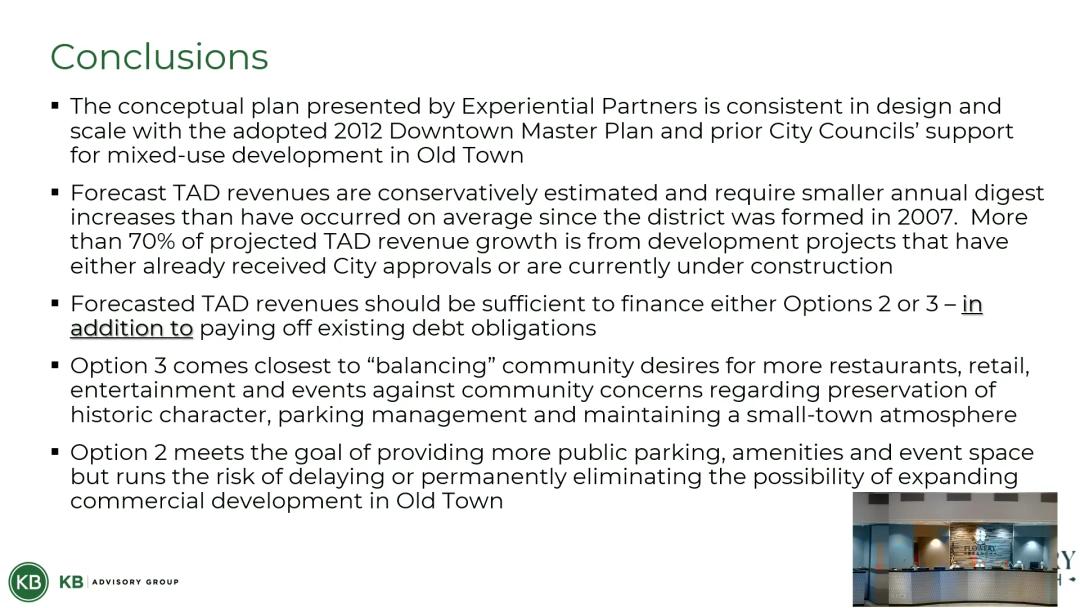
The Flowery Branch City Council held a work session and voting session on Thursday, September 3, 2026, at 6:00 PM at 5410 Pine Street. The work session began at 6:02 PM and adjourned at 7:42 PM; the voting session began immediately thereafter and concluded at 9:34 PM after an executive session. Key topics included a Tax Allocation District (TAD) financing presentation, second readings of ordinances for annexation and rezoning of 4651 and 4665 Hog Mountain Road, a Memorandum of Agreement for a stormwater improvement project, public comments, and department reports. Consent Calendar - The Consent Agenda was approved unanimously, including Mayor McClellan's July 2026 per diem and the August 20, 2026 City Council meeting minutes. Public Comments & Testimony - Jacob Garland and Carly Shoup, representatives of Samaritan's Purse (5535 Rafe Court, Flowery Branch), stated that the organization has established a permanent processing center in the city and seeks to build a partnership with the City. They highlighted the organization's Operation Christmas Child program, which distributes gift boxes globally, and noted that they hire 350 seasonal roles annually, supporting local economic growth. - Mary Willis (6219 Spring Lake Drive, Flowery Branch) offered suggestions and feedback on downtown TAD planning. She argued that Avalon in Alpharetta is not a comparable example for Flowery Branch, questioned the need for additional multifamily housing given existing demand, and urged the council to study smaller municipalities such as Monroe, Buford, or Senoia to learn how they developed their downtowns with similar constraints. Discussion Items - Tax Allocation District (TAD) Financing Presentation: Gary Mongeon of KB Advisory Group presented three options for the TAD. Option 1 would retire existing debt and dissolve the TAD by 2039, generating about $19.4 million in surplus increment (over debt service) that could be refunded to the county or transferred to the general fund. Option 2 would fund only public improvements (parking deck, park, streetscape) using TAD revenues, extending the TAD to fiscal year 2046, with a projected surplus of $9.1 million after debt service. Option 3 would implement the full conceptual plan with a developer (Experiential Partners, LLC), including 134 multifamily units, 8,000 square feet of ground-floor retail, a 400-space parking deck (210 public spaces), and a city green park, extending the TAD to 2046 and generating approximately $76 million in additional taxable private investment; this option showed a surplus of about $4.2 million. Mr. Mongeon emphasized that the TAD's 2026 digest of $240.5 million reflects 14.6% annual growth since its formation and that revenue forecasts are conservative, with over 70% of growth already permitted or under construction. Council members discussed parking needs, unit count, financial risk, and the importance of balancing community interests. Council Member Mezzanotte questioned the 134-unit figure and expressed concerns about bond market conditions and the risk of relying on future development; Council Member Vanderbilt asked about the traffic study and cumulative impacts on the Hog Mountain Road corridor. - Annexation and Rezoning (Ordinances 774 and 784): Planning Director Chris McCrary presented the second reading of ordinances to annex and rezone 19.398 acres at 4651 and 4665 Hog Mountain Road from Hall County zoning (R1 and AR1) to Flowery Branch Single Family Town Homes (SFTH). The project proposes 75 single-family lots, a 35% reduction from the initial 116 units, with centralized open space and enhanced architectural standards. New conditions include a five-foot sidewalk extension to Porter Road, a right-turn-only exit with concrete median, and improvements to the Porter Road pedestrian crossing and ADA ramp. A traffic impact study (conducted January 2026) concluded that level of service would remain at D during peak hours at the Spout Springs/Hog Mountain intersection and at B at most other locations, with the subdivision exit operating at E during peak times; the developer must work with the city engineer on final design. The city has entered into an Intergovernmental Agreement with Hall County, which withdrew its objection to the annexation. Council discussion included questions about cumulative traffic impacts from future developments and whether to wait for the Unified Development Code (UDC) update; staff noted that the future land use map in the Comprehensive Plan already supports mixed uses in this corridor. - Memorandum of Agreement – Hog Mountain Road/Falcon Parkway Stormwater Improvement Project: City Manager Tonya Parrish presented the final MOA with Hall County and the Atlanta Falcons Football Club. The agreement formalizes cost-sharing for stormwater improvements along Atlanta Highway near the Falcons property. The City of Flowery Branch will contribute a fixed $20,000 and cooperate during construction. City Attorney Ted Baggett noted minor technical changes from the previous version, including language about not removing the Falcons' perimeter fence; the city's financial obligation remains unchanged. - Department Reports: - City Clerk Shelia Cooper announced that advance voting for the upcoming election will be held at City Hall from October 13 through October 30 (including two Saturdays), with Election Day on November 3 at regular polling locations. - Fun Director Renee Carden presented the Department of Fun's annual review. In FY2026, the department hosted 92 events attracting 295,350 visitors downtown. Four new events were introduced, including a three-day fall event that drew approximately 12,000 attendees. The department plans to continue expanding signature events. Council Member Vanderbilt noted that the parking challenges during large events could be addressed by a parking deck. Key Outcomes - Consent Agenda approved unanimously. - Annexation and Rezoning (Ordinances 774 and 784): Approved on second reading by a 3-2 vote. Council Members Mundy and Lena voted in favor; Council Members Mezzanotte and Vanderbilt voted against. Mayor McClellan cast the deciding vote in favor. - Memorandum of Agreement – Hog Mountain Road/Falcon Parkway Stormwater Improvement Project: Approved unanimously. - Executive Session: The council entered executive session at 7:52 PM to discuss personnel, litigation, and property matters, and exited at 9:34 PM. No votes were taken in executive session. - Meeting adjourned at 9:34 PM.
The Public Meeting Index
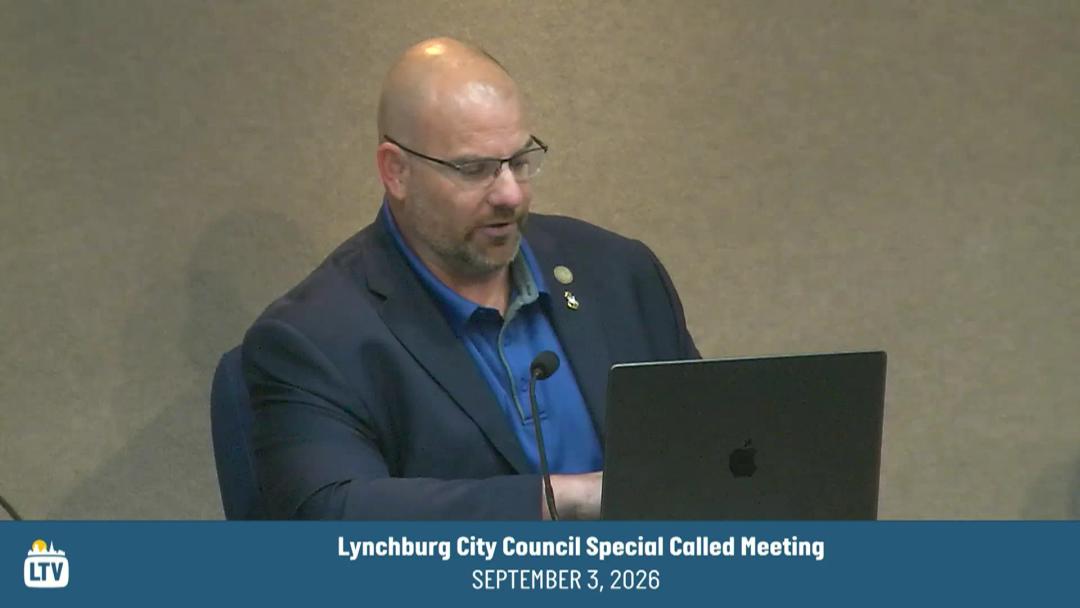
The Public Meeting IndexThe Lynchburg City Council held a special called meeting on September 3, 2026, at 6:00 PM. The sole agenda item was the consideration of Resolution R-26-077, which authorizes a temporary pause of the city's 15 fixed Flock cameras, provides notice and license revocation under the city's agreement with Flock Group, Inc., and expresses support for the Lynchburg Police Department (LPD). The resolution passed with a vote of 6-0, with one member absent. Public Comments & Testimony - No members of the public provided oral testimony during this special called meeting. Councilmember Timmer noted the presence of citizens in the audience and stated that postponing the vote to the September 8 regular meeting would allow for formal public comment. Councilmember Reed framed the Council's action as a direct response to citizen concerns about surveillance, comparing the action to similar reconsiderations by localities like Campbell County, Appomattox, and Giles. Discussion Items - Motion to Adopt Resolution R-26-077: Councilmember Faraldi moved to adopt the resolution, seconded by Councilmember Reed. - Scope of the Resolution: A significant discrepancy emerged regarding the scope. Police Chief Ken Edwards initially stated the resolution applied only to the 15 fixed cameras and that the Raven acoustic gunshot detection system was separate and would remain operational. Following persistent questioning from Councilmember Misjuns, Chief Edwards confirmed that the acoustic sensors fall under the Flock contract. Councilmember Faraldi cited the resolution text directing the removal of "all flock technology," while Mayor Taylor focused the debate on the fixed cameras. - Termination Timeline and Costs: Chief Edwards stated that immediate equipment removal would incur a $500 per-unit charge, whereas allowing the agreement to expire in April 2027 would avoid this cost. Councilmember Misjuns argued that the Revocable License Agreement permits a 30-day unilateral revocation by the City at no cost. City Attorney Matthew Freedman stated termination would be carried out to maximize the avoidance of monetary penalties. - Councilmember Timmer's Substitute Motion: Councilmember Timmer made a substitute motion to postpone the item to the September 8 meeting to follow standard agenda procedures and allow public comment. Councilmember Misjuns seconded the motion but stated he ultimately preferred to proceed that evening. Councilmember Timmer formally withdrew the motion to allow the vote to proceed. - Alternatives and Public Safety Context: Councilmember Wilder inquired about alternatives to the Flock cameras. Chief Edwards described the Hill City Connect program for voluntary private camera registration. Mayor Taylor expressed strong support for retaining the acoustic gunshot detection technology as a distinct public safety tool, distinguishing it from the fixed cameras. Key Outcomes - Resolution Adopted: The Council voted 6-0 to adopt Resolution R-26-077. Voting in favor were Larry Taylor, Sterling A. Wilder, Chris Faraldi, Stephanie Reed, Martin Misjuns, and Jacqueline Timmer. Curt Diemer was absent. - Implementation Directive: The City Manager or designee is directed to provide notice to Flock Group, Inc. and ensure the substance of the resolution is effectuated under the Government Agency Agreement and Revocable License Agreement. - Future Action: Councilmember Misjuns noted that a second, more specific resolution to terminate the Flock agreement was already scheduled for the September 8 meeting to guarantee all equipment is fully removed from City rights-of-way if the September 3 action is insufficient. - Public Record: Councilmember Misjuns requested that the Government Agency Agreement and Revocable License Agreement be included in the official public record of the meeting.
The Clarksville City Council met for its regular session on September 3, 2026, at 6:00 PM. The agenda included public hearings, multiple zoning changes, new regulations for smoke shops, and a sidewalk exemption ordinance. Key votes resulted in the denial of two infill rezoning requests and the advancement of both the smoke shop regulations and a revised sidewalk waiver process. Consent Calendar The consent agenda was adopted unanimously (12-0). Items included second readings for three zoning cases (Ordinances 01, 04, 05), a commercial driveway access (Ordinance 06), board appointments (Resolution 13), a liquor license transfer (Resolution 15), and the August 6 meeting minutes. - Items Pulled: Ordinance 01-2026-27 (Lewis Contracting, Evans Rd) was pulled by Councilmember Claunch. Ordinance 06-2026-27 (Bill Mace driveway) was pulled by Councilmember Chandler. - Ordinance 01: A motion to postpone failed (1-11). The ordinance itself failed on a tie vote (6-6). - Ordinance 06: Approved on second reading (9-3). Public Comments & Testimony - Ordinance 12-2026-27 (Blick Homes, Eva Dr): Mr. Blick spoke in favor of his zone change request, describing plans for a $225,000–$300,000 single-family home. Residents Opie (Earlman Tear) and Yvonne Latham spoke in opposition. Tear voiced concerns over drainage, road safety, lot sizes, and fire hazards. Latham cited density, utility pressure, and a lack of yard space. - Ordinance 13-2026-27 (Hunneycutt, Calvert Dr) and Ordinance 14-2026-27 (Smoke Shops): No members of the public spoke. Discussion Items - Smoke Shop Zoning (Ordinance 14-2026-27, First Reading): Councilmember Streetman proposed limiting future smoke shops to C-5 zoning districts and establishing new distance buffers from schools. Councilmembers Holliman, Claw, and Smith spoke in favor, citing youth marketing and public safety. Councilmembers Chandler and Lovato opposed, arguing it was government overreach and duplicative of state law. The ordinance passed first reading (9-3). - Sidewalk Exemptions (Ordinance 10-2026-27, First Reading): Councilmember Brown introduced a successful amendment (11-1) to move waiver authority from the Street Department Director to the Transportation, Streets, and Garage (TSG) Committee. The amended ordinance passed (7-5). Supporters said it allowed flexibility for infill affordable housing and state road conflicts. Opponents cited Clarksville's walkability score of 18 out of 100 and argued against any sidewalk waivers. The TSG Committee had previously recommended disapproval of the original ordinance. - Planning Commission Rezonings: Ordinance 12 (Blick Homes) failed 5-7. Councilmember Claunch apologized during discussion for providing incorrect information about the property. Ordinance 13 (Hunneycutt) failed 3-9. Councilmember Chandler cited the applicant's absence as a reason for his no vote. - Jordan Road & Eva Drive Sidewalks (Ordinance 08-2026-27, First Reading): The council authorized the Mayor to negotiate easements and potentially use eminent domain. Councilmember Lovato requested the appraisals be reviewed by the TSG committee in September. The ordinance passed 12-0. - Sergeant John W. Hunt Memorial Boulevard (Resolution 14-2026-27): Approved 11-1. Councilmember Holliman voted against, stating general concerns about the practice of honorary street naming. - Police Agreements: The council approved Memorandums of Understanding with the ATF (Resolution 09) and the Secret Service (Resolution 11), both by 12-0 votes. - Debt Obligation Report: Mayor Pitts provided the legally required report on the city's debt obligation; no council action was taken. Key Outcomes - Failed Motions: Ordinance 12-2026-27 (Blick Homes, 5-7), Ordinance 13-2026-27 (Hunneycutt, 3-9), Ordinance 01-2026-27 (Lewis Contracting, 6-6). - Approved First Reading: Ordinance 14-2026-27 (Smoke Shops, 9-3), Ordinance 08-2026-27 (Sidewalks eminent domain, 12-0), Ordinance 09-2026-27 (Drainage codes, 12-0), Ordinance 10-2026-27 (Sidewalk exemptions amended, 7-5). - Adopted Resolutions: Resolution 09-2026-27 (ATF MOU, 12-0), Resolution 10-2026-27 (Cybersecurity, 12-0), Resolution 11-2026-27 (Secret Service MOU, 12-0), Resolution 14-2026-27 (Hunt Memorial Blvd, 11-1). Consent Agenda adopted 12-0. - Next Steps: Ordinances 14 and 10 will return for second reading. The TSG Committee will review appraisals for the Jordan Rd/Eva Dr project. Public comments for the annual CAPER report began September 4.
The available transcript captures pre-meeting technical troubleshooting rather than formal city council business. Participants worked to get the in-room camera feed to display through the meeting broadcast system so the public livestream would show the council chambers. No agenda or minutes were provided, and no formal council actions, public testimony, or votes occurred. Technical Discussion - Participants attempted to activate and route the room camera feed into the meeting broadcast interface. - They checked whether the cameras were turned on or off and noted the feed was showing black. - There was discussion about using a laptop feed or an OBS option as an alternative. - Brandy noted that cameras normally appear automatically when launching a meeting, but were not working at that time. - They considered reviewing previously saved council meeting videos to determine whether earlier streams had also been black. - A support participant suggested logging out and logging back in, then rejoining the meeting. - An audio check was completed successfully: one participant confirmed, "I can hear you clearly, yes." Key Outcomes - No formal decisions or votes were made. - The next step identified was to log out and rejoin the meeting to try to restore the camera feed.
The Lakeland Board of Commissioners held a regular meeting on September 3, 2026, at 5:30 PM at City Hall. The meeting included public hearings on two ordinances, reports from the city manager and commissioners, a presentation on the Flock automated license plate reader (ALPR) system, and adoption of a suicide prevention proclamation. Commissioners approved amendments to board compensation and the fiscal year 2026 budget. Public Comments & Testimony - Mr. Carroll (Lakeland resident) commented during the public hearing, criticizing the current two-minute public comment limit as insufficient for meaningful participation. He asked the Board to reevaluate the policy, noting that the restriction was implemented shortly after a commissioner gave a 30-minute lecture on public participation. The mayor directed the city attorney to prepare information on Robert's Rules for the next meeting. - David Dodge (9733 Shadow Bridge Lane, Lakeland) spoke during public comments regarding privacy and cost concerns with the Flock system. He questioned the cost-effectiveness relative to alternative investments (e.g., hiring more officers) and suggested a third-party audit to prevent data leakage to national networks. He stated he had not met a neighbor who thought the privacy loss was worthwhile. Discussion Items - Flock ALPR System Presentation – Nikki Keaton from the Shelby County Sheriff's Office (SCSO) provided an update. SCSO leases 120 Flock cameras; Lakeland leases an additional 37; local HOAs and businesses add at least 18, covering most of Lakeland except newer construction areas. Keaton highlighted cases: a 2023 homicide on Breezy Shore Cove solved using Flock, a missing person found, and a homicide suspect tracked to Arkansas. In total, 27 documented investigations over roughly two years resulted in 15 arrests and two murder indictments. Data retention is 30 days (indefinite if tied to a crime), stored on Flock's cloud under CJIS compliance. Two-factor authentication is used. Sharing is automatic within 500 miles; beyond requires approval. Lakeland can opt out. Misreads occur but require officer verification. Commissioner Johnson requested a quarterly report on Flock's effectiveness; Keaton agreed to provide supplemental data. Commissioner Johnston noted Lakeland has appropriated $112,500 for Flock in the 2027 budget (40 active cameras plus 3 new installations). Mayor Roman expressed interest in expanding Flock use through aerial technology (drones) with SCSO as a possible beta site. - City Manager's Report – The city manager presented a development map: dark green (residential under construction), light green (approved not yet built), red (commercial approved). Construction updates included the YMCA facility (steel frame for gym, early childhood learning center, phase two aquatics area, locker rooms, pool excavation). The Highway 70 Corridor project was presented at the Public Works Expo in Houston, well-received. Upcoming events: mayoral debate/candidate forum (October 19, Lakeland Prep Middle School), West Tennessee Trail Run and water quality festival (September 26), Harvest Festival (October 24). Job openings: public works manager and part-time recreation specialist for the senior center. - Industrial Development Board Report – Commissioner Johnston reported that two TIF districts (Lakeland Commons and Safe City) are generating increments. Lakeland Commons has generated $515,000 since 2021; Safe City generated its first increment this year, totaling about $11,000 for the IDB. - Mayor's Report – Mayor Roman proclaimed September 2026 as Suicide Prevention Awareness Month. He noted that suicide is the 11th leading cause of death in Tennessee, with over 1,200 lives lost annually and an estimated 25 attempted suicides per death. The 988 Suicide & Crisis Lifeline provides 24/7 support. Commissioner McCarter (a registered nurse) highlighted the elevated suicide risk among nurses and emphasized awareness, stigma reduction, and use of 988. Key Outcomes - Approval of Meeting Minutes (August 20, 2026) – Approved with a correction (spelling of city engineer Aaron Campbell). Vote: 4-0 (Commissioner Dial not present for that meeting and abstained). - Ordinance Second & Final Reading – Board Compensation (Repealing O-03-22) – Passed 4-1 (Commissioner McCarter voted no). The ordinance changes Board compensation for the first time in over 20 years, adopting about half of what the Community Advisory Board recommended. A supermajority of four votes was required. - Ordinance Second & Final Reading – FY 2026 Budget Amendment (Amending O-6-2025) – Passed 5-0. The amendment consolidates all prior budget adjustments for the fiscal year. - The city manager will coordinate with SCSO to include Flock camera usage data (reads, hits, stolen vehicle recoveries) in regular crime reports to the Board.
The Fresno City Council met in regular session on Thursday, September 3, 2026, at 9:00 AM in the Council Chamber at City Hall, 2600 Fresno Street. Council President Nelson Esparza presided; Vice President Tyler Maxwell and Councilmembers Annalisa Perea, Mike Karbassi, Miguel Angel Arias, Brandon Vang, and Richardson were present. The agenda included a proclamation, a large consent calendar with several contested items, a workshop on growth and infrastructure (referred to in the record as the “SATA workshop”), a proposed data center prohibition ordinance, and a closed session. The record notes that roll call votes would not be required for part or all of the meeting because of remote appearances. Note on sources: The available transcript is a partial OCR extract with gaps, cut-off sentences, and inconsistent name spellings (e.g., City Manager “Georgeanne A.” / “Georgian White”; City Clerk “Aller”). Where speakers are not identifiable, this summary uses neutral phrasing such as “a speaker” or “one councilmember.” Proclamation - Vice President Maxwell sponsored a proclamation designating Thursday, September 3, 2026, as “Dr. [Name] Day” in honor of a doctor who returned to Fresno to help young people from families without a background in higher education. The proclamation was issued by Mayor Dyer and the Fresno City Council; Councilmember Annalisa Perea took part in the presentation. The honoree’s name is partially illegible in the transcript. Consent Calendar and Contested Items - City Clerk Aller explained that e-comments submitted through Granicus are compiled into a packet for councilmembers up to 9:00 AM the day before the meeting; later comments are still delivered into the record and are “not in any way removed from the system,” although the public tally freezes at the deadline. - Several items were pulled for separate consideration: Councilmember Richardson pulled line 1; Councilmember Arias pulled an additional item; and Item 20 (ID 26-1194), adopting the 17th Amendment to Annual Appropriation Resolution No. 2026-159, was also moved to the contested consent calendar. - Vice President Maxwell moved to reconsider a prior action; the motion was seconded by President Esparza and passed 7-0. - The consent calendar, including the contested items, was ultimately adopted. Recorded votes were all in the affirmative, with tallies of 5-0, 6-0, and 7-0 appearing in the minutes; no dissenting votes are recorded. Public Comments and Testimony - A speaker from Image Church (Fresno Street) voiced support for the data center ban, applauded Councilmember Richardson’s work on the item, and asked the Council to strengthen enforcement under Fresno Municipal Code Section 603, the city’s emergency ordinance. - A speaker raised concerns about a licensed contractor who had operated in Fresno and about “families across California who paid for homes they received,” referencing a perceived “gap” in oversight before a point of order interrupted the comment. - A speaker accused the city of “doctoring the numbers” and asked, “How are we going to power any of this?” with reference to data centers and growth. - A speaker urged the Council to prioritize small businesses over big-box retail and to give small businesses access to ownership of restaurants and commercial storefronts. - A speaker expressed distrust of the Council’s process, saying the Council was “smarter than just passing stuff … without any information” and that a commission proposal had been pushed through before the public could review it. - A speaker named Mike Betts was recognized; his remarks were not captured in the available transcript. Data Center Prohibition Ordinance - Councilmember Richardson brought forward a proposal to prohibit data centers in the City of Fresno. Council discussion addressed: - A 10-year prohibition: “No land in the city of Fresno will support this use, at least for the next 10 years.” - An amendment applying the prohibition to territory annexed to the city after the ordinance’s effective date. One councilmember clarified that the intent is to ensure the ban continues to apply when the city annexes county land, so data centers cannot be built just outside the city and later brought in through annexation. - Exemptions for hospitals with internal server rooms, City Hall’s ISD data-storage room, and businesses for which a server room is an “auxiliary use” internal to a primary operation (e.g., distribution or manufacturing). - A complementary option: including in the resolution a statement that the city would not provide services (such as utilities) to data centers located outside the city in the county. - A councilmember asked whether the city’s own server room would fit the definition. City Attorney Janz responded that an applicant could argue it does not, because the proposal targets data centers as a primary use; he also noted that a director’s determination on such questions could be challenged. - The Council’s final vote on this item is not clearly captured in the transcript, but no opposition to the direction was recorded. SATA Workshop: Growth, Infrastructure, and Density - Vice President Maxwell, Councilmember Perea, and Councilmember Karbassi were credited with negotiating a tax-sharing agreement with the county in which the city received/handled 62% of [sentence cut off in transcript]. - Participants discussed Community Facilities Districts (CFDs) on newer developments, which impose additional property taxes used to fund street maintenance, tree trimming, and similar services. - Planning staff member “Nick” explained that developers may build at any density within the low-to-high range for a zone, but may not go below the minimum or above the maximum. - One participant estimated that city-run infrastructure work costs “probably 20 to 30 percent higher than what we would do if we were in a bidding scenario,” and that the trunk lines used as a financing mechanism took “more than five, six, seven years to pay back.” - Street-design details were noted: “they fit in the street, the sewer is generally in the middle, and we offset the water line to one side.” - One councilmember said, “I am in a position to look at this plan from the perspective of the people who I represent,” observed that residents in some parts of the city are upset that development is planned “in a different part of the city,” and raised concerns about tying the hands of future councilmembers through long-term obligations. - A public commenter referenced the city’s and county’s next 30 years of growth. Closed Session - The City Attorney read the closed session items. The case “Richard Fitzgerald v. City of Fresno” (agenda subdivision D, subsection one) was continued to the September 17, 2026, meeting by the City Attorney’s Office. - The Council then held a closed session with the Mayor, the City Attorney (serving as City Negotiator, along with Council President Esparza), the City Attorney Investigator, and the City Clerk. No reportable action from the closed session appears in the available minutes. Key Outcomes - Consent calendar and contested items adopted; all recorded votes affirmative (5-0, 6-0, and 7-0). - Data center prohibition ordinance advanced with direction on annexation applicability, a 10-year horizon, and auxiliary-use exemptions (the record does not confirm a final adoption vote). - Closed session litigation item continued to September 17, 2026. - Proclamation issued designating September 3, 2026, as “Dr. [Name] Day.”
The Lake County Council held a budget workshop on September 3, 2026, to set the 2027 budget and discuss salary increases. The meeting included a financial update, approval of baseline budget motions, and a debate on an across-the-board pay raise. Discussion Items - Financial Update: Scott, the county financial officer, reported that the county's financial health continues to improve, with reserves increasing year after year despite challenges from Senate Bill 1 and BTRC issues. He noted that the expiration of the current tax structure was pushed from 2027 to 2028, mitigating some revenue loss, but potential impacts remain in 2029. Lake County is the only county that uses 100% of its 1% for PTRC relief, which helps cushion cap loss. - Pay Raise Discussion: Councilman Brewer initiated discussion on a three percent across-the-board pay raise. Scott estimated each 1% raise costs about $1 million in payroll, with benefits additional. The county's growth quotient is 6%, but competing needs include $3 million for bridges and $2 million for utilities. Several council members raised concerns about recent reorganizations that gave some employees raises above 4% and about fairness for smaller departments. A motion was made and seconded for a 4% across-the-board raise, excluding departments currently under contract negotiations or in the midst of reorganization, with the understanding that reorg requests would be handled separately. The motion passed. Key Outcomes - Motion 1: Approved the 2027 budget for all levy funds at the 2026 original council-approved level, with salaries at June 30, 2026 rates. Passed 6–1 (one absent). - Motion 2: Approved the 2027 budget for non-levy funds as requested by departments, excluding salaries and supplemental payments. Passed 6–1. - Motion 3: Approved salary increases for all collective bargaining agreement and contract increases, with a special note that sheriff's police, correctional officers, and highway departments are in negotiations. Passed 6–1. - Motion 4: Approved mandated salary increases per Indiana Supreme Court for judges, prosecutors, magistrates, sheriff chief, public defender, and assistant chief public defender, and probation officer salaries per the Indiana Judicial Conference Schedule. Passed 6–1. - Motion 5: Approved requested amounts for specific line items: property rental ($63730), assessor certification ($61250), board member per diem ($6129), longevity ($61210), assessor per diem ($61251), and election day workers ($61196). Passed 6–1. - Motion 6: Approved a 4% across-the-board pay raise for all employees not covered by CBAs or currently in negotiations. Passed 6–1. - Motion 7: Approved placing any remaining balance in reserve. Passed 6–1. - Next Steps: The first reading of the budget ordinances is scheduled for Tuesday, with another workshop in October after the study session, followed by the second reading after the October meeting. Council members requested a detailed email from Scott showing the updated budget.
The Lodging Tax Advisory Committee met on September 3, 2026, at 9:00 AM in City Hall Council Chambers, with a recess at approximately 10:30 AM and adjournment following the vote. The committee reviewed an additional service fee for the Puyallup Gateways project, heard city-initiated proposals, and considered 2027 lodging tax applications from nine organizations. Total funds available for committee allocation were $853,690, derived from $1,897,100 in hotel tax revenue after a 55% reserve for city initiatives. The committee approved a final allocation package that fully distributed the available funds. Discussion Items - Puyallup Gateways Additional Service: Public Affairs Officer Eric Johnson presented a revised cost estimate of $72,581 for additional design work to relocate a water main and sewer line and to address geotechnical issues (liquefaction) requiring deeper posts at the two gateway arch sites (North Meridian near Fifth Avenue and the Blue Gate area). The committee acknowledged the work was necessary but took no formal action as it was previously council-approved; the item was presented for comment only. - City-Initiated Proposals: Johnson outlined three city LTAC requests for 2027: (1) continuation of the "Always in Season" tourism campaign (increase from $100,000 to $150,000 in 2027), (2) additional downtown street furnishings (benches, receptacles, planters), and (3) fabrication of wayfinding signage. Mayor Whitting noted these were already council-approved for LTAC spending and were presented for committee comment only. - 2027 Lodging Tax Proposals: Nine organizations presented their funding requests and answered committee questions. Key points from presentations: All Things Fun Sports (Amy Wirtz): Manages multiple races (Puyallup Valley Half Marathon, Chocolate & Coffee Lovers 5K/10K, Daffodil Classic, Gobble Gobble). Received $8,000 of $20,000 requested in 2026; all events were still held. Entry fees range $30–$70. Requested $2,200 for 2027. Arts Downtown (Nicole Martineau): All-volunteer nonprofit with 56 permanent artworks. Requests funding for upkeep, artist stipends, installation, and advertising. Requested $70,000. Daffodil Festival (Bob Sud Earth): 90+ year tradition; parade draws 100,000 attendees. Requested $50,000 (up from $44,000 in 2026). Recovering from a 2026 date conflict that reduced entries. Generous Influencers / First Pursuit (Patty Hoganson): Operates the Puyallup Night Market (Thursday evenings at Pioneer Park). Reports 1,000–1,500 regular attendance, 18,000–24,000 at special events, and over 20,000 annually. Requested $35,000 for tourism-focused marketing. Foothills Rails to Trails (John Hopkins): Art event along the river walk for emerging artists. Uses City Bits analytics showing 34% of attendees from 50 miles. Requested $25,000. Master Gardeners (Jan Lewis): Annual plant sale moved to the fairgrounds in 2026; 6,000 attendees from Everett to Olympia. Requested the same amount as 2026 to stabilize the transition. Northwest Sinfonietta (Karen Chu): Professional chamber orchestra performing at Pioneer Park Pavilion (October–May). Brings patrons from multiple counties and states. Requested $30,000 (up from $23,000). Puyallup Historical Society / Meeker Mansion (Shelly Schumpf): Operates one of four National Register sites in Puyallup. Hosts 15 annual events; technology investments key. Requested $68,000 (up from $49,000). Puyallup Main Street Association (John Palmer): Runs farmers market, Meeker Days, SIP, Santa Parade, Holiday Market, and new Nashville Nights event. Reports 250,000 participants annually, 10,000 from 50 miles. LTAC represents 20–25% of event costs. Requested $236,000. Puyallup Sumner Chamber of Commerce (Stephanie Shram): Requests for visitor center, Red White & Kaboom (July 3), and Brewallop. Red White & Kaboom saw 30% growth in 2026, fireworks costs doubled. Marketing reached 2 million eyeballs outside region. Requested $260,000. Tacoma Regional CVB (Dean Burke): Destination marketing organization; books 200,000 rooms countywide, 35,000 specific to Puyallup. Supported transition at the fairgrounds. Amount requested not specified; fully funded in final motion. - Allocation Discussion: A debate arose over methodology. Councilmember Grove advocated for an across-the-board percentage cut, while Mayor Whitting opposed that as a default and instead proposed specific amounts based on judgment and prior discussions. After detailed proposals from the mayor, the committee approved a motion to allocate funds as amended. Key Outcomes The committee passed a motion (unanimous voice vote) approving the following allocations for 2027 (requested amount in parentheses where known): - All Things Fun Sports: $2,200 (requested $2,200) - Arts Downtown: $70,000 (requested $70,000) - Daffodil Festival: $46,000 (requested $50,000) - Generous Influencers / First Pursuit (Night Market): $25,000 (requested $35,000) - Foothills Rails to Trails: $25,000 (requested $25,000) - Fred Oldfield Center: fully funded (amount not specified, same as prior year) - Master Gardeners: fully funded (amount not specified, same as prior year) - Northwest Sinfonietta: $30,000 (requested $30,000) - Puyallup Historical Society / Meeker Mansion: $57,000 (requested $68,000) - Puyallup Main Street Association: $209,700 (initially proposed $208,000; remaining $3,434 split equally between Main Street and Chamber; requested $236,000) - Puyallup Sumner Chamber of Commerce: $236,700 (initially proposed $235,000; remaining $3,434 split equally; requested $260,000) - Tacoma Regional CVB: fully funded (amount not specified) The total allocated matches the $853,690 available. The committee directed staff to prepare final award documents.
The Clark County Board of Equalization met on September 3, 2026, at the Clark County Government Center in Las Vegas to conduct a remand hearing in State Board of Equalization case 26-107 (County Board case 424), concerning petitioner Mark Wilson's 2025-2026 property assessment appeal. The board denied jurisdiction over a prior-year supplemental assessment, heard evidence on land and improvement equity, and voted to reduce the improvement value by 6 percent. Procedural and Administrative Matters - The board adopted the agenda by unanimous vote. The hearing was recorded, and the district attorney's office stated that the State Board remanded the case for a full and complete record, with testimony from the February hearing incorporated. The deputy district attorney also instructed board members to disclose any conflicts and said the board should address only the issues directed by the remand order. - The assessor's office said it had no general administrative business, and no other cases were on the calendar. Public Comments & Testimony - Public comment was opened and closed with no comments from members of the public; only the petitioner was present for the hearing. Remand and Addendum Issue - The State Board's order directed the county board to address supplemental information the petitioner said he did not have at the February hearing and to make findings on his claim that his property was assessed higher than similarly situated properties, including his supplemental assessment. - Wilson stated he did not receive the 70-page addendum in February. He alleged the transcript inaccurately records him saying "I found 761" when he said "I can't find 761," and he said he submitted two independent transcript reviews, including a forensic review. The deputy district attorney said the remand hearing was limited to the 70 pages Wilson did not receive; Wilson objected, saying the remand required a complete record. Jurisdiction Over Prior-Year Supplemental Assessment - The assessor's office testified that the 2022-2023 supplemental value was first appealed to the county board on January 13, 2025, more than two years late; the county board denied jurisdiction, the State Board affirmed, and a district court petition was dismissed on a filing technicality. The assessor's office argued the board should not accept jurisdiction. - Wilson argued he filed a timely factual-error appeal under NRS 361.768, which he said provides a three-year look-back that ended June 30, 2026, and that county staff prevented him from filing it. The deputy district attorney said NRS 361.768 authorizes the county commission, not the board of equalization, to correct factual errors within three years. - The board voted not to accept jurisdiction over the prior-year supplemental. Wilson objected that he was not allowed to present evidence before the vote. Land Value and Equity - The assessor's office described the property as a rebuilt one-story home with 4,985 square feet of main living area, a 1,096-square-foot guest house, 1,834 square feet of attached and detached garage, and a pool and spa on 0.85 acres. The assessor's presentation referenced a recommended value of $1,687,686. For land, the assessor's comparable vacant-land sales ranged from $643,625 to $1,157,500 and supported a $600,000 land value. - Wilson asked for a $186,000 land value reduction. He presented charts showing neighboring improved lots, often 15 to 80 percent larger, assessed at the same or only modestly higher land values; cited NRS and NAC provisions on improved-lot valuation; and argued the assessor's vacant-land comparables included a fictitious combined parcel, a listing, and duplicate or outdated sales. - Assessor's staff defended the equity grid, stated the base lot range was 0.75 to 1.25 acres, and said larger lots were adjusted using paired sales. Board members, including Kristen Lowe and Paul Chafee, said they did not find land inequity proven; the board concluded the land value should remain unchanged. Improvement Depreciation and Supplemental Assessment - Wilson argued the improvements were inequitable because neighboring remodels and teardowns received depreciation treatment, including a 12 percent "old benefit," that he did not receive, creating about $80,000 in assessed value difference. He also identified permits in the neighborhood that were assessed late or not at all. - Assessor's staff said the worksheets for comparable properties, when considered together, resulted in the same 20 percent original / 80 percent remodel treatment as the subject, and that some cited properties were not complete teardowns. - Wilson also argued his supplemental assessment should have been placed in 2023-2024 rather than 2022-2023 because his remodel did not receive its final inspection until July 27, 2022, after the July 1 lien date. The deputy district attorney said that relief would have to come from the county commission under NRS 361.768, not the board. Assessor's staff said properties can be assessed at percent complete as of July 1 and that they had determined no factual error. - Board member Timothy Eger likened the situation to a driver obeying the speed limit while others speed, but agreed an inequity could exist if many neighboring properties were underassessed. Members generally agreed some improvement inequity was present. Key Outcomes - The board voted not to accept jurisdiction over the 2022-2023 supplemental assessment, based on late filing and prior proceedings. - Terry Farr moved to decrease the improvement value by 6 percent, leaving the land value unchanged. The motion was seconded and passed unanimously. Board members said land inequity was not proven but improvement inequity warranted relief. - Wilson was advised he could appeal to the State Board of Equalization. With no other cases, the meeting adjourned.
The San Francisco Planning Commission met on Thursday, September 3, 2026, at 4:30 PM. Commissioners President Campbell, Chen, McDonald, McGarry, and So were present; Commissioner Coppel was absent. The meeting covered routine items, director's announcements, general public comment, and four major agenda items: a landmark designation process amendment, the Freedom West redevelopment project, a major modifications request for a Market Street project, and a discretionary review for a Broadway property. Consent Calendar & Commission Matters - Item 3 (1581 Webster Street): Conditional use authorization approved unanimously (5-0) on consent. - Minutes: The commission adopted draft minutes for July 23 and July 30, 2026, unanimously (5-0). - Commission Comments: Commissioner So reported on attending the second annual Chinese Housing Summit in Cantonese, emphasizing community support for taller, denser housing and mixed-use complexes. Director’s Announcements - Director Phillips announced the OpenGov contract moving through the Board of Supervisors ($38 million total, $33 million remaining) to improve permitting. - A management shift: Liz Wadi will focus on Permit SF; Rich Sucre and Kate Connor will oversee current planning. - A warning about a new round of payment scams targeting planning department customers. - The Historic Preservation Commission adopted a comment letter opposing proposed amendments to Section 106 regulations. Public Comments & Testimony - Georgia Shudish expressed concern about Ellis Act evictions and urged the commission to support eliminating the Ellis Act for San Francisco. - Ace Washington (Fillmore Corridor Ambassador) spoke about unfulfilled redevelopment obligations in the Western Addition and urged community involvement in projects like Freedom West. - Richard Sinkoff urged attention to design guidelines and neighborhood character as the city builds more housing. Discussion Item: Landmark and Historic District Designation Amendment (Item 8) - Presentation: Staff presented a proposed ordinance to streamline landmark and historic district designation by allowing the Historic Preservation Commission to initiate and recommend in one hearing, clarifying who may request designation, and removing prescriptive outreach requirements. Staff recommended approval with modifications to include "cultural" terminology. - Supervisor Mandelman’s Office (Renail Bajoy): Supported the ordinance as a modest streamlining that does not reduce scrutiny. - Supervisor Mahmood’s Office (Rain El Cooper): Proposed amendments to require housing capacity analysis, documentation of lost housing potential, and offsets through upzoning or transfer of development rights. They argued landmarking can hinder housing production. - Public Comment: Georgia Shudish supported the ordinance, citing examples of lost historic resources. Ace Washington urged community involvement. - Commission Debate: Commissioner So proposed modifications to: (1) strike the redundant language specifying organizations can initiate (since any member of the public can), (2) add a process to seek property owner consent, and (3) include baseline zoning information in reports. Commissioner Chen seconded a motion with these points. - After several votes, the commission adopted a motion to recommend approval with modifications: (1) amend Section 1004.1A to state “the department or any member of the public may request designation,” (2) direct staff to consider seeking property owner consent without undue burden, and (3) recommend the Board of Supervisors explore transfer of development rights. The motion passed 5-0. Discussion Item: Freedom West Project (Item 9) - Overview: The project is a $3 billion revitalization of a 10-acre co-op community (382 units) in the Fillmore, born from urban renewal. Plans include replacing all co-op units, adding 2,000+ new housing units (including 115 senior affordable units and 133 affordable family units), 1.5+ acres of public open space, a STEM center, and a hotel. A unique 20% profit participation for the co-op in market-rate development ensures long-term economic sustainability. - Presenters: Susan Ma (OEWD) explained the development agreement; Landon Taylor (Legacy First Partners) shared the history and vision; Christopher Bell (DLR Group) detailed design standards and guidelines, including connectivity improvements (Octavia Boulevard extension). - Action: The commission was asked to initiate General Plan amendments (map changes to reflect higher density and mixed-use). Staff recommended setting a hearing on or after October 8, 2026. - Public Comment: Multiple speakers, including Michelle Brown (Freedom West Board) and a long-time resident, expressed strong support, emphasizing the need to reverse displacement and preserve community. - Commission Discussion: All commissioners spoke in favor. Commissioner Chen asked about the conversion of 115 co-op units to senior affordable rental, which will likely revert to co-op after 15 years. President Campbell suggested future flexibility for driverless cars and hotel-to-housing conversion. The motion to initiate and schedule a hearing passed unanimously 5-0. Discussion Item: 2051 Market Street Major Modifications (Item 10) - Project: Demolition of a vacant commercial building and construction of a 7-story, 85-foot-tall, 29-unit mixed-use building with 29 dwelling units (15 one-bedroom, 14 two-bedroom) and 1,554 sq ft retail. The project was previously approved under state density bonus law. The proposed modifications are for a rear yard reduction (to 7 feet instead of 18%) and waiver of a light well requirement, both to preserve unit count and two-bedroom units. - Sponsor Arguments: The project is shovel-ready (site permit issued, BART approval, DPW permits) but economically unfeasible under previous inclusionary rates. Using the new TAC legislation and Housing Choice SF program with an in-lieu fee will make it viable. The modifications are necessary to keep the project financially feasible. - Staff Recommendation: Approve with conditions, finding the project consistent with planning objectives. - Commission Discussion: Commissioners asked about the affordable housing path. The project will pay a 10% in-lieu fee under the new TAC legislation. Commissioners expressed support, noting the project brings much-needed housing to a transit-rich corridor. Motion to approve with conditions passed unanimously 5-0. Discussion Item: Discretionary Review – 1142 Broadway (Item 11) - Project: Addition of a 582 sq ft fourth-story primary suite and roof deck on an existing two-flat condominium. The existing building is a category B property. - DR Requesters: Seth Subrian and another neighbor argued that the addition would cast significant shadows (64% increase on windows), increase noise, and degrade mid-block open space. They cited precedent of commission denying similar fourth-floor additions. - Project Sponsor: Doug Levanci and Kenji Yoko said the modest addition allows them to stay in their home and accommodate aging parents. They reduced the size and height in response to concerns. Architect Devi Dutta Churari showed that the addition is set back 15 feet from the front (per historic resource review) and 18.5 feet from the rear, with a 14-foot gap to the neighbor. - Staff Recommendation: Not take discretionary review, as the project complies with residential design guidelines and modifications were made to mitigate impacts. Staff noted no exceptional circumstances. - Commission Discussion: Commissioner McGarry moved to deny the DR, noting the addition is modest and zoning allows it. Commissioner Campbell asked about the 15-foot setback; staff explained it was for historic preservation but flexibility exists. The motion to not take DR and approve as modified passed unanimously 5-0. Key Outcomes - Landmark Designation Amendment: Recommended approval with three modifications (clarify initiation, consider owner consent, explore TDRs). The board of supervisors will consider the ordinance. - Freedom West Project: Initiated General Plan amendments; a public hearing scheduled for October 8, 2026. The project will return for full approvals later this fall. - 2051 Market Street: Approved major modifications under Housing Choice SF, allowing the project to proceed with an in-lieu fee. Construction expected within months. - 1142 Broadway: Discretionary review denied; the fourth-story addition approved as modified.