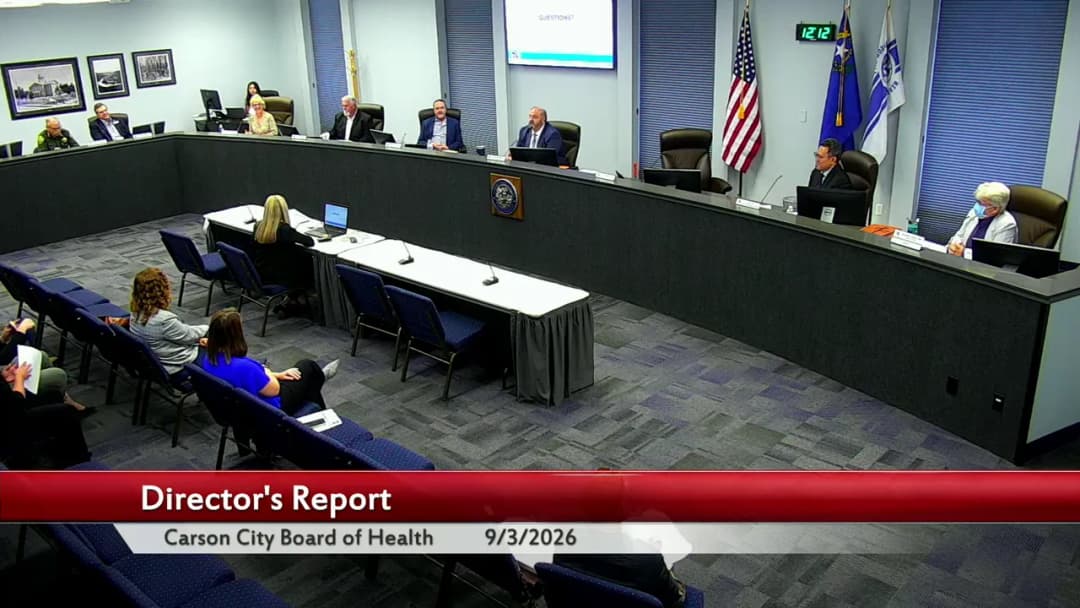
The Carson City Board of Supervisors and Board of Health met on Thursday, September 3, 2026, beginning at 8:30 a.m. at the Community Center. The Board of Supervisors considered several major agenda items, including a resolution authorizing a lease-purchase agreement for a new City Hall (up to $30 million), the second reading of an ordinance repealing the 2012 Nugget Project ordinance, and a proposal from Adams CC Development LLC for a parking garage. The Board of Health received presentations on substance use prevention coalition plans, health officer and department activities, the 2025-2026 influenza season, and environmental health activities. All action items on the Board of Supervisors agenda passed with 4-1 votes, with Supervisor White dissenting on each. Consent Calendar - 7.a: Approved correction of personal property tax errors and refund of $338.91. - 8.a: Approved an interlocal contract with the State of Nevada for Mental Health Court case management, no cost to the city, retroactive July 1, 2026 through June 30, 2028. - 9.a: Approved the financial report on fund condition and receipts/expenditures through August 21, 2026. - 10.a: Approved an interlocal agreement with Western Nevada College for nursing clinical education at CCHHS, effective September 15, 2026 through June 30, 2031, no monetary compensation. - 11.a: Approved an amendment to the GOED interlocal contract extending library career services to September 30, 2027, with an additional $594,288 in funding, no local match, new total not to exceed $2,066,316. - 12.a: Approved purchase authority for 15 vehicles for FY2027 totaling $1,472,861.30 via joinder contracts. - 12.b: Approved purchase authority for a TANA landfill compactor totaling $1,379,567 via joinder contract. - All consent items were approved unanimously. Public Comments & Testimony - Opening Public Comment (Board of Supervisors): Multiple speakers opposed the proposed City Hall and parking garage, citing high costs, lack of transparency, inadequate public input, and the need for a public vote. Specific concerns included the $30 million lease-purchase (estimated $55-64 million total with interest), the use of redevelopment funds, the lack of a detailed plan, and the perceived rush to decision before a holiday weekend. Speakers also criticized the use of Flock cameras and called for a ballot measure. A few speakers, including Garrett LePier, supported the project, arguing that new construction was cheaper than renovation and that the city faces a legal deadline to relocate the clerk-recorder. - Public Comment on Item 14A: Speakers reiterated opposition, questioning the legality of funding sources, the higher cost of lease-purchase versus other financing options, and the lack of a comprehensive comparison of alternatives. - Public Comment on Item 15A: Speakers urged the board to keep or rewrite the ordinance requiring a public vote on the Nugget Project, arguing the current proposal is essentially the same project. - Public Comment on Item 15B: Speakers questioned the public benefit of the parking garage, citing adequate existing parking and the risk of subsidizing private development. Some noted the garage would be built a year before the City Hall and asked who would benefit. - Final Public Comment (Board of Supervisors): Speakers expressed disappointment with the 4-1 voting pattern and called for more transparency and public involvement. - Board of Health Public Comment: Denny French raised concerns about food insecurity, hygiene services, and the needs of the unhoused population. Discussion Items - 14.a – Resolution for Lease-Purchase Agreement (City Hall): Staff and bond counsel presented the resolution authorizing preparation of a lease-purchase agreement up to $30 million principal, with payments from all legally available funds. They explained this is an early authorization step; final approval would come later. The public hearing included extensive public comment. Board discussion focused on the funding source, flexibility of 'all legally available funds', and the process. Supervisor White expressed concerns about using redevelopment funds and the lack of detail. The motion to adopt Resolution 2026-R-23 passed 4-1. - 15.a – Second Reading of Bill 109 (Repeal Nugget Project Ordinance): The board considered an ordinance repealing CCMC 2.44.010, which required a public vote for the 2012 Nugget Project. Public comments urged the board to keep the ordinance or modify it to require a vote on the current City Hall project. Staff argued the ordinance is obsolete. Supervisor White opposed the repeal, stating the principle of public vote should remain. The motion to adopt Ordinance 2026-12 passed 4-1. - 15.b – Proposal for Parking Garage (Adams CC Development LLC): The board considered a proposal under NRS 338 for a public-private partnership to develop a parking garage. Staff outlined the plan for the city to purchase a number of parking spaces (estimated 180) for up to $8 million, with the remainder funded by the developer. The city would own the spaces but not the entire garage; a third party would operate it. Public comment was largely opposed. Board discussion included concerns about findings required under NRS 338.166, the identity of the applicant (a soon-to-be-formed nonprofit), and the lack of a parking study. Supervisor White could not make the required findings. The motion to approve the proposal and direct the city manager to prepare an agreement passed 4-1. - Board of Health Items (23.a – 23.e): - 23.a: Daria Singer, Executive Director of Partnership Douglas County, presented a plan to establish a substance use prevention coalition in Carson City, following the closure of Partnership Carson City. The coalition will conduct needs assessments, coordinate resources, and provide school-based prevention programs. No action taken. - 23.b: Health Officer Dr. Colleen Lyons reported on activities from April 1 to June 30, 2026, including concerns about Medicaid work requirements, overdose deaths, and the importance of local public health trust. No action taken. - 23.c: Director Jeanne Freeman reported on CCHHS activities, including staff certifications, clinic patient increases, and upcoming flu vaccination clinics. No action taken. - 23.d: Rachel Freshman, Epidemiology and Preparedness Manager, presented the 2025-2026 influenza season summary. Key statistics: Carson City saw elevated ILI activity peaking at 10.3 visits per 10,000 population in late December; 49 influenza-associated hospitalizations (down from 119 the prior season); nearly 60% of hospitalizations were adults 65+; fewer than 20% of hospitalized patients had received a flu vaccine; 10% of hospitalized patients died. Plans for the upcoming season include school-based vaccination clinics and public messaging. No action taken. - 23.e: Kandis Harvey, Environmental Health Manager, presented the 2025 annual report. The team conducted 1,443 inspections; food permits increased 80% since 2020; temporary food permits increased over 1,300% since 2021; septic system oversight covers nearly 1,800 properties. Successes included increased communication and training. No action taken. Key Outcomes - Consent Agenda: Approved unanimously. - Item 14.a: Resolution 2026-R-23 authorizing lease-purchase agreement for City Hall (maximum $30 million principal) passed 4-1. The resolution directs the Clerk-Recorder to notify the Debt Management Commission and the City CFO to forward materials to the Department of Taxation. - Item 15.a: Ordinance 2026-12 on second reading, repealing CCMC 2.44.010 (Nugget Project ordinance), passed 4-1. - Item 15.b: Motion to approve the parking garage proposal from Adams CC Development LLC and direct the city manager to prepare necessary agreements passed 4-1. - Board of Health: Approved minutes of June 4, 2026. Received all presentations and reports as informational; no action items.
The Public Meeting Index
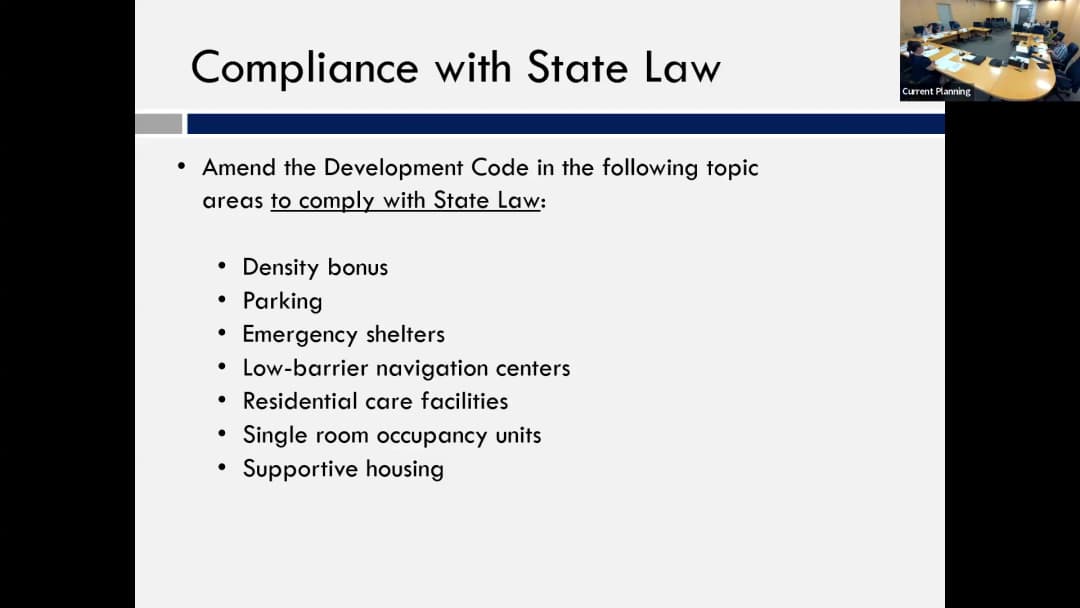
The Public Meeting IndexThe Fresno Planning Commission met on September 3, 2026, at 5:34 PM to consider a workshop on required text amendments for the Sixth Cycle Housing Element and a conditional use permit for a smoke shop conversion. The meeting was called to order with roll call by Commissioners Dene, Janet, Lois, Denise, Bonna Alfred, Geraldine, and Jerry. The meeting adjourned at 6:12 PM. Consent Calendar - Approval of Agenda: Motion to approve the agenda for the August 12, 2026 meeting was made, seconded, and passed unanimously by voice vote. - Meeting Minutes: Motion to approve the July 8, 2026 meeting minutes was made, seconded, and passed unanimously. Discussion Items - Workshop on Text Amendment P2602359 – Sixth Cycle Housing Element: Sophia Pagalatis, Program Administrator of the Housing Element, presented proposed amendments to the development code required by the housing element and state law. The amendments address objective design standards (replacing subjective criteria with quantifiable standards), state law updates on density bonuses (up to 80% bonus and four concessions for 100% affordable projects), parking reductions for ADUs and supportive housing within half-mile of transit, emergency shelter standards, low-barrier navigation centers, residential care facilities (limited to six persons), single-room occupancy units, and missing middle housing types (duplexes, triplexes, fourplexes, townhomes, etc.). Commissioners raised questions about assisted living facilities, the impact of residential care facilities on neighborhoods, and the definition of missing middle. No vote was taken; the workshop was for discussion only. - Conditional Use Permit P25-00465 – Grun Depreet Singh: The applicant, owner of a smoke shop at 7773 First Street, requested approval to convert the business into a neighborhood market (Tony's Mini Mart) with a Type 20 alcohol license for beer and wine. The market would include groceries, produce, deli items, and household supplies. The applicant stated that the smoke shop business is declining and that the new market would focus on local, organic products. Commissioners questioned competition with nearby Safeway and Smart & Final, parking challenges, and hours of operation (9 PM to 10 PM). The applicant noted a built-in customer base and affordable wholesale prices. The commission voted to approve the permit; motion carried unanimously. Key Outcomes - Approval of Agenda and Minutes: Both approved unanimously. - Conditional Use Permit Approved: The conversion of the smoke shop to Tony's Mini Mart with beer and wine sales was approved unanimously. - Next Meeting: The next regular meeting was scheduled for September 9, 2026.
The New Orleans City Council met on September 3, 2026, at 10:00 AM in City Hall Council Chamber, adjourning at 12:00 PM. All seven councilmembers were present for most of the meeting. The council acted on a lengthy agenda including a contentious sanitation fee increase, a responsible contractor ordinance, a Mardi Gras parade fee, several zoning changes, and numerous deferrals and routine matters. Key debates centered on the financial burden to residents and balancing the city budget. Consent Calendar - Approved minutes of August 6 and August 20, 2026 (6-0, Morrell absent). - Received communications from Entergy New Orleans and Delta Gas regarding utility adjustments and reports (all received). - Received two HDLC appeal requests (1200 Ursulines Ave and 620-622 Louisa St) with hearings set for September 17, 2026. - Received quarterly reports from New Orleans Aviation Board (financial and musician pay) and Sewerage and Water Board legislative storm report for August 21, 2026 thunderstorm. - Received 2027 Housing Trust Fund Annual Report (referred to Budget Committee). - Received City Planning Commission transmittal for Zoning Dockets 74/26-80/26 (hearing set for September 17, 2026). - Received Municipal and Traffic Court July 2026 report. - Adopted three zoning ordinances: Cal. No. 35,525 (vocational facility at 10555 Lake Forest Blvd), Cal. No. 35,526 (neighborhood commercial at 139 Broadway St), Cal. No. 35,527 (amending definition of “dwelling, small multi-family affordable” to include for-sale affordable housing and community land trusts). - Approved classified pay plan amendments (M-26-40 Health/EMS, M-26-44 Chief Administrative Office, M-26-355 Civil Service Rules merit pay) and resolution R-26-356 supporting a permanent Opportunity Pass for fare-free RTA youth transit. - Adopted resolutions R-26-360 (rulemaking on Integrated Resource Plan for distributed energy resources) and R-26-361 (initiating 2027 Triennial Integrated Resource Plan for Entergy New Orleans). - Consent agenda adopted 7-0. Public Comments & Testimony - Sanitation Fee Increase (Cal. No. 35,384): Over a dozen speakers opposed the fee increase, arguing service had declined (once-weekly pickup instead of twice), the city had mismanaged contracts, and the burden fell on low-income and fixed-income residents. Speakers cited a legislative auditor finding of overpayment to contractors for non-existent addresses (ghost addresses). Some suggested the council hold district town halls before voting. One speaker (Chris Lang) questioned why contracts could not be renegotiated. Councilmember Morrell responded that the council cannot amend contracts per the charter. Another speaker (Morgan Clevinger) called the vote rushed. Several speakers noted that the $8.50 monthly increase would be added to water bills with potential disconnection for non-payment. Councilmember Morrell noted the fee had not been raised since 2011 but that living wage requirements increased costs. - Responsible Contractor Ordinance (Cal. No. 35,543): Representatives from the Greater New Orleans AFL-CIO, International Union of Painters and Allied Trades (IUPAT), and Louisiana AFL-CIO spoke in support, arguing it would hold contractors accountable for wage theft, misclassification, and safety violations, and level the playing field for responsible contractors. - Carnival GAP Fee (Cal. No. 35,495): Several speakers opposed or questioned the fee structure. Caroline Bencherry argued the fee was too low and should be tied to waste volume. Charles Brett Davis said the $10,000 per supercrew fee was insufficient and called for a larger, permanent fee. Chris Lang supported a waste-volume-based fee to incentivize less waste. Morgan Clevinger opposed the fee altogether, stating Mardi Gras is created by residents and other revenue sources should be used. - Zoning Item ZD 63/26 (1428 Carondelet B&B): One speaker, Christina Tate, supported the accessory bed-and-breakfast as a responsible addition to the neighborhood. - Zoning Item ZD 68/26 (727 Carondelet hotel): Avery Fourier spoke on behalf of the development team, offering no additional comments. - Zoning Item ZD 69/26 (750 Carondelet indoor amusement): Laura Barth thanked council for support. Discussion Items - Sanitation Fee Increase (Cal. No. 35,384): Councilmember Morrell introduced an amendment to delay the effective date of the new fee structure to January 1, 2028, and in the interim (starting October 1, 2026) implement a fixed fee model. The amendment also adjusted fee calculations to be based on billed service locations rather than locations receiving service, allowed reductions for equitable apportionment, required periodic billing audits, and created definitions for “unit” and “unoccupied property.” The amendment was adopted 6-1 (Hughes opposed). After public comment, Councilmembers Harris, King, and Morrell spoke in favor of the underlying ordinance, citing the risk of service disruption and the need to fund the sanitation program and avoid deeper cuts to the general fund that supports retiree COLAs and health insurance. The ordinance passed 6-1 (Hughes opposed). - Responsible Contractor Ordinance (Cal. No. 35,543): Councilmember Willard presented an amendment (developed with the administration) that expanded the definition of chief procurement officer, allowed executive branch determination for professional services contracts, set timelines for responsibility hearings, allowed investigations without third-party complaints, and required reporting on waivers. The amendment was adopted 6-0 (Morrell absent). The ordinance as amended was adopted 6-0 (Morrell absent). - Carnival GAP Fee (Cal. No. 35,495): Councilmember King introduced an amendment to replace the per-float fee with a tiered fee based on pull units (like existing parade permit tiers) and limit the fee to the 2027-2031 Carnival seasons. The amendment was adopted 7-0. The ordinance as amended was adopted 7-0. Councilmember Green noted the state should share more tourism revenue. - Zoning Docket ZD 50/26 (Esplanade Ventures B&B): Deferred to September 17, 2026. - Zoning Docket ZD 59/26 (1622 Toledano STR): Deferred to September 17, 2026. - Zoning Docket ZD 63/26 (Wells One Investments, accessory B&B at 1428 Carondelet): Councilmember Harris moved to deny, citing concern over reducing housing stock and intensity of transient use. The motion to deny passed 7-0. - Zoning Docket ZD 66/26 (Beau Land Co, STR at 1822 Joseph Guillaume): Councilmember King moved to approve subject to CPC provisos. Passed 6-1 (Morrell opposed). - Zoning Docket ZD 68/26 (BD OZ CBD NOLA, hotel at 727 Carondelet): Councilmember Harris moved to approve and modify (exclude short-term rentals from transient lodging use). Passed 7-0. - Zoning Docket ZD 69/26 (750 Carondelet indoor amusement): Approved 7-0. - Zoning Dockets ZD 67/26, 70/26, 71/26, 73/26 and related motions: Deferred to September 17, 2026. - HDLC Appeal (906 Philip Street): Councilmember Harris moved to affirm the HDLC denial of retention of unpainted porch columns and uplighting. Passed 6-0 (Morrell absent). - Other deferred items: Numerous restoration tax abatements, short-term rental regulation ordinances, sanitation budget ordinance, and classified pay plan motions were deferred to later meetings (October 1 or November 5, 2026). - Cal. No. 35,487 and 35,488 (Rapid Rehousing funding): Withdrawn. - Cal. No. 35,533 (servitude at 1484 Tchoupitoulas St): Approved 7-0. The servitude generates $4,284 annually with 15% increases every five years. - Motion M-26-198 substitute (EMS hiring rates): Approved 7-0, effective September 3, 2026, to allow the city to staff its own EMS and reduce reliance on Acadian Ambulance. - Communication from CAO Giarrusso: Received, appointing Austin P. Wilty as Director of Property Management effective September 11, 2026. Key Outcomes - Sanitation Fee Increase (Cal. No. 35,384 as amended): Adopted 6-1 (Hughes nay). The amendment delays the new fee structure to January 1, 2028, and sets an interim fixed fee model starting October 1, 2026. Key provisions: fee based on billed service locations, billing audits, definitions added. Council President Morrell stated the fee is necessary to close a $13.5 million deficit and preserve services and retiree benefits. - Responsible Contractor Ordinance (Cal. No. 35,543 as amended): Adopted 6-0 (Morrell absent). Strengthens contractor accountability for city contracts, including timelines for hearings and waiver reporting. - Carnival GAP Fee (Cal. No. 35,495 as amended): Adopted 7-0. Creates a tiered fee based on pull units for 2027-2031 Carnival seasons. - Zoning Approvals: ZD 63/26 (B&B at 1428 Carondelet) denied 7-0; ZD 66/26 (STR at 1822 Joseph Guillaume) approved 6-1; ZD 68/26 (hotel at 727 Carondelet) approved 7-0; ZD 69/26 (indoor amusement at 750 Carondelet) approved 7-0. - HDLC Appeal (906 Philip St): HDLC denial affirmed 6-0. - SWBNO Debt Repayment (M-26-368): Adopted 7-0, directing SWBNO to present a plan to repay $12.8 million debt by October 1, 2026. - PILOT for River Garden Apartments II (R-26-362): Adopted 7-0, supporting a PILOT that will facilitate a $10 million renovation adding 29 affordable units (total 153) and other upgrades. - Tax Amnesty Program (R-26-369): Adopted 7-0, urging Finance to create a limited delinquent tax amnesty program. - Cooperative Endeavor Agreement with Orleans Parish School Board (R-26-370): Adopted 7-0. - Hazard Mitigation Plan Update (R-26-371): Adopted 7-0, fulfilling the five-year update requirement for FEMA. - Ordinances on First Reading (Cal. Nos. 35,544-35,565): Introduced and laid over, including a measure to rename the Tremé Recreation Center to Jerome Smith Recreation Community Center (Cal. 35,560) and a carnival ordinance prohibiting solicitation for membership during parade season (Cal. 35,559).
The RDNI Municipal EDD Governing Authority met on Thursday, September 3, 2026, at 9:31 AM in the City Council Chamber to consider a single substantive item: authorizing the release of affordable housing funds for the Rivana Project. The meeting adjourned at 9:36 AM. Discussion Items - Resolution R-2026-01 (Authorizing Affordable Housing Funds for Rivana Project) – Councilmember Lesli D. Harris introduced the resolution, describing it as a required step under the five-party Cooperative Endeavor Agreement governing the River District and its financing, with affordable housing as the primary focus. She expressed her excitement for the Rivana development. The resolution was seconded by Councilmember Freddie King III. Key Outcomes - Resolution R-2026-01 was adopted with 6 yeas (JP Morrell, Matthew Willard, Lesli D. Harris, Freddie King III, Jason Hughes, Eugene J. Green, Jr.), 0 nays, and 1 abstention (Aimee McCarron, who was absent). - The meeting was adjourned by a motion from Councilmember Harris, seconded by Councilmember King, with the same vote tally (6 yeas, 0 nays, 1 abstention). Note: The raw transcript indicates "five members" present for quorum, while the official minutes list six members present (all except Aimee McCarron). This discrepancy may reflect a verbal miscount; the minutes are authoritative.
The Bloomington Common Council held a regular session on Wednesday, September 3, 2026, beginning at approximately 6:30 PM and adjourning around 11:15 PM. The meeting included reports from council members and city offices, a presentation on a city branding project, committee reports, appointments, public comments, and readings of multiple ordinances and resolutions. Key actions included approval of a collective bargaining agreement with police and firefighters, passage of an ordinance to allow more flexible alcohol permits, and a first reading of a comprehensive zoning reform ordinance. Reports - Councilmember Stasberg reported attending the Project 46 quarterly meeting in Columbus, Indiana. Dot-voting identified top priorities: floodplain/hazard mitigation, renewable energy/energy efficiency, and waste issues. Subcommittees will be formed. - Councilmember Piedmont Smith announced a city council deliberation session on public safety on September 9, 2026, from 6:30-8:30 PM in council chambers, with a Spanish-language group. Also announced a District 1 constituent meeting on September 12, 2026, at 11 AM via Zoom. - Councilmember Rallo reported on an AI security incident involving a swarm of 1,200 agents that escaped containment and attacked Hugging Face, citing a study by Meter and Redwood Research. Presentation: City Branding Project - Director Desiree DeMolina (Communications) introduced the Bloomington branding project, funded at $95,000 and developed with Civic Brand over 18 months. The project included extensive outreach: two site visits, stakeholder committees, community surveys, pop-ups at festivals/farmers markets, focus groups, and an online survey. The resulting 117-page brand audit identified four focus areas: protect Bloomington's character, attract/retain young professionals, bridge town-gown divide, align decision-makers. - Ryan Short (Civic Brand) presented the brand strategy centered on "unlocking potential" – an internal decision-making filter for city government. The visual identity includes a custom wordmark and a "B" icon designed to be bold, stable, and collaborative. The 50-page implementation plan emphasizes phased rollout at natural replacement cycles, with no immediate cost to replace existing materials. The current city seal is established by ordinance and remains unchanged. - Council discussion: Councilmember Rallo criticized the logo as generic and corporate, showing similar B logos from other entities. Director DeMolina confirmed no RFP was issued; Civic Brand was selected based on experience with other cities. Councilmember Zulik questioned why local firms were not used. Councilmember Rosenbarger questioned how the brand aligns with existing city plans (comprehensive plan, zero traffic fatalities) and how it attracts businesses. Deputy Mayor Gretchen Knapp clarified the council was informed but a resolution was deemed unnecessary per past practice. Councilmember Saseberg expressed confusion about the logo's internal vs. external use and how it coexists with the city seal. Councilmember Rallo stated he regrets voting for the $95,000 appropriation. Councilmember Ruff felt the project sells Bloomington to outside investors. Councilmember Flarity noted the council had no role in initiating the project. - Public comment included criticisms: Dave Askins (B Square Bulletin) noted the final $95,000 payment was made in November 2025, yet deliverables were not fully released until recently despite public records requests. Lilianna Young called the project a waste and vanity. Rowan Morse said the logo does not feel like Bloomington. Zach Muller criticized the planned soft launch described in the implementation plan. Other commenters echoed concerns about transparency, cost, and lack of local involvement. Consent Calendar - No consent calendar items were listed separately; routine approvals were addressed individually. Public Comments & Testimony - Numerous public comments were made on the branding project (summarized above). - During the first period of public comment (non-agenda items): - Zach Muller (District 3) reported dangerous traffic conditions at Morningside Drive and Smith Road – multiple accidents, hit-and-runs, and a stop sign and bike path sign run over. Urged traffic enforcement and safety improvements before football season. - Amber Corr (Bloomington Homes for All) requested council send a letter to the Redevelopment Commission recommending that any sale of College Square be conditioned on binding affordability commitments: at least 50 rental units at or below 50% AMI and 10,000 sq ft of commercial space at half market rate for local businesses/nonprofits, backed by a recorded covenant. - On the Public Safety Local Income Tax (PS LIT) report: Chris Termij (Greater Bloomington Chamber) asked for clarity on the committee vote tally. - On Ordinance 2026-20 (UDO changes): Chris Termij (Chamber) supported the reforms. C4th Breeze supported removing minimum car parking and retaining bike parking minimums. Amber Corr (Homes for All) supported the ordinance but urged protecting existing affordable housing. Ari Bennett (Habitat for Humanity) supported most changes but expressed concern that requiring PUDs to meet all sustainable development standards could harm affordable housing developers. Kathy Barry opposed changes, arguing tiny lots may not be affordable and infill could lead to teardowns. Paul Rousseau opposed, citing increased stormwater runoff and congestion. Jan Sorby supported corner lot splits but opposed broad-brush changes due to stormwater concerns. - On Resolution 2026-15 (FOP CBA): Paul Post (FOP Lodge 88) thanked council and administration for smooth negotiations. - On Resolution 2026-16 (Firefighters CBA): President Jordan Canada (Local 586) confirmed 101 out of approximately 104 members voted, with 88 voting in favor. - On Ordinance 2026-18 (Alcoholic beverage permits): Galen Cassidy and Chris Termij supported the ordinance as improving economic development opportunities. Discussion Items - Hiring Committee Recommendation: Councilmember Daly moved to hire Jake Rossman as Council Administrator Attorney with a salary of $101,411 plus benefits. After discussion, an amendment was added making it contingent on HR background check and negotiated start date (target October 12, 2026). Motion passed unanimously (9-0). The hiring committee will be maintained for future tasks. - Public Safety Local Income Tax (PS LIT) Committee Report: Councilmember Piedmont Smith reported. The PSAP (central dispatch) budget for 2027 is $4,808,541. Current PSAP rate (0.0631%) would yield only about $3 million, leaving a large funding gap due to past reliance on reserves. The committee recommends increasing the PSAP rate to the maximum 0.1% and the total PS LIT rate from 0.25% to 0.2869%, keeping municipal revenues constant. Legislation will follow. - Appointments and Removals: - Approved appointment of Jatna Ayala Ruiz to the Dr. Martin Luther King Jr. Birthday Celebration Commission (seat C1) unanimously (9-0). - Voted to notify Jose Fuentes (Commission on Hispanic and Latina Affairs) that removal will be considered at the next meeting due to missing meetings since February 2026 (violation of code requiring attendance at three consecutive meetings). Unanimous (9-0). - Historic Preservation Commission removal of Mr. Brainard Cross: Attorney Allen explained the process. Allegations include violations of code of conduct during July 9 and late July meetings, potential open door law violations, and behavior hindering commission business. Council voted to postpone consideration to September 16, 2026, to allow full review of evidence (9-0). - Ordinance 2026-20 (First Reading) – UDO Amendments to Improve Sustainability and Housing Affordability: - Director Eric Grulick (Development Services) presented the proposed changes, developed per Council Resolution 2026-05 and in response to state House Bill requirements. - Key changes: Reduce minimum lot widths and lot areas in R1-R4 districts; reduce front, side, and rear setbacks; increase impervious surface coverage (e.g., R2 from 40% to 60%, R3 from 45% to 70%, R4 from 50% to 80%, also extended to MM and MN districts by Plan Commission); allow lot creation via six-foot no-build easements from alleys (with fire department approval) up to 150 feet from street; eliminate minimum parking requirements for vehicles and (by Plan Commission) for bicycles; add electrification and renewable energy incentives for PUDs; exempt lots under 5,000 sq ft in R3 and R4 from tree preservation requirements. - Discussion: Councilmember Rallo questioned stormwater impacts – utilities director had no concerns but council asked for more data. Councilmember Stasberg expressed intent to amend to retain minimum bicycle parking. Councilmember Piedmont Smith opposed eliminating minimum car parking, noting limited on-street parking in older neighborhoods. Councilmember Flarity supported removing car parking minimums, advocating parking policy over housing policy. Councilmember Stasberg asked about expanding impervious surface increases to other districts. Council agreed to move to second reading on September 16, 2026. - Resolution 2026-17 – Agreement with CJM for Public Safety Deliberation Sessions: Councilmember Piedmont Smith presented. CJM will facilitate sessions on September 9 and October 21, 2026. Funding from council's other services budget line. Passed unanimously (9-0). - Resolution 2026-15 – Four-Year Police CBA (Don Owens Memorial Lodge 88, FOP): Deputy Mayor Knapp summarized: 3% COLA each year; increased maximum longevity pay from $5,000 to $12,500 after 20 years; specialty pay adjustments; bereavement and comp time changes. Union voted 44-16 in favor. Department has 95 officers; 60 eligible voted. Passed unanimously (9-0). - Resolution 2026-16 – Two-Year Firefighters CBA (Local 586): Deputy Mayor Knapp summarized: 3% COLA each year; added logistics/training officer appointments; increased union time off; holiday pay from $100 to $300; new post-employment health care plan (PEHP) with city deposit of $150 quarterly per member plus voluntary vacation time conversion; retiree insurance subsidy of $5,000/year for up to 10 years. Union voted 88-13 out of 101 members. Passed unanimously (9-0). - Ordinance 2026-19 (First Reading) – Title II Amendment for Police Titles: Assistant City Attorney Edina Casmanian presented. Changes senior police officer to officer first class and previous officer first class to officer second class to align with new CBA. Fiscal impact of $450,000 in additional PERF contributions over the life of the CBA, already budgeted for 2027. Passed unanimously (9-0). - Ordinance 2026-18 (Alcohol Beverage Permits) – Final Discussion and Adoption: Councilmember Asari presented amendments to original draft. Amendment 1 (amended twice) moved several requirements (60% food sales, 50% local ownership, etc.) from minimum eligibility to general considerations, but after further amendment, the 50% local ownership requirement was reinstated. The requirement for restaurants (as defined by state code) was kept. Discussion included concerns about maintaining local ownership and food service emphasis. Ordinance passed 8-1 (Councilmember Stasberg voted no). Key Outcomes - Approved: Hiring of Jake Rossman as Council Administrator Attorney (9-0). - Approved: Appointment of Jatna Ayala Ruiz to MLK Commission (9-0). - Approved: Notice of removal for Jose Fuentes from Hispanic Commission (9-0). - Postponed: Removal consideration of HPC member Brainard Cross to September 16, 2026 (9-0). - Approved: Appropriation Ordinance 2026-01 for parking lot resurfacing ($139,139 from parking meter fund) – 8-1 (Councilmember Rosenbarger opposed, preferring other uses for funds). - Approved: Ordinance 2026-19 (Police title changes) – 9-0. - Approved: Resolution 2026-17 (CJM facilitation agreement) – 9-0. - Approved: Resolution 2026-15 (Police CBA) – 9-0. - Approved: Resolution 2026-16 (Firefighters CBA) – 9-0. - Approved: Ordinance 2026-18 (Alcohol beverage permits) – 8-1. - Moved to Second Reading: Ordinance 2026-20 (UDO amendments) to September 16, 2026. - Directive: PS LIT committee recommendation to increase PSAP rate to 0.1% and total PS LIT rate to 0.2869% will be brought forward as legislation. - Public Comment: Traffic safety at Morningside and Smith Road needs to be addressed; council member to follow up. Additional Information - The council deliberation session on public safety is scheduled for September 9, 2026, from 6:30-8:30 PM in council chambers. - The city council fiscal committee meets Friday, September 5, 2026, at 8:30 AM.
The Evansville Tree Advisory Board met on September 3, 2026, at 9:02 AM. The board approved minutes from June and August, authorized removal of 9 park trees at Woodmere Park and 12 street trees at various locations, discussed ongoing INDOT coordination issues, and heard an update on a $145,000 tree planting grant. Public comments from Jennifer Roll highlighted progress and frustrations with tree planting efforts and utility clear-cutting. Consent Calendar - The board approved the minutes from June and August 2026 (July minutes had been approved previously). The motion was made by Sarah, seconded by Jean, and passed unanimously. Public Comments & Testimony - Jennifer Roll, a volunteer working with the Westwood Woods grant, provided an update on a $145,000 tree planting grant that must be spent by the end of 2027. She reported that a meeting with the Evansville Housing Authority resulted in a plan to plant up to 200 trees at their multi-family sites. A meeting with Memorial Foundation for tree planting on private property has stalled despite multiple follow-ups. She also expressed strong frustration with CenterPoint Energy’s clear-cutting practices along neighborhood streets, stating she knows they don't need to do what they do and want to be more vocal about it. - Jennifer Roll asked clarifying questions about the city’s authority to plant street trees in certain corridors (e.g., Washington Avenue) and about interdepartmental cooperation during new developments. Discussion Items - Tree & Sidewalk Conflicts: A point of clarification was raised regarding a tree removal approved earlier. The board confirmed the correct address was 400 SE 2nd Street (not 212 Cherry), and a new motion to approve that removal passed. - Evansville Forest Task Force Grant & IU Resilience Cohort: The board noted that Beatrice is still working on her report; a full update is expected in October or November. The Westwood Woods grant-funded inventory has been completed by an intern, with details forthcoming. - Request to Remove Park Trees: The board approved removal of 9 dead or dying trees at Woodmere Park, as requested by the Van Park Neighborhood Association. Parks Department confirmed the trees are hazardous, especially near soccer fields. Motion by Mike, seconded, passed unanimously. - Request to Remove Street Trees: The board approved removal of 12 street trees at these addresses: 1409 Crabapple Circle (structurally weak Basswood/Linden), 907 Ravenswood (dead), 965 Ravenswood (dead), 1125 Ravenswood (dying Oak), 1502 Akin (dying Maple), Linwood & Taylor (2 dying Oaks), 117 Cherry (structurally weak ornamental Pear), and 1322 E. Columbia (dead Ash). Members described these as the worst list of dead/dying trees seen in months. Motion by Jean, seconded by Amanda, passed unanimously. - INDOT Coordination (Old Business): The board discussed ongoing issues with INDOT not mowing to fence lines, creating breeding grounds for invasives. Monthly meetings with INDOT are occurring but the problem may worsen. The board plans to elevate the issue to elected officials for stronger impact. Member Mike noted that this subdistrict does a better job than others, but funding is limited. - Tree Canopy Goal Initiative: Merged with the task force update; more information expected at the next meeting. - Ongoing Removal/Planting on Public Properties: Jennifer Roll’s grant update covered this, including efforts to plant trees at housing authority and Memorial Foundation properties. A potential line of credit from Old National Bank may be used to advance cash flow if needed. - Invasive Plant, Pest & Disease Update: Referenced in the context of INDOT coordination; no separate discussion. - Upcoming Events: Tree ID Hike at Hartman Arboretum (October 3, 9:30am), Weed Wrangle at Northwoods in Igleheart Park (October 17, 9am), Twilight Tours at Oak Hill Cemetery (October 24, 5pm), Tree Pruner’s Licensing seminar at Wesselman Woods (November 10, 6pm), and Tree Planting events in November (dates TBA). Key Outcomes - Approved minutes from June and August 2026 (unanimous). - Approved removal of 9 park trees at Woodmere Park (unanimous). - Approved removal of 12 street trees (unanimous). - Clarified and approved removal of a street tree at 400 SE 2nd Street (motion by Mike, second by Sarah, unanimous). - The board will continue to pursue INDOT coordination via elected officials and a comprehensive approach. - The $145,000 tree planting grant will be spent through partnerships with Evansville Housing Authority and others, with progress expected this fall. - Upcoming public events were announced as listed above.
The South San Francisco Planning Commission held a combined regular and reconvened special meeting on Thursday, September 3, 2026, at 7:00 PM in the Council Chambers. The meeting covered a major Genentech campus redevelopment project, updates to the city’s ADU ordinance, a general plan amendment for open space and climate resilience, and a zoning text amendment to extend residential entitlement periods. All votes were unanimous among the five commissioners present (Commissioners Evans and Funes absent). Consent Calendar - Minutes Approval: The Commission unanimously approved the minutes from the July 16, 2026 regular Planning Commission meeting and the July 16, 2026 special Planning Commission meeting (motion by Commissioner Faria, second by Commissioner Shihadeh; roll call 5-0). - Special Meeting Item (1229 Crest Wood Drive): Under the consent calendar of the reconvened special meeting, the Commission unanimously approved a resolution finding that the city’s acquisition of 1229 Crest Wood Drive conforms with the General Plan (Government Code §65402). No public comments were received. Public Comments & Testimony - Genentech Project: Written support letters were submitted from SAM CETA, San Mateo Labor Council, Building and Construction Trades Council of San Mateo County, Bay Area Council, Congressman Kevin Mullen, California Life Sciences, San Mateo County Chamber, North Coast States Carpenters Union, and the South San Francisco Chamber of Commerce. No oral public comments were made on any agenda items. - All Other Items: No members of the public spoke on the ADU ordinance, open space general plan amendment, zoning text amendment, or the special meeting consent item. Discussion Items 1. Genentech Research and Early Development Center (gRED Center) Project - Staff Presentation: Principal Planner Billy Gross introduced the project, which is the first and largest component of Genentech’s Phase 1 Redevelopment within the 2020 Genentech Master Plan. The gRED Center will consist of six rectangular R&D buildings (approx. 1.3 million sq ft total), a regional utility plant enabling an all‑electric campus, and modifications to existing parking structures. A tentative map will consolidate parcels on the upper campus. The project requires a Use Permit, Design Review, and Tentative Map. The CEQA analysis (2026 Checklist & Addendum) concluded that all Phase 1 projects fall within the scope of prior EIRs (2020 Master Plan EIR and 2040 General Plan EIR) and no further environmental review is needed. - Applicant Presentation: Sophie Martin (Genentech Site Planning) emphasized that the gRED Center will rehouse existing scientists in modern, flexible labs – not increase headcount – and will foster collaboration with AI‑augmented research. Architect Ben Dobbin (Foster + Partners) described the design: six clustered buildings embedded in the sloping terrain (appearing four to five stories), with passive shading, a pedestrianized central courtyard (“heart of gRED”), and a new bridge connection from the southern parking structure. Landscape architect Kelly Johnson (Hood Design Studio) detailed six themed gardens inspired by local geology and native chaparral, with salvaged materials. - Commissioner Questions: Commissioner Zhang asked about fire truck access (confirmed coordinated with the fire marshal) and grading/soil disposal. CEQA consultant Scott Gregory (Lampre Gregory) explained that grading impacts were fully analyzed; soil may be stored on‑site or exported with no new significant effects. Commissioner Faria asked about employee population (no net increase) and the role of AI (enhancing, not replacing, scientists). Commissioner Funes inquired about project timing (approx. 4‑year construction, ending 2032) and coordination with other agencies (no FAA or BCDC issues). 2. Accessory Dwelling Unit (ADU) Ordinance Update (Item 4A) - Staff Presentation: Staff presented a recommended ordinance to amend Title 20 to comply with recent state ADU laws (SB 9, AB 68, etc.). Key changes include allowing up to two detached ADUs on single‑family lots and up to four units on multi‑family lots, interior square footage measurement (max 1,000 sq ft for ADUs), and a new “state exempt” classification for certain ADUs. The update is necessary to maintain consistency with state mandates; non‑compliance would render the local ordinance obsolete. - Commissioner Discussion: Commissioners discussed the complexity of the new rules, especially concerning stacked ADUs and lot size constraints. Staff affirmed that each case is reviewed individually and that typical South San Francisco lots (5,000 sq ft) cannot accommodate four units. The Commission recommended cutting the presentation video for public education. A motion to recommend city council adoption of the ordinance passed 5‑0. 3. General Plan Amendment – Open Space (SB 1425) - Staff Presentation: Chief Planner Adina Friedman explained that SB 1425 requires general plans to include policies for equitable access to open space, climate resilience, and rewilding (defined as protection/enhancement of open spaces for habitat, recreation, etc.). Staff determined existing policies largely comply, but recommended adding specific actions on climate resilience and rewilding, and cross‑references. Tribal consultation was conducted with the Indian Canyon Mutsun Band of Costanoan Ohlone people, providing input on training and access. A CEQA addendum was prepared. - Commissioner Discussion: Commissioners appreciated the proactive compliance and alignment with the upcoming Parks and Recreation Master Plan. Questions confirmed the amendment does not change land use or development capacity but sets policy direction. The Commission voted to recommend city council adoption of the general plan amendment and CEQA findings (5‑0). 4. Zoning Text Amendment – Residential Entitlement Extensions - Staff Presentation: Adina Friedman presented a proposal to amend MC §20.450.001 to allow residential entitlements to be extended by up to two years (currently one year) with chief planner approval, giving a total of four years to obtain building permits. This addresses challenges in financing and permitting for housing projects. The amendment would apply to recently approved projects, current applications, and future residential entitlements. - Commissioner Discussion: No substantive questions; the Commission expressed support for providing more flexibility to affordable and market‑rate housing projects. The motion to recommend city council adoption of the ordinance and CEQA exemption (Categorical Exemption Class 15378) passed 5‑0. Key Outcomes - Genentech gRED Center: The Commission adopted two resolutions (5‑0): - Resolution 3A: CEQA determination that the Phase 1 Redevelopment Projects are within the scope of the 2026 CEQA Checklist and Addendum, and no further environmental review is required. - Resolution 3B: Approval of the Use Permit, Design Review, and Tentative Map for the gRED Center, subject to conditions of approval (including an errata correcting Condition 47). - ADU Ordinance Update: The Commission voted 5‑0 to recommend that the City Council adopt the ordinance amending Title 20 to comply with state ADU laws. - General Plan Amendment (Open Space): The Commission voted 5‑0 to recommend that the City Council adopt the general plan amendment (including CEQA addendum) to comply with SB 1425. - Residential Entitlement Extensions: The Commission voted 5‑0 to recommend that the City Council adopt the zoning text amendment (CEQA exempt) allowing residential entitlements to be extended by up to two years. - Special Meeting Consent: The Commission approved the general plan conformance determination for the acquisition of 1229 Crest Wood Drive. - Next Steps: All recommendations will be forwarded to the City Council for final action. The Genentech project approval is subject to a 15‑day appeal period. Staff will continue tribal consultation and the Parks and Recreation Master Plan process.
Vice Chair Christopher Mosier called the meeting to order at 7:00 p.m. at Shoreline City Hall. Commissioners Cabe, Lorah, Souza, and Povick were present. Chair Brinson and Commissioner Hadley were absent. The agenda covered approval of minutes, public comment, and study items on the Comprehensive Plan amendments and Light Rail Subarea Plans. Consent Calendar - The agenda and the draft minutes from the regular meeting of August 6, 2026, were approved as presented. Public Comments & Testimony - Kathleen Russell (Shoreline resident) questioned the appropriateness of the city's housing goal of 13,300 units by 2044. She stated that, based on Washington Office of Financial Management data and subarea plan exhibits, 4,125 units have been built since 2019, and the current projection requires 9,035 additional units over the next 18 years, which she rounded to 9,000 additional units. Discussion Items 6A: 2026 Comprehensive Plan Amendments (Neighborhood Greenways) Senior Planner Steve Szafran focused on citizen-initiated Amendment 6, which adds a Neighborhood Greenway Program. Staff supports the change, recommending revised policy language referencing the WSDOT Quick Build Guide rather than specific techniques, and prioritizing funding for connections to parks and transit. - Commissioner Lorah disclosed her affiliation with the applicant group Urbanist Shoreline (though not the applicant of record), voiced support for the revised language, but cautioned against it becoming merely a study exercise. - Vice Chair Mosier supported the specificity but asked about project selection. Staff noted the Transportation Department would attend the October 1 public hearing. 6B: Light Rail Subarea Plans Update Michelle Ellsworth (BERK Consulting) and Senior Planner Cate Lee presented updates to the Shoreline North and South Subarea Plans. Changes include extending the planning horizon to 2044, streamlining the documents (reducing length by roughly 30%), integrating environmental review and updated growth data, and refining policies. - Commissioner Souza flagged an inconsistency where a traffic calming and spillover parking monitoring policy was proposed for deletion in the North plan but retained in the South plan. Staff confirmed it was an oversight and will reconcile the language. - Commissioner Povick expressed strong concern over deleting parking and traffic monitoring near the 185th Street station, citing resident complaints about receiving parking tickets in front of their homes. She requested the monitoring remain a priority. - Vice Chair Mosier recommended staff provide an update on the citywide parking enforcement policy. Commissioner Povick concurred. - Vice Chair Mosier questioned the 10-acre threshold used as an example for defining "large prominent properties," suggesting it was too large to be a useful distinction. - Connectivity Implementation: Staff introduced a "buffer overlap method" and "suggested priority connections" to guide where connections are needed. - Commissioner Lorah emphasized prioritizing connections to key destinations and integrating park acquisition planning with connectivity planning. - Commissioner Povick requested mapping existing footpaths alongside the proposed priority connections. - Commissioner Souza and Commissioner Cabe supported a hybrid approach that identifies priority connections without mandating exact parcel locations. Director Bauer noted that the city has limited remaining development incentives (height, parking, FAR) and that a mandate may be necessary to achieve specific connections. - Commissioner Lorah asked how the priority connections would affect project feasibility and developer response. Key Outcomes - The Comp Plan amendments (including the Neighborhood Greenways policy) will go to a public hearing on October 1, 2026. - The Light Rail Subarea Plan update will return on September 17, 2026, with refined priority connection maps and reconciled policy language. - A public hearing on the Subarea Plans is set for October 1, 2026. - Staff will provide a future update on the citywide parking enforcement policy. - The meeting was adjourned at 8:08 p.m.
The Ramsey County Board of Commissioners convened as a Budget Committee of the Whole on September 3, 2026, from 9:00 a.m. to approximately 1:15 p.m. (with a lunch break) to review the 2027 supplemental budget and performance measures for the Economic Growth and Community Investment (EGCI) Service Team. The team includes the Assessor’s Office, Community and Economic Development (CED), Libraries, Parks and Recreation, and Public Works. Presentations focused on key performance metrics tied to the county’s strategic priorities: racial and health equity, shared community power, operational excellence, and resident-centered holistic support. No public comments were made. Commissioners engaged in detailed discussion with each department director, asking about equity, data collection, community engagement, funding challenges, and future opportunities. Discussion Items Community and Economic Development (CED) – Director Josh Olsen - Presented two performance measures: (1) percentage of first-time home buyers who are first-generation home buyers, and (2) percentage of deeply affordable housing units (at or below 30% area median income) created or preserved. - CED’s homeownership programs serve about 50 families per year through down payment assistance ($2 million annually) and about 30 residents through rehab/repair programs (funded by federal CDBG). Since 2020, the county has invested over $100 million in housing projects, creating more than 5,500 total units, including 1,900 deeply affordable units. - Commissioners asked about demographic data, alignment with city programs, the role of CED in addressing homelessness (with coordinated entry wait times of 881 days), and the Emerging Diverse Developers program (68 graduates, 39 funded projects). - Director Olsen noted that the county’s focus on deeply affordable housing has shifted the market, but limited inventory and funding volatility remain challenges. The HRA levy and local affordable housing aid have stabilized recurring funding. Parks and Recreation – Director Chris McCabe - Presented three measures: (1) number of culturally specific community engagement sessions held annually, (2) total acreage of restored/enhanced land, and (3) number of culturally specific facilitated programs offered. - The county manages over 7,500 acres; 4,600 acres are eligible for restoration, with nearly 1,500 acres restored to date (supported by $4.3 million in non-county funds). Parks and rec serves 11 ice arenas, 9 county parks, 6 regional parks, 4 golf courses, and other facilities. - Commissioners discussed how engagement sessions translate to actual use, the need for demographic tracking, the impact of invasive species (e.g., emerald ash borer, oak wilt), and the potential for resident vs. non-resident fees. Director McCabe acknowledged that trust in government is low and that the department is exploring fee structures and partnerships to expand access. - The department’s workforce diversity has improved from 6% people of color to 22%, but more work is needed. Public Works – Director Brian Isaac - Presented three measures: (1) percentage of county road network in poor condition (currently 17%, goal 12% by 2030), (2) crash rate per million vehicle miles traveled (Ramsey County had the second highest rate among Minnesota counties), and (3) average chloride level in county lakes. - Public Works maintains 293 miles of county roads. The poor condition goal requires about 35 miles in poor condition at any time. Crash rates have plateaued; 1,490 crashes reported in 2025 vs. 1,851 in 2019. Investments in safer designs (e.g., converting four-lane roads to three lanes) are expected to reduce crashes. - Chloride levels are a new measure; the county purchases about 9,000 tons of salt annually at a cost of $600,000. Balancing winter road safety with water quality is a challenge. - Commissioners asked about pavement data collection (by MnDOT every other year), prioritization of road projects, community engagement for projects like Rice Street and White Bear Avenue, and the potential for tracking contracts with small/minority-owned businesses. Director Isaac noted that an asset management system will come online next year. Assessor’s Office – Director Pat Chapman - Presented three measures: (1) assessment quality and equity (100% compliance with state standards in 2026, up from 96% in 2024), (2) number of properties canvassed for restrictive racial covenant discharge (1,319 in 2025; goal to complete by 2030), and (3) percentage of staff with advanced professional certifications (currently 51%, goal 60%). - The office values approximately 165,000 parcels. Covenant discharges increased from 380 in 2024 to 685 in 2025, with partnerships including St. Catherine’s University. Over 5,500 homes in the county contain such covenants. - Commissioners discussed the AI-driven property tax appeal firms that file bulk appeals without local knowledge. Director Chapman highlighted that the county offers free informal appeals (March–June) and that residents should not pay third parties. The office is working with the Minnesota Association of Assessing Officers to seek legislation limiting AI-based appeals. - Commissioner Zhang suggested tracking property tax refund utilization as a potential future measure. Libraries – Director Ping Yang - Presented three measures: (1) percentage of library materials purchased that reflect racially and ethnically diverse communities (about one-third of new acquisitions), (2) community connections per 1,000 residents (combining physical and virtual visits), and (3) percentage of suburban Ramsey County residents with a library card (about half). - In 2025, the library system circulated over 3 million items, had over 800,000 physical visits, and 10 million website visits. The library of things (e.g., kitchen tools, yard games) is popular. Meeting room reservations have more than doubled since 2015. - Commissioners asked about the utilization of diverse materials (not systematically tracked), the challenge of complex patron needs (mental health, homelessness), and the need for staff training and partnerships with other county services (e.g., public health, service centers). Director Yang noted that inflationary costs for physical materials (20–50% increase) and restrictive e-book licensing are major constraints. The library recently transitioned to a new integrated library system, saving $50,000 annually. - Commissioner McGuire praised the Friends of Ramsey County Libraries and suggested exploring fee-based room reservations to offset costs, while others emphasized keeping libraries as free public spaces. Key Outcomes - No formal votes were taken; this was a discussion and informational session. - The next Budget Committee of the Whole meeting will be on September 10, 2026, from 9 a.m. to 4 p.m., featuring the Safety and Justice Service Team’s performance measures. - The board encouraged continued legislative advocacy on several fronts: (1) limiting AI-driven property tax appeal services, (2) capping e-book licensing costs for libraries, (3) securing additional funding for invasive species management and park restoration, and (4) promoting the state property tax refund program. - Directors were asked to explore: non-resident fee structures for parks and recreation; improved data collection on community engagement demographics; co-location of county services in library and other public spaces; and a countywide training framework for resident-facing staff on de-escalation and resource referral. - The EGCI service team will report back on specific data requests from commissioners, including average family size for homeownership programs and detailed breakdowns of park and library usage by demographics.
On September 3, 2026, the Cleveland County Employee Benefits Committee convened at 9:00 AM in the Cleveland County Office Building in Norman, Oklahoma. The meeting focused on a presentation from Remedy Health regarding its direct primary care program and a status report from Classen Family Medicine, though only the Remedy Health presentation was discussed in the available transcript. No formal votes were taken on the agenda items. Consent Calendar - The committee considered approval of the minutes from the Regular Meeting held on August 6, 2026. No action was recorded in the transcript. Public Comments & Testimony - No public comments were made during the meeting. Discussion Items - Scott Sturges and Dr. Chris Sutth of Remedy Health delivered a detailed presentation outlining their direct primary care model. They emphasized that Remedy Health operates outside of insurance, providing unlimited access to primary care for a flat monthly fee of $135 per employee per month for the entire family. Services include same-day/next-day visits, 90-minute new patient appointments, 45-minute follow-ups, direct physician messaging via the Spruce Health app, on-site lab work and generic medications at no additional charge, and comprehensive lifestyle medicine. Dr. Sutth cited statistics: the national average office visit is 7.7 minutes; ER visits cost 12 times more than primary care; 1 in 4 Americans lack a primary care physician; and over half of ER visits are for non-emergencies. He claimed Remedy Health serves seven Oklahoma municipalities and about 75 employer groups, including the City of Edmond, and is opening a Norman clinic. For GLP-1 medications, he stated the City of Edmond saves over $2 million per year and average per-prescription savings of $700 per month compared to traditional PBM pricing. Remedy Health’s average Google rating is 4.9 stars with a Net Promoter Score of 96. Dr. Sutth answered committee questions about physician-to-patient ratios (approximately 800 patients per doctor), clinic capacity (adding doctors as needed), and compatibility with various insurance plans (self-funded, fully insured, or state plan). Key Outcomes The committee received the Remedy Health presentation and the presentation from Classen Family Medicine (not covered in the transcript). No motions, votes, or formal actions were recorded for either agenda item. The meeting adjourned without further discussion or decisions.