The Rules and City Government Committee met on September 3, 2026, at 6:30 PM in City Council Chambers. The meeting focused on two legislative items: O-9-26 (updating standing committees) and O-14-26 (Art in Public Places). The committee heard a presentation on the Prescription Drug Affordability Board and spent the majority of the meeting deliberating on a comprehensive substitute amendment (Amendment 11) for O-14-26. The committee ultimately voted to withdraw Amendments 1–10 and to favorably recommend Amendment 11 and the legislation as amended to the full City Council. Public Comments & Testimony - Vincent DeMarco, president of the Maryland Health Care for All Coalition, and Dr. Andrew York, executive director of the Prescription Drug Affordability Board, presented an update on the board's progress. DeMarco highlighted that 43% of people cannot afford needed drugs and that high drug costs contribute to 25–33% of health insurance premiums. He thanked the council for past endorsements and noted that Governor Wes Moore’s support had enabled the board to move forward after delays under the previous administration. - Members of the arts community, including Cynthia Reuter (legislative and policy analyst) and the Director of Planning and Zoning, provided technical input during the discussion of O-14-26. Several speakers emphasized the need to restore authority to the Art in Public Places Commission and to ensure timely payments to artists. Discussion Items - O-9-26 – Updating Standing Committees: This legislation was listed on the agenda but no discussion or action was recorded in the transcript. The committee did not appear to take it up during the meeting. - O-14-26 – Art in Public Places: The committee considered a substitute amendment (Amendment 11) consolidating 10 prior amendments. Key changes included: shifting authority from the Planning and Zoning Director back to the commission; updating definitions to be more inclusive of various art forms and mediums; dedicating hotel tax revenue to the art fund; requiring the finance director to report fund status by October 1; establishing a procedure for the city manager, finance department, and office of law to review projects costing $50,000 or more; and setting membership at nine members with staggered three-year terms, including a preference for one member from each ward and one at-large member with professional art expertise. The committee debated the appeals process and large expenditure review, ultimately removing the proposed appeals mechanism and replacing the Rules and City Government Committee role with a report to the full council. The commission was given authority to establish procedures rather than merely recommend them. Key Outcomes - Motion to withdraw Amendments 1–10 (all previous amendments to O-14-26) was seconded and passed with one abstention (Alderman Shannon). - Motion to give a favorable recommendation to Amendment 11 (the substitute amendment) was seconded and passed with one abstention (Alderman Shannon). - Motion to recommend the legislation as amended (O-14-26 with Amendment 11) to the full council at the next meeting was seconded and passed with one abstention (Alderman Shannon). - The committee adjourned after the vote. No action was taken on O-9-26 during this meeting.
The Public Meeting Index
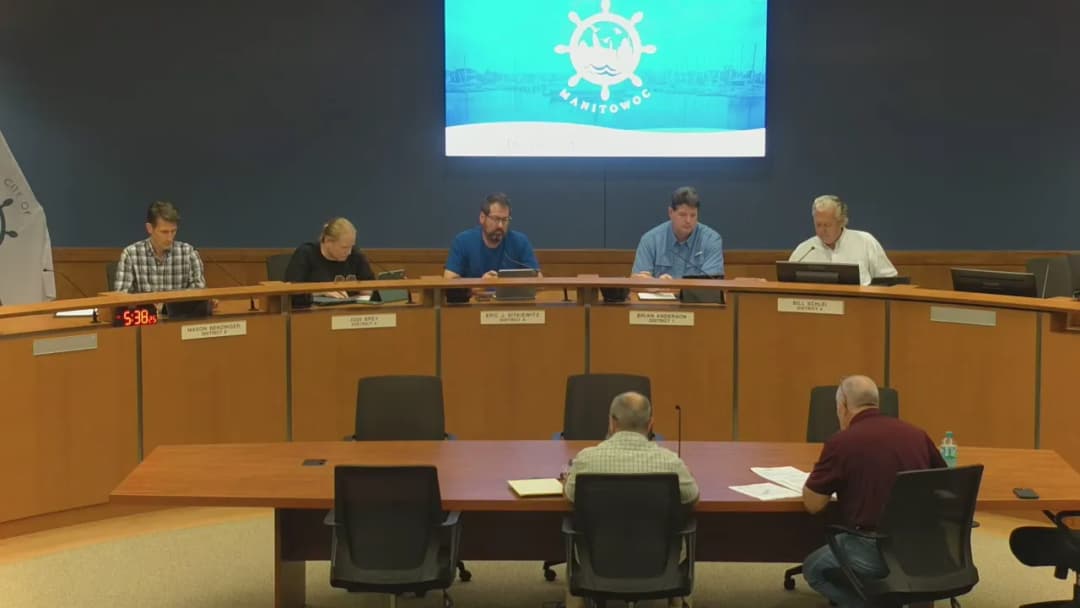
The Public Meeting IndexThe City of Manitowoc Public Works Committee met on Thursday, September 3, 2026, at 5:30 p.m. in Council Chambers and via Zoom. Chairman Bill Schlei called the meeting to order; all five committee members were present: Schlei, Anderson, Sitkiewitz, Brey, and Benzinger. Staff members D. Koski, G. Minikel, and S. Birr also attended. The committee unanimously approved the consent agenda, an ordinance amendment, a state-municipal financial agreement, and three subdivision street lighting resolutions. Consent Calendar - Approved the minutes from the August 6, 2026 Public Works Committee meeting by unanimous vote. No items were removed. Public Comments & Testimony - No public comments were made. One attendee joined online, but offered no comment. Discussion Items - Ordinance to Amend 13.010 Solid Waste Recycling and Disposal (26-0789): Staff explained a request from the Fire Department to move the waste oil drop-off from the Public Safety building to the Department of Public Works (DPW). The new DPW location would be by overhead door A, covered by security cameras, and available from 7 a.m. to 3 p.m. when staffed. Chairman Schlei noted that residents can also take waste oil to AutoZone or O'Reilly Auto Parts after 3 p.m. until 9 p.m., with accepted amounts varying by store. The committee approved the ordinance and referred it to Council. - Maritime Metro Transit Development Plan (TDP) (26-0780): Staff presented the roughly 100-page plan, developed over the past year. No action was requested. The plan was placed on file, and staff said it will return in October with rate increases reflected in the plan. - State-Municipal Financial Agreement (SMFA) for Waldo Blvd - Fleetwood Drive to I-43 (26-0779): Staff said the agreement initiates design work for funding anticipated in 2034, following a prior two-inch overlay that typically lasts 10 to 15 years. The city is responsible for a portion of design costs, capped at $20,189 for priority one plan development, with no construction cost to the city. Alderperson Sitkiewitz noted the project was originally part of the Waldo redesign before being pulled out during the design phase. The committee approved the agreement and referred it to Council. - Street Lighting Resolutions for Abbey Ridge Phase 2, Mariner's Lux, and Deerbrook Crossing Phase 1 (26-0777, 26-0776, 26-0775): Staff described the resolutions as standard roadway lighting for developments, with a 0% city contribution toward installation; developers pay the full installation cost, while the city is responsible for maintenance and energy costs, including a fixed charge of $12 per month depending on the location. The Mariner's Lux charge was slightly higher. The resolutions were approved pending staff finalization, including a fiscal note, and were referred to Council. Key Outcomes - Approved the August 6, 2026 meeting minutes unanimously. - Approved Ordinance 26-0789 and referred it to Council unanimously. - Placed the Maritime Metro Transit Development Plan on file; no action taken. - Approved SMFA 26-0779 and referred it to Council unanimously. - Approved street lighting Resolutions 26-0777, 26-0776, and 26-0775 pending staff finalization, each unanimously, and referred them to Council. - Adjourned at 5:41 p.m.
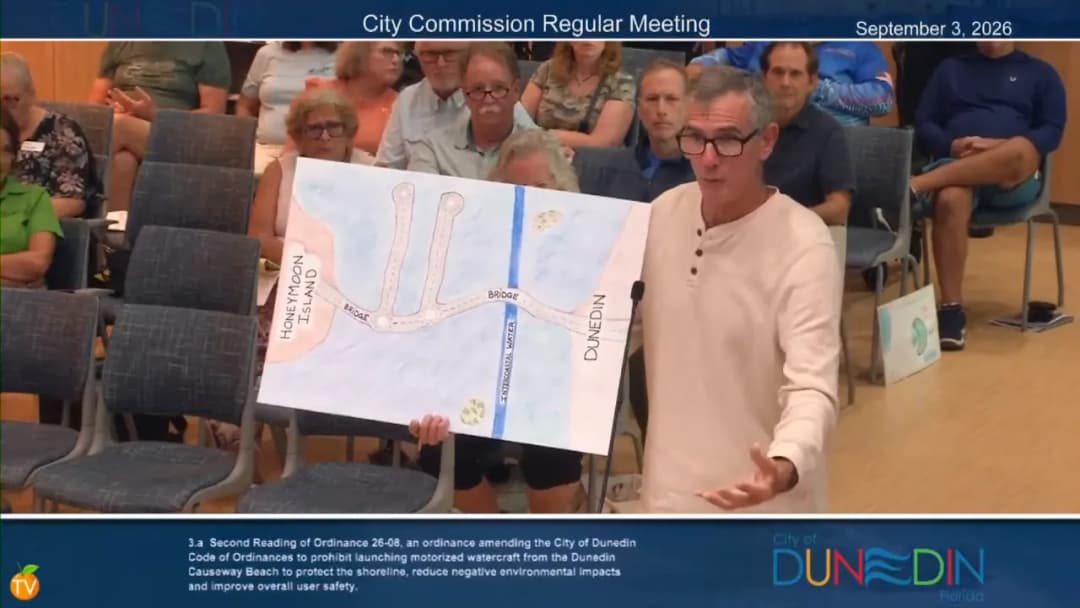
The Dunedin City Commission held a regular meeting on September 3, 2026, at 6:00 PM at City Hall. The meeting included presentations, citizen input, consent agenda approvals, and key action items including a ban on motorized watercraft launches from the Dunedin Causeway, adoption of a tentative millage rate and budget, and an increase in marina slip fees. Presentations - Artist Recognition: Richard Logan was recognized for his artwork displayed in the Commission Chambers from June to December 2026. Logan discussed his creative process and inspirations. - National Constitution Week Proclamation (September 17-23, 2026): Presented to the Caladesi Chapter of the Daughters of the American Revolution by Vice Mayor Walker. The DAR presented a Constitution flag to fly over City Hall during the week. - "A Day to Remember" Proclamation (Patriot Day, September 11, 2026): Presented to the American Legion Auxiliary Dunedin Memorial Unit 275 and Dunedin Fire Rescue by Commissioner Dugard. The proclamation marked the 25th anniversary of the 9/11 attacks. Public Comments & Testimony - David Ballard Geddis Jr. (Palm Harbor) spoke during Citizen Input about bond debt at the Tampa Bay Water Authority, arguing that interest payments on bonds consume a large portion of the budget and that water should not be treated as a privilege. - Numerous speakers addressed Ordinance 26-08 (see Discussion Items). Positions were mixed: many Dunedin residents and organizations supported the ban citing safety, environmental, and quality-of-life concerns; some non-resident jet ski enthusiasts opposed it, arguing it would reduce tourism and economic activity. Specific testimony included: - Mark Clark (Dunedin) argued stormwater runoff, not jet skis, is the primary cause of seagrass damage, and suggested a no-wake zone instead. - Eric Graves (Dunedin) supported the ban, noting improved water clarity and seagrass since the causeway closed. - Carol Horner (Dunedin) a former jet ski user, supported the ban for safety reasons, citing dangerous sandbar changes. - Michelle Birnbaum (Dunedin) expressed concerns about enforcement and safety, recounting a friend injured by a jet ski. - Cleveland Laycock (Dunedin) supported the ban, praising the committee process. - Matt Norman (Dunedin) proposed a compromise: a small, permit-only launch area restricted to Dunedin residents with a one-year pilot. - Sean Spencer (Holiday) opposed the ban, threatening a boycott of Dunedin businesses by a large enthusiast group. - Nancy Schmidt (Dunedin), a Causeway & Coastal Waterways Committee member, explained the committee's decision was driven by safety and enforcement issues, not seagrass. - Rita Foley (Dunedin) urged prioritizing safety and environment. - On Resolution 26-21 and the budget, no public comments were made. - On marina fees, Cleveland Laycock (Dunedin) thanked staff for transparency and noted the Marina Advisory Committee would discuss the boat ramp. Discussion Items - Ordinance 26-08 (Second Reading): Prohibits launching or landing motorized watercraft from the Dunedin Causeway Beach. Staff presented history, safety data (two fatal accidents from 2021-2024), environmental benefits, and support from Pinellas County, Sierra Club, and others. The Commission discussed enforcement (warning, Class 5 citation, trespass), signage, and the distinction between launching and anchoring offshore. The ordinance was adopted unanimously after extensive public testimony. - Resolution 26-21 (Starred Item): Updates the map (Exhibit A) of allowable motorized watercraft operations around the Dunedin Causeway for clarity and readability, without changing waterway designations. The Commission noted needed corrections (zip code, legend consistency). Adopted unanimously. - Resolution 26-12 & 26-13 (Tentative Millage & Budget): Establishes a tentative millage rate of 4.1345 mills ($4.13 per $1,000 assessed value) and a tentative combined operating and capital budget of $138,845,566 — an 11% decrease from FY2026. The budget is balanced, maintains service levels, and includes a state appropriation of $750,000 for a high-water rescue vehicle and Bayshore water main design. Staff noted the budget is advertised as a tax increase due to rising property values. The Commission discussed credit card fees for city services, directing staff to research passing on fees for the golf course first. The contingency plan for Amendment 3 will be presented September 17, 2026. Resolutions adopted unanimously. - Resolution 26-17 (Marina User Fees): Increases marina slip user fees by 7% effective October 1, 2026, rather than the originally planned 10%, due to a $3 million state appropriation for hurricane repairs. The increase is needed to keep the marina fund self-sustaining. The Commission confirmed that five slip sizes changed and that FEMA reimbursement risk could require future adjustments. Adopted unanimously. - Proposed Agenda for September 17, 2026: Approved unanimously. Key Outcomes - Ordinance 26-08 adopted (5-0) — bans motorized watercraft launches from Dunedin Causeway Beach. - Resolution 26-21 adopted (5-0) — updates the causeway watercraft map. - Resolution 26-12 adopted (5-0) — tentative millage rate of 4.1345 mills for FY2027. - Resolution 26-13 adopted (5-0) — tentative operating and capital budget of $138,845,566 for FY2027. - Resolution 26-17 adopted (5-0) — 7% increase in marina slip user fees, effective October 1, 2026. - Agenda for September 17, 2026 approved unanimously. - Staff directed to research steps for passing on credit card fees at the golf course and report back. - Next steps: Final public hearing on millage and budget on September 17, 2026, at 6:00 PM at City Hall. The contingency plan for Amendment 3 will be presented at a workshop at 12:30 PM on the same day.
The Zoning Board of Appeals held a meeting on September 3, 2026, to consider five public hearing applications and several other business items. All applications were granted unanimously, with no public opposition voiced during the hearings. The board also approved amendments to prior decisions, confirmed a minor encroachment, corrected a scrivener's error, and issued preliminary letters of approval for two accessory dwelling units (ADUs). Consent Calendar - Minutes of the August 13, 2026 meeting were approved by a motion (Mr. McGrath) and second (Mr. Castagna), with all in favor. - Confirmation of a lawful minor encroachment for a pool at 18 Hillside Avenue (12-inch variation from the required 5-foot setback) was approved. - Correction of a scrivener's error on ZBA 23736 (change description of garage from detached to attached) was approved. - Preliminary letter of approval for ADU 2256 (689th Avenue) was authorized, with a notation correction regarding the garage connection. - Preliminary letter of approval for ADU 2064 (23 Jane Avenue) was authorized. Discussion Items Public Hearing 23750 (89 Luyster Street, Huntington Station) – Applicant: Daniel and Ashley Marra. Attorney Michael McCarthy presented on behalf of the owners, requesting a variance to maintain an existing semi-inground swimming pool in a technical front yard on a corner lot. The pool was properly screened and fenced; the property had limited depth. No public comments. Board noted the pool had been in place for some time and was not visible from the street. Motion to grant by Mr. Castagna, seconded by Mr. Basso; all in favor. Public Hearing 23741 (267 Lenox Road, Huntington Station) – Applicant: Jeremy Deeg and Stephanie Murphy. The representative requested a rear yard variance for a one-story addition built in 1962. The addition was 21.75 feet from the rear lot line, where 25 feet was required (3.25-foot deficiency). No feasible alternative existed short of demolition. The condition resulted from a prior owner's failure to close out a certificate of occupancy (CO). No public comments. Board clarified that the noncompliance was to both the northerly and westerly lines. Motion to grant by Ms. Whalen, seconded by Mr. Capadano; all in favor. Public Hearing 23726 (86 W. 9th Street, Huntington Station) – Applicant: Armando Dominguez. Attorney Alan M. Davis requested variances to legalize a roofed-over BBQ conversion, porch additions, and a detached garage with habitable features (finished walls but no plumbing or heating). The front porch was 4.5 feet deficient from the required 20-foot setback. The garage was used for storage and a car. No public comments. Board characterized the relief as minor. Motion to grant by Mr. McGrath, seconded by Mr. Basso; all in favor. Public Hearing 23742 (14 2nd Avenue, Huntington Station) – Applicant: Shay Granov / Second Ave. HS Inc. Expiditor Julie Vatrano presented. The buyer in 2016 was unaware of open permits from a 1979 addition and a detached garage. The application sought relief for a 4.5-foot side yard variance (5 feet required) and a 1.75-foot variance for the garage (2 feet required). The addition and garage had existed unchanged since 1979. No public comments. Board clarified the specific relief requested. Motion to grant by Mr. Castagna, seconded by Mr. Campadano; all in favor. Public Hearing 23731 (326 W. Jericho Turnpike, Huntington Station) – Applicant: Paul Schweid (Harley's Grill LLC). Attorney Michael McCarthy returned to request a special use permit, parking variance (80 stalls required, 55 provided), and depth extension for a 550-square-foot seasonal outdoor dining addition. The restaurant would not increase seating; valet parking would be used during peak times. Traffic engineer Wayne Muller (RM Engineering) testified that the valet system and available on-street parking on Jones Lane made the 55 stalls adequate. No public comments. Board found the application fit the neighborhood pattern. Motion to grant (including a negative declaration under SEQRA) by Mr. Whalen, seconded by Mr. Cote; all in favor. Other Business – Amendment to ZBA 23712 (Cabana relief) – Board amended a prior decision to allow air conditioning in the cabana, consistent with previously approved fireplace use. Other Business – Notification on Cornerstone at Melville – Town board notified the ZBA of a pending application; the board chose to take no action at this time. Other Business – ZBA 22647 – Matter adjourned to September 24, 2026, pending clarification from counsel. Other Business – ZBA 23715 (7 Olympia Court, chicken coop) – Board voted to grant the variance for a chicken coop and run, with conditions including no roosters, a limit on the number of chickens, and installation of an odor filtration system as agreed by the applicant. Motion by Mr. Capitano, seconded by Mr. Castagno; all in favor. Key Outcomes - All five public hearing applications were granted unanimously. - The board amended the cabana decision (ZBA 23712) to permit air conditioning. - A 12-inch pool setback encroachment (18 Hillside Avenue) was confirmed as lawful. - A scrivener's error on ZBA 23736 was corrected. - Two ADU preliminary approval letters were authorized. - The regular meeting scheduled for September 10, 2026 was canceled due to incomplete publication; the next meeting will be September 24, 2026.
The Chapel Hill Board of Adjustment met on Thursday, September 3, 2026, at 6:30 PM in the Council Chamber. The meeting included approval of the agenda and minutes from July 2, 2026, a public hearing and deliberation on a dimensional variance for 219 Glenhill Lane, and a discussion on filling the remaining alternate seat on the board. The variance was granted unanimously (7-0), and the membership recommendation was tabled to the next meeting on October 1, 2026, pending further outreach to applicants. Approval of Agenda and Minutes - The agenda was approved unanimously. - The draft minutes from the July 2, 2026 meeting were approved unanimously. Public Comments & Testimony - No members of the public offered testimony on the variance. One attendee asked a procedural question about variance applications but did not comment on the case. Dimensional Variance: 219 Glenhill Lane - Applicant Presentation: Coulter and Kelsey Brinkley, residents of 219 Glenhill Lane, requested a variance to reduce the required 26-foot street setback to 20 feet to construct a 10-foot by 12-foot storage shed. They cited the property's steep topography and irregular corner lot as unique hardships, noting that the only flat area for the shed lies within the setback. They argued the variance would have minimal visual impact, preserve existing trees, and maintain sight lines. - Board Discussion: Board members questioned the applicants about alternative locations, the cost of grading, and the impact on driveway use. The applicants stated that other flat areas were either within other setbacks or would require significant grading and tree removal, which would be financially burdensome. The board considered the four criteria for a variance: unnecessary hardship, unique property conditions, self-created hardship, and consistency with ordinance intent. - Key Support: Board members expressed that the topography and corner lot created a unique hardship, that the applicants did not create the conditions, and that the variance would not affect neighboring properties or streetscape. The board noted the small size of the encroachment (6 feet) and the limited visibility of the shed. - Vote: The motion to grant the variance (Resolution A) passed unanimously (7 ayes, 0 nays). Membership Recommendations - The board reviewed four applications for the remaining alternate seat. Applicants included David (preferred Board of Adjustment), Peter (preferred Planning Commission), Bert Bennett (preferred Downtown Partnership), and Trevor Leatherwood (an ETJ resident). - Discussion: Several members favored David due to his enthusiasm for the BOA and a student perspective, while others noted Peter's environmental background. Concerns were raised about Trevor Leatherwood's application quality (misspellings, grammar) and Bert Bennett's focus on downtown development. The board decided to contact the top two candidates (David and Peter) to confirm their continued interest before making a recommendation. - Decision: A motion to continue the item to the next meeting on October 1, 2026, passed unanimously (7 ayes). Staff will reach out to the applicants and report back. Key Outcomes - Dimensional Variance Granted: The variance for 219 Glenhill Lane (6-foot encroachment into the street setback for a 10x12 shed) was approved unanimously. - Membership Recommendation Tabled: The board will reconsider the alternate seat at its October 1, 2026 meeting after staff contact David and Peter about their interest.
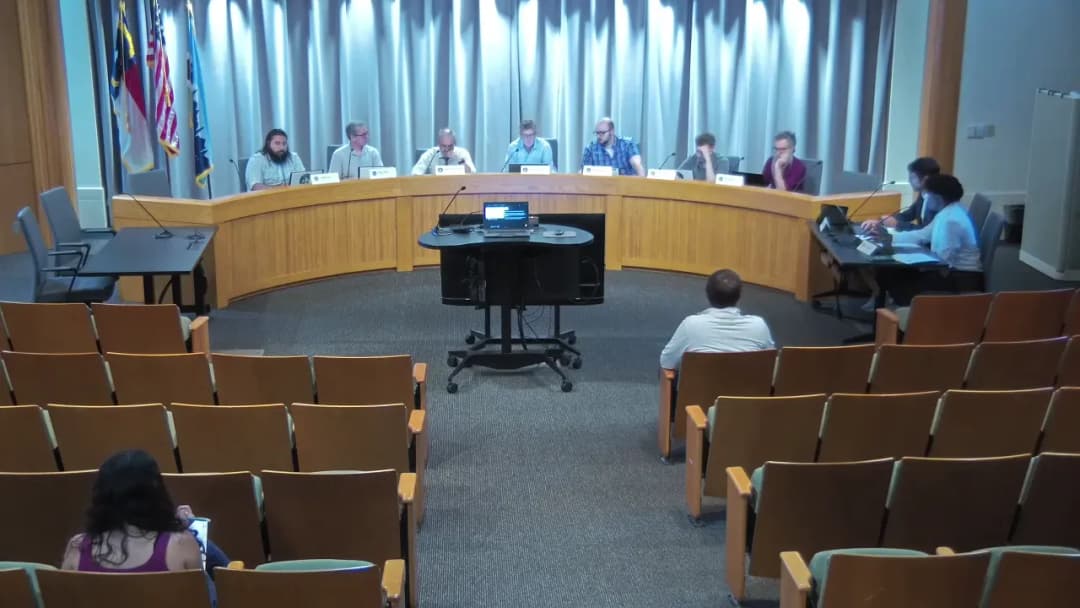
The Gulfport City Council met on Thursday, September 3, 2026, at 6:00 PM at City Hall. The meeting focused on the first readings of the FY 2026-2027 millage rate and operating budget ordinances, along with presentations, public comments, and discussions on various city policies. Key outcomes included approval of a reduced millage rate, a modified budget with several amendments, and a decision to remove funding for e-comments software while maintaining an email alternative. The council also debated the future of Flock automated license plate readers, deferring a final decision to the second reading. Public Hearings: FY 2026-2027 Millage Rate and Budget Ordinances - Millage Rate (Ordinance 2026-09): Councilmember Webb noted the reduction from 4.0258 to 4.026 and asked about exploring a fire assessment fee to reduce the ad valorem burden. City Manager O'Reilly explained that an RFP for a consultant would be needed and could be ready for the next fiscal year. Council gave consensus to proceed with the RFP. The millage rate ordinance passed unanimously (5-0). - Budget (Ordinance 2026-10): City Manager O'Reilly presented adjustments, including transferring $500,000 from the waterfront TIF to the senior center trust fund and reserving $500,000 for stormwater projects. He also noted a reduction in the sanitation fee increase from 8% to 5%, saving $14,000. Extensive council discussion followed on various budget items. Presentations - Spirit of Gulfport Award: Vice Mayor Shaw presented the award to Eileen Navarro for her 30+ years of community service, including leadership of the Gulfport Community Players and the waterfront redevelopment committee. - Florida League of Cities Service Delivery Improvement Award: Mayor Love accepted the award on behalf of the Gulfport Recovers group, which developed a post-hurricane recovery guide after the 2024 floods. Public Comments & Testimony - Flock Cameras: Multiple residents (Metria Jones, Amy Costa reading for Jonathan McCoachy, and others) urged removal of Flock cameras, citing privacy concerns, surveillance state fears, and the need for public trust. One resident requested data on immigration-related arrests. - Budget Items: Residents spoke in favor of restoring the tree budget, eliminating Flock cameras, and maintaining e-comments. Concerns were raised about the tree budget cut (66%), the looper's low ridership, and the need for grant writing services. - Other: Bob Canning advocated for a stormwater backflow preventer program, noting a $200,000 project with a $100,000 EPA grant. April asked about immigration arrests and permitting issues. Discussion Items - Budget Amendments: Councilmember Shaw proposed eliminating the dog run ($20,000), reducing the looper service, increasing the tree budget by $5,000 (from $10,000 to $15,000), reducing COLA from 4.5% to 4%, removing Flock camera funding ($9,000 this year), and eliminating the siding for the little league. Councilmember Webb supported removing Flock, citing state-level concerns and data privacy. Councilmember Early suggested tracking usage of single-use technologies like C Click Fix and short-term rental software. Councilmember Donch supported keeping the leisure services director position frozen but wanted to pursue a grant writer RFP. - Flock Cameras: Police Chief Holloway defended the cameras, citing crime-solving, stolen vehicle recovery, and missing persons cases. He noted that audits are conducted and that only six cameras exist at $9,000/year. Councilmember Webb argued that upcoming state legislation may restrict usage and that the data is owned by Flock, not the city. Council agreed to defer a final vote on Flock to the second reading after hearing from the chief. - Leisure Services Director: Council decided to keep the position frozen (unfunded) but agreed to issue an RFP for grant writing services, using funds from that line item if needed. - Strategic Plan: Councilmember Webb proposed a strategic planning workshop before the comprehensive plan update, but consensus was deferred due to timing concerns. Council agreed to hear a presentation on the Time Weaving project at the first October meeting. - New Business: Council approved holding a town hall on mosquito control on September 21, and a monthly meeting between a rotating council member and the Gulfport Merchants Chamber. Vice Mayor Shaw requested a formal application process for the Spirit of Gulfport Award and a discussion on dinghy dock rules at a future meeting. Key Outcomes - Millage Rate: Ordinance 2026-09 passed unanimously (5-0). - Budget: Ordinance 2026-10 passed unanimously (5-0) after incorporating the following amendments: sanitation increase reduced to 5%, tree budget increased by $5,000, dog run funding removed, little league siding funding removed, COLA set at 4%, e-comments software eliminated but email alternative implemented, Flock camera funding deferred to second reading, leisure services director position kept frozen, and RFP authorized for grant writing services and fire assessment fee consultant. - Consent Agenda: Minutes from July 21, August 4, and August 6, 2026 approved unanimously. - Sanitation Fee Ordinance: Ordinance 2026-11 (first reading) passed unanimously, setting a 5% increase for the coming year and 8% for the following year. - Flock Cameras: Final decision postponed to the second reading of the budget, pending further discussion. - Other: Council gave consensus for a town hall on mosquito control (September 21), a GMC monthly meeting, and an update from the Gulfport Arts and Heritage Board at the first October meeting.
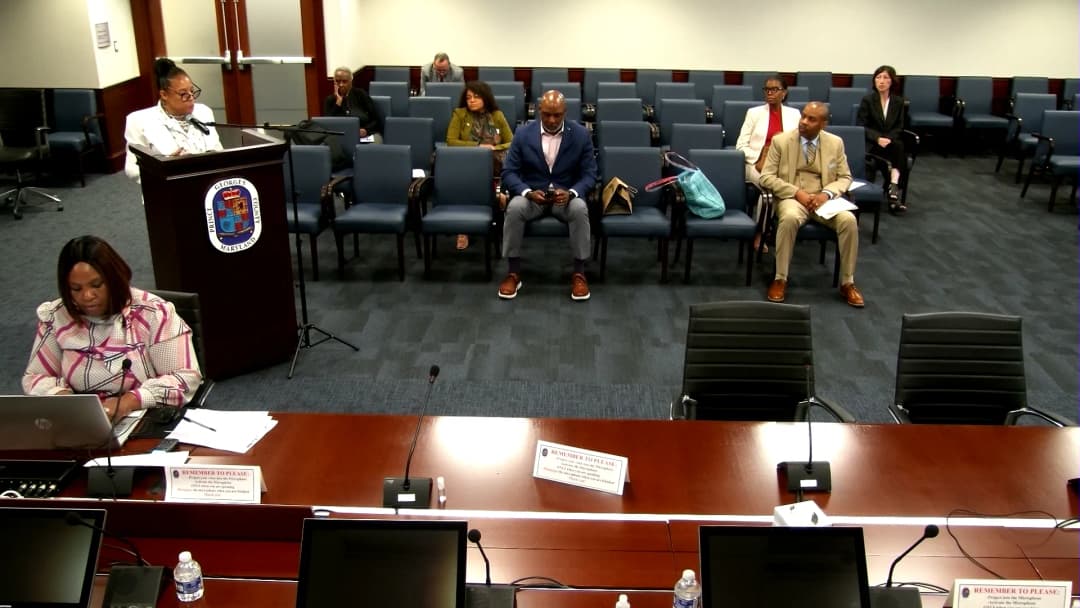
This public hearing, held on September 3, 2026, at the Wayne K. Curry Administration Building in Largo, Maryland, was conducted by WSSC Water to receive public input on the proposed Capital Improvements Program (CIP) for fiscal years 2028 through 2033. The hearing was opened by Commissioner Lynnette D. Espy-Willaims (per the agenda) but the transcript shows Commissioner Regina Speedboss presiding; this discrepancy is noted. Commissioner Speedboss, representing Prince George’s County, welcomed attendees alongside General Manager and CEO Keisha L. Powell and other staff. The hearing featured presentations on outreach efforts, a detailed CIP overview, public testimony, and a report on written comments. No formal votes were taken; the record remained open through September 11, 2026. Public Comments & Testimony - Darlene Cornelius (Capitol Heights) reported a persistent sewage smell in the Capitol Heights area, specifically at the Evelyn Cole senior center on Addison Road, and in her own home when using the dishwasher or washing machine. She also noted a consistent puddle/stream of water on Cling Log Street after underground piping work, asking who is responsible for repairs when the issue is past her property line. Commissioner Speedboss responded that WSSC Water would investigate both the sewage smell and the standing water, and clarified that WSSC Water is responsible for infrastructure in the public right-of-way. - Sharon McClevan (Suitland) raised a question about responsibility for maintenance and repairs on common property in a condominium. She described a dispute with her condominium association regarding boundaries for responsibility. Commissioner Speedboss offered to collect her address and investigate further. - No other speakers signed up or came forward during the open comment period. Discussion Items - Opening Remarks and Outreach: Commissioner Speedboss opened the hearing. Chuck Brown, Director of Communications, described extensive outreach: bilingual inserts in customer bills (May–August), public notices in the Prince George’s County Post and Washington Post, social media promotion across Facebook, Twitter, Instagram, and Blue Sky with paid advertising, a notice sent to 4,342 Constant Contact subscribers, a newsletter emailed to approximately 10,430 customers, and a letter from General Manager Powell to all elected officials. - General Manager Remarks: Keisha L. Powell highlighted the significance of the proposed $4.7 billion investment over six years (FY28–33), including $742.8 million in FY28. She emphasized the economic impact: every $1 million invested in water infrastructure creates 15–18 jobs. Over the past five years, WSSC Water contributed $704 million to businesses in Prince George’s and Montgomery counties, with over $419 million going to local minority- and women-owned businesses. She also noted the passage of House Bill 1230 to modernize WSSC Water’s business participation framework. - CIP Overview by Finance Staff: Sunil Pandya (CIP Section Manager) and Claude Modise (Facility Design and Construction Section Manager) presented the proposed CIP. Key points included: - The preliminary FY28 capital budget is $742.8 million ($35.76 million less than FY27). - Consent decree and multi-use joint facilities account for 21.2% ($157.8 million) of the FY28 budget. - 65% of the FY28 budget is comprised of five programs: Reconstruction, Blue Plains, Metering Infrastructure Upgrade, Western Branch Water Resource Recovery Facility Process Train Improvements, and Lead Reduction/Replacement/Program Management. - The six-year CIP totals $4.71 billion, funded by $3.53 billion in bonds, $121 million in pay‑as‑you‑go, and $265 million in external funds. - No capital project was reduced to achieve the six-year total. - FY28 priorities: rehabilitating water supply treatment and storage facilities; investing in water resource recovery facilities; modernizing the support center and Anacostia Depot; compliance programs (lead/copper reduction, PFAS); meter infrastructure upgrade; and master planning/infrastructure investments. - By county: 41% ($305.1 million) in Prince George’s County, 31% ($231.6 million) bi‑county, and 28% ($206.1 million) in Montgomery County. - 86% of the FY28 budget is for system improvements, 11% for environmental regulations, and 3% for growth. - Mandated projects (consent decrees, multi‑use, public health/safety) account for 21% of both the FY28 and six‑year budgets. - Proposed FY28 includes 135 ongoing projects ($250.9 million), 68 new projects launching in FY28 ($131.8 million), and $360.1 million for initiatives such as lead reduction, PFAS, Blue Plains, master planning, and developer projects. - Project prioritization uses six weighted drivers; regulatory mandates and health/safety risk together represent nearly two‑thirds of the weight. - Highlighted projects: Sewer Reconstruction Program (No. 1), Trunk Sewer Reconstruction Program (No. 5), PFAS Management Strategy (No. 10), water main replacements (small diameter: 32 miles at $67 million; large diameter: 4 miles at $33.74 million), growth projects ($2.48 million), wastewater collection (Trunk Sewer Reconstruction $32.5 million for 6 miles; Sewer Reconstruction $57.19 million for 25 miles), nine wastewater pumping station rehabilitations (e.g., ACOLA $2.71 million, Anacostia 2 $6.1 million), Forest Heights and Spring Garden pump stations, upgrades at PUC ($13.7 million) and Western Branch ($50.68 million), Blue Plains ($151 million – treats 62% of WSSC Water’s wastewater; over 28% of FY28 CIP is for Blue Plains and Metawoman projects), innovation/investment priority category ($108 million) including Energy Performance ($11.68 million), Lead Reduction ($31.3 million), and Water Meter Infrastructure Upgrade ($53.24 million for 53,000 meters), and general facilities (Anacostia Depot reconfiguration $21.94 million; Support Center upgrades $15.43 million). - Report on Written Comments: Sunil Pandya reported that no written correspondence had been received by the date of the hearing. Any submissions received by the close of business on September 11, 2026, would be included in the commission packet and transmitted to the counties. Key Outcomes - The public hearing was adjourned by Commissioner Speedboss. No votes were taken. - The public hearing record remains open until noon on September 11, 2026, for written comments (via email to budgetgroup@wsscwater.com or mail to WSSC Water Budget Division, 14501 Sweitzer Lane, Laurel, MD 20707). - All testimony, transcripts, and any written comments received by the deadline will be transmitted to Prince George’s County and Montgomery County governments by October 1, 2026, as required by state law. - WSSC Water staff committed to investigating the sewage odor and standing water issues raised by Darlene Cornelius, and to following up with Sharon McClevan regarding condominium property line responsibility.
This special session of the Janesville City Council was convened on September 3, 2026. The agenda included only one item: consideration of a motion to enter closed session under Wisconsin Statute Sections 19.85(1)(c), (f), and (e) to discuss the employment agreement with a new City Manager. No minutes or transcript are available, so the outcome of the closed session discussion and any subsequent votes are unknown. The meeting time listed on the agenda is 5:00 PM local time, which differs from the 11:00 UTC timestamp provided for this summary; this discrepancy is noted. Call to Order, Pledge, and Roll Call - The meeting was called to order, the Pledge of Allegiance was recited, and emergency procedures were reviewed. Roll call was taken. Consideration of Closed Session - The council considered a motion to convene into closed session for the purpose of negotiating the employment agreement with a new City Manager. No further details are available from the agenda or transcript. Key Outcomes - No decisions, votes, or next steps are documented due to the absence of minutes and a transcript. The only action noted was the consideration of the closed session motion.
The Board of County Commissioners of Carroll County held a public hearing on the evening of Thursday, September 3, 2026, to receive public comment on three sets of proposed amendments to the county code: (1) Chapter 155 regarding cluster subdivisions, (2) Chapters 155, 156, and 158 regarding accessory dwelling units (ADUs), and (3) Chapters 91, 155, and 158 regarding retirement villages and retirement homes. The hearing was called to order at 6:00 p.m. in the Reagan Room (Room 003) of the County Office Building. Acting County Administrator Deb Ethingham, County Attorney Tim Burke, and Department of Planning and Land Management Director Chris Heyn and Deputy Director Daphne Daly were present. For each topic, staff presented a brief summary, followed by public comments (in person only; no virtual comments were accepted). Each hearing concluded with a unanimous motion to close the public hearing and keep the record open for ten calendar days. Public Hearing on Proposed Amendments to Chapter 155 – Cluster Subdivisions - Staff explained that the amendment, recommended by the Planning and Zoning Commission, would allow the Board of County Commissioners to adjust open space, density, and minimum lot size requirements for a cluster subdivision if the applicant enters into a Development Rights and Responsibilities Agreement (DRRA) that provides a significant community benefit. No other changes to the 2022 cluster subdivision code were proposed. - Several members of the public (Mark Krebs, Brad W., Marty Burns, Timothy S., Michael Bloom, David Bauer Sox) spoke in opposition to current cluster subdivision practices. Key positions included: - Density calculations should be based on net buildable acreage, not gross acreage, to avoid overbuilding. - Existing traffic congestion (e.g., at Route 32 and Bennett Road) would be exacerbated. - The proposed DRRA process was criticized as too subjective and unlikely to benefit residents. - David Bauer Sox, an attorney representing property owners and developers, submitted a proposed revision to the amendment to clarify that a DRRA is elective and to preserve grandfathering for projects submitted before December 2025. He urged the Board not to inadvertently repeal that grandfathering. - No other public comments were offered. The Board voted unanimously to close the hearing and keep the record open for ten calendar days. Public Hearing on Proposed Amendments to Chapters 155, 156, and 158 – Accessory Dwelling Units - Staff stated that the amendments were driven by state House Bill 1466 (passed April 22, 2025), which requires local jurisdictions to adopt ADU regulations by October 1, 2026. The proposal amends definitions, adequate public facilities provisions, and zoning regulations to allow ADUs on single-family lots. - Public commenters included Brett Hackett and Matt Shipley (CLSI), Michael Davis, Joe Kuhn, Roger Coon, Kelly Miller, Kevin Davis, and Lynn Allen. Key positions: - Several speakers (Hackett, Shipley, Miller, Davis) requested removal of the two‑bedroom limit (Sec. 158.176D) and the 50‑foot maximum distance requirement between the primary dwelling and ADU (Sec. 158.176M), arguing these restrictions are among the most restrictive in Maryland and make ADUs financially or physically infeasible. - Joe Kuhn and Roger Coon raised concerns about minimum lot widths, septic requirements, and the impact on agricultural preservation properties. - Lynn Allen highlighted infrastructure strain (electric grid, hospital emergency room) and asked where property tax revenue from new development is going, stating Eldersburg does not see benefits. - No one spoke in favor of the current restrictions. The Board voted unanimously to close the hearing and keep the record open for ten calendar days. Public Hearing on Proposed Amendments to Chapters 91, 155, and 158 – Retirement Villages/Retirement Homes - Staff explained that the amendments address concerns about scale, compatibility, lack of amenities, aging‑in‑place features, density bonuses, and emergency access. The Planning and Zoning Commission held five meetings, and a public survey and open house were conducted. The amendments include new density and unit mix requirements, design standards, parking and connectivity standards, open space, and amenity requirements. - Many residents from the Freedom District (Eldersburg) spoke in strong support of the amendments, urging the Board to adopt them and to reject grandfatheroing for projects already in the pipeline. Speakers included Kathy Barnett, Terry Harrigan, Donna Harrigan, Nancy Kaufner, Jean Roosh, Karen Leatherwood, Brad W., Linda Mussiami, Michael Bloom, Sally Taylor, Marty Burns, Karen Donaldson, Bob Leatherwood, Amy Easter, and Michael Anderson. Key positions: - Several speakers cited safety concerns raised by the Sykesville Freedom Fire Department regarding narrow streets and lack of guest parking; they argued that painted no‑parking curbs are not enforceable and that emergency vehicle access is compromised. - Multiple residents stated that three‑story townhouses are not appropriate for age‑restricted communities; they want single‑story or ranch‑style homes with universal design features (zero‑step entries, wide doorways, grab bars). - Many objected to the use of R20 zoning (single‑family residential) for townhouses, calling it a violation of the Freedom Community Comprehensive Plan. - Speakers demanded that projects already in the pipeline (e.g., Freedom’s Grant, Eldersburg Overlook, Reservoir Run, Freedom Avenue/Jonesville) be held to the new standards and not be grandfathered. - Representatives from developers (Chris Armstrong of Lennar, Thomas Pelon of St. John Properties, Gus Ballman of Beveridge & Diamond, and Mike Calianok of JPB Partners) asked the Board to grandfather their projects because they have invested millions of dollars over several years in reliance on existing code. They argued that the proposed amendments would require them to restart the approval process, which would be unfair and possibly unconstitutional. - Kelly Schaefer Miller, an attorney, raised procedural concerns about new requirements (e.g., amenity reports) and asked for a “test fit” of the amendments to ensure they work as intended. She noted that the Freedom’s Grant plan, with a 30% single‑family detached mandate, cannot achieve the proposed density. - The Board voted unanimously to close the hearing and keep the record open for ten calendar days. Key Outcomes - All three public hearings were concluded with a unanimous vote to keep the record open for ten calendar days (until September 13, 2026). - The Board is expected to deliberate and potentially adopt the proposed amendments in an open session on September 17, 2026. - No votes were taken on the substance of the amendments during the hearing.
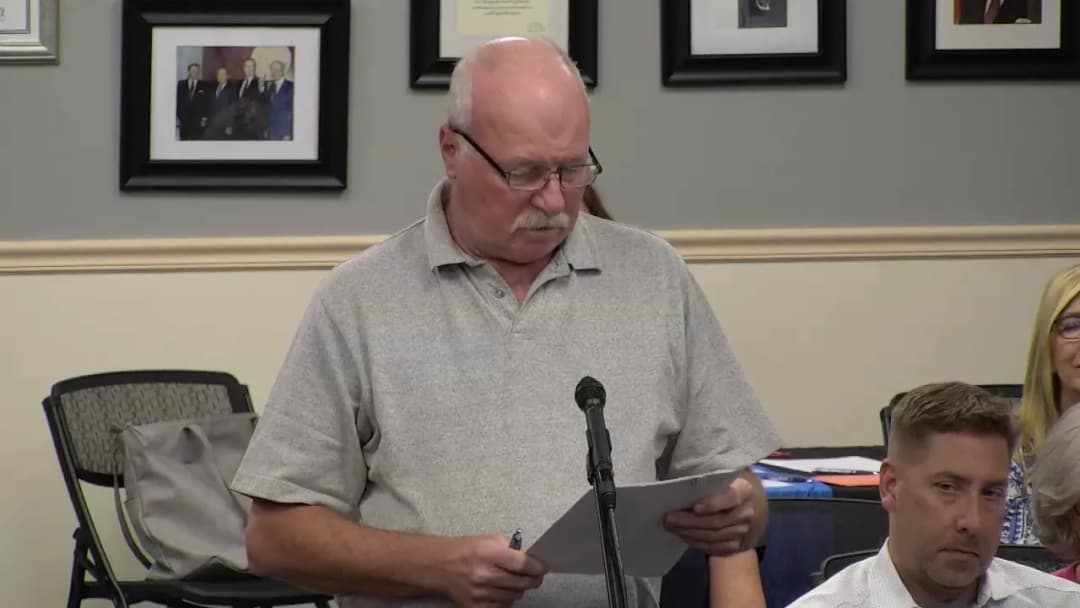
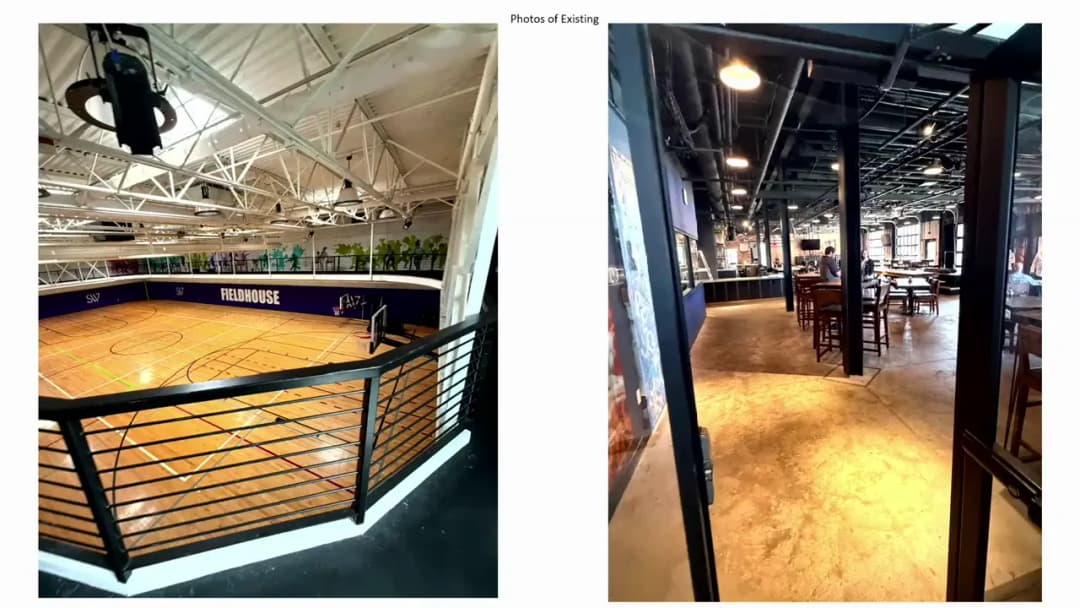
The Lakewood Planning Commission met on September 3, 2026, to consider a parking plan modification for 1384 Heard Avenue and to receive public input on the Delaware Avenue active transportation plan as part of a water main project. The commission approved the parking plan extension with conditions and received and filed the Delaware Avenue presentation. Public Comments & Testimony Delaware Avenue Active Transportation Plan (Item 092626): - Dan Zelinski (2197 Northland Ave): Questioned why raised crosswalks recommended in the Active Transportation Plan were not included; asked for city's guidance on raised crosswalks. - Maggie McKinney (2156 Carabel Ave): Expressed excitement for bike boulevard; supported crosswalk at Olive; asked about bike lane design in front of Hayes Elementary, particularly how students on bikes would access the school. - Emily Lindbergh (1651 Lauderdale Ave): Also questioned lack of raised crosswalks; advocated for a crosswalk at Northland; suggested a bi-directional protected bikeway along the school side and questioned necessity of parking on the south side. - Jim Andrews (Clifton Blvd): Raised concern about transition between shared lane and dedicated bike lane segments; questioned legality of crossing at non-signalized intersections. - Bill Zimmerman (2264 Woodward Ave): Opposed bike lanes during school drop-off/pickup due to safety; asked where curb extensions exist in Lakewood; questioned what problem is being solved; noted speed bumps on Woodward cause drainage issues. - Carrie Sommerman (2264 Woodward Ave): Cautioned against over-engineering; raised concerns about drainage, safety forces access, curb extensions bringing children closer to traffic; suggested keeping it simple. - Karen Schwartz (2249 Eldred Ave): Opposed bike lanes due to dooring risk during school pickup; described solution in search of a problem. - Cody George (2195 Wine Dot): Supported buffer zone between bike lane and parking; advocated for raised crosswalks; suggested painted crosswalk in school zone; noted infrastructure over paint. - Steve Bozia (16615 Delaware Ave): Asked about project timeline (water main replacement in 2028); noted speeding after school zone; supported speed tables at elementary schools; raised drainage issues. Discussion Items 1. Parking Plan Review – 1384 Heard Avenue (Item 092526) The applicant, Mark Casper and Diarius Houston on behalf of the new owner, requested an extension of the parking radius from 500 feet to 1,000 feet to secure additional off-site parking spaces for the Field House (restaurant, bar, event space). The original 2021 parking plan required 113 owner-controlled spaces within 500 feet. The applicant had secured 43 spaces at Martindale Electric and 40 spaces at Northwest School of the Arts (within 1,000 feet). City staff recommended approval with conditions: return to commission in six months if use changes, apply for separate outdoor dining permit, submit final parking agreements, and develop a plan for communicating parking locations and promoting transit/ride-share. The commission discussed operating hours, parking restrictions, and communication plans. A motion to approve with those conditions passed unanimously (Commissioner Gall excused). 2. Delaware Avenue Active Transportation Plan (Item 092626) City Engineer Mark Papke presented a concept plan for a bike boulevard on Delaware Avenue from Glenbury to Carabel, coinciding with a 2028 water main replacement. The plan included shareows (shared lane markings) or a buffered bike lane in the wider section near Hayes Elementary, curb extensions at Woodward and Olive, a rectangular rapid flashing beacon (RRFB) at Olive, and high-visibility crosswalks at Carabel. Public comments raised concerns about raised crosswalks, bike lane transitions, school drop-off conflicts, drainage, and parking loss. Commission members discussed preferences for Option B (buffered bike lane), safety, and the need for further study. No vote was taken; the commission received and filed the communication. Key Outcomes - Parking Plan (1384 Heard Ave): Approved with conditions: 1. Return to Planning Commission in six months (March 4, 2027) to update on use and parking; if unchanged, a letter suffices. 2. Apply for separate outdoor conditional use permit for patio dining. 3. Submit finalized parking agreements for spaces within 1,000 feet. 4. Develop an internal plan for external communication and signage to direct patrons to approved parking areas; promote ride-share and public transit. - Delaware Avenue Project: Received and filed. City staff will incorporate public and commission feedback into the design, with the next stage presentation expected in approximately one year.