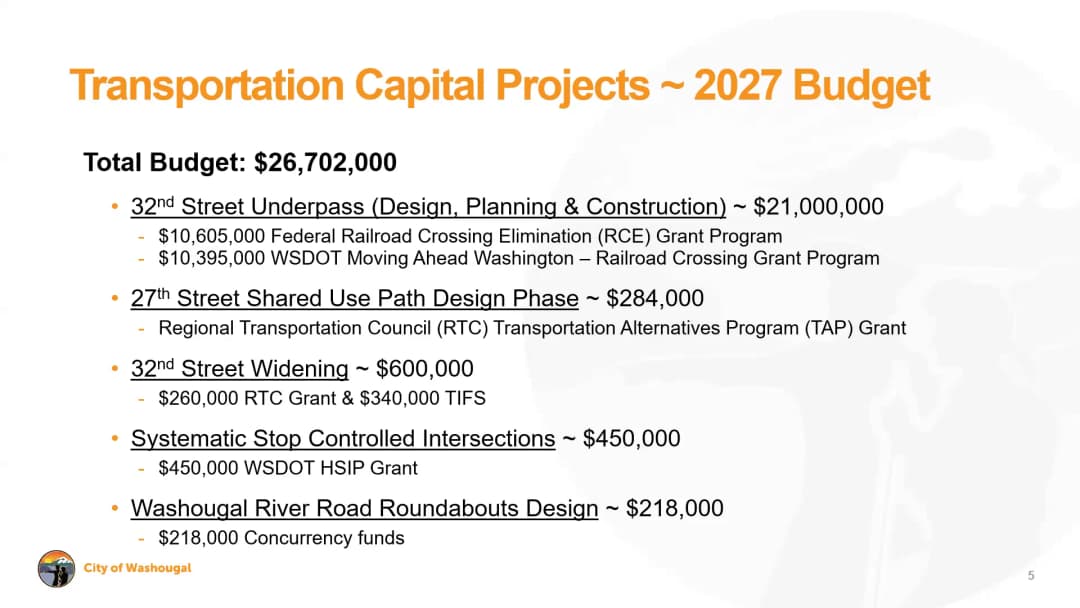
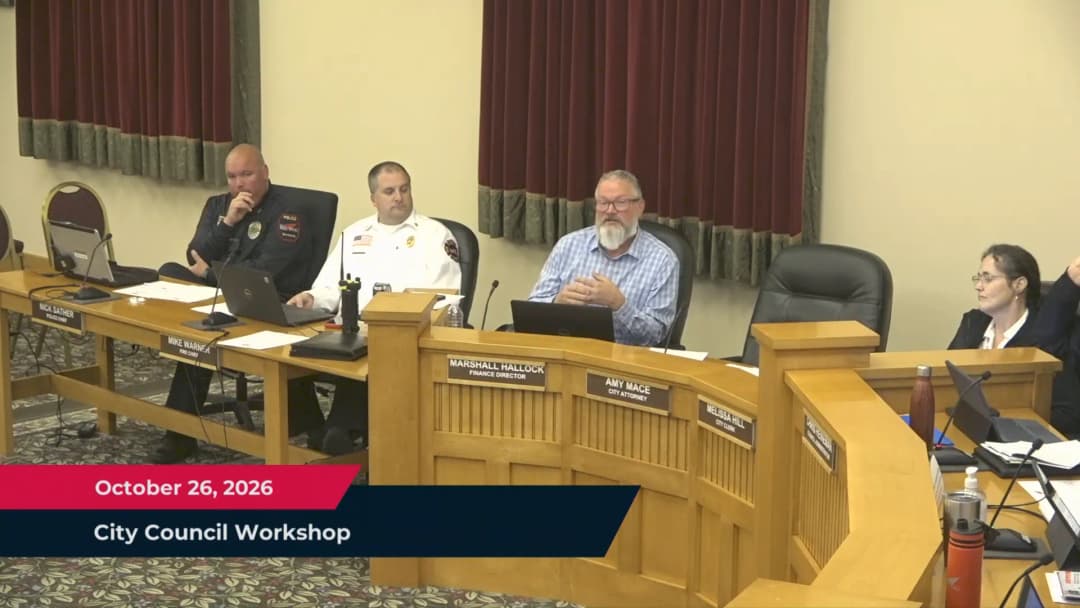
The Washougal City Council met in workshop on October 26, 2026, to receive staff presentations on the Arts Commission ordinance, the final draft Comprehensive Plan, the Shoreline Master Program, updated Transportation Impact Fees, and the first portion of the 2027-2028 budget. The workshop was informational and no formal votes were taken. Note: The agenda lists the meeting date as Monday, October 26, 2026, while the opening transcript says 'Monday, October 27th.' Public Comments & Testimony - Mike Wolf, founder of the Washougal pickleball club, spoke about the pickleball courts at Halfway Park. He said he started the club in 2012 with 24 members, that it now has about 1,600 members, and that roughly 450 of them are from Washougal and Camas. He described the courts' history, including a $5,000 contribution from the Clark County Recreation Organization, and said 50 or more people use the courts on non-rainy days. He urged the city to repair the courts before deterioration raises costs, said Linda Bosle will bring a repair proposal on November 6, and offered to personally advance money if needed. He said he would support a small user fee but warned that high fees could drive players away. Council members thanked him and said they would take the request under serious consideration; discussion also touched on possible indoor pickleball at the port and a recently signed batting-cage lease in port building 18. Discussion Items Arts Commission Ordinance Amendments - Staff presented amendments to WMC 2.120 to reorganize the Arts Commission code and add a definitions section. The change would allow arts funding to support non-capital art forms and artists; it would not change current funding but would create a future budget line item. The ordinance is scheduled for the November 2 adoption agenda. Final Draft Comprehensive Plan - Jessica of Community Development reported that the draft comprehensive plan was out for public comment for just over a month, with the comment period ending October 18. A CEPA mitigated determination of non-significance was completed. Staff received 23 online comments; themes included accommodating growth where services are sufficient and preserving community character. Updates made after public comment and planning commission feedback included cleanup of introductory chapters, reformatted goals and policies, and changes to the implementation strategies table. A draft comment letter from the Washington Department of Commerce arrived late the previous week and was still being reviewed. Public hearings are scheduled, with tentative adoption on December 7. Shoreline Master Program - Ethan reported that the draft Shoreline Master Program was approved by resolution last year and sent to the Washington Department of Ecology. Ecology provided 20 required changes and 18 recommended changes, which staff characterized as minor. Examples included grammar and internal reference updates, archaeology language, small corrections to the shoreline environment designation map, and updates to commercial building height standards. Water-dependent commercial uses increased by about 10 to 20 feet (to roughly 35 to 55 or 60 feet), while water-oriented commercial uses decreased by about 10 feet. A public hearing is set for November 2, with adoption possible on December 7. Transportation Impact Fees - Michaela presented the updated Transportation Impact Fee (TIF) analysis. The update was driven by recent construction cost changes, alignment with the six-year Transportation Improvement Program, and an additional project added from public comment. The updated fee is $3.99 per square foot. For residential units, the minimum fee is $2,840.09 for units below 712 square feet, and the maximum fee is $12,302.64 for units above 3,084 square feet. The current single-family fee is $7,826; an updated 2,500-square-foot unit would be $9,971. Vancouver and Battle Ground are also updating their fees. No feedback from the building industry had been received yet. The TIF memorandum will become an appendix to the Transportation Capital Facilities Plan. 2027-2028 Budget – Community Services & Strategy and Public Works - Daniel presented part three of the departmental budget presentations. The animal control update and remaining capital projects were deferred to the next meeting. - Community Services & Strategy: overall increase of 1.5% from 2026 to 2027. Personnel costs decrease because previously budgeted positions were filled. Community engagement funding is $43,800 for events such as Memorial Day, Movies in the Park, National Night Out, and the lighted Christmas parade. Code enforcement highlights include $2,000 for the Washougal Wins litter program, $1,000 for neighborhood outreach, a new dumpster-rental program for neighborhood cleanups, and funding for potential code enforcement software. Economic development professional services include federal and local advocacy contracts, CREDC, and the small business pilot program. The department remains at 6 FTEs. - Public Works facilities: 8% decrease from 2026 to 2027 due to one-time public safety sales tax facility hardening and janitorial expansion; a 3.7% increase is projected for 2028. A janitorial RFP is out. Utility costs are budgeted at $65,000. - Engineering: 9.43% increase from 2026 to 2027. A vacant stormwater maintenance position would be reallocated to a civil engineer position, with costs shared across funds; the goal is to reduce outside consulting over time. Professional services are budgeted at $100,000 for 2027 and $110,000 for 2028. - Parks: 14% decrease in 2027 due to one-time comp plan costs and a temporary position; 4.4% increase in 2028. Supplies rise by $16,000 for splash pad chlorine. Professional services of $109,000/$112,000 cover seasonal staff, tree trimming, portable toilets, and debris disposal. $15,000 is included for parks hardening from the public safety sales tax. - Street Fund: 6.27% increase from 2026 to 2027. Clark County crews would reconfigure two River Road traffic signals at about $15,000 per signal in preparation for the 32nd Street closure. The street department has about 5 FTEs. - Cemetery Fund: 6.19% increase in 2027, then a 10.9% decrease in 2028. A $42,000 transfer supports the veterans memorial project in the parks capital fund. The cemetery fund has 1.22 FTEs. - Water and Sewer Fund: small decrease of 2.63% from 2026 to 2027, then a 6.56% increase in 2028. Requests include about $50,000 per utility for water/sewer model and GIS/asset management work, and $70,000 per fund for the next rate study in 2028. The first payment on the $22.5 million biosolids loan at 1.6% interest is $479,000, due New Year's Eve 2027, with payments every six months thereafter. Debt service increases 5.2% in 2027 and 16.14% in 2028. - Stormwater Fund: 2.37% decrease from 2026 to 2027. Highlights include $185,000 for enhanced maintenance (mostly Ecology-funded), $120,000 stormwater capacity grant, $200,000 permit compliance, $477,000/$496,000 for catch basin and drainage improvements, $100,000 for the regional stormwater partners program, $31,000 for trail drainage repairs, and $71,000 for the Camp Creek LCEP pass-through. Shepherd Road stormwater improvements are about $1 million, with $800,000 in 2027. Fleet purchases include a CCTV inspection truck and a pickup replacement. The stormwater FTE count decreases by 0.3 due to the civil engineer reallocation. - Total Public Works FTEs are 35. Capital Projects Preview - Facilities capital projects for 2027 total $16.703 million, with the bulk for fire station and police station design/construction. The Public Works Operations Center phase two is $600,000 total, with $550,000 in 2027; it would renovate the garage/mechanic shop and create office space to be rented to the 32nd Street project team. Downtown town center closeout is $100,000; EV chargers are installed at town center lots and are vendor-operated. The 2028 facilities budget includes about $1.1 million for fire/police station closeout. - Transportation capital projects for 2027 total $26.702 million. The largest item is the overpass project at about $21 million, split between federal and state grants (roughly 50.5%/49.5%). Other items include the 27th Street shared use path ($284,000), 32nd Street widening ($600,000), systemic stop-controlled intersections ($450,000), River Road roundabout design ($218,000 from concurrency dollars), Shepherd Road pedestrian improvements ($3.4 million), River Road bridge repairs ($100,000), ADA upgrades ($100,000 per year), railroad crossing upgrades ($100,000), and the 39th Street project ($400,000 with Safe Routes to Schools and TIF funding). Reports and Communications - Council discussion included a proposed AWC scholarship nomination for a local graduating senior, support for the Clark County Pathway Project to provide safe access from Washougal to Lacamas Park and Woodburn Elementary, and praise for the port's economic study. - Several council members expressed concern about high-speed e-bikes and e-motorcycles, helmet use, sidewalk operation, and safety near schools and parks. They asked staff to arrange a briefing from Zane on state preemption and possible local ordinance options, possibly early next year. Key Outcomes - No formal votes were taken at the workshop. - The Arts Commission ordinance will be on the November 2 adoption agenda. - Public hearings are scheduled for November 2 (Shoreline Master Program and general sewer plan amendment), November 9 (parks plan; Transportation Capital Facilities Plan hearing may be opened and continued), and November 16 (draft comprehensive plan and development code amendments). December 7 remains the tentative adoption date for the plans. - The budget presentation will continue the following week, with a physical budget document due by the statutory deadline and updates on remaining capital projects, animal control, and LTAC/LTEC recommendations.
The Public Meeting Index
The Public Meeting IndexThe Red Wing City Council held a workshop on October 26, 2026, to discuss the proposed 2027 budget and levy and potential revisions to the city's Snow and Ice Control Policy. Councilmembers gave feedback on levy targets, capital expenditures, and policy changes, reaching consensus on several items. Budget and Levy Discussion - Staff reviewed the budget calendar and status, noting the initial proposed levy increase of 5.53% could be reduced to 3.99% or 3.5% based on various adjustments (keeping ICRA tax exempt freed up budgeted funds, fuel cost pressures, etc.). - Net tax capacity increased nearly 7%, shifting the tax base: residential taxes would slightly decrease under a flat levy while commercial/industrial would increase. - Councilmember Ron suggested specific cuts (skate park, green fund, ambulance fund, park items) totaling over $1,050,000, potentially allowing a 0% levy increase. - Mayor advocated for a 2% levy increase and expressed support for staff’s recommendation. - Councilmember Becky supported fire department staffing but wanted to see a staffing survey first, and she favored shifting performance pay to longevity pay. - Councilmember Jenny emphasized waiting for the parks master plan before funding major projects like the skate park and supported maintaining playground equipment budgets. - No formal vote was taken; council guidance will inform the next budget draft. Staff indicated final adoption is scheduled for December 14. Snow and Ice Control Policy Discussion - Staff presented potential policy updates, including adding a 325-foot trail segment along Old Tyler Road, extending the snow clearance window from 24 to 72 hours, and establishing an annual review process. - Council reached consensus to add the 325-foot trail segment. - After debate, council agreed to extend the snow clearance window to 72 hours (from 24) for both city-maintained pedestrian routes and private property owners, with an annual review to assess effectiveness. - Council agreed that future service requests for trail additions would be considered annually in spring rather than individually throughout the year. - Staff will prepare formal policy revisions reflecting this guidance. Key Outcomes - 325-foot trail addition: Consensus to include the Old Tyler Road segment in the snow clearance policy. - Snow clearance timeline: Council supported changing the standard clearance window to 72 hours after the last accumulation, applying to both city crews and property owners. - Annual review: The snow and ice policy will be revisited each spring, with staff bringing forward a list of requested additions. - Budget direction: Council members expressed a preference for a lower levy increase (ranging from 0% to 3.5%), with further discussion to continue in subsequent workshops, including consideration of a parks master plan and staffing surveys before certain expenditures.
On October 26, 2026, the Richmond City Council, led by President Nibbil, convened the 2027 Legislative Summit. The meeting brought together Mayor Buller, administrative staff, Richmond Public Schools (RPS) representatives, and the Richmond delegation of the Virginia General Assembly to review and align on the city's unified state legislative and budget priorities for the upcoming session. Discussion Items - Unified Legislative Agenda and State Partnership: Mayor Buller opened by celebrating the collaborative effort behind a single, unified city legislative agenda, which he stated strengthened the partnership with the General Assembly delegation. He highlighted the success of the 2026 session, which yielded a highly favorable FY27 state budget for Richmond, including significant investments in the CSO system, water treatment plant, and downtown development. Capital project execution rates were noted to have risen from 60% to 80%. - Housing and Anti-Displacement: Lobbyist Devin Cabot presented the top legislative priorities. For housing, the city is seeking a constitutional amendment to authorize a long-term owner occupancy program (the council's top priority), expanded tenant protections (including prohibiting algorithmic rent setting and anti-rent gouging), and stronger tools to regulate short-term rentals (requiring platform data sharing and the removal of non-compliant listings). - Blighted and Vacant Properties: Councilwoman Jones requested specifics on tools needed for chronic blight. Sharon Ebert, DCAO for Planning and Economic Development, explained that many properties remain tax-current, making enforcement difficult. Current code enforcement is limited to requiring buildings to be secured, and legal processes are too slow. The city is seeking stronger violation fees, time limits on vacancy, and broader definitions of blight. - Infrastructure and CSO Funding: Significant discussion centered on the Combined Sewer Overflow (CSO) project. Director Morris provided an update, stating the final plan is estimated at $516 million, with $350 million remaining for the high-rate disinfection facility. The city made a formal request for $100 million in FY28. Senator Bagby questioned the alternatives to state funding, which led to confirmation that without state dollars, the burden would fall on ratepayers through rate increases. Richmond was noted to have a higher rate impact than other CSO utilities in Lynchburg and Alexandria. - Affordable Housing Trust Fund and Tax Programs: Housing Director Eric Malone stated the city's Affordable Housing Performance Grant has added nearly 3,000 units to the pipeline. The city has dedicated 2.5% of increased tax revenue (estimated at $12-15 million annually) to the Affordable Housing Trust Fund, with 30% reserved for households at 30% Area Median Income (AMI) and below. The severe challenge of providing housing for the 30% AMI population without deeper state subsidies was a key theme. - Predatory Lending and Taxpayer Protections: Concerns were raised about predatory lending targeting elderly and long-term residents. A delegate noted they are working with the Attorney General's office on legislation to combat rent-a-bank schemes originating from states with weaker regulations. The need for a public education campaign to help residents distinguish city programs from predatory offers was also emphasized. - Education Funding and Alignment: RPS representatives discussed a $9 million deficit caused by a one-time budget assumption from the House that did not materialize in the final state budget. Katie Ricard, RPS Legislative Chair, advocated for long-term reform of the state funding formula based on the JLARC recommendations and a short-term 50-50 cap for cities to reduce the local match burden. The meeting emphasized the strong link between housing stability and educational outcomes, with a commitment to a follow-up meeting on this intersection. - John Marshall Courts Building: Council Vice President Jordan highlighted a request for funding to support the John Marshall Courts building. The CAO stated a feasibility assessment is due in mid-November, with renovations estimated at roughly $150 million, while relocation would be significantly more expensive. The city will seek state partnership on funding depending on the results of the assessment. Key Outcomes - Unified Agenda Reaffirmed: The city council and administration reaffirmed a single, unified legislative agenda for the 2027 session, focusing on housing, infrastructure, education, and public safety. - Specific Requests Defined: The delegation received briefings on specific requests including tenant protection legislation, anti-displacement authority, short-term rental regulation, and a $100 million CSO project funding request for FY28. - Commitment to Follow-Up: Several follow-up meetings were committed to, including a dedicated session on the intersection of housing stability and student success, and further details on the John Marshall Courts building needs. - Delegate Support Expressed: Delegates, including Senator Bagby and Delegate Carr, expressed strong support for the city's priorities and indicated ongoing work on legislation to address predatory lending, housing grant funding, and infrastructure investment.
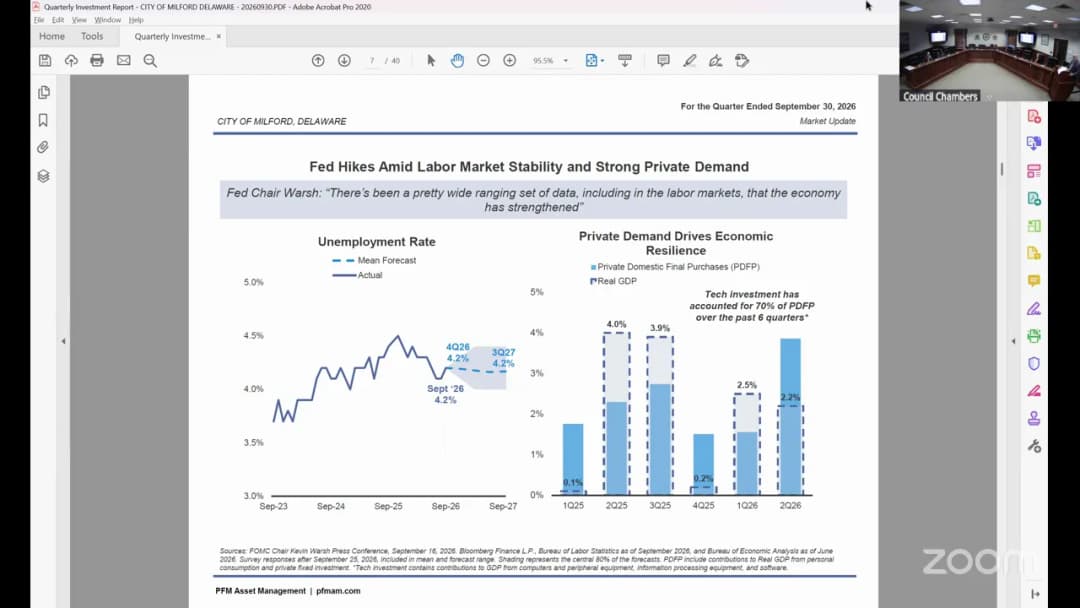
The Finance and Audit Committee of the City of Milford met on October 26, 2026, at 5:00 p.m. Three of four committee members were present, establishing a quorum. The sole agenda item was the quarterly investment review for the quarter ended September 30, 2026, presented by Jeff Facino of PFM Asset Management (PFMAM), the city's longstanding investment advisor, and introduced by Finance Director Lou Vitola. The committee received the report, discussed market conditions, portfolio performance, and credit quality, and adjourned without taking any formal votes. Public Comments & Testimony - The 15-minute public comment period was opened and closed with no speakers; no one was present in the audience, and no one came forward online via the raise-hand feature. Discussion Items Quarterly Investment Review (Quarter Ended September 30, 2026) — Presented by Jeff Facino, PFM Asset Management - Market conditions: Mr. Facino described U.S. growth as resilient, supported by AI-related and consumer spending, but noted that inflation accelerated during the quarter. He cited the conflict involving Iran as a driver of elevated energy prices (oil above $115 per barrel) and supply-chain disruptions, including sharply reduced ship traffic through the Strait of Hormuz. - Federal Reserve policy: The Fed raised rates by 25 basis points during the quarter, bringing the federal funds rate to 3.75%–4.00%. PFM expects rates to hold steady in October (with no typical pre-election move) and anticipates one additional hike at the December 2026 meeting; the market is pricing in one more hike this year and possibly one in 2027. Mr. Facino cited the enactment of an independent Fed as a positive, noting the new Fed chairman made an independent decision to raise rates despite presidential opposition. - Economic indicators: The labor market was described as steady and resilient; GDP through the second quarter was 2.2%, and private domestic final purchases (PDFP) indicated strong underlying demand. Negative factors in PFM's outlook include persistent inflation, geopolitical uncertainty, and supply-chain disruptions; positive factors include resilient domestic demand, a low-unemployment labor market, and strong corporate fundamentals. - Treasury yields: The two-year Treasury yield rose sharply from 4.14% in June to 4.89% on September 30, easing to 4.68% by the end of October. Mr. Facino noted yields are now above their 10-year and 20-year averages. - Sector performance: Asset-backed securities (ABS) was the only sector with a positive return during the third quarter; triple-A corporates were the worst-performing sector. - Portfolio summary (as of September 30, 2026): - Total portfolio just under $31 million: approximately $30.667 million in securities, $195,000 in accrued interest, and $95,000 in cash. - Portfolio duration of 2.07 years, slightly longer than the benchmark. - Yield at cost of 4.42%. - Average credit quality of double-A, with approximately 4% of investments rated triple-A and the lower end of the range at triple-B plus. - Returns: -0.52% for the three-month period; +1.75% over one year; and 4.06% annualized since inception. - Finance Director comments: Lou Vitola noted this was the first negative quarter in the entire relationship with PFM and that significant withdrawals during the quarter — to help fund the corporate center project — may have influenced results, though he had not taken a deep dive into the specific effect. He added that the city's investment policy statement constrains PFM to investment-grade securities, with protocols to restore compliance if a holding is downgraded after purchase, and that PFM's traders have the city's policy parameters loaded into their trading systems. Committee Discussion & Questions - A council member asked which industries support the economy's resiliency. Mr. Facino cited AI, technology, and financials, noting that corporations are currently profitable (unlike during the dot-com bubble) and that the long-term effects of AI spending on labor and production remain uncertain. The council member observed that the same megacap tech companies driving the stock market are also driving the economy, and questioned whether that is cause for celebration or caution. He also expressed concern that AI is ultimately designed to increase efficiency by eliminating large portions of the workforce; Mr. Facino noted some companies have reversed large AI-driven workforce reductions after finding they needed more people than expected. A council member cited figures such as roughly $6 million in revenue per employee for Anthropic, which was described as filing for an IPO. - In response to a question about whether consumers are actually spending, Mr. Facino confirmed consumer spending remains positive (citing the PDFP data), but noted consumer debt is also still rising. - A council member asked whether PFM factors political and electoral outcomes into its analysis, referencing the upcoming November 3 midterm election. Mr. Facino said PFM's fixed-income research team monitors macroeconomic, sector, and individual-holding data daily, including geopolitical factors, and is both current- and forward-looking. - A council member asked for clarification on the portfolio's credit quality. Mr. Facino explained the double-A figure is the average credit quality of the portfolio, with roughly 4% of investments in triple-A and the remainder ranging down to triple-B plus; each individual holding's rating is disclosed. Councilman James emphasized that this information is public, posted on the city's website, and included in meeting packages, and that all investments must comply with the city's investment policy statement. - Councilman James expressed appreciation for the committee's active investment oversight during volatile markets and stressed the importance of transparency so that residents — as owners of the funds — can find answers to their questions in the public record. He also noted that yields reflect risk and that past performance does not guarantee future returns. Key Outcomes - The committee received the quarterly investment review report from PFM Asset Management; no motions, resolutions, or formal votes were taken. - No new business was introduced, and the meeting was adjourned following the presentation and discussion. Note on Transcript Discrepancies - The chair introduces the finance director as "Mr. Botala," but the speaker self-identifies as Lou Vitola, Finance Director; this summary uses the self-identified name. - The PFM presenter's name appears in the transcript as both "Jeff Facino" and "Jeff Asino"; this summary uses "Jeff Facino," as stated in his introduction. - The transcript describes "Tormoon straight ship traffic," which in context (the Iran conflict, the oil price spike, and supply-chain disruptions) is interpreted as ship traffic through the Strait of Hormuz.
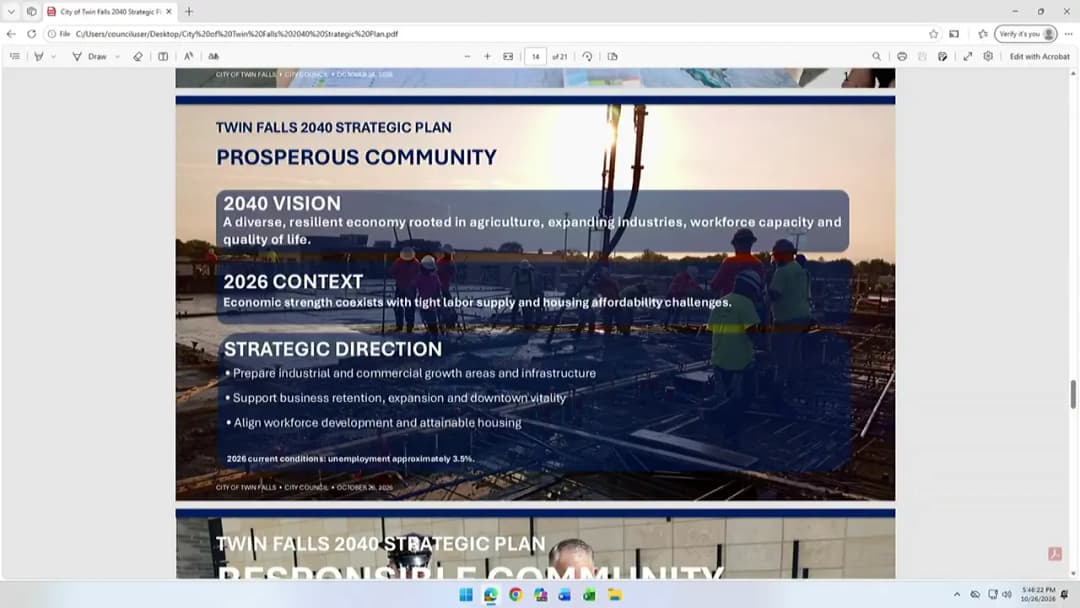
The Twin Falls City Council met on Monday, October 26, 2026, at 5:00 PM. Mayor Jason Brown presided over the meeting with all six council members present. The council unanimously approved a 10-year sanitation contract, authorized negotiations for the Old Clinic building demolition, adopted the 2040 Strategic Plan, and supported a resolution for the LA28 Olympic Torch Relay. All official votes were 6-0. Proclamations & Presentations - Mayor Brown proclaimed October 2026 as Breast Cancer Awareness Month in Twin Falls. - The council proclaimed October 27, 2026, as Bickel Elementary Dual Immersion School Day, celebrating the school's 120th anniversary and its connection to the city's founding. Consent Calendar - The council unanimously approved the consent calendar, including meeting minutes, accounts payable, travel requests, a service agreement with Boot Check Sports Ranch, and a Special Event Permit for the US Capitol Christmas Tree Whistle Stop Tour. Discussion Items - Sanitation Contract: The council approved a 10-year contract with PSI for unlimited service with recycling. Councilmember Pierce made the motion, citing results from a recent citizen survey as the guiding factor. - Old Clinic Building: The council approved entering into negotiations with CORE Construction for construction manager/general contractor (CM/GC) services for the demolition and remediation of the Old Clinic building at 660 Shoshone Street. City Manager Rothweiler clarified that the city does not own the building and continues to work through legal processes to gain access. - HMI Remediation Funding: The council authorized the use of up to $839,445 from Water Fund reserves (total bid of $763,132 plus a 10% contingency) for street and stormwater improvements associated with the Hamilton Manufacturing remediation project. The request was a reauthorization of previously approved funds. - Olympic Torch Relay: The council approved Resolution 2026-007, expressing support for the city's application to host the LA28 Olympic Torch Relay. Rothweiler noted the success of the 2002 relay in Twin Falls and the nationwide application process. - 2040 Strategic Plan: The council formally adopted the City of Twin Falls 2040 Strategic Plan. Rothweiler presented the plan, which resulted from a 2.5-year process involving stakeholders and the public. The plan establishes eight focus areas, a planning horizon to 2040, and an integrated performance measurement system (Invisio) to publicly track progress. Public Comments & Testimony - Resident Maria Hernandez spoke during General Public Input. She expressed strong support for Voices Against Violence, sharing her personal experience with their services during the COVID-19 pandemic. She encouraged victims of domestic violence and sexual assault to seek help, citing statistics that 81% of women and 43% of men experience some form of sexual assault. Advisory Board Reports & Announcements - City Manager Rothweiler announced upcoming interviews for council candidates and NOVA community healing visits scheduled for Wednesday through Friday of the following week. - Councilmember Vollmer reminded the public of the Canyon Trail Park (Chabani Park) dedication ceremony on Wednesday at 3:00 p.m. - Mayor Brown encouraged citizens to vote in the upcoming election on Tuesday, November 2. Key Outcomes - Consent Calendar: Approved (6-0). - Sanitation Contract: Approved 10-year contract with PSI for unlimited service with recycling (6-0). - Old Clinic Negotiations: Approved negotiations with CORE Construction (6-0). - HMI Funding: Authorized $839,445 from Water Fund reserves (6-0). - Olympic Torch Relay: Approved Resolution 2026-007 (6-0). - 2040 Strategic Plan: Adopted (6-0). - Executive Session: Approved adjournment to executive session to discuss pending litigation with legal counsel pursuant to Idaho Code § 74-206(1)(f) (6-0). The meeting adjourned following the session.
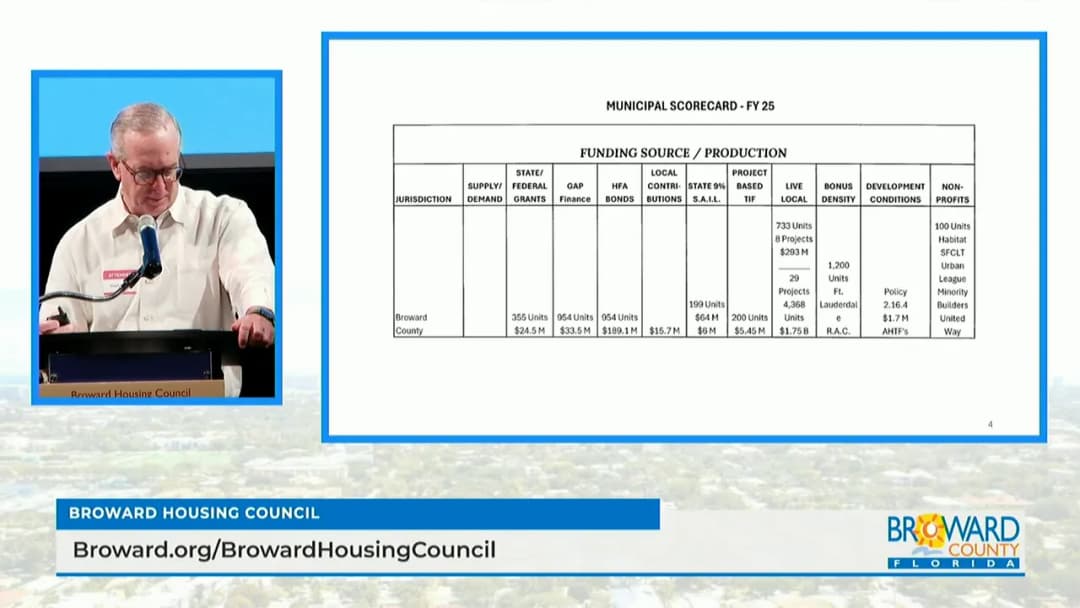
The Broward Housing Council, along with partners including the Coordinating Council of Broward, Broward County Housing Finance Authority, and Wells Fargo, hosted a workshop on housing affordability. The event featured a data presentation by Dr. Ned Murray, panel discussions on public-private partnerships and future strategies, and closing remarks by Senator Nan Rich. Discussion Items - Housing Needs Assessment Findings: Dr. Ned Murray presented the updated assessment, showing that over 340,000 households are cost-burdened (30%+ of income), with 175,000 severely cost-burdened (50%+). Median single-family home price is $620,000, average two-bedroom rent is $2,675/month. Only 7% of housing was built after 2010; 70% before 1990. Broward has lost 96,000 residents since 2020, mainly young adults. - Municipal Scorecard & GAP Program: Ralph Stone introduced a scorecard to track housing production across 31 cities. The GAP program, launched in 2018, has allocated $180 million in gap financing, produced 5,000 units with an average subsidy of $35,000 per unit (lowest in Florida). Funding comes from expired CRA/TIF revenues; projects now require 50–99 year affordability. - Public-Private Partnerships: Panelists (Mitch Rosenstein, Al Milo, Ralph Stone, Barbara Blake Boy, Walter Duke) stressed predictable processes, municipal contributions (totaling $67 million), and faster approvals. Examples included redeveloping motels and using city-owned land. Developers noted the importance of co-investment. - Live Local Act Impact: A second panel (Mayor Michelle Gomez, Chris Cooper, Tim Wheat, Suzanne Cabrera, Dr. Christine Kade) debated the Act. Supporters said it expands developable sites and provides tax exemptions; critics cited loss of local control, lack of public input, and infrastructure strain. Calls for tweaks to allow community engagement and mixed-income requirements. - Yes in God's Backyard (YIGBY) & Faith-Based Development: Discussion on using church land for housing. Need for pre-development resources and developer matches. Enterprise Community Partners highlighted ongoing projects in the region. - Regional Collaboration: Panelists urged a tri-county approach (Miami-Dade, Broward, Palm Beach) to align transportation, economic development, and housing. The housing crisis is an economic competitiveness issue. - Workforce Housing & Mixed-Income Communities: Mixed-income models are ideal but financially challenging. Incentives needed; stigma should be avoided through integration. - University of Miami Community Scholars Program: Chelsea LaFrance presented a 6-month professional development program on affordable housing, with capstone projects leading to real policy changes (e.g., extending eviction notice from 15 to 30 days, increasing set-asides for very low-income). Key Outcomes - Data Confirms Worsening Crisis: Assessment shows Broward ranks last in Florida for affordable rentals at 60% AMI (fewer than 25 units per 100 households). The county needs approximately 1,000 new affordable homes per year for 30 years. - GAP Program Sustained: Board recently allocated $27 million; HFA has 21 projects (4,000+ units) in pipeline. Program remains the primary driver of affordable housing development. - Municipal Engagement Growing: More cities are contributing gap financing; scorecard will increase accountability. Senator Rich urged local governments to protect dedicated housing funds and speed up approvals. - Live Local Act Adjustments Sought: Panelists and Senator Rich called for legislative changes to allow more local control, public input, and mixed-income requirements. The Act's density and height provisions remain contentious. - Amendment 3 Threat: Senator Rich warned that Amendment 3 (property tax cap) could divert up to $334 million in county revenue, endangering the GAP program's expired CRA funding source. - Call to Action: Senator Rich closed by emphasizing that housing impacts real lives; the county has tools and proof but needs continued political will and collaboration across sectors.
On October 26, 2026, the Mountain View Zoning Administrator (George Schroeder) held a public hearing to consider a Development Review Permit for 761 West Middlefield Road. The proposal involved installing three bollards on an existing driveway and modifying conditions from a prior permit. The hearing included staff presentation, applicant remarks, and no public testimony. The administrator approved the item. Public Comments No members of the public spoke during the non-agenda public comment period or on the agenda item. Discussion Items - Item 3.1: 761 West Middlefield Road – Staff planner Tristan White presented the request by Hero Apartments/Prometheus to install three bollards to allow permanent vehicle access from West Middlefield Road instead of the originally required shared driveway with the adjacent Sevens property. The modification aimed to address traffic safety and parking spillover issues. Staff recommended approval based on findings and CEQA exemptions. Applicant representative Michael DeCoti expressed support for staff's recommendation. Key Outcomes - Approval: Zoning Administrator George Schroeder approved item 3.1 based on the findings and conditions posted online and the application materials. The decision is appealable to the City Council within 10 calendar days.
The Prince George's County Council convened at 10:30 a.m. on Monday, October 26, 2026, for Legislative Day No. 36 in Committee Room 2027. The meeting included a consent agenda item, multiple public hearings, and enactment of numerous bills addressing illegal vending, street vending pilot, quiet landscaping equipment, affordable housing, property tax relief for seniors, returning citizen employment, and economic development streamlining. The council also held a public hearing on a court-ordered remand for land use designations in Subregion 5 and 6 Master Plans. Votes were recorded on all items. Consent Calendar - CR-121-2026: A resolution concerning Tax Increment Financing (TIF) for the National Harbor Development District and National Harbor Extraordinary Development District. Introduced by the Chair (by request of the County Executive) and referred to the Committee of the Whole. No additional sponsors. Public Comments & Testimony - Court Order Remand (Subregion 5 & 6): Thomas Haller (attorney for Christmas Farm), Carol Drewyer and Corinne Crispus Sullivan (Christmas family members), Arthur Horn (attorney for Robindale LLC), Daniel Cassidy (for Christmas Farm), and Edward Gibbs (attorney for MCQ Auto Service Center) testified. All urged the council to reaffirm the 2009 zoning approvals (RR zone for Christmas Farm and Robindale; CM zone for MCQ Auto). They argued the remand was solely to correct a procedural error (missing ethics affidavits) and that the council must not make substantive changes. The attorney for MCQ Auto noted his client’s case did not involve ethics affidavits; the Supreme Court found errors in the 2009 downzoning. - CB-003-2026 (Illegal Vending Penalties): Testimony was sharply divided. Supporters (e.g., Latrice, Minnie L. Alexander, Rita Miles, Ebony Brooks) cited safety, traffic, noise, trash, and property value concerns. Opponents (e.g., John Clark of DSA PG, Lindolfo Carvalho of We Are Casa, multiple street vendors including Alba and Sarah Mark) argued the bill targets Latino and immigrant communities, lacks a clear path to licensing, and would devastate livelihoods. Many called for a pilot program first. - CB-013-2026 (Street Vending Pilot Program): Only one speaker (Caroline Edwards) signed up, no testimony given. - CB-093-2026 (Cannabis Reinvestment Board): Board members Dr. Rachel Jordan, Crystal Carpenter, and Natalie Doris, along with community advocates Don Dalton, Yannetta Manual (ACLU of MD), and Tamara McKinney, opposed the bill. They argued it would strip the board of its authority, impose unrealistic deadlines (January 1, 2027), and mischaracterize the fund. They requested retaining board authority, extending the timeline, and ensuring adequate administrative support. Discussion Items - CB-003-2026 (Illegal Vending Penalties): Councilmember Fisher, the sponsor, offered amendments after hearing concerns: (1) removal of the prohibition on private property vending (by Councilmember Dernoga), (2) extending implementation from 6 months to 1 year, and (3) reducing fines to a mandatory warning, then $500, $1,000, and $2,000 for subsequent offenses. Fisher emphasized the companion bill (CB-013) creates a legal vending pathway. After debate, the amendments passed 11-0. On final enactment, Councilmembers Olson, Ivey, Adams-Stafford, and Blegay voted no, while Chair Oriadha, Adams, Burroughs, Dernoga, Fisher, Harrison, and Hunter voted yes. Motion carried 7-4. - CB-013-2026 (Street Vending Pilot Program): Councilmember Fisher moved an amendment to change the implementation timeline from 6 months to 1 year, to align with CB-003. Amendment passed 9-0. Enactment passed 9-0 (Fisher passed on the vote). - CB-048-2026 (Prohibited Home Businesses): No speakers. Enacted 9-0. - CB-061-2026 (Surplus Property): No speakers. Enacted 9-0. - CB-065-2026 (Senior Co-Housing Expansion): Councilmember Blegay was added as a sponsor. Enacted 9-0. - CB-075-2026 (Quiet and Clean Landscaping Equipment): Greg Smith (Sustainable Hyattsville) testified in support, citing health and quality of life benefits. Enacted 9-0. - CB-079-2026 (Housing and Property Standards): No speakers. Enacted 9-0. - CB-080-2026 (Universal Design for Housing): No speakers. Enacted 9-0. - CB-086-2026 (Community Safe Spaces Act): Greg Smith testified in support. Enacted 9-0. - CB-087-2026 (Electrical Code): No speakers. Enacted 8-0 (one member absent). - CB-088-2026 (Concurrent Development Review): Greg Smith testified in opposition, citing concerns about obsolete precipitation data and broken tracking systems. Councilmember Adams offered a technical amendment requiring an approved Natural Resources Inventory (NRI) plan prior to stormwater concept plan approval. Amendment passed 8-0. Enacted as amended 8-0. - CB-091-2026 (Development Ombudsman): Greg Smith testified with concerns about lack of clarity and potential pressure on staff. Enacted 8-0. - CB-092-2026 (Accessory Dwelling Units): No speakers. Enacted 8-0. - CB-094-2026 (Property Tax Credit for Elderly): No speakers. Discussion: Councilmember Adams-Stafford asked about funding; Chair Oriadha explained it was negotiated with the County Executive. Enacted 8-1. - CB-095-2026 (Property Tax Deferral for Elderly/Disabled): No speakers. Enacted 7-1. - CB-096-2026 (Residential Parking on Unpaved Areas): No speakers. Enacted 9-0. - CB-097-2026 (Affordable Housing Opportunity Sites): No speakers. Enacted 9-0. - CB-098-2026 (Property Tax Credit for Reduced Rent): No speakers. Councilmember Adams-Stafford asked about funding and percentage; Chair Oriadha clarified the waiver provision allows modification. Enacted 8-1. - CB-099-2026 (Small Housing Provider Financing): No speakers. Enacted 8-1. - CB-100-2026 (Surplus County Property for Affordable Housing): Discussion on percentage (one-third) and waiver. Councilmember Adams-Stafford expressed concerns about retroactivity and impact on current projects. Motion carried 7-0-2 (Burroughs and Harrison abstained). - CB-101-2026 (Returning Citizen Employment): No speakers. Enacted 9-0. - CB-102-2026 (Re-entry Employment Incentive Modifications): No speakers. Enacted 9-0. - CB-105-2026 (High-Wage Employer Fast Track): Greg Smith testified in opposition, citing undefined process and overburdened agencies. Councilmember Dernoga moved an amendment to add a reporting requirement; passed 9-0. Enacted as amended 9-0. - CB-106-2026 (Economic Development Incentive Fund): No speakers. Enacted 9-0. - CB-107-2026 (Shovel-Ready Employment Sites): Greg Smith testified in opposition. Councilmember Dernoga moved to add a community input requirement; passed 10-0. Enacted as amended 10-0. - CB-108-2026 (Public Land First for Affordable Housing): No speakers. Enacted 7-0 (some members absent). - CB-109-2026 (Public Land Affordability Requirement): No speakers. Enacted 8-0. - CB-093-2026 (Cannabis Reinvestment Board): After public testimony, council debated amendments. Councilmember Blegay moved to extend the deadline for recommendations from January 1, 2027 to April 1, 2027; passed 7-1-2 (Hunter voted no, Harrison passed). Discussion on administrative support, board authority, and appointment process. Councilmember Harrison moved to table, but lacked a second. Final enactment passed 7-2-1 (Harrison and Hunter voted no, Adams-Stafford abstained). - CR-115-2026 (County-Owned Grocery Store): Introduced by Chair Oriadha. A motion to suspend rules for immediate adoption failed to get eight votes; referred to Committee of the Whole. Key Outcomes - CR-121-2026: Introduced and referred to Committee of the Whole. - CB-003-2026 (Illegal Vending): Enacted as amended (7-4). Effective in one year; fines: warning, $500, $1,000, $2,000; private property vending exempted. - CB-013-2026 (Street Vending Pilot): Enacted (9-0). Requires OHS, EDC, Health Dept to develop pilot program within one year. - CB-048, 061, 065, 075, 079, 080, 086, 087, 092, 094, 095, 096, 097, 098, 099, 101, 102, 106, 108, 109: Enacted with broad support. - CB-088, 091, 105, 107: Enacted with amendments (reporting, community input, technical clarity). - CB-093 (Cannabis Board): Enacted (7-2-1). Board name changed; council staff to provide support; $5,000 minimum appropriation; terms expire 45 days after effective date with reappointment possible; deadline for recommendations extended to April 1, 2027. - CB-100 (Surplus Property for Affordable Housing): Enacted (7-0-2). Requires evaluation of surplus property for affordability; one-third affordable units required on residential projects of 10+ units, with waiver authority. - Public Hearing on Subregion 5 & 6 Remand: Concluded; record remains open until November 10, 2026. Staff to prepare resolution for later action. - Meeting adjourned at approximately [time not given], followed by Committee of the Whole.
The meeting was scheduled for October 26, 2026 at 16:30 UTC. However, neither an agenda nor minutes were available. The only provided transcript contains the utterance: "L' Human, okay, okay, okay. Humanity." This content does not indicate any formal proceedings. Key Outcomes - No votes, decisions, or public comments were recorded in the available materials. - The meeting may have been called to order but no substantive business is documented.
The Cleveland County Budget Board met in regular session on Monday, October 26, 2026, at 10:30 AM in the Cleveland County Office Building, Norman, OK. Chairman Rusty Grissom presided; a quorum was present. The board approved prior meeting minutes and the consent calendar, received committee updates, and adjourned. Approval of Minutes - The board unanimously approved the Regular Minutes of September 21, 2026, and the Special Minutes of September 28, 2026, September 30, 2026, and October 5, 2026, as listed on the agenda. Public Comments & Testimony - No members of the public signed up to speak. Consent Calendar - The board unanimously approved consent items 2 through 9 as a block, incorporating clerk's corrections to account numbers on items 4 and 5. - ARPA sub-recipient agreements were amended: Moore Public Schools Foundation (Project 2.019, Bridges of Moore) was increased from $225,000.00 to $467,000.00, and Loveworks Leadership (Project 2.018) was increased from $100,000.00 to $194,975.00. - $5,999.00 was transferred from 112120-5400 ARPA (M&O) to 112120-54825 The Well/Health Department for the Mobile Wellness App. - $20,000.00 was transferred from 100170-5100 (Personnel) to 100170-5300 (Travel), and $8,000.00 was transferred to 100170-55000 (Capital Outlay) for travel and bookcases. - A lapsed appropriation of $98,620.14 in account 112120-54827 for FY 2025-2026 was approved; the same amount had been lapsed into FY 26 on 8/11/25 and again on 9/8/25. - A lapsed appropriation of $98,620.14 in account 112120-54827 for FY 2026-2027 was approved; the amount had already been lapsed into FY 27, leaving $0.00 to lapse. - The amended OSU Local County Training Calculation Formula for 2026/2027 county office salary compensation was accepted; it had been previously approved by the Budget Board on September 21, 2026. - Cash Fund Requests for Appropriations from September 16, 2026, through October 15, 2026, were approved, totaling $1,958,749.83 across 29 listed funds and accounts. Discussion Items - Employee Benefits Committee update: A representative reported that open enrollment was underway, with employee forms requested by Wednesday of that week. Participation and engagement were described as strong, with a noticeable increase in employees selecting the high-deductible/high plan. The Board of County Commissioners recently approved Hub International as the county's broker and strategic partner to evaluate benefits plan performance, identify cost containment opportunities, and analyze market trends. Hub International will introduce itself to the Employee Benefits Committee on November 5, 2026, focusing on buying down premiums and buying up benefits, including non-insurance employee benefits. - Infrastructure Committee update: The committee had met over a month earlier and will now meet about a week before future Budget Board meetings to keep reports current. On the first floor of the new courthouse, air handlers are being replaced, leaving the treasurer's and assessor's offices without air conditioning; officials hoped the system would be running by next month. No action was taken. - Safety & Emergency Management update: George Mauldin, Safety & Emergency Management Director, had nothing new to add at this time and was staying on top of the matter. No action was taken. New Business - No new business was reported. Board Member Statements - The chairman displayed a talking stick that he said Jenny had given him, joking that anyone who got out of line would need to use the stick before speaking. No formal action was taken. Key Outcomes - Approved the minutes by unanimous roll-call vote. - Approved the consent calendar (items 2-9) by unanimous roll-call vote, with clerk's corrections. - Received reports from the Employee Benefits Committee, Infrastructure Committee, and Safety & Emergency Management; no formal action was taken on those reports. - Adjourned by unanimous roll-call vote. Note: The agenda stated the meeting notice was properly posted on October 23, 2025, but the agenda print date is 10/23/2026; this apparent typo was not addressed during the meeting.