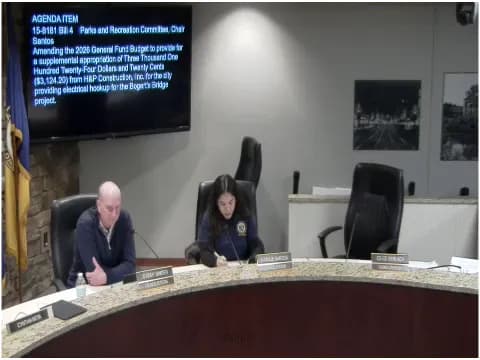
On February 4, 2026, the Allentown Parks and Recreation Committee met to review two supplemental appropriations for parks projects and receive departmental updates. Both proposed bills were moved favorably to full council. Discussion Items - Bill 5 – DLNHC Grant for Jordan Meadows Park Water Fountain Upgrade: The committee considered a $2,000 supplemental appropriation from the Delaware Lehigh National Heritage Corridor (DLNHC) Lehigh Valley Greenways Implementation Block Grant. Parks staff explained the funds will upgrade the existing water fountain to a bottle filling station at Jordan Meadows Park. - Bill 4 – H&P Construction Invoice for Bogert’s Bridge Electrical Hookup: The committee reviewed a $3,124.20 supplemental appropriation from H&P Construction, Inc. This reimbursement covers the cost of city staff performing specialized electrical work for the Bogert’s Bridge project, avoiding contractor expenses. Updates from Parks and Recreation - Seasonal Hiring: Positions (lifeguards, summer playground interns, laborers) are now posted on the city website. Recruitment is underway for a team starting in late May/early June. - All-Star Basketball Game: Scheduled for February 21, 2026, at Dieruff High School, aiming to celebrate community involvement. - Franklin Park Planning: The first of three community input meetings will be held on February 26, 2026, at a local church. Additional meetings in March and April will refine the park design, with completion expected by mid-summer. Key Outcomes - Both Bill 5 and Bill 4 were moved favorably to full council by unanimous votes (motion by Binder/Pungo for Bill 5; motion by Pungo/Binder for Bill 4). - No public comments were received. - The meeting adjourned without further business.
Public Meetings - Allentown, Pennsylvania
Public Meetings - Allentown, PennsylvaniaA committee meeting of Allentown City Council was held on February 4, 2026, to discuss and refine a proposed ordinance that would establish standard operating procedures for the closure of homeless encampments on public property. The ordinance was introduced in response to the controversial closure of the Jordan encampment, which was described as chaotic, traumatic, and lacking transparency. Councilmember Gerlock, the sponsor, presented updated language incorporating feedback from colleagues and the public, aiming to make the ordinance more flexible, realistic, and focused on harm reduction. The meeting included testimony from Eric Tarz of the National Homelessness Law Center, as well as extensive discussion among councilmembers, the Commission on Homelessness, service providers, and city department heads about implementation challenges, the role of the county, and the need for clarity in definitions such as "immediate hazard." Public Comments & Testimony - Eric Tarz, Senior Policy Director, National Homelessness Law Center: Expressed strong support for the ordinance, stating it would create a "win-win situation" for housed and unhoused residents by establishing a clear process to move people into permanent housing rather than simply displacing them. He emphasized that 72% of Americans oppose jailing or fining people for sleeping outside when no shelter is available. He urged the committee to pass the ordinance as a first step toward evidence-based policy and noted that the city can provide leadership even if the county does not yet have similar procedures. Discussion Items - Feedback on Revised Ordinance: Councilmembers and stakeholders reviewed numerous provisions: - Definition of Public Property: Concern raised that the ordinance originally applied to all public property, including county, state, and federal land. Councilmember Napoli suggested limiting it to municipal property; the sponsor agreed to add the word "municipal." - Role of the Commission on Homelessness (COH): Several speakers questioned whether the volunteer commission has capacity for the duties assigned. The sponsor clarified that the revised language includes "COH and/or service providers" to allow flexibility. Christina, co-chair of COH, expressed nervousness about who would determine an "immediate hazard" and suggested that the unsheltered coordinator and street outreach workers should be involved in risk assessments. - Immediate Hazard Definition: Councilmember Pongo argued that "immediate hazard" should be defined in Section 1 (definitions) to avoid misuse. Eric Tarz noted the term is an exception that could "swallow the whole" if not implemented in good faith, and recommended monitoring its use and amending if necessary. - 72-Hour Timeline: Confusion arose over whether the 72 hours for the city to remediate a hazard runs concurrently with 72 hours for removal. The intent was clarified as sequential: first 72 hours to begin remediation, then 72-hour notice before removal. - Training and Recordkeeping: Councilmember Pongo suggested training should focus on frontline staff only, and that data storage and access need clear guidelines. Christina noted that data from the Jordan closure is housed at the Health Department. - Sidewalks and Right-of-Way: Concerns about including sidewalks in the ordinance; the sponsor acknowledged the need to narrow criteria in priority sections. - County Collaboration: Councilmember Napoli asked about partnering with Lehigh County, which lacks its own SOP for encampments. The sponsor noted the county is mentioned in the ordinance as a partner. A joint committee meeting with the county is scheduled for March 5, 2026, which could facilitate discussion. - Departmental Capacity: Vicki (Director of DCED) explained that the unsheltered coordinator, Danielle, is not a frontline decision-maker; her role is coordinating service providers. She stated that DCED lacks the personnel to perform many tasks in the ordinance, and that the burden of removing encampments falls on police, fire, and other departments. She also highlighted a lack of emergency plans among partner agencies and the absence of a year-round shelter in Lehigh Valley. - Cost of Jordan Closure: Riley (street outreach manager) reported that the total cost of the Jordan encampment closure was $261,602.14, including parks, public works, police, and other departments. He described the closure as traumatic and ineffective, with people simply moving to new locations. - Need for Harm Reduction: Multiple speakers emphasized that the ordinance aims to reduce harm to unhoused individuals, not penalize the city. Christina stated, "We need some kind of procedure so the people that are living there... reduces the harm to them." The sponsor agreed that perfect solutions are not possible given the lack of housing and shelter, but the ordinance is a step toward better outcomes. Key Outcomes - No vote was taken; the meeting was a work session to discuss amendments. - The sponsor (Councilmember Gerlock) agreed to make further revisions, including: - Limiting "public property" to municipal property. - Specifying "representatives of COH" rather than the entire commission. - Moving the definition of "immediate hazard" to the definitions section. - Clarifying the risk assessment team composition after further thought. - The committee will forward the revised draft to the city solicitor for legal review; an executive session may be scheduled. - A joint workshop between Allentown City Council and Lehigh County is set for March 5, 2026, at 6:00 PM in council chambers, open to the public, to discuss collaboration on homelessness and other issues. - The next committee meeting will address budget priorities, not this ordinance; the revised ordinance will be reintroduced at a future meeting.
This meeting of the Allentown Finance and Budget Committee on January 28, 2026, featured a detailed presentation of the city's December 31, 2025 monthly and quarterly financial reports by Finance Director Patel, followed by an in-depth discussion of the annual budget process, revenue challenges, and potential collaboration between the administration and city council. Finance Reports Presentation - Finance Director Patel presented the December 31, 2025 monthly and quarterly capital reports. General fund revenues came in at $152 million, 4% above the $146 million budget, driven by stronger earned income tax, business privilege tax, permits and licenses, EMS transit fees, and investment income. Expenditures were at 96% of budget ($146.8 million), with personnel costs at 73% of expenditures. Public safety spending exceeded budget: police at 118%, fire at 122%, EMS at 143%. The risk fund was at 103% of budgeted amount. The solid waste fund showed revenues at 101% ($23.9 million) and expenditures at 90% ($22.1 million), with potential for vendor payment timing adjustments. The building code fund (new in 2025) showed revenues at 158% above budget ($4.2 million) due to billing timing. Cash balance for the general fund was $40.3 million. Investment activities yielded $3.2 million for the year, with $12.1 million in PLGIT prime yielding 3.91% APY and $35 million in term investments yielding 3.74%-4.35% APY. Capital expenditures for Q4 were $2.4 million, year-to-date $12.7 million, with $7.8 million encumbered. - Committee members asked about solid waste fund expenditure timing, the breakdown of building code revenues (commercial vs. residential), and the average term of investments (Patel confirmed investments are structured to mature monthly based on cash flow needs). Discussion on Budget Process - Finance Director Patel outlined the annual budget timeline: begins in June with position budgeting, department guideline emails from the mayor, July budget entry in Munis, August analysis and meetings with department heads, September mayor review and alignment, October proposed budget to council (due Oct 15), council meetings and amendments through December, with adoption by December 31 (changed by 2019 voter referendum). The current year started with a $15 million general fund gap that was closed during the process. - Patel expressed desire for earlier council collaboration, noting that the 3.96% property tax increase was proposed by the mayor without prior council input. She stated, "I would have liked the support from council at that point, having meetings with them to say what we can do." - Committee members discussed exploring new revenue sources beyond the limited options under the Home Rule Charter (e.g., real estate tax, earned income tax, deed transfer tax, local services tax). Council Member Garlock suggested a committee to investigate entertainment taxes, impact fees, and cost savings for low-income residents, including possible rebate programs for all income-qualified households (not just seniors/disabled). - Council Member Atha supported exploring entertainment taxes, stating Allentown has more entertainment venues than Easton or Bethlehem and that such taxes could lower property taxes. Controller Glazer cautioned that the Neighborhood Improvement Zone (NIS) prohibits taxing events at PPL Center and the Archer, and that poking that bear could risk losing the NIS entirely. He noted the NIS has provided significant property tax gains (e.g., Moxie property now paying $33,000/year vs. $4,000 before). He supported a committee to explore other sources but doubted any would be a "home run." - Council Member Pungo (Chair) emphasized the need to examine both revenue and spending cuts. Committee agreed to continue budget process review at the next meeting, including looking at other municipalities' practices. - Patel also addressed a previous ordinance that reduced the penalty for late property tax payment from 10% to 5%, benefiting 2,800 property owners with city savings of $95,500. The property tax/rent rebate program saw claims increase 125% from 2024 (36 claims) to 2025 (81 claims) after outreach. Lifting the age requirement was discussed but deemed administratively challenging due to household income verification; Patel is open to partnering with community organizations. Key Outcomes - The committee received the December 31, 2025 financial reports and will continue to track updates as vendor payments are processed. - A consensus emerged to form a committee or working group to explore alternative revenue sources, with Council Member Garlock and Ms. Atha strongly supporting this. The committee will discuss structure and timing at the next meeting. - Finance Director Patel committed to earlier council engagement in the 2026 budget process, ideally in August-September, to discuss priorities before the proposed budget is finalized. - Patel noted her administrative priorities: implementing the HR/payroll module in Munis (July go-live), controlling healthcare costs, and managing capital projects including the police headquarters groundbreaking (March) and general obligation bond issue. - The meeting was adjourned.
The committees of the Allentown City Council met on January 28, 2026, at 10:45 AM to consider Bill 3, hear departmental priorities from Human Resources, Information Technology, and the Controller's Office, and discuss related operations. Discussion Items - Bill 3 – Bloomberg Philanthropies Grant (Love Your Block): The bill amends the 2026 grant fund budget to accept $50,000 in grant funding from Bloomberg Philanthropies through Johns Hopkins University for the Love Your Block program. HR Director Marty explained that the grant has been received for about two years, and this is not a matching grant; funds will be used for beautification projects (planting flowers, trees) and to pay a part-time fellow managing the program. Councilmember Ms. Patel asked about the percentage of the grant going to communities versus staffing; Marty did not have the exact number on hand but confirmed there is no stipulation on how funds must be used. Mr. Hanlon noted that last year's funds largely went to neighborhood awards, while this year appears to go to personnel—an allowable expense. The committee forwarded the bill unanimously to the full council. - Human Resources Priorities: Marty outlined key initiatives: filling staffing gaps, transitioning to a digital case management system, completing the Personnel Policy Manual (PPM) update (last updated in 2009), preparing for a systems transition in June/July 2026, and launching training programs (harassment and conflict resolution). He mentioned establishing subject matter experts within the department. Councilmembers asked about tuition reimbursement (now authorized with controls), affinity groups (Marty will explore with Kumari), and ongoing education opportunities for staff. Marty emphasized incorporating unconscious bias and microaggressions training into conflict resolution. - Information Technology Priorities: IT Director Jerry reported on technology modernization: upgrading servers, storage (1.4 petabytes capacity), and end-user hardware (laptops replaced every 5 years, desktops 6 years, cell phones 3 years). He highlighted shifting cybersecurity from reactive to proactive, completing the Munis-to-Tyler software transition by July 2026, launching an e-signature solution by mid-February, integrating permitting into Energy, and launching a public right-to-know application in Q1. He noted the need to modernize council chambers audio/video (cameras up to 15 years old) and add closed captioning to meet ADA requirements by April 2026. He also confirmed over 34,000 tax bills will be finalized and postmarked by Friday. - Controller's Office Priorities: Controller Jeff discussed monthly audit reports (payables, P cards, bank reconciliations), noting the P card process is laborious and a “time suck,” especially after bringing the garage in-house (adding 175–275 invoices per month). He cautioned that any future decision to bring solid waste collection in-house would require additional support. He described the internship program and a seminar for departments on February 11 or 17. He mentioned succession planning as his term nears its end in about two years. Councilmember Ms. Appa asked about minimizing invoice volume; Jeff suggested using monthly statements from vendors but acknowledged review time remains similar. Key Outcomes - Bill 3 was forwarded unanimously from the committee to the full City Council. - All three department heads presented their priorities for 2026; no formal votes were taken on those items. - Committee members will continue to follow up on specific requests (e.g., affinity groups, P card efficiency, training schedules).
The Allentown City Council met on Wednesday, January 21, 2026, at 6:30 PM in Council Chambers. All seven council members were present (Cynthia Mota, Natalie Santos, Ce-Ce Gerlach, Candida Affa, Santo Napoli, Jeremy Binder, Cristian Pungo). The meeting covered contract amendments, grant applications, budget process reforms, and multiple public comments on parking, rent affordability, child safety, and code enforcement. All votes were unanimous (7-0). Consent Calendar - R3 – Certificate of Appropriateness for work in Historic Districts at 126-128 N 15th Street and 521 N 6th Street. Approved 7-0. - R4 – Sewage Planning Module at 128 Hamilton Street Apartments. Approved 7-0. Public Comments & Testimony - Asia (no last name given) expressed that the city needs to do more for children, particularly with sports programs to keep them active. She also raised concerns about pedophilia in her neighborhood (around 2nd Street, near Harrison Morton and Sheridan schools), stating that many pedophiles are homeless and not registered. She asked for better enforcement and shelter for homeless individuals to keep children safe. She reported her daughter had been chased by a pedophile near Dieruff High School. - Ms. Bell spoke about rising rent in a gentrifying Allentown. She cited a median income of $54,000 (after taxes $40,500), with low-end rent at $25,000 leaving $1,200 per month for health insurance, food, car, and parking tickets. She said she makes $32,500 at a city job but cannot afford rent. She noted that assistance programs reject her for making "too much," and the Parking Authority suggested she move out of Allentown. She opposed $2,500 rent for a four-bedroom and called for rent control. - Glenda Mason described receiving a parking ticket after street cleaning passed. She appealed but received a court summons for February. She argued that the Parking Authority tickets after the sweeper, but residents park thinking it's safe. Council members (Affa, Gerlach, Napoli, Glazier) discussed that the Parking Authority may have changed its timing (sweeper first, then enforcement), causing confusion. Council President Napoli promised to connect Ms. Mason with customer service and refer the issue to the Public Works Committee for fact-finding. - William Grecky (Pearl Avenue, South Side) requested a crosswalk at Oxford and Lehigh Streets to provide safe access to Alton Park. He noted speeding (40–50 mph in a 35 mph zone), lack of police enforcement, and that his street was plowed last (at 4 PM on the prior Saturday). He also cited increased traffic from a new Giant supermarket at the South Mall and asked for more walkability improvements on the South Side, similar to recent efforts on the North Side. - Mr. Welsh spoke about health insurance and term limits for state legislators. He argued that term-limited states (Ohio, Michigan, South Dakota) do not require a 90-day uninsured waiting period for coverage, unlike Pennsylvania. He said the health insurance industry benefits from captive customers and opposes universal healthcare. - Enrique Moreno (speaking partly in Spanish) raised three issues: a sweep ticket, a parking authority ticket, and a city code enforcement issue. He stated that city inspectors cited him for a "junk car" despite having proof it was in use and that his garage contained valuable items. He felt targeted and had previously left contact information but received no follow-up. Danny Negron supported Moreno, saying the issues were brought up a year ago without resolution. Discussion Items - R1 – Change Order with Tyler Technologies (ERP conversion): Administration representative Sarrah McNeil explained that the original September 2023 resolution only included implementation fees ($791,980). This change adds $445,356 for recurring annual maintenance fees (operational costs) that were erroneously omitted, bringing the total to $1,237,336. Finance Director Bina Patel confirmed the funds were already budgeted for 2026; the resolution corrects the clerical oversight. A public commenter questioned why maintenance wasn't anticipated; McNeil and Patel clarified it was an oversight in the resolution, not a budget increase. Approved 7-0 (Enactment No. 31192). - R2 – Cooperative Contracts for various goods/services with Lobar Associates, American Rock Salt, Kimball Midwest, AutoZone, NAPA, General Code, and Dell Marketing (amounts $40,000). Approved 7-0 (Enactment No. 31193). - Minutes of Previous Meetings (December 3, 2025 Special Council; December 17, 2025 Budget Amendments; December 17, 2025 Council) all approved 7-0. - Committee Reports: No meetings held for Budget & Finance (next Jan 28), Community & Economic Development (tentative Feb 4), Human Resources (tentative Jan 28), Public Works (Feb 4), Rules (no future). Parks & Recreation and Public Safety met earlier that evening. - Controller's Report (Jeffrey Glazier): Presented P-Card review for August 2025 (708 documents, $222,000 total). Found 11 incorrect expense accounts, 2 convenience fees (now policy allows up to $3), 3 instances of sales tax paid (city exempt), 20 late payments (60-day window), and 7 instances of missing documentation (subsequently provided). Bank reconciliation review for October 2025: 35 reconciliations totaling $116 million, with 3 non-city controlled ($1.2 million). One issue: an unexplained difference on accounts payable of $1,700; administration advised to contact the bank. - R5 – Local Share Account Grant for Civic Theatre of Allentown (structural/safety renovations). Approved 7-0 (Enactment No. 31196). - R6 – Local Share Account Grant for Planned Parenthood Keystone (repairs at 29 N 9th St). Approved 7-0 (Enactment No. 31197). - R7 – Local Share Account Grant for Lehigh Valley Health Network (purchase/installation of specialized equipment). Approved 7-0 (Enactment No. 31198). A public commenter asked about the grant; Grants Manager Terri Dakuginow explained the city acts as a pass-through for PA DCED funds. - R8 – Berkheimer Confidentiality Liaison to share confidential tax information for official purposes. Approved 7-0 (Enactment No. 31199). A public commenter asked if the governing board would address per capita tax issues; Finance Director Patel clarified it is about earned income tax collection, not per capita tax. - R9 – Transfer Approvals (multiple departmental transfers including EMS, Fire, Police, Accounting, Recycling, Liquid Fuels, Stormwater; one treasury transfer removed as a mistake). Approved 7-0 (Enactment No. 31200). - R10 – Budget Process Review establishing clear, transparent procedures for developing and adopting the city budget, assigned to the Budget and Finance Committee. Approved 7-0 (Enactment No. 31201). - R11 – Sewage Planning Module Correction at 424-434 N 11th Street (housekeeping measure to fix a minor error in a previously passed module). Council suspended rules to add to the agenda (motion by Pungo, seconded by Mota, passed 7-0). Then R11 approved 7-0 (Enactment No. 31202). Key Outcomes - All resolutions (R1–R11) passed unanimously (7-0). - Ordinance (Bills) Introduced: - Bill 3: Accept $50,000 from Bloomberg Philanthropies/Johns Hopkins for Love Your Block Grant. Referred to Human Resources, Administration and Appointments Committee (Chair Binder). - Bill 4: Supplemental appropriation of $3,124.20 from H&P Construction for Bogert’s Bridge electrical hookup. Referred to Parks and Recreation Committee (Chair Santos). - Bill 5: Supplemental appropriation of $2,000 from DLNHC for trail water fountain upgrade at Jordan Meadows Park. Referred to Parks and Recreation Committee (Chair Santos). - Public Works Committee will investigate Parking Authority timing issues (street sweeper vs. enforcement) and report back. - Council President Napoli will arrange for Parking Authority customer service to contact Glenda Mason regarding her ticket and court case. - Council will follow up with Enrique Moreno and Danny Negron on code enforcement and parking issues. - Crosswalk request at Oxford and Lehigh will be addressed via email follow-up. - Meeting adjourned at 7:26 PM.
An Allentown Parks and Recreation Committee meeting was held on January 21, 2026, to review the city's comprehensive parks master plan. The plan, developed by Simone Collins Landscape Architecture with extensive public input, is scheduled for adoption at the February 4 city council meeting. Committee members Councilperson Santos, Councilperson Pungo, and Councilperson Binder were present, along with parks and recreation staff and the consultant. Discussion Items - Presentation of the Parks Master Plan: William Collins, principal at Simone Collins, presented the plan, which includes a citywide park system analysis, infrastructure assessment, program evaluation, and management recommendations. The plan features a toolbox of improvements (safety/access, recreation facilities, environment/ecology) applied to each park, success stories, and a financing overview highlighting Allentown's success in securing grants. - Solar Parking Canopies: Councilperson Pungo inquired about integrating solar panels over parking lots, similar to a Bethlehem school district example. Collins noted it was not detailed in the plan but falls under the sustainability coordinator's purview. Mandy confirmed the city is researching solar opportunities. - General Obligation Bond and Master Plan Parks: Councilperson Pungo asked which of the four specific park master plans (Bucky Boyle, Roosevelt, Fountain, McCo's Plaza) are included in the $18 million GO bond. Mandy responded that Fountain Park and Franklin Park (not one of the four) are included. Bucky Boyle is not included due to reliance on public-private partnerships; Roosevelt has partial improvements budgeted separately. - Fountain Park Design and Phasing: Questions were raised about budget constraints for the ambitious Fountain Park concept. Mandy explained that the design process will include public input and phased implementation based on community priorities and available funding, with the master plan serving as a first look. - Indoor Facility at Fountain Park: Councilperson Pungo asked about an enclosed, heated/cooled rental facility with a kitchen. Mandy confirmed this is a high priority and is included in the Fountain Park master plan concept. Councilperson Binder noted the plan includes a cooling mist area instead of a pool, and discussion ensued about the trade-offs between a pool (historical interest, high operating costs) and an indoor facility (year-round use). The final decision will require further community input. - Boardwalk and Creek Access: Councilperson Binder asked about a boardwalk shown in Fountain Park plans. Mandy explained it responds to community desire for safe water access (fishing, walking) without swimming, given city ordinances. - Safe Streets Integration: Councilperson Pungo asked whether the master plan addresses traffic safety outside parks. Mandy and Collins noted collaboration with Public Works on Safe Streets for All recommendations, and that all four master plans include accessibility improvements beyond park boundaries, aligning with the mayor's objective. - Staff and Public Engagement Appreciation: Councilperson Santos thanked staff for outreach events and acknowledged community volunteers. Mandy thanked council members for attending public meetings. Key Outcomes - No formal vote was taken; the parks master plan is scheduled for adoption at the city council meeting on February 4, 2026. - The master plan (Island Sound Comprehensive Recreation and Park Plan) is available on the Allentown city website. - Future discussions on specific park designs, especially Fountain Park, will continue with public input and phased budgeting.
A committee meeting of the Allentown City Council was held on January 21, 2026, chaired by AFA Moda Santos, with council members Gerloch, Bender, and Santos present. The primary focus was the announcement of a new Quality of Life Task Force and a police incident report from the Chief of Police. Discussion Items - Quality of Life Task Force Announcement: A council member (speaker not explicitly named, but likely the chair) announced the formation of a Quality of Life Task Force. The task force will include city officials (police, DCR, nuisance abatement, administration), four citizens from different parts of the city (west, east, north, and center city), and a solicitor. The goal is to develop actionable solutions to persistent quality of life issues such as noise, loud vehicles, garbage, dog feces, and dumping. The task force will meet monthly or bi-monthly and will focus on positive, solution-oriented discussions, not complaints. The speaker emphasized that this is a collaborative effort to complement existing efforts like the Disruptive Conduct Reports (DCRs) and nuisance abatement. The Chief of Police expressed full support, noting that quality of life is a citywide issue and that breaking down silos is key. The task force will also consider legislative ideas, such as using cameras to enforce noise ordinances (e.g., loud mufflers and music), similar to previous successful efforts with bike regulations. The council member stated that the task force will not cost the city anything and that the community's involvement is critical. - Police Incident Report: The Chief of Police provided a preliminary update on crime statistics for 2025 (compared to 2024). Violent crime decreased by 2.36 points, and property crime decreased by 132.15 points. Noise complaints also decreased. The Chief announced a new incident dashboard for residents and a specific report for council, to be delivered within the next week, detailing incidents and quality of life issues. The Chief also noted that the department is working on data dissemination for CIS (Community Information System) data, with a meeting scheduled in February to finalize the format. Council member Gerlock asked about the definition of mental health calls and how the data would be presented in layman's terms. The Chief confirmed that the data analysis is ongoing and will be made easily understandable. - Community Policing Discussion: Council members discussed the importance of community policing, targeting specific troublemakers rather than a broad enforcement approach, and leveraging community assets such as schools, corner stores, and nonprofits. The Chief agreed that community trust and partnerships are essential and that the department is focused on holding accountable those who engage in crime while encouraging positive lifestyle changes. Key Outcomes - The Quality of Life Task Force is to be formed, with the speaker having already contacted four potential citizen members and secured commitments from city officials. The first meeting date and final membership list are pending confirmation from the invited citizens. The council will be informed of the membership. - The Chief of Police will provide a detailed incident dashboard and report to council within the next week. - No formal votes were taken during the meeting. The meeting was adjourned without any public comments.
The Allentown Redevelopment Authority held its first meeting of the new year on January 14, 2026, at 7:15 PM. The meeting covered routine approvals, a financial report, property inventory updates, a loan for a community housing project, and a new parking issue at a city-owned lot. The board also announced an executive session to discuss disposal strategy for certain properties. Consent Calendar - Approval of Minutes (December 10, 2025): Approved with a correction noting that the chair did not second the CDBG motion per Robert's Rules. Motion by [member], seconded, carried unanimously. - Staff Financial Report: Approved. The report showed a projected net income of approximately $60,000 for 2025 after pending CDBG reimbursement of $200,000. A brief discussion clarified that a budget variance of $884,000 was not a deficit but reflected unsold property budgeted. Minor formatting suggestions were noted but not required for approval. - Invoices for Payment: Approved 31 invoices totaling $15,010.64. Highlighted: a $1,195 reimbursement from HomeDepot for repairs caused by delivery men. Motion by Dan, seconded by Alan, carried unanimously. Public Comments & Testimony - No members of the public spoke. Discussion Items - Inventory Update (Property 323 9th Street): Staff reported a tenant heat issue resolved under warranty; condenser leak repair costs expected next month. Staff purchased a $30 garbage can and $20 shovel for a low-income tenant to avoid code violations. Board members expressed concern about setting a precedent but acknowledged the small cost and that items remain with the unit. The authority expects to dispose of rental properties within two years. - Old Business: 136 South 8th Street Loan: The board discussed a $150,000 loan at 5% interest to Community Action of Lehigh Valley (CALV) for rehabilitation of a property sold in June 2023. The project has faced delays and cost overruns. City HOME funds will cover bulk of costs. The loan is secured by a first lien, with repayment from sale to an owner-occupant. Board members questioned the feasibility of repayment given neighborhood market values (estimated $200,000), but staff and CALV representatives (including board member Peter Lunis) noted the property will be fully renovated and that CALV has a track record of successful sales. The board emphasized the need for a developer's agreement and deed of reconveyance. Motion carried unanimously. - New Business: 515-519/521 New Street Parking Issue: An illegally used parking pad (part of authority lot) created neighbor disputes. Staff proposed leasing two spots at $25/month each, with tenants responsible for snow removal and insurance, and displaying permits. Board supported direction; no formal vote required. Staff will verify legal parking status with the city. Key Outcomes - Minutes, Financial Report, Invoices: Approved unanimously. - Loan to Community Action (CALV): Approved $150,000 at 5% interest, contingent on a developer's agreement and deed of reconveyance. Motion carried (aye: all present; opposed: none). - Parking Leases: Board directed staff to proceed with month-to-month leases at $25/spot, with insurance and permit requirements. - Executive Session: Called to discuss RFP strategy for property disposition; anticipated vote to release RFPs at next month's meeting.
The Allen Town Planning Commission convened on January 13, 2026, to approve the December minutes, elect officers, review the 2025 Annual Report noting a significant increase in development activity, and deliberate on six major agenda items including a subdivision waiver, two time extensions, a reinstatement request, and two new major land developments. The commission unanimously approved the waiver for 406 North Fair Street, granted extensions for two flexible industrial projects, reinstated the approval for a Popeyes restaurant, and granted preliminary final approvals for a Senior Life daycare facility and a new multi-family apartment building at 411 West Walnut Street, subject to specific staff conditions and future design revisions. Consent Calendar - Approval of the minutes from the December 9, 2025, meeting was granted unanimously without comment or corrections. - Election of officers was conducted via a slate motion without objection or opposition. Public Comments & Testimony - Jason Bupta (representing Allentown Housing Authority): Stated full support for the waiver request at 406 North Fair Street, clarifying the project is a home ownership program for Allentown residents via a HUD program, not for large corporations. - Adam Anderson (Civil Engineer, Site Design Concepts, Popeyes project): Expressed that the applicant is not objecting to the timeline but acknowledged the need for the reinstatement; stated that traffic movements have not changed substantially despite the lapse. - Robert (Executive Director, Senior Life): Expressed support for the project's inclusion in the residential neighborhood to serve the local community; clarified that the facility serves low-income seniors with multiple morbidities and operates Monday through Friday. - Tony Albrecht (Project Architect, Senior Life): Expressed that the current facade design with projecting gables provides necessary visual engagement without requiring a door rotation, emphasizing security needs for the memory care unit. - Don (Planning Commission Member): Expressed concern regarding the potential for commercial vehicle storage and traffic congestion from food truck deliveries, requesting assurance that operations would not impact residential tranquility. Discussion Items - 406 North Fair Street (Subdivision Waiver): Staff presented the case for waiving the Saldo requirement for public street frontage, citing unique historical conditions where three dwellings were previously on separate lots. The applicant confirmed the need to subdivide for a home ownership program and addressed sanitary sewer concerns. Commission members questioned the resale restrictions and income requirements, which were clarified as HUD-program dependent. - 1024 North Bradford Street & Unnamed Self-Storage Project (Extensions): Staff confirmed projects are within the new five-year timeline introduced by the January 1, 2026, code updates. The applicant, represented by attorney Carly Seabia, stated work is proceeding diligently despite delays in finalizing land development agreements and easements. Commission members accepted the request for a one-year extension without further objection. - 701 North 19th Street (Popeyes Reinstatement): Staff recommended reinstatement based on MPC protections for approvals pending under the old code, noting the new code extends protection to five years. The applicant explained the lapse was due to administrative delays and pending PennDOT approvals. Commission members clarified the extension term would run from the date of the current meeting (January 13, 2026) rather than the original approval date, extending to January 13, 2027. - 1415 Lee High Street (Senior Life Daycare): Staff supported the proposal but recommended facade material changes, an entrance addition on Lehigh Street, bird-friendly glass, bike racks, and expanded green infrastructure. The applicant, Don, committed to complying with staff letters but resisted rotating the main entrance facade, arguing the current design meets security and aesthetic goals. A waiver was discussed for moving street trees behind the ROW due to utilities, with the Shade Tree Commission noting this must be shown on the record plan. - 411 West Walnut Street (Multi-Family Apartment): Staff supported the seven-story apartment building but requested an access easement from South College Street, floor plans, lighting plans, and modifications to the first-floor facade to appear more like a residential building than a parking garage. The applicant, Chris Geary, confirmed willingness to work with the parking authority for loading zones and address landscaping and lighting concerns. Commissioners raised points of concern regarding the site clear triangle, utility conflicts between buildings, and the reliability of the off-site easement. Key Outcomes - 406 North Fair Street: Motion passed unanimously to grant the waiver for subdivision into three lots, subject to compliance with staff comments, the condition that the property line be at the party wall, and Zoning Hearing Board approval. Vote: Aye. - 1024 North Bradford Street: Motion passed unanimously to grant a one-year time extension to December 14, 2026. Vote: Aye. - Self-Storage Project: Motion passed unanimously to grant a one-year time extension to December 14, 2026. Vote: Aye. - 701 North 19th Street (Popeyes): Motion passed unanimously to reinstate the conditional approval and extend the timeline by 12 months to January 13, 2027. Vote: Aye. - 1415 Lee High Street: Motion passed unanimously to grant preliminary final approval for the Senior Life daycare, conditioned on compliance with staff comments (facade materials, street entrance suggestion, bike rack, green infrastructure) and the Shade Tree Commission's requirement to show relocated trees on the record plan. Vote: Aye. - 411 West Walnut Street: Motion passed unanimously to grant preliminary final approval for the 44-unit apartment building, conditioned on providing additional details on the first-floor facade, lighting plans, floor plans, steep slope analysis, and working with the parking authority for a dedicated loading zone. Vote: Aye. - Next Meeting: Scheduled for Tuesday, January 20, 2026, at 12:15 PM in the fifth-floor conference room for an informal workshop discussing alternate members, meeting time, and the annual budget.
Allentown City Council convened on January 13, 2026, primarily to vote on Bill 1, the adopted 2026 budget submitted by the Mayor. The meeting involved significant procedural debate regarding the inclusion of prior amendments (originally in Bill 2) into the final budget vote, specifically concerning a proposed $50 reduction in the trash fee. While the council successfully passed the budget with amendments, Councilperson Gelloch and others expressed concern over the long-term financial impact of interest-bearing loans used to fund fee reductions. Consent Calendar - No specific items from a consent calendar were discussed in the transcript; routine procedural matters regarding the roll call and solicitor's introduction were handled prior to substantive debate. Public Comments & Testimony - Councilperson Gelloch proposed an amendment to include all items from Bill 2 in Bill 1, specifically requesting a $50 reduction in the trash fee and the reinstatement of correction items previously voted on. Councilperson Gelloch later revised the amendment to exclude the trash fee reduction after concerns were raised about the long-term cost implications of the associated loan interest. - Councilperson Binder (speaking for the administration/solicitor) explained that amendments in Bill 2 included a $100,000 allocation to decompose Mark and House, various HR position changes (e.g., creation of Deputy Director, changes from 'operation specialist' to 'senior HR general'), and a position title change from 'council budget' to 'public affairs policy office.' Binder explicitly noted that the 3.96% tax increase and the original trash fee reduction were contained within Bill 1 as presented and would not be included in Gelloch's amendment unless voted on separately. - Councilperson Han (or similar spelling variation from transcript) expressed concern that reducing the trash fee by $50 while borrowing $2 million from the general fund at a 3% interest rate would effectively increase costs for residents over a five-year period, violating the goal of a balanced budget without increasing the long-term burden. - Councilperson App argued that voting against the budget violates state law requiring a balanced budget by December 31st, making the scenario a "lose-lose" where voting yes violates the spirit of the 2019 referendum and voting no violates state statute. App stated, "I will be voting yes" despite the governance issues. - Councilperson Gelloch (later in the meeting) stated that if the budget passes, it would be a 2026 reality of a 2025 issue, encouraging colleagues to work together and promising to introduce a resolution on January 21st to define future procedures for budget impasses. Discussion Items - Amendment Procedure: The council debated whether to amend Bill 1 to include Bill 2's items simultaneously or vote separately. Legal advice suggested a concurrent process to ensure legislative clarity. Councilperson Gelloch initially sought to combine the items but withdrew the trash fee reduction proposal after hearing from the administration regarding the financial mechanics of the loan. - Trash Fee & Loan Mechanics: Administration representative Ms. Patel clarified that a $50 fee reduction per unit creates a $2 million shortfall. This would be covered by a 5-year loan from the General Fund to the Solid Waste Fund at a 3% interest rate to maintain the value of the General Fund. Patel discouraged using the interest earnings for other municipal projects to prevent depleting the General Fund. - Budget Integrity: Discussion centered on the failure to pass a balanced budget prior to the deadline, the implications of the 2019 referendum, and the necessity of adhering to state laws versus voter intent. Key Outcomes - Amendment Vote (Bill 2 items in Bill 1): Passed with 7 yea votes (Counselor Affa, Binder, Gelly/Gelloch, Moda, Pungo, Santos, Napoli) and 0 nay votes. The amendment included HR and office configuration changes but explicitly excluded the trash fee reduction. - Bill 1 Vote (2026 Budget): Passed with 4 yea votes (Affa, Binder, Pungo, Napoli) and 3 nay votes (Gelly/Gelloch, Moda, Santos). The bill passed as amended to include the corrections in Bill 2, retaining the 3.96% tax increase and the original trash fee levels (excluding the $50 reduction requested and later withdrawn). - Next Steps: Councilperson App plans to present a resolution on January 21, 2026, to establish clear procedural expectations and consequences for future budget impasses. - Adjournment: Meeting adjourned after the vote on Bill 1.