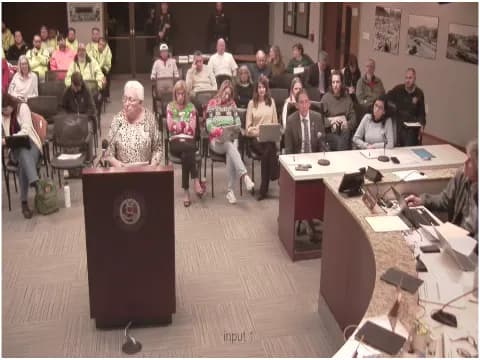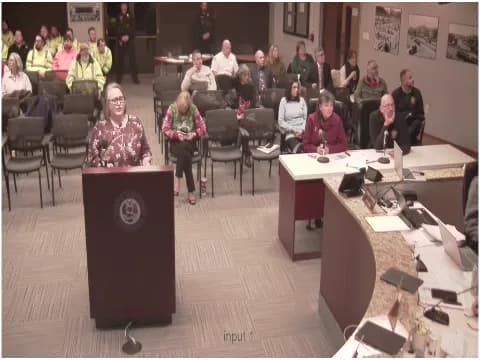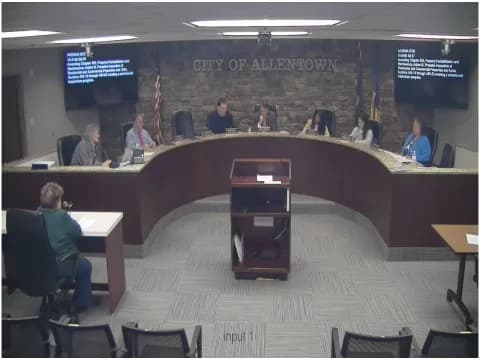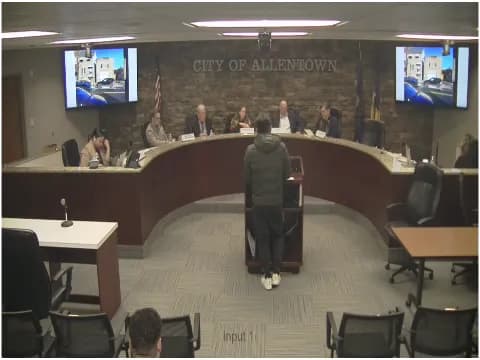
The January 12, 2026, meeting of the Allentown Zoning Hearing Board addressed two primary applications: a request to reconvert a residence to a three-unit dwelling and a request to legitimize a non-permitted side-yard addition. The board reviewed testimony from the applicant, zoning officers, and objectors regarding zoning definitions, parking requirements, and fire safety implications before rendering decisions. Consent Calendar - No specific consent calendar items were listed in the transcript; the meeting immediately proceeded to public testimony and discussion of specific cases. Public Comments & Testimony - Zoning Officer (Mike Hansel): Expressed that under the new code, the current family configuration constitutes a single household, but operating three separate kitchens with independent access would classify the property as a multi-family unit non-compliant with single-family zoning. He indicated that to remain compliant as a single home, the property would need to remove stoves and modify locks to ensure first responder access. He noted historical records suggesting the property was previously acknowledged as a two or three-unit structure decades ago. - Applicant's Attorney: Expressed support for the applicant's position, arguing that the building's existing infrastructure (three kitchens, separate meters, locked doors) clearly indicates a three-unit purpose that was never fully converted back to single-family use. The Attorney argued that the hardship existed at the time of purchase (July 2025) and that converting to three units would utilize the building's full economic capacity without altering the physical structure. - Board Member 1: Expressed a position in favor of the applicant's application, noting that the building was "masquerading" as a single family and that the structural hardship justified relief. This Board Member advocated for approving the conversion provided parking issues were resolved via leasing off-site rather than creating new curb cuts in the yard. - Board Member 2: Expressed opposition to the applicant's hardship claim, stating that the applicant purchased the property knowing it was listed as a single-family home by the real estate broker, and thus assumed the risk. This Board Member found no legal basis to approve the dimensional variances and suggested that removing stoves and locks would be less burdensome than addressing parking. - Neighbor Objector (Ghada Assaf): Expressed strong opposition to the second case (the addition), citing safety concerns. She stated that the encroachment reduced the side-yard space from 36 inches to 17 inches, hindering maintenance access and potentially impeding fire crew entry. She also raised concerns that the encroachment would devalue her property. - Neighbor Objector (Elias Alzaghiti): Appeared to refute claims of un-permitted "chicken houses" on the objector's property, noting that Animal Control had already verified no chickens existed. He requested the board investigate the objector's un-permitted additions as well. - Applicant (Case 2): Admitted to building an addition in 2014 without permits due to a lack of knowledge regarding zoning laws, citing that the project was triggered by a neighbor complaint. Discussion Items - Case 1: Residential Conversion (Single Family to Three Units) - The Board deliberated on whether the property's history and current configuration constituted a legal hardship. The discussion focused on the interpretation of the new ordinance regarding blended families versus multi-family definitions. The primary point of contention was parking: the Board discussed the feasibility of requiring the applicant to lease four off-site parking spaces to meet the former code's requirements (4 spaces for 3 units minus 1 existing garage) or two spaces under the new code interpretation. Board members noted the applicant's willingness to lease spaces and the impracticality of adding new curb cuts. - Case 2: Side-Yard Encroachment (Addition of 17 Inches) - The Board discussed the material impact of the 17-inch encroachment into the side-yard setback. While the applicant argued the goal was to increase sunlight, no evidence was presented as to why exactly 17 inches of encroachment was necessary for that design intent. Board members expressed concern regarding the reduction of the emergency and maintenance access path between the two structures. The Board noted the objector's testimony regarding fire safety and maintenance difficulties. Key Outcomes - Case 1 Approved (2-1 Vote): The application to reconfigure the property as a three-unit dwelling was approved by a vote of 2 in favor and 1 dissenting. - Condition: The approval is contingent upon the provision of four (4) parking spaces. As there is one existing space in the garage, the applicant must secure four additional leased parking spaces (or similar compliance) to the satisfaction of the Zoning Department to meet the parking requirements of the former code (under which the application was filed). - Case 2 Denied (Vote by Voice): The application to legitimize the side-yard addition was denied. The applicant was ordered to bring the structure into compliance with the side-yard setback requirements. - Next Steps: The applicant has 45 days to receive a written decision and may appeal the denial, though they are advised to seek legal counsel for the appeal process.
Public Meetings - Allentown, Pennsylvania
Public Meetings - Allentown, PennsylvaniaOn January 12, 2026, the Allentown Zoning Hearing Board convened to adjudicate three cases involving property appeals and special use applications. The board addressed a request to split consolidated lots for residential ownership, an appeal for a residential conversion in an undersized property, and a third appeal regarding a single property. Proceedings included sworn testimony from property owners, technical reviews by engineering and zoning staff, and deliberation on dimensional variances and special exceptions under both old and current zoning codes. Consent Calendar - Routine procedural confirmations and introductions were completed without objection. Public Comments & Testimony - Robert Liska (Appellant/Owner, 230 & 230½ N Nagel St): Expressed the position that consolidating two row homes into one deed in 2005 was a past action; he now seeks to re-establish the original lot lines to facilitate the sale of the two separate dwellings to current tenants who wish to purchase individually. He affirmed that the physical structures remain segregated with separate utilities, entrances, and firewalls, and no structural changes would occur. - Edward Schlanger (Civil Engineer/Surveyor): Supported the appellant's position regarding the technical necessity of splitting the lot to allow individual ownership transfer, noting that separate ownership often leads to better property maintenance and upkeep. - Brady Rodriguez Cesara (Appellant/Owner, 21 N 11th St): Through interpreter Anna Release, testified that his family (8 members) currently occupies the three-story house, utilizing three existing kitchens and locked internal doorways. He expressed a position of seeking relief to legally convert the property into three separate units (two bedrooms per floor) for his family, stating he is willing to incur the cost of installing three separate utility meters. He confirmed that converting the units would not add new residents to the property and would preserve the current 5-6 bedroom configuration. - Interpreter (Anna Release): Stated her position as a facilitator to ensure accurate translation of the appellant's English-Spanish testimony and questions from the board. Discussion Items - Case 2 (Liska Appeal): Board members discussed the proposal to revert consolidated lots to two separate parcels under the old ordinance. The board expressed concern regarding potential future density increases but accepted the zoning office's clarification that the new code (Lane House designation) currently permits only one dwelling unit per building and restricts accessory dwelling units (ADUs) in this context. The board deliberated on imposing conditions to prevent future residential conversions but was advised by staff that the current code already sufficiently addresses this. One board member noted that the physical layout supports two single-family homes despite the lot's dimension. - Case 1 (Rosato/Quasata Special Use): The board reviewed the application to convert a single-family assessed property into a three-unit residential conversion. The discussion focused on the physical reality of three distinct kitchens and the lack of internal access between floors without exiting the building. The board discussed the parking requirements, noting the applicant's proposal to add two rear lot parking spaces and lease additional off-site spaces, acknowledging the difficulty of meeting standard parking codes in this footprint. The board considered the applicant's willingness to lease off-site parking if rear yard parking is denied. Key Outcomes - Case 2 (Liska): Approved unanimously (3-0). The board granted the dimensional variance required to split the lot. The approval was conditioned on the property fulfilling all necessary code requirements to maintain the structures as separate residences. - Case 1 (Rosato/Quasata): No final vote recorded in the transcript. The discussion regarding the residential conversion, including the utility metering, access issues, and parking contingencies, was ongoing at the conclusion of the provided text. No board position or vote tally was documented in the source material for this specific case. No outcome is recorded for Case 3 in the provided text. Note: The transcript indicates the board proceeded with Case 2 first, then Case 1. The discussion for Case 1 was incomplete in the provided excerpt, and no vote or directive was formally entered in the text.
The Allentown Zoning Hearing Board convened on January 7, 2026, to address items including a special use application for a residential conversion at 406-408 Ridge Avenue and a variance request for a live-work unit at 1343 Linden Street. Item regarding 807 North LaCrosse Street was continued to January 26, 2026, at the applicant's request. The City of Allentown entered appearance as an objector to the Ridge Avenue proposal primarily due to code-specific building safety and egress concerns, while the applicants demonstrated good faith efforts to resolve deficiencies. Board members expressed support for the proposals, emphasizing the need for housing and the unique constraints of the properties. Consent Calendar - [None listed; all items were active discussion and vote items.] Public Comments & Testimony - Bradley Cartre (Neighbor): Expressed full support for the 1343 Linden Street application. The speaker stated that the property is a beneficial addition to the neighborhood and highlighted the area's walkability, proximity to public transit, grocery stores, and community resources like churches and schools. The speaker noted that existing tenants in the immediate vicinity rarely drive, suggesting low impact on parking. Discussion Items - 406-408 Ridge Avenue (Special Use Application): - City Position (Zoning Officer Mike Hanzo): The city is not diametrically opposed to the conversion to four residential units but raised significant concerns regarding building code compliance, specifically the lack of two safe means of egress for the new first-floor units. The officer highlighted that the property is landlocked, making rear egress across private property a legal and physical hurdle. Additionally, a pre-sale inspection revealed code deficiencies, and a stop-work order had been issued by the building department for unpermitted work by the previous owner. The speaker emphasized that the current owner, Mr. Karametti, is acting in good faith to rectify these issues. - Applicant Position (Mr. Karametti): The owner stated his intention to bring the property into full compliance with current codes, noting he had hired an architect and demolition permits were already filed. He explained his decision to pursue two apartments instead of commercial use based on realtor advice regarding marketability in the area. The speaker expressed that the first floor was previously a dental office with unpermitted modifications and that the goal is to legitimize the four-unit configuration. - Architect Position (Stuart Galk, Galk Architects): The architect testified that the proposed use is feasible. Regarding egress, the speaker explained that the International Building Code allows for a single means of egress if the building is fully sprinklered, citing a recent project on Front Street that utilized this provision. The speaker argued that while the lot is landlocked, the lack of off-street parking is an existing non-conformity carried over from the previous dental office use, which required fewer spaces than a dental office would have needed. The speaker also noted that converting the space to a single large unit is less feasible due to market demand for smaller units and the building's internal configuration. - City Concerns on Parking: While the applicant argued that parking relief is unnecessary due to prior commercial non-conformity, the city noted that zoning review letters had previously identified a parking deficiency. The architect countered that the previous dental office use would have required significantly more parking (approx. 9 spaces) than the proposed two apartments (approx. 3 spaces), suggesting the current parking situation is a reasonable non-conformity to maintain. - 1343 Linden Street (Variance for Live-Work Unit): - Applicant Position (Jeff and Kelly Holzman): The owners requested a variance to convert an existing office space into a live-work unit. They stated that commercial office space in the area has been difficult to rent, whereas residential units are in high demand. The speaker noted the property has existing residential apartments on the upper floors and that the proposed space already contains a full bathroom and kitchenette, requiring only minor interior finishing. The speaker indicated the intended use would be for a tailor or similar artist/service professional, which fits the live-work definition. - Board Clarification: Board members clarified that the live-work unit must adhere to specific permissible uses (retail, personal services, artistic studios) compatible with the underlying residential zoning, and that a subsequent city business license would verify the specific tenant's business type. Key Outcomes - Motion Made and Passed: Approved the special use application for 406-408 Ridge Avenue, granting the requested zoning relief for the two additional first-floor units. - Condition 1: The applicant must ensure the entire building is equipped with an automatic sprinkler system OR obtain an engineered solution for fire egress acceptable to the City Building Code Official. - Condition 2: All bedroom windows must be approved egress windows suitable for fire escape, compliant with the current or 2018 building code (whichever applies to the design contract). - Motion Made and Passed: Approved the variance for 1343 Linden Street to create one first-floor live-work unit. - Condition 1: The future tenant must comply with all Article 15 requirements for live-work units, specifically regarding permissible uses. - Condition 2: The tenant must obtain and maintain a valid City Business License, with zoning review to confirm the business type aligns with the live-work regulations and the underlying zone. - Item Continued: The application for 807 North LaCrosse Street was continued to January 26, 2026. A clerical error in the original public notice regarding the 406-408 Ridge Avenue property (indicating a special exception rather than a by-right use) was acknowledged by staff as a non-substantive error that did not affect the sufficiency of notice.
This organizational meeting served as the ceremonial and procedural transition for the City of Allentown, featuring the swearing-in of newly elected Councilpersons Jeremy Bender and Christian Pongo, as well as the return of outgoing Councilperson Natalie Santos and the swearing-in of Mayor Matt Turk for a second term. The evening included farewell remarks from outgoing Councilpersons Ed Zukel and Darrell Hendrix, the election of Natalie Santos as Council President and Cynthia Moda as Vice President, and remarks from the Mayor and newly sworn-in officials, all centering on themes of community service, fiscal responsibility, and unity. Consent Calendar - No formal consent calendar items were discussed; the meeting proceeded directly to organizational business following the oath of office. Public Comments & Testimony - Ed Zukel: Outgoing Councilperson expressed deep pride in eight years of service and 2,920 days in office, stating he acted with a clear conscience and never allowed threats or political influence to dictate his votes. He advised new colleagues to possess the courage to stand by their values rather than succumbing to peer pressure, asserting that true wisdom often means thinking for oneself against the majority. - Darrell Hendrix: Outgoing Councilperson expressed humility regarding his nearly 50-year public service career, specifically thanking staff member Michael Hanlon. He stated he made decisions based on research and facts rather than future election prospects, and expressed a commitment to keeping taxes and service increases down as a fiscally responsible measure. He noted he is ready to spend more time with his wife and five grandchildren. - Cynthia Moda: Newly sworn-in Councilperson expressed excitement and gratitude for the return to service, acknowledging the surreal nature of moving from the audience to the dais. - Jeremy Bender: Newly sworn-in Councilperson expressed humility despite having no prior name recognition, stating his decisions will be shaped by conversations with residents during his campaign. He honored the memory of activist Carol Gonzalez and quoted Father Gregory Boyle, affirming a position that the community must "stand at the margins" rather than just "rescue" marginalized individuals. - Natalie Santos: Returning Councilperson expressed gratitude for the trust of the community, emphasizing that City Council is a part-time position driven by a desire to serve. - Christian Pongo: Newly sworn-in Councilperson stated his commitment to ensuring every resident of Allentown is served, regardless of their generational status or birthplace. He credited his campaign success to community support and thanked his family, particularly his mother's work ethic and his wife Stephanie's support. - Mayor Matt Turk: Returning Mayor expressed gratitude for the support of city employees, stating he has moved past his initial naivety to a profound appreciation for public servants. He acknowledged that while he may not always have agreed with outgoing members Zukel and Hendrix, he respected their character and dedication as former police officers and public servants. Discussion Items - Outgoing Council Remarks: Zukel and Hendrix delivered final statements regarding their tenure, emphasizing professional integrity, fiscal responsibility, and the importance of independent thought and factual decision-making. - Swearing-in Ceremony: The Commonwealth of Pennsylvania, County of Lehigh, City of Allentown administered oaths to Cynthia Moda, Jeremy Bender, Natalie Santos, Christian Pongo, and Mayor Matt Turk, all affirming support for the U.S. and Pennsylvania constitutions and the duties of their respective offices. - Council Leadership Election: The acting president called for nominations and conducted a roll call vote for Council President and Vice President. No opposition was recorded during the voting process. - New Leadership Remarks: Council President Santos and Vice President Moda shared brief remarks expressing excitement for the 2026 term. Santos emphasized a new tone for public meetings and a focus on positive legislation. Moda noted her previous experience serving alongside Santos in leadership two years prior and expressed a commitment to working together to benefit residents. Key Outcomes - Natalie Santos elected as City Council President: Received unanimous support from the council (6 Yes votes). - Cynthia Moda elected as City Council Vice President: Received unanimous support from the council (6 Yes votes). - New Council Members Sworn In: Jeremy Bender and Christian Pongo officially assumed their seats as councilpersons. - Mayor Turk Sworn In: Mayor Matt Turk was sworn in for a second term. - Next Steps: The council declared readiness to begin work on 2026 legislation and community initiatives immediately following the celebration.
On December 30, 2025, the Allentown City Council convened a special meeting to deliberate on Resolution 199, a measure to override the mayor's veto of the 2026 budget bills (84-90). The session featured a heated debate regarding a proposal involving a 3.96% tax increase offset by a $50 reduction in the solid waste fee, alongside discussions on the absence of a default budget in the city charter and the potential for a 2026 government shutdown without an agreement. Public testimony largely focused on the impact of tax increases on renters, seniors on fixed incomes, and the city's financial transparency, while council members deliberated on a compromise plan and the necessity of incremental raises versus deferring decisions. Consent Calendar - No items listed in the transcript. Public Comments & Testimony - Speaker representing citizens of Allentown: Expressed opposition to the mayor's budget and the failure to override the veto; argued that the mayor prioritizes tax advantages for downtown developers over city workers and homeless services; accused the administration of cronyism and noted ongoing lawsuits against the police department; stated that residents are unable to afford rent, medication, and groceries; strongly urged council members to vote against the mayor to support the majority of citizens. - Joseph Maher (Former County Commissioner/Attorney): Expressed support for overriding the veto; clarified that there is no default budget in Allentown, meaning a failure to pass a budget results in no budget for 2026; sought clarification from council regarding the context of the revenue increase versus the solid waste fee issue. - Speaker from Allentown: Expressed strong opposition to tax increases; stated that further increases could lead to more homelessness and displacement; called for an unbiased investigation into the budget and spending under the current administration; expressed resolve to scrutinize future budget spending in 2026. - Speaker from Allentown PA community group: Expressed opposition to tax increases; proposed an alternative revenue source by converting the Hamilton Street Dam into a hydroelectric generating station; noted that other options for raising capital were not enacted. - Landlady (12th and Shoemaker): Expressed support for the mayor's proposal which included a $50 trash fee reduction; argued that reducing the fee by $50 while maintaining a small tax increase results in a net tax savings for many homeowners; expressed concern that landlords might use the tax increase alone as an excuse to raise rents, rather than using the $50 reduction as leverage. - Council Member (Speaker on public comment): Opposed the override, arguing that the compromise (3.96% tax increase plus $50 trash reduction) is beneficial; stated that 23,000 out of 26,000 homes will pay less or break even under the proposal; emphasized that the solid waste fee is a mandatory contract increase and that the tax increase is only a small increment; argued that overriding the veto kicks the can down the road and ignores the benefit of the compromise for seniors. - Council Member (Speaker on public comment): Criticized the compromise as "kicking the can down the road"; argued that borrowing $50 from the solid waste fund creates a liability to be paid back over five years with interest, effectively meaning taxpayers will still pay the full amount eventually; stated that the city officials are creating a false impression of relief when no free lunch exists. - Barbara Redman: Corrected a previous speaker's assumption that West End residents can afford tax increases; stated that many in the West End are retirees on fixed incomes; expressed a preference to eliminate the tax increase entirely, even if it means paying the full trash fee. - Candida (West End homeowner): Expressed concern regarding housing bubble risks and the inability to afford tax increases on a fixed income; stated that property values have dropped and that property taxes are a burden. - Speaker (Council Member/Staff): Argued that while local taxes are a factor, they must be viewed in the context of broader economic pressures including rising medical costs, grocery prices, and utility increases; stated that corporate greed drives rent increases and that the transfer tax increase targets corporate owners; noted that the Allentown School District managed to fund itself without raising taxes despite being underfunded; expressed support for overriding the veto based on the broader economic context. - Unidentified Council Member: Stated they will not override the veto; acknowledged the budget crisis but emphasized the need to use resident money responsibly; noted that 23,000 homeowners will pay less under the compromise, which they view as a significant benefit. Discussion Items - Resolution 199 (Veto Override): The resolution, sponsored by Councilpersons Zuko, Gurloch, Santos, and Moda (transcript mentions "Zuko, Gurloch, Santos and I mean Santos in MODA"), seeks to override the mayor's veto of the 2026 budget bills. - Budget Default Status: The City Solicitor clarified that under the current charter, there is no default budget for the City of Allentown; a referendum in 2019 established that the council and administration must agree on a budget, and a failure to pass one would result in a 2026 with no operational budget. - The $50 Trash Fee Compromise: A discussion ensued regarding a proposal to reduce the solid waste fee by $50 while maintaining a 3.96% tax increase. Council members debated whether this netted savings for 23,000 homes or merely deferred costs. - Solid Waste Fund Borrowing: The Controller and Solicitor explained the financial mechanism: the solid waste fund is borrowing $50 per household (approx. $1.5 million total) from the general fund, to be repaid over five years with interest (estimated 2.5% to 3.9%), paid back via the general fund (taxpayers) rather than directly through a new fee increase immediately. One council member argued this is "robbing Peter to pay Paul" and does not eliminate the ultimate cost. - Procedural Disputes: A motion was made to revisit the amended proposal after the vote failed. The presiding officer ruled that a motion to revisit or reconsider the action must come from one of the four members who originally voted to override the veto (the prevailing side), and since the motion came from a member who voted against the override, it was ruled out of order. Key Outcomes - Roll Call Vote on Resolution 199: The override of the mayor's veto failed. - Yeas (4): Ms. Effa, Ms. Garlot, Ms. Moda, Mr. Santos, Mr. Juko (Note: Transcript lists 5 names for "Yes" in the roll call section: "Ms. Garlot. Yes. Miss Moda. Yes. Mr. Napoli. No. Santos. Yes. Juko. Yes. Mr. Hendrix. No. Mr. President, I have four years and three nays." The tally provided at the end is "four years and three nays", and the names listed as "Yes" were Effa, Garlot, Moda, Santos, Juko - suggesting a discrepancy or miscount in the transcript's spoken tally vs names. Based on the final stated tally of "four years and three nays", the vote failed). - Nays (3): Mr. Napoli, Mr. Hendrix, Mr. President (implied or explicitly stated as part of the 3 nays). - Final Tally: 4 Yeas, 3 Nays (Need 5 votes to override). - Result: The mayor's veto stands; the 2026 budget as vetoed is not enacted by this override. - Procedural Outcome: The motion to revisit the amended budget proposal was ruled out of order because it was not made by a member who voted in the majority (override) on the original resolution. The meeting was adjourned.
The Allentown City Council convened on December 17, 2025, to review contracts, approve the 2026 budget ordinances with significant amendments, and address public safety funding. The meeting included the passage of multiple budget funds, a contentious vote on the General Fund budget featuring a no-tax-increase proposal, and a unanimous transfer to cover rising health care claims. The session concluded with tributes to two retiring council members, Mr. Zuko and Mr. Hendricks, as the body prepared for an organizational meeting in January 2026. Consent Calendar - Contract R 194: Authorized a contract with Barry Isett and Associates for $49,920 to provide consulting and engineering services for the MLK Trail Phase 3 feasibility study. Councilor Zuko noted a family member's employment with the firm but proceeded after clarifying this contract covers a different trail section than previously approved. - Contract R 195: Authorized a cooperative contract with Multi-PRO for $11,875 to purchase a sprayer for the golf course. - Minutes Approved: Minutes from November 19, 2025, and December 3, 2025, were unanimously approved. - Correction: Council noted and corrected an error in a previous resolution regarding a fire overtime transfer, changing the destination account from "premium pay for EMS" to the "fire premium pay" account. - Building Permits: Consented to work permits for the Police Department at 425 Hamilton Street (sewage planning module) and 231 North Fulton Street. Public Comments & Testimony - No formal public comments were recorded during the meeting; attendees noted none when the floor was opened for comments on multiple agenda items. - Note on Bill 84: A member of the public or council raised a request for a minor title change during the discussion of Bill 84 regarding the budget, which was subsequently motioned and seconded by the council. Discussion Items - Budget Amendments (Bill 84): Council debated and approved several amendments to the 2026 General Fund budget. Key points of discussion included: - A motion to change the title of a budget position from "Legislative and Community Engagement Specialists" to "Public Affairs and Policy Officer." - Confirmation that the budget contains a no-tax-increase provision, transferring $1.5 million from the closing fund to offset a reduction in the tax rate. - Approval of $100,000 for the Health Department to serve the unhoused population. - Personnel changes in the Solicitor's Office and CD Department, including the creation of a Deputy Director and renaming a Senior HR Generalist position. - Councilor Zuko expressed concern regarding the scale of unanticipated health care costs, questioning if the city was under-budgeted. The administration clarified that higher claims were due to unpredictable high-cost claims, including costs associated with GLP1 drugs (weight loss/diabetes treatments) covered for all employees, which sometimes range between $10,000 and $20,000 per dose, though specific data was withheld due to HIPAA regulations. - Health Care Claim Transfer (Bill 101): Council discussed and approved a transfer of $2,500,000 from the General Fund unappropriated balance to the Risk Fund to cover significantly higher-than-expected health care claims and prescription drug benefits. Councilor Zuko questioned the budgeting accuracy given a previous $9.5 million transfer for similar reasons, while the administration explained this transfer utilizes actual cash rather than budgeted funds to address the surplus of cash in the general fund unappropriated balance resulting in a vote of 7-0. - Retiring Council Members: The administration and fellow councilors expressed gratitude to Councilors Zuko and Hendricks for their long-term service, describing them as dedicated public servants and former police officers. Tributes highlighted their years of service, their ability to find common ground despite disagreements, and their contributions to the city prior to and during their time on the council. Key Outcomes - Bill 84 (General Fund & Other Budgets): Passed by a vote of 4-3 (in favor) as amended. Nays votes came from Mr. Napoli, Mr. Zuko (initially, then recused or changed context? Transcript says "Mr. Zuko? Yes... Mr. Hendricks, no. Ms. Affa. No..." Wait, let's re-read the vote tally text carefully: "Mr. Zuko. Yes, Mr. Hendricks, no. Ms. Affa. No. Mr. Napoli. No. President. Yes... It's four to three." This implies Mr. Hendricks, Ms. Affa, and Mr. Napoli voted No, while the rest voted Yes.) - Bill 85 (Building Code Fund): Passed 7-0. - Bill 86 (Liquid Fuels Fund): Passed 7-0. - Bill 87 (Rental Unit Licensing Fund): Passed 7-0. - Bill 88 (Solid Waste Fund): Passed 7-0; amended to increase the solid waste fee to $7.40. - Bill 89 (Stormwater Fund): Passed 7-0; maintained the stormwater utility fee at $20 per 500 square feet. - Bill 90 (Trust of Fund): Passed 7-0. - Bill 97 (Property Rehab): Passed 7-0; established a commercial inspections program. - Bill 98 (General Fund Supplemental): Passed 7-0; provided $1,000,000 from the DCD local share account grant to the Bombay School of Art. - Bill 99 (Capital Fund Supplemental): Passed 7-0; appropriated $3,125,825.97 from aqueous film-forming foams class action awards to offset PFAS remediation costs. - Bill 100 (General Fund Transfer): Passed 7-0; transferred $25,000 to the Y for the early warming shelter opening. - Bill 101 (Risk Fund Transfer): Passed 7-0; transferred $2,500,000 from the General Fund to the Risk Fund for health care claims and negotiated a waiver of the 14-day waiting period for the Mayor's signature. - Resolution 198: Passed 7-0; approved a $140,000 transfer for salt and $22,358.75 for actuarial services by Chiron. - Next Steps: The City Council will hold an organizational meeting on January 5, 2026, to swear in newly elected council persons and elect council leadership.
The Allentown City Council convened on December 17, 2025, to deliberate on amendments to the 2026 city budget. The meeting featured a proposal by Councilpersons AFA, Napoli, Santos, and Zuck, supported by the President, to reinstate a 3.96% property tax increase paired with a $50 reduction in solid waste fees. A separate budget memo from the Mayor regarding homeless services was subsequently withdrawn. The council failed to pass the primary tax amendment, voting 3 in favor and 4 against. Consent Calendar - No consent calendar items processed. Public Comments & Testimony - Betty Coller (Resident): Expressed strong support for a property tax freeze for senior citizens and a rent freeze to prevent homelessness. She opposed the tax increase entirely, suggesting revenue could be generated by revoking NIZs, taxing developers (specifically JB Riley more heavily), and ending lawsuits against the administration. She also proposed cutting the police budget by 1% to offset the tax hike. - Quinn Allen (Resident, "What's Really Going On in America"): Expressed opposition to the 3.96% tax increase, characterizing the $50 waste fee reduction as a "sneaky trick" that would result in net increased costs for residents. He argued that the city does not need to raise taxes and criticized the lack of action to support the homeless population. - Anthony Hollowell (SCIU Representative): Expressed opposition to the tax increase on behalf of city workers, citing that non-union staff (including top positions) received 9% raises while bargaining unit members received only 3%. He urged the council to cut new, high-salary part-time positions and existing staffing costs before raising taxes. Discussion Items - Proposal: Reinstatement of 3.96% Tax Increase and $50 Waste Fee Reduction - Sponsors (Councilpersons AFA, Napoli, Santos, Zuck): - Councilperson AFA: Expressed full support for the proposal, stating it helps 23,000 out of 26,000 residential parcels. She argued that the $50 reduction saves money for homeowners compared to the alternative of larger tax increases seen in neighboring municipalities (e.g., Whitehall up 20%, other township up 63%). She emphasized the need for revenue to fund a 3% raise for non-union public safety employees and to maintain capital projects. - Councilperson Santos: Explained this was a "Plan B" compromise following a previous removal of the tax increase on Nov 19. She expressed support, noting the proposal is more equitable by having higher-valued properties contribute slightly more. She affirmed that 23,000 single-family homes would save money or pay the same as 2025, and the loan between funds would be repaid over five years. - Councilperson Napoli: Expressed strong support for the proposal as a necessary compromise to preserve services. He noted his personal preference was the original 4% increase (approx. $23/year for an average homeowner) but accepted this as a vital alternative to maintain employee morale and service delivery. - Councilperson Zuck: Expressed strong opposition to the tax increase. He argued the city is failing due diligence in revenue creation (citing a $385,000 street cleaning spend vs. $2,000 revenue from the parking authority) and that asking the public to pay a 4% increase while non-union staff receive 9% raises is "insane." - Mayor / Administration: Expressed full support for the proposal. They confirmed that 23,000 of 26,000 parcels would receive financial relief and argued that retaining cash reserves and recurring revenue is essential for lowering borrowing costs on future capital projects and sustaining taxpayer-funded services. - Council President Hendricks: Expressed strong support for the compromise, commending the sponsors for finding common ground. He stated the proposal balances protecting struggling households with maintaining the high quality of services (street sweeping, snow plowing, parks, police, fire) expected by residents. - Councilperson Moda: Expressed opposition to the tax increase, honoring a campaign pledge made to constituents who voted for her not to raise taxes. While she supported the waste fee reduction, she stated she could not support the property tax increase this year, citing the economic strain on residents and small businesses. - Councilperson Gerlock: Expressed opposition to the tax increase. She stated that if affordability for the working class was the true intent, the council should have addressed institutional wealth taxes, amusement taxes, or developer impact fees earlier in the process. - Budget Memo: Mayor's Operating Budget ($50,000 for Homeless Services) - Administration: Proposed an amendment to allocate $50,000 to the Conference of Churches to provide Saturday and Sunday homeless support services (currently only open Mon-Fri). - Mayor: Withdrew the memo during the meeting, stating it would be "fiscally irresponsible" to add expenses to a budget that is actively drawing from reserves without passing the tax increase that funds it. Key Outcomes - Vote on Tax Amendment: The proposal to reinstate the 3.96% tax increase and reduce the waste fee by $50 failed with a vote tally of 3 Yea to 4 Nay. - Votes in Favor: Councilperson AFA, Councilperson Napoli, Council President Hendricks. - Votes Against: Councilperson Zuck, Councilperson Moda, Councilperson Santos (Note: Transcript lists Santos as voting "No" during the roll call, though she is a co-sponsor; this may reflect a procedural error or specific condition in the transcript record). - Clarification on Santos: The transcript text explicitly lists Ms. Santos as voting "No" during the roll call, despite her being a sponsor of the motion. This discrepancy is preserved as per source material accuracy rules. - Action on Homeless Services Memo: The memo to increase the Mayor's budget by $50,000 was withdrawn by the Administration and not put to a vote. - Next Steps: The meeting adjourned with the special session complete; a regular council meeting to adopt the amended budget is scheduled to follow. The failure of this amendment suggests the budget without this specific tax increase will require further deliberation or the adoption of the previously amended budget (which lacked the tax increase) or an alternative funding solution. The repayment schedule for the proposed loan (2 million dollars over 5 years, starting 2027) was confirmed but not enacted.
The Allentown Board of Directors convened to address critical infrastructure updates and utility rate justifications. The meeting focused primarily on compliance with an EPA order to replace lead and copper service lines, the associated residential grant programs managed by the Lehigh County Authority (LCA), and a review of upcoming water and sewer rate adjustments. While board members and LCA representatives emphasized the mandatory nature of the replacement timeline, discussions highlighted community communication gaps and funding limitations regarding street rehabilitation. Consent Calendar - No items were listed for formal approval or unanimous action in the provided transcript. Public Comments & Testimony - Public Concern on Communication: A board member expressed concern that confusion regarding the program's mechanics and responsibilities is widespread among residents, specifically noting that the Spanish-speaking population feels "completely in the dark." The speaker emphasized that without clear communication, residents may disregard official mail, assuming it is merely a bill. - Position: Supported stronger, more frequent, and linguistically accessible outreach to ensure residents understand they will not be required to outlay funds upfront. Discussion Items - Lead and Copper Replacement (EPA Order): - Program Overview: LCA presenter Liesel Gross and staff explained the mandate to replace service lines by 2037. Public lines (water main to curb) are the utility's responsibility, while private lines (curb to home) are the property owner's. - Grant Details: Attendees queried the availability of the PEN VEST program. Staff confirmed that grants cover 100% of the cost for private line replacement, including sidewalk restoration in some coordination contexts, with no income requirements, though funding is prioritized for "financially sensitive fragile areas." There is no upfront cost to the homeowner; reimbursement occurs post-completion. - Operational Challenges: Board members noted the difficulty in gaining entry for inspections on the private side. LCA clarified that they utilize a neighborhood-based approach; they do not replace pipes one-by-one but rather target specific pockets (e.g., Center City, next East Side) to ensure cost-effectiveness. - Paving Discrepancy: A speaker noted a conflict where the street rehabilitation ordinance requires curb-to-curb paving after cuts, yet no specific funding exists for this paving work through EPA or state water grants. The speaker expressed a need for Pennsylvania to provide better assistance for paving costs. - Water Efficiency Question: - A board member asked if current assistance grants cover water efficiency upgrades (e.g., low-flow toilets, showerheads) to reduce overall consumption. - LCA Response: The current program is strictly for bill assistance for low-income households to prevent disconnection. However, the speaker stated the program is flexible and could be modeled to include efficiency grants if funds and a specific need arose. - Water and Sewer Rates: - Impact: LCA presented that the 2025-2026 rate adjustment results in an approximate quarterly increase of $18 (roughly $6/month) for an average residential bill of 15,000 gallons. - Comparative Position: Staff presented data indicating that Allentown's rates remain in the middle range compared to 26 other Lehigh Valley communities. A board member commented on the general necessity of rate hikes due to aging infrastructure and national regulations (ASCE grading water systems a C-). - Assistance: LCA highlighted their existing customer assistance program, having awarded nearly 500 grants (totaling $500k in recent years), noting that federal programs (LIWAP, PA HAF) have expired. Key Outcomes - Compliance Timeline: The city is legally required to achieve full lead service line replacement compliance by 2037. - Funding Strategy: The City and LCA will continue to utilize PEN VEST grants for full pipe and sidewalk replacement costs, avoiding income-based restrictions. No funding currently covers the associated street paving costs, creating an administrative burden to manage road assets. - Communication Plan: LCA committed to bilingual (English/Spanish) outreach, including annual EPA-required notices and interim communications via mail and phone to clarify that homeowners will not incur upfront costs. - Next Steps: LCA will develop specific neighborhood programs for replacement cycles and continue legislative outreach to secure additional rate relief and paving funding.
The Community and Economic Development Committee convened on December 17, 2025, to review three legislative items and budgetary transfers related to commercial property inspections, arts funding, and warming shelter operations. The committee unanimously recommended forwarding all three measures to the full council without modification. Consent Calendar - Bill 97: Proposed amendment to Chapter 455 to expand pre-sale inspections to commercial properties, establishing a baseline safety inspection at the time of sale to facilitate future code compliance negotiations. - Bill 98: Proposed budget amendment providing a supplemental appropriation of $1 million from the Pennsylvania DCED local share account grant to the Bomb School of Art for renovations. - Bill 100: Proposed budget amendment transferring $25,000 from the general building code fund to the general fund to pay the YMCA's invoice for the early opening of a warming shelter. Public Comments & Testimony - No public testimony or comments from members of the public were recorded during the meeting. Discussion Items - Bill 97 (Commercial Pre-Sale Inspections): - Ms. Kisler (Administration) stated the current project aims to intercept commercial sales to identify code issues early, allowing owners to negotiate repairs before or during the sale. She clarified that the initial scope is a baseline inspection of the building's "corn shell" (structure, fire safety, windows, entries) rather than specific use-based inspections, which will be triggered later when a business license is applied for (e.g., restaurant vs. event space). - Mr. Napoli expressed inquiry regarding baseline codes for empty commercial buildings with unknown future uses. He sought clarification on how the inspection handles different potential uses (e.g., restaurants requiring hood systems). Ms. Kisler confirmed the inspection serves as a structural baseline, with use-specific requirements handled during the licensing phase. - Mr. Hendrix questioned whether the unit had sufficient manpower to execute the pre-sale program. Ms. Kisler expressed confidence in having sufficient staff to take on pre-sales without additional hiring, citing current streamlining via Energov and the recent addition of a scheduler. - Ms. Kisler admitted that while revenue projections for the program are being worked on, there are no concrete numbers available at this time due to the difference in sales volume between the commercial and residential markets. Key Outcomes - Bill 97: Motion made and seconded to move the bill forward favorably to full council. Vote result: All in favor (Aye). The committee will forward the bill to full council. - Bill 98: Motion made and seconded to move the bill forward favorably to full council. Vote result: All in favor (Aye). The committee will forward the bill to full council. - Bill 100: Motion made and seconded to move the bill forward favorably to full council. Vote result: All in favor (Aye). The committee will forward the bill to full council. - The meeting was adjourned immediately following the unanimous votes.
The Allentown Redevelopment Authority (RACA) held its monthly meeting on December 10, 2025, attended by all board members, solicitor, and staff. The meeting focused on approving financial reports, adopting the 2026 budget, finalizing the audit engagement, and determining the strategy for releasing Requests for Proposals (RFPs) for two key properties: 725 North 10th Street and 540 Hamilton Street. Following an executive session to discuss real estate acquisition strategies, the board proceeded with several unanimous votes and established a committee to refine a two-step RFP process. Consent Calendar - Approved the minutes from the November 12, 2025, meeting unanimously. Public Comments & Testimony - No members of the public presented comments or testimony during this meeting. Discussion Items - Staff Financial Reports (Item 5.0): - Staff presented the budget-to-actual report for November 2025, noting a month-over-month expense increase of approximately $10,000, primarily driven by $8,000 in insurance reclassifications and a $1,000 payment of the premium balance. - A board member requested detailed breakdowns for specific addresses listed in the "Sale of Property" budget notes (e.g., 332 Front Street, 802 Walnut Street) to clarify if these assets were sold or merely budgeted assumptions from the previous year. Staff clarified that these figures represent budgeted revenue projections for properties expected to be sold, not actual sales, and that the actual column remained empty for these items. - The board discussed the $100,000 invoice for City of Allentown staff support, which was dated December but not yet recorded in the November financials. Staff confirmed this would be recorded at year-end upon execution of the CDBG contract. - The "loss on disposal of assets" for 413 Ridge Avenue was explained as a bookkeeping entry reflecting an asset book value of $1, which was sold for $1, resulting in a net $1 gain rather than a financial loss. - Invoices for Payment (Item 5.2): - Staff discussed the 2026 monthly invoicing structure for city staff time, noting that regular monthly billing will commence once the CDBG contract is fully executed with HUD. - The board approved the payment of $103,688.18 across five invoices, including the $100,000 staff support invoice. - Inventory Update: - Staff confirmed all properties are secure. A board member requested the addition of inspection dates to the inventory spreadsheet to document weekly blight inspections for accountability. - The status of 515-519 New Street was clarified as a combined parcel purchased in 2020 for a planned low-income apartment project; the plan has not yet gone to fruition, and the property is awaiting a Request for Proposals (RFP). - 2026 Budget Adoption (Item 7.2): - Staff presented the 2026 budget, projecting $600,000 in CDBG funds (including $100,000 for staff and $100,000 for property maintenance) and revenue from the anticipated sale of five properties totaling $125,000. - A discussion ensued regarding the $2,000 budgeted line item for third-party website design. A board member expressed opposition to paying external costs for web maintenance when board volunteers could handle updates, suggesting the funds be saved or allocated to staff. The board approved the budget as presented but noted future flexibility to amend line items. - Marketing expenses included $500 for the "Morning Call" newspaper (the only printable outlet available for legal notices) and $2,000 for website services. - Audit Engagement (Item 8.1): - The board discussed the engagement letter for the 2025 audit from Maher & Doussle. A board member expressed strong satisfaction with the firm's previous service, deeming the proposed fee of $24,700 a good value given the state of the audit. - The board voted against an immediate RFP process, preferring to retain current auditors for another year, with plans to issue an RFP in 3-5 years. - CDBG Contract (Item 8.2): - The board reviewed the fiscal year 2024 CDBG contract with the City of Allentown, which authorizes the reimbursement of $100,000 for staff costs and $100,000 for property maintenance incurred in 2025. - The contract was approved unanimously to facilitate immediate reimbursement processing. - Meeting Schedule (Item 8.3): - The 2026 meeting schedule was adopted, set for the second Wednesday of each month. A minor correction was made to the start time (changing from 2:30 PM back to 2:00 PM). A board member noted the schedule inconvenience for working professionals but accepted the consensus against moving to evenings due to low attendance at previous night meetings. - Release of RFPs for 725 North 10th and 540 Hamilton (Item 10): - Divided Opinions: The board debated a "two-step" RFP process versus a traditional one-step process. - Position for Two-Step: Several board members advocated for a two-step process (Letter of Intent followed by formal proposal) to encourage "little guys," nonprofits, and creative community developers who might be intimidated by detailed 20-page proposals and financial pro formas. They emphasized community vision over immediate financial return. - Position for One-Step/Financial Security: Other board members, including the Solicitor, expressed concern that a two-step process could lead to legal challenges regarding subjective scoring, favoritism, or accusations based on vague criteria. They argued for a rigorous evaluation requiring detailed financial pro formas and proof of capital to avoid projects stalling in bankruptcy. - Legal & DEI Concerns: The Solicitor warned against incorporating affirmative action or minority ownership preferences into the scoring criteria due to current conservative legal interpretations of federal funding rules, noting the HUD contract had removed such language. - Consensus on Approach: While deadlocked on the exact mechanism, the board agreed that the current proposed RFP language was too technical for non-developers. A committee consisting of Mark, Jessica, Kevin, and Alan was formed to draft a revised RFP strategy. This strategy will likely incorporate a "technical proposal" followed by a "sealed cost proposal" approach, similar to HUD guidelines, while also planning for outreach, press conferences, and technical assistance workshops to support smaller applicants. Key Outcomes - Budget Approval: The 2026 budget was adopted. Total expenses are projected at $724,750 against anticipated revenue of $752,600, resulting in a projected positive balance of $27,850. - Audit Contract: Maher & Doussle was retained for the 2025 audit at a fee of $24,700. - CDBG Contract: The FY 2024 CDBG contract with the City of Allentown was approved to enable $200,000 in reimbursements. - RFP Strategy Committee: Mark, Jessica, Kevin, and Alan were tasked with designing a new, potentially