Browse by city
Date range
Search help

Search titles, summaries, topics and stored transcripts together. Keywords may match separately; put the whole query in double quotes for a phrase. Matching follows word analysis, so punctuation is not exact. Both dates are included. Documents are not searched.

SHOWING 51–60 ENTRIES
51
SEP 14, 2026 · ANCHORAGE, ALASKA · ASSEMBLY & COMMITTEE MEETINGS
Anchorage Military and Veterans Affairs Commission Meeting - September 14, 2026

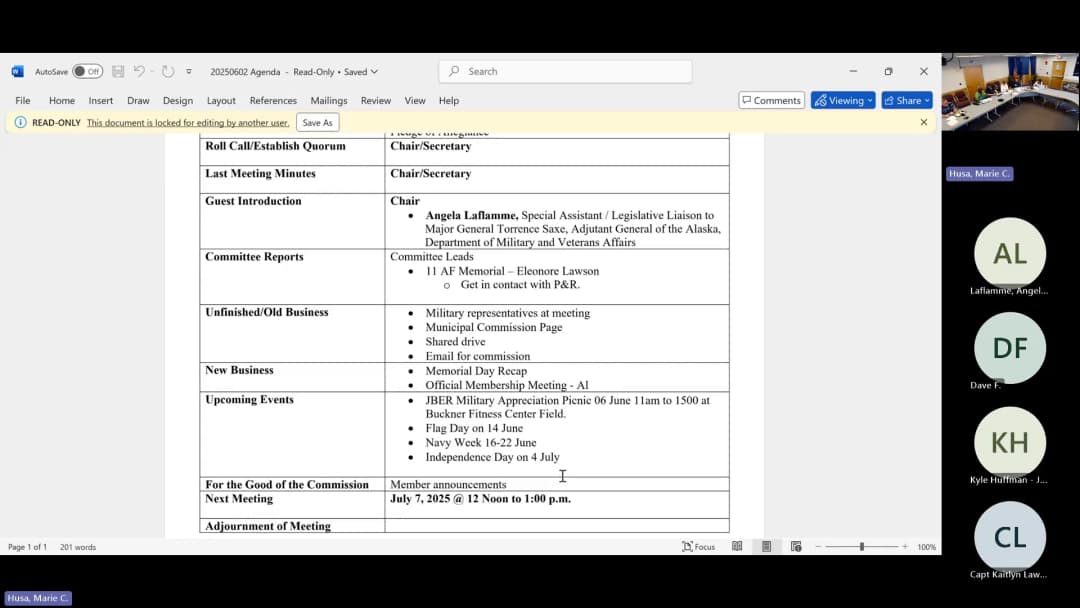
The Anchorage Military and Veterans Affairs Commission held a regular meeting on September 14, 2026, at 9:24 PM (timestamp from source). The meeting included introductions of new guests, updates on membership applications, discussion of the 11th Air Force Memorial, a recap of the May Memorial Day ceremony, planning for future events, and a clarification on the Alaska Open Meeting Act. Several decisions were made regarding the next meeting location and future event coordination. Guest Introductions and Membership Updates - Captain Lawton (477th Fighter Group, Air Force Reserve) attended as a guest, invited by Kyle. Bob Sherrell, executive director of the Alaska Veterans Museum, introduced himself as a potential new commission member. His application had been submitted multiple times, with confusion over the correct commission (Arts Advisory vs. Military and Veterans Affairs). Staff member Anna Marie clarified that the application would be forwarded to the mayor for the June 24 assembly meeting, with approval expected by July. - Commissioner terms expiring in October 2025 (Robert, Eleanor, Al) were noted; members were asked to email their interest in reappointment. 11th Air Force Memorial - The memorial has seen recent improvements: flags flying, barriers removed, and repaving completed. Commissioner Al has been in contact with Colonel Mabbitt (11th Air Force) who expressed enthusiasm for the project. The commission voted unanimously to hold its next meeting (scheduled for July 7, 2026) at the memorial to allow members to inspect the site and facilitate further coordination. Memorial Day Ceremony Recap - The May ceremony was praised by the mayor as well-organized. Lessons learned included the need for better volunteer coordination for distributing flyers to nearby residents (Al noted lack of response from other commissioners), timing of motorcycle escorts (suggestion to return to pre-ceremony motorcycle run), and clearer instructions for wreath placement (VIPs should go first, with barriers to control crowd flow). Commissioner Murray offered to create a task spreadsheet with assignments and due dates for future events. Open Meeting Act Compliance - Staff explained that any gathering of three or more commissioners could be considered a public meeting under state statute, even if informal (e.g., site visit). The commission agreed to public notice all such gatherings to ensure transparency. Upcoming Events and Flag Day Discussion - Upcoming events: JBER Military Appreciation Picnic (June 6), Flag Day (June 14), Navy Week (June 16–22), Independence Day (July 4). Commissioner Olivia proposed a public education campaign on flag etiquette, possibly through TV public service announcements. Commissioners discussed creating a banner for the commission to march in Anchorage parades. Other Announcements - Bob Sherrell offered the Alaska Veterans Museum foyer for veteran recognition events. - Angela announced the Alaska Military Youth Academy graduation on June 12 at 10 AM at the Alaska Airlines Center (110 cadets graduating). Key Outcomes - Next Meeting Location: Unanimously decided to hold the July 7 meeting at the 11th Air Force Memorial. - Application Tracking: Staff to update the commission on application status at each meeting. - Memorial Day Planning: Commissioner Murray to create a task spreadsheet for the 2027 ceremony; suggestions to revert motorcycle timing and manage wreath placement will be incorporated. - Open Meeting Compliance: All future gatherings of three or more commissioners will be publicly noticed. - Parade Participation: Commission will explore creating a banner and marching in future parades. - Flag Day Publicity: Commissioners to contact local media for public service announcements on flag etiquette. Note: The transcript's internal dates (e.g., June 24, July 7) suggest this meeting occurred in late May or early June, but the provided timestamp indicates September 14, 2026. The summary uses the given date per instructions.

VETERAN AFFAIRS 53% · PUBLIC ENGAGEMENT 44% · PUBLIC RECORDS 3%
52
SEP 14, 2026 · ANCHORAGE, ALASKA · ASSEMBLY & COMMITTEE MEETINGS
Anchorage Housing and Community Development Commission Meeting - September 14, 2026

The meeting was held on September 14, 2026, focusing on the 2027 Housing Development Sanction Plan (CDBG, HOME, ESG), a substantial amendment to the HOME-ARP allocation plan, the modular housing redevelopment program, and 2027 municipal budget priorities. Commissioners heard public testimony and discussed funding allocations for housing, homelessness, and neighborhood revitalization. Consent Calendar - Agenda was approved unanimously with a motion and second. - Minutes from the August meeting were approved unanimously. Public Comments & Testimony - Jamar Hill (youth sports program in Mountain View) expressed support for allocating funds to demolition of derelict properties, programmatic funding for community facilities, and community activation. He emphasized the need for safe, warm spaces and noted that such investments can revitalize neighborhoods. - A public commenter (name not stated, spoke after Jamar Hill) supported demolition of blighted buildings and suggested including brownfield remediation, particularly for the former Circle K gas station adjacent to Mountain View Lions Park. They recommended connecting with municipal brownfield programs. - Michael Allen (returned to Alaska after 24 years) expressed concern that current approaches displace people without solving root problems, and that free services may enable crime. He questioned the commission's advisory authority and urged focus on long-term solutions. - A speaker (employed at Circle K, hourly wage $15.50) spoke about the challenges of the 'middle population' struggling to keep housing, citing personal financial strain and a parent's health crisis. They called for accountability for homeless individuals and a holistic approach that includes those barely holding on, not just those on the streets. - A commenter (name not stated) supported the previous speaker's comments, emphasizing the need for community wraparound support and small-scale rental assistance programs. Discussion Items - 2027 Housing Development Sanction Plan (CDBG, HOME, ESG) - Jed (presumably a staff member) presented the early public hearing required by the citizen participation plan, explaining that input is sought before drafting the annual action plan. The city manages three grants: CDBG ($2 million/year, now allowing up to 20% for new housing construction due to the 21st Century Road to Housing Act), HOME ($600,000-$700,000/year for housing), and ESG ($160,000/year for homelessness prevention). Allocations for 2027 are not yet known. - Commissioners suggested including organizations like Catholic Social Services and Covenant House in consultations. The list of consulted organizations was noted to be outdated. - Public input prioritized demolition of derelict properties (slum/blight clearance), supportive services, and community facilities. Jed confirmed these are eligible activities. - HOME-ARP Substantial Amendment 3 - This amendment reclassifies $360,420 from tenant-based rental assistance (TBRA) to supportive services within the HOME-ARP program (funded by ARPA, total $2.7 million). The reallocation does not change the planned activity but aligns with HUD requirements. The funding had been allocated to a grantee (Henning) but not yet spent. - A public commenter raised concerns about a prior RFP (RFGP 2024 GP 005) and alleged that Henning received funds unfairly, while other groups were dismissed. They questioned whether the amendment constitutes a sole-source allocation and urged redirecting funds to organizations serving homeless populations more effectively. - Staff explained the process: additional emergency rental assistance became available during the RFP, leading to a larger rental assistance allocation. The grantee selection and compliance were reviewed by the purchasing department. - Commissioners noted the public comment is forward-facing and not to re-litigate past decisions. - Modular Housing Redevelopment Program Update - Staff gave a brief update on a new program focusing on demolition of nuisance properties, small repairs, and modular housing construction to reactivate vacant parcels. An application portal will be created, and more details will be rolled out in coming months. - 2027 Municipal Budget Priorities - Staff flagged that the administration is developing the proposed 2027 budget (general fund, not grant funds). Public meetings for input are expected soon; Thea will provide an update at the next meeting. Key Outcomes - Agenda and minutes were approved unanimously. - Public testimony on 2027 action plan will inform the draft; another public hearing will follow the draft release. - The HOME-ARP substantial amendment 3 will proceed to reallocate $360,420 to supportive services. No formal vote was taken during this hearing, but the amendment was presented for public comment. - The modular housing redevelopment program will continue development with more details to come. - The next meeting is scheduled for October 7, 2026, at the same time and channel.

AFFORDABLE HOUSING 25% · HOMELESSNESS 14% · PUBLIC COMMENT 13% · PUBLIC ENGAGEMENT 12%
53
SEP 14, 2026 · ANCHORAGE, ALASKA · ASSEMBLY & COMMITTEE MEETINGS
Anchorage ACE Fund Board Finalizes 2027 Budget Recommendations – September 14, 2026

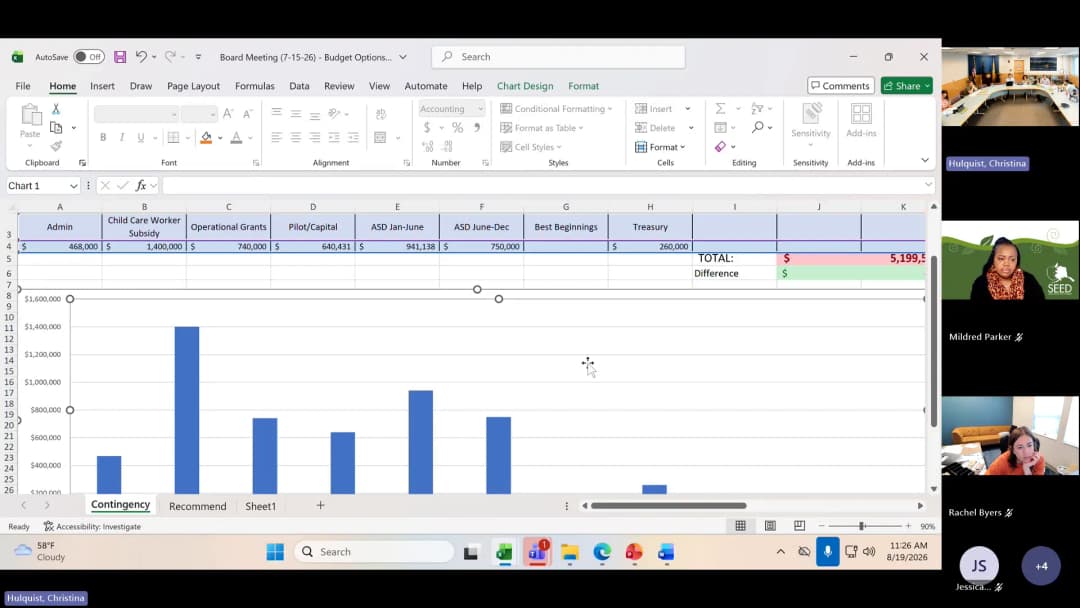
The Anchorage ACE Fund Board held a meeting on September 14, 2026, from 21:20 UTC (postponed from earlier in the day) to finalize its proposed 2027 budget recommendations for the mayor. The board reviewed public survey results, debated funding priorities, and approved both a primary recommended budget and a contingency alternative. Key decisions included shifting funds between childcare workforce subsidies and capital/pilot projects, and reaffirming support for the Anchorage School District (ASD) pre-K program at 75% funding. The board also planned to draft a letter to the mayor and request a meeting to discuss the budget. Consent Calendar - Roll call – All members present: Trevor Storrs, Jessica Simonson, Brian Wynn Collier, Kevin Barry, Khalil Wyvern, Georgina Broke, Mildred Parker, Chuck Shaka. - Approval of minutes from the previous meeting unanimously passed with no discussion. Public Comments & Testimony - No members of the public offered comment. The board closed the public comment period without input. Discussion Items - Presentation on public survey results – Staff member Christina presented survey findings from a 21-day public survey (58 responses). Key results: - Top priority: operational assistance (ranked highest in both recommended and contingency budgets). - Second priority: workforce subsidy. - Third priority: pilot/capital projects. - Current participation: 165 children enrolled in the workforce subsidy program; average 5 new enrollments per month, 1–2 children leaving per month. - Funding percentages: Public preferred 85% tuition coverage (currently at 85%), while the board earlier leaned toward 75%. Discussion noted that 75% would allow more children to be served. - Debate on budget allocations – Members discussed balancing operational grants (flexible funding for programs), workforce subsidies, and capital/pilot projects. Operational grants were seen as most impactful per provider feedback, but capital projects also yielded significant benefits (e.g., creating new childcare spots). - Recommended budget (Plan A) – Assumes ASD and Best Beginnings will be moved back to the alcohol tax, freeing up $5.2 million. The board voted to shift $100,000 from the childcare worker subsidy (originally $1.625M) to pilot/capital, plus any rollover from the subsidy program, aiming to bring the capital/pilot total to approximately $1 million. This keeps all current subsidy participants whole and allows growth. - Contingency budget (Plan B) – If ASD and Best Beginnings remain under the ACE fund, the board set: - Childcare worker subsidy: $1.4 million (reflecting the $100k shift). - ASD pre-K: 75% funding (approximately $750,000 for six months). - Best Beginnings/early literacy: $0. - Operational grants: all remaining funds (estimated $1.38 million plus rollover of $200k–$400k, directed to operational grants). - Pilot/capital: $0 (to avoid spreading funds too thin and administrative burden). - Discussion on presentation strategy – The board agreed to present both budgets to the mayor with a clear recommendation for Plan A. Members also decided to request a meeting with the mayor to discuss the budget before final submission. Key Outcomes - Recommended budget (Plan A) approved unanimously – Motion to move $100,000 from child care worker subsidy to pilot/capital, with all rollover funds from the subsidy program also directed to pilot/capital, aiming for a total of $1 million. The motion was made by Trevor Storrs, seconded by Bronwin, and passed without opposition. - Contingency budget (Plan B) approved unanimously – Motion to adopt the contingency budget as presented (ASD at 75%, Best Beginnings at $0, all rollover to operational grants) made by Khalil Wyvern, seconded by Jessica Simonson, and passed without opposition. - Letter to mayor – Three board members (Michael, Mildred Parker, and one other) volunteered to review and help draft the final budget transmittal letter. - Next steps – Staff will calculate exact rollover amounts, schedule a meeting with the mayor, reconvene the evaluation committee to design the next pilot/capital grant cycle, and explore a new grant management system (using Children’s Trust platform). Terms for members Khalil, Georgina, and Bronwin are ending; they may reapply by email.

BUDGET EQUITY ANALYSIS 51% · CHILD CARE WORKER SUBSIDY 33% · PROCEDURAL 5% · PUBLIC ENGAGEMENT 4%
54
SEP 14, 2026 · ANCHORAGE, ALASKA · ASSEMBLY & COMMITTEE MEETINGS
Anchorage Women's Commission Meeting Summary: September 14, 2026

The Anchorage Women's Commission convened on September 14, 2026, at 4:30 PM with Chair Kristin Traver presiding. Present were Vice Chair Ariana, members Celeste (virtual), Kayla, and Melissa Scarback (virtual), a social worker and small business owner in Anchorage. Leslie was absent. The meeting opened with the Pledge of Allegiance and roll call. The commission discussed onboarding infrastructure, data access, maternal health program milestones, survey findings, commissioner vacancies, and outreach planning. Consent Calendar - Unanimously amended the agenda to move the Mayor's presentation from new business to after minutes approval, allowing her to speak when available. - Approved the amended agenda unanimously. - Approved minutes from the June and August meetings. (The transcript renders "approve" as "appreciate"; the minutes documents themselves were not attached.) Discussion Items - Mayor's Remarks: Following minutes approval, a speaker — identified by context as the Mayor, whose presentation had been moved up per the agenda amendment — addressed the commission, emphasizing the importance of its mission to the administration and to every Anchorage resident. - Onboarding and Infrastructure: Chair Traver noted she and Ariana are now the longest-serving members at 1.5 years and that the commission has lacked structured onboarding. The commission has been building onboarding infrastructure, led by Ariana; staff located historical records that had previously been missing. - Data Access: Members discussed what data the commission can access, including health department and employment data. Staff agreed to compile a list of available data for the commission. Members agreed broad data is useful but does not replace one-on-one conversations. - Maternal and Post-Partum Care: The commission noted Alaska is the first in the state to have a behavioral health provider embedded for maternal and post-partum care in a WIC setting, and only the second in the nation (the other program is not completely WIC-related). - Survey Findings: The commission reviewed survey responses (the transcript is unclear whether the count is 16 or 29): 14% were concerned about missing housing, and 22% had anticipated numbers and were worried about not having [a term garbled in the transcript] in the coming months. Members described the data as heartbreaking but incredible and noted an uptick in these issues. - Commissioner Vacancies: Two seats are open; no applications have been received. Staff member Maria said she could benefit from outreach to recruit applicants. - State Legislation: Members discussed whether the commission should take positions on state legislation, referencing prior work on domestic violence protective orders, including a period when APD had two dedicated officers tracking respondents after orders were filed and visiting spouses despite existing restraining orders. - Outreach and Communications: Leslie and Kayla are the current outreach committee members. They were asked to meet in the interim to review prior outreach work with Sharon and return with recommendations. Members discussed sending materials to the public information officer (an acting PIO will be in place) and reviewing health department communications guidelines. Members also discussed creating a new Facebook page, ensuring staff retain password information for continuity through staff changes, and using Bitly link shorteners. One member cautioned against posting on social media simply for the sake of posting. - Survey Distribution: Members debated in-person versus electronic distribution and agreed the electronic version via QR codes would be the primary push, with paper surveys available as a backup. - Leadership Opportunities: A member recommended the Alaska Center Education Fund's Boards and Commissions leadership cohort (applications close September 17th) and mentioned the League of Women Voters' democracy fair in October and Leadership Anchorage community projects. Key Outcomes - Agenda amendment, amended agenda, and June/August minutes approved unanimously. - Melissa, Leslie, and Kayla were chosen to advance the survey work; Leslie and Kayla will meet in the interim on outreach continuity. - Staff will compile a list of available data for the commission. - The next meeting is scheduled for October 1, 2026, at 4:30 PM.

PUBLIC ENGAGEMENT 23% · WOMEN'S RIGHTS 21% · PROCEDURAL 12% · COMMUNITY ENGAGEMENT 11%
55
SEP 11, 2026 · ANCHORAGE, ALASKA · ASSEMBLY & COMMITTEE MEETINGS
Anchorage Assembly Work Session on Missing Middle Housing Ordinance (AO 2026-85) - September 11, 2026

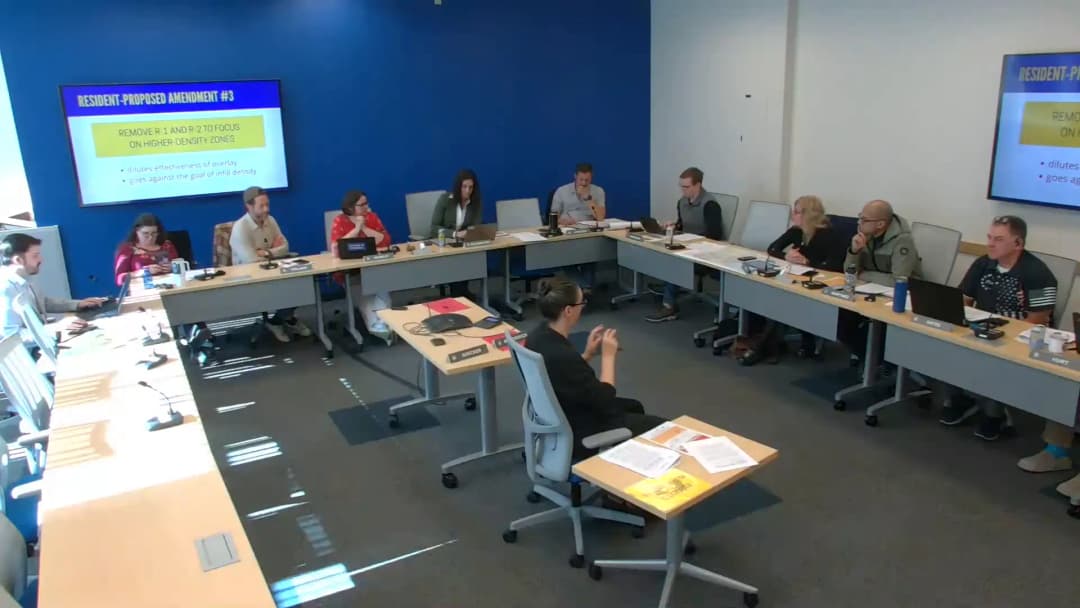
On Friday, September 11, 2026, from 1:00–2:00 PM, the Anchorage Assembly held a work session to discuss AO 2026‑85, the Missing Middle Housing Opportunities (MHOP) ordinance. Chair Anna Brawley called the meeting to order, noting that this was the second work session on the item, that the public hearing had not yet been opened, and that debate was not permitted during work sessions. The session focused on the overlay map and a suite of resident‑proposed amendments. Discussion Items Sponsor Presentation – Problem and Overlay Details Sponsor Assemblymember Baldwin‑Day presented the ordinance as a tool to increase housing supply, supporting both the Assembly’s housing work plan and the mayor’s “10,000 homes in 10 years” goal. The MHOP overlay would apply to parcels within a quarter‑mile of existing or near‑term transit corridors, within the multifamily property tax abatement area, in town centers, and in areas where the 2040 Comprehensive Plan suggests upzoning. Key dimensional changes include: flexible minimum lot size (governed by subdivision standards), 70% lot coverage, no specified front setback, flexible side/rear setbacks (zero if adjacent units), 40‑foot height (30 ft in R1 zones), and any number of structures per lot. Resident‑Proposed Amendment 1 – Exclude Seismic Hazard Zones 4 and 5 The sponsor noted that seismic safety is already managed through building code (Title 23), not zoning (Title 21), and that seismic maps are being updated (current data dates to the 1960s). Member Boland asked whether any analysis showed that taller or more dense buildings would be significantly more dangerous in those zones; none was known. Member Silvers observed that engineering standards are used to address seismic risk. The sponsor declined to support the amendment, stating that building in such zones is feasible (citing Inlet View Elementary built in zone 5). Resident‑Proposed Amendment 2 – Require Multi‑Unit Development with Expanded Dimensions The sponsor expressed strong support for this concept and stated he intends to bring an amendment that prevents “McMansions” (large single‑family homes on large lots from using the flexible standards) but still allows small single‑family homes on small lots. Member Park raised concerns about short‑term rentals taking advantage of the overlay; the sponsor confirmed that the multifamily tax abatement already excludes short‑term rentals. Member Park later indicated she would like to be a co‑sponsor of this amendment. Resident‑Proposed Amendment 3 – Remove R1 and R2 Zones from the Overlay The sponsor argued this would dilute the overlay’s effectiveness and noted that R3 and R4 zones have been underutilized (e.g., no building permits issued for R4A). Member Handlin asked about demand for missing‑middle housing; the sponsor cited 21 rezoning applications since May 2025, of which 29% would likely have been unnecessary if the overlay were in effect (based on analysis by S4 group). Member Johnson requested that planning produce a map showing which parcels are R1, R2, R3, and R4 within the overlay by the next meeting. Resident‑Proposed Amendment 4 – Maintain Height‑to‑Setback Proportions The sponsor considered this technically complex and counter to the goal of simplifying Title 21. Planning Manager Daniel McKenna‑Foster added that current height rules are outdated (e.g., assume 10–12 ft ceilings, but modern construction requires more space for HVAC and fire suppression). Resident‑Proposed Amendment 5 – Define Multiple Uses and Structures McKenna‑Foster explained that allowing multiple uses on a lot (e.g., a church and a house) and multiple primary structures (e.g., cottage clusters) is already permitted in many zones and that the ordinance mirrors existing code. He noted that the definition of “mixed use” is being clarified in a separate upcoming ordinance. Resident‑Proposed Amendment 6 – Remove Dwelling Mixed Use as a Permitted Use The sponsor noted this is a broader question being addressed separately and not specific to MHOP. Resident‑Proposed Amendment 7 – Require Conditional Use Permits for Multifamily in R1 and R2 Conditional use permits add uncertainty and discourage development, making the intended housing types less likely to be built. Member Boland pointed out that in R2 zones, duplexes are currently permitted outright; this amendment would make them conditional, which is more restrictive than existing law. Additional Discussion - Infrastructure costs: McKenna‑Foster stated that AWWU generally requires new development to pay for its own connection costs and that the system has capacity for additional growth. - Member Park asked about the origin of the proposed amendments; they came from the Housing Work Group and were presented to community councils. - Member Martinez argued that the MHOP ordinance is not the starting point for growth planning—the 2017 Transit Supportive Development Corridor map and the 2020 Comprehensive Plan already identified these areas for density. He framed the ordinance as “keeping promises” made in earlier planning processes. - Correction noted: the second regular assembly meeting for this item is October 6, not October 7. Key Outcomes - The public hearing on AO 2026‑85 is scheduled for Tuesday, September 15, 2026, and will be continued to a future meeting (no debate until the public hearing is closed). - Sponsor Baldwin‑Day committed to introduce an amendment requiring multi‑unit development (or small single‑family) under the expanded dimensional standards to prevent “McMansions”. Member Park expressed intent to co‑sponsor that amendment. - Planning department was asked to produce a map highlighting R1, R2, R3, and R4 zones within the overlay for the next meeting. - No votes were taken; the work session was informational only.

LAND USE PLANNING 45% · AFFORDABLE HOUSING 24% · ZONING 11% · SEISMIC SAFETY 5%
56
SEP 11, 2026 · ANCHORAGE, ALASKA · ASSEMBLY & COMMITTEE MEETINGS
Zoning Board of Examiners and Appeals Meeting Summary - September 11, 2026

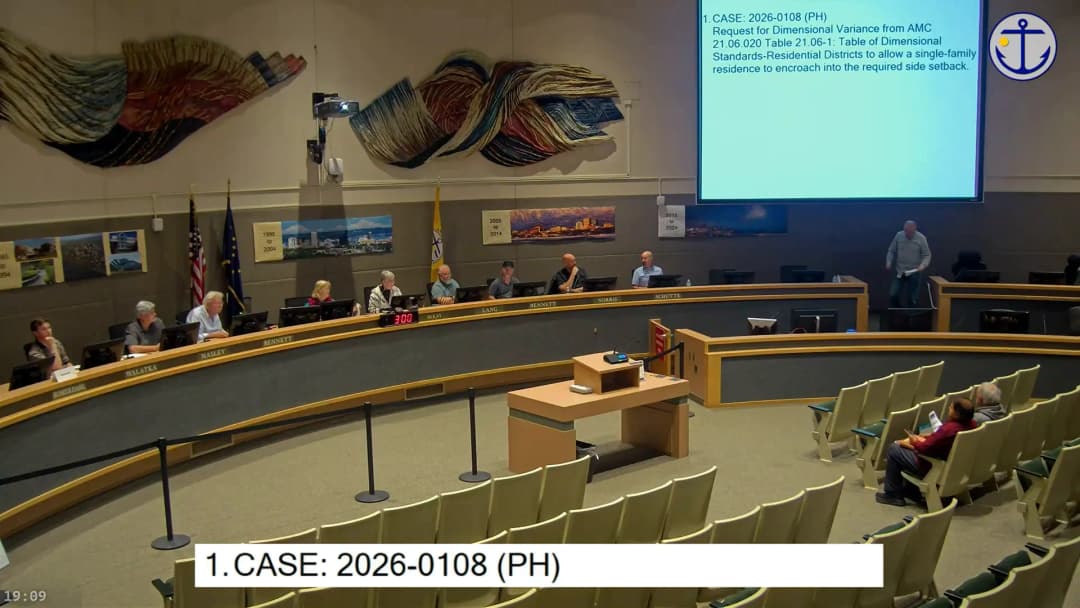
The Zoning Board of Examiners and Appeals (ZBA) met on September 11, 2026, to consider a code change regarding dimensional variance criteria and a variance application for a residential property. The meeting included approval of previous minutes, a consent agenda, a disclosure, and a public hearing. All votes were unanimous. Consent Calendar - Minutes: Approved unanimously for the meeting of July 9, 2026. - Resolutions 2026-009 and 2026-010: Approved as part of the consent agenda. One board member (absent for the July 9 meeting) abstained from voting on the consent agenda. Disclosures - Board member Jonathan Lang disclosed no financial interest in case 2026-0108 and asked to be recused. After discussion, the board voted unanimously to allow his participation, noting his survey company had no stake in the outcome. Public Comments & Testimony - Case 2026-0108 (Variance for 2301 Chandelar Drive): - One anonymous public comment was received in opposition, but staff noted it lacked specific merit beyond aesthetic concerns. - Niall Williams, a neighbor, testified in support via phone, stating the variance would cause no inconvenience and that requiring changes after 25 years would create hardship. He expressed support for private property rights and noted the applicant’s efforts. - No public testimony was taken for the code change (case 2026-0076) as it was not a public hearing; future hearings are scheduled at the Planning and Zoning Commission and the Assembly. Discussion Items - Unfinished Business – Case 2026-0076: Code Change to Dimensional Variance Criteria: - Staff presented a proposal to amend three of eight approval criteria for dimensional variances (standards A, B, and G) and increase the minor modification threshold from 10% to 15% encroachment. - Statistics provided: minor modification fee $135; variance fees range from $710 (single-family) to $3,965 (commercial). Staff reviewed 10–11 years of variance applications and found average encroachment significantly above 15%, supporting the threshold increase. - Board discussed and supported removing a clause that would require the director to request a variance process if a minor modification was denied; staff agreed to strike that language. - Board member Jason Norris suggested the board formally recommend that the planning department review other dimensional standards (e.g., lot coverage), which have been unchanged for decades. This was noted as a finding rather than part of the motion. - Board member Jonathan Lang requested adding “construction errors” alongside “surveying errors” in standard A to cover builder mistakes. Staff agreed. - The board voted unanimously to recommend approval of the code change amendments to the Planning and Zoning Commission, with the understanding that the two amendments (removal of the director-clause and inclusion of construction errors) would be reflected in the memo to the commission. - Public Hearing – Case 2026-0108: Variance for 1.3-Foot Side Setback Encroachment: - The applicant, Patrick Waringuez, requested a variance for an existing single-family residence at 2301 Chandelar Drive, which encroaches 1.3 feet into the required five-foot side setback. The structure was built in 1998 under permit 98-0558, but the permit was never closed out until 2020. - Staff found all eight variance standards substantially met. Key facts: the property has a 24% slope (extraordinary circumstance), the encroachment was not self-imposed (permit process oversight), no complaints from neighbors, and the variance represents minimum relief. - Lot coverage was discussed: with the carport excluded (as per code exceptions), total lot coverage is 36.14%, under the 40% maximum. - One anonymous public comment opposed the variance, citing house size and driveway width; staff noted the driveway was reduced to meet code. - The board unanimously approved the variance subject to two conditions listed on page four of the staff report. Key Outcomes - Case 2026-0076: Unanimous vote to recommend the code change amendments to the Planning and Zoning Commission (meeting November 21, 2026). The recommendation includes: - Increasing the minor modification threshold to 15%. - Broadening “extraordinary circumstances” to include “surveying or construction errors.” - Removing the clause that would require the director to initiate a variance process after a minor modification denial. - A board finding that the planning department should review other dimensional standards. - Case 2026-0108: Unanimous vote to grant the variance for a 1.3-foot side setback encroachment, subject to staff conditions. The decision is appealable to Superior Court within 30 days. - Next Meeting: The board will meet in October 2026; one board member noted absence for the next two meetings.

ZONING 44% · CODE ENFORCEMENT 19% · PROCEDURAL 18% · PUBLIC ENGAGEMENT 15%
57
SEP 10, 2026 · ANCHORAGE, ALASKA · ASSEMBLY & COMMITTEE MEETINGS
Anchorage Public Naming Commission Meeting – September 10, 2026

The Anchorage Public Naming Commission met on September 10, 2026, to consider several naming proposals, approve meeting minutes and a process flowchart, and discuss the application of the 36-month posthumous naming rule. The meeting included a land acknowledgement, public hearings on three naming proposals, and a review of commission membership. Consent Calendar - The June 2026 meeting minutes were approved unanimously. - The August 2026 meeting minutes were approved as amended to reflect that no quorum was present and the meeting was a work session. - A flowchart outlining the public naming and renaming process was approved unanimously. Public Comments & Testimony - Pipples Field Park (Eagle River): The proposer, representing the Eagle River Parks and Recreation Board, spoke in favor of naming the park after pioneers of the Eagle River area. They noted that the Eagle River Parks and Recreation Board had passed a resolution of approval, but the GDA Community Council had not yet submitted a written resolution due to the summer hiatus. The commission continued the public hearing to October 14, 2026, to allow time for advisory opinions from the Board of Supervisors. - Girdwood Lions Club Shelter Naming (John Troutner): No public testimony was given. Staff confirmed that the Girdwood Board of Supervisors (which also serves as the community council) had provided a resolution strongly supporting the naming. The commission voted to recommend approval to the assembly. - Northeast Connector Trail Naming (Karen Bronga): Several individuals testified in support, including: - Jennifer (Parks and Recreation representative) – explained the trail was a project Karen Bronga championed. - State Senator Forrest Dunbar – spoke in his personal capacity, noting the trail would not exist without the Brongas, that Karen Bronga’s death galvanized the community, and that the trail addresses a dangerous road section. He supported naming without waiting 36 months. - Tom Bronga (Karen’s husband) – described Karen as a lifelong trail maker and noted the bridge is already called “Karen’s Bridge” colloquially. - A community member (name not stated) – voiced support, noting the trail is used daily. - Jim (last name not given) – spoke in favor. - Chair of the Clip (unclear affiliation) – spoke in favor. Commissioner Heller expressed nervousness about bypassing the 36-month posthumous requirement, worrying about setting a precedent for comparison. Staff explained that the assembly can waive the requirement by ordinance, and the commission can include a detailed rationale for departure from policy. The public hearing was continued to October 14, 2026, to obtain an advisory opinion from the Parks and Recreation Commission. Discussion Items - Agenda Reordering: The commission voted to reorder the agenda to start with new business (public hearings) before approving minutes and unfinished business. - Review of Public Naming Process: The commission discussed a minor edit to the flowchart regarding application submission. Staff clarified that a community council may submit either an application or a resolution. The flowchart was approved as presented. - 36-Month Posthumous Rule: Extensive discussion occurred regarding the 36-month posthumous naming requirement in the code. Commissioner Heller asked for context on the rule’s origin and expressed concern about making exceptions. Staff (Dean) noted that the code allows departure with a detailed rationale. Commissioner Gupta suggested creating guidelines for exceptional circumstances, but others noted each case is nuanced. The commission discussed potentially recommending a shorter timeline to the assembly in the future. - New Commission Members: Staff reported that at least one new applicant (Hillary Morgan) is on the next assembly agenda, and another applicant from Girdwood had an interview scheduled. One commissioner announced plans to resign at year-end and had suggested a replacement applicant. Key Outcomes - Approved: June 2026 meeting minutes. - Approved: August 2026 meeting minutes as amended. - Approved: Public naming/renaming process flowchart. - Approved Recommendation: The commission voted to recommend naming the shelter in Girdwood Lions Park after the late John Troutner. (Motion by Member Gupta, second by Commissioner Gilbert; no opposition.) - Continued: Public hearing for Pipples Field Park naming to October 14, 2026, to receive advisory opinions from the Eagle River Board of Supervisors and the GDA Community Council. - Continued: Public hearing for the Karen Bronga Northeast Connector Trail naming to October 14, 2026, to allow the Parks and Recreation Commission to provide an advisory opinion. - Adjourned: Meeting adjourned on a motion by Commissioner Gilbert, seconded by Commissioner Heller.

PARKS AND RECREATION 39% · MEETING PROCEDURES 17% · BOARD AND COMMISSION MANAGEMENT 12% · PROCEDURAL 11%
58
SEP 10, 2026 · ANCHORAGE, ALASKA · ASSEMBLY & COMMITTEE MEETINGS
Assembly Rules Committee Meeting - September 10, 2026

The Assembly Rules Committee met on Thursday, September 10, 2026, from 1:00 to 3:15 PM. The meeting covered a wide range of topics including the mayor's report on infrastructure and housing, updates on the ombudsman's office, a presentation on the division of power between the assembly and school board, proposals for youth representative voting procedures, and reorganization of assembly committees. The meeting also included one public comment. Consent Calendar - No consent calendar items were presented. Public Comments & Testimony - Jamie Lopez, formerly homeless, praised the ombudsman's office presentation and advocated for better pay for the ombudsman. He expressed concern about punitive approaches to homelessness, citing a 6.6% acceptance rate for services attached to police, and urged the assembly to establish an independent community-driven police oversight commission. Discussion Items - Mayor's Report (Suzanne Fleet Green, Chief of Staff): - The Port of Alaska modernization program (PAMP) benefits from a $200 million MARAD settlement, reducing the projected cargo surcharge for 2028 from $31 to $24 per ton compared to April 2026 estimates. - A nuisance property on Thompson Avenue was demolished; downtown library construction is underway with a February opening expected. - Midtown 42nd Avenue reconstruction is complete. - Shelter capacity is being increased for winter, with the surge likely to reach full capacity by November, earlier than last year. - NSTAR has issued curtailment notices to large commercial customers; the administration is monitoring natural gas supply hearings. - Discussions with the school district on school closures (Abbot Loop, Campbell STEM) and potential sale of West Park property to support school funding. - Chair's Report (Anna Brawley): - Three youth representatives were appointed: Rikik Ellie, Rebecca McCullough, and Malachi Cochrane; they will be sworn in on September 15. - The branch budget for 2027 includes a $400,000 provision for a potential mayoral runoff election; funds may be reallocated after the April election if no runoff occurs. - Ongoing projects: social media policy review, recognition resolutions for former members, quasi-judicial procedure (AO 2026-107) returning October 6, and an auditor's request for ISA expenditure records. - Work sessions planned on assembly role in labor agreements, Board of Equalization annual report, and short-term rental registration data review. - A fiscal future summit is scheduled for October 30 at UAA Student Union. - Ombudsman's Report (Daryl Hess & Drew): - The office received its 900th complaint of 2026, with 224 open cases; emphasis on timely closure. - A contract with Agnew Beck (valued at $5,000, sole source) began for the first strategic plan of the ombudsman's office; concerns about conflict of interest were addressed by legal counsel citing ethics opinion 2024-02 and the separation of branches. - Staff attended professional development conferences at their own expense; the 2027 budget requests increased training funds. - The office highlighted systemic resource constraints: the Health Department child care licensing has 8 staff down from 12; land use enforcement officers average 250 open cases; code abatement officers average over 100; APD response times are impacted by staffing shortages; property appraisal handled 2,000 appeals. - The annual report (2025) included a new mission statement: "To impartially promote fairness, transparency, and accountability between the local government and constituents." - Assembly & School Board Role Presentation (Kate Bogle, Senior Counsel): - The state legislature has a non-delegable duty for public schools; the school board manages schools, the assembly sets the total budget within state parameters (minimum required local contribution and a cap). - The assembly can increase or decrease the total amount but cannot line-item the school budget; if the assembly does not act in 30 days, the school board's budget is automatically approved. - School closure decisions rest with the school board; disposal of property involves the assembly and mayor, especially for Heritage Land Bank lands. - The administration is proposing a resolution related to West Park property (a potential housing development) with proceeds possibly going to the school district; legal questions exist about compensation and the required local contribution cap. - Youth Representative Voting Procedure Proposal (Donald Handlin & Sydney): - Proposed changing the advisory vote order so youth representatives vote before the assembly, consistent with best practices from other Alaska boards. The current code is silent; the proposal is a procedural change, not a code amendment. The chair expressed openness and suggested starting with the new cohort on September 15. - Committee Reorganization: - Proposed committee name changes: adding "Energy" to Enterprise, Utilities, and Infrastructure; renaming Health and Public Safety to Health and Homelessness and adding "Housing" to Economic and Community Development. - Schedule adjustments: committees moved to noon or later to avoid conflicts with assembly meetings; public safety and health committees may stay at 11 AM per feedback. - Assembly member Cameron proposed a year-long ad hoc committee for APD policy oversight, in coordination with the municipal attorney and police chief. - Members were asked to formally opt-in to committee memberships via the clerk. Key Outcomes - Youth Representatives: Appointed and will start September 15; preferential voting procedure to be tested at the first meeting. - Branch Budget: Approved as proposed with $400,000 for potential runoff; the chair noted funds could be reallocated later. - Recall Petition: Received for the mayor; legal sufficiency review underway; state law prohibits receiving the petition within 180 days of the term's end (less than 30 days away). - Ombudsman Strategic Plan: Contract with Agnew Beck commenced; next steps include quarterly reports to the assembly. - Fiscal Future Summit: Scheduled for October 30, 2026, at UAA. - Committee Schedules: Finalized by chair by September 11; new schedule effective by end of September/early October. - Ad Hoc APD Committee: Under consideration; chair and Cameron to discuss further. - School Proposals: Resolution on West Park property expected soon; administration to bring forward legislation on Abbot Loop and Campbell STEM closures. - Governance Discussion: Deferred to a future meeting; discussion guide provided but not deliberated.

OMBUDSMAN SERVICES 25% · PUBLIC ENGAGEMENT 12% · YOUTH PROGRAMS 7% · COMMITTEE REVIEW 7%
59
SEP 9, 2026 · ANCHORAGE, ALASKA · ASSEMBLY & COMMITTEE MEETINGS
Anchorage Assembly Public Health and Safety Committee: Use of Force Report and Willow Commons Evaluation - September 9, 2026

The Anchorage Assembly Public Health and Safety Committee met on September 9, 2026, beginning at 11:01 a.m. The agenda included two major presentations: a Mayor's Office introduction of a Bloomberg Philanthropies evaluation of Willow Commons, and a detailed presentation by 21st Century Policing Solutions (21 CP) on its use-of-force review of the Anchorage Police Department (APD). The committee also heard public testimony, extended the meeting by 15 minutes, and deferred a planned APD implementation update to a future meeting. No formal votes were taken. Mayor's Office Report and Bloomberg Cities Idea Exchange - Thea Agnew Bemben, special assistant to the mayor, introduced Luke Hydrich and Kirsty Paul of the Bloomberg Cities Idea Exchange, a Bloomberg Philanthropies program, and the Behavioral Insights Team. - Hydrich and Paul said their evaluation team has conducted more than 1,000 evaluations and partnered with more than 130 cities. They are evaluating Willow Commons to document what Anchorage did, inform local decisions, and provide a guide for other cities on rapid housing. - They conducted interviews in the spring with planning, construction, and project members; while in Anchorage they planned to tour Willow Commons and the Anchorage Recovery Center and conduct follow-up interviews. They also planned to visit Atlanta's Melody project and Shreveport later in the year. - In response to a member question, they confirmed the project is both documenting and evaluating effectiveness and return on investment, with a city report expected later. Discussion Item: 21 CP Use of Force Review and Recommendations - Charles Ramsey, founding partner of 21 CP, former Chicago police officer, former police chief in Washington, D.C., former Philadelphia police commissioner, and co-chair of President Obama's Task Force on 21st Century Policing, presented with Michael Moore, senior advisor and former chief of the Los Angeles Police Department. They reviewed APD use-of-force data from January 2021 through June 2025, including 11 officer-involved shootings. - Reported use of force declined by approximately 17% between 2022 and 2024 and was about 4.7% lower in 2024 than in 2021. - Just over 89% of reported uses of force were level one, the lowest category; fewer than 1% were level three, the most serious category. Level three force was most often associated with DUI, arrest, eluding, assault, or burglary calls. - Use of force was concentrated on late Friday and Saturday nights. Officers were injured in just under 8% of reported incidents; subjects were injured in approximately 14.5%. - Twenty officers accounted for 19% of reported use-of-force incidents, and six officers accounted for more than 100 incidents each. 21 CP said such concentrations require deeper review of assignment, tactics, and training. - Chief Case added context: two of the top six officers were in the special investigative support unit/SWAT and conducted high-risk vehicle stops; one officer was no longer with APD; one officer's use of force was 94% level one; and in the first quarter of 2026 none of the original top six remained in the top six. He said 64% of officers move in and out of the top 20 over the study period. - The review found that 56% of reportable force incidents involved an individual experiencing an apparent or known behavioral health crisis. - Tactical concerns included officers bypassing distance, cover, and concealment; inconsistent on-scene command communications; and increased use of vehicle-blocking tactics. 21 CP said the rise in blocking maneuvers appears influenced by APD's restrictive pursuit policy and can place officers in front of reportedly armed individuals, although no officers had been attacked in the reviewed cases. - 21 CP found that APD's administrative use-of-force investigations improved during Chief Case's tenure but recommended transcribed interviews, stronger data collection, and more complete records on subjects and officers. - The report contains 57 recommendations across categories including policy and officer decision-making, training and cultural competency, reporting and investigations, vehicle tactics and supervision, early intervention systems, and community and post-incident support. - Regarding officer-involved shootings, 21 CP noted accountability findings: in 2024, one of eight shootings was found out of policy; in 2025, one of five; and in 2026 so far, one of seven was found out of policy and six were undetermined. - Ramsey said APD is a solid, good department, not an out-of-control or toxic one, but one that must continue improving. Moore cited LAPD and Philadelphia examples where training changes produced major drops in officer-involved shootings. - In response to questions, 21 CP said cross-city force comparisons were requested by the city but are limited because Anchorage reports more low-level events than most agencies, such as drawing a weapon or vehicle-boxing tactics. They recommended creating a 'level zero' category to isolate these unique events. - On legislative oversight, Ramsey and Moore advised the committee to support needed resources, demand regular reports, verify implementation through training observations, and institutionalize changes beyond any single chief's tenure. - Moore said Anchorage should consider a deployment study to assess pairing officers and using technology such as drone first response and online reporting, noting LAPD saved more than 25,000 reports a year through online traffic-collision reporting. Public Comments and Testimony - Jamie Lopez East Anchorage, formerly homeless and formerly with a coalition, said there is no community-driven public safety commission with investigative and subpoena power. She described police as a threat to poor, marginalized, and vulnerable residents, and raised concerns about APD's use of Aura, an external private surveillance network with facial recognition, including 375 licenses obtained by APD at no cost over 60 months. She asked the committee to investigate the June officer-involved shooting at Walmart. - Amanda Bremner, deputy director of Native Movement, thanked 21 CP and the municipality for the independent review. She stated the report shows Alaska Native people were involved in 45% of all APD use-of-force incidents over the past four and a half years while Alaska Native people make up 7.3% of Anchorage's population, and said this disparity was absent from the mayor's office press release. She also noted that 20 officers, or 5% of the department, were involved in 19% of force incidents, and six officers were each involved in 100 or more incidents. She said Seattle, Portland, and Spokane use early intervention windows of six months to a year, while Anchorage's primary window is 30 days, and asked the committee to extend APD's early intervention thresholds and review how the program is used. - Mercedes Arseniga from West Anchorage said the report confirmed disproportionate use of force, called for culture change and independent oversight such as an inspector general with subpoena power, and described the chief as up against a resistant 'good old boy' system. She supported annual reporting and continued municipal due diligence. - Def Williams, a community volunteer with the Anchorage Suicide Prevention Coalition and the Anchorage Community Police Relations Task Force, reported that Chief Case went door-to-door in the Fairview area in July and residents responded positively; he urged more such engagement. - Glenn Cajwamura with First United Methodist Church said the church is launching a child care partnership for up to 80 children and asked how police and community can protect the children and citizens near the church. He noted the mayor attended the August 7 launch. Key Outcomes - The committee received the 21 CP use-of-force report and presentation; no formal action, motion, or vote was taken. - The committee stated it will schedule time for Chief Case to present the department's implementation of changes, an item that was on the agenda but was not reached. - The meeting was extended by 15 minutes to allow public comment. The planned ABAPD update was deferred to a future meeting. - Public testimony raised specific requests for further oversight, transparency, and review of APD's early intervention system and surveillance tools.

POLICE ACCOUNTABILITY 44% · PUBLIC SAFETY 35% · PUBLIC ENGAGEMENT 14% · PROCEDURAL 2%
60
SEP 4, 2026 · ANCHORAGE, ALASKA · ASSEMBLY & COMMITTEE MEETINGS
Community and Economic Development Committee Meeting - September 4, 2026

This meeting of the Anchorage Community and Economic Development Committee (CEDC) was called to order at 9:02 AM on September 4, 2026 (though the transcript references September 3rd). The committee heard a director’s report, a report from the Anchorage Community Development Authority (ACDA), a presentation on the third-party plan review audit, and a presentation from Greater Anchorage Inc. (Fur Rondy). No public testimony was given. No formal votes were taken, but several recommendations were discussed. Director’s Report (Bob Dole, Director of Community Economic Development) - Construction and Development: Valuation of construction activity is up 23% year-over-year by total value. Housing units: 417 units permitted so far in 2026 (compared to 401 all of last year). Subdivision lots: 144 lots under construction, expected to be ready by spring 2027. An Eagle River project of 21 units built for $3.9 million ($186,000 per door, excluding land and off-site) was highlighted as a model for affordability through density. - Permit System: A new smart code permit system is being tested; it will allow simultaneous communication during plan review, reducing delays from 2–3 weeks per round. - Trades Licensure: The state now allows temporary licensure for trades, but the municipality will maintain its own licensing to address bad actors. The $200 fee for municipal contractor licenses remains. - Abbreviated Rezones: The program has processed 20 requests; committee members asked about cost savings from reduced mailing compared to full rezones. - Denali Street Pilot: A winter pilot project to reduce lanes for snow storage, expected to save overtime costs and improve pedestrian safety. Opposition from some Calais Corporation lessees noted; the chair clarified the city’s authority over right-of-way. - Traffic Calming: Collaboration with the state on speed reductions, including traffic feedback signs. The chair noted that NACTO data shows economic benefits of reducing speeds on commercial corridors from 40–45 mph to 30–35 mph. - Right-of-Way Maintenance: Chair flagged issues with snow berms and overgrown brush, and potential for workforce development partnerships. - ABATEMENT Fund: The fund is running low; the administration will incorporate funding requests into the next budget. ACDA Report (Chad Stobel, Development Director) - Housing Focus: ACDA is concentrating on workforce housing (80–120% AMI, termed “foothold housing”). Key initiatives: partnership with UAA for student/workforce housing (letter of intent forthcoming), discussions with Alaska Mental Health Trust Authority, and exploration of modular housing with a Cleveland-based company (Via Build) that offers a lay-flat, lightweight concrete product. - Capital Stack Strategies: Seeking favorable interim construction financing, long-term leases, cooperative housing models (including limited equity co-ops and corporate leases), and technology to reduce vertical construction costs below $100/sq ft. - Acquisition: A property on Burkaw Street acquired for a dense workforce housing complex; RFP expected by end of 2026 with groundbreak in 2027. - Member Questions: Member Baldwin Day requested clarification on “workforce housing” vs. “affordable housing.” Stobel explained the 80–120% AMI target and the need for subsidies. Discussion on modular vertical construction (existing pathways noted) and cooperative models with the National Co-op Foundation. Third-Party Plan Review Audit Report (Daniel King, Engineering Services Manager) - Program Overview: Third-party plan review was expanded in 2024 to include commercial projects (previously only residential). A mandatory 10% audit and a registry of approved reviewers were instituted. The audit report is required annually but sunsets in 2026. - Audit Results (June 2025–June 2026): - Commercial: 600 permits, 1% (8) used third-party review. 2 audits (25% of third-party permits): 1 structural passed with corrections, 1 architectural passed. - Residential: 800 permits, 20% (160) used third-party review. 16 audits: structural – 9 pass, 5 corrections, 2 fails; fire/life safety – 6 pass, 1 correction, 1 fail. - Staffing: Fully staffed since December 2025; plan review times now average 3 days or less (down from 9 days during short-staffing). - Challenges: One reviewer missed major life safety items (lack of fire separation, missing lateral load path) due to pressure from contractors to review faster. He was placed on probation and improved. - Recommendations: 1. Remove the sunset on the third-party review code (now in new code cycle). 2. Make the annual audit report permanent (currently sunsets this year). 3. Change revocation language from “material false statements” to “incompetence or lack of knowledge” (aligns with contractor licensing). - Discussion: Member Brawley (co-sponsor of original expansion) supported keeping the audit. Member Park raised concerns about the extrapolated failure rate (3 fails out of 16 audits) and questioned cost savings. Staff noted that third-party review adds cost (pay both reviewer and reduced city fee) and that faster reviews may lead to missed items. Fur Rondy Presentation (Beth Helgeson, President; Dakota Foujon, Executive Director, Greater Anchorage Inc.) - Winter Tourism: Fur Rondy (93 years old) is a key winter tourism driver, with an estimated $15–30 million economic impact over three weeks, 80,000–100,000 participants, and a 25% increase in hotel occupancy. - Evolution: The festival is modernizing to attract younger demographics and international visitors. Awards include gold from IFEA and recognition from National Geographic. - Community Impact: The booster pin program donates proceeds to school art programs; Running of the Reindeer supports Toys for Tots. Over 100 local businesses and charities participate. - Next Steps: The chair suggested the report be introduced at a future assembly meeting. The committee expressed support for winter tourism initiatives and potential partnerships with the Alaska Native Heritage Center and Nordic skiing events. Key Outcomes - No formal votes were taken. - The committee will consider the third-party plan review recommendations (removing sunset, permanent audit, language change) for future action. Staff urged the committee to find a new sponsor for the ordinance. - The Fur Rondy report will be forwarded to the full assembly for consideration. - The committee noted that committee names may change at the next rules meeting. Note: The transcript indicates the meeting was called to order on Thursday, September 3rd, 2026 at 9:02 AM, but the provided metadata specifies the meeting date as 2026-09-04 17:31:41+00:00. This summary uses the specified date per instructions.

ENGINEERING AND INFRASTRUCTURE 28% · TOURISM PROMOTION 19% · PUBLIC WORKS 15% · AFFORDABLE HOUSING 12%
OPENPUBLICA · PUBLIC MEETING INDEXUPDATED DAILY · openpublica.com