The Bainbridge Island Planning Commission held a special meeting on November 6, 2025, to discuss the draft Resolution 2025-18, the remaining work plan and schedule for the Winslow Subarea Plan (WSP) update, and to receive public comment. The meeting was attended by Chair Sarah Blossom and Commissioners Criss Garcia, Alex Preudhomme, and Ben Deines, along with PCD Director Patty Charnas, Senior Planner Jennifer Sutton, Consultant Joe Tovar, and Council Liaison Jon Quitslund. The meeting adjourned at 8:56 PM after Commissioner Deines left, breaking quorum. Public Comments & Testimony - Malcolm Gander, a resident, commented on water and sewer infrastructure. He stated that the city's water system plan from 2017 shows water usage at approximately 260 million gallons per year in 2015, with projections nearly doubling by 2035. He argued that the city's 10 wells cannot increase production by more than 10%, citing past experiences with well drawdown. He also noted that water and sewer issues are not being discussed alongside proposed upzoning in Winslow. He indicated he would speak about wastewater treatment and conservation at a future meeting. Discussion Items - Draft Resolution 2025-18: Consultant Joe Tovar presented a draft resolution to the City Council that outlines a structured work program for the Winslow Subarea Plan update and other comprehensive plan elements. The resolution proposes a deadline of June 30, 2026, to comply with a Department of Ecology grant requirement of $725,000 for aquifer recharge improvements. Tovar recommended that the Commission finish its draft of the subarea plan by December 18, 2025, after which staff and consultants would prepare a more complete version for review in March 2026. The resolution also calls for two council liaisons to attend 2026 planning commission meetings and for the council to refrain from assigning non-periodic update tasks to the commission during the first six months of 2026. - Commissioner Reactions: Commissioner Garcia expressed reservations about back-timing from a deadline and questioned the feasibility of completing substantive work by December 18 given only three remaining meetings. Commissioner Preudhomme supported a hard deadline, arguing that it would force prioritization and allow staff to take over. Commissioner Blossom criticized the lack of earlier direction from the City Council and expressed concerns that the resolution's scope might limit the commission's ability to address important issues like the water resources element. Commissioner Deines advocated for relying more on staff and consultants to produce draft materials for the commission to review, rather than the commission itself crafting detailed policy. - Remaining Work Plan and Schedule: Senior Planner Jennifer Sutton reviewed the 2025 work plan, identifying key deliverables needed by December 18: finalizing zoning boundaries (including the Ferncliffe zone), basic intensity standards, and a recommendation on mandatory or voluntary inclusionary zoning. She also proposed an additional extended meeting on December 3 or 4 to make progress. - Inclusionary Zoning and Affordable Housing: The commission discussed strategies for meeting Housing Element requirements, particularly for households at 50% area median income (AMI) and below. Commissioner Blossom noted that the Environmental Impact Statement showed inclusionary zoning would not produce units at that income level, while others argued that density bonuses and partnerships could support deeper affordability. No consensus was reached. - Zoning and Outreach: A contentious discussion arose regarding outreach to neighborhoods potentially affected by rezoning, specifically the Ferncliffe area. Commissioner Blossom argued that residents in that area deserve direct notification because the proposed change from units-per-acre to form-based coding is significant and was not analyzed in the DEIS. Other commissioners countered that all communities should be treated equally and that the city has provided public notice through meetings and the website. Key Outcomes - The commission voted unanimously (4-0) to amend the agenda, adding discussion of the draft resolution and moving item 4b ahead of 4a. - No formal votes were taken on the draft resolution or subarea plan content. Discussion is expected to continue at the next meetings. - The meeting adjourned early at 8:56 PM due to loss of quorum after Commissioner Deines left.
Public Meetings - Bainbridge Island, Washington
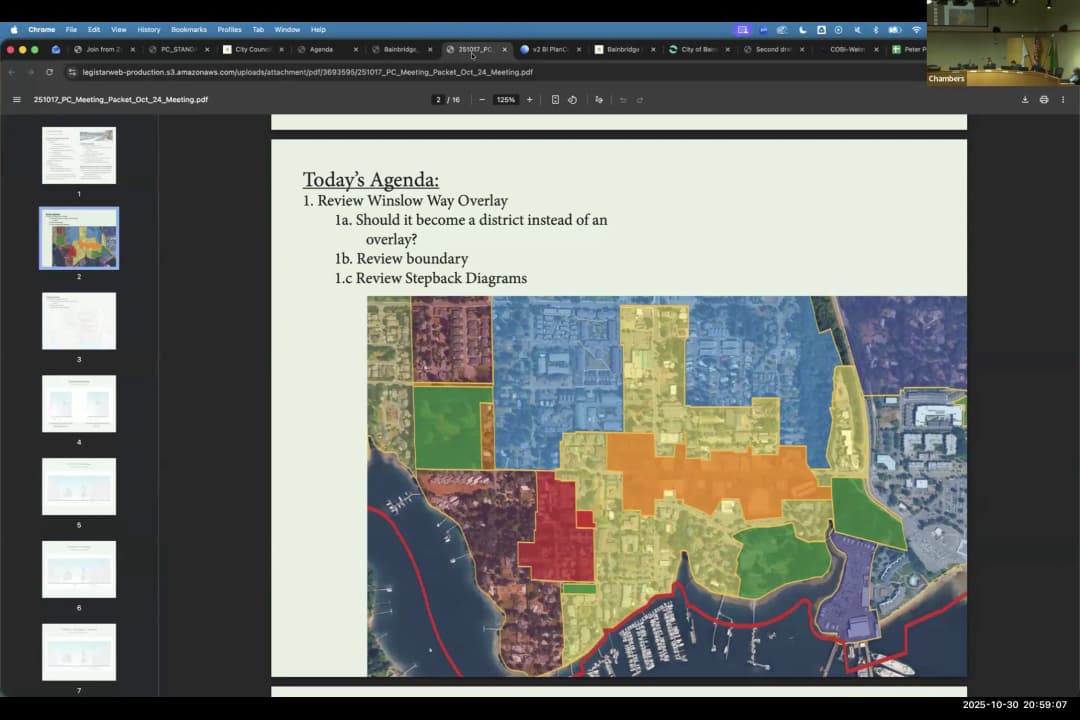
Public Meetings - Bainbridge Island, WashingtonThe Bainbridge Island Planning Commission held a special meeting on October 30, 2025, from 6:02 PM to 9:49 PM at City Hall and via Zoom. The meeting focused on three major agenda items: the peer review of the Groundwater Management Plan (GWMP), the future of subcommittees for the Winslow Subarea Plan, and continued discussion on updates to the Winslow Subarea Plan. The commission adopted two motions related to a Winslow Way overlay district and heard public comments from several residents. Commissioner Sullivan left at 7:48 PM and Commissioner Preudhomme left at 9:09 PM; the remaining four commissioners voted unanimously on the motions. Consent Calendar - Motion to approve agenda: Moved by Schaab, seconded by Garcia. The motion carried unanimously (6-0). Public Comments & Testimony - Kim McCormick (speaking on behalf of Hager Scribner Properties, HSP) announced the passing of Tom Hager, a longtime resident and HSP principal, and described HSP’s proposed civic and cultural connection overlay in downtown Winslow. She expressed support for a multi-use project with affordable housing, retail, and community gathering spaces, including a non-motorized walkway similar to Post Alley in Seattle. - John Quitslund (City Council liaison) addressed agenda items 4B and 4C, recommending that the commission focus on essential work for the Winslow Subarea Plan and complete it by the end of the year. He noted that the council would discuss a resolution to improve coordination and set a schedule for completing the subarea and comprehensive plans. - Melanie (public comment) raised concerns about the GWMP, stating that Washington state debt is approximately $100 billion and that the state faces a $12–16 billion budget deficit over four years. She argued against growth based on a “Ponzi scheme,” criticized consultant Tovar for dismissing infrastructure and water resource limits, and urged the city to limit growth to the current allocation of 4,524 people. She called for inclusion of summary data tables and raw data in the GWMP, conservation targets, and a functioning ETAC with qualified scientists. - Susan Bisnet (resident on Finch Road) shared that her well went dry from September 28 to October 17, 2025, for the first time in 35 years. She emphasized the real concern of water shortages and the need to consider limited water resources in planning. Discussion Items - Groundwater Management Plan Peer Review (4a): Public Works Director Chris Wierzbicki introduced Joel Massmann and Adam Massmann of Keta Waters, who conducted the peer review. The peer reviewers answered questions for about an hour. Key points included: - The groundwater model has significant limitations, particularly in representing surface-water/groundwater interactions and future projections. - The plan lacks a clear overarching goal and specific action steps to achieve management objectives. - Current data do not provide evidence that withdrawals are unsustainable, but long-term monitoring is needed; water level declines in some wells are concerning but may stabilize over decades. - Conservation and increased recharge are the most cost-effective strategies; opportunities exist (e.g., table 2-9 shows wide variation in per‑household water use, from 100 to over 900 gallons/day). - Climate change adds uncertainty, making a conservative approach prudent. - The peer review did not evaluate compliance with Washington Administrative Code (WAC) requirements for historical and projected groundwater use, but commissioners noted the plan lacks such data. - Future of Planning Commission Subcommittees (4b): Consultant Joe Tovar presented his report to the council, recommending that the commission finish work on the Winslow Subarea Plan by the end of 2025 and focus on essential items (e.g., barriers to affordable housing, funding gaps). Commissioners debated whether to continue subcommittees; consensus emerged to wind down subcommittee work and dedicate full-commission meetings to completing priority tasks. Chair Blossom noted that subcommittees had experienced scope creep and consumed significant time. - Continued Discussion on Winslow Subarea Plan (4c): The commission discussed a new overlay district for Winslow Way to preserve its character. After debate over whether to use an overlay or a district, the commission opted for an overlay focused on setbacks and stepbacks. Two motions were passed (see Key Outcomes). The discussion also touched on building types, parking, and other standards, but these were deferred to later phases. Key Outcomes - Motion 1 (Winslow Way Overlay District): Moved by Blossom, seconded by Garcia, to direct staff to bring back proposed code language for a Winslow Way overlay district that begins at the west edge of the Winslow Green Development and extends east to Highway 305, covering 100 feet north and south of the Winslow Way right-of-way. The motion carried unanimously (4-0; Commissioners Preudhomme and Sullivan absent). - Motion 2 (Overlay Setbacks and Stepbacks): Moved by Garcia, seconded by Blossom, to define within the overlay a 2-5 foot setback and a 5-15 foot stepback after two stories, measured from the right-of-way. The motion carried unanimously (4-0; same absentees). - Subcommittee Future: The commission agreed to end subcommittee work immediately and focus remaining meetings on essential Winslow Subarea Plan items, aiming to complete recommendations by year-end, consistent with consultant Tovar’s advice. - For the Good of the Order: Chair Blossom reported meeting with a developer who challenged assumptions about parking, height, and building costs; she will invite the developer to a future meeting. Commissioner Schaab urged kindness and caution regarding misinformation ahead of the election. Commissioner Birtley requested a work planning session and a list of action items.
The Bainbridge Island City Council held a regular business meeting on October 28, 2025, at 6:00 PM in Council Chambers and via Zoom. The meeting included presentations on Veterans Day and the city's clean audit, public comment on emergency food funding and housing policy, and decisions on a $30,000 emergency grant to Helpline House, a change in income restrictions for affordable housing units, and rejection of a federal transportation grant. All votes were unanimous except a procedural motion to postpone a vote that failed 2-4. Consent Calendar - Approved accounts payable and payroll for October 2025. - Approved city council meeting minutes from October 14 and October 21, 2025. - Authorized a construction contract with FPH Construction, Inc. for Public Works shop upgrades ($86,556.29). - Canceled the November 4 study session, rescheduled November 11 business meeting to November 12, and rescheduled November 18 study session as a special business meeting. - Authorized data use agreement for police with Washington State Data Exchange. - Authorized first amendment to interlocal agreement with Kitsap County for housing incarcerated individuals. - Authorized first amendment to animal control services agreement with Kitsap Humane Society (2026 cost $101,669). - Authorized advertising for consultant services for McDonald Creek culvert replacement and removal of Mac's Dam. Public Comments & Testimony - Joan Spencer (volunteer) spoke in favor of emergency funding for Helpline House, citing increased demand and SNAP benefit cuts. - Maria Metzler, Executive Director of Helpline House, strongly supported the $30,000 request, noting over 18,500 visits and nearly one million pounds of food distributed last year, and the urgent impact of federal funding cuts and potential government shutdown on SNAP benefits. - Phaedra Elliott, Executive Director of Housing Resources Bainbridge, spoke in favor of the reconsideration to allow income at 80% AMI for seven units at The Oliver, explaining the need for flexibility to serve local workers who earn slightly above 60% AMI but still cannot afford market housing. She noted 245 households on the waiting list for one-bedroom units, most below 60% AMI, and that only 4% of affordable rentals on the island serve the 60-80% AMI range. - Heather Burger, Executive Director of Friends of the Farms, supported emergency funding for Helpline House, noting a 40% loss in federal food commodities and a doubling of households served in two years to over 400 per week. She also mentioned an $8,000 contribution from the Lewis Foundation for local food purchases. - Mev Hoburg, Helpline House board member, supported the funding, citing 66% increase in visits over two years and federal cuts of over half a billion dollars to the Emergency Food Assistance Program. - Nancy Dowey (volunteer) supported the funding, describing the quality of food and the impact of SNAP benefits ending. - Maggie Kizer (volunteer) described increased demand at the food bank, registering five new households in one morning, and urged approval. - Lara Lant expressed support for additional community funding but urged the council to think about housing strategies first before changing the AMI policy, noting the city hasn't yet implemented HB 1220 mandates. - Barbara Watanabe (volunteer) supported the Helpline House request, emphasizing the importance of community support. Discussion Items - Comprehensive Plan Periodic Update (Joe Tovar presentation): Planning consultant Joe Tovar presented the status of the mandated update, highlighting the need for bold council action to meet a June 2026 deadline. He outlined risks of noncompliance: potential appeal to the Growth Management Hearings Board, state audits under the Housing Accountability Act, possible gubernatorial sanctions (withholding of state funds), and loss of a specific $722,000 Department of Ecology grant for the Manzanita watershed stormwater recharge project if the plan is not compliant by June 2026. He recommended the council focus on essential changes, direct the planning commission to finish the Winslow subarea plan by end of 2025, and schedule citywide element work for early 2026. The council acknowledged the report and scheduled action for November 12, 2025 (unanimous). - Emergency Funding for Helpline House: Councilmember Deets proposed a $30,000 emergency allocation from the council's contingency fund to supplement the food bank program. After public comment, the council unanimously approved the request. - Reconsideration of AMI Policy for 560 Madison North (The Oliver): The council reconsidered a previous 3-3 vote on a request from Housing Resources Bainbridge to change the income restriction on seven units from 60% AMI to 80% AMI. Councilmember Schneider, who initially voted no, explained she switched after learning of the severe shortage of units for the 60-80% AMI range (less than 5% of all affordable units on the island) and the need to serve local workers like grocery clerks who earn just above 60% AMI. After debate, the motion to reconsider passed (unanimous). A motion to postpone the final vote to November 12 (to allow an absent councilmember to participate) failed 2-4. The final motion to approve the change to 80% AMI passed unanimously. - Rejection of Federal Transportation Grant: The council authorized the city manager to reject $295,000 in federal transportation grant funds for the Eagle Harbor Drive boardwalk and Bucklin protected bike lane project. Public Works Director Wierzbicki explained that the design cost would exceed $800,000 due to structural engineering and environmental permitting, far more than the grant and match. The project remains in the capital improvement plan for 2029-2030. The council reluctantly approved, noting the negative optics but the fiscal prudence. - Joint Letter on Derelict Vessel Removal: The council confirmed participation in a joint letter with other Kitsap County cities to Governor Ferguson advocating for derelict vessel removal funding and a change in state law defining derelict vessels. The city has received over $50,000 in the past five years for cleanups. Approved unanimously. - Housing Strategies for HB 1220 Implementation: Councilmember Schneider requested a future council agenda item to discuss housing strategies toward implementing HB 1220 mandates. The council unanimously approved. Key Outcomes - Veterans Day Proclamation was read and accepted. - Clean Audit: The Washington State Auditor's Office issued unmodified clean opinions on the city's financial statements, accountability, and federal grant compliance for fiscal year 2024. - Helpline House Emergency Funding: $30,000 approved from Council Contingency Fund (unanimous, 6-0). - AMI Change for The Oliver: Approved to allow income at 80% of AMI for seven units at 560 Madison North (unanimous, 6-0). - Federal Grant Rejection: Authorized city manager to reject $295,000 grant and evaluate alternative funding (unanimous, 6-0). - Derelict Vessel Letter: Participation in joint letter approved (unanimous, 6-0). - Housing Strategies Discussion: Placed on future council agenda (unanimous, 6-0).
The Bainbridge Island City Council held a special executive session on October 28, 2025, at 5:00 PM in Council Chambers and via Zoom. The meeting was called to order by Mayor Ashley Mathews with six councilmembers present and one excused absence. The sole agenda item was an executive session conducted pursuant to RCW 42.30.110(1)(i) to discuss with legal counsel matters related to agency enforcement actions or litigation where public knowledge could result in adverse legal or financial consequences. The council adjourned to executive session for 30 minutes and reconvened at 5:32 PM, at which point Mayor Mathews adjourned the meeting. Executive Session - The council entered executive session for 30 minutes under RCW 42.30.110(1)(i), which permits closed-door discussions with legal counsel regarding agency enforcement actions and litigation or potential litigation where public disclosure could harm the agency's legal or financial interests. - Councilmember Hytopoulos was absent and excused. All other councilmembers were present. - No public comments were taken, and no votes were taken in open session. Key Outcomes - No decisions, votes, or directives were made in open session. The executive session was informational and privileged. The meeting adjourned without any further action.
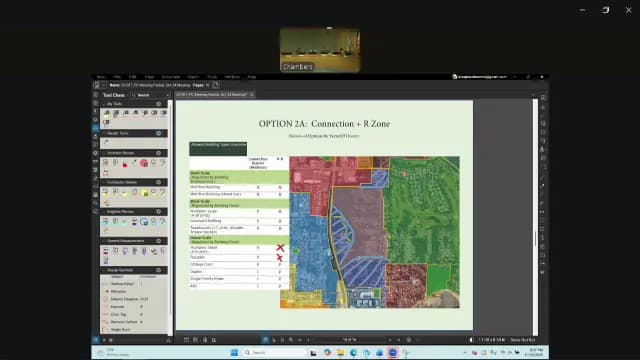
The Planning Commission met on October 23, 2025, at 6:05 PM in Council Chambers and via Zoom. Chair Sarah Blossom presided. Commissioners present: Blossom, Garcia, Preudhomme, Deines, Sullivan. Absent: Schaab (excused), Birtley. Staff included Acting PCD Director Darron Buchanan, Senior Planner Jennifer Sutton, and Council Liaison Jon Quitslund. Consultant Joe Tovar joined via Zoom. The meeting focused on continued discussion of updates to the Winslow Subarea Plan, including subcommittee reports on design standards and incentives. Consent Calendar - Agenda approved unanimously (5-0; motion Garcia/Deines). - Minutes of September 25, 2025 approved unanimously (5-0; Garcia/Preudhomme). - Minutes of October 2, 2025 approved unanimously (5-0; Garcia/Preudhomme). Public Comments & Testimony - Alice Charette (in person) suggested fact-checking Ferncliff options regarding established neighborhoods unlikely to change over 20 years. - Phaedra Elliott (Housing Resources Bainbridge, via Zoom) addressed the city's denial of HRB's request to increase the AMI restriction from 60% to 80% on seven units at The Oliver. She clarified there is no shortage of households at 60% AMI; the Oliver has 245 households on its waiting list for one-bedroom units, with 92% at or below 60% AMI. She urged flexibility and a strong trusted relationship with affordable housing providers. Commissioners discussed the issue, noting it connects to planning for 900+ units required under HB 1220. Acting Director Buchanan indicated the issue would return to council with additional information. Discussion Items Planning Director's Report: None; time used to check attendance for the October 30 meeting. Continued Discussion on Winslow Subarea Plan Updates - Consultant Joe Tovar gave a global overview: progress is 10 months behind schedule; focus on Winslow for the remainder of 2025, then pivot to other comprehensive plan elements (land use, housing, capital facilities) in 2026. He emphasized focusing on "essential" pieces to achieve a compliant periodic update. - Commissioner Preudhomme presented the Standards Subcommittee's work, covering four areas: zoning districts, parking, stepback requirements, and Ferncliff district options. The subcommittee identified that development standards (lot coverage, setbacks, street engagement) differ significantly between Winslow Way proper and the rest of the core. Key debate: whether to create a new Winslow Way district or an overlay zone. Commissioners expressed support for an overlay to preserve historic character. The subcommittee recommended considering a stepback of 15 feet measured from the building facade, with a minimum setback range (e.g., 2-10 feet) to ensure a minimum 5-foot stepback. - Ferncliff district: Three options presented – (1) a unique zone; (2a) a connection zone with moderate density in some areas; (2b) similar but including more area toward High School Road. Preferences leaned toward Option 2A, with higher density only near the high school and preserving existing middle housing in the Deercliff neighborhood. - Middle housing discussion: Major disagreement emerged. Commissioner Blossom stated that allowing duplexes/triplexes on individual lots regardless of underlying unit-per-acre zoning was a "huge deviation" from past practice and not clearly understood by council or the public. Other commissioners argued that middle housing inherently increases affordability and diversity. Council Liaison Quitslund noted that the council had not fully discussed HB 1110 and that the exemption letter was sent by a few individuals; he supported discussing duplex-by-right in certain zones. - Commissioner Sullivan left the meeting at 8:00 PM. Key Outcomes - No formal votes on substantive items; discussion only. - Subcommittees will refine options based on feedback. - Commissioner Schab confirmed availability for the October 30 meeting; Commissioners Preudhomme and Deines cannot attend. - The October 30 meeting will feature the groundwater management plan peer review consultant for Q&A. - Accepted feedback on middle housing confusion; future agendas will include deeper discussion on zoning approach and middle housing. - For the Good of the Order: Senior Planner Sutton provided information about the October 30 meeting. The meeting adjourned at 9:21 PM.
On October 21, 2025, the Bainbridge Island City Council met at 6:00 p.m. in Council Chambers and via Zoom. All seven councilmembers were present: Mayor Mathews, Deputy Mayor Quitslund, and Councilmembers Deets, Fantroy-Johnson, Hytopoulos, Moriwaki, and Schneider. Deputy Mayor Quitslund read the Land Acknowledgement. The council unanimously approved the agenda, 7-0, and no conflicts of interest were disclosed. The agenda estimated adjournment at 7:20 p.m., but the minutes and transcript record adjournment at 8:05 p.m. Groundwater Management Plan Peer Review Public Works and Water Resources Specialist Christian Berg introduced the item, noting that in April the council approved seeking peer reviewers for the Groundwater Management Plan (GWMP), that the council received the second draft on July 22, and that the city hired Keta Waters to review it. Keta Waters consultants Joel Massmann and Adam Massmann presented their roughly 40-page peer review. They agreed that the GWMP's two highest-ranked actions - increasing water conservation and increasing groundwater recharge - warrant high rankings because they improve system resiliency. They found that available water-level data and modeling results do not provide definitive evidence that current or future groundwater withdrawals are sustainable or unsustainable, largely because recharge rates are uncertain and the uncertainties in the water balance are larger than apparent margins. Joel Massmann noted that Bainbridge's withdrawals may be a relatively high share of estimated recharge compared to many systems, making those uncertainties more consequential. The consultants recommended continuing and possibly expanding monitoring, focusing on conservation and recharge, adding metering, and using steady-state simulations to bound sustainable combinations of recharge and extraction. They also said the current model's omission of streams, wetlands, and lakes severely limits its ability to estimate pumping impacts on those resources, though it could be fixed. They advised against spending large additional sums on more complex modeling because inherent uncertainties would remain. Berg also mentioned that Keta Waters was recommended by a Suquamish staff member and was scheduled to present to the Planning Commission on October 30. Council discussion reflected support for the review and concern about its implications. Councilmember Hytopoulos asked whether the council should move to planning or worry about modeling; the consultants said monitoring and conservation are the best use of resources. She also expressed concern about relying on conservation given the difficulty of controlling human behavior and about upcoming growth decisions. Councilmember Deets asked what level of conservation to implement and how to know it is working; consultants cited stabilization of groundwater elevations as an indicator and suggested prioritizing low-cost conservation measures. Councilmember Moriwaki asked whether any part of the plan was sound; consultants said much of the compiled data was useful but that uncertainty was underemphasized. Deputy Mayor Quitslund said carrying capacity should not be assigned a numeric value and asked about reliance on the deepest aquifers; consultants said most large systems rely on the deepest aquifers but did not recall exact percentages. Mayor Mathews mentioned a possible tour of the Port Gamble water treatment facility and raised concerns about Kitsap PUD water-system planning assumptions. A motion by Councilmember Deets, seconded by Councilmember Moriwaki, to forward the peer review to the Groundwater Management Plan Sub-Committee and Technical Advisory Committee for development of next steps and plans for public engagement carried unanimously, 7-0. Ethics Program Changes City Manager Blair King introduced the item, explaining that in May the council discussed changes to the ethics program, including limiting complaints to 12 months after the alleged violation and 12 months after leaving office. The Ethics Board, chaired by Dona Keating, responded by recommending retention of the current two-year timeframes. Keating said the board does not file complaints or 'hunt people down'; complaints are filed by citizens, and the board's role is educational. She argued that lowering the timeframes would reduce standards, that two-year windows already exist in other code sections such as post-service employment restrictions and significant financial conflicts, and that allowing people to leave office or advisory groups to avoid complaints would be harmful. She also said the board has been weaponized in the past, has worked to mitigate that, and had other pending recommendations it wanted the council to consider. Councilmembers expressed strong concerns about post-service complaints. Councilmember Hytopoulos said neither councilmembers nor volunteer committee members should be 'haunted down' after leaving, noted that state ethics law covers the most serious misconduct, said volunteers could be dissuaded from serving, and questioned the city's jurisdiction over former members. Councilmember Fantroy-Johnson called post-service ethics exposure an overreach, noting that former members are ordinary citizens without city-provided legal help. Councilmember Deets asked for equity across roles and noted that frivolous complaints are unpleasant. Councilmember Moriwaki said state ethics law is largely about financial conflicts and contracts and expressed concern about a chilling effect on volunteers. Councilmember Schneider noted the board can also provide exoneration and serve the public good, and that resignation should not allow escape from accountability. Mayor Mathews said elected officials sign up for scrutiny and expressed trust in the Ethics Board, while suggesting a possible compromise limiting two-year exposure for citizen committee members. No formal action was taken on the ethics program. Councilmembers and Keating agreed that a joint subcommittee could 'hash it out' and bring back a proposed compromise to the council and Ethics Board. Committee Reports Councilmember Moriwaki reported on a KCHA tour of north-end housing properties, including a 48-unit property, five single-family homes, and apartment complexes; an upcoming October 28-31 trip to Champaign-Urbana to study a solar-powered hydrogen production facility for transit; Kitsap Transit hydrogen bus plans; FIFA World Cup planning with extra ferries and BI Ride service; and attendance at the No Kings Rally. Councilmember Deets reported on a joint meeting with Poulsbo covering the Sound Olympic Trail, derelict vessels, the SR 305 working group, and law enforcement to deter ferry line cutting; a joint letter on derelict vessels was planned. He also announced Saturday office hours. Deputy Mayor Quitslund noted that the Planning Commission's Thursday meeting would continue Winslow Plan work. Mayor Mathews described speaking at the UW Evans School of Public Policy about public service and civic trust and suggested future large rallies include food-bank donations. Key Outcomes - Agenda approved 7-0; no conflicts disclosed. - Motion to forward the Groundwater Management Plan Peer Review to the GWMP Sub-Committee and Technical Advisory Committee for next steps and public engagement passed unanimously, 7-0. - No vote was taken on ethics program changes; council and Ethics Board agreed to consider forming a subcommittee to develop a compromise proposal for a future business meeting. - The meeting adjourned at 8:05 p.m., later than the 7:20 p.m. estimate in the agenda.
The Bainbridge Island City Council held a regular business meeting on October 14, 2025, at 6:00 PM in Council Chambers and via Zoom. Mayor Ashley Mathews presided, with six councilmembers present (Fantroy-Johnson absent). The meeting included three proclamations, public comment, a consent agenda, several regular business items, and communications. Notable outcomes included the adoption of an ordinance for pre-approved accessory dwelling units, a failed vote on an affordable housing covenant amendment, and approval to place a $30,000 emergency funding request for Helpline House on a future agenda. Consent Calendar - Approved accounts payable and payroll for multiple dates (September 4 through October 9, 2025) and meeting minutes from September 23, 2025. - Authorized the City Manager to enter into a construction contract with Van Ness Construction for the Mobile Home Site Preparation Project ($62,088.60). - Authorized a second contract amendment with Joe Tovar for the Comprehensive Plan Update (increase of $2,520 plus $225 for expenses). - Item 5.E (affordable housing covenant amendment for 560 Madison North, allowing incomes at 80% of AMI) was removed from the consent agenda per Councilmember Quitslund's request and considered separately. Public Comments & Testimony - Sarah Blossom (Planning Commission Chair, speaking personally) asked for more information on item 5.E, noting that 867 units (over 40% of the city's housing allocation) require incomes at 50% AMI or below and questioned why the city would voluntarily reduce inventory for that tier. - Kevin Fetterly discussed House Bill 1220 and suggested alternative solutions to blanket rezoning, such as ADUs, subsidies, and using existing properties (e.g., Suzuki, Bethany, churches) to meet affordable housing needs. - Maggie Rich (Housing Resources Bainbridge) spoke in favor of item 5.E, explaining that since acquiring the units in December 2024, HRB has had to turn away applicants earning just over 60% AMI. She noted that six of the 13 units already serve 50% AMI and below due to Kitsap County funding, and the change would only affect the remaining seven units, allowing flexibility up to 80% AMI. - Heather Burger (Executive Director, Friends of the Farms) supported the $30,000 emergency funding for Helpline House, citing a 40% loss in federal commodity funding and the elimination of $100,000 in annual local food purchasing funds by January 2026. She highlighted that over 400 families depend on Helpline weekly, double the number from two years ago. - Maria Metzler (Executive Director, Helpline House) supported the emergency funding, reporting that last year the food bank supported over 18,500 visits and distributed nearly a million pounds of food. She noted $660 million in USDA cuts, including $100,000 in local food purchasing for Kitsap County, and $200,000 in TFAP food cancellations annually. - Mev Hoburg (Helpline House Board Member) supported the funding, stating that SNAP benefits for a family of four will drop by about $127/month (13%) due to federal cuts, while grocery prices are up nearly 30% since the pandemic. She noted a 66% increase in food bank visits over two years, now serving 400 families/week. - Lara Lant supported the emergency funding and requested a public conversation about potential impacts of federal/state cuts on city projects that have already accepted funding. Discussion Items - Amendment to Affordable Housing Covenants (Item 5.E): The council debated a motion to authorize the City Manager to enter into Amendment No. 1 with Housing Resources Bainbridge for 560 Madison North, raising the income limit from 60% to 80% of AMI. Supporters (Quitslund, Deets, Mathews) argued it provides needed flexibility and reflects real-world applicant incomes. Opponents (Hytopoulos, Moriwaki, Schneider) emphasized the city's obligation to preserve deeply affordable units (60% and below) and questioned whether demand at that tier had been fully explored. The motion failed 3–3. - Pre-Approved Accessory Dwelling Units (Ordinance 2025-26): Acting Planning Director Darren Buchanan presented the ordinance, which amends the municipal code to allow pre-approved ADU plans from the Kitsap Regional Coordinating Council. Changes include increasing maximum square footage from 900 to 1,000 sq. ft., allowing a 50% setback reduction via variance for single-story ADUs, removing the requirement that ADUs match the primary dwelling's appearance, and replacing "shall" with "should" for shared driveways. The motion passed 6–0. - State Lobbying Services: The council authorized issuing a Request for Qualifications for state lobbying services and selected Councilmember Moriwaki to serve on the selection committee. The contract would shift from a two-year to a three-year term to align with the state budget cycle. Motion passed 5–1, with Hytopoulos voting no citing the length of the term. - Lodging Tax Advisory Committee (LTAC) Update: Deputy City Manager Ellen Schroer reported difficulty recruiting committee members due to the city's policy barring organizations that receive LTAC funds from having representatives on the committee. Only one application has been received. The council directed the City Manager to continue recruitment with the goal of completing the LTAC award process as early as practicable in 2026. Motion passed 6–0. - Interview Panel for City Attorney: The council appointed Councilmember Hytopoulos to join the interview panel for the City Attorney position. Hytopoulos noted a medical leave conflict but agreed to participate if scheduling allowed. Motion passed 6–0. - Emergency Funding for Helpline House: Councilmember Deets requested placing a $30,000 emergency funding request from the Council's Contingency Fund on a future agenda to supplement Helpline House's Foodbank Program. The council voted 6–0 to place it on the nearest possible agenda. - Groundwater Management Consultant Attendance at Planning Commission: The council requested that the Acting Planning Director ask the Groundwater Management consultant to attend the Planning Commission meeting following the City Council's October 21, 2025 study session, as soon as possible, to answer questions. Motion passed 6–0. Key Outcomes - Failed Motion: Amendment to affordable housing covenants for 560 Madison North (allowing incomes up to 80% AMI) failed 3–3 (Quitslund, Deets, Mathews aye; Hytopoulos, Moriwaki, Schneider no; Fantroy-Johnson absent). - Adopted Ordinance: Ordinance 2025-26 for pre-approved accessory dwelling units passed 6–0. - Authorized RFQ: The city will issue a Request for Qualifications for state lobbying services; Councilmember Moriwaki appointed to the selection committee (5–1). - LTAC Recruitment: Directed continued recruitment with goal of completing awards as early as possible in 2026 (6–0). - Interview Panel: Councilmember Hytopoulos appointed to the City Attorney interview panel (6–0). - Emergency Funding on Agenda: The $30,000 emergency funding request for Helpline House will be placed on a future council agenda (6–0). - Groundwater Consultant: Requested that the consultant attend the Planning Commission meeting after the October 21 council study session (6–0). - Proclamations: The council proclaimed October 2025 as Resiliency Awareness Month, Filipino American History Month, and National Community Planning Month.
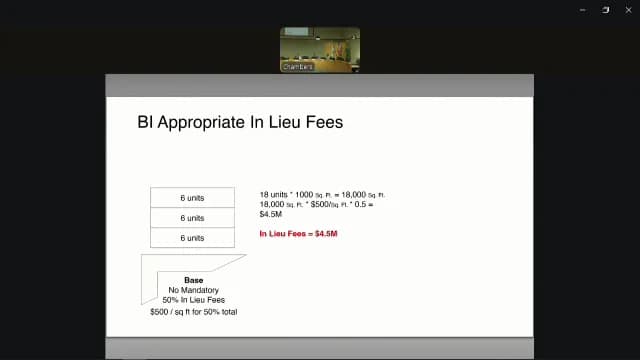
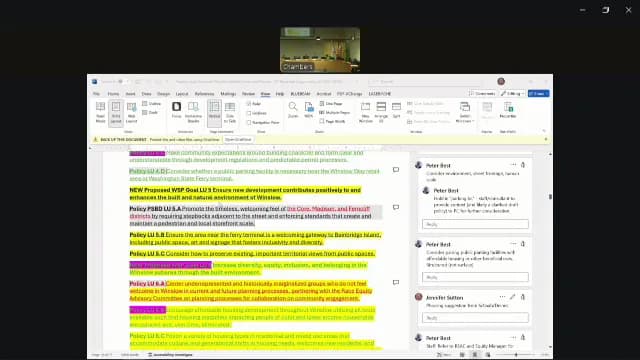
The Bainbridge Island Planning Commission held a special meeting on Thursday, October 2, 2025, at 6:02 PM in Council Chambers. The meeting focused on the Winslow Subarea Plan, including continued discussions on goals and policies, a presentation from the Race Equity Advisory Committee (REAC), and an informational report from the Incentives Subcommittee. Commissioners also reviewed the SEPA appeal process and requested that the Groundwater Management consultant attend a future meeting. SEPA Appeal Process Overview - Senior Planner Jennifer Sutton provided a general overview of the SEPA (State Environmental Policy Act) appeals process with the Hearing Examiner, including timelines and procedures. The overview was prompted by a recent appeal of a non-project action SEPA determination for Ordinance 2025-21. Commissioners asked clarifying questions about the effect of an appeal on city ordinance passage. Winslow Subarea Plan Goals and Policies – REAC Recommendations - Anshu Wahi (Equity & Inclusion Manager) and Caitlin Lombardi (REAC Co-Chair) presented recommended revisions to Goal LU-6 (increase diversity, equity, inclusion, and belonging through the built environment). They proposed adding language to acknowledge past exclusionary policies (e.g., Japanese American internment, racial covenants) and to call for specificity in terms like "small town character" to avoid vague or exclusionary interpretations. Commissioners debated whether to include “feel” as a vague term, with some supporting its inclusion to highlight the need for specificity. Consultant Joe Tovar advised that policies should be specific and actionable. The commission agreed to have REAC continue wordsmithing and bring back revised language. Incentives Subcommittee Report - Vice Chair Criss Garcia presented an informational report from the Incentives Subcommittee, summarizing research on affordable housing funding tools, partners, and innovative models. The presentation covered federal, state, and local funding sources (e.g., LIHTC, CDBG, Housing Trust Fund, REET), inclusionary zoning, in-lieu fees, and potential partnerships with employers, faith-based organizations, and nonprofits. Garcia proposed a conceptual “horseshoe” model integrating market-rate and affordable units with a buyout mechanism. Commissioners discussed the feasibility and potential impacts of such models, with some expressing concern about high in-lieu fees discouraging development. No decisions were made; the report was for discussion only. Key Outcomes - Motion to add SEPA appeal overview to the agenda: Carried unanimously (6–0). - Motion to approve amended agenda: Carried unanimously (6–0). - Motion to request the Groundwater Management consultant attend a future Planning Commission meeting (after the City Council meeting on October 21, 2025) for questions and answers: Carried unanimously (4–0, with Commissioners Deines and Sullivan absent). - Cancellation of next week’s meeting (October 9, 2025): Announced by Chair Blossom to allow subcommittees dedicated work time. - Commissioner Preudhomme proposed further study of innovative housing funding concepts, including urban wealth funds and community investment funds. - Commissioner Blossom emphasized the need to integrate water/sewer infrastructure planning with growth planning, noting that the Groundwater Management Plan’s implications should be understood before finalizing housing allocations.
The Bainbridge Island Planning Commission met on September 25, 2025, at 6:03 PM in Council Chambers and via Zoom. Chair Sarah Blossom presided, with Commissioners Criss Garcia, Alex Preudhomme, Peter Schaab, Ben Deines, and Ariel Birtley (arrived at 6:17 PM) present. Commissioner Sean Sullivan was absent and excused. The meeting focused on continued discussion of the Winslow Subarea Plan (WSP) goals and policies, along with updates from subcommittees on incentives and development standards. The commission also heard a special public comment from Councilmember Dietz, received a planning director’s report, and addressed process concerns during “For the Good of the Order.” Consent Calendar - Agenda Approval: Motion by Schaab, second by Garcia, to approve the agenda as presented. Passed unanimously (5-0). - Minutes Approval: Motion by Schaab, second by Garcia, to approve the minutes from the August 28, September 3, September 4, and September 11, 2025 meetings. Passed unanimously (5-0). Public Comments & Testimony - Councilmember Jon Quitslund (City Council Liaison) expressed gratitude for the commission’s professionalism and dedication during the previous marathon meeting (approximately 7.5–8 hours). He presented each commissioner with a challenge coin as a token of respect. No remote public comment was received. Discussion Items - Planning Director’s Report: Director Patty Charnas thanked the commission for their work and noted upcoming absences (she will be on vacation for a month; Darren Buchanan will serve as acting director). She reported on a Department of Commerce webinar regarding three key questions: (1) religious-owned properties and affordable housing density bonuses – the city will send letters to 19 religious entities to gauge interest; (2) capital facilities planning for a second sewer plant – Commerce confirmed that a 20‑year financing plan is required under GMA; (3) upzoning areas without municipal sewer – Commerce stated such upzoning is permissible but may serve middle‑to‑upper affordability levels because multifamily units below 80% AMI typically require sewer. She also noted that the vacant planning manager position will be re‑advertised in October and that a fourth October meeting (Oct 30) has been added to the schedule. - Continued Discussion on Winslow Subarea Plan Updates (Items 6a & 6b): Consultant Joe Tovar introduced subcommittee reports. - Incentives Subcommittee (Commissioner Garcia): Reported that the subcommittee has met three times and is developing a framework for affordable housing incentives. A detailed presentation is scheduled for the October 2 meeting. Commissioner Deines emphasized the need to engage the local development community (e.g., builders, Housing Resources Bainbridge) and to consider the challenge of serving households between 80% and 120% AMI (the “workforce housing” gap). Commissioner Garcia noted the subcommittee will propose pairings of tools to serve all income levels. Commissioner Birtley raised concerns about the focus on middle housing versus the state’s 1220 mandate, which requires the largest allocation for lower income brackets: 543 units at 0–30% AMI, 324 at 31–50% AMI, and 272 at 51–80% AMI. She also discussed funding challenges (e.g., LITEC, USDA 502) and the need to explore partnerships with the school and park districts. The subcommittee agreed to provide a PDF presentation by 3:00 PM the next day for the October 2 packet. - Standards Subcommittee (Commissioner Preudhomme): Indicated that the group is meeting again on September 26 and will likely give an oral update on October 2, with a more formal presentation later (targeting October 9). Discussion about packet content and “live” tools (e.g., mapping spreadsheets) ensued, with several commissioners preferring that materials be included in the packet to allow full consideration. - Winslow Subarea Plan Goals and Policies Review: Senior Planner Jennifer Sutton led the review of remaining goals and policies. Key debates centered on whether certain items should be in the WSP or the citywide Comprehensive Plan (CP) and on the appropriate level of detail (goal vs. policy). Highlights include: - SU3 (Sustainability/Resilience): After discussion, the commission moved SU3 to the Comprehensive Plan level (motion Deines/Garcia, unanimous). A separate motion (Preudhomme/Birtley, unanimous) referred development of resilience language specific to Winslow to the Climate Change Advisory Committee. - LU2 (Form-Based Code): Consensus that form‑based code is a policy tool that supports housing diversity; it will remain as a policy under Goal LU2 with clarifying text. - WMP 3‑1 (Housing): A motion (Birtley/Preudhomme) to approve the goal and its policies as presented passed unanimously. The commission noted that anti‑displacement language will be added later; Commissioner Garcia will share model language. - WMP X (New Goal): A new goal (locating housing near services and transit) was adopted (Deines/Schaab, unanimous). - Open Space Goal WMP 4‑1: A motion (Garcia/Preudhomme) to accept WMP 4‑1 and its policies as amended (including restoration of policies 4‑1.1 and 4‑1.2) passed unanimously. A subsequent motion (Deines/Birtley) moved policies 4‑1.1 and 4‑1.2 to the Comprehensive Plan and directed the commission to consider additional Winslow‑specific open space policies (e.g., tot lots) in the future; passed unanimously. - Policy WMP 4‑2.2 (Waterfront Park): A motion (Garcia/Schaab) to rewrite this policy as a goal, in present tense active voice, and strike the final sentence, passed unanimously. - Policies WMP 4‑2 and 4‑2.1 were placed in the parking lot (motion Birtley/Schaab, unanimous). - Policies 4‑1.3 (Ravine) and 4‑1.4 (Market Square) were elevated to goal level (motions Garcia/Schaab and Deines/Garcia, respectively, both unanimous). A subsequent motion (Preudhomme/Deines) directed that these new goals have policies drawn from existing language; passed unanimously. - Waterfront Trail: A motion (Deines/Birtley) to include the term “boardwalk” in the waterfront park goal to explicitly reference the full extent of the trail, passed unanimously. - For the Good of the Order: Chair Blossom raised concerns that the ordinance the commission recommended on September 11 (Ordinance 2025‑21) had been amended by city staff/attorney before it was presented to City Council, specifically adding a parking standard that the commission had voted against and removing Mobile Home Park FAR language. She stated this undermined the commission’s process and transparency. Council Liaison Quitslund acknowledged the unease, noting that trust had been strained. Director Charnas explained that the city attorney and executive revised the ordinance, necessitating an additional public hearing at the council level. The commission expressed a desire for clearer communication in future processes. Key Outcomes - Approvals: Agenda, minutes, and ten motions on Winslow Subarea Plan goals and policies were all approved unanimously (6‐0 for each as recorded). - Referrals: The Climate Change Advisory Committee will develop Winslow‑specific resilience language; the Incentives Subcommittee will provide a detailed presentation at the October 2 meeting; the Standards Subcommittee will present later in October. - Directives: Staff will revise the WSP goals and policies document based on the motions, including new goal language for ravine, market square, and waterfront park, and will prepare a cross‑reference analysis to determine whether certain policies belong in the citywide Comprehensive Plan. Staff will also send letters to religious entities to gauge interest in affordable housing density bonuses. - Next Steps: The next planning commission meetings are October 2, 9, 23, and 30. The October 2 meeting will include a subcommittee presentation on incentives, an appearance by the Race Equity Advisory Committee, and a high‑level review of Comprehensive Plan goals to inform placement of WSP policies. The commission will also revisit the open space parking lot items and consider anti‑displacement language. - Adjournment: The meeting adjourned at 9:17 PM.
The Bainbridge Island City Council held a regular business meeting on Tuesday, September 23, 2025, from 6:00 PM to 9:17 PM in Council Chambers and via Zoom. The meeting included two proclamations, extensive public comment (28 speakers), a consent agenda of 13 routine items, and six regular business items. Key discussions centered on a proposed affordable housing development at 625 Winslow Way, a related zoning ordinance (No. 2025-21), a review of affordable housing definitions, the 2026 mid-biennium budget update, the 2026 property tax levy, a wait period for low-income priority at the Dave Ullin Open Water Marina, and the appointment of a councilmember to a public art selection jury. Consent Calendar - Approved payroll for periods ending September 5 and September 20, 2025. - Approved meeting minutes for September 9, 2025 (special and regular) and September 16, 2025 (study session). - Authorized the City Manager to execute project acceptances for Madison Avenue Bundled Project (non-motorized), Country Club Road Reconstruction, and Hawley/Irene Grinder Pumps, all with Sound Pacific Construction and Seton Construction respectively. - Authorized Amendment No. 2 to the Kitsap Law Group contract for indigent defense services ($54,500) and a related 2026 budget adjustment. - Authorized Amendment No. 13 to the Perteet, Inc. agreement for Eagle Harbor/Wyatt Way Non-Motorized Improvement Project construction engineering services ($119,300 from Capital Construction Fund). - Ratified pre-approved purchase orders for a replacement dump truck ($384,269.91) and an asphalt patch truck ($322,881.83) as part of the 2025 Capital Improvement Plan fleet purchases. - Authorized an interlocal agreement with Kitsap County for the West Sound Stormwater Outreach Group ($42,000 from Stormwater and Surface Water Management Fund). - Canceled the October 7, 2025, City Council Study Session. - Authorized a contract amendment with Transpo Group for the Americans with Disabilities Act (ADA) Transition Plan (increase of $20,900). Public Comments & Testimony - Twenty-eight members of the public spoke, the majority addressing the proposed affordable housing project at 625 Winslow Way and the related Ordinance No. 2025-21. Speakers expressed a range of positions: several (including union representative Scott Pattison, business owners, and residents) strongly supported the project, citing the dire need for workforce housing and the benefits of walkable, dense development near transit. Others (including Sarah Blossom, Nancy Nolan, David Schutz, Mary Clare Kersten, and Priscilla Zimmerman) urged a pause or alternative site selection, raising concerns about the site's suitability (busy intersection, sole-source aquifer capacity, traffic, parking, building height, and process fairness). A few commenters (April Ness, Becca Guillote) spoke about the liveaboard community at the Dave Ullin Open Water Marina, advocating for no vacancy period or a short wait for low-income priority. One speaker (Ron Peltier) advocated for a robust groundwater management plan. Several speakers (John Flodin, Bevan Taylor, Chloe Josten) recounted personal experiences and urged the council to move forward to avoid repeating past delays. Discussion Items - Ordinance No. 2025-21 – Development Standards for Affordable Housing Projects: Senior Planner Sutton presented the ordinance, which would increase floor area ratio (FAR) to 2.5 and building height to 55 feet for 100% affordable housing projects in the Central Core and Ferry Terminal districts east of SR 305, with a nine-month sunset. Councilmember Hytopoulos offered an alternative motion to not schedule a public hearing and instead study alternative sites (including 251 Winslow Way), but it failed for lack of a second. After debate, Councilmember Fantroy-Johnson moved to schedule a public hearing on October 14, 2025. The motion passed 6-1, with Hytopoulos opposed. The council will receive a staff report on comprehensive plan consistency before the hearing. - Review of City's Standard Definitions for Affordable Housing: Deputy Mayor Quitslund proposed forwarding a policy statement to broaden affordable housing definitions to include households up to 120% of area median income (AMI), encouraging mixed-income projects. Councilmember Hytopoulos and Moriwaki opposed, citing planning commission workload and potential unintended consequences. Councilmember Schneider suggested creating a local AMI translation table. The motion failed 3-4 (Fantroy-Johnson, Quitslund, Mathews in favor; Deets, Hytopoulos, Moriwaki, Schneider opposed). The discussion remains available for future planning commission consideration. - Ordinance No. 2025-28 – 2026 Mid-Biennium Budget Update: Finance Director Pitts presented a $59.5 million adopted budget for 2026 with proposed changes of about $350,000 (a decrease). Key adjustments include filling 2.5 of 3.5 held-vacant positions (police officer, accountant, half-time court specialist), reductions in sales tax and real estate excise tax forecasts, and modest increases in utility rates. Councilmember Moriwaki praised the city's fiscal prudence. A public hearing was set for November 12, 2025 (unanimous). - Ordinance No. 2025-27 – Property Tax Levy for Collection in 2026: City Manager King noted the property tax is the largest general fund revenue source (over $8 million), with Bainbridge Island receiving only eight cents of every dollar paid. The council set a public hearing for November 12, 2025, on a levy limited to the statutory increase (unanimous). - Wait Period for Low Income Priority at Dave Ullin Open Water Marina: After hearing public comment from liveaboards, the council discussed the appropriate wait period to hold a buoy vacant for income-qualified applicants (60% AMI) when no waiting list exists. Councilmember Fantroy-Johnson moved for a 30-day wait period, which carried unanimously. Staff will draft a policy manual amendment. - Designation for Public Art Selection Jury: Councilmember Moriwaki was appointed unanimously to represent the city on the jury for new public art in the City Hall Engineering Conference Room. Key Outcomes - Two proclamations approved unanimously: "Week Without Driving" (Sep 29–Oct 5, 2025) and "Hispanic and Latine Heritage Month" (Sep 15–Oct 15, 2025). - Consent agenda approved 7-0. - Ordinance No. 2025-21: public hearing scheduled for October 14, 2025 (6-1). - Affordable housing definitions motion failed 3-4. - Ordinance No. 2025-28 (budget) public hearing set for November 12, 2025 (7-0). - Ordinance No. 2025-27 (property tax levy) public hearing set for November 12, 2025 (7-0). - Marina low-income wait period set at 30 days in absence of a waiting list (7-0). - Councilmember Moriwaki appointed to public art selection jury (7-0).