Browse by city
Date range
Search help

Search titles, summaries, topics and stored transcripts together. Keywords may match separately; put the whole query in double quotes for a phrase. Matching follows word analysis, so punctuation is not exact. Both dates are included. Documents are not searched.

SHOWING 11–20 ENTRIES
11
SEP 17, 2026 · BELLEVUE, WASHINGTON · CITY COUNCIL
Bellevue Parks and Community Services Board Meeting - September 17, 2026

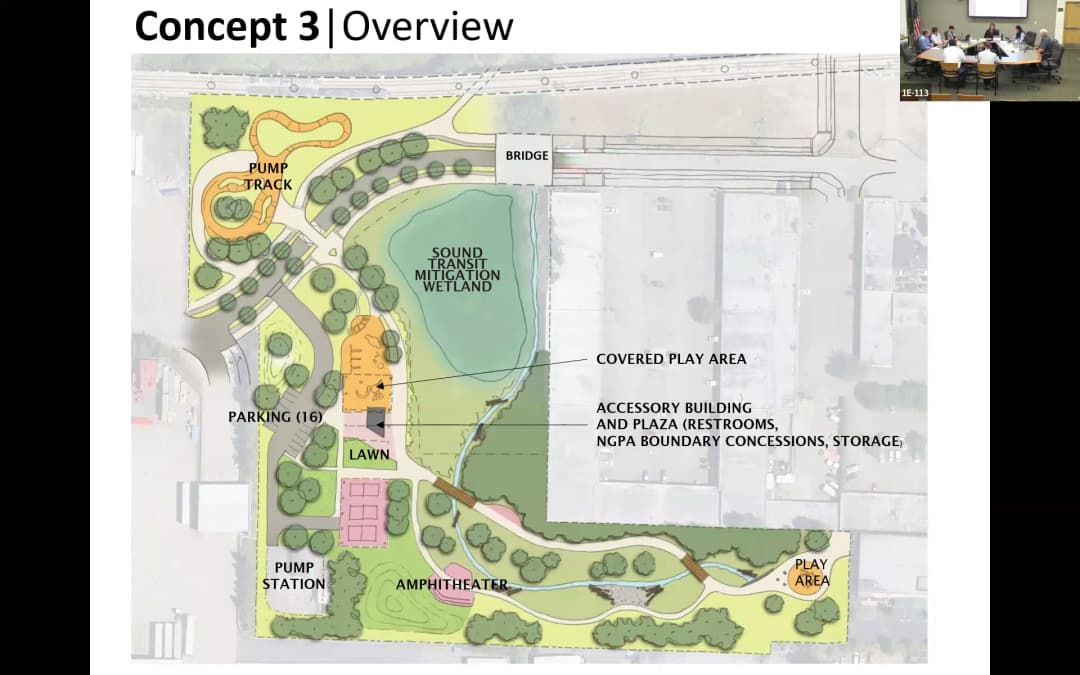
The Bellevue Parks and Community Services Board met on September 17, 2026, to approve the agenda and minutes, hear public comments, receive reports from city council and staff, and discuss the Bell Red Neighborhood Park Master Plan. Key topics included budget priorities, community events, and three design concepts for the new park. Consent Calendar - The board unanimously approved the September 17, 2026 agenda. - The board unanimously approved the minutes from the July 2026 regular meeting. Public Comments & Testimony - Patrick Alina (Bellevue Youth Link staff) and Emma Traub (Youth Link board member) invited board members to the annual Youth Link Gumbo Night on Wednesday, October 28, 6–8 p.m. at Crossroads Community Center, an opportunity for youth to dialogue with leaders over gumbo. - Alex Zimmerman expressed strong criticism of city budget priorities, stating that Bellevue's gross domestic product is over $150 billion (37% of regional GDP) while the parks budget is only $1 billion. He demanded the council redirect funds from corporations to parks and public services, using inflammatory language. - Nicole Myers spoke about the proposed road through Bell Red Park, urging the board to consider pedestrian- and bike-centered designs and preserve trees. She referenced a recent tree removal in Downtown Park and hopes for coordination between transportation and parks planning. Discussion Items - Councilmember Breyer provided updates on city budget deliberations, noting Bellevue starts with a balanced budget and has reserves, unlike neighboring cities. He mentioned options for transportation investments (e.g., car tab fees, sales tax) and a state mandate removing parking minimums in some areas. He read the city's strategic target areas, emphasizing a high-quality built and natural environment. - Director Cameron Parker reported upcoming events: Kelsey Creek Farm Fair (Oct 3), Arbor Day volunteer event at Lewis Creek Park (Oct 17, 9–11 a.m.), and Gumbo Night (Oct 28). He noted that the city council will discuss the parks CIP on October 20, when the board's recommendation memo will be included. - Board communications: Members shared observations from the Bell Red Park open house, including concerns about road safety, bike access, and off-leash dog areas. One member asked about Eastgate Park pickleball conversion; Cameron confirmed it is a pilot with balanced feedback. Board members also discussed climate impacts on trees and community events like the Fall Into Fun series. - Bell Red Neighborhood Park Master Plan Presentation by Zarian Smith and Wyatt Thompson: - Background: The park site in the Bell Red neighborhood includes a wetland, West Tributary stream, storage building, and utility pump station. The park is part of the Bell Red subarea plan (Project N2) and involves coordination with transportation and utilities departments. - Public outreach: Three community meetings (two in-person, one online), tabling at Eastgate Block Party, Spring District farmers market, and food bank. Top community themes included: multi-use paths, flexible lawns, restrooms, picnic shelters, covered event space, and seating. - Three concepts presented: - Concept 1: Dog park, mid-sized parking, covered picnic area with deck over wetland, daylighted stream with cobble beach and seating nodes. - Concept 2: Boardwalk across wetland extending under future bridge, play area, smallest parking, repurposed storage building as flexible covered space, lookout hill, stormwater feature. - Concept 3: Pump track in northwest corner, largest repurposed building for covered play, partially covered recreation courts, lawn, restroom, amphitheater, play area near stream opening. - Next steps: Gather feedback from board, internal departments (transportation, utilities, finance, arts), and Snoqualmie Tribe. Refine to one or two concepts for third community meeting in Q1 2027. Online survey includes naming opportunities. - Board member preferences and discussion: - Eric liked boardwalk (nature immersion), amphitheater (programming), covered play, and dog park (needs assessment). He asked about stream daylighting and road safety. - Elizabeth liked combination of concepts 1 and 2, emphasizing wetland access, dog park, and play area. She advocated for minimal paved parking, noting abundant parking nearby. She highlighted covered space for tai chi and dance. - Steve liked flexible covered space (industrial heritage), boardwalk, pump track (unique feature), and wanted more information on parking and future development. - Eileen liked large amphitheater (drawing events), play area set back from entrance, covered recreational courts, and pump track but questioned proximity to Highland skate park. She suggested surveying for pump track demand. - Chair liked concept 3 overall, noting pump track use observed elsewhere, flexible covered play, and boardwalk from concept 2. She mentioned adventure playground concept as a theme. - Stefan Hovey (absent) emailed comments: questions on park accessibility with constrained parking, wetland experience without ecological harm, and designing for future residents while retaining industrial heritage. - Road discussion: The proposed road connects 124th and 130th as part of Bell Red grid. Board members raised safety concerns (crossing, speed limits, traffic calming). Staff clarified road will have two lanes, bike lanes, and multi-use path. No funding secured for road yet; park may be built first with interim design. Possibility of underpass in concept 2. Key Outcomes - No votes were taken on the Bell Red Park concepts. Staff will incorporate board feedback, internal department input, and public survey results to refine options. - The board will continue discussion at the next meeting on October 21, 2026, which will focus on the Parks and Open Space System Plan update and third-quarter memo.
PARKS AND RECREATION 73% · PROCEDURAL 6% · PUBLIC ENGAGEMENT 6% · TRANSPORTATION SAFETY 6%
12
SEP 15, 2026 · BELLEVUE, WASHINGTON · CITY COUNCIL
Bellevue City Council Meeting – September 15, 2026: Preliminary Budget and Public Hearing

The Bellevue City Council held a regular meeting on September 15, 2026, featuring three proclamations, a public hearing on the preliminary 2027-2028 biennial budget, and a presentation of the budget by city staff. Over 50 members of the public provided testimony, with strong support for the Grand Connection Crossing and increased climate action funding, alongside concerns about affordability and transportation priorities. Consent Calendar - Approved unanimously, including routine approvals. Proclamations - National Hispanic Heritage Month (Sept 15–Oct 15, 2026): Read by Councilmember Breyer, recognizing contributions of Hispanic and Latino communities. - Teen Mental Health Awareness Day (Sept 19, 2026): Read by Deputy Mayor Hamilton; accepted by Bonnie from Asian Counseling Referral Service, who highlighted mental health needs. - National Diaper Need Awareness Week (Sept 14–20, 2026): Read by Councilmember Bargava; accepted by representatives from Babies of Homelessness and KidVantage, emphasizing diaper need in Bellevue. Public Comments & Testimony - Oral Communication (pre‑budget): - Miss Cobb (resident) expressed concerns about middle housing concentration in her neighborhood and parking violations by construction crews. - Alex Zimmerman (Stand Up America Party) criticized the council and mayor, alleging use of a non‑legal name and accusing the council of corruption. - Joe Kunzler (remote) rebutted Zimmerman’s statements and condemned harassment of the council. - Gary Sampson (Family Law CASA of King County) supported human services funding and praised the Human Services Commission’s work. - Budget Public Hearing (48 speakers, time reduced to 1.5 minutes): - Strong support for the Grand Connection Crossing: Speakers included representatives from Amazon (Pearl Lung), Symetra (Beth Osborne), Eastrail Partners (Steve Kramer), KidsQuest Children’s Museum (Mike Hubbard), Friends of the Grand Connection (Sarah Langton), Old Bellevue Merchants Association and Sophia Way (Anthony McKay), Cascade Bicycle Club (Gina Kavesh), Bellevue Downtown Association (Patrick Bannon), Bellevue School District (John Harrison), Boys & Girls Club of Bellevue (Tim Motz), Friends of Youth (Rihanna Kajani), Lime (Nikki Stuck), and several residents. They cited connectivity, equity, economic benefits, climate goals, and safety. - Support for increased climate funding: Speakers from People for Climate Action and others (Cameron Brajas, Lavanya Singh, Nihao Singh, Alice Meng, Tracy Cookley, Michael Lee, Jennifer Keller, Neil Bhakshi, Court Olson, Mark Norrelias) urged the council to allocate at least $12 million for existing building decarbonization (Energy Smart Eastside), arguing the current $6 million is insufficient to meet 2050 targets. - Concerns about transportation funding and taxes: - Craig Speasel (resident) opposed using TBD funds for the Grand Connection and called for a public vote. - Todd Myers (Washington Policy Center) argued that EV charger and e‑bike subsidies are ineffective, citing low usage and a UW study showing no measurable VMT reductions. - Maria Frost (Kemper Development) supported chamber priorities but insisted any TBD tax increases go to a public vote, citing cumulative tax burden. - Tony Sprague (Bellevue Chamber) asked for transparent performance metrics and prioritization of corridor intersections. - Support for neighborhood transportation projects: Speakers from Vasa neighborhood (Karen Armstead) and West Lake Sammamish (Rosemary Dunkel) urged funding for pedestrian and bike safety improvements. - Opposition to Spring Boulevard project: Ben Mickel (resident) argued the $75 million arterial would cut through Bell‑Red Park and suggested a $20 million bike‑only path instead. - Other topics: Support for Bellevue Promise program (John Harrison), human services funding, and continued investment in fire, police, and parks. - An additional speaker (Julie Cobb) raised safety concerns about patrolling the Grand Connection trail. Discussion Items - City Communications Awards: City Manager announced three 3CMA awards for communications excellence (Savvy Award for utility crisis plan, Silver Circle for Lake to Lake show, Award of Excellence for summer day camp guide). - Preliminary 2027‑2028 Budget Presentation: - City Manager Carlson and CFO John Risha presented the budget overview, emphasizing a conservative approach, diverse revenue base, and $15 million in repurposed departmental savings. - The base budget includes no new taxes beyond the statutory 1% property tax increase. It funds the Grand Connection Crossing without additional tax measures, while two Transportation Benefit District (TBD) scenarios were presented (Scenario 2: sales tax; Scenario 3: sales tax + vehicle fee restricted to neighborhood mobility). - The six‑year Capital Improvement Program totals $1.3 billion. - Council discussion: Members asked about risks, unfunded priorities, the cumulative taxpayer impact, cost escalation in CIP projects, and the need to ensure police and fire staffing levels. Questions were deferred to subsequent study sessions. - Intergovernmental Affairs Monthly Update: Received and filed. Key Outcomes - Agenda approved. - Consent calendar approved. - Rules suspended to limit public hearing comments to 1.5 minutes. - Public hearing opened and closed. - No final budget decisions made; the council will deliberate through November 17, 2026, with additional study sessions and a third public hearing on October 27.

BUDGET EQUITY ANALYSIS 23% · TRANSPORTATION SAFETY 10% · PROCEDURAL 9% · PUBLIC ENGAGEMENT 9%
13
SEP 10, 2026 · BELLEVUE, WASHINGTON · CITY COUNCIL
Bellevue Planning Commission Study Session on Bell Red Land Use Code Amendments – September 10, 2026

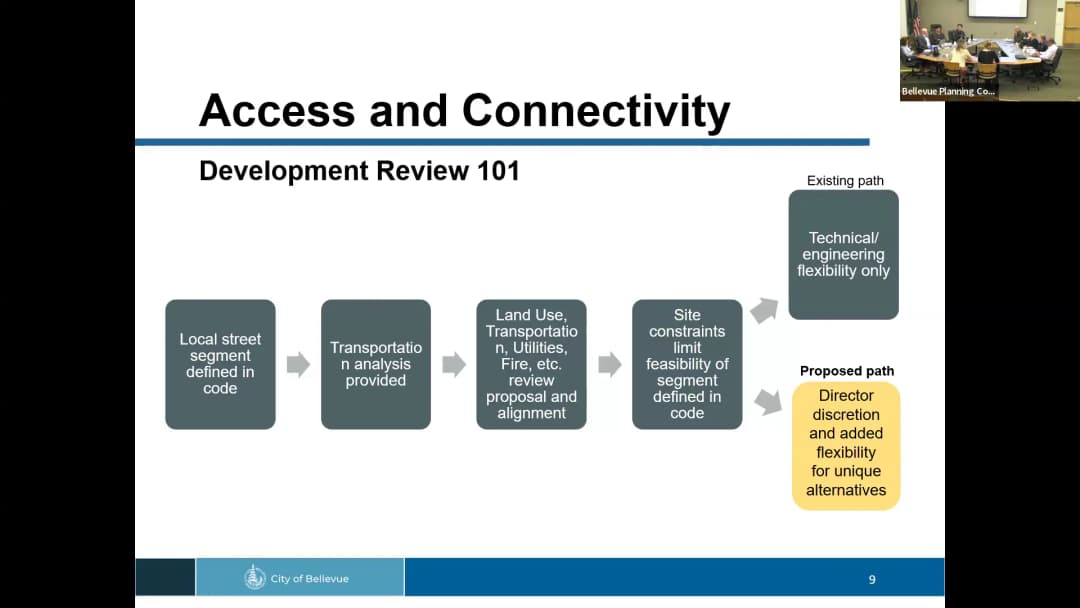
Date note: The transcript identifies the meeting date as September 9, 2026, but the instruction specifies September 10, 2026. This summary uses the provided date. The Bellevue Planning Commission held a study session on the proposed Bell Red Land Use Code Amendments (LUCA) on September 10, 2026. The meeting included public testimony from 16 speakers, a staff presentation on updated draft code provisions, and commission discussion. At the end, the commission voted to set a public hearing for the LUCA. Consent Calendar - Approved the meeting agenda by unanimous vote. - Approved the minutes from June 24, July 9, and July 22, 2026. Reports - Councilmember Bargava reported that the City Council unanimously approved a development agreement for bridge housing in Bell Red and reviewed parking reform work, with general support but requests for further analysis on reduced parking near frequent transit, visitor parking, and senior housing exceptions. Public Comments & Testimony - Valentina Venevo (resident): Opposed the proposed Spring Boulevard road through a planned park in Bell Red, arguing the 2009 plan is outdated given new transit, safety knowledge, and environmental concerns (wetland and stream). She advocated for a multi-use path instead. - Rebecca Bloom (Columbia Pacific Advisors): Described a 9-acre project with 1,100+ units and extensive amenities. Stressed that high costs (energy code, sales tax, affordable housing) make projects challenging and proposed a “Bell Red Arts” district with shared cost offsets. - Matt Rowie (architect/planner): Tested the street grid on dozens of properties and found it impractical due to existing buildings, grades, and landlocked sites. Recommended eliminating the mandatory grid or allowing shared-use paths and increased bonus points for street construction. - Patrick Hanks (Bellevue Chamber of Commerce): Thanked staff for progress but noted economic conditions require a code that works “day one.” Key concerns: mandatory street grid and development agreement eligibility for smaller sites. - Megan Webb (King County DNRP): Promoted Transfer Development Rights (TDR) as a market-based tool that could fund open space and other priorities in Bell Red, offering a potential $1 million grant and 25% revenue return to the city. - Layla Kademi (land use attorney): Supported development agreements but urged broader eligibility (sites smaller than 4 acres or with street grid burdens) and more flexible public benefit requirements. - Morgan Shuck (Echo Northwest, for Bellevue Chamber): Presented independent analysis showing near-zero feasibility under current market conditions. Recommended calibrating street/stream obligations, day-one offset tools, and aligning affordable housing with MFTE. - Paulo Sullivan (Albertson property owner): Opposed the required east-west connection road, citing a traffic study showing up to 6,000 dwellings can be built without it. Called the road unnecessary and expensive. - Brady Nordstrom (HTC): Asked for clarification on the allocation of amenity fees (35% housing, 50% open space, 15% arts) and expressed concern that a proposed catalyst program for medical/life sciences on 116th Avenue could reduce affordable housing funds. - John Morasco (Albertson property): Submitted a traffic analysis concluding up to 6,000 units or 1.2 million sq ft of commercial can be built without the east-west connection. Advocated for flexible block perimeter standards instead of a prescriptive grid. - Jesse Clausen (O'Brien Auto Group): Highlighted private easements preventing road construction and argued the development agreement provisions improperly constrain City Council discretion. Opposed the street grid. - Lucy Zapon (Imagine Housing): Asked to eliminate the prescriptive street grid in favor of multimodal pathways to reduce costs and improve safety. - Alex Zimmerman (resident): Criticized the city for prioritizing corporate interests over ordinary residents, citing high housing costs and a large budget surplus. - Steve Malsom (developer, Evans Wakefield): Provided examples from Lynnwood and Marysville where flexible approaches allowed successful large-scale developments. Urged avoiding overly prescriptive street grids. - Lori Keller (Bellevue College): Expressed support for the LUCA and institutional zoning category, and for continued partnership with the city. Discussion Items - Staff Presentation (Christina Gallant and Charlie Engel): Summarized key updates to the draft LUCA, including: a fee-in-lieu for the amenity system set at $39/square foot (matching downtown); allocation of fees (35% housing, 50% open space, 15% arts); enhanced stream restoration incentives; removal of two street segments; a new flexibile pathway for public street substitution with private streets (via director review); development agreement eligibility for sites larger than 4 acres with mandatory street grid (requiring 3 public benefits for broader modifications); on-street parking reduction options; a commercial catalyst program for medical/life sciences on 116th Avenue (850,000 sq ft eligible for 50% MHA fee reduction); a Sound Transit parcel height bonus; and a tentative schedule leading to City Council review in early 2027. - Commission Discussion: Commissioners focused heavily on the street grid, with several members (Nilchian, Conlu, Keppel, Ferris, Via Veses) requesting additional flexibility, a clearer “performance path,” or reduced prescriptiveness. Staff defended the grid as essential for connectivity and public investment, but acknowledged the built-in flexibilities. Other topics included TDR prioritization, pioneer program possibilities, development agreement size thresholds, assurance devices for stream daylighting, and sidewalk widths in private street alternatives. Commissioner Conlu questioned the 25% assurance device level for stream daylighting, preferring a higher percentage. Key Outcomes - Unanimously voted to direct staff to schedule a public hearing for the Bell Red Land Use Code Amendments. The hearing date will be determined at a future meeting. - Staff was asked to consider the following input for further refinement: - A potential pioneer program to incentivize early development. - Expanded TDR prioritization and integration. - Clarification of street grid goals to guide alternative proposals. - Broadened development agreement eligibility beyond 4-acre sites. - Reduced sidewalk width requirements (e.g., 8 feet) for private street alternatives. - A more explicit performance path for street grid compliance. - Revised assurance device levels for stream daylighting incentives. - Calibrated amenity fee allocation (e.g., 33% each) or further rationale for the current split. - The commission also approved the minutes from previous meetings without objection.

LAND USE AND ZONING 55% · TRANSPORTATION SAFETY 12% · AFFORDABLE HOUSING 9% · PROCEDURAL 6%
14
SEP 8, 2026 · BELLEVUE, WASHINGTON · CITY COUNCIL
Bellevue City Council Regular Meeting - September 8, 2026

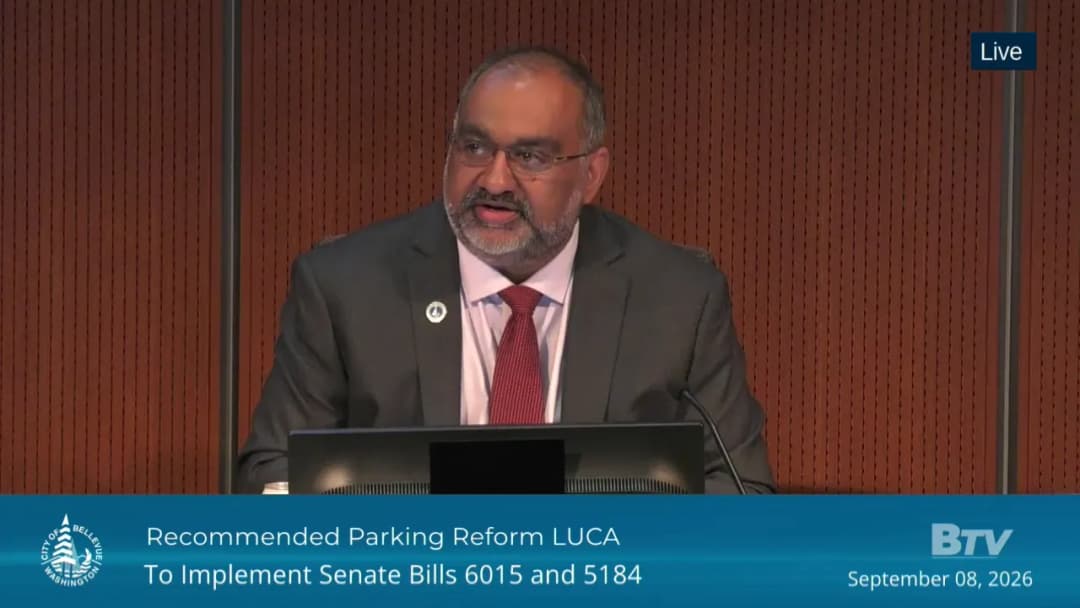
The Bellevue City Council met on September 8, 2026, at 6:00 PM in Council Chambers. The meeting included proclamations, oral communications, a city manager report on summer activities, approval of a consent calendar, a public hearing and action on the BelRed Arts Development Agreement, a study session update from the King County Library System, and a study session on parking reform land use code amendments. The council directed staff to return with additional analysis on the parking reform before final action. Consent Calendar - Approved unanimously: Items 26-512 through 26-513 (minutes, claims) and ordinances/resolutions (ORD 6935-6938, RES 10662-10668). Notable items included: - ORD 6936: Acceptance of $500,000 state grant for heat pump incentives. - ORD 6937: Acquisition of property in Eastgate for a park, not to exceed $1,900,000. - RES 10662: CHIP grant for Saint Andrews affordable housing project. - RES 10663: Stormwater inspection contract with Olson Brothers Pro-Vac, $2,460,794. - RES 10664 & 10665: Amendments to heat pump rebate contracts ($425,000 each). - RES 10666: Amendment to JMA Power Washing contract (additional $250,000). - ORD 6938: Amendments to Multifamily Tax Exemption (MFTE) program. - RES 10667: Labor agreement with Teamsters Local 117 for Police Support employees (2026-2028). - RES 10668: License agreement with Axon Enterprise for Drone as First Responder pilot program (up to $3,401,102.60). Public Comments & Testimony - Oral Communications (pre‑agenda) : Three speakers: Patrick Hanks supported reduced parking minimums; a resident complained about construction site issues and lack of city responsiveness; Alex Zimmerman criticized the city's budget and immigration policies, calling for lower taxes and more privileges for American citizens. An unscheduled speaker echoed complaints about traffic and city response. - Public Hearing (ORD 6939 – BelRed Arts DA) : Three speakers in support: Brady Nordstrom (HDC) called the project a model for collaborative use of surplus land; Maria Lau Hui (BelRed Art District Community Alliance) emphasized the 4,000 sq ft creative space and 60 additional affordable homes; Mary Jane Jagodinski (Bridge Housing) noted the project includes 172 apartments (1,2,3-bedroom) and ground floor arts space. One opponent, Alex Zimmerman, called affordable housing a fraud and claimed 15% vacancy rate in Bellevue. An unscheduled resident expressed concerns about construction and empty apartments. Council closed the hearing. Discussion Items - Proclamations: Three proclamations were read and accepted: - Eastside Welcoming Week (September 10-19, 2026) – proclaimed by Councilmember Sumatouria; accepted by Miwa Like, who highlighted Bellevue's diversity. - Hunger Action and Awareness Month (September 2026) – proclaimed by Councilmember Robinson; accepted by Scott Waleen and Tammy Waddell of Nourishing Networks, who described the organization's volunteer food distribution efforts. - National Service Dog Month (September 2026) – proclaimed by Councilmember Breyer; accepted by a service dog handler, who stressed the importance of access rights. - City Manager Report: Summer Community Activity and Operations presented by Parks Director Meredith Pettit, Police Chief Wendell Shirley, and Fire Chief Dave Tate. Highlights: - 68,000 attendees at Bellevue Family Fourth; 45,000 visits to guarded beaches; 7,300 light rail boardings on July 4. - Park rangers provided 8,000 hours of coverage; lifeguards performed 4,100 preventative actions vs. 7 rescues. - Fire department activated EOC for FIFA matches and July 4; no structure fires in response area for second year. - Police deployed 80 officers for Family Fourth; only one arrest. Safe Roads Initiative and East Safe Street Task Force increased citations by 24% year-to-date. Upcoming drone program expected to be a force multiplier. - Public Hearing & Action – ORD 6939: BelRed Arts Multifamily Project Development Agreement with Bridge Housing. Staff (Jake Hesselgesser, Leticia Walgren) presented modifications (FAR, height, ground floor art spaces) and public benefits (172 affordable units, preference for artists). Council expressed strong support; Councilmember Robinson praised the innovative use of surplus land. Motion to adopt ordinance passed unanimously (voice vote). - Study Session – King County Library System Update: Representatives (John Scheller, David Frappier, Angie Benedetti, Katie Halsey) reported: - 23 million items circulated in 2025 (12 million digital); KCLS is 2 in U.S. and 4 in world for digital checkouts. - Bellevue's four libraries had 900,000 visits and 2.76 million checkouts. - New programs: tech tutors, ELL classes, Civics 101, welcoming center at Crossroads, summer reading partnership with Bellevue SD. - New library sortation system (largest in North America) opened August 19, 2026, in Renton. - Councilmembers praised the system's impact, especially for immigrants and seniors. - Study Session – Parking Reform LUCA: Planning Commission Chair Johnny Liu and staff Nick Whipple presented recommended code amendments to comply with state laws (SB 6015, 5184, HB 1491, 1183) and consolidate parking rules. Key proposals: - Location-based exemptions: no minimum parking within ½ mile of light rail or ¼ mile of BRT. - Use-based: residential max 0.5 spaces/unit; commercial max 2 spaces/1,000 sq ft; exemptions for affordable housing, senior housing, small units, child care, conversions. - Visitor parking: extended citywide with flexibility for projects over 50 units. - Incentive: if 75% of stalls are ≥9 ft wide, 10-15% reduction in total parking. - Consolidation of bike parking standards citywide. - Council discussion: Members requested additional data on visitor parking, stall size incentives, vertical clearance (staff recommended removal as duplicative of building code), walkshed expansion (½ mile vs. ¼ mile for BRT), and impacts on senior housing. No final vote; council directed staff to return with analysis on these topics, with target date of October 20, 2026. Key Outcomes - Adopted unanimously: Three proclamations (Welcoming Week, Hunger Action Month, Service Dog Month). - Approved unanimously: Consent calendar (13 items). - Adopted unanimously: Ordinance 6939 (BelRed Arts Development Agreement). - Directed staff: Return with additional analysis on parking reform LUCA components (visitor parking, vertical clearance, walkshed expansion, frequent transit network, senior housing considerations) for potential action on October 20, 2026.

PARKING REGULATION 15% · LAND USE AND ZONING 15% · PUBLIC ENGAGEMENT 13% · PUBLIC TRANSPORTATION 12%
15
SEP 4, 2026 · BELLEVUE, WASHINGTON · CITY COUNCIL
Bellevue Environmental Services Commission Meeting - September 4, 2026

Note: The transcript indicates the meeting was held on September 3, 2026, but the provided date is September 4, 2026. This summary uses the provided date. The Environmental Services Commission met to discuss the proposed 2027-2028 utilities budget and rates, hold a public hearing, and receive an informational presentation on the wastewater remote sensor monitoring program. The meeting included roll call (Commissioners Margolis, Heinosh, Tyson, DePurtis present; Juan and Laxon excused), approval of the agenda, and public comments. Consent Calendar - Approval of the agenda (motioned and seconded, no objections). - Approval of the June 18, 2026 meeting minutes. - Approval of the July 2, 2026 meeting minutes. Public Comments & Testimony - Alex Zimmerman (President of Stand Up America) spoke during both oral communications and the public hearing. He criticized city policies on development, traffic, and budget transparency, calling for more cash-based budgeting and opposing what he described as discriminatory practices. He expressed support for former President Trump and the

WATER AND WASTEWATER MANAGEMENT 36% · TECHNOLOGY AND INNOVATION 20% · PROCEDURAL 15% · BUDGET EQUITY ANALYSIS 15%
16
SEP 4, 2026 · BELLEVUE, WASHINGTON · CITY COUNCIL
Bellevue Arts Commission Meeting - September 4, 2026

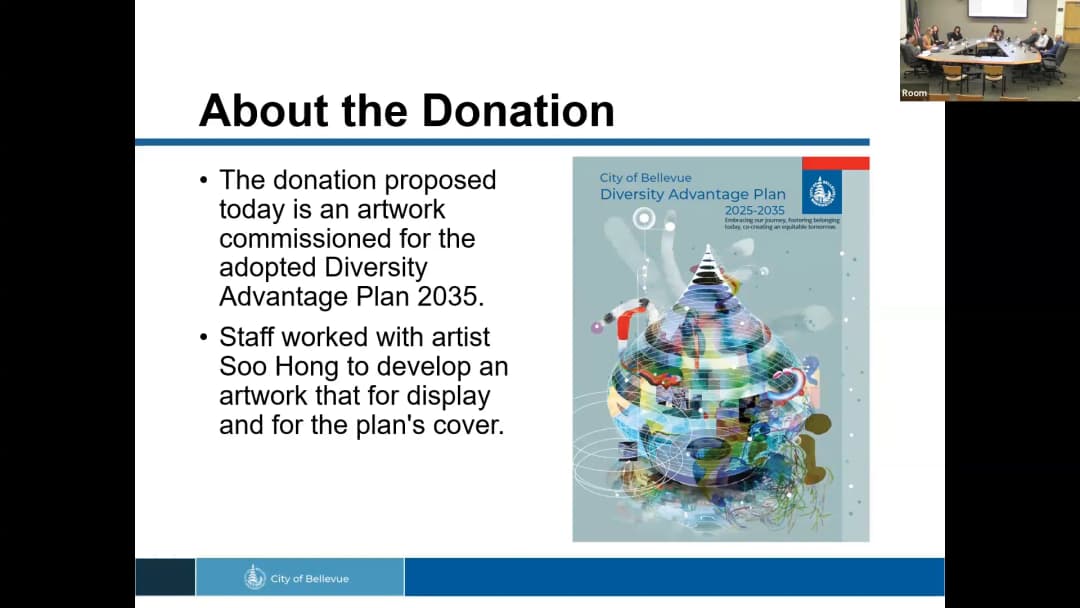
The Bellevue Arts Commission met on September 4, 2026, at 10:30 AM to discuss public comments, a proposed artwork donation, a performing arts center update, and cultural facility grant recommendations. The meeting included routine approvals, public testimony, and two action items approved unanimously. Consent Calendar - Agenda approved by unanimous voice vote. - Minutes from previous meeting approved by unanimous voice vote. Public Comments & Testimony - Mehika Agarwal (ninth-grade student, speaking on behalf of Lens of Youth) described her nonprofit's work advocating for people with intellectual and developmental disabilities (IDD) through art, storytelling, and community engagement. She noted that Lens of Youth has reached seven cities, more than 50 community events, collected over 4,000 pledges for inclusion, and launched five free programs. In Bellevue, their "Misunderstood Moments" exhibition is at Crossroads Bellevue through September 16. She expressed interest in future arts commission grant opportunities and partnership. - Alex Zimmerman (self-identified disabled low-income senior citizen) criticized the city budget in relation to the city's GDP, claiming a disparity between Bellevue's $1.2 billion budget and $150 billion GDP. He expressed frustration with the lack of affordable housing and argued that the city needs to prioritize funding. He also commented on immigration policy, referencing a recent Trump decision on Indian visas and expressing concern about the large Indian population in Bellevue (65,000 out of 150,000 people), urging that more opportunities be given to U.S. citizens. Discussion Items Proposed Donation of "Raindrops" by Su Hong - Staff presented a proposal to accept a donated artwork titled "Raindrops" by local artist Su Hong, currently displayed on the second floor of City Hall. The artwork was originally commissioned by the Diversity Advantage Team as part of the city's Diversity Advantage Plan 2035. A call for artists received 32 applicants, and a panel (including community members from the Bellevue Diversity Advisory Network and Art Commissioner Erica Enamoto) selected Su Hong. The artwork is a framed print with low maintenance costs; the city manager's office has expressed interest in displaying it. The piece would be added to the portable art collection and can be moved to public spaces for special events. Commissioners discussed the accessibility of the piece in a private office, noting that the city manager's office hosts frequent community meetings and the artwork would rotate like other pieces. Support was voiced for the community-oriented selection process and the artwork's relevance to Bellevue's identity. Performing Art Center Update - Staff provided an informational update on a planned validation study for a regional performing arts center (1,800–2,400 seats). The study will assess current market demand, review recent studies by partner organizations (Performing Arts Center East Side, now Avenue 106, and the Bellevue Convention Center Authority), and provide a decision framework. The request for proposals (RFP) received eight submissions; a consultant is expected to be selected within the week. The study will not recreate prior work but will validate findings and identify gaps. The arts commission will receive updates and engage through its Cultural Planning Committee (Charles, Sandra, Joydeep) and potentially the Community Partners Committee. The final report is anticipated in early 2027, ahead of the cultural planning process. Questions addressed the history of the Maidenbauer Center (built as part of the convention center) and how this effort differs from previous ones (convention center expansion creating revenue opportunities and potential partnership with the city). Cultural Facility Grants (2027–2028 Cycle) - Staff presented recommendations from the allocations committee for the new capital facility grant program (approved in 2024). The cycle covers four years (looking forward two and back two). Applications opened April 14 to June 18, 2026. Total eligible requests: $1.2 million from three eligible applicants (one applicant was ineligible). The recommended total allocation is approximately $1 million. The three recommended projects: 1. Asian American Performing Arts Theater (Lake Hills) – Expansion for a dance studio; continuation of a previously funded project. Costs have risen due to permitting delays. Recommended funding at about half of their request. (Panel noted room for improvement in application preparation.) 2. Bellevue College Foundation (KBCS radio station) – Renovation of campus space into a specialized radio studio with community engagement and performance area, adjacent to Carlson Theater and gallery. Recommended full funding. 3. Theater 33 – Equipment for ADA compliance (lift), lighting, and curtains. Previously funded for build-out and HVAC. Recommended full funding. - The selection panel included commissioners (including those present) and interviews were conducted with each applicant. Commissioners praised the interview process and suggested better outreach for future cycles. Commission Quick Business & Project Updates - Next meeting tentatively set for October 7, 2026 (quorum available). - Updates on other grant programs (operational support and project grants due October 10), upcoming events, a planned outdoor event feasibility study, and maintenance of public art collection (including signal box wraps). A walking art map concept was discussed; staff noted ongoing work on a digital tool inspired by Issaquah's Bloomberg Philanthropic app. Key Outcomes - Motion to approve the donation of "Raindrops" by Su Hong — Unanimous voice vote (moved by Charles, seconded, approved). - Motion to approve the allocations committee's 2027-2028 funding recommendations for cultural facility grants — Unanimous voice vote (moved by Erica, seconded, approved). The recommendations will go to City Council on November 17, 2026, for final approval. - Next meeting date: October 7, 2026 (confirmed).

ARTS AND CULTURE 61% · PROCEDURAL 11% · PUBLIC ENGAGEMENT 6% · GRANT FUNDING 4%
17
AUG 19, 2026 · BELLEVUE, WASHINGTON · CITY COUNCIL
Bellevue Transportation Commission Meeting – August 19, 2026

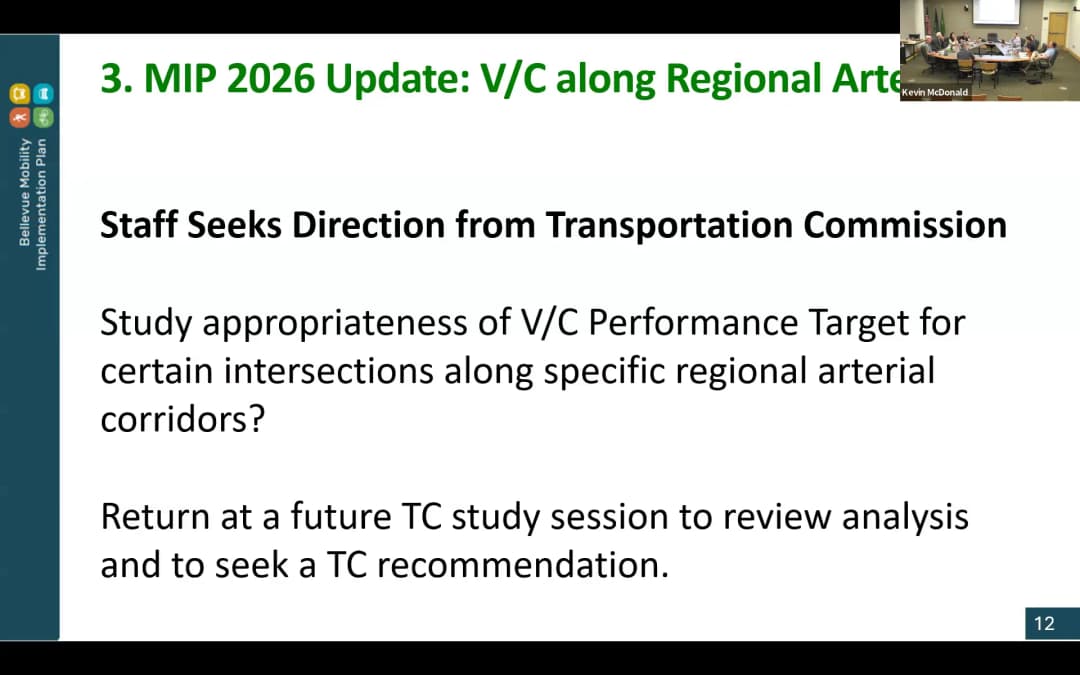
The Bellevue Transportation Commission met on August 19, 2026, starting at approximately 10:15 AM and adjourning at 8:45 PM. The meeting included election of officers, public comments, staff reports, and two study sessions: one on the Eastgate and Factoria Neighborhood Area Plans and one on the 2026 Mobility Implementation Plan (MIP) update. Key discussions centered on speed limit changes, performance metrics for pedestrian and bicycle level of traffic stress, and volume-to-capacity (V/C) ratio targets for regional corridors and freeway access intersections. The commission directed staff to study potential changes to the speed limit factor and to analyze capacity improvements for regional arterials without lowering existing standards. Consent Calendar - Approved the agenda by unanimous consent. - Approved the minutes of the previous meeting by motion and second. Public Comments & Testimony - Diana Leo (Vice President of Government Affairs, Bellevue Chamber) expressed support for updating bicycle and pedestrian level of traffic stress measures but strong opposition to relaxing volume-to-capacity (V/C) ratio performance targets. She urged the commission to require a thorough evaluation of engineering alternatives, multimodal data, and public engagement before any target changes. - Maria Frost (Vice President of Government Affairs, Kemper Development) supported eliminating the 20% speed limit multiplier for pedestrian and bicycle stress calculations but opposed weakening V/C targets on regional corridors, arguing that lowering the bar does not relieve congestion and that the city must explore innovative operational improvements. - David Bonnethan (Maidenbauer neighborhood resident) described severe speeding and illegal exhaust noise on Lake Washington Boulevard, calling for speed enforcement cameras, sound enforcement cameras, a 20 mph speed limit from Old Bellevue to 99th Avenue, and installation of a four-way stop at 100th Avenue and First Street. - Scott Lampy (Maidenbauer Bay Neighbors Association; former Transportation Commission member) supported the proposed speed limit reductions in the MIP update and recommended extending the 20 mph zone one block west to 99th Avenue and Lake Washington Boulevard to improve safety at a heavily used crosswalk and reduce racing on the upper curve. - Vic Bishop (50-year resident, former Transportation Commission member and chair, retired transportation engineer) argued against lowering V/C standards, stating that the city has repeatedly changed standards to mask failure instead of increasing capacity. He urged the commission to develop a priority list of capacity improvements. - Alex Simmerman made a critical and personal attack on the commission and city council, alleging criminal activity and incompetence. He claimed the city is not ready for traffic and that development only worsens conditions. - Joe (online commenter) criticized the previous speaker's comments as racist, sexist, and anti-American, and encouraged Bellevue to promote multimodal transportation like Redmond's e-scooters and e-bikes. - Heidi Dean (Newport Hills resident) commented on the Factoria Neighborhood Area Plan, asserting that the engagement process and survey were biased toward bike/ped/transit and did not adequately address traffic congestion, which is a major concern for residents. She echoed previous speakers' concerns about V/C target changes and urged the commission to demand real traffic mitigation solutions. Discussion Items - Election of Officers: Commissioner McGill was nominated for chair and, with no other nominations, became chair automatically. Commissioner Welcher un-nominated himself, and Commissioner Williams became vice chair for the next year. - Staff Reports: Kevin McDonald reported that a bike network improvement project on Lake Washington Boulevard, 100th Avenue NE, and NE First Street is imminent, with construction expected to start in early July. He also noted that gift boxes from the City Council were provided to commissioners in appreciation of their service. - Study Session – Eastgate and Factoria Neighborhood Area Plans: Senior Planner Zach Lucan presented draft transportation policies for Eastgate and Factoria, based on extensive community engagement with over 1,200 people at 31 events. Policies focus on safe and convenient active transportation, transit connections, and streetscape improvements. Commissioners raised questions about survey design, representation of driver concerns, and the need for more quantifiable metrics of community input. Commissioner Ting suggested including all modes in surveys and using affinity mapping for feedback. Commissioner Rabin noted safety concerns near shelters. The commission did not take formal action; feedback will be shared with the Planning Commission. - Study Session – 2026 Mobility Implementation Plan (MIP) Update: Staff presented four scope topics: 1. Speed Limit Changes: Council has directed lower speed limits on many arterials. Staff will update MIP maps and tables to reflect the new speed limits. The commission concurred without objection. 2. Speed Limit Factor for Ped/Bike Level of Traffic Stress: Staff proposed changing from a factor of 1.2 times the speed limit to simply using the adopted speed limit, citing data showing the factor overestimates actual speeds in many areas. The commission asked staff to also consider a segmented approach (e.g., 1.1 factor or different factors for different areas) and to return with an analysis of the impact. 3. V/C Performance Targets for Regional Arterials (PMA3): Staff sought direction to study whether performance targets should be adjusted for corridors like 148th Ave NE, Bellevue Way, and Coal Creek Parkway that carry significant regional traffic. Most commissioners opposed lowering targets, preferring to keep standards and explore innovative solutions. Staff was directed to analyze capacity improvements and return with options, but not to change the metrics at this time. 4. V/C Performance Targets at Freeway Access Intersections: Similar to the third topic, staff asked for direction to study whether performance targets should be adjusted at intersections providing freeway access. The commission gave the same direction: study capacity improvements and alternatives without lowering standards. Key Outcomes - Commissioner McGill was elected chair and Commissioner Williams was elected vice chair. - The commission concurred with updating the MIP to reflect adopted speed limit changes (no vote needed). - Staff was directed to return with an analysis on changing the speed limit factor for ped/bike stress calculations, including consideration of a segmented approach (e.g., 1.1 factor or area-specific factors). - Staff was directed to study capacity improvements and alternatives for regional arterials and freeway access intersections that fail V/C performance targets, without lowering the existing standards. Options to be presented at future meetings. - The next MIP update discussions are scheduled for July, September, and October 2026 meetings.

TRANSPORTATION SAFETY 47% · PROCEDURAL 13% · COMMUNITY ENGAGEMENT 13% · NEIGHBORHOOD PLANNING 9%
18
AUG 19, 2026 · BELLEVUE, WASHINGTON · CITY COUNCIL
Bellevue Transportation Commission Meeting - August 19, 2026

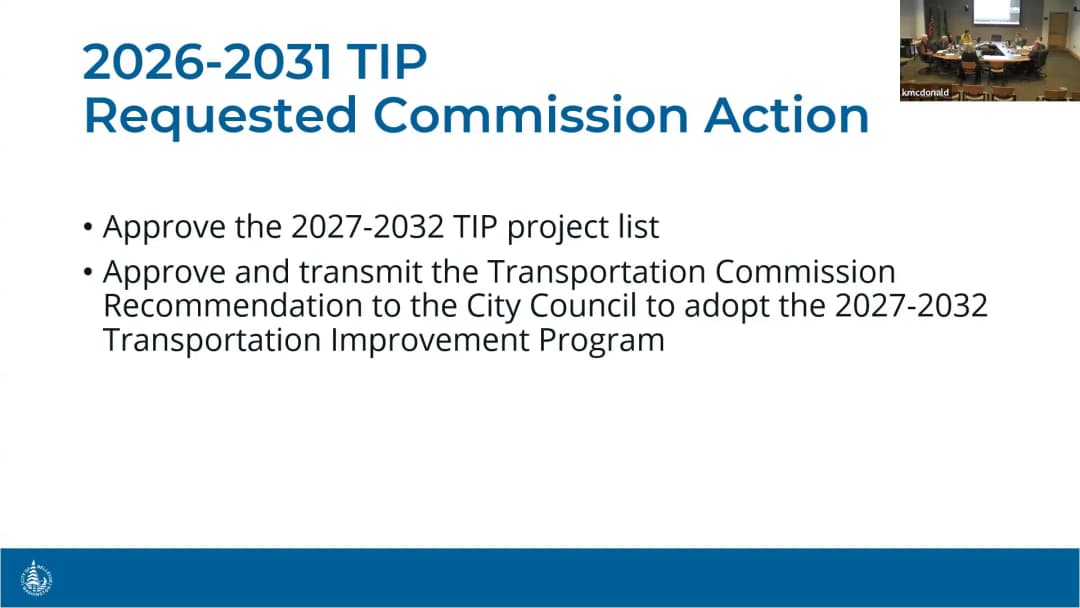
The Bellevue Transportation Commission met on August 19, 2026, to address routine approvals, hear public comments, conduct a public hearing on the Transportation Improvement Program (TIP) 2027-2032 annual update, and approve amendments to the Transportation Comprehensive Plan. The meeting was chaired by Commissioner Ting, with Commissioners Williams and others present. Deputy Mayor Dave Hamilton also provided a city council update. Consent Calendar - Approved the meeting agenda without objection. - Approved the minutes from the March 12, 2026 meeting. Public Comments & Testimony - Oral Communications: Alex Zimmerman, self-identified as president of Stand-Up America, made critical comments about city officials, including Mayor Robinson and Councilmember Hamilton, alleging violations of free speech and calling them derogatory names. He referenced a 12-year-old change to public comment rules and claimed he had been prosecuted seven times with all cases dismissed. - Public Hearing on TIP (2027-2032): - Maria Frost (on behalf of Kemper Development) thanked the commission for recommending removal of TIP projects 49 and 50 (right-turn lanes at Bellevue Way and NE 4th/8th). She also requested that analysis and design for TIP 106 (intersection gaps) be prioritized and expedited, praising the specificity of naming projects. - Marlene Meyer (Bellevue Bridal Trails area) asked about additional bus connections to link outlying areas with the light rail system, noting that current bus service is slow and that she drives to the station. She requested a study of bus links to improve multimodal connectivity. Discussion Items - Deputy Mayor Hamilton Report: Announced Bellevue received a Leadership Award from the Bellevue 2030 District Vision Awards and a People's Choice Award for Fire Station 10. He reported that the city adopted a federal legislative agenda including transportation priorities (safer signals, Safe Streets for All, RapidRide K Line, East Trail). He also noted that on April 28th, the council directed staff to prepare a paid on-street parking ordinance, and on April 21st, a budget workshop covered transportation investments. - Staff Reports (Kevin): - Nominations for chair and vice chair are open; elections will occur at the June 12th meeting (date mentioned in transcript, but meeting is August 19; note potential discrepancy). - The first phase of Urban Core Bike Network projects will begin construction this summer, including segments on Lake Washington Boulevard, 100th Avenue, and 116th Avenue NE. - Transportation Improvement Program (TIP) 2027-2032 Study Session: - Christy (staff) presented the annual update, explaining the TIP's role in securing state/federal grants and its four sections. Key changes: added two new grant candidate projects (TIP35, TIP31), updated the Grand Connection (I-405 non-motorized crossing) description and budget (from $100,000 placeholder to $200-250 million unsecured, $46.5 million secured). The total list includes 113 projects and 19 sub-projects. - Staff clarified that bus route decisions are outside city purview but noted that the TIP includes routes like the K-line and connections to Crossroads/Eastgate. - Discussion: Commissioner Williams confirmed that all five phases of West Lake Sammamish Parkway are in the plan. A commissioner asked about public prioritization feedback; staff directed residents to council budget hearings. Another commissioner inquired about King County transit feedback; staff suggested Metro and Sound Transit are the appropriate agencies. - 2026 Transportation Comprehensive Plan Amendments: - Kevin (staff) explained that amendments are needed to reconcile the transportation element with the adopted Transportation Facilities Plan (changing from 12-year to 20-year reference) and the Mobility Implementation Plan (replacing the repealed Pedestrian and Bicycle Transportation Plan). No significant adverse impacts were found under SEPA. - Commission Calendar: - Next meeting (June 11th) agenda includes election of chair/vice chair, a briefing on Factoria and Eastgate neighborhood area plans, and potential refinements to the Mobility Implementation Plan due to speed limit changes. Key Outcomes - Votes: - Public hearing opened and closed unanimously. - Motion to approve the TIP project list (2027-2032) as recommended by staff: passed unanimously. - Motion to approve the transmittal memo to city council for the TIP: passed unanimously. - Motion to approve the Transportation Comprehensive Plan amendments as recommended by staff: passed unanimously. - Motion to approve the transmittal memo to the Planning Commission for the comprehensive plan amendments: passed unanimously. - Next Steps: - Staff will finalize the TIP packet (including Grand Connection changes) by June 9th for council adoption by June 30th. - The Planning Commission will consider the comprehensive plan amendments on June 10th. - The Transportation Commission will reconvene on June 11th to elect chair/vice chair and receive briefings. Note: The transcript references future dates (June 11th, June 12th) that are inconsistent with the meeting date of August 19, 2026, as provided in the instruction. This summary uses the given date for the title and introductory paragraph, but retains the dates as stated in the transcript for accuracy.

TRANSPORTATION FACILITIES PLAN 37% · TRANSPORTATION SAFETY 21% · PROCEDURAL 19% · PUBLIC TRANSPORTATION 12%
19
AUG 4, 2026 · BELLEVUE, WASHINGTON · CITY COUNCIL
Bellevue City Council Regular Meeting Summary - August 4, 2026

The Bellevue City Council met on August 4, 2026, at 6:00 PM in a hybrid format. The meeting included three proclamations, oral communications from the public, a city manager’s report on wildfire response, and three study session items: a development agreement for the BelRed Arts Transit Oriented Development project, updates to utility connection charges, and the launch of a shared micromobility program. The council approved the consent calendar and directed staff on the first two study session items. Consent Calendar - Approved the minutes of July 21, 2026. - Authorized an agreement with Hughes Fire Equipment, Inc. for four replacement Basic Life Support ambulances at a cost not to exceed $1,600,116. - Authorized an agreement with Braun Northwest, Inc. for one Bomb Squad Support Vehicle at a cost not to exceed $530,354. Public Comments & Testimony - Maria Lau Huey (former chair Bellevue Arts Commission, co-founder BelRed Art District Community Alliance, Habitat for Humanity) spoke in support of item 10A, stating the development agreement modifications are directly tied to delivering public benefits including affordable housing, artist space, and public room, and that reduced parking is appropriate near light rail. - Mary Jane Jagazinski (Senior VP, BRIDGE Housing) spoke in support of item 10A, thanking staff and council for consideration. - Noah Rosen (Director of Development, BRIDGE Housing) spoke in support of item 10A, highlighting the project includes 170 affordable homes, preference for artists, 24 units for individuals with developmental disabilities, and a 4,000 sq ft arts space. - Alex Zimmerman (Stand Up America) began speaking but was repeatedly warned for not addressing city business; his comments were cut short and he was escorted out. - Nagishakaranaboli (Lake Hills resident) spoke against allowing hens and roosters in residential areas, citing noise, pests, disease, and property devaluation. - Amina Condell continued the previous topic, proposing a permit and inspection system for fowl, including rooster bans and minimum setback requirements. - Julie Cobb (164th Place NE) raised concerns about tree cutting permits being approved too quickly via AI, and about fire safety on dead-end streets with new high-density housing. Discussion Items 10A: Development Agreement for BelRed Arts Transit Oriented Development with BRIDGE Housing - Staff presented the proposed public-private partnership development agreement, seeking council direction to enter negotiations and prepare for a public hearing. - The project at 130th Ave NE near the light rail station would deliver 170 affordable homes (all 100% affordable), including 24 units for individuals with developmental disabilities, artist preference, and a 4,000 sq ft arts space. - Modifications requested include increased height and floor area ratio, design flexibility for ground-floor activation, reduced commercial parking, and added arts/placemaking uses. - Councilmembers expressed strong support, noting the alignment with city goals for affordable housing, family-sized units, transit-oriented development, and support for artists. Questions focused on enforcement mechanisms if benefits are not delivered, and ways to expedite permitting. - A motion to direct staff to enter into development agreement negotiations with BRIDGE Housing and prepare the DA for a public hearing passed unanimously. 10B: Utility Connection Charge Improvements - Staff and the Environmental Services Commission (Chair Ken Wan) recommended three changes: 1) eliminate direct facility connection charges (DFCC) and recover costs through capital recovery charges (CRC); 2) update water/sewer CRC calculation from single-family equivalent to meter-capacity-based; 3) collect CRC at permit issuance instead of over 10 years via utility bills. - The changes aim to improve affordability, transparency, and equity. The DFCC elimination spreads large upfront costs across all new connections (e.g., a single-family home would see $200 increase instead of $130,000). The meter-based method reduces charges for large multifamily developments (72% lower in example) and is expected to encourage housing development. - Councilmembers praised the work, asked about outreach to small businesses and existing accounts, and requested a combined fee impact table. - A motion to direct staff to prepare an ordinance implementing the Commission’s recommendations as part of the upcoming biennial budget process passed unanimously. 10C: Update on the Shared Micromobility Program - Staff presented the program launch with Lime on August 10, 2026, deploying 500 devices citywide (350 e-scooters, 50 e-bikes, 100 seated scooters/gliders). - Parking will be managed through 45 corrals, geofencing (no-ride, low-speed, no-parking, mandatory parking zones), and Lime Vision AI technology on all devices to detect sidewalk riding. - Performance will be monitored via a third-party platform (Ride Report) with key performance indicators including parking compliance (85% target within 2-hour response), safety reporting, and trip data. - Council discussion focused on safety, helmet use (encouraged, not required), enforcement of KPIs, preferred routes, and accountability for improper parking. Staff committed to a six-month report back. - No formal vote was taken; the item was for information and council direction. Key Outcomes - 10A: Unanimous motion (with second) directing staff to enter into development agreement negotiations with BRIDGE Housing and prepare the development agreement for a public hearing at a future meeting. - 10B: Unanimous motion to direct staff to prepare an ordinance implementing the Environmental Services Commission’s recommendations to amend Bellevue City Code chapters 24.02, 24.04, and 24.06, with an effective date of January 2027. - 10C: Council provided direction; staff will report back after six months on program performance. - The meeting was adjourned at approximately 7:30 PM; the council will recess for August.

WATER AND WASTEWATER MANAGEMENT 19% · AFFORDABLE HOUSING 12% · PUBLIC ENGAGEMENT 10% · ACTIVE TRANSPORTATION 10%
20
JUL 28, 2026 · BELLEVUE, WASHINGTON · CITY COUNCIL
Bellevue City Council Regular Meeting - July 28, 2026

The Bellevue City Council met on July 28, 2026, starting at 6:00 PM in Council Chambers. The meeting began with a moment of silence for the tragic shooting at the Bite of Seattle event over the weekend, where three people died and at least four were injured, including a toddler. The Council approved a consent calendar, held a public hearing on a detention center moratorium, received updates on Development Services and the Great Neighborhoods program, and adopted five omnibus land use code amendments. Consent Calendar - Approved minutes of July 14, 2026. - RES 10657: Authorized purchase of one Vactor combination catch basin cleaner truck for up to $737,002.79 plus taxes. - RES 10658: Authorized purchase of one Vactor Hydro Excavator truck for up to $731,776.45 plus taxes. - RES 10659: Adopted "Isan Park" as the name for the park at 11101 Main Street. Public Comments & Testimony - Steve Kassner (Lake Hills Neighborhood Association president) thanked the Council for supporting the neighborhood and urged the city to encourage younger residents (20s–40s) to join neighborhood associations. - Amina Condell requested a permit and licensing process for roosters in residential neighborhoods without HOAs, citing a neighbor who uses a rooster to harass others and creates rodent and fly problems. - Nava Carlisle (Bellevue Chamber of Commerce government affairs intern) acknowledged Development Services for processing over 8,200 permit applications and issuing nearly 7,800 permits in the first half of 2026. She praised first review performance improving from 72% to 82% and the use of AI tools to streamline processes. - Paul Rood complained that the city does not enforce noise ordinances for yard equipment, especially leaf blowers, which he measured at 81 decibels at the property line (400 times the limit). He requested a meeting to update noise regulations. - Alex Zimmerman (president of Send Up America) accused the city of being a "Nazi Gestapo" and raised several allegations, including that Mayor Robinson gave him a trespass order and that Mayor Moe uses a not-legal name on official documents. - Julie Cott criticized the missing middle housing development on her dead-end street, which will increase from 10 to 24 houses, and raised safety concerns about new bike lanes on Bel-Red Road that have removed turning lanes and created near head-on collisions. She requested staff follow-up. - Heidi Dean (online) congratulated Development Services but urged that the Great Neighborhoods surveys for Lake Hills and West Lake Sammamish should be multimodal, including car traffic concerns, unlike the Factoria and Eastgate surveys. Public Hearing: Detention Center Moratorium - Guillermo Rivera (community organizer with D Side for All) thanked the Council for the one-year moratorium (Ordinance 6926) on detention centers but urged a permanent ban, citing ongoing ICE activity and family detentions in Bellevue. He called for a regional coordination center for immigrant communities. - Heather Kelly urged the Council to make the moratorium permanent and close any loopholes that could allow privately or federally operated detention centers. She argued Bellevue must not be complicit in cruel detention conditions. Discussion Items Development Services Activity and Continuous Improvement Update - Greg Schrader (Assistant Director) reported that permit activity remains high, with applications and issued permits near 2025 peaks. Permit timeline performance improved from 72% (2025) to 82% (2026) for first reviews meeting state shot clocks, surpassing the 80% target. - Jake Hesselgesser (Acting Director) presented the continuous improvement work plan, highlighting a consolidated review pilot that cut revision cycles for single-family permits, a partnership with Matrix Consulting Group for customer service training, and a public-facing dashboard to launch in Q3 2026. - Steph Collier (Program Manager) introduced the new Small Business Concierge Program, which proactively helps businesses with fewer than 25 employees and under $5 million annual revenue through pre-lease assistance and permitting. Early data shows six months of success, with examples like Taste Buds Kitchen (opening soon) and a bakery relocating from Budapest. - Jake Hesselgesser also reported on the GovStream AI project. The pilot for single-family building permits increased first-time application completeness from 22% to 67% (threefold improvement). The goal is to reduce permitting timelines from months to weeks or days. - Council praised the progress (moving from 72% to 82% on first review targets) and asked about metrics, equity in access, workforce training, AI scaling, and the impact of the Wilburton code changes (700 units now in building permit phase). Councilmember Robinson requested information on affordable units in Wilburton. Councilmember Smodaver asked about diversity in small business design, and Councilmember Newmanhouse questioned how feedback loops work, referencing the Taste Buds Kitchen case where a parking study issue was resolved. Great Neighborhoods Program – Initiation of Lake Hills and West Lake Sammamish Neighborhood Area Plans - Tara Johnson (Planning Director) and Zachary Lukin (Senior Planner) presented the next phase of the Great Neighborhoods program, requesting Council direction to initiate comprehensive plan amendments for Lake Hills and West Lake Sammamish. The program aims to develop community-driven neighborhood area plans over four phases (Discover, Define, Refine, Adopt) focusing on neighborhood identity, mixed-use centers, community gathering spaces, mobility, environment, urban design, and land use. - Engagement strategies include partnerships with schools (Sammamish High School, Big Picture School), community organizations (Jubilee Reach, Hopelink, Youth Eastside Services), cultural outreach assistants, and use of a racial equity toolkit. Early engagement has already begun (e.g., staff attended the Lake Hills picnic). - Future iterations: Staff recommended updating only one neighborhood (Bridal Trails) in 2028–2029 due to capacity constraints from implementing state TOD legislation (House Bill 1491). Councilmember Newnhouse and others asked about maintaining a two-per-year cadence and ensuring equitable reach, especially to underserved communities like Spanish-speaking residents in Lake Hills. - Council expressed support and asked about metrics for success, public safety elements in surveys, and how the program can help neighborhood associations recruit new leaders. Councilmember Robinson requested a separate forum for neighborhoods to discuss missing middle housing (HB 1110) outside the Great Neighborhoods timeline. Omnibus Land Use Code Amendments (Ordinances 6930–6934) - Nick Whipple (Code and Policy Director) presented the 2026 omnibus package, which includes clean-ups, state law compliance (multiple bills), and small policy changes. Key policy changes include: moving the SR1 (suburban residential) district from large-lot to suburban residential tree credit grouping, creating a fee-in-lieu option for residential projects in East Main (previously required on-site affordable housing performance), adding a new chapter for binding site plans, and other technical corrections. - Council discussed the tree code change, with Councilmember Newmanhouse asking for clarification. Nick Whipple explained that a site visit with concerned residents in Kelsey Creek area helped address misconceptions, noting critical areas code still protects stream buffers. Councilmember Bargaba and Robinson questioned the East Main fee-in-lieu change, noting the city had granted additional height in exchange for on-site performance. Staff said the on-site option remains and other incentives may be explored during the upcoming TOD bill implementation. - All five ordinances were adopted unanimously. Key Outcomes - Consent calendar approved unanimously. - Public hearing closed; no additional action taken on the moratorium at this time, but the hearing satisfied the 60-day requirement. - Motion passed to direct staff to initiate comprehensive plan amendments for Lake Hills and West Lake Sammamish neighborhood area plans in 2026–2027, and to confirm Bridal Trails for 2028–2029. (Vote: unanimous) - Ordinance 6930 (clean-up of Land Use Code) – adopted unanimously. - Ordinance 6931 (development regulations) – adopted unanimously. - Ordinance 6932 (environmental regulations) – adopted unanimously. - Ordinance 6933 (land use review procedures) – adopted unanimously. - Ordinance 6934 (development, amending Bellevue City Code chapters) – adopted unanimously. - Council encouraged staff to explore additional incentive tools for affordable housing in East Main and to provide a response to Councilmember Robinson regarding a forum for neighborhoods to discuss missing middle housing outside of the Great Neighborhoods program.

COMMUNITY ENGAGEMENT 24% · LAND USE AND ZONING 17% · ECONOMIC DEVELOPMENT 12% · TECHNOLOGY AND INNOVATION 9%
OPENPUBLICA · PUBLIC MEETING INDEXUPDATED DAILY · openpublica.com