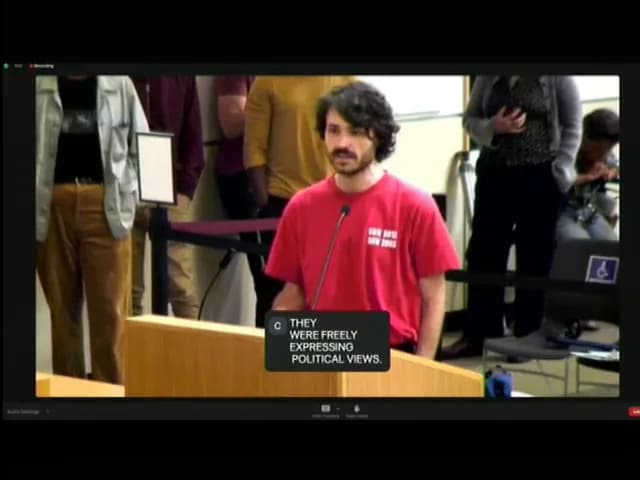
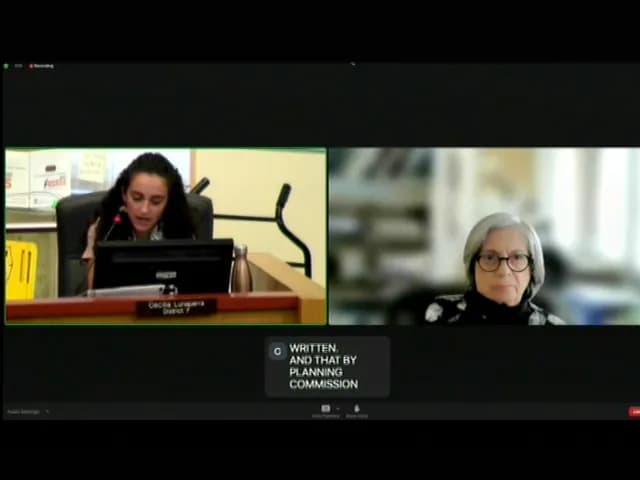
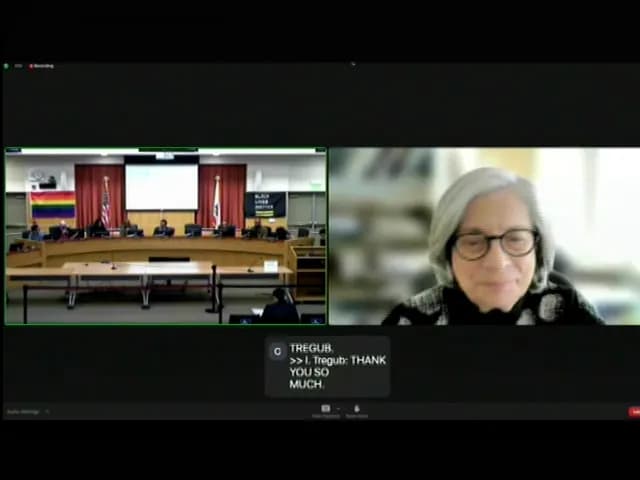
The Berkeley City Council met on Tuesday, July 23, 2024, at 6:00 PM in a hybrid format. The meeting included routine consent items, a public hearing on CDBG fund reallocation, and a contentious resolution to designate the Dwight Triangle as public open space. The council adjourned after 11:30 PM, following a failed vote on the Dwight Triangle item. Consent Calendar - Item 1-16 were approved as a block, with no items pulled to action. Notable items included: - Ordinance setting FY2025 library tax rates ($0.2800/sq ft residential, $0.4233/sq ft commercial). - Ordinance allowing 16- and 17-year-olds to vote in school board elections (second reading). - Contract with Downtown Berkeley YMCA for employee fitness memberships ($161,280). - Reallocation of $549,785 in Measure P funds from Insight Housing’s Russel Street project to their Dwight Way Center. - Appointment of Priscilla Villanueva to the Board of Library Trustees. - Game day parking restriction changes for UC Berkeley football games (Item 15) – supported by council and public. - 2023 Annual Military Equipment Report (Item 10) – Councilmember Lunaparra read the full inventory of BPD military equipment, including 96 M4 patrol rifles, a Barrett .50-caliber rifle, and 300 canisters of tear gas. Several public speakers urged moving this item to action for debate, but the item remained on consent and passed. - Lease for Office of the Director of Police Accountability at 1900 Addison Street (Item 16) – approved despite concerns about leasing private space. Public Comments & Testimony - Non-Agenda Matters: Multiple speakers addressed the Israeli-Palestinian conflict, urging the council to denounce settler violence and call for a ceasefire. One speaker described a Berkeley City College student assaulted by settlers in the West Bank. Others raised issues with Apex private security on Southside (alleged assaults and harassment), fire alarm malfunctions at the Granada Apartments, and the need for homeless services. - Consent Calendar: Public comment focused on Item 10 (military equipment), with several speakers calling for its removal from consent. Speakers questioned the need for military-grade weapons, noted $2,000 spent on tear gas despite a city ban, and highlighted the killing of Sonia Massey by police. Other comments supported Item 15 (parking changes) and Item 18 (Dwight Triangle). A speaker for the Homeless Services Panel of Experts criticized lack of staff materials for their review of Item 6. - Item 17 – CDBG Reallocation: Speakers expressed concern about taking funds from the Senior Disabled Home Rehabilitation Loan Program without full transparency. Staff later clarified the program has a backlog and sufficient remaining funds. - Item 18 – Dwight Triangle: Over a dozen speakers spoke in strong support, describing the triangle as a vital community space for mutual aid, gardening, and art since People’s Park closure. One speaker (Alex Knox, Telegraph BID) opposed, citing lack of planning and stakeholder engagement. Others requested a trash can, porta-potty, and lighting. Discussion Items - Item 17 – CDBG Reallocation (Public Hearing): The council held a public hearing on substantial amendments to reallocate $478,500 of CDBG funds from the Senior Disabled Home Rehab Loan Program to the Public Facility Improvement Program, with $450,000 for Insight Housing’s Dwight Way shelter and $52,775 for Larkin Street Youth Services. The mayor read a staff email explaining the loan program was underutilized due to contractor shortages and pandemic safety concerns. The item was approved unanimously. - Item 18 – Dwight Triangle as Public Open Space: Councilmember Lunaparra introduced the resolution, emphasizing the need for green space in District 7 after People’s Park closure. Public Works Director Terrence Davis noted 16 traffic incidents in 10 years (mostly vehicle collisions) and proposed interim safety measures like K-rail. Councilmember Hahn expressed support but wanted more stakeholder engagement and clarity on maintenance. Councilmember Tregub cited concerns about staff resources and competing projects. An amendment was added to establish additional stakeholder engagement with local businesses. After debate, the council voted: Kesarwani (No), Taplin (No), Bartlett (yes? not clear in transcript), Tregub (Abstain), Hahn (No), Wengraf (No), Lunaparra (Yes), Humbert (unclear but likely Abstain or No), Mayor Arreguin (Abstain). The motion failed. Key Outcomes - Consent Calendar (Items 1-16) approved unanimously (Councilmember Taplin absent momentarily but later joined). - Item 17 – CDBG Reallocation approved unanimously. - Item 18 – Dwight Triangle Resolution failed (votes: 1 Yes, 5 No? 2 Abstentions? Exact tally: Lunaparra Yes; Kesarwani, Taplin, Hahn, Wengraf No; Tregub and Mayor Abstain; Humbert not recorded in transcript but likely No or Abstain). The meeting adjourned immediately after the vote at 11:30 PM.
Public Meetings - Berkeley, California
Public Meetings - Berkeley, CaliforniaThe Berkeley City Council held a special meeting on July 23, 2024, at 5:30 PM in the School District Board Room, 1231 Addison Street, Berkeley, CA. The sole agenda item was a resolution to approve amended home loan documents as part of the separation agreement for former City Manager Dee Williams-Ridley. Public Comments & Testimony - Elon Auerbach expressed opposition, questioning the approximately $200,000 payoff and calling it an effort to keep events between May 7 and July 10, 2024, confidential. He alleged the former city manager misled the community and unionized employees. - A second speaker (unnamed) characterized the payment as extortion, criticized the city manager's performance, and questioned the ongoing payments. - A third speaker (unnamed) criticized the city manager's tenure, citing surveillance and drones, and pleaded for limits on the next city manager's power. - A fourth speaker (unnamed) recalled turnover in 2018 and argued that the strong city manager form of government was a problem, describing the payoff as $400,000 of taxpayers' money. - Former Councilmember (on Zoom) called the payment “ridiculous,” alleged corruption and collusion, and noted that the city manager had given herself an $85,000 raise the previous year. - Matty Tieblum (on Zoom) questioned why the city would write off $200,000 owed to the city, demanded transparency, and asked for precedent or legal justification. - Kai Freeman (on Zoom) urged the council to be transparent and accountable, stating that the public is watching and questioning the use of funds given the city's fiscal constraints. Discussion Items - Motion to adopt the resolution was made by Mayor Arreguin and seconded. No discussion from council members occurred before the vote. Key Outcomes - Resolution adopted on a vote of 8 yes, 1 abstention (Councilmember Hahn abstained). No votes were cast in opposition. The resolution approves amended home loan documents for former City Manager Dee Williams-Ridley as part of her separation agreement. - The meeting was adjourned after the vote, followed by a 15-minute recess before the 6:00 PM regular meeting.
This special meeting of the Berkeley City Council, held on July 23, 2024, at 3:30 PM in the School District Board Room, focused solely on proposed zoning ordinance and general plan amendments to encourage “middle housing” (duplexes, triplexes, fourplexes, etc.) in low-density residential districts. The council did not adopt a final ordinance but instead provided staff with direction to prepare a revised ordinance, after a procedural error was discovered. The meeting featured extensive public testimony, with over 100 speakers in person and via Zoom, and more than 600 written communications. Key themes included support for increased housing density, concerns about fire safety in the hillside overlay, affordability, community process, and equity. Public Comments & Testimony - Support for Middle Housing: Many speakers urged adoption, citing the need to reverse exclusionary zoning, provide housing for young families, teachers, and low-income residents, and lower rents. Representative comments: “We need more housing… Berkeley created single-family zoning as an explicitly racist segregationist policy” (Jacob Dadman); “Berkeley’s Kamala Harris grew up in a duplex… we need to do better for the next generation” (Councilmember Kesarwani referencing public sentiment). - Fire Safety Concerns: Numerous residents, including members of the Disaster and Fire Safety Commission and the Berkeley Fire Safe Council, opposed applying the new zoning in the hillside overlay (very high fire hazard severity zones) until an evacuation study is completed. They cited the 1991 Tunnel Fire, loss of insurance, narrow streets, and Fire Chief Sprague’s memo warning that increased density “may nullify wildfire safety work.” Speakers urged that “the most fundamental goal of government is to promote safety” (Vice Mayor Wengraf) and that adding people and vehicles to the hills is “madness.” - Process and Equity Concerns: Several speakers criticized the lack of public notice, the 3:30 PM meeting time, and the complexity of the proposal. Some argued that upzoning alone would not create affordable housing and could lead to speculation and displacement, especially in historically redlined areas. “We need to make sure everyone understands what we’re talking about before we take action” (Councilmember Hahn). Discussion Items - Staff Presentation: Planning Director Jordan Klein and Land Use Planning Manager Ann Hirsch presented the background, nine proposed standards, and differences between the Planning Commission’s recommendation (which included the hillside overlay and no maximum density) and staff’s alternative (which excluded the hillside and included density caps). Staff acknowledged a procedural error in the general plan amendment process and requested direction rather than a vote. - Council Deliberation: Councilmembers debated the extent of the upzoning, fire risk, density caps, and community outreach. Mayor Arreguin and Councilmember Kesarwani introduced a motion to exempt the hillside overlay until the evacuation study, adopt maximum density standards (40 units/acre in R1, 50 in R1A/R2, 60 in R2A/MUR), regulate primary unit size, simplify height rules, and fund a historic context statement. Councilmember Lunaparra offered a substitute motion supporting the Planning Commission’s version (no density caps, include hillside overlay except R1H), but it failed 3-2-4. - Friendly Amendments: Accepted amendments included: holding community workshops citywide (Vice Mayor Wengraf), analyzing general plan consistency (Councilmember Hahn), reporting on mini-dorm/growth living accommodation concerns (Hahn), confirming demolition ordinance compliance (Councilmember Tregub), and noting land value recapture (Councilmember Tregub). Key Outcomes - Council Direction (Main Motion): The council voted 9-0 to direct staff to prepare a middle housing ordinance that: 1. Exempts the Hillside Overlay Zone and ESR district until the fire department’s evacuation study is received and reviewed. 2. Establishes maximum density standards: 40 units/acre in R1, 50 in R1A/R2, 60 in R2A/MUR (resulting in approximately 4-6 units on a typical 5,000 sq ft lot). 3. Limits primary unit size to no more than half the lot area or 2,500 sq ft, whichever is greater. 4. Sets a maximum height of 35 feet or 3 stories (with a 22-ft limit within 15 ft of the rear property line). 5. Requires front and rear setbacks to total 20 ft, with a minimum of 5 ft each. 6. Mandates neighbor notice similar to the ADU ordinance. 7. Allocates $200,000 for a citywide historic context statement. 8. Holds community workshops before the ordinance returns for first reading. - Staff Estimates: Staff projected up to 1,700 units over 8 years under the proposal, but noted only 25 middle housing projects (75 units) were permitted citywide in the past 6 years, indicating a likely modest increase. - Next Steps: The public hearing remains open. Staff will return with a revised ordinance following additional analysis, community workshops, and the completion of the evacuation study. The council also requested reports on mini-dorm risks, demolition ordinance integration, and land value recapture principles.
The Berkeley City Council held a special meeting at 5:00 PM on July 9, 2024, at the School District Board Room to consider an ordinance and resolution authorizing youth voting for persons aged 16 and 17 years old in Berkeley Unified School District (BUSD) school board elections. This action implements Measure Y1, passed by voters in 2016, which had been delayed due to technical and administrative feasibility issues. The council unanimously adopted both measures, enabling youth voting in the November 2024 election. Public Comments & Testimony - Jacob Goldman (rising senior at Berkeley High School) expressed support, stating that students feel unheard without the ability to vote on school board decisions affecting their daily lives. - Maisie Klein (BHS alumna and former Vote16 president) shared her personal disappointment at not being able to vote at 16 and urged the council to pass the measure so current students can participate. - Liam Buffington (rising junior at Berkeley High School) supported the ordinance, arguing that students are experts of their own needs and deserve a voice in school board decisions. - Jen Korn (educator and parent) enthusiastically supported the measure, highlighting the importance of early civic education and the role of teachers in guiding students through the voting process. - Vanessa (board commissioner and nonprofit executive director) supported the measure but stressed the need to ensure accessibility for Black, Brown, Indigenous, and disabled youth, and called for safeguards to prevent voter suppression. Discussion Items - City Clerk (Mark Numainville) and City Attorney (Farimah Brown) presented the item, explaining that after years of collaboration with BUSD, Oakland Unified, and Alameda County, the county registrar now has the technical capacity to implement youth voting. The ordinance specifies that no city funds may be used; only BUSD funds can cover election costs. - Mayor Jesse Arreguin thanked staff and advocates, and highlighted the importance of voter education and outreach, suggesting a vote center at Berkeley High School. - Councilmember Rashi Kesarwani noted that youth voting is a national movement and expressed regret that implementation took eight years. - Councilmember Cecilia Lunaparra celebrated the expansion of voting rights in the face of nationwide efforts to restrict access, and thanked student advocates. - Councilmember Mark Humbert recalled voting for Measure Y1 and emphasized that entrusting 16- and 17-year-olds with driving and jobs makes voting reasonable; he welcomed the possibility of youth swinging elections. - Councilmember Sophie Hahn stressed the lifelong habit of voting and urged outreach to all Berkeley youth, including those in private schools or not attending BUSD. - Councilmember Igor Tregub shared personal history with youth advocacy and underscored the importance of equity and education to ensure all eligible youth know how to register. - Councilmember Susan Wengraf was absent. - Councilmember Ben Bartlett and Councilmember Terry Taplin also expressed support. - In response to a question, the City Attorney confirmed that the ordinance only extends voting rights to 16- and 17-year-olds, not the right to run for school board. Key Outcomes - Adopted Ordinance (unanimous, 7-0 with one absence) providing for youth voting by persons aged 16 and 17 for the office of School Director, pursuant to Article III, Section 5(3) of the City Charter. The ordinance requires the City Council to authorize youth voting via resolution for each election year. - Adopted Resolution (unanimous) calling for youth voting in the November 2024 BUSD school board election and requesting that the Alameda County Registrar place a vote center, if feasible, at Berkeley High School to facilitate participation. - The council directed staff to work with BUSD and the county on voter education and outreach, with an emphasis on reaching all eligible youth, including those not enrolled in BUSD.
The Berkeley City Council met in regular hybrid session on Tuesday, July 9, 2024, beginning at 6:00 p.m. in the School District Board Room, 1231 Addison Street, Berkeley. All nine councilmembers were present. The council recognized former Councilmember Max Anderson, Kong Yuen, and Narcy David in memory, added an urgency item responding to the U.S. Supreme Court's Grants Pass decision, approved an amended consent calendar, received the homelessness system gap analysis, placed one initiative on the November 5 ballot while scheduling four other initiatives for a July 30 special meeting, and adopted a resolution condemning the University of California's anti-labor actions. Item 17, youth voting in Berkeley school board elections, was removed from the agenda by the City Attorney. Consent Calendar - Adopted second reading of Ordinance No. 7,924-N.S., amending Berkeley Municipal Code Chapter 23.326, Demolition and Dwelling Unit Controls. - Adopted second reading of Ordinance No. 7,925-N.S., setting FY 2025 Measure GG fire protection tax rates at $0.0629 per square foot for dwelling units and $0.09519 per square foot for other property. - Adopted second reading of Ordinance No. 7,926-N.S., the FY 2025 Annual Appropriations Ordinance, with $793,319,711 in gross appropriations and $686,125,119 in net appropriations. - Approved appointments, contracts, and authorizations including: a Police Accountability Board appointment; ballot measure argument filing policies; a Bureau of Justice Assistance body-worn camera grant application not to exceed $300,000; a Gallup, Inc. employee engagement contract not to exceed $150,000; a Pierce Manufacturing fire apparatus purchase and lease amendment totaling about $9.49 million and bringing the master lease to $26,693,305; a new CERT Civilian Instructor job class with an hourly range of $31.5568 to $38.7241; a GovInvest, Inc. contract amendment not to exceed $375,000; a Rincon Consultants environmental services contract not to exceed $3,080,000; and a Bay Cities Paving street rehabilitation contract not to exceed $12,361,800. - Approved Item 14, relinquishing up to $500 per councilmember from discretionary office budgets to grant to the Port Chicago Alliance and co-sponsor Port Chicago Weekend 2024; several councilmembers recorded contributions. - Approved Item 15, removing the Dwight Way/Telegraph Avenue intersection from the list of locations being considered for additional surveillance technology. - Approved Item 13, referring Community Health Commission comments on the Dark Skies Ordinance to the Planning Commission and City Manager/Public Works; several councilmembers requested to be recorded as no or abstaining. - Moved Items 19-22, the natural gas consumption tax, Fix the Streets and Sidewalks, indoor air quality, and SAFE STREETS initiative petitions, to the consent calendar for scheduling at the July 30 special meeting on ballot measures so the council could first receive Elections Code Section 9212 reports. - Moved Item 23, short-term rental amendments, to consent and referred it to the City Attorney for legal review. Public Comments & Testimony - Employee union representatives spoke during the union public comment period. Amanda Montes of AFSCME Local One supported Item 21, the indoor air quality initiative, and called for open and coordinated bargaining and improved workplace conditions. Alison Reimer of SEIU CSU/PTRLA said about half the city workforce is without a contract after the June 30 expiration and requested open bargaining. Jocelyn Goldsmith DeSena of SEIU 1021 raised Palestine and said her union remains committed to ceasefire advocacy. - Speakers on non-agenda matters included calls to commemorate Max Anderson, concerns about Grants Pass and unhoused residents, a complaint about repeated hate crimes and a ceasefire sign at a physical therapy clinic, a tenant harassment complaint, and a request to fill vacancies on the Fair Campaign Practices Commission. - On consent and ballot initiative items, representatives of Berkeley's for Better Planning and Berkeley Citizens for Safe Streets supported their respective street and sidewalk measures. The Berkeley People's Alliance spoke in support of Items 19 and 21 and expressed disappointment about delaying those measures. Other speakers supported the healthy buildings measure and the natural gas tax, and one speaker criticized the Dark Skies referral, saying South Berkeley needs more lighting. - On the homelessness gap analysis, public commenters urged increased oversight, a homeless protection board, release of wellness encampment funds, and more supportive services. Andrea Henson and Jessica Prado challenged the city manager's description of the notices and the shelter offer process. Several speakers called for no sweeps and no enforcement actions. - On Item 24, UAW 4811 members and other supporters described unfair labor practices, arrests at UC campuses, and UC's attempt to bypass the Public Employment Relations Board, urging the council to stand with workers. - On the Grants Pass urgency item, speakers said the Supreme Court ruling is cruel, urged the council to adopt the resolution rather than delay, and asked the mayor to say publicly that no enforcement would occur at Aethan Harrison the next day. Several speakers said notices posted around encampments threatened arrest and frightened unhoused residents. Discussion Items Item 16 – Gap Analysis of Berkeley's Homelessness System of Care Staff from the City Manager's office and consultant Zoe Klingman presented a comprehensive gap analysis responding to a 2021 referral. Key findings included: about 1,000 people were homeless on a 2022 point-in-time count; more than 2,000 people accessed homeless services during 2022, roughly 2% of Berkeley's population; Berkeley added about 100 permanent supportive housing beds and more than tripled non-congregate shelter beds; non-congregate shelters had about 95% utilization compared to about 75% for congregate shelters; the 2024 point-in-time count showed about a 20% reduction in homelessness; coordinated entry waits were about nine months, with only about two in ten people housed after a year; and Black residents were disproportionately represented among people experiencing homelessness. The report estimated that achieving the All Home regional goal of a 75% reduction in unsheltered homelessness would require roughly $750 million over ten years, or $75 million per year, approximately tripling current spending. Recommendations included maintaining and increasing funding, continuing non-congregate shelter and permanent supportive housing, and expanding targeted prevention. Councilmembers discussed the Measure P funding cliff, the need for prevention and housing retention, disability and racial equity, regional coordination, RV homelessness, and the need to keep building housing. The item was received and filed without a vote. Item 18 – Direct Rental Payments Initiative Council considered an initiative petition proposing direct rental payments and amendments to the rent stabilization ordinance. The Mayor moved to adopt Option B, submitting the measure without alteration to the November 5, 2024 ballot, and to designate the Mayor and Councilmember Lunaparra to file ballot arguments. During discussion, the Mayor and Finance Director Henry Oyekanmi raised concerns that the measure would restrict use of Measure U1 funds, contain no clear eligibility criteria, and prohibit contracting with nonprofits such as the Eviction Defense Center. Public comment included allegations that signature gatherers used misleading tactics. The council then voted unanimously to place the measure on the ballot. Item 24 – Condemning the University of California's Anti-Labor Actions and Legal Tactics Councilmember Lunaparra introduced a resolution condemning UC's alleged unfair labor practices, unilateral workplace policy changes, and legal tactics that bypassed PERB. The resolution was amended to state that the city opposes any illegal actions or unfair labor practices by UC and opposes legal tactics that undermine labor rights. UAW 4811 workers and supporters gave public testimony in support. Councilmember Humbert voted no, saying the issue was complex, largely concerned other UC campuses, and was best left to the courts and PERB. The amended resolution was adopted 8-1. Urgent Item – Rights Against the Criminalization of Unhoused Individuals Council considered an urgency resolution responding to the June 28, 2024 U.S. Supreme Court decision in Grants Pass v. Johnson. The resolution would have reaffirmed that Berkeley would not criminalize sleeping in public when no shelter is available, would not impose criminal penalties without an offer of shelter, and would commit to non-congregate shelter and permanent housing. The Mayor said the city's pre-existing policy remains unchanged and cited the need for a City Attorney legal analysis. Several councilmembers said they were not ready to adopt new policy that evening. A substitute motion to adopt the resolution as written failed. The council instead approved the Mayor's motion to refer the matter to the City Attorney for a confidential legal analysis and subsequent closed-session discussion. Key Outcomes - The amended consent calendar was approved. - The homelessness gap analysis was received and filed; no formal action was taken. - Item 18 was submitted to the November 5, 2024 ballot without alteration; the Mayor and Councilmember Lunaparra were designated to file arguments. - Items 19-22 were scheduled for action at the July 30, 2024 special council meeting on ballot measures, after receipt of required reports. - Item 23, short-term rental amendments, was referred to the City Attorney for legal review. - The UC anti-labor resolution was adopted as amended, 8-1, with Councilmember Humbert dissenting. - The Grants Pass urgency resolution was not adopted; the council referred the matter to the City Attorney, with analysis expected within about two weeks and a possible closed-session discussion, while city staff confirmed there was no change to the city's current outreach and no-enforcement-without-shelter-offer policy.
The City Council met on Tuesday, June 25, 2024, at 6:00 PM in the School District Board Room, 1231 Addison Street, Berkeley, in a hybrid format. The meeting lasted until after midnight and included the swearing-in of new Councilmember Igor Tregub (District 4), a tribute to outgoing City Manager Dee Williams-Ridley, public testimony from city employee unions, and adoption of the FY2025–2026 biennial budget. Major actions included reserving $24.5 million for affordable housing at the North Berkeley BART station, approving a $2 million gun violence intervention contract, and adopting a balanced budget that uses one-time measures to close a structural deficit. Ceremonial Matters - The council conducted a swearing-in ceremony for new Councilmember Igor Tregub, who filled the vacant District 4 seat. Tregub spoke about building bridges and healing divides in the community. - The council unanimously adopted a proclamation honoring outgoing City Manager Dee Williams-Ridley for eight years of service, citing her leadership during the COVID-19 pandemic, a 45% reduction in unsheltered homelessness, and numerous equity initiatives. Individual councilmembers praised her crisis management and partnership. Public Comments & Testimony - Employee Unions (First Regular Meeting of the Month): Representatives from SEIU Local 1021 (Maintenance & Clerical, CSU/PTRLA units) and Local 1 (AFSCME) spoke during a special public comment period. Speakers called for open and coordinated bargaining, noting that city workers’ wages have fallen 30–40% behind inflation. Several highlighted retention challenges, lack of competitive parental leave, and the need for cost-of-living adjustments. A representative for the SEIU Maintenance & Clerical chapter reported that after months of negotiation, a successor MOU had been reached with supermajority member approval, and urged council to ratify it. - General Public Comment (Non-Agenda): Multiple speakers addressed the Black Repertory Group Theater, asking the council to honor agreements for operational funding and to preserve the institution as a cultural hub. Other speakers raised concerns about the absence of the efficacy report for surveillance cameras (Item 40), the use of a PR firm (Szabo & Associates) for the Mayor’s Office, and neighborhood impacts from the Golden Bear Homes supportive housing project. - Public Comment on Consent Calendar and Budget: Many residents spoke in favor of the small sites program (funding to preserve naturally occurring affordable housing), food security RFP (Item 59), and community agency funding. Several city employees again urged support for fair contracts and open bargaining. Consent Calendar The council adopted the consent calendar as amended, with the following notable changes and votes: - Item 13 – Contract with Live Free USA for Gun Violence Intervention and Prevention Program ($2 million over two years) – approved. - Items 26, 27, 28 – New MOUs with SEIU Local 1021 Maintenance & Clerical, Unrepresented Employee Group salary adjustments, and Berkeley EMS Professionals – all approved. Councilmembers noted the three-year contract for SEIU Maintenance & Clerical was reached just before the old contract expired. - Items 49 & 50 – Reserving $24.5 million for affordable housing at North Berkeley BART (three projects by BRIDGE Housing, EBALDC, Insight Housing) and approving the Affordable Housing Compliance Plan – moved from action to consent and adopted unanimously. - Item 33 – Audit recommendation status for police overtime and outside security work – accepted as a report. - Item 40 – Contract for installation of surveillance cameras at 15 locations ($850,000) – remained on consent; Councilmember Lunaparra recorded a “no” vote, and Councilmember Hahn abstained, citing lack of efficacy data. - Item 43 – Allocation of $100,000 for a nexus study for a parks impact fee – Councilmember Kesarwani voted no; Councilmember Taplin abstained. - Item 56 – Proposed ordinance establishing horse protections (Golden Gate Fields closure made moot) – moved to consent with no action. - Item 57 – Risk analysis for long-term debt – moved to consent and referred back to Budget & Finance Committee. - Item 58 – Ordinance establishing emergency greenhouse gas limits – moved to consent with no action (Councilmember Tregub abstained). Co-sponsors indicated the ordinance was not ready for adoption. - Item 59 – Referral for RFP to support food assistance providers – moved to consent (later funded in budget). - Council Consent Items 44–48 – Relinquishments of council office funds for Front Row Festival, Pride on the Plaza, support for ACA 14, Equitable Black Berkeley initiative, and contract amendment for Szabo & Associates – all approved. Councilmembers contributed varying amounts from their office budgets. Discussion Items - Item 53 – FY2025 & FY2026 Biennial Budget Adoption: After a staff presentation and extensive public comment, the council debated the budget. Key points included: - The budget closes a projected $10 million deficit using one-time measures: a holiday on workers’ compensation fund contributions ($4.7 million), increased salary savings assumptions in police and fire, use of $3 million per year from the Section 115 pension trust, and $11 million in fund balance. - The mayor’s supplemental budget added $5 million per year for the small sites program (preserving affordable housing), $200,000 per year for a food security RFP, funding for community agencies (e.g., Aurora Theater, WaterSide Workshops, Junior Jackets), and $150,000 for additional surveillance cameras in Districts 3 and 8. - Councilmember Kesarwani expressed concern about the structural deficit, noting that 85% of the balancing strategies are one-time. She proposed an amendment requiring quarterly financial reporting for community agencies funded outside the standard RFP process. After discussion, the council adopted a friendly amendment requiring annual reporting with city staff technical assistance. - The final budget was adopted on a 9-0 vote (all present). - Item 54 – FY2025 Annual Appropriations Ordinance: The ordinance was amended to reflect the budget adjustments (including $670,240 for legislative assistant salary step increases, $150,000 for cameras, and $200,000 for food security RFP in FY2026). Approved unanimously. - Item 55 – Borrowing of $36 million in Tax and Revenue Anticipation Notes: Staff noted this is a routine cash-flow measure. Approved unanimously. - Items 51 & 52 – Public hearings on street lighting assessments and clean stormwater fee: Both approved after brief public comment. Key Outcomes - FY2025–2026 Biennial Budget Adopted (9-0). The budget includes $5 million/year for the small sites program, $2 million for gun violence intervention, $1.5 million EPA stormwater grant, and funding for numerous community agencies. It relies on one-time balancing strategies, with a commitment to revisit sustainability in the next cycle. - New MOUs Approved: Three-year contracts with SEIU Local 1021 Maintenance & Clerical (retroactive to June 27, 2024) and Berkeley EMS Professionals, plus salary adjustments for unrepresented employees. - Affordable Housing Commitment: Resolved $24.5 million for three projects at North Berkeley BART, ensuring 50% of units are permanently affordable. Also approved the Affordable Housing Compliance Plan. - Surveillance Cameras: Authorized $850,000 contract for 15 cameras, plus $150,000 in budget for additional cameras; a separate resolution to remove a camera at Telegraph & Dwight was scheduled for July 9. - Labor Relations: Council committed to open and coordinated bargaining for remaining unions (Local 1 and CSU/PTRLA units), after hearing union concerns. - Other Actions: Accepted the police overtime audit report, referred long-term debt risk analysis back to committee, and took no action on horse protections and greenhouse gas limits ordinances.
At a special meeting on June 25, 2024, at 3:30 PM, the Berkeley City Council conducted a public hearing and voted on proposed amendments to Berkeley Municipal Code Chapter 23.326 (Demolition and Dwelling Unit Control Ordinance). The ordinance aims to recodify local affordable housing preservation and tenant protections while aligning with state law (SB 330). After extensive discussion and public comment, the council adopted first reading of the ordinance with two clarifications. Public Comments & Testimony - Planning staff (Jordan Klein, Justin Horner) presented the proposed ordinance, explaining the background, key changes (e.g., removal of fee-in-lieu option, expanded protections for units removed via no-fault eviction, and tiered replacement requirements for protected units). They recommended approval. - Councilmember Rashi Kesarwani presented a supplemental package of amendments, developed after stakeholder outreach, intended to balance tenant protections with project feasibility. Key elements included: using CHAS data to assume 61% of rent-controlled units with unknown tenant income are low-income (requiring BMR replacement for that share); exempting unpermitted units not tenant-occupied from replacement if financial hardship is shown; and aligning the definition of “comparable unit” with state law. - Rent Stabilization Board Chair Leah Simon‑Weisberg spoke against the amendments, arguing they would weaken tenant protections and violate the spirit of rent control. She urged adoption of the original staff version, which she said had been vetted over years and requires one‑for‑one replacement of all rent‑controlled units regardless of tenant income or vacancy status. - In‑person public speakers: - Bryce Nesbitt (consultant) supported Kesarwani’s amendments, noting the ordinance should distinguish between small owner‑occupied projects and larger developments; warned that low-income preferences could discourage renting to low-income tenants. - Debbie Sanderson supported the amendments, arguing that freezing vacant units would harm housing production and that unpermitted units should not be forced to be replaced at great cost. - Andrew Fisher (consultant) supported the amendments, stating that many unpermitted units are created incidentally and that the original ordinance would impose huge costs on small property owners. - Sally Albert (Vice Chair of Rent Board) opposed the amendments, asserting that SB 330 requires replacement of all protected units (including vacant rent‑controlled units) and that the original ordinance is legally sound and tenant‑centered. - Zoom public speakers: - Blair Beekman supported the amendments and urged clearer ADU policies. - Cheryl Daville (former councilmember) opposed the amendments, calling them “in the pocket of developers” and urging strong tenant protections. - Kelly Hammergren supported the original ordinance but raised concerns about developers sitting on approved permits for years. - Bridget Schenck (architect/developer) supported the amendments, particularly allowing administrative use permits for owner‑occupied single‑family replacements without a net density increase. - Kathleen Crandall supported the amendments, citing unintended consequences for low‑income homeowners and the insurance crisis. - Matthew Lewis (Berkeley Tenants Union) strongly opposed the amendments, stating they would gut tenant protections, violate state law, and incentivize harassment of tenants to create vacancies. Discussion Items - Presentation and Council Deliberation: The council heard detailed presentations from planning staff and Councilmember Kesarwani about the proposed ordinance and amendments. Members discussed the interplay between state law (SB 330), local rent control, and inclusionary housing policies. Key points included: - Whether rent‑controlled units should be replaced with BMR units or rent‑controlled units; the current rent stabilization ordinance does not allow imposing rent control on new construction. - The concern that requiring BMR replacement for all rent‑controlled units could make redevelopment infeasible, especially near UC Berkeley where students often do not qualify for BMR units. - The risk that tying protections to current occupancy could incentivize landlords to keep units vacant or harass tenants to vacate. - The importance of preserving rent‑controlled units as a source of naturally occurring affordable housing and community stability. - Councilmember positions: - Mayor Arreguin and Councilmembers Tregub, Hahn, Bartlett, and Lunaparra expressed support for the original staff proposal, emphasizing strong tenant protections and the need to avoid actions that could weaken rent control or encourage displacement. - Councilmember Hahn argued that rent control runs with the unit, not the tenant, and that all rent‑controlled units should be replaced regardless of tenant income; she opposed means‑testing protections. - Councilmember Tregub noted that rent-controlled units are a form of “missing middle” housing and that the original ordinance reflects years of careful balancing. - Councilmember Lunaparra made a substitute motion to pass the original ordinance without amendments, suggesting that after a potential November ballot measure to restore rent control on new units, the council could revisit the Southside issue. - Councilmembers Kesarwani and Humbert supported the supplemental amendments, arguing they would better align with state law, protect small property owners, and ensure housing projects remain feasible while still providing substantial tenant protections. - Vice Mayor Wengraf asked questions about administrative implementation. Key Outcomes - Substitute motion (to approve the original staff/Planning Commission version without amendments): failed in a 2‑4‑2 vote (Yes: Bartlett, Lunaparra; No: Kesarwani, Taplin, Wengraf, Humbert; Abstain: Tregub, Mayor Arreguin). - Main motion (to approve the staff proposal with two amendments): carried 6‑3 (Yes: Taplin, Bartlett, Tregub, Hahn, Lunaparra, Mayor Arreguin; No: Kesarwani, Wengraf, Humbert). The two adopted amendments were: 1. Revising the definition of “comparable unit” to conform to the state law “equivalent size” standard (Councilmember Kesarwani’s proposal). 2. Clarifying that when tenant household income is unknown, the presumption of low-income occupancy shall be based on the proportion of low‑income renter households citywide rather than all households (staff’s clarification). - The council adopted first reading of the amended ordinance. A second reading will be required for final approval. - The special meeting then adjourned at approximately 4:45 PM to reconvene at the 6:00 PM regular meeting.
The Berkeley City Council held a brief special meeting at 3:15 PM on June 25, 2024, at the School District Board Room, 1231 Addison Street, with remote participation. The sole purpose was to act on three consent calendar items: certifying the May 28, 2024 Special Municipal Election results for District 4, approving committee appointments to include newly elected Councilmember Igor Tregub, and adopting a new dais seating arrangement. The meeting lasted only a few minutes and adjourned immediately after the unanimous vote. Consent Calendar - Item 1 – Confirming Election Results: Adopted a resolution confirming the results of the May 28, 2024 Special Municipal Election for City Council District 4, which elected Councilmember Igor Tregub. - Item 2 – Committee and Regional Body Appointments: Adopted a resolution approving appointments to City Council Policy Committees, Partnership Committees, and Regional Bodies, incorporating Councilmember Tregub and making other changes. - Item 3 – Seating Arrangements: Adopted a resolution rescinding Resolution No. 70,632‑N.S and establishing a new dais seating order: (left to right, facing the dais) Tregub, Humbert, Kesarwani, Bartlett, Arreguin, Wengraf, Hahn, Taplin, Lunaparra. Public Comments & Testimony - Blair Beekman (speaking via Zoom) congratulated the new councilmember and expressed hope that the council would honor the work and legacy of former Councilmember Harrison. The speaker declined to address the specific agenda items after the mayor clarified the meeting’s scope. Key Outcomes - All three consent calendar items were moved together by Councilmember Hahn, seconded by Councilmember Kesarwani, and passed unanimously on a roll‑call vote: 8‑0‑0 (all members present, Councilmember Wengraf participating remotely). - The special meeting was then adjourned by a second unanimous vote.
This special meeting, held at 2:00 PM in the School District Board Room, focused on two primary agenda items: (1) a referral to the City Manager to prepare impartial reports on two voter-initiated ordinances (Control of Infectious Aerosols in City Buildings and Large Buildings Fossil Fuel Emissions Tax), and (2) review of community survey results and direction on potential November 2024 ballot measures, including the Parks Tax, Measure P (real property transfer tax), Sugar-Sweetened Beverage Product Distribution Tax, and a potential new arts funding measure. Council also discussed the feasibility of an additional survey on arts revenue options. Consent Calendar - Item 1 – Elections Code Section 9212 Reports on Initiative Ordinances: Mayor Arreguin referred two proposed initiative ordinances to the City Manager for reports on fiscal impact, staffing, economic effects, and feasibility. The ordinances are "Control of Infectious Aerosols in City Buildings" and "Large Buildings Fossil Fuel Emissions Tax." Council directed staff to include a cost-benefit analysis (not just cost impact) and to consider social cost of carbon, safety risks, and current gas usage trends. The motion passed unanimously (7-0, with Councilmember Taplin absent). Public Comments & Testimony - Chuck Soper (personal capacity, long COVID survivor) expressed strong support for the infectious aerosols ordinance, citing preventable COVID spread and the low cost of improved filtration. He urged council to consider health and economic benefits. - Brianna McGuire (Chair of Environment and Climate Commission, speaking personally) requested the fossil fuel tax report include the social cost of carbon, financial benefits of electrification, and analysis of current natural gas usage trends in large buildings. She noted gas consumption in those buildings increased by over 230,000 therms from 2020 to 2023 despite existing regulations. - Moni Law (City employee, speaking personally) supported both initiative ordinances, emphasizing worker safety, her father's dementia, and her sister's cancer. She also spoke in favor of the infectious aerosols measure via email. - David Mayeri (Berkeley Music Group/UC Theater) supported the proposed arts tax, stressing the economic multiplier effect of performing arts ($14–$16 per ticket sold for local businesses) and the urgent need for rescue funding post-pandemic. - Kathleen Crandall (Berkeley Symphony board) urged council to advance the arts tax, noting that arts organizations are still struggling to recover from COVID and need sustained support. - Igor Tregub (incoming District 4 councilmember) spoke in support of the arts tax, emphasizing the role of arts as a form of resistance and the need for Berkeley to remain a vibrant cultural destination. - Kieran Chinoy (Bridge Association of Realtors) urged caution on increasing the transfer tax (Measure P), citing potential negative impacts on home sales, property values, and rent. He recommended removing the sunset date without a rate increase, and questioned whether multiple tax measures could overwhelm voters. - Ari Lipske (Berkeley Repertory Theater) strongly supported an arts ballot measure, noting that the pandemic is not over for performing arts and that an emergency measure is needed to prevent closures. Discussion Items - Community Survey Results and Direction on Potential November 2024 Ballot Measures: David Merman (Lake Research Partners) presented results from a survey of 500 likely Berkeley voters (May 30–June 4, margin of error ±4%). Key findings: - Top priorities: Affordable housing (56%) and street/sidewalk repairs (41%). - Direction of city: 47% said “right direction,” consistent with prior years; 54% rated city services good/excellent. - Parks Tax (20% increase): 68% initial yes (just above two-thirds threshold); after hearing pro/con arguments, fell to 62%. The 28% increase received 61% initial yes, dropping to 60% after arguments. Council leaned toward the 20% option. - Measure P (transfer tax): A tiered increase (2.5% for properties ≥$1.5M, 3% for ≥$3M, 3.5% for ≥$10M, no sunset) received 62% yes (well above 50% threshold). A simple extension with no increase received 59% yes. Support for the tiered version remained at 61% after arguments. Council expressed interest in maintaining the existing annual reset formula (top one-third of transactions) and potentially adjusting the floor. - Sugar-Sweetened Beverage Tax: No specific polling; council agreed to remove the 2027 sunset date. - Arts Tax (concept): 69% said they would support a measure to fund performing arts, arts education, grants, festivals, and capital projects. No specific revenue vehicle was tested. Council discussed options: a parcel tax (similar to parks), a sales tax increase (max 0.75%, raising $2M), or a transient occupancy tax increase (2% raising $833K). Councilmember Hahn proposed a tiered parcel tax with a surge in early years, but no specific dollar amount was set. - Council discussion: Several members raised concerns about ballot crowding (five potential parcel tax measures), voter fatigue, and affordability for homeowners. Councilmember Kesarwani suggested a low initial revenue target ($2M) and preferred the transient occupancy tax as less regressive. Councilmember Humbert favored a higher threshold for Measure P (e.g., $1.8M) to avoid taxing median home sales. Vice Mayor Wengraf urged caution on multiple taxes, noting rising costs for homeowners (insurance, PG&E, property taxes). Councilmember Lunaparra supported a progressive tiered approach. Councilmember Hahn argued that the voters should decide on each measure rather than council pre-selecting. Key Outcomes - Motion (Mayor Arreguin, seconded by Councilmember Hahn): Directed staff to prepare ballot measure language for the July 30, 2024 council meeting, as follows: 1. Parks Tax: Amend the existing tax to result in a 20% increase. 2. Measure P: Amend the existing tax to remove the January 1, 2029 expiration date and add a tiered increase: 2.5% for properties ≥$1.5M, 3% for ≥$3M, 3.5% for ≥$10M (the same tiers tested in the survey). The existing annual reset formula (top one-third of transactions) will be retained. 3. Sugar-Sweetened Beverage Tax: Remove the current 10-year expiration date (January 1, 2027). 4. Arts Tax: Authorize the Mayor, in consultation with staff and the polling firm, to conduct an additional survey testing three revenue options: a transient occupancy tax increase (2%), a sales tax increase (max 0.75%), and a parcel tax (e.g., four cents per square foot). Survey results and a proposed framework will be brought back to council for further direction. The cost of the survey (up to $30,000) is to be identified from existing funds. - Vote: The motion passed 7–0–1 (Councilmember Taplin absent). - Next Steps: Staff will return with draft ballot language and the arts survey proposal at a special meeting on July 30, 2024.
This regular meeting of the Berkeley City Council, held on June 4, 2024, was called to order at 6:00 PM. The council addressed a lengthy consent calendar, conducted public hearings on the fire code, building codes, and a major development appeal, and received presentations on the proposed Fiscal Years 2025 and 2026 budget and associated Capital Improvement Program (CIP). Key appointments included an interim and a new city manager. Public comment focused on parking permits for Berkeley High School educators, youth program funding, the small sites housing program, and labor concerns. Consent Calendar - Urgency Items Added: The council added two urgent items by a two-thirds vote: - Berkeley High School RPP Permits: Adopted a resolution clarifying the calculation of Neighborhood Servicing Community Facilities residential preferential parking permits for Berkeley High School employees. The formula multiplies total employees by 0.6 to yield the maximum permit number, then subtracts parking spaces provided by BHS to get the unparked employee number; permits issued up to the lower of the two numbers. - Fire Department Lease: Adopted an urgency ordinance to lease multiple properties on 9th and 8th Streets for the Berkeley Fire Department, with lease terms ranging from 232 to 240 months. - Consent Calendar Approval: The consent calendar was approved by an unanimous vote (7-0-1, Councilmember Lunaparra abstained on item 33). Notable items included: - Second readings of ordinances repealing the natural gas ban (Ordinance No. 7,907-N.S.), amending FY 2024 appropriations, establishing EV charging fees, and amending commissioner leave of absence procedures. - Contracts for various services: parking benefit district formation, fine art services, fire department alternative medical response unit pilot ($510,000), mobile CAD system, and others. - Grant applications for active transportation projects (up to $4 million for Southwest Berkeley Bike Boulevards, up to $1.05 million for Adeline Street Quick-Build). - Appointment of LaTanya Bellow as Interim City Manager (effective July 11, 2024 to September 15, 2024, at a prorated annual salary of $401,722.10). - Appointment of Paul Buddenhagen as City Manager (effective September 16, 2024, at an annual salary of $401,722.10). - Approval of reappointment of Monica Renee Jones to the Mental Health Commission. - Several tax rate ordinances for FY 2025 (e.g., Measure FF firefighting tax at 0.1220% per square foot, parks tax at $0.2210 per square foot, affordable housing bond tax at 0.0250%, and others). - A temporary appropriation of $50,000,000 for FY 2025 payroll. - Support for H.R. 7849 (Disaster Resiliency and Coverage Act). - Approval of council office budget funds for Berkeley Humane's adoption event ($500 from Councilmember Taplin, with additional contributions from others). - Item 47 was moved to consent with no action taken as it was moot. Public Comments & Testimony - Employee Unions: Representatives from Berkeley Firefighters Local 1227 spoke in strong support of the fire department lease. SEIU 1021 representatives raised concerns about the city's refusal to engage in open and coordinated bargaining and called for a ceasefire resolution on Palestine. SEIU maintenance and clerical chapters reported reaching a tentative agreement with the city. - Non-Agenda Matters: Speakers urged support for Black Repertory Theater, a ceasefire in Gaza, funding for youth programs (Berkeley Junior Jackets), and improved communication from city officials. - Consent Calendar: Multiple speakers supported the Berkeley High School parking permit item, including Regina Chigoya (Berkeley Federation of Teachers) and a BUSD board member. Yavette Holtz (Lorin Business Association) supported item 5 on parking benefit districts. Others expressed concerns about police vehicle purchases and questioned the fire department alternative medical response unit's integration with existing services. - Budget (Item 46): Over 30 speakers addressed the budget, primarily advocating for: - Berkeley Junior Jackets: Youth and parents requested funding to support this 54-year-old community program. - Small Sites Program: Tenants and land trust representatives urged full funding to preserve affordable housing at buildings like 2627 California Street. - Arts Organizations: Speakers from Aurora Theatre (requesting emergency funding to avoid closure) and Black Repertory Theater sought city support. - Other: Festival grants, capital project grants, Casadero camp creek erosion, and the small sites program were highlighted. Discussion Items - Item 43 – Fire Code Adoption: Second reading of Ordinance No. 7,903-N.S. adopting local amendments to the 2022 California Fire Code. Public hearing opened and closed with no public testimony. Approved unanimously. - Item 44 – Building Codes Re-Adoption: Second reading of Ordinance No. 7,906-N.S. repealing and reenacting Berkeley Building Codes. Public hearing opened and closed with no testimony. Approved unanimously. - Item 45 – ZAB Appeal (2113-15 Kittredge Street): This was a public hearing on an appeal of the Zoning Adjustments Board's approval of Use Permit ZP2022-0144 for an 18-story, 211-unit mixed-use building with a 24,273-square-foot live theater space on a landmarked site (preserving the front facade). The appellant, East Bay Residents for Responsible Development, argued the project has significant air quality and historic resource impacts, does not qualify for a CEQA infill exemption, and should provide community benefits. The applicant, Gilbane Development, responded that the project complies with state law and that conditions of approval address concerns. - Councilmember Lunaparra recused herself due to prior ZAB membership. - The appellant requested modifications to conditions 41 (requiring a health risk assessment and use of Tier 4 final equipment) and 42 (strengthening water quality enforcement). The applicant agreed to these modifications. - Council discussion included questions about the theater's viability, sidewalk width, and labor practices. Councilmember Hahn urged meetings between the developer and labor representatives. - Key Outcome: The council voted 7-0-1 (Lunaparra recused) to affirm the ZAB decision, approve the use permit, and deny the appeal. The motion included amendments to conditions 41 and 42 as agreed by the applicant. Key Outcomes - Council Appointments: LaTanya Bellow approved as Interim City Manager (July 11–Sept 15, 2024); Paul Buddenhagen approved as City Manager (effective Sept 16, 2024). - ZAB Appeal: Affirmed approval of the 2113-15 Kittredge Street project (203 feet, 211 units, 22 very low-income units, live theater). Conditions of approval modified to require a health risk assessment, Tier 4 final construction equipment, and enhanced water quality oversight. - Budget Direction: The council will deliberate further on the FY 2025-2026 budget and FY 2025-2029 CIP, with the Budget and Finance Policy Committee meeting on June 5, 2024, and adoption scheduled for June 25, 2024. The proposed budget totals approximately $776 million (FY25) and $771 million (FY26), constrained by slower revenue growth and increased personnel costs. - Permanent Local Housing Allocation: Authorized application for up to $3,321,617 in state funds. - Shelter Plus Care Grants: Authorized receipt of multiple HUD grants totaling over $9.8 million for homeless assistance programs. - Police Vehicle Purchase: Approved purchase of 20 Ford Police Interceptor Utility vehicles for $1,269,808.20 (Councilmember Lunaparra abstained). - Simplified Title: The meeting lasted until approximately 11:30 PM, with extended hours approved by vote.