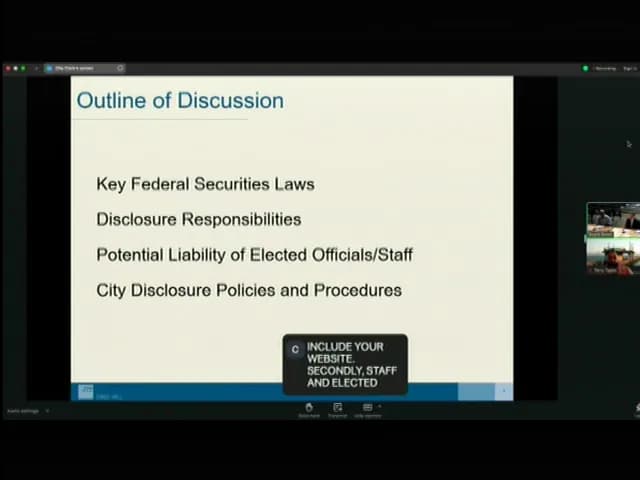
This special meeting of the Berkeley City Council convened at 4:30 PM on Tuesday, May 20, 2025, in the School District Board Room and via teleconference. The Council considered two financing items: authorizing up to $11 million in lease revenue notes for the Fire Administration and Training Project, and issuing $35 million in general obligation bonds for Measure O affordable housing. The meeting also included a required training on federal securities laws for municipal bond issuance. No public comments were received on either item. All actions were approved unanimously. Discussion Items Federal Securities Law Training - Bond counsel Chris Lynch (Jones Hall) delivered a training on federal securities law requirements for municipal bond issuers, as required by the city's disclosure policies. Key points included: - The city is subject to anti-fraud provisions under the Securities Act of 1933 and Securities Exchange Act of 1934 when issuing bonds and making continuing disclosures. - Material facts (those a reasonable investor would consider) must be fully disclosed in official statements, annual reports, and even on the city's website if intended to reach investors. - The SEC's Orange County (1994) and San Diego enforcement actions were cited as examples where elected officials faced personal liability for inadequate disclosure. - Staff and elected officials must take reasonable steps to ensure all material facts (e.g., pension liabilities, structural budget imbalances, reserves) are included. - The city's Disclosure Working Group, chaired by the Finance Director, reviews official statements before council approval. Item 1: Lease Revenue Notes for Fire Administration and Training Project - Finance Director Henry Oyekanmi presented the request to issue up to $11 million in federally taxable Lease Revenue Notes through the Berkeley Joint Powers Financing Authority. - The total project cost is estimated at $15–17 million; the city has already saved $7.5 million toward it. The notes would cover the remaining balance. - The notes are interest-only for 4 years, with a lump-sum principal payment due in 2029. Repayment would come from the general fund via lease payments. - Initially, fire stations 2 and 5 were proposed as collateral because they are unencumbered and have sufficient value (approximately $15 million). However, staff is reviewing other city facilities and the resolution allows swapping properties. - Councilmember Tregub asked about repayment risk; bond counsel confirmed the city intends to refinance with tax-exempt bonds upon exercising a purchase option on the property within approximately 3–4 years. The city manager stated resources are committed to cover both the notes and the property purchase. Item 2: $35 Million General Obligation Bonds for Measure O – Affordable Housing - This is the third tranche of the $135 million Measure O affordable housing bond approved by voters. After this issuance, approximately $22 million remains for a fourth tranche. - The $35 million will fund five projects: People's Park supportive housing, Ashby BART development, North Berkeley BART development, St. Paul Terrace, and Ephesian Legacy Court. - The bonds are taxable (rather than tax-exempt) because affordable housing projects often take longer than 3–5 years to spend proceeds, which would violate tax-exempt spend-down rules. - Interest rates are currently estimated at 4–5%, though the market remains volatile. The city uses a competitive bid process rather than negotiated sale. - Staff outlined a five-year borrowing plan to spread out issuances and manage taxpayer costs. - Councilmember Tregub noted that the Measure O Oversight Committee was dissolved after making final recommendations, so the fourth tranche ($22 million) has been allocated by staff recommendation: $2 million for North Berkeley BART and $20 million for Ashby BART. Key Outcomes - Item 1 – Lease Revenue Notes: Council voted unanimously (7–0; Councilmembers Kesarwani, Bartlett, and Blackaby absent) to adopt Resolution No. [not provided] authorizing the issuance and sale of up to $11 million in federally taxable Lease Revenue Notes for the Fire Administration and Training Project. The public hearing was closed by a unanimous vote. (Roll call: Kesarwani absent, Taplin yes, Bartlett absent, Tregub yes, Blackaby absent, Lunaparra yes, Humbert yes, Mayor Ishii yes.) - Item 2 – Measure O Bonds: Council voted unanimously (same roll) to adopt Resolution No. [not provided] authorizing the issuance and sale of $35 million in general obligation bonds for affordable housing under Measure O. - The meeting adjourned at approximately 5:00 PM.
Public Meetings - Berkeley, California
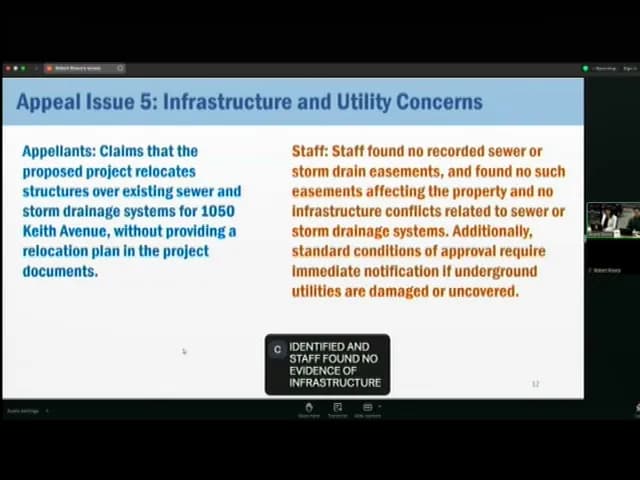
Public Meetings - Berkeley, CaliforniaThe Berkeley City Council met on Tuesday, May 6, 2025, starting at 6:00 PM in the School District Board Room. The meeting covered a consent calendar of routine approvals, a public hearing on a Zoning Adjustment Board (ZAB) appeal for a residential project at 1048 Keith Avenue, and extensive public comment on non-agenda matters. Key fire-related items were postponed to June 17 for further community outreach. Consent Calendar - Items 1–8b were approved unanimously in one motion, including: adoption of CALFIRE Fire Hazard Severity Zones (Item 1, postponed to June 17 but moved to consent for part of process; actually the item was postponed, but it remained on consent? The agenda shows Item 1 was on consent but the city manager announced it would be moved to June 17. The transcript confirms both Items 1 and 9 were moved to June 17, but the consent calendar vote occurred after that announcement. The consent calendar items that remained were Items 2–8b. The council voted to approve the consent calendar including Item 8b (take no action on SB 1343 enforcement recommendation). Councilmember Tregub explained his support for the intent but cited budget constraints. Item 7 (red curb painting for daylighting) and Item 3 (Diablo Fire Safe Council fiscal sponsorship) received positive council comments. Public Comments & Testimony - Non-Agenda Public Comment: Speakers addressed: a resident concerned about a homeless encampment in a park and the need for coordinated city response; a speaker urging a more balanced dialogue on the proposed Ember wildfire prevention rules, citing conflicting research on vegetation removal near homes; a resident opposed to the proposed zone-zero rule, arguing power lines are a greater wildfire cause and that removing vegetation harms shade and mental health; a commenter criticizing homeless sweeps and calling for public housing; the Bridge Association of Realtors raising concerns that the city's fire hardening transfer tax rebate is not publicly advertised or known to staff; a representative of the Alliance for Practical Fire Solutions supporting postponement and asking for collaborative workshops; and a comment opposing SB 607 for eliminating CEQA environmental review. - Employee Union Comment: Amori Langmo, president of Berkeley Firefighters Local 1227, cautioned against a hiring freeze for public safety positions, noting that 10–15 retirements are expected and that mandatory overtime leads to increased sick leave and workers' compensation costs. - Public Comment on Consent/Information Items: Carol (former commission chair) urged council to work with businesses to educate them about SB 1343 requirements. A Realtors representative asked for transparency in the BESO software contract regarding escrow deposit data. Discussion Items - ZAB Appeal – 1048 Keith Avenue (Use Permit ZP2024-0014): Staff presented the project: demolition of a 2,760 sq ft single-family home and construction of a 3,600 sq ft two-story home (25 ft tall) with a reduced rear setback (20 ft to 15 ft), parking in front setback, and a trellis/fence. The ZAB approved it in January 2025. The appeal was filed by the uphill neighbor at 1050 Keith, claiming encroachment, inaccurate surveys, and that the project would set a precedent for property line disputes in a landslide-prone area. Staff found the survey accurate to within an inch, no encroachment, and no city policy on sliding land. The appellant’s representative argued that the land has shifted over decades and that the city should require a comprehensive survey. The applicant, Lindsay Newman, a civil engineer, presented her design, emphasized fire-resistant features, and stated the survey confirmed the project is entirely within her lot. She noted a pending lawsuit over the property lines. Public comment was split: several neighbors supported the appeal, fearing a domino effect of land grabs; others supported the project as an improvement and responsibly engineered. Council questions focused on the non-detriment finding and whether the city could consider broader community detriment. Councilmember Blackaby expressed concern about precedent and asked for more data. Councilmember Humbert and others noted the quasi-judicial limits. The motion to affirm the ZAB decision and deny the appeal passed 7–1 (Blackaby dissenting; O’Keefe recused). Key Outcomes - Fire-Related Items Postponed: Items 1 (CALFIRE map) and 9 (Fire Code amendments) were moved to the June 17 meeting to allow more community engagement. Councilmember Blackaby announced two Ember workshops: a Zoom webinar on May 15, 2025 (RSVP: bit.ly/May15Ember) and an in-person workshop on May 27, 2025 at Northbrae Community Church. - Consent Calendar Approved: All consent items (2–8b) passed, including re-establishment of the Berkeley Tourism Business Improvement District for 10 years, contracts for home hardening donations, HR data services, South Cove repaving rejection/re-bid, BESO software updates, red curb painting (918 intersections), and taking no action on the SB 1343 enforcement recommendation (Item 8b). - ZAB Appeal Denied: The council upheld the ZAB’s approval of the 1048 Keith Avenue project. The project may proceed subject to existing conditions; property line disputes remain a private civil matter. - Adjournment: The meeting adjourned after a brief history lesson on former Mayor Lewis Bartlett and a call to prioritize EMS funding.
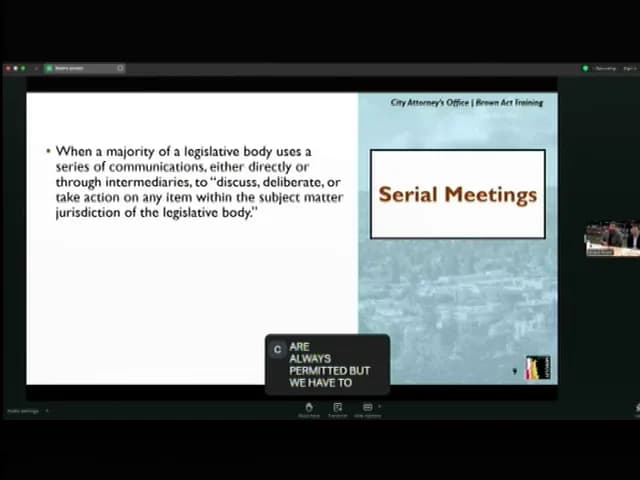
The Berkeley City Council held a special meeting on May 6, 2025, at 4:30 PM (noticed start time) for a worksession focused on Brown Act training presented by the City Attorney's Office. The meeting included a detailed presentation on the state's open meeting law, followed by questions and answers from councilmembers. One member of the public provided comment. No formal actions or votes were taken. Roll Call - Present: Councilmembers Tregub, O'Keefe, Blackaby, Lunaparra, and Mayor Ishii. Absent: Councilmembers Kesarwani, Taplin, Bartlett, and Humbert. Quorum was present. Public Comments & Testimony - Carol Morasovic (via Zoom) asked about the Brown Act implications of the same public comment being heard by two different policy committees with different council members, potentially creating a quorum discussion across committees. The City Attorney's Office responded that such discussion at noticed meetings would be permissible under the Brown Act. Discussion Items - Brown Act Training Presentation: Deputy City Attorneys Sam Harvey, Steve Heilis, and Nate Dahl delivered a presentation covering the basics of the Brown Act, including definitions of meetings, serial meeting prohibitions (daisy chain and hub-and-spoke models), agenda posting requirements (72 hours for regular, 24 hours for special meetings), teleconferencing rules, public comment periods, social media guidelines, closed session exceptions, and enforcement mechanisms. Real-life examples of violations were provided. Councilmembers asked clarifying questions about committee referrals, hub-and-spoke scenarios involving members of the public, social media interactions, teleconferencing accommodations, and best practices for maintaining Brown Act circles. The City Attorney's Office advised contacting their office for specific fact-pattern inquiries. Key Outcomes - No votes or formal decisions were made. The meeting concluded with a motion to adjourn, seconded by Councilmember Bartlett, which passed unanimously. - Councilmembers received updated training materials and were reminded to consult the City Attorney's Office for Brown Act compliance questions.
The Berkeley City Council met on Tuesday, April 29, 2025, at 6:00 PM in the School District Board Room and via teleconference. The meeting included ceremonial adjournments, public comments, a consent calendar with 27 items, and action items including a public hearing on the 2025-2030 Consolidated Plan and a residential parking program. The meeting lasted several hours, with councilmembers participating both in-person and remotely. Ceremonial Matters - The Council adjourned in memory of former Councilmember Mary Wainwright, with a proclamation presented to her family. Councilmember Taplin read a tribute. - Adjourned in memory of Bill Chapman, a longtime League of Women Voters member, honored by Mayor Ishii. - Adjourned in memory of environmental activist David "Chicken" Nesmith, with remarks from Councilmember Tregub. - Councilmember Taplin also adjourned in memory of constituents Betty and Jimmy Pugh. Consent Calendar - The Council approved an urgent item (added to the agenda) supporting AB-389, which would provide a state income tax credit for fire-resistant home improvements. The resolution passed unanimously. - Item 7 (Adjustment to Police Accountability Board Stipend Cap) was approved after a brief discussion; Councilmember Taplin voted no, Councilmember Humbert abstained, and Councilmember Blackaby recused himself. - Item 19 (Resolution opposing police brutality and use of force on nonviolent protesters) was on the consent calendar with a negative recommendation from the Public Safety Policy Committee. The Council took no action; Councilmembers Tregub and Lunaparra abstained. - Numerous budget referrals and resolutions were approved as part of the consent calendar, including: - Item 15: Budget referral for afterschool program expansion ($300,000). - Item 16: Budget referral for F and G dock deck replacement ($250,000). - Item 17: Relinquishment of council office budget funds for Berkeley Juneteenth Festival (multiple councilmembers contributed). - Item 18: Support for Berkeley High Robotics Team (funds contributed by several councilmembers). - Item 21: Budget referral for deportation defense legal and education funds ($200,000). Mayor Ishii and Councilmember Tregub pledged additional funds from their office budgets. - Item 24: Budget referral for Street Spirit drop-in center ($25,000). - Item 25: Resolution supporting state and regional funding for Bay Area public transit. - Item 27: Deferral of $150,000 for Round Park conversion. - Item 22 (Adding ADA expertise to the SAFE STREETS Citizen Oversight Committee) was moved to the Action Calendar for amendment. Public Comments & Testimony - Non-Agenda Matters: Speakers addressed concerns about a proposed public bathroom at Adeline and Alcatraz, the demolition of the United Artists Theater, and the city's meeting procedures. - Consent Calendar: Numerous speakers supported items including Juneteenth, Street Spirit, afterschool programs, deportation defense funds, and public transit funding. A robotics team representative thanked the council for support. One speaker expressed confusion about item 19 (police brutality) and urged its passage. Parents highlighted the need for more aftercare slots. - Public Hearing on Item 28 (Consolidated Plan): One speaker asked about flexibility in funding allocations given potential federal cuts. - Public Hearing on Item 29 (RPP on Virginia Street): A resident of the block spoke in favor, citing spillover parking from BART. - Item 22 (ADA expertise): Speakers supported the amendment, including a commissioner on aging and the founder of Streets of Equality, emphasizing the need for disability representation. Discussion Items - Item 28: Submission of 2025-2030 Consolidated Plan and PY 2025 Annual Action Plan – Staff presented the HUD-required plan, detailing $3.3 million in estimated annual funding for CDBG, ESG, and HOME programs. Councilmembers asked about federal funding uncertainty and the difference between CDBG and HOME programs. The plan was approved unanimously. - Item 29: Residential Preferential Parking (RPP) on the 1500 block of Virginia Street – Staff reported that 83% of residents opted in, exceeding the 51% threshold. A parking occupancy study confirmed need. The item was approved unanimously. - Item 22: Adding ADA expertise to the SAFE STREETS Citizen Oversight Committee – Councilmember Blackaby proposed an amendment to clarify that at least one member should have experience with ADA compliance or accessible infrastructure challenges. The amendment was approved unanimously after public comment. Key Outcomes - Votes: - Urgent item (AB-389) added to consent calendar and approved unanimously. - Consent calendar approved as amended (with Item 7 passing 6-1-1-1, Item 19 taken as no action). - Item 28 (Consolidated Plan) approved 8-0. - Item 29 (RPP) approved 8-0. - Item 22 (ADA expertise) approved 8-0. - Budget referrals: Items 15, 16, 21, 24 were referred to the Fiscal Year 26 Mid-Biennial Budget Update process. - Next steps: Staff will finalize and submit the Consolidated Plan to HUD; implement RPP signs on Virginia Street; and reopen the application process for the SAFE STREETS committee with the new ADA criteria.
The Berkeley City Council held a special meeting on Monday, April 28, 2025, at the School District Board Room (1231 Addison Street) beginning at 5:00 PM, to consider a resolution for an immediate and permanent ceasefire in Gaza, an end to U.S. military aid to Israel, and support for Palestinian self-determination. The meeting, which ran for over six hours, featured extensive public comment from a deeply divided community. After deliberation, the council voted on competing resolutions but ultimately adjourned without adopting any resolution on the matter. Consent Calendar No consent calendar items were listed or considered during this special meeting. Public Comments & Testimony The public comment period was extended multiple times, ultimately totaling nearly four hours. Over a hundred speakers provided testimony on both sides of the issue. - Supporters of the Peace and Justice Commission (PJC) resolution — including members of Jewish Voice for Peace, the Gazan Student Support Network, SEIU 1021, Code Pink, and numerous Berkeley residents and students — urged the council to adopt the PJC resolution calling for an immediate ceasefire and an end to U.S. military aid to Israel. They argued that U.S. tax dollars are directly funding what they described as a genocide in Gaza, that the conflict is a local issue given federal tax contributions, and that Berkeley has a historical moral obligation to take a stand (citing the anti-apartheid and anti-Vietnam War movements). - Supporters of Councilmember Taplin's alternative resolution — including several Jewish residents, the JCRC Bay Area, and community members — urged the council to adopt his resolution focused on combating hate locally, healing community divides, and protecting free speech. They argued that the city has no jurisdiction over foreign policy and that the PJC resolution was one-sided, divisive, and would increase anti-Semitism in Berkeley. - Many commenters on both sides shared deeply personal testimony about family members killed, hostages taken, harassment experienced, and trauma from the Holocaust, the occupation of Palestine, and the October 7th attack. - A public commenter who identified as a trauma surgeon testified about treating wounded patients in Gaza and described being present when a hospital was bombed, killing a 16-year-old patient. - The meeting was marked by frequent interruptions, heckling, and shouted exchanges between audience members. The Mayor repeatedly called for decorum and paused the meeting multiple times. Discussion Items - Peace and Justice Commission Presentation: Pastor Duane L. Phillips, Chair, and Commissioner Luke Taylor presented the Commission's resolution. Taylor noted it was passed by the Commission in September 2024 with an 8-7 vote. He highlighted ongoing suffering in Gaza, including the deaths of two students from his network the day before, and urged the council to adopt the resolution without dilution. - Councilmember Taplin's Alternative Resolution: Taplin presented a substitute resolution titled "Reaffirming Berkeley's Commitment to Peace at Home and Abroad," which focused on local impacts of the conflict, rising hate crimes in Berkeley, and the importance of community healing. He argued the Council has no jurisdiction over foreign affairs and expressed frustration with the focus on such matters. - Mayor Ishii's Resolution: Mayor Ishii presented her own substitute resolution that condemned hate, supported a lasting peace between Israelis and Palestinians, opposed a US occupation of Gaza, and affirmed the Council's commitment to free speech. She emphasized her efforts over the prior three months to meet with community stakeholders. - Councilmember Taplin's Proposed Amendments: Taplin proposed a series of friendly amendments to the Mayor's resolution, including specific condemnations of Hamas's October 7 attack, sexual violence, and language about educational institutions protecting free speech while addressing anti-Semitism. The Mayor declined the amendments, saying she could not consider so many changes at the dais. Councilmember Kesarwani later requested that the amendments be included, but they were not incorporated. Key Outcomes - Vote on Substitute Motion (Mayor Ishii's Resolution): Failed, 4-3-1 (Ayes: Bartlett, Tregub, Lunaparra, Ishii; Noes: Blackaby; Abstentions: Kesarwani, Taplin, O'Keefe, Humbert). - Vote on Main Motion (Councilmember Taplin's Resolution): The roll call was interrupted by audience disruption. Based on the audible votes, Kesarwani, Taplin, Bartlett, Tregub voted yes; Blackaby, Humbert voted no; O'Keefe and Lunaparra appeared to abstain or vote no; Ishii's vote was not heard. The motion did not pass. - Adjournment: The Council voted to adjourn without adopting any resolution. The meeting was adjourned at approximately 11:30 PM. - Next Steps: No further meetings or actions were scheduled. The issue of a Gaza ceasefire resolution was not resolved.
The Berkeley City Council held a special meeting on April 22, 2025, beginning at 6:04 PM, to consider a single agenda item: an appeal of the Zoning Adjustments Board (ZAB) decision to approve Use Permit ZP2023-0079 for a 17-story mixed-use residential building at 2274 Shattuck Avenue. The project proposes to demolish the historic United Artists (UA) Theater (except for the front façade and lobby), build 227 dwelling units (including 23 very low-income density bonus units), one ADA parking space, and a ground-floor cafe. Staff recommended dismissing the appeal and affirming ZAB's approval. Public Comments & Testimony - In support of the project (against the appeal): Speakers included Kara Bins, Jake Price, Alan Chamorro, Sean Carseng, Sarah Bell, Kaveya Chattrabathy, Theo Gordon, and a representative from East Bay for Everyone. They argued that the housing crisis requires urgent action, the theater is no longer economically viable, and the project preserves the historic façade and lobby while providing needed housing and tax revenue. Some noted that the theater's interior has been heavily altered and is in poor structural condition, and that state law (AB 1633) requires approval. - In opposition to the project (supporting the appeal): Speakers included Tom Lippe (attorney for appellant Save the UA Berkeley), Connor Mitchell, Moni Law, Therese Polletti, Laura Linden, Gregory Sharpin, Madeleine Roberts, Alan Michon (owner of Grand Lake Theater), Greg King, and many others. They argued that CEQA requires a full environmental impact review because the theater is a state historic landmark and the project would cause substantial adverse change to a historical resource. They disputed the structural claims, saying the building is a steel-reinforced fortress and that the auditorium and original Art Deco details remain intact behind multiplex partitions. They stressed that demolishing the theater would be irreversible and that downtown needs cultural venues, not another stalled project. Several speakers accused the developer of misleading statements and criticized the city's process for granting a CEQA exemption without public input. Discussion Items - Staff Presentation: Sharon Gong, principal planner, summarized the project and staff’s CEQA determination. She noted that the project qualifies for a Class 32 infill exemption because it preserves the character-defining features (the upper Shattuck façade) identified by the Landmarks Preservation Commission (LPC). Staff found that the auditorium no longer conveys historic significance due to extensive alterations and deterioration. She also explained that AB 1633 requires the city to determine exemption within 90–180 days and that ZAB’s approval was consistent with all applicable objective standards. - Appellant Presentation: Tom Lippe argued that CEQA Section 21084(e) prohibits a categorical exemption if a project “may cause a substantial adverse change” to a historical resource, and that the fair-argument standard applies. He cited the city’s own consultant (Rincon) who concluded demolition would cause substantial adverse change. He contended that AB 1633 did not override this more specific statute. - Applicant Presentation: Robin Barral (attorney for Panoramic Interests) defended the staff’s CEQA exemption, stating that AB 1633 establishes a substantial-evidence standard for these infill projects and that the applicant provided sufficient evidence. Patrick Kennedy (project sponsor) noted that the theater was offered to the operator for $1/year but they declined, and that the building is structurally unsafe. He said the project will restore the façade and lobby as required by the LPC. - Council Deliberation: Councilmembers disclosed ex parte contacts. Councilmember Taplin recused himself due to potential conflict. Councilmembers Tregub, Bartlett, Blackaby, Lunaparra, Humbert, O’Keefe, Kesarwani, and Mayor Ishii each spoke. Several expressed personal sadness about losing the theater but concluded that state law, the CEQA exemption, and the need for housing compelled them to support the project. Councilmember Tregub noted the absence of any concrete alternative plan for saving the theater. Councilmember Blackaby questioned staff and both parties about whether the auditorium is a character-defining feature. The staff and applicant said it is not; the appellant argued it is, citing the Rincon report and photographs of intact ornamentation. Key Outcomes - Motion to close public hearing: Approved unanimously (8-0, with Taplin absent). - Motion to affirm the ZAB decision and dismiss the appeal: Councilmember Bartlett moved; Councilmember Humbert seconded. The vote was 7-0 in favor (Kesarwani, Bartlett, Tregub, O’Keefe, Blackaby, Lunaparra, Humbert, and Mayor Ishii all voted yes; Taplin was absent and had recused himself). The motion carried, thereby approving the Use Permit and allowing the project to proceed.
The Berkeley City Council held a regular hybrid meeting on Tuesday, April 15, 2025, starting at 6:00 PM. The meeting included proclamations, a unanimous consent calendar, and a contentious action item concerning police accountability. The council also approved an urgent item and heard extensive public testimony on a range of topics including Holocaust remembrance, police oversight, and park improvements. Consent Calendar The council voted unanimously (9-0) to approve the consent calendar, which included the following items: - Item 1: Second reading of amendments to the Building Emissions Saving Ordinance (BESO) for small residential buildings (first reading all ayes). - Item 2: Second reading establishing the Manufacturing, Research & Development (M-RD) zoning district for the former Pacific Steel Casting site (first reading all ayes). - Item 3: Appointment of a new member to the Police Accountability Board. - Item 4: Contract with UC San Francisco for Encampment Resolution Funding evaluation ($200,000). - Item 5: Approval of formal bid solicitations and RFPs. - Item 6: Amendment to contract for Mental Health Crisis Line services (add $50,001, extend term). - Item 7: Amendment to contract for Substance Use Disorder services (add $500,000, extend term). - Item 8: Amendment to NextRequest PRA software contract (add $61,098). - Item 9: Purchase order for a portable emergency power generator for Berkeley Tuolumne Family Camp ($116,766). - Item 10: Proclamation declaring April 17 as Police Accountability Day. - Item 12: Referral to City Attorney for Sanctuary City Ordinance. - Item 13: Budget referral for Ohlone Greenway Safety Improvements Project ($150,000 for final design). - Item 14: Establish rules for community-based organizations receiving emergency funds without procurement (annual limit $225,000 total, $25,000 per org). - Item 15: Relinquishment of council office budget funds for Sylvia Mendez Elementary School Spring Cultural Celebration. - Item 16: Resolution commemorating April 24, 2025, as Berkeley Holocaust Remembrance Day. - Item 17: Relinquishment of council office budget funds for 2025 Virtual Holocaust Remembrance Day Program. - Item 18: Resolution supporting California Senate Bill 42 (California Fair Elections Act of 2026). - Item 19: Budget referral for Thousand Oaks Park Playground Update ($80,000 for airplane-themed structure). - Item 20: Study of sabbatical leave for City employees (policy committee gave negative recommendation; no action taken on consent). - Item 21: Relinquishment of council office budget funds for Music in the Elmwood Festival. Additionally, an urgent item (Kala Art Institute 2025 Relinquishment) was added to the agenda by a unanimous vote and approved as part of the consent calendar. Public Comments & Testimony Public comment was taken on both non-agenda matters and consent/information items. Key themes included: - Holocaust Remembrance (Items 16–17): Many speakers expressed appreciation for the recognition, with survivor Sunny DeWitt sharing her harrowing story. Others urged the council to also recognize the plight of Palestinians, arguing that "never again" must apply to all. - Police Accountability (Items 11A & 11B): Multiple speakers, including former commissioners and community members, urged the council to adopt the PAB's recommendations rather than the substitute resolution. Speakers highlighted the need for a formal arrest quota ban and full document access. - Ohlone Greenway (Item 13): Several members of the California Habitats, Indigenous Activists (CHIA) group opposed widening of the pathway, citing Measure L protections and the value of the native plant garden. Councilmember Kesarwani clarified that Measure L does not prohibit changes and that safety improvements are needed. - Thousand Oaks Park Playground (Item 19): Supporters, including friends of Michael Seltzer, spoke in favor of the airplane-themed structure. Neighbors raised concerns about the location, process, and cost, suggesting alternative memorial options. - Other: A speaker highlighted the lack of public space in District 7; another criticized the city's public records request process. Union representative Jocelyn spoke about moral injury regarding the lack of a ceasefire resolution. Discussion Items The main discussion focused on Items 11A and 11B, taken together as a single action item: Item 11A (PAB Report): The Police Accountability Board and ODPA presented their investigation into BPD Downtown Task Force texting offenses, recommending: (1) affirm PAB access to documents, (2) adopt a resolution ensuring accountability for misconduct, (3) create a public repository for sustained allegations, and (4) call on state legislators to extend the arrest quota prohibition beyond vehicle code. The Public Safety Policy Committee had given a negative recommendation. Item 11B (Councilmember Blackaby): Blackaby's resolution affirmed support for BPD, acknowledged the PAB’s work, condemned racism and misconduct, opposed arrest quotas, and asked the legislature to expand the quota prohibition. Council debate revealed disagreements over whether existing state law (Vehicle Code §§41600–41603) already prohibits all arrest quotas. The city attorney clarified it applies only to vehicle code citations, not all arrests. The chief stated the department interprets it broadly. Multiple councilmembers (Bartlett, Taplin, Tregub, O'Keefe, Humbert) supported the substitute resolution, arguing it captured the actionable items and respected the ongoing meet-and-confer process. Councilmember Lunaparra expressed concern that the resolution did not go far enough and voted against. The final motion (to accept the PAB report with thanks and adopt Resolution 11B) passed 8-1 (Lunaparra dissenting). Key Outcomes - Consent Calendar: Approved unanimously (9-0) with all listed items. - Urgent Item: Added and approved unanimously; councilmembers contributed discretionary funds to Kala Art Institute (up to $500 each) and other community events (Sylvia Mendez, Holocaust Remembrance, Music in the Elmwood). - Items 11A & 11B: Motion to accept the PAB report and adopt Councilmember Blackaby’s resolution passed 8-1. The PAB report was acknowledged, but its specific recommendations were not adopted as binding policy. - Proclamations: Holocaust Remembrance Day (April 24), Muslim American Appreciation Month (April), and Education and Sharing Day (April 9) were all proclaimed. - Referrals: The Sanctuary City Ordinance referral (Item 12) and budget referrals for Ohlone Greenway (Item 13) and Thousand Oaks Park (Item 19) were approved as part of the consent calendar and will proceed to the June budget process. - Next Steps: The meet-and-confer process for PAB regulations is expected to conclude within a few months. The council directed staff to continue work on transparency and accountability measures.
The Berkeley City Council held a special meeting on April 15, 2025, to consider two interconnected wildfire safety items: the adoption of updated CAL FIRE Fire Hazard Severity Zone (FHSZ) maps with additional local designations, and the modification and adoption of local amendments to the Berkeley Fire Code (the "Ember" package). After extensive public comment and council deliberation, both items were approved unanimously. Public Comments & Testimony - Approximately 40 speakers provided comment in person and online, with many yielding time. The majority expressed support for the Ember proposal, citing scientific evidence, personal experience with past fires (1991 Tunnel Fire, 2025 Los Angeles fires), and the need for collective action to protect the entire city. - Supporters included Firewise community leaders, Fire Safe Council members, and residents who have already begun creating defensible space. They emphasized that zone zero (5-foot clearance) is supported by the Insurance Institute for Business & Home Safety (IBHS) and state standards, and that delaying would increase risk while insurance becomes harder to obtain. - Several speakers voiced opposition or concerns, focusing on: the financial burden on homeowners (especially seniors and fixed-income residents); the lack of an impact study or mitigation fund; the one-size-fits-all approach (not accounting for slope, non-flammable plants, or already-hardened homes); the need to address eucalyptus in Tilden Park and undergrounding PG&E power lines; and enforcement provisions they called unjust (fines, liens, potential misdemeanors). Some questioned whether the science on zone zero is settled, arguing home hardening should be the priority. - A few speakers requested map refinements for specific streets (e.g., Piedmont Avenue) and clarity on how properties with less than 5 feet of land to the property line would comply. Discussion Items - Item 1 – Adoption of CAL FIRE Maps and Additional Designations: Fire Chief David Sprague and Assistant Chief Colin Arnold presented the rationale for shrinking the previous Very High Fire Hazard Severity Zone boundary and designating a smaller area as Very High (required) plus a High zone where local conditions warrant. They explained that the state-identified Very High zone (red) cannot be reduced, but the city has discretion to add areas. The new map focuses on the highest-risk neighborhoods near Grizzly Peak and Panoramic Hill, where structure density, limited evacuation routes, and fuel loads create the greatest danger. - Item 2 – Berkeley Fire Code Local Amendments: The proposed amendments primarily affect the first five feet from a structure (Zone Zero), prohibiting in-ground vegetation, combustible mulch, new wooden fences within 5 feet, and requiring removal/replacement of fence sections contacting the structure. Exceptions are allowed for small plants in non-combustible movable containers and well-maintained mature trees. The chief emphasized that these standards align with the California Department of Insurance and state Board of Forestry, and will help lower insurance costs over time. - Councilmember Blackaby, the lead sponsor, made a motion to adopt both items as presented in the revised supplemental materials. He stressed that the Ember package is the first step in a multi-phase effort, and that future phases will extend requirements to other parts of the High zone. Councilmembers expressed strong support, acknowledging the hardship on residents but arguing the cost of inaction far exceeds the cost of compliance. - Several councilmembers asked about outreach to Greek life and co-op houses in the zone (Councilmember Lunaparra), flexibility for steep slopes (Councilmember Taplin), and map refinement for individual parcels (Chief Arnold confirmed the maps are reference-only and can be adjusted post-approval). - Councilmembers committed to pursuing financial assistance, including the $1 million CAL FIRE grant, Measure FF funds for low-income/elderly/disabled residents, and state/federal tax credits. They also pledged to coordinate with regional partners (East Bay Regional Parks, PG&E, UC Berkeley) on eucalyptus removal and undergrounding power lines. Key Outcomes - Vote: Unanimous (8–0) to approve both items. Councilmembers present: Kesarwani, Taplin, Bartlett, Tregub, O'Keefe, Blackaby, Lunaparra, Humbert, and Mayor Ishii. - Action on Item 1: Adopted first reading of an ordinance designating Fire Hazard Severity Zones within the Local Responsibility Area as recommended by CAL FIRE, plus additional local designations of Very High and High zones based on substantial evidence (Government Code §§ 51178, 51182). - Action on Item 2: Adopted first reading of an ordinance amending Section 19.48.020 of the Berkeley Municipal Code (Amendments to the California Fire Code) and a resolution setting forth findings of local conditions justifying more stringent standards than the 2022 California Fire Code. A public hearing was held; the second reading and final adoption are scheduled for May 6, 2025. - Next Steps: The Fire Department will begin public notification and support for affected property owners (approximately 850 parcels in the initial phase). Inspections will begin in 2026. The council directed staff to return with a financing plan and to seek additional grants. Future phases will bring more of the High zone under defensible space requirements, potentially before the state’s 2029 deadline.
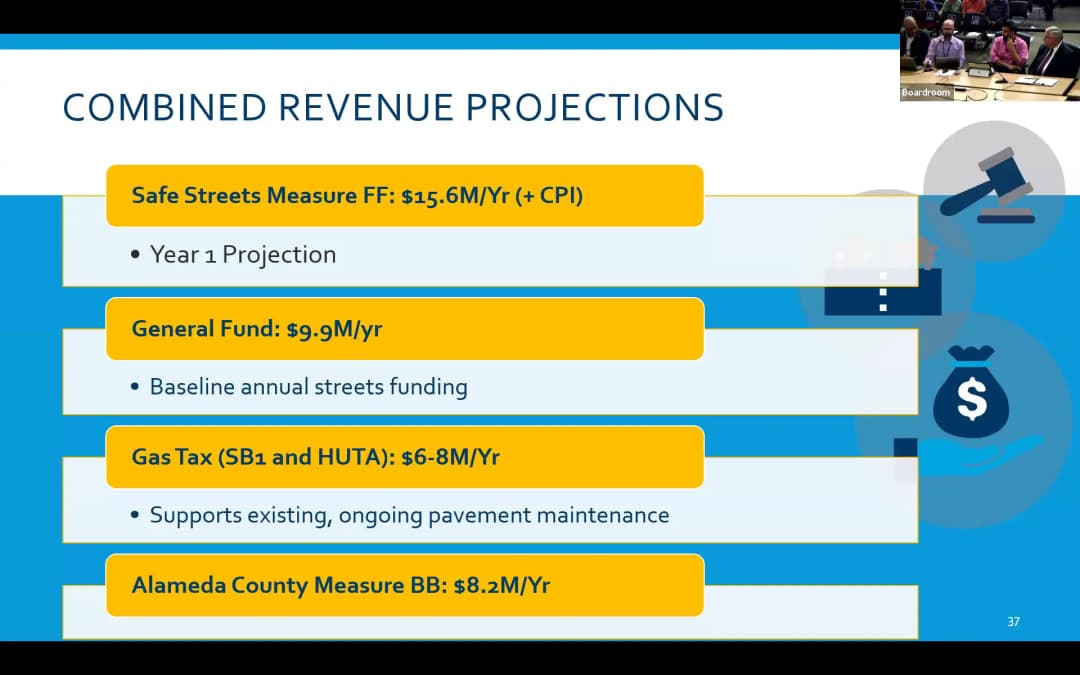
Note: The agenda listed the meeting date as March 25, 2025, but the provided timestamp indicates the meeting occurred on March 27, 2025 at 20:00 UTC. This summary uses the timestamp date as instructed. The Berkeley City Council held a special meeting on March 27, 2025, primarily to receive a detailed presentation on pavement management and infrastructure planning in light of the newly passed Measure FF parcel tax, and to adopt the prioritized list of outstanding city council referrals using Re-Weighted Range Voting (RRV). The meeting was conducted in a hybrid format. All eight council members were present except Councilmember Bartlett, who was absent. The consent calendar was approved unanimously, and the RRV resolution was adopted unanimously. Consent Calendar - Item 1: Amend Memorandums of Understanding for Represented Employee Groups to Include Cesar Chavez Day as a Paid City Holiday – The council unanimously approved a resolution adding Cesar Chavez Day (observed the last Monday of March) as a paid city holiday beginning in 2025. The City Manager noted the item codifies an agreement reached in closed session. Public Comments & Testimony - On Pavement Management Presentation (Item 2): - Margot Schuler (former Public Works Commissioner) highlighted that the StreetSaver software is geared for asphalt, making it difficult to integrate innovative materials. She noted that asphalt is damaging to salmon and urged reconsideration of materials. She also raised concerns about coordinating with other departments (e.g., Parks for street trees) and the complexity of bundling utility work across multiple jurisdictions. - Ray Yep (former Public Works Commissioner, former Transportation Infrastructure Commission member) congratulated staff and credited the former Public Works Commission, city auditors, former Mayor Jesse Arreguín, and current council members for advancing infrastructure funding. - Gordon Wozniak (former councilmember) argued that a flat PCI after 14 years is unacceptable and urged reducing overhead, earning higher interest on idle funds, and considering permeable pavers for heavy-traffic streets. - Nancy Rader (District 6, Berkeley’s for Accessible Rights of Way) urged a holistic approach that prioritizes ADA compliance and accessibility for disabled and senior populations, noting that the presentation lacked focus on these issues. - Blair Beekman (San Jose resident) commented on meeting procedure and urged the council to adopt tech accountability best practices. - Helen Walsh (Berkeley’s for Accessible Rights of Way, Commission on Disability) expressed concern that ADA transition plan updates were not positively integrated, and that ADA requirements were described only as an unfunded 40% cost on paving dollars. - Meryl Siegel (District 1) requested that businesses be included in planning and public engagement. - A fourth online speaker (Shana Rush) declined to comment after clarifying the agenda item. - On RRV Referral Prioritization (Item 3): - Blair Beekman offered procedural good wishes. Discussion Items - Pavement Management & Infrastructure Planning Presentation (Item 2): - Staff Presentation: Director Terrance Davis, along with consultants Joe Ryrie (PEI) and Wahid Amiri (Deputy Director), presented a comprehensive overview. Key statistics: city maintains 212.8 center-line miles of roadway (39 million sq ft), average PCI of 56 (regional average is 67). To maintain the current condition requires $26.2M/year; to increase PCI by 5 points would need $41.7M/year. The city’s deferred roadway-related infrastructure needs total approximately $420M (roads $250M, sidewalks $62M, bicycle safety $62M, pedestrian plan $61M, ADA $47M, green infrastructure costs variable). - Measure FF Funding: Year one revenue estimated at $15.6M (60% streets, 30% safety, 10% environmental). The assessment can be escalated annually by CPI or Personal Income Growth. The council will have a choice each May. The first FF revenues are expected in December 2025, with the first round of projects potentially ready for summer 2026 construction. - Policy Discussion: Staff presented a list of potential policy considerations for future council action, including: evaluating additional impact fees (e.g., for heavy vehicles/EVs), negotiating broader utility trench repairs, bundling projects geographically for cost savings, and establishing a dedicated green infrastructure funding stream. Staff emphasized that the current paving plan goal of achieving a 70 PCI is likely unattainable due to cost escalations. - Council Questions and Comments: - Councilmember Kesarwani raised concerns about the accuracy of the “current budget” slide ($9.9M general fund for pavement) and the inclusion of non-local funds (e.g., gas tax, Measure BB) to meet the 15.3M maintenance-of-effort requirement. She requested a clear breakdown showing how all funding sources combine to project PCI improvements. She also expressed concern about lengthy, expensive public processes that delay safety improvements. - Councilmember Humbert asked about integrating FF projects into the capital program, staffing up to reduce consultant reliance, and ensuring the transportation division is more involved in paving decisions. He noted that Claremont and Oxford corridors are due for paving and corridor studies, and that the fire department has plans for Claremont. He also asked about the existing “dig once” policy and what the council can do to support staff. - Councilmember Blackaby asked about the distinction between sidewalk repair and new sidewalk construction, the use of critical point management in pavement selection, and the need to consider liability from poor streets. He requested future data on traffic usage by road classification and expressed interest in adding evacuation routes and historical repaving frequency to prioritization criteria. He also asked about the timeline for a new prioritization framework (target: May–June 2025) and about coordinating oversight bodies (SOC vs. TIC). - Councilmember Taplin asked about the timeline for a unified planning strategy (target: October 2025), staffing updates (vacancy rate reduced to 12%), and the front-loaded revenue from Measure FF (150% of rate in year one). He asked about leveraging a road user charge for EVs, economic uncertainty in 10-year projections, community notification improvements (a dedicated engagement position is planned), and regional coordination with neighbors. - Councilmember Tregub asked about the timeline for a unified strategy, staffing, leveraging front-loaded FF revenue, grant opportunities (noting no grant writer currently), road user charges, economic uncertainty, community notification, and regional coordination. He also requested a clear line showing what PCI improvement is achievable under FF. - Councilmember Lunaparra asked about the risk of increased speeds after repaving and whether post-project analysis is built in. Staff confirmed that a task force is developing pre- and post-analysis to assess traffic metrics and that additional features (e.g., traffic calming) will be incorporated if data support it. - Councilmember Bartlett asked about drivers of cost escalation—staff cited traffic control (300% increase), labor (prevailing wage), and regulatory changes (independent trucker prevailing wage). - Councilmember O’Keefe asked about the formal approval process for the new prioritization criteria. Staff indicated that the criteria will be presented to council for discussion and will ultimately be embedded in the Capital Improvement Program (CIP) adoption process, which requires council approval. - 2025 City Council Referral Prioritization Results Using Re-Weighted Range Voting (RRV) (Item 3): - City Clerk Presentation: Mark Numainville explained the RRV process: each council member scored outstanding referrals (0–5), and the algorithm produced a ranked list of 43 priorities. Public Works had the most referrals (four of the top six). The city manager has discretion to adjust assignments based on departmental capacity. - Council Action: Councilmember Taplin moved adoption of the resolution approving the prioritized list, seconded by Councilmember Tregub. The resolution passed unanimously. Key Outcomes - Consent Calendar: Approved unanimously. - Pavement Management Presentation: No formal vote; the presentation was received as a workshop. Staff will incorporate council feedback into the planning process, including developing a new prioritization framework, improving community engagement, and refining funding projections. - RRV Referral Prioritization: Resolution adopting the prioritized list of 43 council referrals approved unanimously. - Next Steps: Staff will recruit for the Measure FF Citizens Oversight Committee (applications due April 15, 2025); begin integrated planning and design work in May 2025; continue public engagement; and aim for first FF-funded projects in summer 2026. The council will receive ongoing updates and policy recommendations for approval.
The Berkeley City Council met on Tuesday, March 25, 2025, at 6:50 PM in the School District Board Room (1231 Addison Street) and via Zoom. The meeting adjourned at 9:57 PM. The Council approved a consent calendar, held public hearings on zoning and land use items, and took action on several ordinances and allocations. Ceremonial Matters - National Library Week Proclamation – The Council recognized April 6–12, 2025, as National Library Week. Beverly Green (President of the Board of Library Trustees) and Tess Mayer (Director of Library Services) highlighted the library’s 157,190 registered users, 1.4 million physical items and 1.3 million digital items circulating annually, and over 150 programs per month. They noted the passage of Measure X and concerns about federal funding cuts and rising censorship. - Adjournment in Memory of Marty Schiffenbauer – Councilmember Tregub read a statement honoring Marty Schiffenbauer (died February 6, 2025, age 86), co-author of Berkeley’s rent control legislation and advocate for municipal election changes. The meeting was adjourned in his memory. Consent Calendar - Item 1 – Proposed Amendments to the Building Emissions Saving Ordinance (BESO) – Adopted first reading of Ordinance No. 7,953-N.S. establishing a flexible resilience standard for small residential buildings (up to four units). - Item 2 – Prohibition of Pricing Algorithms for Rent Setting – Adopted second reading of Ordinance No. 7,956-N.S. adding Chapter 13.63 to ban the sale or use of coordinated pricing algorithms for residential dwelling units. First reading vote was 8–1 (Humbert dissenting). - Item 3 – Minutes for Approval – Approved minutes for Council meetings of February 3, 11, and 25, 2025. - Item 4 – Formal Bid Solicitations – Approved issuance of RFPs and IFBs totaling $6,575,000. - Item 5 – Contract Amendment for NEXGEN Asset Management Software – Authorized an amendment increasing the contract by $1,123,457 (total not-to-exceed $2,830,366 through June 30, 2029). - Item 6 – On-Call Landscape Architectural Services – Approved five contracts (Carducci & Associates, MIG, Inc., PGAdesign, RHAA, RRM Design Group) each not to exceed $450,000 for May 1, 2025 – April 30, 2028. - Item 7 – Tom Bates Regional Sports Complex Restroom and Community Space Project – Adopted a Mitigated Negative Declaration and Mitigation Monitoring and Reporting Plan. - Item 10b (moved from Action to Consent) – Companion Report on Sugar-Sweetened Beverage (SSB) Fund Allocation – Approved allocation of $2,294,774 over FY2026 and FY2027: $905,292 to BUSD for cooking and gardening programs, $905,292 to community-based organizations via RFP, $128,990 to Finance Department, and $355,200 to HHCS/PHD for administration. The consent calendar was approved unanimously. Public Comments & Testimony - Non-Agenda Matters – Speakers addressed: raising the affordable housing mitigation fee; importance of living wages, local hiring, and apprenticeship programs; frustration with permitting delays for window replacements; appreciation for recent transportation improvements at Hillagas/Nashby; recognition of International Day of Remembrance of Victims of Slavery; concerns about ICE actions and free speech; human trafficking and for-profit emergency vehicles; illegal redwood tree cutting. - Item 8 (M-RD Zoning) – Public comment included: a question about applicability of the city’s “hard hats” ordinance (staff confirmed it applies to projects over 50,000 sq ft); a letter from a resident of 1306 Third Street expressing concerns about the EIR’s handling of historic resource impacts and potential demolition; support from Biocom California for creating a predictable regulatory framework for life sciences. - Item 9 (3000 Shattuck Ave Appeal) – Extensive public comment from neighbors, labor representatives, and community groups. Key points: - Neighbors (e.g., Les Shipnock, Janice Ching, Paul Dillingham) argued the 10-story, 166-unit project is too large for the intersection, poses safety risks (traffic, narrow sidewalks, lack of loading zones), and inadequately analyzed cumulative impacts. They urged denial or remand for a full EIR. - Appellants (East Bay Residents for Responsible Development, Laborers Local 304) argued the CEQA addendum was insufficient, citing benzene contamination (12 times safe limit per their reading), formaldehyde cancer risks, and cumulative impacts from nearby projects. They requested a supplemental EIR. - Labor speakers (Josh Reyes, EJ Sire, John Dalrymple) emphasized potential health risks to construction workers from un-remediated soil and urged the Council to uphold the appeal to ensure safe working conditions. They noted the developer’s threat to terminate union subcontractors if the appeal was pursued. - Applicant (Emily Levin) argued the project complies with the Housing Accountability Act, provides 17 very low-income units (four times the housing element projection), and that the addendum is legally sufficient. She characterized the labor appeals as leveraging CEQA for negotiation. Discussion Items - Item 8: Establishment of M-RD Zoning District (Pacific Steel Casting site) – Staff presented the proposed zoning changes to allow manufacturing, research, and development uses on the former Pacific Steel Casting site, with associated General Plan and West Berkeley Plan amendments. The EIR found significant unavoidable impacts for air quality, cultural resources (potential demolition of 1306 Third Street), and greenhouse gas emissions. Councilmembers Kesarwani, Taplin, and Humbert expressed support, noting the site’s blight, environmental contamination, and the potential for job creation and revenue. The item was approved unanimously. - Item 9: ZAB Appeal at 3000 Shattuck Avenue – After a public hearing, Council deliberation centered on environmental concerns (benzene levels, noise, cumulative impacts) and legal constraints under the Housing Accountability Act. Staff and the CEQA consultant maintained that the addendum was adequate and that benzene levels were below residential screening levels in the 2022 on-site testing. Councilmembers Humbert and Blackaby expressed confidence in the environmental review; Councilmembers Taplin, Bartlett, and Mayor Ishii expressed concerns about safety and the need for better community engagement. A motion to affirm the ZAB decision and dismiss the appeals was made by Councilmember Blackaby and seconded by Councilmember Humbert. Key Outcomes - Approved unanimously (all items): - Consent Calendar (Items 1–7, 10b) - Item 8: First reading of Ordinance to establish M-RD zoning district; Resolution adopting West Berkeley Plan and General Plan amendments; Certification of the EIR. - Item 9 (3000 Shattuck Ave): The motion to affirm the ZAB decision and dismiss the appeals failed (4–2: Kesarwani, Blackaby, Humbert, Ishii yes; Taplin, Bartlett no; Tregub and O’Keefe recused). Under BMC Section 23.410.040, the ZAB decision remains in effect unless the Council reconsiders within 30 days. Therefore, the Use Permit for the 10-story, 166-unit mixed-use building (including 17 very low-income units) stands as approved by the Zoning Adjustments Board. - Referrals/Directives: None specific beyond the actions taken. Councilmember Taplin noted support for developing objective design standards in the future.