Browse by city
Date range
Search help

Search titles, summaries, topics and stored transcripts together. Keywords may match separately; put the whole query in double quotes for a phrase. Matching follows word analysis, so punctuation is not exact. Both dates are included. Documents are not searched.

SHOWING 11–20 ENTRIES
11
SEP 21, 2026 · BLOOMINGTON, INDIANA · CITY COUNCIL
Bloomington Special Fiscal Committee Meeting - September 21, 2026

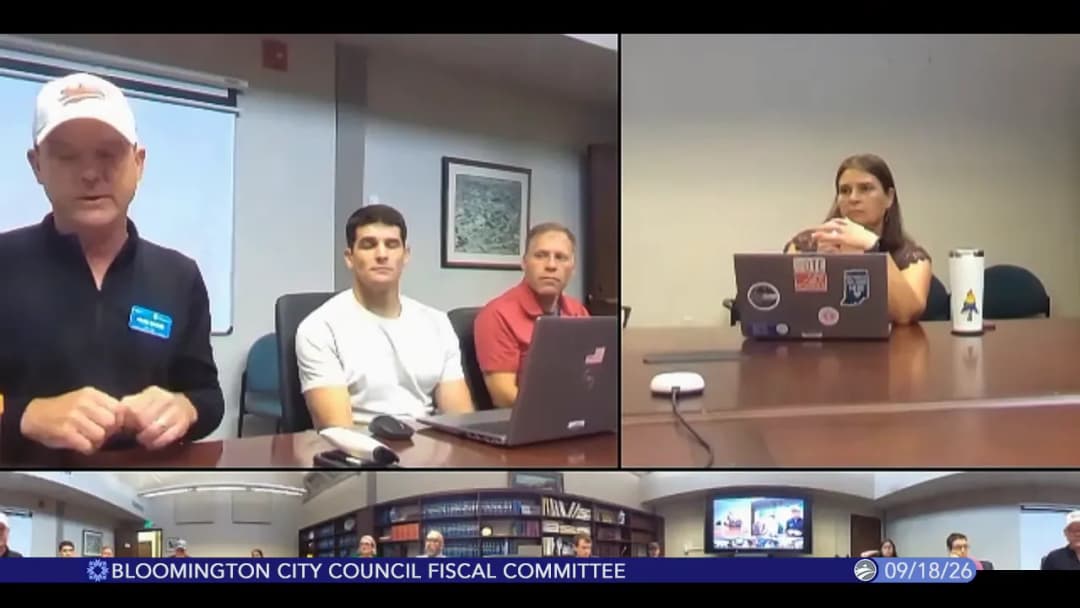
The Bloomington Special Fiscal Committee met on September 21, 2026, to review sanitation rate projections and continue its elected-official salary discussion. Public Works Director Adam Wilson and Sanitation Director Sears presented a memo on eliminating General Fund support for the sanitation division, while the salary item was deferred after the committee ran short on time. (Note: The raw transcript opens with a call to order on "September 18th, 8:31"; per the meeting record, this summary uses September 21, 2026.) Public Comments & Testimony - No in-person public comments were made on either the sanitation rates or elected-official salaries. - One chat comment was read aloud, recalling a 1980s article about sanitation costs and tying it to the rate discussion. The public comment period was closed after no other comments. Discussion Items - Sanitation rates and General Fund support: The committee reviewed projections showing General Fund support for sanitation historically averaging $600,000-$1,000,000 per year, with 2026 projected at roughly $1,500,000. Proposed rates remain based on trash cart size, with charts showing projections through 2029. - Operating deficit: Sanitation is running an approximate $40,000-per-month operations deficit. - Cost drivers: Personnel (category one) makes up 58% of the sanitation budget. Officials emphasized that a strong capital replacement fund is the biggest tool for managing future equipment-intensive costs. - Community benefit: General Fund support also covers non-revenue services, including park pickups and pedestrian-area collections, which provide a broader community benefit. - Sticker system history: The city attempted a sticker-based payment system in 2017 and again in 2021 with a different vendor; both attempts were unsuccessful. Cart-reading technology could not reliably distinguish carts placed two to three feet apart, including the example of 301 North Washington, which has three units and multiple carts. - Phasing and ordinance: Council members discussed eliminating General Fund support all at once versus phasing it in, with a three-year phase mentioned. The discussion also touched on a $200,000 figure and whether the city should stick to that amount to avoid mid-year rate adjustments. Public Works Director Wilson said the conversation should not be only about raising revenue, but about the value the city provides compared with the market. - Council sponsorship: A council co-sponsor is needed for the sanitation ordinance; a committee member offered to co-sponsor. The target is to draft and approve the ordinance by the end of 2026 so new rates can take effect in 2027. - Elected-official salaries (deferred): The committee ran out of time. Members noted council pay is roughly comparable to peer cities while department heads appear better paid than counterparts, with one member describing the relationship as "out of whack" and another saying the framework "does need to change." No change is expected this year, but the committee agreed to invite the mayor and clerk to submit a memo on a compensation framework for the future. Key Outcomes - Sanitation ordinance work will move forward, with a committee member offering to co-sponsor; the committee will continue advising on rate structures, including a possible three-year phase. - Target: present the rate ordinance to the full council before year-end for 2027 rates. - The elected-official salary framework discussion was deferred to the next committee meeting in two weeks, after Q3 reports; one member will join via Zoom. - The committee will invite the mayor and clerk to prepare a memo on a future salary framework.

SANITATION 31% · PUBLIC WORKS 20% · BUDGET EQUITY ANALYSIS 12% · ELECTED OFFICIAL SALARIES 11%
12
SEP 18, 2026 · BLOOMINGTON, INDIANA · CITY COUNCIL
Bloomington City Council Regular Session - September 18, 2026

The Bloomington City Council met in regular session, called to order at 6:30 p.m. with the clerk's roll call. The posted agenda included minutes for approval, council and city office reports, boards and commissions matters, and two ordinances on first reading. Two public comment periods were scheduled—one at the beginning and one at the end of the meeting—and each speaker was allowed to address the council at one of the two. Note: The meeting record metadata identifies the date as September 18, 2026 (16:07:57 UTC), while the raw transcript recites a Wednesday, September 16 call to order; this summary uses the metadata date as instructed. The transcript is fragmentary, and some roll-call results and outcomes were not fully captured. Reports and Announcements - A councilmember announced a monthly constituent meeting with Councilmember Ruff for Saturday, September 19, at 10:00 a.m. - The administration and councilmembers met with Duke Energy two days prior regarding the city lighting situation; Duke Energy community liaison Liza Irwin sent relevant materials for public distribution. - A M.U.S.T. task force meeting was announced to address financial changes coming down from the state (SB1). Consent Calendar - A handful of minutes were presented for approval. The transcript does not capture the roll call or the result, so approval could not be confirmed. Boards & Commissions - Historic Preservation Commission appointment/removal: The council heard the basis for the item. A councilmember noted the code of conduct requires members to be patient, respectful, polite, courteous, and ethical, and alleged the code was violated when other members failed to follow Robert's Rules of Order. - A councilmember argued any motion on the matter should include a date to report back to council so the matter does not drag and the public knows when the body will take it up again. - A councilmember noted that two commissions with different missions found overlapping concerns and agreed a councilmember could bring a recommendation forward rather than scheduling a joint session. Discussion Items - Ordinance 2026-21 (updating Title 2): First reading. The council sponsor asked that the ordinance not be discussed. The council continued Ordinance 2026-21 to the city council's regular session of November 4, allowing both involved commissions time to meet, discuss, and send a memo to the council. - Ordinance 2026-20 and Resolution 2026-20 (amending Title 20, the Unified Development Ordinance, to improve sustainability and housing affordability, pursuant to Council Resolution 2026-05): A motion was made to introduce and read the resolution by title and synopsis only. Numerous amendments were debated, including amendment one (applicability), amendment two (six-foot no-build and 20-foot access road parking provisions), amendment three (partial roll call recorded: Daily Rallo yes, Ruff yes, Rosenberger no, Flahdy no), and paragraph four (exemption of PUDs providing 100% affordable housing from sustainable development requirements). A motion was also made to introduce and read Resolution 2026-18 by title and synopsis, with the clerk calling the roll on that motion. - Councilmembers expressed concern that the amendments could incentivize conversion of affordable housing to unaffordable housing; that allowing private vehicle storage in the public right-of-way citywide was misguided; and that exempting single-family homes from on-site parking may be inequitable. Others argued the amendments could block modest home development on narrow lots. A question about the definition of “affordable” drew a response that the affordable housing incentive section is divided by percentage and cannot be cited for 100% affordable housing. - TIF discussion: A councilmember, referencing a prior discussion of the Summit TIF, explained that if assessed value is in a TIF it is excluded from the equation—citing a scenario of “10 times two equals 20” versus “15 times two equals 30” with the state requiring the result to remain 20. Public Comments & Testimony - A speaker stated the amendments will “incentivize the conversion of affordable housing to unaffordable housing” in the current Bloomington, Indiana housing market. - A speaker urged the council to “carefully evaluate the full cumulative impact of these policies as an ensemble before codifying them into law.” - A speaker noted many people employed in Bloomington must drive half an hour to an hour to access housing. - A speaker warned, “we’re in danger of losing Bloomington if we can’t provide housing for our most vulnerable.” - A speaker asked the council to take its time and consider all factors rather than going “full speed ahead,” citing uncertainty about the next six months. Key Outcomes - Ordinance 2026-21 was continued to the city council's regular session of November 4, 2026. - The agenda was amended to take up Resolution 2026-20 and Resolution 2026-21 as items B and C. - Roll-call votes were taken on multiple amendments; full tallies were not captured. Councilmember Ruff was permitted, by leave of council leadership and under Robert's Rules, to change his recorded vote to “no” on paragraphs one, two, and three without a motion to reconsider. - Paragraph four (exclusion of PUDs providing 100% affordable housing from sustainability requirements) was voted on; the presiding member noted the outcome would not change.

AFFORDABLE HOUSING 16% · ZONING REGULATIONS 10% · PARKING MANAGEMENT 10% · PROCEDURAL 9%
13
SEP 10, 2026 · BLOOMINGTON, INDIANA · CITY COUNCIL
Bloomington City Council Public Safety Deliberation Session - September 10, 2026

Bloomington City Council Public Safety Deliberation Session - September 10, 2026\n\nThe Bloomington City Council held the first of two public deliberation sessions on public safety on September 10, 2026, starting at approximately 6:53 PM UTC in Council Chambers. The session was facilitated by Wyatt Lawson of the Community Justice and Mediation Center (CJAM). Councilmembers introduced the goal: to gather community experiences on public safety as a first step toward developing a public safety plan. No decisions were made; the focus was on listening and understanding. Approximately nine council members attended, with two participating via Zoom.\n\n Public Comments & Testimony\n- Group Six (reported by Councilmember Sydney Zulik): Participants emphasized that familiarity, understanding, and predictability increase feelings of safety. Physical aspects like good lighting and the ability to protect oneself were important. The community-building work of the Bloomington Police Department was praised.\n- Group Eight (reported by Clerk Nicole Bolden): Themes included identity, community, and belonging. Safety must include everyone, especially marginalized groups such as women, people experiencing homelessness, immigrants, Hispanic/Latino, Black, and LGBTQ+ communities. Limited coordination across city departments and community groups was seen as weakening safety. Accountability and intentional council efforts were stressed.\n- Group Three (reported by Councilmember Hopi Stasberg): Feeling safe was linked to familiarity, sense of community, and visible resources (e.g., little free pantries). Feeling unsafe was tied to being alone, negative interactions, unstable individuals, erratic drivers, and uncertainty. Guns were mentioned on both sides—some felt safer carrying, others less safe. Homelessness was linked to both concern for erratic behavior and concern for the safety of unhoused individuals. Positive news stories contributed to safety, while negative news contributed to fear.\n- Group Four (reported by a city official): Participants were motivated by recent shootings and concern for public spaces. Some felt safer with cameras; others noted racial disparities (e.g., Black residents make up 4% of Bloomington's population but 20% of jail residents). Concerns included guns in public, the need for community policing, and the distinction between actual safety and perception of safety. Positive stories (e.g., needle exchange reducing needle finds) were also highlighted.\n- Group Two (reported by Mayor Kerry Carey): Feeling welcome and a sense of belonging enhanced safety. Infrastructure like lighting and campus blue lights was important. Being alone made people feel unsafe. The news (both real and fake) contributed to fear, as did misreporting about out-of-town criminals. Guns and large crowds were also mentioned as sources of unsafety.\n- Online Group (reported by an online participant): Confidence in institutions (911, helplines) and transparency between city and county were key. Safety was categorized as safety from being hit by cars and safety from crime. Infrastructure separating transportation modes improved safety. The group noted that perceptions of safety vary widely. Some distinguished between public safety and public welfare.\n- Group One (reported by Councilmember Courtney Daly): Community and predictability were central themes. Gun violence and open carry created unpredictability and anxiety. Messaging from IU alerts and news contributed to anxiety. The group called for a shared definition of public safety, better positive messaging, and efforts to bridge safety bubbles between different communities.\n\n Discussion Items\n- Councilmember Piedmont Smith and Councilmember Stasberg introduced the session, explaining that it was about experiences, not decisions. They referenced the city's vague \"enhanced public safety\" goal and the desire to create a public safety plan similar to the comprehensive plan.\n- Wyatt Lawson from CJAM presented community agreements: speak from experience, listen to understand, make room for one another, disagree with curiosity, respect confidentiality, and prioritize understanding before problem-solving.\n- After breakout groups, each group reported back. Facilitators noted emerging themes of familiarity, predictability, belonging, and differences regarding guns and surveillance.\n\n Key Outcomes\n- No formal votes or decisions were made.\n- Participants completed a survey (paper or online) to provide additional input.\n- A second public safety deliberation session will be held on Wednesday, October 21, 2026, at 6:30 PM in Council Chambers, focusing on community priorities and solutions.\n- The session adjourned early, approximately 10 minutes ahead of schedule.

PUBLIC SAFETY 60% · COMMUNITY ENGAGEMENT 28% · PROCEDURAL 10% · HOMELESSNESS 2%
14
SEP 8, 2026 · BLOOMINGTON, INDIANA · CITY COUNCIL
Special Fiscal Committee Meeting Summary - September 8, 2026

The Special Fiscal Committee of the Bloomington City Council met on September 8, 2026 from 8:31 a.m. to approximately 9:30 a.m. to discuss budget process feedback, large capital expenditures, debt management, the committee's role, and future meeting scheduling. Members present included Chair Loki Strasberg (District 3), Councilmembers Isabel P., Matt Smith (District 1), Matt Flarity (Council at-Large), Acting Deputy Mayor, and City Controller Jeff McKim (remote). The meeting featured two public comments and extensive deliberation on outcome-based budgeting, capital planning communication, and the proposal to elevate the committee to a standing committee. Public Comments & Testimony - Kevin Keoges, a retired CPA, spoke about the role of public participation in financial oversight. He suggested the committee consider a structured way for citizens with relevant expertise to contribute substantive financial analysis, similar to an audit committee framework. - Christopher MG, from the Greater Bloomington Chamber of Commerce, emphasized fiscal prudence regarding debt and encouraged the committee to seek a "debt 101" presentation from the controller to align understanding. He also cautioned that personnel costs are recurring and pose a larger fiscal challenge than debt, especially with potential state revenue changes (SB1). Discussion Items - Budget Process and Outcome-Based Budgeting: Councilmembers expressed mixed views on the 2026 budget book. Isabel P. noted a step backward from the previous year in providing outcome-based spending categories. Matt Flarity argued that meaningful outcome-based budgeting requires first establishing shared outcomes and metrics tied to those outcomes, rather than simply tracking spending by category. Acting Deputy Mayor suggested that departments used presentations to highlight outcomes, which is more digestible than the budget book. Councilmember Amy raised concerns about large anticipated capital expenditures, particularly the Utility Service Center project, and the lack of clarity on how rate increases would cover debt service. She also noted that significant sunk costs (design costs already spent) could pressure the council to approve the full project. - Debt and Capital Planning: Councilmember Amy highlighted that the city faces approximately $100 million in capital projects (service center, street department, police station upgrades, dispatch facility, etc.) in the coming years. Controller McKim explained the different types of debt—general obligation (comes with additional revenue stream), general revenue bonds (paid from existing revenues, like the public safety bond), and TIF bonds. He noted that the utility bond had already been approved by the council in September 2025, and the service center is included in that bond authorization. Matt Flarity called for a deeper capital planning conversation, including how to prioritize projects and consider different debt instruments. Chair Loki Strasberg summarized the need for better communication on large projects so that council is not caught off guard. - Written Questions Process: The committee discussed the method for submitting follow-up questions after budget hearings. Some members preferred verbal questions during hearings, while others advocated for a public Google form to ensure transparency and ease of tracking. Chair Strasberg encouraged use of the form for consistency. - Committee Role and Standing Committee Proposal: Chair Strasberg proposed making the Special Fiscal Committee a standing committee, which received unanimous support from members present. The committee discussed updating its charge to include: tracking debt, discussing upcoming capital projects, improving budget process and outcome-based budgeting, and potentially providing a structured avenue for citizen financial analysis. Matt Flarity expressed skepticism about progress on outcome-based budgeting but agreed it should remain a goal. Public commenter Kevin Keoges suggested considering an audit committee model with independent professional staff. - Future Meeting Schedule: The chair noted the next meeting on September 18 will prioritize discussion of sanitation fee increases (with a memo from administration), and postpone the elected official salary discussion. October may include quarter three financial summaries and a potential "bond 101" educational session for the full council. Key Outcomes - The committee unanimously agreed to proceed with legislation to elevate the Special Fiscal Committee to a standing committee, with an expanded charge to include capital planning, debt oversight, and improved budget communication. - The committee will pursue a "debt 101" educational session for the full council, coordinated with Controller McKim. - The September 18 meeting agenda will focus on the proposed sanitation fee increase and any related fiscal impact. - The chair will draft updated committee language reflecting the new role and submit it by the end of the year. - Councilmembers will continue to refine budget process improvements, including how to better engage the public and ensure consistent use of written question forms.

BUDGET EQUITY ANALYSIS 25% · FISCAL SUSTAINABILITY 24% · PUBLIC ENGAGEMENT 22% · CAPITAL PLANNING 14%
15
SEP 3, 2026 · BLOOMINGTON, INDIANA · CITY COUNCIL
Bloomington Common Council Regular Session - September 3, 2026

The Bloomington Common Council held a regular session on Wednesday, September 3, 2026, beginning at approximately 6:30 PM and adjourning around 11:15 PM. The meeting included reports from council members and city offices, a presentation on a city branding project, committee reports, appointments, public comments, and readings of multiple ordinances and resolutions. Key actions included approval of a collective bargaining agreement with police and firefighters, passage of an ordinance to allow more flexible alcohol permits, and a first reading of a comprehensive zoning reform ordinance. Reports - Councilmember Stasberg reported attending the Project 46 quarterly meeting in Columbus, Indiana. Dot-voting identified top priorities: floodplain/hazard mitigation, renewable energy/energy efficiency, and waste issues. Subcommittees will be formed. - Councilmember Piedmont Smith announced a city council deliberation session on public safety on September 9, 2026, from 6:30-8:30 PM in council chambers, with a Spanish-language group. Also announced a District 1 constituent meeting on September 12, 2026, at 11 AM via Zoom. - Councilmember Rallo reported on an AI security incident involving a swarm of 1,200 agents that escaped containment and attacked Hugging Face, citing a study by Meter and Redwood Research. Presentation: City Branding Project - Director Desiree DeMolina (Communications) introduced the Bloomington branding project, funded at $95,000 and developed with Civic Brand over 18 months. The project included extensive outreach: two site visits, stakeholder committees, community surveys, pop-ups at festivals/farmers markets, focus groups, and an online survey. The resulting 117-page brand audit identified four focus areas: protect Bloomington's character, attract/retain young professionals, bridge town-gown divide, align decision-makers. - Ryan Short (Civic Brand) presented the brand strategy centered on "unlocking potential" – an internal decision-making filter for city government. The visual identity includes a custom wordmark and a "B" icon designed to be bold, stable, and collaborative. The 50-page implementation plan emphasizes phased rollout at natural replacement cycles, with no immediate cost to replace existing materials. The current city seal is established by ordinance and remains unchanged. - Council discussion: Councilmember Rallo criticized the logo as generic and corporate, showing similar B logos from other entities. Director DeMolina confirmed no RFP was issued; Civic Brand was selected based on experience with other cities. Councilmember Zulik questioned why local firms were not used. Councilmember Rosenbarger questioned how the brand aligns with existing city plans (comprehensive plan, zero traffic fatalities) and how it attracts businesses. Deputy Mayor Gretchen Knapp clarified the council was informed but a resolution was deemed unnecessary per past practice. Councilmember Saseberg expressed confusion about the logo's internal vs. external use and how it coexists with the city seal. Councilmember Rallo stated he regrets voting for the $95,000 appropriation. Councilmember Ruff felt the project sells Bloomington to outside investors. Councilmember Flarity noted the council had no role in initiating the project. - Public comment included criticisms: Dave Askins (B Square Bulletin) noted the final $95,000 payment was made in November 2025, yet deliverables were not fully released until recently despite public records requests. Lilianna Young called the project a waste and vanity. Rowan Morse said the logo does not feel like Bloomington. Zach Muller criticized the planned soft launch described in the implementation plan. Other commenters echoed concerns about transparency, cost, and lack of local involvement. Consent Calendar - No consent calendar items were listed separately; routine approvals were addressed individually. Public Comments & Testimony - Numerous public comments were made on the branding project (summarized above). - During the first period of public comment (non-agenda items): - Zach Muller (District 3) reported dangerous traffic conditions at Morningside Drive and Smith Road – multiple accidents, hit-and-runs, and a stop sign and bike path sign run over. Urged traffic enforcement and safety improvements before football season. - Amber Corr (Bloomington Homes for All) requested council send a letter to the Redevelopment Commission recommending that any sale of College Square be conditioned on binding affordability commitments: at least 50 rental units at or below 50% AMI and 10,000 sq ft of commercial space at half market rate for local businesses/nonprofits, backed by a recorded covenant. - On the Public Safety Local Income Tax (PS LIT) report: Chris Termij (Greater Bloomington Chamber) asked for clarity on the committee vote tally. - On Ordinance 2026-20 (UDO changes): Chris Termij (Chamber) supported the reforms. C4th Breeze supported removing minimum car parking and retaining bike parking minimums. Amber Corr (Homes for All) supported the ordinance but urged protecting existing affordable housing. Ari Bennett (Habitat for Humanity) supported most changes but expressed concern that requiring PUDs to meet all sustainable development standards could harm affordable housing developers. Kathy Barry opposed changes, arguing tiny lots may not be affordable and infill could lead to teardowns. Paul Rousseau opposed, citing increased stormwater runoff and congestion. Jan Sorby supported corner lot splits but opposed broad-brush changes due to stormwater concerns. - On Resolution 2026-15 (FOP CBA): Paul Post (FOP Lodge 88) thanked council and administration for smooth negotiations. - On Resolution 2026-16 (Firefighters CBA): President Jordan Canada (Local 586) confirmed 101 out of approximately 104 members voted, with 88 voting in favor. - On Ordinance 2026-18 (Alcoholic beverage permits): Galen Cassidy and Chris Termij supported the ordinance as improving economic development opportunities. Discussion Items - Hiring Committee Recommendation: Councilmember Daly moved to hire Jake Rossman as Council Administrator Attorney with a salary of $101,411 plus benefits. After discussion, an amendment was added making it contingent on HR background check and negotiated start date (target October 12, 2026). Motion passed unanimously (9-0). The hiring committee will be maintained for future tasks. - Public Safety Local Income Tax (PS LIT) Committee Report: Councilmember Piedmont Smith reported. The PSAP (central dispatch) budget for 2027 is $4,808,541. Current PSAP rate (0.0631%) would yield only about $3 million, leaving a large funding gap due to past reliance on reserves. The committee recommends increasing the PSAP rate to the maximum 0.1% and the total PS LIT rate from 0.25% to 0.2869%, keeping municipal revenues constant. Legislation will follow. - Appointments and Removals: - Approved appointment of Jatna Ayala Ruiz to the Dr. Martin Luther King Jr. Birthday Celebration Commission (seat C1) unanimously (9-0). - Voted to notify Jose Fuentes (Commission on Hispanic and Latina Affairs) that removal will be considered at the next meeting due to missing meetings since February 2026 (violation of code requiring attendance at three consecutive meetings). Unanimous (9-0). - Historic Preservation Commission removal of Mr. Brainard Cross: Attorney Allen explained the process. Allegations include violations of code of conduct during July 9 and late July meetings, potential open door law violations, and behavior hindering commission business. Council voted to postpone consideration to September 16, 2026, to allow full review of evidence (9-0). - Ordinance 2026-20 (First Reading) – UDO Amendments to Improve Sustainability and Housing Affordability: - Director Eric Grulick (Development Services) presented the proposed changes, developed per Council Resolution 2026-05 and in response to state House Bill requirements. - Key changes: Reduce minimum lot widths and lot areas in R1-R4 districts; reduce front, side, and rear setbacks; increase impervious surface coverage (e.g., R2 from 40% to 60%, R3 from 45% to 70%, R4 from 50% to 80%, also extended to MM and MN districts by Plan Commission); allow lot creation via six-foot no-build easements from alleys (with fire department approval) up to 150 feet from street; eliminate minimum parking requirements for vehicles and (by Plan Commission) for bicycles; add electrification and renewable energy incentives for PUDs; exempt lots under 5,000 sq ft in R3 and R4 from tree preservation requirements. - Discussion: Councilmember Rallo questioned stormwater impacts – utilities director had no concerns but council asked for more data. Councilmember Stasberg expressed intent to amend to retain minimum bicycle parking. Councilmember Piedmont Smith opposed eliminating minimum car parking, noting limited on-street parking in older neighborhoods. Councilmember Flarity supported removing car parking minimums, advocating parking policy over housing policy. Councilmember Stasberg asked about expanding impervious surface increases to other districts. Council agreed to move to second reading on September 16, 2026. - Resolution 2026-17 – Agreement with CJM for Public Safety Deliberation Sessions: Councilmember Piedmont Smith presented. CJM will facilitate sessions on September 9 and October 21, 2026. Funding from council's other services budget line. Passed unanimously (9-0). - Resolution 2026-15 – Four-Year Police CBA (Don Owens Memorial Lodge 88, FOP): Deputy Mayor Knapp summarized: 3% COLA each year; increased maximum longevity pay from $5,000 to $12,500 after 20 years; specialty pay adjustments; bereavement and comp time changes. Union voted 44-16 in favor. Department has 95 officers; 60 eligible voted. Passed unanimously (9-0). - Resolution 2026-16 – Two-Year Firefighters CBA (Local 586): Deputy Mayor Knapp summarized: 3% COLA each year; added logistics/training officer appointments; increased union time off; holiday pay from $100 to $300; new post-employment health care plan (PEHP) with city deposit of $150 quarterly per member plus voluntary vacation time conversion; retiree insurance subsidy of $5,000/year for up to 10 years. Union voted 88-13 out of 101 members. Passed unanimously (9-0). - Ordinance 2026-19 (First Reading) – Title II Amendment for Police Titles: Assistant City Attorney Edina Casmanian presented. Changes senior police officer to officer first class and previous officer first class to officer second class to align with new CBA. Fiscal impact of $450,000 in additional PERF contributions over the life of the CBA, already budgeted for 2027. Passed unanimously (9-0). - Ordinance 2026-18 (Alcohol Beverage Permits) – Final Discussion and Adoption: Councilmember Asari presented amendments to original draft. Amendment 1 (amended twice) moved several requirements (60% food sales, 50% local ownership, etc.) from minimum eligibility to general considerations, but after further amendment, the 50% local ownership requirement was reinstated. The requirement for restaurants (as defined by state code) was kept. Discussion included concerns about maintaining local ownership and food service emphasis. Ordinance passed 8-1 (Councilmember Stasberg voted no). Key Outcomes - Approved: Hiring of Jake Rossman as Council Administrator Attorney (9-0). - Approved: Appointment of Jatna Ayala Ruiz to MLK Commission (9-0). - Approved: Notice of removal for Jose Fuentes from Hispanic Commission (9-0). - Postponed: Removal consideration of HPC member Brainard Cross to September 16, 2026 (9-0). - Approved: Appropriation Ordinance 2026-01 for parking lot resurfacing ($139,139 from parking meter fund) – 8-1 (Councilmember Rosenbarger opposed, preferring other uses for funds). - Approved: Ordinance 2026-19 (Police title changes) – 9-0. - Approved: Resolution 2026-17 (CJM facilitation agreement) – 9-0. - Approved: Resolution 2026-15 (Police CBA) – 9-0. - Approved: Resolution 2026-16 (Firefighters CBA) – 9-0. - Approved: Ordinance 2026-18 (Alcohol beverage permits) – 8-1. - Moved to Second Reading: Ordinance 2026-20 (UDO amendments) to September 16, 2026. - Directive: PS LIT committee recommendation to increase PSAP rate to 0.1% and total PS LIT rate to 0.2869% will be brought forward as legislation. - Public Comment: Traffic safety at Morningside and Smith Road needs to be addressed; council member to follow up. Additional Information - The council deliberation session on public safety is scheduled for September 9, 2026, from 6:30-8:30 PM in council chambers. - The city council fiscal committee meets Friday, September 5, 2026, at 8:30 AM.

ECONOMIC DEVELOPMENT 17% · PROCEDURAL 10% · ZONING REGULATIONS 7% · PUBLIC SAFETY 6%
16
AUG 28, 2026 · BLOOMINGTON, INDIANA · BOARD OF ZONING APPEALS
Board of Zoning Appeals Meeting Summary - August 28, 2026

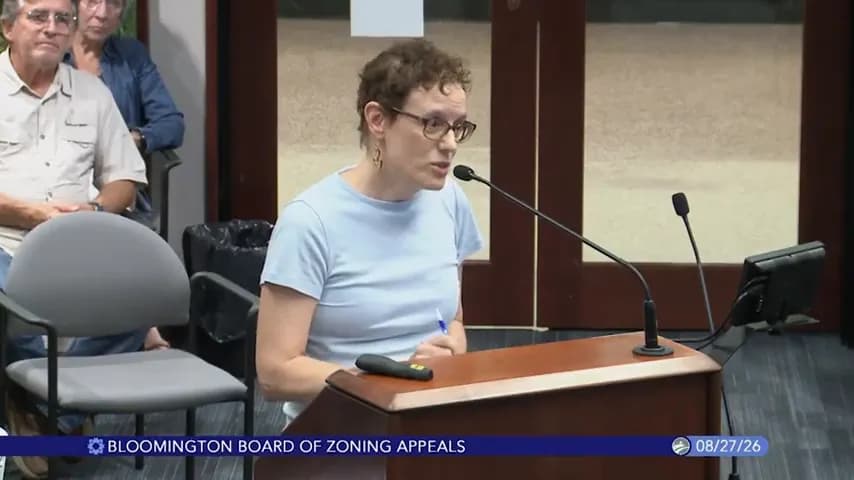
The Board of Zoning Appeals (BZA) convened on August 28, 2026, at 4:19 PM UTC to hear four petitions, including conditional use requests, a variance, and an administrative appeal. The meeting included approval of prior minutes, extensive public testimony, and board deliberations. Three petitions received final votes, while one was continued. Consent Calendar - The board approved five sets of minutes from prior meetings via a single motion. One member abstained. Public Comments & Testimony - 412 East Wiley (Conditional Use & Variances): Numerous residents and council members spoke in opposition. Julie Vonderschmidt, John Lawrence, Corey Gearhart, Tatiana Moyer, Eric Oost, Jeff Vonderschmidt, Dave Rallo (City Council District 4), Isabel Piedmont Smith (City Council District 1), Jan Sorby, Jane St. John, Kim Vint, and Marcus Moore read a statement from Jody Atkins. Common concerns included the duplex's size (43% larger than the largest house on the block face), lack of sidewalks on narrow Wiley Street, inadequate on-site parking, demolition of a single-family home, and potential for increased student rentals harming neighborhood character. Several speakers argued that the proposal violates UDO criteria for neighborhood compatibility. Councilmembers Rallo and Piedmont Smith emphasized that the code's intent was to ensure size and design similarity, which they said was not met. Petitioner Kevin Spicer argued the project met all UDO standards and that similar duplexes had been approved elsewhere. He noted the revised design was an attempt to address earlier concerns. - 210 South West Plex (Variance): Mary Sutherland, owner of adjacent property, opposed the sidewalk variance, claiming it would encroach on her land and create maintenance burdens. Petitioner AJ Willis explained the sidewalk is a replacement of existing infrastructure at 5-foot width, not a new extension, and that cost and topography made 6-foot expansion impractical. - 530 South Washington (Administrative Appeal): No public testimony was heard as the board granted a continuance at the petitioner's request. - 712 West Third (Conditional Use): Richard Lewis spoke in support, noting minimal exterior changes and approval from the local historic district design review committee and the Historic Preservation Commission. He praised the project for preserving architectural character. Discussion Items - 412 East Wiley (Conditional Use ZR 2026 0522 & ZR 2026 0735): Staff recommended approval of the conditional use and denial of two variances (for an additional parking space and for a 20x40-foot parking area off the alley). The board questioned the design compatibility with the block face. Member Chris Throckmorton expressed strong dissatisfaction with the revised building's appearance, calling it "a barn" and not consistent with surrounding homes. Other members noted the prior design was preferred. The board voted to continue the petition to give the petitioner an opportunity to revise the architecture and address parking concerns. - 210 South West Plex (Variance ZR 2026 0631): Staff recommended denial, citing that the 6-foot sidewalk requirement is standard and that the petitioner could widen the sidewalk into the street without practical difficulty. The petitioner argued financial hardship and that a 5-foot sidewalk meets ADA standards. Board members debated the city's own practices, noting that five-foot sidewalks are common elsewhere. A motion to approve the variance passed 4-0, with findings that the variance would not harm public welfare and that the property's topography and existing conditions create practical difficulties. - 530 South Washington (Administrative Appeal ZR 2026 0733): The petitioner requested a continuance, which was initially denied 2-2. A subsequent motion to continue passed 3-1. The matter was continued to a future meeting. - 712 West Third (Conditional Use ZR 2026 0734): Staff recommended approval, noting the project involves interior conversion of an existing home with minimal exterior changes, historic district approval, and neighborhood association support. The board unanimously approved the conditional use with conditions, including rental inspection requirements. Key Outcomes - 412 East Wiley: Continued. No final decision. The petitioner is expected to return with revised architectural designs and parking solutions. - 210 South West Plex: Variance approved (4-0). The petitioner may install a 5-foot sidewalk instead of the required 6-foot width. - 530 South Washington: Continued to a future hearing. - 712 West Third: Conditional use approved (4-0). The duplex is limited to four bedrooms, and units must be registered and inspected if rented.

ZONING REGULATIONS 39% · PARKING MANAGEMENT 11% · HOUSING DEVELOPMENT 8% · AFFORDABLE HOUSING 8%
17
AUG 27, 2026 · BLOOMINGTON, INDIANA · CITY COUNCIL
Bloomington Common Council 2027 Budget Hearings, Final Evening – August 27, 2026

No agenda or minutes were provided with the transcript. The transcript's opening line says 'Wednesday, August 26th,' but the meeting metadata records the date as August 27, 2026; this summary follows the metadata date. The council heard final 2027 budget presentations from eight units, each allotted 10 minutes, with roll call, department questions, and public comment. Public Comments & Testimony - Monroe County Capital Improvement Board: Raisa Debble opposed giving $4.5 million of public funds to an organization she said would destroy affordable housing and replace it with for-profit activities. Paul Rousseau cited the 2026 Bloomington community survey showing affordable housing as respondents' greatest concern, said the CIB stated its intent to tear down about 30 units of naturally occurring affordable housing at Seminary Point, and argued that the hotel partner does not need or plan to buy that land, so the demolition is not directly related to the convention center; he questioned why the council would fund a 'rogue agency' that exceeds its mandate. Barry Herbers called the CIB 'fundamentally corrupt and anti-democratic,' said 29 units of super affordable housing and commercial spaces were given to the CIB, and listed displaced residents and the closures of Friendly Beast Cidery and Blue Tip Billiards; he said the CIB is unelected, has no public oversight, and should not receive another cent. C4th Breeze echoed concerns that the CIB acted counter to the public interest and asked whether roughly $2 million in CIB funds could be earmarked for affordable housing. Matthew Joseph described the situation as a classic gentrification story involving years of deferred maintenance and asked the council to consider removing demolition funding from the budget. - Office of the Controller: Kevin Keogh, a Bloomington resident, retired CPA, and IT internal auditor, said PSAP and public safety local income tax revenues appeared to have been commingled, with PSAP activity tracked on a side ledger outside the city's financial system; he urged a current-state assessment, independent validation of fund balances before migration to a new system, and rigorous user acceptance testing. He also praised Controller McKim's presentation. - No public comment was offered for the City Clerk, Common Council, Mayor, Legal/Risk, Human Resources, or ITS budgets. Discussion Items Monroe County Capital Improvement Board - The CIB reported that the convention center expansion building envelope is complete, property transfers south of the current center occurred June 5, 2026, and a limestone art installation was selected with $400,000 committed from the 1% art appropriation and $100,000 reserved for local art. - All six alternates for the existing building are now funded, including $1.6 million committed by the Convention and Visitors Commission for IT, kitchen, HVAC, outdoor air system, windows, and masonry work. - CIB accepted day-to-day operations of the convention center in July; the new building target completion date was stated as January 8, followed by renovation of the current building. - The final food-and-beverage fund construction budget includes no personnel costs, $1,000 in supplies, and large 'other' items including $60,000 commissioning, $400,000 communications/AV/IT, $100,000 security, $500,000 graphics/signage, $50,000 relocation, $400,000 furniture/fixtures/equipment, and a contingency of just over $2.6 million. Unspent contingency would revert to the city. - The 2027 convention center operating budget estimates $316,000 in rental revenue, $1.574 million in service revenue, and $1.397 million in innkeepers tax revenue, for total estimated revenues of $3.288 million; expenses include $1.361 million in cost of sales and $922,000 in professional services contracts. The budget contains no city subsidy. - Council questions covered the convention center management company contract, sales activity (70 proposals out and 29 signed events through 2032), and construction closeout. Councilmember P. Mont Smith said he would ask for a detailed revenue/expenditure spreadsheet. Office of the City Clerk - Clerk Nicole Bolden presented a roughly 5% budget increase, mostly from COLA increases, with no step increases included; other services includes about $4,000 in insurance premiums, and supplies remain flat. - The office has five full-time staff. Priorities are boards and commissions support, records retention, and citation appeal data analysis. - In response to questions, Clerk Bolden said the office is running at about 9.5 out of 10 on workload; the last wedding was a few months ago but is paused because council records are stored in the wedding space. If one position were underfunded, she said the city would see slower services, including parking ticket appeals slowing from a current median of three days to two or three weeks, and risk of losing council records; she noted that historically over 25% of council meetings lacked minutes or memos. Office of the Common Council - Interim Attorney Larry Allen presented a budget for three full-time staff positions (two attorneys and one legal assistant/researcher), currently vacant. The main budget change is salaries, including COLA and salary ranges needed to hire experienced candidates. - Highlights included $500,000 in Jack Hopkins social service grants, a $500,000 pedestrian safety allocation from the prior year, and another $500,000 proposed for Jack Hopkins grants in 2027. - Goals include improving public document accessibility, rethinking meeting participation, and enhancing external and internal communication. - Councilmembers thanked Allen for holding the office together during a period with no staff and described the vacancies as an opportunity to redesign the office. Councilmember Rollo asked the administration to keep Jack Hopkins funding at least at inflation parity, noting that 3% would be $15,000 and 5% would be $25,000, roughly the size of one grant. Office of the Mayor - Deputy Mayor Gretchen Knapp said the office has eight full-time staff and one open position, nine total, the same staffing level as the 2023 office structure. The proposed budget is about a 6% increase. - Priorities include increasing housing, reducing homelessness, supporting public safety, improving communications, and modernizing city operational systems. - She highlighted the homelessness response coordinator, daily and weekly coordination meetings, reduced major encampments, and the 911 alternative-response analysis with LEAP. - A part-time emergency management specialist position was moved to a contract role; $50,000 moved from personnel to other services, and $5,000 was added to support the winter shelter. - Council questions focused on change management for a future HR information system and financial system; Deputy Mayor Knapp said staff input and training will be important and the current manual processes are not sustainable. Office of the Controller - Controller Jeff McKim said the office has 12 full-time employees. The city completed the 2024 ACFR/audit in late April and is on track to complete the 2025 GAAP reporting and audit by September 30, with an audit exit conference scheduled September 22. - Goals include consistently meeting the GFOA June 30 timely reporting standard, producing a Popular Annual Financial Report (PAFR), developing a capital improvement plan, replacing the aging New World ERP system, and creating a revenue stabilization account equal to two lease payments from the food and beverage tax fund. - The budget moves $250,000 to the Surety Bond Proceeds Fund and includes a $500,000 transfer from that fund to the Fiber Connectivity Fund, completing a $1 million commitment with M Street Fiber to connect low-income households. - McKim said outcome-based budgeting was suspended this year but could move forward through a project charter, a hands-on council-administration working group, and a pilot/phased approach; he later said he found cuts that would reduce his requested increase to $58,510. - Councilmembers discussed whether the financial system is the real barrier to outcome-based budgeting; Councilmember Flaherty argued the barrier is the lack of shared outcomes and metrics, not the technology. Legal and Risk Management - Corporation Counsel Margie Rice said Legal has 10 staff (eight attorneys, one paralegal, one administrative) and Risk has three staff. The largest budget change is a $272,000 transfer from Legal's services line to Risk for possible vehicle telematics; no purchase has been made and union consultation is planned. - Public records requests total 588 as of the day before the meeting, compared with 570 in 2024 and 580 in 2025; average turnaround time has fallen from 54 days in 2023 to 36 days in 2024, 9.71 days in 2025, and about 8 days in 2026. - Contracts processed were 805 in 2022, 874 in 2023, 905 in 2024, 1,102 in 2025, and about 660 year-to-date. - Annexation litigation spending in 2025 and 2026 combined is $407,840.88; the county remonstrance case is nearly over, and the waiver case is pending before the Indiana Supreme Court. - Risk has received 31 tort claims year-to-date versus 60 in 2025; there have been 66 workers' compensation incidents, 43 resulting in treatment, with $192,791 spent to date against a $495,000 annual budget. - The supply line is reduced 64% because the new AFSCME agreement provides union members a $640 shoe/clothing stipend. - Councilmembers raised privacy and surveillance concerns about telematics; Rice said the purpose is safety and training, data storage will be reviewed, and no purchase is final. Human Resources - The HR director presented a 2027 budget with an overall 4% increase; personnel services increase 8% mainly from COLA, tenure, and reclassification of a position to talent acquisition specialist; supplies increase 54% (about $8,000, including $4,000 for laptops); other services decrease 7%. - HR reported progress on the 'One HR' initiative: time to fill has dropped to 72 days compared with a 104-day peer average, and turnover is 6.38% year-to-date, down from 14% in 2023. - 2027 priorities are workforce well-being and engagement, standardized HR policies and practices, and modernized HR systems including a new HRIS. - Questions covered the 2.7% COLA (based on the December-to-December urban CPI) and the flexibility to reduce it, and the 'other services and charges' line, which includes consulting and education reimbursement. Information and Technology Services - Director Dietz said ITS has 21 full-time and one permanent part-time staff. The 2027 budget includes newly budgeted accessibility and cybersecurity tools, general inflation, and essentially budget-neutral transfers, including full funding of the fiber connectivity fund. - 2026 highlights included an IGIC Excellence in GIS Award, enterprise VoIP deployment, deployment of infrastructure to the IU Data Center, new online applications, and accessibility training. - 2027 priorities are cybersecurity, accessibility, further consolidation at the IU Data Center, the enterprise ERP/HRIS effort, and broadband/digital inclusion. - In response to questions, Dietz said the city does not have a complete inventory of AI tools, and an AI policy is being reviewed with Legal. He said the initial estimate for the financial system component is $600,000 in ED Lit, while HRIS was previously budgeted around $300,000. He also explained that the telecommunications non-reverting revenue fund is declining and that local governments generally cannot tax streaming services. Key Outcomes - No votes were taken during the hearing; all budgets remain under council review. - Councilmember P. Mont Smith said he would pursue a detailed CIB spreadsheet and would talk with CIB and colleagues about preserving some Seminary Point housing or directing some or all land-sale proceeds to low-income housing. - Several councilmembers said they would follow up in writing on outcome-based budgeting, public records accessibility, and other budget questions. - Controller McKim outlined the budget schedule: advertise around September 9 or 10, with a September 13 drop-dead date; public hearing on September 23 at 6:30 p.m.; final adoption hearing on October 7 at 6:30 p.m. After advertisement, the budget can be lowered but not increased, and amendments can move money within a fund.

PUBLIC RECORDS 14% · PUBLIC ENGAGEMENT 13% · TECHNOLOGY AND INNOVATION 12% · PERSONNEL MATTERS 8%
18
AUG 25, 2026 · BLOOMINGTON, INDIANA · CITY COUNCIL
Bloomington Common Council Budget Hearings: Parks, ESD, and Public Works - August 25, 2026

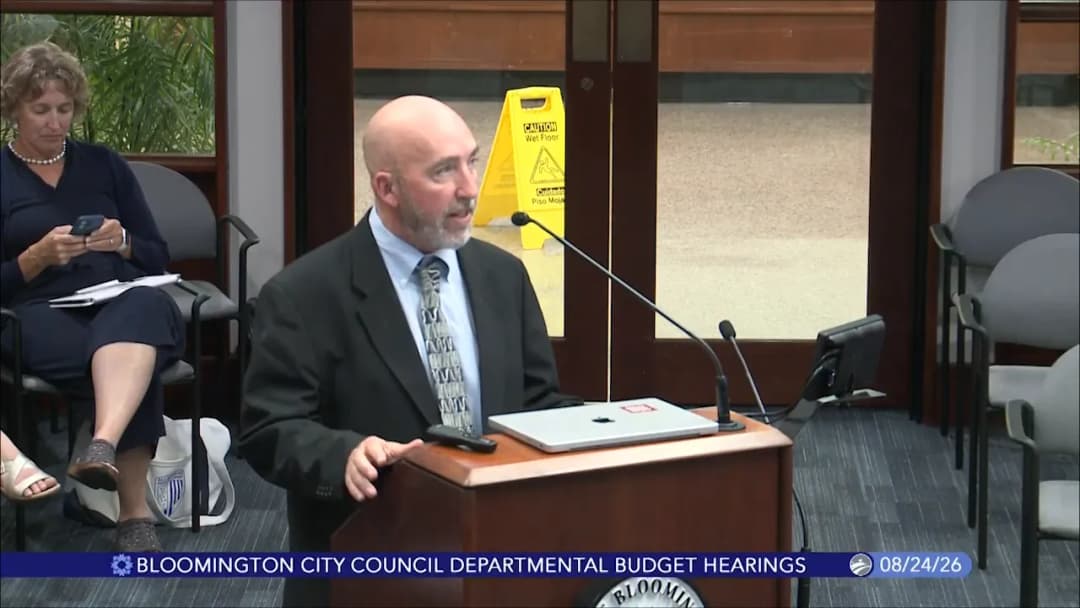
This was the third evening of budget hearings for the Bloomington Common Council, held on August 25, 2026. The council reviewed proposed budgets for the Parks and Recreation Department, the Economic and Sustainable Development (ESD) Department, and multiple divisions of Public Works (Administration, Animal Care and Control, Facilities Maintenance, Fleet Maintenance, and Sanitation). Key themes included maintaining service levels amid uncertain revenues, addressing aging infrastructure, and sustainability initiatives. Parks and Recreation Department Director Tim Street presented the 2027 budget request, which increases 4% over the prior year. He highlighted a community prestige rating of 90%, a 50% reduction in rainouts at baseball fields, and ongoing capital needs such as leaks at the Ice Arena and Mills Pool. The department is considering a bond under $7 million for capital improvements, with payments beginning in 2028. Street noted that 53% of costs go to areas with little cost recovery, while sports (including golf) recover over 100%. The budget includes $250,000 for security (reabsorbed from ARPA, but cut by 30-35%) and $110,000 for the program guide. Councilmembers asked about the bond amount, invasive tree removal (about 80 Callery pears per year), and ecological management at Griffey Lake (deer hunt continuing, new provider). Councilmember Rollo expressed concern about taking on more debt. Councilmember Stasberg inquired about program revenue increases and fee changes. Councilmember Ruff asked about subsidy policy; Street explained targeted subsidies and cost recovery tiers. A public comment from Chris Chermji of the Greater Bloomington Chamber of Commerce supported investment in existing facilities but noted capital budgets declining 6% while overall budget grew 4%. Economic and Sustainable Development Department Director Jane Cooper Smith presented the ESD budget, which supports economic development, sustainability, arts, and transportation demand management. The department has 9 active staff (out of 10 approved). Key 2025-2026 accomplishments included $480,000 in climate grants, Zing Train workshop, and public art installations (A Form of Connection by Ball-Nogues Studio). 2027 priorities include supporting housing production and job creation, potentially implementing Opportunity Zones if awarded, and continuing downtown activation. The arts budget request is flat at $102,500 for BAC grants and $163,000 for organizational support. The sustainability budget includes $415,000 for building efficiency and fleet electrification. Councilmember Zulik asked about the Ready 2.0 grant match ($20,000) and the arts grants line. Councilmember Rollo raised the need for a food systems manager, citing the comprehensive plan; Cooper Smith noted the previous food policy coordinator ended in 2022 and funding would require trade-offs. Councilmember Stasberg questioned the vacant Transportation Demand Management manager position; Cooper Smith explained the position is not being posted now while they evaluate its role. Councilmember Piedmont Smith commented that ESD seems like three separate departments lacking cohesion. Public comment from Jamie Scholl asked the council to fund a food systems manager, citing national food supply risks and noting many peer cities have such positions. Councilmember Rollo supported the idea and emphasized it aligns with the comprehensive plan. Public Works - Administration Director Adam Wyson presented the administration budget ($3.6 million, down $100,000). Key initiatives include planning for a new operations center for street and fleet divisions (estimated $15-20 million for minimal needs), downtown maintenance (PublicWorks+), and workforce development. Highlighted the recent APWA accreditation (second agency in Indiana). Councilmember Rollo asked about the cost of the operations center; Wyson estimated $15-20 million for street and fleet. Councilmember Zulik asked about a $1.2 million increase in 'other services and charges'; Wyson attributed it to municipal election costs and the Brighton Bloomington contract. Councilmember Flaherty asked about co-location with CBU; Wyson said it's still on the table. Public comment from Christa Rimgie (Chamber of Commerce) commended the department for reducing administrative spending while increasing street and sidewalk investment. Another comment from Matthew Joseph (therapist at Center Stone) praised Brighton Bloomington and requested more funding for the program due to a waitlist. Councilmember Strasberg noted the budget reduction is partly due to reallocating liability premiums. Councilmembers expressed support for improving public works facilities. Public Works - Animal Care and Control Wyson presented on behalf of the shelter, which is at capacity in every sense. The 2027 budget request is $2.673 million (up $130,000, mostly personnel). The live release rate is 93%, return-to-owner rates are double the national average. Challenges include overcrowding, parvo outbreak (contained), and facility wear. Councilmember Stasberg asked about the relationship with Pets Alive; Director Virgil Sauter said they continue but have diversified spay/neuter partners. Councilmember Rollo asked about deer population counts; Sauter reported DNR found about 90 deer per square mile and discussed potential for a larger-scale count with thermal drones. Councilmember Ruff asked about the ad placement in B Square Bulletin; Wyson appreciated the outlet's support. Councilmember Stasberg promoted fostering and adoption. Public Works - Facilities Maintenance Wyson presented the $1.5 million budget (down $526,000 due to reallocation of downtown specialists and Brighton Bloomington to admin). The division maintains 28 city buildings, including City Hall and fire stations. Highlighted repairs to the City Hall Plaza fountain (awaiting part) and ongoing HVAC modernization. Councilmember Stasberg noted reductions in electrical services lines; Wyson explained some double budgeting was corrected. Councilmember Zulik asked about sidewalk snow clearing; Wyson said funding is in the street division for high-priority pedestrian network, while facilities handles city properties. Councilmember Piedmont Smith asked about rodenticide use; Wyson said they are researching alternatives, and use is limited to two garages. Public Works - Fleet Maintenance Wyson presented the $4.885 million budget (up 8%, mostly personnel). The division is fully staffed, has added a service and capital coordinator, and implemented 24/7 on-call technicians. Fuel and parts costs remain volatile. Preventative maintenance has improved (46% reduction in past-due services projected). Councilmember Rollo asked about fuel and supply lines; Wyson clarified that the budget accounts for parts, supplies, and fuel. Councilmember Stasberg appreciated the anti-idling efforts. Councilmember Rollo expressed concern about supply shocks. Public Works - Sanitation Wyson presented the $4.066 million budget (up 1.5%). The division handles 14,000 units, plus 33 parks and 26 city facilities. General fund support is about $1.5 million, with $300,000-$400,000 for city services. Diversion rate is about 28%, down from 42% in some years. Wyson indicated they will bring a rate increase proposal to the fiscal committee in the next 30-60 days. Councilmember Rollo asked about compostables; no recent audit. Councilmember Stasberg expressed concern about the subsidy and supported rate increases. Councilmember Piedmont Smith noted the importance of pay-as-you-throw. Councilmember Zulik thanked the team. Councilmember Rosenbarger suggested pay-as-you-throw to reduce waste. Key Outcomes - No formal votes were taken on any budget proposals. The council will continue deliberations and may make adjustments before adoption. - Parks and Recreation: A September 28 meeting will review draft priorities for a 2027 bond; council review expected in early 2027. - ESD: Council expressed interest in a food systems manager position; director will explore grant funding or FTE. - Public Works: Sanitation rate increase proposal to be brought to fiscal committee within 30-60 days. Planning for a new operations center (street/fleet) will continue with council input. - Several councilmembers emphasized the need to balance capital investments with fiscal constraints.

PUBLIC WORKS 33% · PARKS AND RECREATION 18% · ANIMAL WELFARE 8% · PUBLIC ENGAGEMENT 6%
19
AUG 20, 2026 · BLOOMINGTON, INDIANA · CITY COUNCIL
Bloomington City Council Interview Committee B, August 20, 2026

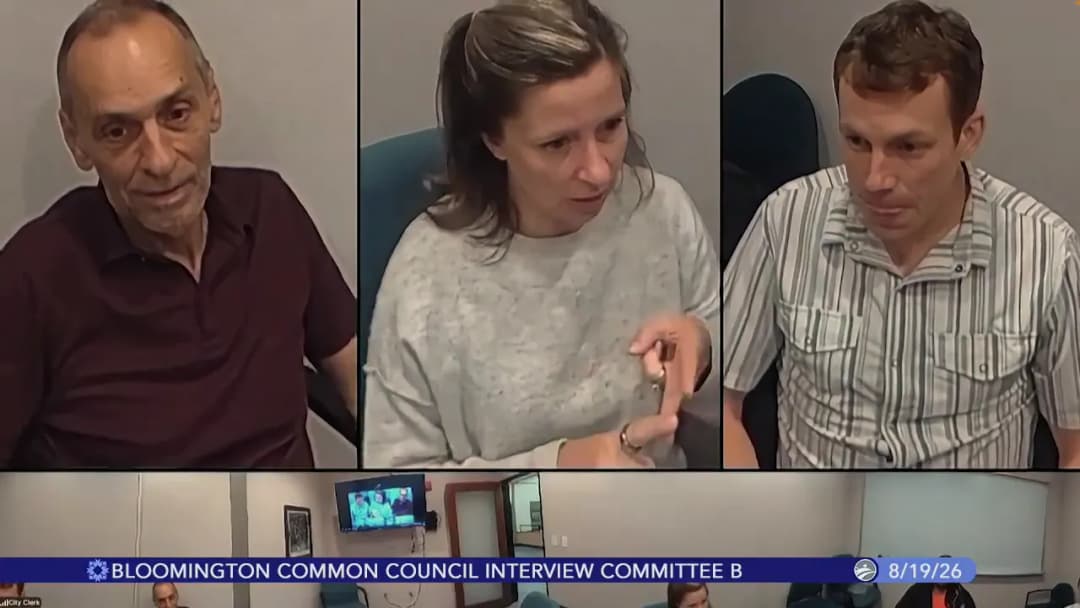
The City of Bloomington City Council's Interview Committee B met on August 20, 2026, to interview applicants for a vacancy on the Dr. Martin Luther King Jr. Birthday Celebration Commission. The committee, consisting of Council Members Matt Flaherty, Andy Ruff, and Courtney Daly, heard from one applicant and discussed a second candidate who had been interviewed earlier. After deliberation, the committee voted to recommend appointing Jatna Ayala Ruez to the commission. Discussion Items - Interview with Lysonda McCoy: McCoy, a former Bloomington Police Department social worker and long-time preschool teacher, now serves as a social worker for school resource officers. A 40-year resident of Bloomington, she is involved with the Black Culture Club at South High School and was previously recognized by the Dr. Martin Luther King Jr. Birthday Celebration Commission as one of 60 women honored at the Black History Month Gala. She expressed interest in bridging gaps between Indiana University, the City of Bloomington, and the Monroe County Community School Corporation, and emphasized her skills in active listening, conflict resolution, and community organizing. She confirmed her availability for the commission’s monthly meetings. - Review of Candidate Jatna Ayala Ruez: Council Member Courtney Daly reported that she had interviewed Jatna Ayala Ruez, a junior at Indiana University heavily involved in the Neal Marshall Center and the Black Student Union, where she has organized events. Ruez was recommended by Dr. Glove of the commission. She expressed interest in engaging with the broader Bloomington community beyond campus and was comfortable with the meeting schedule. - Deliberation and Vote: Committee members praised both candidates. Council Member Ruff noted Dr. Glove’s recommendation leaned toward McCoy but acknowledged Ruez’s potential to bring youth and student perspectives. Council Member Flaherty suggested appointing Ruez to encourage student involvement, with the possibility of McCoy serving when another vacancy arises. The committee moved to appoint Jatna Ayala Ruez to seat C (C2) of the commission. The motion carried. Key Outcomes - Appointment Recommendation: The committee voted to recommend appointing Jatna Ayala Ruez to the Dr. Martin Luther King Jr. Birthday Celebration Commission. The recommendation will be presented to the full City Council at its regular session on September 6, 2026. - Future Consideration: The committee expressed strong interest in Lysonda McCoy for a future vacancy and directed staff to convey that message when notifying her of the decision.

COMMUNITY ENGAGEMENT 70% · YOUTH PROGRAMS 24% · PROCEDURAL 6%
20
AUG 20, 2026 · BLOOMINGTON, INDIANA · CITY COUNCIL
Interview Committee A Meeting for Bloomington Transit Board of Directors - August 20, 2026

The interview committee for Bloomington Transit Board of Directors (BT Board) met on August 20, 2026, to interview candidate Hank for a council-appointed seat. The committee, comprising Councilmembers Isak Sari, Hope East Osberg, and Kate Rosenbarger, also deliberated on three candidates (Hank, Zach, Kent) and discussed next steps, including a potential fourth interview and possible expansion of the board. Discussion Items - Candidate Interview with Hank: Hank expressed a strong desire to serve on the BT Board, citing his professional background as the city's Safe Streets Program Manager and previous role as Little 500 race director. He highlighted his expertise in transportation, community representation, and his experience as a carless resident of Bloomington. - Key Positions Expressed by Hank: - He supports improved fixed-route frequency (e.g., 15-minute service on major corridors) over expanding microtransit, arguing that microtransit has lower return on investment per rider. - He advocated merging Bloomington Transit with IU Campus Bus to increase federal funding and efficiency, acknowledging IU's historical reluctance due to desire for control. - He emphasized the need for better route connectivity, especially for underserved areas like the west side and Bryan Park neighborhood. - He identified his top priority as making transit convenient, using data and community listening to guide decisions. - Committee Deliberation: After Hank's interview, the three councilmembers shared their assessments of all three candidates (Hank, Zach, Kent). They praised Hank's community perspective and city interface, Zach's data analysis skills, and Kent's institutional knowledge. However, they noted that Kent might withdraw if the BT board votes to change management companies at its upcoming meeting (scheduled for the third Tuesday of August). The committee discussed whether to expand the board from five to seven members to add missing skill sets, but took no final action. Key Outcomes - No Immediate Appointment: The committee decided to wait until after the BT board's meeting on August 25, 2026, to see if candidate Kent withdraws, which would affect the selection. - Fourth Interview Scheduled: The committee will interview a fourth applicant, Perry Mall, on Wednesday, August 26, 2026, at approximately 3:00 PM. Only Councilmembers East Osberg and Rosenbarger (via Zoom) will be present; Councilmember Sari will be out of town. - Future Discussion: The committee will bring up the possibility of expanding the BT Board to seven members during the Committee on Council Processes, and will also consider a new applicant for the Commission on the Status of Black Males. - Candidate Rankings: Councilmember Sari gave a slight edge to Zach, while Councilmember East Osberg also leaned toward Zach, citing his data proficiency. Councilmember Rosenbarger valued Hank's community perspective but noted that institutional knowledge might be filled by city staff liaisons.

PUBLIC TRANSPORTATION 56% · PERSONNEL MATTERS 25% · PROCEDURAL 6% · PUBLIC PRIVATE PARTNERSHIPS 5%
OPENPUBLICA · PUBLIC MEETING INDEXUPDATED DAILY · openpublica.com