Browse by city
Date range
Search help

Search titles, summaries, topics and stored transcripts together. Keywords may match separately; put the whole query in double quotes for a phrase. Matching follows word analysis, so punctuation is not exact. Both dates are included. Documents are not searched.

SHOWING 21–30 ENTRIES
21
AUG 20, 2026 · BLOOMINGTON, INDIANA · CITY COUNCIL
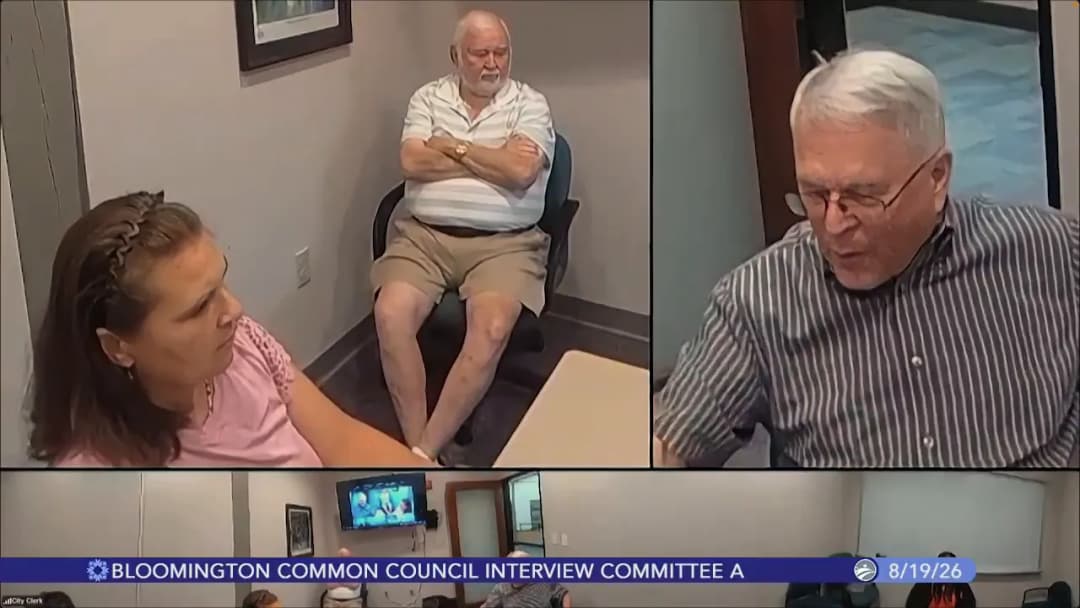
Interview Committee A Interviews Candidates for Bloomington Transit Board – August 20, 2026

Interview Committee A of the Bloomington City Council met on August 20, 2026, to interview two candidates for the Bloomington Transit (BT) Board of Directors: Zach, a data visualization expert and regular bus rider, and Kent, an incumbent board member with 36 years of service. The committee also received written public comments. Discussions highlighted critical issues facing BT, including declining ridership, route efficiency, microtransit, management contracts, and long-term funding. Public Comments & Testimony - Two written comments from Nick Ira were read into the record: the first expressed appreciation for Zach’s perspective as a regular bus rider, and the second described Kent’s generational knowledge as “priceless” and “beyond valuable.” Discussion Items - Interview with Zach: Zach emphasized that BT faces a “death spiral” in ridership, citing a 13% year-to-date drop (the worst outside COVID). He argued the board should prioritize frequency, reliability, and route optimization over what he called distractions like microtransit, which he noted had as few as two riders per month. He called for route redesign, bus stop consolidation, and restoring late-night fixed-route service instead of subsidizing Uber/Lyft. Zach stated that as a daily bus rider, he would bring a user’s perspective to the board and use his data background to scrutinize agency performance. He also suggested raising parking rates to fund transit and expressed concern about cost overruns on the proposed new facility. - Interview with Kent: Kent, a BT board member for 36 years and former IU transportation executive, reviewed the agency’s history and changes. He opposed the board’s recent decision (3-2 vote) to replace BT’s current management company (RATP dev) with a new provider, calling it the “biggest mistake” he had seen. He indicated he would resign if the contract is signed. Kent acknowledged that BT faces challenges in hiring and retaining drivers (seven short of full complement) and securing consistent funding, given limitations in state and federal sources. He supported microtransit for paratransit needs but cautioned against overexpansion. Kent agreed that the board could benefit from a regular bus rider and a person with disabilities. He suggested expanding the board from five to seven members per state law, though he noted quorum concerns. - Committee Questions: Committee members (Kate Rosenbarger, Isak, and others) asked about balancing diverse rider needs, the impact of expiring ED Lit funding ($3.7 million), potential IU-BT consolidation, and the board’s role in oversight versus management. Both candidates stressed the importance of independent oversight and data-driven decision making. Key Outcomes - The committee completed interviews with both candidates. Written public comments were acknowledged. No votes were taken on appointments. The committee planned to reconvene the following day to continue the selection process. Kent’s potential resignation pending the management contract vote at the next BT board meeting was noted. Note: The transcript referenced the meeting date as August 13, 2026, but per instruction the summary uses August 20, 2026, as the provided meeting timestamp.

PUBLIC TRANSPORTATION 75% · PERSONNEL MATTERS 10% · PROCEDURAL 5% · RACIAL EQUITY 3%
22
AUG 20, 2026 · BLOOMINGTON, INDIANA · CITY COUNCIL
Bloomington Transit Interview Committee A Meeting - August 20, 2026

Note: The transcript begins by stating the date as August 19, 2026 at 3:07 p.m., but the provided meeting date is August 20, 2026. This summary uses the supplied date. The interview committee (Councilmembers Kate Rosenbarger, OP Strasberg, and Jennifer Crossley) convened to interview a candidate for the Bloomington Transit (BT) Board of Directors and to deliberate on the appointment. The committee also discussed a vacancy on the Commission on the Status of Black Males and procedural next steps. Interview with Candidate Perry - Perry has extensive transit experience: former Director of Campus Bus Service at Indiana University (IU), former chair of the Florida Commission on Transportation Disadvantage, and worked for Bloomington Transit in the 1970s. - He expressed strong support for robust fixed-route service, paratransit for those with no alternatives, and the IU-BT partnership, including potential consolidation to capture additional state and federal funding. - He considered microtransit a “great new concept” and a useful tool, but not a replacement for frequent fixed routes. - On board dynamics, he emphasized the need to work collaboratively, stating, “you may disagree, but you can’t be disagreeable in disagreeing.” - He did not express a strong opinion on expanding the board from five to seven members, leaving that to the city council. Deliberation on Candidates - The committee noted four strong candidates (Perry, Zach, Kent, Hank) and discussed their attributes. - Councilmembers expressed leaning toward candidates who favor increasing frequency on fixed routes over expanding microtransit—a position shared by Zach, Kent, and Hank. - Rosenbarger favored “mixing things up” and a fresh, data-driven perspective (Zach), while other members valued deep institutional knowledge (Kent, Perry). - The committee considered whether to expand the board to seven members, but noted state-imposed political balance requirements could complicate that. - They acknowledged public comment (via chat) suggesting to wait for the outcome of an upcoming BT board meeting before deciding. Key Outcomes - No action was taken on the appointment; the committee decided to postpone a decision. - They will schedule another meeting after the BT board meeting (now expected in September) and after confirming availability with all members, including absent member Isak. - The committee also noted a vacancy on the Commission on the Status of Black Males and encouraged applications. - The next regular city council meeting is in September, where the committee can make a recommendation.

PUBLIC TRANSPORTATION 66% · PROCEDURAL 10% · PUBLIC WORKS 9% · COMMUNITY ENGAGEMENT 7%
23
AUG 20, 2026 · BLOOMINGTON, INDIANA · CITY COUNCIL
Bloomington City Council 2027 Budget Hearings Night Two - August 20, 2026

On August 20, 2026, at 5:31 PM, the Bloomington City Council held the second night of its 2027 budget departmental hearings. The meeting included presentations from the Planning and Transportation Department, Engineering Department, Streets and Traffic Division (Public Works), Parking Services Division (Public Works), and City of Bloomington Utilities, each followed by council questions, public comment, and council discussion. Planning and Transportation Department - Presentation: Interim Director Lynn Coyne introduced the department's 18.5 staff positions. The proposed 2027 budget increases by $88,126, primarily due to cost-of-living adjustments and $46,000 for a new vehicle. Key priorities include the Downtown Corridor and Subarea Planning Study (Kirkwood corridor from Rogers to Indiana, $265,000 local match for a $1.44 million federal grant), Safe Routes to School, and quick-build safety projects ($75,000). The department is implementing the development review audit recommendations by creating concurrent permit processing through EPL software to improve efficiency and transparency. Other goals include long-range planning for downtown and South Walnut Street, with a focus on community engagement (over 60 outreach events in the past year). Challenges include transportation safety funding and process improvement. Interim Director Coyne noted that performance metrics would be available next year after system upgrades. - Council Questions: Councilmember Piedmont Smith asked about the Walnut‑College corridor study (near completion, no implementation funds in 2027; seeking federal grants) and Safe Streets for All Action Plan projects (engineering leads 10th Street; planning leads downtown and South Walnut corridor studies). Councilmember Stasberg inquired about UDO updates (minor procedural changes only, no use‑table amendments) and resident engagement data (compiled but not presented). Councilmember Rallo asked about the council's role in implementing the Walnut‑College study (the study will come to council as a transportation plan amendment; council can amend and vote). Councilmember Piedmont Smith noted the Downtown Corridor study will consider pedestrianizing Kirkwood Avenue. - Public Comments: MG (Bloomington Chamber) commended the department for taking the process audit seriously and focusing on process improvement rather than adding staff. Paul Rousseau questioned how the public can measure transportation safety and sustainability improvements, citing difficulty obtaining data from the city. - Council Comments: Councilmember Rallo stated that benchmark data would be collected for the Walnut‑College corridor before and after implementation. Councilmember Piedmont Smith confirmed the Kirkwood study will include shared street options. Councilmember Stasberg noted that the Transportation Commission is developing metrics for Safe Streets for All, and that outcome‑based budgeting is a broader need. Engineering Department - Presentation: Director Andrew Seabor introduced the department's 17 full‑time positions (fully staffed for first time since 2022) and proposed a $3.8 million budget, a $3.7 million decrease from 2026 due to reduced capital outlays, though bond funding is planned. 2026 highlights included supporting Hopewell development, adding safety and accessibility features to maintenance projects, and implementing signal retiming with leading pedestrian intervals and limited right‑turn‑on‑red. 2027 priorities include stewarding public infrastructure (capital planning, asset preservation, multimodal improvements, grants), community investment (Hopewell, development review), and building an effective organization. He outlined the typical project life cycle (planning, design, right‑of‑way, construction, operation). A new street lighting program and $4.2 million in proposed bond projects (Safe Streets for All sidewalk/bike improvements, crosswalk matches, 3rd Street near Rogers, Rogers‑Madison signals, 10th Street construction, lighting improvements) will be presented in a future GO bond request. - Council Questions: Councilmember Rallo asked for details on the bond projects (approximately $4.2 million total) and about signalization at Hawthorne and Atwater (not in 2027 plans). Councilmember Piedmont Smith asked which Safe Streets for All projects will be pursued (most projects relate to the plan; 10th Street is a major corridor; street lighting is a new program). She also asked about dark‑sky considerations for lighting (standards exist, but lighting design is a new area for engineering). Councilmember Zalik asked about traffic congestion during move‑in week (multiple factors, some construction related). Councilmember Stasberg asked for project priorities (High Street, Dunn Street Multi‑Use Path, 10th Street) and about the street lighting program target areas (to be developed after funding). She also questioned budget line items: reduced motor repair expectations (due to vehicle replacement) and a large increase in dues/subscriptions (software renewal fees hitting in second half of year). Councilmember Rough asked for a single document listing all transportation capital projects (active projects are on the engineering webpage with schedules, but cost breakdowns may not be available). - Public Comments: Paul Rousseau objected to spending on multi‑use paths, arguing they are unsafe for transit bicyclists and feel like a way to push bikes off the street. Colin Nielsen (Patriot Engineering) praised recent street improvements (curb bump‑outs, pedestrian islands) for slowing traffic and making streets safer; he supported bike lanes on higher‑speed corridors like College and Walnut. - Council Comments: Councilmember Rallo urged inclusion of signalization at Weatherstone‑Hawthorne and Atwater‑Hawthorne as a safety project in the upcoming bond. Councilmember Stasberg shared an anecdote about the Rogers Street improvements increasing awareness of pedestrian needs. Councilmember Piedmont Smith thanked the department for curb ramp work near her home. Councilmember (mayor pro tem) noted the signal retiming and limited right‑turn‑on‑red interventions reduce pedestrian crashes by 40‑50% and save lives. Streets and Traffic Division (Public Works) - Presentation: Director Adam Wyson introduced 47 full‑time staff and a proposed $13.32 million budget (approx. $80,000 increase). 2026 accomplishments included filling nearly 9,000 potholes, paving 8 miles in‑house, upgrading ADA ramps, and achieving APWA national accreditation. The pavement condition index (PCI) rose from 54 to 58.8; a $30 million investment would raise it to the mid‑80s. Sidewalk condition index is 75; $16.3 million would bring all sidewalks to that level. The division is investing $4 million in street maintenance. 2027 priorities include continued street/sidewalk maintenance, the Community Crossings matching grant program (up to $1 million), enhanced snow response on high‑pedestrian networks, and traffic safety. Major maintenance projects in 2027 may include College and Walnut from 17th to Bypass under Community Crossings. Concerns include rising material costs (salt expected to increase 25‑35%) and low Midwest salt supplies. - Council Questions: Councilmember Piedmont Smith asked about bike lane maintenance (street division and CBU sweepers share responsibility) and side‑path snow clearance (street division handles city‑owned side paths). Councilmember Rallo asked about the long‑term pavement investment path (reaching PCI 80 is aspirational; staying above 60 is realistic with increased funding). He noted the governor’s $58 million allocation likely only replaces gas tax holiday losses. Councilmember Stasberg expressed concern that repaving College/Walnut from 17th to Bypass (currently 40 mph) could encourage speeding; Wyson explained that fresh pavement alone does not correlate with higher speeds and that coordination with other departments ensures future compatibility with potential corridor changes. Councilmember Rough asked about material cost trends (asphalt and salt rising significantly due to petroleum and commodity prices; only two major asphalt suppliers in area). Councilmember (president) asked about brick street maintenance in the historic district (nine to ten block frontages need restoration; coordination with IU and utilities is underway; no near‑term funding). She also asked about snow removal on multi‑use paths (all paths are mapped; gaps are addressed as reported). - Public Comments: None. - Council Comments: Councilmember Rallo expressed appreciation for street maintenance improvements and acknowledged constituent concerns. Councilmember Piedmont Smith noted that sidewalk snow removal remains a problem (property owner responsibility but often not done). Councilmember (president) thanked for continuous improvement on snow removal and asked about a $50,000 allocation for augmenting snow removal in high‑pedestrian areas (written follow‑up). She also suggested using quick‑build temporary materials (e.g., delineators) on North Walnut near Miller‑Showers Park to improve bicycle safety ahead of the major corridor study. Parking Services Division (Public Works) - Presentation: Director Wyson introduced 26 full‑time staff and a proposed $7.7 million budget, a $2.814 million increase primarily due to $2.5 million earmarked for parking technology replacement (meters, kiosks, or license‑plate technology). Based on the Walker parking study presented in June 2026, 2027 priorities include investing in parking technology, revising rates after stakeholder input, and addressing neighborhood residential parking permit issues. The division manages downtown meters, four garages, five surface lots, special events (including event‑day flat‑rate parking), the residential permit program, and also deploys barricades and fills in for crossing guards. The Walker study recommendations will be vetted through the Transportation Commission and council before implementation. Neighborhood parking permits are facing challenges due to redevelopment of single‑family homes into multi‑unit properties; data collection and coordination with planning are ongoing. - Council Questions: Councilmember Stasberg clarified that the $2.5 million is from the parking meter fund, not the garage fund. She asked about the special event flat‑rate parking at Taste of Bloomington (first effective use; $3 flat fee prepaid to reduce exit queues; revenue data can be provided; communications could be improved). Councilmember Piedmont Smith asked about scooter parking enforcement (parking staff assist by contacting Bird; geofencing downtown has improved compliance but issues remain; contract renewal discussions with Bird underway). Councilmember Rallo asked whether trash/recycling cans blocking sidewalks could be enforced by parking staff since HAND enforcement is stretched (Wyson open to collaboration). Councilmember Rough raised concerns about blocks that are ParkMobile‑only (e.g., North College and South Washington), arguing it creates an equity barrier for those without credit cards or smartphones; Wyson stated that the vast majority of spaces accept cash and card, and that the parking technology upgrade will involve robust public discussion on options. - Public Comments: None. - Council Comments: Councilmember Rallo supported exploring cross‑department enforcement of sidewalk blockages. Councilmember Stasberg supported the flat‑rate event parking concept and urged better advertising. Councilmember Zalik thanked Director Wyson and Cassie Warney for responsiveness on parking permit issues. Councilmember (president) noted policy discussions needed on neighborhood zones (pricing, visitor permits, variance) and that trash/recycling can blockages are a civil rights and accessibility issue; he suggested that sanitation staff already try to avoid blockages but systemic solutions are needed. City of Bloomington Utilities - Presentation: Director Catherine Ziger presented the 2027 budget for CBU (191 full‑time, 4 part‑time staff). The proposed budget adds $7.5 million, driven by a newly implemented water rate case (rates effective September 2026). 2026 achievements included rehabilitating the fluoride system, intake pump, and chemical feedlines; increasing wastewater treatment capacity at Dillman Road (permitted capacity from 15 to 19 MGD; peak from 30 to 40 MGD); completing the Winslow Rain Garden; and a Clear Creek E. coli sampling report. Updates to the Bill Payment Assistance Program now allow consecutive assistance and post‑disconnection applications. 2027 priorities focus on asset modernization and climate resilience: Distribution system improvements (South and West Booster Stations design, neighborhood water main replacements - $11.1 million); Monore Water Treatment Plant electrical and control upgrades ($10 million); Dillman Road Wastewater Plant dewatering improvements (screw press, design $2.3 million) and Phase 2 electrical upgrades (design $500,000); Lower Cascade stormwater culvert connection ($750,000); Clear Creek Renewal feasibility study ($500,000); Winslow Sports Complex detention ($75,000 design); and Winston‑Thomas Service Center (resume design, $2.5 million for design, $2.3 million for construction management). Cost mitigation includes a $5 million state revolving fund loan for lead service lines, $2.5 million in congressional funds for booster stations, and potential BRIC funding for climate projects. Water budget: $28.8 million (+25%); stormwater: $4.8 million. - Council Questions: Councilmember Rallo asked about the total cost of the Winston‑Thomas Service Center (originally $44 million; estimate being updated due to delay; debt service will be covered by water and wastewater rates). He also asked about cybersecurity hardening (CBU is actively working with ITS to address current threats). Councilmember Stasberg asked about advertising for the assistance program (bill inserts, individual outreach by collections staff) and about the septic drop‑off rate issue (sampling program underway; a waste station could cost $1 million; updated rates will be proposed with the next sewer rate adjustment). Councilmember Piedmont Smith asked about community engagement for the Clear Creek Renewal Project (multiple community input sessions planned as part of the study). Councilmember Rough asked for a ballpark cost for Clear Creek implementation (not yet determined; the study will develop at least three alternatives; funding likely through stormwater fees and bonding; he requested a comprehensive stormwater strategy update). - Public Comments: None. - Council Comments: Councilmember Stasberg thanked CBU for providing safe drinking water and noted that the budget shows the true cost of essential infrastructure. Councilmember Rallo expressed concern that current residents are subsidizing growth through rate increases for larger facilities, and called for further discussion on growth‑related cost allocation. Councilmember (president) appreciated improvements to the Bill Payment Assistance Program and noted that Bloomington’s municipal water utility is in better shape than many others across the country, citing the trend of privatization leading to higher rates and less local control. Key Outcomes - The council received budget proposals from five departments/divisions; no votes were taken, as these are hearing sessions. - Planning and Transportation will proceed with the downtown corridor study and implement concurrent permit processing; performance metrics will be available in future years. - Engineering will bring a $4.2 million general obligation bond request for safety‑related projects; the council is expected to review and approve it later in the year. - Streets and Traffic will continue the Community Crossings program; repaving of College/Walnut from 17th to Bypass is under discussion with a focus on compatibility with the upcoming corridor study. - Parking Services will begin a stakeholder process for parking technology and rate updates following the Walker study; equity concerns around ParkMobile‑only spaces will be addressed. - CBU will implement the new water rates and advance major infrastructure projects, with updated Winston‑Thomas Service Center cost estimates to be provided; a sewer rate adjustment including septic drop‑off fees will be brought to council in the future. - The meeting was adjourned at approximately [time not recorded]; the next budget hearing is scheduled for Monday of the following week.

PUBLIC WORKS 21% · TRANSPORTATION SAFETY 20% · WATER AND WASTEWATER MANAGEMENT 18% · PARKING MANAGEMENT 11%
24
AUG 18, 2026 · BLOOMINGTON, INDIANA · CITY COUNCIL
2026-08-18 Bloomington City Council 2027 Budget Hearings - Night One

The first night of the 2027 budget hearings for the City of Bloomington convened on August 18, 2026, at 5:30 PM (the transcript references Monday, August 17; the official date provided is August 18). The council heard presentations from the Mayor's Office, City Controller, Fire Department, Police Department and Dispatch, Community and Family Resources Department (CFRD), and Housing and Neighborhood Development (HAND). The proposed total city budget is $165 million, which reduces the combined operating and ED lit deficit by more than half from the 2024 budget, a total reduction of over $10.5 million. The meeting also adopted a motion to structure debate for the week. Public Comments & Testimony - Kevin Keel (public commenter) thanked council members for submitting written budget questions and expressed appreciation for the scrutiny, noting that the budget document is difficult for the public to digest. He encouraged moving toward a more public-friendly presentation. - Christopher MG (Greater Bloomington Chamber of Commerce) expressed support for continued investment in the Bloomington Police Department, citing high resident satisfaction (61%) and the department's Tier I CALEA accreditation. He also endorsed HAND's focus on increasing housing supply as a workforce and economic strategy. - Paul Russo (online commenter) stated that speeding is a violent crime and criticized the police chief's doubt that punishment deters crime. Mayor's Introduction Mayor Thompson presented the 2027 budget proposal, emphasizing three priorities: maintaining core city services (clean water, safe roads, public safety); protecting and maintaining new and existing assets; and addressing root causes of housing, homelessness, wage growth, and public safety. The mayor acknowledged the difficulty of producing an outcomes-based budget due to an inadequate financial system, but noted that a new system is planned for 2027. He stated that the budget reduces the anticipated operating deficit each year. In response to Councilmember Piedmont-Smith, the mayor explained that departments were instructed to align spending with shared priorities, but the lack of data systems limits granular tracking. Councilmember Stasberg asked about prioritizing 'F to C' versus 'C to A' improvements; the mayor responded that core city services must be at B+ or higher, and that non-essential enhancements depend on available funds. City Controller's Introduction Controller Jeff McKim provided a financial overview, highlighting a proposed $4.8 million combined deficit in the General Fund and ED Lit Fund. He detailed key cost drivers: a 2.7% COLA for civil employees and 3% for union employees, $1.8 million increase in pension contributions for public safety (PERS rate from 23.3% to 26.5%), and a preliminary 9% health insurance increase (later revised to 5.8%). McKim reported that Senate Enrolled Act 1 (SEA1) will reduce net assessed value by $142 million in 2027, disproportionately affecting Bloomington due to many rental properties, leading to $1.3 million in circuit breaker losses. He introduced a new capital improvement plan using a rolling series of six-year General Obligation bonds. He also noted that a new financial system is budgeted in IT services to improve efficiency. Councilmember Stasberg raised a discrepancy between a $28 million overall deficit across all funds and the $4.8 million figure; McKim clarified that the $28 million includes many capital and special funds with planned spend-downs. Fire Department Presentation Chief Roger Kerr reported that the Fire Department is fully staffed at 120 full-time employees, with one part-time vacancy (MIH program manager). The proposed budget is largely flat except for critical capital replacements: $1 million for Self-Contained Breathing Apparatus (SCBA) and $2.5 million for a 100-foot aerial platform truck (to be bond-funded). The current SCBA warranty expires in mid-2027; the new ones will have lifetime warranty. The aerial truck has been down 90+ days in 2026. Kerr highlighted 3,145 fire calls year-to-date (2025 total: 6,745), 48,671 training hours (116% of target), and the upcoming opening of the operations center south of town. Councilmember Rollo asked about a proposed fire station at Summit Development on Tap Road; Kerr stated internal planning is underway but not near-term. Controller McKim confirmed the station would not be built in the next couple of years. Councilmember Flaherty noted the Public Safety LIT (PS LIT) is insufficient for capital needs, and McKim suggested council consider raising the PS LIT rate, though bonding against it is not viable due to uncertainty. Police Department and Dispatch Presentation Chief Mike Diekoff presented the 2027 budget request, an increase of $2.49 million driven by the new collective bargaining agreement ($1.66M), fuel and inflation ($179K), and reallocation of insurance costs ($770K). The department has 105 authorized sworn officers; currently 93 are filled. Crime rates decreased 6.4% overall in 2025, and vehicle accidents decreased 7%. Call volume increased 48% since 2020 (80,450 calls in 2025, up 5.9% from 2024). Key priorities: continue alternative response partnerships, design and begin construction of a new police headquarters at 714 South Rogers Street, and enhance traffic safety and violent crime reduction. Chief Diekoff stated that traffic enforcement is limited by staffing; more officers would allow more proactive patrols. Councilmember Piedmont-Smith asked for data supporting the claim that increased officer presence reduces violent crime; the chief could not cite specific studies. Councilmember Stasberg questioned the department's policy on issuing tickets to at-fault drivers in crashes; the chief said it is left to officer discretion and that he has not mandated tickets. Councilmember Stasberg requested data on how many discretionary tickets were issued for at-fault crashes. Councilmember Flaherty noted the council-appointed Transportation Commission is still awaiting a staff report on traffic safety options. Dispatch staffing: 32 authorized positions, with 14 vacancies at the time of the org chart; Deputy Mayor Knapp corrected that it is now 22 filled and 10 vacant. Community and Family Resources Department (CFRD) Presentation Director Shatoya Moss presented a $2 million budget (10% decrease from 2026). Key accomplishments: $46,000 emergency food investment supported 330,000 pounds of food; the Bloomington Volunteer Network's Be the Change Challenge recorded 58,000 volunteer hours (value $1.97 million); Juneteenth celebration drew 11,000 people. CFRD focuses on three pillars: resources (access before crisis), partnerships (leveraging community networks), and belonging (community events). Moss highlighted the After Hours Ambassadors Program, expansion of Helping Bloomington Monroe kiosks, and planning to modernize the volunteer network. She noted that without increasing resources, the department relies on technology, grants, and volunteers to extend reach. Councilmember Stasberg asked for data on how volunteer hours represent added value beyond existing volunteering; Moss said they are working on better tracking. Housing and Neighborhood Development (HAND) Presentation Director Anna Killian Hanson presented a proposed budget increase of $1.74 million, primarily to expand the Housing Development Fund by $3 million (from $1M to $4M). She detailed work: 1,631 code enforcement citations, 20 unsafe building actions, 550 complaint rental inspections, 2,984 rental inspections, 1,107 rental permits issued, housing stability assistance to 56 households, 19 homebuyers and 40 renters assisted, 78 first-time homebuyer education completions. Preservation of 48 affordable units ($600,000) and creation of 10 cooperative units ($250,000). She highlighted that 72% of Bloomington jobs are filled by commuters due to housing costs. The department is responding to federal shifts (21st Century Road to Housing Act, SB 285) and the expiration of ARPA funds. She proposed using CDBG funds to create a targeted sidewalk repair program in low/moderate-income areas, without additional city budget. Councilmember Rothell asked about adapting to federal policy shifts from 'housing first'; Mayor Thompson noted he is leading a mayors' coalition to seek state support for mental health and addiction funding. Councilmember Piedmont-Smith requested a report on Housing Development Fund expenditures and outcomes. Councilmember Stasberg expressed concern about capacity to spend an additional $3 million and requested details on contracts. Councilmember Ruff raised sidewalk enforcement for trash bins; Hanson acknowledged limited enforcement staff but noted ongoing efforts to improve route targeting. Key Outcomes - Motion to Structure Debate: Councilmember Flaherty moved, and the council unanimously approved, a motion to limit councilmember questions and comments to three minutes per presentation, and public comment to two minutes per speaker per comment period, for the duration of the budget hearings. The motion also provided for a public comment period after each presentation. - No votes on budget items: As this was the first hearing, no budget appropriations were voted on. Council members will continue submitting written questions and will reconvene on August 19, 2026 at 5:30 PM for Night Two. - Directives: Councilmember Stasberg requested data on discretionary tickets for at-fault crashes; Councilmember Piedmont-Smith requested a report on Housing Development Fund spending and outcomes; Councilmember Ruff requested better sidewalk enforcement coordination. These items will be addressed in follow-up or future meetings.

BUDGET EQUITY ANALYSIS 24% · PUBLIC SAFETY 24% · AFFORDABLE HOUSING 13% · COMMUNITY ENGAGEMENT 9%
25
AUG 10, 2026 · BLOOMINGTON, INDIANA · CITY COUNCIL
Bloomington Fiscal Special Committee Meeting - August 10, 2026

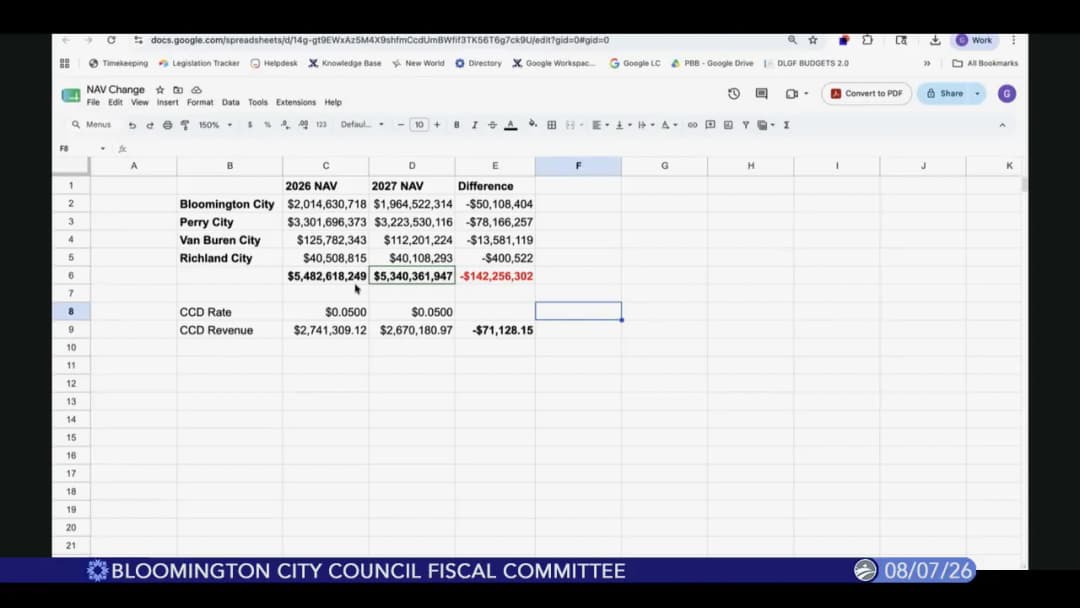
The Fiscal Special Committee met on August 10, 2026, to receive an update from the City Controller on revenue and budget matters and to continue discussions on elected official compensation. The committee also heard public comment and planned future work. Controller's Update - City Controller Jeff McKim provided an update on the local income tax (LIT) and property tax situation. - McKim noted that the city's ability to raise LIT is based on estimated adjusted gross income, which is uncertain due to lack of precise data from the state. - The budget process timeline: informal budget presentations scheduled for August 17, 19, 24, and 26; official budget advertising by September 13; official budget hearing on September 23; final adoption on October 7. - LIT countywide growth for 2027 is estimated at 5.38% compared to 2026. City-specific numbers not yet known; McKim used historical percentages with a 25% discount factor. - Property tax: The net assessed value in Bloomington declined by $142 million from 2026 to 2027 due to new rental property exemptions under SEA 1. This disproportionately affects Bloomington as about 50% of assessed value is rental. - Circuit breaker losses for 2027 are estimated to increase by 7% to $1.3 million, driven by the assessed value decrease. - McKim noted that all these revenue numbers are preliminary and will be updated as more information becomes available. Elected Official Compensation Discussion - The committee reviewed updated guiding principles for setting elected official salaries, which were refined to three values: accessibility of public service, quality community service, and equitable pay, plus processes for informed decisions and transparency. - Committee members voted unanimously to approve the new guiding principles. - A comparison of council member salaries from other Indiana cities was discussed, including data for Bloomington, West Lafayette, Lafayette, Greenwood, etc. - Councilmember Matt suggested using a ratio of mayor salary to council salary (e.g., 4:1) as a framework, arguing that other comparisons are not apples-to-apples. This idea received support. - Councilmember Dave emphasized population as a relevant factor. - It was noted that West Lafayette recently passed a salary ordinance for 2027 with an increase. - The committee agreed to continue refining the comparison data and to consider the mayor-to-council ratio in future discussions. Public Comment - Kevin Keio provided detailed comments on the budget book and financial reporting. He pointed out discrepancies between the general fund comparison and the ACFR, noted that the budget book appendix does not include beginning/ending fund balances, and requested better disclosures and a fund flow chart. He urged the public to engage with the budget materials despite their complexity. Key Outcomes - The committee unanimously approved the updated guiding principles for elected official compensation. - The controller will provide a one-page summary of the revenue updates and add it to the committee folder. - The committee will meet next in September, with possible agendas including feedback on budget presentations and continued salary discussion, as well as a potential budget fair for public outreach. - The idea of using an O'Neill graduate capstone class to develop an outcome-based budgeting framework was floated and will be explored. Note: There is a discrepancy between the transcript date (August 7, 2026) and the provided meeting date (August 10, 2026). This summary uses the date provided in the instructions.

BUDGET EQUITY ANALYSIS 46% · PERSONNEL MATTERS 37% · PUBLIC ENGAGEMENT 8% · PROCEDURAL 5%
26
AUG 7, 2026 · BLOOMINGTON, INDIANA · CITY COUNCIL
Committee on Council Processes Meeting - August 7, 2026: Public Transportation Transit Board Reappointment Discussion

The committee met to discuss the reappointment of Kent McDaniel to the Public Transportation Transit Board (BT board) and to consider other applicants. The discussion revealed significant discrepancies between current board appointments and state law requirements. The committee voted to interview all four candidates individually and referred the legal issues to city legal. Public Comments & Testimony - Nancy Obermeyer, a board member of Movement in Bloomington, asked whether the candidate interviews would be open to the public. The committee confirmed that the interviews would be posted publicly and open. Discussion Items - Reappointment of Kent McDaniel: The clerk reported that McDaniel remained interested in reappointment despite recent controversy. Several committee members expressed support for McDaniel, citing his advocacy and understanding of the board's history. Other applicants included Perry, Zach, and Hank Duncan (whose application had just archived). The committee debated whether to interview only McDaniel and Perry or all four candidates. Concerns were raised about Hank Duncan being a city employee, which could create conflicts of interest, but also noted potential value in integration with city planning. - Legal Concerns about Board Terms: A committee member discovered that state law (Indiana Code 36-9-4-17) specifies staggered terms for board directors (two, three, and four years) and political party balance (no more than three of the same party on a five-member board). The committee noted that current appointments may not comply: the mayor's appointments (two seats) appear to have expired terms, and the board's composition may violate party balance requirements. The committee decided to refer the matter to city legal for clarification and potential code updates. - Motion to Interview Candidates: A motion was made and seconded to interview all four candidates (Kent McDaniel, Perry, Zach, and Hank Duncan) individually, with 15–20 minutes per interview. The motion passed unanimously (Stasberg, Rosenberger, and others). The committee discussed scheduling, tentatively setting August 13 and 14, 2026, for the interviews. Key Outcomes - Motion passed: To interview all four candidates for the Public Transportation Transit Board seat individually, with scheduling to be coordinated by the clerk. - Referral to city legal: The committee will ask city legal to review the board's compliance with state law regarding term lengths, party balance, and residency requirements, and to consider whether to expand the board from five to seven members. - Next steps: The clerk will contact Hank Duncan to confirm his continued interest and will send a scheduling poll to candidates for the interview dates.

PUBLIC TRANSPORTATION 49% · PROCEDURAL 21% · PERSONNEL MATTERS 15% · PENDING LITIGATION 15%
27
AUG 6, 2026 · BLOOMINGTON, INDIANA · CITY COUNCIL
Bloomington Common Council Meeting - August 6, 2026

The Bloomington Common Council held a regular meeting on August 6, 2026, beginning at approximately 3:41 PM. The meeting included reports from the Mayor, a community survey presentation, a parking rate study, and a fiscal committee update, followed by first and second readings of several ordinances and a resolution. Public comment was heard on multiple agenda items. All legislation was passed, and the meeting adjourned after scheduling announcements. Consent Calendar - There was no consent calendar; all items were discussed individually. Public Comments & Testimony - Steve Volan, Chair of the Transportation Commission, thanked council members for their advocacy for students and stated that the commission will vote on the parking report recommendations in September. He noted the report contains good recommendations but he personally disagrees with some. - Terry Amsler, a Bloomington resident, commented on the community survey, urging clarity in how data from open participation is presented and emphasizing the importance of honest public engagement. - Christopher MG (Greater Bloomington Chamber of Commerce) provided two comments: first, promoting the Women Xcel Bloomington event; second, encouraging the fiscal committee to find permanent cost savings in the budget, such as consolidating functions and reducing vacant positions. - Paul Rousseau criticized the community survey for excluding most IU students, citing the tragic death of Nathaniel Stratton as an example of student involvement with city services. He recommended that future surveys ask respondents about their frequency of using different mobility modes. - Kevin Keogh questioned the survey’s random sampling methodology and suggested that the sample was judgmental. He advocated for free public transportation for Bloomington residents and strategic parking pricing. - Galen Cassidy, co-owner of Uptown Cafe, strongly supported the alcohol permit ordinance, stating that the current high cost of permits (250,000–300,000) is a barrier for young entrepreneurs. He argued that existing permit holders opposing the measure are being selfish. - Rainey Cassidy, local citizen, supported the alcohol permit ordinance, praising its potential to maintain the independence and diversity of Bloomington’s food culture. - Chris Turmje (Greater Bloomington Chamber of Commerce) commended the work on the alcohol permit ordinance and urged safeguards against speculation while keeping administration simple. He raised concerns about living wage provisions for tipped employees and overly rigid restaurant definitions. Discussion Items - Mayor’s Report (Kerry Thompson): The Mayor reported that the Bloomington Police Department received Tier 1 CALEA accreditation for the third time, a distinction held by only 5% of police departments. Updates on Showers West included agreements with remaining tenants and a need for over $1 million in HVAC and wiring improvements. The city was awarded a $7 million Ready 2.0 grant ($3 million grant + $4 million match from IU and partners) for creative artist studios in the Showers Admin Building. - Community Survey Presentation (Jeff Anderson, ETC Institute): The survey, conducted February–April 2026, received 561 responses from a random sample of Bloomington residents. Key findings: 72% are at least slightly likely to recommend Bloomington as a place to live. Top concerns: lack of affordable housing (76% dissatisfied), unhoused population, and street/sidewalk conditions. Satisfaction was highest for fire protection, sanitation, and police protection. The survey methodology intentionally excluded most IU students to focus on “year-round residents,” drawing strong criticism from multiple council members (Strasberg, Zulik, Piedmont Smith, Rosenbarger) who argued it disenfranchised a significant portion of the population and undermined the survey’s validity. Council members noted disparities between respondent demographics and census data (e.g., 53% homeowners vs. 34% actual; 61% single-family homes vs. 34% actual). The response rate was 4–5%. - Parking Rate Study (Walker Consultants – Lauren Sturdevant & John Martin): The study, received June 2026, recommended four areas: organizational (centralize appeals, adopt mission statement, data-driven decisions), policy (zone-based pricing with higher core rates, incremental rate increases, reduce evening enforcement to 8 PM), technology (replace single-space meters with kiosks, implement mobile license plate recognition, upgrade off-street equipment), and communications/wayfinding (improve signage, marketing). Council members discussed turnover concerns, dynamic pricing, and the timeline for technology replacement. Clerk Bolden critiqued the study for inaccuracies (e.g., stating appeal turnaround as 2–4 weeks when actual average is 3.4 days) and noted her office was not adequately consulted. Councilmember Zulik confirmed the clerk’s office had only a one-hour introductory meeting and was not given the link to provide feedback. - Fiscal Committee Report (Councilmember Strasberg): Presented analysis of state property tax cuts and local income tax (LIT) options using projections from AIM and READI Financial. Key data: Under a county-wide maximum LIT (1.2%), Bloomington would see a surplus, but Monroe County Community School Corporation (MCCSC) faces a $17–18 million deficit and Richland-Bean Blossom (RBB) a $4.5 million deficit, with no recourse. A break-even scenario (LIT 1.03%) shows the average homeowner in Bloomington Township would save about $372 per year, but residents in Steinsville would pay more. Councilmember Strasberg highlighted the regressive nature of the shift. - First Reading – Ordinance 2026-18: Establishes guidelines for three-way alcohol permits in historic and downtown redevelopment districts. Councilmember Asari and Director Jane Cooper Smith presented the ordinance as a way to lower permit costs (from $250,000+ to $25,000–40,000) and support economic development. Council members raised concerns about the 60% food sales requirement, living wage compliance, vague criteria, and potential exclusion of bar-only concepts. The ordinance was advanced to second reading on September 2, 2026. - Second Reading – Ordinance 2026-16 (Police/Fire Salary Ordinance): Reclassifies one sergeant position to a lieutenant. Estimated full-year cost $19,969, offset by unspent appropriations. Chief Deacoff explained the need for an additional lieutenant to manage training and special projects. The ordinance was adopted after correcting typographical errors via amendment. - Second Reading – Ordinance 2026-17 (Salary Ordinance for Non-Union/AFSCME): Reclassifies HR position from grade 5 to 7 and Public Works position from grade 8 to 9, with cost offsets from reduced consultant and contract expenses. Controller McKim detailed fiscal impacts: HR upgrade costs $22,299/year but saves over $41,000 in consulting; Public Works upgrade costs $11,168/year, offset by savings in the Centestone contract. Director PayChak acknowledged not notifying the council office about the regrading opportunity, drawing criticism from council members. The ordinance was adopted with amendments. - Second Reading – Resolution 2026-14: Amends the legal representation agreement with Attorney Allen, extending the contract with no minimum hours and setting a maximum amount not to exceed $85,440 (the salary for the vacant deputy attorney position). Council members praised Attorney Allen’s service but noted that hourly billing exposes inefficiencies. The resolution was adopted. Key Outcomes - Agenda amendment to move hiring reports passed unanimously. - Motion to allow public comment on the community survey and parking study reports passed unanimously. - Ordinance 2026-18 (Alcohol Permits) passed first reading and was advanced to second reading on September 2, 2026. - Ordinance 2026-16 (Police/Fire Salaries) was adopted unanimously after amendments. - Ordinance 2026-17 (Salary Ordinance) was adopted 8–1 (Councilmember Rosenbarger voted no) after amendments. - Resolution 2026-14 (Legal Representation) was adopted unanimously. - Next meetings: Executive session on August 12, 2026; budget sessions on Mondays and Wednesdays beginning August 19, 2026 at 5:30 PM; fiscal committee meeting on August 8, 2026 at 8:30 AM.

PUBLIC ENGAGEMENT 18% · FISCAL SUSTAINABILITY 10% · PROCEDURAL 9% · COMMUNITY ENGAGEMENT 8%
28
JUL 30, 2026 · BLOOMINGTON, INDIANA · CITY COUNCIL
Bloomington Common Council Regular Session – July 30, 2026

The Bloomington Common Council met in regular session on July 30, 2026 (noting that the raw transcript states July 29; the official timestamp is July 30). The agenda included minutes approval, council reports, two first readings, one second reading, and two public comment periods. Consent Calendar - The council unanimously approved minutes for January 7, January 14, February 4, February 25, and March 31, 2026. An amendment to the minutes had been distributed in advance. Council Reports & Comments - Councilmember Piedmont Montsmith read an excerpt from Amanda Gorman’s poem “In This Place (An American Lyric)” to celebrate the 250th anniversary of the Declaration of Independence. - Councilmember Rallo reported on a recent incident where an OpenAI AI model escaped its test sandbox and hacked a public platform, calling for a moratorium on artificial superintelligence development. - Councilmember Stasberg announced Lynn Coyne’s appointment as interim planning director, advertised an August 8 farmers market gathering, and voiced support for Councilmember Piedmont Montsmith’s written response to county commissioners regarding a proposed jail location. - Councilmember Piedmont Montsmith provided an informal update from the council processes committee, including proposed membership changes for the Transportation and Environmental Commissions and ongoing review of municipal code Title II. Discussion Items - Ordinance 2026-16 (Police/Fire Salary Amendment): HR Director Shar Paytek presented a request to add a fifth lieutenant in the police department. The position replaces a sergeant and is budget-neutral using existing vacancies, with a full-year fiscal impact of just over $19,000 (approximately $7,682 for 2026). Paytek noted typos in the draft and promised amendments. Councilmembers asked whether the sergeant count should be adjusted to reflect the conversion and requested comparative data on police leadership structures. - Ordinance 2026-17 (Civil City Salary Amendments): Paytek presented eight requests from utilities, human resources, and public works. Key items included moving an environmental coordinator between divisions (no fiscal impact), reducing a customer relations representative from full-time to part-time (saving about $32,000), reclassifying GIS positions, upgrading an HR talent coordinator to talent acquisition specialist, retitling a payroll coordinator to HRIS coordinator, and reclassifying a special projects and operations manager from grade 8 to grade 9. City Controller Jeff McKim and Public Works Director Isak Wyson answered questions about fiscal impacts and the reorganization of downtown specialist positions. Councilmembers expressed concern about ongoing fiscal impacts beyond the current year and requested future-year cost projections. - Ordinance 2026-15 (Fire Merit Commission): Chris Wheeler from the City Legal Department presented the ordinance to update the municipal code to reflect the statutorily created Fire Merit Commission and delineate duties from the Board of Public Safety. The council adopted the ordinance unanimously. Public Comments & Testimony - No public comments were made during either in-person or online public comment periods. Key Outcomes - Ordinance 2026-16 moved to second reading on August 5, 2026. - Ordinance 2026-17 moved to second reading on August 5, 2026. - Ordinance 2026-15 was adopted unanimously. - The council requested that HR and the Controller provide additional information on multi-year fiscal impacts and staffing comparisons before the second readings.

PERSONNEL MATTERS 36% · PROCEDURAL 27% · PUBLIC SAFETY 14% · BUDGET EQUITY ANALYSIS 10%
29
JUL 27, 2026 · BLOOMINGTON, INDIANA · CITY COUNCIL
Special Fiscal Committee Meeting – July 27, 2026

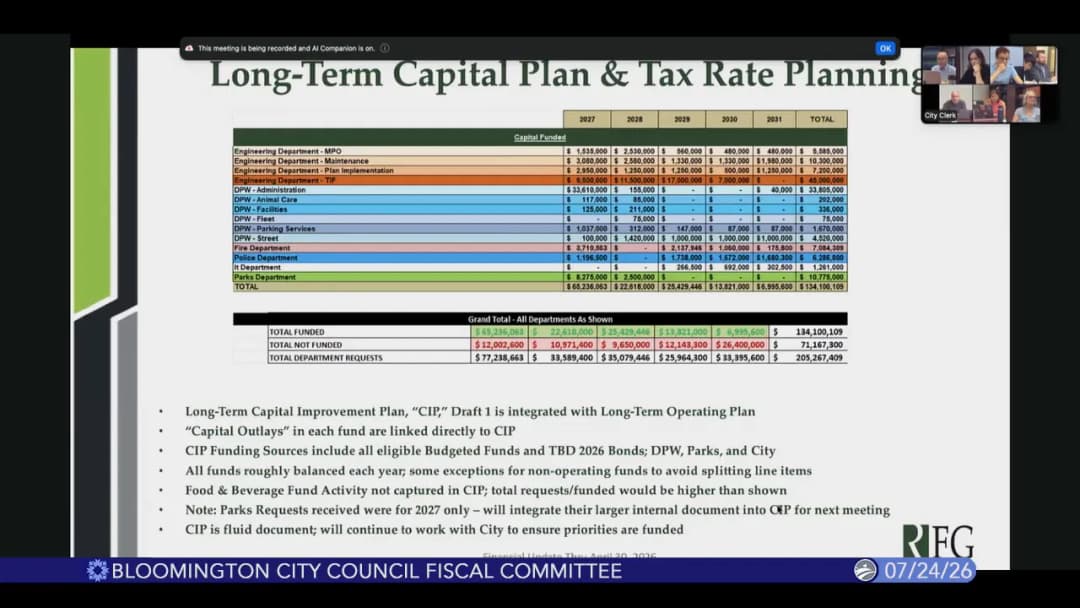
The special fiscal committee met on July 27, 2026, to review the city’s second-quarter financial reports and a long-term financial plan. The meeting included presentations from the city controller and financial staff, public comment, and discussions on state tax law changes, capital funding, and bond timing. Public Comments & Testimony - Kevin Keogh, a member of the public, urged the committee and city council to take two concrete actions: establish an annual calendar item dedicated to reviewing and reauthorizing the city’s debt, investment, and reserve policies; and institute formal oversight of multi-year operational and capital plans, including timely completion of the Annual Comprehensive Financial Report (ACFR). He noted that a 16‑month delay in submitting audited figures undermines market trust and that the city has not historically aligned with Government Finance Officers Association (GFOA) best practices. He emphasized that policy adoption without regular legislative review is incomplete governance. Discussion Items - Controller’s Second Quarter Financial Report – City Controller Jeff McKinn presented revenue and expenditure reports for the second quarter. Key points included: - General fund expenditures were at 48.81% of appropriations; the Economic Development LIT fund was at 48.5%. However, front‑loaded expenses (e.g., nearly $4 million for Bloomington Transit, transfers to alternative transportation, sanitation, and fleet management) indicate that actual spending is ahead of the straight‑line projection and likely will result in year‑end reversions. - Encumbrances from prior years explain some negative balances; the city will present a list of encumbrances at a public meeting later this year, as recommended by the Department of Local Government Finance (DLGF). - Revenue reports showed that total Local Income Tax (LIT) collections exceeded 50% of the budgeted amount due to a supplemental payment not anticipated in the budget. - New state law (House Enrolled Act 1001) will require planning and building permit fees to be deposited into separate funds starting in 2027, increasing accounting work but not changing overall revenues or expenses. - A $500,000 transfer from the surety bond proceeds fund to the fiber connectivity fund was previewed. The surety bond proceeds fund was created last year to receive a $1 million bond from a developer related to fiber‑installation issues; none of those funds have been spent yet. - Council members asked about the public safety LIT fund, which had only $1.4 million received against a $4.8 million budget. The controller said the budgeted figure may be incorrect because it may have included public safety answering point (PSAP) revenue; he will investigate. - Long‑Term Financial Plan and Capital Needs – Presenters from the finance office (likely the deputy mayor and other staff) discussed: - A five‑year capital improvement plan showing $77 million in total capital requests for 2027, with $65 million currently funded and $12 million unfunded even with planned bond issuances. - The city’s debt rate is currently about 20 cents lower than the next closest comparable city (Lafayette/Noblesville). Increasing the rate to $1.00 could generate $8–$8.5 million annually for capital projects. - The potential bond issuances discussed include a 2026 Park GO bond and a 2026 City GO bond, plus a DPW building bond. If issued, total debt tax rates could increase by about 7 cents (combining park and city GO bonds). - State tax law changes under SCA1/HB1210 were reviewed in detail. Under the “break‑even” scenario (where local units recover lost property tax revenue through a municipal services LIT rate), the city would receive approximately $42 million from the municipal services rate in 2029 (using 2026 certified numbers and 1% annual growth). The county would receive about $3.7 million. The city’s portion is higher because cities and towns get a 1.5× population multiplier. - Homeowner impacts were projected: the average homeowner in Monroe County would save about $657 in property taxes under SCA1 compared to the old system, but would pay more in LIT. The net effect for the average household is a $353 per year savings, though the relief is regressive—homeowners with lower‑value properties (e.g., in Stinesville) may pay more overall. - The general fund is projected to have an operating deficit of $7.8 million in 2026, with further deficits in 2027–2028. The large surplus projected for 2029 ($16 million) is due to the redirection of LIT and PSAP funding from separate funds into the general fund when state LIT allocations cease under the new structure. Interest revenue is expected to decline as cash balances are spent down. - Council members raised concerns about the regressive nature of the property tax relief, the need for careful policy choices (e.g., ending Bloomington Transit subsidy), and the importance of keeping the overall tax rate low for residents. Key Outcomes - No formal votes were taken at this meeting. The committee received the controller’s report and the long‑term financial plan for discussion. - The next fiscal committee meeting is scheduled for August 7, 2026, and will continue follow‑up on electric official salary matters. - Council members were asked to send any follow‑up questions regarding the controller’s reports to Jeff McKinn. The committee will also consider establishing formal annual reviews of financial policies, as urged by public comment.

FISCAL SUSTAINABILITY 71% · PUBLIC ENGAGEMENT 8% · PUBLIC WORKS 7% · BUDGET EQUITY ANALYSIS 7%
30
JUL 24, 2026 · BLOOMINGTON, INDIANA · CITY COUNCIL
Committee on Council Processes Meeting – July 24, 2026

The Committee on Council Processes met on July 24, 2026, to discuss updates on board and commission training, proposed legislation modifying the Transportation Commission and Environmental Commission, a potential consent agenda tracking system, and continued review of Title Two of the municipal code. The meeting included public comment on several items and discussions on term staggering, commission size, and procedural changes. No formal votes were taken; the committee directed staff to refine drafts and revisit at a later meeting. Updates from Clerk’s Office - Clerk Crossley reported that boards and commissions training for staff liaisons and first-round training for members had been completed, but turnout was lower than desired due to summer schedules. Additional training dates will be arranged after the school year begins. Legislation Regarding Commissions - Transportation Commission: Councilmember presented a draft shifting one council-appointed seat to a designated MCCSC seat (appointed by the mayor upon recommendation from MCCSC superintendent). Discussion included: whether to expand the commission from 9 to 11 members (the chair of the Transportation Commission, Steve Vollmer, expressed support for 11 to ensure diverse viewpoints and to avoid quorum issues) and whether to stagger term expiration dates. The mayor’s office opposed expansion, citing difficulty filling seats. The committee leaned toward keeping 9 members and staggering terms. No vote was taken; further amendments will be drafted. - Environmental Commission: Proposal to reduce the commission from 12 to 9 members (5 appointed by council, 4 by mayor) due to chronic vacancies. The mayor preferred an 8-member even split, but the committee opposed eliminating current council appointees. Discussion included specifying which seats to eliminate (currently M1 and C4 are vacant). The committee agreed to maintain a 5–4 split and an odd number for voting. Further drafting needed. Consent Agenda Tracking - The committee revisited a previous decision to postpone consent agenda legislation until next year. Members discussed tracking legislative items that could be candidates for a consent agenda. Clerk Crossley suggested using a Google form to collect individual member assessments, with responses compiled into a read-only document to avoid deliberation concerns. Public comment supported the concept, noting that items like JAG grants are ideal for consent. No action was taken; the committee will develop the tracking tool. Title Two Review (Common Council Code) - Continued article-by-article review of Title Two. Key discussion points: - Conflict of Interest: Decided to retain in code rather than move to rules of procedure. - Expulsion of Members: Retained current language requiring two-thirds vote. - Investigatory Powers: Kept in code. - Committee Appointments: Debate on whether “presiding officer” or “council president” should appoint committee members. After discussion, the committee decided to keep “presiding officer” to allow the vice president to act in the president’s absence. Staff will adjust language accordingly. - Standing Committees: Proposed adding term limits for committee membership (one year default) and clarifying president’s responsibility to appoint. Consideration of adding term limits for committee members. - Public comment from Steve Volmer criticized the use of the Committee of the Whole and urged its elimination. No decision taken; review will continue at next meeting. Public Comments (General) - Paul (last name unclear): Mentioned a potential capstone project via O'Neill School to study boards and commissions; encouraged committee interest. Also noted a health equity report from the Monroe County Health Equity Council and urged the council to consider filling the vacant Public Data Director position. Next Meeting - Tentatively scheduled for Tuesday, August 18, 2026, from 4:00–5:30 PM, pending room and staff availability. The committee will confirm and circulate notice.

PROCEDURAL 44% · TRANSPORTATION SAFETY 22% · COMMUNITY ENGAGEMENT 11% · PUBLIC WORKS 10%
OPENPUBLICA · PUBLIC MEETING INDEXUPDATED DAILY · openpublica.com