Browse by city
Date range
Search help

Search titles, summaries, topics and stored transcripts together. Keywords may match separately; put the whole query in double quotes for a phrase. Matching follows word analysis, so punctuation is not exact. Both dates are included. Documents are not searched.

SHOWING 71–80 ENTRIES
71
NOV 20, 2025 · BLOOMINGTON, INDIANA · CITY COUNCIL
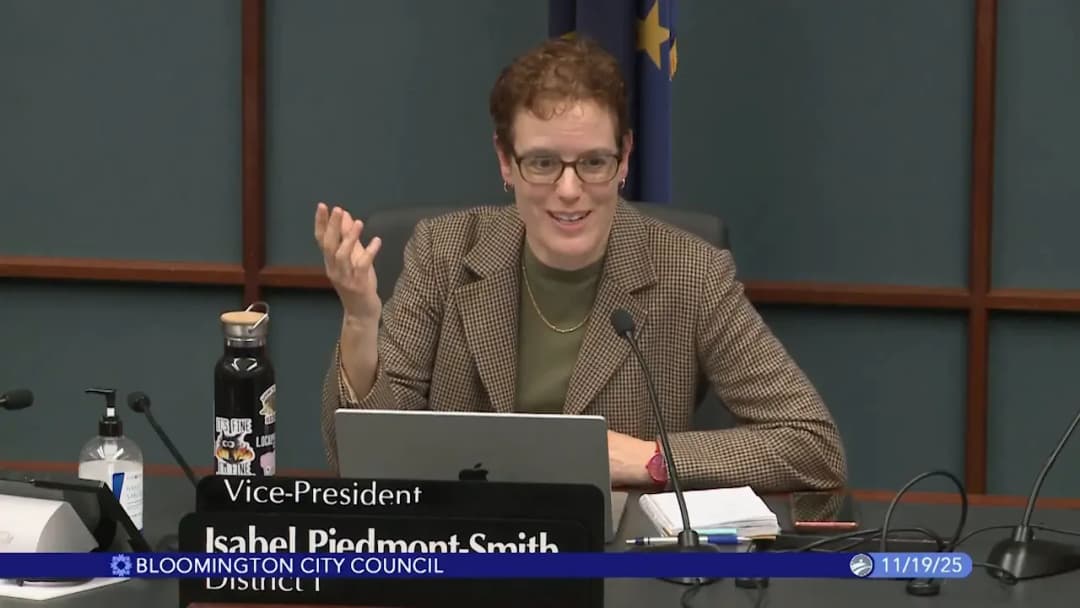
Bloomington Common Council Meeting - November 20, 2025

Note: The meeting transcript indicates the meeting occurred on Wednesday, November 19, 2025, but the provided instructions specify using the date November 20, 2025. This summary uses the given date per instructions. The meeting was called to order by Council Vice President (presiding in the absence of Council President Stasberg, who arrived later). All council members were present. The agenda included minutes approval, reports, public comment, appointments, first readings, and second readings/resolutions. Consent Calendar - Minutes from July 23, 2025 were approved unanimously by voice vote. Council Reports - Councilmember Asari reported on an upcoming Maple Heights neighborhood meeting, Innovation Week outcomes, and a food security community conversation. - Councilmember Zulik reported on progress toward adopting a consent agenda procedure. - Council Vice President delivered remarks on threats to democracy and press freedom. Public Comments & Testimony (Non-Agenda Items) - Christopher MG (Greater Bloomington Chamber of Commerce) presented economic data: Bloomington wages fell 6.2% in 2025 while Indiana wages grew 5.6% and U.S. wages grew 3.7%. He attributed the decline to Indiana University cuts/hiring freezes. He noted private small business creation rose 3% (three times the national rate) and urged the council to streamline regulations for small businesses and rethink housing incentives, specifically mentioning the payment-in-lieu approach. Appointments to Boards and Commissions - Joseph Shing appointed to the Commission on the Status of Children and Youth (Seat C2). - Zachary Ammerman appointed to the Commission on Sustainability (Seat C5). - Approved unanimously by voice vote. First Readings (Legislation) Four ordinances were introduced and read by title and synopsis only. They will be discussed and voted on at the December 3, 2025 meeting: - Ordinance 2025-19: Updates maximum towing charges for city-initiated tows. - Ordinance 2025-20: Updates fees and licensing requirements for nonconsensual towing. - Ordinance 2025-44: Adjusts septic collar rates for wastewater treatment. - Appropriation Ordinance 2025-14: Various fund transfers and appropriations. Discussion Items (Second Readings and Resolutions) Resolution 2025-20 – Emergency Food Services Funding - Sponsored by Councilmember Asari in response to prior government shutdown. Distributes funds from the Jack Hopkins Social Services Grant Program to Hoosier Hills Food Bank for emergency food services. - Discussion focused on a residency requirement in the funding agreement. Council Attorney clarified it was taken from a CDBG MOU and not standard for Jack Hopkins funds. Councilmember Asari indicated no issue with amending if needed, but it was considered moot for this distribution. - Council comments: Councilmembers expressed pride in the resolution and noted the need for consistent, reliable food assistance funding. - Vote: Adopted unanimously (8-0). Ordinance 2025-45 – Salaries of Elected Officials for 2026 - Provides a 2.7% cost-of-living increase for the Mayor, City Clerk, and Councilmembers. - Councilmember Flaherty opposed, arguing that salaries should be set using the city's comprehensive compensation framework rather than a simple COLA. He voted no. - Councilmember Rosenbarger also voted no. - Vote: 6-2 (Ruff, Rahlo, Piedmont Smith, Daly, Zulik, Asari in favor; Rosenbarger and Flaherty opposed). Ordinance 2025-41 – Single Room Occupancy (SRO) Use Amendment - Proposed to allow SROs as a conditional use in R1-R4 districts with owner-occupancy, maximum 3 bedrooms, and 2 adults per bedroom. Also permits SROs in RM, RH, and mixed-use districts. - Amendment 1 (sponsored by Councilmember Piedmont Smith): Technical clarification, corrected typos, added a whereas clause, and clarified definition changes. Passed 8-0. - Amendment 2 (sponsored by Councilmember Rahlo): Reduce occupancy to 1 adult per bedroom. Debate centered on HUD guidelines, potential for family overcrowding, and impact on housing supply. Councilmember Flaherty and others argued that allowing 2 adults would lower per-capita rent and better serve couples exiting homelessness. Councilmember Ruff supported the amendment, citing HUD standards and abuse prevention. Amendment failed 2-6 (Ruff and Rahlo yes; others no). - Public Comments on Amendment 2 and the ordinance: - Christopher MG (Chamber) noted that BZA hearings are a hurdle. - Jan Sorby supported SROs but argued the ordinance is "half-baked" compared to Salt Lake City's detailed regulations. - Eric Oost (online) raised concerns about LLC loopholes for owner-occupancy and questioned affordability. - Wendy Bricht testified about neighborhood impacts, loss of single-family homes to rentals. - John Lawrence suggested focusing on converting existing hotels/motels rather than "chipping away" at neighborhoods. - Council comments: Councilmembers shared varied views on owner-occupancy effectiveness, need for incremental housing, and potential for future refinement. - Vote: 7-2 (Daly, Zulik, Rosenberger, Asari, Flaherty, Piedmont Smith, Stasberg in favor; Ruff and Rahlo opposed). Council Schedule for 2026 - A proposed annual legislative schedule was presented. Councilmember Asari suggested minimizing meetings for flexibility. Council President Stasberg explained the rationale for a lighter schedule in early 2026 due to interview committees. - Vote: Adopted unanimously by roll call. Key Outcomes - Minutes approved. - Two board appointments confirmed. - Resolution 2025-20 (food bank funding) adopted (8-0). - Ordinance 2025-45 (salary increase) adopted (6-2). - Ordinance 2025-41 (SRO amendment) adopted after amendments (7-2). - 2026 council schedule adopted unanimously. - Next meeting: December 3, 2025.
AFFORDABLE HOUSING 29% · ZONING REGULATIONS 24% · PROCEDURAL 14% · PUBLIC ENGAGEMENT 11%
72
NOV 11, 2025 · BLOOMINGTON, INDIANA · CITY COUNCIL
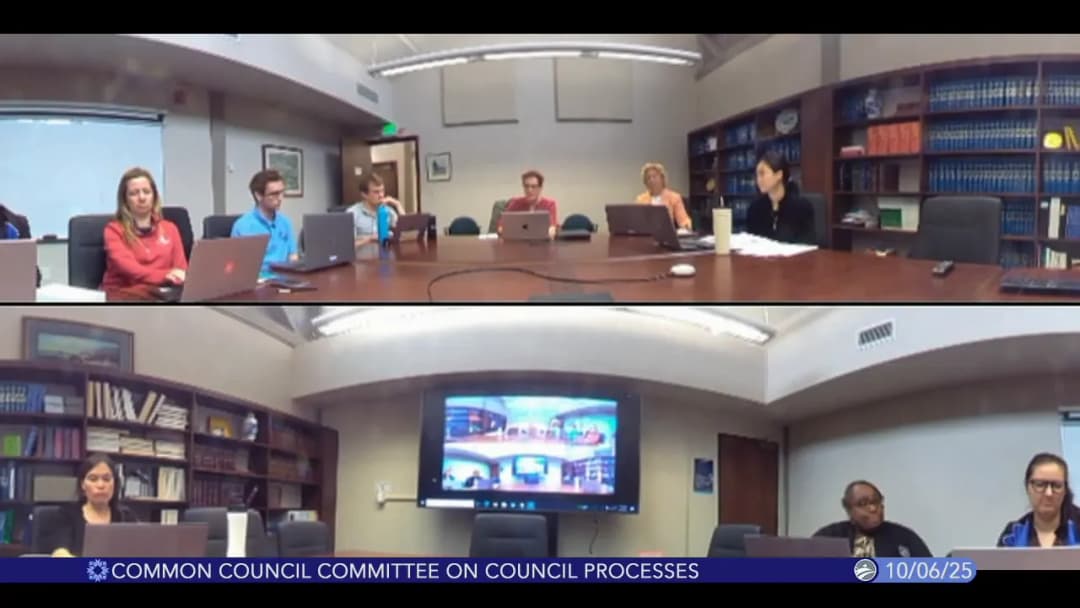
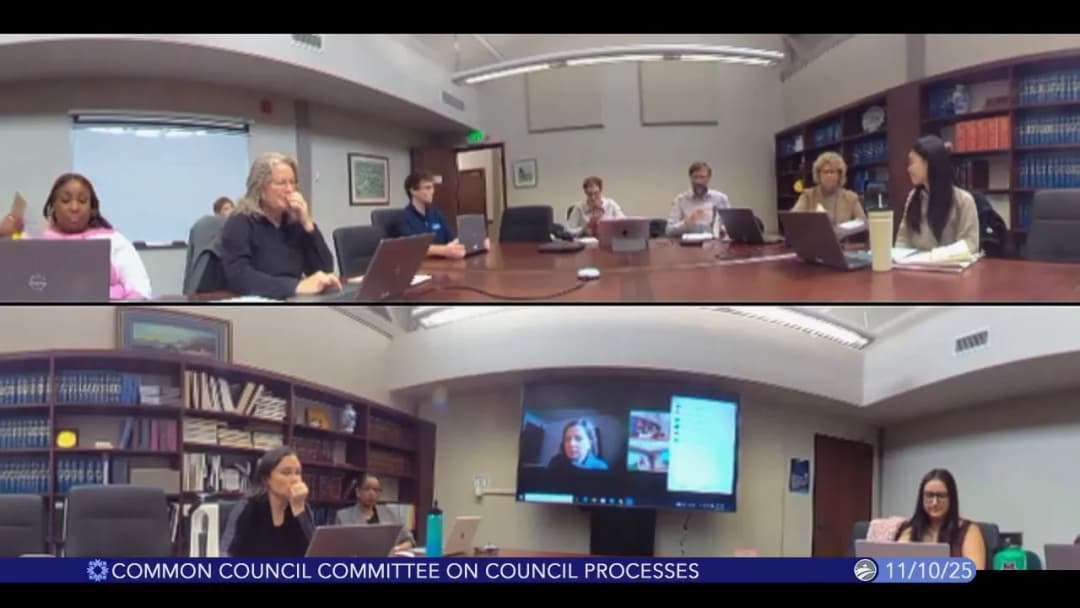
Committee on Council Processes Meeting - November 11, 2025

Note: The transcript begins by stating the meeting was held on Monday, November 10th, but the provided date is 2025-11-11 (Tuesday). This summary uses the date as instructed. The Committee on Council Processes met to discuss the city residency requirement for boards and commissions, a proposed code cleanup, and staff efficiency recommendations. Council Members Daly, Courtney, Sydney, and Chair Pete Hossman were present, along with council staff, a member of the public, and the city tech. Public Comments & Testimony - First Speaker (name not given): Supported the exploration of county resident membership on boards and commissions, calling it a "frontier" for more effective local government. Noted limitations of the Novak report and suggested linking membership changes to broader questions about board roles and citizen participation. - Angie Isabel: Emphasized making boards and commissions manageable as a privilege of city residency. Supported allowing county residents on certain boards, especially when coordinated with county government, to foster genuine community engagement. Advised using a "scalpel" rather than a broad approach. - Christopher (third speaker): Raised concerns about transparency and public access: described difficulty finding the council office after relocation, urging better signage. Asked about the impact of Novak report recommendations on board-committee relationships. Also mentioned the Monroe County Health Equity Council and a spring capstone project seeking input from council members. - Final speaker (name not given): Endorsed a consent agenda for administrative items to streamline council meetings, citing the county's example. Discussion Items - City Residency Requirement for Boards and Commissions: - Chair Hossman presented a document listing 11 boards/commissions not controlling city funds, not currently allowing non-city residents, and not limited by state code. He identified six as potentially appropriate for county resident membership: Arts Commission, Environmental Commission, Tree Commission, Commission on the Status of Women, Commission on Hispanic and Latino Affairs, and Farmers Market Advisory Council. - Staff Christina Chang and Julius reported survey results from liaisons of four identified commissions. Responses were predominantly "no" or "maybe" on adding county advisory seats; one commission (Environmental) suggested merging with the Board of Commissioners on Sustainability (BCOS). - Council Member Courtney proposed taking the question directly to commission members for their individual input. The committee agreed to visit the six commissions in person to gather feedback, with staff to create a spreadsheet of meeting times. - Administration (Julius) expressed hesitation due to administrative burden and city-funding concerns, particularly for the Arts Commission. Deputy Clerk Jennifer clarified that tracking residency is already part of routine work and not a significant burden, especially with planned IT integration. - Council Member Sydney supported opening the Arts Commission to county residents, arguing that art has no borders and that county residents should be eligible for grants. She advocated for including the Commission on the Status of Women and the Commission on Hispanic and Latino Affairs. - Proposed Code Cleanup (Item 2B): - Chair Hossman proposed moving residency and other general provisions from section 2.08.020 (executive branch) to section 2.12.01 (boards and commissions) for clarity. Committee members expressed no objections. Next step: contact the mayor's office and legal department for feedback. - Staff Efficiency Updates: - Lisa (council staff) outlined challenges from new state and federal laws, including increased staff time for meeting support. She suggested a consent agenda, merging the Fiscal Committee and Budget Task Force, reconsidering meeting order, and establishing deadlines for council member submissions. Council members gave feedback: - Sydney opposed moving council reports to the end of meetings. - Courtney supported a consent agenda and offered to draft an ordinance. - Pete favored merging the two committees. - Discussion included submitting questions in advance to reduce meeting time, with proposals to make Q&A exchanges public or include them in packets. Key Outcomes - Next Steps on Residency Requirement: Committee members will individually visit the identified boards/commissions (excluding CAPS) to gather direct input from commissioners. Staff will provide a schedule. - Code Cleanup: Chair Hossman will confer with the deputy mayor, and legal counsel will review the proposed move of residency provisions. No formal vote taken. - Consent Agenda: Council Member Courtney will work with staff to research options and present a draft ordinance at a future meeting. - Committee Merger: There was consensus to merge the Fiscal Committee and Budget Task Force; details to be refined. - Meeting Scheduling: The December meeting will be moved to after 5 p.m. to accommodate members' schedules; a Doodle poll will be circulated. - Staff Efficiency: No formal decisions were made, but staff will explore deadlines for council materials and methods to pre-submit questions.

PUBLIC ENGAGEMENT 51% · COMMUNITY ENGAGEMENT 17% · PUBLIC WORKS 13% · PROCEDURAL 10%
73
OCT 16, 2025 · BLOOMINGTON, INDIANA · CITY COUNCIL
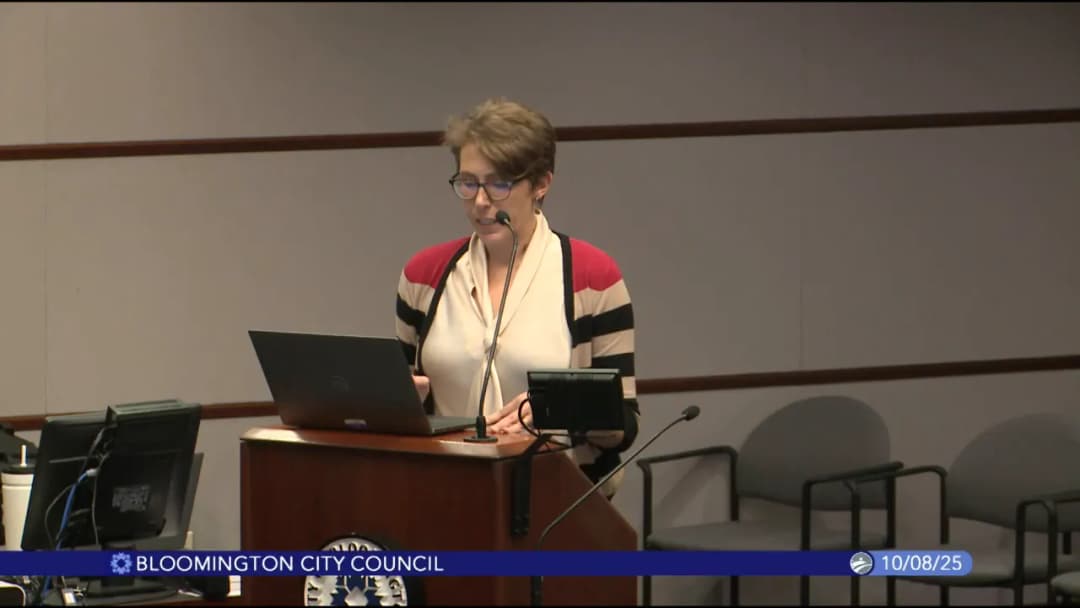
Bloomington Common Council Deliberation Session with Historic Preservation Commission - October 16, 2025

The Bloomington Common Council held a deliberation session on October 16, 2025, to discuss historic preservation issues with members of the Bloomington Historic Preservation Commission (HPC). The meeting included a presentation by Program Manager Noah Sandweiss, a moderated discussion led by Councilmember Zulik, and public comment. Key topics included the design review process, repair costs, demolition procedures, and the need for better notification of historic district status. Public Comments & Testimony - Elizabeth Cox Ash (McDoel Gardens) shared her neighborhood's inclusive process for creating guidelines, with committees representing landlords, homeowners, and business owners. She emphasized that Bloomington's unique kit homes and stone-mason homes should be preserved to maintain the city's character. - Richard Lewis (Prospect Hill) described his neighborhood's transition from a conservation district to a historic district, highlighting a committee of 15 volunteers who reached consensus on all guideline items. He praised the partnership between the HPC and homeowners and thanked the council for facilitating the conversation. - Bill Bowles (Near West Side) noted his neighborhood's guidelines were designed to avoid making preservation unaffordable, and that historic designation has helped protect affordable housing from speculative development. - Wendy Grist (Elm Heights) expressed support for historic designation as a way to slow rental creep and preserve smaller, affordable homes. She raised concerns about a rental agency replacing original windows without permits in a historic home. - Christopher Emgie (Sunny Slope) cautioned that not all architecture is equally valuable and that some trade-offs may be necessary for growth. He suggested preserving representative examples of architectural styles rather than every building. - Jeff Richardson (Elm Heights) argued that preservation and affordable housing are not mutually exclusive, citing his own conversion of a basement into a studio apartment. He supported intervention to prevent neglect of older homes. - John Butler (potential Cottage Grove conservation district) explained that property owners seek historic designation for stability against demolition. He noted that tear-downs are replacing affordable units with much more expensive ones, exacerbating the housing crisis. - Matt Sutton (former HPC member) identified four issues: (1) the process for forming a neighborhood group to request designation is vague; (2) cost and affordability questions are outside HPC expertise; (3) the demolition delay process offers no middle ground between approval and designation; (4) the code lacks incentives ("no carrot"). - James Ford (Cottage Grove) asked how the city expects guidelines to treat out-of-town owners, LLCs, and short-term renters who may not be invested in the neighborhood. - Tonda Radowan (uncategorized neighborhood) noted that many renters are not students, and that out-of-town landlords often neglect repairs while converting homes to Airbnbs, destabilizing neighborhoods. Discussion Items - Repairs and Code Impact: Commissioners explained that the state code requires historic buildings to be maintained to prevent loss of historic material, but ordinary repairs that do not conspicuously change appearance are allowed. The HPC aims to process certificates of appropriateness (COAs) quickly, meeting twice a month (except November and December). Staff can review minor alterations; four categories (demolition, moving buildings, additions, new construction) require commission review by state law. - District Standards: Each historic district writes its own guidelines, which are ratified by the HPC. This decentralized approach allows neighborhoods to tailor rules. Elm Heights has more restrictive guidelines; McDoel Gardens has lighter rules. The commission encourages neighborhoods to rewrite guidelines if they become onerous, but noted that the process for initiating rewrites is not always clearly defined. Commissioner DeSeller stated that the HPC leaves guideline writing to neighborhoods, with commissioners serving as advisors to ensure clarity and legality. - Economic Hardship: Councilmembers asked whether the defined term "economic hardship" is ever applied. Commissioner Cross recalled three instances where cost was considered; in one case an allowance was made, in another it was not. Commissioner Campbell added that cost is only one factor; the commission gives more latitude for contributing structures versus outstanding ones. The lack of city incentives was noted as a gap. - Demolition and Neglect: Commissioners expressed concern about the high volume of demolition requests (4-5 per meeting, nearly all approved). The demolition delay process only offers two outcomes: permit demolition or refer the property to the council for possible designation. There is no middle option. Commissioner DeSeller stated that neglect leading to demolition is a major issue, and the commission feels it lacks tools to intervene. Commissioner Duffy noted that many new demolition applications are for full demolition due to real estate pressure. New commissioner Deusner said this is her least favorite part of the job, as small, character-rich homes disappear. - Notification of Historic Status: Commissioner Cross proposed a formal system to inform buyers at the time of sale that their property is in a historic district, so ignorance is no longer an excuse. Sandweiss concurred and noted that 90% of COAs are approved, indicating most applicants comply after learning the rules. - Commissioner Qualifications and Appointments: Commissioner Campbell read the ordinance requirement that members have demonstrated expertise in historic preservation disciplines. He urged the council to ensure qualified appointments, and Commissioner DeSeller asked for faster appointments to achieve a full slate and avoid quorum issues. - Affordable Housing Connection: Several commissioners noted that historic preservation often aligns with affordable housing goals, as older, smaller homes provide entry-level housing. Commissioner Deusner highlighted the tension between zoning allowing higher-density development and the loss of these homes. Key Outcomes - Councilmember Zulik listed four action items from the discussion: (1) develop a more consistent approach for reporting at-risk houses (e.g., a U-Report option on city website); (2) create an alternative to the demolition delay process beyond full approval or council designation; (3) establish a formalized system to inform potential homebuyers of historic district status; (4) press the mayor to appoint qualified voting members promptly. - The HPC invited council members to attend their meetings (second and fourth Thursday at 5 p.m.) to observe the process. - Councilmember Rallo asked for specific zoning code concerns that might affect historic preservation and affordability, to be shared via email for a future discussion. - Councilmember Munt Smith noted the need to include long-term renters and others who live in neighborhoods but may not be property owners in the guideline process, and suggested engaging the city's neighborhood liaisons. - No formal votes were taken; the session was an information-sharing and deliberation meeting.

HISTORIC PRESERVATION 71% · AFFORDABLE HOUSING 8% · PUBLIC ENGAGEMENT 7% · PROCEDURAL 4%
74
OCT 9, 2025 · BLOOMINGTON, INDIANA · CITY COUNCIL
Bloomington Common Council Special Session on Budget Approvals and Elected Official Salaries - October 9, 2025

The Bloomington Common Council held a special session on October 9, 2025, to finalize the 2026 budgets for the civil city, Bloomington Transportation Corporation, and water/wastewater utilities, and to discuss elected official salaries. The meeting began at 4:33 PM. The council passed three appropriation ordinances and reached consensus on a 2.7% COLA increase for elected officials for 2026. Public Comments & Testimony - Eric Oost (public comment on 2025-11): Urged transparent communication on the city's debt profile, citing $414 million total outstanding debt per DLGF, and recommended inviting public participation in budget committees. He praised the controller's goal of making data understandable. - Kevin Keogh (public comment on 2025-11): A CPA and auditor, he expressed concern that the administration had not fully explained "macro errors" that reduced the projected budget deficit by $2.3 million, and urged the council not to approve the 2026 budget until explanations were public. - Joshua Stockton (public comment on 2025-13): A water treatment plant employee, he invited council members to tour the water and wastewater treatment facilities to witness issues firsthand, and noted transparency concerns within the organization. Discussion Items - Appropriation Ordinance 2025-11 (Civil City Budget for 2026): City Controller Jessica McClellan presented the budget. DLGF-reviewed funds totaled $110,184,108; non-DLGF funds totaled $52,968,449, for a combined total of $65,108,729 (though the sum of the two figures appears inconsistent, the controller provided these numbers). She noted deficit spending was reduced from $11 million to $9.4 million after revenue corrections, and the general fund cash balance at end of 2026 is $26,161,215 (40% of operating budget). Outstanding city debt (principal only) was $249,959,700 for property tax, wastewater, and water bonds. Councilmember Flaherty and Rosenbarger voiced opposition, citing lack of trust in the administration, failure to operationalize equity, and concerns about policy implementation. Councilmember Piedmont Smith noted the slow progress on outcome-based budgeting. The ordinance passed 7-2 (Flaherty and Rosenbarger voted no). - Appropriation Ordinance 2025-12 (Bloomington Transportation Corporation Budget for 2026): General Manager John Connell presented the budget, unchanged from previous presentation, totaling $19,383,402 with a proposed tax levy of 0.0371. Councilmember Flaherty questioned the impact of sunsetting ED LIT funds (by 2028), which were used as matching funds for federal grants. Connell explained that internal funds were now covering microtransit services. The ordinance passed 9-0. - Appropriation Ordinance 2025-13 (Water and Wastewater Utility Budgets for 2026): Utilities Director Catherine Zager presented the budgets, unchanged from previous presentation: water $23,110,000 and wastewater $34,590,000. Councilmember Flaherty praised the Utility Service Board's diligence. The ordinance passed 9-0. - Elected Official Salary Discussion: The council discussed salaries for 2026. Mayor Carrie Thompson recommended a 2.7% COLA increase (consistent with non-union staff) and urged development of principles for future salary setting. Clerk Nicole Bolden also supported COLA and suggested separating salary ordinances for council, mayor, and clerk. Councilmembers largely agreed on a 2.7% COLA for 2026, with most favoring a future values-based framework. Some councilmembers noted the need to compare salaries with peer cities and consider cost of living. The fiscal committee was tasked with continued work on a repeatable, values-based method. Key Outcomes - Approval of 2026 Civil City Budget (Ordinance 2025-11): Passed 7-2. Councilmembers Flaherty and Rosenbarger voted no. - Approval of 2026 Bloomington Transportation Corporation Budget (Ordinance 2025-12): Passed 9-0. - Approval of 2026 Water and Wastewater Utility Budgets (Ordinance 2025-13): Passed 9-0. - Elected Official Salaries for 2026: Consensus to provide a 2.7% COLA increase, matching non-union city employees. The council agreed to continue developing a principles-based framework for future salary adjustments. - Next Steps: Councilmembers were asked to sign appropriation ordinances 2025-11 and 2025-12. The next deliberation session is scheduled for October 15, 2025.

BUDGET EQUITY ANALYSIS 47% · PERSONNEL MATTERS 13% · PUBLIC ENGAGEMENT 10% · ELECTED OFFICIAL SALARIES 8%
75
OCT 7, 2025 · BLOOMINGTON, INDIANA · CITY COUNCIL
Bloomington City Council Committee Meeting on October 7, 2025

The committee met to discuss several operational and policy items, including an electronic public sign-in system for meetings, updates to deliberation session planning forms, a revision to the municipal code clarifying which offices can submit reports, and a detailed review of city residency requirements for service on boards and commissions. The committee also received an overview of council staff processes and began a discussion on allowing debate of legislation at first reading. The meeting included a public comment period on residency requirements, during which no one spoke. Public Comments & Testimony - No members of the public offered comment on the topic of city residency requirements for service on boards and commissions, nor on any other items during the final public comment period. Discussion Items - Electronic Public Sign-In Update: Council staff presented a new electronic sign-in form for public commenters, to be used via iPad with a tiny URL (replacing a QR code due to security concerns). Staff recommended testing the system on October 22. A council member volunteered to manage the sign-in queue during meetings. No objections were raised; a test run with appropriate staff was planned. - Proposal for Planning and Scheduling Deliberation Sessions: Staff revised a form to include required fields such as the legislative stage, meeting type, public engagement format (e.g., breakout groups), and whether facilitators are needed. The form was deemed ready for distribution to all council members. - Revision of Code to Clarify Reports Not Only from City Offices: Staff prepared an ordinance (with redline) adding the city clerk and city boards and commissions to the list of reporting entities. Committee members expressed support; the ordinance will be introduced at a regular meeting as a first reading. - City Residency Requirement for Service on Boards and Commissions: Council staff presented extensive research on all city boards and commissions (approximately 40). Findings showed that many bodies already allow county representation via county commissioner appointments or state statute. For those restricted to city residents (often due to city funding or state law), a uniform approach was deemed unworkable. The committee discussed creating advisory (non‑voting) seats for county residents, citing examples from the Historic Preservation Commission and the Commission on Hispanic and Latina Affairs. The mayor’s legislative affairs specialist stated the mayor does not blanketly oppose county residency but prefers a case‑by‑case approach. The committee agreed to identify 3–4 commissions where an advisory seat might be appropriate, then solicit input from those bodies before making a decision. Staff also noted the residency requirement is currently located in an obscure section of the municipal code (executive branch general provisions) and recommended moving it to the boards and commissions chapter. This topic will continue at the next meeting. - Council Staff Process Overview: Staff provided a three‑page list of steps required to organize a meeting, emphasizing increased transparency and upcoming accessibility requirements (effective April 2026). No action was requested; accessibility will be on the next meeting’s agenda. Staff also mentioned internal efforts to create templates and improve efficiency. - Order of Business at Regular Sessions: Allowing Discussion at First Reading: The committee reviewed a proposed revision to Title 2.04 to permit debate and amendment of ordinances at first reading. Two versions were presented (a staff version and a council member version). Discussion touched on the meaning of unanimous consent for title‑and‑synopsis readings and the interplay with consent agendas. The committee decided to defer further consideration until the next meeting, when research on consent agendas will also be presented. Key Outcomes - The electronic sign‑in system will be tested on October 22, with a council member designated to manage the queue. - The revised deliberation session planning form will be circulated to all council members. - The ordinance clarifying report sources will be introduced at first reading at a future regular council meeting. - A list of 3–4 commissions potentially suited for advisory county‑resident seats will be prepared, and those commissions will be contacted for feedback before the next committee meeting. - Discussion of allowing debate at first reading was postponed to the next meeting (scheduled for November 10, 2025, at 12:15 p.m. in the same room). - No votes were taken; all items were discussion or informational only.

COMMUNITY ENGAGEMENT 39% · LEGAL AFFAIRS 18% · PUBLIC ENGAGEMENT 16% · PUBLIC RECORDS 8%
76
OCT 1, 2025 · BLOOMINGTON, INDIANA · CITY COUNCIL
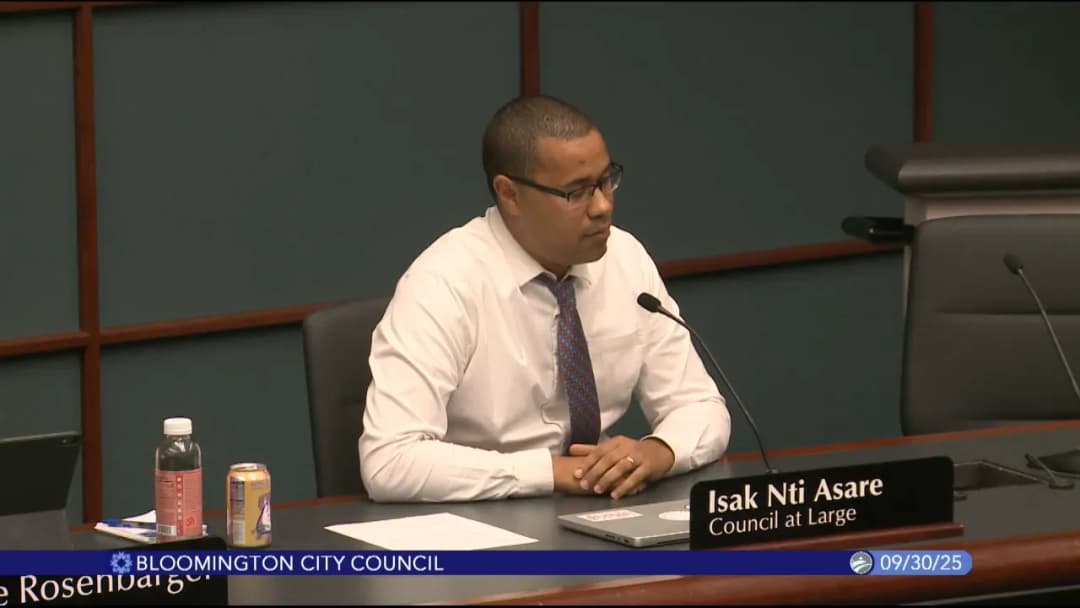
Bloomington Common Council Regular Session – October 1, 2025

The Bloomington Common Council held a regular session on October 1, 2025, with seven members present (a quorum). The meeting began with a point of interest regarding Yom Kippur, followed by council member reports, a special fiscal committee discussion on elected official salaries, appointments to boards and commissions, first readings of four ordinances, and second readings and votes on several key items including a stadium district naming, water rate adjustments, and bond authorizations. Public comments were heard on multiple agenda items. Reports from Council Members - Councilmember Rosenberger reported on recent violent incidents: the murder of Sean Sullivan on Friday night near downtown, an assault on an unhoused individual named Bobby, and the third anniversary of Nate Stratton’s death. She offered condolences and noted GoFundMe campaigns for funeral and dental expenses. - Councilmember Zuleck announced her election as chair of the Food and Beverage Tax Advisory Committee (FABTAC) for the coming year. - Councilmember Rallo discussed deer-vehicle collisions, noting over 100 annually in Monroe County, and advocated for deer management, including revisiting birth control options, to reduce collisions and tick-borne diseases. - Councilmember Piedmont Smith read a statement on violence against unhoused individuals, citing national data and the recent local attacks, and also noted the passing of Barry Lessow, former United Way director, with a tribute from Community Kitchen. - Council President Stasberg gave a personal report on childhood vaccinations, emphasizing the importance of risk assessment and noting potential public health catastrophes from reduced herd immunity. Special Fiscal Committee Report and Discussion on Elected Official Salaries Councilmember Piedmont Smith, chair of the Special Fiscal Committee, opened a discussion on setting salaries for elected officials for 2026. The committee reviewed last year’s ad hoc salary committee recommendations and sought full council input. Councilmember Daly expressed discomfort with increases given budget constraints from SB1 and federal funding cuts. Councilmember Rosenbarger noted the prior research and consultant work that was dismissed, and asked for clarity on the mayor’s support. Council President Stasberg agreed to place the item on the October 22nd regular session agenda for further discussion. A potential special session was also suggested but not finalized. Public Comments & Testimony - Kevin Keel (public comment on salaries): Suggested that elected official compensation be benchmarked to 50% of median household income for Bloomington ($50,156 per BEDC), with the mayor at four times that. - On Resolution 2025-18 (Stadium District): - Sarah Alexander (Maple Heights resident): Objected to the inclusion of residential areas, concerned it would encourage short-term rentals and undermine neighborhood identity. - Greg Alexander (Maple Heights resident): Argued the naming ignores residents and the need for safer pedestrian corridors; called for a road diet on College/Walnut. - Chris Strumjree (Chamber of Commerce): Supported the district as a no-cost marketing tool to harness IU athletics for economic development, especially in light of SB1. - Aubrey Williams (co-founder of Heartwork Brewing): Supported the district as a way to unite businesses and improve visibility, noting the need for liquor license reform to allow family-friendly establishments. - Gabriel Holbrow (city employee, Maple Heights resident): Requested the removal of Maple Heights from the map to preserve the neighborhood’s historic identity. - Mike McAfee (Visit Bloomington): Urged approval, noting the district would help market hotels during slow tourism months. - Casey Green (Maple Heights resident): Criticized the double speak that naming is powerful yet claimed to have no impact; worried about aligning with IU’s brand and losing local character. - On Ordinance 2025-35 (Water Rate Adjustment): - Chris Frimbury (Chamber of Commerce): Expressed concerns about the 50% increase for commercial/industrial customers, urging a more gradual approach to avoid sudden shocks. - Additional Public Comment: A block party announcement was read: a block party at Butler Park on October 25th after a tree planting, with food trucks and live music. Discussion Items - Resolution 2025-17 (Reinitiating UDO Amendment on Affordability Incentives): Councilmember Stasberg presented the third initiation of this resolution to request the Plan Commission to modify affordability incentive eligibility and PUD standards. The Plan Commission had twice failed to act. Director Hiddle apologized, stating safeguards are now in place. The resolution passed 7-0. - Resolution 2025-18 (Stadium District Naming): Councilmember Stasberg and Director Cooper Smith presented the proposal to name the area around Miller Showers Park as the “Stadium District” for economic development and marketing purposes. Boundaries include commercial and some residential areas. Extensive council discussion ensued regarding impacts on neighborhoods, short-term rentals, and the separate liquor license program. Councilmember Rosenbarger expressed support but wanted more neighborhood consultation; Councilmember Sari raised concerns about process and map boundaries. A motion to postpone to October 22nd passed 6-0. - Ordinance 2025-35 (Water Rate Adjustment): Director of Utilities Catherine Zager, Jennifer Wilson (Crow), and Danica Katz (Stantec) presented a 30.5% overall revenue increase to fund an $84 million capital improvement plan, including $54 million in bonds. Residential rates would rise about 19.8%, commercial/industrial about 42%, and irrigation up to 122% (capped at 4x the overall increase). The increase is needed to address deferred maintenance, aging infrastructure, a new service center, and to maintain debt service. Council questioned the rate design, impacts on low-income customers (assistance program improvements described), and the bond issuance. After public comment, the ordinance passed 6-0. - Ordinance 2025-36 (Waterworks Revenue Bonds): Companion ordinance authorizing up to $71 million in bonds for capital projects described in the rate ordinance. Introduced and read after 10:30 p.m., initially failing on a 4-2 vote (needed 2/3 of all council members, requiring 6 votes). Councilmember Sari moved to reconsider, and upon revote, the motion to introduce passed 6-0. After brief questions and no public comment, the ordinance passed 6-0. Key Outcomes - Resolution 2025-17 (UDO Affordability Incentives): Adopted 7-0. Directs the Plan Commission to prepare amendments. - Resolution 2025-18 (Stadium District): Postponed to October 22, 2025, by a 6-0 vote, to allow map adjustments and further neighborhood engagement. - Appropriation Ordinance 2025-08 (Fiber Connectivity Fund): Adopted 6-0, transferring $250,000 from general fund to fund low-income housing fiber connections. - Appropriation Ordinance 2025-09 (Additional Budget Appropriations): Adopted 6-0, covering ITS, engineering reimbursements from IU, and clerk’s office budget transfers. - Ordinance 2025-35 (Water Rate Adjustment): Adopted 6-0, implementing a 30.5% revenue increase with varying class impacts, pending IURC approval. - Ordinance 2025-36 (Waterworks Revenue Bonds): Adopted 6-0, authorizing up to $71 million in bonds for capital improvements, also subject to IURC approval. - Appointments: Three appointments to boards and commissions approved unanimously (voice votes): Drew Heron (Historic Preservation), Lynn Hooker (Arts Commission), Avon Binder (Transportation Commission), and Joshua Brewer (Board of Housing Quality Appeals).

WATER AND WASTEWATER MANAGEMENT 29% · ECONOMIC DEVELOPMENT 14% · FISCAL SUSTAINABILITY 9% · PROCEDURAL 8%
77
SEP 25, 2025 · BLOOMINGTON, INDIANA · CITY COUNCIL
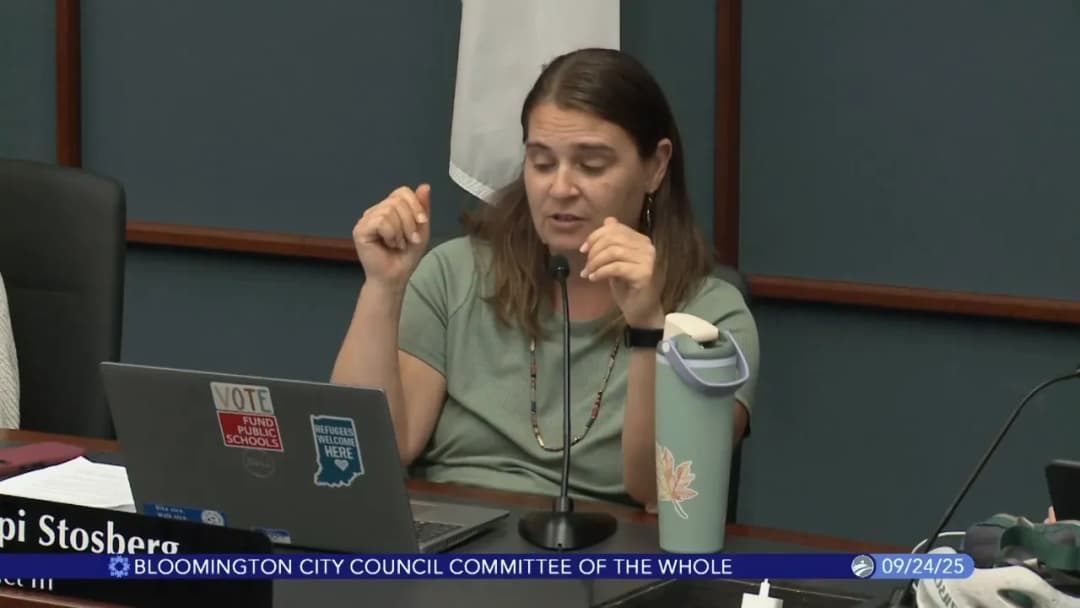
Bloomington Committee of the Whole Meeting – September 25, 2025

This meeting of the Bloomington City Council Committee of the Whole considered three appropriation ordinances for the 2026 fiscal year: the water and wastewater utilities budget, the Bloomington Transit budget, and the civil city (general government) budget. All ordinances were recommended for adoption by the full council after presentations, council questions, and public comment. The meeting also included extensive discussion of the city's fiscal outlook, tax rates, sanitation fund subsidies, and audit timeliness. Public Comments & Testimony - Kevin Keogh (Bloomington resident) expressed concern about the late publication of the city's 2024 Annual Comprehensive Financial Report (ACFR) and the timeliness of audits in general, stating that audits should be completed within 90 days of year-end. He also noted that his property taxes increased 20.69% last year and averaged over 10.5% annually over the previous three years, calling such increases unsustainable. He urged greater transparency and timely financial reporting. Discussion Items - Appropriation Ordinance 2025‑13 (Water & Wastewater Utilities Budget) – Presented by Utilities Director Caslin Zager. The water utility budget totals $23,119,000 and the wastewater utility budget totals $34,590,000. Councilmember Piedmont‑Smith asked about a negative $603,000 entry for "extensions and replacements," which Director Zager explained is a balancing mechanism used to achieve a net‑zero budget; the negative amount indicates a shortfall that will be covered by a one‑time loan from the sewer utility. Councilmember Rollo asked about water treatment plant capacity; Director Zager replied that maximum capacity is 30 million gallons per day (MGD), average usage is about 15 MGD, and peak is 19–20 MGD. Director Zager confirmed the budget does not assume any rate increases. - Appropriation Ordinance 2025‑12 (Bloomington Transit Budget) – Presented by General Manager John Connell. The total 2026 budget is $19,383,402 with a proposed property tax rate of 0.0371 (down from 0.0403 in 2025). Councilmember Piedmont‑Smith asked about the rate comparison; Mr. Connell noted the 2025 budget was $32 million due to significant capital programming, while the 2026 capital budget is 72% lower. Councilmember Stasberg questioned a line item for miscellaneous revenue that jumped from $0 in 2025 to $6.4 million in 2026; Mr. Connell said that figure includes ED‑lit funding from the city and the Public Mass Transportation Fund (PMTF), and he promised to follow up on why 2025 was zero. She also asked about a $1 million increase in "other charges for services, sales, and fees," which Mr. Connell attributed to increased partnership agreements, including service to Monroe County. Councilmember Piedmont‑Smith wished Mr. Connell luck in finding a new location for the transportation center. - Appropriation Ordinance 2025‑11 (Civil City Budget) – Presented by City Controller Jessica McClellan. The total advertised budget is $163,152,557. Since the budget hearings, key changes include: a 2.7% cost‑of‑living adjustment (COLA) for all non‑union regular appointed employees (police and fire already budgeted for 3%; AFSCME employees will receive a 5% increase while negotiations continue), corrections of a $2 million error in the budget book (due to an export issue between New World and the budget book), and an increase in general fund support for the sanitation fund from $700,000 to $1.5 million. Controller McClellan explained that the advertised tax rate of 1.36 is intentionally high to give the Department of Local Government Finance (DLGF) leeway; the actual estimated tax rate for 2026 is about 0.8426, down from 0.8627 in 2025. She noted the city expects to spend about 90% of its budget, reducing the projected deficit from $11 million to $9.4 million. Councilmember Stasberg raised questions about personal services vs. personnel services terminology and about the discrepancy between the total in Form 4 ($163,152,557) and the memo ($162,556,352); Controller McClellan attributed the difference to an over‑advertised rate for the CUMCAP Development Fund. Councilmember Sari asked about the impact of SEA 1 on circuit breaker losses; Controller McClellan said the budget internally accounts for expected losses. Councilmember Piedmont‑Smith asked about the composition of city revenues: 37.4% from property taxes and 33.1% from local income taxes, with the city's share of income tax based on county‑wide collections until 2028 when it will be limited to city residents. Controller McClellan confirmed that the sanitation fund subsidy has historically hovered around $1 million, and although the budget advertises $1.5 million, the actual need may be closer to $1 million. Councilmember Sari questioned why the administration did not make more aggressive cuts to studies and consulting; Controller McClellan replied that the time between budget hearings and adoption was insufficient to assess dependencies and ripple effects, and that cutting studies would not free up enough money for capital projects. Councilmember Stasberg noted that corridor studies remain relevant longer than engineering studies and provide information for future budgeting. Deputy Mayor Gretchen Knapp clarified that the $2 million error stemmed from a macro issue when ESD divided its budget into new divisions for internal tracking. - Response to Public Comment on Audits – Controller McClellan explained that the city is catching up on ACFRs after prior delays. The 2022 ACFR was completed in December 2023, the 2023 ACFR was completed in July 2024, and the 2024 ACFR is currently in progress. The city expects to return to a normal cycle with the 2025 ACFR completed by September 30, 2026. The smaller Annual Financial Report (AFR) due April 1 has been filed on time. Key Outcomes - Appropriation Ordinance 2025‑13 (Water & Wastewater Utilities Budget): Recommended for adoption by a vote of 7‑0. - Appropriation Ordinance 2025‑12 (Bloomington Transit Budget): Recommended for adoption by a vote of 7‑0. - Appropriation Ordinance 2025‑11 (Civil City Budget): Recommended for adoption by a vote of 6‑0. - All three ordinances will be presented to the full council for final action. The committee also directed staff to provide additional information on the sanitation fund's long‑term subsidy needs and to continue developing a framework for evaluating deficit spending and potential service cuts.

BUDGET EQUITY ANALYSIS 52% · PROCEDURAL 14% · PUBLIC TRANSPORTATION 13% · FISCAL SUSTAINABILITY 12%
78
SEP 25, 2025 · BLOOMINGTON, INDIANA · CITY COUNCIL
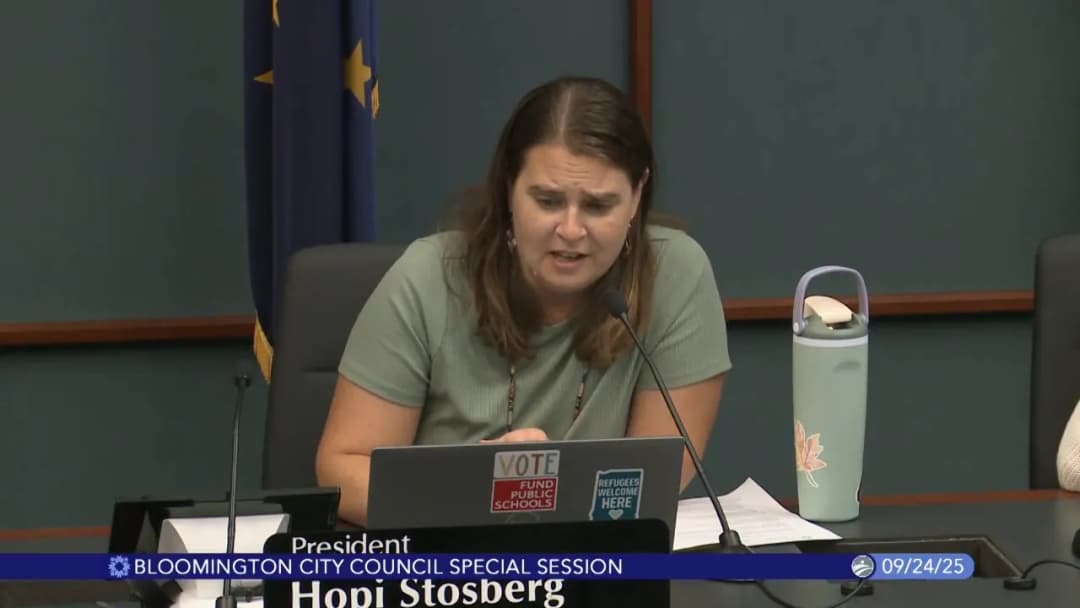
Bloomington Common Council Special Session - September 25, 2025

This was a brief special session of the Bloomington Common Council called to introduce three appropriation ordinances for first reading. The meeting was followed by a Committee of the Whole session scheduled for 6:45 PM. All three ordinances were approved for first reading and referred to the Committee of the Whole. Note: The transcript indicates the meeting was called to order on September 24, 2025, but the provided date is 2025-09-25. Discussion Items - The council introduced three appropriation ordinances for first reading: - Appropriation Ordinance 2025-11: Establishes the 2026 civil city budget for the City of Bloomington. - Appropriation Ordinance 2025-12: Sets appropriations and tax rates for Bloomington Transportation Corporation for 2026. - Appropriation Ordinance 2025-13: Adopts a budget for operation, maintenance, debt service, and capital improvements for water and wastewater utility departments for 2026. - The council agreed to the order of business: first readings in the special session, followed by the Committee of the Whole where the ordinances would be discussed in reverse order (starting with 2025-13, then 2025-12, then 2025-11). Key Outcomes - All three ordinances were moved and seconded for first reading and approved by voice vote (all in favor, no opposition). - Each ordinance was referred to the Committee of the Whole meeting that began at 6:45 PM the same evening. - The council adjourned the special session until 6:45 PM to reconvene as the Committee of the Whole.

PROCEDURAL 100%
79
SEP 24, 2025 · BLOOMINGTON, INDIANA · BOARD OF ZONING APPEALS
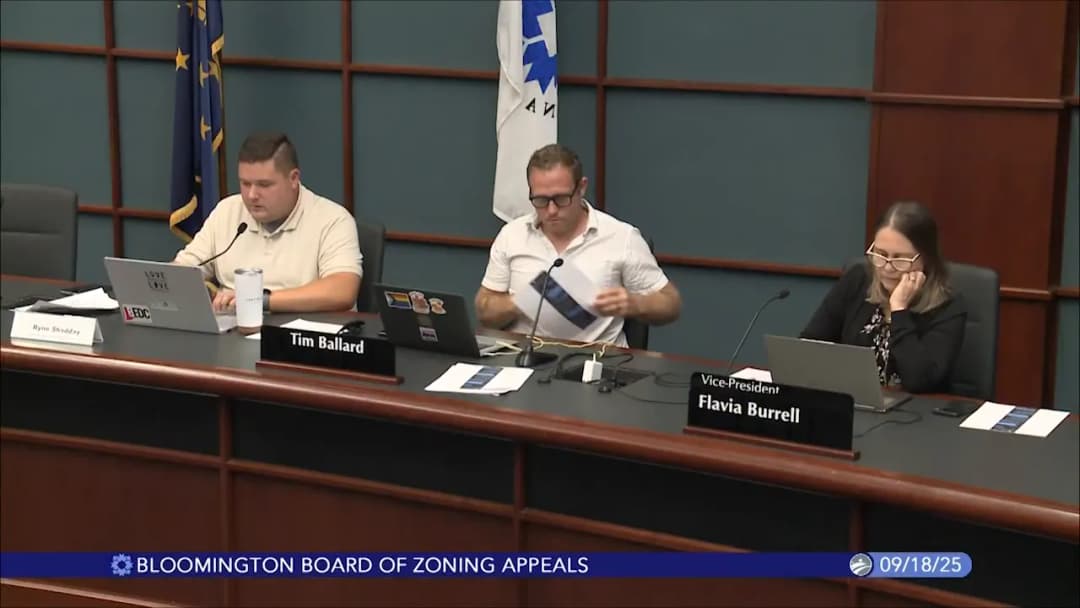
Bloomington Board of Zoning Appeals Meeting - September 24, 2025

The Bloomington Board of Zoning Appeals (BZA) met on September 24, 2025, to consider four petitions: a sidewalk variance, a driveway width variance, a conditional use for floodplain development (continued), and a combined conditional use and front setback variance for a duplex. The board approved two petitions with conditions and continued one due to incomplete documentation. Consent Calendar - The minutes from the August 21, 2025 meeting were continued to the next hearing because one board member had not reviewed them and abstained from voting. Public Comments & Testimony - V-35-25 (sidewalk variance): The petitioner, Ethan Michelson, stated that several neighbors submitted unsolicited letters supporting his variance request, though no members of the public spoke during the formal public comment period. - V-36-25 (driveway width): No public comment was offered. - CU-37-25 (floodplain development): No public comment was offered. - CU/V-38-25 (duplex): No public comment was offered. Discussion Items - V-35-25 – Griefy Properties (Ethan Michelson) – Determinate Sidewalk Variance: - Staff recommended approval, noting that no multi-use path exists along Headley Road and that installing a 60-foot section would be impractical until future developments connect to it. Topography and tree preservation were also cited. - The petitioner argued that the narrow parcel (0.79 acres, 60 feet wide) resulted from a lot line adjustment and that a 60-foot sidewalk to nowhere would serve no purpose, would require removing two large white pine trees, and would be an eyesore. He noted that a similar variance was granted in the neighborhood in 2007. - The board voted unanimously to approve the variance with the condition that a zoning commitment be recorded within 60 days. - V-36-25 – Mohasan Kianadasha Kanazade – Driveway Width Variance: - Staff recommended denial, arguing that a 24-foot-wide driveway cut (requested to be 3 feet wider on each side) increases pedestrian danger on a street with no sidewalks. They stated that an 18-foot width is sufficient for two cars. - The petitioners (through their daughter) argued that the narrow street, on-street parking, bus stop, and pedestrian paths create safety hazards that force them to park on the street; a wider driveway would allow single-movement entry/exit and reduce risk. - After discussion, the board proposed a compromise: the driveway must remain 18 feet wide for at least 10 feet south of the street edge, then may flare to a maximum of 24 feet up to the garage. The petitioners agreed. - The board voted unanimously to approve the variance with that condition. - CU-37-25 – Built LLC (Madeline Sanders) – Conditional Use for Floodplain Development: - Staff and legal counsel noted that the UDO requires a DNR permit or a letter stating no permit is needed before a conditional use can be approved. The petitioner did not have such documentation. - The board voted unanimously to continue the petition to the October 23, 2025 meeting to obtain the necessary DNR correspondence. - CU/V-38-25 – Todd Sachstetter (represented by Jamie Kreinler) – Conditional Use for Duplex and Front Setback Variance: - Staff recommended approval. The property at 111 South Jefferson Street is zoned R3; the petitioner proposes demolishing an existing single-family home and building a duplex. To meet Green Acres Neighborhood Association concerns about scale, the duplex is set back 33.47 feet (instead of the 15-foot build-to line), requiring a variance. - The petitioner stated they incorporated neighborhood feedback (using engineered wood siding, moving the building back) and have a demolition permit. - The board voted unanimously to approve the conditional use and variance with conditions requiring two large street trees planted as shown on the plan and limiting approval to the presented design. Key Outcomes - V-35-25: Approved (3-0) with condition to record zoning commitment within 60 days. - V-36-25: Approved (3-0) with condition that driveway width be 18 feet for at least 10 feet from the street edge, then flare to max 24 feet. - CU-37-25: Continued to October 23, 2025, pending DNR documentation. - CU/V-38-25: Approved (3-0) with conditions for two street trees and design limitation. - Meeting adjourned at approximately 3:10 PM.

ZONING REGULATIONS 34% · SIGNAGE REGULATIONS 20% · TRANSPORTATION SAFETY 18% · PROCEDURAL 11%
80
SEP 19, 2025 · BLOOMINGTON, INDIANA · CITY COUNCIL
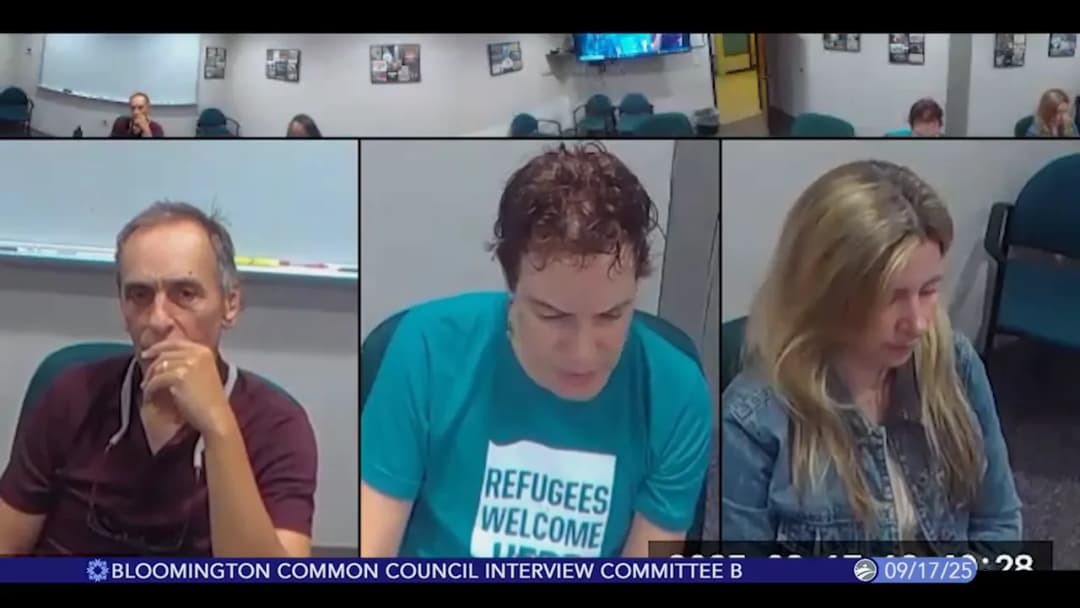
Interview Team B Meeting – September 19, 2025

The Interview Team B (a subcommittee of the Bloomington Board of Public Works? Unclear from transcript) met to discuss vacancies on the Transportation Commission and the CAPS Commission. The team reviewed previous applicants, considered new applicants, and decided to appoint a prior interviewee to fill a Transportation Commission seat. Outreach efforts to boost CAPS applications were also discussed. Discussion Items - Vacancy Status: The team noted that the CAPS Commission still has no qualified applicants (one application was rejected due to residency requirements). The Transportation Commission has two new applicants: Drew Yaker (an attorney) and Zachary Amarin (a student who primarily bikes, walks, or uses public transit). Four prior interviewees from a previous round were also discussed: Aubon Binder, Daniel Burnham, Norman Crampton, Jordan Davis, and Jacob Emory (one of whom, Mark Stosdorf, was already appointed to another commission). - Staff Outreach Efforts: A staff member reported on ongoing outreach, including a forthcoming segment on WFHB ("Activate"), plans to work with WTIU, creation of a flyer with a QR code linking to the application portal, and direct calls to past applicants to gauge interest in other boards. The team discussed the need to attract more applicants, especially women and CAPS candidates. - Debate on Appointment Path: The team debated whether to interview the two new applicants or directly appoint a previous interviewee. Members noted scheduling challenges and the urgency of filling the long‑vacant Transportation seat. Several members expressed a preference for Aubon Binder, who had previously served on the Parking Commission and was well‑regarded from earlier interviews. Concerns about over‑representation from one commission (parking vs. bike/ped) were raised but not leading. - Motion: A motion was made and seconded to appoint Aubon Binder to the Transportation Commission seat (seat C‑1). No opposition was heard. Key Outcomes - Appointment: Aubon Binder was appointed to the Transportation Commission by a unanimous voice vote (motion and second, no objections). The appointment is subject to mayoral confirmation (the mayor still has one appointment to make). - No Action on CAPS: The team noted the continued lack of applicants for the CAPS Commission and agreed to continue outreach, including asking current commissioners to recommend potential candidates and reminding past applicants that they may reapply. - Next Steps: Staff will finalize the outreach flyer and share it with the team. The team may consider the remaining new applicants (Drew Yaker, Zachary Amarin) for future vacancies. The next meeting was not scheduled. Other Items - The team acknowledged that the Transportation Commission vacancy has been open for some time and that filling it quickly would help the commission regain a full complement.

COMMUNITY ENGAGEMENT 70% · PUBLIC ENGAGEMENT 30%
OPENPUBLICA · PUBLIC MEETING INDEXUPDATED DAILY · openpublica.com