The Appointments Committee of the Bloomington City Council met on September 19, 2025, beginning at approximately 5:45 PM, to interview candidates for the Historic Preservation Commission and the Arts Commission, and to deliberate on recommendations to the full council. The committee members present included Sydney Zuluk (District 6), Matt Flarity (At-Large), Dave (last name not given), and Clerk Jennifer Crossley. Historic Preservation Commission Interview - Drew Heron, a real estate agent at Remax Clay Properties, was interviewed for a seat on the Historic Preservation Commission. He expressed interest in expanding his knowledge of historic preservation to become a well-rounded agent and serve the community. He referenced attending part of a prior commission meeting, discussing demolition delay cases (a collapsing garage and an unused pool) and the balance between historic character and cost/safety. He stated he would recuse himself in conflicts of interest and confirmed his flexible schedule allowed him to attend the bi-weekly Thursday evening meetings. Council members noted his preparedness and knowledge. Arts Commission Interviews - Brandy McDonald, Executive Director of the Museum of Archaeology and Anthropology, highlighted her passion for community-led arts initiatives and creative capital. She emphasized gathering data from the community to identify gaps and evaluating grant applications holistically—considering sustainable impact, artist compensation, and alignment with broader city initiatives. She confirmed her ability to attend the monthly second-Wednesday meetings, with occasional travel. - Lynn Hooker, a music scholar and returning Bloomington resident, spoke about music as a unifying force and the importance of supporting multicultural richness and international artist visas. She expressed interest in broadening outreach to underserved parts of the city and ensuring fair grant advertising and sustainable artist budgets. She noted occasional travel conflicts for meetings but planned to attend mostly in person. Deliberation and Key Outcomes - The committee discussed the qualifications of each candidate. For the Historic Preservation Commission, they agreed Drew Heron was qualified and nominated him for the C4 seat. The motion passed unanimously (Zuluk, Flarity, and Dave all voting yes). - For the Arts Commission, the committee noted that Brandy McDonald was also being strongly considered by the mayor's office for a mayoral appointment. They decided to recommend Lynn Hooker for the council-appointed C3 seat to fill a vacancy left by a member with a music background. A motion to appoint Lynn Hooker was seconded and passed unanimously. - Clerk Jennifer Crossley also informed the committee of a recent vacancy on the Commission on Sustainability and an open seat on the Committee on the Status of Children and Youth, with the former requiring a 15-day notice period before appointment. The committee noted they would address these at a future meeting. - The committee adjourned with plans to coordinate formal appointments through the clerk's office, with candidates expecting to hear within two to three weeks.
Public Meetings - Bloomington, Indiana
Public Meetings - Bloomington, IndianaNote: The meeting was called to order on September 17, 2025, but the official date for this summary is September 18, 2025, as provided. The session covered agenda amendments, approval of minutes, multiple reports, public comment, and legislative actions including first readings, second readings, and resolutions related to fiber optics, water utility bonds, a housing authority update, and an EPA endangerment finding letter. Consent Calendar - Minutes Approval: The council approved the minutes from February 19, 2025 (with a minor grammatical revision) by a unanimous roll call vote. Public Comments & Testimony - First Public Comment Period (Items Not on Agenda): - A resident expressed opposition to the construction of a fourplex in his neighborhood, requesting an amendment to the Unified Development Ordinance (UDO) to allow neighborhood residents to vote on such projects. He urged council members to consider a vote on this measure. - A representative from Exodus Refugee Immigration (Community Engagement Coordinator) thanked Councilmember Zulik and the Bloomington Police Department for their support. She requested that the city budget include a contracted language interpretation service for first responders and city departments, noting that Exodus clients speak over 20 languages and that such a service would ensure equitable access to city resources. She offered free training to city departments on how to use phone interpretation services. - Second Public Comment Period (on specific legislation): - On Ordinance 2025-34 (surety bond fund): A commenter asked about the city’s total exposure from the subcontractor’s failure and whether the main contractor (Meridium/M Street Fiber) is liable for damages and fines. He expressed confusion about who is ultimately responsible and requested clarification. - On Ordinance 2025-33 (fiber connectivity fund): A commenter expressed confusion about the overall fiber project status, noting the master agreement may not be in compliance, and questioned whether citizens are getting good value. He requested an assessment of the project’s progress and quality. Discussion Items - Council Member Reports: - Councilmember Daly encouraged applications for boards and commissions, noting that previous applicants who were not appointed should reapply. - Councilmember Piedmont Smith introduced a letter for council to sign opposing the EPA’s reconsideration of the 2009 endangerment finding for greenhouse gases. She explained that a repeal would remove the legal basis for climate pollution regulations, increase air pollution, and accelerate climate change impacts. The letter, from the Public Rights Project, argues that local governments rely on EPA regulation and that the proposed rule fails to consider harms to communities. After a brief discussion, the council voted unanimously to adopt the letter. - Councilmember Rallo condemned political violence, referencing the assassination of Charlie Kirk, and urged that political differences be settled through civil debate, not violence. - Councilmember Sari (Rosenbarger?) added that school shootings also have no place in society and noted that there has been a greater reaction to one person than to hundreds of school children shot over the past 25 years. - Councilmember Sari (likely the same person) also reported on the Plan Commission’s September 8 meeting, where they voted 7-1 to forward a positive recommendation on changing residential rooming house use to single room occupancy, with updated definitions. The council will take it up after budget discussions, likely late October/early November. He also updated on the Metropolitan Planning Organization (MPO) votes on the Transportation Improvement Plan (TIP), including constructing a sidewalk along the bypass between North Walnut and Kinzer, and reconstructing the pedestrian bridge over the bypass near Arlington, with majority funding in 2029. - Councilmember Sari also announced a constituent meeting on Sunday, September 21, at 1:30 PM on Zoom. - Report from the Bloomington Housing Authority (BHA): - Executive Director Nathan Ferreira presented an overview of BHA operations. Key points: - BHA has completed its second Rental Assistance Demonstration (RAD) conversion, meaning there is no longer traditional public housing. All units (Walnut Woods, Reverend Butler, Crestmont) are now under low-income housing tax credit deals with investor oversight. - BHA serves over 1,700 households (about 3,400 individuals) through Section 8 vouchers, with long waiting lists. Residents pay no more than 30% of income toward rent. Waitlist closed in April 2025 with 1,764 weights for housing choice vouchers. - Voucher utilization is at 68%, down from 70%, attributed to the pause of the Landlord Risk Mitigation program (funded by ARPA, now being replaced by the city). The program is expected to resume. - BHA is expanding resident services: Family Self-Sufficiency (80 participants), Resident Opportunities and Self-Sufficiency (ROS) program, grocery shuttle (in partnership with health department), eviction prevention, and a digital equity program. - Nonprofit Summit Hill CDC is developing: Core Community Flats (38 units, including 9 permanent supportive housing, on track for summer 2026); Chandler Early Learning Center (28 infant/toddler seats and 3 affordable apartments, named after Rev. Marvin Chandler); and a Community Land Trust with 9 homes, seeking new properties (including a four-plex pilot and a partnership with Mother Hubbard’s Cupboard for a food-oriented development). - BHA is exploring essential function bonds for workforce housing (up to 120% AMI) and a potential 185 additional units via another RAD/Faircloth deal. - Revenue for next year includes $936,000 in city grants (mostly ARPA), with ARPA funds expected to be spent down by 2026. - Ferreira stressed that land contributions are critical for affordable housing development and requested the city consider freeing up land for such projects. - Councilmembers asked about the Landlord Risk Mitigation fund size ($200,000 requested), the breakdown of grants, and ideas for land acquisition. Ferreira suggested the city could donate land or partner to purchase land. - Legislation – First Readings: - Ordinance 2025-35: Amends Title 9 (Water Rate Adjustment) to reflect increased costs and debt service payments. - Ordinance 2025-36: Authorizes up to $71 million in waterworks revenue bonds for capital improvements at Monroe Water Treatment Plant, distribution system, and a new service center. - Appropriation Ordinance 2025-08: Transfers funds from general fund to fiber connectivity fund for ITS department per the master development agreement with Meridium/M Street Fiber. - Appropriation Ordinance 2025-09: Appropriates general fund expenditures for ITS, engineering (reimbursed by IU), and a transfer in the clerk’s office. - All four ordinances were introduced by roll call votes and will be heard for second reading on September 30, 2025 (Tuesday, due to Yom Kippur). - Legislation – Second Readings and Resolutions: - Ordinance 2025-34 (Surety Bond Fund): Established a non-reverting fund to hold $1 million received from a surety bond for damages caused by subcontractor AEG’s work on the fiber optics network. Corporation Counsel Margie Rice explained that the city received the bond payment on July 8, 2025, after filing a notice. The fund will be used for city costs related to the damages; appropriations will be requested later. Councilmembers discussed the scope of allowable uses (“any other lawful purpose”), the potential for over $7 million in fines, and the role of the new contractor (M Street Fiber) in fixing right-of-way issues. The ordinance passed unanimously. - Resolution 2025-16 (Food & Beverage Tax Advisory Commission): Requested the Food and Beverage Tax Advisory Commission (FABTAC) to recommend expenditures for the Capital Improvement Board’s (CIB) 2026 budget. Treasurer Jeff McKim presented, noting that the CIB budget is funded by the food and beverage tax and requires this statutory procedure. The resolution passed 8-1 (Councilmember Rosenbarger voted no). - Resolution 2025-15 (Council Liaison Expectations): Codified expectations for council members serving as liaisons to boards and commissions. Sponsored by Councilmember Zulik, it assigns each interview committee member to be a liaison to 2-3 boards, requiring at least one meeting per year and three check-ins. Councilmembers discussed implementation, accountability, and the timing of feedback. The resolution passed unanimously. - Ordinance 2025-33 (Fiber Connectivity Fund for Digital Opportunity): Established a non-reverting fiber connectivity fund (amended to explicitly state “non-reverting”) to support broadband access for income-qualifying residents. The fund will be seeded with $1 million over four years ($250,000 annually from the general fund). Controller McClellan and ITS Director Dietz explained that the city will match up to $350 per connection, with M Street Fiber covering costs above $700. The ordinance passed unanimously. Key Outcomes - Votes: - Minutes approved unanimously. - Letter opposing EPA endangerment finding repeal adopted unanimously. - Ordinance 2025-34 (surety bond fund) adopted unanimously. - Resolution 2025-16 (FABTAC request) adopted 8-1. - Resolution 2025-15 (liaison expectations) adopted unanimously. - Ordinance 2025-33 (fiber connectivity fund) adopted unanimously after amendment. - Next Steps: - The four first-reading ordinances will have second readings and public hearings on September 30, 2025. - The city will return to request appropriations from the surety bond fund and the fiber connectivity fund. - The BHA will continue to seek land and funding for affordable housing; the city will consider ways to free up land. - The fiber optics construction is expected to resume in the coming weeks, with completion anticipated by late 2026. - The council scheduled a special budget session on September 24, 2025, and noted the next regular session on September 30, 2025 (Tuesday).
On September 11, 2025, the Bloomington Common Council held the first of two deliberation sessions focused on housing needs. The session aimed to collect personal experiences regarding finding and maintaining housing, rather than debating specific policies. Approximately seven small groups, each co-facilitated by a council member and city staff, discussed participants’ housing experiences. The meeting included an introduction, breakout groups, group report-outs, and a call for input via online forms. A note: the raw transcript dates the meeting as September 10, 2025, but the provided metadata indicates September 11, 2025; this summary uses the latter date as instructed. Consent Calendar - No consent calendar items were presented. Public Comments & Testimony - No formal public comment period was held. After the breakout reports, a few individuals offered additional remarks: - A speaker urged the city, county, and Indiana University to collaborate on a long-term housing plan (5–10 years). - A longtime resident questioned how the housing crisis developed and asked for more inclusion of older residents who have witnessed past changes. - A younger resident expressed urgency, noting that many high school and college classmates have left Bloomington due to lack of affordable housing, and that they themselves may not be able to stay long-term. Discussion Items - Opening and Logistics: Council President set expectations, emphasizing non-judgmental listening and shared vocabulary. Participants were asked to complete demographic cards (renter/owner, length of residency) and place a pin on a map to gauge diversity of attendees. - Breakout Group Reports: Seven groups reported back on themes from their facilitated conversations. Key recurring themes included: Group 3 (facilitated by Jamie and Hopi) - Most felt housing met their needs; renters considered rent high but fair relative to others. Preferences varied by life stage (e.g., yard size). Short-term rentals: some investors present, no negative experiences reported. ADUs: little firsthand experience, viewed as too expensive but interesting. Group 6 (facilitated by Councilmember Zulik and others) - Mix of realtors, builders, homeowners, renters, and county residents. Needs met for some, not for others. Key desires: affordability, walkability, proximity to loved ones, homeownership. Enjoyed neighborhoods near campus but affordable buying options limited. Missing middle housing (around $300,000) sought by older downsizers and first-time buyers. Density discussed. Group 4 (facilitated by David Brandes, zoning planner) - Majority homeowners, some renters. Some felt trapped in their neighborhood due to crime, desire for larger house, better sidewalks, transit, amenities. Strong desire to live within city. Lack of stepping stones to homeownership. Open to ADUs. Group 7 (facilitated by Councilmember Flaherty and Gabriel) - 16 participants: 14 homeowners, 2 renters; one apartment, one condo. Majority said housing met needs, but some did not. Issues of right-sizing (too much or too little house). Appreciation for traffic calming and multi-use paths. Concerns about connectivity beyond neighborhood, safety, food deserts. Affordability barrier to moving. Strong desire for mixed-use, walkable neighborhoods with diverse housing. Missing middle not present in Bloomington. ADUs: about half would consider building, half would consider renting; mixed views on ownership requirement. Short-term rentals: mixed perspectives on impacts. Group 2 (facilitated by Councilmember?) - Blend of renters and homeowners. Affordability central: home prices outpacing income, property taxes doubling since COVID. Concerns about investor-owned rentals changing neighborhood character. Discussed encampments and safety. Solutions: starter homes, condos, duplexes, family-friendly rentals, density in specific places but not tall buildings. Policy tools: land trusts, land banks, rental caps, limits on investor ownership, parking permits, accessible loans, rent control (illegal), form-based zoning, streamlining planning, stronger cooperation with IU and Ellettsville. Short-term rentals: some called for permits and data, others concerned about property rights. Group 5 (facilitated by Councilmember?) - Mix of renters and owners. Owners in smaller houses felt needs met; those in larger houses wanted to downsize but were stuck by low interest rates. Valued walkability, diversity, mix of rentals and ownership, parks/trails, grocery stores. Renters forced further out by prices. ADUs: half interested if lot size permits, half not; all supportive of idea. Short-term rentals: unanimously viewed as skewing the market and problematic. Interest in requiring owner occupancy to prevent short-term use. Group 1 (facilitated by Councilmember?) - Mix of renters and homeowners, many downtown or walking distance. Discussed definition of “meeting needs.” Some own houses because priced out of condos; prefer condos but few available. Desire for more small businesses, third spaces. Housing policy should not focus only on core neighborhoods. Good landlord critical. Renters face annual rent increases. Key themes: diversity, options, creativity. Key Outcomes - No formal votes or decisions were made. The session was purely informational and experiential. - Next steps: Part 2 is scheduled for November 12, 2025. It will include a summary of feedback from this session and other related community discussions, and will likely present specific policy proposals for deliberation. - Participants were encouraged to complete a reflection survey (available via QR code) and to submit any additional thoughts via an online form. All survey data will become part of the public record, with names disassociated from comments. - Facilitators are asked to submit their notes (electronic or transcribed) to the council president.
Note: The transcript indicates the meeting was called to order on September 3, 2025, but the provided metadata states the date is September 4, 2025. This summary uses the metadata date as instructed. The Bloomington Common Council met on September 4, 2025, to approve minutes, hear reports, consider ordinances and resolutions, and receive public comment. Key actions included establishing an affordable housing pilot fund, designating Bloomington as a B City USA affiliate, and introducing two ordinances related to fiber connectivity. Consent Calendar - Unanimously approved minutes from February 5, 2025, April 16, 2025, and July 16, 2025 (corrected from July 7). - Unanimously appointed Maria Poscama to seat C4 of the Commission on Hispanic and Latina Affairs. Public Comments & Testimony - Matthew Austin reported on a food waste pilot at the Taste of Bloomington: 150 pounds of food waste composted, over 300 pounds of usable food reclaimed for Wheeler Mission, Friends Place, and the Shalom Center. He described the model as a "food waste training company" for festivals. - An unnamed speaker opposed the Unified Development Ordinance (UDO) and a planned fourplex in his neighborhood, arguing residents should have final say. He expressed frustration with top-down decision-making and loss of neighborhood character. - Mark Haggerty, a Vietnam veteran and former mayoral candidate, criticized one-party rule, long voting lines, police presence at protests, and rising property taxes. He urged the council to take action on these issues. - Christopher MG (Greater Bloomington Chamber of Commerce) praised the 2026 budget process, supported the mayor's "fix-it-first" approach, and encouraged offset-first spending and clear metrics for new investments. Discussion Items - Bloomington Commission on Sustainability (BCOS) Annual Report – Chair Justin Vassal presented the 2024 report. Highlights: - BCOS is a 14-member advisory body promoting holistic sustainability (environmental, social, economic) since 2005. - In 2024, they held 9 of 12 regular meetings, welcomed 7 new commissioners, and awarded $7,000 in grants. - Projects included: a TerraCycle recycling pilot in the Covenanter neighborhood (follow-on from 2023), a native pollinator garden in Grand View Hills ($1,000), a Canopy Bloomington partnership planting 16 trees with three-year maintenance, a cob bench and pollinator garden at Red Bud Books, and a planned Bokashi composting education project. - The commission faced operational challenges (lack of permanent leadership, quorum issues) but strengthened processes by year-end. - 2025 priorities: housing and urban agriculture (green building, alternative models, urban aquaculture) and education/coalition building. - First Readings – Ordinance 2025-33 (fiber connectivity fund for digital opportunity) and Ordinance 2025-34 (surety bond fund for fiber optics work) were introduced and moved to second reading. - Resolution 2025-13 – Affordable Housing Pilot Fund – Controller McClellan explained the fund would hold payments in lieu of taxes (PILOTs) from four apartment complexes (Cambridge Square, Henderson Courts, Country View Apartments, Evergreen Village). About $150,000 in prior payments would be transferred from the general fund. Council members questioned the fund's geographic scope (county vs. city) and the role of council in appropriations. The legal department clarified state code allows county-wide use but city can narrow it via policy. Councilmember Flaherty urged using the funds to promote income diversity in high-opportunity neighborhoods. The resolution was adopted unanimously (7-0). - Resolution 2025-14 – B City USA Designation – Presented by the Environmental Commission and Parks & Recreation. Bloomington would become a certified B City USA, recognizing pollinator-friendly practices. Requirements include hosting outreach events, installing a sign, submitting an annual report, and paying a $400 annual fee (from EC budget). The city already meets many criteria through existing programs (native plantings, invasive species removal, integrated pest management). Council members expressed support and asked about data on pollinator health, collaboration with other designations (Bird City, Tree City), and community engagement. The resolution passed unanimously (7-0). Key Outcomes - Minutes approved (unanimous, 7-0). - Appointment of Maria Poscama to Commission on Hispanic and Latina Affairs (unanimous, 7-0). - Ordinances 2025-33 and 2025-34 introduced for first reading (unanimous, 7-0 each). - Resolution 2025-13 (Affordable Housing Pilot Fund) adopted (unanimous, 7-0). - Resolution 2025-14 (B City USA Designation) adopted (unanimous, 7-0). - Next council deliberation session will be held on September 11, 2025, featuring a community conversation on housing experience and needs. - The Committee on Council Processes will meet on September 8, 2025, at 12:15 PM in the Allison Conference Room.
The meeting was the fourth and final night of departmental budget hearings for the 2026 budget, focused on the transportation priority area. Presentations were heard from Bloomington Transit, the Department of Planning and Transportation, the Engineering Department, and the Department of Public Works (Street & Traffic and Parking Services). The meeting also included a council discussion on potential budget modifications, particularly raising the Cost of Living Adjustment (COLA) to 2.7%. Public Comments & Testimony - Kevin Keogh (online) inquired about the planned external audit of permitting processes, asking about criteria, frequency, public reporting, and whether it is a requirement. - Chris Fernie (Greater Bloomington Chamber of Commerce) commended Director Hiddle for outreach efforts and expressed hope for improvements in permitting and outcome-based budgeting. - Steve Olin (Chair of the Transportation Commission) urged the council to fill two vacancies on the commission to ensure it can function effectively. - Chris Fernie (second appearance) praised Public Works Director Wyson for accessibility and excellent service. Bloomington Transit Presentation General Manager John Connell presented the 2026 budget of $19,383,402. Key points included: - Use of ED LIT funds for capital projects (16 zero-emission electric buses, microtransit, Sunday service) and new operations complex. - Personnel increase of 3.92%, health insurance up 18.5%, liability insurance up 161%. - Electric buses cost $0.27 per mile vs. diesel at $0.80; 18 electric buses now 41% of fleet. - Revenue: passenger fares budgeted at $2.5 million (up 27%), advertising down, $824,870 in reserves used. - Goals: begin design/construction of new operations complex, prepare for SB impact, market Blink microtransit. - Council questions: reserves at $10M after drawdown; union contract expiring Dec 31; staffing adequate; microtransit ridership low but targeting awareness; positive feedback on bus stop improvements. Planning and Transportation Presentation Director David Hiddle presented the 2026 budget, with significant personnel increase due to salary lift and two proposed FTEs (long-range planner and alternative transportation coordinator). Key points: - Development Services handles permits, zoning map, UDO amendments; 2024 saw 30 BZA petitions (28 approved). - Floodplain management strengthened; housing attainability study underway; external audit of permitting process planned. - Planning Services active on corridor studies (College Walnut, Kinser Madison Rogers, Indiana Avenue, 10th Street), Safe Routes to School, crash dashboard. - New FTEs would increase capacity for studies, comprehensive planning, and safe streets implementation. - Council questions focused on level of service (deferred to Engineering), BZA patterns, linkage fee study, permitting efficiency, and concerns about studies outpacing implementation. Engineering Department Presentation Director Andrew Seabor presented the 2026 budget of approximately $7.5M (nearly double 2025, partly due to bond funding shift). Key points: - Personnel changes: promote one field specialist to program manager; add project engineer and construction inspector (expected savings from reduced consulting). - Department turnover rate 29%; never had all 15 positions filled. - Transportation Commission established; still two vacancies. - Project life cycle: planning (Planning Dept), design/ROW/construction (Engineering), then maintenance (Public Works). - Recent success: $1M bond claim against contractor for right-of-way violations. - Council questions: concerns about hiring challenges, capital outlay details, and savings projections; discussed High Street sidepath ROW acquisition (ongoing). Public Works Street & Traffic Division Presentation Director Adam Wyson highlighted maintenance, paving, traffic signals, and emergency response. Key points: - Successful paving seasons in 2024-2025; pavement condition index data collection underway. - Challenges: equipment costs, staff retention (CDL training), budget constraints. - Street lights and traffic signals budget cut nearly half; intended to offset by parking meter funds. - Council questions: repaving goals (20-year for residential, 10-year for arterials); Kirkwood stress from festivals; parking meter fund usage limitations. Parking Services Division Presentation Director Adam Wyson (also presenting) described ongoing master planning, frustrations with elevator projects and enforcement harassment. Key points: - 2026 budget reductions from completed projects (ADA markings, study). - Goals: implement master plan recommendations (code updates, ADA spaces, pavement markings). - Turnover high; challenges with elevator vendor. - Council questions: Fourth Street garage capacity for convention center (uncertain for largest events); license plate readers (efficiency vs. privacy); scooter enforcement (fines issued in commercial districts). Public comment from Chris Fernie asked about Trades District garage capacity with new hotel and Forge. Key Outcomes - Council unanimously approved (roll call 9-0) a motion to amend the agenda to add a discussion item: "Common council discussion and reflection on the proposed 2026 budget, including consideration of reductions and consideration of increases" (discussion only, no vote). - During the discussion, multiple council members expressed support for raising the proposed 2% COLA to 2.7% to match inflation. Administration (Deputy Mayor Knapp and Controller McClellan) indicated willingness to accommodate the increase, noting it would cost just under $500,000. - Council members suggested potential cuts to fund the COLA: special legal services budget, consultant studies, padded budget lines, and delaying elective projects. Controllers noted that some funds (e.g., MVH, parking facilities) may require offsets, but general fund can absorb. - No formal vote on budget changes occurred tonight; controller plans to bring a revised budget ordinance incorporating the 2.7% COLA and corresponding cuts to the September 24th public hearing for council consideration.
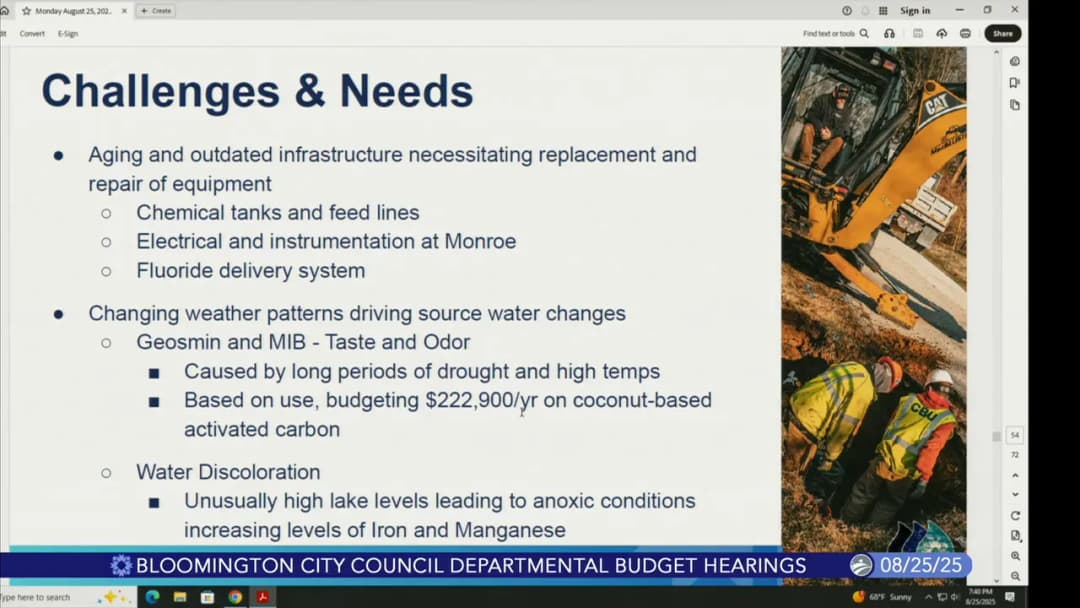
This was the third budget hearing for the 2026 city budget, focusing on the priority area of community health and vitality. Departments presented included Community and Family Resources (CFRD), Parks and Recreation, Public Works (Animal Care and Control, Sanitation), and City of Bloomington Utilities (CBU). Key discussions centered on budget constraints from Senate Enrolled Act 1, the removal of $300,000 in DEI training funding due to legal concerns, and efforts to maintain services despite fiscal challenges. No votes were taken; the hearing was for presentation and public comment. Public Comments & Testimony - Chris Ringe (Greater Bloomington Chamber of Commerce): Praised the after-hours ambassadors program and supported maintaining the ambassador positions. Urged careful management of park assets and investment in youth sports facilities. - Former Councilmember Sims: Asked for a clear city definition of DEI and federal definitions of "radical and wasteful spending." Stressed that budget allocations reflect values and urged continued support for marginalized communities. - Claudia Lada (CHLA Commission on Hispanic Latino): Opposed the elimination of the Latino Holiday Gift Program, describing its personal impact. Emphasized the program builds trust and access for families facing language and fear barriers. - Nicole Bolden (resident): Criticized council for directing DEI questions to Director Moss rather than to the mayor or deputy mayor. Urged more focus on anti-racist behavior rather than abstract definitions. Discussion Items Priority Area Introduction – Community Health & Vitality - Mayor Thompson stated the city remains committed to its values but faces fiscal reality: ARPA funds for DEI training were one‑time, and SEA 1 reduces revenues. The city cannot spend $300,000 it no longer has on a one‑size‑fits‑all training. - Deputy Mayor Knapp outlined that many departments fall under this priority area and asked council to identify which programs they most want to track. - Councilmember Stasberg expressed hope to hear how the city will demonstrate continued commitment to diversity, equity, inclusion, and belonging. Community and Family Resources Department (CFRD) - Director Chatoya Moss presented CFRD’s 2026 budget. Key points: - 2024: 74 navigation calls; by mid‑2025, 40 (surpassed halfway). Nearly 1,000 searches on Helping Bloomington Monroe; top need is housing assistance. - 116 families directly assisted since June 2024 through outreach and violence reduction funds. - After‑hours ambassadors trained 13 organizations on NARCAN and substance use awareness; provide 30 hours/week downtown. - Programs discontinued: Blacky Brown Arts Festival (goals merged with other events) and Latino Holiday Gift Program (funding redirected to gaps). - Planned 2026: citywide 100,000 hours volunteer challenge. - Council questions: - Councilmember Piedmont Smith asked about DEI training integration in onboarding; HR Director PayChak said no DEI‑specific onboarding, but best‑practice training exists. - Councilmember Zulik asked about translation services and the definition of DEI. Moss had no city definition. - Councilmember Daly explored why $300,000 for DEI training from last year’s general fund was not spent and why it didn’t roll over. Controller noted ARPA funds were mostly spent; the $300k will revert to general fund. - Corporate Counsel Margie Rice explained legal advice led to a conservative approach due to federal and state executive orders ending DEI programs, to avoid risking federal funding and potential False Claims Act liability. - Councilmember Stasberg asked about $250,000 pass‑through to SCAP; it comes from the UD‑LIT fund with an annual agreement. - Councilmember Ruff inquired about data tracking; Moss confirmed the Helping Bloomington Monroe database can refine neighborhood‑level needs. Parks and Recreation Department - Director Tim Street presented: - 64 full‑time staff, 434 seasonal/part‑time staff. 34 parks, 300 programs, 1 million annual participations. 2,300 acres. - 2025 successes: CAPRA re‑accreditation, Hopewell Commons opened, accessibility improvements, farmers market reaching 5,000+ weekly visitors. - Budget: $13.02 million (corrected). 2026 includes $260k for critical Banneker Center repairs and equipment replacement. - One vacant position eliminated (data & special projects manager). Master plan underway with community workshop on October 8. - Challenges: aging facilities (pools need $4‑5M, ice arena outdated cooling), property tax caps, extreme weather. - Council questions: - Councilmember Piedmont Smith asked about public‑private partnerships and revenue opportunities; Street said they are exploring sponsorships and pricing/subsidy targeting. - Councilmember Rosenbarger asked about park maintenance overlaps with other departments; Street said coordinated efforts exist. - Councilmember Daly noted a 192% increase in “instruction” line; Street said he would follow up. - Councilmember Stasberg asked about the parks activity guide printing/mailing cost ($150,000/year); Street said 36,000 copies mailed three times a year, with 25% of master plan respondents reporting it as a source of info. - Councilmember Ruff asked about deer management; Street confirmed it continues. - Councilmember Piedmont Smith asked about park security after ARPA ends; Street described current security hours (6 AM–1 AM) and safety interventions. Public Works – Animal Care and Control - Director Adam Wyson presented: - 94% live release rate despite highest intake levels. 2,408 adoptions in 2024 (highest in 5 years); Jan‑Jul 2025: 1,314 adoptions. - 3 animal control officers, 24/7 on call. Calls: 9% bite cases, 29% wildlife, 21% stray, 21% other. - Challenges: rising medical costs, increased percentage of dogs (9% annual increase), need for volunteers. - Council questions: - Councilmember Piedmont Smith asked how the public can help beyond adopting; Wyson suggested volunteering and donating supplies. - Councilmember Stasberg asked how animal control decides which wildlife to handle; Virgil Souter explained they focus on safety and disease (e.g., bat in living space, injured/deceased deer). - Councilmember Ruff asked about euthanasia rates; Wyson said 6% of intake are euthanized (severe medical or aggression). Public Works – Sanitation Division - Director Wyson presented: - 32‑35% diversion rate from landfill. Modernization efforts continue (automated side‑load routes reduce injuries). - 2026 budget includes decrease in other services (break room built in 2025) and decrease in capital (two trucks ordered in 2025). - Planning a rate study to make sanitation revenue neutral. - Council questions: - Councilmember Piedmont Smith asked about last year’s recycling education pilot; Wyson said he would provide data. - Councilmember Stasberg asked about inter‑fund transfer for sanitation; Controller noted actuals were not immediately available but could be provided. City of Bloomington Utilities (CBU) - Director Zager presented: - 194 full‑time employees. Budget $57.7 million total revenue (water $23.1M, sewer $29.8M, storm $4.7M). - Major challenge: water fund shortfall due to pre‑pandemic cost estimates. A one‑time loan from wastewater fund may be needed in 2026. - Rate case pending: presented to Utility Service Board on August 26; public meeting August 29; council first reading September 17. - Fluoridation issue: bulk tank leak since 2019; temporary fixes failed; permanent solution planned for 2027. - Customer assistance expanded: removing shut‑off requirement; $17,000 spent this year (double last year). - Council questions: - Councilmember Piedmont Smith asked about the 17% interdepartmental charge; Zager explained it covers HR, IT, etc. - Councilmember Stasberg asked about bond payments (largest budget percentage) and impact of SEA 1; Zager said utilities are not affected the same way. - Councilmember Ruff asked about the history of fluoridation and safety issues; Zager described the leak, relining, temporary totes posing safety risks, and intent to reintroduce fluoride. - Councilmember Piedmont Smith asked about growth costs; discussion noted bonds for new service center and that rate increases partly cover debt service. Key Outcomes - No votes or official actions were taken; the hearing was informational. - Council directed administration to provide additional data on several topics: DEI definition, recycling education metrics, SCAP agreement, parks activity guide effectiveness, and actual sanitation fund transfers. - Administration will respond to written follow‑up questions from council in the coming days. - The next budget hearing (August 28) will cover transportation, Bloomington Transit, Planning and Transportation, and Public Works Streets/Traffic/Parking.
The Bloomington Board of Zoning Appeals (BZA) met on August 22, 2025, at 1:54 PM (ET) to hear four variance petitions. All three board members – Ballard, Casinko, and Burrell – were present. The meeting included staff presentations, public testimony, and unanimous votes on each agenda item. Key outcomes included approval of a fence height variance, a clean-up motion for a previous case, a sidewalk variance with conditions, and a front setback variance for an accessible addition. Consent Calendar - Approval of minutes from the July 2025 meeting was moved, seconded, and passed unanimously by roll call. - No reports, resolutions, or communications from staff or the board. Petitions Continued to September 18, 2025 - The following petitions were continued: AA Vesh 17-22; Joe Camp Construction, LLC; Blackwell Construction Inc.; CU-33-24 (Hat Rentals LLC); CU-32-25 (Spring Point Architects, Barry Clapper); and CU-33-25 (Way Engineers, St. Rami HOA). Discussion Items Petition V-13-25 – Carolina Lopis (on behalf of mother Patricia Lopez) - Staff Presentation (Joe Patterson): Request for a variance from fence height standards (section 20.04.08) to allow a six-foot tall fence along the front east side of the property at Park Ridge East Subdivision (R2 zoning). The fence was built without a variance. Staff found the first two criteria (no injury to public welfare, no adverse effect on adjacent property values) were met, but the third criterion (practical difficulties peculiar to the property) was not satisfied because the neighbor dispute is civil in nature and the slight grade change is not significant. Staff recommended denial. - Petitioner Testimony (Carolina Lopez): Explained the fence was needed to stop harassment from the adjacent neighbor, who had leaned six-foot panels against the existing four-foot fence, damaging it. The neighbor’s property is cluttered and the neighbor has a protective order against him for verbal abuse and harassment. The fence has improved safety and blocked visual blight. - Public Testimony: Six individuals spoke in support, including neighbors Nancy Martin, Michelle Wilson (neighbor behind), a neighbor from Saratoga Drive, Craig Mercer (across the street), Tia (real estate agent), Kathleen Bogas (Solar for All volunteer), and Georgia Fry (former neighbor). They described the neighbor’s erratic behavior, trash, hateful signs, and harassment. The protective order and arrests were cited. Many argued the six-foot fence is necessary for safety and property value. - Board Deliberation: Board members discussed the slope of the neighboring property (uphill) as a peculiar condition making the four-foot fence insufficient. Staff confirmed fines are now accruing for the neighbor’s property violations. - Vote: Motion to approve with alternate finding for criterion three (practical difficulty due to higher slope of adjacent yard). Seconded. Roll call: all yes (3-0). Petition V-22-25 – Auto Vest LLC - Staff Presentation (clarification): This was a clean-up petition from a July hearing. The board had previously granted variances but one condition (street tree spacing) needed to be struck to align with the variance approval. The motion was to strike conditions two and three from the staff report and approve as modified. - Board Action: Motion to approve with striking conditions two and three. Seconded. Roll call: all yes (3-0). Petition V-29-25 – Value Built Construction - Staff Presentation (David Brantez): Request for a determinate sidewalk variance at 1017 East Aaron Court (vacant lot in Walnut Creek neighborhood, R2 zoning). The petitioner seeks to keep existing four-foot sidewalk on Azalea Lane (instead of required seven-foot) and not install any sidewalk on Aaron Court (no existing). Staff recommended denial for Azalea (no peculiar conditions, safety concerns) but approval for Aaron Court (low traffic, short cul-de-sac, no pedestrian destinations). Recommended conditions: street trees 30 feet on center along both streets and recording of zoning commitment. - Petitioner Testimony (Sabra Bowers): Petitioner Ernest wants to keep costs down to provide affordable housing. He is willing to replace damaged sidewalk panels but not widen the entire sidewalk. The existing four-foot sidewalk on Azalea has 18 of 24 panels in poor condition. - Board Deliberation: Board members discussed financial impact (estimated $35,000 for both sides) and uniformity. A motion was made to approve the variance on both Azalea Lane and Aaron Court, allowing the four-foot sidewalk on Azalea with a condition to replace damaged panels in compliance with engineering standards, and street trees 30 feet on center on both streets. Alternate findings for Azalea: criterion D (other pedestrian networks exist) and E (uniformity of development best served by keeping existing width). Seconded. Roll call: all yes (3-0). Petition V-31-25 – Kathy Church - Staff Presentation: Request for a variance from the front yard building setback (15-foot build-to line) to allow a 10x16-foot sunroom addition at 318 East Wiley (R3 zoning). The house is currently 22 feet from the property line; the addition would extend to 12 feet (3-foot encroachment). Staff recommended denial because there is no peculiar condition – the property is typical size, no topographic/utility constraints, and a seven-foot-wide addition (complying with setback) could be built. - Petitioner Testimony (Kathy Church): The existing house is small and dark; the addition would provide a glassed den for herself and her disabled son. A seven-foot-wide room cannot accommodate wheelchair maneuvering (requires 60-inch turning radius). The west side of the house has a basement exit that would be obstructed, and other sides are not feasible. Parking will not be impacted. - Board Deliberation: Board asked if the doors could be relocated to meet setback while keeping dimensions. Petitioner said the design allows entry from both ends; shifting would compromise function. Staff noted ADA needs are personal, not property peculiarities, but Assistant Director suggested the house’s proximity to the street makes an accessible addition infeasible within setback. - Vote: Motion to approve the variance based on the peculiarity of the house’s location on the lot, approving the design as shown (12-foot setback, 10x16 foot addition). Alternate finding for criterion three: the house’s position prevents a compliant accessible addition. Seconded. Roll call: all yes (3-0). Key Outcomes - V-13-25 (Lopis/Lopez): Variance approved 3-0. The six-foot fence on the east side is permitted. The board cited the uphill slope of the adjacent property as a peculiar condition justifying the extra two feet. - V-22-25 (Auto Vest): Approval with conditions two and three removed 3-0. The variance for street tree spacing is now consistent with the July decision. - V-29-25 (Value Built): Determinate sidewalk variances approved on both Azalea Lane and Aaron Court 3-0. Conditions: street trees 30 feet on center on both streets, replacement of damaged sidewalk panels on Azalea Lane as directed by engineering, and recording of a zoning commitment. - V-31-25 (Church): Variance from front setback approved 3-0. The 12-foot setback and 10x16-foot sunroom addition as shown in the petition are allowed. No additional conditions beyond standard permitting. - All votes were unanimous.
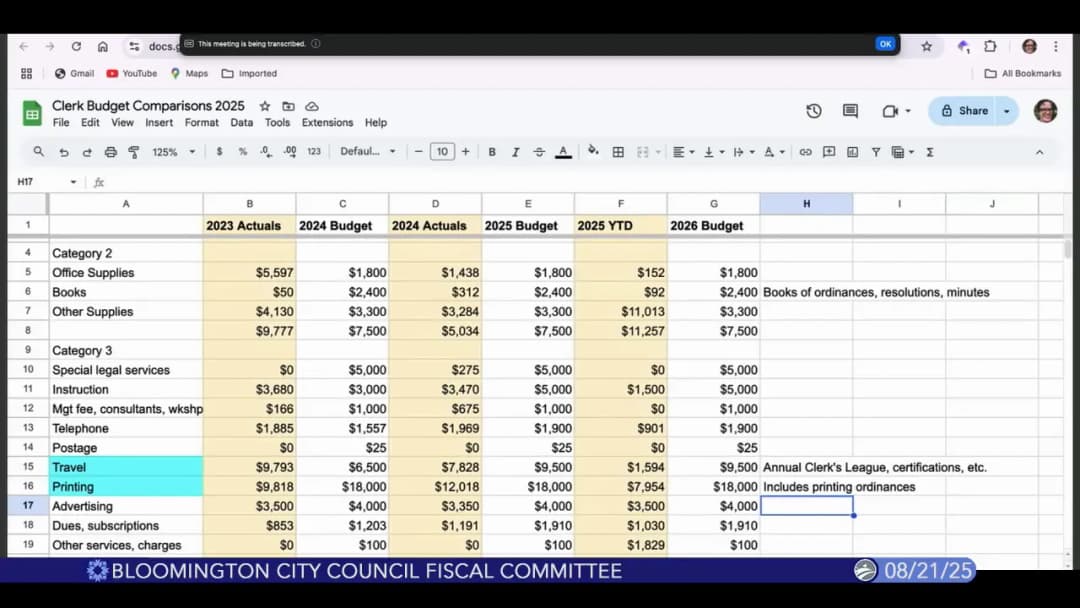
This special fiscal committee meeting of the Bloomington Common Council focused on the 256 budget process, review of the Office of the Mayor and City Clerk budgets, public comment, and planning for a special work session. The committee reordered the agenda to discuss budget follow-up first due to a member's time constraint. Key discussions centered on the transition to outcomes-based budgeting, the granularity of program inventories, and the need for meaningful council input during austerity. Public Comments & Testimony - Chris Remgie, Greater Bloomington Chamber of Commerce: Expressed support for the direction of the budget process ("moving in the right direction") and emphasized not cutting deferred maintenance on city assets, calling it short-sighted and politically expedient. Discussion Items - Agenda Reorder: Councilmember Hobie Stasberg moved item 5 (plans to follow up on the 256 budget process) ahead of item 2 to accommodate Councilmember Isab Asari's early departure. The motion passed unanimously. - Budget Process & Feedback: Councilmember Asari raised questions about meaningful council input, noting that current budget hearing formats do not allow sufficient debate. Deputy Mayor Gretchen Knapp explained the three-stage process (program inventory, outcomes, prioritization) and requested feedback on program granularity. She acknowledged that this year's software transition limited the ability to link programs to outcomes, but that the work is laying groundwork for future years. Councilmember Hopi Stasberg expressed comfort with the current level of detail but noted the challenge of knowing what questions to ask as a newer member. Councilmember Dave Rollo prioritized capital projects (e.g., a new fire station, road maintenance) and requested a ranking of discretionary capital and infrastructure priorities. The committee agreed that the Budget Task Force will continue long-term process work, while this committee focuses on immediate budget feedback. - Office of the Mayor Budget Review: Deputy Mayor Nat presented the proposed 2026 budget line by line, explaining variances between actuals (2023-2024) and proposed amounts. Highlights included a reduction in consulting (civic brand project), an increase in advertising for a new website, and a productivity allowance for software subscriptions. The travel budget was set at $15,000, with a note that the mayor often pays for her own travel via Harvard grants. Questions arose about telephone line increases and motor repairs. - City Clerk Budget Review: City Clerk Nicole Bolden presented her proposed 2026 budget, focusing on ordinance book costs (codified paper required by state code), legal services, and certifications for staff. A discrepancy was noted between budget book actuals and expense reports for book spending in 2023-2024. The clerk explained that books are only replaced as needed, and the budget anticipates worst-case scenario. Deputy Mayor Knapp confirmed no cuts were made to the clerk’s budget as it was already close to actuals. - Elected Official Salary Ordinance: The committee tabled this item to the next meeting. Councilmember Rollo proposed a 2.7% cost-of-living increase (matching estimated 2026 CPI), but noted that if civilian city employees receive only 2%, the difference may be politically problematic. The committee will discuss further. Key Outcomes - The committee agreed to schedule a special work session during the week of August 25, 2025, to allow council to discuss budget questions and potential cuts before the September 12 advertising deadline and September 9 question response due date. A scheduling poll will be sent to members. - The Budget Task Force will continue long-term work on outcomes-based budgeting; this committee will focus on immediate feedback for the current budget cycle. - No formal votes were taken on the budgets; the review was educational. Clerk and Mayor budget line items will be further explored through written questions.
The Bloomington City Council held the second of four budget hearings for the proposed 2026 city budget on August 21, 2025, starting at 5:31 p.m. The meeting featured presentations from multiple departments and priority area introductions, along with a procedural motion to adjust debate rules. Council members questioned department heads on staffing, program effectiveness, and funding shifts. Public Comments & Testimony - Only one public comment was made, by Kevin Keo, who expressed concerns about cybersecurity and cybercrime risks to the police department, citing the Monroe County government intrusion and the Bloomingfoods credit card skimming incident. He called for greater attention to cybercrime statistics and data protection. Discussion Items Procedural Motion - Councilmember Piedmont Smith moved to add two points to the debate structure: (1) after public comment, council members may use their three-minute comment time to redirect questions from public comment to staff; (2) each three-minute period is limited to one turn per council member. The motion passed unanimously. Priority Area: Affordable Housing & Homelessness - Deputy Mayor Gretchen Knapp introduced the priority area, noting that the budget includes allocations from the Housing and Neighborhood Development (HAND) department, the Mayor's Office homelessness response coordinator, and police funds for reunification. She outlined key questions about moving from priorities-based to outcomes-based budgeting and measuring effectiveness of pass-through dollars. Housing and Neighborhood Development (HAND) Department - Director Anna Killian Hansen presented HAND's diverse programs, including affordable housing, homelessness prevention, rental inspection, community engagement, and federal grant administration. She highlighted the use of over $6 million in ARPA funding for housing and homelessness projects. Key statistics: 60% of households in city limits are renters. The rental inspection program is limited to long-term rentals (leases over 30 days). The department faces challenges filling a grant compliance manager position. Council questions covered the housing development fund's health, outreach for programs, and vacancies. Priority Area: Economic Development - Deputy Mayor Knapp introduced the economic development priority, including departments like Economic and Sustainable Development (ESD) and the Capital Improvement Board (CIB). She noted that planning's impact on economic development is not yet included in this category. Monroe County Capital Improvement Board (CIB) - Jeff McKim presented the CIB budget, which excludes construction costs (funded by a $52 million bond) and architectural fees. The budget includes legal fees, owner's representative services, insurance, and soft costs such as testing, relocation, and contingency. The convention center expansion is on track: new building completion target January 1, 2027, renovation of existing building by July 1, 2027. Council questions addressed the budget schedule and public art benefits. Economic and Sustainable Development (ESD) Department - Director Jane Cooper Smith presented ESD's 2026 budget, emphasizing the critical moment for the local economy due to population decline and aging. Key goals: grow workforce population, grow wages, reinforce economic base. She highlighted the Trades District development, including the Mill leasing 68% of space in the Forge, and a planned hotel. The Arts Incubator partnership with IU and Seagerly Canadian. 49.5% of IU students would like to stay in Bloomington post-graduation, but 91.5% feel it's not possible due to lack of jobs and housing. Budget reductions include cuts to Stay Cool, Bloomington, SEAL funding, and sustainability grants. The TDM strategy (Go Bloomington website) funding is reduced. Council member questions focused on the shift of ESD personnel costs into the ED Lit fund, and the difficulty of comparing budgets year-to-year. Priority Area: Public Safety - Deputy Mayor Knapp introduced the public safety priority, covering police and fire departments, and noting that ARPA dollars are used for some public safety expenses. She raised questions about categorizing prevention programs and alternative response. Fire Department - Chief Roger Kerr presented the fire department budget, which is essentially flat except for the collective bargaining agreement. 911 calls increased 8.2% from 2023 to 2024 (5,961 to 6,449). The department is about to be fully staffed for the first time in years, thanks to a competitive collective bargaining agreement that attracted 272 applicants (up from 87 in 2024). The MIH (Mobile Integrated Health) division is growing. Capital projects: Station 3 on IU campus near completion, new operations and training center south of town under construction. A joint recruit academy with Monroe Fire Protection District was a success. Council questions covered response times, the Tapp Road fire station for the Summit development, and overtime budget. Police Department and Dispatch - Chief Mike Deakoff presented the police budget. Calls for service in 2024: 75,951 (2.4% increase from 2023). Violent crime decreased 24%, community engagement increased 40%. The department hired 11 officers in a recent process, with six certified and five starting the academy. The dispatch center is critically short: 14 of 18 telecommunicator positions vacant, 3 of 6 supervisor positions vacant. A new reunification fund is proposed for 2026 to help people return to their home communities. The new police headquarters at 714 South Rogers is in early planning stages. Council questions covered traffic enforcement, the "quiet nights" program, and the shift of some expenses to PS Lit fund. Key Outcomes - The council approved a motion to adjust debate rules for the remaining budget hearings. - No final votes on budget items were taken; the hearings are for discussion and questions. - Council members will submit written questions, and responses will be made public. - The next budget hearing is scheduled for August 25, 2025.
The Bloomington City Council began the first of five nights of budget hearings for the 2026 fiscal year on August 19, 2025 (though the mayor referenced the date as Monday, August 18, creating a discrepancy with the provided meeting date). The evening focused on the "High Performing Government" priority area, covering internal support departments. Key themes included the impacts of Indiana Senate Enrolled Act 1 (SEA 1), a transition to priority-based budgeting, and a projected $11.2 million general fund deficit. Procedural Motion - Speaking Time Limits: Councilmember Stasberg moved to limit council member questions and comments to three minutes each per presentation and public comment to two minutes per speaker. The motion passed unanimously (8-0). Mayor's Budget Introduction - Mayor Thompson presented the administration's budget vision, emphasizing that SEA 1 will cause a $1.4 million loss in local income tax revenue this year, growing to tens of millions annually by 2028. The city will need to "do less with less" but will prioritize existing commitments, maintenance of assets, and core services. The mayor acknowledged this is a "learning year" for priority-based budgeting and expects mistakes. Council member questions explored the definition of "existing commitments," collaboration with county and school entities, potential revenue enhancements, and clarification on the $16 million deficit figure used in messaging. The mayor explained that the deficit reflects spending exceeding recurring revenues but noted the council had intentionally spent down reserves in prior years. Public Comments & Testimony - Kevin Keogh (CPA, resident) commented on the controller's presentation, expressing confusion about the "budgetary basis" accounting in the city's financial schedules, which he said showed a large variance between final budget and actuals. He questioned the accuracy of deficit projections. - Chris Rimgie (Greater Bloomington Chamber of Commerce) expressed support for the mayor's budget with no new initiatives and urged the city to make hard decisions on personnel cuts as part of the outcome-based budgeting process. Discussion Items - Controller's Budget Overview: Controller McClellan presented a $54 million projected revenue vs. $65.2 million in expenditures, a $11.2 million deficit. Key points: declining property taxes, SEA 1 bond restrictions, a 2% COLA for employees (council members argued for matching the 2.7% Social Security estimate), and a shift of interfund transfers into the controller's budget for clarity. Councilmembers debated the messaging around the deficit and the use of cash reserves. - High Performing Government Overview: Deputy Mayor Knapp explained the rationale for clustering certain departments under this priority and acknowledged the need to refine program definitions and outcome measurements. She welcomed council input through the budget task force. - City Clerk: Clerk Nicole Bolden presented a budget with near-zero increases. Council members asked about the resumption of wedding officiations and the clerk's role in council support. - Common Council: Council Attorney Lisa Lanor highlighted challenges from new state laws, ADA compliance (effective April 2026), and increased workload from the Jack Hopkins and sidewalk programs. She proposed a $30,000 increase for consultants and workshops. Council members discussed the need for resources vs. concerns about budget bloat. - Mayor's Office: Deputy Mayor Knapp presented a budget with a 2% decrease, partly due to the absence of the biennial community survey. New: a part-time emergency management planner ($50,000). Council members supported the role and discussed overlapping responsibilities and FOIA improvements. - Controller's Office: Controller McClellan presented reductions in training, supplies, and consultants. She noted revenue ideas: wheel tax, sanitation rate increase, parking fee study. Councilmember Rallo pushed back on the assumption that development automatically increases net revenue, citing nexus studies. - Legal Department: Corporation Counsel Margie Rice highlighted a high volume of contracts (654 year-to-date), improved FOIA response time (avg. 9.71 days), and a budget of $917,800 for outside counsel (mostly for annexation litigation). Council members asked about AI use and the risk of underestimating future legal needs. - Human Resources: Director Shar Paychak reported 2025 accomplishments (onboarding tool, employee handbook update) and 2026 goals focused on policy efficiency and workforce strategy. The HR budget reflects decreases; no new FTEs. Council members asked about employee retention and exit interviews. - Information Technology Services (ITS): Director Rick Dietz presented a $6.47 million budget, with increases in cybersecurity (due to reduced federal support) and enterprise software. No new FTEs. Council members discussed website revamp timeline (launch in summer 2026) and opportunities for efficiency gains through technology. - Public Works Administration: Director Adam Wyson requested a new Deputy Director for Operations to oversee street, sanitation, and fleet, allowing him to focus on strategic issues. The budget also reflects planning for a new public works operations center, delayed by SEA 1 bond restrictions. - Facilities Maintenance: Wyson presented a budget with a requested new Downtown Specialist to cover weekend gaps. Council members expressed support for the role and noted the department's work on council office relocation. - Fleet Maintenance: Wyson reported on vehicle maintenance, a focus on asset management, and an apprenticeship partnership with Hoosier Hills Career Center. Council member questions covered technician training and the status of a new fleet facility (delayed due to bonding constraints). Key Outcomes - Motion to limit speaking times was adopted (8-0). The meeting adjourned at approximately 9:30 PM after completing all scheduled presentations for Night One. No formal votes on budget items were taken; the hearings continue on subsequent nights.