Browse by city
Date range
Search help

Search titles, summaries, topics and stored transcripts together. Keywords may match separately; put the whole query in double quotes for a phrase. Matching follows word analysis, so punctuation is not exact. Both dates are included. Documents are not searched.

SHOWING 11–20 ENTRIES
11
SEP 24, 2026 · BOZEMAN, MONTANA · CITY COMMISSION
Bozeman Urban Parks and Forestry Board Meeting - September 24, 2026

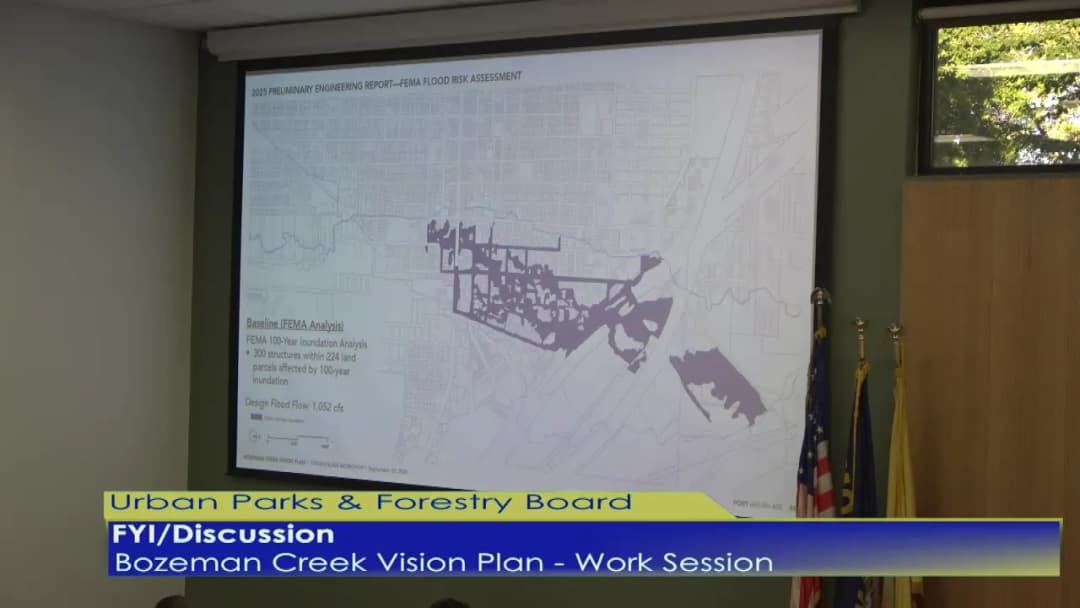
The Urban Parks and Forestry Board met on September 24, 2026, at 6:00 PM to discuss two major work sessions: the Bozeman Creek Vision Plan and the 2026 Urban Forest Management Plan, along with routine updates. The meeting included a presentation on the creek vision plan, public comment on the forest management plan, and director's and commissioner's updates. Consent Calendar - The board approved the minutes from the August 27, 2026 meeting with a vote: Brant Perubi (yes), Steve Lowry (yes), Paige Lizowski (abstain), Joe Cartray (abstain), Matthew Fortin (yes). Public Comments & Testimony - No public comments on non-agenda items were received. Discussion Items - Bozeman Creek Vision Plan - Work Session: Assistant City Manager John Henderson presented a comprehensive vision for Bozeman Creek focusing on flood mitigation, parkland improvements, and policy recommendations. The plan aims to mitigate a potential $1 billion in property damage from a 100-year plus rain-on-snow flood event by diverting water via Mill Ditch and improving creek conveyances. Key proposals include: creating a park in front of City Hall by abandoning the parking lot, reconfiguring Rouse Avenue between Main and Olive to daylight the creek, and long-term improvements to Bogart Park (20-30 years out). The project would be phased over 30 years, funded largely through grants. The board discussed upstream storage, prioritization, funding, and community engagement. A seed funding of $150,000 has been allocated for a ten-year implementation plan. Board members expressed strong support for the bold vision and emphasized the need for clear short-term milestones and partnerships with the nonprofit "C Bozeman Creek." - 2026 Urban Forest Management Plan - Work Session: Parks Director Mitch Overton presented an update on public comment and final draft revisions. Four public engagement meetings were held (2 virtual, 2 in-person). Major themes from public comments included: need for a heritage tree program (soft launch on city property), stronger language to protect mature trees (especially private trees during development), improved readability of the document, and more detail on staffing and equipment costs. The consultant team is incorporating these comments and plans to deliver a final draft by November 12, 2026, for presentation to the City Commission on December 8, 2026. Board members discussed the role of an urban ecologist, addressed concerns about AI-generated content (contracts require disclosure), and supported elevating key recommendations from appendices to the main document. The board will review the community grant program process at the next meeting. - Director's Update: Overton reported on the Community Grant Program for FY27 with $210,000 available; applications opening mid-October, with board approval targeted for February 2026. Code updates from the Pratt Plan will begin in October. Wayfinding design package for trails finalized, installation this fall. The board will need to reschedule November (Thanksgiving) and December (Christmas Eve) meetings. - Commissioner's Update: Commissioner Sweeney informed the board about upcoming City Commission work sessions: October 6 (ballot initiatives for 2027), October 20 (Northwest Bozeman sub-area plan), November 10 (Fowler Housing work session), November 17 (integrated water resource plan). He noted unanimous commission support for the Cattle Creek Corridor vote and thanked the board for participation. Key Outcomes - The board provided input on the Bozeman Creek Vision Plan to be incorporated into the draft plan presented to the City Commission on December 15, 2026. - The board reviewed public comment themes for the Urban Forest Management Plan; final revisions due by November 12, 2026, with commission presentation on December 8, 2026. - The board will revisit the Community Grant Program process at the October meeting. - The board will set new meeting dates for November and December at the next meeting.
FLOOD MITIGATION 29% · URBAN FOREST MANAGEMENT 14% · URBAN REDEVELOPMENT 12% · PROCEDURAL 8%
12
SEP 23, 2026 · BOZEMAN, MONTANA · CITY COMMISSION
Transportation Board Meeting – September 23, 2026: Northwest Bozeman Area Plan and E-Bike Policy Work Session

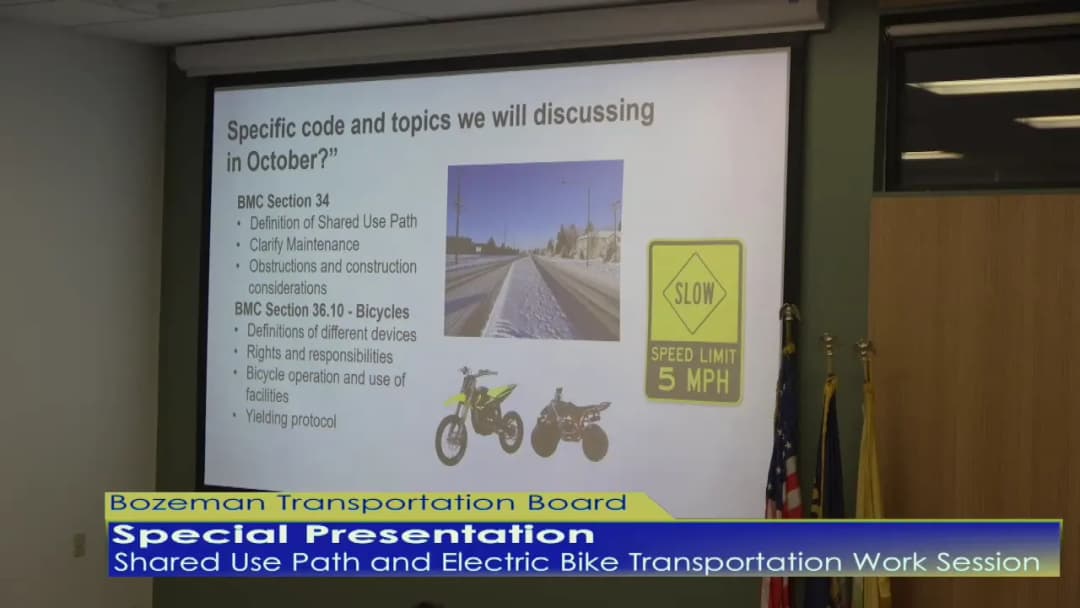
The Transportation Board of Bozeman met on September 23, 2026, to discuss two major agenda items: the draft Northwest Bozeman Area Plan (a 3,000-acre planning area) and a work session on shared-use path and electric bike transportation policy. Board members provided feedback on transportation network design, wetland avoidance, and active transportation connections. No formal votes were taken; both items are being refined for future public comment and adoption. Public Comments & Testimony - Kiki Hulls, a resident at 4833 Glenwood (near Gooch Hill), expressed concern about the proposed alignment of Gooch Hill Road from Durston to Oak, stating that the current map inaccurately places roads, creeks, and trails through her property and existing buildings. She cited pollution from diesel trucks on Durston and Oak, and suggested moving the road west toward a large wetland area that could serve as a wetland mitigation bank or stormwater park. She opposed having the road near existing homes. Discussion Items H.1 Northwest Bozeman Area Plan - Chris Naumann (Planning) and Taylor Lonsdale (Transportation Engineer) presented the high-level framework for future land use and transportation in the approximately 3,000-acre planning area. The plan aims to avoid wetland impacts, minimize where unavoidable, and mitigate impacts through regional facilities (e.g., wetland mitigation banks, a stormwater treatment park similar to Shiloh in Billings). The transportation network (principal arterials, minor arterials, and collectors) was shown as dashed lines, intentionally avoiding sensitive natural resources (e.g., Cattail Creek, Baxter Creek, multiple wetland complexes). - Board member Simon asked about the total mileage of roads and trails proposed; staff noted this detail was not calculated but would come from the TMP update. He also questioned how infrastructure triggers work – staff explained that development leads infrastructure incrementally through annexation and subdivision, with right-of-way and construction funded by developers. - Board member Bryce asked how parks and wetlands (not shown on the future land use map) are designated after annexation. Staff explained that subdivision and site plan processes require parkland dedication, often focused around watercourses and wetlands, creating greenways and trails. - Board member Chris (chair) commented positively on the plan’s approach to balancing transportation connectivity with natural resource protection, noting that slight delays in commute (e.g., 45 seconds) could be acceptable for high-value environmental outcomes. He emphasized the opportunity for active transportation connections where road grid is missing. - Another board member (name not clearly stated) questioned the necessity of the Gooch Hill road jog near large wetlands, suggesting it might not need to connect Oak to Durston if transportation needs can be met elsewhere. Staff acknowledged that design details would evolve at finer scales. - Staff noted that the draft plan will be released in early October for public comment, with additional work sessions in October (including City Commission), and adoption scheduled for mid-December. H.2 Shared Use Path and Electric Bike Transportation Policy Work Session - Taylor Lonsdale presented an overview of a policy update focused on public right-of-way. Key topics: defining “shared use path,” clarifying maintenance responsibilities, and regulating e-devices (e-bikes, e-motos, scooters). The timeline: October work session with draft code language, December City Commission presentation, January first reading, and effective date in spring 2027 to align with education and enforcement. - Board members discussed the challenge of subclassifying devices (pedal-assist vs. throttle-only, e-motos) and whether to regulate the device or the behavior. They emphasized that education and enforcement are difficult, and that enforcement by police may be impractical; instead, coordination with stakeholders like GVLT (Gallatin Valley Land Trust) trail ambassadors could help correct behavior. - The board suggested a use-case approach: define what behaviors/speeds are desired on each facility type (shared use path, bike lane, sidewalk) and then classify devices accordingly. For example, on shared use paths, limit to devices that cannot exceed 15 mph and can stop frequently; in bike lanes, higher speeds may be acceptable if sharing with cars. - Board member (name not specified) noted the need to align definitions with state code and ensure that policies do not discourage active transportation. Another member stressed that e-devices can provide alternatives to single-occupant vehicles, but safety of all users must be prioritized. Key Outcomes - Northwest Bozeman Area Plan: No formal action. The draft plan will be released in early October 2026 for public comment. Additional work sessions with other city boards and the City Commission are scheduled in October, with adoption targeted for mid-December 2026. - E-Bike/Shared-Use Path Policy: Staff will bring a draft code proposal to the October Transportation Board meeting for deeper discussion. A presentation to the City Commission is planned for December, with ordinance adoption (first and second reading) in January and February 2027, effective spring 2027.

ACTIVE TRANSPORTATION 31% · TRANSPORTATION SAFETY 19% · ENVIRONMENTAL PROTECTION 15% · LAND USE PLANNING 11%
13
SEP 22, 2026 · BOZEMAN, MONTANA · CITY COMMISSION
Bozeman City Commission and Belgrade Council Joint Meeting - September 22, 2026

The Bozeman City Commission held a regular meeting on September 22, 2026, preceded by a joint session with the Belgrade City Council. The joint session focused on regional growth, infrastructure, transportation connectivity, behavioral health, and the 2027 Montana state legislative agenda. The regular business included the unanimous approval of the consent agenda and annual assessments for delinquent charges and special districts. The majority of the evening was dedicated to an extensive public hearing and commission deliberation on the South Bozeman Technology Tax Increment Financing (TIF) District, resulting in the adoption of resolutions to fulfill a development agreement by issuing a $3.894 million bond, which consequently extends the district beyond its 15-year term. Joint Session with Belgrade City Council (C.1) - Leaders from both cities discussed the Bozeman-Belgrade corridor, managing growth, utility coordination, and community identity. Bozeman Commissioner Alison Sweeney expressed a preference for an open space delineation with wildlife corridors between the communities. Belgrade officials noted the city's rapid growth and transition away from being solely a bedroom community, with Mayor Meese highlighting that 3,000 people now commute into Belgrade for work. - Transportation: Discussion focused on the expansion of the Streamline Pink Line to the Belgrade airport, the need for microtransit in Belgrade, improved bike and pedestrian connections, and regional park-and-ride solutions. The Urban Transportation District’s role was emphasized. - Behavioral Health: Both groups highlighted a lack of state funding as a growing crisis straining police, fire, and hospital resources. The success of the Mobile Crisis Response Unit was noted, but funding insecurity for the program was a concern. - Legislative Priorities: A strong consensus emerged around the need for a local option sales tax, property tax relief, and direct state funding for behavioral health services as key joint priorities for the 2027 Montana Legislature. Public Comments & Testimony - Joint Session: Gallatin County Commissioner Zach Brown expressed support for regional collaboration on the topics discussed. Developer Mike Magrins encouraged a continued dialogue between the cities on policy differences impacting growth. Gabe, an MSU student, connected the cost of living to mental health strain. - Action Items I.6 & I.7 (South Bozeman Tech District): Over 20 residents and students provided testimony. The overwhelming majority spoke in opposition, arguing that extending the TIF district for 25 years would lock in local tax funds to support a development housing military technology contractors. Speakers including Julian Stags, Sarah Fina Warren, and Charles Miller (an Army National Guard sergeant) specifically named tenants like Reveal Technology and the DOD On-Ramp Hub, relating them to the conflict in Gaza. Critics argued the funds could better support local housing, public transit (Streamline), and emergency services. MSU representative Mike Veslick spoke in support, highlighting the campus’s role in quantum computing, retaining high-paying jobs from companies like Aurora Innovation, and fostering spin-out companies from university research. Discussion Items - FYI: Commissioner Sweeney highlighted the HRDC pre-purchase counseling program for potential homebuyers. Deputy Mayor Fisher and Mayor Morrison welcomed a delegation from the city's sister city, Kopachinsky, Ukraine. Commissioner Magic reported multiple bear sightings and urged residents to secure garbage. - Annual Assessments (I.1-I.5): Budget analyst Caitlin Johnson presented resolutions for the Business Improvement District ($295,000), 84 lighting districts ($583,600), and delinquent charges for snow (2 bills, $5,450), weed (6 bills, $1,731), and utility accounts (51 bills, $26,838). The commission discussed the Snow Angels program and complaint-driven code enforcement. - South Bozeman Technology TIF District Extensions (I.6 & I.7): Urban Renewal Program Manager David Fine explained the city's obligation under a 2022 development agreement to reimburse a developer for public infrastructure. To achieve this, the city must issue a bond, which triggers a statutory extension of the TIF provision from 15 to a maximum of 25 years. Commissioner Bowdy focused heavily on the legal obligation, the impact on the city's bond rating if the agreement were breached, and frustration over a lack of city control over tenant types. Commissioner Sweeney criticized the lack of foresight in the original agreement and questioned the ethics of supporting the current tenant mix. Deputy Mayor Fisher and Mayor Morrison emphasized the necessity of honoring contracts to maintain the city’s financial credibility and ability to fund local services. Commissioner Magic acknowledged the difficulty of the TIF tool but noted its necessity given the lack of other local revenue sources like sales tax. Key Outcomes - Consent Agenda (G.1-G.7): Approved unanimously (5-0). - Annual Assessments (I.1-I.5): Resolutions adopted unanimously (5-0). - TIF Extension Resolution (I.6 Main): Adopted 5-0. The resolution determines that fulfilling the South Bozeman Technology District plan requires pledging tax increment to bond payments, extending the TIF provision beyond its 15th year. - TIFF Policy Exploration (I.6 Supplement): The commission voted 5-0 to direct staff to explore methods to limit the ability of TIFF beneficiaries to participate in particular activities (e.g., the military industrial complex) and for those methods to be reviewed by the TIFF board. - Bond Authorization Resolution (I.7 Main): Adopted 5-0. The resolution preliminarily authorizes the private negotiated sale of a $3.894 million Tax Increment Revenue Bond. - Bond Early Payoff Exploration (I.7 Supplement): The commission voted 4-1 (Deputy Mayor Fisher dissenting) to direct staff to explore bond options that would allow the city to pay off the bond early.

TAX INCREMENT FINANCING 38% · PUBLIC ENGAGEMENT 10% · PROCEDURAL 7% · BEHAVIORAL HEALTH 5%
14
SEP 21, 2026 · BOZEMAN, MONTANA · CITY COMMISSION
Bozeman City Commission Special Meeting: Additional Findings on Shady Glen PUD, September 21, 2026

This special meeting was convened to comply with a district court order remanding the Shady Glen development applications (Preliminary Planned Unit Development 22293 and Preliminary Plat 22294) back to the City Commission for additional findings. The court had found the 2023 commission's findings insufficient for meaningful judicial review. The four former commissioners who participated in the original 2023 decision (Mayor Cindy Andrews, Mayor Terry Cunningham, Commissioner Christopher Coburn, and current Commissioner Matthew Magic) provided detailed explanations of how they weighed evidence and why they unanimously denied the applications. Following their statements, the current Commission heard public comment and voted 5-0 to adopt the additional findings as clarifications of the original decision. Consent Calendar - No consent calendar items were presented. Public Comments & Testimony - Aaron Arnold (attorney for Bridger Center, LLC) argued that the proceeding is unlawful because it provides after-the-fact rationalizations, violates the Montana Subdivision and Planning Act, and fails to meet proper noticing requirements. He stated that a motion to amend the court's order is still pending and urged the commission to decline adopting the findings. - Brian Gallach (attorney for Bridger Center) echoed that the commissioners' remarks went beyond the court's scope and included new evidence (e.g., citations to recent affordable housing projects). He moved to strike the findings, claiming violations of due process and fundamental fairness due to late notice (Friday morning for a Monday meeting) and lack of opportunity to submit evidence. - Tom Murphy (developer) stated that the gated emergency access was suggested by the fire chief, and that city staff recommended placing wetland oversight with the HOA because the city had no personnel for it. He noted conflicting information between experts and commissioners. - Greg Garaguse (adjacent resident, 31-year Bozeman resident) opposed the development but acknowledged the court's remand was about evidentiary reasoning. He asked the current commission to clearly state whether they were explaining the 2023 commission's evidentiary judgments or making their own independent review. Discussion Items - Commissioner Matthew Magic explained his original reasoning, focusing on three relaxations: (1) affordable housing townhomes sited next to M1 industrial zoning, which he considered scrap lots; (2) a locked-gate secondary access that relied on HOA enforcement, which he deemed unreliable based on public testimony and personal experience; (3) reduced wetland setback from 50 to 35 feet, which he felt did not protect the resource. He also noted that the three planning board members who voted against the PUD had the most expertise (two architects and a planner), and he weighed their views more heavily. He concluded the project did not produce a superior product justifying the relaxations. - Former Mayor Cindy Andrews stated she did not find the project superior due to unacceptable setbacks, affordable housing limitations (only two units insufficient for community needs), emergency access concerns, cul-de-sac design, and reliance on HOA enforcement. She cited her 13 years on the commission and lived experience in two HOAs. - Former Mayor Terry Cunningham explained his filtering process: personal site visits, observation of slopes and wildlife, aversion to reducing wetland setbacks, and concerns over HOA enforcement based on his own HOA board experience and public comments (e.g., concerns about snow blockage, wetland mowing). He noted the affordable housing placement was not interspersed like in other PUDs, making it less desirable. He concluded the project was not a benefit to the community in exchange for the relaxations. - Former Commissioner Christopher Coburn emphasized public safety as his primary concern: the emergency access was a gated route too close to the primary access, risking both routes being impaired by a single incident or snow buildup. He acknowledged the need for affordable housing but found the proposal inadequate given the other relaxations. - Current Commission Deliberation: Commissioner Magic moved to adopt the additional findings. Commissioner Sweeney expressed discomfort with the unprecedented procedure but supported the motion as clarification of the 2023 decision, not a judgment on the application. Commissioner Bodie affirmed she watched the original video and reviewed materials, finding the proceeding complied with the court's direction and the statements were clarifications, not new findings. Deputy Mayor Fisher and Mayor Morrison echoed support, noting the former commissioners' thoughtfulness and expertise. The vote was 5-0 in favor. Key Outcomes - Vote: The motion to adopt the additional findings of fact for Preliminary PUD 22293 and Preliminary Plat 22294 passed unanimously (5-0). - Next Steps: The findings will be incorporated into the court record. The district court will review whether these additional findings satisfy its order. The applicant's motion to amend the court's order is still pending. - Legal Discrepancy Noted: The city attorney stated that no new evidence was presented and the process was for former commissioners to clarify their reasoning. The applicant's attorneys argued that the proceeding violated Montana law, included new evidence (e.g., references to other affordable housing projects), and was procedurally unfair due to insufficient notice. The commission acknowledged the unusual nature of the process but proceeded.

LAND USE PLANNING 52% · PENDING LITIGATION 17% · PROCEDURAL 16% · PUBLIC ENGAGEMENT 9%
15
SEP 21, 2026 · BOZEMAN, MONTANA · CITY COMMISSION
Community Development Board Meeting – September 21, 2026

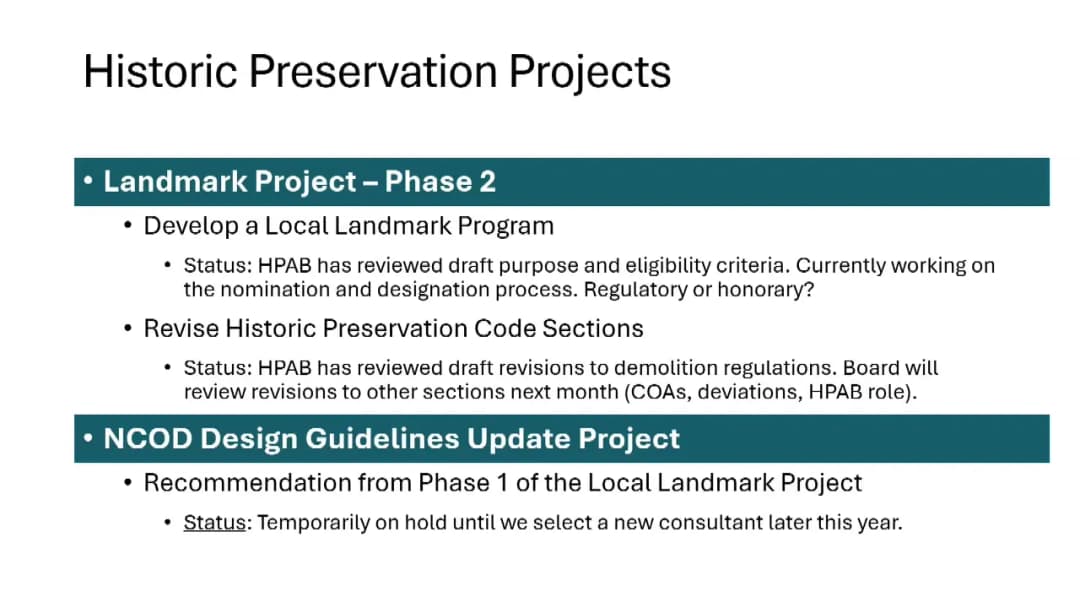
The Community Development Board (CDB) of Bozeman, Montana, met on September 21, 2026, to receive an update on the status of the Landmark Program and related historic preservation code revisions from Deputy Director of Community Development Rebecca Harbage. Board members engaged in extensive discussion on the balance between preserving historic resources, property rights, and economic viability. No votes were taken. Discussion Items - Presentation on the Status of the Landmark Program: Rebecca Harbage provided a comprehensive overview of the city's historic preservation program, including the history of the Neighborhood Conservation Overlay District (NCOD) established in 1991, design guidelines from 2006, and current efforts under the Local Landmark Project (Phase 2). Key projects include: (1) developing a local landmark program to recognize sites of local cultural/historic significance that may not meet National Register criteria; (2) revising historic preservation code sections, starting with demolition regulations; and (3) updating NCOD design guidelines (temporarily on hold due to staffing vacancies). Harbage noted that the city has had 58 total demolitions within the NCOD since 2018, of which 11 were contributing/eligible structures and 47 were non-contributing; 12 of those demolitions were for unsafe structures. She outlined proposed changes to demolition regulations, including: - Requiring an inventory for buildings over 50 years old outside the NCOD before demolition. - Public notice posting for all NCOD demolitions. - Splitting the current two-year stay on demolition into two one-year periods: an initial one-year mandatory stay, followed by a second year only if the applicant fails to demonstrate consideration of alternatives. - Reimagining the "no economic life remaining" test as an economic hardship test. - Considering mandatory pre-application meetings for demolition of historic resources. - Exploring strategies to prevent demolition without a permit or demolition by neglect. - Updating the overall NCOD code structure to align with the new Unified Development Code (UDC) and revising submittal requirements and allowed deviations. - Board Discussion and Questions: Board members raised several concerns and perspectives: - Jason Dilmu questioned the definition of "historic" and the 50-year threshold, emphasizing that not every old structure is significant and that overly broad regulation could unfairly burden property owners. He suggested that truly special resources should have regulatory protection, but the community as a whole should bear the cost when preservation is a community benefit. - Eric Bonnet stressed the need to focus on incentives ("carrots") rather than just regulations ("sticks"), noting that two-year stays may cause economic waste without achieving preservation goals. He encouraged case studies of successful preservation in other cities and highlighted the potential for using tax credits or incentives. He also noted that historic preservation has sometimes been used as a NIMBY tool to block growth and called for recognizing erased histories, such as the minority community at Eho Memorial Park. - Ben Lloyd asked what problem the code revisions are solving, given the relatively low number of demolitions. He suggested shifting focus from preventing demolitions to incentivizing refurbishment and cleaning up derelict structures. - Chris Edmunds (board member) commented on the tension between preserving historic fabric and allowing modern renovations, noting that the UDC already addresses mass and scale issues. He mentioned the concept of "iceberg houses" (subterranean additions) as a creative way to increase density without altering facades. - Mark Haggie proposed a "cash in lieu of waiting" fee for expedited demolition, which could generate revenue for historic preservation maintenance. - Chris Saunders (staff) added context on the federal level's opt-in approach and the importance of defining significance beyond just age. Key Outcomes - No formal decisions or votes were taken. The board's discussion was informational and intended to guide staff and the Historic Preservation Advisory Board (HPAB). - Next steps outlined by Harbage: - HPAB will continue reviewing draft code revisions at its mid-October 2026 meeting. - CDB may receive a further update in December 2026, with a formal public hearing anticipated in early January 2027, followed by City Commission consideration in February 2027. - The city is making progress on hiring a new historic preservation planner to support these projects. - The board also received an FYI on upcoming CDB items: a presentation on the Bozeman Creek Vision Plan and review of a potential downtown urban renewal district expansion at the October 5, 2026 meeting. A placeholder for City Commission discussion on revisions to city boards was noted for October 27, 2026.

HISTORIC PRESERVATION 71% · LAND USE PLANNING 10% · ECONOMIC DEVELOPMENT 5% · PROCEDURAL 4%
16
SEP 17, 2026 · BOZEMAN, MONTANA · CITY COMMISSION
Bozeman TIF Advisory Board Meeting Summary: September 17, 2026

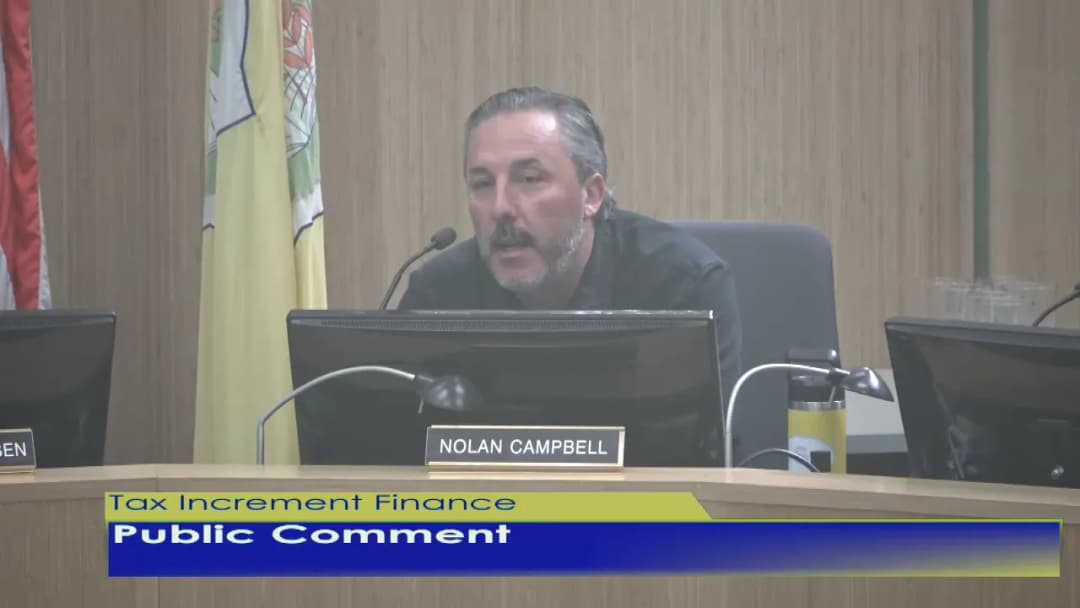
The Tax Increment Finance (TIF) Advisory Board of Bozeman, Montana met on Thursday, September 17, 2026, at 12:00 p.m. The meeting covered a special presentation on the Montana State University (MSU) Innovation Campus, public comments on the campus’s defense‑related tenants, and a vote on the North Park TIF Assistance Program application criteria. Consent Calendar - Minutes Approval: The board unanimously approved the minutes from the August 20, 2026 meeting. (Motion by a member, seconded, all in favor.) Public Comments & Testimony - Non‑agenda public comment: None received at the start of the meeting. - Comment after special presentation: - Audriana Carreon (MSU student): Urged the city to limit investment in companies involved in war profiteering. Noted that several Innovation Campus tenants have provided technology or aid to Israel during the Gaza conflict and benefit from TIF funding. Requested preventative measures to ensure companies directly involved in a genocide recognized by the United Nations do not benefit from TIF funding now or in the future. - Daisy Baertschi (recent MSU graduate in conservation biology and ecology): Expressed concern that 48% of MSU research funding comes from the Department of Defense (which she referred to as the Department of War). Stated that MSU has not been transparent about tenants on the Innovation Campus, particularly regarding war profiteering, and referenced a company (Reveal Technology) whose technology was allegedly used by Israel. Criticized the extension of the TIF district for another 25 years and called for reduced reliance on the military‑industrial complex. Discussion Items - MSU Innovation Campus – Special Presentation - Presenter: Mike Veselik, Assistant Vice President for Federal Relations & Economic Development at MSU. He provided an overview of the 42‑acre campus (west of 19th Avenue, north of Garfield, south of College), initially a research park that saw little development until a partnership with Charter Realty began around 2017. - Buildings described: - Applied Research Lab (20,000 sq ft, classified research up to TS/SCI and Q level – only commercially available classified space in Montana). - EngineWorks (78,000 sq ft, multi‑tenant incubator, including QCorp for quantum computing and a spin‑out Resilient Computing). - Aurora (80,000 sq ft, houses Aurora’s LIDAR technology for autonomous trucking; market cap $14 billion). - TIF investment: $3.6 million from the South Bozeman Technology District (formed 2012) for road extension (Technology Boulevard) and sewer capacity. The developer fronted the infrastructure cost, providing an interest‑free loan to the city, repaid from new increment (tax collection jumped from $30,000 to $520,000 annually). - Future plans: Big Sky Science Center (life sciences, anchor tenant Center for Biofilm Engineering), Applied Research Lab Phase 2 (non‑classified), and an EngineWorks expansion. MSU Alumni Foundation owns the land; Charter builds and leases buildings. The campus is zoned as a Planned Development Zone (PDZ) allowing higher density. - Board discussion: - Board member asked about food/retail; Veselik replied that the development agreement ties uses to the university mission (possible coffee shop, but not large commercial). - Board member inquired about the purpose of the TIF district and whether local TIF funds subsidize federal government activities. David Fine explained the district aims to attract high‑wage, value‑adding industries; the road and infrastructure investments enable private development that generates new property tax value. - Board member clarified that land is state‑owned (not taxable) but TIF captures increment from building improvements; the infrastructure improvements were funded via a developer advance, making the structure efficient. - Board member asked whether the board should consider limiting tenancy based on ethical concerns (e.g., defense contracts). Several board members responded that the board’s role is limited to infrastructure (roads, pipes, sidewalks) and that dictating tenants is outside its purview and would politicize decisions. Key Outcomes - North Park TIF Assistance Program Application Criteria – David Fine presented revised criteria based on previous board feedback: - Increased points for value‑adding industries. - Clarified definition of public‑private partnerships as projects implementing adopted city plans (e.g., climate plan, parks plan). - Standardized point values. - Vote: The board unanimously (all ayes) approved a motion to recommend that the Bozeman City Commission adopt the updated criteria. Applications over $50,000 will be brought to this board for review. - Adjournment: The meeting adjourned at approximately 1:30 p.m.

TAX INCREMENT FINANCING 29% · TECHNOLOGY AND INNOVATION 22% · ECONOMIC DEVELOPMENT 21% · PROCEDURAL 16%
17
SEP 16, 2026 · BOZEMAN, MONTANA · CITY COMMISSION
Bozeman Downtown Business Improvement District Board Meeting – September 16, 2026

The Bozeman Downtown Business Improvement District (BID) Board met on Wednesday, September 16, 2026, at 12:00 p.m. The meeting covered operational updates, staffing, downtown improvements, and planning initiatives. The board approved the August minutes and received reports from staff and board members. Consent Calendar - Approval of August Minutes: The board held a roll call vote and unanimously approved the minutes of the August meeting (6-0). Board members participating: Susan Nybauer, Randy Scholey, Eric Nelson, Elena Andrewin, Mark Kiki, and Eric Woman. Public Comments & Testimony - No public comments were offered, either in person or online. Emily Cope confirmed there were no attendees online. Discussion Items - Flower Basket Performance: Emily Cope reported that flower baskets declined earlier than normal due to a hot, dry summer. The standard twice-weekly watering was insufficient; three times per week is recommended in extreme heat. Aphid infestations exacerbated the issue, particularly on south-side baskets. Oak Gardens, the contractor, noted that stressed plants attract aphids. The board discussed removing dead baskets sooner and storing them temporarily. A suggestion was made to arrange preventative aphid spraying with Oak Gardens, though Oak Gardens indicated spraying outdoor baskets is more complicated. Staffing for flower watering was successful, with Heather continuing to water pocket parks and water bags. Patty, a former flower waterer, returns for weekend and winter maintenance. - Staffing Update: The Downtown Bozeman Partnership is interviewing for a new operations manager; an announcement is expected next week. - HRDC De-escalation Training: A four-hour training is offered on September 17, 2026, in partnership with HRDC, aimed at frontline employees. A board member reported an anecdotal increase in unhoused individuals seeking shelter downtown, attributing it to HRDC incentives, but no other board member had heard this. - Zoning Update (B3C District): The August board meeting featured Chris Saunders discussing the B3C height allowance. The city commission maintained the 90-foot height limit but directed staff to explore zone edge transition options. Commissioner Fisher indicated the current code will be given a year to settle before further changes. - Bozeman Creek Plan: Consultants will visit next week; the next public engagement is in November, with a vision plan presentation expected mid-December. - Future Meetings: Commissioner Fisher noted upcoming city meetings with Belgrade, ballot issue discussions on October 6th, and potential advisory board restructuring (e.g., forming committees for projects like Fowler). A board member asked about city charter ballot changes; updates are available on the city website. - Trick-or-Treating: Scheduled for Friday, October 30th, from 3-5 or 4-6 p.m. Main Street will be closed from Rouse to Broadway for pedestrian safety, not for vendors. - Monday Walks: A recurring weekly event organized by DBA board members, touring different downtown businesses. Molly Bryan (Element) leads coordination; attendance averages about eight people. - Parking Garage AEDs: The board is purchasing AEDs for the parking garage through the fire department’s contract. They will meet with Nick Faulkin to confirm locations. - Parking Garage Restrooms: HRDC and the City of Bozeman are working to reopen the parking garage bathrooms, which are in poor condition due to a sewer issue. HRDC may help fund improvements. - Passenger Rail: Board member reported progress with the passenger rail authority; BNSF and Montana Rail are involved. - MSU Strategic Plan: Board member served on the committee; the plan is nearing adoption by the Board of Regents in November. One more feedback opportunity will be provided. - URD Projects: The Babcock Street project (curb extensions, pedestrian ramps) is complete. A board member noted a grade discrepancy at one corner; Emily Cope will review photos. Pedestrian lighting will be installed on the north side of Main Street from Fifth to Wells Fargo, with potential expansion to the south side. - Finance Report: Flower basket expenses were paid before July 1. New downtown banners were printed at modest additional cost. Finances are otherwise on track. - Christmas Decor Update: New garland and bows are in storage; old garland (faded, dusty, with broken lights) is available free to property owners. Key Outcomes - Minutes approved (6-0). - No formal action items were voted on besides the minutes. - Directives: Staff will discuss early aphid spraying with Oak Gardens, remove dead baskets more promptly, and investigate storage options. Emily Cope will follow up on the sidewalk grade issue at Babcock and Black. - Next Steps: The October board meeting may be canceled or rescheduled; Emily Cope will email board members to confirm. - Training: De-escalation training (Sept. 17) is still open for registration.

URBAN FOREST MANAGEMENT 22% · URBAN REDEVELOPMENT 19% · PUBLIC ENGAGEMENT 18% · PUBLIC SAFETY 10%
18
SEP 16, 2026 · BOZEMAN, MONTANA · CITY COMMISSION
Bozeman Historic Preservation Advisory Board Work Session on Demolition Code – September 16, 2026

The Bozeman Historic Preservation Advisory Board (HPAB) met on Wednesday, September 16, 2026, at 6:00 p.m. in the City Commission Room for a work session focused on draft amendments to the Unified Development Code (UDC) consolidating demolition regulations. The discussion continued work from the Local Landmark Project Phase One Report and a July work session with the City Commission. No meeting minutes were available. The board took no formal action. Discussion Items - Staff (Aaron and a second staff member) presented a draft that would consolidate existing UDC Sections H through K, which cover demolition of historic and non-historic structures, into a single section addressing applicability and procedures for all types of proposed demolition. - Staff noted that the July City Commission work session expressed interest in applying demolition regulations outside the Neighborhood Conservation Overlay District (NCOD), but not design standards. The board reiterated its desire to consider structures 50 years old or older anywhere in the city, which makes the inventory form important for evaluating those properties. - Inside the NCOD, a Certificate of Appropriateness (COA) is required for demolition, and a COA application must include a proposal for subsequent development, addressing the city's past concern about removing historic structures without certainty of what will replace them. - The existing one-year demolition stay can currently be terminated at any point when the applicant submits documentation that alternatives were considered. The draft retains this concept but intentionally uses flexible language rather than prescribing a specific document type, letting the applicant submit what they believe is sufficient and allowing staff to use judgment. - A board member criticized that open-ended documentation approach, saying, "not telling people what to provide, but letting them provide it... that's horrible on the end user side." Another member responded that "code's not always the place for instructions." - A board member asked whether the survey/inventory form includes historic data such as who lived in the house; staff confirmed the form is in-depth and includes those stories. - Staffing and budget: A board member suggested converting a consultant budget line into a second staff position. Staff responded that the current preservation planner position is already more than full-time, the department's office space is completely full, and fee revenue is not enough to support current operations, so the city general fund already supplements the department. Staff also noted that the city has two wetland consultants on contract who serve as peer reviewers for the city. - A board member offered to lead historic tours, noting, "Crystal has me doing four different historic tours," and invited city staff to join one. - A board member observed that people in their neighborhood "are not trying to get into historic preservation" but care about neighborhood character, adding, "I think we're on the same side of the fence there." - Bylaws: A board member reported that bylaws passed at the last agenda item, and the earlier consensus was to wait until Historic Preservation Month, which is May. Key Outcomes - No formal motion or vote was taken; the meeting was a discussion-only work session. - Staff will continue refining the draft demolition section, revisit the flexibility of documentation requirements, and later combine the demolition standards with draft COA standards, deviations, and HPAB role language into an ordinance format. - Per state law, any UDC amendment requires a public hearing before the Community Development Board (planning commission), which makes a recommendation to the City Commission. The City Commission must hold a public hearing for provisional adoption and then a final adoption meeting at least two weeks later. HPAB will also provide its own recommendation to the City Commission at a future meeting. - The board's next meeting is scheduled for Tuesday, October 13, 2026. (The agenda states the board generally meets the third Wednesday of the month; the October meeting was moved to a Tuesday.)

HISTORIC PRESERVATION 57% · ZONING CODE 25% · PROCEDURAL 5% · PERSONNEL MATTERS 3%
19
SEP 15, 2026 · BOZEMAN, MONTANA · CITY COMMISSION
Bozeman Downtown Urban Renewal District Board September 15, 2026 Meeting Summary

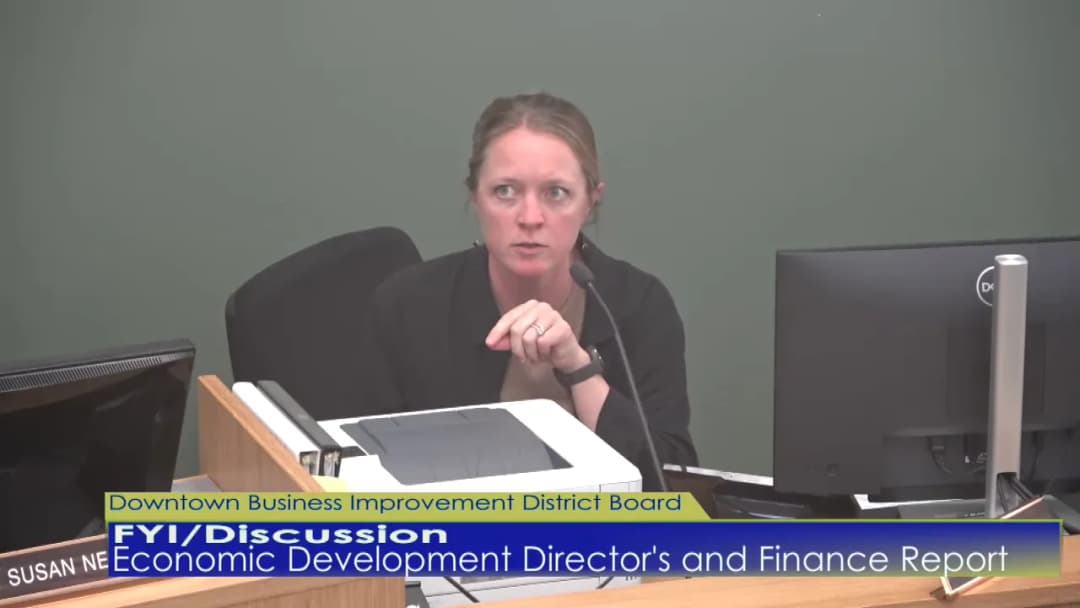
The Downtown Area Urban Renewal District (DURD) Board met on Tuesday, September 15, 2026, at 12:00 p.m. in Bozeman. The board approved its August minutes, received the Executive Director’s September report and monthly finance report, and heard an update on the City Commission’s downtown building-height discussion. Newer members Ryan Finn and Mike Waterman were welcomed. No disclosures or agenda changes were reported, and no public comment was offered. Consent Calendar / Routine Approvals - The board approved the August 2026 DURD meeting minutes as presented. Roll call votes were recorded for Nicholas Wicks, Jake Van Dusen, Tony Renzo, Mike Waterman, and Ryan Finn; all voted aye. Executive Director’s September 2026 Report - Ellie Staley said there were no action items and gave a project-by-project update. - Staffing: Patty Silversmith was hired for the BID weekend maintenance position and will work through April. - An HRDC de-escalation training is scheduled for Thursday, September 17, 2026, with 15 participants; additional sessions are planned. - Downtown flower baskets came down earlier than usual because of heat, dry conditions, and aphids; adjustments are planned for next year. - The City Commission is expected to approve Design Five for the Wilson School ADA playground through its consent agenda; construction is targeted for spring 2027. - Bozeman Federal Building/post office: the city is interested in acquiring the property, and URD expansion blight research continues. A realistic timeline for actionable information is January or February, with David Fine as the city’s lead. The potential post office relocation is a major community motivation. - The Bozeman Creek vision plan has no new update, but funding discussions are expected soon. - Fifth and Main lighting: pedestrian lights extending toward Wells Fargo are expected to be installed in early October. - Parking vision plan: a draft is expected in late October or early November, combining Audience Insights data and parking working group input. - Winter downtown events include Monday motivational walks, a homecoming pep rally, and downtown trick-or-treating, which will close Main Street as it did last year. - Business turnover: new businesses include Saffron, Lumen Foundry, Crazy Mountain Outdoor Company, Mason Frile’s, Schaefer Outfitters, Wax Tyrant Records, and Hokey Pokey ice cream. Closures or departures include Allegra, Blush, Nova Cafe, Open Range, Cafe Aurora, and Architect’s Wife. Development updates noted East Main Trading Company, the U.S. Bank facade, and the Hampton hotel are nearing completion. - Fire Station One: the city is negotiating to buy out or be reimbursed for the affordability component, and the matter must return to the City Commission. URD-encumbered funds sunset in October 2027, and the small lot makes an affordable project challenging. - Staley also reported strong regional interest in passenger rail and noted that the MSU strategic plan, with about 15 projects, is nearing adoption in November. Monthly Finance Report - The fiscal year began July 1, 2026. Final entitlement shares and interest income will not be known until later in the year. - A portion of the management fee to the Downtown Bozeman Partnership has been paid. - September expenses include general park improvements, street furniture and lighting for the Fifth and Main project, SALD-related work with TDH, early wayfinding work, Design Five lighting updates to the alley plan because previous lighting was not up to spec, and the first of three payments to Pioneer for URD expansion work. - Staff may ask the board later about how to approach the SALD, including whether it should be district-wide or outside the district. City Commission Updates and Future Ballot Discussion - Douglas, reporting on the City Commission, said the Commission kept the 90-foot height limit in the B3 zone and will continue to explore zone-to-zone transitions through zoning rather than new B3 code language. Ellie Staley noted the board’s prior recommendation aligned with the Commission’s discussion, including the 60-foot transition. - The City Commission will hold a joint meeting with Belgrade next week to discuss water, sewer, growth, and related synergies. - On October 6, the Commission will hold a work session on possible ballot measures. Mentioned needs include regional items like Streamline and emergency medical services; city-specific items like a fourth fire station, a second library, and an aquatic center; and affordable housing and alternative mental-health response. - Douglas said a private foundation could build a new library, but the city would need about $2 million per year to operate a second library. - In November, the Commission will review advisory board structure; Douglas said the URD’s role likely would not change much. - Douglas expressed concern that commissioners might advocate for individual projects rather than a cohesive strategy. Board members discussed framing these needs as community investments, with Marley noting that the library foundation had raised funds to build a new library and hand it to the city. Key Outcomes - Approved the August 2026 DURD meeting minutes unanimously. - Received the Executive Director’s report and monthly finance report without formal action. - Next steps: a board priorities review is planned for the October or November meeting; a draft parking vision plan is expected in late October or early November; URD expansion and federal building updates are expected around January or February; and staff will continue SALD and financing discussions.

URBAN REDEVELOPMENT 34% · PUBLIC SAFETY 11% · PUBLIC ENGAGEMENT 10% · TECHNOLOGY AND INNOVATION 8%
20
SEP 15, 2026 · BOZEMAN, MONTANA · CITY COMMISSION
Bozeman City Commission Regular Meeting - September 15, 2026

The Bozeman City Commission met on Tuesday, September 15, 2026, at 6:00 PM in the Commission Room at City Hall. The meeting covered a special presentation on housing affordability civic dialogue, action items including a water adequacy ordinance and the Cattail Creek Corridor and Anchor Route Park Master Plan, and a pulled consent item regarding the Olympic Torch Relay. All votes were 5-0. Public comments addressed concerns about the Cattail Creek plan, the torch relay costs, and general safety. Consent Calendar - F.1–F.16 (except F.3): Approved unanimously (5-0). This included accounts payable, various professional services agreements, a resolution correcting resolution numbers, and final adoption of a text amendment to wetland and watercourse regulations. Item F.3 (Torch Relay Agreement) was pulled from consent and considered later as an action item. Public Comments & Testimony - Cindy Miller (Harvest Creek resident): Expressed concerns about the Cattail Creek Corridor plan, including removal of natural grasses, fire hazards, noxious weeds, and lack of HOA engagement. She requested that the Harvest Creek HOA board be involved in future planning. - Heather Higgs (Harvest Creek HOA): Representing 525 homeowners, she listed concerns about the boundary between irrigated lawn and native grasses, weed management, fire risk, and impacts on adjacent properties. She requested collaboration with the city on these issues. - Suki Nakamura (Bozeman resident, EV Board member): Speaking on the Torch Relay agreement, she questioned fiscal implications, noting the contract prohibits charging fees and the city has stated it cannot fully fund police and fire. She asked what Bozeman residents gain from the event. - Terry Lundsden (Bozeman resident, Urban Parks and Forestry Board chair): Expressed support for adopting the Cattail Creek Master Plan. - Ryan William Wilson (Harvest Creek resident): Supported the Cattail Creek plan, citing its similarity to the Gallagator Trail and the need for safe biking/walking routes. He also noted dangerous traffic conditions on Oak Street. Discussion Items - Special Presentation – Housing Affordability Civic Dialogue: Russia Chavez Perdinas (Civic Dialogues, powered by Change.org) presented results. The open phase received 193 ideas from 500+ residents. A lottery-selected panel of 100 residents, demographically representative of Bozeman, deliberated on housing policy options. Top priorities included reforming HOA covenants to allow ADUs (88% support), pre-approved pattern book for home plans (79%), fast-track permitting (72%), and a tourist/resort tax (71%). A workplan prioritized actions: immediate (pattern book, fast-track, HOA reform), near-term (MSU student housing partnership, low-interest loans, ADU incentives), and medium-term (tourist tax, down payment assistance). The city may request no-cost research support from Civic Dialogues. - Action Item I.1 – Water Adequacy Ordinance (Provisional Adoption): Director Sean Coates presented the ordinance to move water adequacy requirements from Chapter 38 (UDC) to Chapter 40 (Utilities Code) for housekeeping. No substantive code changes. Duplicate language will remain until a spring cleanup. Public comment was silent. Motion to provisionally adopt carried 5-0. - Action Item F.3 – Olympic Torch Relay Agreement (Pulled from Consent): Assistant City Manager Henderson noted the early stage of planning, with off-ramps, and that MSU may be a partner. Fiscally, typical city services (police, street closures) are absorbed in operations. Commissioner Sweeney raised concerns about staff burden and costs. Public comment raised concerns about waived fees and city trade-offs. Motion to authorize the city manager to sign the agreement approved 5-0. - Action Item I.2 – Cattail Creek Corridor and Anchor Route Park Master Plan: Parks staff (Mitch Overton, Addie Jaden) presented the plan, a 3.25-mile corridor from Davis Pond to Bozeman Ponds, serving 12,000 people within a quarter mile. Key features: unified trail, wayfinding, native vegetation, limited turf conversion, and phased implementation. Public comments raised concerns about HOA engagement, grass management, and weed/fire hazards. Commissioners discussed pickleball prohibition in the corridor, future engagement for site-specific design, and herbicide policies. Motion to adopt the resolution carried 5-0. - Appointments – Library Board of Trustees: Mayor Morrison disclosed a past professional relationship and campaign donation from applicant Amara Reese Hansel. Motion to appoint Amara Reese Hansel (short term ending June 30, 2027) and Emmy Chuck (full term ending June 30, 2031) approved 5-0. Key Outcomes - Consent Calendar: Items F.1 through F.16 (except F.3) approved 5-0. - Water Adequacy Ordinance: Provisionally adopted 5-0; will be duplicated in code until spring cleanup. - Torch Relay Agreement: Authorized City Manager to sign with LA28, 5-0. - Cattail Creek Master Plan: Resolution adopted 5-0; future site-specific engagement with neighborhoods planned. - Library Board: Appointments made 5-0. - Commission FYI: Only one board vacancy remains (Sustainability Board). Commissioner Sweeney requested a work session on the neighborhoods program and noted park distribution disparities in older urban areas.

PARKS AND RECREATION 28% · COMMUNITY ENGAGEMENT 16% · PUBLIC ENGAGEMENT 14% · PARKS AND RECREATION 11%
OPENPUBLICA · PUBLIC MEETING INDEXUPDATED DAILY · openpublica.com