Browse by city
Date range
Search help

Search titles, summaries, topics and stored transcripts together. Keywords may match separately; put the whole query in double quotes for a phrase. Matching follows word analysis, so punctuation is not exact. Both dates are included. Documents are not searched.

SHOWING 91–100 ENTRIES
91
APR 28, 2026 · BOZEMAN, MONTANA · CITY COMMISSION
Bozeman City Commission Meeting April 28, 2026: Priorities, Public Comment, and Interim Zoning

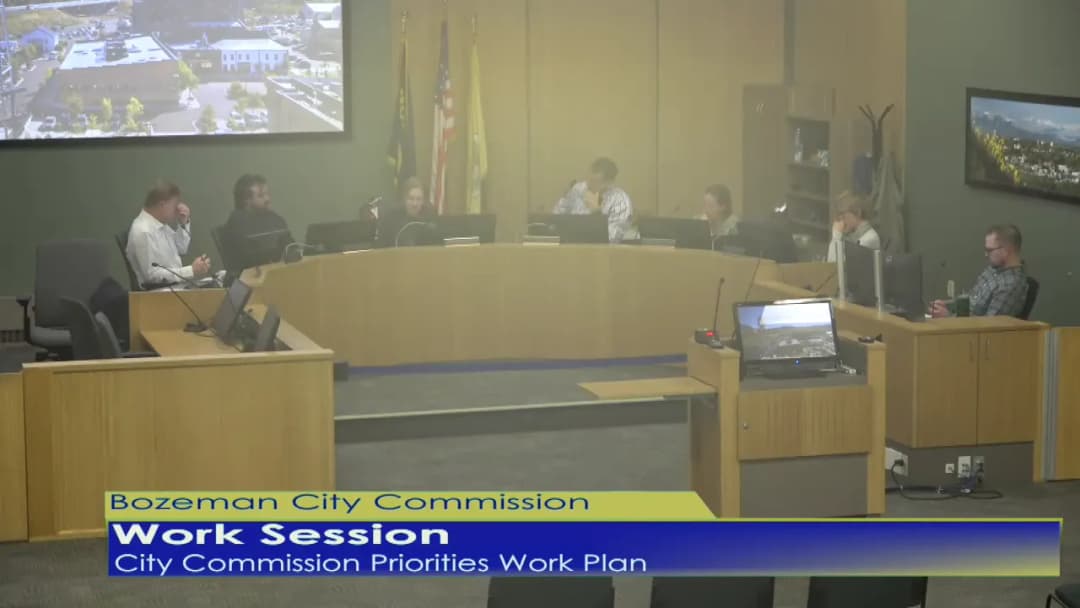
The Bozeman City Commission met on April 28, 2026, for a regular meeting that included a work session on the City Manager’s work plan and commission priorities. The evening began with the Pledge of Allegiance and updates from commissioners, followed by consent items, extensive public comment on a range of issues, and a deep dive into the city’s strategic priorities. Key topics included interim zoning, social housing, public safety funding, and upcoming ballot measures. Consent Calendar - Consent one (items 1–6) approved 5–0. - Consent two (adoption of findings of fact for appeal 25769, Send and Springs) continued to the May 5, 2026 meeting after public comment from appellant Jeff Poole and discussion about reviewing omitted Unified Development Code provisions. The commission will consider the document again after allowing time to review Poole’s comments. Public Comments & Testimony Non-Agenda Items: - Natsuki Nakamura (Bozeman resident, Economic Vitality Board member) commented on the interim zoning discussion, thanking commissioners for sharing views but wishing it had been agendized. She also spoke as Teamsters union president, urging fair contract negotiations for city workers. - Aidan Rasmussen (Bozeman DSA Housing Working Group) advocated for social housing funded by revenue bonds, citing a 44.2% vacancy rate for units built in 2024–2025 compared to 9.2% for pre-2024 units, and called for market-shielded affordable housing. - Anthony Smith raised concerns about police accountability, referencing a 27-hour standoff and calling for transparent coroner’s inquests and policy changes. - Riley Dunn urged proactive rather than reactive governance, arguing that proactive measures now save time later. - Mary Bateson highlighted that the Neighborhood Conservation Overlay District (NCOD) is not being enforced and argued that large buildings threaten the general welfare of residents. - Daniel Cardi supported social housing and criticized the commission for not holding a public hearing on interim zoning; advocated for reducing B3 height limits from 90 to 60 feet. - Isaac Buttery (MSU student) urged water conservation policies due to declining snowpack, noting that 80% of Bozeman’s water supply comes from snowmelt. - Autumn Michaels (DSA) reiterated the request for bond council consultation on social housing, stating the campaign has been running for five years. - Emily Toledo (online) challenged the commission’s definition of urgency, arguing that dysfunctional land use policy has real cumulative impacts on quality of life. Work Session Comments: - Mary Bateson read prior commissioner statements on B3 height limits from December 2024 and asked the commission to publicly discuss height limits as they said they would. - Bonnie Rice (Sacagewea Audubon Society) requested that dark sky preservation be formally incorporated into commission priorities, noting that a formal analysis of Bozeman’s lighting code by DarkSky International is complete and includes specific recommendations. - Nathan Stein (Headwaters Community Housing Trust) supported bridging the affordability gap and urged exploring new funding sources such as a housing levy or revenue bonds, citing the narrow failure of the 2020 levy. - Catherine Barry (Gallatin Watershed Council) encouraged developing a wetland and watercourse mitigation manual and adding natural resource staff capacity to ensure consistent implementation of the new code. - Riley Dunn questioned the need for interim zoning, called for statistically valid surveys rather than self-selected ones, and asked that B3 height concerns be addressed separately from NCOD updates. Discussion Items Interim Zoning and NCOD Update: During commissioner FYI, all five commissioners gave their positions on the request for an interim zoning ordinance (IZO) for the NCOD: - Deputy Mayor Fisher opposed an IZO, citing the four-year UDC rewrite process, need for predictability, and concerns that a pause would undermine trust and create legal/financial uncertainty. He argued that reopening that debate pulls time from other priorities and that the strongest calls for a pause come from already-protected areas. - Commissioner Bodie cited Montana Code Annotated, noting that IZO is meant to address uses, not design standards. She found no exigent circumstances or specific threat to public health, safety, or welfare, and stated that an IZO would undermine the ongoing NCOD update public engagement process. - Commissioner Magic said she began discussing interim zoning last summer but now feels less urgency due to slowed development and the completed UDC update. She remains open to investigating an IZO but prefers to focus energy on the NCOD process. - Commissioner Sweeney read from the 1990 Bozeman interim zoning ordinance and expressed support, emphasizing that the NCOD is a conservation overlay and that the Historic Preservation Advisory Board has voted to write a letter analyzing pros and cons. - Mayor Morrison stated he sees no level of threat to health, safety, or welfare that merits urgency, and that other issues (e.g., a recent traffic fatality) have already mobilized swift action. Work Plan and Priorities Refinement: The commission held a lengthy work session to finalize the joint city manager work plan. Key areas addressed: - Public Safety: Fire staffing (Safer grant cliff, options for a quick response unit and future ballot measures), police staffing and a potential police impact fee study ($50,000), EMS transport services, and behavioral health coordination. - Community Engagement: Consensus program (pilot underway), review of citizen advisory boards (report expected, work session in June), enhanced MSU partnership (including housing, policing, and parking coordination), “Telling Our Story” initiative, and a proposed Citizens Academy (moved under engagement). - Affordability: A dedicated housing work session will be scheduled to explore revenue bonds, GO bonds, a housing levy, and zoning incentives (density in RB, design standards modifications). Commissioners expressed differing views on developer concessions and the effectiveness of current tools like LITeC and the Affordable Housing Ordinance. - Heritage and Environment: NCOD update, urban forest management plan (including canopy goals, vulnerability analysis, and heritage tree recommendations), Pratt Plan (parks, recreation, active transportation), integrated water resources plan, and Bozeman Creek Vision Plan. - UDC Revisions: Commissioners committed to a comprehensive review of the Unified Development Code and zone map in August 2026, including topics like B3 height limits, dark sky amendments, wetland mitigation rules, and short-term rental regulations. Language and Structural Edits: - Changed “streamline the development review process” to “improve predictability and cut inefficiencies.” - Moved Citizens Academy to the “Engaging Meaningfully with Community” section. - Adjusted completion definitions for the Safe Streets for All plan to include a long-term vision beyond the three listed initiatives. - Consolidated references to the Affordable Housing Ordinance. - Added police impact fee study to the work plan. Key Outcomes - Consent Item 2 continued to May 5, 2026 to allow review of new comments. - Housing Work Session to be scheduled in the coming months to discuss funding mechanisms, zoning incentives, and overall housing strategy. - Ballot Question Strategy Work Session will determine which issues (fire staffing, police staffing, housing levy, etc.) to present to voters and on what timeline. - UDC Text and Map Amendments will be reviewed in a dedicated work session in August 2026, with input from advisory boards and the public. - Advisory Board Work Session planned for June 2026. - Consensus Program Pilot continues as planned. - Police Impact Fee Study to be pursued; commissioners expressed support. - Affordable Housing Ordinance Revisions to be discussed in the housing work session; specific proposals include exploring density bonuses in RB zoning and alternative incentives. Additional FYI - Commissioner Magic announced a walk along Bozeman Creek on April 29 (dog-friendly, trash pickup). - City Manager announced the Hidden Creek groundbreaking on May 1 (182 apartments for 30–70% AMI, 9 for-sale homes, $2 million city support, partnership with county/HRDC/United Housing Partners) and completion of the Riverside Lift Station ($1 million under budget, serving 140 homes). - Commissioner Sweeney promoted the Give Big event and Extreme History Project walking tours (May 1). - Mayor Morrison closed by responding to public comments, defending the commission’s proactive record on transportation safety and interim zoning. Meeting adjourned.
AFFORDABLE HOUSING 20% · LAND USE PLANNING 18% · COMMUNITY ENGAGEMENT 15% · PROCEDURAL 13%
92
APR 24, 2026 · BOZEMAN, MONTANA · CITY COMMISSION
Bozeman Study Commission Meeting – April 24, 2026: Public Records Decision and Neighborhood Association Charter Draft

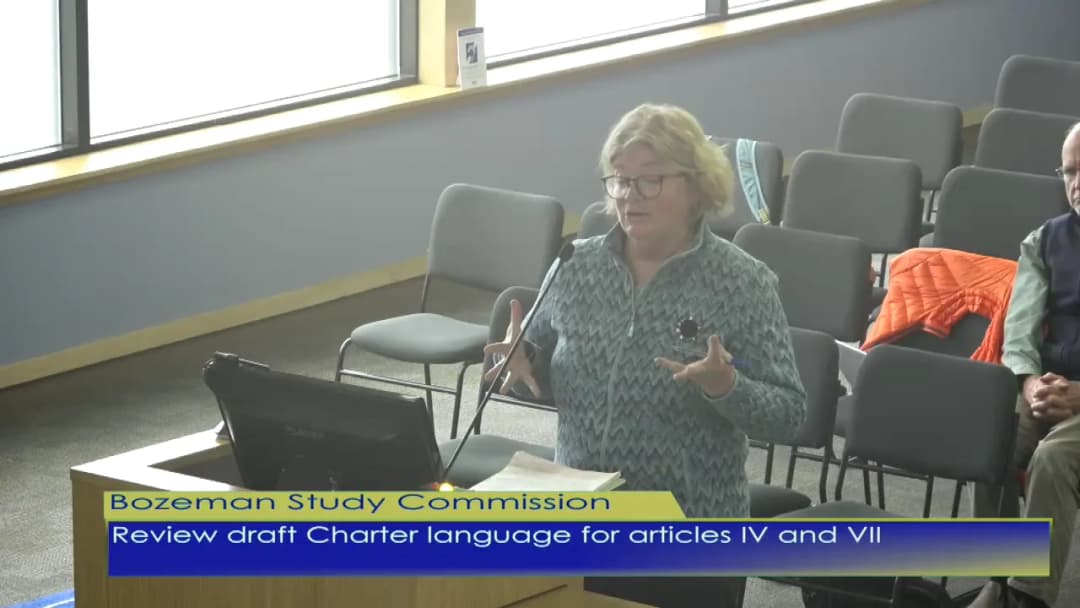
The Bozeman Study Commission met on April 24, 2026, to address a public records request from the Gallatin Valley Sentinel and to commence discussion on proposed charter language regarding neighborhood associations and civic engagement. The meeting included extensive public comment and a vote on the release of survey data. Consent Calendar - Approval of study commission minutes (passed unanimously without discussion). Public Comments & Testimony - Pam Bodie, Cooper Park Neighborhood Association, urged the commission to consider why citizens not involved in neighborhood associations are not participating, as they deliberate potential changes to association bylaws. - Abby Jones, Gallatin Valley Sentinel, requested the release of raw survey data, arguing that Montana's right-to-know law does not allow a blanket exemption. She also presented draft charter language based on public feedback, advocating for organic neighborhood development and ward-based representation. - Mary Bateson, Bozeman resident, gave specific language suggestions for Article VI, Section 7.3, including removing "consensus-based" requirements and clarifying terms. - Daniel Cardi, Bozeman resident, stressed transparency in data release and argued that the Inter-Neighborhood Council (INC) should remain a partner board with advocacy powers, not merely advisory. He criticized attempts to speak for those not engaged. - Jane Jelinski, former county commissioner, warned against creating voter wards, arguing it could suppress voter turnout and reduce big-picture thinking among commissioners. - Alison Sweeney, city commissioner, praised the inclusion of language requiring timely responses to INC recommendations but opposed imposing consensus-based decision-making on neighborhood associations, calling it a barrier to participation. - Jim Webster, INC member and Historic Preservation Advisory Board member, requested more direct dialogue between the commission and INC. - Zara Osman, INC representative (Valley Unit Neighborhood Association), asked to strengthen language so that the city commission must discuss INC recommendations in a public meeting. - Lori J, Bozeman resident, recommended eligibility requirements for advisory boards (no conflicts of interest), the right for boards to set their own agendas, and a formal response requirement from the commission when voting against recommendations. Discussion Items 1. Public Records Request – Gallatin Valley Sentinel - City Clerk Mike presented three options: release raw data in full, release in scrambled format (responses grouped by question, not by respondent), or deny the request. He highlighted the balancing test between Montana's right-to-know and the right to privacy, noting the promise of confidentiality made during the survey. - Commissioners debated the merits. Some argued scrambling would preserve privacy while still releasing all the substantive data, while others expressed concern that scrambling would prevent cross-tabulation and diminish the data's value. - A motion was made and seconded to authorize release in a format showing every response to each question rather than all responses by each respondent, with redaction of privacy-related information in written responses. - The motion carried 4-1 after public comment and deliberation. 2. Neighborhood Associations – Draft Charter Language (Article 7) - Commissioners Barb and Becky presented a first draft of a new Article 7 on Public Engagement in Local Governance, which would replace existing Article 4 sections on neighborhood associations and advisory boards. Key elements included: a purpose statement for civic engagement, recognition standards for neighborhood associations, composition and responsibilities (including a cap of 20 neighborhoods), and a full-time staff liaison. - Discussion focused on: the appropriateness of consensus-based decision-making requirements (Section 7.03 B.9); the proposed cap of 20 neighborhoods; whether to dictate boundaries organically or by city action; the level of support needed from the city (full-time staff vs. sufficient resources); and the need for enforceable guardrails versus high-level charter language. - Many speakers and commissioners favored removing the consensus-based language and the cap on neighborhoods, preferring organic growth. Concerns were raised about the enforceability of the language and the need for more formal processes for INC recommendations. - The commission agreed to continue the discussion at the next meeting, with Barb and Becky to refine the draft based on input and meet with INC representatives. Key Outcomes - Records Request Vote (4-1): Approved release of survey data in a randomized format (responses grouped by question, not by respondent) with redaction of personally identifying information from written responses. - Neighborhood Association Discussion: Tabled to the next meeting (April 30, 2026). Barb and Becky will revise the draft language and meet with INC representatives before that meeting. - Scheduling: The next meeting will also cover advisory boards, wards/districts, and a presentation from the Municipal Court.

COMMUNITY ENGAGEMENT 59% · PUBLIC ENGAGEMENT 17% · PROCEDURAL 13% · CHARTER REVISION 9%
93
APR 23, 2026 · BOZEMAN, MONTANA · CITY COMMISSION
Urban Parks and Forestry Board Meeting - April 23, 2026

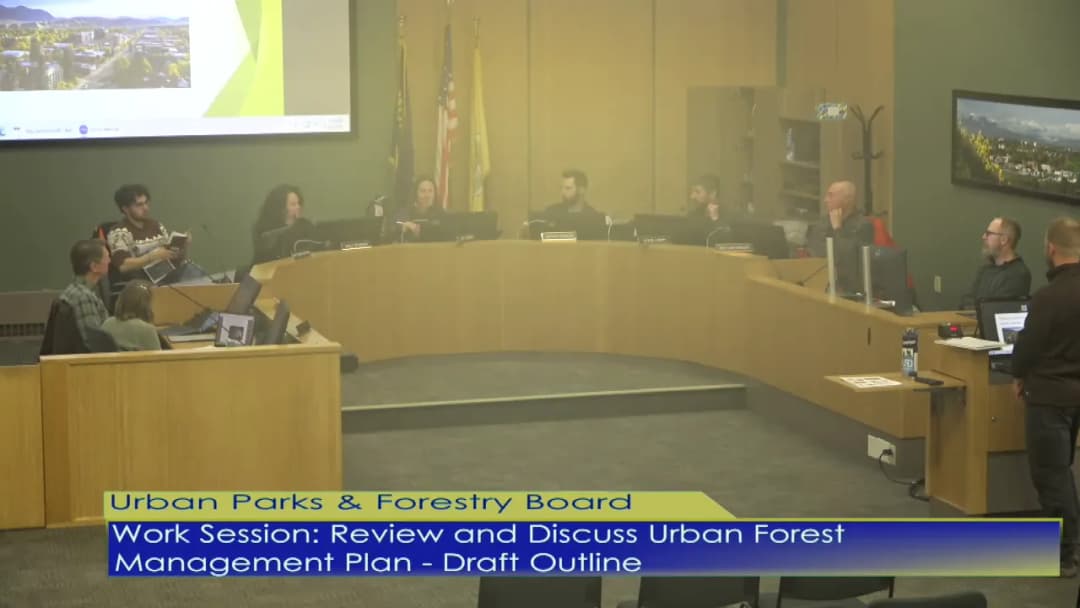
The Bozeman Urban Parks and Forestry Board met on April 23, 2026, to approve the meeting minutes, adopt the 2026-2027 work plan, and hold a work session on the Urban Forest Management Plan update. The meeting also included director updates on parks and recreation projects. Consent Calendar - The board unanimously approved the minutes from the March 26, 2026 meeting. Public Comments & Testimony - No public comments were made on non-agenda items or the work plan. Discussion Items - Adoption of the 2026-2027 Work Plan: Parks and Recreation Director Mitch Overton presented a proposed work plan aligned with the board's five focus areas: Arbor Day program, urban forest reports, equity distribution of parks/trails, evaluation of the Parks, Recreation, Open Space and Trails (PROST/Pratt) plan, and recommendations for Sunset Hills Cemetery. Board members asked for clarification on the Unified Development Code (UDC) updates and the Cash and Lou grant program. The board discussed incorporating community gardens and the Story Mill garden model under equity distribution. After discussion, the board voted unanimously to adopt the work plan. - Work Session on Urban Forest Management Plan (UFMP) Update: Consultants from DJ&A and PlanIT Geo presented the outline for the 2026 UFMP. Key sections include introduction, goals, value of urban trees, inventory analysis, management challenges, and a 10-year implementation roadmap. Preliminary inventory data showed ash tree percentage reduced from 47% to 22% since 2016. The board discussed capacity constraints, catastrophic risks, heritage tree program, canopy monitoring, and partnerships. No formal vote was taken; the outline was accepted as presented. - Director Updates: Mitch Overton provided updates on the Parks and Recreation Foundation (new board members, 501c3 status), construction of synthetic turf fields at Bozeman Sports Park (field 7 and field 13), potential ball diamond complex and community center through public-private partnerships, retirement of Park Superintendent Tom White, and upcoming public meetings for the UFMP and Arbor Day event. Key Outcomes - The 2026-2027 Urban Parks and Forestry Board Work Plan was adopted unanimously. - The UFMP outline was approved as a working structure; the next work session is scheduled for June 25, 2026. - Several director updates were noted for information.

PARKS AND RECREATION 91% · COMMUNITY ENGAGEMENT 4% · PROCEDURAL 1% · LAND USE PLANNING 1%
94
APR 22, 2026 · BOZEMAN, MONTANA · CITY COMMISSION
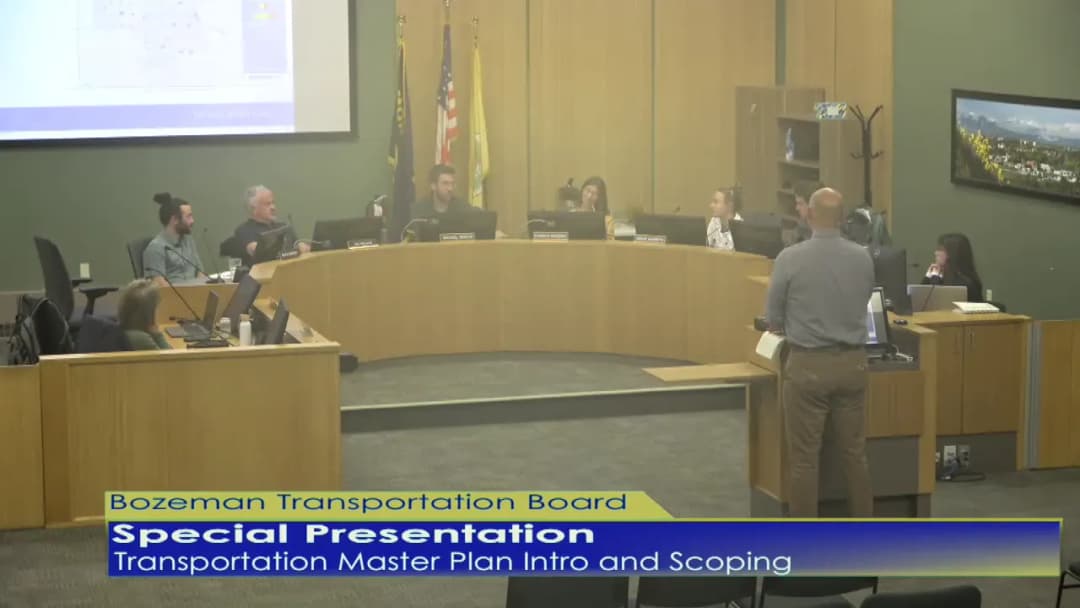
Bozeman Transportation Board Meeting – April 22, 2026

The Bozeman Transportation Board met on April 22, 2026, to discuss and act on several items including the adoption of the 2026-2027 work plan, the administrative review board (ARB) appointments, and a detailed scoping discussion for the upcoming Transportation Master Plan (TMP) update. The meeting was called to order at 12:15 PM (agenda time) and included public comment opportunities, though none were received. Consent Calendar - Approval of Minutes: The board unanimously approved the minutes from the January, February, and March 2026 Transportation Advisory Board meetings. - Excusal of Board Member: A motion was passed to excuse Hagen Glinds from the meeting. Public Comments & Testimony - No members of the public provided comment either in person or online during the general public comment period or during the TMP discussion. Discussion Items - Staff Updates: Director Nick Ross provided updates on the Oak and Ferguson Signal Improvement Project (awarded under estimate, completion expected this year), the Safe Streets for All safety action plan (awarded to Kittle City Associates with a crash data platform from City In and signal safety software at eight intersections), and the neighborhood traffic calming program (16 eligible projects, 18 installations by end of May 2026, including 13 asphalt art installations and 19 planters). Additionally, Ross outlined a programmatic approach to install stop signs at approximately 450 uncontrolled intersections citywide, with a goal of 50 per year. - Administrative Review Board (ARB): Parking Manager Nick Fokan explained the three-level parking citation appeal process: administrative review (by him), the ARB (three board members), and judicial review. The board appointed Mike Vassilik as ARB chair, with Bryce and Rio as members, and Grace Gilbert and Simon Ruzinski as alternates. The ARB will meet approximately monthly to review citations. - 2026-2027 Transportation Advisory Board Work Plan: Director Ross presented the two-year work plan covering board governance, planning (including the TMP update and safety action plan), capital projects (Stucky Road, Frontage Path, College Street), and policy efforts (residential parking permit districts, metered parking, e-bike policy, curb management). The board unanimously approved the work plan. - Transportation Master Plan (TMP) Scoping: Ross led a discussion on the scope of the TMP27 update. Key topics included: - Goals and Objectives: The board expressed support for retaining the existing goals but suggested a public conversation to refine them, noting that performance measures could be deemphasized. - Existing Conditions Analysis: The board agreed to avoid costly intersection level-of-service calculations for all 60-80 intersections, instead focusing on vehicle volumes, origin-destination studies, and safety evaluations at uncontrolled intersections. - Bicycle Operations: The board supported replacing the citywide bicycle level of traffic stress (LTS) map with a more targeted approach, as the current map is rarely used. - Project Prioritization: The board endorsed developing a prioritization framework based on community goals, with a cost-benefit or weighted matrix to guide capital project selection. - Road Ecology: The board strongly supported integrating an ecological lens (using the existing Sensitive Lands Plan) into the TMP to better align future street alignments with natural features, as demonstrated on the Fowler Avenue project. - Origin-Destination Studies: Several members highlighted the value of OD data for understanding travel patterns, informing land use decisions, and identifying multimodal opportunities. - Procurement: The board agreed to release an RFQ for a consultant team in May 2026, with final scope refinement to occur in subsequent meetings. Key Outcomes - Votes: All motions passed unanimously, including approval of minutes, excusal of board member, ARB appointments, and adoption of the 2026-2027 work plan. - Directives: Staff will proceed with issuing the RFQ for the TMP consultant team in May 2026, incorporating the board’s guidance on scope (e.g., focus on volumes, safety, origin-destination, road ecology, and project prioritization). A more detailed scope discussion will be held at the next board meeting. - Next Steps: The ARB will begin meeting monthly; the TMP update is expected to be completed by the end of 2027; the neighborhood traffic calming installations will be in place by end of May 2026 with post-implementation surveys in June.

ENGINEERING AND INFRASTRUCTURE 29% · TRANSPORTATION SAFETY 27% · PARKING 12% · COMMUNITY ENGAGEMENT 10%
95
APR 21, 2026 · BOZEMAN, MONTANA · CITY COMMISSION
Bozeman Urban Renewal District Board Meeting – April 21, 2026

The Bozeman Downtown Urban Renewal District (DURD) board held its regular meeting on April 21, 2026. The board approved the fiscal year 2027–2028 budget after a third draft review, and discussed two major items: a potential parking project at the federal building site and the new infrastructure grant program. A decision on the federal building blight study was deferred pending city feedback, while the grant program language is under legal review. Consent Calendar - Approval of Minutes: A motion to approve the previous meeting minutes was made, seconded, and passed via roll call. John abstained due to absence at the prior meeting. All other members (Nicholas, Sky, Tony, Jake, Amy) voted in favor. Public Comments & Testimony - No public comment was offered either in person or online. Discussion Items - Federal Building Parking Opportunity: The board discussed a proposal by staff to spend $32,500 on a blight study by Pioneer Technical to potentially expand the URD boundary to include the federal building site, which could house a parking structure. Tony and Jake expressed hesitation due to uncertainty about the federal property transfer timeline and the city's level of commitment. They suggested waiting for feedback from Chuck Wynne (city economic development) before committing funds. Ellie noted that the study could be phased, and the process might still be useful for other sites. Marley advocated for simultaneously seeking alternative parking sites. The board agreed to table a formal vote until the May meeting after receiving city input. - Infrastructure Grant Program & 302 Eastman Hall Application: Staff explained a shift from DURD-managed projects to a reimbursement-based grant model for private developers. City legal (Greg) is reviewing the grant language to ensure public interest protections. The first applicant, Matt Payne (representing the 302 Eastman Hall project), was present. The board expects to have a decision on the grant program and the application by the May meeting. Key Outcomes - Budget Approval: The board voted unanimously to approve the FY 2027–2028 budget as presented. The budget includes $1.6 million for infrastructure improvements in FY 2026 and increased amounts for FY 2027–2028, along with allocations for parking, park improvements, and other projects. Staff will remove unused line items for clarity. - Next Steps on Federal Building: Staff will await a response from Chuck Wynne and share with the board. A formal vote on the blight study will be scheduled for May. - Next Steps on Infrastructure Grant: Legal review is ongoing; the board will consider the grant program and the 302 Eastman Hall application at the May meeting.

ENGINEERING AND INFRASTRUCTURE 29% · PARKING 27% · FISCAL SUSTAINABILITY 24% · ECONOMIC DEVELOPMENT 8%
96
APR 21, 2026 · BOZEMAN, MONTANA · CITY COMMISSION
Bozeman City Commission Regular Meeting – April 21, 2026

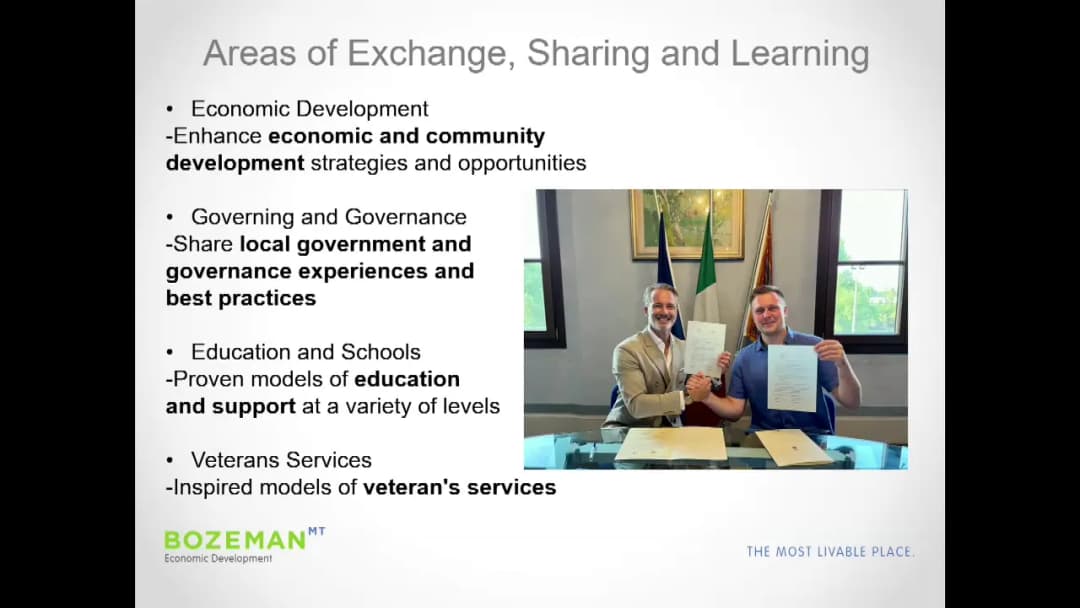
The Bozeman City Commission met on Tuesday, April 21, 2026, at 6:00 PM in the Commission Room at City Hall. The meeting included approval of amended minutes from December 16, 2025, a consent agenda of seven routine items, a mayoral proclamation for Arbor Day, two special presentations (economic impact of Yellowstone Fiber and IT operations), and a unanimous vote to enter a cooperative agreement with the Ukrainian municipality of Kopychyntsi. Commissioners also discussed interim zoning, a request from Montana Public Service Commissioner Brad Molnar, and various community FYIs. Consent Calendar - Items G.1–G.7 approved 5-0 without public comment: - G.1 Accounts Payable Claims Review and Approval - G.2 Task Order 11 with Sanbell for Mendenhall Sanitary Sewer Replacement (5th–7th Avenue) - G.3 Annual Montana State Historic Preservation Office Certified Local Government Program Grant - G.4 Rejection of all bids for Water Reclamation Facility Solar Generation Project (to be rebid later) - G.5 Gran Cielo Phase 3 Major Subdivision Preliminary Plat – subdividing 4 lots into a 42-lot subdivision for single-family and townhouse/rowhouse uses (Quasi-Judicial) - G.6 Resolution of Intent to Create Special Improvement Lighting District 797 for Urban + Farm Phase 2 - G.7 Resolution of Intent to Create Special Improvement Lighting District 798 for South Range Crossing Subdivision (SRX) Phase 4 Public Comments & Testimony - Marilee Brown (resident outside city limits) urged the commission to request an expanded environmental study for the Airport Authority’s expansion, noting the study only considers airport property and has a comment deadline of Thursday, April 23 (midnight). She asked commissioners to also notify the county commission. - John Meyer (homeowner) criticized the commission for not holding a public conversation about a moratorium on development, accusing Deputy Mayor Fischer of avoiding the topic. He also claimed Commissioner Bode failed to disclose a relationship with a paid lobbyist who testified against an affordable housing initiative, and called for systemic changes to affordable housing in Bozeman. - Owen Minton (MSU senior, renter) urged the city to evaluate adopting ASHRAE Standard 189.1 for municipal projects to improve building sustainability, water use efficiency, and indoor environmental quality. - Mary Bateson (resident) requested that the commission publicly discuss interim zoning options to temporarily halt large developments and demolitions in the Neighborhood Conservation Overlay District (NCOD) until its update is complete and a new historic preservation officer is hired. - Leisher (MSU senior) praised the new wetlands ordinance as “the most progressive in Montana” but asked the commission to enforce the mitigation hierarchy (on-site first, then local credits, then distant credits) to avoid developers purchasing credits 90 miles away at Twin Bridges. - Macy Schmidt (MSU senior) opposed House Bill 664 (2025), which repealed numeric nutrient standards for Montana rivers. She urged the commission to support petitions reinstating numeric standards to protect water quality and aquatic habitats. - Commissioner Brad Molnar (Montana Public Service Commission, District 2) gave a 10-minute presentation asking the City Commission to send a letter to the Federal Energy Regulatory Commission (FERC) by April 30, 2026. He argued that Northwestern Energy is transferring 370 MW of low-cost coal-fired electricity (from Colstrip Units 3 & 4) from rate-based to market-based, which would allow Northwestern to sell that power to a data center rather than to Montana retail customers. He stated the energy is valued at $300 million by the state, but Northwestern’s FERC filing values it at zero. A letter of support for reconsideration would help protect ratepayers and reduce property taxes. He noted he and Commissioner Puccinelli are intervening without commission funding. Discussion Items 1. Approval of Minutes (F.1) – Commissioners debated two amendments to the December 16, 2025 minutes. The first amendment (pass 4-1) required listing all eight speakers in favor and eleven opposed to the 90-foot B3 height increase, including the five who cited the affordable housing ordinance. The second amendment (fail 1-4) would have recorded Deputy Mayor Fischer’s desire for robust public discussion and Commissioner Madgic’s desire for a work session on the height issue. The minutes as amended were approved 5-0. City Attorney Sullivan noted the city’s policy designates the video as the official record; minutes only record actions, not verbatim discussion. 2. Mayoral Proclamation – Arbor Day (I.1) – Mayor Morrison proclaimed Friday, April 24, 2026, as Arbor Day and encouraged citizens to plant trees. City Forester Alex Nordquest noted tree-planting events at Boulder Creek Park and Westbrook Park on Friday from noon to 3 PM. 3. Special Presentation: Yellowstone Fiber Economic Impact (J.1) – Grace Gilbreth (Project Director, NRMEDD) presented an economic impact analysis showing the Yellowstone Fiber network generated over $135 million in total economic activity across three study periods (2015, 2022-2024, projected 2022-2027) and supported more than 1,400 jobs, with over 80% of value retained locally. She highlighted the open-access model, local control, and $105 million in total investment (initially catalyzed by $4 million in local bank financing secured by early city leadership and 12 public land easements). The network serves as a model for other communities. 4. Special Presentation: IT Operations (J.2) – IT Director Scott McMahan described the department’s four focus areas: cybersecurity (currently a shared role), application support, systems administration, and help desk. He noted support for over 30 city departments, 110 servers, 650 network devices, and a help desk that addressed over 2,000 tickets in 2025. He warned of an uptick in phishing scams targeting the development community, using city logos and demanding wire payments. He also announced email domain changes from @bozeman.net to @bozemanmt.gov and the website change to bozemanmt.gov effective April 27, 2026. 5. Action Item: International Territorial Cooperation with Kopychyntsi, Ukraine (K.1) – Economic Development Manager Brit Fontenot presented a resolution authorizing the mayor to sign a non-binding agreement with Kopychyntsi (Ternopil Region, Ukraine) through the Cities4Cities initiative. The partnership focuses on four pillars: economic development, governance, education/schools, and veterans services. Fontenot noted existing relationships, including a sculpture by Jim Dolan (“Mustang”) standing in Kopychyntsi’s main square. Mayor Bogdan Kelichavyi joined via video and expressed support, noting that two Bozeman volunteers have stayed in Kopychyntsi and created a family. The resolution passed unanimously 5-0 without public comment. 6. FYI / Discussion (L) – Commissioner Sweeney requested future discussions on: (a) writing a letter to FERC regarding Commissioner Molnar’s request, with a deadline of April 30; (b) interim zoning to pause large developments in the NCOD during its update. Commissioner Bode supported examining the FERC letter and noted the airport expansion’s impact on greenhouse gas emissions (the airport sector is the fastest-growing in Bozeman’s inventory). Deputy Mayor Fischer and Commissioner Bode both expressed interest in the FERC letter. City Manager Winn noted staff would investigate the airport’s environmental study involvement. Key Outcomes - Minutes of December 16, 2025 approved (5-0) after first amendment passed (4-1) to list all public comment positions on the B3 height issue; second amendment failed (1-4). - Consent Items G.1–G.7 approved unanimously (5-0). - Arbor Day Proclamation issued. - Resolution for partnership with Kopychyntsi, Ukraine approved (5-0). Next step: potential delegation visit to Bozeman in fall 2026. - No formal action taken on the PSC/FERC letter request; staff will explore feasibility and may place on a future agenda. - No formal action on interim zoning; Commissioner Sweeney’s request for a public discussion noted. - City Manager announced: (a) installation of over 400 stop signs at 328 uncontrolled intersections, to be completed by 2029; (b) a turbidity monitoring violation at the Water Treatment Plant due to a monitor left in calibration mode for 28 hours – no effect on water quality, but a public notice will be issued; (c) the 2026 National Community Survey is open until May 5. - IT department warned of phishing scams targeting developers and announced domain changes effective April 27.

PROCEDURAL 28% · TECHNOLOGY AND INNOVATION 21% · ECONOMIC DEVELOPMENT 18% · ENVIRONMENTAL PROTECTION 8%
97
APR 20, 2026 · BOZEMAN, MONTANA · CITY COMMISSION
Bozeman Community Development Board Meeting – April 20, 2026

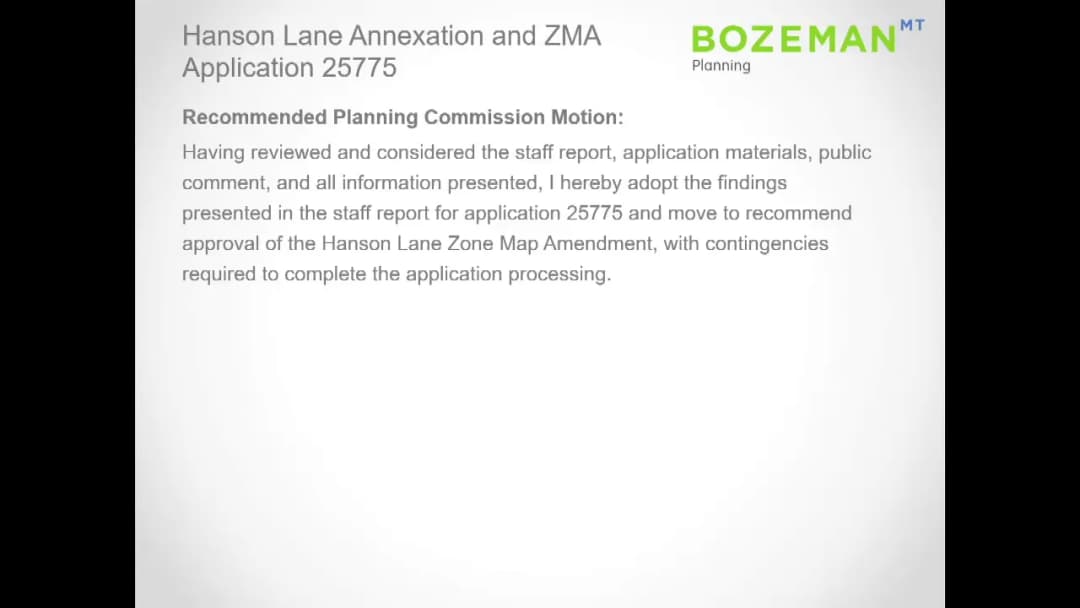
The Community Development Board held a regular meeting on April 20, 2026, starting at 6:00 p.m. in a hybrid format. The 2-hour 41-minute meeting included a special presentation on the city's Economic Development Strategy and a public hearing on the Hanson Lane Annexation Zone Map Amendment. The board voted 7-0 to recommend approval of the zone change to the City Commission. Consent Calendar - Approval of Minutes: The minutes from the April 6, 2026 meeting were approved unanimously (7-0). Special Presentations - Overview of the Economic Development Strategy Issue Plan: Director Brit Fontenot presented the department's structure, priorities (infrastructure, education/workforce, local business support), and the distinction between traded-sector jobs (higher wages, average $68,200 in 2020) and local-sector jobs (average $51,500). He noted that housing affordability remains the biggest challenge and that the city does not recruit companies but relies on quality of life. The board discussed coordination between departments and the upcoming update to the Economic Vitality Strategy. Public Comments & Testimony - Public Hearing on Hanson Lane Annexation: 63 written comments were received. Several residents spoke in opposition to the RB zoning, requesting RA instead or denial. Key speakers included: - Heather Higgs (Harvest Creek HOA): Argued RB is inconsistent with surrounding single-family neighborhoods and raised safety concerns about the planned Fowler Avenue and Annie Street connections. - Steve Holland, Cindy Miller, Carol Pfeifer, Mike Roser, Mike Harris, Merideth Center, Claire Mack, Bill Valencore, Tom Gane, Kristen Tripp: Expressed concerns about building height (fears of 5-story buildings), traffic safety for children walking to Emily Dickinson School, loss of wildlife, and a preference for single-family homes. - Diana Saros (Cottage Park): Opposed higher density and tall buildings, citing impacts on neighborhood character. - Bill Valencore (second comment): Raised fire safety concerns for multi-story buildings. - Online commenters Mary France McHugh and Patty Dickerson also opposed RB, advocating for RA zoning consistent with the prevailing single-family character. Discussion Items - Hanson Lane Annexation Zone Map Amendment (Application 25775): The property is 9.979 acres, currently unannexed, located north of Durston Road and east of Hanson Street. Staff presented findings that RB zoning (Residential Mixed Use Low-Medium) is consistent with the Urban Neighborhood future land use designation and the surrounding zoning pattern (a mix of RA and RB). Key RB standards: maximum height 45 feet, wall plate height 33 feet (effectively 3 stories), minimum density 8 units/acre, maximum 8 units per building. The applicant (Chris Naumann of Sandbell) stated that RB allows for gentle density increase and fits the "missing middle" housing spectrum, including single-family homes. - Board members discussed the compatibility of RB with adjacent RA/R1 neighborhoods, noting that RB allows single-family development and that the height and density are modest. They addressed public concerns about road safety, clarifying that road design is handled separately by the engineering department and that Annie Street is planned as a bicycle boulevard. They also noted that the property is adjacent to arterial streets, making higher density appropriate. - Staff clarified that the board's role is to evaluate against the community plan and zoning criteria, not to rezone to RA. If the board disagreed with RB, the proper action would be to recommend denial. Key Outcomes - Motion to Recommend Approval: Jason Delmue moved to adopt the findings in the staff report and recommend approval of the Hanson Lane Zone Map Amendment with contingencies. Joey Morrison seconded. After discussion, the motion carried 7-0. - Next Steps: The application will go to the Bozeman City Commission on May 5, 2026, for final decision. Future development will require additional approvals (subdivision, site plan, etc.). - Public Comments on Non-Agenda Items: One resident commented on the need for more single-family home developments. - FYI/Discussions: The board noted that the May 4, 2026 meeting will include a work session on the Urban Forest Master Plan.

LAND USE PLANNING 53% · ECONOMIC DEVELOPMENT 15% · TRANSPORTATION SAFETY 11% · AFFORDABLE HOUSING 7%
98
APR 16, 2026 · BOZEMAN, MONTANA · CITY COMMISSION
Bozeman TIF Advisory Board Meeting – April 16, 2026

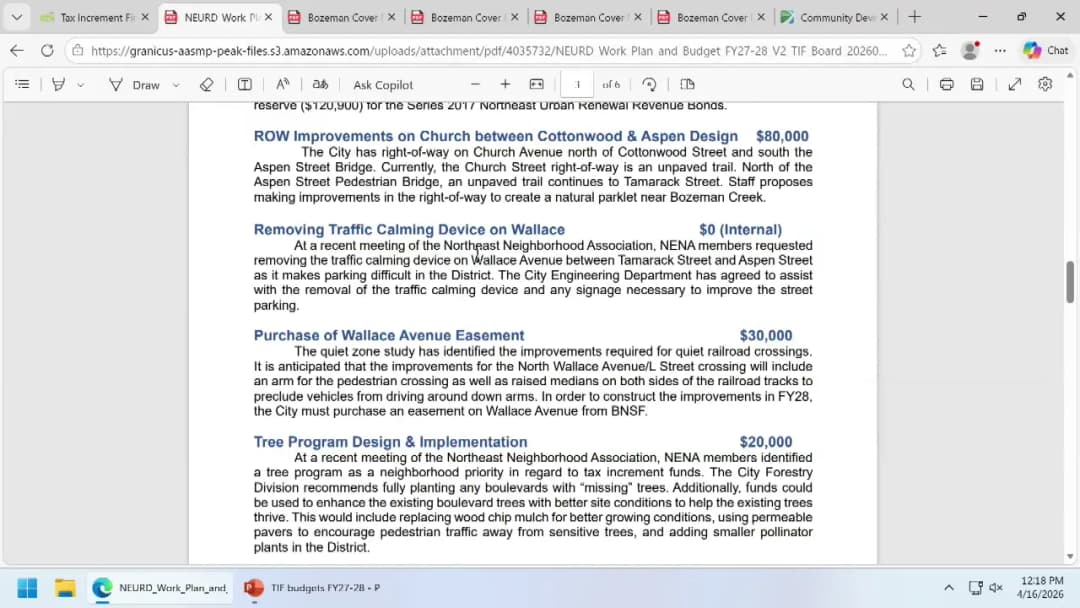
The Tax Increment Finance (TIF) Advisory Board met on April 16, 2026, at 12:00 p.m. to review and recommend approval of the FY 2027 and FY 2028 work plans and budgets for five urban renewal districts: Northeast, Pole Yard, North Park, South Bozeman Technology, and Midtown. The meeting lasted approximately two hours and included public comment on several topics, staff presentations, and board votes on each district's budget, including amendments. Public Comments & Testimony - Mark Campanelli (Bogart Park neighborhood) urged the board to consider using TIF funds for the Bozeman Creek Vision Plan, noting an estimated $35–80 million in flood protection infrastructure with a 50-year net present value benefit-cost ratio. He also expressed concerns about the Bozeman Yards luxury development and the potential for TIF to support affordable housing and public goods. - Jason Delmu (Northeast neighborhood resident) requested a dialogue with city staff about the North Church Avenue right-of-way project, emphasizing that the $580,000 placeholder seemed more than what residents envisioned for a simple creek-side parklet. He asked for clarity on access to adjacent parcels. - Nathan Stein (Executive Director, Headwaters Community Housing Trust) spoke in support of the proposed housing acquisition loan fund amendment, stating that such a fund could make a critical difference for affordable homeownership projects in the Midtown area. - Emily Telago (remote comment) questioned the legal basis for the housing acquisition loan fund under Montana urban renewal law and asked for clear findings. She also noted that the Midtown Design and Connectivity Plan had been sunset, and urged the board to consider zoning-specific corridor planning. - Additional public comments addressed the L Street Annex site (potential contamination and utility costs), the South Bozeman Technology District (concerns about Department of Defense-linked tenants), and the need for neighborhood engagement on TIF projects. Discussion Items - Northeast Urban Renewal District – Staff presented a budget with $2.4 million in cash on hand, proposing $314,000 in FY 2027 and $2.5 million in FY 2028. Key projects: quiet zone engineering, tree planting program, right-of-way improvements on Church Street (between Cottonwood and Aspen), and existing development agreements (Wallace Works, Bozeman Yards). The board discussed the need to broaden the scope of the Church Street project to address neighborhood priorities beyond the current corridor. - Pole Yard Urban Renewal District – The newest district, with limited private projects but growing increment. The budget focuses on completing the quiet zone project, with funds set aside for construction costs. - North Park Urban Renewal District – A small industrial district with no current TIF requests. The developer has already installed infrastructure and will seek reimbursement for future phases. The board approved the budget as submitted. - South Bozeman Technology District – The district is seeing revenue from two new buildings (Engine Works and Aurora Technologies). The budget includes authorization to bond up to the full amount owed to the developer for infrastructure, with a 170% debt coverage ratio. The board added a bullet acknowledging that appropriation reflects existing obligations, not project approval. - Midtown Urban Renewal District – The most complex agenda item. Staff proposed a $2.5 million housing acquisition loan fund by eliminating $1.89 million in “other” and reducing parking garage design funds by $610,000. After discussion, the board amended the sub-motion to simply increase the “other” line item by $610,000 (derived from parking garage design) to preserve flexibility. The final budget includes funding for Whittier School parking lot, Fifth Avenue lighting, North Fifth Avenue pedestrian safety design, Mendenhall Street sewer design, and a technical assistance grant program. Key Outcomes - Northeast Urban Renewal District – The board approved the FY 2027 and FY 2028 work plans and budgets with an amendment expanding the scope of the right-of-way improvements on Church Street to address neighborhood needs. Motion carried on roll call. - Pole Yard Urban Renewal District – Approved as submitted. Motion carried on roll call. - North Park Urban Renewal District – Approved as submitted. Motion carried on roll call. - South Bozeman Technology District – Approved with an added bullet stating that appropriation for development agreements reflects existing obligations, not project endorsement. Motion carried on roll call. - Midtown Urban Renewal District – The board approved the work plans and budgets after a sub-motion to increase the “other” line item by $610,000 (reducing parking garage design funds) to allow for potential housing acquisition loans or other opportunities. The main motion carried on roll call. - The board also discussed future projects at Whittier School and expressed interest in exploring additional TIF-supported improvements for the school.

ECONOMIC DEVELOPMENT 45% · ENGINEERING AND INFRASTRUCTURE 12% · AFFORDABLE HOUSING 9% · COMMUNITY ENGAGEMENT 8%
99
APR 15, 2026 · BOZEMAN, MONTANA · CITY COMMISSION
Downtown Bozeman Board Meeting – April 15, 2026

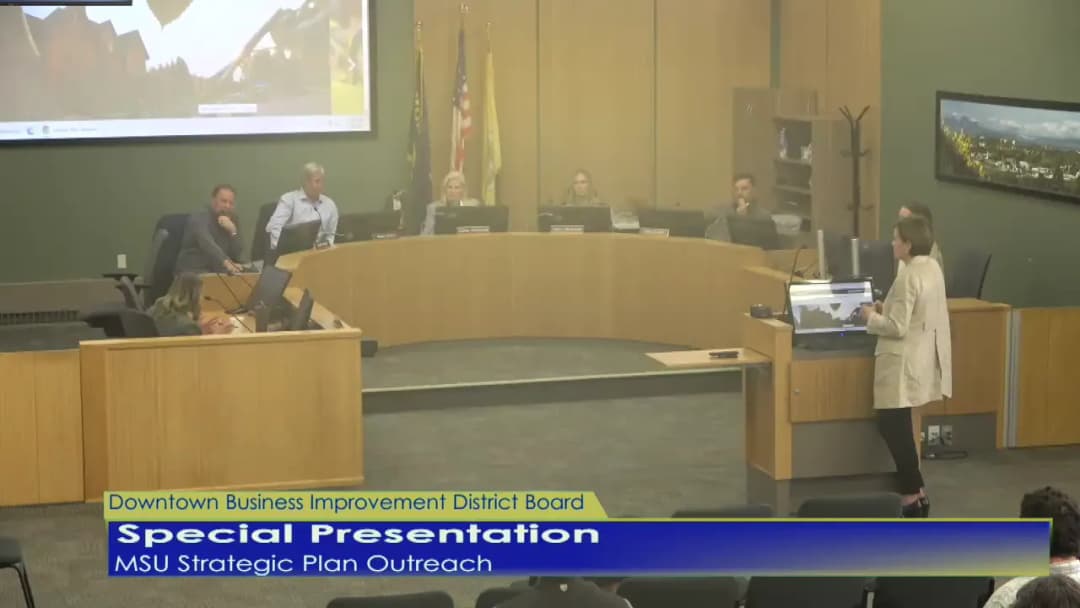
The Downtown Bozeman board met on April 15, 2026, to approve prior meeting minutes, receive updates on a downtown parking vision plan, and hear two presentations: one from Montana State University's strategic planning team and another on proposed updates to the Neighborhood Conservation Overlay District (NCOD) design guidelines. Board members provided feedback during both presentations, and no votes were taken on the substantive topics. Consent Calendar - Approval of Minutes: The board approved the minutes from the February and March 2026 meetings by a unanimous roll-call vote (Eric Nelson, Susan Neybauer, Elena Angelin, Randy Schooling, Mark Kiki – all in favor). Public Comments & Testimony - No public comments were made during the meeting. Discussion Items - Parking Vision Plan Update: Board member Ellie reported that a downtown parking survey received over 1,400 completed responses, all verified as non-spam. She noted that over 80% of respondents are weekly users of downtown parking facilities. The data will be reviewed with a core team in early May, after which the key insights and vision plan will be brought to the board and other city boards for feedback. - MSU Strategic Plan Presentation: Consultant Kate Sutherland, hired by MSU President Tessman's office, presented the process for developing a new university strategic plan. She explained that input has been gathered from on-campus groups since January and that the effort is now moving into the broader Gallatin Valley and around the state. Board members shared their priorities: Mark Kiki emphasized workforce development across all skill levels, including Gallatin College; Andy (board member) highlighted the need for programs serving private schools and special education; Elena Angelin raised healthcare workforce and criminal justice programs; a restaurant owner (likely Randy Schooling) asked for better collaboration between Gallatin College and local businesses; Eric Nelson stressed retaining graduates as future Montanans and addressing housing affordability. Ellie added that MSU should take responsibility for housing impacts, noting the gap between student population growth and on-campus housing. Board members also discussed improving internship platforms like Hire-A-Bobcat and using accurate housing data to aid recruitment. - NCOD Design Guidelines Update: Aaron George, Community Development Director, introduced consultants from The Lakota Group who are updating the downtown design guidelines (last updated in 2006/2015). The consultants asked board members about their experience with the Certificate of Appropriateness (COA) process and preferences for new construction. Eric Nelson advocated for clarity and certainty in guidelines and process, noting that the current system works well in the downtown core but may be less effective elsewhere. Susan Neybauer supported preserving historic character while allowing new architecture. Mark Kiki favored maintaining human scale and contextual design. Randy Schooling emphasized flexibility and the evolution of buildings over time. Elena Angelin stressed the importance of preserving historic authenticity. Andy reported positive experiences with the COA process when working with an architect. The consultants noted the large size of the NCOD and the need for a tiered approach to accommodate different contexts. Key Outcomes - The board unanimously approved the minutes from the February and March 2026 meetings. - No other formal decisions or votes were taken; the presentations served as listening sessions for board input.

HISTORIC PRESERVATION 28% · WORKFORCE DEVELOPMENT 23% · COMMUNITY ENGAGEMENT 19% · AFFORDABLE HOUSING 17%
100
APR 15, 2026 · BOZEMAN, MONTANA · CITY COMMISSION
Bozeman Downtown Business Improvement District Board Meeting - April 15, 2026

This meeting of the Bozeman Downtown Business Improvement District Board was called to order at 12:00 p.m. on Wednesday, April 15, 2026, as listed on the agenda. No meeting minutes or transcript were provided; therefore, this summary is derived entirely from the agenda and may not reflect actual discussions or decisions made during the meeting. Call to Order and Procedural Items - The meeting began with call to order, disclosures, and consideration of changes to the agenda. - The board approved the meeting minutes from the previous session (agenda item D.1). No further details are available. Public Comments on Non-Agenda Items - The agenda scheduled a period for public comments on non-agenda matters falling within the board's purview. No record of any comments made is available. Special Presentation: MSU Strategic Plan Outreach - Kate Sutherland delivered a presentation on Montana State University's Strategic Plan outreach efforts (agenda item F.1). Specific content was not recorded in available documentation. Discussion Item: Neighborhood Conservation Overlay District Design Guidelines Update - The board received an informational update from the Lakota Group on the Neighborhood Conservation Overlay District Design Guidelines Project (agenda item G.1). No action was taken; the item was listed for discussion only. Adjournment - The meeting adjourned. The board generally meets from 12:00 p.m. to 1:30 p.m. on the third Wednesday of the month, consistent with this agenda. No adjournment time is documented.

OPENPUBLICA · PUBLIC MEETING INDEXUPDATED DAILY · openpublica.com