Browse by city
Date range
Search help

Search titles, summaries, topics and stored transcripts together. Keywords may match separately; put the whole query in double quotes for a phrase. Matching follows word analysis, so punctuation is not exact. Both dates are included. Documents are not searched.

SHOWING 81–90 ENTRIES
81
MAY 20, 2026 · BOZEMAN, MONTANA · CITY COMMISSION
Bozeman Historic Preservation Advisory Board Work Session on Local Landmark Project Phase II – May 20, 2026

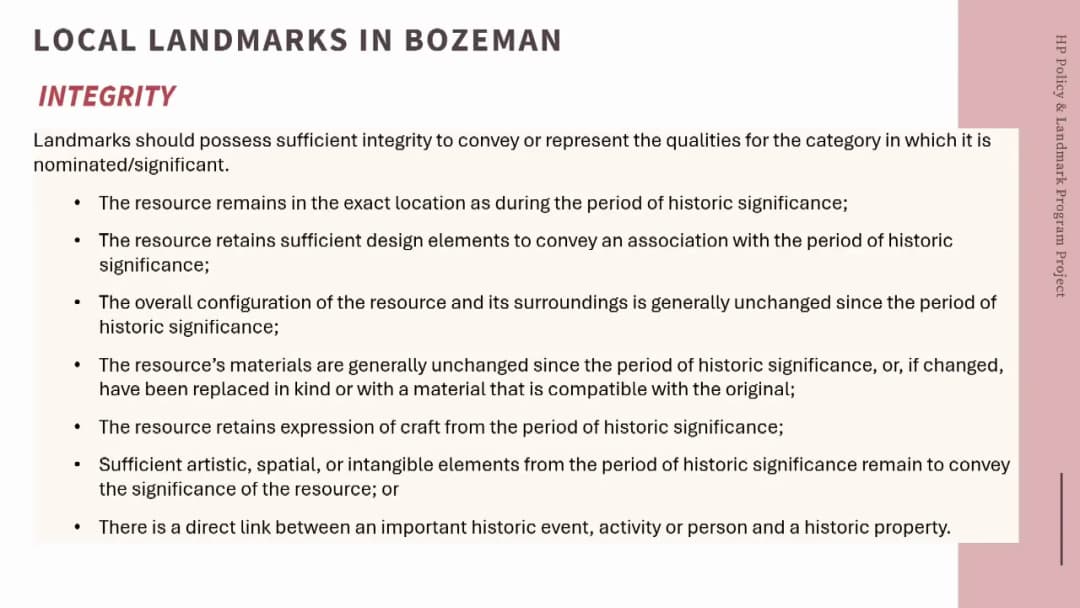
The Bozeman Historic Preservation Advisory Board (HPAB) held a work session on Wednesday, May 20, 2026, from 6:00 PM to approximately 7:52 PM to discuss the next phases of the Local Landmark Project, including creation of a local landmark program, updates to the NCOD design standards, and related code revisions. The meeting included presentations from staff and consultant, board deliberation, and informal discussion after quorum was lost at 7:44 PM. Call to Order & Attendance - Time: 6:00 PM - Members Present: Danielle Nicholas, Chelsea Holling, Ashley Wilson, Michael Wiseman - Members Excused: Allyson B. Brekke, James Webster, Mitchell Korus - Staff: Deputy Director of Community Development Rebecca Harbage; Consultant Adrienne Burke (Community Planning Collaborative) via video - Quorum: Initially present (4 members). Quorum lost at 7:44 PM when Member Nicholas left; meeting continued as informal discussion. Consent Calendar - Approval of Minutes (April 15, 2026): Motion by Michael Wiseman, seconded by Ashley Wilson. The motion carried 4–0. (Danielle Nicholas, Chelsea Holling, Ashley Wilson, Michael Wiseman voting yes; none opposed.) Public Comments & Testimony - No public comments were offered in person or online on non-agenda items or on the work session topic. Discussion Items - Work Session on Phase II of the Local Landmark Project: Rebecca Harbage reviewed the project background: the Local Landmark Project began in late 2023 with Phase I, producing three near-term recommendations: code revisions, revision of NCOD design guidelines, and creation of a local landmark program. Staff contracted with Community Planning Collaborative (CPC) for the landmark program and with the Lakota Group for design standards. Harbage outlined three options for sequencing the work: - Option 1: Establish local landmark program first, then design standards and code revisions. - Option 2: Complete design standards and code revisions first, then address landmark program. - Option 3: Begin with local landmark criteria and designation process (Option 3A was proposed to separate criteria from process). - Board members favored Option 3A: first define local landmark criteria and categories, then update NCOD design standards and code, and later decide what regulatory protections apply to landmarks. They noted that criteria definition would inform the scope of design standards and reduce dependencies. - Member Wilson read comments from excused member Allyson B. Brekke, who recommended prioritizing updates to design guidelines and demolition code, and requested data on 2025 demolitions of NCOD properties. - Board discussed the need to address demolition code as a high priority, possibly separating it from other code updates. - Board requested that staff provide regular summaries or bullet points of consultant meetings to help HPAB stay informed without full reports. - Consultant Adrienne Burke led a discussion on local landmark criteria, including categories of significance (history, architecture, culture, townscape/landscape, archaeology) and integrity (location, design, setting, materials, workmanship, feeling, association). She emphasized flexibility (e.g., requiring “one or more” criteria) and the importance of a local inventory form less burdensome than the state form. - Hypothetical examples were discussed: Pete’s Hill/Burke Park as a landscape landmark, Story Mansion as a single-site landmark, and a potential future built district (with examples from Lakota Group’s tour). Board raised questions about viewshed protection, continuity of use, character-defining features, and how overlays interact with underlying zoning. - After quorum was lost at 7:44 PM, the meeting continued as informal discussion. Board members reiterated support for Option 3A and the demolition code priority, but no formal guidance was adopted due to lack of quorum. Key Outcomes - Board Direction (informal, no formal vote due to loss of quorum): Staff was advised to pursue Option 3A, focusing first on establishing local landmark criteria and categories while continuing design standards work; to prioritize demolition code updates as a separate track; and to provide brief summaries of consultant meetings to the board. - Next Steps: Staff will continue working with CPC and Lakota Group, prepare an online survey for community input on design standards, and return to HPAB with more detailed recommendations on landmark criteria and proposed code language. - Data Request: Staff will provide the number of demolitions of NCOD properties in 2025. - Public Comment: None received. Note: Because the board lost quorum at 7:44 PM, all discussions and guidance after that time are informal and will need to be formally revisited at a future meeting where a quorum is present.
HISTORIC PRESERVATION 95% · PROCEDURAL 3% · COMMUNITY ENGAGEMENT 2%
82
MAY 20, 2026 · BOZEMAN, MONTANA · CITY COMMISSION
Bozeman City Study Commission Meeting - May 20, 2026

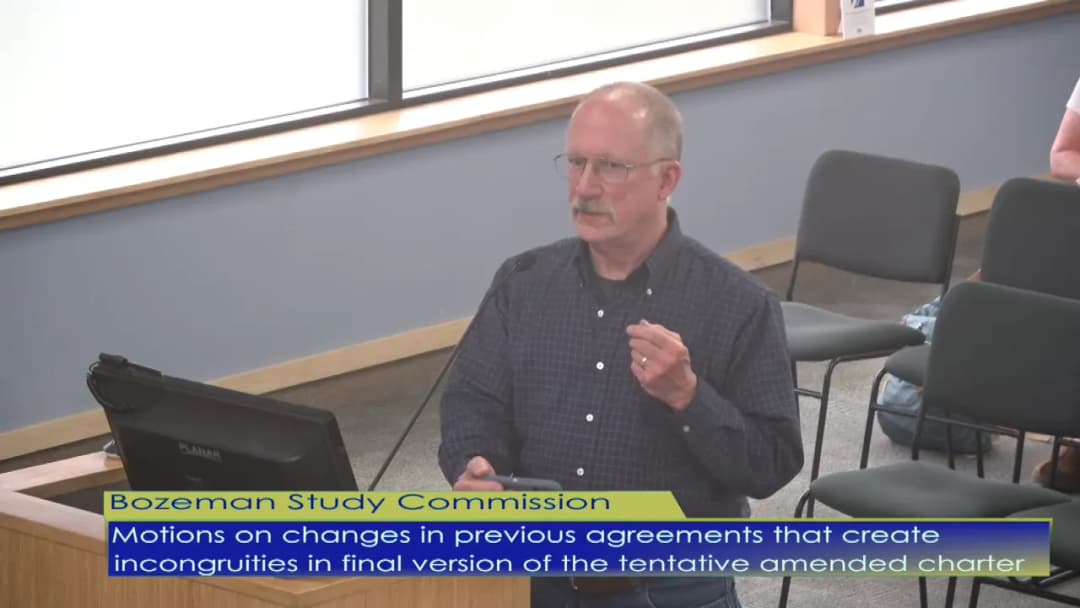
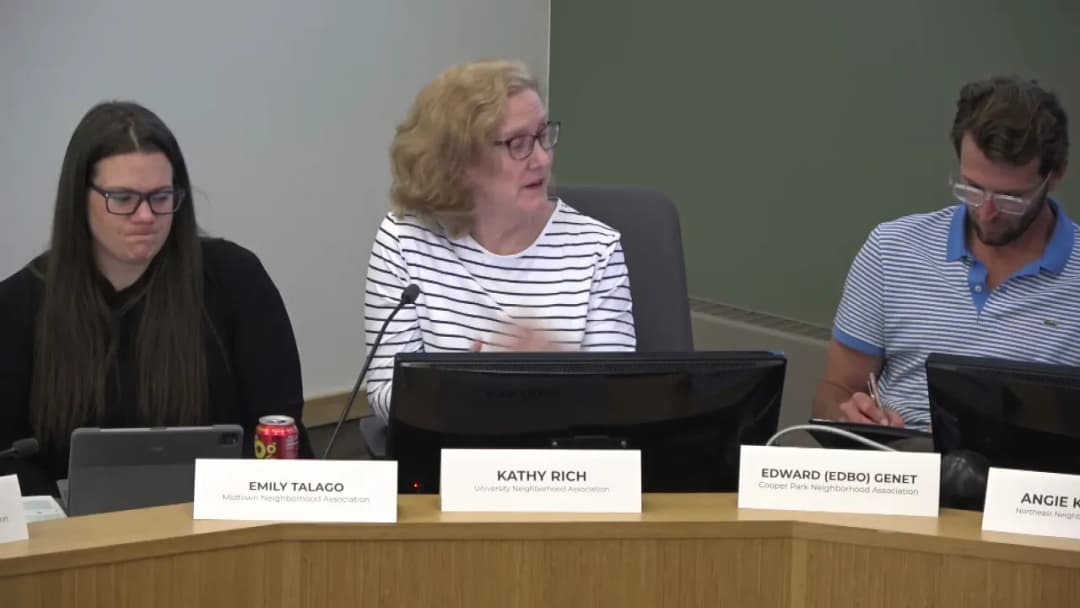
The Bozeman City Study Commission met on May 20, 2026, at 10:00 AM with a hard stop at 6:00 PM. The meeting focused on ballot language for a ward system, commissioner compensation, the number of commissioners, and review of the draft charter. The commission took several votes and continued the meeting to May 27, 2026. Public Comments & Testimony - Brian Close (former study commissioner, 1140 Cherry Drive) urged reinstating the phrase "principal residence" in the elector definition (Section 2.02) to prevent landlords voting from rental addresses, and supported expanding the city commission from five to seven members. - Mark Camp (Bogert Park Neighborhood Association president, speaking for himself) opposed striking neighborhood associations and the Inter-Neighborhood Council from the charter, and suggested Section 8.02 was superfluous. - Billy Warford (online comment) opposed the ward system, stating it would increase division. - Beth Boyson (1140 Cherry Drive) urged the commission to pick one ballot option before taking public comment. - Natsuki Nakamura (Bozeman resident, not representing the Economic Vitality Board or Better Bozeman Coalition) preferred a single clear ballot question (alternative two) and supported district-only voting if wards are adopted. - Tim Marsenko (1216 South Third Avenue) asked about the number of wards (equal to non-mayoral commissioners) and later urged keeping four commissioners if wards are adopted. - Mary Bateson (Bozeman resident) favored no change in commissioner number but supported a ballot question; cautioned that more commissioners does not reduce workload. - Jane Jelinski (North Tracy) emphasized adequate commissioner compensation and warned that increasing to six commissioners would be expensive and likely voted down. - Ann Vince-Aguera (Valley West/Lakes Neighborhood Association) supported strong language for neighborhood associations and the Inter-Neighborhood Council. - Dan Cardi (Bozeman resident) thanked the commission for keeping public engagement in the draft charter and criticized the deputy mayor’s request to strike it. - Angie Katoak (620 North Tracy Avenue, INC rep for Northeast Neighborhood Association, speaking for herself) noted many written public comments opposing the removal of neighborhood association language. Discussion Items - Ward Ballot Language: The commission debated multiple options for ballot sub-options regarding a ward system. - First Motion (Deanna): Option A – at-large system; Option B – ward system with commissioners living in a ward and elected only by voters in that ward. Failed (1-4 vote). - Second Motion (Barb): Alternative three – Option A at-large; Option B wards with commissioners elected at-large. Failed (1-4 vote). - Third Motion (unmoved? Actually motion by Deanna? The final motion was for alternative one, moved and seconded): Two sub-options: Sub-option 1 – choose at-large or ward system; Sub-option 2 – if ward system approved, choose election by ward voters only or at-large. Passed (5-0). - Commissioner Pay and Number of Commissioners: - Motion (Jan and Carson): Establish a Compensation Board (two commissioners, city CFO, four residents) to set salaries for mayor and commissioners based on a percentage of Gallatin County area median income (AMI) and expected hours. Passed (4 yes, 1 abstention – Deanna). The motion was amended to allow word-smithing. - Motion (unmoved?): Add a third sub-option for voters to choose between 4 or 6 commissioners (not including the mayor). Passed (voice vote, no opposition noted). - Draft Charter Review: Began review of the draft charter. A motion to amend the preamble to add "human rights" after "democratic representation" was moved and seconded but not voted on due to time constraints. - Mayor Election: Discussion confirmed the mayor will remain elected at-large regardless of commissioner numbers. Key Outcomes - Adopted ballot language for two sub-options on wards (as described above). - Adopted a third sub-option for voters to choose between 4 or 6 commissioners. - Approved a Compensation Board model for commissioner and mayor salaries, pending final language. - The meeting was continued to Wednesday, May 27, 2026, at 4:00 PM to complete the draft charter review and address remaining motions (including the preamble amendment and other proposed changes). - The motion to continue passed 4-0.

CHARTER REVISION 77% · PERSONNEL MATTERS 9% · PROCEDURAL 7% · PUBLIC ENGAGEMENT 6%
83
MAY 14, 2026 · BOZEMAN, MONTANA · CITY COMMISSION
INC Meeting May 14, 2026: Bylaws Approved, Commission Rejects Interim Zoning Request

The Inner Neighborhood Council (INC) met on Thursday, May 14, 2026, at 11:30 AM MT in the City Commission Room. The meeting included a presentation from the Bozeman Neighborhood Connection (BNC), adoption of amended INC bylaws, and a report from the City Commission liaison regarding the INC's request for an interim zoning ordinance addressing downtown height limits. Council members expressed frustration that the City Commission declined to formally consider the request. Consent Calendar - Minutes from the April 9, 2026, meeting were approved unanimously. Public Comments & Testimony - No public comments were offered on non-agenda items. - During the bylaws discussion, a public comment period was called but no one spoke. Discussion Items - Bozeman Neighborhood Connection (BNC) Presentation: Representatives Andre Zollers, Virginia McQueen, and Wes Siler presented a grassroots communications infrastructure designed to foster neighbor-to-neighbor connections and mutual aid across Bozeman. They proposed a system of neighborhood coordinators and text-based groups to share resources (e.g., generators, tool sharing, child care). They asked INC to feature them on the city website and help identify neighborhood contacts. Council members asked about the relationship with the city's existing neighborhoods program, data privacy, and potential overlap. BNC emphasized they are volunteer-run, non-political, and intended to complement, not replace, formal neighborhood associations. Several INC members expressed support and offered technical feedback on their sign-up form. - Update and Adoption of Amended INC Bylaws: The bylaws subcommittee (Kath Crumrine, Zara Osmond, and the presenter) proposed changes after previous discussion. Key revisions: (1) quorum changed from one-third to a majority of recognized neighborhood associations (currently 15 recognized neighborhoods, so quorum = 8); (2) added succession rule: if both chair and vice chair are absent, the secretary or treasurer may preside. The motion to adopt the amended bylaws passed by hand vote. The final draft will be sent to the City Commission for ratification as a consent item. - City Commission Liaison Update (Douglas Fisher): Fisher reported that the City Commission had considered the INC's April request for an interim zoning ordinance to pause 90-foot building height allowances downtown while the Neighborhood Conservation Overlay District (NCOD) guidelines are developed. The Commission majority decided not to place the item on a future agenda, citing reasons of stability, predictability, and the integrity of the recently adopted Unified Development Code (UDC). Commissioners argued that reopening the issue could undermine trust in public processes and divert resources from other priorities. Several INC members expressed disappointment that the Commission did not hold a public discussion, noting that the 90-foot allowance was added late in the UDC process. Fisher noted an August 25 work session is scheduled to discuss B3 height and transitions. INC members reiterated their desire for a formal, public deliberation on the matter. - Water Conservation Committee Report (Beth): The committee is meeting next Wednesday. A recent survey received 643 responses. They aim to finish a recommendation by year-end and then move into the legislative session. - Neighborhood Program Updates (Emily Kiley): Annual reports due June 1; officer elections in June (current leadership may continue); consideration of a social event in July/August; the city's engagement framework survey is open until June 15; upcoming events include the Urban Forest Management Plan open house (May 18) and Bozeman Creek Vision Plan Open House (June 2). - MSU Neighborhood Engagement: A representative from the University Neighborhood Association (UNA) announced that MSU President is hosting a reception for neighborhoods near campus, with his cabinet present, to discuss collaboration. INC members discussed the possibility of having an MSU student representative on the INC, but deferred further discussion. - Study Commission Charter Language: Emily Kiley noted that the Bozeman Study Commission's draft charter includes articles on the neighborhood program and INC. She encouraged INC members to review and provide feedback, especially regarding provisions that might expand INC's role in neighborhood boundary setting. Key Outcomes - Amended INC bylaws were adopted, changing quorum to majority and adding officer succession rules; ratification by City Commission as a consent item is the next step. - City Commission declined to schedule a formal discussion on the interim zoning ordinance request; the INC's recommendation did not advance. An August work session on height and transitions was noted. - BNC presentation was received; no formal action taken, but INC members expressed interest and offered to discuss further within their neighborhoods. - Water conservation committee aims to finalize a recommendation by end of 2026. - INC will hold officer elections in June; annual reports due June 31st. - INC encouraged to submit feedback on draft charter language by May 20th.

COMMUNITY ENGAGEMENT 70% · PROCEDURAL 17% · HISTORIC PRESERVATION 6% · PUBLIC SAFETY 5%
84
MAY 13, 2026 · BOZEMAN, MONTANA · CITY COMMISSION
Sustainability Advisory Board Meeting - May 13, 2026

The Sustainability Advisory Board convened on May 13, 2026, to approve the board's work plan for 2026-2027, receive updates on the city's engagement framework and the Earth Day Festival, and discuss various sustainability initiatives. The meeting was held in person and via Zoom, with board members and staff liaisons participating. Consent Calendar - The board unanimously approved the meeting minutes from the April 8, 2026 meeting. - The board voted unanimously to adopt the 2026-2027 Sustainability Advisory Board work plan as presented, with no amendments. Public Comments & Testimony - No public comments were made on non-agenda items or on the work plan. Discussion Items - Work Plan Adoption: Natalie Myers, Sustainability Program Manager, presented the 2026-2027 work plan, which aligns with the city commission's priorities. Key additions included municipal solar projects, municipal EV charging stations, and a high-performance building standard for city facilities. The board discussed the distinction between planning and policy items, with members agreeing to keep the green power program under planning rather than policy. Commissioner Bodie clarified that trade-offs for affordable housing do not involve sacrificing wetland or water course setbacks, and that cash-in-lieu of parklands is allowed for smaller developments. The board also suggested a future presentation on the city's drought management plan. - Engagement Framework Update: The city is updating its engagement framework (Engage Bozeman) to comply with the Montana Land Use Planning Act (SB 382). A public survey is open until June 15, 2026, on the Engage Bozeman website. Board members were encouraged to share their feedback. - Earth Day Festival Summary: The 2026 Gallatin Valley Earth Day Festival, led by volunteer Anne Ready, featured over 2,000 attendees, a 5K fun run, an EV car show, a poster contest, and cleanup week. The city's solid waste division provided year-round yellow trash bags for community cleanup. Board members suggested better marketing to businesses and HOAs, and exploring competitions or partnerships with MSU to increase participation. Key Outcomes - The board unanimously approved the 2026-2027 work plan. - No formal action was taken on the engagement framework or Earth Day summary, but the board discussed potential improvements for future events. - Meeting adjourned at approximately 8:15 PM.

ENVIRONMENTAL PROTECTION 26% · PROCEDURAL 18% · COMMUNITY ENGAGEMENT 14% · WATER AND WASTEWATER MANAGEMENT 10%
85
MAY 13, 2026 · BOZEMAN, MONTANA · CITY COMMISSION
Bozeman City Study Commission Meeting - May 13, 2026

The Bozeman City Study Commission met on May 13, 2026 from 4:02 p.m. to 6:02 p.m. to discuss further edits to the public engagement article (Article 7), deliberate on ward and district electoral options, and defer a decision on the elected mayor. The meeting included unanimous approval of the consent agenda, reports on charter corrections and public outreach, and public comment on both agenda items. Consent Calendar - The consent agenda was approved unanimously (5-0). Reports - Commissioner Carson reported a correction to Article 4.01 of the draft charter: two paragraphs inadvertently copied from a 2006 draft version have been removed to match the final 2006 charter. Carson completed a full word-by-word review and found no other substantive discrepancies. - Carson and Becky met with the Bozeman Daily Chronicle editorial board to update them on the commission's progress; the newspaper expressed openness to weekly op-eds for public education. - Website meeting links for May were corrected; lost document links from February/March were recreated. - The commission approved engagement with Danegeld consulting to assist with educational materials, with a kickoff meeting to be scheduled. Public Comments & Testimony - Angie Kachelek (Northeast Neighborhood Association representative to INC): Spoke in favor of at-large elections, stating that wards are not the right direction for Bozeman. Emphasized the importance of a strong neighborhood program and INC to address geographic concerns. Submitted written edits for Article 7. - Natsuki Nakamura (resident, not speaking for Economic Vitality Board): Expressed concerns about wards, particularly wards elected at-large, arguing they do not lower campaign costs and can dilute ward voices. Suggested a sub-option for voters to decide, with a requirement for further study before the next charter review. - Emily Kelly (Baxter Meadows resident): Opposed replacing elected representation with mandated neighborhood associations, calling them advisory only. Favored a ward system with at-large seats. Also advocated removing the deputy mayor position and directly electing the mayor. - Bob Muldowney (Northwest side resident): Supported wards for formal geographic representation, citing distinct issues on the northwest side (traffic, policing). Argued that at-large elections do not ensure representation for all areas. Discussion Items Further Edits to Public Engagement Article (Article 7) - Becky and Barb presented round-two edits for Article 7, now titled “Public Engagement.” Key changes: clarified language on city boards, moved principles of public engagement higher, added neighborhood association recognition criteria, refined INC responsibilities, and replaced “50 percent” with “a substantial portion” in recommendations. - Commissioner feedback: - Carson suggested removing the phrase “not just as an occasional process or activity” from 7.01, and questioned whether INC requirements (7.04 D6–7) were too rigid. - Jen proposed adding a “community impact statement” mechanism under INC responsibilities (7.04 D) and under neighborhood association reporting (E2). - Deanna raised concerns about vague or ideological language (e.g., “authorities” in 7.02, “shall” in 7.04 D8) and requested a paragraph-by-paragraph review due to insufficient time. She submitted a written document of suggested edits. - Dan Clark recommended keeping “citywide concerns” in INC purpose but changing “concerns” to “issues” for consistency. He also noted a section numbering conflict (7.04 vs. 7.05). - The commission agreed to have Deanna and Barb meet on Friday, May 15 to refine language, with Barb and Becky meeting on Sunday, May 17 to incorporate attorney Sullivan’s legal edits and create a complete draft for the May 20 meeting. Decisions on Wards and Districts - Commissioners shared positions: - Carson: Leaning toward four wards with at-large elections (commissioners must live in ward but elected citywide) to balance geographic representation and citywide focus. Opposed wards elected by ward due to gerrymandering and parochialism risks. - Barb: Supported wards with at-large elections to ensure geographic representation without non-competitive races. Favored expanding commission size if needed. - Deanna: Strongly favored traditional wards (elected by ward residents) to improve responsiveness and representation; argued that neighborhood associations cannot replace ward representation. Supported voter determination via sub-option. - Becky: Leaning toward maintaining at-large elections; argued that the main barrier to diverse candidates is financial (lack of living wage) rather than geography. Open to a sub-option for wards with at-large voting. - Jan: Supported at-large elections with better compensation for commissioners; suggested a sub-option for wards to let voters decide. - Public comment reflected a split: some favored wards, others at-large or hybrid models. - Decision: Deanna and Mike will draft ballot language for ward options (to be presented at the next meeting) that may include multiple options for the commission to consider. The commission will revisit this issue on May 20. Elected Mayor Discussion - Discussion was deferred to the next meeting, pending the ward decision. Some commissioners argued that a directly elected mayor would complement a ward system (providing a citywide voice), while Deanna argued for a commission-appointed mayor (two-year term) to preserve collaboration in a commission-manager form of government. No vote was taken. Key Outcomes - Consent agenda approved unanimously (5-0). - Deanna and Barb will meet Friday to refine Article 7 language; Barb and Becky will meet Sunday to produce a complete draft incorporating legal edits. - Deanna and Mike will draft ballot language for ward/district electoral options for the May 20 meeting. - The decision on an elected mayor was postponed until after the ward discussion.

CHARTER REVISION 49% · PUBLIC ENGAGEMENT 26% · PROCEDURAL 18% · COMMUNITY ENGAGEMENT 6%
86
MAY 12, 2026 · BOZEMAN, MONTANA · CITY COMMISSION
Bozeman City Commission Meeting - May 12, 2026

The Bozeman City Commission held a regular meeting on May 12, 2026, starting at approximately 12:45 PM. The meeting covered a mayoral proclamation, multiple urban renewal district annual reports and work plans for fiscal years 2027 and 2028, public comments on various topics, and consent agenda items. Key discussions included support for the Equal Rights Amendment, urban renewal district budgets, an action plan for Midtown, and concerns about tenants at the MSU Innovation Campus. Consent Calendar - The commission approved consent items F1 through F13 in a 5-0 vote. Items included a grant for a fully electric bucket truck and a fully voltaic system at the library, as highlighted by Commissioner Bodie, and a contract extension for a third traffic circle on West Olive and South Sixth Street, noted by the city manager. Public Comments & Testimony - Courtney Johnson, a former city planner, homeowner, and business owner, requested that the commission direct staff to place the Gallatin High Residential Parking District request on a commission agenda. She stated the process has stalled for nearly two years without formal response. The city manager committed to investigating and providing an answer. - Dan Cardi, a Bozeman resident, urged the commission to immediately adopt an interim zoning ordinance (IZO) for the Neighborhood Conservation Overlay District (NCOD) to pause major exterior construction and demolition until the NCOD update is complete. - Nathan Stein, Executive Director of Headwaters Community Housing Trust, expressed strong support for the Midtown URD budget and the proposed $2.5 million land acquisition loan fund for affordable housing. - Emily Talego, a Bozeman resident, advocated for a North Seventh traffic modality summit, a business improvement district for Midtown, and renewed focus on multimodal infrastructure. She also commented on the Pole Yard quiet zone, warning of long-term liability for the city. - Julian Staggs, an MSU student and member of Students Against Genocide, opposed funding for the MSU Innovation Campus, citing tenants Reveal Technology and others that sell AI-powered military tech to the Israeli military. He asked the commission to withhold funding until a strong ethics policy is developed. - Taylor Pynan, an MSU student and Bozeman resident, echoed these concerns, urging the commission to break or renegotiate the contract with the Innovation Campus. - Skylar (MSU alum), Alana Selinger, Jackson Staggs, and William McLean also spoke against the Innovation Campus funding, describing the tenants' ties to genocide and urging the commission to vote no. - Emily Talego also commented on the Pole Yard quiet zone, noting that railroads oppose quiet zones and that liability shifts to the city once compliant, and suggested the increment could be placed in the general fund. Discussion Items - Mayoral Proclamation: Mayor Morrison proclaimed support for the Equal Rights Amendment, citing ratification by 37 states and urging Congress to modify the deadline. The proclamation was shared with the community. - Downtown Business Improvement District (BID): Emily Cope presented the FY27 work plan and budget ($295,000 assessment). The BID board unanimously approved. Commissioners praised the program for flowers, holiday spiders, and graffiti removal. Approved 5-0. - Downtown Urban Renewal District (URD): Ellie Staley presented the FY27 and FY28 work plan and budget. Key projects include improvements to Seroptimus Park (including lead paint mural), parking garage maintenance, and preparation for the 2032 sunset. Commissioner Sweeney asked about police presence funding; Staley noted it may not be an allowable URD expense. Approved 5-0. - Midtown Urban Renewal District: David Fine presented the FY27 and FY28 work plan and budget. The TIFF advisory board voted 6-0 to recommend, with an amendment to keep the "other" line item flexible. Discussion centered on a proposed $2.5 million loan fund for nonprofit housing land acquisition, an action plan update, and public comments calling for a new action plan. Commissioner Magic moved to approve with two amendments: (1) reduce parking garage design funding by $100,000 to fund an action plan ($50,000-$100,000 goal), and (2) adopt clarifying language for the "other" bucket prioritizing infrastructure, neighborhood planning, and a pilot loan program for affordable housing. Both amendments passed 5-0. The main motion passed 5-0. - South Bozeman Technology District: David Fine presented the budget, which includes up to $3.6 million in bond reimbursement for the MSU Innovation Campus infrastructure. Public comment focused on tenants with ties to the Israeli military. Commissioners expressed sympathy but noted the city is contractually obligated to reimburse. They committed to exploring ethics policies and further meetings with students. Approved 5-0. - North Park Urban Renewal District: David Fine described the district as a placeholder for future industrial development; no active projects. Approved 5-0. - Pole Yard Urban Renewal District: David Fine presented the budget, primarily for a quiet zone project at Rouse Avenue crossing to allow trains to refrain from sounding horns. Commissioner Sweeney raised liability concerns and questioned whether the increment should go to the general fund. The public comment warned of long-term liability and insurance rate increases if compliance requirements change. Approved 5-0. - Northeast Urban Renewal District: David Fine presented the budget, which includes Wallace crossing quiet zone improvements, a tree planting program, and Church Street right-of-way improvements for Bozeman Creek access. The Northeast Neighborhood Association was engaged. Commissioners noted the neighborhood's fingerprints on the plan. Approved 5-0. Key Outcomes - Approved consent agenda (F1-F13) 5-0. - Approved Downtown BID FY27 work plan and budget 5-0. - Approved Downtown URD FY27 and FY28 work plan and budget 5-0. - Approved Midtown URD FY27 and FY28 work plan and budget with two amendments (action plan funding and language clarification) 5-0. - Approved South Bozeman Technology District FY27 and FY28 work plan and budget 5-0. - Approved North Park URD FY27 and FY28 work plan and budget 5-0. - Approved Pole Yard URD FY27 and FY28 work plan and budget 5-0. - Approved Northeast URD FY27 and FY28 work plan and budget 5-0. - The city manager agreed to investigate the status of the Gallatin High Residential Parking District request. - The commission committed to further discussions with students and the community regarding an ethics policy for the MSU Innovation Campus.

ECONOMIC DEVELOPMENT 47% · MISCELLANEOUS 26% · ENGINEERING AND INFRASTRUCTURE 8% · COMMUNITY ENGAGEMENT 5%
87
MAY 6, 2026 · BOZEMAN, MONTANA · CITY COMMISSION
Economic Vitality Board Meeting, May 6, 2026: Fiber Impact and Land Trust Presentations

The Bozeman Economic Vitality Board (EVB) met on Wednesday, May 6, 2026, from 6:00 p.m. to 7:26 p.m. The meeting featured two special presentations: an economic impact analysis of the Yellowstone Fiber network and an overview of the community land trust model for affordable housing. The board also approved four sets of meeting minutes, received an update on the city's engagement framework, and discussed summer meeting scheduling. Consent Calendar / Minutes Approval - The board approved the minutes from January 7, February 4, March 4, and April 1, 2026, as amended. Corrections were noted: board member Lowerson was absent in January; board member Jones was listed twice in February; and the February vote tally was corrected from 7-0 to 6-0 (a staff member had been counted). The motion carried unanimously. Public Comments & Testimony - No public comments were offered for non-agenda items or in response to the special presentations. Special Presentation: Fiber as Economic Infrastructure - Grace Gilbreth (Project Manager, Northern Rocky Mountain Economic Development District – NERMED) presented the findings of an economic impact analysis of the Yellowstone Fiber network, a community-built fiber-optic infrastructure initially led by the City of Bozeman in 2012. Sid Boswell (CEO of Yellowstone Fiber) and Sarah Thompson (NERMED Executive Director) were also present. - Key statistics from the report: - Over the three study periods (2015, 2022–2024, projected 2025–2027), the network generated more than $135 million in total economic activity and supported over 1,400 jobs, with over 80% of the value retained locally. - Total investment in the network to date is approximately $105 million (initial $4 million from local banks, plus $101 million in additional private investment), at no cost or risk to taxpayers. - The network uses an open-access model: multiple service providers compete on the shared infrastructure, driving affordability and choice. The presenters emphasized that this model functions as a fourth utility and is replicable in other communities. - Board members asked about challenges (e.g., difficulty and long timeline), the role of local banks, integration with new development, geographic coverage, and financial sustainability. Sid Boswell noted the network reached profitability in 2019, was impacted by COVID, but now adds about 1,600 customers per year and forecasts a 40% take rate to achieve full debt service. The city, school district, and county were critical anchor tenants. Special Presentation: Explaining the Land Trust Model for Affordable Housing - Rick Simpkins (HRDC) presented on the community land trust (CLT) model, which separates ownership of land (held by a nonprofit or government) from ownership of the home (sold to a private individual at a restricted price). The lease ensures permanent affordability through resale restrictions. - HRDC has developed several CLT projects in the region, including the West Babcock CLT (25 homes, 1994), Willow Springs (24 townhomes, 2021), and Bridge View (62 homes, mixed-income). A case study comparing a CLT home, a market-rate home, and a rental over three years illustrated that the CLT home provided stable monthly costs ($1,300 vs. $2,300 for market-rate) and modest equity buildup, while the rental saw rents rise from $1,600 to $3,100. - Key points: CLTs require a one-time subsidy that creates permanent affordability; ongoing stewardship (resales, compliance, homeowner support) is essential. The homes are typically priced 30% below market and serve the “missing middle” (80–120% of area median income). - Board members asked about inheritance (allowed, subject to income eligibility), lease terms (75 or 99 years, renewable), buyer screening, and rental restrictions. A representative from the Headwaters Community Housing Trust added that CLTs become increasingly affordable relative to the market over time due to capped appreciation (2% per year). Discussion Items - Engagement Framework Update: Staff liaison Brit Fontenot reported that the city is relaunching its “Engaged Bozeman” public engagement framework. A survey is open until May 18 (despite an earlier June 15 date noted in materials); the board was encouraged to participate. - Summer Meeting Schedule: The board agreed to cancel the July 2026 meeting due to multiple members’ conflicts. The June meeting will include a formal motion to cancel the July meeting. The board will next meet in August. Key Outcomes - Approved four sets of meeting minutes as amended. - Received and discussed the Yellowstone Fiber economic impact report; the board expressed appreciation for the project and its community benefits. - Received and discussed the land trust presentation; the board acknowledged the importance of CLTs in the city’s evolving affordable housing strategy, particularly for for-sale homes. - Noted the engagement survey deadline and planned to cancel the July meeting. Meeting adjourned at 7:26 p.m.

TECHNOLOGY AND INNOVATION 49% · AFFORDABLE HOUSING 33% · PROCEDURAL 9% · ECONOMIC DEVELOPMENT 4%
88
MAY 5, 2026 · BOZEMAN, MONTANA · CITY COMMISSION
Bozeman City Commission Regular Meeting – May 5, 2026

The Bozeman City Commission met on May 5, 2026, at 6:00 PM in the Commission Room at City Hall. Commissioners Joey Morrison, Jennifer Madgic, Douglas Fischer, and Alison Sweeney were present; Commissioner Emma Bode was excused. The meeting covered consent items, a mayoral proclamation, a special presentation on building safety, a major annexation and zoning action, an appointment to the Police Commission, and various FYI items. Consent Calendar - Consent I (Items I.1–I.14): Approved unanimously (4-0). Included accounts payable, grant applications (Justice Assistance Grant, Land and Water Conservation Fund, Highway Traffic Safety, Public Safety and Mental Health), contract awards (Oak and Ferguson intersection improvements to Knife River of Belgrade; Black Lot repaving to CK May Excavating), final plat for Canyon Gate Major Subdivision, software service agreement with Citian Inc. for the CRASH data platform, and professional services agreements for planning fee study, engineering review, water reclamation facility upgrades, WRF solar project, and right-of-way acquisition for Fowler Avenue Connection. - Consent II (Item J.1): Adopted Findings of Fact and Order for Appeal 25769 (Sundance Springs Subdivision Commercial Lot 2 Site Plan) unanimously (4-0). Commissioner Sweeney noted that while she dissented in the original appeal, the findings accurately reflect the commission’s decision. Public Comments & Testimony - Geoffrey Poole (resident, South Bozeman): Argued that the proposed findings of fact for Appeal 25769 are incorrect regarding trail frontages and setbacks, stating the city’s position has shifted over time. He questioned the legal implications of the Mayor signing findings he believes are not factual. - Cynthia Miller (resident): Described a traffic accident involving her daughter, urging the city to address uninsured drivers and suspended licenses. - Mary Frances McHugh: Requested removal of Item I.14 from consent for staff explanation on a date in the scope of services. - General Public Comment (non-agenda): - Unnamed resident: Commented on the Bozeman Creek walk, proposed shifting tree district assessment methodology from square footage to per-unit basis, and suggested using tree district funds for creek cleanup. - Mark Campanelli (Bogart Park neighbor): Supported public discussion of the work plan, raised concerns about revenue bonds vs. general obligation bonds for solar farms, noted that neighborhood associations are more inclusive than city boards, and expressed concern about affordable housing drying up under the Neighborhood Conservation Overlay District (NCOD). He also highlighted the need for quality construction and adherence to building codes. - Hanson Lane Annexation/Zoning Public Comment (12 speakers in room, plus online): - Heather Higgs (Harvest Creek Owners Association): Opposed RB zoning, citing spot zoning concerns, exponential density increase, and traffic safety issues on Durston Road and Fowler Avenue. She referenced a Montana Supreme Court case (Hearts Horn v. Whitefish) and an 11-page HOA letter. - Bill Valincourt (Harvest Creek resident): Opposed RB zoning, arguing it would create significantly higher density, taller buildings (45 feet, double the height of adjacent homes), and infringe on privacy, light, air, and property values. He advocated for RA zoning. - Susan Francis (Harvest Creek resident): Opposed RB zoning, citing narrow streets (Lilly, Annie, Rose, Oak) not built for increased traffic and safety concerns for children walking to school. - Cindy Miller (Harvest Creek resident): Urged commissioners to visit the site, criticized the missing middle illustrations as misleading, and noted that many new apartments are empty. She emphasized safety for children crossing Oak Avenue. - Nigel Anselmi (Harvest Creek resident, Bozeman native): Opposed RB zoning, supporting RA to preserve neighborhood character and allow single-family homes. He referenced the city’s priorities of protecting heritage neighborhoods and natural environment. - Paul Francis (Harvest Creek resident): Supported the Fowler Avenue extension but opposed mixed housing, urging consistency with surrounding RA zoning. He noted that his property value would be affected. - Krista Tripp (Harvest Creek resident): Supported annexation but opposed RB zoning. She calculated that 2.65 acres at RA could yield 16 units (32 cars) vs. RB at 21 units (42 cars), arguing that RA is a gradual, predictable density increase while RB is a step change. - Sam Knight (Harvest Creek resident): Opposed RB zoning, arguing that increased density from RB would offset any traffic relief from Fowler Avenue and that the city’s push for multifamily reduces homeownership opportunities and long-term wealth for residents. - Mary Frances McHugh (online): Opposed RB zoning, stating that the city’s community plan lacks guidance on where urban neighborhood zoning districts should be applied, making the plan equivalent to “no plan at all." Discussion Items - Mayoral Proclamation (L.1): Mayor Morrison proclaimed May 2026 as Building Safety Month, emphasizing the role of code officials in protecting public safety. - Special Presentation (M.1): Chief Building Official Ben Abbey presented Building Safety Month “Built to Last,” highlighting weekly themes: safe homes, voices of the built environment, preparing for disasters, and accessibility. He noted that building codes are the first line of defense and that the industry faces a “silver wave” with 50-75% of code officials expected to retire in 5-10 years. - Hanson Lane Annexation and Zone Map Amendment (N.1): - Staff Presentation (Planner Colin Mieras): The 9.979-acre property is an unannexed inholding, surrounded by city limits on three sides. The applicant requested RB (Residential Mixed Use Low-Medium) zoning. Staff concluded that criteria A-D were met and positive outcomes outweighed negatives for criteria E-K. The Planning Commission (Community Development Board) voted unanimously to recommend approval. Over 105 written public comments were received, primarily opposing RB zoning and citing concerns about density, traffic, and safety. - Applicant Presentation (Chris Naumann, Sanbell): The annexation is a condition of the right-of-way purchase agreement for the Fowler Avenue Connection project. The net buildable area after right-of-way and easements is approximately 2.65 acres. RB zoning allows for gentle infill and missing middle housing (duplexes, triplexes, townhomes) and fits the existing zoning pattern of alternating RA and RB in the area. - Commission Discussion: - Commissioner Sweeney: Opposed RB zoning, citing character of the area (criteria H) and the need for starter homes. She noted that new RA has no minimum lot size and could allow duplexes/multiples. She expressed concern that the worst-case scenario under RB (eight-unit buildings at 45 feet) would be incompatible. - Commissioner Madgic: Supported RB zoning, arguing that mixed housing can create vibrant neighborhoods (e.g., Bridger View development). She noted that the growth policy supports gradual density increases and that RB is an incremental step from RA. She emphasized that parking requirements and the small parcel size limit density. - Deputy Mayor Fischer: Struggled but ultimately supported RB, stating that RA does not meet community goals for dynamic, walkable neighborhoods with a mix of housing types. He noted that the differences between RA and RB are not dramatic and that the code provides protections. - Mayor Morrison: Supported RB, noting that RB is a novel zone request and that the net buildable area (2.65 acres) limits potential density. He adopted staff’s findings, with criteria J (preserve value of existing structures) being neutral rather than met. - Appointment to Police Commission (O.1): Commissioner Madgic moved to appoint Beth Corriea to a term expiring April 30, 2029. Public comment: Anthony Smith urged the commission to appoint a leader who prioritizes accountability, mental health support for officers, and de-escalation over force. The motion passed 4-0. Key Outcomes - Annexation (Hanson Lane): Approved 4-0. Staff directed to prepare an annexation agreement. - Zone Map Amendment (Hanson Lane): Approved 3-1 (Commissioner Sweeney dissenting). The RB zoning designation is approved with contingencies for adoption of an implementing ordinance. - Consent Items: All consent items I.1–I.14 and J.1 approved unanimously. - Appointment: Beth Corriea appointed to the Police Commission, term expiring April 30, 2029. - Next Steps: The Fowler Avenue Connection project right-of-way acquisition is separate but contingent on annexation. The city will continue to engage with the public on the Bozeman Creek vision plan, with a public activity event scheduled for June 2, 2026. The city manager and staff will explore ways to share information about homeownership opportunities under $400,000.

ENGINEERING AND INFRASTRUCTURE 34% · AFFORDABLE HOUSING 24% · PROCEDURAL 13% · PUBLIC SAFETY 5%
89
MAY 4, 2026 · BOZEMAN, MONTANA · CITY COMMISSION
Community Development Board Meeting - May 4, 2026

The Bozeman Community Development Board held a regular meeting on May 4, 2026, from 6:03 PM to 8:45 PM MDT. The meeting included a work session with the Forestry Division on the Urban Forest Master Plan, discussion of the board’s work plan, and routine administrative items. The board heard public testimony from two speakers regarding the master plan vision and tree preservation. Consent Calendar - Approval of Minutes (April 20, 2026): The minutes were approved with a correction noted by Vice Chair Delamu: the motion for the Handsome Lane ZMA should record as 7-0, not 6-0. The correction was acknowledged on the record. Motion carried 7-0. Public Comments & Testimony - Daniel Cardi (Bozeman resident): Urged the board to adopt an updated vision statement for the Urban Forest Master Plan that explicitly protects and enhances ecological function and ecosystem services on public and private lands. He argued this would help inform code changes to protect the natural environment, aligning with a 2026-2027 city commission priority. - Marcia Cavaney (Bozeman resident, co-founder of Bozeman Tree Coalition): Speaking for herself and the coalition, she recommended better interdepartmental communication on green infrastructure, incentivizing developers to preserve native tree groves (e.g., cottonwood/willow), integrating wildlife corridors, and valuing mature trees for carbon sequestration, heat island mitigation, and wildlife habitat. She cited the success of permeable pavers on North 7th and the importance of preserving existing canopy over planting new trees. Discussion Items - Urban Forest Master Plan Work Session: The Forestry Division (Alex, staff arborist) presented the update to the 2016 plan, which is being developed as an issue plan with consultant DGNA and subconsultant Planet Geo. Key topics include: - Current operations: 5 full-time staff plus seasonal help; approximately 28,500 city-maintained trees (boulevard and park trees, not private property). - Process: Public survey launching soon, three more public meetings (in-person and virtual), work sessions with Urban Parks and Forestry Board, and adoption expected by December 2026. - Key challenges: Species diversity (green ash dominance), age diversity, tree protection zones on private property, informal third-party tree installation process, and need for data-driven canopy coverage goals. - Canopy analysis: Using leaf-on aerial imagery every three years to track coverage and inform targets. - Heritage tree program: Voluntary recognition of exceptional trees on private or park land, based on HPAB work. - Board members discussed regulatory limits on preserving trees on private property (e.g., constitutional sideboards, Lupa requirements, irrigation rights), and suggested exploring incentive-based approaches or requiring applicants to explain why existing trees cannot be preserved. Vice Chair Delamu expressed interest in a future roundtable-style work session on thorny issues. - Cancellation of May 18, 2026 Meeting: Due to no scheduled items, the board voted to cancel the next meeting. - Community Development Board Work Plan 2026-2027: The plan covers statutory duties (zone map amendments, land use plan amendments, appeals), UDC code amendments, impact fee updates, issue plans (integrated water resources, Gooch Hill sub-area, transportation plan), and annual reports. Board members expressed interest in hosting informal discussion sessions ("fireside chats") on complex topics and ensuring the transportation plan aligns with land use goals. The plan was adopted. Key Outcomes - Minutes Approved: April 20, 2026 minutes approved with correction (motion carried 6-0 with 7 members present). - May 18, 2026 Meeting Canceled: Motion carried 6-0. - Work Plan Approved: Community Development Board Work Plan 2026-2027 adopted (motion carried 6-0). - No action was taken on the Urban Forest Master Plan; the work session was informational, with a formal public hearing and recommendation expected later in 2026. - Staff noted that board members will receive an email from Director George regarding board functions and potential process improvements.

PARKS AND RECREATION 51% · ENVIRONMENTAL PROTECTION 14% · PROCEDURAL 13% · ENGINEERING AND INFRASTRUCTURE 9%
90
APR 30, 2026 · BOZEMAN, MONTANA · CITY COMMISSION
Bozeman City Study Commission Meeting – April 30, 2026

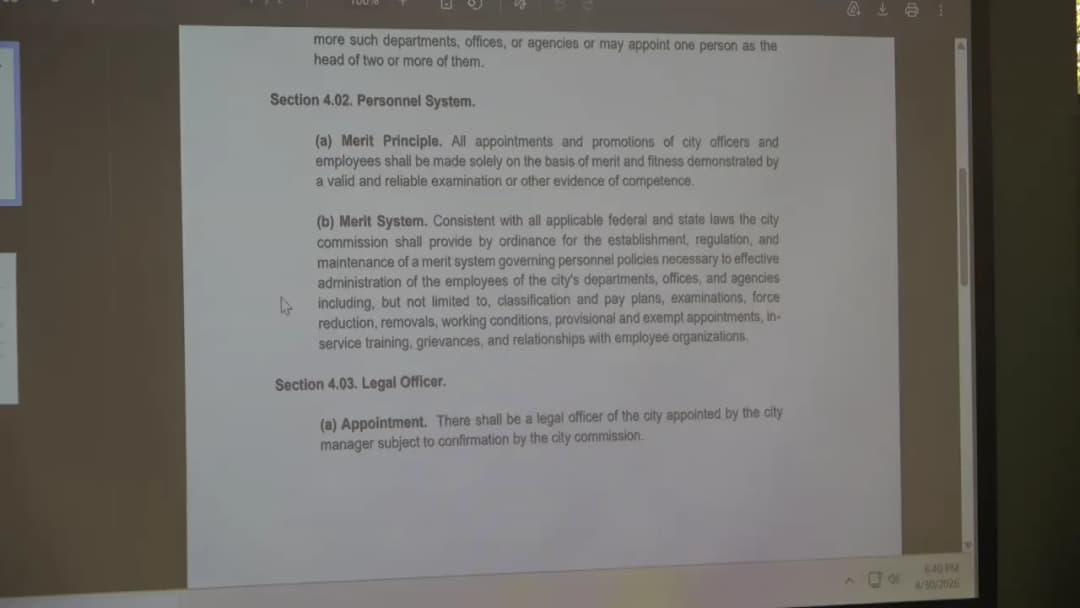
The Bozeman City Study Commission met on April 30, 2026, at 4:00 PM to continue detailed discussions on proposed charter amendments, including neighborhood associations, advisory boards, the judicial branch, and wards/districts. The meeting included public comment, deliberation on draft language, and a vote on the judicial branch article. Consent Calendar - Approved the consent agenda (minutes and claims review) for the April 30 meeting by unanimous voice vote. Public Comments & Testimony - Mary Bateson thanked the commission for clear instructions on when to comment. - Multiple public comments were heard on neighborhood associations, advisory boards, and wards/districts, including: - Alison Sweeney (city commissioner, speaking personally) raised concerns about neighborhood association membership requirements, communication burdens, and the appropriateness of allowing the Inner Neighborhood Council (INC) to set agenda items. - Natsuki Nakamura (Economic Vitality Board member, speaking personally) cautioned against over-prescribing neighborhood association expectations and urged respect for INC bylaws. - Members of the public advocated for stronger conflict-of-interest language, term limits tied to board expertise, and ensuring minority opinions are recorded in staff reports. - Emily Talago (Bozeman resident) shared personal experience running for city commission, highlighting the time and financial demands of at-large campaigns versus ward-based systems. Discussion Items - Neighborhood Associations (Article 7): Barb and Becky presented revised language incorporating feedback from prior meetings. Key changes included removing the cap of 20 neighborhoods, emphasizing resident-led formation, and adding a requirement for INC to present formal recommendations as an agenda item. Commissioners debated the role of businesses/nonprofits, the need for two-way communication, and the appropriate level of city involvement. The commission agreed to further edits and will bring a revised version on May 20. - Advisory Boards (Article 7.04): Discussed proposed changes to purpose, powers, and term limits. Commissioners expressed concerns over the term “advisory only,” the need for board autonomy in setting agendas, and conflict-of-interest provisions. Mike (staff) suggested renaming “city boards” to remove the advisory connotation and recommended that the city commission retain authority to define board powers. Public comment supported term limits tied to board needs and clear conflict-of-interest rules. - Judicial Branch (Article 4.05): Judges Harrington and Tierney, along with Court Administrator Miranda Johnson, proposed adding a separate judicial branch article to ensure separation of powers. The commission agreed to create a new Article 4 (judicial branch) distinct from departments. A motion to adopt Article 4 as amended (including the new judicial branch location) passed unanimously. - Wards & Districts: Commissioners shared initial positions. Jan favored at-large with possible additional commissioners; Deanna supported seven wards with a mayor selected by the commission; Barbara preferred at-large with strong neighborhood associations; Becky leaned toward a hybrid (wards with at-large voting) but remained open; Carson favored at-large with a separately elected mayor and full-time compensation. The commission scheduled a dedicated discussion for May 13. Key Outcomes - Vote on Article 4 (Judicial Branch): Moved and seconded to adopt Article 4 as amended, creating a separate judicial branch article. Passed unanimously by voice vote. - Directives for Staff: Barb and Becky will refine Article 7 (neighborhood associations and advisory boards) based on commission and public input, with a revised draft due May 20. - Future Meetings: - May 13: Discussion on wards/districts, mayor election method, size of commission, and compensation. Also, public engagement article (Article 7) review. - May 20: Full charter review and final approval of all articles. - May 28: Public hearing on the full report and amended charter. - Recommendations: The commission will include a recommendation for an annual citywide town hall meeting and a review of Resolution 5323 (one-body-one-voice policy) as part of the final report.

COMMUNITY ENGAGEMENT 54% · CHARTER REVISION 35% · PROCEDURAL 8% · PUBLIC ENGAGEMENT 2%
OPENPUBLICA · PUBLIC MEETING INDEXUPDATED DAILY · openpublica.com