Browse by city
Date range
Search help

Search titles, summaries, topics and stored transcripts together. Keywords may match separately; put the whole query in double quotes for a phrase. Matching follows word analysis, so punctuation is not exact. Both dates are included. Documents are not searched.

SHOWING 131–140 ENTRIES
131
FEB 26, 2026 · BOZEMAN, MONTANA · CITY COMMISSION
Bozeman Urban Parks and Forestry Board Meeting – February 26, 2026

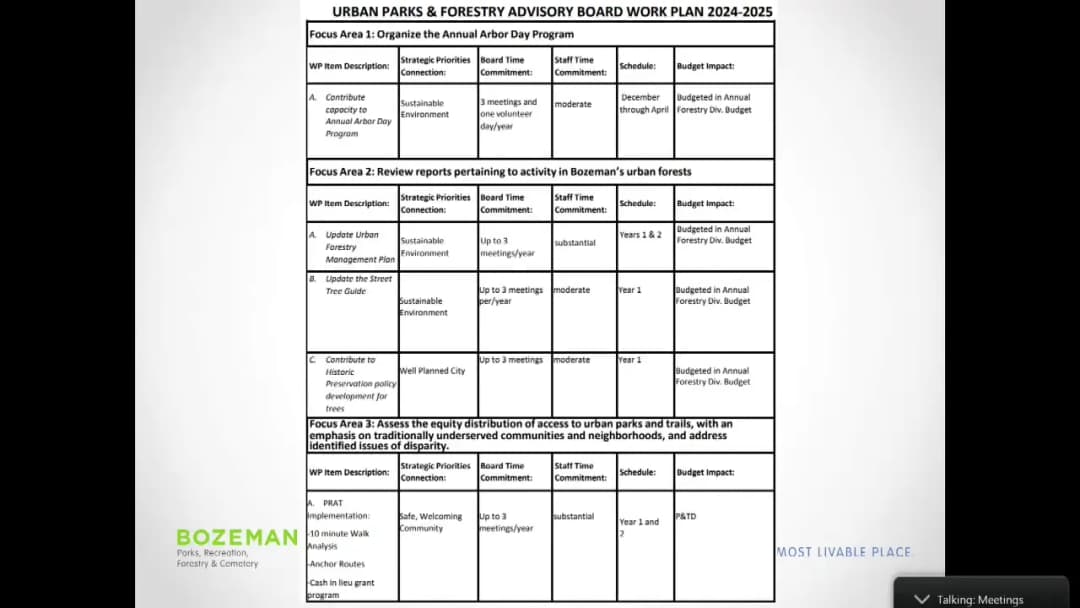
This meeting of the Bozeman Urban Parks and Forestry Board covered three main discussion items: an update on the Bike Fill Community Park (including public engagement results), the schedule for updating the Urban Forest Management Plan, and a review of the board’s two-year work plan. Public comments focused on environmental protections for the proposed Bike Fill park and on renaming the forest management plan. The meeting was held both in person and virtually, with no agenda or minutes provided. Consent Calendar - Approval of Minutes: The minutes from the January 22, 2026 meeting were approved unanimously. The board members voting in favor: Terry Lumsden, Brant Baruby, Steve Lowry, Paige Lizowski, Joe Cartwright, Matthew Cortan, and Sally Schrank. Public Comments & Testimony - Annie Sheets (Bozeman Tree Coalition, retired city arborist) thanked the city and board for community engagement on the Urban Forest Management Plan. She suggested renaming the document to a “Community Forest Management Plan” to be more inclusive and to cover the entire ecosystem (public, private, and naturalized areas). - Marcia Caveney (Bozeman Tree Coalition co-founder) spoke about Bike Fill park. She urged incorporation of independent wildlife experts (e.g., from Sacajawea Audubon) to inventory birds and other wildlife before construction, postpone construction near nesting areas until late July to comply with state law, and use a wildlife monitor on site. She noted that grasslands are the fastest disappearing ecosystem and grassland birds are experiencing steep declines. - Ken Sinai (resident, board member of Sacajawea Audubon, speaking for himself) expressed support for the Bike Fill park goals but emphasized environmental considerations. He recommended: conducting wildlife habitat and use assessments; mapping wetlands and streams; designing trails to achieve science-based 100–150 foot setbacks from watercourses; placing trails on only one side of Chern Creek; creating a long-term vegetative rehabilitation plan including trees and shrubs. He noted that the site has potential for habitat improvement. - Additional written public comments were received: one regarding the Urban Forest Management Plan and four regarding Bike Fill, all forwarded to the board. Discussion Items - Bike Fill Community Park Update: Addy (Development Manager) and Matt Parsons (GVLT Trails Director) presented an update on the project, which is a community bike park with about five miles of trails. They reviewed the public engagement process led by CRO Planning and Design (Jeanine Esleck, Brett Rano). Key findings from a survey (1,016 responses, 770 completed) and focus groups included: strong support for cross-country and flow trails, shade structures, toilets, parking, and trash/recycling bins; emphasis on natural areas, viewpoints, and wayfinding; over 70% of respondents prioritized water drainage/erosion control; nearly half prioritized planting native grasses and trees; 90–95% supported seasonal and maintenance closures; and strong interest in stewardship activities. Focus groups with youth cycling, cyclocross, and adaptive riders requested shade structures, pump tracks, staging areas, accessible design, and wide turnarounds. The park master plan will be available on Engage Bozeman by mid-March and will be presented to the board on March 26, 2026. The city commission is expected to approve the master plan on April 7, 2026. Construction is slated for June/July 2027, with Mackelhattan Road reconstruction also starting July 1, 2027. The board discussed trail setbacks from creeks, noting that city code requires 50-foot setbacks for buildings but gravel trails are allowed closer; the design aims to exceed requirements. Dogs will be banned from the bike trail area to reduce user conflict, with a connection to Snowfill Park for dog walking. Shade structures and tree planting are being considered. The board expressed interest in a site visit before the next meeting. - Urban Forest Management Plan Update: Mitch Overton (Parks and Recreation Director) presented the proposed schedule for updating the 2016 Urban Forest Management Plan. The plan has four components: Infrastructure and Management (tree inventory, canopy cover goals, staffing, budget); Planning and Development (code guidance, tree protection, heritage tree program, integration with other departments); Community Engagement (volunteer initiatives, education); and Insect/Disease/Disaster Preparedness (emerald ash borer, climate adaptation). Key milestones: March 26, 2026 – community engagement plan to board; April – outline of management plan; June – feedback from public engagement; July – preliminary draft review; final plan by end of calendar year 2026. The board will have four work sessions with contractors. The plan will also address tree canopy assessment, which will set measurable goals. - Advisory Board Work Plan Review: Mitch Overton reviewed the board’s 2024-25 work plan and previewed the 2026-27 plan aligned with city commission priorities (to be adopted March 3, 2026). Current work plan items included Arbor Day program, updating the urban forest management plan, street tree guide (completed), historic preservation policy for trees (ongoing), Pratt Plan implementation (10-minute walk analysis, anchor route for Cattail Creek corridor), and Cash and Lou Grant Program (first round completed). Future items will incorporate code updates from the Pratt Plan and possibly revisions to parkland dedication fees. The board discussed the importance of aligning with commission priorities, such as “Strengthening Advisory Board Efficacy” and “Protecting Bozeman’s Heritage and Neighborhood Environment.” Commissioner feedback emphasized the need for a clear pathway for board recommendations to the commission. Key Outcomes - Minutes Approved: Unanimously approved (8-0). - Next Steps for Bike Fill: Park master plan to be posted on Engage Bozeman by mid-March; board to review at March 26 meeting; city commission to act April 7; site visit for board members to be arranged. - Urban Forest Management Plan: Schedule adopted; board will receive community engagement plan at March 26 meeting. - Work Plan: Board to finalize 2026-27 work plan at next meeting after reviewing commission priorities adopted March 3.
PARKS AND RECREATION 58% · PUBLIC ENGAGEMENT 16% · ENVIRONMENTAL PROTECTION 15% · PROCEDURAL 5%
132
FEB 25, 2026 · BOZEMAN, MONTANA · CITY COMMISSION
Bozeman Transportation Board Meeting - February 25, 2026

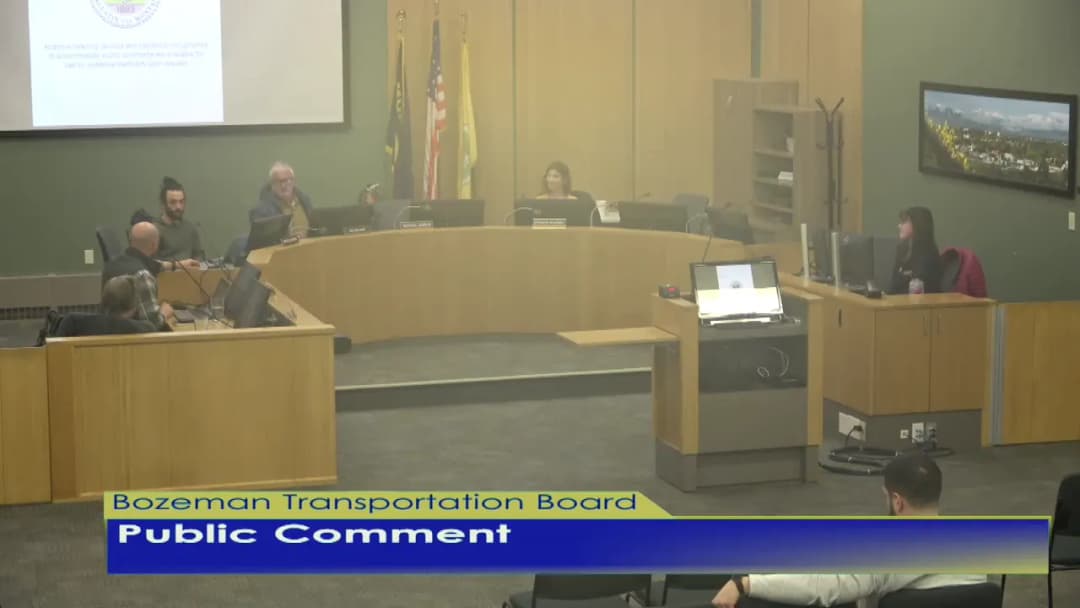
The Bozeman Transportation Board held an abbreviated meeting on February 25, 2026, due to a lack of quorum. The meeting focused on staff updates, public comment, the introduction of a new commission liaison, and discussion of upcoming projects and work plan items. The board voted to continue action items to the March meeting. Consent Calendar - The board excused two absent members via unanimous consent. Public Comments & Testimony - No public comment was received, either in person or online. Discussion Items - Staff Updates (Director Nick Ross): - The city closed the RFP for the Comprehensive Safety Action Plan, receiving five submissions. The plan will be developed in parallel with the upcoming Transportation Master Plan. - The North 27th Street (Baxter to Cat Till) project is out for bid, with bids opening March 4, 2026; completion expected summer 2026. - The annual street maintenance project will be bid next week, including milling and overlay of Babcock Street (Wilson to Rouse) with $100,000 in pedestrian safety improvements, and North 15th Street (Durston north) with ADA upgrades. - The city's Streets Division plans to mill and overlay approximately 3,000 tons of asphalt in-house this year. - The contract for permanent traffic calming installations (neighborhood traffic circles and speed tables) has been structured to support the new Neighborhood Traffic Calming Program. - The Black Avenue Bicycle Boulevard final traffic circle installation contract is approved for early spring construction. - Final design is underway for the College Avenue project (8th to 11th); bidding expected in April with construction before the Keggy Boulevard reconstruction next summer. - McAlhattan Road reconstruction to city standard is moving into final design, funded by the Arterial and Collector District, to support the bike park project with GVLT. - Introduction of Commissioner Liaison: - Commissioner Jen Magic was welcomed as the new Commission liaison for the next two years. She expressed support for empowering the board and advancing safety for vulnerable road users. - Traffic Calming Program Update: - Director Ross noted the new program has received limited applications so far. Staff are working through previous ad hoc requests and will consider extending the March 6 deadline if needed. A board member suggested using Engage Bozeman to publicize the program. - Upcoming March Meeting Prep: - Director Ross indicated the March meeting will include adoption of the two-year work plan and a discussion item to kick off the Transportation Master Plan update. He encouraged board members to help shape future agendas. A board member suggested coordinating with the Gallatin Valley MPO and UTD for overlap with the long-range transportation plan. Key Outcomes - The board voted unanimously to move the two action items from tonight's agenda to the March meeting. - The March meeting will include a discussion on the Transportation Master Plan scope and an MPO update. - Staff will continue to promote the Neighborhood Traffic Calming Program and may extend the application deadline.

TRANSPORTATION SAFETY 59% · PUBLIC ENGAGEMENT 21% · PROCEDURAL 20%
133
FEB 24, 2026 · BOZEMAN, MONTANA · CITY COMMISSION
Bozeman City Commission Regular Meeting – February 24, 2026

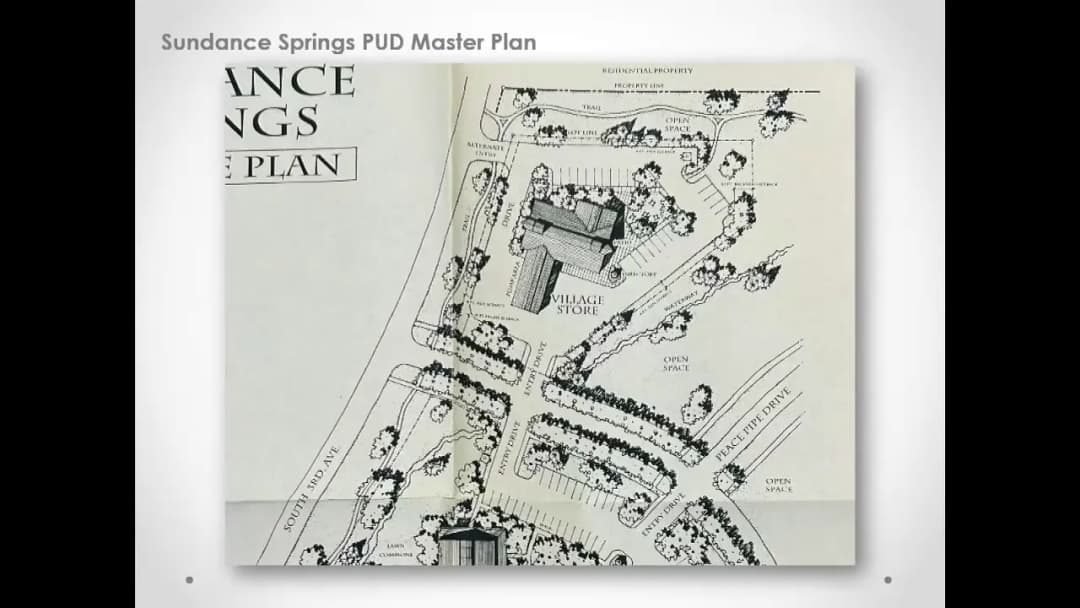
The Bozeman City Commission met on Tuesday, February 24, 2026, at 6:00 PM in the Commission Room at City Hall. All five commissioners (Joey Morrison, Jennifer Madgic, Douglas Fischer, Emma Bode, Alison Sweeney) were present. The meeting included a consent agenda, public comments on non-agenda items, a special presentation on unseen crimes, and a lengthy appeal hearing on the Sundance Springs Commercial Lot 2 site plan, which was continued to March 24, 2026. The meeting was extended to 10:30 PM and adjourned at approximately 10:51 PM. Consent Calendar - F.1–F.16 were approved unanimously (5-0). Notable items included: - F.2: Parks Community Grant Program grant agreement with Mountain Time Arts for "See Bozeman Creek Artwork." - F.3: Notice of Award to Hardrives Construction, Inc. for the 2023 Transportation Alternatives Path Preservation Project. - F.4: Notice of Award to Hoffman's R&M Services, Inc. for the Whittier Elementary School Parking Lot Reconstruction Project. - F.5: Bailment agreement with Craig Hergert for art display in City Hall (no cost to taxpayers). - F.7: Professional Services Agreement with Maddaus Water Management to update the Water Conservation DSS Model. - F.11: First Amendment to architectural services with MSR Design for Bozeman Library Children's Room Renovation. - F.14–F.16: Resolutions for Special Improvement Lighting Districts 794, 795, and modification of 743. Public Comments & Testimony - Non-agenda items: Two speakers requested the commission schedule a public hearing to revisit the December 16, 2025 decision allowing 90-foot buildings in B-3 zones by right. Mary Bateson, a Bozeman resident, urged timely action within the four-month window suggested by Deputy Mayor Fischer. Daniel Carty, a Northside resident, argued that 90-foot buildings would damage historic character, provide no community benefits (e.g., no cash-in-lieu of affordable housing), and worsen downtown parking problems. He requested a hearing by May 31, 2026, to return maximum height to 60 or 70 feet. Discussion Items - Special Presentation (H.1): Detective Captain Anthony Hutchings of the Bozeman Police Department presented "The Story of Unseen Crime." He described the Special Victims Unit (formed in 2017) which investigates sexual and physical abuse of adults and children, including internet crimes against children. Key statistics: The unit handles about 350 high-level felony cases per year; roughly 65% go to SVU, and 45% involve children. Estimated underreporting is 63–75% for adult crimes and 70–90% for child crimes. National statistics indicate 10% of partner family member assault crimes involve strangulation, and 43% of actual homicides involve strangulation. The goal is community outreach, education, and connecting survivors with treatment. The next sexual assault awareness event is April 15, 2026, at the Safety Center. - Action Item I.1: Appeal 25769 – Sundance Springs Commercial Lot 2 Site Plan (25238) - Staff Presentation: Community Development Director Erin George and Planner Zachary Moon outlined the timeline: The Sundance Springs PUD was approved in 1995/1998 with 141 residential lots and two commercial lots. A previous 2022 site plan was appealed and overturned by the commission in February 2024 with findings of fact. The current site plan proposes two two-story commercial buildings (each just under 5,000 sq. ft., 33 ft. tall) for uses like restaurant, office, gym, and retail. Staff argued that the master plan document from 1997 is a conceptual sketch, not binding; the applicable code is the 2025 Bozeman Municipal Code in effect when the application was deemed adequate. The site plan complies with all code sections except lighting for residentially adjacent properties (0.86 footcandles vs. the required 0.3 footcandles), which staff recommended amending via a new condition of approval. 55 public comment letters were received: 4 in support, 51 in opposition. - Appellants' Presentation: Dr. Geoff Poole, Rob Ferris Olsen, Timothy and Nancy Swanson argued the site plan violates the PUD's approved final master plan (showing only one building), the original 1992 zoning code (which they claim remains applicable via covenants), and block frontage standards. They contended that the current code requires compliance with the PUD's final plan and that two buildings and the arrangement of parking do not match what was approved. They asked the commission to overturn the conditional approval. - Developer's Presentation: Landowner Michael Shriner, engineer Marlene Sadaj, and attorney Brian Gallik presented comparisons to the previous denied plan, highlighting changes made to comply with design guidelines: no parking in front of the west building, no departure requests, redesigned buildings with pitched roofs, and reduced outdoor patio. They argued the site plan meets all current code and PUD requirements, and that the master plan is not a binding regulatory document. They noted the market study from 1997 listed 18 possible uses, not just a village store, and that the PUD allowed B1 uses on the lot. - Public Comment: 13 speakers (in-person and online) were heard. Residents opposed to the development cited traffic, noise, safety concerns for children, disruption of neighborhood character, and that the original PUD trust was being violated. Supporters (including a neighbor and a business owner) emphasized the need for commercial nodes, walkability, and that the developer had gone through proper processes and made good-faith changes. One speaker (Jeff King) argued that allowing two buildings on Lot 2 would set a precedent for the larger Lot 1 (which could then host up to 10 buildings). - Rebuttals: Staff clarified that the 1996 PUD findings of fact had been consumed by the final 1998 plan, and the market study did not limit uses to a single village store. Appellants reiterated that the code prohibits issuing permits for improvements not shown on the approved final plan (which shows one building). Developer offered willingness to adjust parking if needed. Key Outcomes - The commission voted 5-0 to continue Consideration of Appeal 25769 to March 24, 2026, closing the public hearing record. No additional evidence or testimony will be accepted before that date. - The commission also voted 5-0 to start the March 24 meeting as early as 4:00 PM, with the understanding that the appeal would be taken up at 6:00 PM (after the CIP discussion) to allow public participation at a standard time. - Commissioner Bode raised the need to schedule a resolution for student ex-officio seats on advisory boards before the end of the academic year. Commissioner Sweeney requested that the B-3 height issue be added to the six-month calendar. Additional Notes - Commissioner Madgic reminded the public that March 1 is the deadline to apply for primary residence tax treatment for second homes (homestead.mt.gov). - The Anne Frank: A History for Today exhibit will be at Bozeman Public Library from March 2–31, 2026, with an opening reception on March 4, 6–7 PM. - The City Commission is open to all; accommodations for disabilities are available by contacting the ADA Coordinator.

LAND USE PLANNING 51% · PROCEDURAL 16% · PUBLIC ENGAGEMENT 9% · ENGINEERING AND INFRASTRUCTURE 9%
134
FEB 23, 2026 · BOZEMAN, MONTANA · CITY COMMISSION
Bozeman Community Development Board Meeting – Training on Zone Map Amendments and Appeals – February 23, 2026

The Bozeman Community Development Board (CDB) held a regular meeting on Monday, February 23, 2026, at 12:00 PM (MST) in the City Commission Room. The agenda was light, consisting of routine approvals and a board training session on the review of zone map amendments and appeals of administrative decisions under the new Montana Land Use Planning Act (MLUPA). No public comments were made on non-agenda items. Consent Calendar - February 2, 2026 Minutes: Approved unanimously (5-0) via roll call (Morrison aye, Egggy aye, Delmian aye, Mitro aye, Chair Boyd aye). - Cancellation of March 16, 2026 Meeting: Approved unanimously (5-0) to cancel the regularly scheduled meeting due to spring break. The next meeting will be held on March 3, 2026. Public Comments & Testimony - One member of the public was present but did not offer any testimony during the public comment period on non‑agenda items. No online participants were dialed in. Discussion Items - Board Training on Zone Map Amendments and Appeals of Administrative Decisions: - Chris Saunders (Planning Manager) and City Attorney Greg Sullivan led a training session covering two key responsibilities of the CDB under MLUPA: reviewing zone map amendments and hearing appeals of administrative land use decisions. - Zone Map Amendments: - The board’s role is to make a recommendation to the City Commission on whether a proposed zone change is in substantial compliance with the Bozeman Community Plan and the criteria in MLUPA § 76‑1‑304. - The new criteria (replacing the old 12 factors) include: consistency with the future land use map, impacts on housing, natural resources, economic development, etc. (listed as A–B and C1–C7 in the statute). - Key differences from previous practice: no protest provisions; emphasis on fact‑based decisions; the board must base findings on the record, including public testimony. - “Substantial compliance” is the standard; the board looks at the application as a whole, not single elements out of context. - Motions: The board was encouraged to make affirmative motions (to approve, modify, or reject) to clearly convey their recommendation to the City Commission. - Appeals of Administrative Decisions: - Under MLUPA, the CDB sits as a quasi‑judicial body for appeals of final decisions by the Planning Administrator (e.g., on subdivisions, site plans, variances). - The appeal is limited to issues raised in the appeal application; the appellant must show error and bears the burden of proof. - The board’s decision is de novo, but the initial decision must be sustained unless found arbitrary, capricious, or unlawful. - The board must avoid ex parte communications and treat the proceeding like a judge, basing decisions solely on the record. - Appeals are rare (∼1 per year historically), but the board is expected to handle them with strict adherence to due process. Key Outcomes - No decisions were made on substantive applications; the meeting was dedicated to training. - The board was reminded of their responsibilities under MLUPA, the importance of clear findings, and the need to maintain a neutral, record‑based approach in both zone map amendment recommendations and appeal hearings. - The next regular meeting is scheduled for March 3, 2026.

LAND USE PLANNING 70% · GOVERNMENT ETHICS 11% · PROCEDURAL 8% · PUBLIC ENGAGEMENT 6%
135
FEB 19, 2026 · BOZEMAN, MONTANA · CITY COMMISSION
Bozeman Urban Renewal Board Meeting: TIF Request & Budget Proposals - February 19, 2026

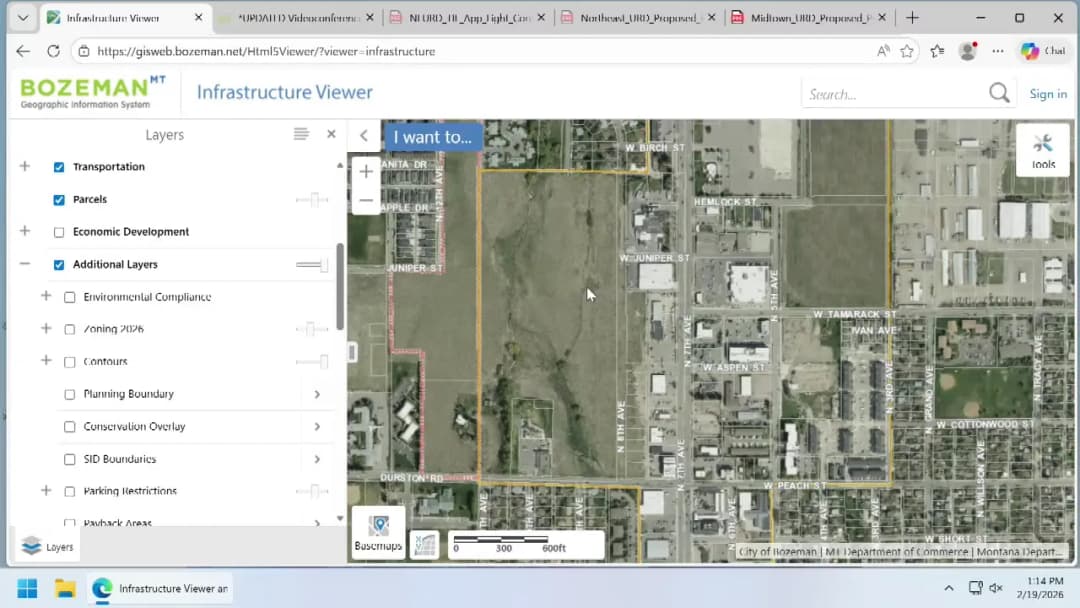
The Bozeman Urban Renewal Board met on February 19, 2026, to discuss a tax increment financing (TIF) request from Light Conversion USA (formerly Altos Photonics) and proposed budgets for the Midtown and Northeast Urban Renewal Districts. The meeting included public comments on conflicts of interest, project specifics, and neighborhood priorities. Public Comments & Testimony - Amy Hoytzma (President, Northeast Neighborhood Association): Raised concerns about potential conflicts of interest on the board due to the presence of realtors and developers, noting that in the past, developers who received TIF money had sat on the Northeast Urban Renewal Board. She referenced municipal ethics laws and the importance of avoiding even the appearance of a conflict. - Amy Hoytzma (later in the meeting): Commented on the Northeast district budget, suggesting that proposed right-of-way enhancements on North Church Street might not align with neighborhood priorities. She recommended focusing on improving the stretch of Bozeman Creek between Tamarack and the alley south of Juniper, especially given Light Conversion USA's plans to extend the alley. She also expressed personal concern about the quiet zone project benefiting Bozeman Yards, which she described as "uber luxury" units, noting that Bozeman Yards received a $3.66 million TIF award and would further benefit from quiet zone funding. Discussion Items - TIF Request – Light Conversion USA (Item I3): Staff presented a $543,000 TIF assistance application from Light Conversion USA, a photonics company rebranded from Altos Photonics, for public infrastructure improvements at a corner lot on Tamarack and Rouse. Eligible costs included demolition ($200,000 budgeted, but reimbursement likely based on actuals), curb/gutter/alley improvements, water and sewer service lines, impact fees, and cash-in-lieu of water rights. The parking lot was deemed ineligible as a private improvement. Board members discussed the potential for the company to sell the improved property and whether job creation guarantees should be required. Staff noted that this is the first time a company building its own structure has sought TIF assistance; prior projects involved developer-owned buildings. The board voted unanimously to direct staff to conduct due diligence, including a third-party financial performance analysis, and return with a staff report. - Midtown Urban Renewal District Budget (FY27 Proposed Projects): Staff presented a list of recommended projects for FY27, including: - Fifth Avenue Trail Lighting Construction (pedestrian-scale lighting) - Whittier parking lot construction (bid came in at $160,000 vs. $300,000 estimate) - Aspen and Seventh intersection improvements (bulb-outs, flashing beacons) - Mendenhall sewers (7th to 5th) design - Professional services line item ($100,000) - Fifth & Mendenhall lighting development agreement (already approved by city commission) - Midtown asset development agreement payment - Public parking structure exploration (10% design placeholder) Staff clarified the budget is not final and can be modified at the next meeting, which would be the latest for adding new items. - Northeast Urban Renewal District Budget: Proposed FY27 projects included: - Right-of-way enhancements at Church, Cottonwood, and Aspen (conceptual design and renderings) - Removal of Wallace Avenue traffic calming (at neighborhood request, at no cost to the district) - Tree design and planting study (to address infrastructure conflicts) - FY28 items already approved include the Wallace Works pay-go agreement and Bozeman Yards bond issuance (the latter's low bid came in at $1.7 million vs. $2.6 million estimate). The quiet zone project, in development since 2020, is progressing with construction targeted for summer 2027. Key Outcomes - Motion to advance Light Conversion USA TIF request: Unanimously approved. Staff will perform due diligence and return with a staff report for a future decision. - Midtown budget: No formal vote taken; staff recommended the board consider adoption at the next meeting. Board members were encouraged to submit additional project ideas. - Northeast budget: No formal vote; staff agreed to revisit the proposed right-of-way enhancements to ensure alignment with neighborhood input, particularly regarding the creek area. Discussion acknowledged the quiet zone project's broad benefits despite some neighborhood concerns.

ENGINEERING AND INFRASTRUCTURE 29% · ECONOMIC DEVELOPMENT 21% · PUBLIC ENGAGEMENT 19% · PROCEDURAL 10%
136
FEB 18, 2026 · BOZEMAN, MONTANA · CITY COMMISSION
Bozeman BID Board Meeting: Fiscal Year 2027 Budget Draft Review – February 18, 2026

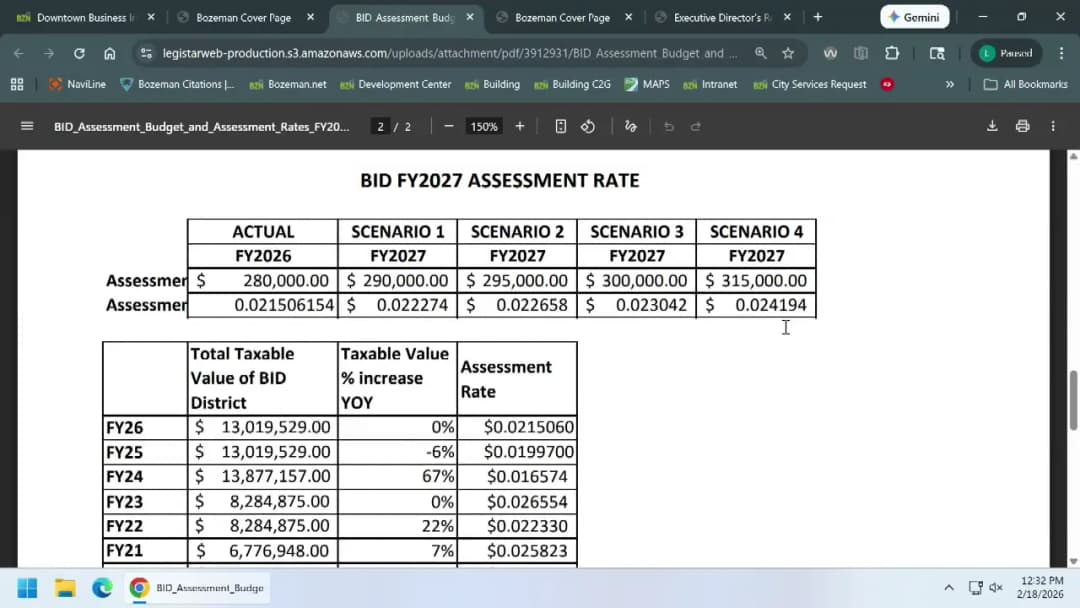
Note: The transcript of the meeting refers to the date as "Wednesday, February eighth," but the meeting was scheduled for February 18, 2026 per the official record. This summary uses the February 18, 2026 date as provided. The Bozeman Business Improvement District (BID) Board met to review the first draft of the fiscal year 2027 budget. The board discussed the proposed assessment rate, various line items, and future planning in light of the upcoming Urban Renewal District (URD) sunset in 2032. No formal votes were taken; the board will consider approval at a rescheduled March board meeting. Discussion Items - Proposed Assessment Rate for FY2027: Emily presented a suggested assessment of $295,000, a 5% increase over the FY2026 amount of $280,000. She provided examples of alternative rates. The board expressed general support for the 5% increase, with members noting it was a "business as usual" scenario. - Budget Line Items: Key changes included: - 8% increase in the management fee for the Downtown Bozeman Partnership, attributed to a new bookkeeper and general cost increases. - Slight increase in payroll expenses due to plans to be fully staffed. - No proposed spending for the Downtown Safety Program this fiscal year; the $15,000 earmarked remains for potential partnerships with the police department, but a full resource officer position is not imminent. - Holiday lights reserve fund: Focus shifting from repairing "spiders" to replacing garland and bows. Additional funds for banner replacement and rebranding (new colors/logo) were discussed. - New line item for hazmat cleanup (human waste) previously covered under maintenance supplies. - Vehicle insurance: $16,000 payout due to an accident, but annual premium expected to be $7,600. - Flower Baskets Performance: The board discussed the poor flower basket survival last year, attributed to soil compaction and fertilizer issues. Oak Gardens, the contractor, is aware and plans to use fresh fertilizer and address compaction. - URD Sunset and Future Role of BID: Staff noted that the URD sunsets in October 2032, and the BID may need to step up to fund some URD programs. The city is willing to collaborate, and consultants will be sought to develop scenarios. The BID is not restricted to "clean and safe" programs; it could support marketing, operations, or a revolving loan fund. - Downtown Improvement Projects: - Bozeman Creek Vision Plan: Consultants from Port are conducting outreach. - EHO Peace Park: Construction is ongoing; ribbon cutting planned for August 14, 2026. - Downtown Special Improvement Lighting District (SILD): Renewal process begun for a district from the 1940s to fund pedestrian light maintenance. - Parking: Consultant Indigo West conducting surveys; an RFP for a parking public-private partnership is being developed, with potential expansion of the URD to include the federal building. - Staff Updates: Chris McGoffin, a new maintenance staff member, started. Marketing and branding efforts will be discussed with the DBA (Downtown Bozeman Association). Key Outcomes - The board will vote on the FY2027 budget at the rescheduled March board meeting (tentatively March 25, 2026) after public notice. No action was taken at this meeting. - The board agreed to continue exploring the Downtown Safety Program, but no immediate spending is planned. - Staff will coordinate with the city clerk to confirm room availability for the March 25 meeting. - The BID budget presentation will be on the City Commission calendar for May 12, 2026.

PUBLIC ENGAGEMENT 24% · BUDGET EQUITY ANALYSIS 22% · PARKS AND RECREATION 19% · PROCEDURAL 14%
137
FEB 18, 2026 · BOZEMAN, MONTANA · CITY COMMISSION
Bozeman Historic Preservation Advisory Board Meeting - February 18, 2026

The Bozeman Historic Preservation Advisory Board (HPAB) met on February 18, 2026, from 6:00 PM to approximately 8:42 PM. The meeting focused on the update of the Neighborhood Conservation Overlay District (NCOD) Design Guidelines, including a special presentation from the consulting firm Lakota Group and discussion of a community engagement plan. The board also received significant public comment from residents expressing concerns about new development height, enforceability of guidelines, and the need to preserve historic character. Consent Calendar - None present. Public Comments & Testimony - Jeff Ball, city resident, expressed strong opposition to increased building heights in the B3 zone, stating that zoning changes have diminished property values and that the concept of a gentle transition from downtown to neighborhoods has been abandoned. He urged the board to reinstitute pragmatic protections. - Mark Campanelli, Bogert Park resident, stated that the NCOD guidelines are being treated as optional by staff, which he called "ridiculous." He argued the NCOD purpose is code that must be achieved, with guidelines providing flexibility. - Angie Kaciolek, speaking for herself and as INC rep for Northeast Neighborhood Association, argued that the NCOD guidelines were intended to carry weight and are not mere suggestions. She provided examples from city code where "guidelines" are treated as enforceable standards. - Daniel Carty, Bozeman resident and NCOD resident, reported that a developer told residents to "get out of our way" during a neighborhood walk. He called for the NCOD to have "legal teeth" to protect historic character, viewsheds, urban forest, and solar access. - Marcia Kaveny, Bozeman resident and co-founder of the Bozeman Tree Coalition, asked whether landscaping design guidelines will be included in the update and whether the Heritage Trees program will be part of the landmark program. - Ken Sinnay, NCOD resident since 1993, expressed concern about out-of-scale new construction (citing the Depot Street project) and emphasized the importance of height transitions and solar access for downtown livability. - Zehra Osman, Bozeman resident, cited portions of the Bozeman Municipal Code and the Secretary of the Interior Standards to argue that the existing code and guidelines already provide sufficient tools if enforced. She welcomed Lakota Group and urged that the update produce enforceable standards. Discussion Items - H.1 Special Presentation – NCOD Design Guideline Update: Lakota Group (Saraj Al Sahani, Matt Cole, Scott Ferris, Douglas Carrie, Doug Gilbert) presented their background, emphasizing a focus on community engagement, clear and user-friendly graphics, and balancing preservation with economic vitality. They outlined a two-phase process: Phase 1 (research and engagement) and Phase 2 (drafting and review). Board members asked about engaging the design community and educating the public on preservation benefits. Lakota noted that they have worked in communities with similar growth pressures and that they will conduct stakeholder interviews and walking tours. - I.1 Action Item – NCOD Design Guidelines Update Community Engagement Plan Discussion: Staff presented the proposed community engagement plan, which includes open houses, stakeholder meetings, a neighborhood focus group, surveys, walking tours, and an Engage Bozeman project page. The board discussed several proposed amendments, including adding the Inner Neighborhood Council (INC) as a key external partner, making the online survey and walking tours required methods, and ensuring walking tours occur early in the process. After discussion, the board voted 5-0 to approve the plan as amended. - J. FYI/Discussions: Member James Webster requested that an item regarding an Interim Zoning Ordinance to address the 90-foot height allowance in B3 be placed on the next meeting's agenda. Staff noted they would need to consult with the city attorney before adding it, given it involves a commission decision and zoning authority delegated to the Community Development Board. Key Outcomes - Motion to approve minutes from the January 21, 2026 HPAB meeting carried 6-0. - Motion to amend the community engagement plan (to include INC as a key external partner, add walking tour and survey as listed methods, and ensure walking tours are included in the Phase 1 timeline) carried 5-0. - Motion to approve the NCOD Guidelines Update Community Engagement Plan as amended, recommending it to the City Commission, carried 5-0. - The City Commission is expected to consider the plan for adoption on March 10, 2026. - Homework for board members: review existing NCOD guidelines before the April work session with Lakota Group, focusing on what works, what is unclear, and what is missing. - Next HPAB meeting is scheduled for March 31, 2026, focusing on the local landmark project.

COMMUNITY ENGAGEMENT 39% · HISTORIC PRESERVATION 33% · PROCEDURAL 11% · LAND USE PLANNING 8%
138
FEB 18, 2026 · BOZEMAN, MONTANA · CITY COMMISSION
Bozeman Study Commission Meeting - February 18, 2026

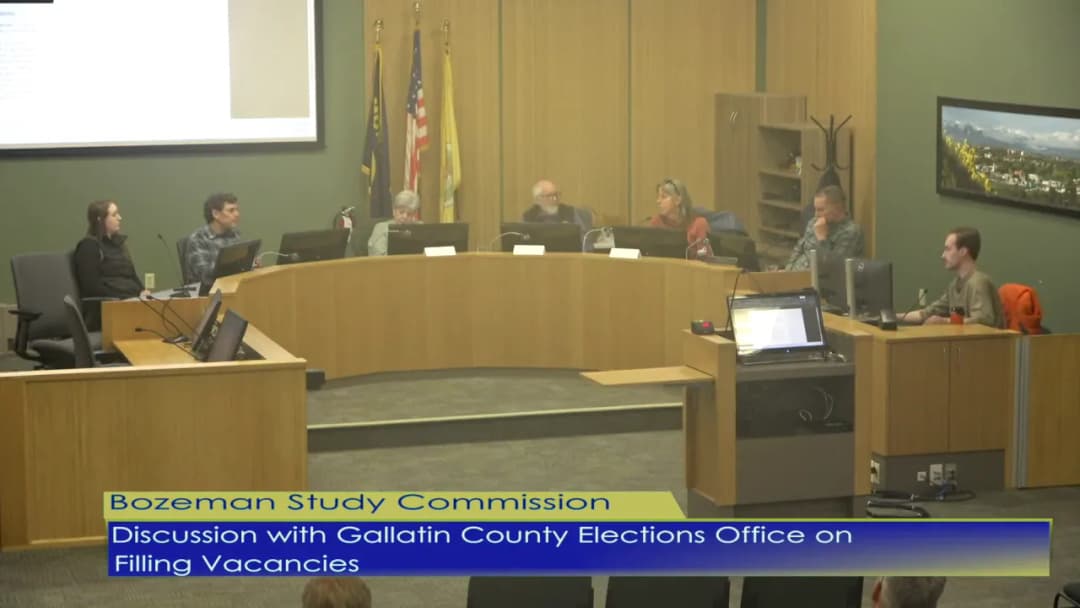
The Bozeman Study Commission met on February 18, 2026 at 4:00 PM to discuss the charter revision schedule, ballot education strategy, and methods for filling vacancies on the city commission or mayor's office. The meeting included public comment, approval of the consent agenda, adoption of a revised timeline, a decision to issue an RFP for a ballot education firm, and a vote to adopt a charter amendment on vacancy appointments. The meeting adjourned at approximately 5:57 PM. Consent Calendar - The consent agenda was approved unanimously. It included four claims totaling $7,620.69. Public Comments & Testimony - James Dilts (2204 Buckreak Avenue, Bozeman) expressed concern that recent city commission decisions minimized public input (e.g., meetings scheduled during holidays and summer). He urged the Study Commission to consider requiring special elections rather than appointments to fill vacancies, stating that even low-turnout or expensive elections would force candidates to appear before the public. - Roger Blank (Bozeman resident) advocated for maximizing democratization of the vacancy-filling process and requested that the commission seek an opinion from the Montana Attorney General on the legality of special elections for vacancies. He argued this would give the public the best possible process. - Natsuki Nakamura (Bozeman resident) asked for clarity on whether a vacancy could be placed on the next already-scheduled election (e.g., June primary or school board election) rather than a standalone special election. She also referenced the recent plastics initiative and public safety mill levy as examples of special elections. - Jason Delmu (Peach Street, Bozeman) supported the appointment process, stating that elected commissioners are capable of deep analysis and that appointees often have relevant experience. He argued appointments are superior to truncated elections based on campaign slogans and spending. Discussion Items Schedule Change for Final Charter and Ballot Language - Becky presented a revised schedule to avoid the July 4th holiday week and to allow more time for public review. Key proposed dates: - May 7: Review draft charter language and submit for legal review. - May 13: Edits to charter language. - May 28: Second public hearing. - June 4: Review public and legal comments. - June 17: Decide on any sub-options for the ballot. - July 15: Review draft report and charter language. - July 30: Approve ballot language (must be submitted to county by August 10). - End of August: Final approval of charter and report. - Discussion ensued about whether the full charter must be finalized at the time of ballot language approval. City Attorney Greg Sullivan noted that the required final report date is later than the ballot language deadline, but he urged the commission to be “pretty considerate” about having the charter completed when voting on ballot language. - The schedule change was approved 4-0. Ballot Education Firm - Becky reported that the contract with Working Ventures (communication strategist) is nearly complete ($20,000 remaining in that contract). She recommended hiring a specialized ballot education firm to handle voter education without advocacy, as is standard city practice for ballot measures (e.g., public safety center, parks and trails district). Estimated cost $50,000. - Proposed timeline: issue RFP in March, due April 1, start June 1. Mike and Carson would develop the RFP and bring a recommendation to the April 15 meeting. - Deanna wanted the full commission to evaluate candidates, citing concerns about the prior ward initiative education possibly crossing into advocacy. Others preferred a subcommittee approach due to time constraints. - Motion to issue RFP with Mike and Carson developing it and bringing a recommendation to April 15 passed 4-0. Filling Vacancies: Appointment vs. Special Election - City Attorney Greg Sullivan distinguished between two statutes: one allowing charters to define vacancy-filling methods (MCA §7-3-? ) and another prohibiting charters from altering election procedures (MCA §7-3-? ). - Gallatin County Elections Administrator Eric Semarat and Election Manager Jasmine Hall explained that Montana law (MCA 13-14-405) only permits special elections for funding measures (bonds, levies), not for filling vacancies. They also detailed logistical constraints: federal election cycles, list maintenance, and compressed timelines make standalone or piggy-backed special elections extremely difficult. - The commission considered two options: - Option A: Appointment by existing commissioners within 60 days, with a required public forum, until the next scheduled general municipal election. - Option B: Special election, which appeared legally unavailable. - After discussion, Barb moved to adopt Option A. Becky seconded with an amendment to change “general municipal election” to “next scheduled election pursuant to state law” to future-proof the charter. The motion passed 3-1 (Deanna opposed). - Deanna then moved to request an Attorney General opinion on special election options. The motion failed for lack of a second. Key Outcomes - Consent agenda approved unanimously (including $7,620.69 in claims). - Revised meeting schedule adopted 4-0. - RFP for ballot education specialist authorized 4-0; Mike and Carson to bring recommendation by April 15. - Charter amendment on vacancy appointments adopted 3-1 (Deanna opposed) with language specifying a 60-day appointment process, public forum, and the appointment lasting until the next scheduled election pursuant to state law. - Motion to request Attorney General opinion failed (no second). - The commission agreed to focus the next meeting (March 5, 2026) on the mayor and city manager structure.

CHARTER REVISION 54% · PUBLIC ENGAGEMENT 28% · PROCEDURAL 14% · ELECTION PROCEDURES 3%
139
FEB 17, 2026 · BOZEMAN, MONTANA · CITY COMMISSION
Bozeman URD Board Meeting Summary - February 17, 2026

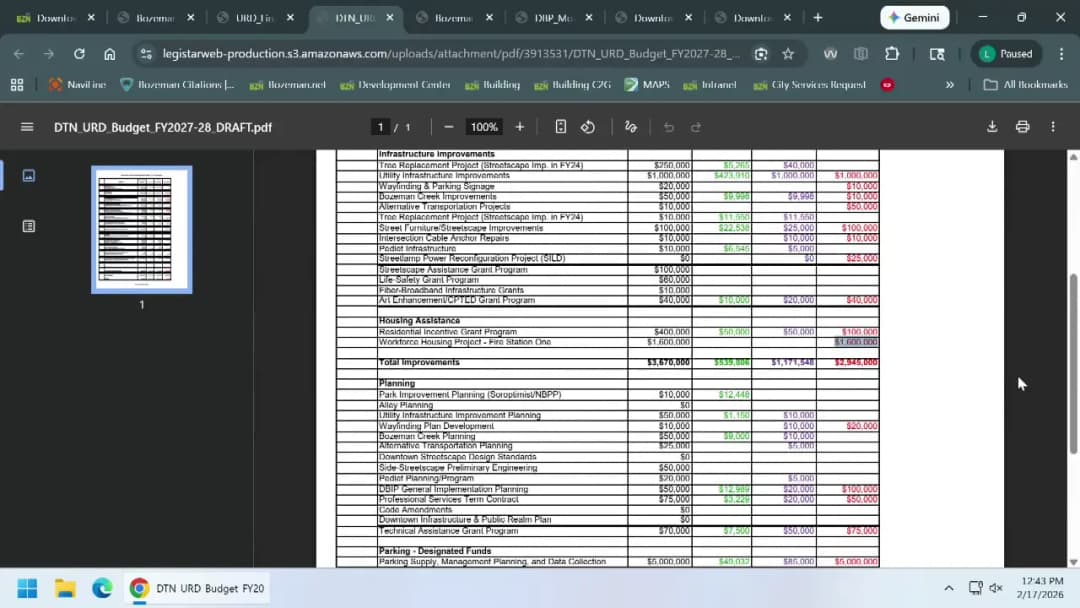
This meeting of the Bozeman URD Board covered a range of topics including the introduction of a new commission liaison, a discussion of downtown building heights in the B3 zone, annual ethics training for board members, a financial report, and a draft budget review for FY27. The board also set a new meeting date for March 10, 2026. Consent Calendar - No consent calendar items were presented during this meeting. Public Comments & Testimony - Jason (city resident/property owner): Provided historical context regarding the 90-foot height limit in the B3 zone, noting that it was not a new change brought by the UDC update but rather an implementation of a height (approximately seven stories) that had been called for in previous downtown plans. He stated that the 90-foot limit was a clearer alternative to the more ambiguous "seven stories" and that it reflects the city's role as a regional economic hub. Discussion Items - Introduction of New Commission Liaison: Douglas Fisher introduced himself as the new commission liaison, replacing Terry Cunningham. He noted his previous role as liaison for the downtown Business Improvement District (BID) board. - City Commission Priorities Update (March 3, 2026): Douglas Fisher outlined the city commission's draft priorities for the next two years, including: making Bozeman a safe and welcoming place for all; engaging meaningfully with the community; strengthening the effectiveness of advisory boards (reviewing the consolidation from 42 boards to five "superboards" in 2021); bridging the affordability gap (housing, jobs, child care); and protecting Bozeman's heritage neighborhoods and environment (including the Neighborhood Conservation Overlay District, water resources plan, and urban transportation district). - B3 Height Discussion: Fisher reported ongoing community pressure regarding the B3 zone height limit (currently 90 feet), with some calling for a rollback to 70 feet or a moratorium. The majority commission sentiment leans toward letting the new UDC (Unified Development Code) play out without immediate tinkering, but to compile issues over the next 4-6 months for a later review. Board members discussed the lack of a clear metric for "appropriate" height, with one member suggesting the board should evaluate whether the height supports community priorities rather than seeking a quantitative benchmark. Another member emphasized the need for a longer runway (more than six months) to see tangible change and noted that the board had previously written a letter in support of 90 feet, citing implications for tax increment financing and long-term downtown infrastructure needs (e.g., underground utilities, sewer lines). The board also expressed concern that past commissions have ignored advisory board recommendations (citing the firehouse sale) and urged that the board's voice be properly weighted. - Ethics Training: The board participated in annual ethics training, reviewing scenarios on conflict of interest, nepotism, and public comment. Key points included: board members must disclose potential conflicts on the record at meetings; they should not use their position for private benefit or to advocate personal opinions as if speaking for the board; they have free speech rights but must clarify they are acting as private citizens; and that the city attorney (Greg Solvan) is the primary contact for ethics questions. - Financial Report: The board reviewed the current financial report for FY26-to-date. Key expenditures included: $11,550 for tree replacement, $703 for sunshine lighting (replacing light bulbs on Main Street and Mendenhall), and $23,162 for consultant fees on the parking vision project. A finalized cash balance for the start of the fiscal year was reported. - Draft Budget Review for FY27: The board discussed the draft budget, which includes an estimated 8% increase in operations costs. Key items included: $5 million allocated for parking and data collection; $335,000 annual bond payment; $1.6 million encumbered for Fire Station 1 (until October 2027); a $50,000 project for Babcock, Bozeman, and Black intersection; $100,000 for downtown planning funds; and $1 million for utility infrastructure improvements (with only a $300,000 current pipeline for a TIFF infrastructure grant request for sewer repairs on Mendenhall). The board discussed the possibility of exceeding the $1 million budget for infrastructure improvements given increased community interest and noted that the URD has budgetary authority to approve amounts above budgeted levels without additional commission approval (unlike the Tax Increment Board). The board agreed to refine the budget with cleaner categorization of line items and to approve the final budget in April. - Downtown Economic Development Report: Updates included: a new downtown website and logo refresh; participation in the MSU strategic planning committee (first public listening session on February 18, 2026); progress on the E.H.O. Peace Park (grand opening planned for August 14, 2026); initiation of a Special Improvement Lighting District; and a hold on the RFP for parking-related work. A list of new downtown developments and business openings was shared. - March Meeting Date Adjustment: The board changed the next meeting date to March 10, 2026 (instead of March 25) due to scheduling conflicts related to spring break and a board member's commitment to a national panel. Key Outcomes - The board will continue to compile feedback on the B3 height limit over the next 4-6 months, with no immediate action to change the 90-foot limit. - The board completed its annual ethics training. - The board will refine and finalize the FY27 budget in March and April, with a focus on clearer categorization of expenses. - The next regular meeting is scheduled for March 10, 2026. - The board acknowledged receipt of the downtown economic development report and will follow up on the TIFF infrastructure grant and parking vision plan as items arise.

GOVERNMENT ETHICS 23% · BUDGET EQUITY ANALYSIS 22% · ZONING CODE 15% · PROCEDURAL 12%
140
FEB 12, 2026 · BOZEMAN, MONTANA · CITY COMMISSION
Bozeman INC Meeting: Traffic Calming, Creek Vision, Bylaw Revisions – February 12, 2026

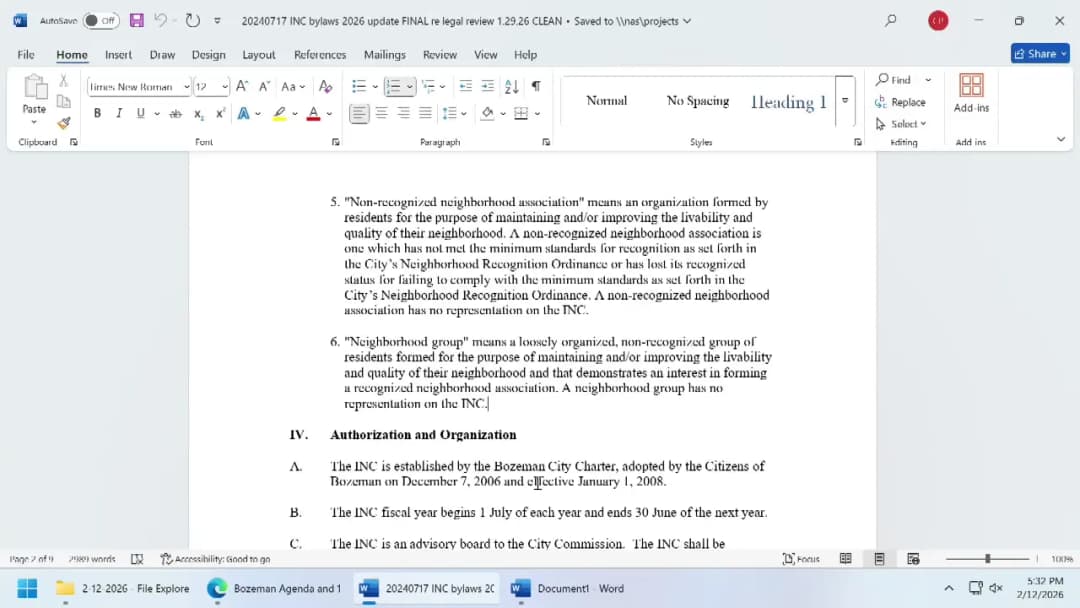
The Neighborhoods Inter-Neighborhood Council (INC) met on February 12, 2026, at 4:30 PM in the City Commission Room. The meeting featured presentations on the newly formalized Neighborhood Traffic Calming Program and the C. Bozeman Creek visioning process, followed by an action item to revise the INC bylaws. Public comment included an update on the Historic Preservation Advisory Board's engagement plan. All agenda items were addressed, with votes taken on minutes approval and bylaw revisions. Consent Calendar - Approval of Minutes (January 8, 2026): The minutes were approved unanimously. A correction was noted: the phrase "keepers" in a prior discussion should read "trust" (East Gelaton Watershed Trust). The board agreed to note the change without altering the public record. Public Comments & Testimony - Historic Preservation Advisory Board Update: Alison Sweeney, City Commissioner and liaison, reported that a draft community engagement plan for the National Conservation Overlay District (NCOD) is available on the city website. The plan will be discussed at the HPAB meeting next week and is scheduled for City Commission adoption on March 10, 2026. Seven neighborhoods partially or fully within the NCOD are listed as external key partners. Written feedback is welcome via comments@bozeman.net. Special Presentations Neighborhood Traffic Calming Program Danay Gianetti, Transportation and Engineering Division, presented the formalized citizen-initiated program. Key features: - Eligibility: Local streets only; arterials and collectors excluded but under separate review. - Application: Web-based, rolling basis with fixed schedule. Requires petition with 50% of addresses within one block or letter of support from HOA/INC rep. - Screening: Two of three criteria needed—vehicle crash in last 5 years, 1,000+ vehicles per day, or 85th percentile speed 5 mph over limit. Proximity to pedestrian generators (schools, parks) also considered. - Prioritization: Weighted scoring with speed as highest factor. - Toolbox: Horizontal deflection treatments (splitter islands, curb extensions, traffic circles, pedestrian refuge islands). Speed tables are under development for future inclusion. - Timeline: Applications close March 6, 2026, for 2026 installations. Projects are temporary/seasonal, removed before snow. Post-installation data collection in summer. - Concurrent Effort: Uncontrolled intersection stop-sign installation program starting near MSU, moving outward. No specific timeline yet; communication with neighborhoods planned. - Questions: Clarified that Highland Boulevard and Third Avenue are collectors and ineligible; Grand Avenue is also a collector under separate review. Neighborhood support can include sweat equity via art stencils. Previously installed projects will be maintained and considered for permanent installation. C. Bozeman Creek Visioning Process Jim Madden and Steve Noble introduced the visioning effort for Bozeman Creek. Background includes a flood risk study completed August 2025 and an RFP that selected a consultant team (Port architecture/urban design and Rio ASE water resources). Goals: - Enhance flood mitigation - Improve water quality and ecological health - Increase access and connectivity to parks/trails - Support economic vitality opportunities - Strengthen community access The process will run approximately nine months, with community engagement through an advisory group of subject matter experts (including Gallatin Watershed Council, Trout Unlimited, architects, former Mayor Cunningham). A kickoff meeting for neighborhoods is set for Tuesday, February 17, 2026, from 12:00–1:00 PM in the Mason Room. Q&A addressed watercourse setbacks: the group affirmed they uphold scientifically backed setbacks and will review current codes. Economic vitality refers to creating an attractive water feature downtown and reducing flood risk. The deviation for a recent hotel did not change the 35-foot setback but allowed encroachment; C. Bozeman Creek supported it with conditions to protect long-term goals. Action Item: INC Bylaw Revisions Kath (Marwan Lindley), with Angie and Zara, presented proposed revisions to the INC bylaws, last amended August 8, 2024. Key changes aimed to clarify voting procedures, especially between administrative and representative votes, delegate representation, proxy processes, and majority determination. Discussion led to several amendments: - Removal notification: When a delegate is removed, the neighborhood association must be notified. - Representative voting method: Neighborhoods may define their own sufficient representation (e.g., surveys) per their bylaws; the mandatory two-week advance distribution was softened to "when possible." - Alternate delegates: Changed from one alternate to "at least one alternate" per neighborhood association bylaws. - Proxy process: Clarified that a proxy is for a specific meeting when neither delegate nor alternate can attend. - Majority vs. two-thirds: For bylaw amendments, the threshold was changed back to two-thirds vote (from majority) to align with common parliamentary practice. - Date update: Changed from 12/7/2 to 2/12/26. - Cleanup: Removed extraneous notes at the end. Key Outcomes - Minutes Approved: Unanimously. - Traffic Calming Program: Application window remains open until March 6, 2026. Neighborhoods encouraged to apply or reach out with eligibility questions. - Bozeman Creek Vision: Public meeting scheduled for February 17, 2026. Neighborhoods invited to participate in the nine-month planning process. - INC Bylaws Revised: The board voted to approve the revised bylaws as amended. The document will proceed to legal review and then to the City Commission for ratification. No vote tally was recorded in the transcript, but the motion carried.

BOARD OPERATIONS 38% · TRANSPORTATION SAFETY 20% · FLOOD MITIGATION 12% · COMMUNITY ENGAGEMENT 9%
OPENPUBLICA · PUBLIC MEETING INDEXUPDATED DAILY · openpublica.com