Browse by city
Date range
Search help

Search titles, summaries, topics and stored transcripts together. Keywords may match separately; put the whole query in double quotes for a phrase. Matching follows word analysis, so punctuation is not exact. Both dates are included. Documents are not searched.

SHOWING 141–150 ENTRIES
141
FEB 11, 2026 · BOZEMAN, MONTANA · CITY COMMISSION
Gallatin Valley MPO Technical Advisory Committee Meeting – February 11, 2026

The Gallatin Valley Metropolitan Planning Organization (MPO) Technical Advisory Committee (TAC) met on the morning of February 11, 2026, with 10 of 11 members present. The committee reviewed and recommended adoption of revised Vision, Goals, and Objectives (VGO) for the Long-Range Transportation Plan (LRTP), following previous discussions at the January TAC and TPCC meetings. Consent Calendar - Approval of January 2026 Meeting Minutes: The committee unanimously approved the minutes from the January meeting with a 10-0 vote. Discussion Items - Long-Range Transportation Plan Vision, Goals, and Objectives (VGO): - Staff (Jeff) presented revisions to the VGO document based on input from the January TAC meeting and the Transportation Policy Coordinating Committee (TPCC) meeting. - Key changes included: separating system preservation and resiliency into two goals; emphasizing Vision Zero framework (aspirational goal of eliminating all traffic fatalities and serious injuries) in Goal 1; reorganizing objectives; tightening language; adding new objectives such as encouraging land use consistency with transportation investments. - Clarification was requested on Goal 5, Objective 3 regarding "walkable" vs. "multimodal" language; staff noted it was intended as an outcome of land use and transportation coordination. - Member Chris Saunders raised a point about Goal 1, Objective 1, suggesting the absolute language of "eliminate all traffic related fatalities" was unrealistic and proposing softer wording like "work to" or "strive to". After discussion, the committee chose to keep the language as drafted, noting the TPCC had already endorsed the aspirational tone. - The committee voted 10-0 to recommend adoption of the VGO to the TPCC. - Upcoming Meeting: The Chair announced that the March TAC meeting will be held in person in Belgrade and will feature a construction and planning update from various agencies. Key Outcomes - Vote: Motion to recommend adoption of the Long-Range Transportation Plan Vision, Goals, and Objectives to the TPCC passed 10-0. - Next Steps: The recommendation will be forwarded to the TPCC for final approval at its end-of-February meeting. The TAC will meet in person in Belgrade in March.

TRANSPORTATION SAFETY 53% · PUBLIC ENGAGEMENT 24% · PROCEDURAL 21% · COMMUNITY ENGAGEMENT 2%
142
FEB 10, 2026 · BOZEMAN, MONTANA · CITY COMMISSION
Bozeman City Commission Regular Meeting - February 10, 2026

The Bozeman City Commission met on Tuesday, February 10, 2026, at 6:00 PM in the Commission Room at City Hall. The meeting covered approval of minutes, a consent agenda, the Annual Comprehensive Financial Report (ACFR) for Fiscal Year 2025, an annexation and zone map amendment, and an appointment to the Historic Preservation Advisory Board. All votes were unanimous (5-0). Consent Calendar - Accounts Payable Claims Review and Approval (G.1) - Approval of depository bonds and pledged securities as of December 31, 2025 (G.2) - Ratify the Grant Application to MT DEQ for an All Electric Aerial Bucket Truck (G.3) - Approve the Final Plat for the Meadow Bridge Subdivision (G.4) - Authorize City Manager to sign a Professional Services Agreement with Sanbell for 2026 Transportation Engineering Term Contract (G.5) - Authorize City Manager to sign Professional Architectural Services Agreement with Open Studio Collaborative for Cattail Corridor Park Node Design (G.6) - Authorize City Manager to sign Amendment 1 to the Professional Services Agreement with HDR Engineering for Lyman Transmission Main Condition Assessment (G.7) - Authorize City Manager to sign Task Order Number 3 for right-of-way acquisition for the Fowler Avenue Connection Project (G.8) - Resolution approving Main and Mendenhall Lighting Project as an Urban Renewal Project in the Midtown Urban Renewal District (G.9) - Resolution amending a Development Agreement in the South Bozeman Technology Tax Increment Financing District (Montana State University Innovation Campus) (G.10) City Manager Chuck Winn highlighted G.8 (Fowler Avenue Connection) and G.9 (Midtown lighting project connecting downtown and midtown). No public comments were received on the consent agenda. The consent items were approved 5-0. Public Comments & Testimony - General Public Comment on Non-Agenda Items: Mary Bateson and Daniel Carty, Bozeman residents, commented on the B-3 height limit, requesting that a thoughtful discussion of the issue be placed on a future commission agenda. They referenced Deputy Mayor Douglas Fischer’s suggestion for a four-month review window. - Public Comment on Action Items: No public comments were offered on the ACFR (I.1) or the annexation (I.2). Discussion Items - Annual Comprehensive Financial Report (ACFR) for Fiscal Year 2025 and Audit Results (I.1): Controller Aaron Funk presented the ACFR for the fiscal year ending June 30, 2025. The city’s total net position was $740 million, an increase of $46.9 million from the prior year. Property tax revenues increased by $3.5 million due to growth, while program revenues decreased by $3.1 million, primarily from lower impact fees and development charges. Total expenditures increased by $9.7 million, including $4 million for public safety (negotiated wage increases and 12 new firefighter positions funded partly by a SAFER grant). Janeen Hathcock of Eide Bailly presented the audit results: an unmodified (clean) opinion on all 12 opinion units, no material weaknesses or significant deficiencies, and no audit findings. The city was classified as a low-risk auditee. The single audit showed no compliance issues. The Finance Director noted that the decrease in program revenues was typical of development cycles. Commissioners expressed appreciation for the thoroughness of the report and the city’s financial management. Deputy Mayor Fischer highlighted the city’s growth and the need for continued investment. The ACFR and letter of governance were approved 5-0. - Annexation and Zone Map Amendment for 1071 Story Mill Road (I.2): Senior Planner Tom Rogers presented the application to annex 1.173 acres (two lots) and establish initial zoning of R-1 (now RA). The site is within the city’s growth area, adjacent to Bridger Creek Golf Course. Staff found the proposal met all annexation policies and zoning criteria. The Community Development Board had recommended approval unanimously. One written comment supported the annexation. The applicant, Bridger Creek Golf Course Partners, sought annexation to obtain city water and sewer services for the golf course. Commissioners discussed the transition from RA to adjacent higher-density zoning (B2M) and the five-acre preference in annexation policy. Commissioner Bode noted that future zoning changes would not raise spot zoning concerns. The annexation motion and the zone map amendment motion were each approved 5-0. - Appointment to the Historic Preservation Advisory Board (J.1): Commissioner Sweeney disclosed that the selected applicant, Danielle Nicholas, had donated to her campaign. Sweeney moved to appoint Nicholas to an at-large position for a term ending July 1, 2027. The motion was seconded and approved 5-0 after no public comment. - FYI/Discussion: Commissioners discussed the five-acre annexation policy, the B-3 height limit, and the need for future UDC transitions. Commissioner Bode suggested requiring applicants to document neighbor outreach. Deputy Mayor Fischer emphasized giving the new UDC time to work. Commissioner Sweeney stressed the importance of examining B-3 height to protect the historic core. City Manager Winn noted that the five-acre preference was not a firm requirement. Key Outcomes - Approved the Regular City Commission Meeting Minutes from December 10, 2024 (5-0). - Approved all ten consent agenda items (G.1–G.10) (5-0). - Approved the Fiscal Year 2025 Annual Comprehensive Financial Report and accompanying Letter of Governance (5-0). - Approved the annexation of 1071 Story Mill Road (1.173 acres) subject to an annexation agreement (5-0). - Approved the zone map amendment establishing R-1 (RA) zoning for the annexed property with contingencies for implementing ordinance (5-0). - Appointed Danielle Nicholas to the Historic Preservation Advisory Board for a term ending July 1, 2027 (5-0). - Next meeting: The next regular commission meeting is scheduled for February 24, 2026 (no meeting February 17 due to holiday).

FISCAL SUSTAINABILITY 43% · PROCEDURAL 20% · ZONING CODE 14% · LAND USE PLANNING 8%
143
FEB 5, 2026 · BOZEMAN, MONTANA · CITY COMMISSION
Bozeman Study Commission Meeting - February 5, 2026

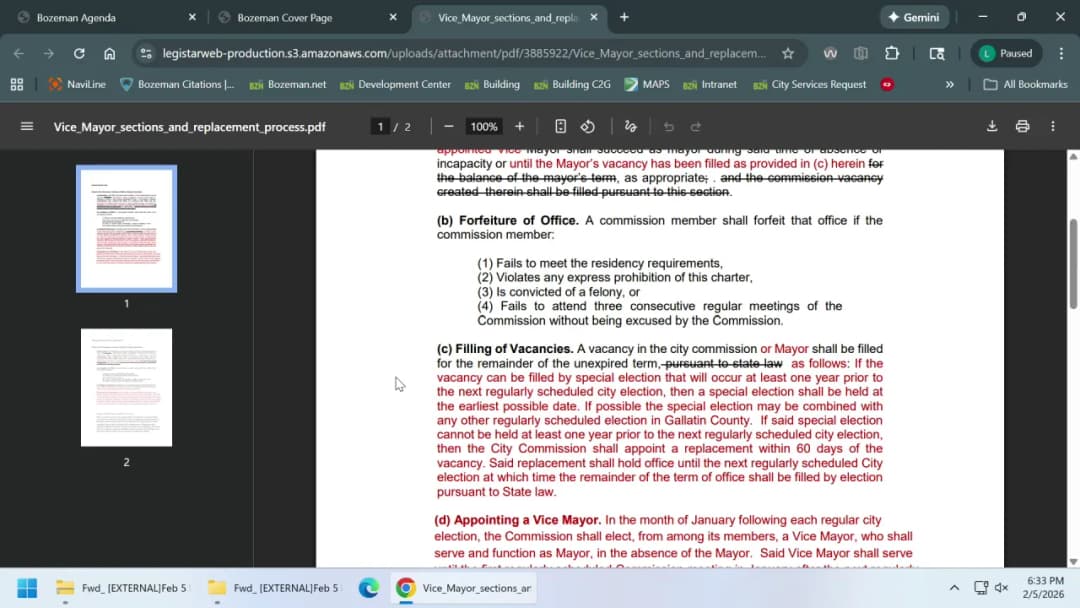
The Bozeman City Study Commission met on February 5, 2026, to continue discussions on potential changes to the city's charter. Key topics included filling commissioner vacancies, the role of the mayor, the commission-manager form of government, commissioner duties, and public engagement. The meeting featured a presentation by Dan Clark on various models of executive power and included public testimony opposing certain proposed changes. Consent Calendar - Approved unanimously. Public Comments & Testimony - James Linsky (North Tracy Avenue) expressed strong opposition to dividing Bozeman into wards, drawing on his 14 years as a county commissioner. He argued that at-large voting ensures commissioners consider the entire community. He also supported increasing the commissioner stipend. - Abby Jones (Gallatin Valley Sentinel) urged that commissioner vacancies be filled by special election rather than appointment, noting that four out of five recent appointees won subsequent elections due to incumbency advantage. She opposed transitioning to full-time commissioner or mayor salaries, stating it would exclude working residents and create career politicians. She supported expanding to seven ward-based seats. - James Diltz (2204 Buckrake Avenue) disagreed with the statement that low public engagement indicates satisfaction. He recommended vacancies be filled by election, opposed full-time positions, and suggested lowering pay to match smaller communities like Billings. - Natsuki Nakamura (Bozeman resident) commented later on the vice mayor and vacancy processes, advocating for clear criteria and consistent appointment procedures. Correspondence/Study Commission Update - The commission discussed outreach efforts, including an upcoming op-ed series, radio appearances (February 17), and presentations to neighborhood associations and the League of Women Voters (March 23). - Anna and Stan presented a summary of January's digital media campaign: reach of 26,000, 808 clicks (3% engagement rate), and an 83% drop in landing page performance. Commissioner Deanna questioned effectiveness, noting low conversion and demographic gaps (limited reach to ages 55+). Mike explained technical issues with website updates and that the engagement rate was within industry standards. The campaign’s goal was awareness; further adjustments were planned for February. Presentation by Dan Clark – Executive Branch Options - Dan Clark, from the Montana Department of Commerce, presented various models of municipal executive power: the commission-executive (strong mayor/strong council), commission-manager, and a hybrid with a Chief Administrative Officer (CAO). - He detailed statutory options for appointing/removing department heads, veto power, and budget preparation, using examples from Montana cities (Missoula, Great Falls, Bozeman). - Clark noted that Bozeman’s current charter gives the elected mayor some executive functions (e.g., intergovernmental relations, agenda-setting), unlike purely ceremonial mayors in other cities. He also discussed the importance of clear roles between a city manager and commission to avoid operational conflicts. Discussion Items – Unfinished Business Process to Appoint Vice Mayor - The commission considered language to replace the former deputy mayor position with an annually elected vice mayor from among the commission, to serve in the mayor’s absence. The motion included placement in Section 2.03 (Mayor). - Motion passed unanimously. Filling Commissioner Vacancies - Debate centered on the 30-day appointment process versus requiring a special election for vacancies with more than one year remaining. Public testimony supported special elections due to perceived incumbency advantage and transparency concerns. - Logistics were discussed: special elections require at least 85 days, cost roughly $105,000 at-large (less with wards), and must be coordinated with the county elections office. Mike noted that 60 days would improve the appointment process and allow more public input. - A motion to table the discussion for further study (including inviting the elections office) passed 4-0 with one abstention. Duties of Commissioners - A proposal to require the city to adopt a formal commissioner job description, reviewed every five years, was debated. Some argued it would provide clarity for candidates and the public; others worried about rigidity given changing state laws. - Motion passed unanimously (to be included in the charter as a requirement, with the job description adopted by resolution within 90 days of charter approval). Key Outcomes - Approved: Creation of a vice mayor position (annually appointed, serves in mayor’s absence). - Approved: Requirement that the city adopt a commissioner job description, updated every five years. - Tabled: Discussion on filling vacancies (special election vs. extended appointment) for the next meeting on February 18, with additional research and a potential visit from the elections office. - Next Steps: February 18 meeting will focus on continued learning about executive leadership and preliminary discussion on number of commissioners, compensation, and the commission-manager vs. mayor-council system. Preliminary decisions are targeted for March 5.

CHARTER REVISION 27% · GOVERNMENT ETHICS 22% · ELECTION PROCEDURES 16% · PUBLIC ENGAGEMENT 9%
144
FEB 4, 2026 · BOZEMAN, MONTANA · CITY COMMISSION
Bozeman Economic Vitality Board Meeting - February 4, 2026

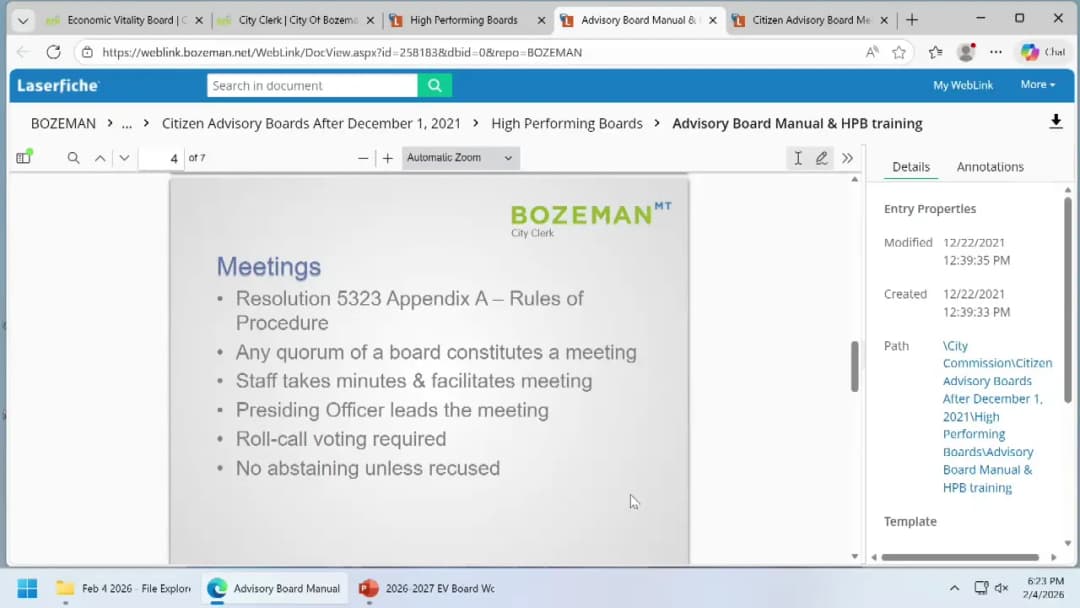
The Economic Vitality Board (EVB) of Bozeman, Montana, met on February 4, 2026, to onboard new members and discuss the 2026-2027 two-year work plan with a focus on economic development and housing. Following staff presentations and board discussion, the board unanimously approved the economic development and housing elements of the work plan, deferring the belonging and public art components to the March 4, 2026 meeting. Public Comments & Testimony - Daniel Cardi (Bozeman resident) spoke twice. First, he requested that the board record dissenting opinions in its minutes and forward both majority and minority views to the city commission, arguing that dissent plays a vital role in constitutional democracy. Later, during the work plan discussion, he urged the board to prioritize local sector jobs over traded sector jobs and to focus on raising wages in local area jobs, citing a 2019 study on high-tech growth effects in the UK. Discussion Items - Onboarding Presentation: Deputy City Clerk Alex Newby presented board norms, procedures, and ethics, emphasizing the "one body, one voice" principle, communication rules, and attendance expectations. In response to Mr. Cardi's earlier comment, staff noted that official minutes are the video recording and that providing dissenting opinions is not city practice. Commission Liaison Douglas Fisher said he would work to convey points of friction in board votes to the full commission. - 2026-2027 Two-Year Work Plan – Economic Development: Staff Liaison Britt Fontenot outlined work plan items including traded sector business development, workforce development, the child care portal (supported with $25,000 in city funding), MSU Innovation Campus support (with urban renewal district and PDZ zoning), and annual market data reports. He proposed updating the five-year Economic Vitality Strategy in 2027, which would involve board leadership. Fontenot noted that the department has limited capacity and that adding work requires removing other items. - 2026-2027 Two-Year Work Plan – Housing: Community Housing Manager Brian Geyer (newly hired) presented housing work plan items including: using CDBG funds ($350,000/year) for Family Promise water/sewer infrastructure to enable transitional housing units; revising the Affordable Housing Ordinance (cash-in-lieu rates, for-sale provisions, and new incentives to replace parking relaxations lost under state law effective October 2026); advancing the Fowler Housing Project (a city pilot for workforce homeownership with land trust restrictions); updating the housing needs assessment (last done pre-pandemic); and establishing a housing stewardship program to monitor compliance of LIHTC and other below-market units. - Board Questions & Discussion: Board members asked clarifying questions about staff capacity, incentives for developers (e.g., innovation campus PDZ, TIF), potential walkability design levers, and the role of the city in monitoring LIHTC property management. Member Natsuki Nakamura requested clearer guidance on where the board could contribute, particularly on the strategy refresh and CDBG planning. Some members expressed interest in the housing needs assessment update and exploring additional subsidy sources. - Public Comment on Work Plan: Daniel Cardi reiterated his request to prioritize local sector jobs over traded sector jobs, stating that the traded-sector multiplier effect does not guarantee living wages. Key Outcomes - Motion passed unanimously (6-0) to approve the economic development and housing elements of the 2026-2027 EVB Two-Year Work Plan. - The belonging and public art components of the work plan were deferred to the March 4, 2026 meeting due to staff unavailability. - Staff will provide the board with a clearer outline of expected board involvement at the next meeting, and will arrange security training and Robert's Rules training as requested.

AFFORDABLE HOUSING 29% · ECONOMIC DEVELOPMENT 25% · BOARD OPERATIONS 18% · PROCEDURAL 9%
145
FEB 3, 2026 · BOZEMAN, MONTANA · CITY COMMISSION
Bozeman City Commission Meeting – February 3, 2026

The Bozeman City Commission met on Tuesday, February 3, 2026, at 6:00 PM in the Commission Room at City Hall, 121 North Rouse. Commissioners Joey Morrison (Mayor), Jennifer Madgic, Emma Bode, and Alison Sweeney were present; Deputy Mayor Douglas Fischer was excused. The meeting covered a consent agenda, public comment on a non-agenda item, and a single action item regarding the Gooch Hill Area Plan. Consent Calendar - H.1 Accounts Payable Claims Review and Approval - H.2 First Amendment to Professional Services Agreement with Dowl, LLC for MSU Interceptor Improvements - H.3 First Amendment to Master Services Agreement with Hennebery Architects, LLC for Public Works Facility Expansion - H.4 Resolution approving Change Order Two to the Smith River Construction Contract for the Story Mill Splash Pad (installing a fence and relocating a UV water-cleaning system to comply with state law) - H.5 Resolution authorizing an INTERCAP Loan with the State of Montana Board of Investments for a jetting and vacuum vactor truck for stormwater - H.6 Resolution confirming City Commission Liaison Assignments All consent items were approved unanimously (4–0) without public comment. Public Comments & Testimony - Daniel Carty (Bozeman resident) spoke during general public comment. He urged the Commission to reconsider its December 16, 2025 decision that increased the maximum allowable building height in the B3 zone from 70 feet to 90 feet “by right.” He requested the issue be placed on the commission’s calendar as an action item within four months and argued that returning to 70 feet would allow the city to collect affordable housing funds via the AHO, preserve historical character, and provide a gradual transition from the 60-foot limit in B3C (historic Main Street). No public comment was offered on the consent agenda or on the action item. Discussion Items - J.1 – Gooch Hill Area Plan – Professional Services Agreement and Community Engagement Plan - Utilities Director Shaun Kotz presented the background on the proposed Gooch Hill Sanitary Sewer Lift Station, which would serve a service area of roughly 3,166 acres. The first phase (approximately 2,000 acres) would provide sewer capacity for about 20 years, with a long-term build-out capacity of about 5,000 acres extending south of Huffline. The lift station is in the city’s CIP but the area plan is not legally required—it is a proactive planning effort. - Consultant Chris Naumann (Sanbell – Rocky Mountain) outlined the scope of work, which includes layering the Transportation Master Plan, Trails Plan, and Gallatin Valley Sensitive Lands Plan to create a base map, then conducting community engagement through Engage Bozeman (webpage, direct mail, social media, online surveys, and in-person events). The plan will comply with the Montana Land Use Planning Act (MLUPA) and support the Community Plan’s seven themes. - Commissioner discussion covered: how to engage private property owners (direct mail, yard signs, partnerships with organizations like Gallatin Valley Land Trust); the use of Sensitive Lands data (wildlife corridors, groundwater recharge, prime farmland); coordination with the Triangle Plan and the MPO; and the need to involve additional city boards (Sustainability Board, Transportation Board). Commissioners emphasized that this is an opportunity to proactively plan for growth, protect natural resources, and create walkable neighborhoods with commercial nodes. - Commissioner Sweeney disclosed that her father and stepmother live in the Gooch Hill area. Commissioner Bode asked that the Sustainability Board and Transportation Board be added as stakeholders; the consultant agreed. Key Outcomes - Authorize Absence: Motion to excuse Deputy Mayor Fischer passed 4–0. - Approval of Minutes: Minutes of the December 17, 2024 regular meeting approved 4–0. - Consent Agenda: Items H.1 through H.6 approved 4–0. - Motion 1 (Professional Services Agreement): Authorize the City Manager to sign a Professional Services Agreement with Sanbell – Rocky Mountain for the Gooch Hill Area Plan. Passed 4–0. - Motion 2 (Community Engagement Plan Resolution): Adopt the resolution for the Gooch Hill Area Plan Community Engagement Plan. Passed 4–0. - Commissioner Bode mentioned a written public comment inquiring about installing summer recreation equipment (tennis/pickleball nets) due to the lack of snow; the City Manager agreed to discuss with the Parks Director. - The meeting adjourned at approximately 7:05 PM.

LAND USE PLANNING 27% · PROCEDURAL 26% · COMMUNITY ENGAGEMENT 20% · ENVIRONMENTAL PROTECTION 9%
146
FEB 2, 2026 · BOZEMAN, MONTANA · CITY COMMISSION
Community Development Board Meeting - February 2, 2026

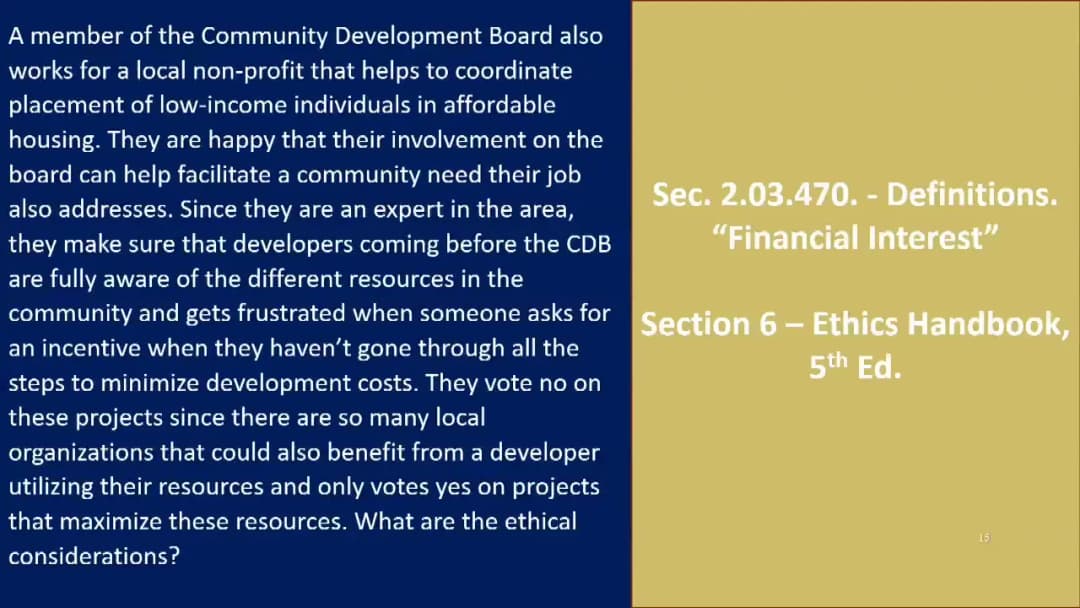
The Bozeman Community Development Board met on February 2, 2026, at 6:00 PM, with five of seven members present: Erik Bonnett, Chris Egnatz, Mark Egge, Ben Lloyd, and Lauren Mitro. Jason Delmue and Courtney Johnson were excused. Mayor Joey Morrison attended but did not vote. The meeting covered approval of previous minutes, annual ethics training, and a preview of upcoming board training. Consent Calendar - Approval of minutes from November 17, 2025, and January 26, 2026: Motion by Mark Egge, second by Chris Egnatz. Approved unanimously (5-0). Public Comments & Testimony - No public comments were made, either in person or online. Discussion Items - City Ethics Training (F.1): Chris Saunders conducted the annual ethics training, reviewing the city's ethics code, state law requirements, and the High Performing Boards Resolution (5323). The training used five hypothetical scenarios to explore conflicts of interest, disclosure obligations, public perception (the "front page test"), the principle of "one body, one voice" for board communications, and the importance of impartial decision-making. Board members and Mayor Morrison participated in the discussion, emphasizing that when in doubt, members should consult the city attorney and disclose potential conflicts on the record. - Upcoming Items for February 23, 2026 (F.2): Staff announced that the next regular meeting would be held on February 23, 2026 (moved from the usual first Monday due to the Presidents' Day holiday). The agenda will include training on new quasi-judicial responsibilities for appeals and on zone map amendments, reflecting recent state law changes. Staff also noted an appeal hearing scheduled for the following evening (February 3) at the City Commission meeting, which board members were invited to observe. Key Outcomes - Approved the minutes from the November 17, 2025, and January 26, 2026, meetings. - Completed the annual ethics training for the board. - Next CDB meeting scheduled for February 23, 2026, with specialized training sessions.

GOVERNMENT ETHICS 53% · ETHICS TRAINING 31% · PROCEDURAL 6% · BOARD OPERATIONS 4%
147
JAN 29, 2026 · BOZEMAN, MONTANA · CITY COMMISSION
Transportation Policy Coordinating Committee Meeting - January 29, 2026

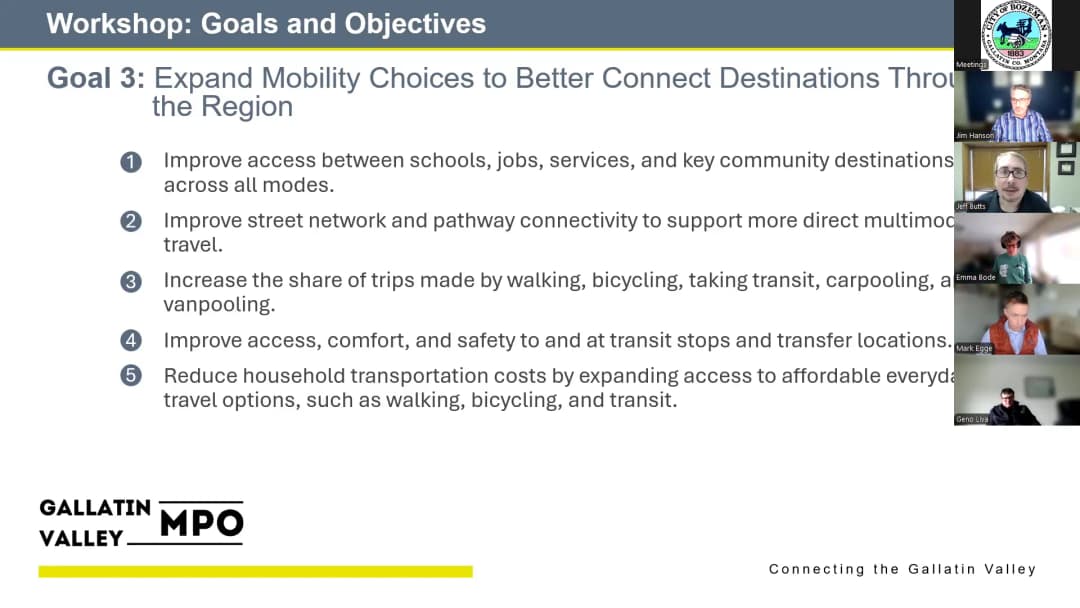
The meeting was held on January 29, 2026, primarily to conduct a workshop on the draft vision, goals, and objectives for the Gallatin Valley Long-Range Transportation Plan (LRTP). The committee also addressed organizational matters including the nomination of a chair and vice chair, and approved previous meeting minutes. Consent Calendar - Approval of Minutes (December 10, 2025): The minutes from the December 10, 2025 Gallatin Valley MPO meeting were approved unanimously (5-0). Public Comments & Testimony - No members of the public requested to speak. Discussion Items - Organizational Matters - Chair/Vice Chair Election: The committee discussed the nomination of a chair and vice chair for the year. Current chair (Mayor Cunningham) and vice chair (Commissioner McFarland) were absent. A motion to nominate Mayor Morrison as chair (with Commissioner McFarland as vice chair) was moved, but after discussion the motion was withdrawn. The committee voted unanimously (5-0) to table the election until the February meeting. Staff representative Jeff Butz was then nominated and unanimously (5-0) approved to act as chair for this meeting only. - Workshop on Draft LRTP Vision, Goals, and Objectives (Item E1): Staff presented a draft vision statement and five goals, developed from public outreach (168 survey responses, community events, TTAC input, and a community advisory panel). The committee reviewed each goal and associated objectives, offering substantive feedback: - Goal 1: Safe and Secure Travel Across All Modes. Members recommended removing “perceived” safety in favor of “removing safety barriers”; eliminating the per-capita qualification for fatality reduction; and adding an objective addressing coordination with MDT to adjust speed limits contextually. - Goal 2: Ensure a Reliable, Resilient, and Well-Maintained System. Members suggested splitting this into two separate goals – “System Preservation” (standalone) and “Reliability and Resilience” – to allow clearer resource allocation. They also recommended replacing “efficient movement” with “reliable movement” and moving “emerging technologies” to Goal 3 or treating it as an overarching theme. - Goal 3: Mobility Choices to Better Connect Destinations. Members supported renaming “walking, bicycling, and transit” to “multimodal” for consistency and to include all modes. - Goal 4: Enhance Health and Quality of Life While Protecting Regional Character. Members emphasized that active transportation objectives should first address travel options for those without car access, not just health benefits. - Goal 5: Coordinate Transportation and Land Use. Members urged making the coordination two-way (land use plans should also consider transportation plans) and adding explicit language on working with the Highway Commission and MDT on speed limits and transit stops on state highways. - Staff will incorporate committee feedback, take it to TTAC for review, and return the revised goals and objectives for adoption at the February TPCC meeting. Key Outcomes - The election of chair and vice chair was tabled to the February 2026 meeting. - Jeff Butz (staff) was appointed acting chair for the January 29 meeting (vote: 5-0). - The committee provided detailed direction on revisions to the LRTP vision, goals, and objectives. Staff will revise the draft, consult with TTAC, and present a final version for adoption at the next TPCC meeting.

TRANSPORTATION SAFETY 44% · PROCEDURAL 18% · LAND USE PLANNING 11% · BOARD OPERATIONS 7%
148
JAN 28, 2026 · BOZEMAN, MONTANA · CITY COMMISSION
Bozeman Transportation Board Meeting – January 28, 2026: Ethics Training and Work Plan Discussion

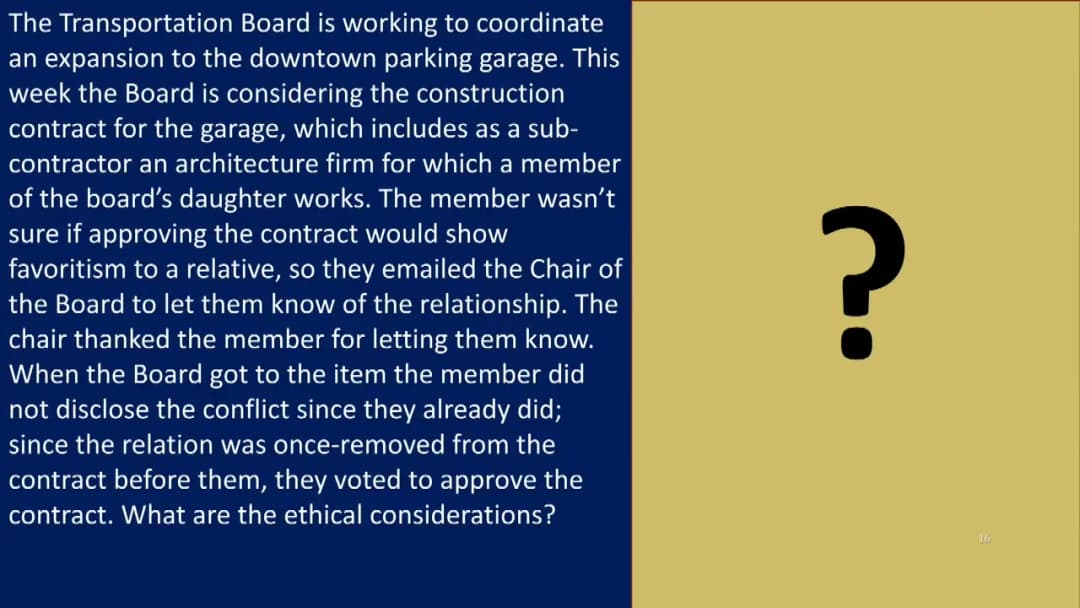
The Bozeman Transportation Board met on January 28, 2026, to conduct annual ethics training and review the draft 2026-2027 advisory board work plan. The board also acted on several agenda modifications, received department updates, and set the stage for adopting the final work plan in February. Consent Calendar - Approval of Minutes: The board unanimously approved the minutes from the November 20, 2025 meeting. Public Comments & Testimony - No members of the public provided comment, either in person or online. Discussion Items Department Updates (Director Nick Ross) - Director Ross congratulated Rio Rowling as the new board chair and Mike Vasilick as vice chair for the next two years. - He noted two vacant board positions, with one applicant currently under consideration. - He announced that the citywide Neighborhood Traffic Calming program is now live and encouraged board members to promote it. - The Safe Streets for All Safety Action Plan RFP has been advertised; consultant selection is expected by early February, with work anticipated to begin around March. - The construction contract for the North 27th Street connection (Baxter to Cattail) will be advertised at the end of the week, with construction planned for this summer. Ethics Training - Director Ross led the annual 2025 city ethics training, focusing on conflicts of interest, disclosure, recusal, and impartiality. - The board worked through five scenarios covering financial disclosure, speaking as a board member vs. individual, agenda setting for personal benefit, use of position to benefit a personal nonprofit interest, and nepotism. - Board members engaged in discussion, questioning the boundaries of impartiality and the role of board members in shaping policy vs. applying existing criteria. - The training concluded with the board certified as ethical for the year. 2026-2027 Advisory Board Work Plan - Director Ross presented a draft work plan organized under four categories: Board Governance, Planning Efforts, Capital Efforts, and Policy Efforts. - Key proposed items included: - Transportation Master Plan (TMP) Update: Funding begins July 1, 2026, with board involvement in scoping and review. - Comprehensive Safety Action Plan: Grant-funded, to be conducted in parallel with the TMP. - Meetings with Gallatin Valley MPO and UTD board: Scheduled for enhanced regional coordination. - Capital Projects: Sourdough Road, College Street (11th-19th), and the shared-use path along North Frontage Road. - Parking and Curb Management: Downtown parking work group, curb management, metered parking policy considerations, and permit district evaluation. - E-Bike Policy: Development of ordinance language for shared-use paths. - Board members provided feedback: - Mike Vasilick expressed strong support for prioritizing the TMP update and emphasized the importance of collaboration with MPO and UTD. - Hayden questioned the timing relative to the MPO's long-range plan and suggested the work plan may have too many meetings. - Chair Rio Rowling supported moving up the Frontage Road path planning and showed interest in a metered parking pilot on College Street. - A board member noted the need to revisit the two downtown permit districts, particularly the high school district, which appears underutilized. - Another member suggested the 'parking kiosk update' item might be more operational than strategic, and recommended public engagement on design. - Director Ross agreed to incorporate the feedback and will bring a revised draft for a vote at the February meeting. Key Outcomes - Agenda Modifications: The board voted to excuse board member Shannon Mahori and to move the ethics training to the first agenda item (both passed unanimously). - Administrative Review Board Selection: Continued to the February meeting due to insufficient members in attendance to make selections. - Minutes Approved: Unanimously approved minutes from November 20, 2025. - Ethics Training Completed: Annual requirement fulfilled for 2025. - Work Plan Next Steps: Staff will revise the draft work plan based on board discussion and submit it for formal adoption at the February meeting.

GOVERNMENT ETHICS 24% · TRANSPORTATION SAFETY 22% · PARKING 20% · ETHICS TRAINING 14%
149
JAN 28, 2026 · BOZEMAN, MONTANA · CITY COMMISSION
Bozeman Study Commission Meeting Summary – January 28, 2026

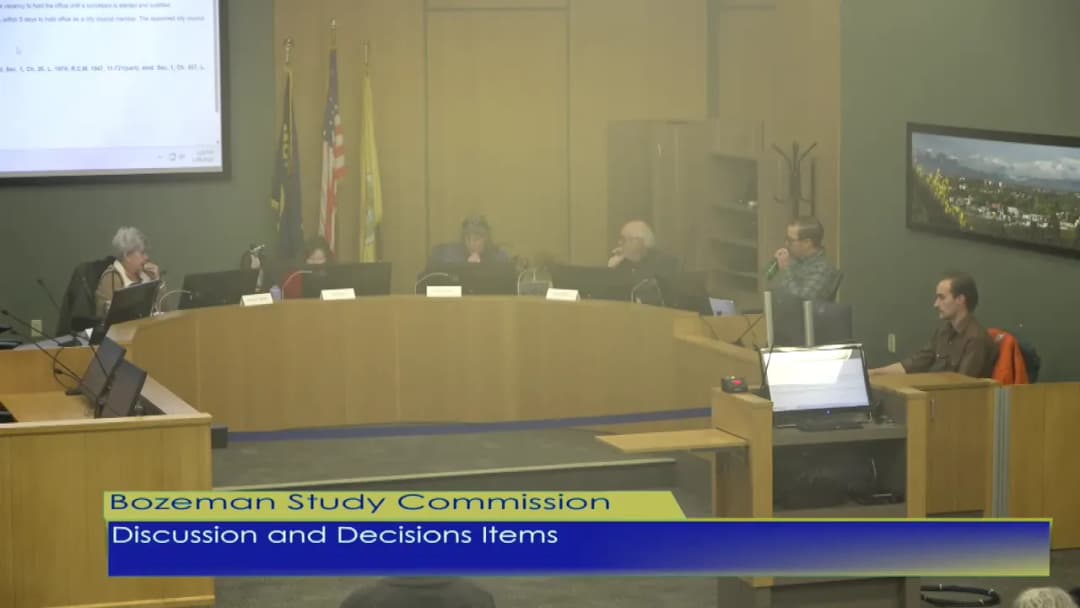
The Bozeman Study Commission met on January 28, 2026, from 4:00 PM to approximately 6:04 PM to discuss proposed changes to the city charter. The Commission addressed five agenda items related to the role of deputy mayor, partisan elections, filling commissioner vacancies, other elected offices, and scheduled future discussions. The meeting included public testimony, commissioner deliberations, and votes on preliminary charter amendments. Public Comments & Testimony - Mary Bateson (Bozeman resident) opposed splitting the electorate into wards, arguing that commissioners should consider the whole city and that low pay discourages broad representation. She advocated for increased commissioner compensation rather than wards. - Jim Webster (Bozeman resident) raised concerns about public notice and transparency, citing the recent UDC second reading process. He also urged the Commission to recommend restoring advisory board powers that state law has diminished. - Daniel Carty (213 North Third, Bozeman) proposed increasing the commission to seven members, eliminating the deputy mayor, making the city attorney an elected nonpartisan position, introducing six district seats plus an at-large mayor, imposing term limits (max six years total among offices), and granting the mayor a veto overrideable by a 5-2 vote. - Dar Armstrong (name from minutes) provided comment but no transcript details; position not recorded. - Emily Talago (Bozeman resident, remote) supported nonpartisan elections and argued that commissioner pay should be a livable wage rather than part-time/full-time designation. She suggested that filling vacancies can include additional criteria under state law. - Lara Grochowski (final public comment) questioned the extent of state control over local decisions and requested data on voter turnout for special elections; Ex Officio Mike Maas noted that the 2020 parks and trails district election had about 27% turnout. Discussion Items - Deputy Mayor Position (Section 2.03(b)): Commissioners supported eliminating the deputy mayor role. Commissioner Taylor noted the current system (elected mayor serves as deputy for first two years) causes confusion and limits intergovernmental relations. Commissioners Franks, Campbell, Strout, and Cestero agreed. The discussion also addressed creating a mayor pro tem to serve when the mayor is incapacitated. After debate about proper notice, a motion to eliminate the deputy mayor and draft a process for a mayor pro tem passed 4-1 (Taylor, Franks, Cestero, Strout in favor; Campbell opposed). - Partisan vs. Nonpartisan Elections (Section 6.01(a)): All five commissioners expressed support for retaining nonpartisan elections, citing public comment, the model city charter, and the fact that all Montana cities use nonpartisan local elections. A motion to keep nonpartisan elections passed unanimously (5-0). - Filling Commissioner Vacancies (Section 2.06(c)): The City Attorney explained that state law (MCA 7-3-704 and 7-3-708) sets a 30-day appointment requirement but allows the charter to specify a different method. Commissioners debated the tradeoffs of special elections (cost $100,000–$135,000, low turnout) versus extended appointment periods. Strout proposed a 60-day window; Franks echoed the need for more time while opposing special elections; Campbell supported special elections; Taylor suggested a hybrid approach based on remaining term length. No motion was made; the item was tabled for further research and will be revisited on February 5, 2026. - Other Elected Offices (Article IV): Commissioners unanimously agreed to keep the city attorney, police chief, and other professional positions as appointed rather than elected. They cited the need for expertise and nonpartisan professionalism. A motion to retain Section 4.03 (Legal Officer) as an appointment passed 5-0. - Items 5 and 6 (Duties of Commissioners; Number of Commissioners and Part-time/Full-time): These items were deferred to the February 5, 2026 meeting due to time constraints. Key Outcomes - Motion 1 (Deputy Mayor Elimination) carried 4–1 (Approve: Taylor, Franks, Cestero, Strout; Disapprove: Campbell). Staff will draft charter language eliminating the deputy mayor and adding a process for a mayor pro tem, to be reviewed at a future meeting. - Motion 2 (Nonpartisan Elections) carried 5–0 to retain nonpartisan elections for mayor and commissioners. - Motion 3 (Other Elected Offices) carried 5–0 to keep Section 4.03 (Legal Officer) as an appointed position. - Vacancy filling discussion was tabled; commissioners requested cost and turnout data for special elections and further legal analysis. - Future Meetings: The February 5, 2026 meeting will begin with a learning session on executive structure (city manager vs. strong mayor) presented by City Manager Dan Clark, followed by resumed discussion on vacancy filling, duties of commissioners, and number of commissioners. Decisions are preliminary until the final charter draft in May 2026.

CHARTER REVISION 27% · ELECTION PROCEDURES 22% · PUBLIC ENGAGEMENT 14% · GOVERNMENT ETHICS 14%
150
JAN 27, 2026 · BOZEMAN, MONTANA · CITY COMMISSION
Bozeman City Commission Regular Meeting - January 27, 2026

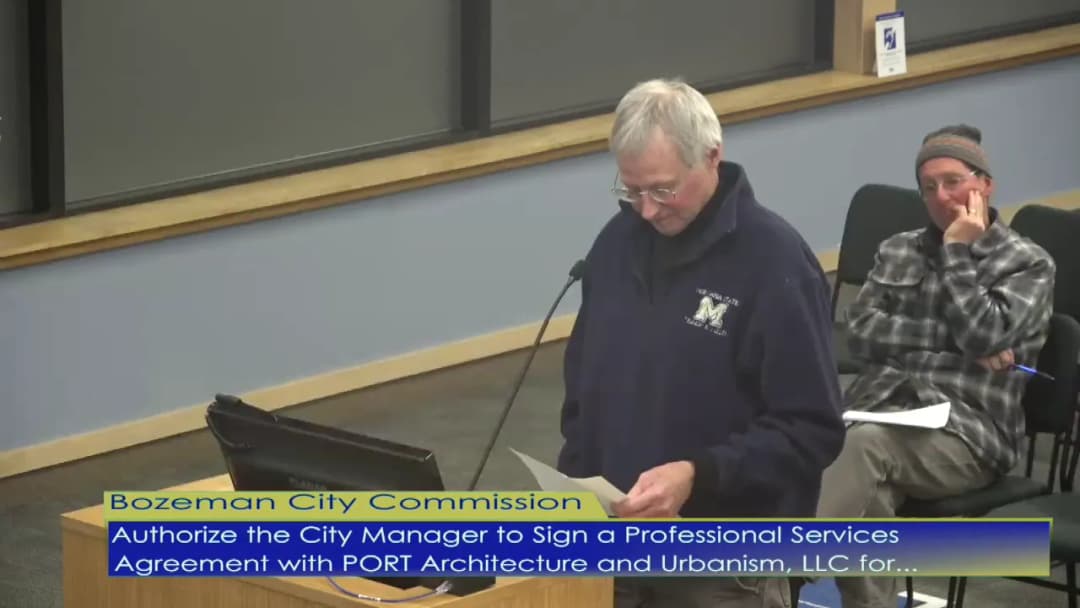
The Bozeman City Commission met on January 27, 2026, at 6:00 PM in the Commission Room at City Hall. Commissioners present: Joey Morrison (Mayor), Jennifer Madgic, Emma Bode, Alison Sweeney. Deputy Mayor Douglas Fischer was excused. The meeting covered consent items, a special presentation on child care, and an action item for the Bozeman Creek Vision Plan. Key decisions included approval of consent items and authorization of a professional services agreement for the vision plan, with direction to adjust project goals. Consent Calendar - Items F.1–F.8 approved unanimously (4-0). F.9 (Special Improvement Lighting District 795 for SRX II) was not included in the motion and was effectively deferred. - F.2 (Hidden Creek Minor Subdivision final plat): 182 dwelling units, 100% permanently rent-restricted, 25% of units restricted to tenants earning 30% of Area Median Income (AMI), overall average 60% AMI. The project is a low-income housing tax credit project in partnership with Gallatin County, United Housing Partners, and HRDC. - F.5 (2026 Urban Forest Management Plan with DJ&A): Public comment by Daniel Carty (resident) supported the plan, emphasizing a holistic forest management approach. Jeff Ball (resident) commented on tree maintenance funding and non-boulevard tree corridors. - Other items included accounts payable, irrigation/landscape maintenance agreements, a change order for the WRF MCC project, and resolutions for special improvement lighting districts. Public Comments & Testimony - Jim Webster (South Third Avenue, HPAB member, speaking for himself) commented on the Preserve Historic Bozeman Coalition, urging a survey of best practices from other historic cities regarding height regulations (B-3, 90-foot zoning). He noted 309 signatures on the coalition petition. - Mark Campanelli (Bogert Park neighbor) spoke about the importance of stay-at-home parents in economic data, cautioning against labeling them as "non-working." Special Presentation: Child Connect - Tori Sproles, Director of Early Learning at Greater Gallatin United Way, presented on child care affordability and accessibility. Key statistics: child care costs in Montana range from 13% to 36% of household income (Gallatin County 23%–25%); 64,000 adult Montanans cannot fully engage in the workforce due to child care responsibilities. The Child Connect initiative launched Kinside, an online child care search platform, in September 2025. As of the presentation: 47 open slots across four counties, 822 page views, 210+ people engaged. The program also includes a business subsidy program and updated 45F tax credit for employer-provided child care. Discussion Items - Bozeman Creek Vision Plan (Action Item I.1): Assistant City Manager Jon Henderson, along with Jim Madden and Steve Noble of See Bozeman Creek (SBC), presented the proposal to authorize a $150,000 professional services agreement with PORT Architecture and Urbanism, LLC. The plan aims to enhance flood mitigation, improve water quality, increase access, support economic vitality, and strengthen community connection. Henderson clarified that the plan is not a watershed study and will not immediately solve the Main Street tunnel flood conveyance issue. SBC will serve as a community partner, not a decision-maker. Seven proposals were received; PORT was selected via a committee. - Public Comment on I.1: - Pete Geddes (resident) supported the plan. - Angie Kociolek (INC Northeast Neighborhood rep, speaking personally) asked to delay approval to add explicit ecological health goals and clarify the role of SBC, noting a past instance where SBC letterhead supported a watercourse setback variance for a hotel. - Mark Campanelli (Bogert Park neighbor) raised flood risk concerns for his neighborhood and urged economic analysis. - Daniel Carty (resident) requested reinstating "increase ecological health" as a goal and adding an ecologist to the consultant team. - Zera Osman (INC alternate, speaking personally) supported adding ecological function and an ecologist, and suggested including adjacent residents as stakeholders. - Marcia Kaveney (resident, co-founder of Bozeman Tree Coalition) supported adjusting wording to "ecological health" and "economic vitality" and urged broader community engagement. - Commission Discussion: Commissioners expressed support for the plan but raised concerns about missing ecological health as a goal and the term "economic development." Commissioner Sweeney proposed adding "ecological health" to the water quality goal and changing "economic development" to "economic vitality." The City Manager and Assistant City Manager agreed to incorporate these changes without amending the contract, as they would not affect the scope of work. The timeline was noted, with a flag that the November 2 presentation date conflicts with Election Day. Key Outcomes - Consent Calendar approved 4-0 (Items F.1–F.8). - Action Item I.1 approved 4-0 to authorize the City Manager to sign the professional services agreement with PORT Architecture and Urbanism, LLC for the Bozeman Creek Vision Plan. The commission directed staff to add "increase ecological health" to the water quality goal and replace "economic development" with "economic vitality" in the project goals. The timeline will be adjusted to avoid Election Day. - No other action items. - FYI: Commissioner Bode announced the Streamline Bus app launch. Commissioner Sweeney updated on Historic Preservation Advisory Board projects (Local Landmark Program update, NCOD design guidelines). Mayor Morrison announced liaison changes and a trip to Washington, D.C. for transportation infrastructure funding discussions. City Manager Winn reaffirmed that the Bozeman Police Department does not enforce immigration laws, emphasizing community policing and civil dialogue.

ENVIRONMENTAL PROTECTION 19% · COMMUNITY ENGAGEMENT 18% · CHILD CARE 13% · FLOOD MITIGATION 11%
OPENPUBLICA · PUBLIC MEETING INDEXUPDATED DAILY · openpublica.com