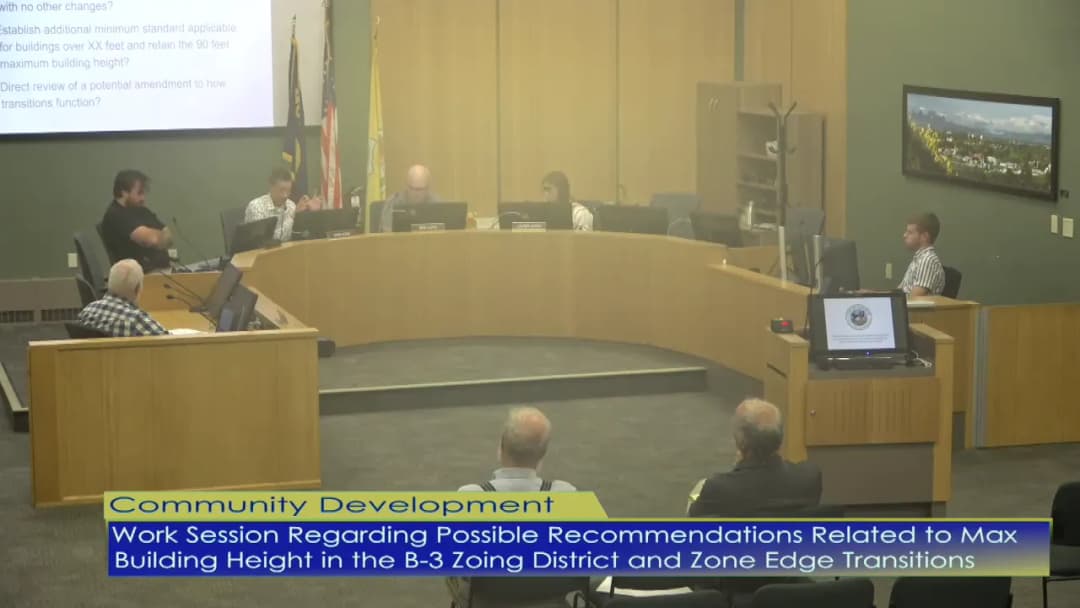
The Bozeman Community Development Board (CDB) held a work session on August 3, 2026, to discuss possible recommendations to the City Commission regarding the maximum building height in the B-3 zoning district and zone edge transitions. The meeting included a presentation by staff, public testimony, and board deliberation on four questions posed by the commission. The board ultimately voted to recommend retaining the 90-foot height maximum and considering additional stepbacks or setbacks for buildings above a defined height. The board also expressed support for exploring a code amendment to allow a "fair across the line" minimum development standard on the burdened side of a zone edge. Consent Calendar - The minutes from the July 20, 2026 meeting were approved unanimously (6-0). Public Comments & Testimony - David Losef (owner/developer of Backstory, and other downtown properties) opposed increasing the height allowance, citing examples of successful downtowns with lower height limits (e.g., Charleston, SC at 50 feet; Boulder, CO; Jackson, WY; Vail, CO; Aspen, CO; Burlington, VT; Old Town Alexandria, VA). He stated that even 70 feet is double what some of those towns allow, and 90 feet is even more, and warned against harming Bozeman’s downtown vitality. - Mark Campanelli (Boulevard Park resident) criticized the process that led to the 90-foot height limit, referencing the 2019 Downtown Bozeman Improvement Plan which recommended five stories in the core and seven stories outside the core (approximately 70 feet), with stepbacks for upper floors. He argued that the stepback recommendations were omitted and questioned the public engagement that resulted in the 90-foot change. Discussion Items - Staff presented background on the B-3 height history, including the 2025 Unified Development Code (UDC) update, and provided shadow studies comparing 70-foot and 90-foot buildings. The presentation also covered zone edge transition standards, including stepback and setback requirements, and examples from other communities. - Board members debated the four questions from the commission: 1. Retain 90 feet? Most members supported retaining 90 feet, noting it was part of the UDC process and had not yet been implemented. Some cited other cities (e.g., Missoula at 100 feet, Paris at 120 feet, Washington DC at 130 feet) and argued that height is not the main issue—mass and scale matter more. 2. Direct review of a potential amendment to height (no other changes)? This was seen as redundant if question 1 was answered yes. 3. Establish additional minimum standards for buildings over a certain height? Several members supported adding stepbacks or setbacks for buildings above a defined height (e.g., 70 feet) to reduce perceived mass. Some preferred setbacks over stepbacks for creating more street-level space, while others noted structural and economic implications. 4. Review zone edge transitions? Members generally agreed that the current transition system has not been given a chance to work. Some expressed preference for fixed height limits with stepbacks/setbacks rather than modifying transition standards. There was also support for a concept called "equal across the line"—allowing the burdened parcel to develop up to the same mass/scale as the protected parcel before transition requirements kick in. The board did not vote on a motion for this but indicated majority support for further exploration. Key Outcomes - Motion passed (6-0): The board recommends that the City Commission retain the 90-foot height maximum in the B-3 zoning district, and also consider adding additional required stepbacks and/or setbacks that limit the perceived mass and scale for buildings in the B-3 zone above a defined height (applicable across the district, not just at zone edges). - Majority support for further exploration: The board indicated support for staff to investigate a code amendment incorporating the "equal across the line" principle, which would allow the burdened lot to develop to the same extent as the abutting lower-intensity district before transition requirements apply. No formal motion was made, but the sentiment will be conveyed to the commission. - The next CDB meeting is scheduled for August 17, 2026, with topics including a presentation on the city's cash and water rights program, an update on the Engage Bozeman framework, and a text amendment on wetlands review procedures.
Public Meetings - Bozeman, Montana
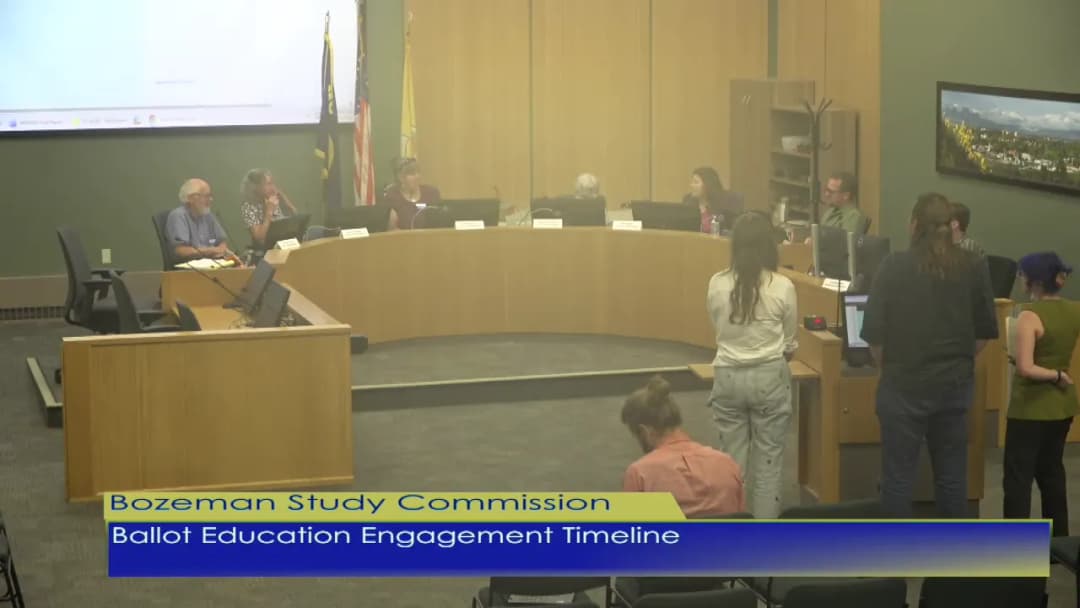
Public Meetings - Bozeman, MontanaThe Bozeman City Study Commission held a three-hour meeting on Thursday, July 30, 2026, from 4:00 p.m. to 7:02 p.m., continuing its review of the 2026 Tentative Report and receiving a ballot education engagement timeline from its consultants. The meeting included detailed edits to ballot language and approval of a treasurer for an incidental committee to manage public education efforts. Consent Calendar - The Commission unanimously approved the meeting minutes from July 23, 2026. Correspondence & Study Commission Update - Commissioner Barb reported on a July 27 presentation to the Valley West Neighborhood Association, which was well-received despite being cut short by a thunderstorm. - Ex Officio Mike Maas provided updates on ballot logistics: the Gallatin County elections administrator confirmed there are 27 precincts within city limits, and each precinct will require a different ballot layout due to randomized sub-option order. Mr. Maas recommended listing the "current" option first in sub-options. He also noted that the city's ballot may trigger a third page if county, school, and other questions are added, affecting cost sharing with Monfortin. Public Comments & Testimony - City Attorney Greg Sullivan addressed a public comment question regarding the use of the word "recommend" in the report. He stated that since the ballot measure has not yet been adopted, it is permissible to use "recommend" in the report. Once placed on the ballot, public resources cannot be used to support or oppose the measure, but factual statements about the commission's recommendation remain allowed. Discussion Items - Unfinished Business – Review of 2026 Tentative Report: The Commission spent the majority of the meeting editing the report and ballot language. Key changes included: - Revised sub-option titles to improve clarity: "Size of the Commission" instead of "Composition", "Residency Requirements of Commissioners", and "Method of Electing City Commissioners if the Ward System is Approved". - Adjusted the wording of sub-options to separate the concepts of wards and election method. - Added a finding about geographic centralization of commissioners and linked it to compensation. - Corrected language in the charter regarding vacancies and mayoral succession. - Noted that a minority report may be submitted by September 6 if needed, but no commissioner committed to one. - New Business – Ballot Education Engagement Timeline: Consultants Nevin, Aaron, Audrey, and Tor presented a draft presentation, talking points/FAQs, and an engagement timeline. They advocated for a distinct brand separate from the city logo to maintain neutrality in education. The Commission discussed: - The need for printed materials (flyers, postcards) with QR codes to the website. - Staffing events: Commissioners will sign up for tabling slots; consultants will fill gaps. - Upcoming events: Sweet Pea Festival (Aug 7-8), SLAM, Farmers Market, downtown car show, and library tabling. - The website will be updated with new branding and content, archiving old materials. - Appointment of Treasurer: Mike Maas was unanimously appointed as treasurer of the incidental committee to manage campaign finance reporting, effective immediately. Key Outcomes - The Commission reached consensus on ballot language edits; Becky and Barb will incorporate all changes and circulate a clean draft by Saturday morning, August 1. Final edits must be submitted by Sunday, August 2 at 5:00 p.m. to be included in the August 6 agenda. - The final report will be adopted and signed at the next meeting on August 6, 2026. - Mike Maas will file the necessary paperwork with the Commissioner of Political Practices and act as treasurer. - Consultants will provide view-only access to the engagement spreadsheet and begin securing booth space and printing materials for Sweet Pea and SLAM. - Commissioners were asked to sign up for tabling shifts via email to Nevin.
The Bozeman City Commission held a regular meeting on July 28, 2026, at 6:00 PM in the Commission Room, City Hall. The agenda included a consent calendar, public comments, a special presentation on the Urban Forest Management Plan update, a work session on the Local Landmark Program and Neighborhood Conservation Overlay District (NCOD) design standards, and appointments to city boards. Key decisions included approving consent items, continuing a kennel license revocation appeal, and making appointments. The work session provided policy direction on the sequence of historic preservation projects and the role of the NCOD in regulating development. Consent Calendar - F.1–F.8 Approved: Accounts payable, VOCA grant agreement, hydrometeorological station purchase agreement, third addendum to MOU with Bozeman School District 7 for Sports Park facilities, professional services agreement for 2027 Transportation Master Plan Update, amendment to Lyman Creek Reservoir project agreement, final adoption of UDC housekeeping amendments for parking in B-3 district and legacy short-term rentals in RA district. All items were approved 5–0. Public Comments & Testimony - Jerry Pate (Bozeman broker, former planning board member) urged the commission to reconsider forwarding Census Tract 11.02 for Opportunity Zone 2.0 designation, arguing that the tract forwarded (Tract 6) is industrial while Tract 11.02 is housing-focused and aligns with city priorities on affordability and infill. - Marsha Caveney (Bozeman resident, co-founder of Bozeman Tree Coalition) requested adding public input opportunities to work sessions and thanked staff for inclusive language. She also advocated for tracking tree loss to development and incorporating external stakeholders earlier in the Urban Forest Management Plan process. - Daniel Cardi (Bozeman resident, Bozeman Tree Coalition co-founder) emphasized fairness in zone edge transitions and urged setting a 20-year canopy goal of 16% (rather than the recommended 12%), and called for a heritage tree program with specific guidelines. - Mark Campanelli (Bozeman resident, Bozeman Park neighbor) discussed solar energy incentives and community programs, referencing Tucson Electric Power as a model. - Emily Telego (Bozeman resident) urged the commission to revisit special assessment methods tied to zoning, given the new development code and growth. - Multiple speakers during the work session commented on the NCOD and landmark program, emphasizing the need for clarity, incremental zoning, and protection of neighborhood character without over-regulating historic homes. Discussion Items - Special Presentation: 2026 Urban Forest Management Plan (Mid-Process Update) - Consultants from DJA and Planet GEO presented the project schedule, public engagement results, staff and public survey findings, and tree inventory analysis. - Key data: Bozeman has 28,000 inventoried city trees, with roughly 10% canopy cover (baseline 9.8% for tracking). Recommended 20-year goal: 12% canopy cover (a 1/5 increase). - Ash trees make up 22% of public trees; the plan recommends reducing to 10% over 10 years to prepare for emerald ash borer (EAB), which is not yet present but expected. - The plan includes a heritage tree program starting with public trees, with criteria and model programs from seven other cities. - Commissioners asked about EAB preparedness, tree removal vs. treatment, and capacity for maintenance. Staff noted the need to balance planting and maintenance, and that the current forestry division is at capacity. - Work Session: Landmark Program and NCOD Design Standards Project Updates - Context: Bozeman's historic preservation program dates to the 1980s, with the NCOD established in 1991. Current design guidelines (2006) are vague and challenging to implement. The Local Landmark Project (Phase 2) and NCOD Design Standards Update were initiated. - Consultant issues: The contract with the Lakota Group for design standards was terminated after an incident of unprofessional behavior. Staff plan to hire a new consultant later in 2026. - Local Landmark Program: On hold per HPAB direction, which prioritized code revisions and NCOD guidelines first. The program aims to recognize sites of local historical/cultural significance without requiring National Register listing. - Demolition Code Revisions: Currently only regulate within the NCOD. HPAB recommended updated inventory forms, documentation of alternatives, and greater board involvement. The two-year stay on demolition of historic structures has never saved a building, according to staff. - Design Standards Update: Community engagement (surveys, tours, focus groups) revealed strong concerns about bulk, mass, and scale. A proposed detailed table on historic window treatment was rejected by HPAB as too restrictive. Public comments emphasized protecting neighborhood character, especially public realm features like trees, narrow streets, and porches. - Commission Direction: - Question 1 (Sequence): Majority agreed to prioritize code revisions (demolition, COA) first, then local landmark program, then NCOD design guidelines update. Some commissioners favored reordering to 1) code revisions, 2) landmark program, 3) design guidelines. - Question 2 (Modify dimensional standards through NCOD): Four commissioners (Magic, Sweeney, Bowden, Morrison) said no – they do not want to modify base zoning dimensional standards (height, width, setbacks, lot coverage) through the NCOD overlay. They prefer zoning map amendments or landmark districts as better tools. One commissioner (Sweeney) noted that overlay zones typically do modify such standards, but supported exploring landmark districts with tailored regulations. - Question 3 (Demolition): Three commissioners supported extending demolition regulations beyond the NCOD for historic structures. Three supported public notice for all demolitions. Three expressed concern that demolition processes should not be used to slow development. The two-year stay was criticized as ineffective; staff noted it has never saved a building. Commissioners expressed interest in incentives for adaptive reuse and material salvage. Key Outcomes - Continued Hearing: The appeal of the kennel license revocation for Katherine Miller (3309 Fieldstone Drive West) was continued to August 18, 2026, at 6:00 PM (5–0 vote). - Consent Agenda Approved: Items F.1–F.8 approved 5–0. - Appointments: - Downtown Business Improvement Board: Reappointed Eric Bowman (term ending June 30, 2030), appointed Erik Nelson as Chair and Ileana Indreland as Vice-Chair (5–0). - Downtown Urban Renewal Board: Appointed Amy Horton, John Howe, and Skye Cook as citizen members (terms ending June 30, 2029), and Ryan Finn as Gallatin County representative (5–0). - Policy Direction on Historic Preservation Projects: - Staff will proceed with code revisions (demolition, COA) first, using the existing consultant. - Commission directed that base zoning dimensional standards should not be modified through the NCOD; instead, other tools (zoning map amendments, landmark districts) should be explored. - Demolition regulations may be extended citywide for historic structures, public notice for all demolitions will be investigated, and incentives for adaptive reuse will be considered. - The two-year demolition stay will be reviewed for effectiveness; staff is open to alternative approaches. - Next Steps: Staff will update the scope for a new NCOD design consultant, incorporating feedback on landmark districts and tiered guidelines. The Urban Forest Management Plan will return for final approval in November 2026.
The Urban Parks and Forestry Board held a work session on the preliminary draft of the 2026 Urban Forest Management Plan (UFMP) and received updates from the Parks and Recreation Director. The meeting began with a technical delay and intermittent audio issues with remote consultants, but discussions proceeded with board members and in-person public comment. Consent Calendar - Minutes Approval: The board unanimously approved the minutes from the June 2026 meeting (motion passed 7-0). Public Comments & Testimony - Northeast Neighborhood Resident (Nina): Expressed concern about the ongoing construction at Northern Pacific Park (depot park) related to the Yards development, stating that the park appears to be losing its grass and mature trees and may become largely concrete. Asked the board to intervene to preserve a better park. - Daniel Cardi, Bozeman Tree Coalition Co-founder: Stated the coalition recommends a canopy cover goal of 18% (noting that similar cities average 18%) rather than the current plan's 10-12% goal. Emphasized the need for a bold plan that informs changes to the unified development code. Also submitted written comment on behalf of the coalition. - Marcia Caveney, Bozeman Tree Coalition Co-founder (during work session): Requested that the coalition be treated as an external stakeholder beyond just the online survey, offering expertise on tree-related codes. Urged greater focus on retaining existing mature trees during development, citing examples like Canyon Gate (250 trees removed, 11 replanted) and the Seventh and Aspen project (all trees lost). Discussion Items Work Session on the 2026 Urban Forest Management Plan (UFMP) Preliminary Draft - Presentation by Consultant Team (Josh, Matt, Hannah): The team presented the preliminary draft, noting it is near the end of Phase 2. A public comment period will follow after board and staff review. The team highlighted canopy cover analysis, tree inventory data, and a goal implementation matrix. They explained current planting capacity (300 trees/year) and that achieving a 2% canopy increase to 12% would require 871 trees/year. A 30% city / 70% community partnership is assumed for tree planting. - Board Feedback and Discussion: - Canopy Goals: Several board members supported offering a "menu" of canopy options (e.g., 12%, 15%, 18%) with associated costs and resource needs (staffing, budget). Mitch asked for clear budget and capacity implications to present to the City Commission. Sally Schrank noted the plan must be actionable and include cost estimates to avoid commission rejection later. - Executive Summary: Board members (Sally, Joe, others) requested a concise executive summary with specific proposed actions, benefits, and costs in plain language for commissioners. The current executive summary was deemed too vague. - Tree Retention and Code Updates: Board member Matthew Cortan and others emphasized the need for stronger tree preservation measures in new developments, clearer regulations for tree removal notifications, and a heritage tree program. Consultant noted that code recommendations are in the plan (e.g., page 82) but could be better highlighted. - Mature Tree Focus: Goal 2 was noted for lacking specific actions on mature tree retention; board suggested adding more detail. - Formatting and Figures: Board member Ali praised the figures/graphs and requested more visual aids, especially for inventory condition ratings (e.g., only 2% excellent condition). - Consultant Responses: The team acknowledged board feedback and agreed to provide option scenarios with cost/resource implications, improve the executive summary, include more data visualizations, and add specific recommendations for heritage tree program and code updates in the next draft. - Technical Issues: Audio of the consultants was lost for several minutes midway through the discussion, causing a short recess. Once restored, the board continued. Director's Updates (Parks and Recreation Director) - Splash Pad: Opened successfully and very popular; three attendants on site. - Bogert Pools: Now open seven days a week due to increased lifeguard staffing. - Ability Montana: 5K walk/run and ribbon cutting for Ability Montana pathway at Lindley Park on July 25 at 9 a.m. - HRDC Partnership: Parks Department working with HRDC to address homelessness impacts on parks, particularly Glen Lake Rotary Park; training staff and engaging code enforcement and community policing. - Position Vacancy: The Parks and Cemetery Superintendent position has closed; interviews will occur next month. - Rate Study: A departmental rate study (first since 2019) will be undertaken, to come before the board before going to the City Commission. - Synthetic Turf Fields: Field 7 (rugby/multi-use) at Sports Park is operational with punch-list items; Field 14 (football/soccer) near Gallatin High School is nearly complete, opening next month for football practice. Key Outcomes - No formal votes were taken on the UFMP draft; this was a work session for feedback. - Next Steps: The consultant team will revise the draft based on board comments, including adding canopy option scenarios with cost and capacity information, improving the executive summary, incorporating heritage tree program details, and enhancing visual data presentation. A revised draft will be presented at the September 2026 work session, followed by a public comment period. - Director's Updates: Noted for information; no action required.
The Bozeman Study Commission met on Thursday, July 23, 2026, at 4:00 PM in the Commission Room at City Hall. The meeting focused on reviewing and editing the proposed charter, particularly a new section on ward boundaries (Section 7.04), and discussing revisions to the tentative charter based on public feedback and expert input. The commission aims to have a finished charter and final report ready for approval at the August 6 meeting after review on July 30. Consent Calendar - Approval of Minutes: The commission approved the minutes from July 15, 2026, by a 4-0 vote (Commissioner Carson Taylor was absent). A motion to excuse Taylor’s absence was also approved. Public Comments & Testimony - Dan Cardi (Bozeman resident): Urged the commission to remove political party affiliation from the Ward Advisory Board composition. - Katie Adams (Gallatin Valley Sentinel volunteer): Testified on several points: (1) Remove partisan language from Ward Advisory Board; (2) Recommend a 10% population deviation trigger for redrawing wards (citing Missoula city attorney’s letter); (3) Simplify candidate filing deadline language in Section 7.04C; (4) In Article 8, suggested replacing “shall” with “should” to avoid overly prescriptive language; (5) Noted potential conflicts between HOA bylaws and Inter-Neighborhood Council (INC) recognition requirements; (6) Suggested wording for public solicitation of board members. - Emily Talago (Bozeman resident): Raised that MLUPA (Montana Land Use Planning Act) may be revised by the legislature and asked for clarity on whether INC having a presentation opportunity constitutes decision-making or presentation authority. Discussion Items F.1 – Review Edits to Wards and Adjustments (Section 7.04) Commissioner Barb presented a new Section 7.04 establishing a Ward Advisory Board process, drawn from public comments, the National Civic League model, and Missoula’s approach. Key debated elements: - Political party affiliation: Commissioners unanimously agreed to remove the sentence requiring party disclosure from the board composition, as Bozeman elections are nonpartisan. - Appointment of board members: Commissioners preferred that the city commission appoint all five members, rather than four appoint a fifth chair. Jan supported this, and the public comment echoed it. - Population trigger for redrawing wards: Deanna favored a 10% threshold to avoid frequent redraws due to rapid growth; Jan argued for a five-year mid-census review instead; Mike recommended leaving the details to ordinance rather than the charter. Barb will present a revised version on July 30. - Criteria for ward boundaries: Deanna proposed adding “shall preserve existing neighborhood association boundaries to the maximum extent feasible”; Jan and Barb cautioned against over-specificity. Mike noted that compact, contiguous, and respect for political/census boundaries (including precincts) is standard. - Annexation treatment: Mike will consult Community Development Manager Chris Saunders on whether to prescribe annexation placement in the charter or leave to ordinance. - Timeline: Commissioners decided to move the first implementation to 2029 (rather than 2027) to allow adequate transition time, especially if both ward and commission expansion are approved. Deanna preferred 2027, but the majority supported 2029. F.2 and G.1 – Review Edits to Tentative Charter and Draft Final Report Barb walked through changes to Article 8 (public engagement, boards, INC), Article 6 (financial management), and Article 9 (Board of Ethics). Key discussion points: - Article 8.04 – Inter-Neighborhood Council (INC): Commissioners agreed to keep the requirement that INC shall follow the city’s code of ethics, with training implied. A sentence about presenting recommendations to the city commission was removed to avoid making INC a decision-making body. - Article 8.05 – City Boards: Carson and Jan requested reinstating Section B (purpose, number, skills) that had been removed as overly prescriptive. Mike argued the city commission should retain flexibility. After debate, commissioners supported a modified version: “The city shall establish the purpose of each board and the number of desired skills, necessary experience” without specifying “by resolution.” Section C (public education, subcommittees) remained but Barb suggested it may be too prescriptive. - Article 6.09 – Independent Audit: A sentence allowing the same firm to provide audit and other services was debated. Deanna and Becky opposed it as contrary to industry standards. Mike noted only two firms have been used in 10–15 years and one no longer provides audits. A compromise was reached: require a unanimous vote of the city commission to waive independence. - Article 9.01 – Board of Ethics: Barb removed candidates for political office from annual training requirements, citing city attorney advice that the city cannot bind candidates. No objections. - Preamble: Jan defended the inclusion of “human rights” as previously voted; Deanna noted poor parallel construction but no change was made. Deanna requested re-adding reference to the U.S. Constitution (from the 2006 charter). Barb will check and include. - Other: Edits to comply with MLUPA (Section 5.04) were accepted. Deletions of references to specific organizations like GFOA were approved. Key Outcomes - Consent agenda approved (4-0). - Direction to Barb: Revise Section 7.04 per discussion (remove party affiliation, adjust appointment process, decide on population trigger, simplify language) and bring updated version to July 30 meeting. - Direction on Charter: Barb will incorporate decisions (Article 8 revisions, audit compromise, ethics board change, preamble edits) and produce a clean document for July 30. - Final Report Edits: Commissioners must send written edits to the draft final report to Becky (via group email) by end of day Saturday, July 25. Becky will compile them for a unified clean report on July 30. - Additional Tasks: Mike will report on annexation placement (by end of day July 24) and on the number of state-approved audit firms. Jan will resend the ballot education outreach list; commissioners to respond by end of day July 24. - Next Meeting: July 30, 2026 – review clean charter and final report; final approval scheduled for August 6.
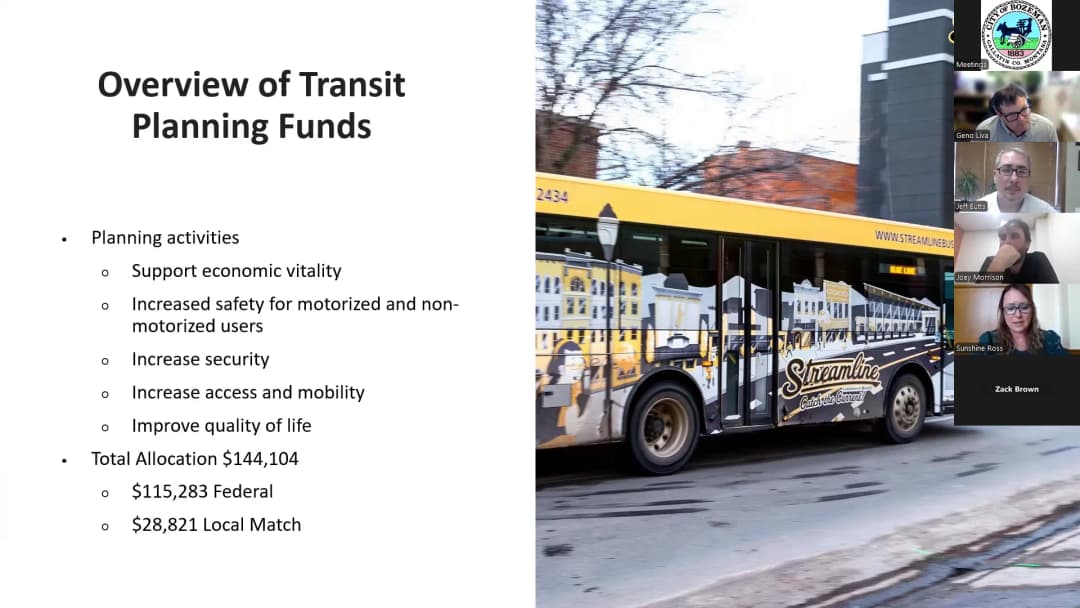
The committee met to consider two main agenda items: (1) a Memorandum of Agreement (MOA) for cooperative performance-based planning measures and targets, and (2) the Federal Fiscal Year 2027 Unified Planning Work Program (UPWP). Both items were approved after discussion and an amendment to the first item. Public Comments & Testimony - No members of the public provided comment during the general public comment period or during the public comment portions for either agenda item. Discussion Items - Memorandum of Agreement (MOA) for Cooperative Performance-Based Planning Measures and Targets: MPO staff (Jeff) presented the MOA, which continues the MPO's support of statewide targets (the MPO does not currently have the data or methodology to set its own). The original motion was to approve the MOA with an ongoing term. Commissioner Brown expressed interest in eventually developing local targets. Mark Eggie voiced reservations, noting that the statewide targets are "weak" (e.g., not aiming to reduce fatalities) and argued the MPO should define its own ambitious targets. An amendment was moved by Mark Eggie and seconded to limit the MOA's term to the current two-year cycle, requiring the matter to return to the committee in 2026 for a decision on whether to develop local targets or continue supporting state targets. After discussion, the amendment passed. The main motion as amended then passed. - Unified Planning Work Program (UPWP) for FFY 2027: Staff presented the UPWP, covering MPO planning activities (e.g., long-range transportation plan completion, data collection, the Valley Trail Loop study) and transit planning activities presented by Sunshine Ross (Urban Transportation District director). Discussion focused on indirect costs and office rent paid to the City of Bozeman, with assurances that negotiations are ongoing to reduce overhead. The motion to adopt the UPWP and authorize minor modifications passed unanimously. Key Outcomes - Amendment to MOA motion: Passed (5 in favor, 1 opposed). The amendment limits the MOA to a two-year term, ensuring the committee will reconsider the approach in 2028. - Memorandum of Agreement (as amended): Approved (6-0 or all ayes; one member not recorded). The Chair is authorized to sign the MOA, which now expires in two years rather than being ongoing. - Unified Planning Work Program for FFY 2027: Approved unanimously (6-0). Staff is authorized to make minor regulatory compliance changes. - Next steps: The MOA must be finalized before September 11, 2026; the UPWP will be submitted to MDT and FHWA for final authorization prior to October 1, 2026.
The Transportation Board (acting as Parking Commission) met on July 22, 2026, to discuss several transportation and parking matters. Major topics included an update on the League of American Bicyclists Silver designation, a downtown parking data and perceptions study, a proposed residential parking permit district near Gallatin High School, and public comments on parking issues near Montana State University. Consent Calendar - Excused Members: The board approved a motion to excuse Bryce Gordon and Shannon Mouni from the meeting. - Minutes: The board unanimously approved the minutes from the June 24, 2026 Transportation Board meeting. Public Comments & Testimony - Jarrett (resident, 611 South 13th Avenue): Expressed concern that his block is the only non-permitted parking area near MSU Highlight Hall. He described unsafe conditions for children walking to Irving Elementary, abandoned cars, and frequent student parking. He asked the board to consider giving residents the same parking protections as neighboring blocks. Parking Manager Nick Foken indicated staff would follow up. - Public Comment on Gallatin High School District (via email from Brianna Walsh, 820 Augur Lane): Walsh expressed strong support for the proposed parking district, noting the issue has persisted for years. - Unplanned Public Comment (resident attending meeting): Supported Courtney Johnson's efforts and highlighted near-miss incidents involving children. Suggested educating high school students about safe driving and parking near residential areas. Discussion Items - Director Ross Public Service Announcements: - City Commission approved a transportation master plan update; professional services agreement expected for approval next week. - Macquatton Road bike/ped access improvements bid came in $500,000 under engineer's estimate, savings to be returned to the arterial collector program. - Fowler Avenue connection (Oak to Durston) right-of-way approved; bidding schedule upcoming. - Board Dialogue: Member Grace asked about rain gardens in curb extensions; Director Ross noted funding constraints ($50,000 extra for rain gardens not available). Member Rio inquired about the 2023 shared use path project and tree preservation conflicts; Ross explained a portion of Valley Center path will not be paved due to mature tree removal conflicts, and federal funding restrictions prevent using TA funds for non-ADA compliant trails. - Member Rio asked if the $500,000 savings could be earmarked for near-term safety projects; Ross explained zero-based budgeting and encouraged recommendations for quick-build projects. - Board Member Jen noted recent advisory board work session on loosening meeting formality to encourage dialogue. - League of American Bicyclists Evaluation Summary (Candace Mastel, TDM Coordinator): - Bozeman maintained Silver designation since 2012. Nationally, 444 of 870 applicants received designations. Max score was 78.63% (likely Gold/Platinum). - Scores by category: Engineering 47.27 points (out of 128), Education lower but improving through Safe Routes to School, Encouragement high, Evaluation/Planning improving with better data, Equity/Accessibility a newer category needing work (replaced Enforcement). - Key recommendations to reach Gold: expand bicycle network for all ages and abilities, adopt a bicycle master plan (or robust chapter in TMP), improve winter maintenance, enhance adult and motorist education, and improve data collection. - Board Comments: Member Grace asked about adult education; Mastel discussed outreach to neighborhood organizations. Member Hayden asked if all recommendations must be met; Mastel said focusing on network and education would be key. Member Chris emphasized motorist education and fatality reduction. Member Michael expressed support for accelerated progress. Member Rio asked about neighborhood byways; Ross noted TMP update will focus on implementation. - Downtown Parking Insights (McLaren Latta, Indigo West, for Downtown Urban Renewal District and City): - Data: In August 2023, on-street and off-street supply data available. June 2026 occupancy highest in on-street, Black lot, and South Wilson lot. - Visitation: 1.3 million US visitors to downtown in 2025. 74% out-of-state; 11% from Bozeman area. Overall visitation up 8% vs. 2019; out-of-state up 22%, Montana visitors down 20%. Bozeman area visitation steady but not keeping pace with population growth (Bozeman +14%, surrounding +17% since 2019). - Citations: 58% of overtime citations (15,000+ violators) went to Bozeman area residents; 55% of safety citations also to locals. - Survey (March 2026, 1,300+ respondents): 74% daily/weekly downtown visitors; 64% live within 5 miles. 26% downtown employees. 77% said adding more spots is important. 41% avoid downtown partly due to parking challenges. 15% choose the parking garage as first choice. Key concerns: employee parking, need for education, infrastructure improvements. Long-term priority: public-private partnership for new parking infrastructure; short-term: FAQ, wayfinding, garage improvements. - Board Comments: Member Mike advocated for paid parking as a solution, noting avoidance of this option delays progress. Chair Rio and Members Simon and Hayden agreed that paid parking should be on the table. Chair Rio noted that downtown feels messy beyond parking (traffic, left turns, pedestrian conflicts). Member Simon highlighted the need to make alternative modes more convenient. Member Grace asked about occupancy rates; Parking Manager Foken explained goal is to leave on-street for transient users and move longer-term parkers to garages. - Gallatin High School Residential Parking Permit District (Staff and Petitioner): - Staff (Ben Bailey, Nick Foken): Presented history of request since 2024. Infrastructure improvements: restriping added 100 on-street spaces, intersection changes, sports park parking lot (119 spaces) with pedestrian hybrid beacon crossing Oak. Proposed district: Augur Lane from Sunstone to Tanzanite, and portions of Sunstone, Tanzanite, and Annie. Data: 370+ citations (Aug 2025-Jul 2026), 23% safety-related. Two management tools: Residential Parking Permit District (RPPD) – prioritizes residents, cost recovery through permits; Parking Benefit Zone (PBZ) – larger district, allows commuter permits, revenue can reduce fees. Staff recommended RPPD due to low demand and residential character; estimated permit cost $132 (based on 57 permits). Additional enforcement staff/vehicle needed. - Petitioner Courtney Johnson (resident, former city planner): Detailed history: high school originally proposed 613 on-site spaces with joint use (sports park, Meadowlark) to meet 1,020 spaces (comparable to Bozeman High’s 1,040). But sports park not built when school opened; human behavior leads students to park closest to southeast entrance, resulting in only 35% utilization of available spaces and neighborhood overflow. She presented photos of safety hazards (cars blocking sidewalks, emergency access, near-misses). Over 30 young children live on affected streets. Neighborhood support: door-to-door petition with majority support, letters of support, media coverage. Request: move forward to City Commission for consideration. She drafted staff memo and ordinance to reduce city workload. - Board Dialogue: Members Hayden, Grace, Chris, and Simon voiced support for the recommendation. Key points: safety paramount, especially for children; sports park may help but student behavior likely unchanged; RPPD is appropriate. Board voted informally (all in favor) to recommend that City Commission consider establishing the parking permit district. Key Outcomes - Consent Calendar: Minutes approved; members excused. - League of American Bicyclists: No formal action; board expressed support for continuing to work toward Gold designation, with focus on infrastructure and education. - Downtown Parking: No action; discussion informed upcoming vision plan and public education campaign. Board members urged including paid parking in future conversations. - Gallatin High School Parking District: The board unanimously recommended (via voice vote) that City Commission consider the creation of a residential parking permit district as proposed. The recommendation includes continued coordination with the school district and monitoring of the sports park lot's impact.
This was a lengthy meeting of the Bozeman City Commission, starting early at 4:00 p.m. and continuing late into the evening. The commission considered a wide range of items, including approving an amendment to previous meeting minutes, consent agenda items, a work session on advisory board structure, a construction update on Kagy Boulevard, approval of the community engagement plan for the 2027 Transportation Master Plan, authorization of the Green Power Program Lead Community Agreement with Northwestern Energy, and provisional adoption of an ordinance to reorganize city departments. Numerous public comments were heard on various topics. Consent Calendar - Minutes Amendment: The commission approved an amendment to the March 24, 2026, minutes to correct the recorded vote on the Sundance Springs Commercial Lot 2 site plan from 5-0 to 4-1, with Commissioner Magic as the dissenting vote. Motion carried 5-0. - Consent Agenda (G1-G15): Approved as amended (including a correction to the legal description in item G15) with a 5-0 vote. Public Comments & Testimony - General Public Comment (non-agenda): - Daniel Cardi (Bozeman resident) criticized the destruction of public trees by private developers and thanked the Historic Preservation Advisory Board for opposing the NCOD update draft. - Mark Campanelli (Bogart Park resident) expressed skepticism about the Bozeman Yards TIFF project, citing financial projections and questioning city staff's reassurances. - Emily Telego (remote) asked the commission to clearly mark meetings that start earlier than the regular 6 p.m. time as special meetings to improve public notice. - Advisory Board Work Session Public Comment: - Mike Mees (Mayor of Belgrade) offered to share training resources for advisory boards. - Daniel Cardi urged removal of the "one body, one voice" provision, called for allowing joint meetings, improving commission liaison participation, engaging boards earlier, and enforcing term limits of two terms. - Mark Campanelli expressed concerns about the "one body, one voice" rule and suggested boards hold office hours. He also flagged a potential conflict of interest on the TIFF board. - Emily Telego advocated for ad hoc committees, loosening Robert's Rules during work sessions, and using a "book club" model for board preparation. - Transportation Master Plan Public Comment: - Mark Campanelli highlighted local pedestrian safety concerns around schools and requested that neighborhood-level engagement be included in the plan. - Mike Mees noted collaboration between Bozeman and Belgrade on transit routes. - Green Power Program Public Comment: - Mark Campanelli questioned the program's economics, noting the lack of price discovery until late in the process, and expressed concern about counterparty benefits for Northwestern Energy. Discussion Items - FYI from Commission: Commissioners announced upcoming walking tours (Bozeman Creek on July 31; zone edge transitions on July 22 and 27) and promoted the first annual ADA celebration at Windley Park on July 25. - Mayoral Proclamation: Mayor Morrison read a proclamation declaring July 26, 2026, as Americans with Disabilities Act Awareness Day. - Advisory Board Work Session (Presented by Cola Rowley): - The assistant city manager presented findings from a review of advisory boards, noting that consolidation was successful but there are opportunities for improvement in four areas: structure, communication, autonomy, and training. - Commissioners discussed: loosening Robert's Rules during work sessions; removing "one body, one voice" language in favor of allowing board members to speak as individuals; supporting ad hoc committees for specific projects; clarifying that boards can hold work sessions; integrating board work plans with the commission's six-month calendar; and improving recruitment and training. - On term limits, opinions were divided; the commission decided to postpone a decision. - There was consensus to remove the commissioner as a voting member from the Community Development Board, move recreation from the Sustainability Board to Urban Parks and Forestry, and consider placing public art and beautification under Economic Vitality with a different staff liaison. - Kagy Boulevard Construction Update (Presented by Nick Ross): - The project, funded partly by a $25 million federal grant, will be delivered via design-build by CK May and DJ. Construction is expected to be substantially completed in one year (by end of 2027), with a three-month closure of Kagy between 11th and 7th during summer 2027. Pedestrian tunnels will be built at 11th and 7th, and a detour will use South 19th, Graf, and South 3rd. - Transportation Master Plan 2027 – Community Engagement Plan (Presented by Emiliano Esparza): - The plan will update the 2017 Transportation Master Plan, with public engagement starting at the "consult" level. The commission encouraged including a presentation to the Inter-Neighborhood Council and considering more visionary elements. - Green Power Program Lead Community Agreement (Presented by Natalie Meyer and Charlie Lane): - The agreement with Northwestern Energy allows voluntary purchase of power from a new Montana renewable energy facility (up to 50 MW) by commercial and institutional customers. The city's municipal load commitment would be approximately 2.5 MW (for a wind facility) or more if other subscribers join. The tariff will be filed with the Public Service Commission by September 15, 2026. The city is not yet committed to a subscription; the cost of the RFP will be borne by the city if the project does not proceed. - Ordinance Reorganization (Presented by City Manager Chuck Wynn): - The commission provisionally adopted an ordinance dissolving the Department of Strategic Services and creating a Department of Communication and Engagement to elevate that function. Key Outcomes - Votes (all 5-0): - Approved amendment to March 24 minutes. - Approved consent agenda (G1-G15) as amended. - Approved the community engagement plan for the 2027 Transportation Master Plan. - Authorized the city manager to sign the Green Power Program Lead Community Agreement with Northwestern Energy. - Provisionally adopted the ordinance to dissolve the Department of Strategic Services and create the Department of Communication and Engagement (final adoption scheduled for consent on the next agenda). - Directives and Next Steps: - Staff will incorporate commission guidance on advisory board changes (structure, communication, autonomy) and return with proposed resolution amendments. - The city will make a presentation to the Inter-Neighborhood Council regarding the Transportation Master Plan. - The city manager will work with commission liaisons to clarify roles and improve coordination with advisory board staff liaisons.
The Community Development Board of Bozeman, Montana, met on Monday, July 20, 2026, at 6:00 PM at City Hall and via video conference. The meeting focused primarily on an update to the Bozeman Creek Vision Plan, including community engagement results, draft policy recommendations, and next steps. The board also reviewed upcoming agenda items and approved previous meeting minutes. Consent Calendar - Approval of Minutes: The minutes from the June 15, 2026, Community Development Board meeting were approved unanimously (7-0). Public Comments & Testimony - No public comments were made on non-agenda items. Discussion Items - Disclosures and Announcements: Board member Jason Delmue highlighted a walk led by Commissioner Jennifer Madgic for the Bozeman Creek Vision Plan on July 31, 2026, at 7:30 AM starting at City Hall (corrected from the initially stated July 24). - Bozeman Creek Vision Plan – Engagement Summary & Community Priorities (Item F.1): Assistant City Manager Jon Henderson presented a mid-project update, joined by Steve Noble and Jim Madden of See Bozeman Creek. Key points included: - The plan aims to mitigate flooding, improve water quality, enhance trail connectivity, support economic vitality, and protect the creek’s ecological health. - The project scope covers Ice Pond Road to I-90. Community engagement included an open house on June 2, 2026, at Storoptimus Park with 300–400 attendees, and outreach to neighborhood associations, the Downtown Urban Renewal District, and other stakeholders. - Flood modeling utilized a rain-on-snow scenario (estimated 1,250 CFS) in addition to the FEMA 100-year flood (1,000 CFS) and 500-year flood (1,680–1,700 CFS). The modeling is not authoritative for regulation. - Draft recommendations (11 “big ideas”) include: diverting flood flow via Mill Ditch (as a flood control device, not perennial due to water rights constraints); converting a section of Rouse Avenue (Maine to Olive) into a greenway; creating “sponge park” concepts at Beale Park and City Hall; improving trail connectivity across downtown and north of Story Mill; and revisiting setback requirements (current 75-foot fixed setback, with potential climate-conditioned floodplain-based setbacks). - Funding is expected from a diverse capital stack including grants, philanthropy, private contributions, and local enterprise funds (stormwater utility, parks maintenance), but not general tax increases or bonds at this stage. - The city commission recently approved $150,000 to maintain momentum. Next steps include a presence at the Sweet Pea Festival (August 8, 2026), further advisory board meetings, a public draft in early November, and a target city commission adoption date of December 15, 2026. - Board Discussion and Feedback: - Mark Egge asked about typical creek flows (200 CFS) and flood history. - Jason Delmue inquired about Mill Ditch perennial flow and water rights; staff clarified it is now planned as a flood-only channel. - Chris Egnatz supported expanding setbacks based on a climate-conditioned floodplain, and emphasized closing the downtown trail connectivity gap. - Eric Bonnett expressed strong support for the downtown greenway concept and asked about affordable housing integration; staff noted development would occur adjacent to, not in, the floodplain, leveraging the greenway for housing. Bonnett later suggested flexibility in where housing funds are used. - Ben Lloyd urged focus on flood mitigation and trail connectivity rather than tying affordable housing to the creek plan, stating it “might be a little too much.” - Joey Morrison and Lauren Mitro discussed upstream storage, property rights, and the challenges of setbacks on small lots (eighth- to quarter-acre parcels). - Chris Saunders (staff) noted existing 75-foot setbacks and floodplain-based expansion; variance options exist. - Upcoming Items for August 3, 2026 (Item F.2): Chris Saunders announced a work session on zone edge transitions and maximum height in the B3 district, as requested by the City Commission. Additional FYIs included: - City Commission work session on advisory boards (July 21, 2026). - City Commission work session on Landmark and NCOD design guidelines (July 28, 2026). - August 17, 2026, CDB meeting will be a text amendment public hearing relating to wetlands and watercourses (procedural updates). Key Outcomes - Minutes Approved: Motion to approve the June 15, 2026, minutes carried 7–0. - No Action Taken on Vision Plan: The Bozeman Creek Vision Plan update was informational; the board provided feedback that will inform future iterations. Staff will return with a more polished draft in late September/early October 2026. - Next Scheduled Meeting: August 3, 2026, with a work session on B3 height and zone edge transitions.
The transcript was not provided in the user's message. Therefore, no summary can be generated.