Browse by city
Date range
Search help

Search titles, summaries, topics and stored transcripts together. Keywords may match separately; put the whole query in double quotes for a phrase. Matching follows word analysis, so punctuation is not exact. Both dates are included. Documents are not searched.

SHOWING 51–60 ENTRIES
51
JUL 15, 2026 · BOZEMAN, MONTANA · CITY COMMISSION
Bozeman BID Board Meeting – July 15, 2026: Creek Vision Plan & Parking Data

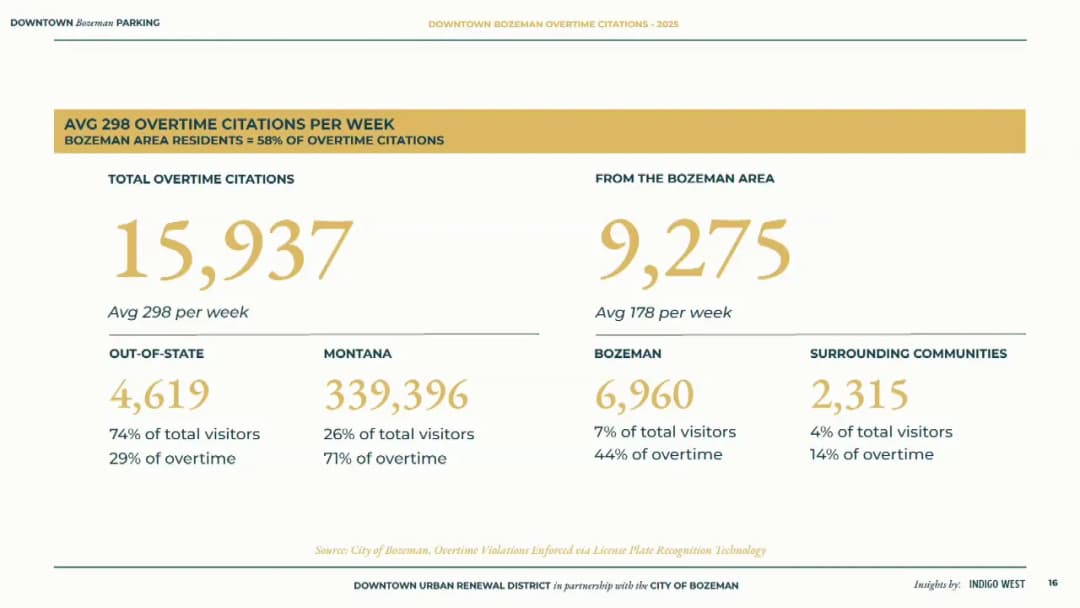
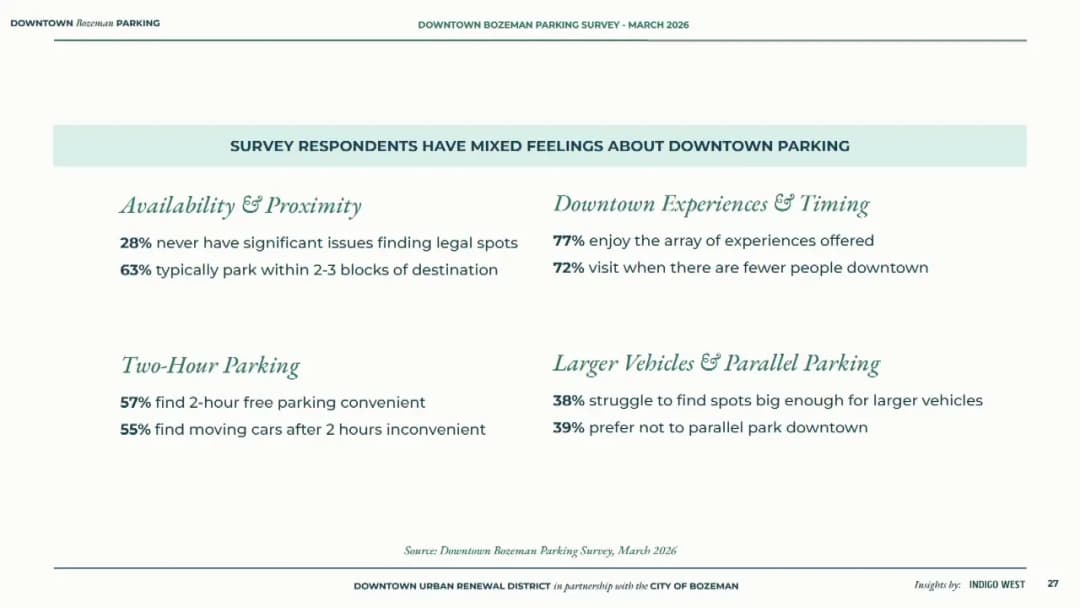
The Bozeman Business Improvement District (BID) Board met on July 15, 2026, to hear two major presentations: the Bozeman Creek Vision Plan and the Downtown Parking Vision Plan. Board members approved April 2026 meeting minutes, received public comment, and discussed next steps for both initiatives. Consent Calendar - Minutes Approval: The April 2026 meeting minutes were approved unanimously (4-0) by roll call. Voting members: Elaine, July, Eric Nelson, Mark Kiki, and Susan Nightby. Public Comments & Testimony - David Lose (written comment): Submitted a letter regarding building heights and transitions, which will be discussed at the city commission meeting on August 25, 2026. The letter will be distributed to the board after the meeting. - Ken Vanderwall (public comment): Expressed general support for the Bozeman Creek Vision Plan but raised concerns about: - The Mill Ditch option potentially requiring extensive tree removal; suggested selective cutting. - Accessibility and universal design for a proposed bridge over the railroad tracks, noting the opportunity to use the Undivided Preserve as an alternative to avoid disturbing a pocket wetland west of the creek. - John Anderson (city staff): Clarified that Mill Ditch would likely be used for flood mitigation only (not perennial flow) due to water rights issues, and that parking at City Hall would be addressed through a potential parking structure near the community gardens. Discussion Items Bozeman Creek Vision Plan - John Anderson presented an update on the Bozeman Creek Vision Plan, a multi-year community effort to address flood hazard, water quality, ecological health, parkland access, and economic vitality. Key points: - The plan is about halfway through the process, targeting City Commission adoption in December 2026. - A public open house was held June 2, 2026, at Syroptimus Park, with an estimated 300–400 attendees. - The next public open house is scheduled for August 8, 2026, at SLAM. - Big Ideas include: - Diverting flood water via Mill Ditch (Alternative 2 from a 2025 engineering study). - Expanding Bogart Park channel and relocating the pavilion. - "Daylighting" Bozeman Creek along Rouse Avenue from Main to Olive streets, converting the right-of-way into a greenway. - Creating underground flood storage under Beale Park ("sponge park"). - Redesigning City Hall’s front parking area to braid the creek. - Smoothing the 90-degree bend at Creekside Park. - Using abandoned right-of-way near the Safety Center for a trail. - Building a viaduct or bridge over railroad tracks to connect to Story Mill Park. - Policy recommendations are shifting away from indexing setbacks by parcel size due to complexity; instead, will focus on increasing setbacks, first right of refusal for flood-damaged properties, and incentives for private property owners. - Funding: The plan emphasizes seeking federal grants (e.g., FEMA) and philanthropic support; no bond or general tax increase is envisioned. - Board feedback: Members questioned sequencing, prioritization metrics, long-term maintenance costs, and the need to design for maximum grant eligibility. The board encouraged thinking about phased, scaled-down alternatives and not concentrating beautification on one segment. Downtown Parking Vision Plan - McLaren (Indigo West) and Ellie (BID staff) presented results of a public education campaign and survey to inform a Downtown Parking Vision Plan. - Data Sources: Placer AI foot traffic data (2025); on-street/off-street occupancy counts (2023); citation records; and an online survey of 1,300+ respondents. - Key Statistics: - 1.3 million unique US visitors experienced downtown Bozeman in 2025 (74% out-of-state, 26% Montana; 11% of US visitors were from the Bozeman area). - Out-of-state visitors up 22% since 2019; Montana visitors down 20%. - Bozeman-area visitation is steady but not keeping pace with 14–17% population growth. - On-street average occupancy: 70% in June 2026. - 58% of overtime parking citations go to Bozeman area residents; 55% of safety citations also go to locals. - 51% of downtown employee respondents report significant issues finding legal parking. - 77% of all survey respondents say adding more parking spots is important. - Perceptions: 45% worry about citations; 74% find downtown traffic patterns challenging; 51% worry about vehicle-pedestrian collisions; only 15% choose Bridger Garage as first choice. - Next Steps: Develop FAQs, update signage/wayfinding, enhance the parking garage experience, and create a final vision plan (action plan) with board and commission support. Focus includes employee parking, shared-use programs, subsidized programs, and exploring top-level parking at the existing garage. - Board feedback: Members stressed the need to move from “vision” to action plan, cited employee parking as a top priority, and noted that parking data is essential for discussions on building height and density. Key Outcomes - Vote: Motion to approve April 2026 minutes passed 4-0. - Directives: - The Bozeman Creek Vision Plan will continue with public input; board will provide feedback at the August 19, 2026 meeting with Chris Daunders from Community Development on building heights/transitions. - The Downtown Parking Vision Plan team will incorporate board comments and return with a finalized plan in early fall 2026, seeking formal board support before City Commission consideration. - No formal votes taken on the presentations themselves.
ENGINEERING AND INFRASTRUCTURE 46% · ENVIRONMENTAL PROTECTION 14% · COMMUNITY ENGAGEMENT 12% · MISCELLANEOUS 6%
52
JUL 15, 2026 · BOZEMAN, MONTANA · CITY COMMISSION
Bozeman Historic Preservation Advisory Board Meeting - July 15, 2026

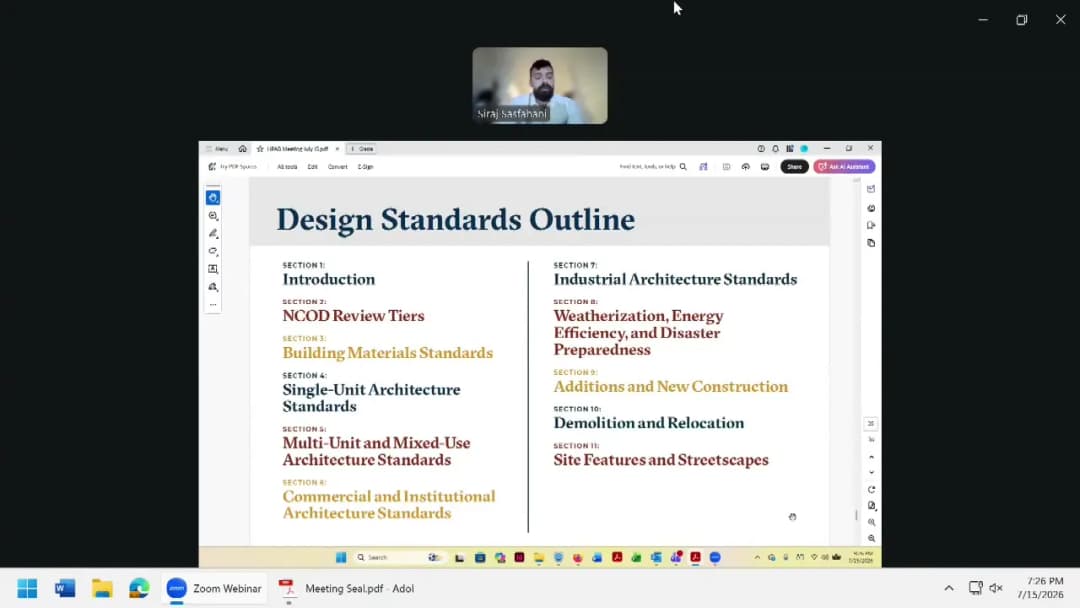
The Bozeman Historic Preservation Advisory Board (HPAB) met on Wednesday, July 15, 2026, from 6:00 PM to approximately 9:00 PM. The meeting focused on two major action items: receiving a public engagement summary and preview of updated design standards for the Neighborhood Conservation Overlay District (NCOD) from the Lakota Group, and a work session to continue discussion of demolition regulations. Board members present included Danielle Nicholas, Allyson B. Brekke, James Webster, Ashley Wilson, Michael Wiseman, and Lisa Weilbacker. Mitchell Korus was excused. The board also introduced new members and leadership. Consent Calendar - Approval of Minutes (June 17, 2026): Motion by Ashley Wilson, seconded by Danielle Nicholas. The motion carried 5-0 (Lisa Weilbacker abstained). The minutes were approved with a noted correction to the spelling of a public commenter's name. Public Comments & Testimony - Non-Agenda Items: No public comment was offered. - Action Item F.1 (NCOD Design Standards): No public comment was offered during the meeting, but the board noted significant community feedback received via email and from a neighborhood focus group held the previous week, expressing concerns about over-regulation of small homeowners and lack of focus on mass and scale. - Action Item F.2 (Demolition Regulations): No public comment was offered. Discussion Items - FYI/Discussions (Moved Up): - New board member Lisa Weilbacker was welcomed. Michael Wiseman was introduced as the new HPAB Chair, and Ashley Wilson as the new Vice Chair. - Staff announced two walking tours on July 22 and July 27, 2026, at 6:00 PM, starting at Beall Park, to observe zone edge transitions in preparation for the August 25 City Commission work session on building heights and transitions. - The August 19 HPAB meeting will include a discussion of B3 height and zone edge transitions, with board members planning to attend or watch the Community Development Board presentation beforehand. - Action Item F.1: Public Engagement Summary and Preview of Layout for Updated Design Standards for the NCOD (The Lakota Group): - The Lakota Group presented findings from extensive public engagement, including over 300 participants (stakeholder interviews, open house, online survey with 248 respondents, of which 56% lived in the NCOD). Key themes: need for clarity, predictability, stronger guidance on massing and scale, and better balance between preservation and flexibility. - The proposed framework includes four tiers: Preservation (for designated historic resources), Preservation-Eligible (areas with potential for future designation), Character (neighborhoods with distinct identity, e.g., the Northeast neighborhood), and Context (remaining NCOD properties). Each tier would have varying levels of regulatory vs. advisory standards. - Board members expressed significant concerns: - The survey was criticized as exclusionary and too technical. - The tiered approach was seen as overly complex, especially after the recent adoption of the Unified Development Code (UDC). - Several members argued the focus should be on demolition and new construction mass/scale, not micromanaging homeowners (e.g., window treatments). - The preservation-eligible tier requires more data and a clear methodology; the character tier was questioned as unnecessary for NCOD design guidelines. - A consensus emerged to reduce the tiers to three: Preservation, Local Landmark, and Context, with preservation-eligible areas addressed through the local landmark process. - Staff clarified that the draft is preliminary and that further policy direction from the City Commission is needed on how to address mass and scale conflicts between base zoning and the overlay. - Action Item F.2: Work Session to Continue Discussion of Demolition Regulations: - Chair Wiseman compiled recommendations for demolition code revisions based on previous board discussions. The board reviewed these notes and decided to forward them to the project consultant, Community Planning Collaborative. - Key points included requiring survey updates when a demolition permit is applied for, and ensuring demolition regulations are integrated with the local landmark program. Key Outcomes - Direction to Lakota Group: The board directed the consultants to refine the tiered approach, aiming for three tiers (Preservation, Local Landmark, Context) and to focus design standards on clarity, predictability, and major issues like new construction massing, scale, and demolition, while avoiding overly prescriptive standards for minor home improvements. - Demolition Code Recommendations Forwarded: The board voted unanimously (6-0) to send the compiled recommendations to the Community Planning Collaborative for further development. The motion, made by Ashley Wilson and seconded by Allyson B. Brekke, carried with all members in favor. - Future Meetings: The August 19 HPAB meeting will include discussion of B3 height and zone edge transitions, and a draft of revised demolition code will be presented for review.

HISTORIC PRESERVATION 83% · COMMUNITY ENGAGEMENT 8% · ENGINEERING AND INFRASTRUCTURE 5% · PROCEDURAL 4%
53
JUL 15, 2026 · BOZEMAN, MONTANA · CITY COMMISSION
Bozeman City Study Commission Meeting – July 15, 2026

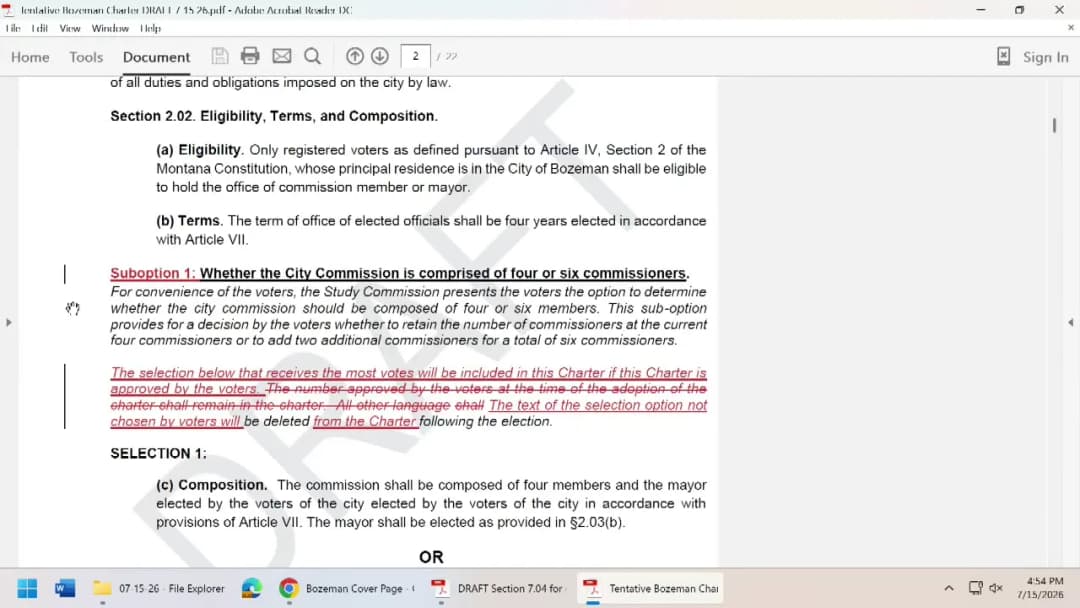
The Bozeman City Study Commission met on July 15, 2026, from 4:00 p.m. to 6:08 p.m. at City Hall. Four commissioners were present (Carson, Jan, Deanna, Mike); Commissioner Franks was excused. Staff members Barb and Becky (absent) presented proposed edits to the tentative charter. The meeting focused on revisions to compensation board language, mayoral succession, and education and outreach plans with the consulting firm Dane Geld. A public commenter addressed the compensation board section. Consent Calendar - Approved the consent agenda as presented unanimously (4-0). Public Comments & Testimony - Daniel Cardi, a Bozeman resident, expressed support for Commissioner Campbell’s proposed language for the compensation board, stating it “removes all potential conflicts of interest” and is straightforward. - No other public comments were made during the meeting. Discussion Items - Compensation Board (Section 2.04): Barb presented track changes based on prior public hearing feedback. Changes included deleting the area median income (AMI) reference, removing the board’s authority to set hours per week, and clarifying that the board makes recommendations to the city commission. Commissioners debated the composition of the board: whether to include commissioners as voting or non-voting members, and whether to meet annually or biennially. Deanna Campbell proposed specific language removing commissioners from the board, while others favored including them in a non-voting ex officio capacity. The city attorney advised that non-voting members would avoid mandatory duty conflicts. After discussion, the commission adopted a motion to amend the section with several changes (see Key Outcomes). - Mayor/Vice Mayor Succession (Section 2.06): Barb explained edits to fix a conflict where a vacancy in the mayor’s office was incorrectly subject to the same appointment process as a commission vacancy. The commission agreed to replace the phrase “for the balance of the mayor’s term” with “until the next municipal election” to ensure shorter interim terms and alignment with election cycles. A motion to adopt the edits with that change passed unanimously. - Explanatory Text for Sub-Options (Section 2.02): Commissioners reviewed proposed clarifying language for the voter options on commission size (four or six members) and election method (at-large or by wards). Deanna Campbell offered revised text emphasizing readability and consistency with ballot language. The commission agreed the text remained confusing and asked Barb to take another pass, incorporating suggestions from the League of Women Voters and others. - Article 7 – Elections: Barb reorganized Article 7, moving initiative, referendum, and recall to Section 7.01 and creating Section 7.03 (methods of electing commissioners under a ward system) and Section 7.04 (ward boundary process). Commissioners noted the need for clearer transitional language explaining that Section 7.03 only applies if voters choose to adopt wards. Carson expressed concern about over-prescribing ward boundaries in the charter, suggesting the commission should instead set up a neutral process by ordinance. No final decision was reached; further revisions were deferred. - Outreach and Education Plan: Representatives from Dane Geld (Audrey Dozier, Aaron Corsi, Nevin Graves) presented a proposed budget, timeline, and branding for the public education campaign. The budget included allocations for TV, radio, print (Bozeman Daily Chronicle, MSU Exponent), direct mail (postcards from Miniman Press), social media, and in-person events (Sweet Pea Festival, farmers market, etc.). The timeline targets early August for print materials and late August for video ads. Commissioners discussed the need for consistent messaging, a single slide deck, and a point-person system for approving materials. Deanna Campbell raised concerns about the branding’s color palette and imagery, calling them “dull” and not reflective of the commission’s work. The commission did not formally approve the branding. Key Outcomes - Compensation Board Edits (Section 2.04): Motion passed 4-0 to: (1) make commission members non-voting ex officio members appointed by their peers; (2) require compensation recommendations to be adopted prior to candidate filing opening for the next municipal election; (3) add language ensuring public meetings; (4) strike the annual meeting requirement and reference to the subsequent fiscal year; (5) change the title “chief financial officer” to “finance director.” Staff will prepare the revised language for the next meeting. - Mayor/Vice Mayor Succession (Section 2.06): Motion passed 4-0 to accept the track changes and replace “for the balance of the mayor’s term” with “until the next municipal election” in Section 2.06A. Staff will update the draft. - Liaison Appointment: Motion passed 3-0-1 (one abstention) to appoint Commissioners Carson and Jan as the point people to coordinate with Dane Geld on outreach materials and messaging. - Next Meetings: The commission will meet on July 23, 2026, from 4:00 p.m. to 6:00 p.m. to continue charter revisions, and on July 30, 2026 (no time limit) to finalize the charter and review the education plan. Commissioner Carson and Jan will also present to the Valley West Neighborhood Association on July 27, 2026. - Action Items: Barb will revise the explanatory text for Sub-options 1 and 2 (Section 2.02) and Article 7 based on commission feedback. Dane Geld will provide a message guidance document and a slide deck for commissioner presentations. The commission will share a list of desired events with Dane Geld.

CHARTER REVISION 65% · COMMUNITY ENGAGEMENT 16% · PUBLIC ENGAGEMENT 10% · PROCEDURAL 9%
54
JUL 14, 2026 · BOZEMAN, MONTANA · CITY COMMISSION
Downtown Urban Renewal District Board Meeting - July 14, 2026

The Downtown Urban Renewal District (URD) Board held a meeting on July 14, 2026, at 6:45 PM. The meeting covered a decision on a plat amendment for the Calico Industrial Park, a special presentation on the Downtown Parking Vision Plan, approval of bylaw amendments, and an executive director's report. All votes were unanimous. Consent Calendar - Minutes Approval: Minutes from the previous meeting were approved by roll call (John, Amy, Nicholas, Sky, Marley all in favor). Public Comments & Testimony - No public comments were received, either in person or online, for any agenda item. Discussion Items - Calico Industrial Park Plat Amendment (Regular Agenda Item 11): Chloe Bonson (County Planning) presented a request from Scott Lowry (Middle Fork Engineering) on behalf of JA Ventures to amend Lot 3 of the Calico Industrial Park Major Subdivision (78 Wildcat Way). The amendment proposes to abandon a portion of an existing utility easement originally established for a septic system serving Lot 1, which was disconnected in 2015. The easement is no longer needed. The application was noticed twice in the Bozeman Daily Chronicle (June 27 and July 7, 2026) and mailed to adjacent property owners. No public comments were received. The Health Department noted a concern about wastewater permitting for a second commercial unit. Staff found the amendment complies with subdivision regulations. Commissioner commentary noted the frustration of incremental development and infrastructure lag but acknowledged the proposal fits property rights and the letter of the law. The motion passed 3–0. - Downtown Parking Vision Plan (Special Presentation): McLaren (Indigo West) presented findings from a parking study commissioned by the city and the URD. Key data points included: - Occupancy Data (Jan–June 2026): Average occupancy rates in city parking lots at 1 PM weekdays; Black and South Wilson lots show highest rates. - Visitor Data (Placer AI): 1.3 million U.S. visitors experienced downtown Bozeman in 2025. 11% were from the greater Bozeman area (including Belgrade, Livingston, etc.). Overall visitation is down from 2021 but up 8% vs. 2019. Out-of-state visitors increased 22% since 2019; Montana visitors decreased 20%. Downtown visitation from Bozeman and surrounding communities has been stagnant despite area population growth (Bozeman +14%, surround +17% from 2019–2024). - Overtime Citations (2025): $50,000 in fines collected. Bozeman residents (zip codes 59715 and 59718) account for 7% of total visitors but 44% of overtime citations. Out-of-state visitors: 74% of visitors but only 29% of citations. Safety citations (1,480 total) also disproportionately given to locals. - Survey Results: 1,310 respondents (convenience sample). 74% visit/work/live downtown daily or weekly. 90% live within 15 miles. 51% of downtown employees report significant issues finding legal parking. 77% said adding parking spots is important. 41% avoid downtown at times because parking takes too long. 74% find traffic patterns challenging. 45% worry about receiving citations. 15% are unsure where they can legally park. Only 25% have a positive overall parking experience. - Stakeholder Interviews: 17 one-on-one interviews revealed parking concerns vary by block and user type. Employee parking is the top priority. - Proposed Solutions: Short-term: public education campaign (FAQ, wayfinding, addressing misperceptions), explore free top-level parking in garage for employees, subsidized or shared-use programs. Long-term: expand parking supply, explore paid parking on surface lots or other revenue models. Commissioner John stressed the need to explicitly include parking supply expansion as a goal, noting $5 million already set aside. Discussion also covered the possibility of paid on-street parking and capitalizing on visitor spending. Key Outcomes - Plat Amendment Vote: Motion to approve the amendment of Lot 3 of Calico Industrial Park (abandonment of utility easement) passed 3–0. - Bylaw Amendment Vote: Motion to approve amendments to the Downtown URD bylaws (changing board size from 7 to 9 to include county and state members, and aligning with SB 3 and high-performing boards resolution) passed unanimously by roll call (Amy, Nicholas, Sky, Marley all in favor). The amendment will go to the City Commission for final approval. - Next Steps: The Parking Vision Plan and public education campaign are targeted for completion in fall 2026. The URD Board will hold a discussion on building height regulations (B3 district) at its August 25, 2026 meeting, with staff presentation by Aaron George. The URD is also moving forward with a Special Assessment Lighting District (SALD) to maintain pedestrian lights after the URD sunsets, and is collaborating on an ADA playground at Wilson School.

ECONOMIC DEVELOPMENT 30% · TRANSPORTATION SAFETY 19% · PROCEDURAL 17% · ENGINEERING AND INFRASTRUCTURE 15%
55
JUL 14, 2026 · BOZEMAN, MONTANA · CITY COMMISSION
Bozeman City Commission Meeting – July 14, 2026

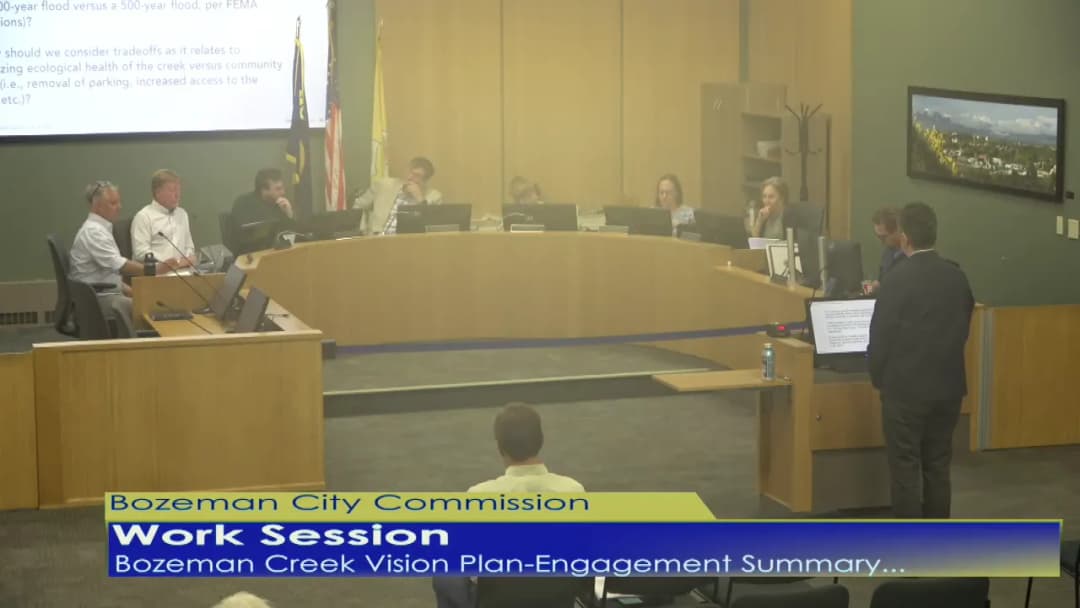
The Bozeman City Commission met on Tuesday, July 14, 2026, at 12:30 PM. The meeting covered consent agenda approvals, public comments on various topics, two Unified Development Code housekeeping items (parking and short-term rentals), two street name changes (Thomas Drive to North 27th Avenue and Graf Street to East Graf Street), a work session on the Bozeman Creek Vision Plan, and appointments to boards. All votes were unanimous (5-0) unless noted. Consent Calendar - Items F1 through F22 were approved unanimously (5-0) after public comment. - Item F11: Authorizing a professional services agreement with Mediation Help Association for landlord-tenant mediation services was highlighted by the City Manager as part of the tenants' rights to counsel program. - Item F3: A donation of nearly $1.5 million from the school district to the city for a sports field (part of an agreement for a TERF sports field at Gallatin High) drew public comment from Emily Kelly (Baxter Meadows), who questioned the source of funds. The City Manager explained it is a long-standing partnership, with the field to be used by students during school and the community afterward, also providing parking to relieve neighborhood congestion. Public Comments & Testimony - Emily Kelly (Baxter Meadows) – Expressed shock at the school district donating nearly $1.5 million to the city, questioning why those funds were not used to offset school mill levies. The City Manager responded, clarifying the collaboration and cost savings for both entities. - Mark Campanelli (Bogar Park) – Announced upcoming events: Big Sky DevCon (July 24-25 at MSU) and a Cold Climate Conference (October 12-14 at MSU), promoting housing discussions involving building science. - Robert Muldowney (Baxter Meadows) – Criticized the city's Tax Increment Financing (TIF) districts, arguing that downtown and 7th Avenue corridor capture growth value without contributing fairly to the general fund, while west side lacks basic traffic safety measures. He cited a $9.7 million surplus in the downtown URD TIF and called for reform. - Daniel Cardi (Bozeman resident) – Urged the commission to adopt a resolution declaring Bozeman an “ICE-free zone” and to prohibit city police and fire from aiding federal immigration enforcement, citing deaths and disruption caused by ICE nationwide. - Jeff Ball (Bozeman) – Commented on Bozeman Creek work session, urging consideration of woody debris removal, channelization risks, and learning from flooding in Red Lodge and Gardiner. He suggested re-installing headgates and cleaning the old Mill Ditch to split flows. - Cindy Smith (Bozeman resident) – Repeatedly requested public records on city funding to the Human Resource Development Council (HRDC). She stated records have not been provided despite prior assurances from the City Manager, and has filed an ethics complaint. She requested immediate release of records, a written explanation for any missing documents, a public explanation of oversight processes, and an independent audit of city funds provided to HRDC. Discussion Items Unified Development Code Housekeeping: Parking in B3 District - Provisional adoption of amendments to Section 38.530.040 to revise parking regulations in the B3 (downtown) district effective October 1, 2026, to comply with new state laws. Staff noted that language for group residential uses was inadvertently omitted and needs to be carried forward. The Community Development Board unanimously recommended approval. No public comment was received. Commissioner Bodie moved approval, stating it is procedural to implement state law. Approved 5-0. Unified Development Code Housekeeping: Short-Term Rentals in RA District - Two alternatives were presented: - Alternative 1: Grandfather existing type two short-term rentals in RA (62 units) but prohibit new ones. - Alternative 2: Allow type two short-term rentals outright in the RA (residential) district as an accessory use. - Director George explained that the new UDC inadvertently disallowed type two STRs in RA (previously allowed in R2). The Community Development Board recommended Alternative 2, which is easier to administer and expands allowances to areas previously zoned RS and R1. Sixteen public comments were received in April from affected hosts. Staff confirmed that enforcement relies on affidavits of primary residency (70% occupancy), and software tracks bookings. Commissioner Sweeney moved Alternative 2, citing simpler administration and support from homeowners seeking flexibility. Commissioners discussed concerns about enforcement and potential for corporate exploitation, but noted type twos require owner residency, unlike banned type threes. Approved 5-0. Street Name Change: Thomas Drive to North 27th Avenue - Petition from city engineering staff to rename Thomas Drive (33 addresses) to North 27th Avenue for continuity with existing North 27th to the north and south, improving emergency response and navigability. A capital project is already under construction to connect the segment. One public comment opposed the change (sentimental value), and one official protest was received. Commissioner Magic moved approval, citing safety benefits. Commissioners acknowledged the burden of address changes on residents. Approved 5-0. Street Name Change: Graf Street to East Graf Street (east of Tracy Avenue) - Petition from South Meadows Condominium Association (representing 100 units) to rename the section east of Tracy Avenue to East Graf Street, aligning with common usage and city addressing grid. 160 addresses would be affected. One official protest was received. Staff noted that official plat names are Graf Street, but city records and street signs already use East Graf Street; the change brings consistency. Deputy Mayor Fisher moved approval, noting it reduces confusion for deliveries and emergency services. Approved 5-0. Work Session: Bozeman Creek Vision Plan – Engagement Summary and Community Priorities - Presentation by Chris Marks (Port Urbanism) on mid-project progress. The plan aims to address flood mitigation, water quality, ecological health, access, connectivity, economic vitality, and community connection to the creek. Four priority buckets emerged: flood mitigation, downtown creekside parks (Beall Park, Rouse/Seraphimus, City Hall), zoning/policy recommendations (acquisition, setbacks, incentives), and incremental access/connectivity (right-of-ways, bridges). Key questions for commissioners: level of service (100-year flood, 100-year plus climate change, or 500-year), trade-offs between parking, ecological health, and community needs. Commissioner discussion: - Commissioner Bodie supported using Mill Ditch as a bypass, was cautious about removing the Bogart Park Hockey Pavilion, supported closing Rouse between Olive and Maine (with access maintained), and supported converting City Hall parking lot to park. He suggested a 100-year-plus flood target and prioritized ecological health over parking. - Commissioner Sweeney supported Mill Ditch, wanted to keep the hockey pavilion (possibly relocate), expressed interest in the parking garage concept, and prioritized flood mitigation above all. She favored the 100-year-plus target. - Commissioner Magic supported all ideas and urged boldness, recommending removal of the hockey rink, closure of Rouse, and elimination of parking at City Hall. He preferred 100-year-plus (not 500-year) and saw ecological health as synonymous with community health. - Deputy Mayor Fisher and Mayor Morrison echoed similar support for bold vision, with Morrison highlighting the generational opportunity and prioritizing flood mitigation and creek health. - Comments from the public (Mark Campanelli) urged consideration of 3D models, TIFF funding for flood infrastructure, and ice management. - Staff will use input to refine recommendations and present final plan in December 2026. Key Outcomes - Consent Agenda (F1-F22) approved 5-0. - UDC Parking Amendment provisionally adopted 5-0 (final adoption July 28). - UDC Short-Term Rental Amendment (Alternative 2) provisionally adopted 5-0 (final adoption July 28). - Thomas Drive renamed to North 27th Avenue – approved 5-0. - Graf Street (east of Tracy) renamed to East Graf Street – approved 5-0. - Appointments: - Danica Comey to City-County Board of Health (term ending June 2029) – approved 5-0. - Gary Limison (at-large), Alison Breckey and Lisa Weilbacher (professional) to Historic Preservation Advisory Board, with Michael Wiseman as chair and Ashley Harville as vice chair – approved 5-0. - Mike Waterman as Bozeman School District 7 representative to Downtown Urban Renewal Board – approved 5-0. - City Manager confirmed that Cindy Smith’s public records request (July 5) is in progress and staff will reach out to her; Commissioner Bodie requested a status update be communicated. - Work session direction: Commission generally supports 100-year-plus flood target, prioritizes flood mitigation and ecological health over parking, and encourages bold vision including potential reconfiguration of downtown streets and parks. Staff will continue community engagement in August.

ENGINEERING AND INFRASTRUCTURE 24% · CANNABIS REGULATION 19% · ENVIRONMENTAL PROTECTION 15% · PARKS AND RECREATION 12%
56
JUL 9, 2026 · BOZEMAN, MONTANA · CITY COMMISSION
Bozeman MPO Transportation Technical Advisory Committee Meeting - July 9, 2026

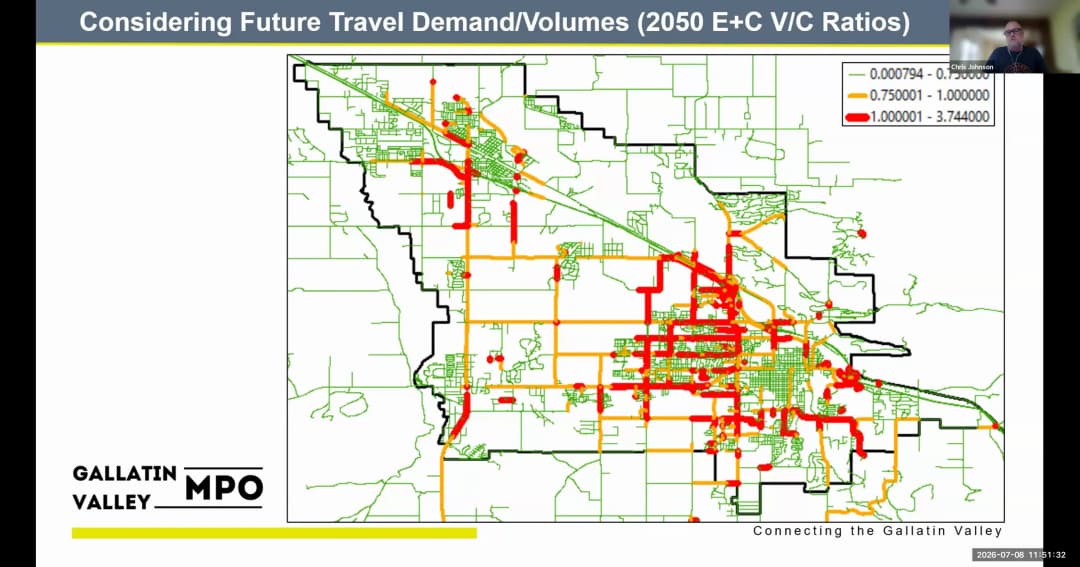
The TTAC met in a hybrid format to discuss coordination with emergency services for the Long Range Transportation Plan (LRTP), review and recommend the Unified Planning Work Program (UPWP) for FFY 2027, and examine updates on LRTP project scoring and travel demand modeling. The committee approved the June meeting minutes and recommended adoption of the UPWP with minor modifications. Consent Calendar - Approval of June Meeting Minutes: Moved by Sunshine Ross, seconded. Roll call vote: all present members voted in favor. Minutes approved without changes. Public Comments & Testimony - No public comments were offered during the general public comment period. Discussion Items - Emergency Management Coordination for LRTP: Kevin Larson, Operations and Training Manager for Gallatin County Emergency Management, presented an overview of emergency preparedness, response, and coordination structures. He described the county's duty officer program, the Everbridge community notification system, and mutual aid agreements. The discussion covered hazards such as wildfires, floods, earthquakes, and major transportation disruptions (e.g., the I-90 Bozeman Pass closure). The MPO seeks to incorporate emergency coordination into LRTP Objective 4 (strengthen coordination, cooperation, and preparedness among transportation partners). No formal action was taken. - Unified Planning Work Program (UPWP) for FFY 2027: Jeff Butts, MPO Manager, presented the final UPWP, detailing a total allocation of $600,000 from federal (PL and FTA funds), state, and local sources. The program funds two staff positions, the LRTP, the Valley Trail Loop study, data collection, public involvement, and transit planning. Rent and indirect costs were discussed, with acknowledgement of high costs and ongoing efforts to reduce them. Beth Clarkson from MDT outlined minor regulatory compliance tweaks, including clarifying language to tie the Valley Trail Loop to transportation, updating funding tables to include local contributions, and adjusting text in the TIP section. No changes to overall funding or work items were proposed. - LRTP Project Scoring and Travel Demand Modeling: Consultants from Nelson Nygaard (Zach, Bethany, Chris) provided an update. Bethany explained the GIS-based scoring methodology using R scripts and ArcGIS Pro, with criteria such as access to essential services, multimodal improvements, and crash corridors. Updated project descriptions from cities and the county allowed some projects to gain points (e.g., inclusion of bike lanes, sidewalks). Chris presented results from the travel demand model (calibrated to 2022), showing volume-to-capacity ratios for existing and future (2050) conditions. Two alternatives were modeled: capacity projects on existing roads and new connections (both from tier 1 and tier 2 scored projects). The combined model run is underway. Members discussed that the scoring tends to favor projects in population centers over regional connectivity projects. Levi from Gallatin County expressed concern that county projects scored low due to missing multimodal attributes, and that the scoring criteria were duplicative. The committee agreed to send feedback within two weeks and requested the slide deck and Excel file for review. Key Outcomes - UPWP Recommendation: The committee unanimously passed a motion to recommend that the Transportation Policy Coordinating Committee (TPCC) adopt the FFY 2027 UPWP and authorize MPO staff to make minor regulatory modifications as needed. - LRTP Next Steps: Consultants will incorporate feedback on project descriptions and scoring, run a combined model alternative, and present a fiscally constrained project list at the next TTAC meeting in August. The draft LRTP is expected in September, with adoption by TPCC in November/December 2026.

ENGINEERING AND INFRASTRUCTURE 59% · PUBLIC SAFETY 25% · PROCEDURAL 8% · FISCAL SUSTAINABILITY 4%
57
JUL 9, 2026 · BOZEMAN, MONTANA · CITY COMMISSION
City INC Meeting: MSU Strategic Plan, Bike Rodeo, and City Updates (July 9, 2026)

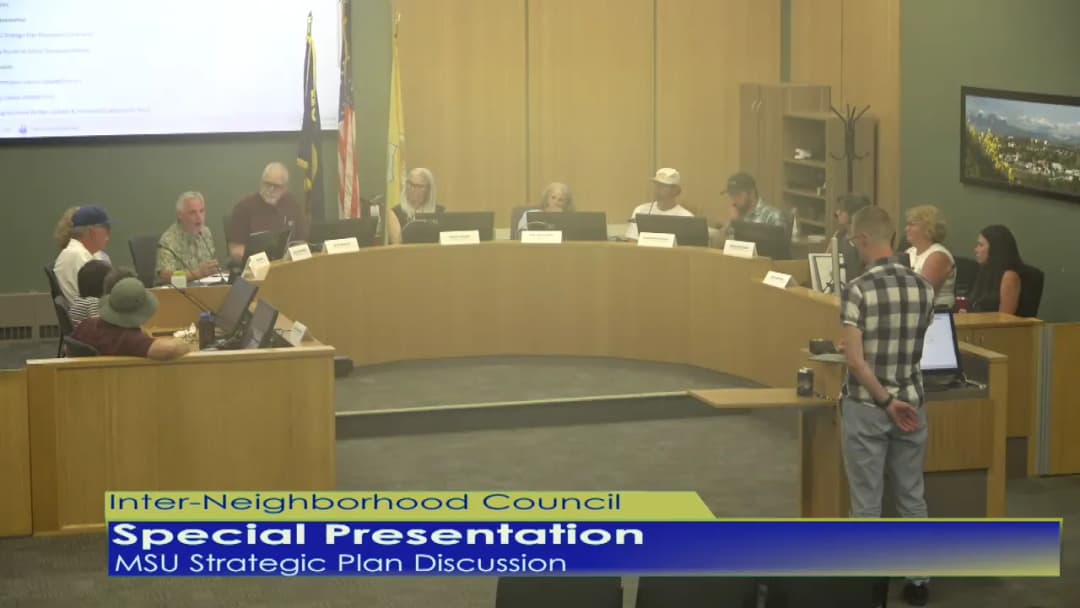
The INC met on July 9, 2026, and received presentations on Montana State University’s strategic plan, a proposed neighborhood bike rodeo program, and an update from Deputy Mayor Douglas Fisher on upcoming city commission items. Neighborhood representatives provided feedback on housing, transportation, pedestrian safety, and community engagement. Consent Calendar - The minutes from the previous meeting were approved by motion and second. Public Comments & Testimony - No public comments on non-agenda items were offered. Discussion Items - MSU Strategic Plan: James Tobin, executive assistant to the MSU president, described the university’s effort to create a new “living” strategic plan with 3–4 themes and 3–4 projects each. Since January 2026, MSU has collected 2,400 completed surveys and met with over 1,000 people. A final public listening session will be held July 30 at 6:00 p.m. at the Bozeman Library. The plan will be announced November 19–20. Neighborhood representatives raised concerns about housing (MSU grew 27% since 2010, adding 3,600 students but only 1,000 housing units), transportation (11th Avenue jaywalking, College Street disrepair), and pedestrian/trail connectivity. Mark Campanelli questioned research spending and pay for non-tenure-track instructors. Kathy Rich provided a list of concerns from the University Neighborhood Association. - Safe Routes to School – Bike Rodeo Program: Candice Mastel (City TDM Coordinator) and Jen McMackFarlane (WTI) presented a proposal to bring bike rodeo events to neighborhoods. The program, operating since 2009, recently won a $60,000 federal grant for expanded programming. The rodeo teaches cycling skills and safety. The city seeks neighborhood partners to host events; the city will provide the course layout, staffing, and supplies. Discussion included concerns about arterial street safety, distracted driving, e-bike safety, and the need for adult education. Dick Mocker noted the challenge of Hawthorne School children biking three miles on busy streets. Noah Tembrock expressed fear for his daughter’s safety biking in Bozeman and suggested a systems approach. - City Commission Update: Deputy Mayor Douglas Fisher reported the city approved a $610 million two-year budget, adding 18 full-time positions, 9.5 of which are for police traffic safety units. Upcoming commission items: July 21 – advisory board restructuring and Kagy Boulevard 30% design update; August 4 – housing work session on affordable housing tools; August 25 – B3 height and transition discussion; October 6 – community ballot issues (fire station, library, swim center, mental health response). A future pedestrian safety discussion will be scheduled. Fisher encouraged INC input on these topics, especially the B3 height discussion. Key Outcomes - The INC received information and will consider sharing feedback with the city on the MSU strategic plan and the B3 height issue. - No formal votes were taken; the meeting adjourned by motion and second.

MISCELLANEOUS 32% · ACTIVE TRANSPORTATION 22% · COMMUNITY ENGAGEMENT 14% · TRANSPORTATION SAFETY 11%
58
JUL 8, 2026 · BOZEMAN, MONTANA · CITY COMMISSION
Sustainability Advisory Board Meeting - July 8, 2026

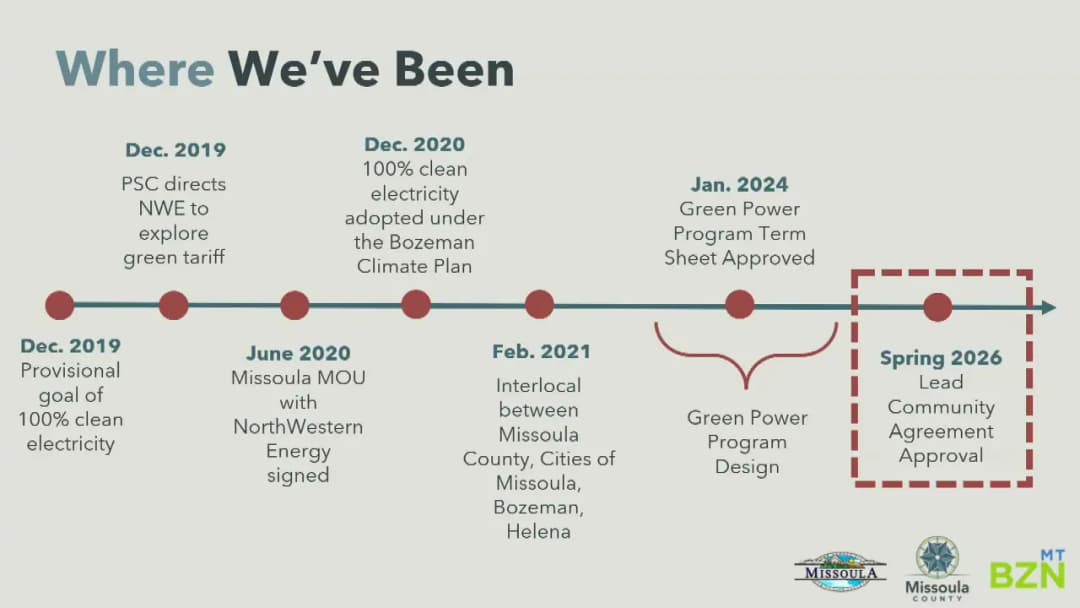
The Sustainability Advisory Board met on July 8, 2026, at 11:30 AM (UTC) in the City Hall commission room. The board considered a special presentation on proposed wetland and water course code amendments and an action item to recommend authorization of the Green Power Program Lead Community Agreement with Northwestern Energy. Both items were supported by the board, with discussions focusing on streamlining permitting processes and advancing the city's 100% clean electricity goal. Consent Calendar - Approval of Minutes (June 10, 2026): The board amended the June meeting minutes to change the documented attendance from five attendees to four, reflecting actual attendance. The amended minutes were then unanimously approved (6 ayes). Public Comments & Testimony - Catherine Barry, Gallatin Watershed Council: Expressed support for the proposed removal of two submittal requirements (AJD and GCD jurisdictional determination) from the wetland and water course delineation report. She noted that a June 30 stakeholder meeting reached consensus on the removals and recommended requiring the wetland delineation report at the earliest development phase (pre-application or concept plan review) to improve avoidance of water resources. Discussion Items - Special Presentation – Wetland and Water Course Code Submittal Requirements Amendment: Nick Ross, Director of Transportation and Engineering, presented on a narrow code amendment to remove two submittal requirements from the delineation report: - A2 (Approved Jurisdictional Determination – Army Corps): Originally included to identify federally jurisdictional wetlands after the Supreme Court's WOTUS ruling. However, obtaining an AJD can take 12–18 months and is a separate process. Removing it allows applicants to assume Corps jurisdiction and enter the 404 permitting process directly. - A8 (Determination of Water Course Status – Gallatin Conservation District): The GCD changed its policy and no longer offers preliminary jurisdictional determinations before a 310 permit application. Removal allows applicants to proceed without this upfront step; the GCD will make the determination when the 310 permit is submitted later. - Stakeholder engagement on June 30, 2026, including the Gallatin Watershed Collaborative and the Army Corps (the GCD could not attend but provided input), reached consensus on the removals. Future topics include city-defined mitigation ratios, on-site mitigation manuals, and potential joint permitting with the Army Corps. - Board Questions/Comments: Members expressed strong support for the amendment, noting it is practical and necessary. Specific questions addressed the risks of mitigation priority loopholes (staff confirmed the city retains authority through land use approval), the GCD's role, and the possibility of joint permit processes. No opposition was raised. - Action Item – Green Power Program Lead Community Agreement: Natalie Meyer, Sustainability Program Manager, presented the recommendation to authorize the city manager to sign the Lead Community Agreement with Northwestern Energy. Key points: - The program aims to develop a utility-scale renewable energy project (up to 50 MW) in Montana, owned and operated by Northwestern Energy, to help meet Bozeman's 100% clean electricity goal. - The Lead Community Agreement outlines roles, RFP design, rate structure, and a joint filing with the Montana Public Service Commission. It is non-binding regarding actual power purchase; the binding commitment comes later via a subscription agreement. - Participants (jurisdictions and commercial customers) will pay for the project through a tariff, with a floating credit based on locational marginal pricing. Early modeling suggested a modest premium with potential for a bill credit, but expiration of federal tax credits adds uncertainty. - Off-ramps exist: after PSC approval, after RFP pricing is known, etc. The board discussed the 50 MW cap, RFP selection criteria, interconnection costs, subscription terms (25-year project life), and impacts of federal policies. - Board Questions: Covered storage integration, RFP design, subscription fees, reserve fund mechanics, and potential delays if economics become unfavorable. The board emphasized the need to monitor market conditions and preserve options to pause if needed. Key Outcomes - Wetland Code Amendment: The board provided positive feedback on the proposed removal of submittal requirements A2 and A8. Staff will present the same amendment to the Community Development Board on August 17, 2026, and to the City Commission on September 1, 2026. - Green Power Program Agreement: The board voted unanimously (6 ayes) to recommend that the City Commission authorize the City Manager to sign the Green Power Program Lead Community Agreement with Northwestern Energy. The City Commission will consider the recommendation at a future meeting.

ENVIRONMENTAL PROTECTION 70% · RENEWABLE ENERGY 16% · PROCEDURAL 8% · ECONOMIC DEVELOPMENT 3%
59
JUN 25, 2026 · BOZEMAN, MONTANA · CITY COMMISSION
Urban Parks and Forestry Board Meeting - June 25, 2026: Sunset Hills Report and Urban Forest Management Plan Work Session

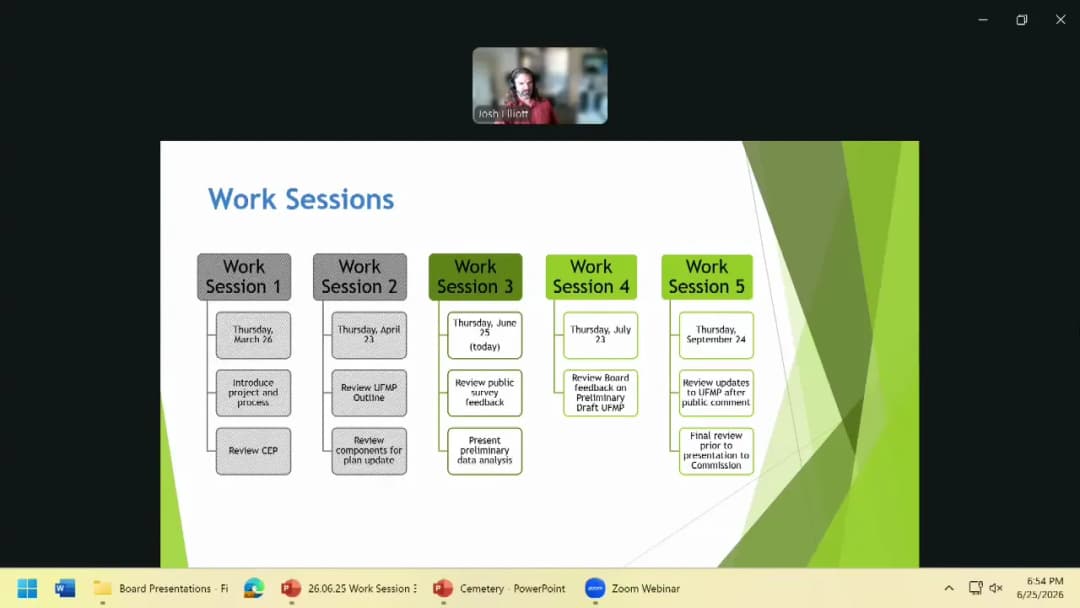
The Urban Parks and Forestry Board met on Thursday, June 25, 2026, from 6:00 to 8:00 PM. The meeting included approval of previous minutes, a biannual report on Sunset Hills Cemetery, and a work session on the 2026 Urban Forest Management Plan (UFMP) update, reviewing public survey results and preliminary tree data. A director update covered current projects and seasonal operations. Consent Calendar - Approval of Minutes from May 28, 2026: Motion by Steve Lowry, seconded. Approved unanimously (Brian Baru, Terry Lumson, Matthew Curtan, Joe Carwright all voting yes). Public Comments & Testimony - One written public comment was received before the noon deadline and entered into the record. No in-person or video conference public comments were offered for non-agenda items. Discussion Items - Sunset Hills Cemetery Biannual Report: Cemetery Coordinator Shane Serber presented an overview of operations. Key points: 73 acres in use out of roughly 55+ additional developable acres; approximately 145 burials per year (including ash and full casket); five columbariums with 80 niches each; the Southwest Montana Veterans Cemetery now has 34 spaces filled with two columbariums and in-ground ash burial underway; irrigation switched from treated water to a surface right from Bozeman Creek via a pump station; staffing of 3 full-time plus one 6-month seasonal and four 90-day workers. Board questions covered lot prices ($1,865 for full-size, $1,150 for ash lot), the perpetual care fund, and user groups (Bridger Ski Foundation, cyclocross, youth cycling) which pay fees under seasonal agreements. The board noted the cemetery is heavily subsidized but provides a valued community service. - Urban Forest Management Plan Work Session: Consultant Josh Elliott (DJA), Hannah Coons, and Matt Ermson (Planet Geo) presented. Public Survey Results: 137 respondents completed the 38-question survey; majority were homeowners over 55 and had lived in Bozeman over 20 years. Four key takeaways: (1) strong support for maintaining existing public trees and increasing new plantings, with concern about mature tree removal; (2) split opinion on city involvement with private trees – about 40% support requiring permits for removal, 40% oppose, many neutral – but general agreement on desire for education; (3) interest in species diversity and native species selection, especially for wildlife and pollinators; (4) desire for tree maintenance education (pruning, care) via volunteer events or classes. Preliminary Tree Data: Public tree inventory of 28,459 trees; 59% are young (0-6" diameter at breast height). Condition: 44% good, 29% fair, 2% excellent, remainder poor/very poor/dead. Ash comprises 22% of public trees (down from 47% in 2016), exceeding the 10-20-30 diversity guideline. Canopy cover estimated at 9.8% (recommended baseline). Recommended 20-year goal of 12% canopy, requiring 871 new trees planted per year. Maintenance gap: current pruning averages 1,988 trees/year versus recommended 7,200/year under industry standard 7-year (large trees) and 3-year (young trees) cycles. Emerald Ash Borer (EAB) not yet in Montana but considered high risk; phased removal of poor-condition ash and retention of high-value trees recommended. Board discussion covered species diversity, future development, tree equity, and the need to engage younger and renter demographics in future outreach. Key Outcomes - Minutes approved unanimously. - Information only; no formal votes taken on UFMP items. Next steps: draft UFMP to be provided to the board in approximately two weeks; next board work session scheduled in about one month; city commission update at end of July; public comment period and meetings in August; final plan expected to go to commission for approval later this year. - Director Update: Parks and Recreation Director reported a busy season with large construction projects (Westlake BMX, Sports Park, Bike Fill trails, splash pad opening planned for June 26). Bogert Pool renovations will begin after the season. Southwood Park ribbon cutting celebrated a new 24-acre community park on the south side. Bird survey for Bike Fill was completed by Audubon. Staff burnout was noted as a concern, encouraging self-care.

PARKS AND RECREATION 45% · MISCELLANEOUS 25% · ENVIRONMENTAL PROTECTION 19% · PROCEDURAL 5%
60
JUN 24, 2026 · BOZEMAN, MONTANA · CITY COMMISSION
Gallatin Valley MPO Transportation Policy Coordinating Committee Meeting - June 24, 2026

The Gallatin Valley Metropolitan Planning Organization (MPO) Transportation Policy Coordinating Committee (TPCC) met on June 24, 2026, at 8:00 PM (UTC). The meeting was called to order after a delay due to traffic, with 6 of 7 members present. The committee approved minutes from the March 25, 2026 meeting, considered an amendment to the current Unified Planning Work Program (UPWP), reviewed the draft UPWP for the next fiscal year, and discussed the Valley Center Spur multimodal connection. One member of the public provided testimony on bicycle safety in construction zones and on the Valley Center Spur. Consent Calendar - Approval of Minutes: The minutes from the March 25, 2026 meeting were approved unanimously (6-0). Public Comments & Testimony - Jennifer McFarlane (speaking as a private citizen, employed at the Western Transportation Institute at MSU) raised concerns about unsafe conditions for bicyclists in construction zones, specifically on Huffine Lane west of Bozeman, citing a lack of safe pathways as required by FHWA and MDT guidance. She urged the MPO to adopt strong language ensuring multimodal access through construction zones. - Later in the meeting, Ms. McFarlane commented on the Valley Center Spur item, noting that about one-third of citizens cannot drive and rely on walking, biking, or transit. She described her own experience biking from Four Corners to Belgrade and then to Bozeman, emphasizing the critical access need. She encouraged the committee to use low-cost temporary safety measures (e.g., temporary crossings) rather than lengthy studies before investing in permanent infrastructure. Discussion Items - Amendment No. 1 to the FY2026 UPWP: Jeff (MPO Manager) presented a request to move $20,859 from reserve funds to cover $53,000 in additional consultant costs for GIS work, land use projection verification, and enhanced community engagement. The shortfall was offset by savings from a staff vacancy and reduced conference attendance (only one staff member attending a national conference). The Technical Advisory Committee (TAC) had recommended approval. The amendment was approved unanimously (6-0). - First Review of the FY2027 UPWP: Jeff presented the draft work plan for the next federal fiscal year (starting October 1, 2026). Key points: $440,000 annual income, with $50,000 taken by the state, leaving $390,000 for staff (two positions), rent, and the long-range transportation plan (LRTP). Approximately one-third of staff time is allocated to administration. The plan includes reductions in training and conferences to fund the required LRTP. Discussion focused on office space costs: the MPO pays indirect costs to the City of Bozeman for rent and operations. Commissioner Brown noted that the city advocated to house the MPO and offered county office space as a potential alternative. Commissioner Bowdy suggested using existing city or county engagement materials (e.g., an unbranded awning) to save $1,000 allocated for engagement supplies. Jeff acknowledged the offers and said discussions with the city are ongoing. No formal action was taken; the plan will return for final approval in July 2026. - Valley Center Spur Report: Jeff presented a report on the 560-foot connection under I-90 linking Valley Center to Frontage Road. The segment is narrow with bridge pillars, has a history of crashes (mitigated by MDT traffic signals in 2019), and currently lacks bicycle and pedestrian facilities. Challenges include BNSF right-of-way, railroad preemption, multiple jurisdictions, and differing views on a four-way connection. Short-term recommendations include a limited crossing concept (e.g., marked crosswalk with signal coordination) and a bicycle-pedestrian feasibility study. Commissioner Brown shared that BNSF had previously indicated willingness to permit a pedestrian crossing. Jim Hanson raised technical concerns about pedestrian signal preemption with rail crossings and advocated for a feasibility study before installing devices. Mark Eggie suggested using Strava Metro data (available free to the MPO) to understand user origins/destinations and recommended a proper engineering assessment. Commissioner Brown also noted that the city is annexing north of frontage road and the transfer station location may affect planning. No action was taken; further study and interagency coordination were discussed. Key Outcomes - Amendment No. 1 to FY2026 UPWP: Approved unanimously (6-0). - FY2027 UPWP First Review: No action taken; input from the committee will be incorporated and the plan will return for final approval in July 2026. Staff will continue discussions with the City of Bozeman about office space costs and explore options offered by the county and the Urban Transportation District. - Valley Center Spur: No formal action; the committee expressed support for advancing a limited crossing concept and a feasibility study. Commissioner Brown offered to connect Jeff with BNSF technical consultants who have assisted with other crossing projects. The committee emphasized the need for safe multimodal connectivity and urged avoiding unnecessary delays.

ENGINEERING AND INFRASTRUCTURE 38% · ACTIVE TRANSPORTATION 29% · FISCAL SUSTAINABILITY 11% · TRANSPORTATION SAFETY 10%
OPENPUBLICA · PUBLIC MEETING INDEXUPDATED DAILY · openpublica.com